key MERCEDES-BENZ C-CLASS COUPE 2015 Repair Manual
[x] Cancel search | Manufacturer: MERCEDES-BENZ, Model Year: 2015, Model line: C-CLASS COUPE, Model: MERCEDES-BENZ C-CLASS COUPE 2015Pages: 385, PDF Size: 13.12 MB
Page 148 of 385
boostin
geffect. You will require considerably
more effor ttosteer and brake. There is arisk
of an accident.
Do not switch off the ignition while driving. G
WARNING
If the parkin gbrake has not been fully
released when driving ,the parkin gbrake can:
R overheat and cause afire
R lose its hold function.
There is arisk of fire and an accident. Release
the parkin gbrake fully before driving off.
! Do not warm up the engin
ewhen the vehicle
is stationary. Driv eoff immediately. Avoid
high engin espeeds and driving at full throttle
until the engin ehas reached its operating
temperature.
Only shift the automatic transmission to the
desired drive position when the vehicle is sta-
tionary.
Where possible, avoid spinning the drive
wheels when pulling away on slippery roads.
You could otherwise damage the drive train.
! Mercedes-AMG vehicles:
at low engineoil
temperatures (below +20 †), the maximum
engin espeed is restricted in order to protect
the engine. To protect the engin eand main-
tain smoot hengin eoperation ,avoid driving at
full throttle when the engin eiscold. Key positions
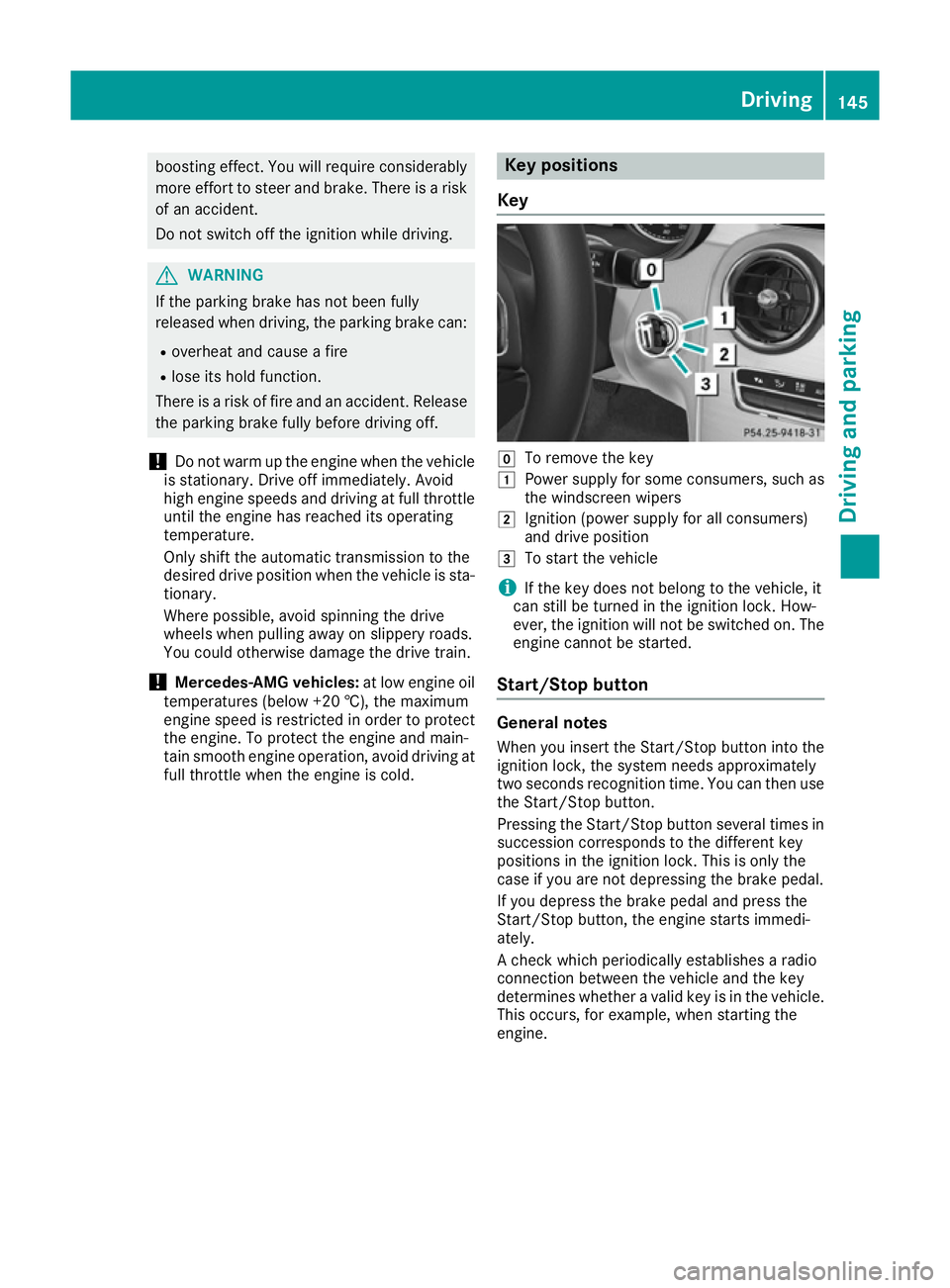
Key g
To remov ethe key
1 Power supply for some consumers, such as
the windscreen wipers
2 Ignition (power supply for all consumers)
and drive position
3 To start the vehicle
i If the key does not belong to the vehicle, it
can still be turned in the ignition lock .How-
ever, the ignition will not be switched on. The
engin ecannot be started.
Start/Stop button General notes
When you insert the Start/Stop butto nintot he
ignition lock ,the system needs approximately
two seconds recognition time. You can then use
the Start/Stop button.
Pressin gthe Start/Stop butto nseveral times in
succession corresponds to the differen tkey
position sinthe ignition lock .This is only the
case if you are not depressin gthe brake pedal.
If you depress the brake pedal and press the
Start/Stop button, the engin estart simmedi-
ately.
Ac hec kwhich periodically establishes aradio
connection between the vehicle and the key
determines whether avalid key is in the vehicle.
This occurs, for example, when starting the
engine. Driving
145Driving and parking Z
Page 149 of 385
To start the vehicle without actively using the
key:
R the Start/Stop button must be inserted in the
ignition lock
R the key must be in the vehicle
R the vehicle must not be locked with the key or
KEYLESS-GO (Y page 81)
Do not keep the key:
R with electronic devices, e.g. amobile phone
or another key
R with metallic objects, e.g. coins or metal film
R inside metallic objects, e.g. ametal case
This can affect the key's functionality.
If you lock the vehicle with the key's remote
control or with KEYLESS-GO, after ashort time:
R you will not be able to switch on the ignition
with the Start/Stop button
R you will not be able to start the engine with the
Start/Stop button until the vehicle is
unlocked again
If you lock the vehicle centrally using the button
on the front door (Y page 87), you can continue
to start the engine with the Start/Stop button.
The engine can be switched off while the vehicle
is in motion by pressing and holding the Start/
Stop button for three seconds. This function
operates independently of the ECO start/stop
automatic engine switch-off function.
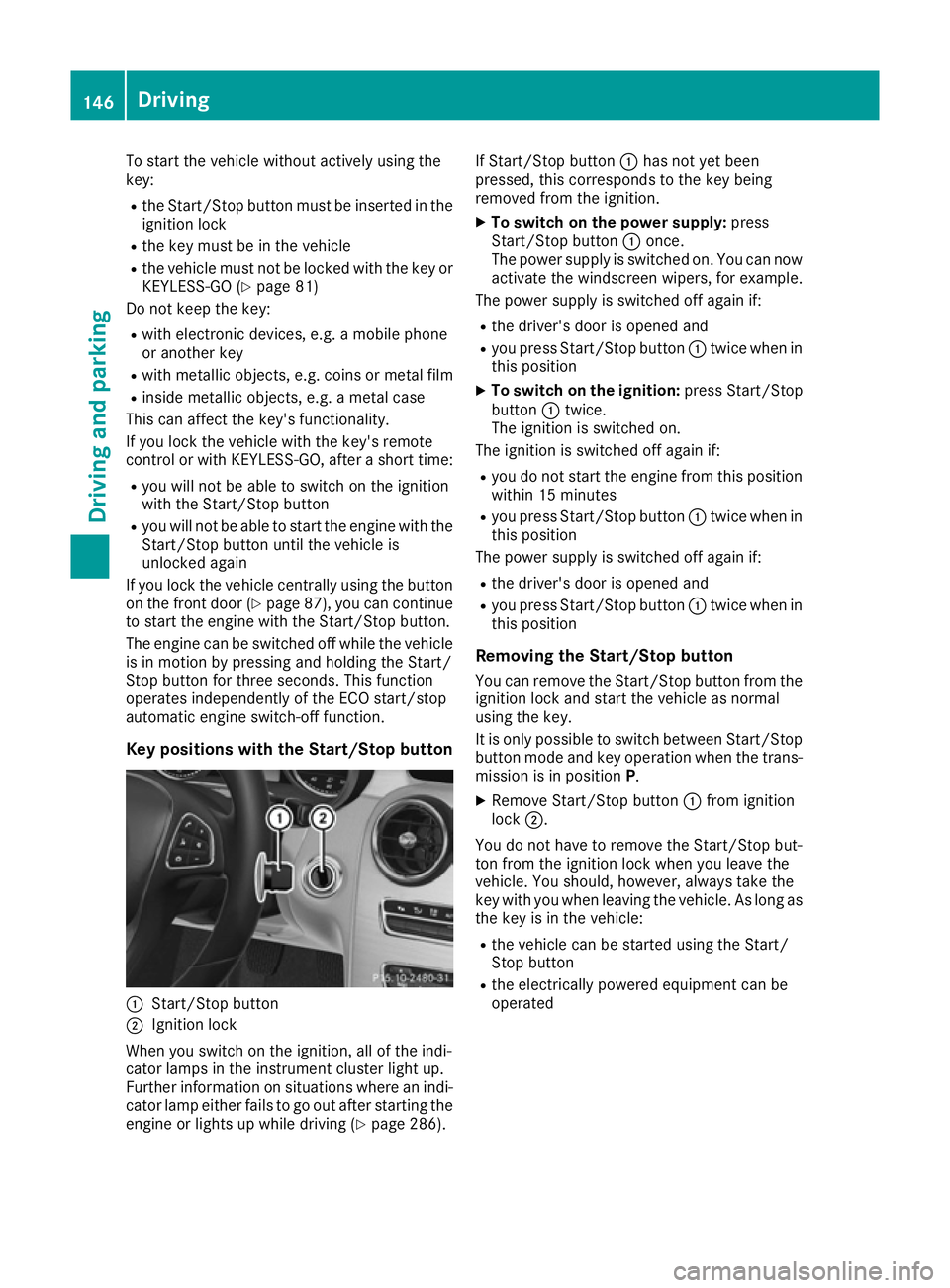
Key positions with the Start/Stop button :
Start/Stop button
; Ignition lock
When you switch on the ignition, all of the indi-
cator lamps in the instrument cluster light up.
Further information on situations where an indi-
cator lamp either fails to go out after starting the engine or lights up while driving (Y page 286).If Start/Stop button
:has not yet been
pressed, this corresponds to the key being
removed from the ignition.
X To switch on the power supply: press
Start/Stop button :once.
The power supply is switched on. You can now activate the windscreen wipers, for example.
The power supply is switched off again if:
R the driver's door is opened and
R you press Start/Stop button :twice when in
this position
X To switch on the ignition: press Start/Stop
button :twice.
The ignition is switched on.
The ignition is switched off again if:
R you do not start the engine from this position
within 15 minutes
R you press Start/Stop button :twice when in
this position
The power supply is switched off again if:
R the driver's door is opened and
R you press Start/Stop button :twice when in
this position
Removing the Start/Stop button You can remove the Start/Stop button from the
ignition lock and start the vehicle as normal
using the key.
It is only possible to switch between Start/Stop
button mode and key operation when the trans-
mission is in position P.
X Remove Start/Stop button :from ignition
lock ;.
You do not have to remove the Start/Stop but-
ton from the ignition lock when you leave the
vehicle. You should, however, alway stake the
key with you when leaving the vehicle. As long as
the key is in the vehicle:
R the vehicle can be started using the Start/
Stop button
R the electrically powered equipment can be
operated 146
DrivingDriving and parking
Page 150 of 385
Starting the vehicle
Important safety notes G
WARNING
If children are left unsupervised in the vehicle, they could:
R open doors, thereby endangering other per-
sons or road users
R get out and be struck by oncomingt raffic
R operate vehicle equipment and become
trapped, for example
In addition, the children could also set the
vehicle in motion, for example, if they:
R release the parking brake
R shift the automatic transmission out of park
position Porshift manual transmission into
neutral
R start the engine
There is arisk of an accident and injury.
When leaving the vehicle, always take the key with you and lock the vehicle. Never leave
children and animals unattended in the vehi-
cle. Keep the keys out of the reach of children. G
WARNING
Combustion engines emit poisonous exhaust
gases such as carbon monoxide. Inhaling
these exhaust gases leads to poisoning. There is ar isk of fatal injury. Therefore never leave
the engine running in enclosed spaces with-
out sufficient ventilation. G
WARNING
Flammable materials introduced through
environmental influence or by animals can
ignite if in contact with the exhaust system or parts of the engine that heat up. There is arisk
of fire.
Carry out regular checkstom ake sure that
there are no flammable foreign materials in
the engine compartmen torinthe exhaust
system. General notes Vehicles with
apetrol engine: the catalytic
converter is preheated for up to 30 seconds
after acold start. The sound of the engine may
change during this time.
Manual transmission X
Depress the brake pedal and keep it
depressed.
X Fully depress the clutch pedal.
X Shift to neutral N.
Automatic transmission X
Shift the transmission to position P
(Y page 158).
The transmission position indicator in the
multifunction display shows P(Y page 159).
i You can start the engine in transmission
position Pand N.
Starting procedurew ith the key To start the engine using the key instead of the
Start/Stop button, pull the Start/Stop button
out of the ignition lock.
X To startad iesel engine:t urn the key to
position 2in the ignition lock (Y page 145).
The % preglow indicator lamp in the instru-
ment cluster lights up.
X Turn the key to position 3in the ignition lock
and release it as soon as the engine is running
(Y page 145).
i Vehicles with
adiesel engine: you can
start the engine without preglow if the engine
is warm.
If the engine will not start:
X Remove the key from the ignition lock.
X Reinsert the key into the ignition lock after
waiting for ashort period.
X Turn the key to position 2in the ignition lock
(Y page 145).
The indicator lamps in the instrumen tcluster
light up (Y page 285).
X Turn the key to position 3(Y page 145) in the
ignition lock and release it as soon as the
engine is running. Driving
147Driving and parking Z
Page 151 of 385
Starting procedureu
sing the Start/
Stop button The Start/Stop button is only available on vehi-
cles with KEYLESS-GO or the KEYLESS-GO start
function.
The Start/Stop button can be used to start the
vehicle manually without insertin gthe key into
the ignition lock. The key must be in the vehicle and the Start/Stop button must be inserted in
the ignition lock. This mode for startingt he
engine operates independently of the ECO
start/stop automatic engine start function.
You can start the engine if avalid key is in the
vehicle. Switch off the engine and always take
the key with you when leaving the vehicle, even
if you only leave it for ashort time. Pay attention
to the important safety notes.
X Depress the brake pedal and keep it
depressed.
X Press the Start/Stop button once
(Y page 145).
Vehicles with apetrol engine: the engine
starts.
Vehicles with adiesel engine: preglow is
activated and the engine starts. Pulling away
General notes G
WARNING
Vehicles with automatic transmission:
If the engine speed is above the engine idling speed and you then engage transmission
position Dor R,t he vehicle may accelerate
suddenly. There is arisk of an accident.
When engaging transmission position Dor R,
always keep the brake pedal firmly depressed
and do not depress the accelerator pedal at
the same time.
! Vehicles with manualt
ransmission:
change gear in good time and avoid spinning
the wheels. You could otherwise damage the
vehicle.
Depress the accelerator carefully when pulling
away.
The vehicle locks centrally once you have pulled
away.T he locking knobs in the doors drop down. You can open the doors from the inside at any
time.
You can also deactivate the automatic locking
feature; see the Digital Owner's Manual.
Vehicles with automatic transmission: it is
only possible to shift the transmission from posi- tion Pto the desired position if you depress the
brake pedal. If you do not depress the brake
pedal, the DIRECT SELECT lever can still be
moved but the parking lock remains engaged.
i Vehicles with automatic transmission:
upshifts take place at higher engine speeds
after acold start. This helps the catalytic con-
verter to reach its operating temperature
more quickly.
Information on automatically releasing the elec- trical parking brake (Y page 175).
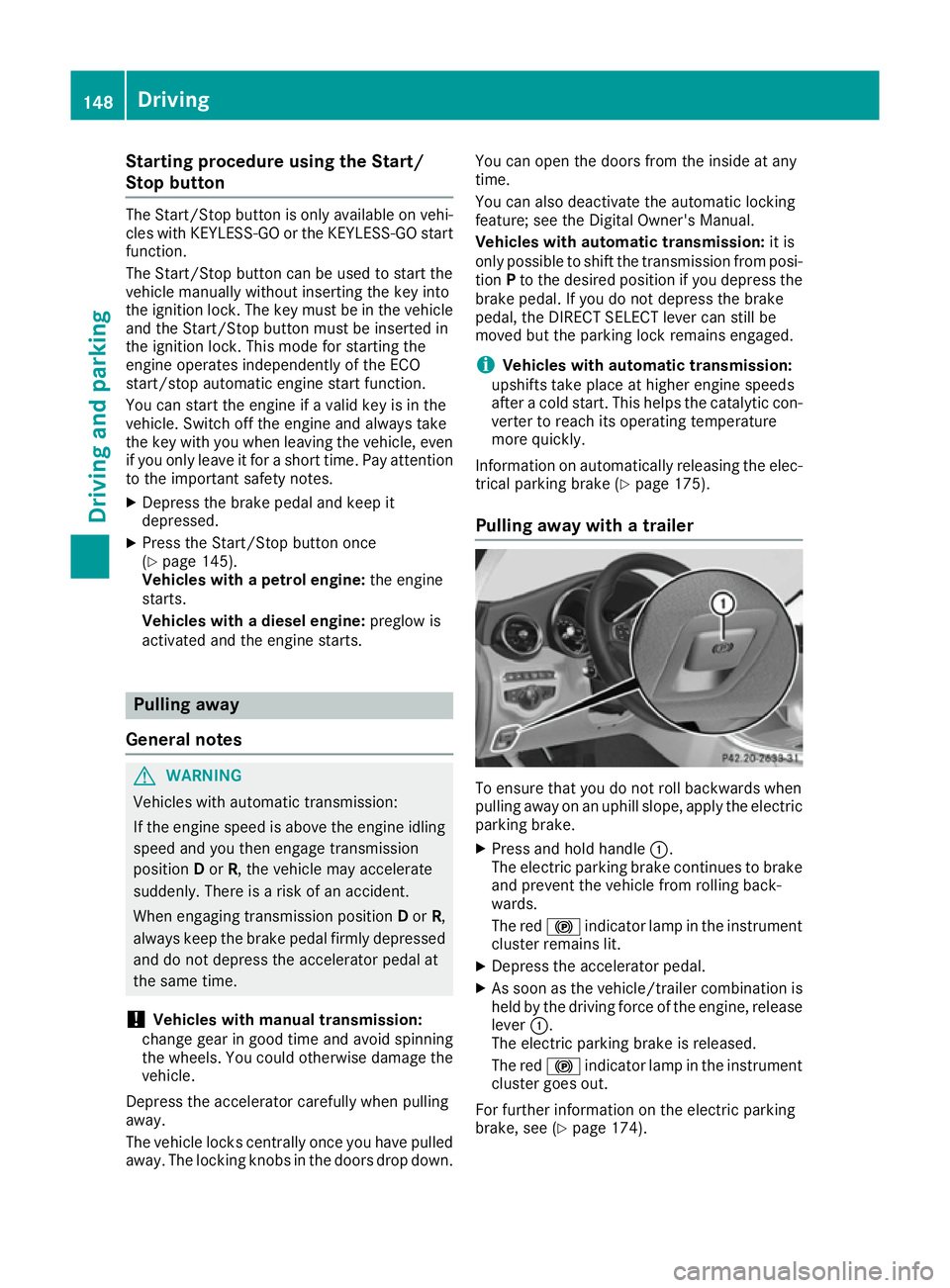
Pulling away with atrailer To ensure that you do not roll backwards when
pulling away on an uphill slope, apply the electric
parking brake.
X Press and hold handle :.
The electric parking brake continues to brake
and prevent the vehicle from rolling back-
wards.
The red !indicator lamp in the instrument
cluster remains lit.
X Depress the accelerator pedal.
X As soon as the vehicle/trailer combination is
held by the driving force of the engine, release lever :.
The electric parking brake is released.
The red !indicator lamp in the instrument
cluster goes out.
For further information on the electric parking
brake, see (Y page 174).148
DrivingDriving and parking
Page 152 of 385
Hill start assist
Hill start assist help
syou when pulling awa yfor-
wards or in reverse on an uphill gradient. It holds
the vehicl efor as hort time after you have
removed you rfoot from the brake pedal. This
gives you enoug htime to move yourf oot from
the brake peda ltothe accelerator peda land
depress it before the vehicl ebegins to roll. G
WARNING
After awhile, hills tart assist no longer holds
the vehicl eand it may roll away. There is arisk
of an accident and injury.
Therefore, quickly move yourf oot from the
brake peda ltothe accelerator pedal. Never
leave the vehicl ewhen it is held by hills tart
assist.
Hill start assist is not active if:
R you are pulling awayonal evelroad or a
downhill gradient
R on vehicles with automatic transmission, the
transmission is in position N
R the electric parking brake is applied
R ESP ®
is malfunctioning ECOs
tart/stop function
Introduction The ECO start/stop function switches the
engine off automatically if the vehicl eisstopped
under certain conditions.
When pulling awa yagain, the engine starts auto-
matically .The ECO start/stop function thereby
help syou to reduce the fuel consumption and
emissions of you rvehicle.
Important safety notes G
WARNING
If the engine is switched off automatically and you exit the vehicle, the engine is restarted
automatically.T he vehiclemay begi nmoving.
There is arisk of accident and injury.
If you wis htoexit the vehicle, alwayst urn off
the ignitio nand secure the vehicl eagainst
rolling away. General notes
:
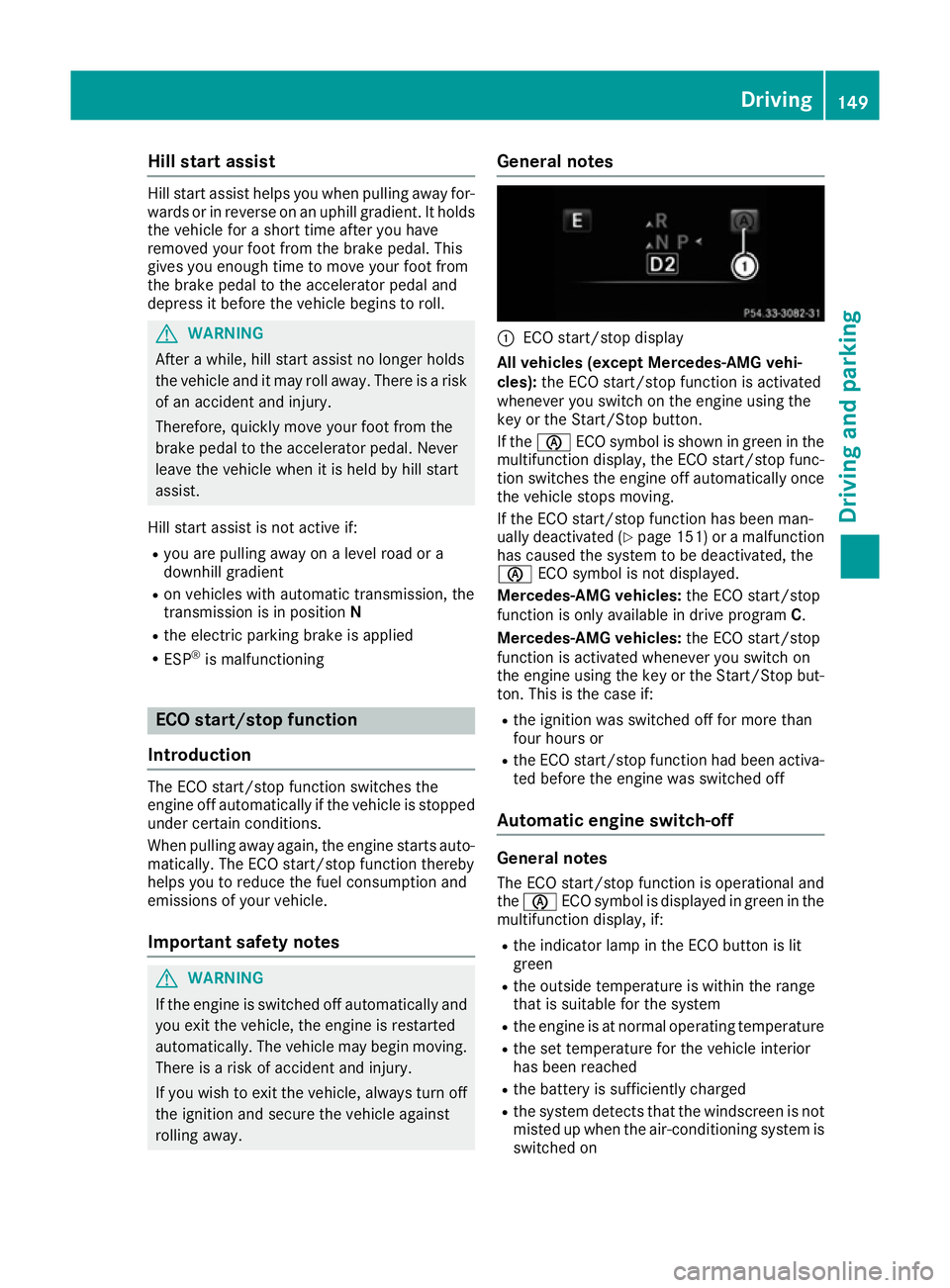
ECO start/stop display
All vehicle s(except Mercedes-AMG vehi-
cles): the ECO start/stop function is activated
whenever you switch on the engine using the
key or the Start/Stop button.
If the è ECO symbol is show ningreen in the
multifunction display ,the ECO start/stop func-
tion switches the engine off automatically once the vehicl estops moving.
If the ECO start/stop function has been man-
ually deactivated (Y page151) or amalfunction
has caused the system to be deactivated, the
è ECO symbol is not displayed.
Mercedes-AMG vehicles: the ECO start/stop
function is only available in drive program C.
Mercedes-AMG vehicles: the ECO start/stop
function is activated whenever you switch on
the engine using the key or the Start/Stop but- ton. This is the case if:
R the ignitio nwas switched off for more than
four hour sor
R the ECO start/stop function had been activa-
ted before the engine was switched off
Automatic engine switch-off General notes
The ECO start/stop function is operational and
the è ECO symbol is displayed in green in the
multifunction display ,if:
R the indicator lamp in the ECO button is lit
green
R the outside temperature is withi nthe range
that is suitable for the system
R the engine is at normal operating temperature
R the set temperature for the vehicl einterior
has been reached
R the battery is sufficiently charged
R the system detects that the windscreen is not
misted up when the air-conditioning system isswitched on Driving
149Driving and parking Z
Page 156 of 385
Problems with the engine
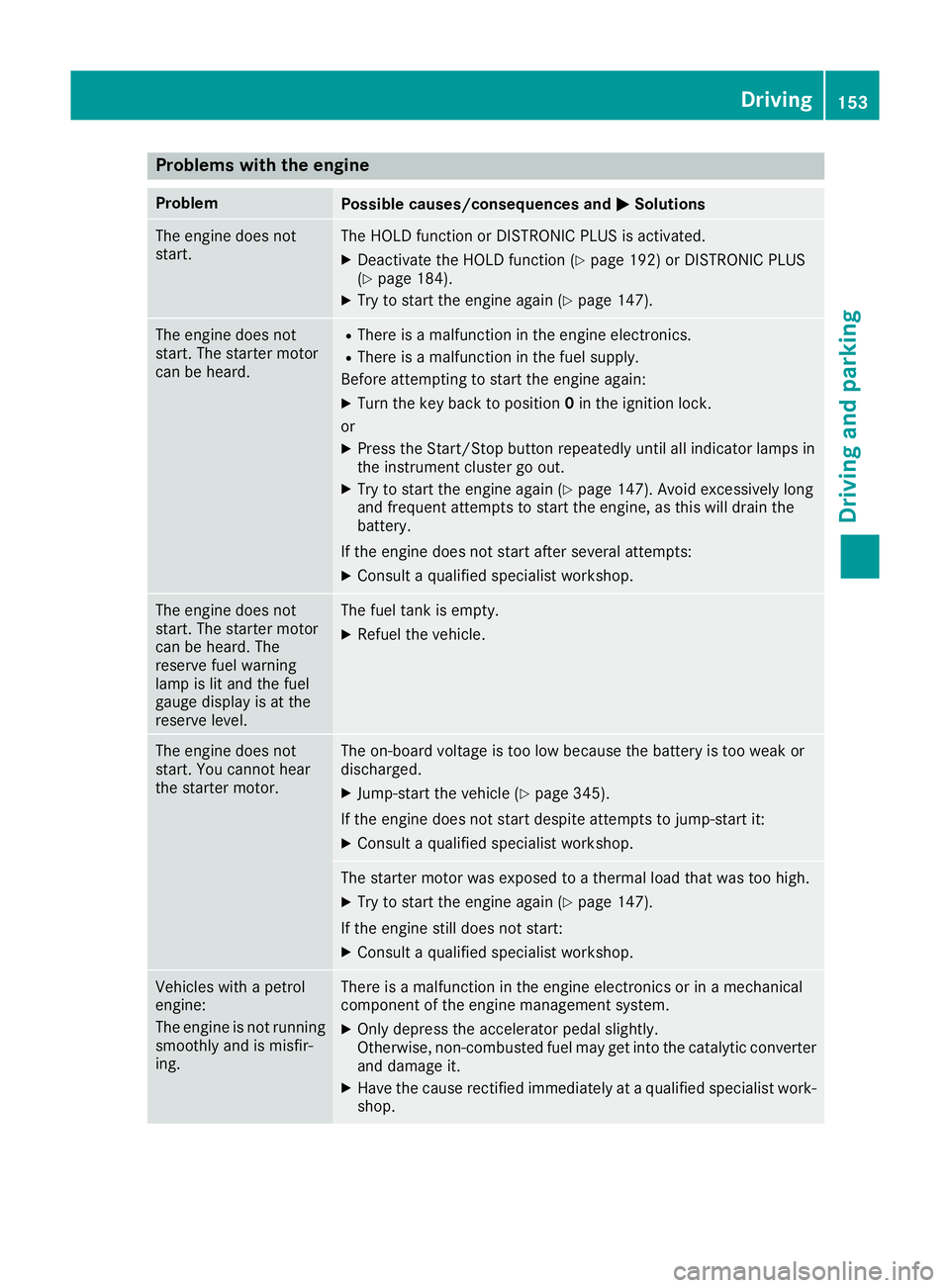
Problem
Possible causes/consequences and
M
MSolutions The engine does not
start. The HOLD function or DISTRONIC PLUS is activated.
X Deactivat ethe HOLD function (Y page 192) or DISTRONIC PLUS
(Y page 184).
X Try to start the engine again (Y page 147).The engine does not
start. The starter motor
can be heard. R
There is amalfunction in the engine electronics.
R There is amalfunction in the fuel supply.
Before attempting to start the engine again:
X Turn the key back to position 0in the ignition lock.
or X Press the Start/Stop button repeatedly until all indicator lamps in
the instrumen tcluster go out.
X Try to start the engine again (Y page 147). Avoid excessively long
and frequent attemptstos tart the engine, as this will drain the
battery.
If the engine does not start after several attempts:
X Consult aqualified specialist workshop. The engine does not
start. The starter motor
can be heard. The
reserve fuel warning
lamp is lit and the fuel
gauge display is at the
reserve level. The fuel tank is empty.
X Refuel the vehicle. The engine does not
start. You cannot hear
the starter motor. The on-board voltage is too low because the battery is too weak or
discharged.
X Jump-start the vehicle (Y page 345).
If the engine does not start despite attemptstoj ump-start it:
X Consult aqualified specialist workshop. The starter motor was exposed to
athermal load that was too high.
X Try to start the engine again (Y page 147).
If the engine still does not start:
X Consult aqualified specialist workshop. Vehicles with
apetrol
engine:
The engine is not running
smoothly and is misfir-
ing. There is
amalfunction in the engine electronics or in amechanical
componen tofthe engine management system.
X Only depress the accelerator pedal slightly.
Otherwise, non-combusted fuel may get into the catalytic converter
and damage it.
X Have the cause rectified immediately at aqualified specialist work-
shop. Driving
153Driving and parking Z
Page 161 of 385
After switching off the engine
,alway sswitch
to parking position P.Prevent the parked vehi-
cle from rolling away by applying the parking
brake. DIREC
TSELECT lever
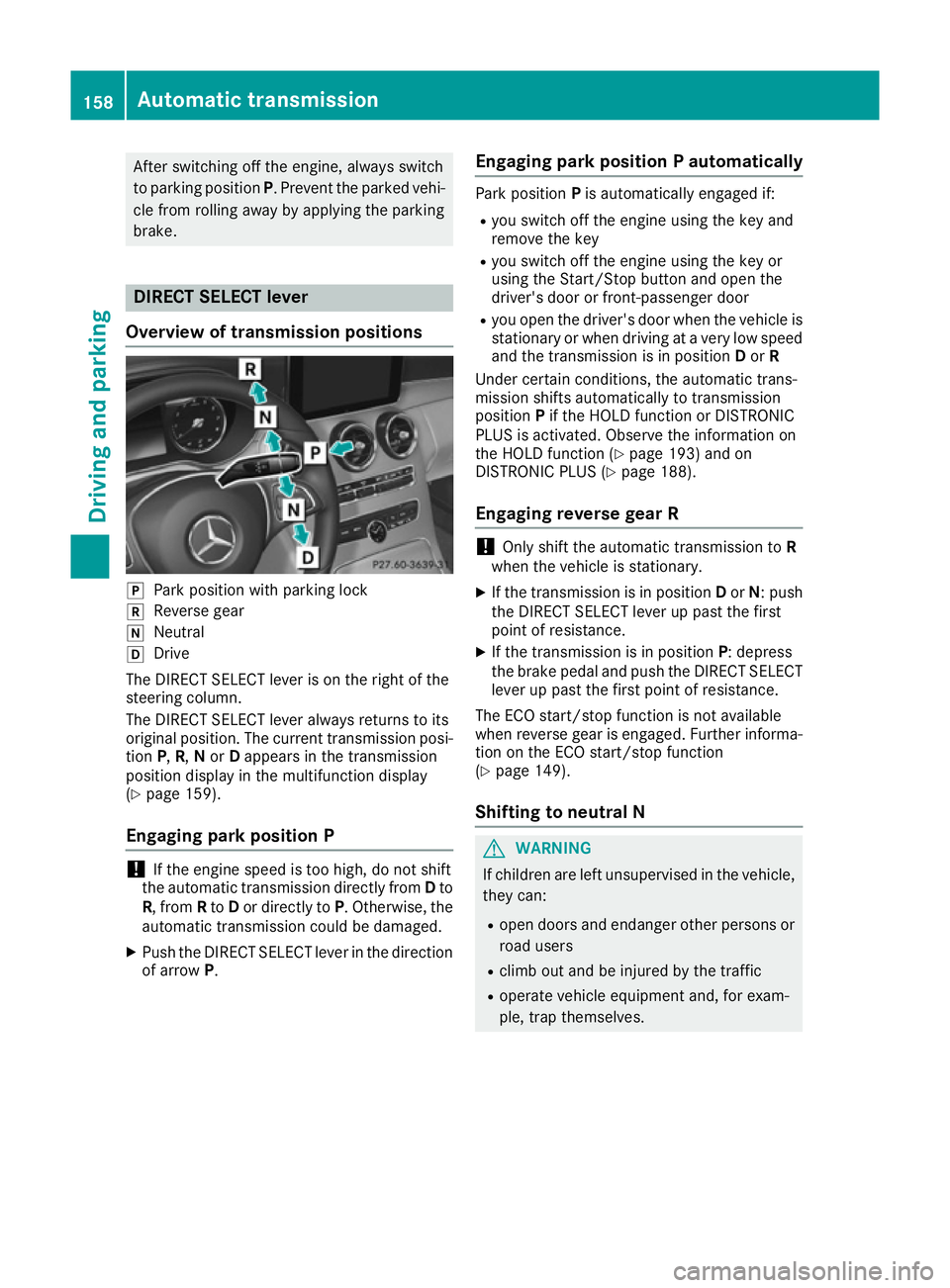
Overvie woftransmission positions j
Park positio nwithp arking lock
k Reverse gear
i Neutral
h Drive
The DIRECT SELEC Tlever is on the right of the
steering column.
The DIRECT SELEC Tlever always returns to its
original position. The current transmission posi- tion P,R, Nor Dappear sinthe transmission
positio ndisplay in the multifunctio ndisplay
(Y page 159).
Engagin gpark position P !
If the engine speed is too high, do not shift
the automatic transmission directl yfrom Dto
R,f rom Rto Dor directl ytoP.Otherwise, the
automatic transmission could be damaged.
X Push the DIRECT SELEC Tlev er in the direction
of arrow P. Engagin
gpark position Pautomatically Park position
Pis automaticall yengaged if:
R yous witch off the engine using the key and
remove the key
R yous witch off the engine using the key or
using the Start/Stop button and open the
driver's door or front-passenger door
R youo pent he driver's door when the vehicl eis
stationar yorwhend riving at averyl ow speed
and the transmission is in position Dor R
Unde rcertain conditions, the automatic trans-
mission shifts automaticall ytotransmission
position Pif the HOLD functio norDISTRONIC
PLU Sisa ctivated .Observ ethe informatio non
the HOLD functio n(Ypage 193 )and on
DISTRONI CPLUS(Ypage 188).
Engagin grevers egearR !
Onl
yshift the automatic transmission to R
when the vehicl eisstationary.
X If the transmission is in position Dor N:p ush
the DIRECT SELEC Tlever up past the first
point of resistance.
X If the transmission is in position P:depress
the brake peda land push the DIRECT SELECT
lever up past the first point of resistance.
The ECO start/sto pfunctio nisn ot available
when revers egearise ngaged .Further informa-
tio nont he ECO start/sto pfunction
(Y page 149).
Shiftin gtoneutral N G
WARNING
If children ar eleftu nsupervised in the vehicle,
they can:
R open doors and endanger othe rpersons or
roa dusers
R climb ou tand be injured by the traffic
R operate vehicl eequipment and,for exam-
ple, trap themselves. 158
Automati
ctransmissionDriving an dparking
Page 162 of 385
Children could also set th
evehicle in motion,
for example by:
R releasin gthe parking brake
R shiftin gthe automatic transmission out of
park position P
R starting th eengine.
Ther eisar iskofana ccidentand injury.
When leaving th evehicle ,always tak ethe key
wit hyou and loc kthe vehicle .Never leave
children unattende dinthevehicle .Always
keep th ekeyout of reac hofchildren.
X If th etransmission is in position Dor R:p ush
th eD IRECT SELECT leve rupordown to the
first poin tofresistance.
X If th etransmission is in position P:depress
th eb rak epedal and push th eDIRECT SELECT
leve rupord own to th efirst poin tofresist-
ance.
If you switch th eengineo ff wit hthe transmis-
sion in position Ror D,t heautomatic transmis-
sion shifts to Nautomatically.
Wit hthe key: if you then open th edriver' sdoor
or th efront-pa ssenger door or remove th ekey
from th eignition ,the automatic transmission
shifts to Pautomatically.
Wit hthe Start/Stop button: if you then open
th ed river' sdoor or th efront-pa ssenger door,
th ea utomatic transmission shifts to Pautomat-
ically.
If you want th eautomatic transmission to
remain in neutral N,e.g.w hen having th evehicle
cleane dinana utomatic car wash wit hatowing
system:
X Vehicles with th
eStart-Sto pbutton:
remove th eStart-Sto pbutto nfromt heigni-
tio nlock.
X Inser tthe keyintot he ignition lock.
X All vehicles: switch theignition on.
X Depress th ebrak epedal and keep it
depressed.
X Shift to neutral N.
X Release th ebrak epedal.
X Release th eelectric parking brake.
X Switch off th eignition and leave th ekeyin the
ignition lock. Engaging drive position D X
If th etransmission is in position Ror N:p ush
th eD IRECT SELECT leve rdown past th efirst
poin tofr esistance.
X If th etransmission is in position P:depress
th eb rak epedal and push th eDIRECT SELECT
leve rdown past th efirst poin tofresistance. Transmission position and drive pro-
gram display
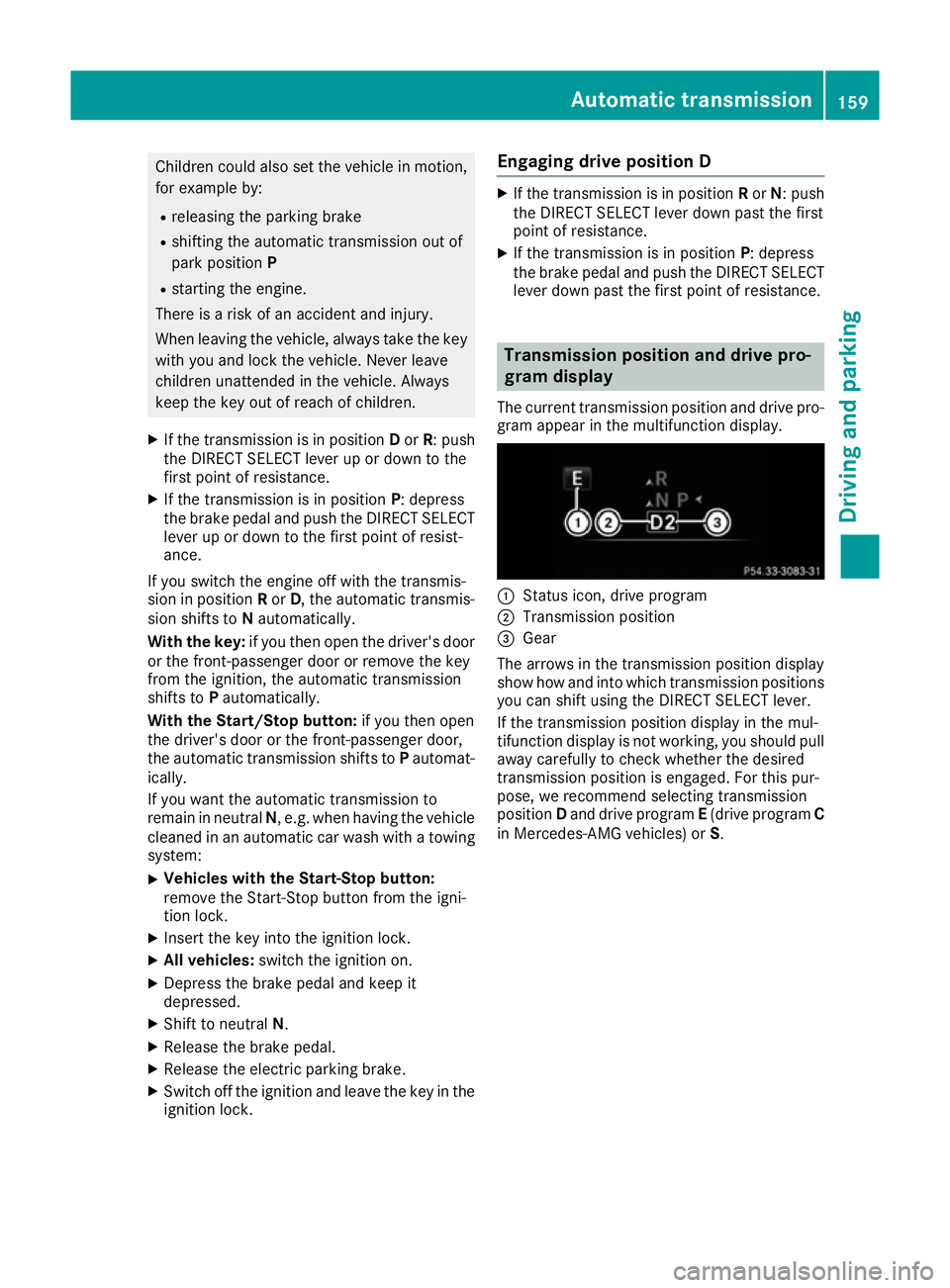
The curren ttransmission positio nand driv epro-
gram appear in th emultifunction display. :
Status icon, driv eprogram
; Transmissio nposition
= Gear
The arrows in th etransmission positio ndisplay
sho whow and int owhichtransmission positions
you can shif tusin gthe DIRECT SELECT lever.
If th etransmission positio ndisplay in th emul-
tifunctio ndisplay is no tworking ,you should pull
away carefull ytoc heck whether th edesired
transmission positio nisengaged .For this pur-
pose ,wer ecommen dselecting transmission
position Dand driv eprogram E(drive program C
in Mercedes-AM Gvehicles) or S. Automatic transmission
159Driving and parking Z
Page 163 of 385
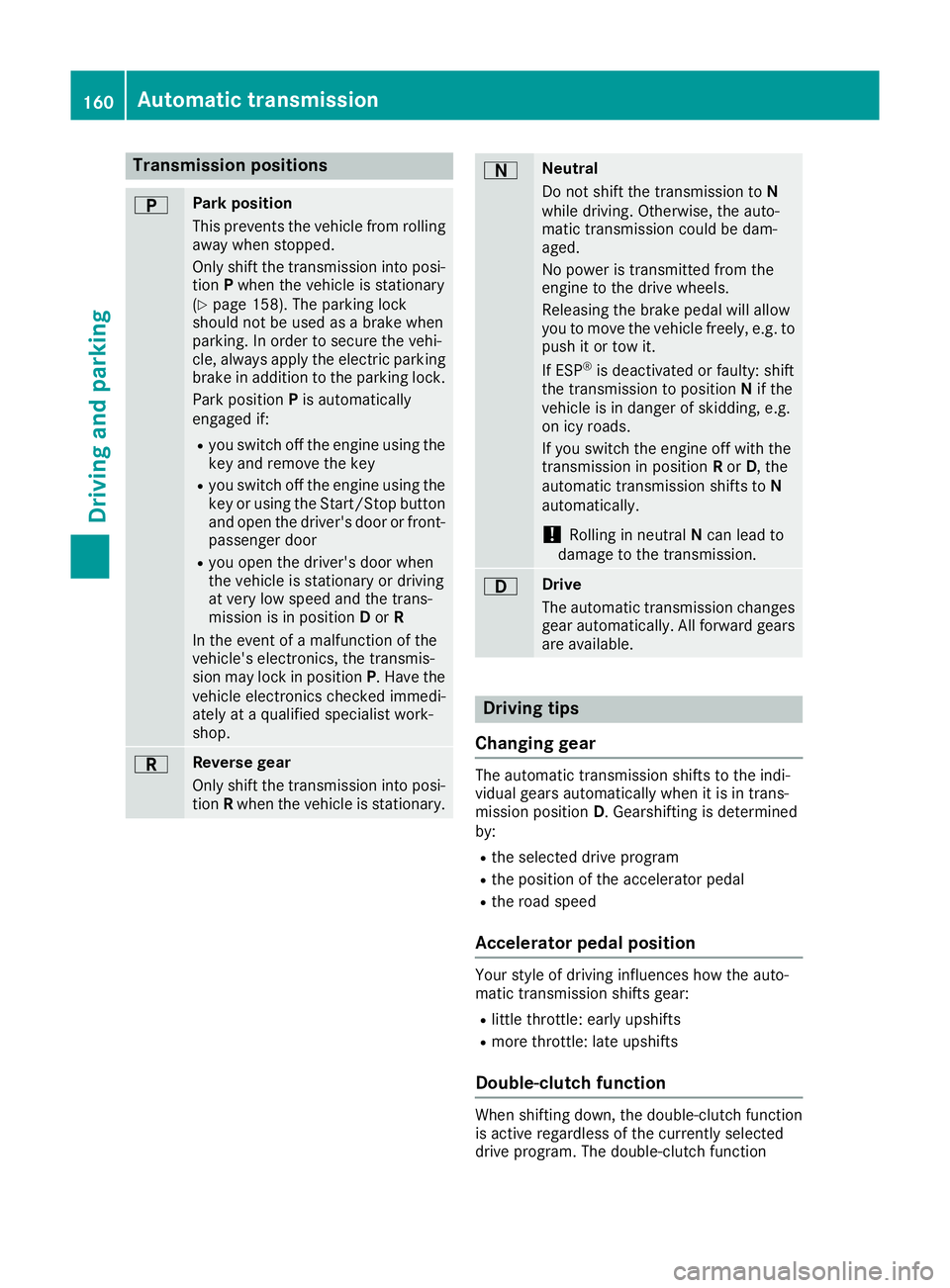
Transmission positions
B Park position
Thi sprevents the vehicl efromr olling
away when stopped.
Onl yshift the transmission into posi-
tion Pwhen the vehicl eisstationary
(Y page 158). The parkin glock
shoul dnot be used as abrake when
parking. In order to secur ethe vehi-
cle ,alway sapply the electri cparking
brake in additio ntothe parkin gloc k.
Park position Pis automatically
engaged if:
R yous witch off the engine using the
key and remove the key
R yous witch off the engine using the
key or using the Start/Stop button
and open the driver's door or front- passenge rdoor
R youo pent he driver's door when
the vehicl eisstationar yordriving
at ver ylow spee dand the trans-
mission is in position Dor R
In the event of amalfunctio nofthe
vehicle's electronics ,the transmis-
sion ma yloc kinp ositionP.H avet he
vehicl eelectronics checked immedi-
ately at aquali fied specialis twork-
shop. C Revers
egear
Onl yshift the transmission into posi-
tion Rwhen the vehicl eisstationary. A Neutral
Do not shift the transmission to
N
whil edriving. Otherwise, the auto-
matic transmission could be dam-
aged.
No powe ristransmitted fro mthe
engine to the drive wheels.
Releasing the brake peda lwilla llow
yo utom ovet he vehicl efreely, e.g .to
push it or tow it.
If ESP ®
is deactivated or faulty: shift
the transmission to position Nif the
vehicl eisind angerofs kidding ,e.g.
on icy roads.
If yo uswitch the engine off with the
transmission in position Ror D,t he
automatic transmission shifts to N
automatically.
! Rolling in neutral
Ncan lead to
damage to the transmission. 7 Drive
The automatic transmission changes
gear automatically. All forward gears
ar ea vailable. Driving tips
Changin ggear The automatic transmission shifts to the indi-
vidua
lgears automaticall ywhenitisint rans-
mission position D.Gearshifting is determined
by:
R the selecte ddrive program
R the positio nofthe accelerator pedal
R the roa dspeed
Accelerator peda lposition Your style of drivin
ginfluences how the auto-
matic transmission shifts gear:
R little throttle :early upshifts
R mor ethrottle :lat eu pshifts
Double-clutc hfunction When shifting down, the double-clutch function
is active regardless of the currentl yselected
drive program. The double-clutch function 160
Automati
ctransmissionDriving an dparking
Page 170 of 385
If you mix dieself
uel with petrol, the flash
point of this fuel mixture is lowert han that of
pure dieself uel. When the engine is running,
components in the exhaust system may over-
heat unnoticed. There is arisk of fire.
Never refuel with petrol. Never add petrol to
dieself uel.
! Do not use dieseltor
efuel vehicleswith a
petrol engine. Do not switch on the ignition if you accidentally refuel with the wrong fuel.
Otherwise ,the fuel wille nter the fuel system.
Even small amounts of the wrong fuel can
resultind amage to the fuel system and the
engine. Notify aqualifieds pecialist workshop
and have the fuel tank and fuel lines drained
completely.
! Do not use petrol to refuel vehicle
swith a
diesele ngine. Do not switch on the ignition if
you accidentally refuel with the wrong fuel.
Otherwise ,fuel can enter the fuel system.
Even small amounts of the wrong fuel could
resultind amage to the fuel system and the
engine. The repairc osts are high. Notify a
qualifieds pecialist workshop and have the
fuel tank and fuel lines drained completely.
! Overfilling the fuel tank could damage the
fuel system.
! Take care not to spilla
ny fuel on painted
surfaces .You could otherwise damage the
paintwork.
! Use
afilter when adding fuel from afuel can.
The fuel lines and/or the fuel injection system could otherwise be blocked by particle sfrom
the fuel can.
If you overfill the fuel tank, some fuel may spray
out when you remove the fuel pump nozzle.
Further information on fuel and fuel quality
(Y page 371). Refuelling
General notes Observe the important safety notes
(Y
page 166).
If you unlock/lock the vehicle from the outside,
the fuel fillerf lap also unlocks/locks. The positio
nofthe8 fuel fillerc ap is dis-
played in the instrument cluster. The arrow next to the filling pump indicates the side of the vehi-
cle.
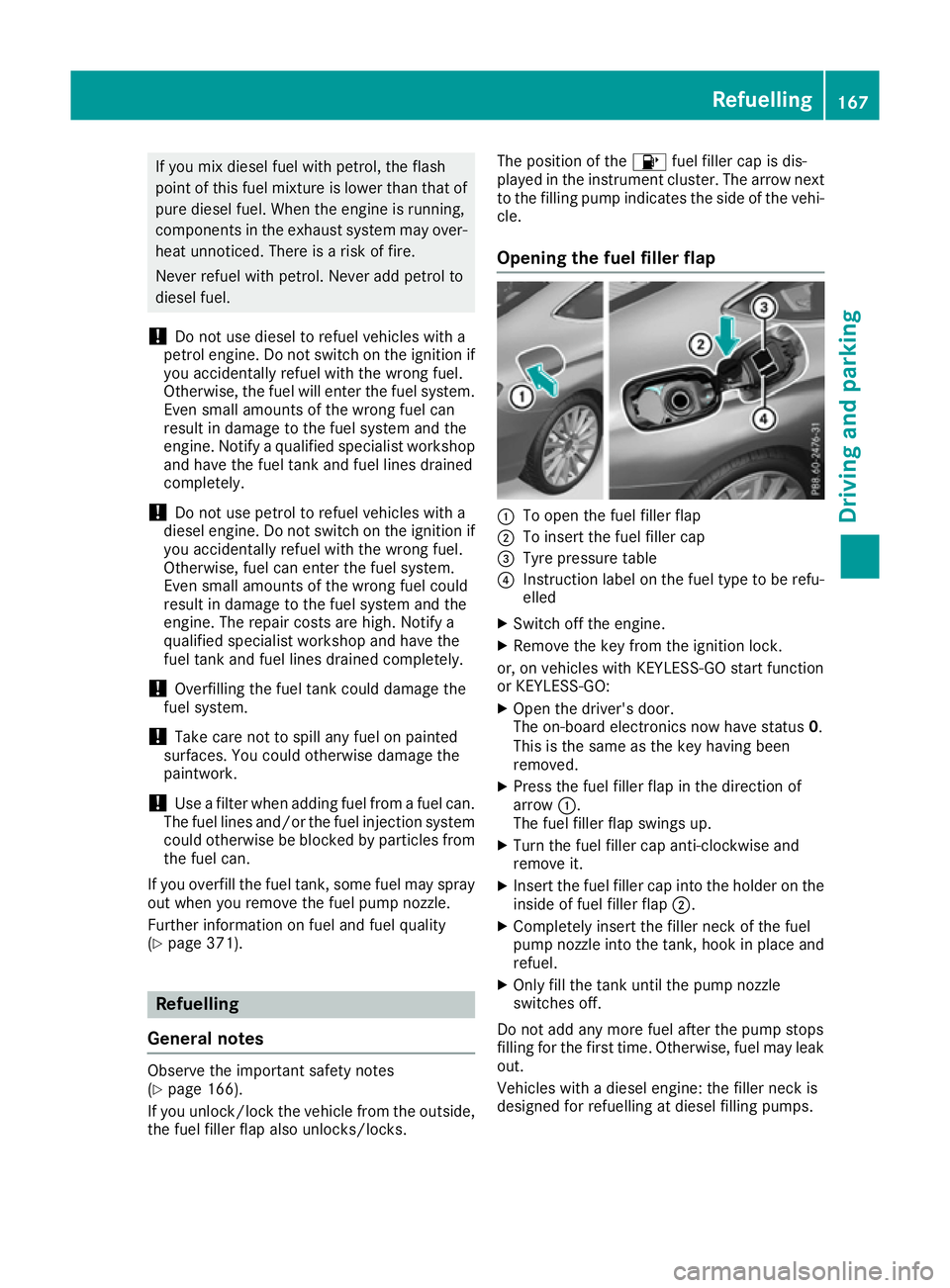
Openin gthe fuel fillerf lap :
To open the fuel fillerf lap
; To insert the fuel fillerc ap
= Tyre pressure table
? Instruction label on the fuel type to be refu-
elled
X Switch off the engine.
X Remove the key from the ignition lock.
or, on vehicle swith KEYLESS-GO start function
or KEYLESS‑GO:
X Open the driver's door.
The on-board electronics now have status 0.
This is the same as the key having been
removed.
X Press the fuel fillerf lap in the direction of
arrow :.
The fuel fillerf lap swings up.
X Turn the fuel fillerc ap anti-clockwise and
remove it.
X Insert the fuel fillerc ap into the holderont he
inside of fuel fillerf lap;.
X Completely insert the fillern eck of the fuel
pump nozzle into the tank, hook in place and refuel.
X Only fill the tank until the pump nozzle
switches off.
Do not add any more fuel after the pump stops
filling for the first time. Otherwise ,fuel may leak
out.
Vehicle swithadiese lengine: the fillern eck is
designed for refuelling at dieself illing pumps. Refuelling
167Driving and parking Z