child restraint MERCEDES-BENZ E-CLASS CABRIOLET 2015 Owners Manual
[x] Cancel search | Manufacturer: MERCEDES-BENZ, Model Year: 2015, Model line: E-CLASS CABRIOLET, Model: MERCEDES-BENZ E-CLASS CABRIOLET 2015Pages: 349, PDF Size: 12.51 MB
Page 9 of 349
Driving tips .................................... 160
HOLD functio
n............................... 177
Important safety notes .................. 160
Parking brake ................................ 159
Warning lamp ................................. 255
Breakdown
Where will I find...? ........................ 304
see Flat tyre
Brightness control (instrument
cluster lighting) ................................... 31
Bulbs
see Replacing bulbs C
Calling up a fault see Display messages
Car
see Vehicle
Car wash (care) ................................. 295
Care
360° camera ................................. 300
AIRCAP .......................................... 298
Automatic car wash ....................... 295
Cabriolet soft top ........................... 298
Carpets .......................................... 303
Display ........................................... 301
Draught stop .................................. 298
Exhaust pipe .................................. 301
Exterior lighting ............................. 300
Gear or selector lever .................... 302
High-pressure cleaner .................... 297
Interior ........................................... 301
Matt paintwork .............................. 297
Note s............................................. 295
Paint .............................................. 297
Plastic trim .................................... 302
Reversing camera .......................... 300
Roof lining ...................................... 303
Seat belt ........................................ 303
Seat cove r..................................... 302
Sensors ......................................... 300
Steering wheel ............................... 302
Trim pieces .................................... 302
Washing by hand ........................... 296
Wheels ........................................... 299
Wind deflector ............................... 298
Windows ........................................ 299 Wiper blades .................................. 299
Wooden trim .................................. 302
CD
See also Digital Owner's Manua l... 263
CD player (on-board computer) ........ 218
Central locking
Automatic locking (on-board com-puter) ............................................. 225
Locking/unlocking (key) .................. 74
Changing bulbs
Main-beam headlamp s................... 120
Child
Restraint system .............................. 50
Child seat
Automatic recognition ..................... 51
Forward-facing restraint system ...... 54
ISOFIX .............................................. 51
On the front-passenger seat ............ 53
Problem (malfunction) ..................... 55
Rearward-facing restraint system .... 54
Recommendations ........................... 58
Suitable positions ............................ 55
Child seat lock ..................................... 50
Child-proof locks
Important safety notes .................... 60
Children
child seat lock .................................. 50
Cigarette lighter ................................ 280
Cleaning
Mirror turn signal ........................... 300
Trailer tow hitch ............................. 301
Climate control
Auxiliary heating/ventilation .......... 132
Controlling automaticall y............... 127
Convenience opening/closing
(air-recirculation mode) ................. 131
Cooling with air dehumidification .. 127
Demisting the windows .................. 129
Demisting the windscreen ............. 129
Indicator lamp ................................ 127
Information on using
THERMOTRONIC automatic cli-
mate control .................................. 125
Overview of systems ...................... 123
Problem with the rear window
heating .......................................... 131
Problems with cooling with air
dehumidification ............................ 127 6
Index
Page 17 of 349
PARKTRONIC ................................. 179
PRE-SAFE ®
(anticipatory occu-
pant protection) ...............................47
PRE-SAFE ®
PLUS (anticipatory
occupant protection PLUS) .............. 48
Reversing camera .......................... 188
SPEEDTRONIC ...............................1 65
Traffic Sign Assist .......................... 197
Mercedes-Benz Service Centre
see Qualified specialist workshop
Message memory (on-board com-
puter) ................................................. .229
Messages
see Display messages
Mirrors
see Exterior mirrors
see Rear-view mirror
see Vanity mirror (in sun visor)
Mobile phone
Connecting (Bluetooth ®
inter-
face) .............................................. 266
Connecting another mobile
phone ............................................ 267
Connecting the telephone module
with Bluetooth ®
(SAP profile) ......... 269
Frequencies ................................... 335
Installation ..................................... 335
Menu (on-board computer) ............ 219
Notes/placing in the bracket ......... 281
Transmission output (maximum) .... 335
Mobile telephone
Pre-installed bracket ..................... .282
Modifying the programming (key) ..... 76
MOExtended tyres .............................306
Motorway mode ................................ 117
MP3
Operating ....................................... 218
See also Digital Owner's Manual ... 263
Multicontour seat
Adjusting (on the seat) .................. 104
Multifunction display
Function/notes ............................ .215
Permanent display ......................... 223
Multifunction steering wheel
Operating the on-board computer .. 214
Overview .......................................... 32 Multimedia system
see Separate operating instructions
Music files
See also Digital Owner's Manual ... 263 N
Navigation Menu (on-board computer) ............ 217
See also Digital Owner's Manual ... 263
NECK-PRO head restraints
Important safety notes .................... 47
Operation ......................................... 47
Resetting triggered .......................... 47
Notes on running in a new vehicle .. 138 O
Occupant safety Airbags ............................................ 42
Automatic measures after an acci-
dent ................................................. 49
Children in the vehicle ..................... 49
Important safety notes .................... 37
PASSENGER AIRBAG indicator
lamp ................................................. 38
Pets in the vehicle ........................... 61
PRE-SAFE ®
(anticipatory occu-
pant protection) ............................... 47
PRE-SAFE ®
PLUS (anticipatory
occupant protection PLUS) .............. 48
Restraint system introduction .......... 37
Restraint system warning lamp ....... .38
Odometer ...........................................2 15
Oil
see Engine oil
On-board computer
Assistance menu ........................... 220
Audio menu ................................... 218
Convenience submenu .................. 227
Display messages .......................... 229
Displaying a service message ....... .294
DISTRONIC PLUS ........................... 173
Factory setting submenu .............. .228
Heating submenu ........................... 226
Important safety notes .................. 213
Instrument cluster submenu .......... 223
Light submenu ............................... 223 14
Index
Page 19 of 349
Pulling away
Automatic transmission ................. 141
General notes ................................ 141
Manual transmission ......................1 41Q
QR code Mercedes-Benz Guide App ................. 1
Rescue card ..................................... 27
Qualified specialist workshop ........... 27R
Radiator cover ................................... 291
Radio
Selecting a station ......................... 218
see separate operating instructions
Radio mode
See also Digital Owner's Manual ... 263
Radio-based vehicle components
Declaration of conformity ................ 26
Reading lamp ..................................... 118
Rear compartment
Setting the temperature ................ 128
Rear foglamp
Display message ............................ 236
Switching on/off ........................... 115
Rear seat
Display message ............................ 250
Rear window heating
Problem (fault) ............................... 131
Switching on/off ........................... 130
Rear-compartment seat belt sta-
tus indicator ........................................ 42
Rear-view mirror
Anti-dazzle mode (automatic) ....... .111
Dipping (manual) ........................... 110
Refuelling
Fuel gauge ....................................... 31
Important safety notes .................. 154
Refuelling process ......................... 155
see Fuel
Remote control
Auxiliary heating/ventilation .......... 133
Changing the batteries (auxiliary
heating) ......................................... 135
Garage door opener ....................... 282 Programming (garage door
opener) .......................................... 283
Replacing bulbs
Important safety notes .................. 119
Overview of bulb types .................. 119
Replacing the battery (auxiliary
heating remote control) .................... 135
Rescue card ......................................... 27
Reserve (fuel tank)
see Fuel
Reserve fuel
Display message ............................ 239
Warning lamp ................................. 259
Residual heat (climate control) ........132
Restraint system
Display message ............................ 235
Introduction ..................................... 37
Problem (malfunction) ................... 258
Warning lamp (function) ................... 38
Rev counter ........................................ 213
Reverse gear
Engaging (manual transmission) .... 146
Reversing camera
Cleaning instructions ..................... 300
Display in the multimedia system .. 189
Function/notes ............................ .188
Switching on/off ........................... 188
Reversing feature
Side windows ................................... 85
Reversing lamp (display message) .. 236
Roll bar
Display message ............................ 234
Operation ......................................... 45
Roof
Overview .......................................... 88
see Soft top
Roof lining and carpets (cleaning
instructions) ...................................... 303
Roof load (maximum) ........................ 342
Route guidance
See also Digital Owner's Manual ... 263 S
Safety Children in the vehicle ..................... 49
see Occupant safety 16
Index
Page 40 of 349
Panic alarm
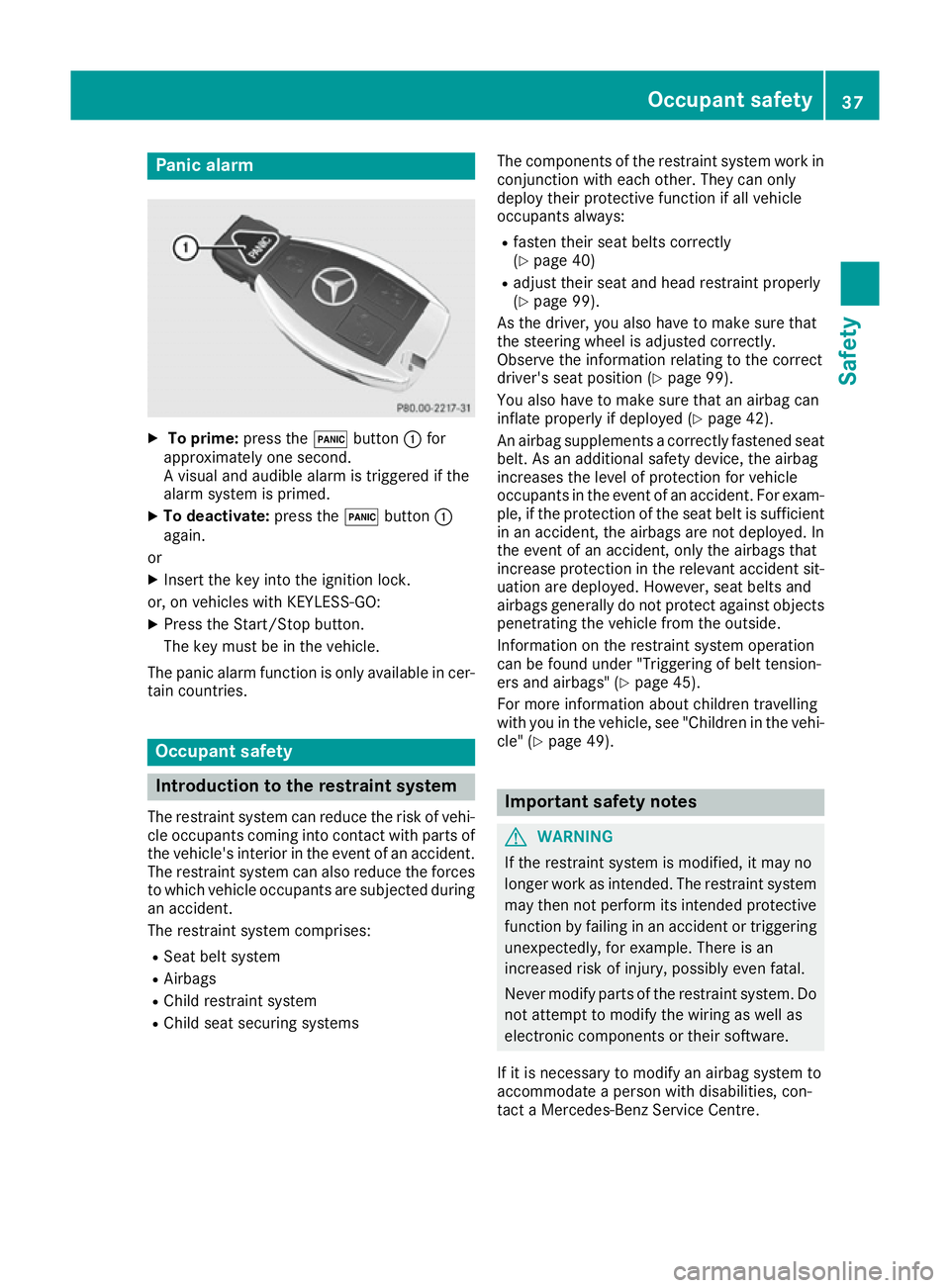
X
To prime: press the!button :for
approximately one second.
A visual and audible alarm is triggered if the
alarm system is primed.
X To deactivate: press the!button :
again.
or
X Insert the key into the ignition lock.
or, on vehicles with KEYLESS‑GO: X Press the Start/Stop button.
The key must be in the vehicle.
The panic alarm function is only available in cer- tain countries. Occupant safety
Introduction to the restraint system
The restraint system can reduce the risk of vehi- cle occupants coming into contact with parts of
the vehicle's interior in the event of an accident.
The restraint system can also reduce the forces to which vehicle occupants are subjected during
an accident.
The restraint system comprises:
R Seat belt system
R Airbags
R Child restraint system
R Child seat securing systems The components of the restraint system work in
conjunction with each other. They can only
deploy their protective function if all vehicle
occupants always:
R fasten their seat belts correctly
(Y page 40)
R adjust their seat and head restraint properly
(Y page 99).
As the driver, you also have to make sure that
the steering wheel is adjusted correctly.
Observe the information relating to the correct
driver's seat position (Y page 99).
You also have to make sure that an airbag can
inflate properly if deployed (Y page 42).
An airbag supplements a correctly fastened seat belt. As an additional safety device, the airbag
increases the level of protection for vehicle
occupants in the event of an accident. For exam-
ple, if the protection of the seat belt is sufficient in an accident, the airbags are not deployed. In
the event of an accident, only the airbags that
increase protection in the relevant accident sit- uation are deployed. However, seat belts and
airbags generally do not protect against objects penetrating the vehicle from the outside.
Information on the restraint system operation
can be found under "Triggering of belt tension-
ers and airbags" (Y page 45).
For more information about children travelling
with you in the vehicle, see "Children in the vehi-
cle" (Y page 49). Important safety notes
G
WARNING
If the restraint system is modified, it may no
longer work as intended. The restraint system
may then not perform its intended protective function by failing in an accident or triggering
unexpectedly, for example. There is an
increased risk of injury, possibly even fatal.
Never modify parts of the restraint system. Do not attempt to modify the wiring as well as
electronic components or their software.
If it is necessary to modify an airbag system to
accommodate a person with disabilities, con-
tact a Mercedes-Benz Service Centre. Occupant safety
37Safety Z
Page 41 of 349
Restraint system warning lamp
The functions of the restraint system are
checked after the ignition is switched on and at
regular intervals while the engine is running.
Therefore, malfunctions can be detected in
good time.
The 6 restraint system warning lamp in the
instrument cluster lights up when the ignition is switched on. It goes out no later than a few sec-
onds after the vehicle is started. The compo-
nents of the restraint system are in operational
readiness.
A malfunction has occurred if the 6restraint
system warning lamp:
R does not light up after the ignition is switched
on
R does not go out after a few seconds with the
engine running
R lights up again while the engine is running G
WARNING
If the restraint system is malfunctioning,
restraint system components may be trig-
gered unintentionally or might not be trig-
gered at all in the event of an accident with a high rate of vehicle deceleration. This can
effect belt tensioners or airbags, for example. There is an increased risk of serious or even
fatal injuries.
Have the restraint system checked and
repaired immediately at a qualified specialist
workshop. PASSENGER AIR BAG OFF indicator
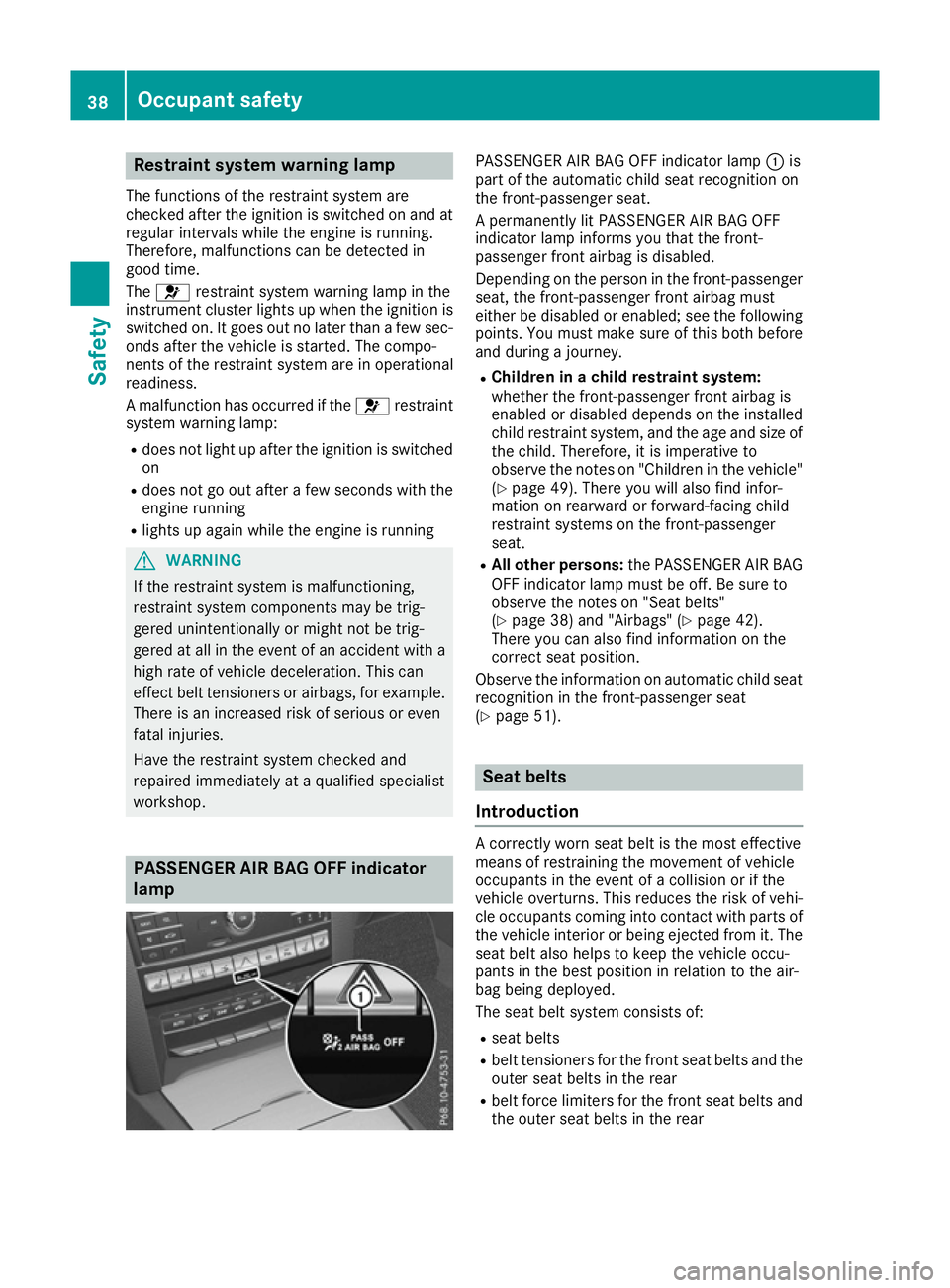
lamp PASSENGER AIR BAG OFF indicator lamp
:is
part of the automatic child seat recognition on
the front-passenger seat.
A permanently lit PASSENGER AIR BAG OFF
indicator lamp informs you that the front-
passenger front airbag is disabled.
Depending on the person in the front-passenger seat, the front-passenger front airbag must
either be disabled or enabled; see the following
points. You must make sure of this both before
and during a journey.
R Children in a child restraint system:
whether the front-passenger front airbag is
enabled or disabled depends on the installed
child restraint system, and the age and size of the child. Therefore, it is imperative to
observe the notes on "Children in the vehicle"
(Y page 49). There you will also find infor-
mation on rearward or forward-facing child
restraint systems on the front-passenger
seat.
R All other persons: the PASSENGER AIR BAG
OFF indicator lamp must be off. Be sure to
observe the notes on "Seat belts"
(Y page 38) and "Airbags" (Y page 42).
There you can also find information on the
correct seat position.
Observe the information on automatic child seat recognition in the front-passenger seat
(Y page 51). Seat belts
Introduction A correctly worn seat belt is the most effective
means of restraining the movement of vehicle
occupants in the event of a collision or if the
vehicle overturns. This reduces the risk of vehi- cle occupants coming into contact with parts of
the vehicle interior or being ejected from it. The
seat belt also helps to keep the vehicle occu-
pants in the best position in relation to the air-
bag being deployed.
The seat belt system consists of:
R seat belts
R belt tensioners for the front seat belts and the
outer seat belts in the rear
R belt force limiters for the front seat belts and
the outer seat belts in the rear 38
Occupant safetySafety
Page 42 of 349
If the seat belt is pulled quickly or sharply by the
seat-belt extender, the inertia reel locks. The
belt strap cannot be pulled out any further.
The belt tensioner tightens the seat belt in the
event of a collision so that it fits tightly across
your body. However, it does not pull the vehicle occupants back in the direction of the seat
backrest.
The belt tensioner does not, however, correct an
incorrect seat position or correct the routing of
a seat belt that is worn incorrectly.
If the seat belt is also fitted with a belt force
limiter and this is triggered, the force exerted by the seat belt on the vehicle occupant is reduced.
The belt force limiters on the front seats are
synchronised with the front airbags, which take
on a part of the deceleration force. This can
reduce the forces to which the vehicle occu-
pants are subjected during an accident.
! If the front-passenger seat is not occupied,
do not engage the seat belt tongue in the
buckle on the front-passenger seat. Other-
wise, the belt tensioner and the front-
passenger front airbag could be triggered in
the event of an accident and would need to be
replaced.
Important safety notes G
WARNING
The seat belt cannot perform its intended pro- tective function if it is not fastened correctly. Also, an improperly fastened seat belt can
cause additional injuries in the event of an
accident, sudden braking or abrupt changes
of direction. There is an increased risk of
injury, possibly even fatal.
Always make sure that all vehicle occupants
are wearing their seat belt properly and are
seated correctly. G
WARNING
The seat belt does not offer the intended level of protection if you have not moved the back-
rest to an almost vertical position. When brak-
ing or in the event of an accident, you could
slide underneath the seat belt and sustain
abdomen or neck injuries, for example. This poses an increased risk of injury or even fatal
injury.
Adjust the seat properly before beginning
your journey. Always ensure that the backrestis in an almost vertical position and that the
shoulder section of your seatbelt is routed
across the centre of your shoulder. G
WARNING
Persons under 1.50 mtall cannot wear the
seat belts correctly without a suitable, addi-
tional restraint system. The seat belt cannot
perform its intended protective function if it is not fastened correctly. Also, an improperly
fastened seat belt can cause additional inju-
ries in the event of an accident, sudden brak-
ing or abrupt changes of direction. There is an increased risk of injury, possibly even fatal.
Secure persons less than 1.50 mtall in a suit-
able restraint system.
If a child younger than twelve years old and
under 1.50 m in height is travelling in the vehi-
cle: R always secure the child in a child restraint
system suitable for this Mercedes-Benz vehi-
cle. The child restraint system must be appro-
priate to the age, weight and size of the child.
R always observe the instructions and safety
notes on "Children in the vehicle"
(Y page 49) in addition to the child restraint
system manufacturer's installation and oper-
ating instructions. G
WARNING
Seat belts cannot protect as intended, if:
R they are damaged, have been modified, are
extremely dirty, bleached or dyed
R the seat belt buckle is damaged or
extremely dirty
R modifications have been made to the belt
tensioners, belt anchorages or inertia reels
Seat belts may sustain non-visible damage in an accident, e.g. due to glass splinters. Modi-
fied or damaged seat belts can tear or fail, for example in the event of an accident. Modified
seat belt tensioners may be deployed unin- Occupant safety
39Safety
Z
Page 44 of 349
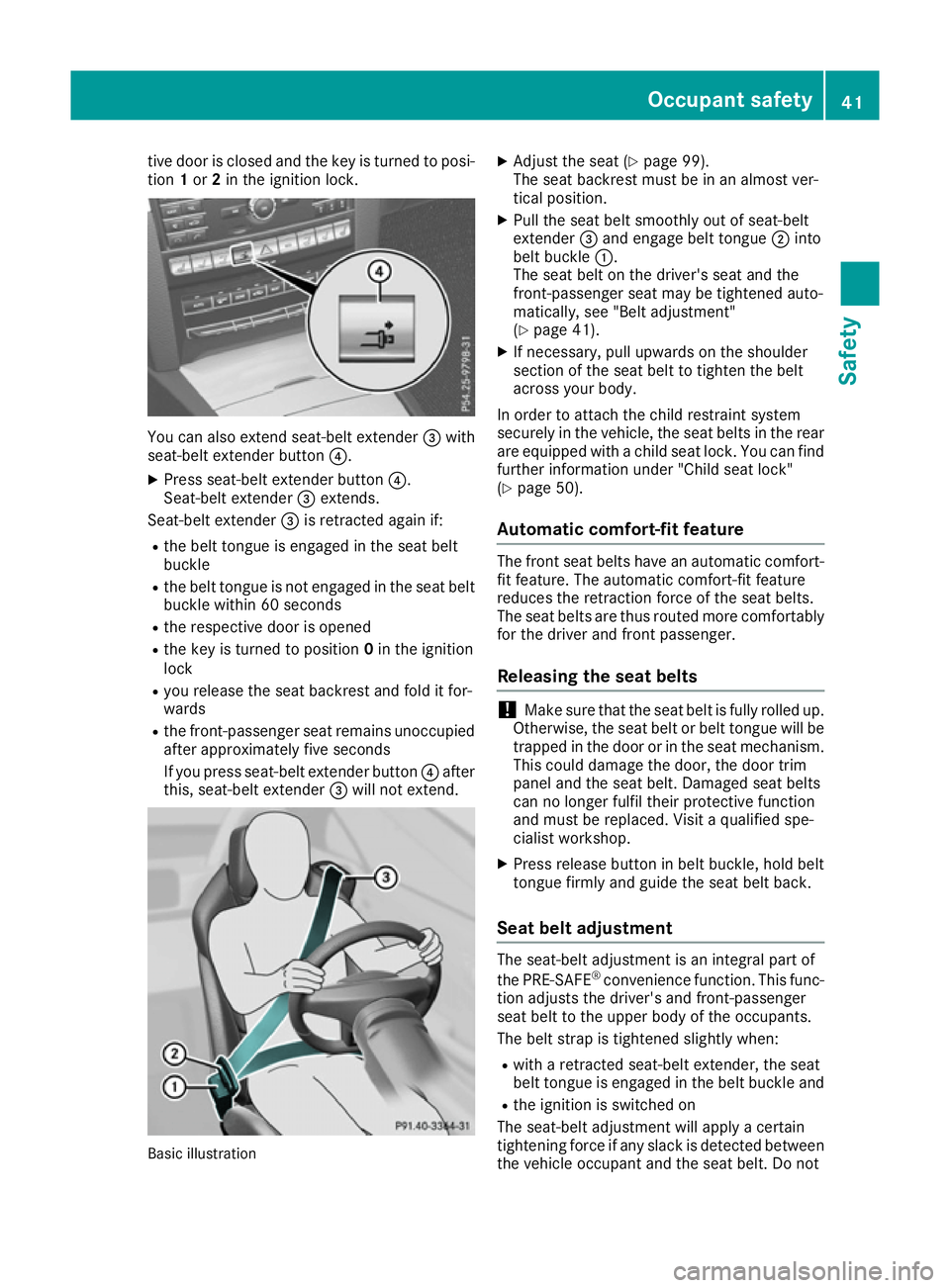
tive door is closed and the key is turned to posi-
tion 1or 2in the ignition lock. You can also extend seat-belt extender
=with
seat-belt extender button ?.
X Press seat-belt extender button ?.
Seat-belt extender =extends.
Seat-belt extender =is retracted again if:
R the belt tongue is engaged in the seat belt
buckle
R the belt tongue is not engaged in the seat belt
buckle within 60 seconds
R the respective door is opened
R the key is turned to position 0in the ignition
lock
R you release the seat backrest and fold it for-
wards
R the front-passenger seat remains unoccupied
after approximately five seconds
If you press seat-belt extender button ?after
this, seat-belt extender =will not extend. Basic illustration X
Adjust the seat (Y page 99).
The seat backrest must be in an almost ver-
tical position.
X Pull the seat belt smoothly out of seat-belt
extender =and engage belt tongue ;into
belt buckle :.
The seat belt on the driver's seat and the
front-passenger seat may be tightened auto-
matically, see "Belt adjustment"
(Y page 41).
X If necessary, pull upwards on the shoulder
section of the seat belt to tighten the belt
across your body.
In order to attach the child restraint system
securely in the vehicle, the seat belts in the rear
are equipped with a child seat lock. You can find
further information under "Child seat lock"
(Y page 50).
Automatic comfort-fit feature The front seat belts have an automatic comfort-
fit feature. The automatic comfort-fit feature
reduces the retraction force of the seat belts.
The seat belts are thus routed more comfortably for the driver and front passenger.
Releasing the seat belts !
Make sure that the seat belt is fully rolled up.
Otherwise, the seat belt or belt tongue will be
trapped in the door or in the seat mechanism.
This could damage the door, the door trim
panel and the seat belt. Damaged seat belts
can no longer fulfil their protective function
and must be replaced. Visit a qualified spe-
cialist workshop.
X Press release button in belt buckle, hold belt
tongue firmly and guide the seat belt back.
Seat belt adjustment The seat-belt adjustment is an integral part of
the PRE-SAFE
®
convenience function. This func-
tion adjusts the driver's and front-passenger
seat belt to the upper body of the occupants.
The belt strap is tightened slightly when:
R with a retracted seat-belt extender, the seat
belt tongue is engaged in the belt buckle and
R the ignition is switched on
The seat-belt adjustment will apply a certain
tightening force if any slack is detected between
the vehicle occupant and the seat belt. Do not Occupant safety
41Safety Z
Page 46 of 349
If a child is travelling in your vehicle, also
observe the following notes:
R Always secure children under twelve years of
age and less than 1.50 mtall in suitable child
restraint systems.
R Child restraint systems should be fitted to the
rear seats.
R Only secure a child to the front-passenger
seat when the front-passenger front airbag is
disabled, and only then in a rearward-facing
child restraint system. If the PASSENGER AIR
BAG OFF indicator lamp is permanently lit, the
front-passenger front airbag is disabled
(Y page 38).
R Always observe the instructions and safety
notes on "Children in the vehicle"
(Y page 49) and on the "Child restraint sys-
tem on the front-passenger seat"
(Y page 53) in addition to the child restraint
system manufacturer's installation and oper-
ating instructions.
Objects in the vehicle interior may prevent
the airbag from functioning correctly. Before
starting your journey and to avoid risks resulting from the speed of the airbag as it deploys, make
sure that:
R there are no people, animals or objects
between the vehicle occupants and an airbag.
R there are no objects between the seat, door
and B-pillar.
R no hard objects, e.g. coat hangers, are hang-
ing on the grab handles or coat hooks.
R no accessories, such as cup holders, are
attached to the vehicle within the deployment
area of an airbag, e.g. to doors, side windows, rear side trim or side walls.
R no heavy, sharp-edged or fragile objects are in
the pockets of your clothing. Store such
objects in a suitable place. G
WARNING
If you modify an airbag cover or affix objects
such as stickers to it, the airbag can no longer function correctly. There is an increased risk
of injury.
Never modify an airbag cover or affix objects
to it. G
WARNING
Sensors to control the airbags are located in
the doors. Modifications or work not per- formed correctly to the doors or door panel-
ling, as well as damaged doors, can lead to the
function of the sensors being impaired. The
airbags might therefore not function properly any more. Consequently, the airbags cannot
protect vehicle occupants as they are
designed to do. This poses an increased risk
of injury.
Never modify the doors or parts of the doors.
Always have work on the doors or door pan-
elling carried out at a qualified specialist
workshop.
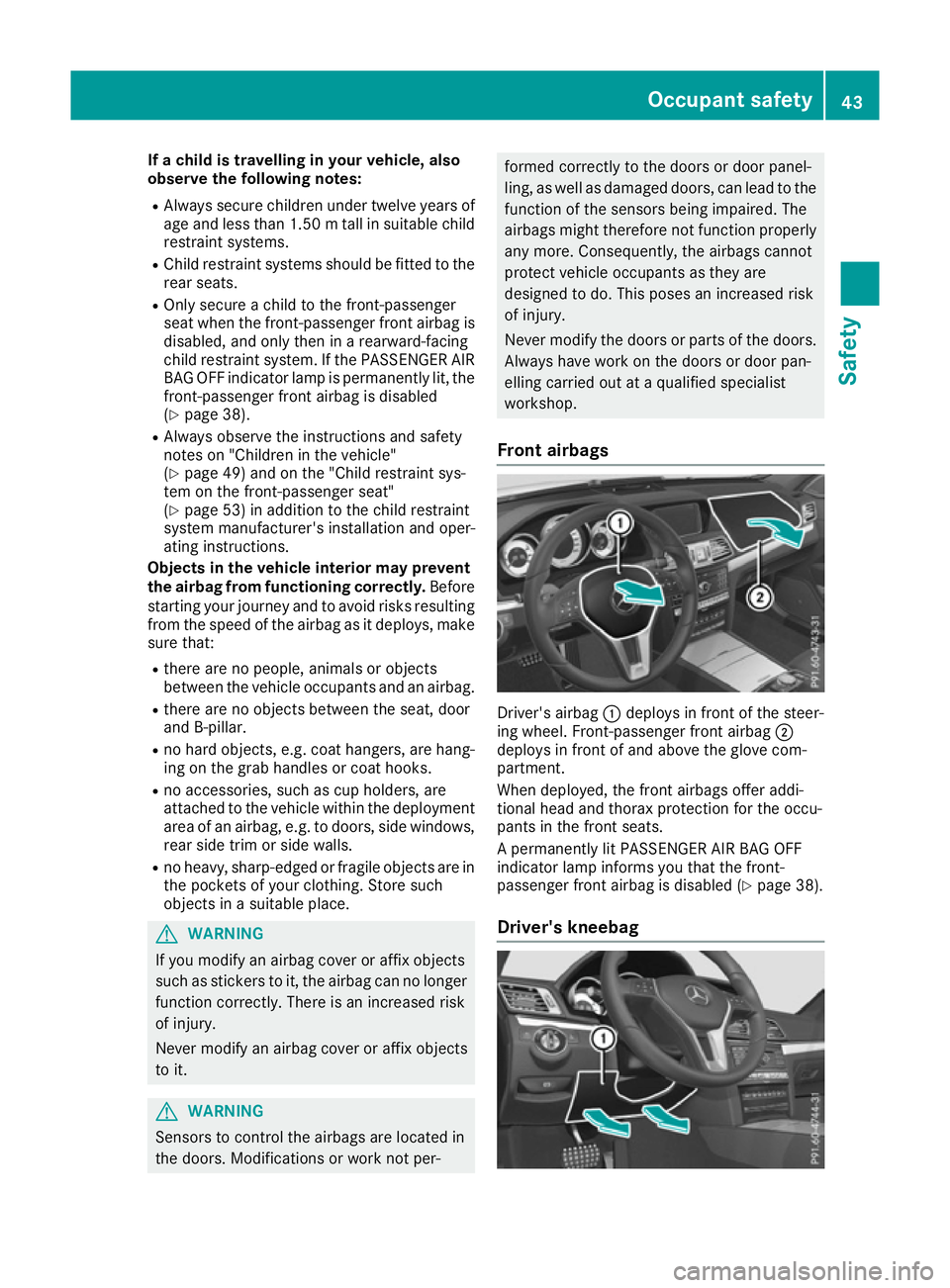
Front airbags Driver's airbag
:deploys in front of the steer-
ing wheel. Front-passenger front airbag ;
deploys in front of and above the glove com-
partment.
When deployed, the front airbags offer addi-
tional head and thorax protection for the occu-
pants in the front seats.
A permanently lit PASSENGER AIR BAG OFF
indicator lamp informs you that the front-
passenger front airbag is disabled (Y page 38).
Driver's kneebag Occupant safety
43Safety Z
Page 49 of 349
Operation
During the first stage of a collision, the restraint
system control unit evaluates important physi-
cal data relating to vehicle deceleration or accel-
eration, such as:
R duration
R direction
R intensity
Based on the evaluation of this data, the
restraint system control unit triggers the seat
belt tensioners in the event of a head-on or rear collision.
A seat belt tensioner can only be triggered if:
R the ignition is switched on
R the components of the restraint system are
operational. You can find further information
under: "Restraint system warning lamp"
(Y page 38)
R the belt tongue has engaged in the belt buckle
of the respective front seat
The seat belt tensioners in the rear compart-
ment are triggered independently of the lock
status of the seat belts.
If the restraint system control unit detects a high severity accident, in certain head-on collisions,
additional components of the restraint system
are deployed independently of each other:
R front airbags and driver's kneebag
R headbag, if the system determines that
deployment can offer additional protection to
that provided by the seat belt
Depending on the person in the front-passenger seat, the front-passenger front airbag is either
disabled or enabled. The front-passenger front
airbag can only be deployed in an accident if the
PASSENGER AIR BAG OFF indicator lamp is off. Observe the information on the PASSENGER AIR
BAG OFF indicator lamp (Y page 38).
Your vehicle has two-stage front airbags. In the
first deployment stage, the front airbag is filled
with propellant gas to reduce the risk of injuries. The front airbag is fully deployed if the second
deployment stage is activated within a few mil-
liseconds.
The activation threshold for the seat belt ten-
sioners and airbags is determined based on the evaluation of the vehicle's rate of deceleration
or acceleration at various points in the vehicle.
This process is pre-emptive in nature. The trig-
gering/deployment process should take place
in good time at the start of the collision. The rate of vehicle deceleration or acceleration
and the direction of the force are essentially
determined by:
R the distribution of forces during the collision
R the collision angle
R the deformation characteristics of the vehicle
R the characteristics of the object with which
the vehicle has collided
Factors which can only be seen and measured
after a collision has occurred do not play a deci-
sive role in the deployment of an airbag, nor do they provide an indication of airbag deployment.
The vehicle may be deformed significantly with- out an airbag being deployed. This is the case if
only parts which are relatively easily deformed
are affected and the rate of deceleration is not
high. Conversely, an airbag may be deployed
even though the vehicle suffers only minor
deformation. This is the case if, for example,
very rigid vehicle parts such as longitudinal body
members are hit, and sufficient deceleration
occurs as a result.
If the restraint system control unit detects a side impact or if the vehicle overturns, the applicablecomponents of the restraint system are activa-
ted independently of each other depending on
the apparent type of accident.
R Sidebags and pelvisbag on the side on which
an impact occurs, independent from the seat
belt tensioner and seat belt usage
Vehicles with the automatic child seat recog-
nition on the front-passenger seat: the side-
bag and pelvisbag on the front-passenger side (front) deploy under the following conditions:
- an occupant is detected on the front-
passenger seat or
- the belt tongue is engaged in the belt
buckle of the front-passenger seat
R Headbag on the side on which an impact
occurs, independent of seat belt usage and
regardless of whether the front-passenger
seat is occupied
R Seat belt tensioners, if the system determines
that deployment can offer additional protec-
tion for the vehicle occupants in this situation
R Headbags on the driver's and front-passenger
side in certain situations if the vehicle over-
turns and if the system determines that
deployment can offer additional protection to that provided by the seat belt 46
Occupant safetySafety
Page 52 of 349
The PRE-SAFE
®
PLUS braking application is can-
celled:
R if the accelerator pedal is depressed when a
gear is engaged
R if the risk of a collision passes or is no longer
detected
R if DISTRONIC PLUS indicates an intention to
pull away
If the hazardous situation passes without result- ing in an accident, the original settings are
restored. Automatic measures after an acci-
dent
Immediately after an accident, the following
measures may be implemented, depending on
the type and severity of the impact:
R the hazard warning lamps are activated
R the emergency lighting is activated
R the vehicle doors are unlocked
R the front side windows are lowered
R vehicles with a memory function: the electri-
cally adjustable steering wheel is raised
R the engine is switched off and the fuel supply
is cut off
R vehicles with the Mercedes-Benz emergency
call system: automatic emergency call Children in the vehicle
Important safety notes
Accident statistics show that children secured
in the rear seats are safer than children secured in the front seats. For this reason, Mercedes-
Benz strongly advises that you fit a child
restraint system on a rear seat. Children are
generally better protected there.
If a child younger than twelve years old and
under 1.50 m in height is travelling in the vehi-
cle:
R always secure the child in a child restraint
system suitable for Mercedes-Benz vehicles.
The child restraint system must be appropri-
ate to the age, weight and size of the child.
R be sure to observe the instructions and safety
notes in this section in addition to the child
restraint system manufacturer's installation
instructions. G
WARNING
If you leave children unattended in the vehi-
cle, they may be able to set the vehicle in
motion if, for example, they:
R release the parking brake
R shift the automatic transmission out of park
position Por shift manual transmission into
neutral
R start the engine
In addition, they may operate vehicle equip-
ment and become trapped. There is a risk of
an accident and injury.
When leaving the vehicle, always take the key with you and lock the vehicle. Never leave
children unattended in the vehicle. G
WARNING
If persons (particularly children) are exposed
to heat or cold for a prolonged period, there is a risk of serious or even fatal injuries. Never
leave persons (particularly children) unatten-
ded in the vehicle. G
WARNING
If the child restraint system is placed in direct sunlight, the parts could become very hot.
Children could be suffer burns by touching
these parts, in particular on the metallic parts
of the child restraint system. There is a risk of injury.
If you and your child leave the vehicle, always
make sure that the child restraint system is
not in direct sunlight. Cover it with a blanket, for example. If the child restraint system has
been exposed to direct sunlight, leave it to
cool down before securing the child in it.
Never leave children unattended in the vehi-
cle.
Always ensure that all vehicle occupants have
their seat belts fastened correctly and are sitting
properly. Particular attention must be paid to
children.
Observe the safety notes on the seat belt
(Y page 39) and the notes on how to use the seat
belt properly (Y page 40). Children in the vehicle
49Safety Z