lights MERCEDES-BENZ G-CLASS SUV 2008 Owner's Guide
[x] Cancel search | Manufacturer: MERCEDES-BENZ, Model Year: 2008, Model line: G-CLASS SUV, Model: MERCEDES-BENZ G-CLASS SUV 2008Pages: 293, PDF Size: 4.49 MB
Page 127 of 293
Air conditioning
124 Switching the air conditioning on/off
i When the air conditioning is switched off,
the air supply and air circulation are also
switched off. Only select this setting briefly,
otherwise the windows may mist up.
Thermatic X
Make sure that the key is in position 2in
the ignition lock or that the engine is run-
ning.
X To activate: turn thumbwheel 1clock-
wise to the desired position (apart from the
0 position) (Y page 122).
X The previously selected settings come into
effect again.
X To deactivate: turn thumbwheel 1anti-
clockwise to position 0(Y page 122). Switching cooling with air dehumidi-
fication on/off
The "cooling with dehumidification" function
is only available when the engine is running.
The air inside the vehicle is cooled and dehu-
midified according to the temperature selec-
ted. This prevents the windows from misting
up. G
Risk of accident
If the "cooling with air dehumidification"
function is deactivated, the air inside the
vehicle will not be cooled (during warm
weather) or dehumidified. The windows
could mist up more quickly. This may pre-
vent you from observing the traffic condi-
tions, thereby causing an accident. H
Environmental note
The cooling system uses the refrigerant
R134A. This refrigerant does not damage
the earth's ozone layer.
i Condensation may drip from the under-
side of the vehicle when Thermatic is in
cooling mode. X
To activate: press the9button.
The indicator lamp in the 9button lights
up.
X To deactivate: press the9button.
The indicator lamp in the 9button goes
out. Controlling the air conditioning auto-
matically
In automatic mode, the set temperature is
maintained automatically at a constant level.
To do so, the system automatically regulates
the temperature of the dispensed air, the air-
flow and the air distribution. The "cooling with
air dehumidification" function is on.
X Make sure that the engine is running.
X Set the desired temperature.
X To activate: press theUbutton
(Y page 122).
The indicator lamp in the Ubutton
comes on. Automatic air distribution and
airflow are activated.
X To deactivate: press theUbutton.
The indicator lamp in the Ubutton goes
out. Automatic air distribution and airflow
are deactivated. Cont
rols
463_AKB; 1; 8, en-GB
wobuchh,
Version: 2.10.6 2008-07-17T15:19:41+02:00 - Seite 124Dateiname: 6515_4091_02_buchblock.pdf; preflight
Page 131 of 293
Air conditioning
128 Switching windscreen heating* on/
off G
Risk of accident
Clear all windows of ice or snow before set-
ting off. Impaired visibility could otherwise
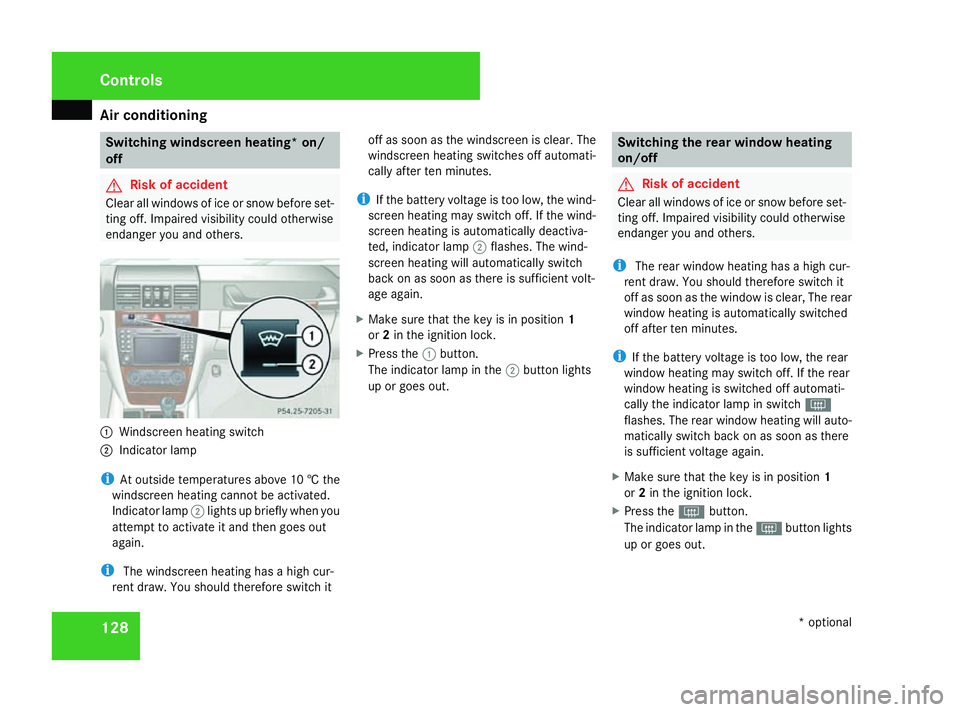
endanger you and others. 1
Windscreen heating switch
2 Indicator lamp
i At outside temperatures above 10 †the
windscreen heating cannot be activated.
Indicator lamp 2lights up briefly when you
attempt to activate it and then goes out
again.
i The windscreen heating has a high cur-
rent draw. You should therefore switch it off as soon as the windscreen is clear. The
windscreen heating switches off automati-
cally after ten minutes.
i If the battery voltage is too low, the wind-
screen heating may switch off. If the wind-
screen heating is automatically deactiva-
ted, indicator lamp 2flashes. The wind-
screen heating will automatically switch
back on as soon as there is sufficient volt-
age again.
X Make sure that the key is in position 1
or 2in the ignition lock.
X Press the 1button.
The indicator lamp in the 2button lights
up or goes out. Switching the rear window heating
on/off
G
Risk of accident
Clear all windows of ice or snow before set-
ting off. Impaired visibility could otherwise
endanger you and others.
i The rear window heating has a high cur-
rent draw. You should therefore switch it
off as soon as the window is clear, The rear
window heating is automatically switched
off after ten minutes.
i If the battery voltage is too low, the rear
window heating may switch off. If the rear
window heating is switched off automati-
cally the indicator lamp in switch F
flashes. The rear window heating will auto-
matically switch back on as soon as there
is sufficient voltage again.
X Make sure that the key is in position 1
or 2in the ignition lock.
X Press the Fbutton.
The indicator lamp in the Fbutton lights
up or goes out. Controls
* optional
463_AKB; 1; 8, en-GB
wobuchh
,V ersion: 2.10.6
2008-07-17T15:19:41+02:00 - Seite 128 Dateiname: 6515_4091_02_buchblock.pdf; preflight
Page 132 of 293
Air conditioning
129Activating/deactivating air-recircula-
tion mode
You can deactivate the flow of fresh air if
unpleasant odours are entering the vehicle
from outside. The air already inside the vehi-
cle will then be recirculated. G
Risk of accident
Only switch over to air-recirculation mode
briefly at low outside temperatures. Other-
wise, the windows could mist up, thus
impairing visibility and endangering your-
self and others. This may prevent you from
observing the traffic conditions, thereby
causing an accident.
X To activate: briefly press the ,button.
The indicator lamp in the ,button
comes on.
i Air-recirculation mode is activated auto-
matically at high outside temperatures.
When air-recirculation mode is activated
automatically, the indicator lamp in
the , button is not lit.
Outside air is added after about 30
minutes. X
To deactivate: press the,button.
The indicator lamp in the ,button goes
out.
i Air-recirculation mode switches off auto-
matically:
R after approximately five minutes at out-
side temperatures below approximately
5 †
R after approximately five minutes if cool-
ing with air dehumidification is deactiva-
ted
R after approximately 30 minutes at out-
side temperatures above approximately
5 † Switching the residual heat on/off
It is possible to make use of the residual heat
of the engine to continue heating the station-
ary vehicle for up to 30 minutes after the
engine has been switched off. The heating
time depends on the coolant temperature and
on the interior temperature that has been set.
i The blower will run at a low speed regard-
less of the airflow setting. i
If you activate the "residual heat" function
at high temperatures, only the ventilation
will be activated.
X Make sure that the key is in position 1or
0 in the ignition lock or that it has been
removed.
X To switch on: press the9button.
The indicator lamp in the 9button lights
up.
X To deactivate: press the9button.
The indicator lamp in the 9button goes
out.
i The auxiliary heating/ventilation is auto-
matically deactivated after about 30
minutes, or when:
R the ignition is switched on
R the battery voltage drops
R when the coolant temperature is too low Cont
rols
463_AKB; 1; 8, en-GB
wobuchh,
Version: 2.10.6 2008-07-17T15:19:41+02:00 - Seite 129 ZDateiname: 6515_4091_02_buchblock.pdf; preflight
Page 134 of 293
Air conditioning
131
The indicator lamps in the button may light up
in red or yellow.
R Red: auxiliary heating/ventilation is acti-
vated
R Yellow: departure time of the auxiliary
heating/ventilation is preselected
(Y page 108)
Activating the auxiliary heating/ventila-
tion
If the key is in position 1or 2in the ignition
lock:
X Press and hold button 1for more than two
seconds.
Red indicator lamp 2lights up.
If the key is removed from the ignition lock or
in position 0:
X Briefly press button 1.
Red indicator lamp 2lights up.
Deactivating the auxiliary heating/venti-
lation
X Press and hold button 1for more than two
seconds.
The red or yellow indicator lamp in the 1
button goes out. Remote control
Your vehicle comes with one remote control.
You may use one additional remote control
for your vehicle. For further information, con-
sult a qualified specialist workshop, e.g. a
Mercedes-Benz Service Centre.
The remote control has a maximum range of
approximately 300 metres. This range may be
reduced by:
R sources of radio interference
R solid objects between the remote control
and the vehicle
R the remote control being in an unfavoura-
ble position in relation to the vehicle
R transmitting from an enclosed space
i The optimum range can be achieved if you
hold the remote control vertically, pointing
upwards when you press one of the but-
tons.
i More information about the auxiliary
heating can be found in the "Practical
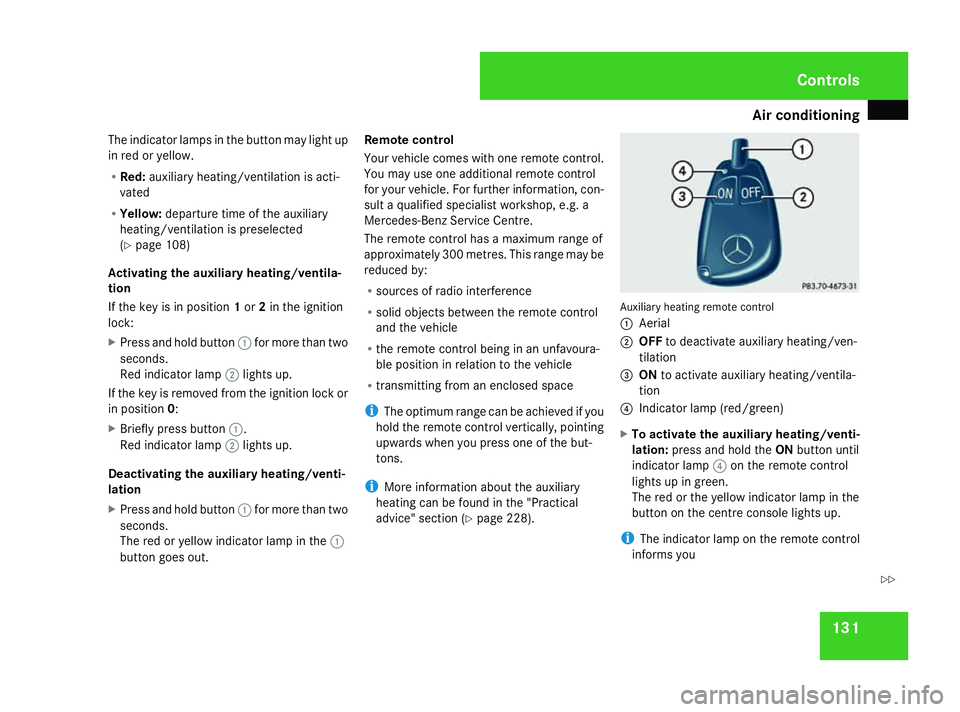
advice" section (Y page 228). Auxiliary heating remote control
1
Aerial
2 OFF to deactivate auxiliary heating/ven-
tilation
3 ON to activate auxiliary heating/ventila-
tion
4 Indicator lamp (red/green)
X To activate the auxiliary heating/venti-
lation: press and hold the ONbutton until
indicator lamp 4on the remote control
lights up in green.
The red or the yellow indicator lamp in the
button on the centre console lights up.
i The indicator lamp on the remote control
informs you Controls
463_AKB; 1; 8, en-GB
wobuchh
, Version: 2.10.6
2008-07-17T15:19:41+02:00 - Seite 131 ZDateiname: 6515_4091_02_buchblock.pdf; preflight
Page 135 of 293
Sliding sunroof
132R
whether a signal has been transmitted to
the auxiliary heating or ventilation
R about the remote control's battery
charge status:
If the remote control indicator lamp first
lights up orange when you press one of
the buttons, the battery is almost dis-
charged.
If the remote control indicator lamp only
flashes orange when you press one of the
buttons, the battery is discharged.
Replace the battery (Y page 235).
The signal has been interrupted if the indi-
cator lamp on the remote control flashes
green when switching on or red when
switching off.
In this case, repeat the procedure. Stand
somewhere else or move closer to the vehi-
cle, if necessary.
X To deactivate the auxiliary heating/
ventilation: press and hold the OFFbutton
until indicator lamp 4on the remote con-
trol lights up in red.
The red or the yellow indicator lamp in the
button on the centre console goes out. Sliding sunroof
Sliding/tilting sunroof*
G
Risk of injury
Children could injure themselves if they
operate the sliding/tilting sunroof.
Never leave children unsupervised in the
vehicle. Always take the key with you when
leaving the vehicle, even if you are only
leaving it for a short time. G
Risk of injury
Make sure that nobody can become trap-
ped when you are opening and closing the
sliding/tilting sunroof. If there is a risk of
entrapment, release the switch and push it
briefly in any direction to stop the sliding/
tilting sunroof. G
Risk of injury
If you are not wearing a seat belt, there is
a risk that you could be thrown through the
opening in the event of the vehicle over-
turning. Therefore, always wear a seat belt
to reduce the risk of injuries.
! Only open the sliding/tilting sunroof if it
is free of snow and ice. Otherwise, mal-
functions may occur. Do not allow anything to protrude from the
sliding/tilting sunroof. The seals could oth-
erwise be damaged.
i Resonance noises can occur in addition
to the usual airflow noises when the slid-
ing/tilting sunroof is open. They are caused
by minor pressure fluctuations in the vehi-
cle interior.
Change the position of the sliding/tilting
sunroof or open a side window slightly to
reduce or eliminate these noises.
i It is also possible to open and close the
sliding/tilting sunroof from the outside
using the "Summer opening" and "Conve-
nience closing" features respectively. Controls
* optional
463_AKB; 1; 8, en-GB
wobuchh,
Version: 2.10.6 2008-07-17T15:19:41+02:00 - Seite 132Dateiname: 6515_4091_02_buchblock.pdf; preflight
Page 151 of 293
Features
148 Features
Sun visors
G
Risk of accident
Keep the mirrors in the sun visors covered
while driving. Otherwise, you could be daz-
zled, impairing your view of traffic condi-
tions. As a result, you could cause an acci-
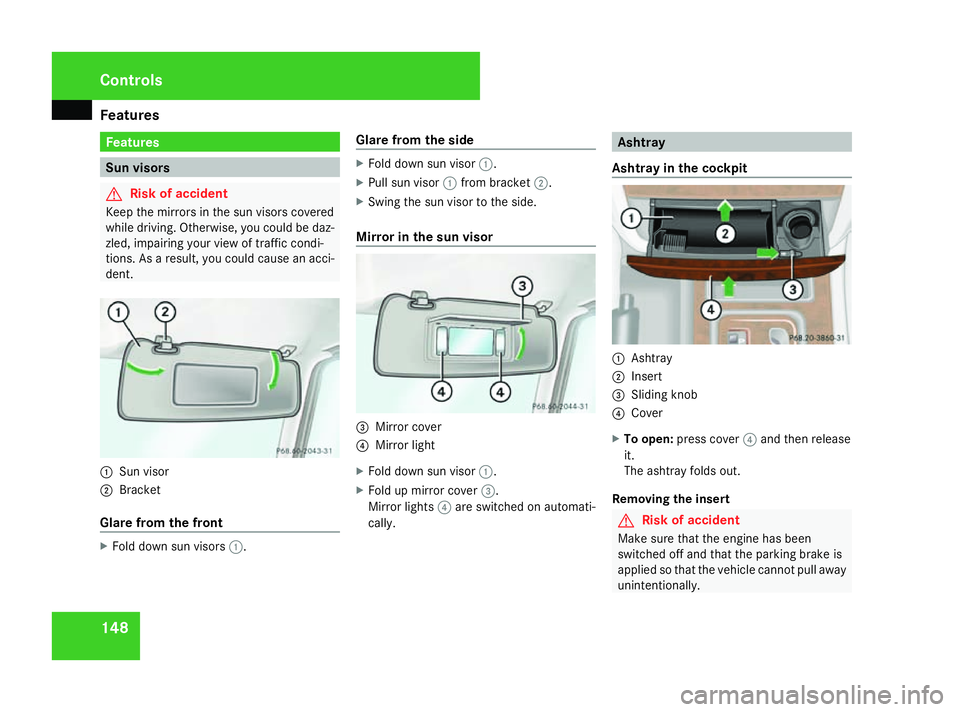
dent. 1
Sun visor
2 Bracket
Glare from the front X
Fold down sun visors 1. Glare from the side X
Fold down sun visor 1.
X Pull sun visor 1from bracket 2.
X Swing the sun visor to the side.
Mirror in the sun visor 3
Mirror cover
4 Mirror light
X Fold down sun visor 1.
X Fold up mirror cover 3.
Mirror lights 4are switched on automati-
cally. Ashtray
Ashtray in the cockpit 1
Ashtray
2 Insert
3 Sliding knob
4 Cover
X To open: press cover 4and then release
it.
The ashtray folds out.
Removing the insert G
Risk of accident
Make sure that the engine has been
switched off and that the parking brake is
applied so that the vehicle cannot pull away
unintentionally. Cont
rols
463_AKB; 1; 8, en-GB
wobuchh,
Version: 2.10.6
2008-07-17T15:19:41+02:00 - Seite 148 Dateiname: 6515_4091_02_buchblock.pdf; preflight
Page 177 of 293
Off-road driving
174
i
Information about retrofitting special all-
terrain tyres is available from any
Mercedes-Benz Service Centre.
Checklist before driving off-road X
Engine oil level: check the engine oil and
top it up if necessary.
Only then does the engine receive enough
oil when the vehicle is standing on a steep
incline.
X Vehicle toolkit: check that the jack is
working and make sure you have the wheel-
brace, a robust tow cable and a folding
spade in the vehicle.
X Wheels and tyres: check the tyre tread
depth and tyre pressure.
X Check for damage and remove any objects,
e.g. small stones, from the wheels/tyres.
X Replace any missing valve caps.
X Replace dented or damaged wheels.
Checklist after driving off-road Driving over rough terrain places greater
demands on your vehicle than driving on nor-
mal roads. After driving off-road, check the
vehicle. This allows you to detect damage
promptly and reduce the risk of an accident
to yourself and other road users. X
Shift the transfer case to HIGH
(Y page 93).
X Disengage the differential locks
(Y page 95).
X Clean the headlamps and rear lights and
check for damage.
X Clean the front and rear licence plates.
X Clean the wheels/tyres with a water jet and
remove any foreign objects.
X Clean the wheels, wheel arches and the
vehicle underside with a water jet; check
for foreign objects and damage.
X Check whether twigs or other parts of
plants have become trapped. These
increase the risk of fire and can damage
fuel pipes, brake hoses or the rubber bel-
lows of the axle joints and propeller shafts.
X After the trip, examine without fail the
entire undercarriage, wheels, tyres, brakes,
bodywork structure, steering, chassis and
exhaust system for damage.
X After driving for extended periods across
sand, mud, gravel, water or in similarly dirty
conditions, have the brake discs, wheels,
brake pads /linings and axle joints checked
and cleaned.
X If you detect strong vibrations after off-road
travel, check for foreign objects in the
wheels and drive train and remove them if necessary. Foreign objects can disturb the
balance and cause vibrations. Travelling uphill
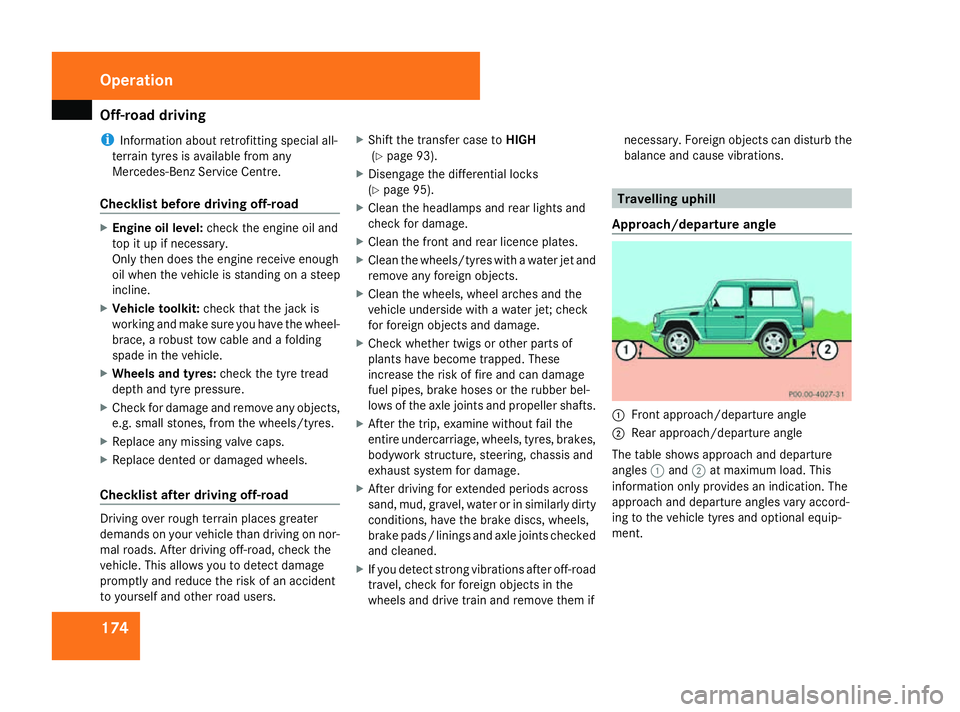
Approach/departure angle 1
Front approach/departure angle
2 Rear approach/departure angle
The table shows approach and departure
angles 1and 2at maximum load. This
information only provides an indication. The
approach and departure angles vary accord-
ing to the vehicle tyres and optional equip-
ment. Operation
463_AKB; 1; 8, en-GB
wobuchh,
Version: 2.10.6 2008-07-17T15:19:41+02:00 - Seite 174Dateiname: 6515_4091_02_buchblock.pdf; preflight
Page 186 of 293
Care
183H
Environmental note
Dispose of empty packaging, cleaning
cloths and polishing wads in an environ-
mentally responsible manner.
! Do not affix:
R stickers
R films
R magnetic plates or similar items
to painted surfaces, otherwise you could
damage the paintwork. Vehicle care
! Do not park the vehicle for a long period
of time directly after cleaning, especially if
the wheels have just been cleaned with a
wheel cleaner. Wheel cleaners could cause
rapid corrosion of the brake discs and
brake pads/linings. After cleaning, park
the vehicle when it is at normal operating
temperature.
Automatic car wash You can wash the vehicle in an automatic car
wash from the beginning. !
Do not use a touch-free automatic car
wash that uses chemical agents to wash
the vehicle.
Preferably use automatic car washes without
brushes.
If the vehicle is very dirty, pre-wash it before
cleaning it in an automatic car wash.
! Make sure that the automatic car wash is
suitable for the size of the vehicle. Fold in
the exterior mirrors before the vehicle is
washed. There is otherwise a risk of dam-
age to the exterior mirrors.
! Make sure that the side windows are com-
pletely closed, that the ventilation/heater
blower is fully turned off and that the wind-
screen wiper switch is set to 0. The rain
sensor may otherwise be activated, trig-
gering unintended wiper movements. This
could cause damage to the vehicle.
After using an automatic car wash, wipe any
wax and drying agents off the windscreen and
the wiper blades. This will prevent smears and
reduce wiping noises caused by residue on
the windscreen. High-pressure cleaners G
Risk of accident
Do not use high-pressure cleaners with cir-
cular-jet nozzles (dirt grinders) to clean
your vehicle or ― especially ― the tyres.
Otherwise, you could damage the tyres and
cause an accident.
! Observe the instructions issued by the
equipment manufacturer concerning the
distance to be maintained between the
nozzle of the high-pressure cleaner and the
vehicle (at least 30 cm).
Move the high-pressure cleaner nozzle
around when cleaning your vehicle.
Do not aim directly at any of the following:
R tyres
R door joint
R electrical components
R battery
R connectors
R lights
R seals
Damaged seals or electrical components
can lead to failures or leaks. Operation
463_AKB; 1; 8, en-GB
wobuchh,
Version: 2.10.6 2008-07-17T15:19:41+02:00 - Seite 183 ZDateiname: 6515_4091_02_buchblock.pdf; preflight
Page 207 of 293
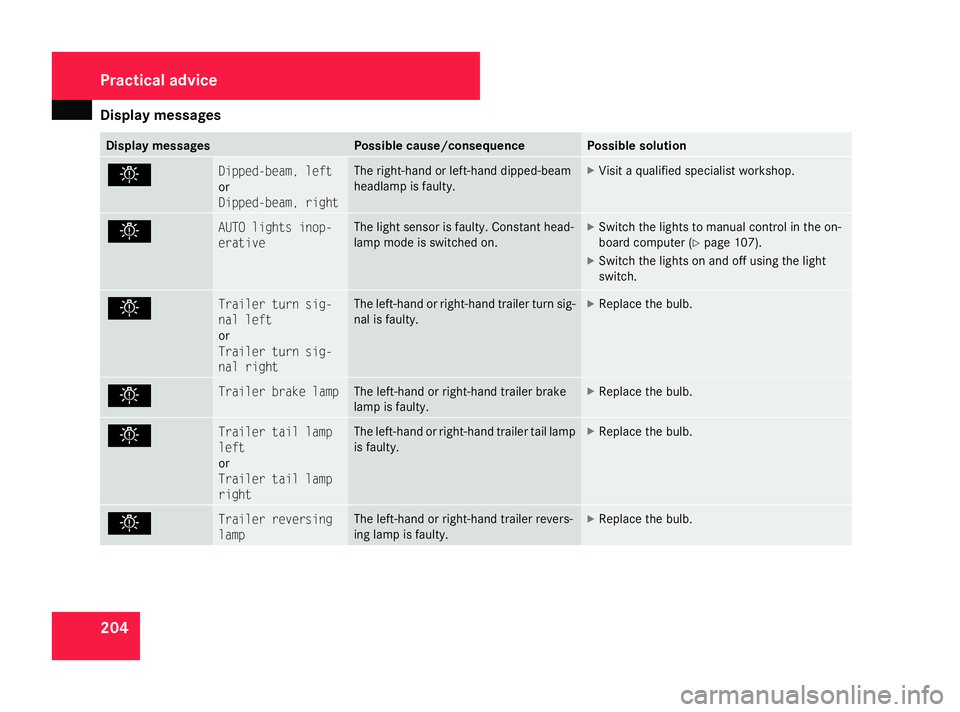
Display
messages 204 Display messages Possible cause/consequence Possible solution
. Dipped-beam, left
or
Dipped-beam, right The right-hand or left-hand dipped-beam
headlamp is fa
ulty. X
Visit a qualified specialist workshop. . AUTO lights inop-
erative The light sensor is faulty. Constant head-
lamp mode is switched on. X
Switch the lights to manual control in the on-
board computer (Y page 107).
X Switch the lights on and off using the light
switch. . Trailer turn sig-
nal left
or
Trailer turn sig-
nal right The left-hand or right-hand trailer turn sig-
nal is faulty. X
Replace the bulb. . Trailer brake lamp The left-hand or right-hand trailer brake
lamp is faulty. X
Replace the bulb. . Trailer tail lamp
left
or
Trailer tail lamp
right The left-hand or right-hand trailer tail lamp
is faulty. X
Replace the bulb. . Trailer reversing
lamp The left-hand or right-hand trailer revers-
ing lamp is faulty. X
Replace the bulb. Practical advice
463_AKB; 1; 8, en-GB
wobuchh,
Version: 2.10.6 2008-07-17T15:19:41+02:00 - Seite 204Dateiname: 6515_4091_02_buchblock.pdf; preflight
Page 209 of 293
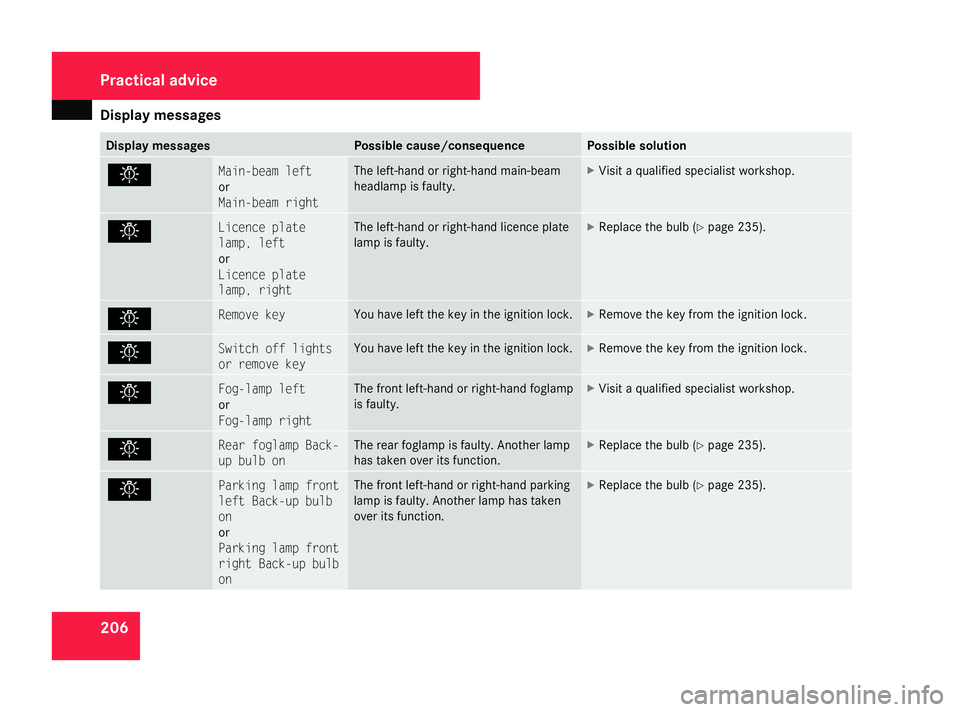
Display
messages 206 Display messages Possible cause/consequence Possible solution
. Main-beam left
or
Main-beam right The left-hand or right-hand main-beam
headlamp is fa
ulty. X
Visit a qualified specialist workshop. . Licence plate
lamp, left
or
Licence plate
lamp, right The left-hand or right-hand licence plate
lamp is faulty. X
Replace the bulb (Y page 235).. Remove key You have left the key in the ignition lock. X
Remove the key from the ignition lock. . Switch off lights
or remove key You have left the key in the ignition lock. X
Remove the key from the ignition lock. . Fog-lamp left
or
Fog-lamp right The front left-hand or right-hand foglamp
is faulty. X
Visit a qualified specialist workshop. . Rear foglamp Back-
up bulb on The rear foglamp is faulty. Another lamp
has taken over its function. X
Replace the bulb (Y page 235).. Parking lamp front
left Back-up bulb
on
or
Parking lamp front
right Back-up bulb
on The front left-hand or right-hand parking
lamp is faulty. Another lamp has taken
over its function. X
Replace the bulb (Y page 235).Practical advice
463_AKB; 1; 8, en-GB
wobuchh,
Version: 2.10.6 2008-07-17T15:19:41+02:00 - Seite 206Dateiname: 6515_4091_02_buchblock.pdf; preflight