tow MERCEDES-BENZ G-CLASS SUV 2014 Repair Manual
[x] Cancel search | Manufacturer: MERCEDES-BENZ, Model Year: 2014, Model line: G-CLASS SUV, Model: MERCEDES-BENZ G-CLASS SUV 2014Pages: 272, PDF Size: 39.13 MB
Page 251 of 272
Bead
The tire bead ensures that the tire sits
securely on the wheel. There are several steel
wires in the bead to prevent the tire from
coming loose from the wheel rim.
Sidewall The part of the tire between the tread and the
bead.
Weight of optional extras The combined weight of those optional extras
that weigh more than the replaced standard
parts and more than 2.3 kg (5 lbs). These
optional extras, such as high-performance
brakes, level control, a roof rack or a high-
performance battery, are not included in the
curb weight and the weight of the
accessories.
TIN (Tire Identification Number) This is a unique identifier which can be used
by a tire manufacturer to identify tires, for
example for a product recall, and thus identify
the purchasers. The TIN is made up of the
manufacturer's identity code, tire size, tire
type code and the manufacturing date.
Load bearing index The load bearing index (also load index) is a
code that contains the maximum load bearing
capacity of a tire.
Traction Traction is the result of friction between the
tires and the road surface.
TWR (Tongue Weight Rating)
The TWR specifies the maximum permissible
weight that the ball coupling of the trailer tow
hitch can support. Treadwear indicators Narrow bars (tread wear bars) that are
distributed over the tire tread. If the tire tread
is level with the bars, the wear limit of
áin
(1.6 mm) has been reached.
Occupant distribution The distribution of occupants in a vehicle at
their designated seating positions.
Total load limit
Nominal load and luggage load plus 150 lbs
(68 kg) multiplied by the number of seats in
the vehicle.
Changing a wheel
Flat tire
The "Breakdown assistance" section
(Y page 214) contains information and notes
on how to deal with a flat tire. Rotating the wheels
G
WARNING
Rotate front and rear wheels only if the tires
are of the same dimension.
If your vehicle is equipped with mixed-size
tires (different tire dimensions front vs. rear),
tire rotation is not possible. G
WARNING
Have the tightening torque checked after
changing a wheel. The wheels could come
loose if they are not tightened to a torque of
96 lb-ft (130 Nm).
Only use genuine Mercedes-Benz wheel bolts
specified for your vehicle's rims.
! On vehicles equipped with a tire pressure
monitor, electronic components are
located in the wheel. Changing a wheel
249Wheels and tires Z
Page 255 of 272
G
WARNING
Only use genuine Mercedes-Benz wheel bolts.
Other wheel bolts may come loose.
Do not tighten the wheel bolts when the
vehicle is raised. Otherwise, the vehicle could
fall off the jack.
! To prevent damage to the paintwork, hold
the wheel securely against the wheel hub
while screwing in the first wheel bolt.
Always pay attention to the instructions and
safety notes in the "Changing a wheel"
section (Y page 249).
X Clean the wheel and wheel hub contact
surfaces.
X Place the new wheel on the wheel hub and
push it on.
X Tighten the wheel bolts until they are
finger-tight.
Lowering the vehicle G
WARNING
The wheels could work loose if the wheel nuts
and bolts are not tightened to the specified
tightening torque. There is a risk of accident.
Have the tightening torque immediately
checked at a qualified specialist workshop
after a wheel is changed. X
Open the pressure release screw on the
jack using the pump lever (Y page 251) by
approximately one turn.
X Lower the vehicle until it is once again
standing firmly on the ground. X
Place the jack to one side.
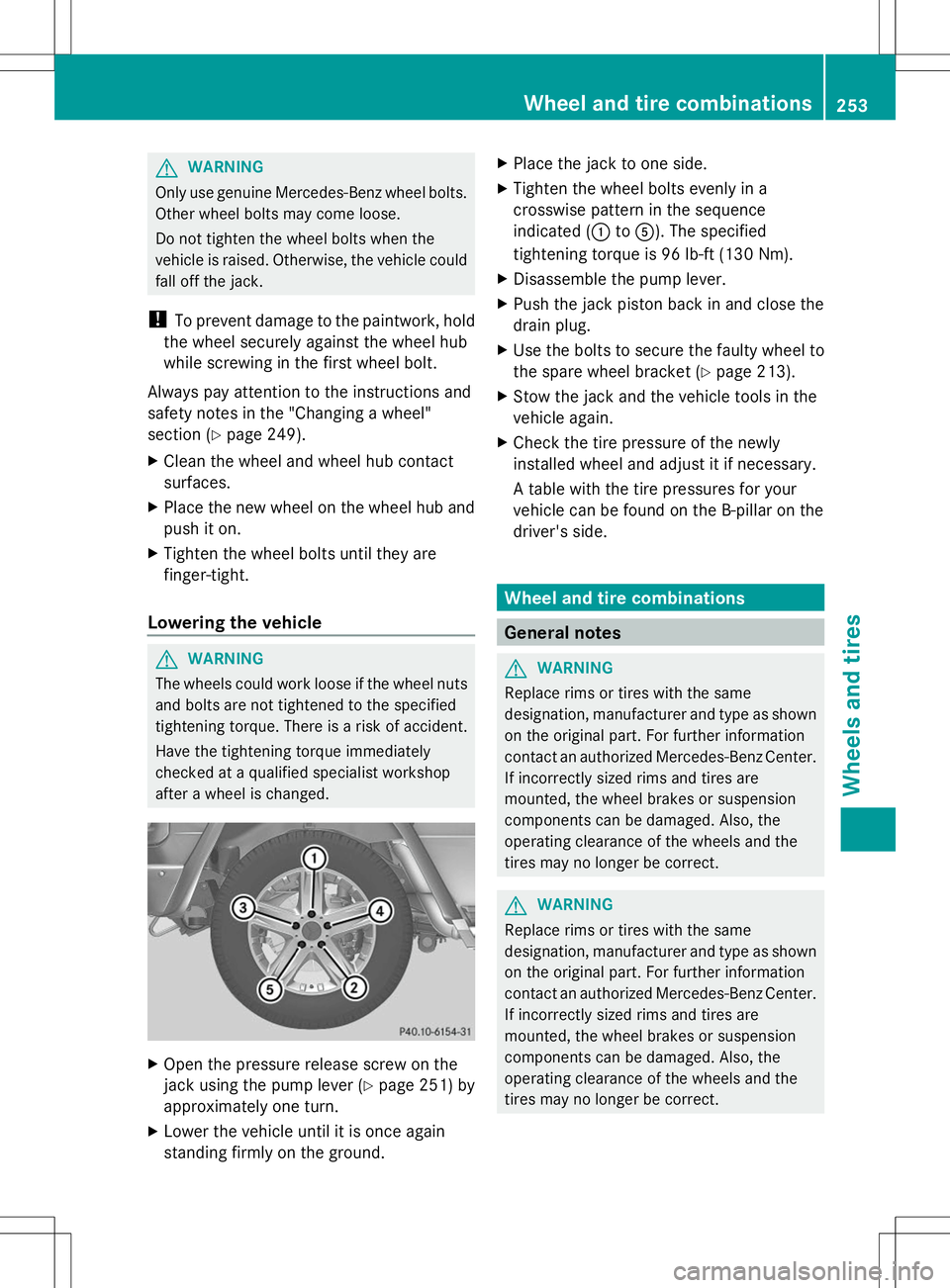
X Tighten the wheel bolts evenly in a
crosswise pattern in the sequence
indicated (: toA). The specified
tightening torque is 96 lb-ft (130 Nm).
X Disassemble the pump lever.
X Push the jack piston back in and close the
drain plug.
X Use the bolts to secure the faulty wheel to
the spare wheel bracket (Y page 213).
X Stow the jack and the vehicle tools in the
vehicle again.
X Check the tire pressure of the newly
installed wheel and adjust it if necessary.
A table with the tire pressures for your
vehicle can be found on the B-pillar on the
driver's side. Wheel and tire combinations
General notes
G
WARNING
Replace rims or tires with the same
designation, manufacturer and type as shown
on the original part. For further information
contact an authorized Mercedes-Benz Center.
If incorrectly sized rims and tires are
mounted, the wheel brakes or suspension
components can be damaged. Also, the
operating clearance of the wheels and the
tires may no longer be correct. G
WARNING
Replace rims or tires with the same
designation, manufacturer and type as shown
on the original part. For further information
contact an authorized Mercedes-Benz Center.
If incorrectly sized rims and tires are
mounted, the wheel brakes or suspension
components can be damaged. Also, the
operating clearance of the wheels and the
tires may no longer be correct. Wheel and tire combinations
253Wheels and tires Z
Page 256 of 272
G
WARNING
If you notice sudden significant vibrations or
unusual handling performance or if you
suspect that damage has occurred to the
vehicle, you should activate the hazard
warning lamps, gently reduce speed and
carefully head for an area that is located at a
safe distance from the road.
Check the tires and the underside of the
vehicle for damage. If the vehicle seems
unsafe, have the vehicle towed away to the
nearest Mercedes-Benz Center or tire dealer
to be repaired. G
WARNING
Do not drive with a flat tire. A flat tire affects
the ability to steer or brake the vehicle. You
might lose control of the vehicle. Continued
driving with a flat tire or driving at high speed
with a flat tire will cause excessive heat build-
up and possibly a fire.
! For safety reasons, Mercedes-Benz
recommends that you only use tires,
wheels and accessories which have been
approved by Mercedes-Benz specifically
for your vehicle. These tires have been
specially adapted for use with the driving
safety systems, such as ABS or ESP ®
.
Only use tires, wheels or accessories
tested and approved by Mercedes-Benz.
Certain characteristics, e.g. handling,
vehicle noise emissions or fuel
consumption, may otherwise be adversely
affected. In addition, when driving with a
load, tire dimension variations could cause
the tires to come into contact with the
bodywork and axle components. This could
result in damage to the tires or the vehicle.
Mercedes-Benz accepts no liability for
damage resulting from the use of tires,
wheels or accessories other than those
tested and approved.
Further information about wheels, tires and
approved combinations can be obtained from any authorized Mercedes-Benz
Center.
i The recommended pressures for various
operating conditions can be found:
R on the Tire and Loading Information
placard with the recommended tire
pressures on the B-pillar on the driver's
side
R in the tire pressure table on the inside of
the fuel filler flap
Observe the notes on recommended tire
pressure under various operating
conditions.
Check tire pressures regularly, and only
when the tires are cold. Comply with the
maintenance recommendations of the tire
manufacturer in the vehicle document
wallet.
Further information on recommended tire
pressures as well as tire pressures for
specific driving situations, see (Y page 247).
i Notes on the vehicle equipment – always
equip the vehicle with:
R tires of the same size on a given axle
(left/right)
R tires of the same type on your vehicle at
a given time (summer tires, winter tires,
all-weather tires, all-terrain tires)
i The following pages contain information
on approved wheels and tire sizes for
equipping your vehicle with winter tires.
Winter tires are not available at the factory
as standard equipment or optional extras.
If you want to equip your vehicle with
approved winter tires, it may be necessary
to obtain wheel rims in the corresponding
size. The size of the approved winter tires
may differ from the standard tires. This is
dependent on the model and the
equipment installed at the factory.
The tires and wheel rims, as well as further
information, can be obtained at a qualified
specialist workshop. 254
Wheel and tire combinationsWheels and tires
Page 259 of 272
Useful information
............................258
Identification plates .........................258
Service products and filling capaci-
ties ..................................................... 258
Vehicle data ...................................... 264
Vehicle data for off-road driving .....264
Trailer tow hitch ................................ 265 257Technical data
Page 263 of 272
For a list of approved products, consult an
authorized Mercedes-Benz Center. Comply
with the instructions for use on the product
label.
Do not mix other fuel additives with fuel. This
causes unnecessary costs and could damage
the engine.
Notes on fuel consumption H
Environmental note
CO 2(carbon dioxide) is the gas which
scientists believe to be principally responsible
for global warming (the greenhouse effect).
Your vehicle's CO 2emissions are directly
related to fuel consumption and therefore
depend on:
R efficient use of the fuel by the engine
R driving style
R other non-technical factors, such as
environmental influences, road conditions
or traffic flow
You can minimize your vehicle's CO 2
emissions by driving carefully and having it
serviced regularly.
The vehicle will use more fuel than usual in
the following situations:
R at very low outside temperatures
R in city traffic
R on short journeys
R in mountainous terrain
R when towing a trailer Engine oil
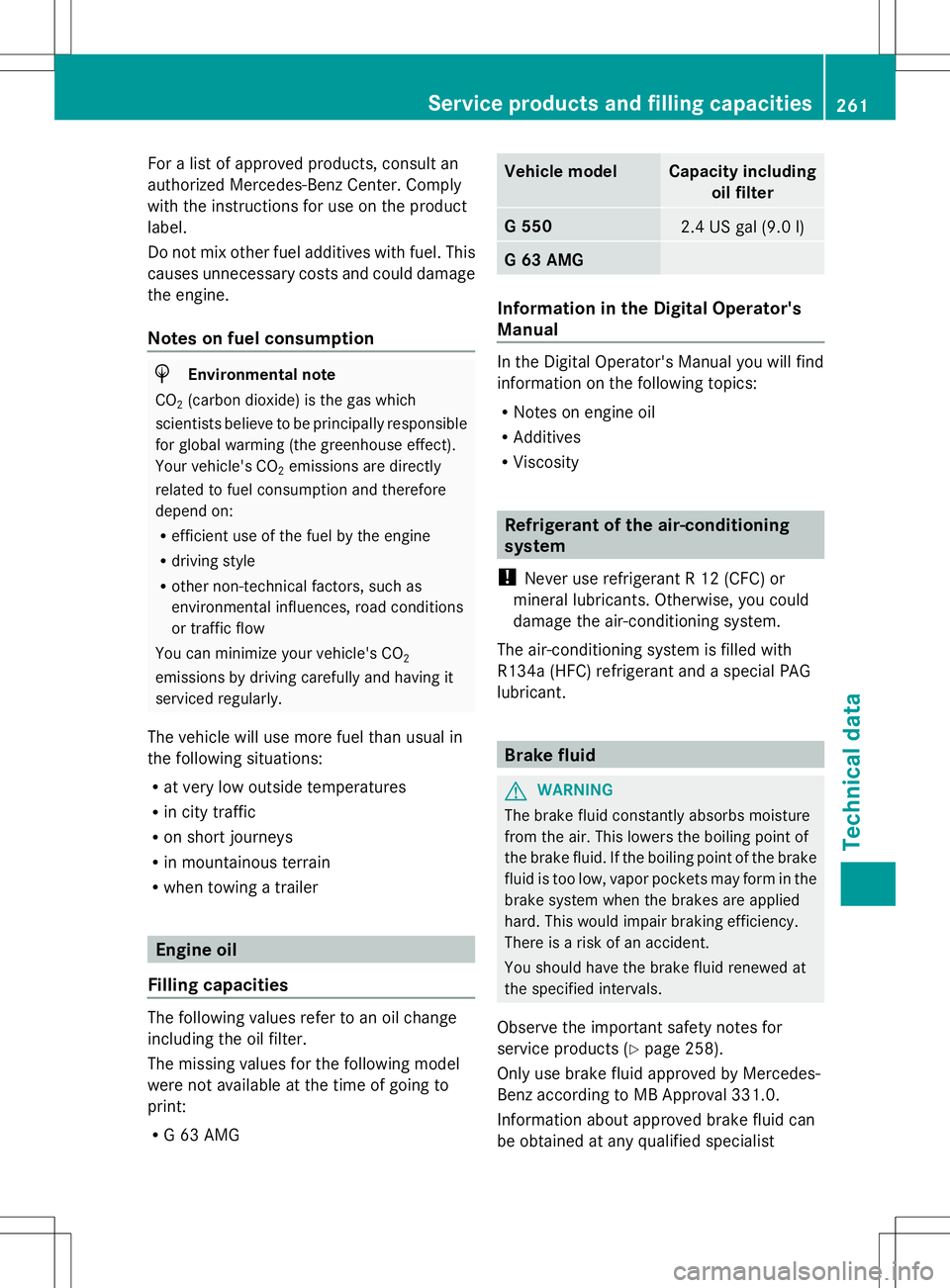
Filling capacities The following values refer to an oil change
including the oil filter.
The missing values for the following model
were not available at the time of going to
print:
R
G 63 AMG Vehicle model Capacity including
oil filter G 550
2.4 US gal (9.0 l)
G 63 AMG
Information in the Digital Operator's
Manual
In the Digital Operator's Manual you will find
information on the following topics:
R
Notes on engine oil
R Additives
R Viscosity Refrigerant of the air-conditioning
system
! Never use refrigerant R 12 (CFC) or
mineral lubricants. Otherwise, you could
damage the air-conditioning system.
The air-conditioning system is filled with
R134a (HFC) refrigerant and a special PAG
lubricant. Brake fluid
G
WARNING
The brake fluid constantly absorbs moisture
from the air. This lowers the boiling point of
the brake fluid. If the boiling point of the brake
fluid is too low, vapor pockets may form in the
brake system when the brakes are applied
hard. This would impair braking efficiency.
There is a risk of an accident.
You should have the brake fluid renewed at
the specified intervals.
Observe the important safety notes for
service products (Y page 258).
Only use brake fluid approved by Mercedes-
Benz according to MB Approval 331.0.
Information about approved brake fluid can
be obtained at any qualified specialist Service products and filling capacities
261Technical data Z
Page 267 of 272
possible fording depth is less in flowing
water.
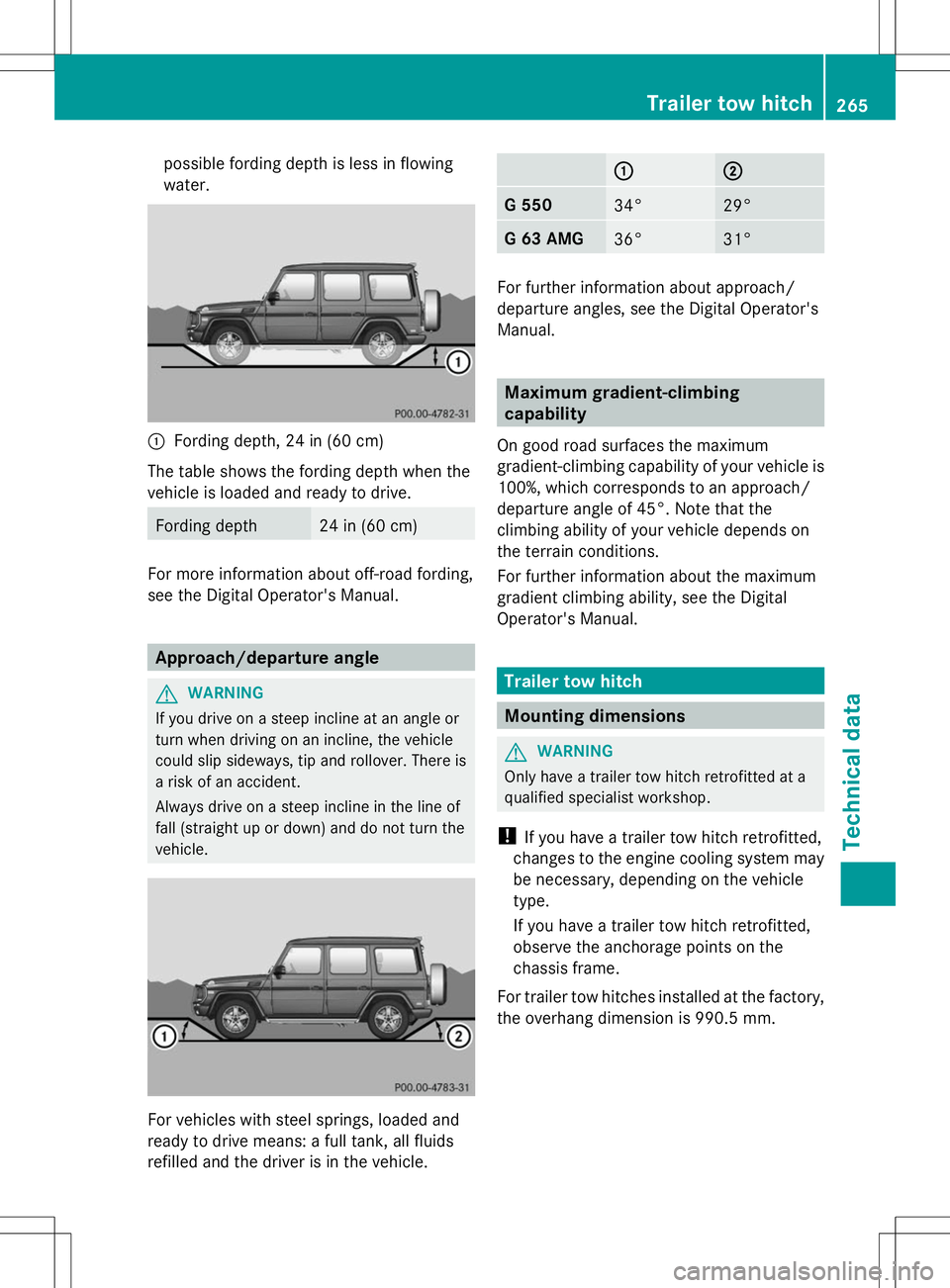
:
Fording depth, 24 in (60 cm)
The table shows the fording depth when the
vehicle is loaded and ready to drive. Fording depth 24 in (60 cm)
For more information about off-road fording,
see the Digital Operator's Manual.
Approach/departure angle
G
WARNING
If you drive on a steep incline at an angle or
turn when driving on an incline, the vehicle
could slip sideways, tip and rollover. There is
a risk of an accident.
Always drive on a steep incline in the line of
fall (straight up or down) and do not turn the
vehicle. For vehicles with steel springs, loaded and
ready to drive means: a full tank, all fluids
refilled and the driver is in the vehicle. : : ;
;
G 550
34° 29°
G 63 AMG
36° 31°
For further information about approach/
departure angles, see the Digital Operator's
Manual.
Maximum gradient-climbing
capability
On good road surfaces the maximum
gradient-climbing capability of your vehicle is
100%, which corresponds to an approach/
departure angle of 45°. Note that the
climbing ability of your vehicle depends on
the terrain conditions.
For further information about the maximum
gradient climbing ability, see the Digital
Operator's Manual. Trailer tow hitch
Mounting dimensions
G
WARNING
Only have a trailer tow hitch retrofitted at a
qualified specialist workshop.
! If you have a trailer tow hitch retrofitted,
changes to the engine cooling system may
be necessary, depending on the vehicle
type.
If you have a trailer tow hitch retrofitted,
observe the anchorage points on the
chassis frame.
For trailer tow hitches installed at the factory,
the overhang dimension is 990.5 mm. Trailer tow hitch
265Technical data Z
Page 268 of 272
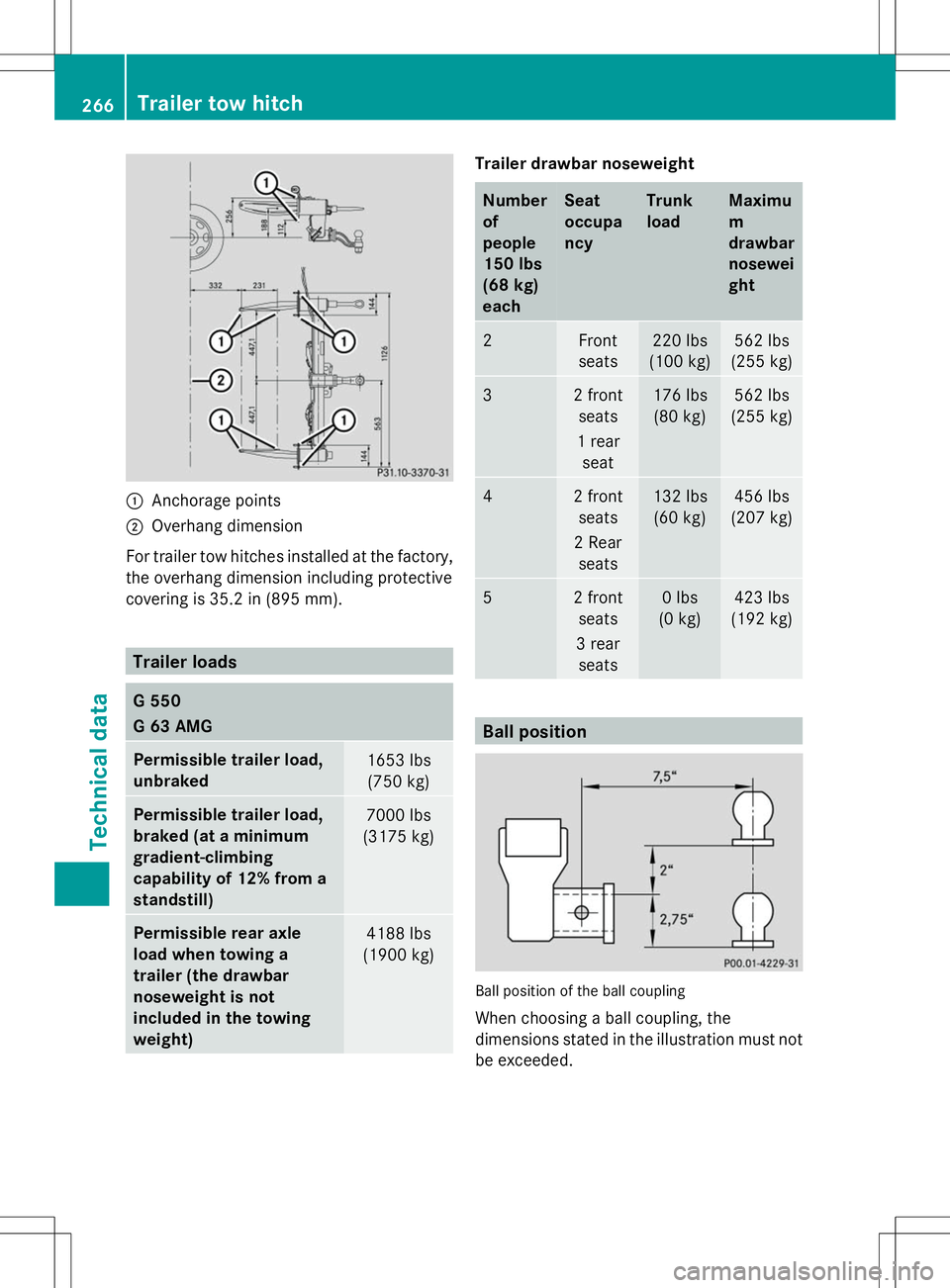
:
Anchorage points
; Overhang dimension
For trailer tow hitches installed at the factory,
the overhang dimension including protective
covering is 35.2 in (895 mm). Trailer loads
G 550
G 63 AMG
Permissible trailer load,
unbraked
1653 lbs
(750 kg) Permissible trailer load,
braked (at a minimum
gradient-climbing
capability of 12% from a
standstill)
7000 lbs
(3175 kg) Permissible rear axle
load when towing a
trailer (the drawbar
noseweight is not
included in the towing
weight)
4188 lbs
(1900 kg) Trailer drawbar noseweight
Number
of
people
150 lbs
(68 kg)
each Seat
occupa
ncy Trunk
load Maximu
m
drawbar
nosewei
ght
2 Front
seats 220 lbs
(100 kg) 562 lbs
(255 kg) 3 2 front
seats
1 rear seat 176 lbs
(80 kg) 562 lbs
(255 kg) 4 2 front
seats
2 Rear seats 132 lbs
(60 kg) 456 lbs
(207 kg) 5 2 front
seats
3 rear seats 0 lbs
(0 kg) 423 lbs
(192 kg) Ball position
Ball position of the ball coupling
When choosing a ball coupling, the
dimensions stated in the illustration must not
be exceeded.266
Trailer tow hitchTechnical data