sensor MERCEDES-BENZ GL SUV 2012 User Guide
[x] Cancel search | Manufacturer: MERCEDES-BENZ, Model Year: 2012, Model line: GL SUV, Model: MERCEDES-BENZ GL SUV 2012Pages: 441, PDF Size: 10.66 MB
Page 55 of 441
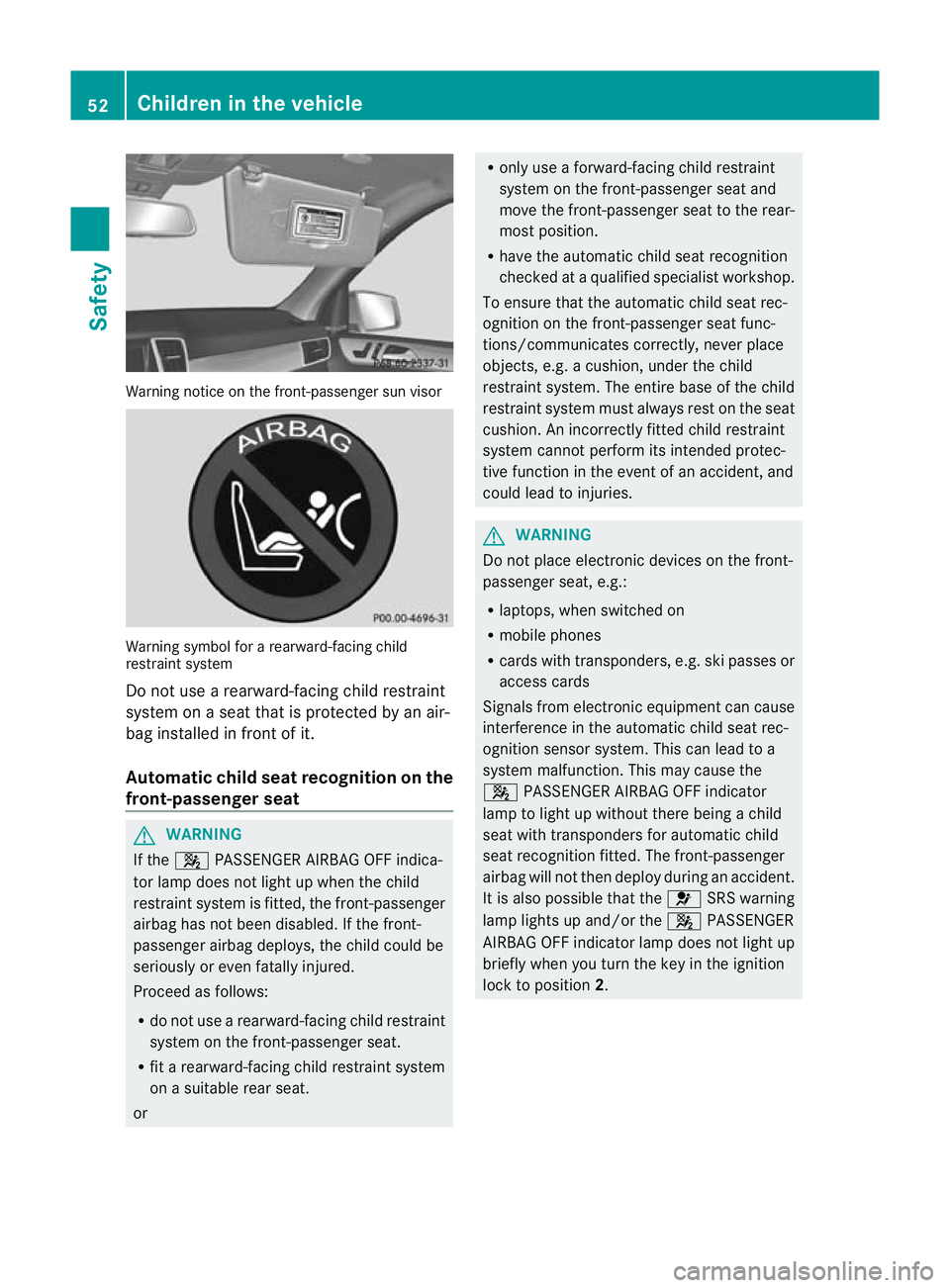
Warning notice on the front-passenger sun visor
Warning symbol for
arearward-facin gchild
rest raint system
Do not use arearward-facin gchild rest raint
system on aseat that is protected by an air-
bag installed in fron tofit.
Automatic chil dseat recognition on the
front-passenger seat G
WARNING
If the 4 PASSENGE RAIRBA GO FF indica-
tor lamp does not light up whe nthe child
restraint system is fitted, the fr ont-passenger
airbag has not been disabled. If the fr ont-
pa ssenger airbag deploys, the chil dcould be
seriou slyor even fatally injured.
Proceed as follows:
R do not use arearward-facin gchild restraint
system on the fr ont-passengers eat.
R fit arearward-facing child restraint system
on asuitable rear seat.
or R
only use aforward-facing child rest raint
system on the front-passenger seat and
move the front-passenger seat to the rear-
most position.
R have the automatic child seat recognition
checked at aqualified specialist workshop.
To ensure that the automatic child seat rec-
ognition on the front-passenger seat func-
tions/communicates correctly, never place
objects, e.g. acushion, under the child
restraint system. The entire base of the child
restraint system must alway srest on the seat
cushion. An incorrec tlyf itted child restraint
system cannot perfor mits intended protec-
tive function in the event of an accident, and
could lead to injuries. G
WARNING
Do not place electronic devices on the front-
passenger seat, e.g.:
R laptops, when switched on
R mobile phones
R cards with transponders, e.g. ski passes or
access cards
Signals from electronic equipment can cause
interference in the automatic child seat rec-
ognition sensor system. Thi scan lead to a
system malfunc tion. This may cause the
4 PASSENGER AIRBA GOFF indicator
lamp to light up without there being achild
seat with transponder sfor automatic child
seat recognition fit ted. The front-passenger
airba gwill not then deploy during an accident.
It is also possible that the 6SRS warning
lamp lights up and/or the 4PASSENGER
AIRB AGOFF indicator lam pdoes not light up
briefly when you tur nthe key in the ignition
lock to position 2.52
Children in th
evehicleSafety
Page 56 of 441
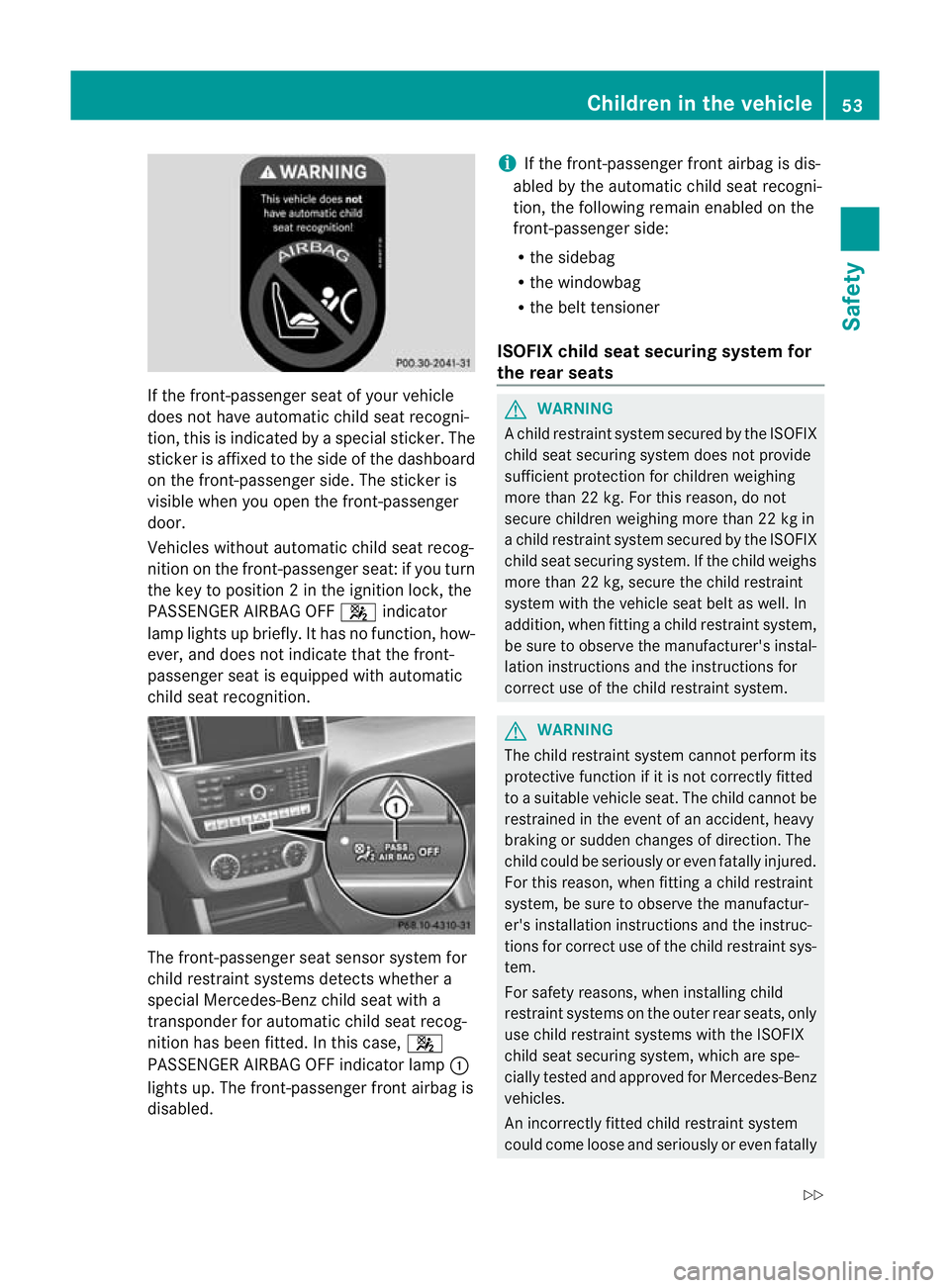
If th
efront-passenger seat of yo urvehicle
does no thave automatic child seat recogni-
tion, this is indicated by aspecial sticker. The
sticker is affixed to the side of the dashboard
on the front-passenger side. The sticker is
visible when you open the front-passenger
door.
Vehicles without automatic child seat recog-
nition on the front-passenger seat: if you turn
the key to position 2inthe ignition lock ,the
PAS SENG ER AIRBAG OFF 4indicator
lamp lights up briefly. It has no function, how-
ever, and doe snot indicate that the front-
passenger seat is equipped with automatic
child seat recognition. The front-passenger seat sensor system for
child restraint system
sdetect swhether a
special Mercedes-Ben zchild seat with a
transpo nder for automatic child seat recog-
nition has been fitted. In this case, 4
PASSENGER AIRBA GOFF indicato rlamp :
lights up. The front-passenger front airbag is
disabled. i
If the front-passenger front airbag is dis-
abled by the automatic child seat recogni-
tion, the following remain enabled on the
front-passenger side:
R the sidebag
R the windowbag
R the belt tensioner
ISOFI Xchilds eat securing system for
the rear seats G
WARNING
Ac hild restraint system secured by the ISOFIX
chil dseat securing system does not provide
sufficien tprotection for children weighing
more than 22 kg. For this reason, do not
secure children weighing more than 22 kg in
ac hild restraint system secured by the ISOFIX
chil dseat securing system. If the child weighs
mor ethan 22 kg, secur ethe chil drestraint
system with the vehicle seat belt as well. In
addition ,when fittin gachild restraint system,
be sur etoobservethe manufacturer' sinstal-
latio ninstructions and the instructions for
correct use of the child restraint system. G
WARNING
The child restraint system cannot perform its
protective function if it is not correctly fitted
to as uitable vehicle seat. The child cannot be
restrained in the event of an accident, heavy
braking or sudde nchanges of direction. The
chil dcould be seriously or even fatally injured.
For this reason, when fittin gachild restraint
system ,besure to observe the manufactur-
er's installatio ninstructions and the instruc-
tions for correct use of the child restraint sys-
tem.
For safety reasons, whe ninstalling child
restraint systems on the outer rear seats, only
use child restraint systems with the ISOFIX
child sea tsecuring system, which are spe-
ciall ytested and approved for Mercedes-Benz
vehicles.
An incorrectly fitted child restraint system
could com eloose and seriously or even fatally Children in the vehicle
53Safety
Z
Page 65 of 441
BAS (Brak
eAssis tSystem)
i Observet he "Imp ortant safety notes "sec-
tion (Y page 61). G
WARNING
If BAS is malfunctioning, the braking distance
in an emergency braking situation is
increased .There is arisk of accident.
In an emergenc ybraking situa tion, depress
the bra kepedal with full force. AB Sprevents
th ew heels fr om locking.
BAS operate sinemergency brakin gsitua-
tions. If you depress the brake pedal quickly,
BAS automatically boosts the brakin gforce,
thus shortening the stoppin gdistance.
The brakes will func tion as usual onc eyou
release the brake pedal. BA Sisd eactivated. BAS PLUS (Brake Assist Syste
mPlus)
i Observe the "Importan tsafety notes" sec-
tion (Y page 61).
BAS PLUS is only available on vehicles with
DISTRONIC PLUS.
BAS PLUS provides braking assistance in haz-
ardous situations at speeds greater than
7k m/h and uses rad ar sensortechnology to
assess the traffic situation.
With the help of the rada rsensor system ,BAS
PLU Scan detect obstacles that are in the
path of your vehicle for an extended period of
time.
At speeds up to approximately 70 km/ h,BAS
PLUS may also det ects tationar yobstacles,
for example, stopped or parked vehicles.
To prevent afront-en dcollision, BA SPLUS
calculate sthe brake force necessary if:
R you approach an obstacle, and
R BA SP LUS ha sdetected arisk of collision
If you ar edriving at aspeed over
30 km/h:ify ou depress the brake sharply,
BA SP LUS automatically raise sthe brake
pressur etoavalue adapted to the traffic sit-
uation. If you are driving at
aspeed under
30 km/h:ify ou depress the brake, BA SPLUS
is activated. Braking will be carried ou tatthe
last possible moment.
If BA SPLUS demand sparticularly high brak-
ing force, preventative passenger protection
measures (PRE-SAFE ®
)a re activate dsimul-
taneously.
X Keep the brake pedal depressed until the
emergenc ybraking situatio niso ver.
ABS prevents th ewheels from locking.
BA SP LUS is deactivate dand the brakes func-
tion as usual ,if:
R you release th ebrake pedal.
R there is no longe rany danger of arear-end
collision.
R no obstacl eisdetected in front of your
vehicle.
If you have activated DSR (Y page 251), BAS
PLU Sisa lso deactivated.
The radar sensor system is switched off auto-
matically in the vicinit yofradio telescope
facilities in the following vehicles:
R vehicles with COMAND Online and naviga-
tion
R vehicles with Audio 20 and Becker ®
MAP
PILOT
Becker ®
MAP PILOT must be connected;
see the separate operating instructions.
The radar senso rsystem must be switched off
using the on-board computer in the vicinit yof
radio telescop efacilities in the following vehi-
cles:
R vehicles without COMAND Online and nav-
igation
R vehicles without Audio 20 and Becker ®
MAP PILOT
R vehicles for Australia
For information on switching off the radar
senso rsystem using the on-board computer,
see (Y page 283). 62
Driving safety systemsSafety
Page 66 of 441
For BAS PLUS to assis
tyou whe ndriving, the
rad ar se nsorsystem must:
R be switched on (Y page 283)
R be operational (Y page 298)
If the radar sensor syste mism alfunctioning,
BA SP LUS wi llnot be available. The brake
system is stil lavailable wit hcomplete brake
boostin geffect and BAS. G
WARNING
BAS PLUS canno talways clearly identify
objects and complex traffic situations. BAS
PLU Scannot intervene in these cases. There
is ar isk of an accident.
Always pay careful attention to the traffic sit-
uation and be ready to brake.
In partic ular,the detection of obstacles can
be im paired if there is:
R dirt on the sensors or anything else cov er-
ing the sensors
R snow or heavy rain
R interference by othe rradar sources
R the possibility of stron gradar reflections,
for example, in multi-storey car parks
R an arrow vehicle travellin ginfront,e.g. a
motorcycle
R av ehicle travel lingin fron tonad ifferent
line G
WARNING
BA SP LUSd oes no treact:
R to peopl eoranimals
R to oncomin gvehicles
R to crossin gtraffic
R when corneri ng
As aresult, BAS PLU Smay not intervene in all
critical situations. There is arisk of an acci-
dent.
Always pay careful attention to the traf fics it-
uation and be ready to brake.
Following damage to the fron tend of the vehi-
cle ,havet he configuration and operation of
the radar sensors checked at aqualified spe- cialist workshop. This also applie
stoc olli-
sions at slow speeds where ther eisnovisible
damage to the fron tofthe vehicle. COLLISION PREVENTION ASSIST
Genera lnotes COLLISION PREVENTION ASSIST consist
sof
Adaptive Brake Assist and the distance warn-
ing function, which are described in the fol-
lowing.
Distance warnin gfunction Important safety notes
i
Observe th e"Importan tsafety notes" sec-
tion (Y page 61). G
WARNING
The distance warning function does not react:
R to people or animals
R to oncomin gvehicles
R to crossing traffic
R when cornering
Thus, the distanc ewarning function cannot
provide awarning in all critical situations.
There is arisk of an accident.
Always pay careful attention to the traffic sit-
uation and be ready to brake.
The distance warnin gfunction cannot always
clearly identify objects and complex traffic
situations.
In such cases, the distance warning signal
may:
R give an unnecessary warning
R not give awarning
Always pay careful attention to the traffic sit-
uation, do not rely on the distance warning
function alone.
Function
X To activate/deactivate: activate or deac-
tivate the distance warning function in the
on-board computer (Y page 278). Driving safety systems
63Safety Z
Page 67 of 441
When the distan
cewarning function is acti-
vated, the multifunction display shows the
Ä symbol as long as the HOLD function is
not activated (Y page 211). On vehicles with
Active Parking Assist, the Äsymbol is dis-
played when position Pis engaged or you are
driving faster than 35 km/h.
The distanc ewarning function can help you
to minimise the risk of acollision with the
vehicle in fron torreduce the effects of such
ac ollision .Ifthe distanc ewarning function
detect sthat ther eisar isk of acollision ,you
will be warned visually and acoustically .The
distanc ewarning function cannot preven ta
collision without your inte rvention.
The distan cewarning function will issue a
warning at speed sofaround 30 km/h or
more if:
R thed istanc etothe vehicle in fron tist oo
short for the speed you ar edriving at for
severa lseconds. The ·distan cewarn-
ing lamp then lights up in the instrument
cluster.
R you are rapidly approaching the vehicle in
front. An intermittent warning ton ewill
then sound and the ·distanc ewarning
lamp will light up in the instrument cluster.
X Brak eimmediatel yinordertoi ncreas ethe
distanc efrom th evehicle in front.
or
X Take evasiv eactio nprovide ditiss afe to do
so.
For the distanc ewarning function to assist
you when driving, the function must be acti-
vated in the on-board computer and be opera-
tional (Y page 278).
Due to the nature of the system, particularly
complicated driving conditions may cause the
system to display an unnecessary warning.
With the help of the radar senso rsystem, the
distanc ewarning function can detect obsta-
cles that are in the path of your vehicle for an
extended period of time.
At speeds up to approximately 70 km/h, the
distance warning fun ction may also detect stationary obstacles, for example, stopped or
parked vehicles.
If you approach an obstacle and the distance
warnin gfunction detects arisk of acollision,
the system will initially aler tyou both visually
and acoustically.
In particular ,the detection of obstacles can
be impaired if ther eis:
R dir tont he sensors or anythin gelse cover-
ing the sensors
R snow or heavy rain
R interferenc ebyother radar sources
R the possibility of strong radar reflections,
for example, in multi-storey car parks
R an arro wvehicle travelling in front, e.g. a
motorcycle
R av ehicle travelling in fron tonadifferent
line
Following damage to the fron tend of the vehi-
cle ,havet he configuration and operation of
the radar sensor checked at aqualified spe-
cialist workshop. This also applie stoc olli-
sions at slow speeds where ther eisnovisible
damage to the fron tofthe vehicle.
Adaptive Brake Assist i
Observ ethe "Importan tsafety notes" sec-
tion (Y page 61). G
WARNING
Adaptive Brake Assist cannot always clearly
identify objects and complex traffic situa-
tions. In these cases, Adaptive Brake Assist
may not intervene. There is arisk of an acci-
dent.
Always pay careful attention to the traffic sit-
uation and be ready to brake. G
WARNING
Adaptive Brak eAssist does not react:
R to people or animals
R to oncomi ng vehicles
R to crossing traffic 64
Driving safety systemsSafety
Page 68 of 441
R
to stationary obstacles
R when cornering
As aresult, Adaptive Br akeA ssist may not
int ervene in al lcritica lconditions .There is a
risk of an accident.
Always pay carefu lattention to the traffic sit-
uation and be ready to brake.
Adaptive Brake Assist aids you in braking dur-
ing hazardous situations at speeds above
30 km/h and uses the radar sensor system
to evaluate the traffic situation.
With the hel pofthe adaptive Brake Assist ,the
distanc ewarning signal can detect obstacles
that are in the path of your vehicle for an
extended period of time.
Should you approach an obstacle and the
adaptive Brake Assis thas detected arisk of
collision, the adaptive Brake Assist calculates
the brakin gforc enecessar ytoavoidac olli-
sion with the vehicle in front .Should you
apply the brakes forcefully ,the adaptive
Brake Assist will automatically increase the
brakin gforc etoal evel suitable for the traffic
conditions.
X Keep the brak epedal depressed until the
emergency braking situation is over.
ABS prevents the wheels from locking.
The brakes will work normally again if:
R you release the brak epedal.
R there is no longer any danger of arear-end
collision.
R no obstacl eisdetected in front of your
vehicle.
Adaptive Brake Assist is then deactivated.
If adaptive Brake Assist demands particularly
high braking force, preventative passenger
protec tion measure s(PRE-SAFE ®
)a re activa-
ted simultaneousl y.
Up to vehicl espeeds of around 25 0km/h,
th ea daptiv eBrake Assist is capable of react-
ing to moving objects that have alread ybeen
recognised as such at least once over the
period of observation .Adaptiv eBrake Assist
does not react to stationary obstacles. If th
eadaptiv eBrake Assist is not available
du et oam alfunction in the radar senso rsys-
tem, the brake syste mremains available with
ful lbrake boostin geffect and BAS.
In particular, th edetection of obstacles can
be impaired if there is:
R dirt on the sensors or anything else cover-
ing the sensors
R snow or heavy rain
R interference by other rada rsources
R the possibility of stron gradar reflections,
for example, in multi-storey car parks
R an arrow vehicle travelling in front ,e.g. a
motorcycle
R av ehicle travelling in front on adifferent
line
Following damage to the front end of the vehi-
cle, have the configuration and operation of
the radar sensor checked at aqualified spe-
cialist workshop. This also applies to colli-
sions at slow speeds where there is no visible
damage to the front of the vehicle. Adaptive brake lamps
If you brake sharply from aspeed of more
than 50 km/ horifbraking is assisted by BAS
or BAS PLUS, th ebrake lamp sflash rapidly.
In this way, traffic travelling behind you is
warned in an even more noticeable manner.
If you brake sharply from aspeed of more
than 70 km/ htoastandstill, the hazard warn-
ing lamps are activated automatically .Ifthe
brakes ar eapplied again, the brak elamps
light up continuously .The hazard warning
lamps switc hoff automatically if you travel
faster than 10 km/h .You can also switc hoff
th eh azard warning lamps using the hazard
warning button (Y page 122). Driving safety systems
65Safety Z
Page 72 of 441
X
Brake immediatel yinorder to increas ethe
distanc efrom th evehicle in front.
or
X Take evasive actio nprovided it is safe to do
so.
From aspeed of approxim ately 7km/h ,ifthe
driver and passengers hav efastened their
seat belts, PRE-SAFE ®
Brake can brake the
vehicl eautom atically at speeds up to approx-
imatel y200 km/h.
Due to the nature of the sy stem, particu larly
comp licate ddriving conditions may cause
unneces sary warnings or th eunneces sary
interventi onof PRE-SAFE ®
Brake.
You can stop PRE-SAFE ®
Brake interventi on
at any time by:
R depressing the accelerato rpedal further
R activa ting kickdown
R releasing the brake pedal.
The braking action of PRE-SAFE ®
Brak eis
ended automatically if:
R you manoeuvr etoavoidthe obstacle.
R ther eisnol onger any danger of arear-end
collision.
R ther eisnol onger an obstacle detected in
fron tofy our vehicle.
If you have activa tedD SR (Y page 25 1)PRE-
SAFE ®
Brak eisa lso deactiva ted.
With the help of the rada rsensor system,
PRE- SAFE ®
Brake can detect obstacles that
are in front of your vehicle for an extended
period of time.
At speed suptoapproximately 70 km/h, PRE-
SAFE ®
Brak ecan also detect stationary
obstacles such as stopped or parked vehi-
cles.
If you approach an obstacle and PRE-SAFE ®
Brak edetects arisk of acollision ,the system
will aler tyou both visually and acoustically .If
you do not brake or take evasive action, the
syste mwill warn you by automatically braking
the vehicle gently. If ther eisanincreased risk
of collision, preventativ epassenger protec-
tion measures (PRE-SAFE ®
)a re activated (Y
page 45). If, at speeds ove r30km/h, arisk
of collision remains and you do not brake,
take evasive action or significantly acceler-
ate, automatic brakin gmay be performed up
to alevel of automatic emergency braking.
Automatic emergency brakin gisnot per-
formed until immediately prior to an accident
that can no longer be avoided. G
WARNING
PRE- SAFE®
Brake wil linitiall ybrake your vehi-
cle by apartial application of the brakes if a
danger of collisio nisd etected. There may be
ac ollision unless you also brake. Automatic
emergency brakin gcannot preven tacolli-
sion. There is arisk of an accident.
Always apply the brakes yourself and try to
take evasive action. G
WARNING
PRE-SAFE ®
Brak ecannot alway sclearly iden-
tify objects and complex traf ficc onditions.
In these cases, PRE- SAFE®
Brake may:
R give an unnecessary warning and then
brake the vehicle
R neithe rgive awarning nor intervene
There is arisk of an accident.
Always pay particular attention to the traf fic
situation and be ready to brake, especiall yif
PRE- SAFE®
Brake warns you. Terminate the
intervention in anon-critical driving situation.
In particular, the detection of obstacles can
be impaired if ther eis:
R dir tont he sensor soranything els ecover-
ing the sensors
R snow or heav yrain
R interference by other radar sources
R the possibility of strong radar reflections,
for example, in multi-storey car parks
R an arrow vehicle travellin ginfront, e.g .a
motorcycle
R av ehicle travellin ginfront on adifferent
line Drivin
gsafety systems
69Safety Z
Page 73 of 441
G
WARNING
PRE-SAFE ®
Brake does not react:
R to people or animals
R to oncoming vehicles
R to crossing traffic
R when cornering
As aresult, PRE-SAFE ®
Brake may neither
give warnings nor intervene in all critical sit-
uations. There is arisk of an accident.
Always pay caref ulattention to the traffic sit-
uation and be read ytobrake.
In order to maintai nthe appropriate distance
to the vehicle in front and thus preven tacol-
lision, you must apply the brake syourself.
X To activate/deactiva te:activate or deac-
tivate PRE-SAFE ®
Brake in the on-board
computer (Y page 278).
When PRE-SAFE ®
Brake is activated, the
Ä symbol appears in multifunction dis-
play ,asl ong as the HOL Dfunction is deac-
tivated (Y page 211). On vehicles with the
Active Parking Assis tdriving system, the
Ä symbo lisdisplayed when position P
is engaged or you are drivin gfaster than
35 km/h.
For PRE-SAFE ®
Brake to assis tyou when driv-
ing, the radar sensor system must be
switched on (Y page 283) and be opera-
tional.
The radar sensor system is switched off auto-
matically in the vicinit yofradio telescope
facilities in the following vehicles:
R vehicles with COMAND Online and naviga-
tion
R vehicles with Audio 20 and Becker ®
MAP
PILOT
Becker ®
MAP PILOT must be connected;
see the separate operating instructions. The radar senso
rsystem must be switched off
using the on-board computer in the vicinity of
radio telescope facilities in the following vehi-
cles:
R vehicles without COMAND Online and nav-
igation
R vehicles without Audio 20 and Becker ®
MAP PILOT
R vehicles for Australia
For information on switching off the radar
sensor syste musing the on-boar dcomputer,
see (Y page 283).
Following damage to the front end of the vehi-
cle, have the configuration and operation of
the radar sensor schecked at aqualified spe-
cialist workshop. This also applies to colli-
sions at slow speeds where there is no visible
damage to the front of the vehicle. STEER CONTROL
i Observe the "Important safety notes" sec-
tion (Y page 61).
STEE RCONTROL helps you by transmittin ga
noticeable steering force to the steering
wheel in the direction require dfor vehicle
stabilisation.
This steering suppor tisprovide dinparticular
if:
R both right wheel sorboth left wheels ar eon
aw et or slippery road surface when you
brake.
R the vehicle starts to skid.
If there is an ESP ®
malfunction ,you will not
receive any steering suppor tfrom STEER
CONTROL. Powe rsteering will ,however, con-
tinue to func tion. 70
Driving safety systemsSafety
Page 75 of 441
R
the doors are closed.
R the tailgate is closed.
Onl ythen is the tow-away protection
primed.
X Lock the vehicle with the key or KEYLESS-
GO.
Tow-awa yprotectio nisprimedafter
approximately 60 seconds.
Switchin goff X
To switc hoff wit hkey: unlock the vehicle
with the key.
or
X Insert the key into the ignition lock.
Tow-awa yprotectio nisswitched off auto-
matically.
X To switch off with KEYLESS-GO: unlock
the vehicle with KEYLESS-GO.
or
X Press the Start/Stop button on the dash-
board. The key must be inside the vehicle.
Tow-awa yprotectio nisswitched off auto-
matically.
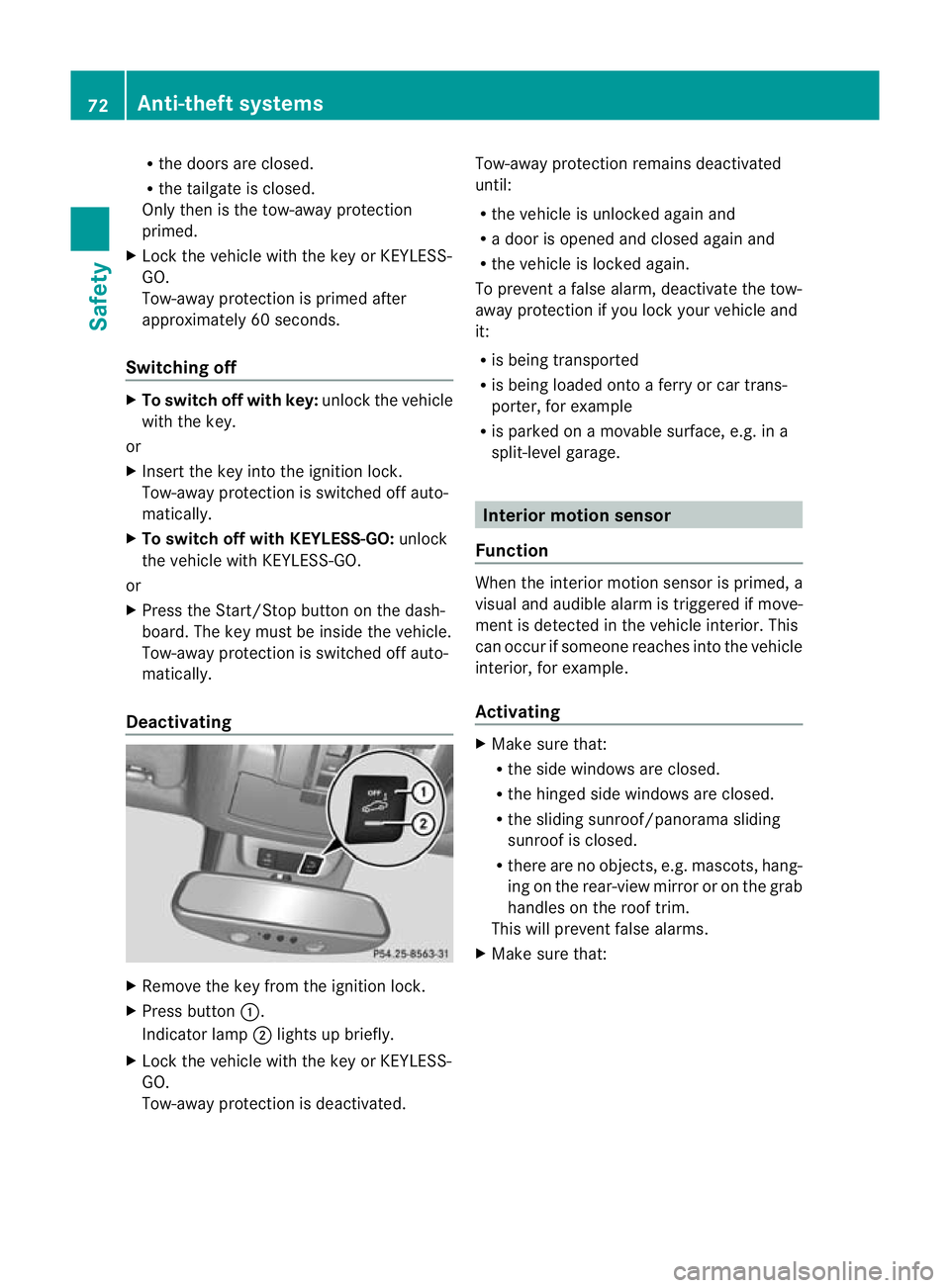
Deactivating X
Remove the key from the ignition lock.
X Press button :.
Indicator lamp ;lights up briefly.
X Lock the vehicle with the key or KEYLESS-
GO.
Tow-awa yprotectio nisdeactivated. Tow-away protec
tion remains deactivated
until:
R the vehicle is unlocked again and
R ad ooriso peneda nd closed agai nand
R the vehicl eislocked again.
To prevent afalse alarm, deactivate the tow-
away protection if yo uloc ky ourv ehicle and
it:
R is being transported
R is being loaded onto aferry or car trans-
porter, for example
R is parked on amovable surface, e.g. in a
split-level garage. Interio
rmotion sensor
Function When the interior motion sensor is primed, a
visual and audible alarm is triggered if move-
ment is detected in the vehicle interior
.This
can occur if someon ereaches into the vehicle
interior, for example.
Activating X
Make sure that:
R
the side windows are closed.
R the hinged side windows are closed.
R the sliding sunroof/panorama sliding
sunroof is closed.
R there are no objects, e.g. mascots, hang-
ing on the rear-view mirror or on the grab
handles on the roof trim.
This will prevent false alarms.
X Make sure that: 72
Anti-theft systemsSafety
Page 76 of 441
R
the sliding sunroof/panorama sliding
sunroo fisclosed.
R the doors are closed.
R the tailgate is closed.
Only then is the interior motion sensor
primed.
X Lock the vehicle with the key or KEYLESS-
GO.
The interior motion sensor is primed after
approximately 30 seconds.
Switching off X
To switch off with the key: unlock the
vehicle using the key.
or
X Insert the key into the ignition lock.
The interior motion sensor is switched off
automatically.
X To switch off with KEYLESS-GO: unlock
the vehicle using KEYLESS-GO.
or
X Press the Star t/Stopbutton on the dash-
board. The key must be inside the vehicle.
The interior motion senso riss witched off
automatically.
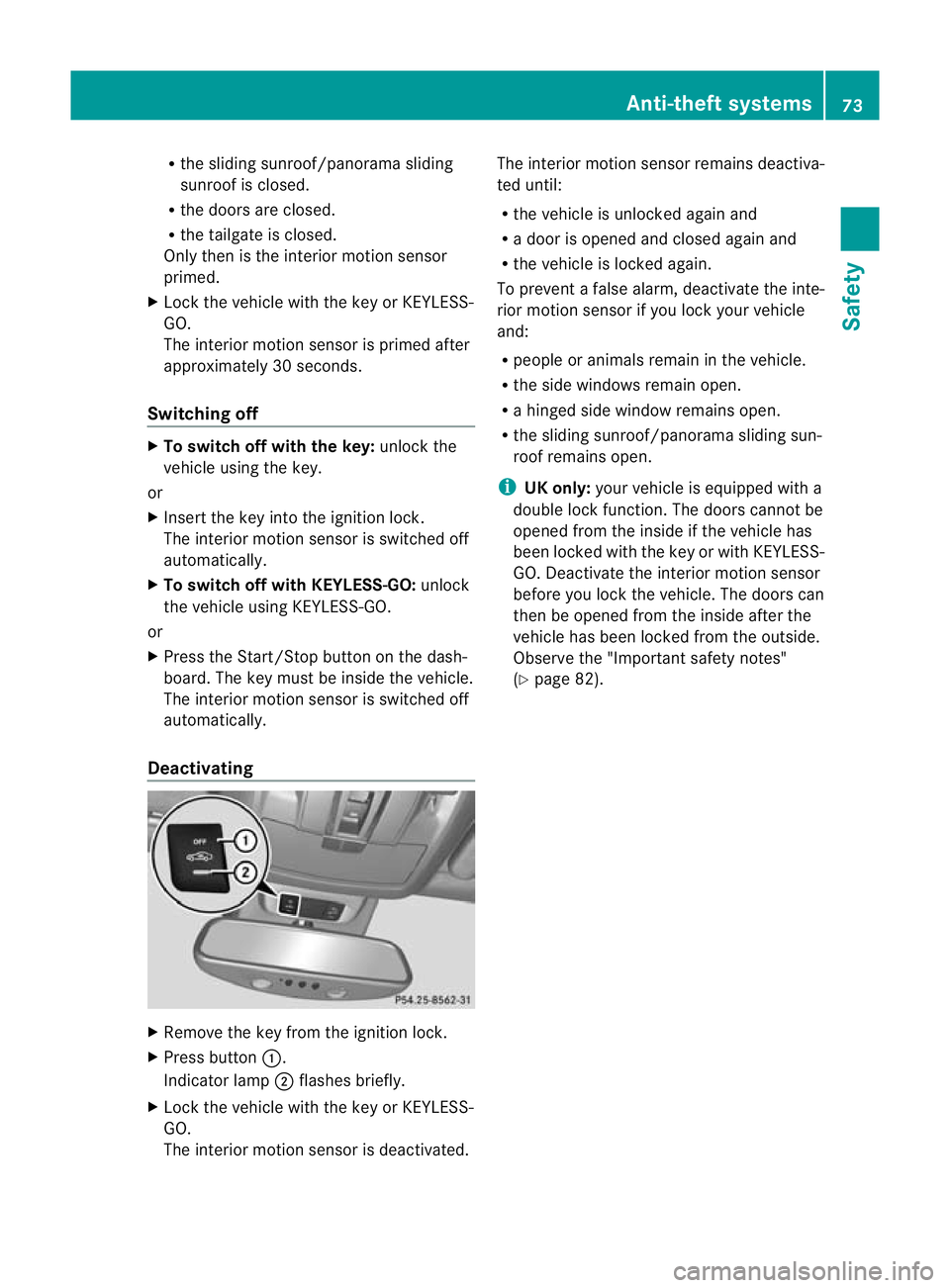
Deactivating X
Remove the key from the ignition lock.
X Press button :.
Indicator lamp ;flashes briefly.
X Lock the vehicle with the key or KEYLESS-
GO.
The interior motion sensor is deactivated. The interior motion sensor remains deactiva-
ted until:
R
the vehicle is unlocked agai nand
R ad ooriso peneda nd closed agai nand
R the vehicl eislocked again.
To prevent afalse alarm, deactivate the inte-
rio rm otion sensor if you lock your vehicle
and:
R people or animals remain in the vehicle.
R the side window sremai nopen.
R ah inged side window remains open.
R the sliding sunroof/panoram asliding sun-
roof remains open.
i UK only: your vehicle is equipped with a
double lock func tion. The doors can notbe
opened from the inside if the vehicle has
been locked with the key or with KEYLESS-
GO. Deac tivate the interior motion sensor
before you lock the vehicle .The doors can
then be opened from the insid eafter the
vehicl ehas been locked from the outside.
Observe the "Importan tsafety notes"
(Y page 82). Anti-thef
tsystems
73Safety Z