tow MERCEDES-BENZ GL SUV 2012 User Guide
[x] Cancel search | Manufacturer: MERCEDES-BENZ, Model Year: 2012, Model line: GL SUV, Model: MERCEDES-BENZ GL SUV 2012Pages: 441, PDF Size: 10.66 MB
Page 40 of 441
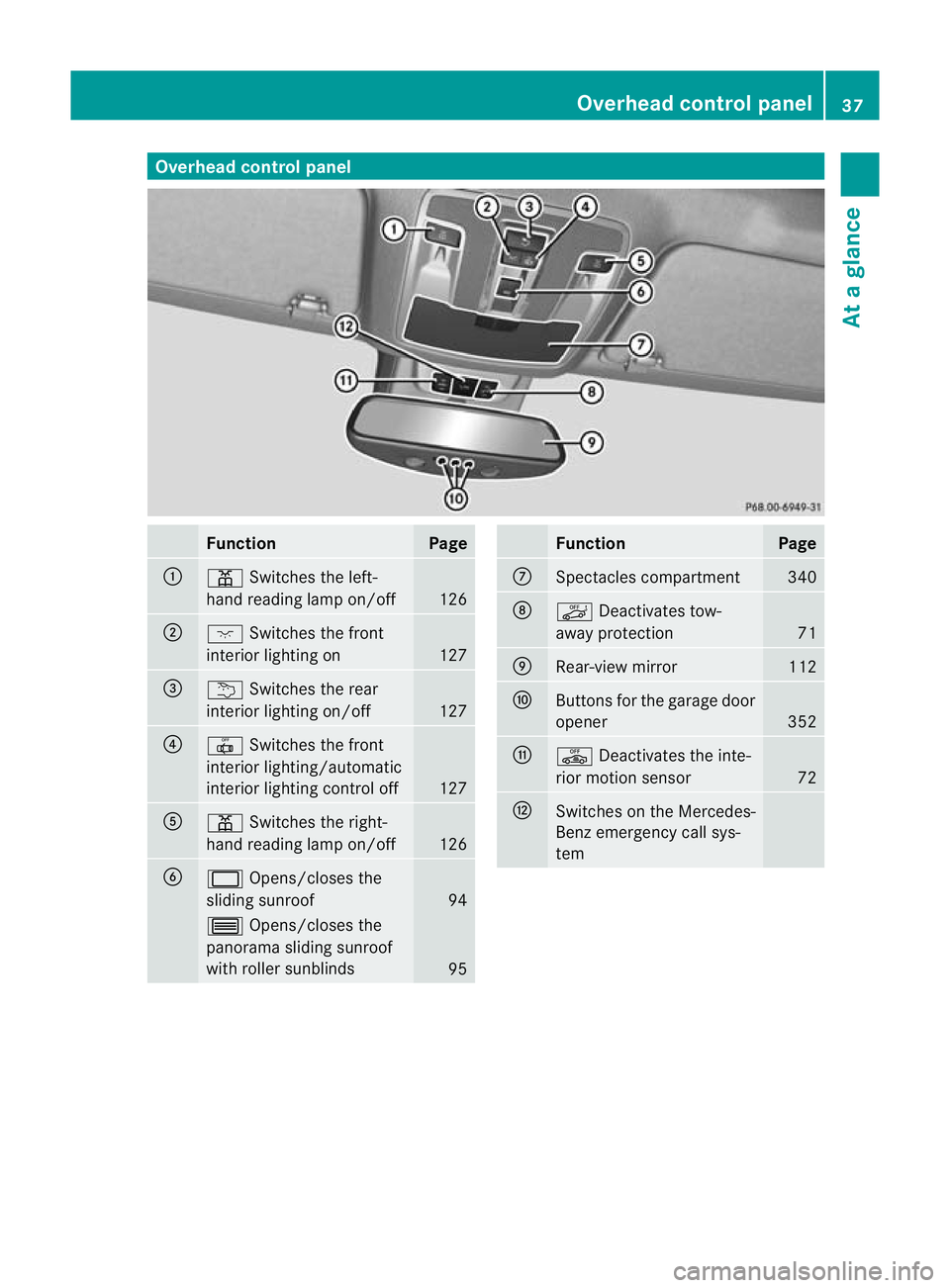
Overhea
dcontrol panel Function Page
:
p
Switche sthe left-
han dreadin glamp on/off 126
;
c
Switches the front
interior lighting on 127
=
u
Switches the rear
interior lighting on/off 127
?
|
Switches the front
interior lighting/automatic
interior lighting control off 127
A
p
Switches the right-
hand readin glamp on/off 126
B
2
Opens/close sthe
slidin gsunroof 94
3
Opens/close sthe
pano rama sliding sunroof
with rolle rsunblinds 95 Function Page
C
Spectacles compartment 340
D
ë
Deactivates tow-
away protection 71
E
Rear-view mirror 112
F
Button
sfor the garage door
opener 352
G
ê
Deactivates the inte-
rior motion sensor 72
H
Switches on the Mercedes-
Ben
zemergenc ycall sys-
tem Ov
erhead control panel
37Atag lance
Page 43 of 441
Usefu
linfor mati on
i This Owner's Manual describes all mod-
els, series and optional equipment for your
vehicle that were available at the time of
going to press. National variation sare pos-
sible. Note that your vehicl emay not be
equippe dwith all of the function sdescri-
bed. This is also the case for system sand
functions relevant to safety.
i Read the information on qualified special-
ist workshops: (Y page25). Occupan
tsafety Impo
rtantsafety notes G
WARNING
If service work is not carrie dout correctly, the
operatin gsafet yofyour vehicle may be affec-
ted. This coul dcause you to lose contro lof
your vehicle and cause an accident. More-
over, the safety syste ms maynolonger be
able to protect you or other sastheya re
designed to do.
Always have se rvicew ork carried out at a
qualified specialist workshop. G
WARNING
Modification stoorwork performed incor-
rectly on th efollowin gpartsc an result in the
restraint system snot functioning as in tended:
R ther estraint system, consisting of seat
belt sand their anchorage poi nts,belt ten-
sioners ,belt force limi ters and airbags
R the wiri ng
R networked ele ctronicsystems
Airbags and belt tensioners could fail to
deploy or be triggered in an accident despite
the deceleration for cebeing sufficien ttotrig-
ge rthe systems, or coul dbetriggered unin-
ten tionally. For this reason, never mak eany
modifications to the restraint systems.
Therefore, you must not tamper with elec-
tronic compone ntsort heir software. The seat belts, together with SRS (Supple-
men
talR estraint System), are complemen-
tary, co-ordinated restraint systems
(Y page 41). They reduc ethe risk of injury
in specific ,pre-defined types of accident sit-
uations and thereby increas eoccupant
safety. However, seat belts and airbags gen-
erall ydon ot protect against objec tspene-
tratin gthe vehicle from the outside.
To ensur ethat the restraint system scan
deliver their full potential protection, make
sure that:
R the seat and head restraint are adjusted
properly (Y page 100).
R the seat belt has been fastened properly
(Y page 47).
R the airbags can inflate unrestricted if
deployed (Y page 42).
R the steering wheel is adjusted properly
(Y page 100).
R the restraint systems have not been modi-
fied.
An airbag increases the protection of vehicle
occupant swearing aseat belt. However, air-
bags are only an additional restraint system
which complemen ts,b ut does not replace,
the seat belt. All vehicle occupant smust wear
their seat belt correctly at all times, even if
the vehicle is equipped with airbags. The air-
bags are not deployed in all types of acci-
dents. For example, if the protective capacity
of correctly fastened seat belts is not
increased by deploying the airbags, the air-
bags will not deploy.
Airbag deployment only provides increased
protection if the seat belt is worn correctly.
First ,the seat belt helps to keep the vehicle
occupan tinthe best position in relation to the
airbag. Second, in ahead-on collision ,for
example, the seat belt prevent sthe vehicle
occupan tfrom being propelled toward sthe
point of impact. 40
Occupant safetySafety
Page 51 of 441
Sea
tbelt adjustment The seat-belt adjustment func
tion adjusts the
driver's and front-passenger seat belt to the
upper body of the occupants.
The belt strap is tighte neds lightly when:
R you engage the belt tongue in the belt
buckle and you then turn the key to position
2in the ignition lock.
R the key is in position 2in the ignition lock
and you then engage the belt tongue in the
buckle.
The seat-belt adjustment will apply acertain
tightening force if any slack is detected
between the occupant and the seat belt. Do
not hold on to the seat belt tightly while it is
adjusting. You can switch the seat-belt
adjustmen tonand off in the on-board com-
puter (Y page285).
Th es eat-belt adjustmen tisani ntegral part of
the PRE-SAFE ®
convenience function. More
information abou tPRE-SAFE ®
can be found
under "PRE-SAFE ®
(preventative occupant
protection)" (Y page 45).
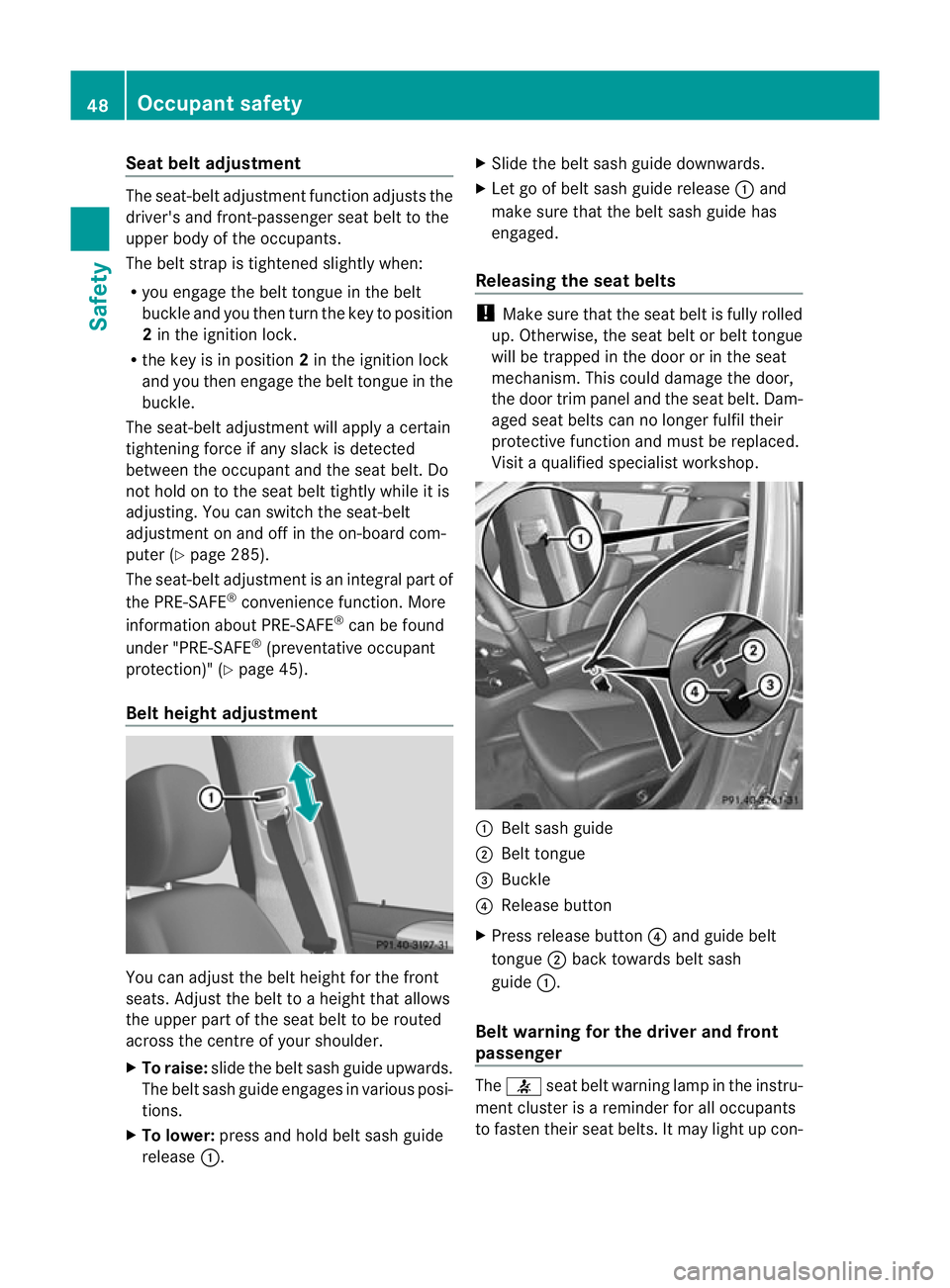
Belt height adjustment You can adjust the belt height for the front
seats
.Adjust the belt to aheight that allows
the upper part of the seat belt to be routed
across the centre of your shoulder.
X To raise: slide the belt sash guide upwards.
The belt sash guide engages in various posi-
tions.
X To lower: press and hold belt sash guide
release :. X
Slide the belt sash guide downwards.
X Let go of belt sash guide release :and
mak esure that the belt sash guide has
engaged.
Releasing the seat belts !
Make sure that the seat belt is fully rolled
up. Otherwise, the seat belt or belt tongue
will be trapped in the door or in the seat
mechanism. This could damage the door,
the door trim panel and the seat belt. Dam-
aged seat belts can no longer fulfil their
protective function and must be replaced.
Visit aqualified specialist workshop. :
Belt sash guide
; Belt tongue
= Buckle
? Release button
X Press release button ?and guide belt
tongue ;back towards belt sash
guide :.
Belt warning for the driver and front
passenger The
7 seat belt warning lamp in the instru-
ment cluster is areminder for all occupants
to fasten their seat belts. It may light up con- 48
Occupant safetySafety
Page 53 of 441
The seat belts on the following seats have belt
tensioner
sand bel tforc elimiters:
R driver's and front-passenger seat
R the outer seats in the second row
R the seats in the third row
The belt tensioners tighten the seat belts in
an accident ,pulling them close against the
body.
Belt tensioners do not correc tincorrect seat
positions or incorrectly fastened sea tbelts.
Belt tensioners do not pull vehicle occupants
back towards the backrest.
If the seat belt is also fit tedw ithabelt force
limiter and this is triggered, the force exer ted
by the seat belt on the vehicle occupant is
reduced.
The belt force limiters for the fron tseats are
synchronised with the fron tairbags, which
tak eona part of the deceleration force. This
result sinthe force exerted on the occupant
being distributed over agrea tera rea.
Th eb elt tensioners can only be activa ted
when:
R the ignition is switched on.
R the restraint system sare opera tional; see
"SR Swarnin glamp" (Y page 41).
The belt tensioners on the outside seats in the
second row and on the seats in the thir drow
ar et riggere dindependently of the lock status
of the sea tbelts.
The belt tensioners are triggere ddepending
on the type and severity of an accident:
R if, in the even tofahead-on or rear-end col-
lision, the vehicle decelerates or acceler-
ates rapidly in alongitudinal direction dur-
ing the initial stages of the impact
R if, in the even tofaside impact, on the side
opposit ethe impac tthe vehicle deceler-
ates or accelerates rapidly in alateral direc-
tion
R in certain situations where the vehicle over-
turns and the system determines that it can
provide additional protection If the airbags are deplo
yed,you will hear a
bang, and asmall amount of powder may also
be released. Only in rare cases will th ebang
affect your hearing. The powde rthat is
released generally does not constitute a
healt hhazard. The 6SRS warning lamp
lights up. Children in the vehicle
Child restraint systems
Important safety notes G
WARNING
To reduce the risk of serious or even fatal
injury to the child in the event of asudden
change in direction, braking or an accident:
R children less than 1.50 mtall and under
twelve years of age must always be secured
in special child restraint systems on asuit-
able vehicle seat. This is necessary
because the seat belts are not designed for
children.
R Do not drive with achild secured in arear-
ward-facing child restraint system on the
front-passenger seat. Exception: if the vehi-
cle is equipped with automatic child seat
recognition on the front-passenger seat
and the child is secured in achild restraint
system with transponders for automatic
chil dseat recognition
R if you secur eaforward-facing child
restraint system to the front-passenger
seat, you must mov ethe front-passenger
seat as fa rback as possible.
R children must never travel sitting on the lap
of another occupant. Due to the forces
which occur in the event of asudden
change of direction, heavy braking or an
accident, it would not be possible to
restrain the child. The child could be thrown
against parts of the vehicle interior and be
seriously or even fatally injured. 50
Children in the vehicleSafety
Page 74 of 441
Anti-
thefts ystems Im
mo biliser
X To activate wit hthe ke y:remove the key
from the ignition lock.
X To activat ewith KEYLESS-GO: switch the
ignitio noff and open th edriver's door.
X To deactivate: switch on the ignition.
Th eimmobil iser prev ents you rvehicle from
being star tedw ithout the correct key.
When leaving the vehicle, always take the key
with you and lock the vehicle. Anyone can
start the engin eifavalid key has been left
inside the vehicle.
i The immobiliser is alway sdeactiva ted
when you start the engine. ATA (Anti-Theft Alarm system)
X
To prime: lock the vehicle with the key or
KEYL ESS-GO.
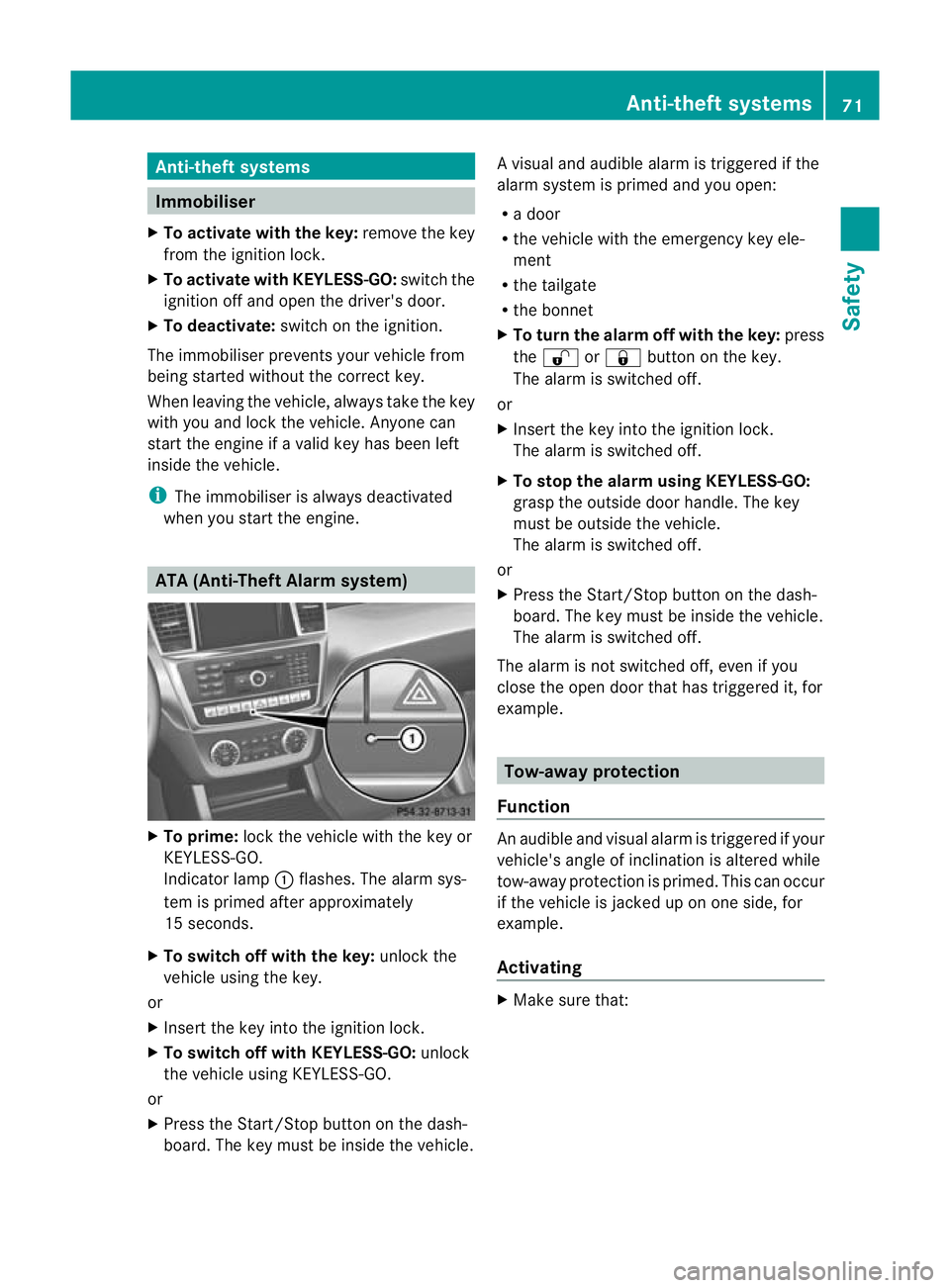
Indicator lamp :flashes .The alar msys-
tem is primed after approximately
15 seco nds.
X To switch of fwith the key: unlock the
vehicle using the key.
or
X Inser tthe key int othe ignition lock.
X To switch of fwith KEYLESS-GO: unlock
the vehicle using KEYL ESS-GO.
or
X Pres sthe Start/Stop button on the dash-
board. The key must be insid ethe vehicle. Av
isual and audible alarm is triggered if the
alarm system is prime dand you ope n:
R ad oor
R the vehicle with the emergency key ele-
ment
R the tailgate
R the bonnet
X To turn th ealarmo ff wit hthe ke y:press
the % or& button on the key.
Th ea larm is switche doff.
or
X Insert the key into the ignition lock.
Th ea larm is switche doff.
X To sto pthe alarm using KEYLESS-GO:
gras pthe outside door handle. The key
must be outside th evehicle.
The alar misswitched off.
or
X Press the Start/Stop button on the dash-
board. The key must be inside the vehicle.
The alarm is switched off.
The alarm is not switched off ,even if you
close the open door that ha striggered it, for
example. Tow
-away protection
Function An audible and visual alarm is trigge
redify our
vehicle' sangle of inclination is altered while
tow-away protection is primed. Thi scan occur
if the vehicle is jacked up on one side, for
example.
Activating X
Make sure that: Anti-theft systems
71Safety Z
Page 75 of 441
R
the doors are closed.
R the tailgate is closed.
Onl ythen is the tow-away protection
primed.
X Lock the vehicle with the key or KEYLESS-
GO.
Tow-awa yprotectio nisprimedafter
approximately 60 seconds.
Switchin goff X
To switc hoff wit hkey: unlock the vehicle
with the key.
or
X Insert the key into the ignition lock.
Tow-awa yprotectio nisswitched off auto-
matically.
X To switch off with KEYLESS-GO: unlock
the vehicle with KEYLESS-GO.
or
X Press the Start/Stop button on the dash-
board. The key must be inside the vehicle.
Tow-awa yprotectio nisswitched off auto-
matically.
Deactivating X
Remove the key from the ignition lock.
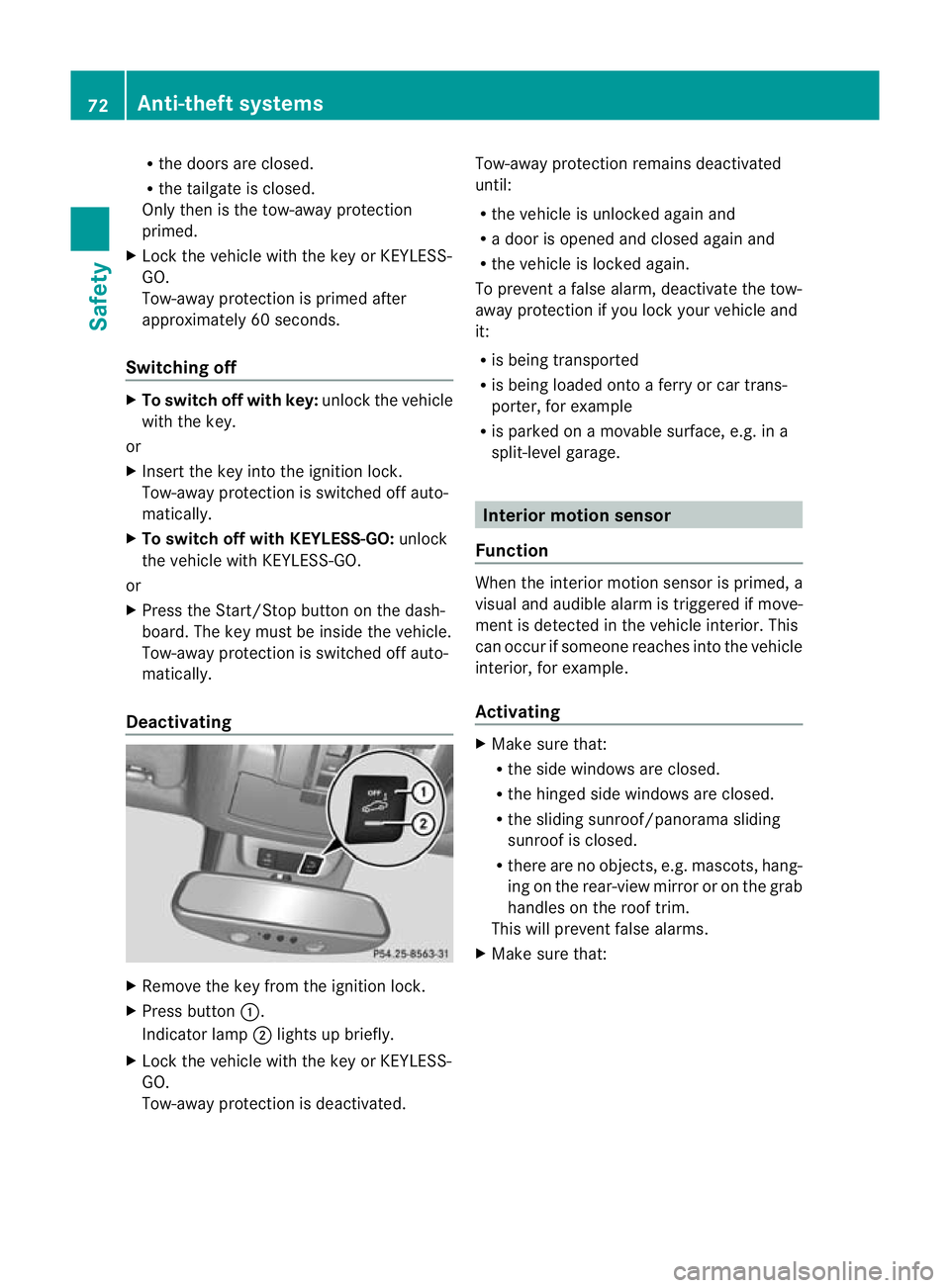
X Press button :.
Indicator lamp ;lights up briefly.
X Lock the vehicle with the key or KEYLESS-
GO.
Tow-awa yprotectio nisdeactivated. Tow-away protec
tion remains deactivated
until:
R the vehicle is unlocked again and
R ad ooriso peneda nd closed agai nand
R the vehicl eislocked again.
To prevent afalse alarm, deactivate the tow-
away protection if yo uloc ky ourv ehicle and
it:
R is being transported
R is being loaded onto aferry or car trans-
porter, for example
R is parked on amovable surface, e.g. in a
split-level garage. Interio
rmotion sensor
Function When the interior motion sensor is primed, a
visual and audible alarm is triggered if move-
ment is detected in the vehicle interior
.This
can occur if someon ereaches into the vehicle
interior, for example.
Activating X
Make sure that:
R
the side windows are closed.
R the hinged side windows are closed.
R the sliding sunroof/panorama sliding
sunroof is closed.
R there are no objects, e.g. mascots, hang-
ing on the rear-view mirror or on the grab
handles on the roof trim.
This will prevent false alarms.
X Make sure that: 72
Anti-theft systemsSafety
Page 87 of 441
Automati
clocking feature :
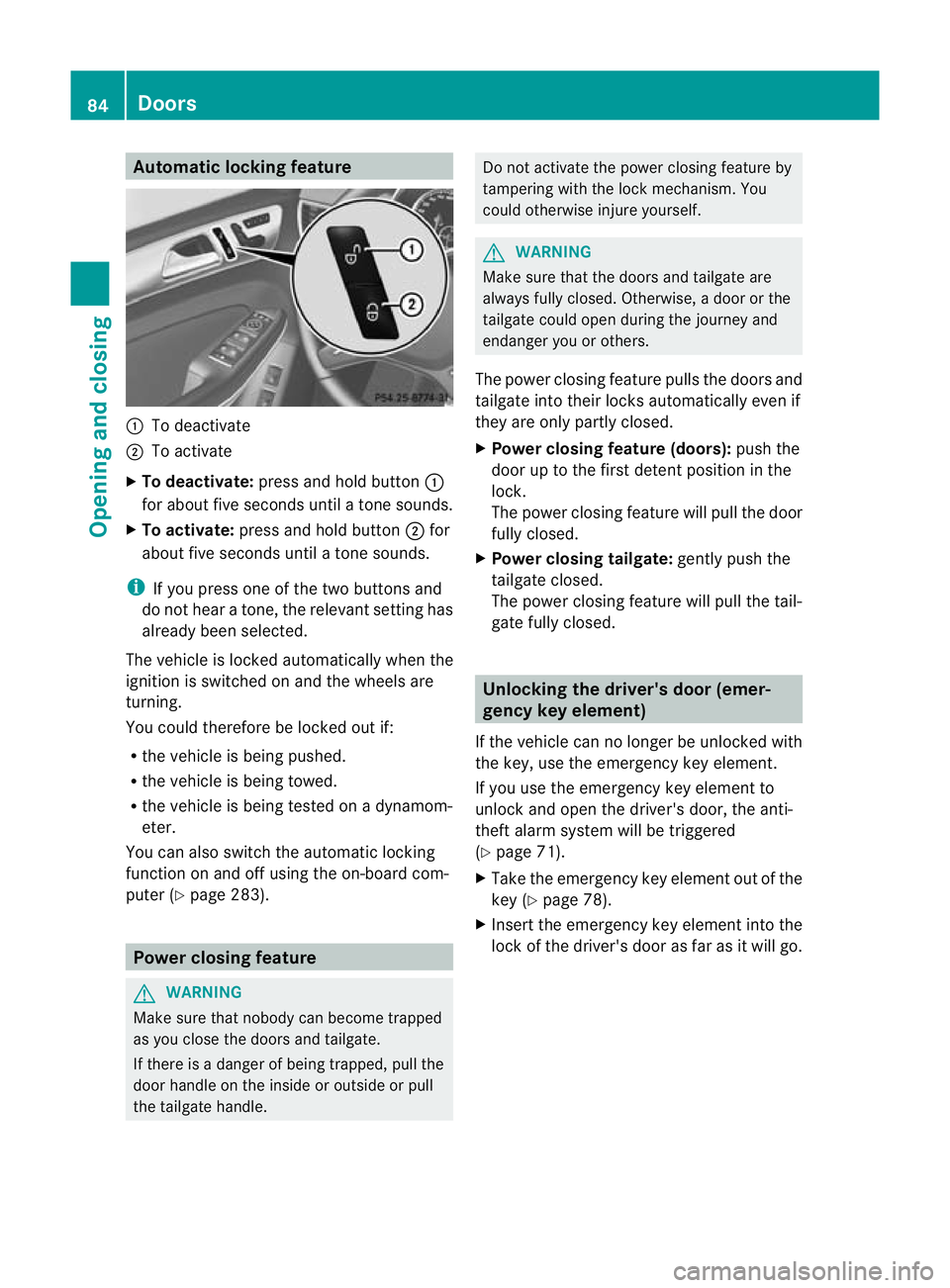
To deactivate
; To activate
X To deactivate: press and hold button :
for about fiv eseconds until atone sounds.
X To ac tivate: press and hold button ;for
about fi veseconds until atone sounds.
i If you press on eofthe two buttons and
do not hear atone ,the rele vant settin ghas
already been selected.
The vehicle is locked automatically when the
ignitio nisswitched on and the wheels are
turning.
You could therefore be locked out if:
R the vehicle is being pushed.
R the vehicle is being towed.
R the vehicle is being tested on adynamom-
eter.
You can also switch the automatic locking
function on and off using the on-board com-
puter (Y page 283). Powe
rclosing fea ture G
WARNING
Make sure tha tnobody can becom etrapped
as you close the doors and tailgate.
If there is adanger of being trapped, pull the
door handle on the inside or outside or pull
the tailgate handle. Do not activate the power closin
gfeature by
tam pering with th elock mechanism .You
coul dotherwis einjure yourself. G
WARNING
Make sure that the doors and tailgate are
alway sfully closed .Otherwise, adoor or the
tailgate coul dopen durin gthe journey and
endanger you or others.
The power closin gfeatur epulls the doors and
tailgate into their locks automatically even if
they are only partly closed.
X Power closin gfeatu re(doors): push the
door up to the first detent position in the
lock.
The power closing featur ewill pull the door
fully closed.
X Power closing tailga te:gentl ypush the
tailgate closed.
The power closing feature will pull the tail-
gate fully closed. Unlockin
gthe driver' sdoor (emer-
gency key element)
If the vehicle can no longer be unlocked with
the key, use the emergenc ykey element.
If you use the emergenc ykey elemen tto
unlock and open the driver' sdoor, the anti-
thef talarm system will be triggered
(Y page 71).
X Take the emergenc ykey elemen tout of the
key (Y page 78).
X Insert the emergenc ykey elemen tinto the
lock of the driver's doo rasfar as it will go. 84
DoorsOpening and closing
Page 124 of 441
use of the
Tside lamps for several
hours. If possible, switc hontheX right
or the Wleft par king lamp. 1W
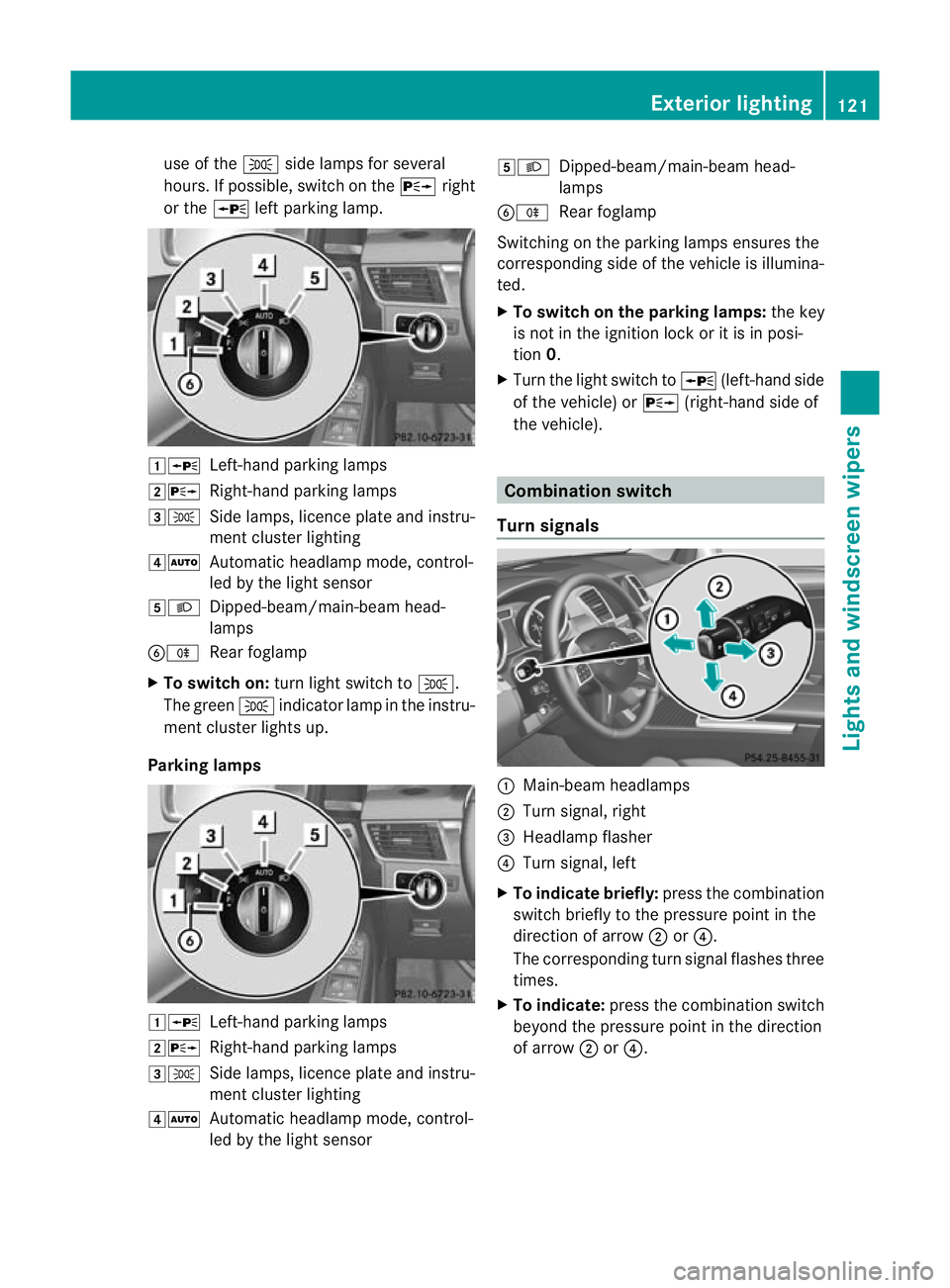
Left-hand parking lamps
2X Right-hand parking lamps
3T Side lamps, licence plate and instru-
mentcluster lighting
4Ã Automatic headlamp mode, control-
led by the light sensor
5L Dipped-beam/main-beam head-
lamps
BR Rear foglamp
X To switch on: turnlight switc htoT .
The green Tindicator lam pinthe instru-
men tcluster lights up.
Parking lamps 1W
Left-handparking lamps
2X Right-hand parking lamps
3T Side lamps, licence plate and instru-
mentcluster lighting
4Ã Automatic headlamp mode, control-
led by the light sensor 5L
Dipped-beam/main-beam head-
lamps
BR Rear foglamp
Switchin gonthe par king lamps ensures the
correspondin gside of the vehicle is illumina-
ted.
X To switch on th eparki ng lamps: the key
is not in the ignition lock or it is in posi-
tion 0.
X Turn the light switc htoW(left-han dside
of the vehicle) or X(right-han dside of
the vehicle). Combination switch
Turn signals :
Main-beam headlamps
; Turn signal, right
= Headlamp flasher
? Turn signal, left
X To indicate briefly: press the combination
switc hbrieflytot he pressur epoint in the
direction of arrow ;or?.
The correspondin gturns ignal flashes three
times.
X To indicate: press the combination switch
beyond the pressure point in the direction
of arrow ;or?. Exterior lighting
121Lights and windsc reen wipers Z
Page 135 of 441
5
¯ Continuous wipe, fast
B í Single wipe
C î To wipe with washer fluid
X Turn the key to position 1or 2in the ignition
lock (Y page 159).
X Turn the combination switc htothe corre-
sponding position.
In the ÄorÅ position, the appropriate
wipin gfrequency is se tautomatically accord-
ing to the intensity of the rain. In the Å
posi tion, the rain sensor is mor esensitive
than in the Äposition, causin gthe wind-
screen wiper stowipe mor efrequently. Switc
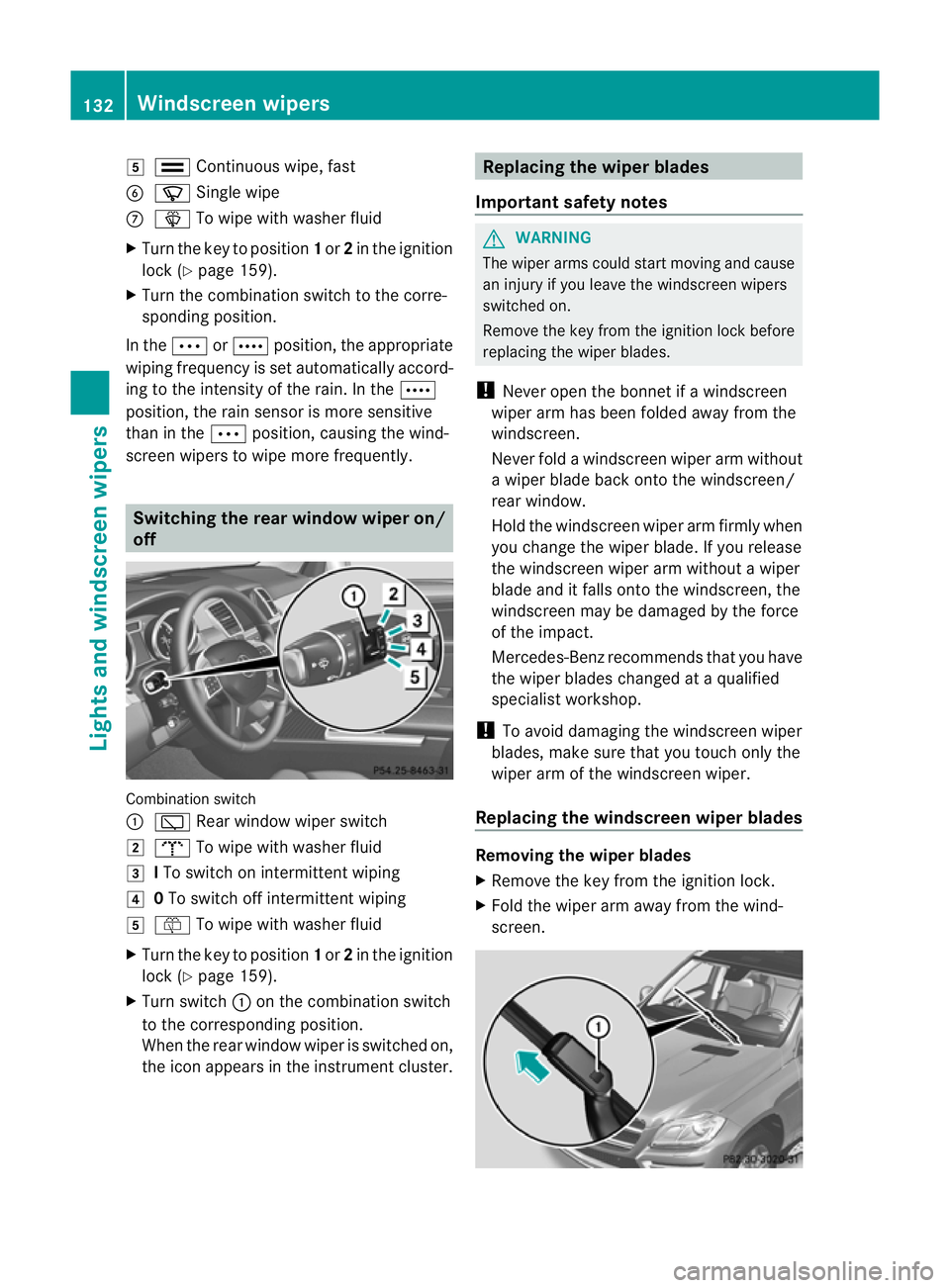
hing th erearw indow wiper on/
off Combi
nation switch
: è Rear windo wwiper switch
2 b To wipe with washer fluid
3 ITo switc honintermitten twiping
4 0To switc hoff intermittent wiping
5 ô To wip ewith washer fluid
X Turn the key to position 1or 2in the ignition
lock (Y page 159).
X Turn switch :on the combination switch
to the correspondin gposition.
When the rea rwindow wiper is switched on,
the icon appears in the instrumen tcluster. Replacing th
ewiper blades
Important safety notes G
WAR
NING
The wipe rarms could start moving and cause
an injury if you leave the windscreen wipers
switche don.
Remove the key from the ignition lock before
replacing the wipe rblades.
! Never open the bonnet if awindscreen
wiper arm has been folded away from the
windscreen.
Never fold awindscreen wiper arm without
aw iper blade back ont othe windscreen/
rea rwindow.
Hold the windscreen wiper arm firmly when
you change the wiper blade. If you release
the windscreen wiper arm without awiper
blade and it falls ont othe windscreen, the
windscreen ma ybedamaged by the force
of the impact.
Mercedes-Benz recommends that you have
the wiper blades changed at aqualified
specialist workshop.
! To avoid damaging the windscreen wiper
blades, mak esure that you touc honly the
wipe rarm of th ewindsc reen wiper.
Replacing th ewindscreen wiper blades Removing th
ewiper blades
X Remov ethe key fr om theignition lock.
X Fold the wiper ar maway fro mthe wind-
screen. 132
Windscreen wipersLights and windscreen wipers
Page 160 of 441
Usefu
linfor mation ............................ 158
Running-in notes ............................... 158
Driving ............................................... 158
Automati ctran smission ................... 167
Refuelling ........................................... 174
Parking ............................................... 181
Driving tips ........................................ 184
Driving systems ................................ 193
Towing atrailer ................................. 257 157Driving and parking