tow MERCEDES-BENZ GLA 2019 User Guide
[x] Cancel search | Manufacturer: MERCEDES-BENZ, Model Year: 2019, Model line: GLA, Model: MERCEDES-BENZ GLA 2019Pages: 346, PDF Size: 16.66 MB
Page 54 of 346
tection in an accident. There is an increased
risk of injury.
Have the vehicle towed to a qualified spe-
cialist workshop in order to have a deployed
air bag replaced.
It is important for your safety and that of yourpassenger to have deployed air bags replacedand to have any malfunctioning air bagsrepaired. This will help to make sure the airbags continue to perform their protective func-tion for the vehicle occupants in the event of acrash.
GWARNING
Emergency Tensioning Devices that have
deployed pyrotechnically are no longer
operational and are unable to perform their
intended protective function. This poses an
increased risk of injury or even fatal injury.
Have pyrotechnically triggered Emergency
Tensioning Devices replaced immediately at
a qualified specialist workshop.
If Emergency Tensioning Devices are triggeredor air bags are deployed, you will hear a bang,and some powder may also be released. Theurestraint system warning lamp lights up.
Only in rare cases will the bang affect yourhearing. The powder that is released generallydoes not constitute a health hazard, but it maycause short-term breathing difficulties in peo-ple with asthma or other respiratory problems.Provided it is safe to do so, you should leavethe vehicle immediately or open the window inorder to prevent breathing difficulties.
Air bags and pyrotechnic Emergency Tension-ing Devices (ETDs) contain perchlorate mate-rial, which may require special handling andregard for the environment. National guide-lines must be observed during disposal. In Cal-ifornia, seewww.dtsc.ca.gov/HazardousWaste/Perchlorate/index.cfm.
Method of operation
During the first stage of a collision, therestraint system control unit evaluates impor-tant physical data relating to vehicle decelera-tion or acceleration, such as:
Rduration
Rdirection
Rintensity
Based on the evaluation of this data, therestraint system control unit triggers the Emer-gency Tensioning Devices during a head-on orrear-end collision.
An Emergency Tensioning Device can only betriggered, if:
Rthe ignition is switched on
Rthe components of the restraint system areoperational. You can find further informationunder "Restraint system warning lamp"(Ypage 40)
Rthe seat belt buckle tongue has engaged inthe belt buckle of the respective front seat
The Emergency Tensioning Devices in the rearpassenger compartment are triggered inde-pendently of the lock status of the seat belts.
If the restraint system control unit detects amore severe accident, further components ofthe restraint system are activated independ-ently of each other in certain frontal collisionsituations:
RFront air bags as well as driver's and front-passenger knee bags
RWindow curtain air bag, if the system deter-mines that deployment can offer additionalprotection to that provided by the seat belt
Depending on the person in the front-passenger seat, the front-passenger front airbag is either enabled or disabled. The front-passenger front air bag can be deployed in anaccident only if the PASSENGER AIR BAG OFFindicator lamp is off. Observe the informationon the PASSENGER AIR BAG indicator lamps(Ypage 40).
Your vehicle has two-stage front air bags.
The activation threshold of the EmergencyTensioning Devices and the air bags is deter-mined by evaluating the rate of vehicle decel-eration or acceleration which occurs at variouspoints in the vehicle. This process is pre-emp-tive in nature. Deployment should take placein good time at the start of the collision.
52Occupant safety
Safety
Page 57 of 346
Removing the child restraint system and deac-tivating the special seat belt retractor:
XMake sure you observe the child restraintsystem manufacturer's installation instruc-tions.
XPress the release button of the seat beltbuckle and guide the seat belt tongue backtowards the belt sash guide.The special seat belt retractor is deactiva-ted.
Child restraint system
The use of seat belts and child restraint sys-tems is required by law in:
Rall 50 states
Rthe U.S. territories
Rthe District of Columbia
Rall Canadian provinces
If you install a rearward-facing child restraintsystem on the center rear seat, the rear seatarmrest must be folded back as far as it willgo.
You can obtain further information about thecorrect child restraint system from any author-ized Mercedes-Benz Center.
GWARNING
If the child restraint system is installed
incorrectly on a suitable seat, it cannot pro-
tect as intended. The child cannot then be
restrained in the event of an accident, heavy
braking or sudden changes of direction.
There is an increased risk of injury, possibly
even fatal.
Make sure that you observe the child
restraint system manufacturer's installation
instructions and the notes on use. Please
ensure, that the base of the child restraint
system is always resting completely on the
seat cushion. Never place objects, e.g. cush-
ions, under or behind the child restraint sys-
tem. Only use child restraint systems with
the original cover designed for them. Only
replace damaged covers with genuine cov-
ers.
GWARNING
If the child restraint system is installed
incorrectly or is not secured, it can come
loose in the event of an accident, heavy
braking or a sudden change in direction. The
child restraint system could be thrown
about, striking vehicle occupants. There is
an increased risk of injury, possibly even
fatal.
Always install child restraint systems prop-
erly, even if they are not being used. Make
sure that you observe the child restraint sys-
tem manufacturer's installation instructions.
You will find further information on stowingobjects, luggage or loads under "Loadingguidelines" (Ypage 250).
GWARNING
Child restraint systems or their securing sys-
tems which have been damaged or subjec-
ted to a load in an accident can no longer
protect as intended. The child cannot then
be restrained in the event of an accident,
heavy braking or sudden changes of direc-
tion. There is an increased risk of injury,
possibly even fatal.
Replace child restraint systems which have
been damaged or subjected to a load in an
accident as soon as possible. Have the
securing systems on the child restraint sys-
tem checked at a qualified specialist work-
shop, before you install a child restraint sys-
tem again.
The securing systems of child restraint sys-tems are:
Rthe seat belt system
Rthe LATCH-type (ISOFIX) securing rings
Rthe Top Tether anchorages
If it is absolutely necessary to carry a child onthe front passenger seat, be sure to observethe information on the "Occupant Classifica-tion System (OCS)" (Ypage 47). There you willalso find information on disabling the frontpassenger front air bag.
Children in the vehicle55
Safety
Z
Page 66 of 346
cle. The engine output is also modified to keepthe vehicle on the desired course within physi-
cal limits. ESP®assists the driver when pulling
away on wet or slippery roads. ESP®can alsostabilize the vehicle during braking.
ETS/4ETS (Electronic Traction System)
iObserve the "Important safety notes" sec-tion (Ypage 60).
ETS traction control is part of ESP®. On vehi-
cles with 4MATIC, 4ETS is part of ESP®.
Traction control brakes the drive wheels indi-vidually if they spin. This enables you to pullaway and accelerate on slippery surfaces, forexample if the road surface is slippery on oneside. In addition, more drive torque is transfer-red to the wheel or wheels with traction.
Traction control remains active, even if you
deactivate ESP®.
Off-road 4ETS (Electronic Traction Sys-
tem)
A 4ETS system specifically suited to off-roadterrain is activated automatically once the off-road program is activated (Ypage 170).
Important safety notes
iObserve the "Important safety notes" sec-tion (Ypage 60).
GWARNING
If ESP®is malfunctioning, ESP®is unable to
stabilize the vehicle. Additionally, further
driving safety systems are deactivated. This
increases the risk of skidding and an acci-
dent.
Drive on carefully. Have ESP®checked at a
qualified specialist workshop.
Vehicles without 4MATIC:when towing yourvehicle with the front axle raised, it is impor-
tant that you observe the notes on ESP®
(Ypage 299).
If the
Page 78 of 346
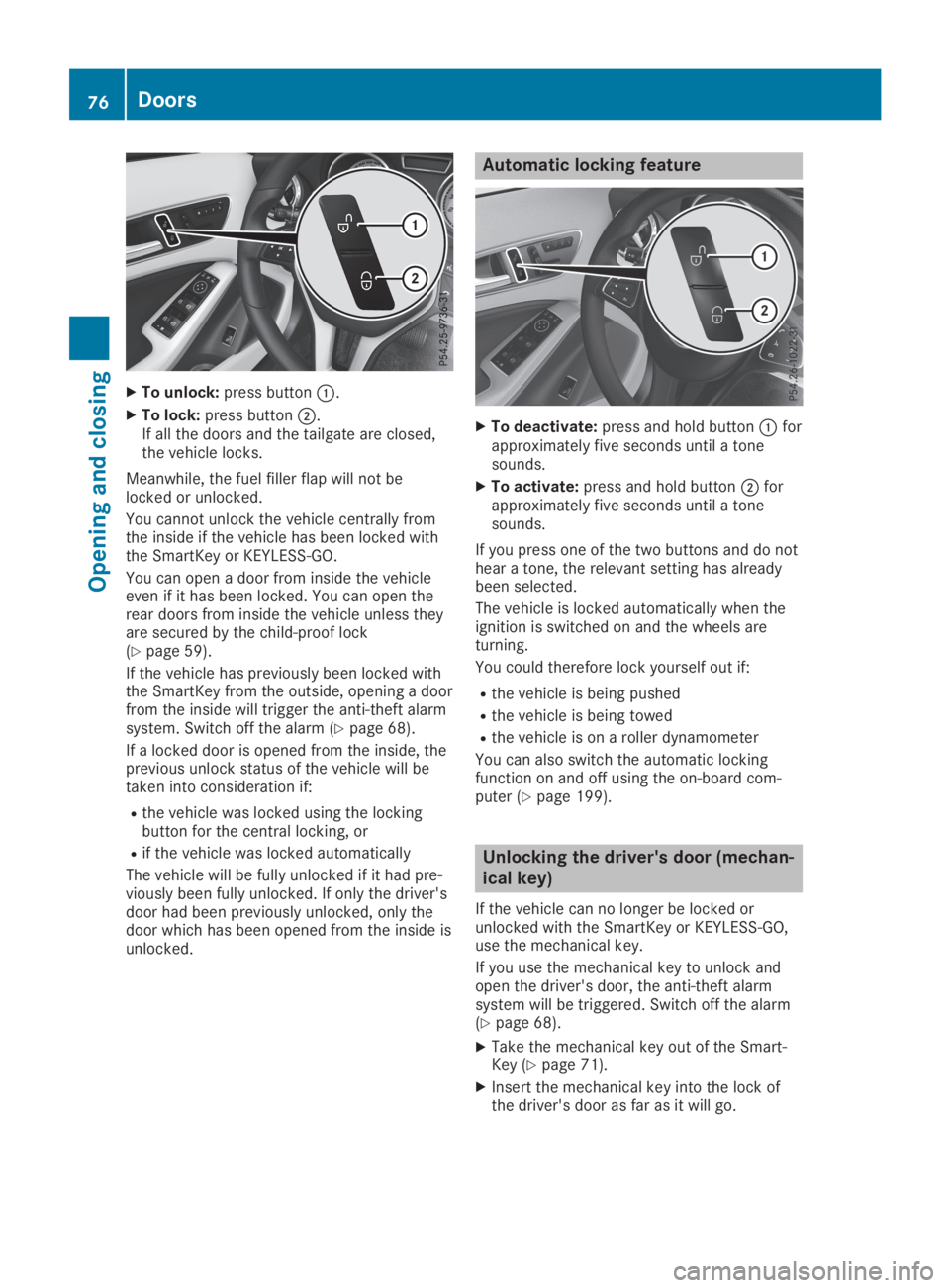
XTo unlock:press buttonC.
XTo lock:press buttonD.If all the doors and the tailgate are closed,the vehicle locks.
Meanwhile, the fuel filler flap will not belocked or unlocked.
You cannot unlock the vehicle centrally fromthe inside if the vehicle has been locked withthe SmartKey or KEYLESS-GO.
You can open a door from inside the vehicleeven if it has been locked. You can open therear doors from inside the vehicle unless theyare secured by the child-proof lock(Ypage 59).
If the vehicle has previously been locked withthe SmartKey from the outside, opening a doorfrom the inside will trigger the anti-theft alarmsystem. Switch off the alarm (Ypage 68).
If a locked door is opened from the inside, theprevious unlock status of the vehicle will betaken into consideration if:
Rthe vehicle was locked using the lockingbutton for the central locking, or
Rif the vehicle was locked automatically
The vehicle will be fully unlocked if it had pre-viously been fully unlocked. If only the driver'sdoor had been previously unlocked, only thedoor which has been opened from the inside isunlocked.
Automatic locking feature
XTo deactivate:press and hold buttonCforapproximately five seconds until a tonesounds.
XTo activate:press and hold buttonDforapproximately five seconds until a tonesounds.
If you press one of the two buttons and do nothear a tone, the relevant setting has alreadybeen selected.
The vehicle is locked automatically when theignition is switched on and the wheels areturning.
You could therefore lock yourself out if:
Rthe vehicle is being pushed
Rthe vehicle is being towed
Rthe vehicle is on a roller dynamometer
You can also switch the automatic lockingfunction on and off using the on-board com-puter (Ypage 199).
Unlocking the driver's door (mechan-
ical key)
If the vehicle can no longer be locked orunlocked with the SmartKey or KEYLESS-GO,use the mechanical key.
If you use the mechanical key to unlock andopen the driver's door, the anti-theft alarmsystem will be triggered. Switch off the alarm(Ypage 68).
XTake the mechanical key out of the Smart-Key (Ypage 71).
XInsert the mechanical key into the lock ofthe driver's door as far as it will go.
76Doors
Opening and closing
Page 134 of 346
ProblemPossible causes/consequences andPPSolutions
The engine is not run-ning smoothly and ismisfiring.
There is a malfunction in the engine electronics or in a mechanicalcomponent of the engine management system.
XOnly depress the accelerator pedal slightly.Otherwise, non-combusted fuel may get into the catalytic con-verter and damage it.
XHave the cause rectified immediately at a qualified specialistworkshop.
The coolant tempera-ture gauge shows avalue above 248 ‡(120 †). The warninglamp may also be onand a warning tone maysound.
The coolant level is too low. The coolant is too hot and the engine isno longer being cooled sufficiently.
XStop as soon as possible and allow the engine and the coolant tocool down.
XCheck the coolant level (Ypage 276). Observe the warning notesas you do so and add coolant if necessary.
Notes on towing vehicles
The vehicle is not suitable for attaching towbar systems, such as those used for flat tow-ing or dinghy towing.
Attaching or using tow bar systems may resultin damage to the vehicle.
When towing a vehicle with tow bar systems,safe driving characteristics cannot be guaran-teed for the towing vehicle or the towed vehi-cle.
The vehicle/trailer combination may swerve.
Observe the permissible towing methods(Ypage 300) and the notes on towing withboth axles on the ground (Ypage 300).
DYNAMIC SELECT button (all vehi-
cles except Mercedes-AMG vehicles)
Use the DYNAMIC SELECT button to changethe drive program. Depending on the drive pro-gram selected the following vehicle character-istics will change:
Rthe drive (engine and transmission manage-ment)
Rthe sound of the exhaust system (vehicleswith sports exhaust system)
Rthe steering
Rthe availability of the ECO start/stop func-tion
Rthe climate control
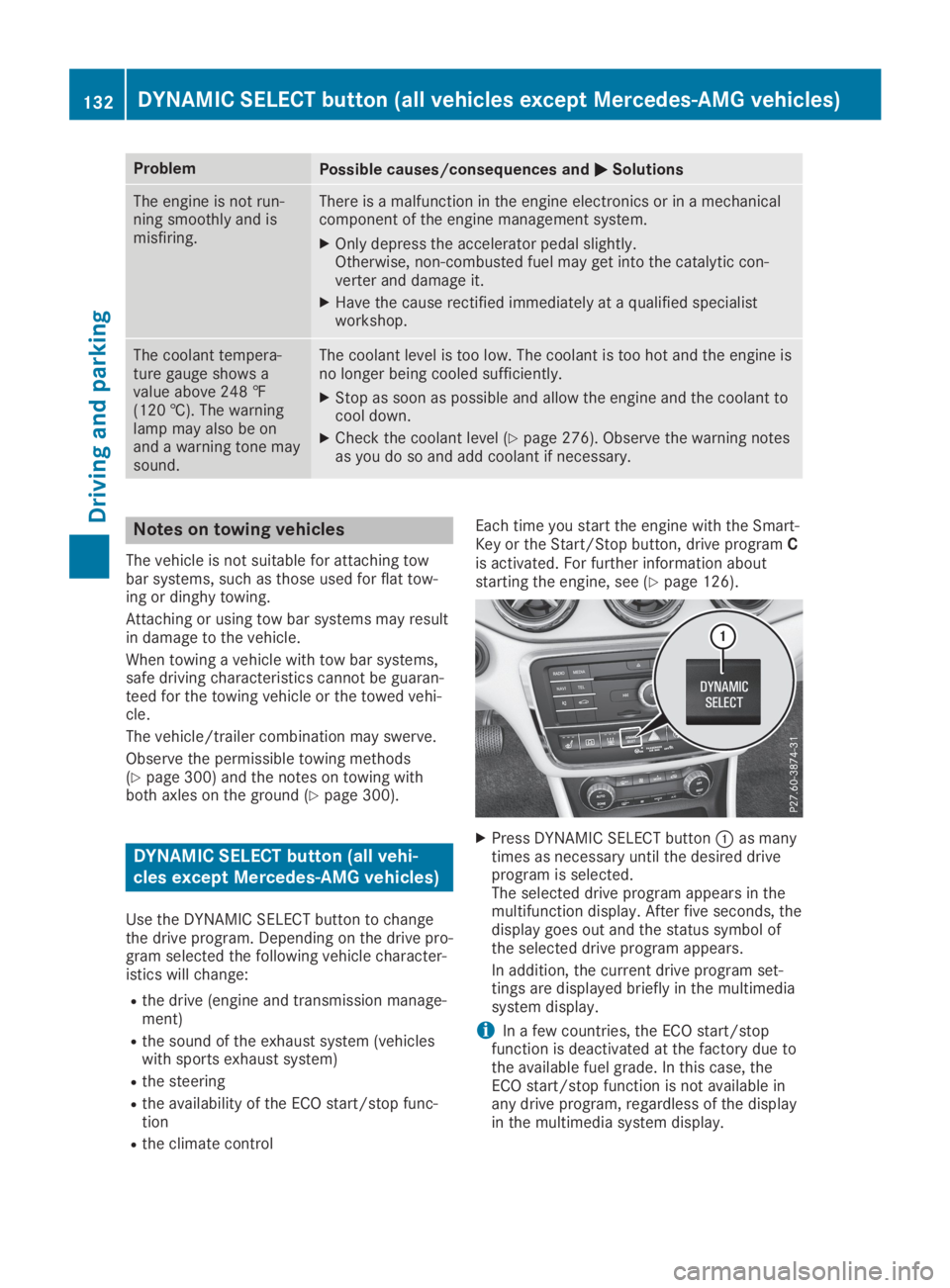
Each time you start the engine with the Smart-Key or the Start/Stop button, drive programCis activated. For further information aboutstarting the engine, see (Ypage 126).
XPress DYNAMIC SELECT buttonCas manytimes as necessary until the desired driveprogram is selected.The selected drive program appears in themultifunction display. After five seconds, thedisplay goes out and the status symbol ofthe selected drive program appears.
In addition, the current drive program set-tings are displayed briefly in the multimediasystem display.
iIn a few countries, the ECO start/stopfunction is deactivated at the factory due tothe available fuel grade. In this case, theECO start/stop function is not available inany drive program, regardless of the displayin the multimedia system display.
132DYNAMIC SELECT button (all vehicles except Mercedes-AMG vehicles)
Driving and parking
Page 139 of 346
![MERCEDES-BENZ GLA 2019 User Guide Transmission positions
EPark position
This prevents the vehicle from roll-ing away when stopped.
Only shift the transmission to posi-tion]when the vehicle is station-ary. The parking lock should not](/img/4/59079/w960_59079-138.png "MERCEDES-BENZ GLA 2019 User Guide Transmission positions
EPark position
This prevents the vehicle from roll-ing away when stopped.
Only shift the transmission to posi-tion]when the vehicle is station-ary. The parking lock should not")
Transmission positions
EPark position
This prevents the vehicle from roll-ing away when stopped.
Only shift the transmission to posi-tion]when the vehicle is station-ary. The parking lock should not beused as a brake when parking.Always apply the electronic parkingbrake in addition to the parking lockin order to secure the vehicle.
In the event of a malfunction of thevehicle's electronics, the transmis-sion may lock in position]. Havethe vehicle electronics checkedimmediately at a qualified specialistworkshop.
Park position]is automaticallyengaged if:
Ryou switch off the engine usingthe SmartKey and remove theSmartKey
Ryou switch off the engine usingthe SmartKey or using the Start/Stop button and open the driver'sdoor or front-passenger door
Ryou open the driver's door whenthe vehicle is stationary or whendriving at a very low speed andthe transmission is in position[or^
FReverse gear
Only shift the transmission intoposition^when the vehicle is sta-tionary.
DNeutral
Do not shift the transmission to\\while driving. The automatic trans-mission could otherwise be dam-aged.
No power is transmitted from theengine to the drive wheels.
Releasing the brakes will allow youto move the vehicle freely, e.g. topush it or tow it.
If ESP®is deactivated or faulty: shiftthe transmission to position\\ifthe vehicle is in danger of skidding,e.g. on icy roads.
If you switch the engine off with thetransmission in position^or[,the automatic transmission shifts to\\automatically.
!Coasting in neutral\\maycause damage to the drive train.
:Drive
The automatic transmissionchanges gear automatically. Allforward gears are available.
Driving tips
Changing gear
The automatic transmission shifts through theindividual gears automatically when it is intransmission position[. This automatic gearshifting behavior is determined by:
Rthe selected drive program
Rthe position of the accelerator pedal
Rthe road speed
Accelerator pedal position
Your style of driving influences how the auto-matic transmission shifts gear:
Rlittle throttle: early upshifts
Rmore throttle: late upshifts
Automatic transmission137
Driving an d parking
Z
Page 148 of 346
![MERCEDES-BENZ GLA 2019 User Guide To ensure that the vehicle is secured againstrolling away unintentionally:
Rthe electric parking brake must be applied.
Rthe transmission must be in position]andthe transmission position display must](/img/4/59079/w960_59079-147.png "MERCEDES-BENZ GLA 2019 User Guide To ensure that the vehicle is secured againstrolling away unintentionally:
Rthe electric parking brake must be applied.
Rthe transmission must be in position]andthe transmission position display must")
To ensure that the vehicle is secured againstrolling away unintentionally:
Rthe electric parking brake must be applied.
Rthe transmission must be in position]andthe transmission position display must show]in the multifunction display.
Rthe SmartKey must be removed from theignition lock.
Ron uphill or downhill gradients, the frontwheels must be turned towards the curb.
Switching off the engine
Important safety notes
GWARNING
The automatic transmission switches to neu-
tral positionNwhen you switch off the
engine. The vehicle may roll away. There is a
risk of an accident.
After switching off the engine, always switch
to parking positionP. Prevent the parked
vehicle from rolling away by applying the
parking brake.
Automatic transmission
XApply the electric parking brake.
XAll vehicles (except Mercedes-AMG vehi-cles):shift the transmission to position].
XMercedes-AMG vehicles:press buttonC.
XWith the SmartKey :turn the SmartKey topositionZin the ignition lock and removeit.The immobilizer is activated.
XWith the Start/Stop button:press theStart/Stop button (Ypage 125).The engine stops and all the indicator lampsin the instrument cluster go out.
If the driver's door is closed, this is thesame as key positionG. If the driver's dooris open, this is the same as key positionZ,i.e. the SmartKey having been removed.
If you switch the engine off with the transmis-sion in position^or[, the automatic trans-mission shifts to\\automatically.
With the SmartKey:if you then open the driv-er's door or the front-passenger door orremove the SmartKey from the ignition, theautomatic transmission shifts to]automati-cally.
With the Start/Stop button:if you then openthe driver's door or the front-passenger door,the automatic transmission shifts to]auto-matically.
If you want the automatic transmission toremain in neutral\\, e.g. when having thevehicle cleaned in an automatic car wash witha towing system:
XVehicles with the Start-Stop button:remove the Start-Stop button from the igni-tion lock.
XInsert the SmartKey into the ignition lock.
XAll vehicles:switch the ignition on.
XDepress the brake pedal and keep itdepressed.
XEngage neutral\\.
XRelease the brake pedal.
XRelease the electric parking brake.
XSwitch off the ignition and leave the Smart-Key in the ignition lock.
Electric parking brake
General notes
GWARNING
If children are left unsupervised in the vehi-
cle, they could:
Roperate the vehicle's equipment
146Parking
Driving and parking
Page 156 of 346
GWARNING
Flammable material such as leaves, grass or
twigs may ignite if they come into contact
with hot parts of the exhaust system. There
is a risk of fire.
When driving on an unpaved road or off-
road, check the vehicle underside regularly.
In particular, remove trapped plant parts or
other flammable material. Contact a quali-
fied specialist workshop immediately if dam-
age is detected.
!There is a risk of damage to the vehicle if:
Rthe vehicle becomes stuck, e.g. on a highcurb or an unpaved road
Ryou drive too fast over an obstacle, e.g. acurb, a speed bump or a pothole in theroad
Ra heavy object strikes the underbody orparts of the chassis
In situations like this, the body, the under-body, chassis parts, wheels or tires could bedamaged without the damage being visible.Components damaged in this way can unex-pectedly fail or, in the case of an accident,no longer withstand the loads they aredesigned to.
If the underbody paneling is damaged, com-bustible materials such as leaves, grass ortwigs can gather between the underbodyand the underbody paneling. If these materi-als come in contact with hot parts of theexhaust system, they can catch fire.
In such situations, have the vehicle checkedand repaired immediately at a qualified spe-cialist workshop. If on continuing your jour-ney you notice that driving safety isimpaired, pull over and stop the vehicleimmediately, paying attention to road andtraffic conditions. In such cases, consult aqualified specialist workshop.
The vehicle is only designed for easily negotia-ble off-road terrain and poor road surfaces.
When driving off-road, substances such assand, mud and water or water mixed with oilmay get into the brakes. This could result in areduced braking effect or in total brake failureand also in increased wear and tear. The brak-ing characteristics change depending on thematerial entering the brakes. Clean the brakesafter driving off-road. If you detect a reduced
braking effect or grinding noises, have thebrake system checked in a qualified specialistworkshop as soon as possible. Adapt yourdriving style to the different braking character-istics.
Driving off-road increases the likelihood ofdamage to the vehicle, which, in turn, can leadto failure of the mechanical assembly or sys-tems. Adapt your driving style to suit the ter-rain conditions. Drive carefully. Have damageto the vehicle rectified immediately at a quali-fied specialist workshop.
Do not shift into transmission position\\when driving off-road. You could lose controlof the vehicle if you attempt to brake the vehi-cle using the service brake. If the gradient istoo steep for your vehicle, drive back down inreverse gear.
General notes
HEnvironmental note
Protection of the environment is of primary
importance. Treat nature with respect.
Observe all prohibiting signs.
Read this section carefully before driving yourvehicle off-road.
Off-road driving is only possible with theON&OFFROAD package.
The following driving systems are speciallyadapted for driving over easily negotiable off-road terrain:
ROff-road program (Ypage 170)
ROff-road ABS (Ypage 60)
ROff-road 4ETS (Ypage 64)
ROff-road ESP®(Ypage 66)
RDSR (Downhill Speed Regulation)(Ypage 169)
Observe the following notes:
RStop the vehicle before starting to drivealong an off-road route. If necessary, acti-vate the off-road program (Ypage 132).
RTo avoid damaging the vehicle, make surethere is always sufficient ground clearance.
RCheck that items of luggage and loads arestowed safely and are well secured(Ypage 255).
RAlways keep the engine running and in gearwhen driving on a downhill gradient. Acti-vate DSR (Ypage 169).
154Driving tips
Driving and parking
Page 160 of 346
XAccelerate the vehicle to the desired speed.
XBriefly press the cruise control lever upCor downD.
XRemove your foot from the acceleratorpedal.Cruise control is activated. The vehicle auto-matically maintains the stored speed.
iCruise control may be unable to maintainthe stored speed on uphill gradients. Thestored speed is resumed when the gradientevens out. Cruise control maintains thestored speed on downhill gradients by auto-matically applying the brakes.
Storing the current speed or calling up
the last stored speed
GWARNING
If you call up the stored speed and it differs
from the current speed, the vehicle acceler-
ates or decelerates. If you do not know the
stored speed, the vehicle could accelerate
or brake unexpectedly. There is a risk of an
accident.
Pay attention to the road and traffic condi-
tions before calling up the stored speed. If
you do not know the stored speed, store the
desired speed again.
XBriefly pull the cruise control lever towardsyou
Page 162 of 346
!When Active Distance Assist DISTRONICor the HOLD function is activated, the vehi-cle brakes automatically in certain situa-tions.
To avoid damage to the vehicle, deactivateActive Distance Assist DISTRONIC and theHOLD function in the following or similar sit-uations:
Rwhen towing the vehicle
Rin the car wash
Active Distance Assist DISTRONIC can neitherreduce the risk of an accident if you fail toadapt your driving style, nor override the lawsof physics. Active Distance Assist DISTRONICcannot take into account road, weather or traf-fic conditions. Active Distance AssistDISTRONIC is only an aid. You are responsiblefor the distance to the vehicle in front, forvehicle speed, for braking in good time and forstaying in your lane.
Do not use Active Distance Assist DISTRONIC:
RIn road and traffic conditions which do notallow you to maintain a constant speed, e.g.in heavy traffic or on winding roads
ROn slippery road surfaces. Braking or accel-erating could cause the drive wheels to losetraction and the vehicle could then skid
RIn poor visibility, e.g. due to fog, heavy rainor snow
Active Distance Assist DISTRONIC may notdetect narrow vehicles driving in front, e.g.motorcycles, or vehicles driving in a staggeredformation.
In particular, the detection of obstacles can beimpaired if:
RThere is dirt on the sensors or anything elsecovering the sensors
RThere is snow or heavy rain
RThere is interference by other radar sources
RThere are strong radar reflections, for exam-ple in parking garages
If Active Distance Assist DISTRONIC no longerdetects a vehicle in front, Distance PilotDISTRONIC may unexpectedly accelerate tothe speed stored.
This speed may:
RBe too high if you are driving in a turninglane or an exit lane
RBe so high when driving in the right-handlane that you overtake vehicles in the left-hand lane
RBe so high in the left lane that you passvehicles driving on the right
If there is a change of drivers, advise the newdriver of the speed stored.
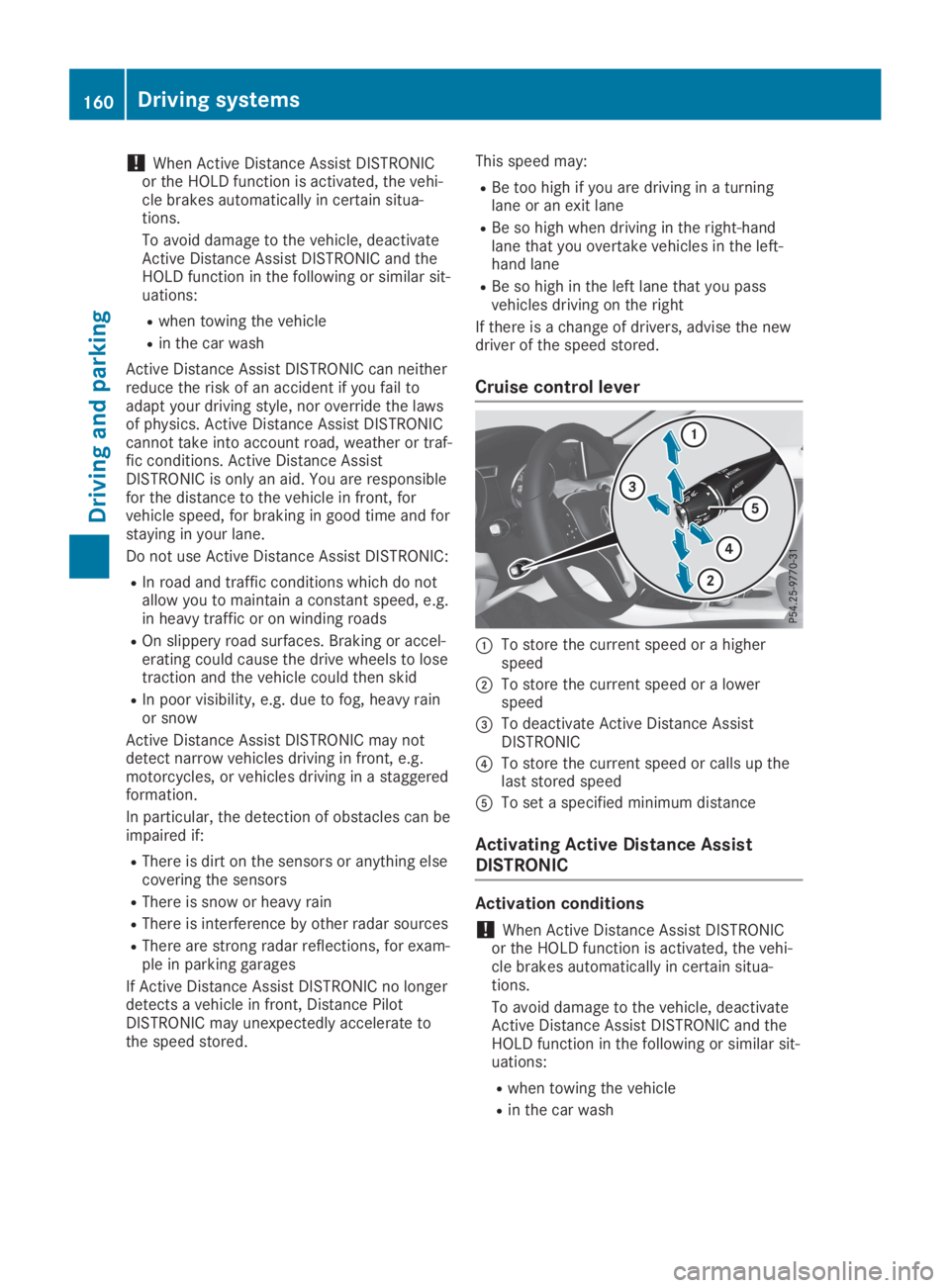
Cruise control lever
CTo store the current speed or a higherspeed
DTo store the current speed or a lowerspeed