change time MERCEDES-BENZ METRIS 2016 MY16 Operator’s Manual
[x] Cancel search | Manufacturer: MERCEDES-BENZ, Model Year: 2016, Model line: METRIS, Model: MERCEDES-BENZ METRIS 2016Pages: 310, PDF Size: 7.28 MB
Page 271 of 310
RDo not drive with tireswhich have too little
trea ddepth,ast hissignificantl yreduce sthe
tractio nonw etroads (hydroplaning).
RReplace the tire safter 6y ears at the latest,
regardless of wear .Thisa lsoa pplies to the
spar ewheel .
Operatio ninwinter
General notes
Hav eyourv ehicl ewinterproofed at aquali fied
specialis tworkshop at the onse tofwinter.
Onlyu sewheels with tire sizes approved by
Mercedes-Benz.
Prior to the onse tofwinter, ensur ethats now
chains ar estowed in the vehicl e(
Ypage 270).
Snow chains canno tbem ounted on al lwheel /
tire combinations. Observe the restrictions on
the us eofsnow chains under "Wheel/tir ecom-
binations" (
Ypage 291).
Als oo bserve the note sinthe "Changing a
wheel" sectio n(
Ypage 286).
Driving with summe rtires
At temperatures belo w45‡(+7 †),summer
tire slos ee last icity and therefore tractio nand
braking power. Chang ethe tire sonyourvehicle
to M+S tire s. Usingsumme rtires at very cold
temperatures could cause tears to form,
thereby damaging the tires permanently.
Mercedes-Benz cannot accept responsibility for
this type of damage.
M+S tires
GWARNING
Wheel and tire dimensions as wel lasthe type
of tire can vary betwee nthe spare whee land
the whee ltobereplaced. When the spare
whee lismounted, driving characteristics may
be severelya ffected. There is arisk of an acci-
dent.
In order to reduce risks:
Ryou should therefore adapt you rdriving
style and drive carefully.
Rnever mount more than one spare wheel
that differs from the whee ltobereplaced.
Ronly use aspare whee lthat differs from the
whee ltober eplaced for ashort time.
Rhave aspare whee lthat differs from the
whee lthat has been changed replaced at
the nearest qualified specialist workshop.
You must observe the correct whee land
tire dimensions as wel lasthe whee ltype.
GWARNING
M+S tires with atire tread depth of less than
ã in (4 mm) are not suitable for use in winter
and do not provid esufficient traction. There is
ar isk of an accident.
M+S tires with atread depth of less than ãin
(4 mm) must be replaced immediately.
Use winter tires or all-season tires at tempera-
tures below4 5‡(+7 †). Both types of tire are
identified by the M+S marking.
Only winter tires bearing the isnowflake
symbo linaddition to the M+S marking provide
the best possible grip in wintry road conditions.
Only these tires wil lallow driving safety systems
such as ABS and ESP
®to function optimally in
winter. These tires have been developed specif-
ically for driving in snow.
For safe driving, use M+S tires of the same make
and tread pattern on all wheels.
Always observe the maximu mpermissible
speed specified for the M+S tires you have
mounted.
If you mount M+S tires that have alower maxi-
mum permissibl espeed than the maximum
design speed of the vehicle, affix acorrespond-
ing warning label in the driver' sfieldofv ision.
You can obtai nthis at aqualified specialist work-
shop.
Once you have mounted the winter tires:
XCheck the tire pressure (Ypage 270).
XRestart the tire pressure monitor
(Ypage 277).
Operation in winter269
Wheel sand tires
Z
Page 279 of 310
positionsfor as hort time. This is rectified after a
few minutes of driving ;the tire pressures are
then displayed for the correct positions.
Restarting the tir epressure monitor
General notes
When you restart the tire pressure monitor, all
existing warning messages are deleted and the
warning lamp goes out. The monitor uses the
currently set tire pressures as the referenc eval-
ues for monitoring. In most cases, the tire pres-
sure monitor will automatically detec tthe new
referenc evalues after you have changed the tire
pressures. However,y ou can also define refer-
enc evalues manually as described here. The tire
pressure monitor then monitors the new tire
pressure values.
Vehicles without steering wheel buttons
The vehicle must be stationary. Use the buttons
in the instrument cluster.
XTurn the key to position 2in the ignition lock.
XPress Èto select the TirePressuremenu.
XPress3to confirm.
The display shows the Monitoring Active
message.
XPress3to confirm.
The display shows the Tire Pressure OK?
message.
If you wish to confirm the restart:
XPress the fbutton.
The display shows the distance menu.
After you have driven for afew minutes, the
system checks whether the currentt ire pres-
sures are within the specified range. The new
tire pressures are then accepted as reference
values and are monitored.
If you wish to cancel the restart:
XPress g.
The display shows the tire pressure menu.
The tire pressure values stored at the last
restart will continue to be monitored.
Vehicles with steering wheel buttons
Using the steering wheel buttons
XMake sure that the tire pressures of all four
wheels are set correctly for the currento per-ating conditions. When doing so, observe the
notes under "Tire pressure" (
Ypage 270).
XTurn the key to position 2in the ignition lock.
XPress =or; to select the Servicemenu.
XPress9or: to select the TirePres‐suresubmenu.
XPressato confirm.
The display shows either the currentt ire pres-
sure for the individual tires, or the Tire
pressure will be displayed afterdrivingafew minutesmessage.
XPress the:button.
The display shows the Use CurrentPres‐
sures as New Reference Values:mes-
sage.
If you wish to confirm the restart:
XPress the abutton.
The display shows the Tire Press. Moni‐
tor Restartedmessage.
After you have driven for afew minutes, the
system checks whether the currentt ire pres-
sures are within the specified range. The new
tire pressures are then accepted as reference values and are monitored.
If you wish to cancel the restart:
XPress the %button.
The tire pressure values stored at the last
restart will continue to be monitored.
Tirep ressure277
Wheels and tires
Z
Page 288 of 310
TIN (Tire IdentificationNumber)
Auniqu eide ntificatio nnumbe rwhich can be
used by atire manufacturer to identify tires, for
exampl efor ap roduct recall ,and thusi dentify
the purchasers. The TIN is compose dofthe
manufacturer identificatio ncode, tire size, tire
model cod eand manufacturing date.
Load bearin gind ex
The load bearing index (als oloa dindex) is acode
thatc ontains the maximu mloadb eari ng capa-
city of atire.
Traction
Tractio nist he resul toffrictio nbetween the tires
and the roa dsurface.
TWR (permissibl etrailer drawbar load)
The TWRist he maximumpermissibl eweigh t
thatm ayact on the ball coupling of the trailer
tow hitch.
Wea rind icator
Narrowb ars( tread wear bars) thata redistrib-
ute doverthe tire tread. If the tire trea dislevel
with the bars, the wear limit of áin (1.6 mm)
hasb eenr eached.
Distribution of the vehicle occupants
The distributio nofvehicleoccupants ove rdes-
ignate dseatp osit ions in avehicle.
Maximum permissible payload weight
Nomina lloa da nd goods/luggage load plus
68 kg (150 lb s)multiplie dbythe number of
seats in the vehicle.
Changing wheels
Rotating the wheels
GWARNING
Interchanging the front and rear wheels may
severelyi mpair the driving characteristics if
the wheels or tires have different dimensions. The whee lbrakes or suspension components
may als obedamaged. There is arisk of acci-
dent.
Rotate front and rear wheels only if the wheels and tires are of the same dimensions.
!On vehicles equippedw ithatire pressure
monitor, electronic components are located
in the wheel.
Tire-mounting tools should not be used near
the valve .This could damage the electronic
components.
Only have tires changed at aqualified spe-
cialist workshop.
Always observe the instructions and safety
notes under "Mounting awheel" (
Ypage 287).
The wea rpatterns on the front and rear tires
differ, depending on the operating conditions.
Rotate the wheels before aclear wea rpattern
has formed on the tires. Front tires typically
wea rmore on the shoulders and the rear tires in
the center.
If you rvehicle's tire configuration allows, you
can rotate the wheels according to the intervals
in the tire manufacturer's warranty book in your
vehicled ocuments. If no warranty book is avail-
able, the tires should be rotated every 3,000 to
6,000 mile s(5,000 to 10,000 km) or earlier if
tire wea rrequires. Do not change the direction
of rotation.
Clean the contact surfaces of the whee land the
brake disc thoroughly every time awheelisr ota-
ted. Avoid oily or greas ycleaning agents.
Check the tire pressure and reactivate the tire
pressure monitor if necessary.
Directio nofrotation
Tires with aspecified directio nofrotation have
additional benefits, e.g. if there is arisk of hydro-
planing. You wil lonly gai nthese benefits if the
correct directio nofrotation is observed.
An arrow on the sidewal lofthe tire indicates its
correct directio nofrotation.
You may mount aspare whee lagainst the direc-
tion of rotation. Observe the time restriction on
use as wel lasthe speed limitation specified on
the spare wheel.
Storing wheels
Store wheels that are not being used in acool,
dry and preferably dark place. Protect the tires
from contact with oil, greas eand fuel.
286Changing wheels
Wheel sand tires
Page 293 of 310
Tires
R17
TiresSteel wheel
225/55R 17RF (XL) 101V,6.5Jx17H2ET5 0
225/55 R17 RF (XL )101H,6.5 Jx17H2ET5 0
R17
TiresAllo ywheels
225/55 R17 RF (XL )101V,7Jx17H2ET5 1
225/55 R17 RF (XL )101H,7Jx17H2ET5 1
Spare wheel
Important safety notes
GWARNING
Wheel and tire dimensions as well as the type of tire can var ybetween the spare whee land
the whee ltobereplaced .Whent he spare
whee lismounted, driving characteristic smay
be severely affected. There is ariskofana cci-
dent.
In order to reduce risks:
Ryo us houl dtherefore adap tyou rd riving
style and drive carefully.
Rneve rmount more thano ne spare wheel
thatd iffer sfrom the whee ltobereplaced.
Ronlyuseaspare whee lthatd iffer sfrom the
whee ltober eplaced for ashort time.
Rdo not deactivate ESP®.
Rhave aspare whee lthatd iffer sfrom the
whee lthath asbeen changed replaced at
the neares tquali fied specialist workshop.
Yo um usto bserve the correct whee land
tire dimensions as well as the whee ltype.
Whe nusing aspare whee lofadifferent size, do
not exceed the maximump ermissibl espeed of
50 mph (80 km/h).
General notes
The procedure for mounting the spare whee lis
describe din"Mounting awheel "(Ypage 287).
The following shoul dbechecked regularly, par-
ticularly prior to long journeys:
Rthe tire pressure of the spare wheel, which
shoul dthen be corrected if necessary
(
Ypage 270).
Rthe fastenings of the spare whee lbracket.
The spare whee lislocate deither in the left rear
compartment or in aspare whee lbracket under
the vehicle.
Replace the tire safter6y ears at the latest,
regardless of wear. Thi salsoa pplies to the spare
wheel.
Vehicles with tire pressure monitor: the
spare whee lisnot equipped with asensor for
monitoring tire pressure. If yo uhavei nstalle da
spare wheel, the tire pressure monitor will not
functio nfor this wheel. The system may con-
tinu etos howt he tire pressure of the whee lthat
hasb eenr emoved for afew minutes. The value
displayed for the position where the spare wheel
is installe disnot the same as the current tire
pressure of the spare wheel.
Whe nyou are driving with the spare wheel
mounted, the tire pressure monitor canno tfunc-
tio nr eliably. Only restart the tire pressure mon-
ito rw henthe defective whee lhas been replaced
with anew whee land sensor.
Mor eInformati on can be found under "Tire pres-
sure
monitor" (Ypage 274).
Spare wheel291
Wheel sand tires
Z
Page 301 of 310
Additives
!Do notuse any additive sintheengin eoil.
This could damag ethe engine.
Engineo il viscosity
!If theSAE viscosit yclassoft heengin eoil
used does no tcover th eoutside temperature
range in whic hyou are operating th evehicle,
it mus tbechanged in goo dtime, in particular
before th ecolds eason commences. Using an
engin eoil that does no thavea dequate tem-
peratur echaracteristics can lead to engin e
damage.
The temperature range information of th eSAE
classification always refers to that of fresh oil.
The temperature characteristics of th eengine
oil may deteriorat esignificantly due to agin g
in use, especially at low outside tempera-
tures.
We recommen dthaty ou chang ethe engin e
oil before th ecolds eason commences. Use
an approve dengineo il of th especifie dSAE
class.
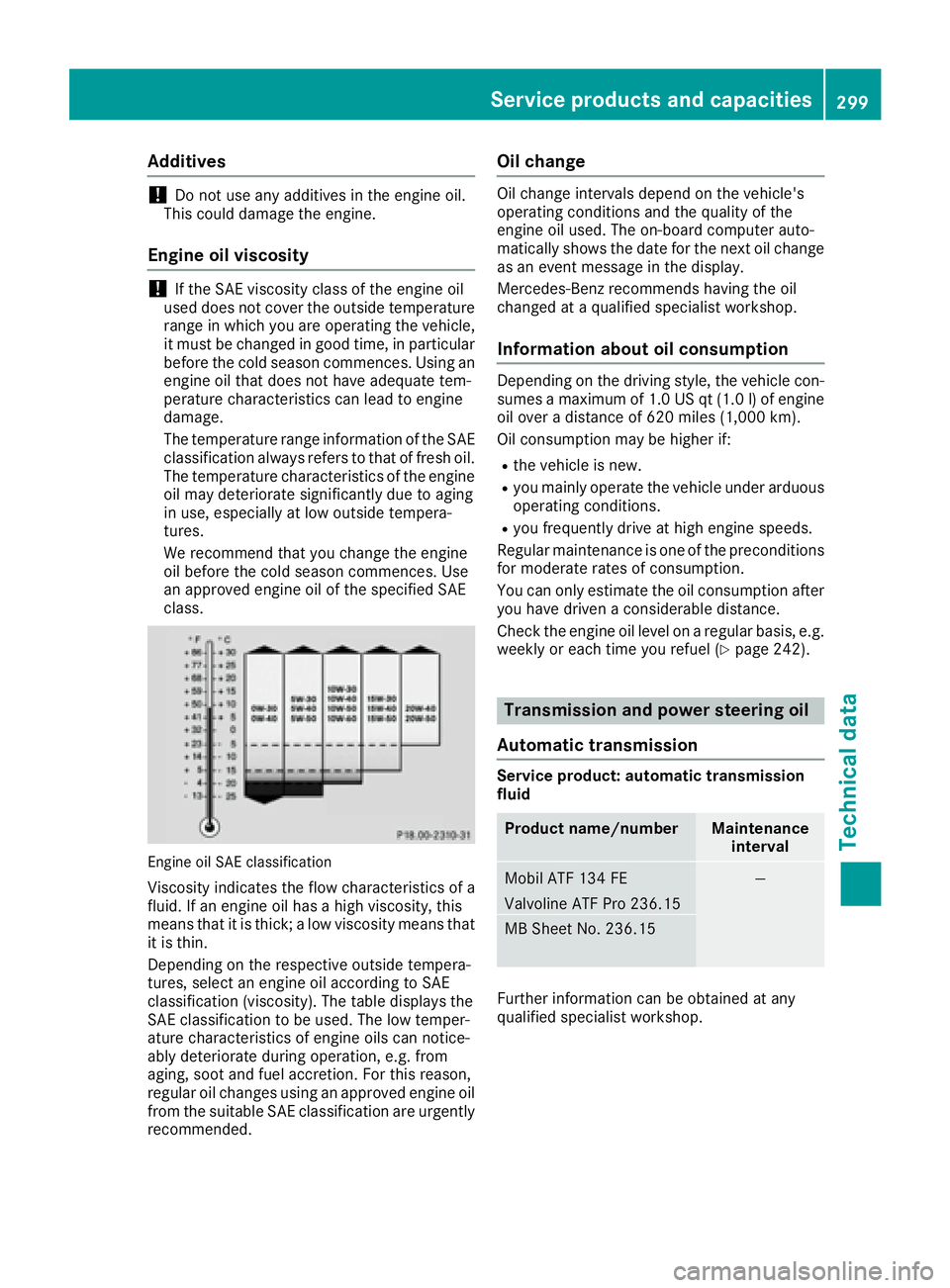
Engin eoil SA Eclassification
Viscosit yindicates th eflowc haracteristics of a
fluid .Ifane ngineo il has ahigh viscosity, this
mean stha titi sthick ;al ow viscosit ymean stha t
it is thin.
Dependin gontherespective outside tempera-
tures, select an engin eoil according to SA E
classification (viscosity). The table displays th e
SA Ec lassification to be used .The low temper-
atur echaracteristics of engin eoils can notice -
ably deteriorat eduring operation ,e.g.f ro m
aging, soo tand fuel accretion .For this reason ,
regular oil changes usin ganapprove dengineo il
from th esuitable SA Eclassification are urgently
recommended.
Oil change
Oil chang eintervals depend on th evehicle's
operating condition sand th equalit yoft he
engin eoil used .The on-board computer auto -
matically shows th edatef or th enexto il chang e
as an event message in th edisplay.
Mercedes-Benz recommends having th eoil
changed at aqualified specialist workshop .
Information abou toil consump tion
Dependin gonthedrivin gstyle, th evehicl econ-
sumes amaximum of 1. 0USqt(1.0l )ofe ngine
oil over adistance of 620 miles (1,000 km).
Oil consumption may be higher if:
Rthe vehicle is new.
Ryou mainly operate the vehicle under arduous
operating conditions.
Ryou frequently drive at high engine speeds.
Regularm aintenance is one of the preconditions
for moderate rates of consumption.
You can only estimate the oil consumption after
you have driven aconsiderable distance.
Check the engine oil level on aregular basis, e.g.
weekly or each time you refuel (
Ypage 242).
Transmission and power steering oil
Automatic transmission
Service product: automatic transmission
fluid
Product name/numberMaintenance interval
Mobil ATF 134 FE
Valvoline ATF Pro 236.15—
MB Sheet No. 236.15
Further information can be obtained at any
qualified specialist workshop.
Service products and capacities299
Technical data
Z
Page 306 of 310
Cargo tie-down points and carriersys-
tems
Cargo tie-down points
General notes
!Observ ethe informatio nonthemaximum
loadingc apacity of th eindividua lcargo tie-
down points.
If you use several cargo tie-down points to
secure aload, you must always tak ethe max-
imum loadingc apacity of theweakest cargo
tie-down pointi ntoa ccount.
If you brak ehard ,for example ,the forces act-
ing coul dbeuptos everal times th eweight
force of th eload. Always use multiple cargo
tie-down points in order to distribut ethe force
absorption.L oad theanchorages evenly.
You will fin dadditional informatio nabout cargo
tie-down points and cargo tie-down rings in the
"Securin gloads"s ection(
Ypage 234).
Cargo tie-down rings
The maximum tensile load of th ecargo tie-down
rings is:
Cargo tie-down
ringsPermissible nomi- nal tensile load
Passenger Vans786. 5lbf
(35 0daN)
Cargo Van1124.0 lbf
(50 0daN)
Guide/load rails
The maximum tensile load for th ecargo tie-
down points on aguide/load rail is:
Cargo tie-down
pointPermissible nomi-
nal tensile load
Guide rail786. 5lbf
(35 0daN)
Load rails on cargo
compartmen tfloor1124.0 lbf
(50 0daN)
Load rail on sidewall225. 0lbf
(10 0daN)
The values specifie dapply only to loads placed
on th ecargo compartmen tfloo rif:
Rth el oad is secured to two cargo tie-down
points on th erail and
Rthed istanc etotheneares tload-securing
pointont hesame rail is approximately 3ft
(1 m).
Roo fracks and rear racks
GWARNING
If yo uuseopenings in the bodywork or
detachabl eparts as steps, yo ucould:
Rslipa nd/or fall
Rdamag ethe vehicl eand cause yourselft o
fall.
There is ariskofi njury.
Alway susesecure climbing aids, e.g. asuita-
bl el adde r.
!Do not us ethe lowe rsliding doo rguide (car-
riage) as astep .Otherwise, yo ucould damage
the paneling and/or the sliding doo rmecha-
nism.
GWARNING
Whe nyou load the roof, the center of gravity
of the vehicl erises and the driving character-
istics change. If yo uexcee dthe maximum roof
load ,the driving characteristics, as well as
steering and braking, will be greatl yimpaired.
There is ariskofana ccident.
Neve rexcee dthe maximum roo floa da nd
adjust your driving style.
!The weight of any load carrie donthe roof,
including the roo fcarrier, mus tnot exceed
the maximum permissible roo fload.
The roo fcarrie rsuppo rts mus tbem ounted at
equal distances.
Install rai lcarriers in front of and behind the
middl eprop.
!For safety reasons,M ercedes-Benz recom-
mend sthat yo uonly us eroofcarrie rsystems
which have bee nteste dand approved for
Mercedes-Benz vehicles. Thi swillh elpt o
avoid damage.
304Vehicl edata
Technical data