brake MERCEDES-BENZ METRIS 2020 MY20 Operator’s Manual
[x] Cancel search | Manufacturer: MERCEDES-BENZ, Model Year: 2020, Model line: METRIS, Model: MERCEDES-BENZ METRIS 2020Pages: 320, PDF Size: 26.38 MB
Page 32 of 320
that takes the requirements of both nature
and humanity into account.
You too can help to protect the environment
by operating your vehicle in an environmen-
tally responsible manner.
Fuel consumption and the rate of engine,
transmission, brake and tire wear are affec-
ted by these factors:
R operating conditions of your vehicle
R your personal driving style
You can influence both factors. You should
bear the following in mind:
Operating conditions:
R avoid short trips as these increase fuel
consumption.
R always make sure that the tire pressures
are correct.
R do not carry any unnecessary weight.
R remove roof racks once you no longer
need them.
R a regularly serviced vehicle will contribute
to environmental protection. You should
therefore adhere to the service intervals.
R always have service work carried out at a
qualified specialist workshop.
Personal driving style:
R do not depress the accelerator pedal
when starting the engine.
R do not warm up the engine when the vehi-
cle is stationary.
R drive carefully and maintain a safe dis-
tance from the vehicle in front.
R avoid frequent, sudden acceleration and
braking.
R change gear in good time and use each
gear only up to Ô of its maximum engine
speed.
R switch off the engine in stationary traffic.
R keep an eye on the vehicle's fuel con-
sumption. Environmental issues and recom-
mendations
When prompted by this Operator's Manual to
dispose of materials, please try to regenerate
and recycle these materials. Observe all rele-
vant environmental guidelines and regulations
when disposing of materials. This helps to pro-
tect the environment. Operating safety and vehicle
approval
Important safety notes
G
WARNING
If you do not have the prescribed service/
maintenance work or any required repairs
carried out, this can result in malfunctions
or system failures. There is a risk of an acci-
dent.
Always have the prescribed service/mainte-
nance work as well as any required repairs
carried out at a qualified specialist work-
shop.
Airbags and pyrotechnic Emergency Tension-
ing Devices contain perchlorate material,
which may require special handling or environ-
mental protection measures. National guide-
lines must be observed during disposal.
For California, you will find further information
online at: http://www.dtsc.ca.gov Notes on driving
Damage to the vehicle may occur in the follow-
ing cases:
R The vehicle becomes grounded, e.g. on a
high curb or an unpaved road.
R You drive too fast over an obstacle, e.g. a
curb, a speed bump or a pothole in the road.
R A heavy object strikes the underbody or
chassis components.
In such situations, the body, frame, under-
body, chassis parts, wheels or tires could be
damaged without the damage being visible.
Components damaged in this way can unex-
pectedly fail or, in the case of an accident, no 30
Introduction
Page 36 of 320
vehicle. This also includes labeling and docu-
mentation affected by their modifications.
It is their responsibility to certify that:
R the altered vehicle conforms to all applica-
ble standards and regulations affected by
the vehicle alteration
R the altered vehicle continues to comply with
the motor vehicle safety standards and
emissions regulations
R the changes or installation of accessories do
not impair the safety of the vehicle
We are not responsible for any final certifica-
tion or claims regarding product liability or
warranty claims that arise as a result of such
changes. This applies to:
R components, assemblies or systems which
have been altered
R non-compliance with emissions laws and
regulations or with vehicle safety standards
arising as a result of the alterations
R all consequences resulting form the
changed, less safe or even defective vehicle
We do not assume responsibility as the final
stage manufacturer or the consequential prod-
uct liability.
Notes on the engine radiator Even seemingly small changes to the vehicle,
such as attaching a radiator trim for winter
driving or as protection against insects, are
not permitted. Do not cover the radiator. Do
not use thermal mats, insect protection covers
or anything similar.
Doing so can cause the diagnostics system to
display inaccurate values. Some of these val-
ues are legally required and must always be
correct.
Notes for commercial vehicles without
partitions Vehicles, which are approved as commercial
vehicles (N1), do not comply with the
ISO 27956
standard in the respective current
valid version unless equipped with a partition.
The ISO 27956 Standard details the equip-
ment for correct load securing in delivery vehi-
cles. Retrofitting the partition is strongly rec-
ommended when using the vehicle for the
transport of goods, as correct load securing in
vehicles without the partition is difficult to
achieve. Genuine Mercedes-Benz parts
! Air bags and Emergency Tensioning Devi-
ces, as well as control units and sensors for
these restraint systems, may be installed in
the following areas of your vehicle:
R doors
R door pillars
R door sills
R seats
R cockpit
R instrument cluster
R center console
Do not install accessories such as audio sys-
tems in these areas. Do not carry out
repairs or welding. You could impair the
operating efficiency of the restraint sys-
tems.
Have aftermarket accessories installed at a
qualified specialist workshop. H
Environmental note
We supply reconditioned assemblies and
parts which are of the same quality as new
parts. The same New Vehicle Limited War-
ranty applies as for new parts.
The operating safety of the vehicle could be
jeopardized if you use parts, tires and wheels
as well as accessories relevant to safety which
have not been approved by Mercedes-Benz.
This could lead to malfunctions in safety-rele-
vant systems, e.g. the brake system. Only use
genuine Mercedes-Benz parts or parts of equal
quality. Only use tires, wheels and accessories
that have been specifically approved for your
vehicle.
Mercedes-Benz tests genuine Mercedes-Benz
parts, conversion parts and accessories that
have been specifically approved for the type of
vehicle for:
R Reliability
R Safety
R Suitability
Despite ongoing market research, Mercedes-
Benz is unable to assess other parts. Even if
an independent or official approval has been
provided in exceptional cases, Mercedes-Benz
accepts no responsibility for the use of such
parts in Mercedes-Benz vehicles. 34
Introduction
Page 37 of 320
In some countries, certain parts are only offi-
cially approved for installation or modification
if they comply with legal requirements. All gen-
uine Mercedes-Benz parts satisfy these
requirements. Make sure that all parts are
suitable for your vehicle.
Always specify the vehicle identification num-
ber (VIN) ( Y page
304) and engine number
when ordering genuine Mercedes-Benz parts
(Y page 305). QR code for rescue card
The QR Code stickers are affixed to the B-pillar
on the driver's and front-passenger side.
In the event of an accident the rescue services
use the QR Code to quickly find the rescue
card for your vehicle. The current rescue card
contains the most important information on
your vehicle, e.g. the electric cable routes, in a
compact form.
Further information can be found at http://
www.mercedes-benz.de/qr-code. Data stored in the vehicle
Electronic control units
Electronic control units are installed in your
vehicle. Some of them are necessary to ensure
that your vehicle functions safely, some are
there to support the driver (driver assistance
systems). In addition to that, your vehicle
offers convenience and entertainment func-
tions which are also made possible by the use
of electronic control units.
Electronic control units contain data memories
which can store technical information on the
vehicle's operating state, component stress,
maintenance requirements as well as technical
events and malfunctions either temporarily or
permanently.
In general, this information documents the sta-
tus of a component, a module, a system or the
surroundings, for example:
R operating states of system components (e.g.
fill levels, battery status, tire pressure)
R status messages concerning the vehicle or
its individual components (e.g. number of
wheel revolutions/speed, deceleration in movement, lateral acceleration, display of
fastened seat belts)
R malfunctions and defects in important sys-
tem components (e.g. lights, brakes)
R information on events damaging the vehicle
R system responses in special driving situa-
tions (e.g. air bag deployment, intervention
of stability control systems)
R ambient conditions (e.g. temperature, rain
sensor)
In addition to the underlying control unit func-
tion, this data can be used for the detection
and the rectification of malfunctions as well as
the optimization of vehicle functions by the
manufacturer. Most of this data is volatile and
is only processed in the vehicle itself. Only a
small proportion of the data is stored in event
or malfunction memories.
When you use services, the technical data
from the vehicle can be read out by service
network employees (e.g. workshops, manufac-
turers) or third parties (e.g. breakdown serv-
ices). Services can include repair services,
maintenance processes, warranty cases and
quality assurance measures. Data is read out
using the legally prescribed diagnostics con-
nection in the vehicle. The respective repre-
sentatives of the service network or third par-
ties collect, process and use the data. It docu-
ments technical states of the vehicle, helps
staff to find malfunctions and improve quality
and, in certain cases, is passed on to the man-
ufacturer. Furthermore, the manufacturer is
subject to product liability provisions. For this
reason, the manufacturer requires technical
data from vehicles.
Malfunction memories in the vehicle can be
reset within the scope of the repair or service
work carried out by a service outlet.
Depending on the equipment selected, you
can add data to the convenience and infotain-
ment functions of the vehicle yourself.
These include:
R multimedia data, such as music, films or
photos for playback in an integrated multi-
media system
R address book data for use in connection
with an integrated hands-free system or an
integrated navigation system
R navigation destinations entered
R data on the utilization of Internet services Introduction
35 Z
Page 39 of 320
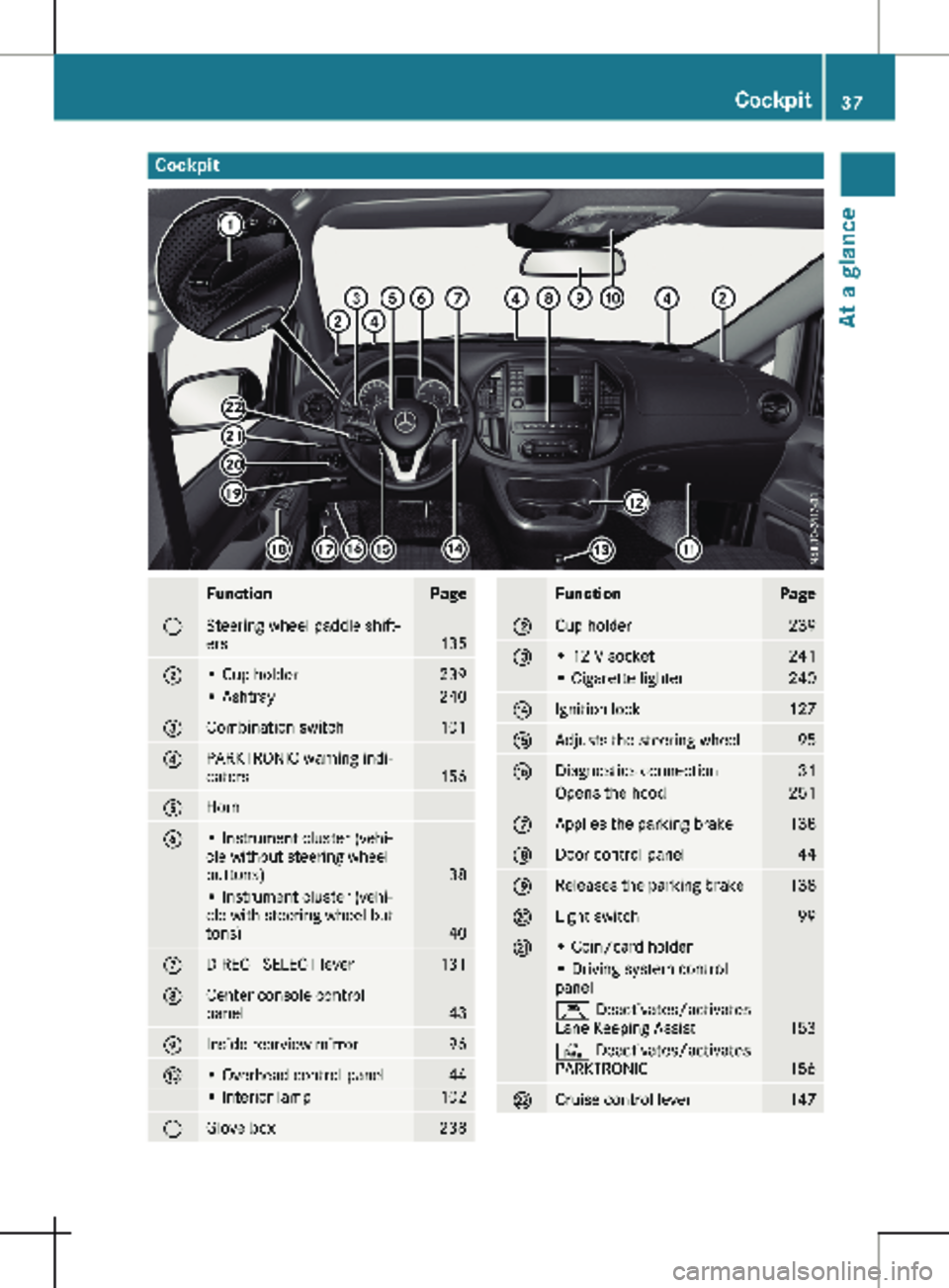
Cockpit
Function Page
:
Steering wheel paddle shift-
ers
135
;
• Cup holder 239
• Ashtray 240
=
Combination switch 101
?
PARKTRONIC warning indi-
cators
156
A
Horn
B
• Instrument cluster (vehi-
cle without steering wheel
buttons)
38
• Instrument cluster (vehi-
cle with steering wheel but-
tons)
40
C
DIRECT SELECT lever 131
D
Center console control
panel
43
E
Inside rearview mirror 96
F
• Overhead control panel 44
• Interior lamp 102
G
Glove box 238 Function Page
H
Cup holder 239
I
• 12 V socket 241
• Cigarette lighter 240
J
Ignition lock 127
K
Adjusts the steering wheel 95
L
Diagnostics connection 31
Opens the hood 251
M
Applies the parking brake 138
N
Door control panel 44
O
Releases the parking brake 138
P
Light switch 99
Q
• Coin/card holder
• Driving system control
panel
Ç Deactivates/activates
Lane Keeping Assist
153
c Deactivates/activates
PARKTRONIC
156
R
Cruise control lever 147Cockpit
37At a glance
Page 41 of 320
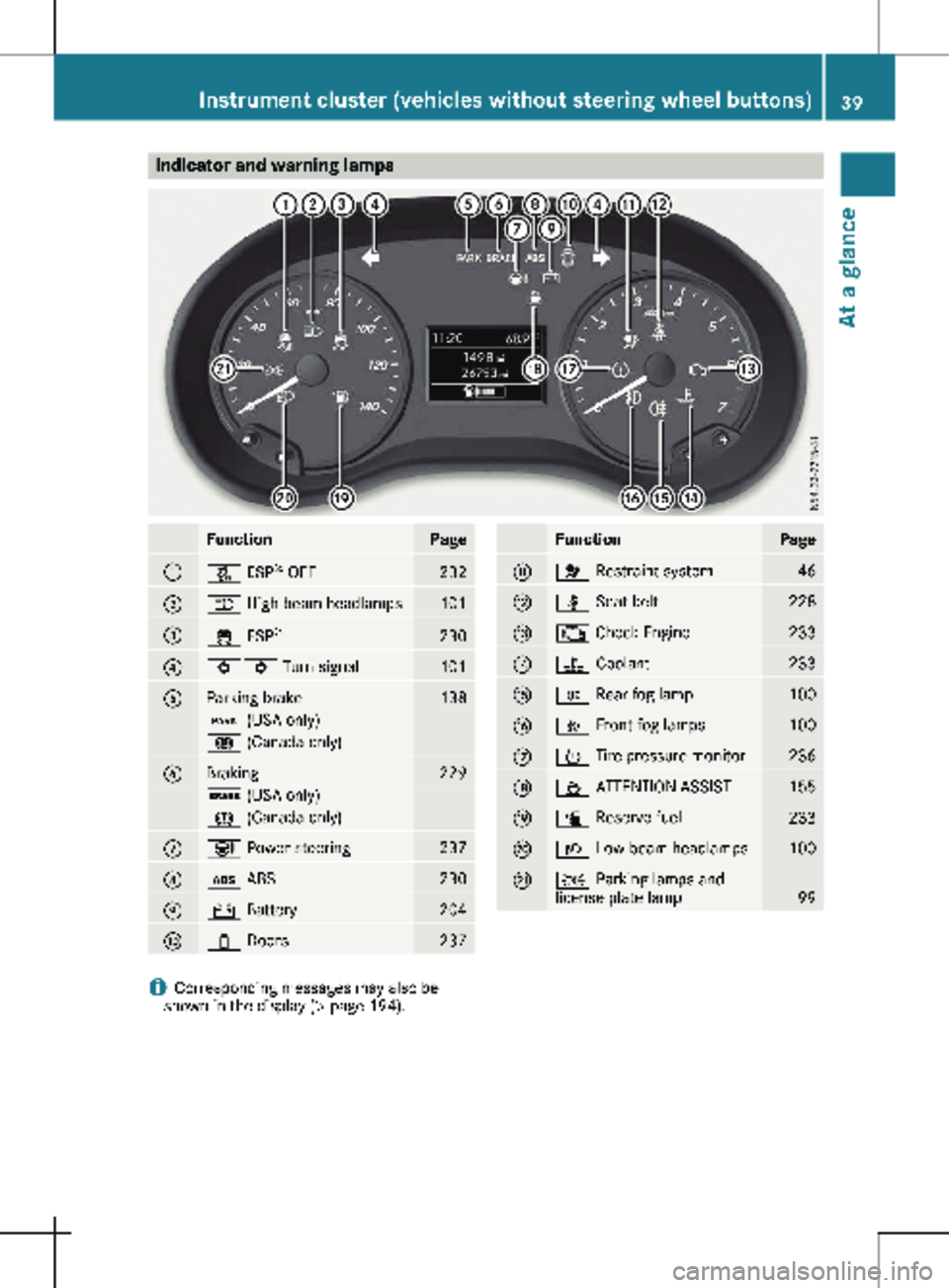
Indicator and warning lamps
Function Page
:
å ESP
®
OFF 232
;
K High-beam headlamps
101
=
÷ ESP
® 230
?
#! Turn signal
101
A
Parking brake 138
F (USA only)
! (Canada only)
B
Braking 229
$ (USA only)
J (Canada only)
C
Ð Power steering
237
D
ò ABS
230
E
# Battery
204
F
1 Doors
237 Function Page
G
6 Restraint system
46
H
ü Seat belt
228
I
; Check Engine
233
J
? Coolant
233
K
R Rear fog lamp
100
L
O Front fog lamps
100
M
h Tire pressure monitor
236
N
À ATTENTION ASSIST
155
O
æ Reserve fuel
233
P
L Low-beam headlamps
100
Q
T Parking lamps and
license plate lamp
99
i
Corresponding messages may also be
shown in the display (Y page 194).Instrument cluster (vehicles without steering wheel buttons)
39
At a glance
Page 43 of 320
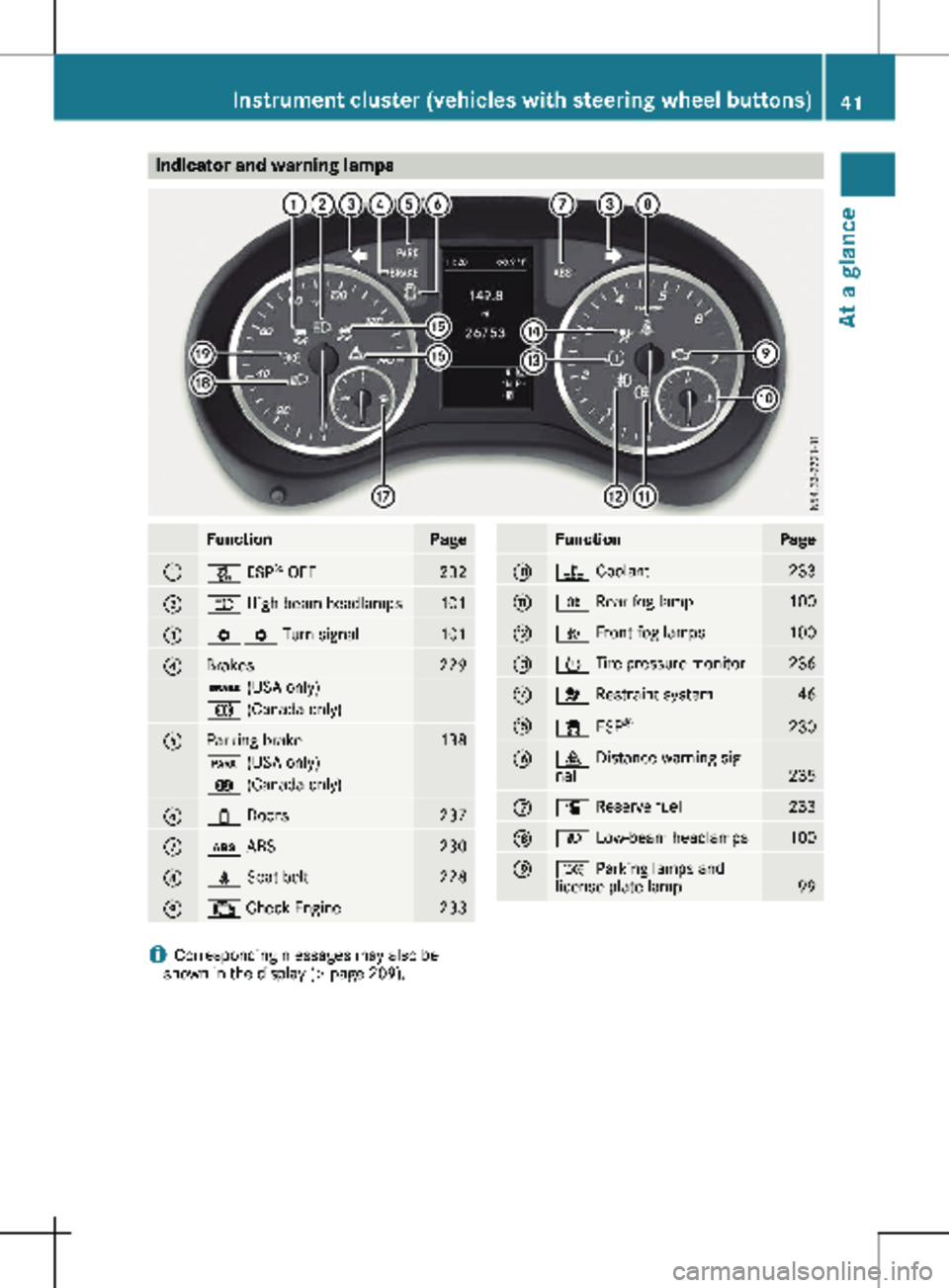
Indicator and warning lamps
Function Page
:
å ESP
®
OFF 232
;
K High-beam headlamps
101
=
#! Turn signal
101
?
Brakes 229
$ (USA only)
J (Canada only)
A
Parking brake 138
F (USA only)
! (Canada only)
B
1 Doors
237
C
ò ABS
230
D
ü Seat belt
228
E
; Check Engine
233 Function Page
F
? Coolant
233
G
R Rear fog lamp
100
H
O Front fog lamps
100
I
h Tire pressure monitor
236
J
6 Restraint system
46
K
÷ ESP
® 230
L
· Distance warning sig-
nal
235
M
æ Reserve fuel
233
N
L Low-beam headlamps
100
O
T Parking lamps and
license plate lamp
99
i
Corresponding messages may also be
shown in the display (Y page 209).Instrument cluster (vehicles with steering wheel buttons)
41
At a glance
Page 63 of 320
In addition, children could set the vehicle in
motion, for example, if they:
R release the parking brake.
R change the transmission position.
R start the vehicle.
There is a risk of accident and injury.
Never leave children unsupervised in the
vehicle.
When leaving the vehicle, always take the
SmartKey with you and lock the vehicle.
Keep the SmartKey out of the reach of chil-
dren. G
WARNING
If persons, particularly children are subjec-
ted to prolonged exposure to extreme heat
or cold, there is a risk of injury, possibly
even fatal. Never leave children unattended
in the vehicle. G
WARNING
If the child restraint system is subjected to
direct sunlight, parts may get very hot. Chil-
dren may burn themselves on these parts,
particularly on the metal parts of the child
restraint system. There is a risk of injury.
If you leave the vehicle, taking the child with
you, always ensure that the child restraint
system is not exposed to direct sunlight.
Protect it with a blanket, for example. If the
child restraint system has been exposed to
direct sunlight, let it cool down before secur-
ing the child in it. Never leave children unat-
tended in the vehicle.
Make sure that all vehicle occupants have fas-
tened their seat belts properly and are seated
correctly. This is particularly important for chil-
dren.
Observe the safety notes on seat belts
(Y page
48) and the notes on the correct use
of the seat belt (Y page 49).
A booster seat may be necessary to achieve
proper seat belt positioning for children over
40 lbs (18 kg) until they reach a height where
a three-point seat belt fits properly without a
booster seat. Special seatbelt retractor
G
WARNING
If the seat belt is released while driving, the
child restraint system will no longer be
secured properly. The special seat belt
retractor is disabled and the inertia real
draws in a portion of the seat belt. The seat
belt cannot be immediately refastened.
There is an increased risk of injury, possibly
even fatal.
Stop the vehicle immediately, paying atten-
tion to road and traffic conditions. Reacti-
vate the special seat belt retractor and
secure the child restraint system properly.
All seat belts in the vehicle, except the driver's
seat belt, are equipped with a special seat belt
retractor. When activated, the special seat belt
retractor ensures that the seat belt cannot
slacken once the child seat is secured.
Installing a child restraint system:
X Make sure you observe the child restraint
system manufacturer's installation instruc-
tions.
X Pull the seat belt smoothly from the belt
outlet.
X Engage seat belt tongue in belt buckle.
Activating the special seat belt retractor:
X Pull the seat belt out fully and let the inertia
reel retract it again.
While the seat belt is retracting, you should
hear a ratcheting sound. The special seat
belt retractor is enabled.
X Push the child restraint system down so that
the seat belt is tight and does not loosen.
Removing the child restraint system and deac-
tivating the special seat belt retractor:
X Make sure you observe the child restraint
system manufacturer's installation instruc-
tions.
X Press the release button of the seat belt
buckle and guide the seat belt tongue back
towards the belt sash guide.
The special seat belt retractor is deactiva-
ted. Children in the vehicle
61
Safety Z
Page 67 of 320
running from the belt outlet to the belt guide
of the child restraint system. The shoulder belt
strap must be routed forward and down from
the vehicle belt outlet. Adjust the belt outlet
and co-driver's seat as required.
Always comply with the manufacturer's instal-
lation and operating instructions for the child
restraint system. Override feature/child-proof locks
Important safety notes G
WARNING
If children are traveling in the vehicle, they
could in particular:
R open doors, thereby endangering other
persons or road users.
R get out and be struck by oncoming traffic.
R operate vehicle equipment and become
trapped.
There is a risk of an accident and injury.
Always activate the child-proof locks and
override feature if children are traveling in
the vehicle. When leaving the vehicle,
always take the key with you and lock the
vehicle. Never leave children unattended in
the vehicle.
Child-proof lock/override feature for:
R Sliding doors ( Y page
66)G
WARNING
If children are left unsupervised in the vehi-
cle, they could, in particular:
R open doors, thereby endangering other
persons or road users.
R get out and be struck by oncoming traffic.
R operate vehicle equipment and become
trapped, for example.
In addition, children could set the vehicle in
motion, for example, if they:
R release the parking brake.
R change the transmission position.
R start the vehicle. There is a risk of accident and injury.
Never leave children unsupervised in the
vehicle.
When leaving the vehicle, always take the
SmartKey with you and lock the vehicle.
Keep the SmartKey out of the reach of chil-
dren.
G
WARNING
If persons, particularly children are subjec-
ted to prolonged exposure to extreme heat
or cold, there is a risk of injury, possibly
even fatal. Never leave children unattended
in the vehicle. G
WARNING
If the child restraint system is subjected to
direct sunlight, parts may get very hot. Chil-
dren may burn themselves on these parts,
particularly on the metal parts of the child
restraint system. There is a risk of injury.
If you leave the vehicle, taking the child with
you, always ensure that the child restraint
system is not exposed to direct sunlight.
Protect it with a blanket, for example. If the
child restraint system has been exposed to
direct sunlight, let it cool down before secur-
ing the child in it. Never leave children unat-
tended in the vehicle. Children in the vehicle
65
Safety Z
Page 68 of 320
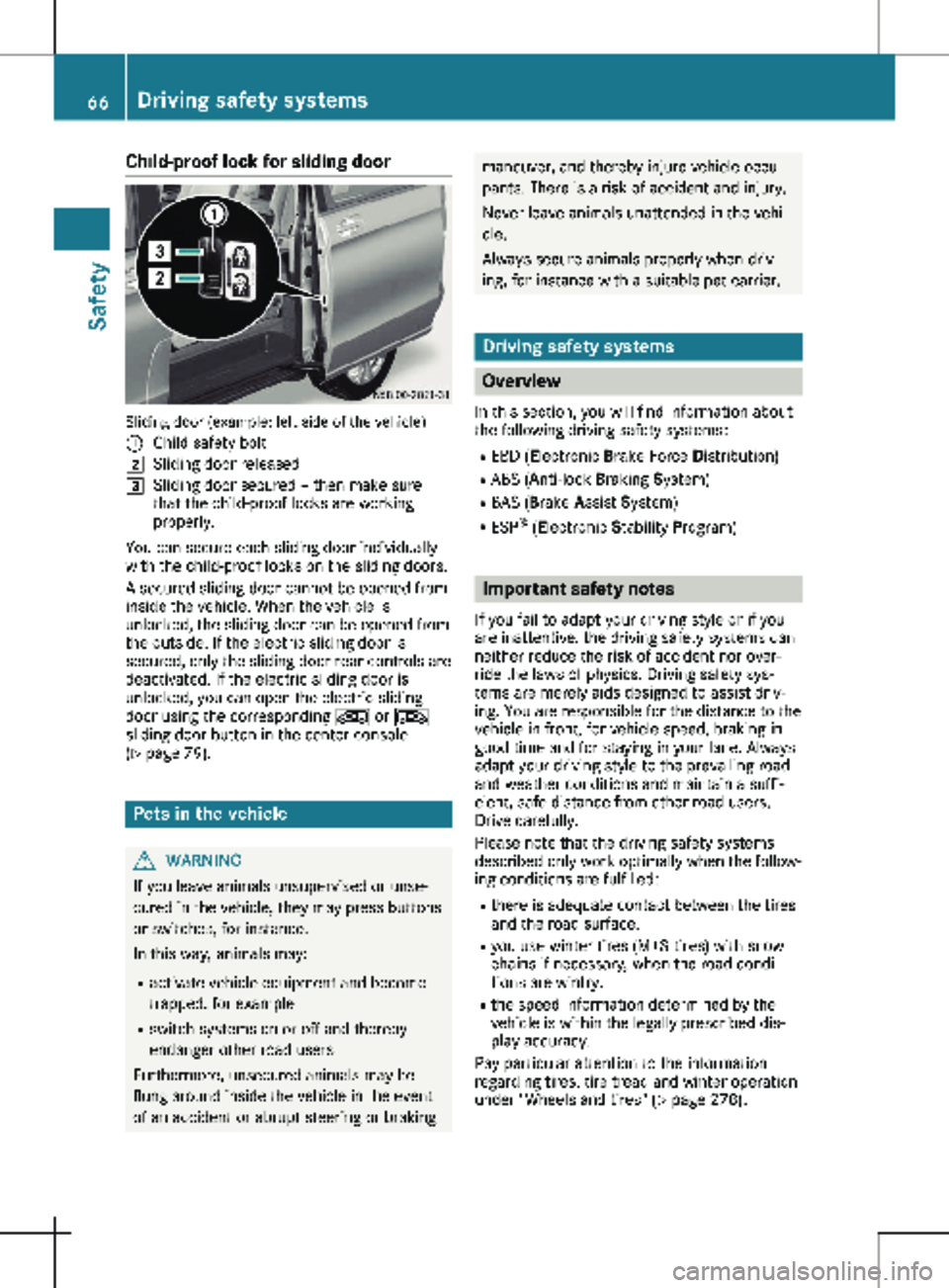
Child-proof lock for sliding door
Sliding door (example: left side of the vehicle)
: Child safety bolt
2 Sliding door released
3 Sliding door secured – then make sure
that the child-proof locks are working
properly.
You can secure each sliding door individually
with the child-proof locks on the sliding doors.
A secured sliding door cannot be opened from
inside the vehicle. When the vehicle is
unlocked, the sliding door can be opened from
the outside. If the electric sliding door is
secured, only the sliding door rear controls are
deactivated. If the electric sliding door is
unlocked, you can open the electric sliding
door using the corresponding Å or Æ
sliding door button in the center console
(Y page
79). Pets in the vehicle
G
WARNING
If you leave animals unsupervised or unse-
cured in the vehicle, they may press buttons
or switches, for instance.
In this way, animals may:
R activate vehicle equipment and become
trapped, for example
R switch systems on or off and thereby
endanger other road users
Furthermore, unsecured animals may be
flung around inside the vehicle in the event
of an accident or abrupt steering or braking maneuver, and thereby injure vehicle occu-
pants. There is a risk of accident and injury.
Never leave animals unattended in the vehi-
cle.
Always secure animals properly when driv-
ing, for instance with a suitable pet carrier. Driving safety systems
Overview
In this section, you will find information about
the following driving safety systems:
R EBD ( Electronic Brake Force Distribution)
R ABS ( Anti-lock Braking System)
R BAS ( Brake A ssist System)
R ESP ®
(Electronic Stability Program) Important safety notes
If you fail to adapt your driving style or if you
are inattentive, the driving safety systems can
neither reduce the risk of accident nor over-
ride the laws of physics. Driving safety sys-
tems are merely aids designed to assist driv-
ing. You are responsible for the distance to the
vehicle in front, for vehicle speed, braking in
good time and for staying in your lane. Always
adapt your driving style to the prevailing road
and weather conditions and maintain a suffi-
cient, safe distance from other road users.
Drive carefully.
Please note that the driving safety systems
described only work optimally when the follow-
ing conditions are fulfilled:
R there is adequate contact between the tires
and the road surface.
R you use winter tires
(M+S tires) with snow
chains if necessary, when the road condi-
tions are wintry.
R the speed information determined by the
vehicle is within the legally prescribed dis-
play accuracy.
Pay particular attention to the information
regarding tires, tire tread and winter operation
under "Wheels and tires" (Y page 278). 66
Driving safety systems
Safety
Page 69 of 320
ABS (Anti-lock Braking System)
General notes ABS regulates brake pressure in such a way
that the wheels do not lock when you brake.
This allows you to continue steering the vehi-
cle when braking.
The ò warning lamp in the instrument clus-
ter lights up when the ignition is switched on.
The lamp goes out when the engine starts run-
ning.
Important safety notes Observe the important safety guidelines for
the driving safety system (
Y page
66).
ABS works from a speed of about 5 mph
(8 km/h), regardless of road-surface condi-
tions. ABS works on slippery surfaces, even
when you only brake gently. G
WARNING
If ABS is faulty, the wheels could lock when
braking. The steerability and braking charac-
teristics may be severely impaired. Addition-
ally, further driving safety systems are deac-
tivated. There is an increased danger of
skidding and accidents.
Drive on carefully. Have ABS checked imme-
diately at a qualified specialist workshop.
If ABS is malfunctioning, the ò warning
lamp
(Y page 230) lights up while the engine
is running and the display shows a message:
R on vehicles without steering wheel buttons
(Y page 196)
R on vehicles with steering wheel buttons
(Y page 210)
BAS, Hill Start Assist and ESP ®
and its driving
safety systems and other driving systems also
fail. Observe the notes on the ò warning
lamp and the display messages.
Braking If ABS intervenes when braking, you will feel a
pulsating in the brake pedal.
The pulsating brake pedal can be an indication
of hazardous road conditions and functions as
a reminder to take extra care while driving. X
If ABS intervenes: continue to depress the
brake pedal with force until the braking sit-
uation is over.
X To make a full brake application: depress
the brake pedal with full force. BAS (Brake Assist System)
General notes BAS operates in emergency braking situations.
If you depress the brake pedal quickly, BAS
automatically boosts the braking force, thus
shortening the stopping distance.
Important safety notes Observe the important safety guidelines for
the driving safety system
(Y page 66). G
WARNING
If BAS is malfunctioning, the braking dis-
tance in an emergency braking situation is
increased. There is a risk of an accident.
In an emergency braking situation, depress
the brake pedal with full force. ABS prevents
the wheels from locking.
If BAS is malfunctioning, the ÷ warning
lamp lights up while the engine is running
(Y page
230) and the display shows a mes-
sage:
R on vehicles without steering wheel buttons
(Y page 200)
R on vehicles with steering wheel buttons
(Y page 214)
Braking X
Keep the brake pedal firmly depressed until
the emergency braking situation is over.
ABS prevents the wheels from locking.
The brakes will function as usual once you
release the brake pedal. BAS is deactivated. Driving safety systems
67
Safety Z