sensor MERCEDES-BENZ SPRINTER 2005 Service Repair Manual
[x] Cancel search | Manufacturer: MERCEDES-BENZ, Model Year: 2005, Model line: SPRINTER, Model: MERCEDES-BENZ SPRINTER 2005Pages: 1232, PDF Size: 39.23 MB
Page 964 of 1232
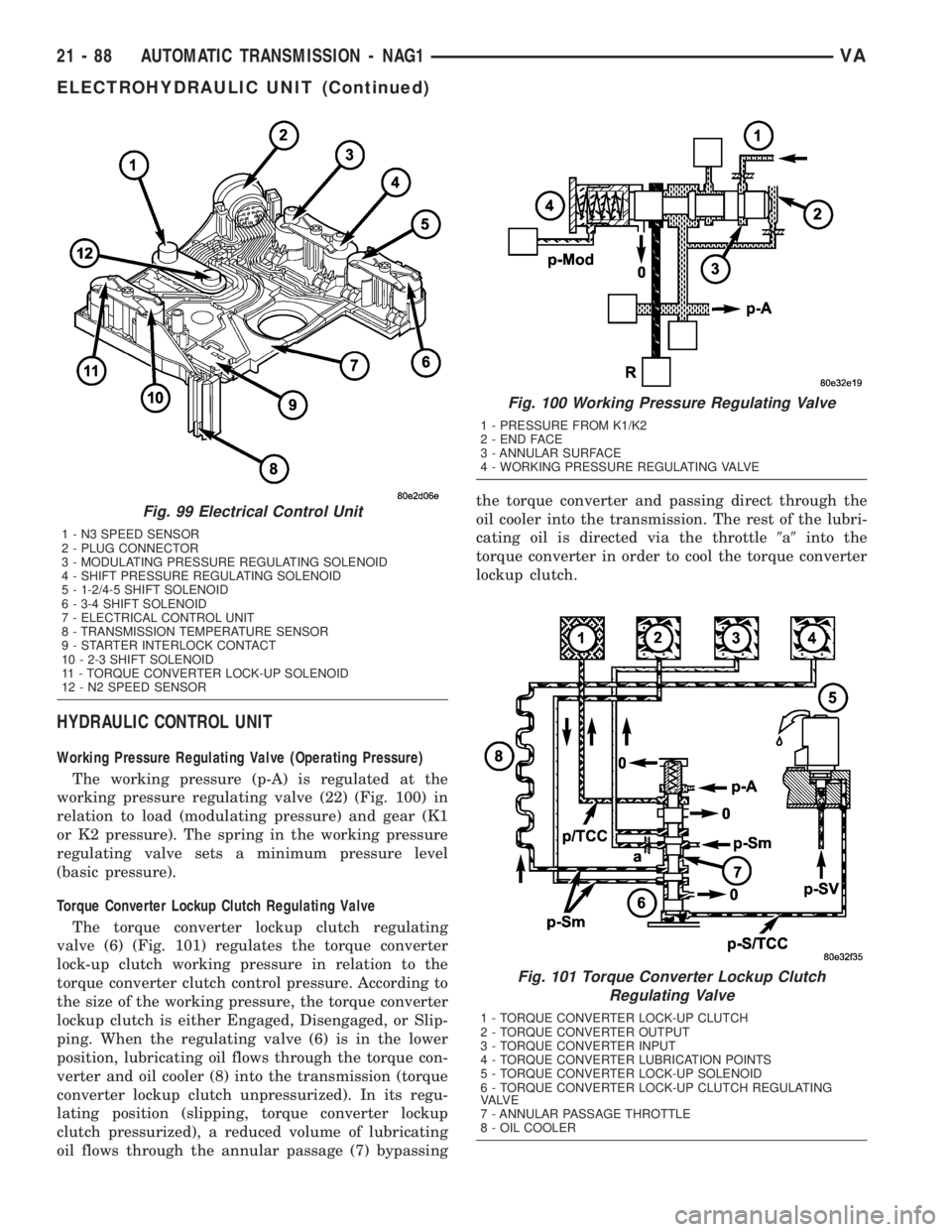
HYDRAULIC CONTROL UNIT
Working Pressure Regulating Valve (Operating Pressure)
The working pressure (p-A) is regulated at the
working pressure regulating valve (22) (Fig. 100) in
relation to load (modulating pressure) and gear (K1
or K2 pressure). The spring in the working pressure
regulating valve sets a minimum pressure level
(basic pressure).
Torque Converter Lockup Clutch Regulating Valve
The torque converter lockup clutch regulating
valve (6) (Fig. 101) regulates the torque converter
lock-up clutch working pressure in relation to the
torque converter clutch control pressure. According to
the size of the working pressure, the torque converter
lockup clutch is either Engaged, Disengaged, or Slip-
ping. When the regulating valve (6) is in the lower
position, lubricating oil flows through the torque con-
verter and oil cooler (8) into the transmission (torque
converter lockup clutch unpressurized). In its regu-
lating position (slipping, torque converter lockup
clutch pressurized), a reduced volume of lubricating
oil flows through the annular passage (7) bypassingthe torque converter and passing direct through the
oil cooler into the transmission. The rest of the lubri-
cating oil is directed via the throttle9a9into the
torque converter in order to cool the torque converter
lockup clutch.
Fig. 99 Electrical Control Unit
1 - N3 SPEED SENSOR
2 - PLUG CONNECTOR
3 - MODULATING PRESSURE REGULATING SOLENOID
4 - SHIFT PRESSURE REGULATING SOLENOID
5 - 1-2/4-5 SHIFT SOLENOID
6 - 3-4 SHIFT SOLENOID
7 - ELECTRICAL CONTROL UNIT
8 - TRANSMISSION TEMPERATURE SENSOR
9 - STARTER INTERLOCK CONTACT
10 - 2-3 SHIFT SOLENOID
11 - TORQUE CONVERTER LOCK-UP SOLENOID
12 - N2 SPEED SENSOR
Fig. 100 Working Pressure Regulating Valve
1 - PRESSURE FROM K1/K2
2 - END FACE
3 - ANNULAR SURFACE
4 - WORKING PRESSURE REGULATING VALVE
Fig. 101 Torque Converter Lockup Clutch
Regulating Valve
1 - TORQUE CONVERTER LOCK-UP CLUTCH
2 - TORQUE CONVERTER OUTPUT
3 - TORQUE CONVERTER INPUT
4 - TORQUE CONVERTER LUBRICATION POINTS
5 - TORQUE CONVERTER LOCK-UP SOLENOID
6 - TORQUE CONVERTER LOCK-UP CLUTCH REGULATING
VA LV E
7 - ANNULAR PASSAGE THROTTLE
8 - OIL COOLER
21 - 88 AUTOMATIC TRANSMISSION - NAG1VA
ELECTROHYDRAULIC UNIT (Continued)
Page 969 of 1232
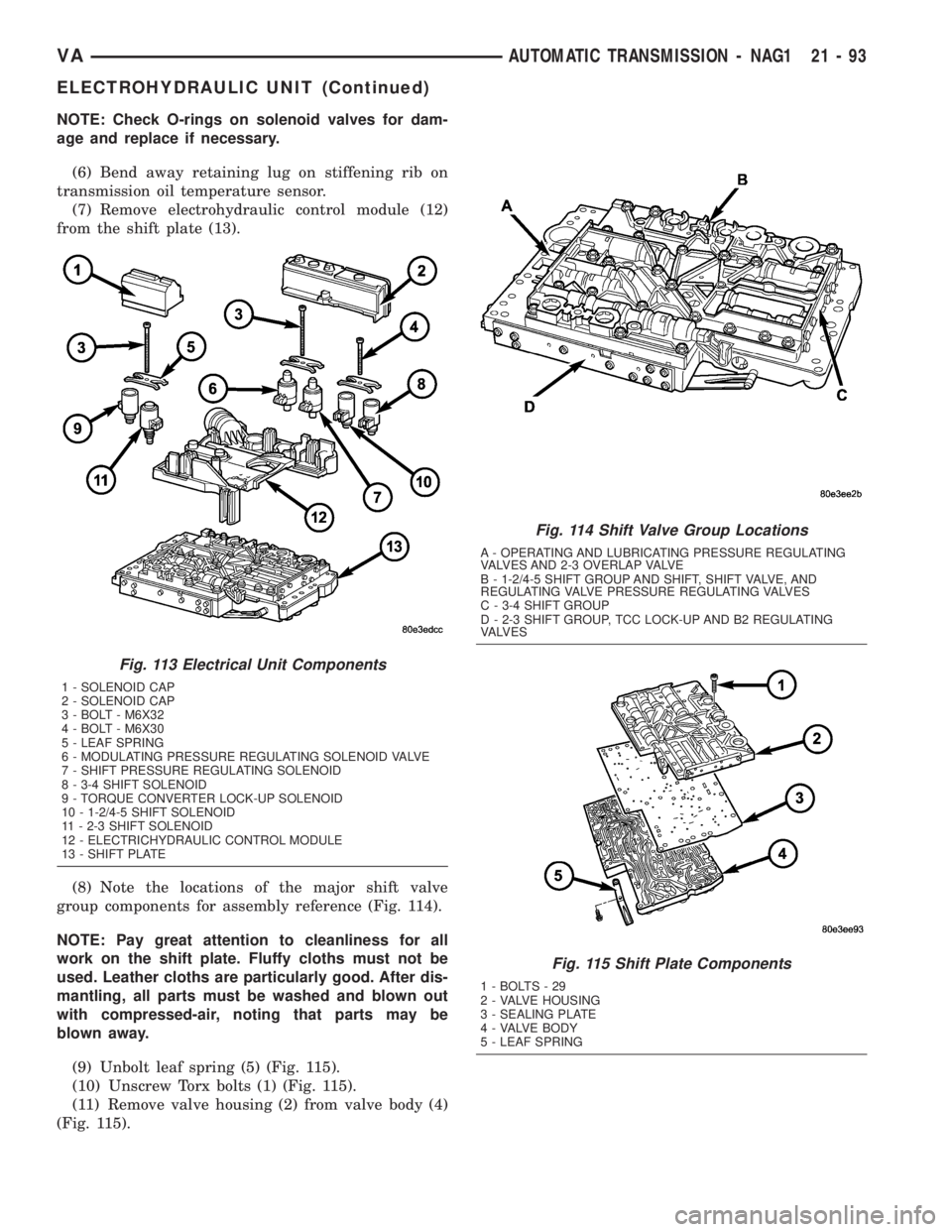
NOTE: Check O-rings on solenoid valves for dam-
age and replace if necessary.
(6) Bend away retaining lug on stiffening rib on
transmission oil temperature sensor.
(7) Remove electrohydraulic control module (12)
from the shift plate (13).
(8) Note the locations of the major shift valve
group components for assembly reference (Fig. 114).
NOTE: Pay great attention to cleanliness for all
work on the shift plate. Fluffy cloths must not be
used. Leather cloths are particularly good. After dis-
mantling, all parts must be washed and blown out
with compressed-air, noting that parts may be
blown away.
(9) Unbolt leaf spring (5) (Fig. 115).
(10) Unscrew Torx bolts (1) (Fig. 115).
(11) Remove valve housing (2) from valve body (4)
(Fig. 115).
Fig. 113 Electrical Unit Components
1 - SOLENOID CAP
2 - SOLENOID CAP
3 - BOLT - M6X32
4 - BOLT - M6X30
5 - LEAF SPRING
6 - MODULATING PRESSURE REGULATING SOLENOID VALVE
7 - SHIFT PRESSURE REGULATING SOLENOID
8 - 3-4 SHIFT SOLENOID
9 - TORQUE CONVERTER LOCK-UP SOLENOID
10 - 1-2/4-5 SHIFT SOLENOID
11 - 2-3 SHIFT SOLENOID
12 - ELECTRICHYDRAULIC CONTROL MODULE
13 - SHIFT PLATE
Fig. 114 Shift Valve Group Locations
A - OPERATING AND LUBRICATING PRESSURE REGULATING
VALVES AND 2-3 OVERLAP VALVE
B - 1-2/4-5 SHIFT GROUP AND SHIFT, SHIFT VALVE, AND
REGULATING VALVE PRESSURE REGULATING VALVES
C - 3-4 SHIFT GROUP
D - 2-3 SHIFT GROUP, TCC LOCK-UP AND B2 REGULATING
VA LV E S
Fig. 115 Shift Plate Components
1-BOLTS-29
2 - VALVE HOUSING
3 - SEALING PLATE
4 - VALVE BODY
5 - LEAF SPRING
VAAUTOMATIC TRANSMISSION - NAG1 21 - 93
ELECTROHYDRAULIC UNIT (Continued)
Page 975 of 1232
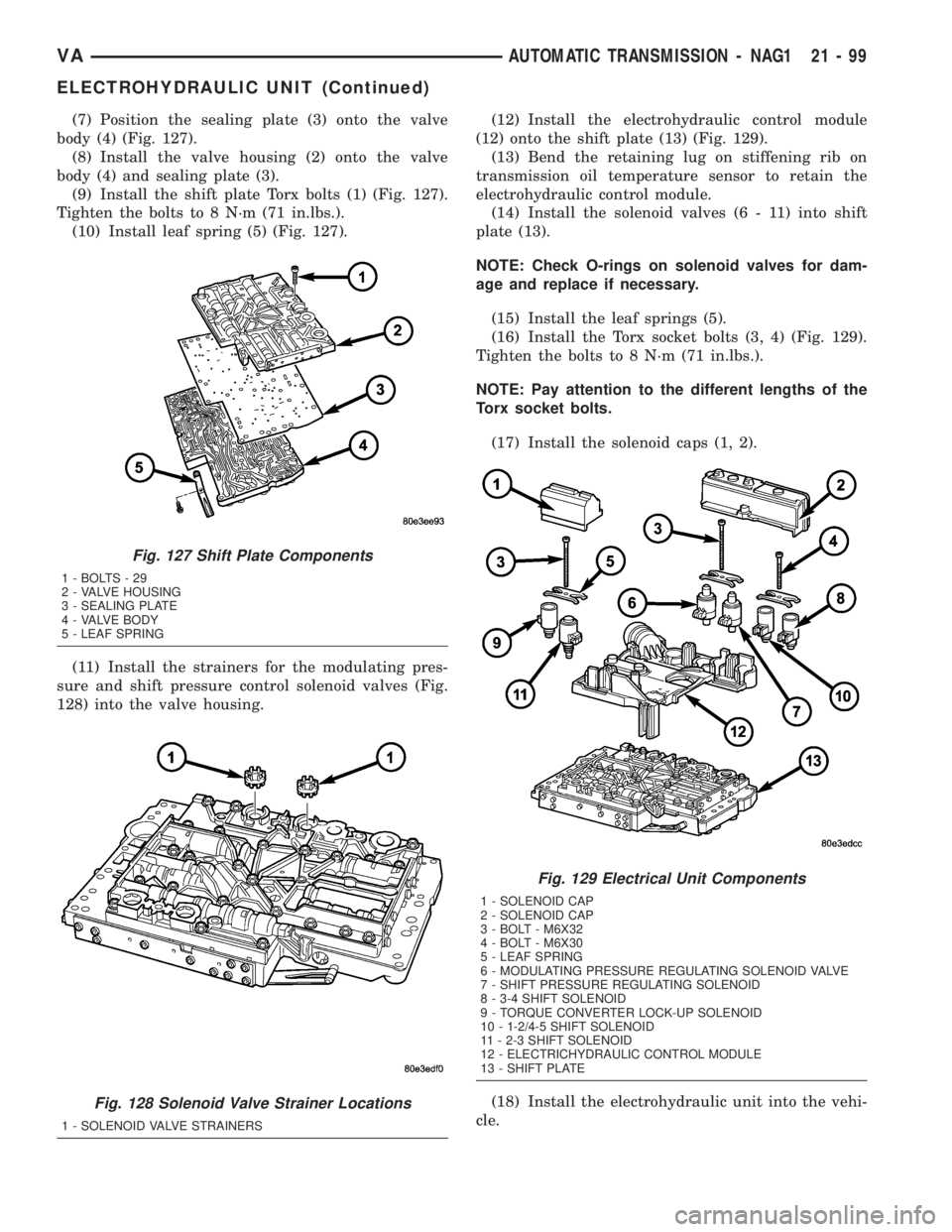
(7) Position the sealing plate (3) onto the valve
body (4) (Fig. 127).
(8) Install the valve housing (2) onto the valve
body (4) and sealing plate (3).
(9) Install the shift plate Torx bolts (1) (Fig. 127).
Tighten the bolts to 8 N´m (71 in.lbs.).
(10) Install leaf spring (5) (Fig. 127).
(11) Install the strainers for the modulating pres-
sure and shift pressure control solenoid valves (Fig.
128) into the valve housing.(12) Install the electrohydraulic control module
(12) onto the shift plate (13) (Fig. 129).
(13) Bend the retaining lug on stiffening rib on
transmission oil temperature sensor to retain the
electrohydraulic control module.
(14) Install the solenoid valves (6 - 11) into shift
plate (13).
NOTE: Check O-rings on solenoid valves for dam-
age and replace if necessary.
(15) Install the leaf springs (5).
(16) Install the Torx socket bolts (3, 4) (Fig. 129).
Tighten the bolts to 8 N´m (71 in.lbs.).
NOTE: Pay attention to the different lengths of the
Torx socket bolts.
(17) Install the solenoid caps (1, 2).
(18) Install the electrohydraulic unit into the vehi-
cle.
Fig. 127 Shift Plate Components
1-BOLTS-29
2 - VALVE HOUSING
3 - SEALING PLATE
4 - VALVE BODY
5 - LEAF SPRING
Fig. 128 Solenoid Valve Strainer Locations
1 - SOLENOID VALVE STRAINERS
Fig. 129 Electrical Unit Components
1 - SOLENOID CAP
2 - SOLENOID CAP
3 - BOLT - M6X32
4 - BOLT - M6X30
5 - LEAF SPRING
6 - MODULATING PRESSURE REGULATING SOLENOID VALVE
7 - SHIFT PRESSURE REGULATING SOLENOID
8 - 3-4 SHIFT SOLENOID
9 - TORQUE CONVERTER LOCK-UP SOLENOID
10 - 1-2/4-5 SHIFT SOLENOID
11 - 2-3 SHIFT SOLENOID
12 - ELECTRICHYDRAULIC CONTROL MODULE
13 - SHIFT PLATE
VAAUTOMATIC TRANSMISSION - NAG1 21 - 99
ELECTROHYDRAULIC UNIT (Continued)
Page 979 of 1232
(4) Actuate the service brake. Start engine and let
it run at idle speed in selector lever position9P9.
(5) Shift through the transmission modes several
times with the vehicle stationary and the engine
idling
(6) Warm up the transmission, wait at least 2 min-
utes and check the oil level with the engine running.
Push the Oil Dipstick 8863A in up to the stop on the
electrohydraulic unit and pull out again, read off oil
level, repeat if necessary.
NOTE: The dipstick will protrude from the fill tube
approximately 75mm (3 inches) when installed.
(7) Check transmission oil temperature.
NOTE: The true transmission oil temperature can
only be read by a scan tool in REVERSE or any for-
ward gear position. (Refer to 21 - AUTOMATIC
TRANSMISSION- NAG1/TRANSMISSION TEMPERA-
TURE SENSOR/PARK-NEUTRAL SWITCH - OPERA-
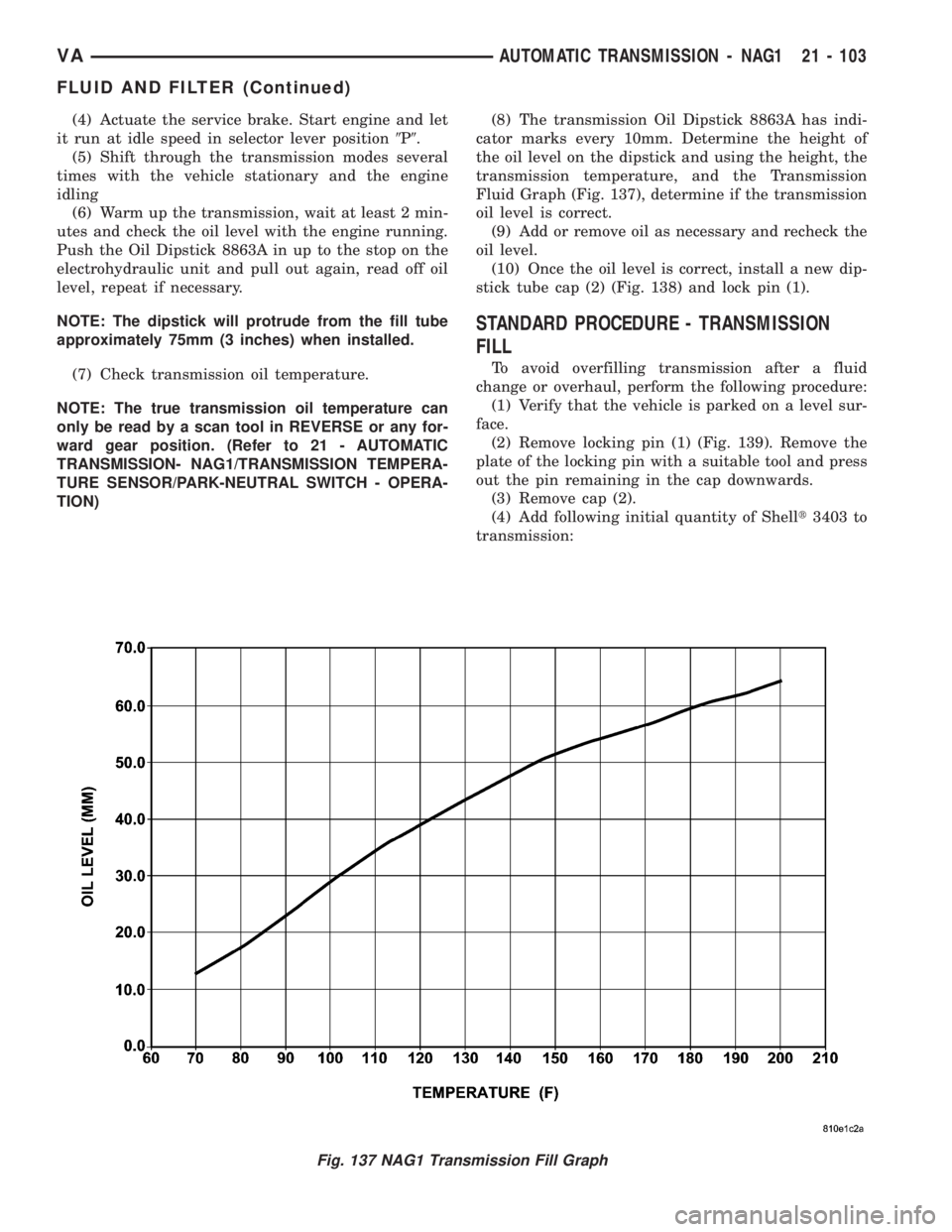
TION)(8) The transmission Oil Dipstick 8863A has indi-
cator marks every 10mm. Determine the height of
the oil level on the dipstick and using the height, the
transmission temperature, and the Transmission
Fluid Graph (Fig. 137), determine if the transmission
oil level is correct.
(9) Add or remove oil as necessary and recheck the
oil level.
(10) Once the oil level is correct, install a new dip-
stick tube cap (2) (Fig. 138) and lock pin (1).
STANDARD PROCEDURE - TRANSMISSION
FILL
To avoid overfilling transmission after a fluid
change or overhaul, perform the following procedure:
(1) Verify that the vehicle is parked on a level sur-
face.
(2) Remove locking pin (1) (Fig. 139). Remove the
plate of the locking pin with a suitable tool and press
out the pin remaining in the cap downwards.
(3) Remove cap (2).
(4) Add following initial quantity of Shellt3403 to
transmission:
Fig. 137 NAG1 Transmission Fill Graph
VAAUTOMATIC TRANSMISSION - NAG1 21 - 103
FLUID AND FILTER (Continued)
Page 995 of 1232
INPUT SPEED SENSORS
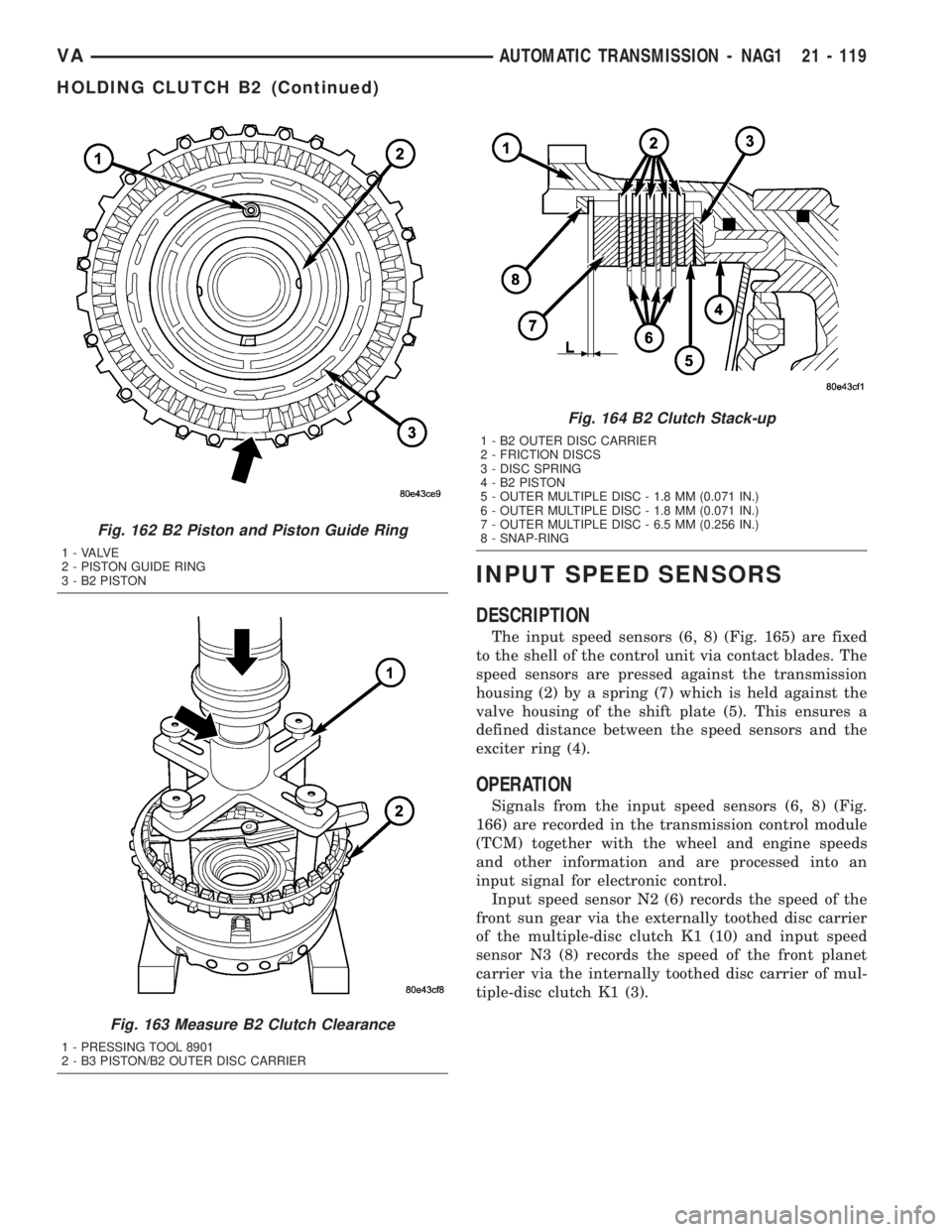
DESCRIPTION
The input speed sensors (6, 8) (Fig. 165) are fixed
to the shell of the control unit via contact blades. The
speed sensors are pressed against the transmission
housing (2) by a spring (7) which is held against the
valve housing of the shift plate (5). This ensures a
defined distance between the speed sensors and the
exciter ring (4).
OPERATION
Signals from the input speed sensors (6, 8) (Fig.
166) are recorded in the transmission control module
(TCM) together with the wheel and engine speeds
and other information and are processed into an
input signal for electronic control.
Input speed sensor N2 (6) records the speed of the
front sun gear via the externally toothed disc carrier
of the multiple-disc clutch K1 (10) and input speed
sensor N3 (8) records the speed of the front planet
carrier via the internally toothed disc carrier of mul-
tiple-disc clutch K1 (3).
Fig. 162 B2 Piston and Piston Guide Ring
1 - VALVE
2 - PISTON GUIDE RING
3 - B2 PISTON
Fig. 163 Measure B2 Clutch Clearance
1 - PRESSING TOOL 8901
2 - B3 PISTON/B2 OUTER DISC CARRIER
Fig. 164 B2 Clutch Stack-up
1 - B2 OUTER DISC CARRIER
2 - FRICTION DISCS
3 - DISC SPRING
4 - B2 PISTON
5 - OUTER MULTIPLE DISC - 1.8 MM (0.071 IN.)
6 - OUTER MULTIPLE DISC - 1.8 MM (0.071 IN.)
7 - OUTER MULTIPLE DISC - 6.5 MM (0.256 IN.)
8 - SNAP-RING
VAAUTOMATIC TRANSMISSION - NAG1 21 - 119
HOLDING CLUTCH B2 (Continued)
Page 996 of 1232
OIL PUMP
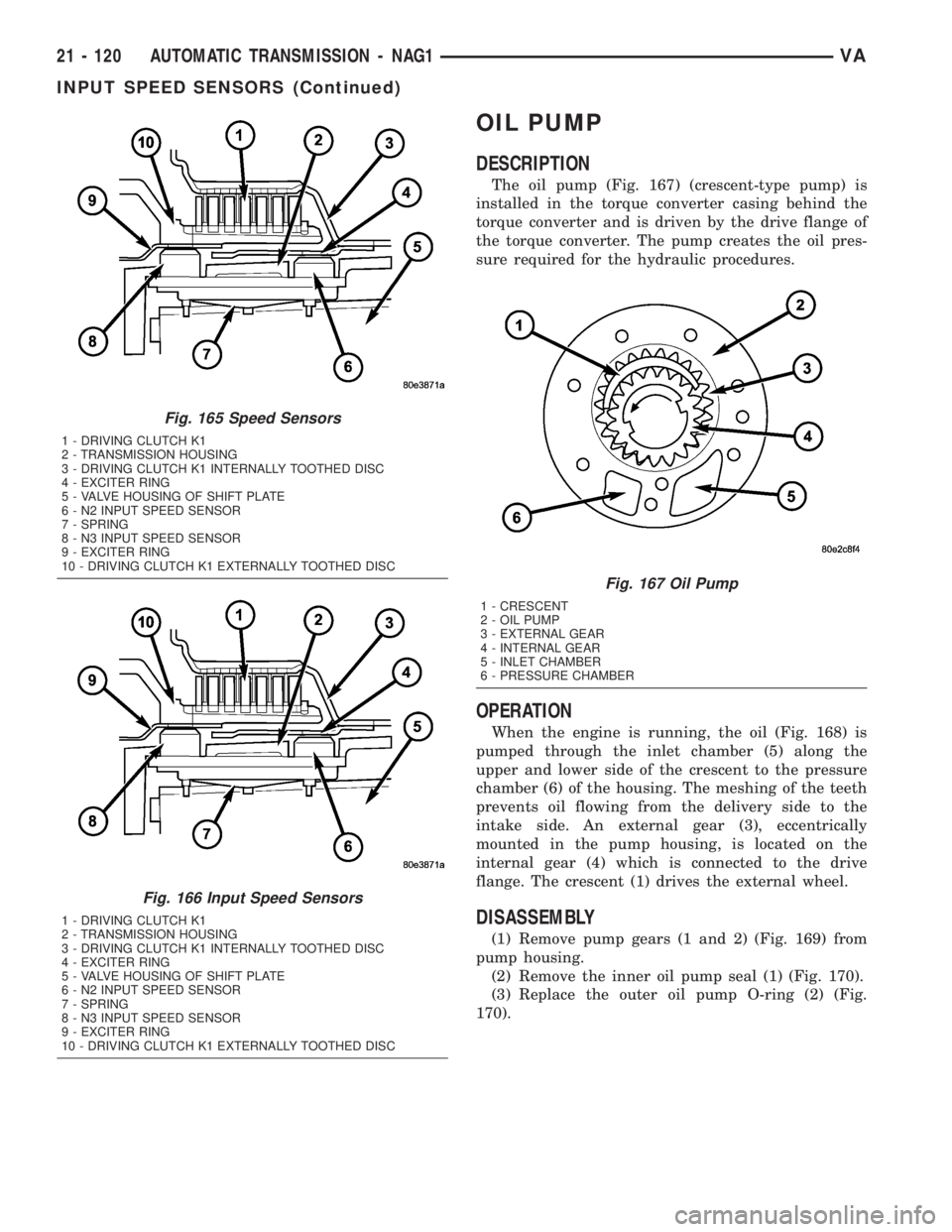
DESCRIPTION
The oil pump (Fig. 167) (crescent-type pump) is
installed in the torque converter casing behind the
torque converter and is driven by the drive flange of
the torque converter. The pump creates the oil pres-
sure required for the hydraulic procedures.
OPERATION
When the engine is running, the oil (Fig. 168) is
pumped through the inlet chamber (5) along the
upper and lower side of the crescent to the pressure
chamber (6) of the housing. The meshing of the teeth
prevents oil flowing from the delivery side to the
intake side. An external gear (3), eccentrically
mounted in the pump housing, is located on the
internal gear (4) which is connected to the drive
flange. The crescent (1) drives the external wheel.
DISASSEMBLY
(1) Remove pump gears (1 and 2) (Fig. 169) from
pump housing.
(2) Remove the inner oil pump seal (1) (Fig. 170).
(3) Replace the outer oil pump O-ring (2) (Fig.
170).
Fig. 165 Speed Sensors
1 - DRIVING CLUTCH K1
2 - TRANSMISSION HOUSING
3 - DRIVING CLUTCH K1 INTERNALLY TOOTHED DISC
4 - EXCITER RING
5 - VALVE HOUSING OF SHIFT PLATE
6 - N2 INPUT SPEED SENSOR
7 - SPRING
8 - N3 INPUT SPEED SENSOR
9 - EXCITER RING
10 - DRIVING CLUTCH K1 EXTERNALLY TOOTHED DISC
Fig. 166 Input Speed Sensors
1 - DRIVING CLUTCH K1
2 - TRANSMISSION HOUSING
3 - DRIVING CLUTCH K1 INTERNALLY TOOTHED DISC
4 - EXCITER RING
5 - VALVE HOUSING OF SHIFT PLATE
6 - N2 INPUT SPEED SENSOR
7 - SPRING
8 - N3 INPUT SPEED SENSOR
9 - EXCITER RING
10 - DRIVING CLUTCH K1 EXTERNALLY TOOTHED DISC
Fig. 167 Oil Pump
1 - CRESCENT
2 - OIL PUMP
3 - EXTERNAL GEAR
4 - INTERNAL GEAR
5 - INLET CHAMBER
6 - PRESSURE CHAMBER
21 - 120 AUTOMATIC TRANSMISSION - NAG1VA
INPUT SPEED SENSORS (Continued)
Page 1015 of 1232
UPSHIFT/DOWNSHIFT SOLENOID VALVES
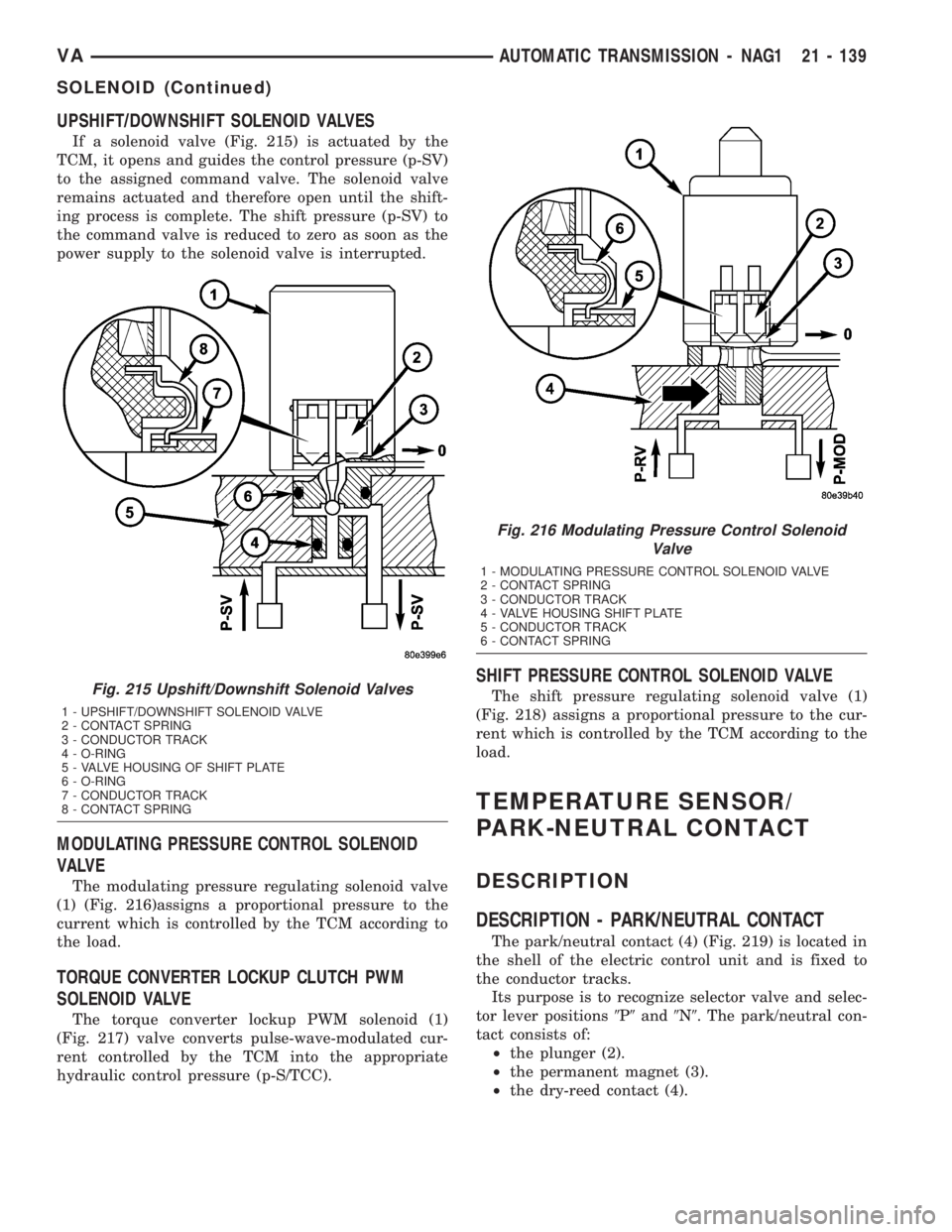
If a solenoid valve (Fig. 215) is actuated by the
TCM, it opens and guides the control pressure (p-SV)
to the assigned command valve. The solenoid valve
remains actuated and therefore open until the shift-
ing process is complete. The shift pressure (p-SV) to
the command valve is reduced to zero as soon as the
power supply to the solenoid valve is interrupted.
MODULATING PRESSURE CONTROL SOLENOID
VALVE
The modulating pressure regulating solenoid valve
(1) (Fig. 216)assigns a proportional pressure to the
current which is controlled by the TCM according to
the load.
TORQUE CONVERTER LOCKUP CLUTCH PWM
SOLENOID VALVE
The torque converter lockup PWM solenoid (1)
(Fig. 217) valve converts pulse-wave-modulated cur-
rent controlled by the TCM into the appropriate
hydraulic control pressure (p-S/TCC).
SHIFT PRESSURE CONTROL SOLENOID VALVE
The shift pressure regulating solenoid valve (1)
(Fig. 218) assigns a proportional pressure to the cur-
rent which is controlled by the TCM according to the
load.
TEMPERATURE SENSOR/
PARK-NEUTRAL CONTACT
DESCRIPTION
DESCRIPTION - PARK/NEUTRAL CONTACT
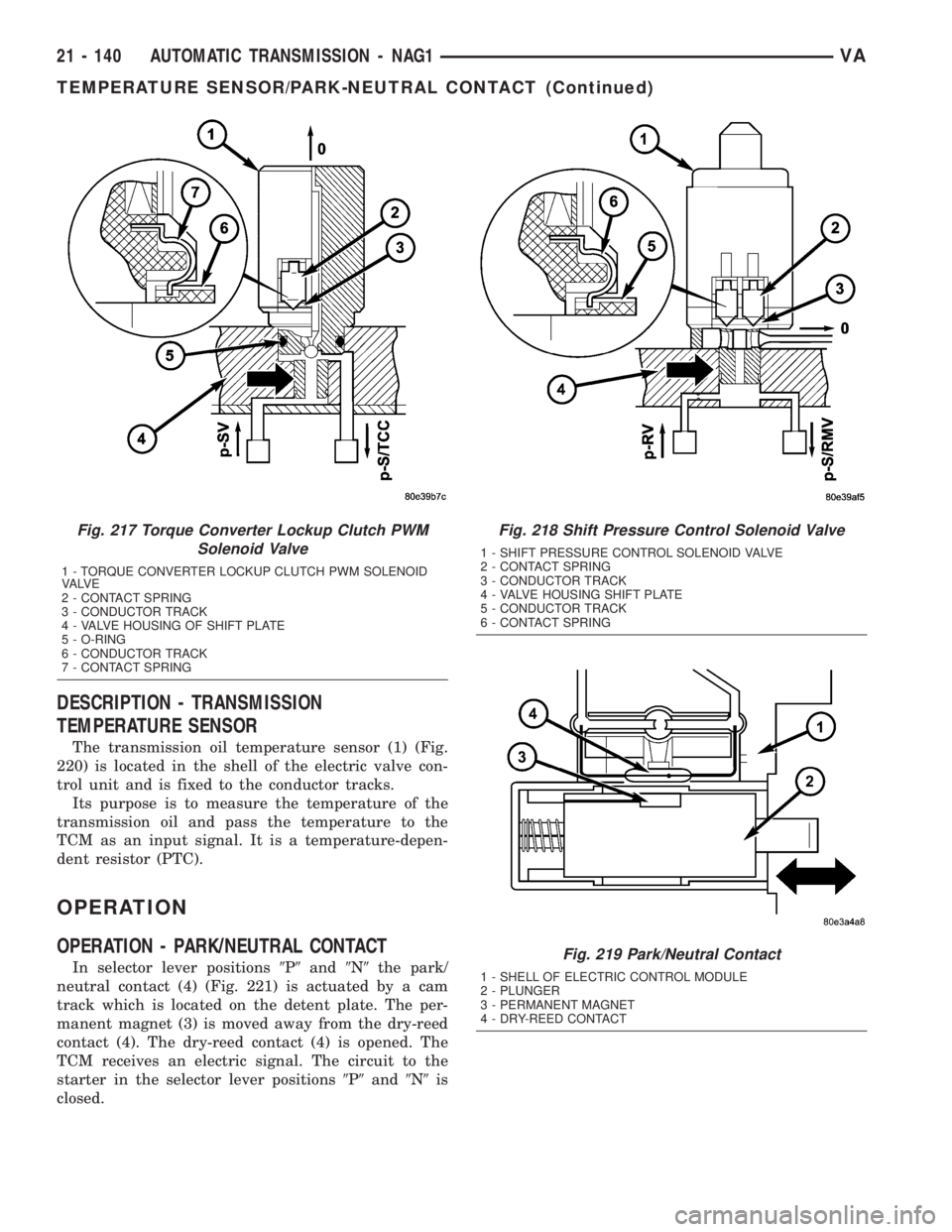
The park/neutral contact (4) (Fig. 219) is located in
the shell of the electric control unit and is fixed to
the conductor tracks.
Its purpose is to recognize selector valve and selec-
tor lever positions9P9and9N9. The park/neutral con-
tact consists of:
²the plunger (2).
²the permanent magnet (3).
²the dry-reed contact (4).
Fig. 215 Upshift/Downshift Solenoid Valves
1 - UPSHIFT/DOWNSHIFT SOLENOID VALVE
2 - CONTACT SPRING
3 - CONDUCTOR TRACK
4 - O-RING
5 - VALVE HOUSING OF SHIFT PLATE
6 - O-RING
7 - CONDUCTOR TRACK
8 - CONTACT SPRING
Fig. 216 Modulating Pressure Control Solenoid
Valve
1 - MODULATING PRESSURE CONTROL SOLENOID VALVE
2 - CONTACT SPRING
3 - CONDUCTOR TRACK
4 - VALVE HOUSING SHIFT PLATE
5 - CONDUCTOR TRACK
6 - CONTACT SPRING
VAAUTOMATIC TRANSMISSION - NAG1 21 - 139
SOLENOID (Continued)
Page 1016 of 1232
DESCRIPTION - TRANSMISSION
TEMPERATURE SENSOR
The transmission oil temperature sensor (1) (Fig.
220) is located in the shell of the electric valve con-
trol unit and is fixed to the conductor tracks.
Its purpose is to measure the temperature of the
transmission oil and pass the temperature to the
TCM as an input signal. It is a temperature-depen-
dent resistor (PTC).
OPERATION
OPERATION - PARK/NEUTRAL CONTACT
In selector lever positions9P9and9N9the park/
neutral contact (4) (Fig. 221) is actuated by a cam
track which is located on the detent plate. The per-
manent magnet (3) is moved away from the dry-reed
contact (4). The dry-reed contact (4) is opened. The
TCM receives an electric signal. The circuit to the
starter in the selector lever positions9P9and9N9is
closed.
Fig. 217 Torque Converter Lockup Clutch PWM
Solenoid Valve
1 - TORQUE CONVERTER LOCKUP CLUTCH PWM SOLENOID
VA LV E
2 - CONTACT SPRING
3 - CONDUCTOR TRACK
4 - VALVE HOUSING OF SHIFT PLATE
5 - O-RING
6 - CONDUCTOR TRACK
7 - CONTACT SPRING
Fig. 218 Shift Pressure Control Solenoid Valve
1 - SHIFT PRESSURE CONTROL SOLENOID VALVE
2 - CONTACT SPRING
3 - CONDUCTOR TRACK
4 - VALVE HOUSING SHIFT PLATE
5 - CONDUCTOR TRACK
6 - CONTACT SPRING
Fig. 219 Park/Neutral Contact
1 - SHELL OF ELECTRIC CONTROL MODULE
2 - PLUNGER
3 - PERMANENT MAGNET
4 - DRY-REED CONTACT
21 - 140 AUTOMATIC TRANSMISSION - NAG1VA
TEMPERATURE SENSOR/PARK-NEUTRAL CONTACT (Continued)
Page 1017 of 1232
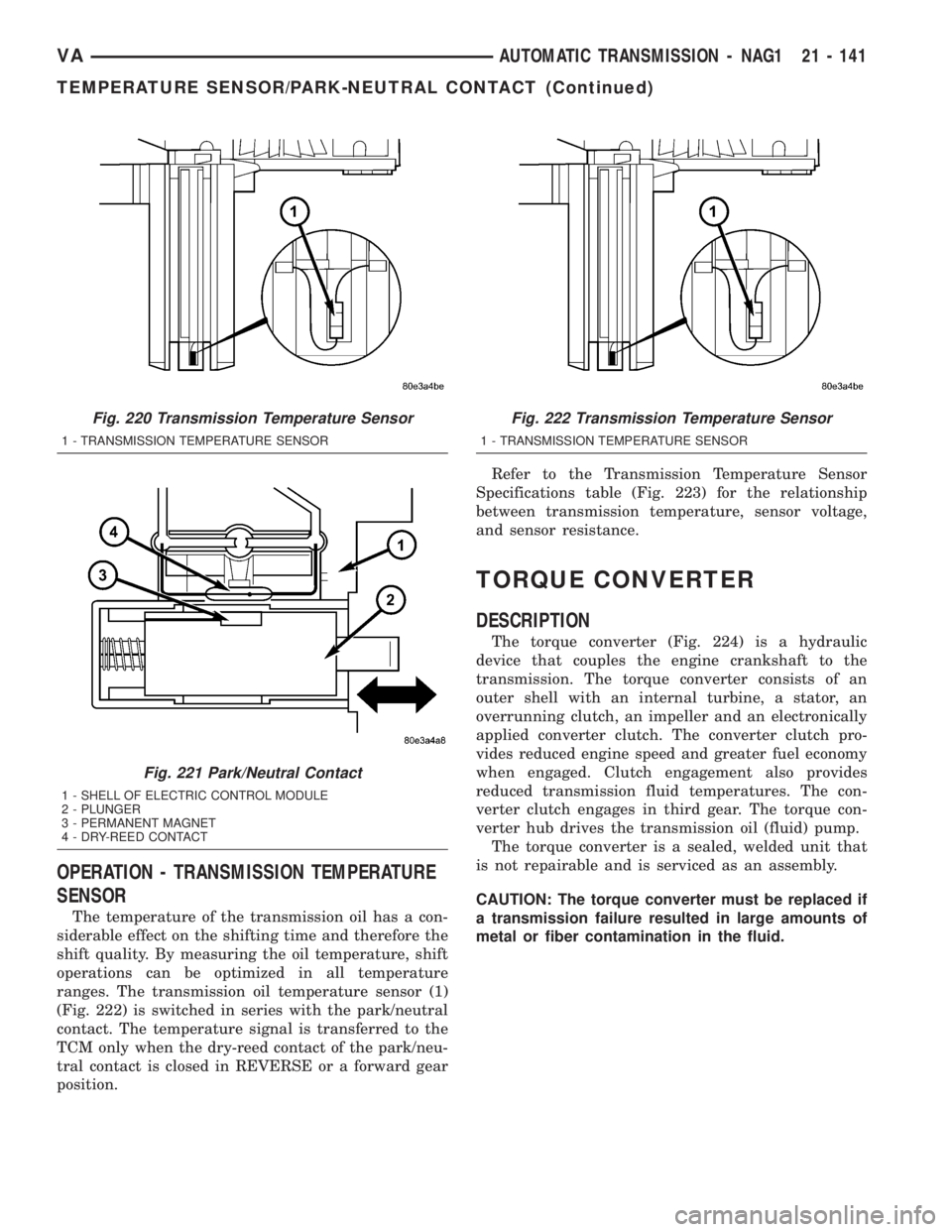
OPERATION - TRANSMISSION TEMPERATURE
SENSOR
The temperature of the transmission oil has a con-
siderable effect on the shifting time and therefore the
shift quality. By measuring the oil temperature, shift
operations can be optimized in all temperature
ranges. The transmission oil temperature sensor (1)
(Fig. 222) is switched in series with the park/neutral
contact. The temperature signal is transferred to the
TCM only when the dry-reed contact of the park/neu-
tral contact is closed in REVERSE or a forward gear
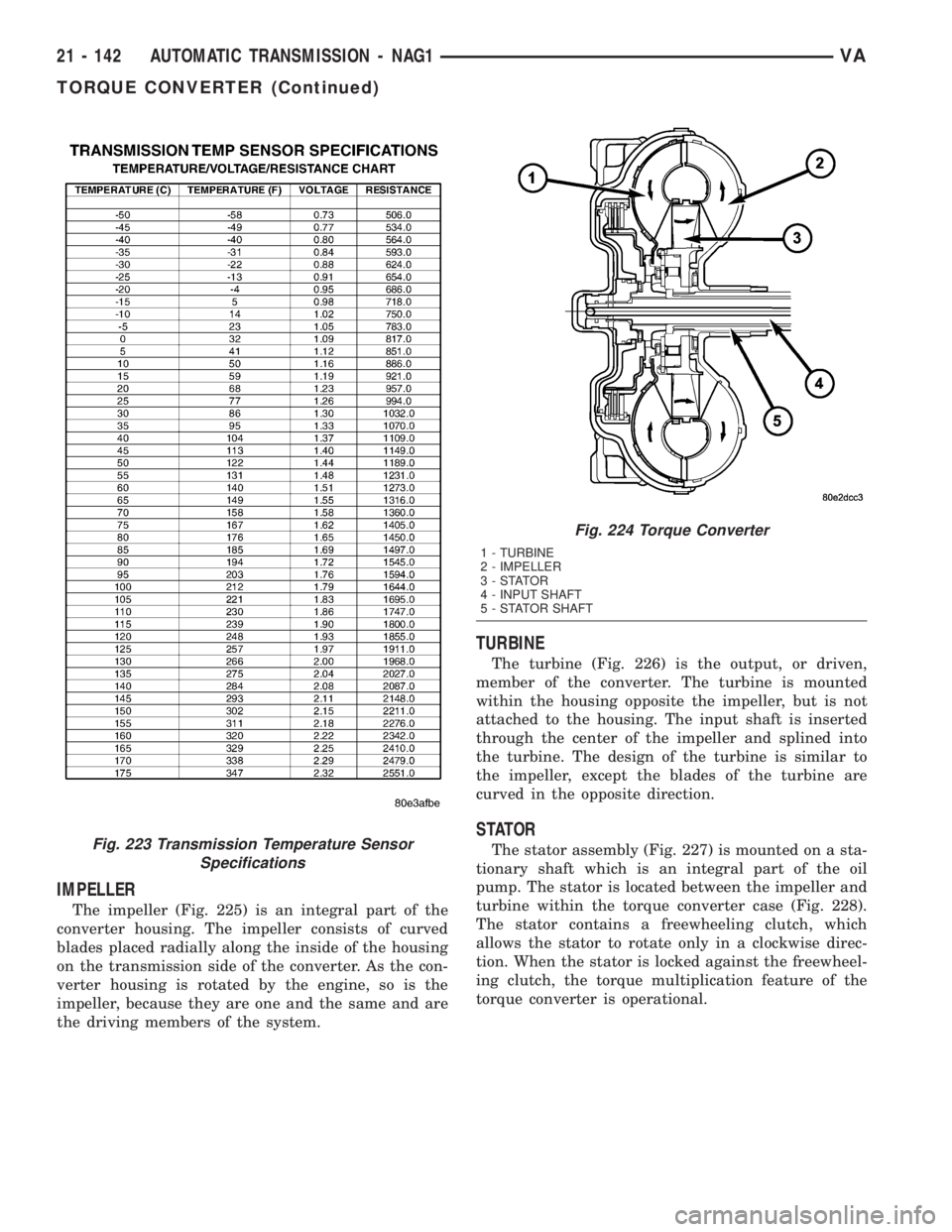
position.Refer to the Transmission Temperature Sensor
Specifications table (Fig. 223) for the relationship
between transmission temperature, sensor voltage,
and sensor resistance.
TORQUE CONVERTER
DESCRIPTION
The torque converter (Fig. 224) is a hydraulic
device that couples the engine crankshaft to the
transmission. The torque converter consists of an
outer shell with an internal turbine, a stator, an
overrunning clutch, an impeller and an electronically
applied converter clutch. The converter clutch pro-
vides reduced engine speed and greater fuel economy
when engaged. Clutch engagement also provides
reduced transmission fluid temperatures. The con-
verter clutch engages in third gear. The torque con-
verter hub drives the transmission oil (fluid) pump.
The torque converter is a sealed, welded unit that
is not repairable and is serviced as an assembly.
CAUTION: The torque converter must be replaced if
a transmission failure resulted in large amounts of
metal or fiber contamination in the fluid.
Fig. 220 Transmission Temperature Sensor
1 - TRANSMISSION TEMPERATURE SENSOR
Fig. 221 Park/Neutral Contact
1 - SHELL OF ELECTRIC CONTROL MODULE
2 - PLUNGER
3 - PERMANENT MAGNET
4 - DRY-REED CONTACT
Fig. 222 Transmission Temperature Sensor
1 - TRANSMISSION TEMPERATURE SENSOR
VAAUTOMATIC TRANSMISSION - NAG1 21 - 141
TEMPERATURE SENSOR/PARK-NEUTRAL CONTACT (Continued)
Page 1018 of 1232
IMPELLER
The impeller (Fig. 225) is an integral part of the
converter housing. The impeller consists of curved
blades placed radially along the inside of the housing
on the transmission side of the converter. As the con-
verter housing is rotated by the engine, so is the
impeller, because they are one and the same and are
the driving members of the system.
TURBINE
The turbine (Fig. 226) is the output, or driven,
member of the converter. The turbine is mounted
within the housing opposite the impeller, but is not
attached to the housing. The input shaft is inserted
through the center of the impeller and splined into
the turbine. The design of the turbine is similar to
the impeller, except the blades of the turbine are
curved in the opposite direction.
STATOR
The stator assembly (Fig. 227) is mounted on a sta-
tionary shaft which is an integral part of the oil
pump. The stator is located between the impeller and
turbine within the torque converter case (Fig. 228).
The stator contains a freewheeling clutch, which
allows the stator to rotate only in a clockwise direc-
tion. When the stator is locked against the freewheel-
ing clutch, the torque multiplication feature of the
torque converter is operational.Fig. 223 Transmission Temperature Sensor
Specifications
Fig. 224 Torque Converter
1 - TURBINE
2 - IMPELLER
3-STATOR
4 - INPUT SHAFT
5 - STATOR SHAFT
21 - 142 AUTOMATIC TRANSMISSION - NAG1VA
TORQUE CONVERTER (Continued)