sensor MERCEDES-BENZ SPRINTER 2005 Service Repair Manual
[x] Cancel search | Manufacturer: MERCEDES-BENZ, Model Year: 2005, Model line: SPRINTER, Model: MERCEDES-BENZ SPRINTER 2005Pages: 1232, PDF Size: 39.23 MB
Page 1144 of 1232
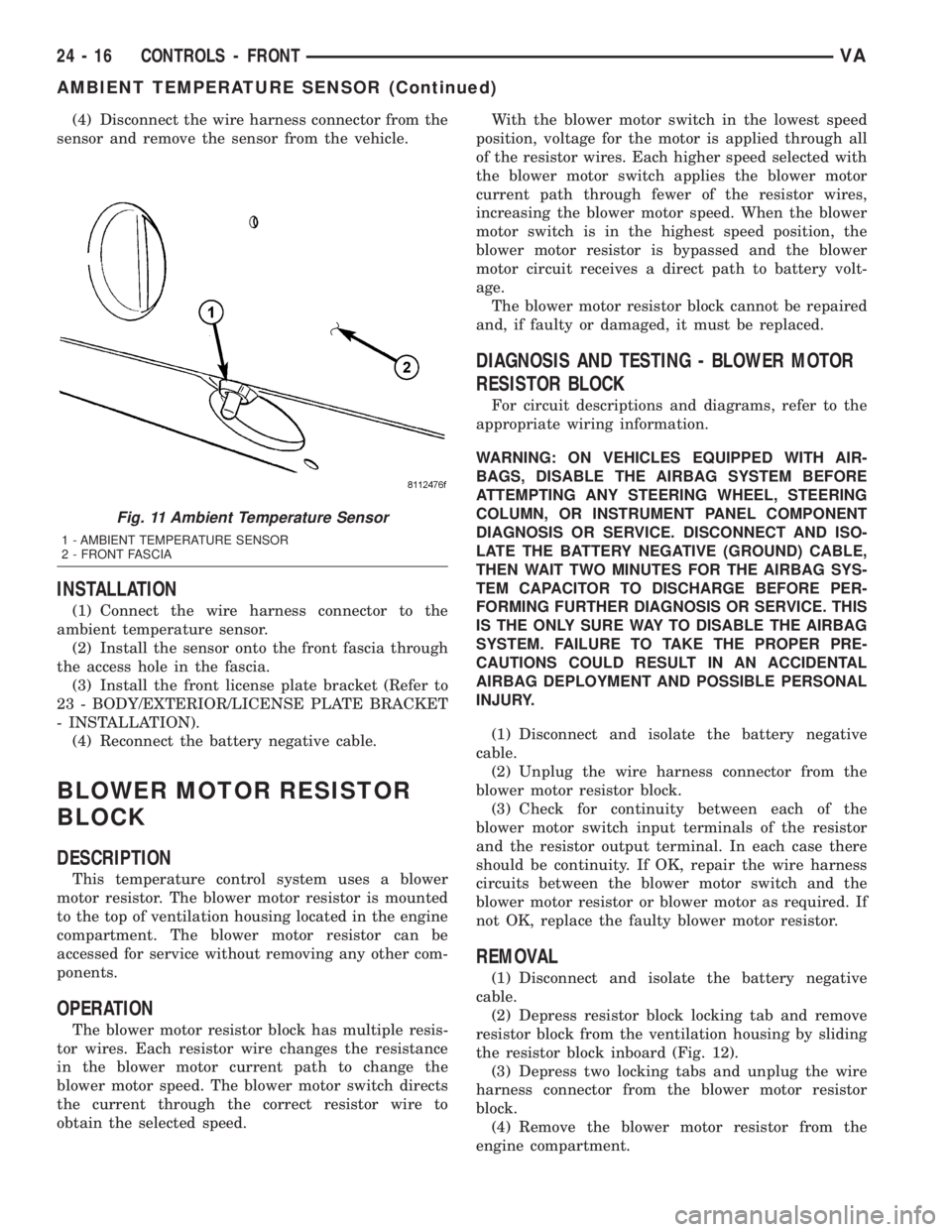
(4) Disconnect the wire harness connector from the
sensor and remove the sensor from the vehicle.
INSTALLATION
(1) Connect the wire harness connector to the
ambient temperature sensor.
(2) Install the sensor onto the front fascia through
the access hole in the fascia.
(3) Install the front license plate bracket (Refer to
23 - BODY/EXTERIOR/LICENSE PLATE BRACKET
- INSTALLATION).
(4) Reconnect the battery negative cable.
BLOWER MOTOR RESISTOR
BLOCK
DESCRIPTION
This temperature control system uses a blower
motor resistor. The blower motor resistor is mounted
to the top of ventilation housing located in the engine
compartment. The blower motor resistor can be
accessed for service without removing any other com-
ponents.
OPERATION
The blower motor resistor block has multiple resis-
tor wires. Each resistor wire changes the resistance
in the blower motor current path to change the
blower motor speed. The blower motor switch directs
the current through the correct resistor wire to
obtain the selected speed.With the blower motor switch in the lowest speed
position, voltage for the motor is applied through all
of the resistor wires. Each higher speed selected with
the blower motor switch applies the blower motor
current path through fewer of the resistor wires,
increasing the blower motor speed. When the blower
motor switch is in the highest speed position, the
blower motor resistor is bypassed and the blower
motor circuit receives a direct path to battery volt-
age.
The blower motor resistor block cannot be repaired
and, if faulty or damaged, it must be replaced.
DIAGNOSIS AND TESTING - BLOWER MOTOR
RESISTOR BLOCK
For circuit descriptions and diagrams, refer to the
appropriate wiring information.
WARNING: ON VEHICLES EQUIPPED WITH AIR-
BAGS, DISABLE THE AIRBAG SYSTEM BEFORE
ATTEMPTING ANY STEERING WHEEL, STEERING
COLUMN, OR INSTRUMENT PANEL COMPONENT
DIAGNOSIS OR SERVICE. DISCONNECT AND ISO-
LATE THE BATTERY NEGATIVE (GROUND) CABLE,
THEN WAIT TWO MINUTES FOR THE AIRBAG SYS-
TEM CAPACITOR TO DISCHARGE BEFORE PER-
FORMING FURTHER DIAGNOSIS OR SERVICE. THIS
IS THE ONLY SURE WAY TO DISABLE THE AIRBAG
SYSTEM. FAILURE TO TAKE THE PROPER PRE-
CAUTIONS COULD RESULT IN AN ACCIDENTAL
AIRBAG DEPLOYMENT AND POSSIBLE PERSONAL
INJURY.
(1) Disconnect and isolate the battery negative
cable.
(2) Unplug the wire harness connector from the
blower motor resistor block.
(3) Check for continuity between each of the
blower motor switch input terminals of the resistor
and the resistor output terminal. In each case there
should be continuity. If OK, repair the wire harness
circuits between the blower motor switch and the
blower motor resistor or blower motor as required. If
not OK, replace the faulty blower motor resistor.
REMOVAL
(1) Disconnect and isolate the battery negative
cable.
(2) Depress resistor block locking tab and remove
resistor block from the ventilation housing by sliding
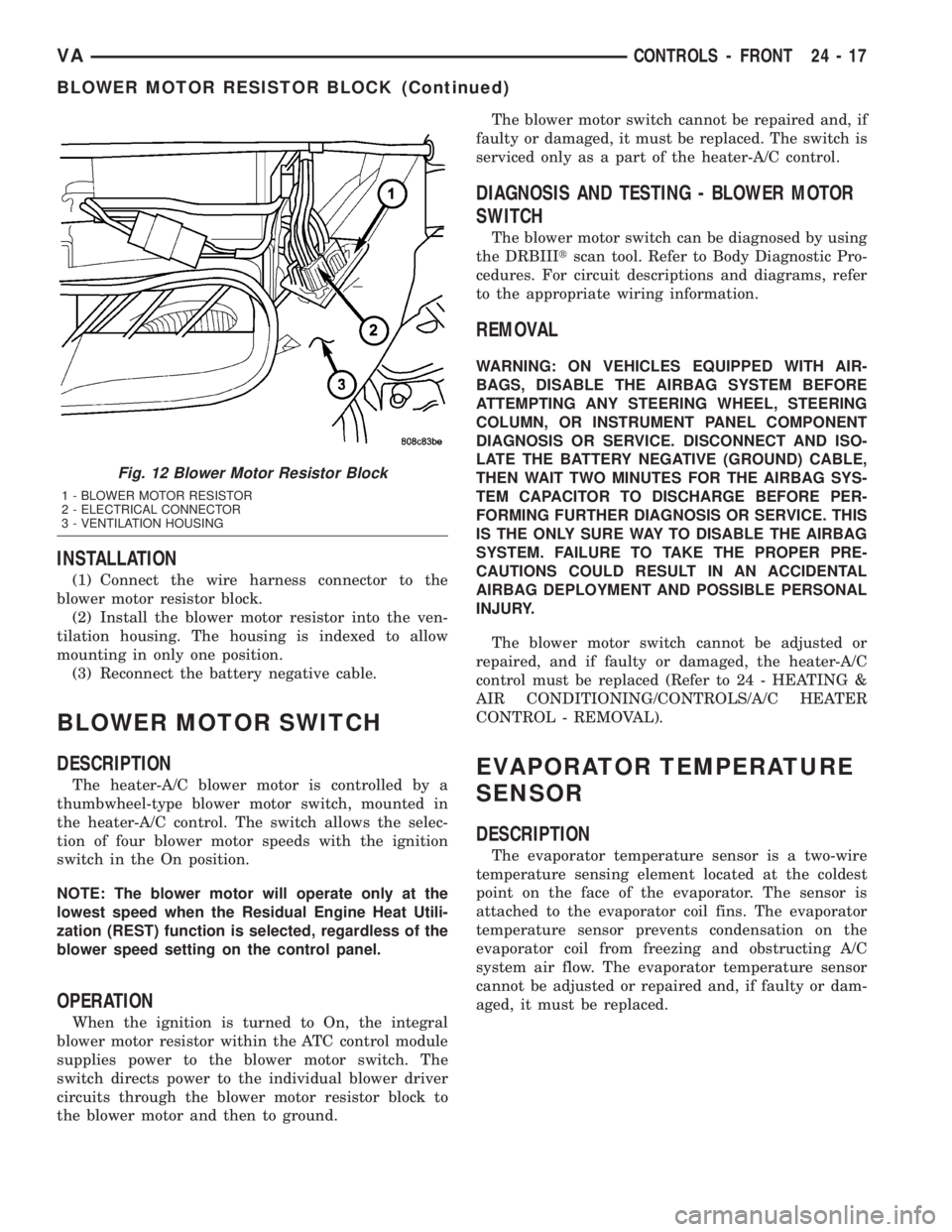
the resistor block inboard (Fig. 12).
(3) Depress two locking tabs and unplug the wire
harness connector from the blower motor resistor
block.
(4) Remove the blower motor resistor from the
engine compartment.
Fig. 11 Ambient Temperature Sensor
1 - AMBIENT TEMPERATURE SENSOR
2 - FRONT FASCIA
24 - 16 CONTROLS - FRONTVA
AMBIENT TEMPERATURE SENSOR (Continued)
Page 1145 of 1232
INSTALLATION
(1) Connect the wire harness connector to the
blower motor resistor block.
(2) Install the blower motor resistor into the ven-
tilation housing. The housing is indexed to allow
mounting in only one position.
(3) Reconnect the battery negative cable.
BLOWER MOTOR SWITCH
DESCRIPTION
The heater-A/C blower motor is controlled by a
thumbwheel-type blower motor switch, mounted in
the heater-A/C control. The switch allows the selec-
tion of four blower motor speeds with the ignition
switch in the On position.
NOTE: The blower motor will operate only at the
lowest speed when the Residual Engine Heat Utili-
zation (REST) function is selected, regardless of the
blower speed setting on the control panel.
OPERATION
When the ignition is turned to On, the integral
blower motor resistor within the ATC control module
supplies power to the blower motor switch. The
switch directs power to the individual blower driver
circuits through the blower motor resistor block to
the blower motor and then to ground.The blower motor switch cannot be repaired and, if
faulty or damaged, it must be replaced. The switch is
serviced only as a part of the heater-A/C control.
DIAGNOSIS AND TESTING - BLOWER MOTOR
SWITCH
The blower motor switch can be diagnosed by using
the DRBIIItscan tool. Refer to Body Diagnostic Pro-
cedures. For circuit descriptions and diagrams, refer
to the appropriate wiring information.
REMOVAL
WARNING: ON VEHICLES EQUIPPED WITH AIR-
BAGS, DISABLE THE AIRBAG SYSTEM BEFORE
ATTEMPTING ANY STEERING WHEEL, STEERING
COLUMN, OR INSTRUMENT PANEL COMPONENT
DIAGNOSIS OR SERVICE. DISCONNECT AND ISO-
LATE THE BATTERY NEGATIVE (GROUND) CABLE,
THEN WAIT TWO MINUTES FOR THE AIRBAG SYS-
TEM CAPACITOR TO DISCHARGE BEFORE PER-
FORMING FURTHER DIAGNOSIS OR SERVICE. THIS
IS THE ONLY SURE WAY TO DISABLE THE AIRBAG
SYSTEM. FAILURE TO TAKE THE PROPER PRE-
CAUTIONS COULD RESULT IN AN ACCIDENTAL
AIRBAG DEPLOYMENT AND POSSIBLE PERSONAL
INJURY.
The blower motor switch cannot be adjusted or
repaired, and if faulty or damaged, the heater-A/C
control must be replaced (Refer to 24 - HEATING &
AIR CONDITIONING/CONTROLS/A/C HEATER
CONTROL - REMOVAL).
EVAPORATOR TEMPERATURE
SENSOR
DESCRIPTION
The evaporator temperature sensor is a two-wire
temperature sensing element located at the coldest
point on the face of the evaporator. The sensor is
attached to the evaporator coil fins. The evaporator
temperature sensor prevents condensation on the
evaporator coil from freezing and obstructing A/C
system air flow. The evaporator temperature sensor
cannot be adjusted or repaired and, if faulty or dam-
aged, it must be replaced.
Fig. 12 Blower Motor Resistor Block
1 - BLOWER MOTOR RESISTOR
2 - ELECTRICAL CONNECTOR
3 - VENTILATION HOUSING
VACONTROLS - FRONT 24 - 17
BLOWER MOTOR RESISTOR BLOCK (Continued)
Page 1146 of 1232
OPERATION
The evaporator temperature sensor monitors the
temperature of the evaporator. The sensor will
change its internal resistance in response to the tem-
peratures it monitors. The ATC control module is
connected to the sensor through a sensor ground cir-
cuit and a sensor signal circuit. As the evaporator
temperature increases, the resistance of the sensor
decreases and the voltage monitored by the module
decreases. The module uses this monitored voltage
reading to an indication of the evaporator tempera-
ture. The ATC control module is programmed to
respond to this input by cycling the air conditioning
compressor clutch as necessary to optimize air condi-
tioning system performance and to protect the sys-
tem from evaporator freezing. The external location
of the sensor allows the sensor to be removed or
installed without disturbing the refrigerant in the
system. The evaporator temperature sensor is diag-
nosed by performing the ATC Function Test using a
DRBIIItscan tool. Refer to Body Diagnostic Proce-
dures.
REMOVAL
(1) Disconnect and isolate the battery negative
cable.
(2) Remove the radio (Refer to 8 - ELECTRICAL/
AUDIO/RADIO - REMOVAL).
(3) Remove glove compartment.
(4) Remove cover from instrument cluster (Refer to
23 - BODY/INSTRUMENT PANEL/INSTRUMENT
PANEL TOP COVER - REMOVAL).
(5) Remove the instrument cluster (Refer to 8 -
ELECTRICAL/INSTRUMENT CLUSTER - REMOV-
AL).
(6) Remove passenger side airbag.
(7) Remove cover above air nozzle on passenger
side.
(8) Remove speaker.
(9) Remove center section of instrument panel.
(10) Remove heater-A/C control from the instru-
ment panel (Refer to 24 - HEATING & AIR CONDI-
TIONING/CONTROLS/A/C HEATER CONTROL -
REMOVAL).
(11) Remove instrument panel top section.
(12) Remove electrical connections.
(13) Remove air bezels from instrument panel.
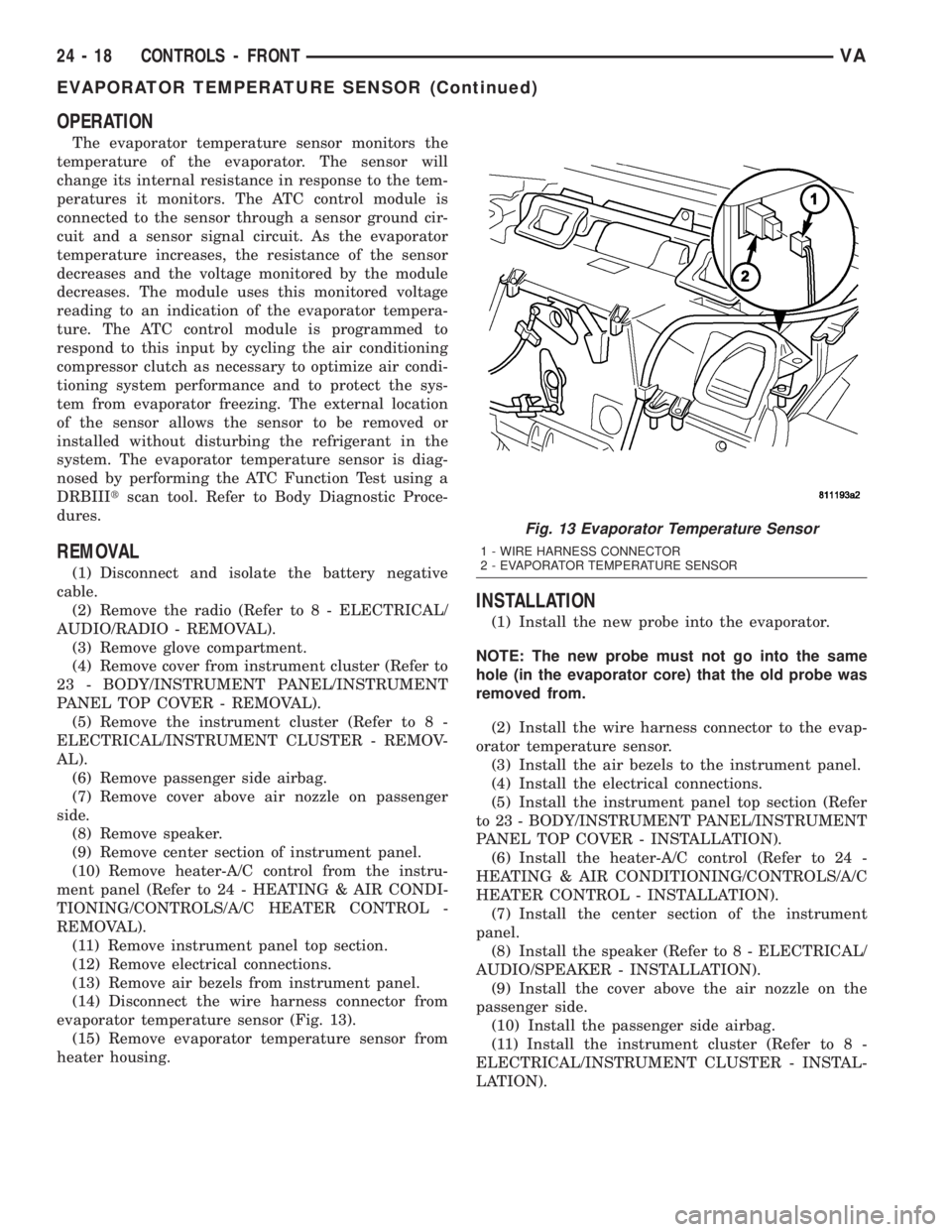
(14) Disconnect the wire harness connector from
evaporator temperature sensor (Fig. 13).
(15) Remove evaporator temperature sensor from
heater housing.
INSTALLATION
(1) Install the new probe into the evaporator.
NOTE: The new probe must not go into the same
hole (in the evaporator core) that the old probe was
removed from.
(2) Install the wire harness connector to the evap-
orator temperature sensor.
(3) Install the air bezels to the instrument panel.
(4) Install the electrical connections.
(5) Install the instrument panel top section (Refer
to 23 - BODY/INSTRUMENT PANEL/INSTRUMENT
PANEL TOP COVER - INSTALLATION).
(6) Install the heater-A/C control (Refer to 24 -
HEATING & AIR CONDITIONING/CONTROLS/A/C
HEATER CONTROL - INSTALLATION).
(7) Install the center section of the instrument
panel.
(8) Install the speaker (Refer to 8 - ELECTRICAL/
AUDIO/SPEAKER - INSTALLATION).
(9) Install the cover above the air nozzle on the
passenger side.
(10) Install the passenger side airbag.
(11) Install the instrument cluster (Refer to 8 -
ELECTRICAL/INSTRUMENT CLUSTER - INSTAL-
LATION).
Fig. 13 Evaporator Temperature Sensor
1 - WIRE HARNESS CONNECTOR
2 - EVAPORATOR TEMPERATURE SENSOR
24 - 18 CONTROLS - FRONTVA
EVAPORATOR TEMPERATURE SENSOR (Continued)
Page 1147 of 1232
(12) Install the cover to the instrument cluster.
(13) Install glove compartment.
(14) Install the radio (Refer to 8 - ELECTRICAL/
AUDIO/RADIO - INSTALLATION).
(15) Reconnect the battery negative cable.
IN-CAR TEMPERATURE
SENSOR
DESCRIPTION
The in-car temperature sensor measures the actual
air temperature within the passenger compartment.
The in-car temperature sensor is located inside of the
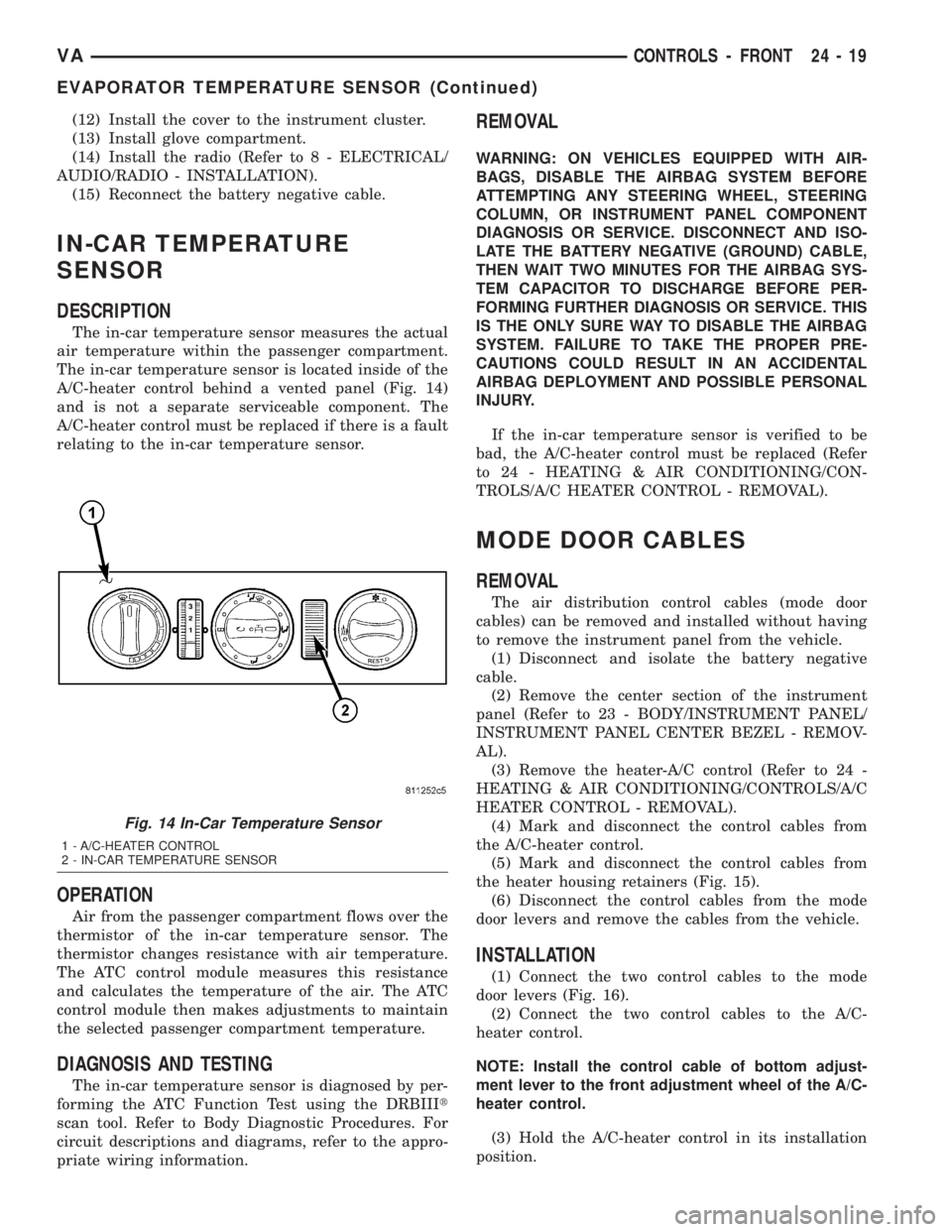
A/C-heater control behind a vented panel (Fig. 14)
and is not a separate serviceable component. The
A/C-heater control must be replaced if there is a fault
relating to the in-car temperature sensor.
OPERATION
Air from the passenger compartment flows over the
thermistor of the in-car temperature sensor. The
thermistor changes resistance with air temperature.
The ATC control module measures this resistance
and calculates the temperature of the air. The ATC
control module then makes adjustments to maintain
the selected passenger compartment temperature.
DIAGNOSIS AND TESTING
The in-car temperature sensor is diagnosed by per-
forming the ATC Function Test using the DRBIIIt
scan tool. Refer to Body Diagnostic Procedures. For
circuit descriptions and diagrams, refer to the appro-
priate wiring information.
REMOVAL
WARNING: ON VEHICLES EQUIPPED WITH AIR-
BAGS, DISABLE THE AIRBAG SYSTEM BEFORE
ATTEMPTING ANY STEERING WHEEL, STEERING
COLUMN, OR INSTRUMENT PANEL COMPONENT
DIAGNOSIS OR SERVICE. DISCONNECT AND ISO-
LATE THE BATTERY NEGATIVE (GROUND) CABLE,
THEN WAIT TWO MINUTES FOR THE AIRBAG SYS-
TEM CAPACITOR TO DISCHARGE BEFORE PER-
FORMING FURTHER DIAGNOSIS OR SERVICE. THIS
IS THE ONLY SURE WAY TO DISABLE THE AIRBAG
SYSTEM. FAILURE TO TAKE THE PROPER PRE-
CAUTIONS COULD RESULT IN AN ACCIDENTAL
AIRBAG DEPLOYMENT AND POSSIBLE PERSONAL
INJURY.
If the in-car temperature sensor is verified to be
bad, the A/C-heater control must be replaced (Refer
to 24 - HEATING & AIR CONDITIONING/CON-
TROLS/A/C HEATER CONTROL - REMOVAL).
MODE DOOR CABLES
REMOVAL
The air distribution control cables (mode door
cables) can be removed and installed without having
to remove the instrument panel from the vehicle.
(1) Disconnect and isolate the battery negative
cable.
(2) Remove the center section of the instrument
panel (Refer to 23 - BODY/INSTRUMENT PANEL/
INSTRUMENT PANEL CENTER BEZEL - REMOV-
AL).
(3) Remove the heater-A/C control (Refer to 24 -
HEATING & AIR CONDITIONING/CONTROLS/A/C
HEATER CONTROL - REMOVAL).
(4) Mark and disconnect the control cables from
the A/C-heater control.
(5) Mark and disconnect the control cables from
the heater housing retainers (Fig. 15).
(6) Disconnect the control cables from the mode
door levers and remove the cables from the vehicle.
INSTALLATION
(1) Connect the two control cables to the mode
door levers (Fig. 16).
(2) Connect the two control cables to the A/C-
heater control.
NOTE: Install the control cable of bottom adjust-
ment lever to the front adjustment wheel of the A/C-
heater control.
(3) Hold the A/C-heater control in its installation
position.
Fig. 14 In-Car Temperature Sensor
1 - A/C-HEATER CONTROL
2 - IN-CAR TEMPERATURE SENSOR
VACONTROLS - FRONT 24 - 19
EVAPORATOR TEMPERATURE SENSOR (Continued)
Page 1150 of 1232
CONTROLS - REAR
TABLE OF CONTENTS
page page
BLOWER MOTOR SWITCH
DESCRIPTION.........................22
OPERATION...........................22
DIAGNOSIS AND TESTING................23
REMOVAL.............................23
INSTALLATION.........................23
BLOWER MOTOR RELAY
DESCRIPTION.........................23
OPERATION...........................23
DIAGNOSIS AND TESTING................24
REMOVAL.............................24
INSTALLATION.........................24
CONTROL MODULE
DESCRIPTION.........................24
OPERATION...........................24
DIAGNOSIS AND TESTING................24
REMOVAL.............................24
INSTALLATION.........................25
EVAPORATOR TEMPERATURE SENSOR
DESCRIPTION.........................25
OPERATION...........................26DIAGNOSIS AND TESTING................26
REMOVAL.............................26
INSTALLATION.........................26
SOLENOID VALVE
DESCRIPTION.........................27
OPERATION...........................27
DIAGNOSIS AND TESTING................27
REMOVAL.............................27
INSTALLATION.........................28
TEMPERATURE CONTROL
DESCRIPTION.........................29
OPERATION...........................29
DIAGNOSIS AND TESTING................29
REMOVAL.............................29
INSTALLATION.........................29
TEMPERATURE SENSOR
DESCRIPTION.........................30
OPERATION...........................30
DIAGNOSIS AND TESTING................30
REMOVAL.............................30
INSTALLATION.........................30
BLOWER MOTOR SWITCH
DESCRIPTION
The optional rear A/C unit blower motor is con-
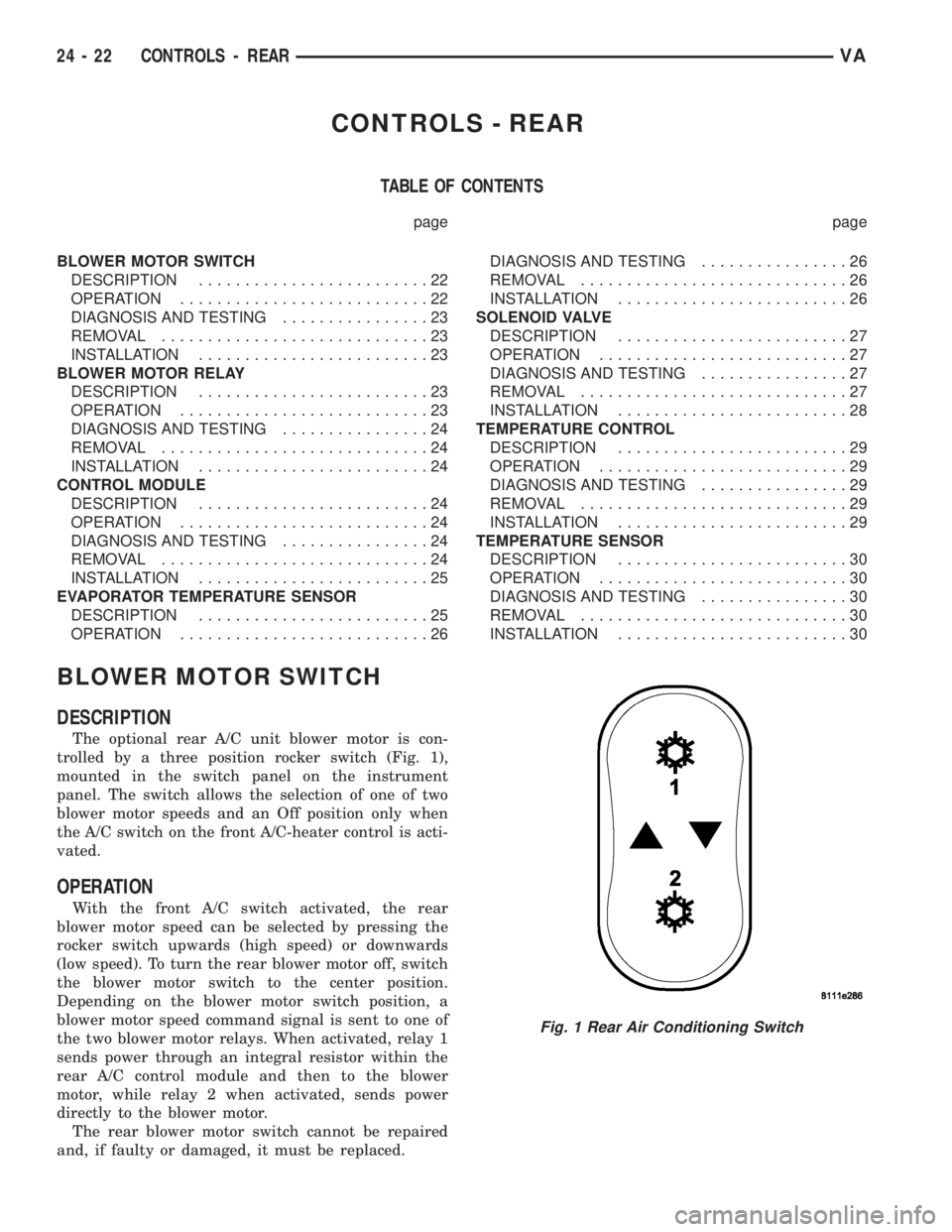
trolled by a three position rocker switch (Fig. 1),
mounted in the switch panel on the instrument
panel. The switch allows the selection of one of two
blower motor speeds and an Off position only when
the A/C switch on the front A/C-heater control is acti-
vated.
OPERATION
With the front A/C switch activated, the rear
blower motor speed can be selected by pressing the
rocker switch upwards (high speed) or downwards
(low speed). To turn the rear blower motor off, switch
the blower motor switch to the center position.
Depending on the blower motor switch position, a
blower motor speed command signal is sent to one of
the two blower motor relays. When activated, relay 1
sends power through an integral resistor within the
rear A/C control module and then to the blower
motor, while relay 2 when activated, sends power
directly to the blower motor.
The rear blower motor switch cannot be repaired
and, if faulty or damaged, it must be replaced.
Fig. 1 Rear Air Conditioning Switch
24 - 22 CONTROLS - REARVA
Page 1152 of 1232
DIAGNOSIS AND TESTING
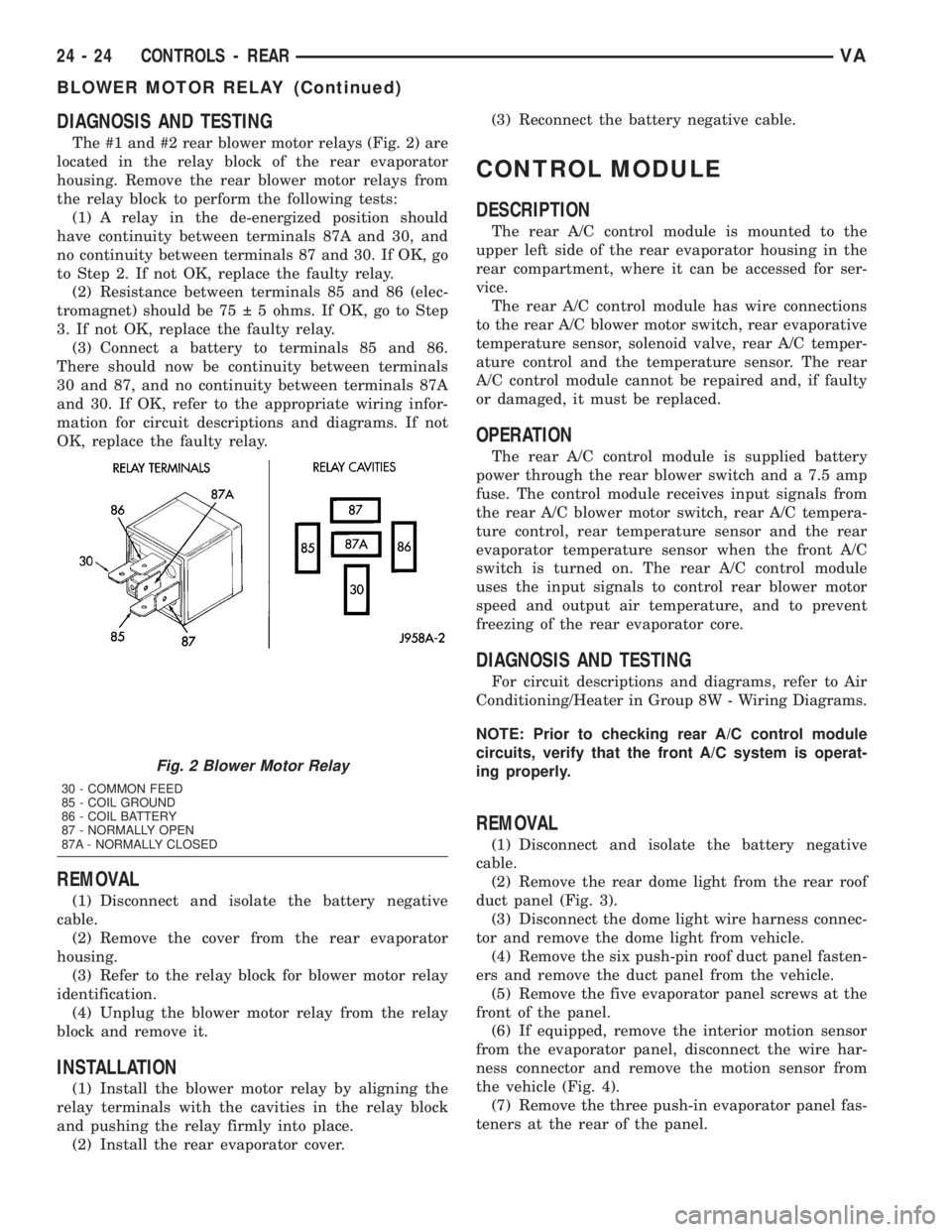
The #1 and #2 rear blower motor relays (Fig. 2) are
located in the relay block of the rear evaporator
housing. Remove the rear blower motor relays from
the relay block to perform the following tests:
(1) A relay in the de-energized position should
have continuity between terminals 87A and 30, and
no continuity between terminals 87 and 30. If OK, go
to Step 2. If not OK, replace the faulty relay.
(2) Resistance between terminals 85 and 86 (elec-
tromagnet) should be 75 5 ohms. If OK, go to Step
3. If not OK, replace the faulty relay.
(3) Connect a battery to terminals 85 and 86.
There should now be continuity between terminals
30 and 87, and no continuity between terminals 87A
and 30. If OK, refer to the appropriate wiring infor-
mation for circuit descriptions and diagrams. If not
OK, replace the faulty relay.
REMOVAL
(1) Disconnect and isolate the battery negative
cable.
(2) Remove the cover from the rear evaporator
housing.
(3) Refer to the relay block for blower motor relay
identification.
(4) Unplug the blower motor relay from the relay
block and remove it.
INSTALLATION
(1) Install the blower motor relay by aligning the
relay terminals with the cavities in the relay block
and pushing the relay firmly into place.
(2) Install the rear evaporator cover.(3) Reconnect the battery negative cable.
CONTROL MODULE
DESCRIPTION
The rear A/C control module is mounted to the
upper left side of the rear evaporator housing in the
rear compartment, where it can be accessed for ser-
vice.
The rear A/C control module has wire connections
to the rear A/C blower motor switch, rear evaporative
temperature sensor, solenoid valve, rear A/C temper-
ature control and the temperature sensor. The rear
A/C control module cannot be repaired and, if faulty
or damaged, it must be replaced.
OPERATION
The rear A/C control module is supplied battery
power through the rear blower switch and a 7.5 amp
fuse. The control module receives input signals from
the rear A/C blower motor switch, rear A/C tempera-
ture control, rear temperature sensor and the rear
evaporator temperature sensor when the front A/C
switch is turned on. The rear A/C control module
uses the input signals to control rear blower motor
speed and output air temperature, and to prevent
freezing of the rear evaporator core.
DIAGNOSIS AND TESTING
For circuit descriptions and diagrams, refer to Air
Conditioning/Heater in Group 8W - Wiring Diagrams.
NOTE: Prior to checking rear A/C control module
circuits, verify that the front A/C system is operat-
ing properly.
REMOVAL
(1) Disconnect and isolate the battery negative
cable.
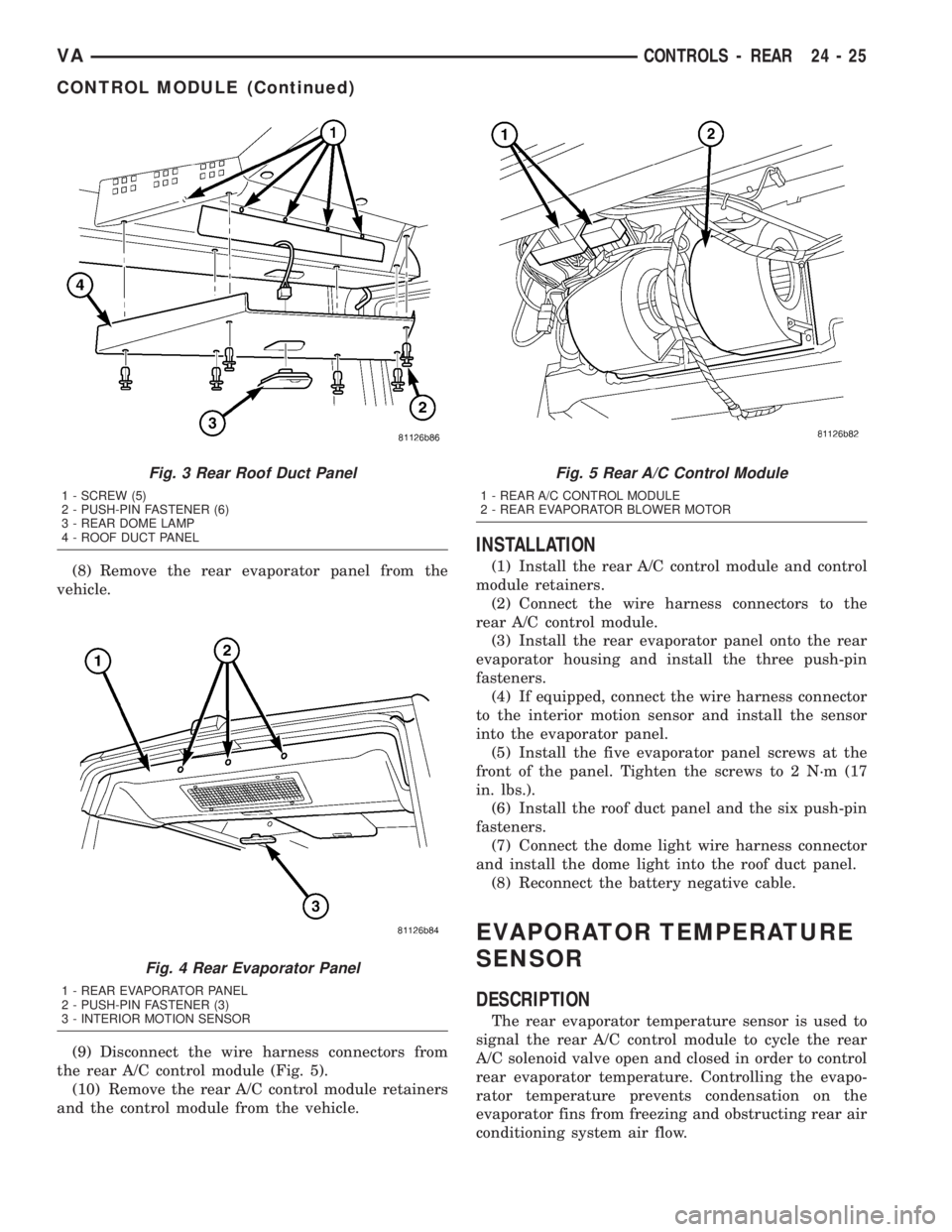
(2) Remove the rear dome light from the rear roof
duct panel (Fig. 3).
(3) Disconnect the dome light wire harness connec-
tor and remove the dome light from vehicle.
(4) Remove the six push-pin roof duct panel fasten-
ers and remove the duct panel from the vehicle.
(5) Remove the five evaporator panel screws at the
front of the panel.
(6) If equipped, remove the interior motion sensor
from the evaporator panel, disconnect the wire har-
ness connector and remove the motion sensor from
the vehicle (Fig. 4).
(7) Remove the three push-in evaporator panel fas-
teners at the rear of the panel.
Fig. 2 Blower Motor Relay
30 - COMMON FEED
85 - COIL GROUND
86 - COIL BATTERY
87 - NORMALLY OPEN
87A - NORMALLY CLOSED
24 - 24 CONTROLS - REARVA
BLOWER MOTOR RELAY (Continued)
Page 1153 of 1232
(8) Remove the rear evaporator panel from the
vehicle.
(9) Disconnect the wire harness connectors from
the rear A/C control module (Fig. 5).
(10) Remove the rear A/C control module retainers
and the control module from the vehicle.
INSTALLATION
(1) Install the rear A/C control module and control
module retainers.
(2) Connect the wire harness connectors to the
rear A/C control module.
(3) Install the rear evaporator panel onto the rear
evaporator housing and install the three push-pin
fasteners.
(4) If equipped, connect the wire harness connector
to the interior motion sensor and install the sensor
into the evaporator panel.
(5) Install the five evaporator panel screws at the
front of the panel. Tighten the screws to 2 N´m (17
in. lbs.).
(6) Install the roof duct panel and the six push-pin
fasteners.
(7) Connect the dome light wire harness connector
and install the dome light into the roof duct panel.
(8) Reconnect the battery negative cable.
EVAPORATOR TEMPERATURE
SENSOR
DESCRIPTION
The rear evaporator temperature sensor is used to
signal the rear A/C control module to cycle the rear
A/C solenoid valve open and closed in order to control
rear evaporator temperature. Controlling the evapo-
rator temperature prevents condensation on the
evaporator fins from freezing and obstructing rear air
conditioning system air flow.
Fig. 3 Rear Roof Duct Panel
1 - SCREW (5)
2 - PUSH-PIN FASTENER (6)
3 - REAR DOME LAMP
4 - ROOF DUCT PANEL
Fig. 4 Rear Evaporator Panel
1 - REAR EVAPORATOR PANEL
2 - PUSH-PIN FASTENER (3)
3 - INTERIOR MOTION SENSOR
Fig. 5 Rear A/C Control Module
1 - REAR A/C CONTROL MODULE
2 - REAR EVAPORATOR BLOWER MOTOR
VACONTROLS - REAR 24 - 25
CONTROL MODULE (Continued)
Page 1154 of 1232
The rear evaporator temperature sensor consists of
a probe and a switch unit. The probe, which is a Neg-
ative Temperature Coefficient (NTC) thermistor in a
capillary tube, is inserted between the rear evapora-
tor coil fins to monitor evaporator temperature. The
switch unit contains internal control logic that mon-
itors the input from the probe in order to switch an
internal transistor that controls the output signal to
the rear A/C control module.
OPERATION
When the rear evaporator temperature sensor sees
a temperature input below about 1.6É C (35É F), it
signals the rear A/C control module to cycle the rear
A/C solenoid valve closed. When the temperature
input reaches above about 3.9É C (39É F), the switch
signals the control module to cycle the valve open.
The rear evaporator temperature sensor can be
accessed for service by removing the air inlet grate
from the rear evaporator housing. The rear evapora-
tor temperature sensor cannot be adjusted or
repaired. If faulty or damaged, the sensor must be
replaced.
DIAGNOSIS AND TESTING
Before testing the rear evaporator temperature
sensor, verify that the front A/C system is operating
correctly by performing the ATC Function Test using
the DRBIIItscan tool. Use a volt/ohmmeter to test
the sensor. For circuit descriptions and diagrams,
refer to the appropriate wiring information. The wir-
ing information includes wiring diagrams, proper
wire and connector repair procedures, details of wire
harness routing and retention, connector pin-out
information and location views for the various wire
harness connectors, splices and grounds.
(1) Turn the ignition switch and the front A/C
switch to the On position. Place the rear blower
motor switch in either low or high speed position.
Check for voltage to the rear evaporator relay from
the rear evaporator temperature sensor. If OK, go to
Step 2. If not OK, repair the open or shorted evapo-
rator temperature sensor circuit as required.
(2) With the ambient temperature between 20 to
30É C (68 to 90É F), start the engine and run the rear
air conditioning system. The rear A/C solenoid valve
should cycle open and closed. Use a voltmeter con-
nected to the output side of the sensor for this check.
If the A/C solenoid valve fails to cycle in these tem-
peratures, replace the faulty rear evaporator temper-
ature sensor.
NOTE: If the ambient temperature is above 32É C
(90É F) the rear A/C solenoid valve may not cycle
due to the high heat load. This condition is normal.
REMOVAL
(1) Disconnect and isolate the battery negative
cable.
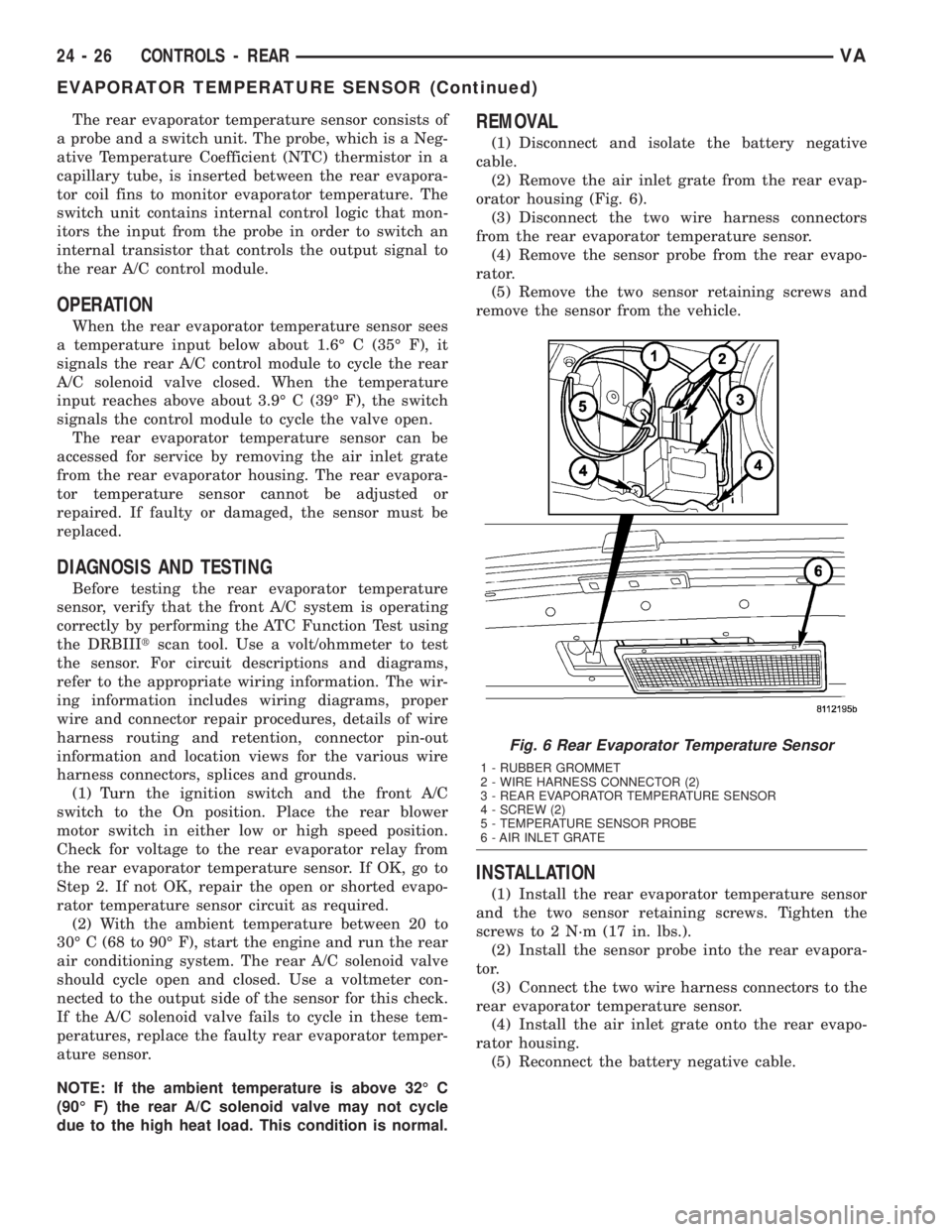
(2) Remove the air inlet grate from the rear evap-
orator housing (Fig. 6).
(3) Disconnect the two wire harness connectors
from the rear evaporator temperature sensor.
(4) Remove the sensor probe from the rear evapo-
rator.
(5) Remove the two sensor retaining screws and
remove the sensor from the vehicle.
INSTALLATION
(1) Install the rear evaporator temperature sensor
and the two sensor retaining screws. Tighten the
screws to 2 N´m (17 in. lbs.).
(2) Install the sensor probe into the rear evapora-
tor.
(3) Connect the two wire harness connectors to the
rear evaporator temperature sensor.
(4) Install the air inlet grate onto the rear evapo-
rator housing.
(5) Reconnect the battery negative cable.
Fig. 6 Rear Evaporator Temperature Sensor
1 - RUBBER GROMMET
2 - WIRE HARNESS CONNECTOR (2)
3 - REAR EVAPORATOR TEMPERATURE SENSOR
4 - SCREW (2)
5 - TEMPERATURE SENSOR PROBE
6 - AIR INLET GRATE
24 - 26 CONTROLS - REARVA
EVAPORATOR TEMPERATURE SENSOR (Continued)
Page 1155 of 1232
SOLENOID VALVE
DESCRIPTION
The rear A/C solenoid valve is a two-position elec-
trically operated shut-off valve, which is used to con-
trol refrigerant flow to the rear A/C evaporator from
the A/C compressor. The solenoid valve is located in
the rear A/C evaporator housing and is attached by a
bracket.
OPERATION
The solenoid valve is used by the rear A/C control
module to control rear A/C output temperature and
to prevent evaporator freezing. Evaporator tempera-
ture is controlled by cycling the solenoid valve open
and closed, thereby controlling refrigerant flow to the
rear evaporator. The normally closed valve only
allows refrigerant to flow through it when power is
supplied to the solenoid by the rear A/C control mod-
ule.
DIAGNOSIS AND TESTING
For circuit descriptions and diagrams, refer to Air
Conditioning/Heater in Group 8W - Wiring Diagrams.
NOTE: Prior to performing the following checks,
verify that the front A/C system is operating prop-
erly.
(1) With the engine running, the front A/C switch
in the On position and the rear A/C blower switch in
the Off position, check that the rear evaporator is not
colder than the ambient temperature. If the evapora-
tor temperature is colder than the ambient tempera-
ture, the solenoid is allowing refrigerant to flow
through the rear evaporator when in the closed posi-
tion. If OK, go to Step 2. If not OK, replace the rear
A/C solenoid valve (Refer to 24 - HEATING & AIR
CONDITIONING/CONTROLS/SOLENOID - REMOV-
AL).
(2) With the ignition switch in the Off position and
the rear A/C solenoid valve wire harness discon-
nected, check for continuity between the two solenoid
valve terminals. If OK, go to Step 3. If not OK,
replace the solenoid valve (Refer to 24 - HEATING &
AIR CONDITIONING/CONTROLS/SOLENOID -
REMOVAL).
(3) With the ignition switch in the Off position and
the rear A/C solenoid valve wire harness discon-
nected, check the solenoid valve ground circuits for a
good ground at all times. If OK, go to Step 4. If not
OK, repair the open circuit to ground as required.(4) With the ignition switch and the front A/C
switch in the On position and the rear A/C solenoid
valve wire harness disconnected, check the harness
for battery power at terminal 2. If OK, replace the
solenoid valve (Refer to 24 - HEATING & AIR CON-
DITIONING/CONTROLS/SOLENOID - REMOVAL).
If not OK, test the A/C control module as required
(Refer to 24 - HEATING & AIR CONDITIONING/
CONTROLS/POWER MODULE - DIAGNOSIS AND
TESTING).
REMOVAL
(1) Recover the refrigerant from the refrigerant
system (Refer to 24 - HEATING & AIR CONDITION-
ING/PLUMBING - STANDARD PROCEDURE).
(2) Disconnect and isolate the battery negative
cable.
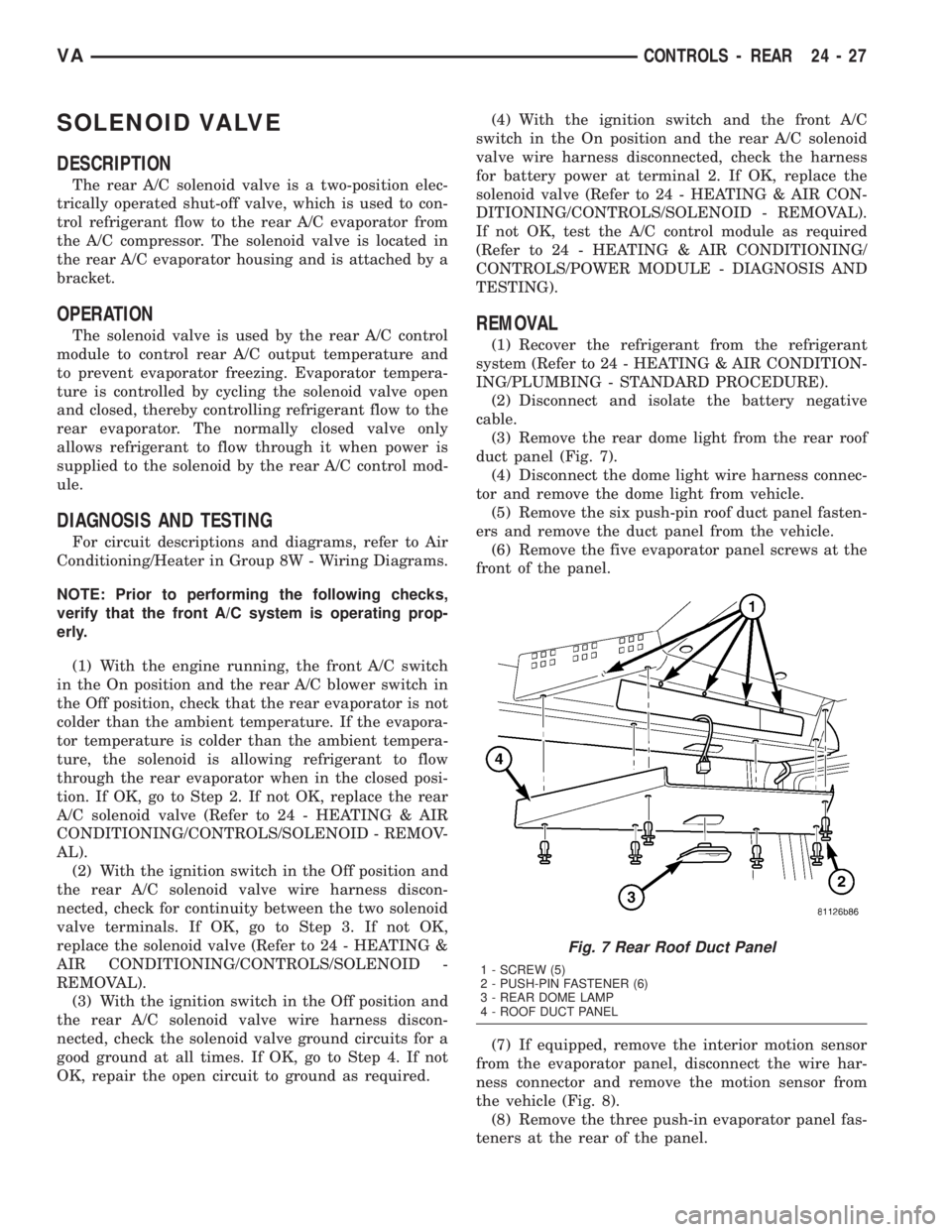
(3) Remove the rear dome light from the rear roof
duct panel (Fig. 7).
(4) Disconnect the dome light wire harness connec-
tor and remove the dome light from vehicle.
(5) Remove the six push-pin roof duct panel fasten-
ers and remove the duct panel from the vehicle.
(6) Remove the five evaporator panel screws at the
front of the panel.
(7) If equipped, remove the interior motion sensor
from the evaporator panel, disconnect the wire har-
ness connector and remove the motion sensor from
the vehicle (Fig. 8).
(8) Remove the three push-in evaporator panel fas-
teners at the rear of the panel.
Fig. 7 Rear Roof Duct Panel
1 - SCREW (5)
2 - PUSH-PIN FASTENER (6)
3 - REAR DOME LAMP
4 - ROOF DUCT PANEL
VACONTROLS - REAR 24 - 27
Page 1156 of 1232
(9) Remove the rear evaporator panel from the
vehicle.
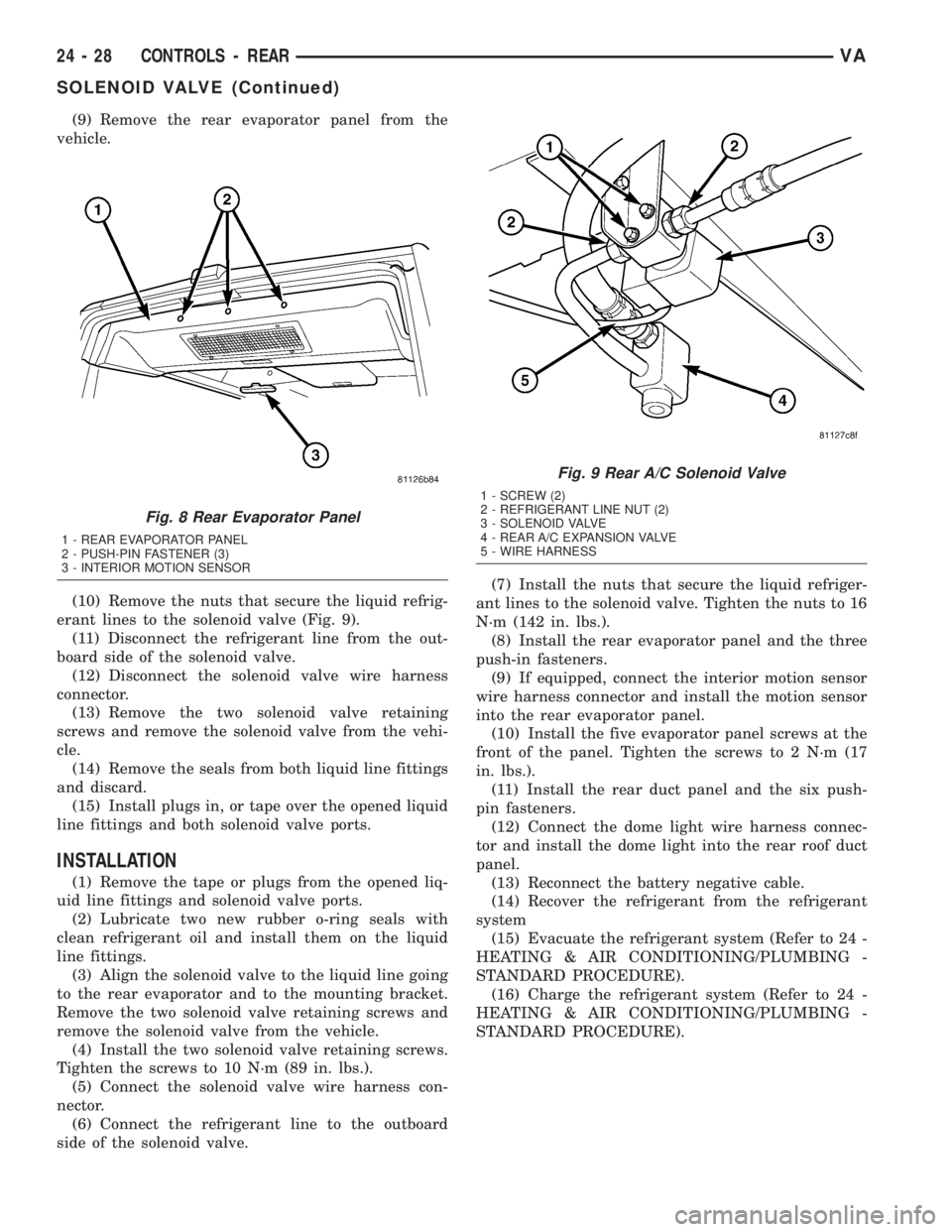
(10) Remove the nuts that secure the liquid refrig-
erant lines to the solenoid valve (Fig. 9).
(11) Disconnect the refrigerant line from the out-
board side of the solenoid valve.
(12) Disconnect the solenoid valve wire harness
connector.
(13) Remove the two solenoid valve retaining
screws and remove the solenoid valve from the vehi-
cle.
(14) Remove the seals from both liquid line fittings
and discard.
(15) Install plugs in, or tape over the opened liquid
line fittings and both solenoid valve ports.
INSTALLATION
(1) Remove the tape or plugs from the opened liq-
uid line fittings and solenoid valve ports.
(2) Lubricate two new rubber o-ring seals with
clean refrigerant oil and install them on the liquid
line fittings.
(3) Align the solenoid valve to the liquid line going
to the rear evaporator and to the mounting bracket.
Remove the two solenoid valve retaining screws and
remove the solenoid valve from the vehicle.
(4) Install the two solenoid valve retaining screws.
Tighten the screws to 10 N´m (89 in. lbs.).
(5) Connect the solenoid valve wire harness con-
nector.
(6) Connect the refrigerant line to the outboard
side of the solenoid valve.(7) Install the nuts that secure the liquid refriger-
ant lines to the solenoid valve. Tighten the nuts to 16
N´m (142 in. lbs.).
(8) Install the rear evaporator panel and the three
push-in fasteners.
(9) If equipped, connect the interior motion sensor
wire harness connector and install the motion sensor
into the rear evaporator panel.
(10) Install the five evaporator panel screws at the
front of the panel. Tighten the screws to 2 N´m (17
in. lbs.).
(11) Install the rear duct panel and the six push-
pin fasteners.
(12) Connect the dome light wire harness connec-
tor and install the dome light into the rear roof duct
panel.
(13) Reconnect the battery negative cable.
(14) Recover the refrigerant from the refrigerant
system
(15) Evacuate the refrigerant system (Refer to 24 -
HEATING & AIR CONDITIONING/PLUMBING -
STANDARD PROCEDURE).
(16) Charge the refrigerant system (Refer to 24 -
HEATING & AIR CONDITIONING/PLUMBING -
STANDARD PROCEDURE).
Fig. 8 Rear Evaporator Panel
1 - REAR EVAPORATOR PANEL
2 - PUSH-PIN FASTENER (3)
3 - INTERIOR MOTION SENSOR
Fig. 9 Rear A/C Solenoid Valve
1 - SCREW (2)
2 - REFRIGERANT LINE NUT (2)
3 - SOLENOID VALVE
4 - REAR A/C EXPANSION VALVE
5 - WIRE HARNESS
24 - 28 CONTROLS - REARVA
SOLENOID VALVE (Continued)