sensor MERCEDES-BENZ SPRINTER 2005 Service Repair Manual
[x] Cancel search | Manufacturer: MERCEDES-BENZ, Model Year: 2005, Model line: SPRINTER, Model: MERCEDES-BENZ SPRINTER 2005Pages: 1232, PDF Size: 39.23 MB
Page 855 of 1232
INSTALLATION
(1) (Refer to 14 - FUEL SYSTEM/FUEL INJEC-
TION - WARNING) Install the sealing ring on to the
sensor (Fig. 13).
(2) Screw the sensor in to the fuel rail. Counter-
hold the threaded connection and tighten the sensor
to 18 lbs. ft. (25 N´m.) (Fig. 13).
(3) Connect the wiring harness to the sensor.
(4) Install the mixing housing.
(5) Connect negative battery cable.
FUEL PRESSURE SOLENOID
DESCRIPTION
The fuel pressure solenoid is attached to the rear
of the fuel rail. The solenoid controls and maintains
the rail pressure constant along with a control cur-
rent transmitted by the engine control module (ECM)
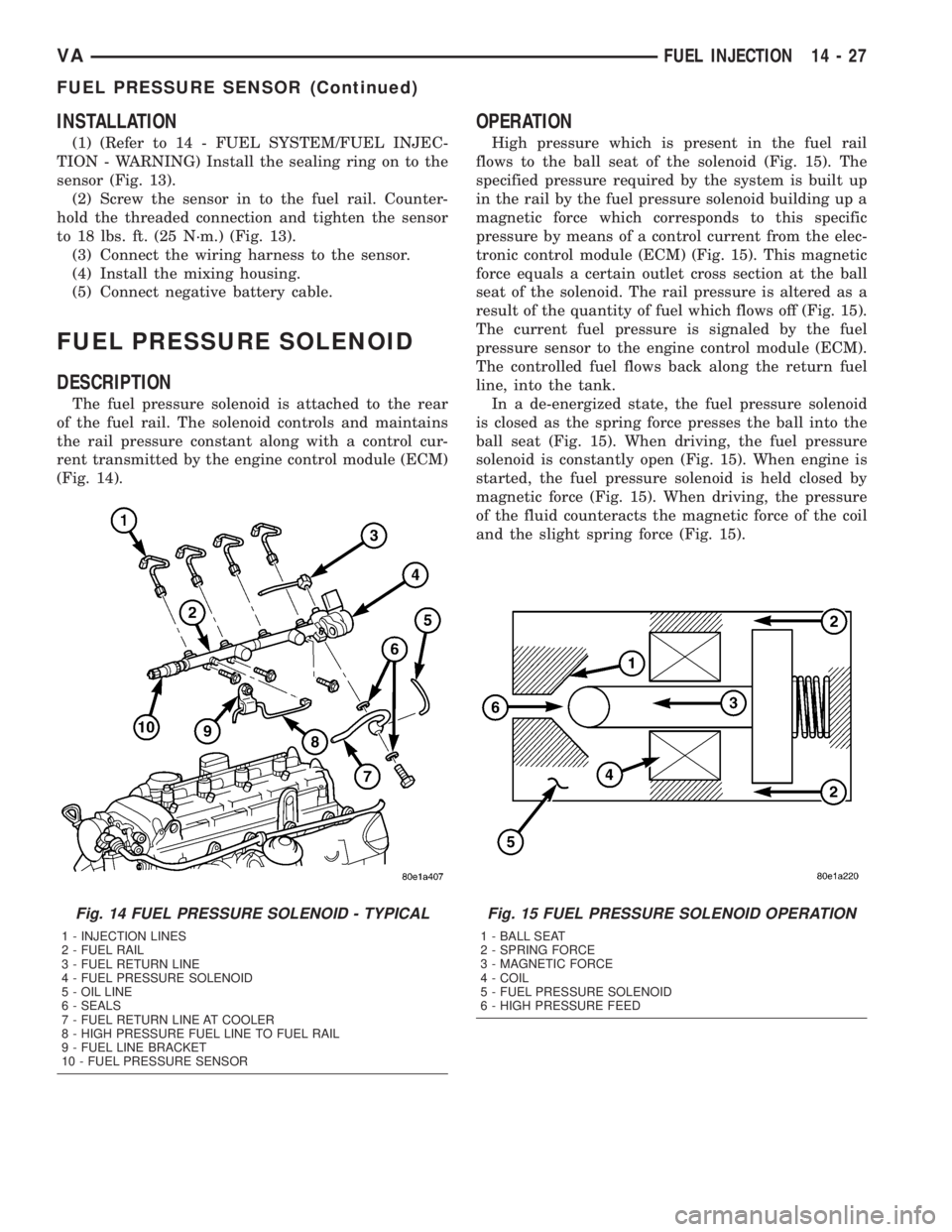
(Fig. 14).
OPERATION
High pressure which is present in the fuel rail
flows to the ball seat of the solenoid (Fig. 15). The
specified pressure required by the system is built up
in the rail by the fuel pressure solenoid building up a
magnetic force which corresponds to this specific
pressure by means of a control current from the elec-
tronic control module (ECM) (Fig. 15). This magnetic
force equals a certain outlet cross section at the ball
seat of the solenoid. The rail pressure is altered as a
result of the quantity of fuel which flows off (Fig. 15).
The current fuel pressure is signaled by the fuel
pressure sensor to the engine control module (ECM).
The controlled fuel flows back along the return fuel
line, into the tank.
In a de-energized state, the fuel pressure solenoid
is closed as the spring force presses the ball into the
ball seat (Fig. 15). When driving, the fuel pressure
solenoid is constantly open (Fig. 15). When engine is
started, the fuel pressure solenoid is held closed by
magnetic force (Fig. 15). When driving, the pressure
of the fluid counteracts the magnetic force of the coil
and the slight spring force (Fig. 15).
Fig. 14 FUEL PRESSURE SOLENOID - TYPICAL
1 - INJECTION LINES
2 - FUEL RAIL
3 - FUEL RETURN LINE
4 - FUEL PRESSURE SOLENOID
5 - OIL LINE
6 - SEALS
7 - FUEL RETURN LINE AT COOLER
8 - HIGH PRESSURE FUEL LINE TO FUEL RAIL
9 - FUEL LINE BRACKET
10 - FUEL PRESSURE SENSOR
Fig. 15 FUEL PRESSURE SOLENOID OPERATION
1 - BALL SEAT
2 - SPRING FORCE
3 - MAGNETIC FORCE
4 - COIL
5 - FUEL PRESSURE SOLENOID
6 - HIGH PRESSURE FEED
VAFUEL INJECTION 14 - 27
FUEL PRESSURE SENSOR (Continued)
Page 857 of 1232
WARNING: USE EXTREME CAUTION WHEN ENGINE
IS OPERATING. DO NOT PUT YOUR HANDS NEAR
PULLEYS, BELTS, OR FAN. DO NOT WEAR LOOSE
CLOTHES.
(4) Start engine and inspect for leaks (Refer to 14 -
FUEL SYSTEM - DIAGNOSIS AND TESTING).
FUEL TEMPERATURE SENSOR
DESCRIPTION
The fuel temperature sensor is located in the fuel
return line directly down stream of the fuel rail pres-
sure control valve. The sensor measures the temper-
ature of the fuel in the return pipe between the rail
and the pre-heating valve. The sensor ranges from -
40ÉF (- 40C) to 284ÉF (140ÉC). If the engine is cold,
the actual value sent will read ambient temperature.
The value rises after the engine has been started.
OPERATION
An negative temperature coefficient (NTC) resistor
integrated in the fuel temperature sensor alters it's
electrical resistance in line with the fuel temperature
(the resistance drops as the temperature rises). If
fuel temperature has reached 248ÉF and engine
speed is above 2000 rpm, a pumping element of the
high pressure fuel injection pump is switched off and
engine output is reduced.
REMOVAL
(1) Disconnect the negative battery cable.
(2) Disconnect the sensor wiring harness connector
(Refer to 14 - FUEL SYSTEM/FUEL INJECTION -
WARNING).
(3) Remove the fuel temperature sensor from the
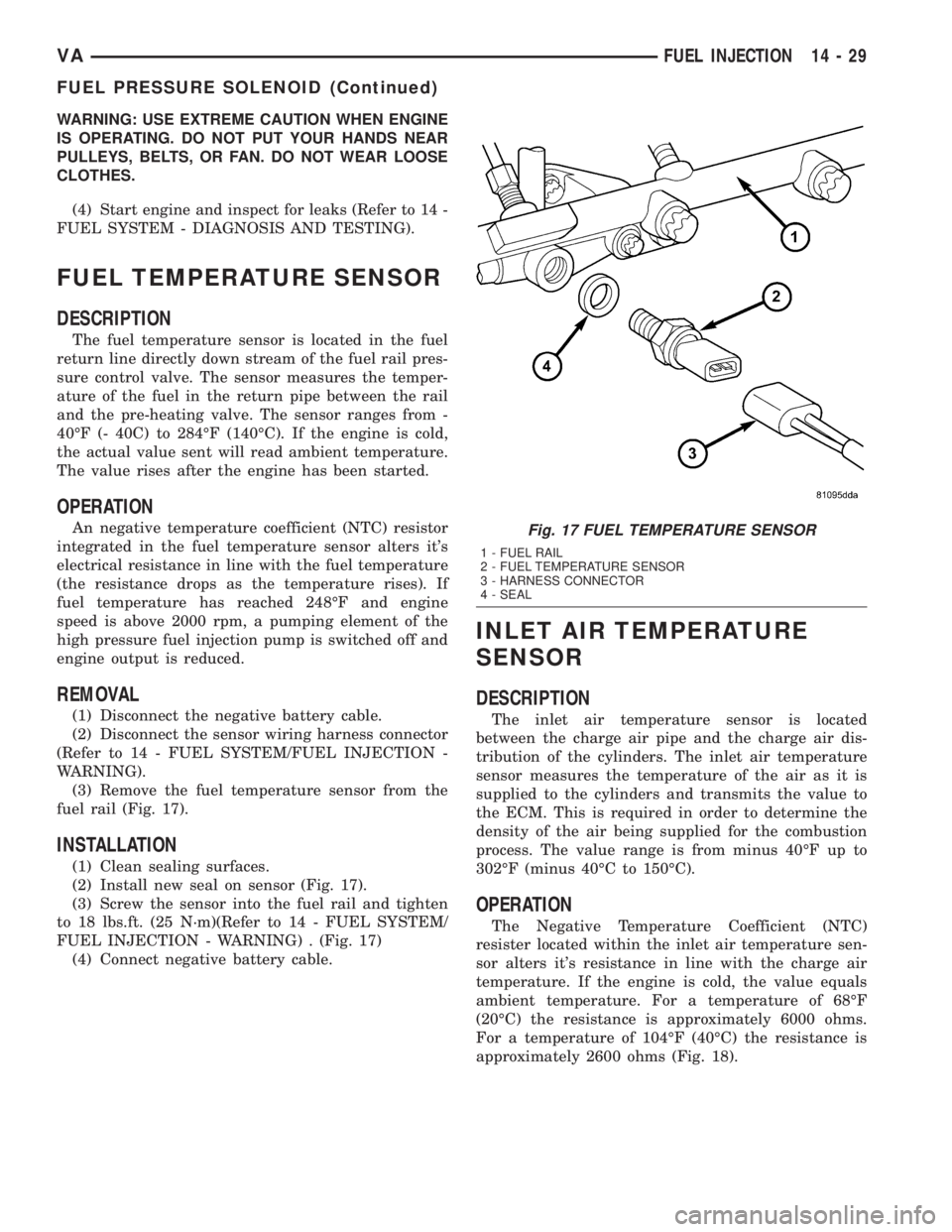
fuel rail (Fig. 17).
INSTALLATION
(1) Clean sealing surfaces.
(2) Install new seal on sensor (Fig. 17).
(3) Screw the sensor into the fuel rail and tighten
to 18 lbs.ft. (25 N´m)(Refer to 14 - FUEL SYSTEM/
FUEL INJECTION - WARNING) . (Fig. 17)
(4) Connect negative battery cable.
INLET AIR TEMPERATURE
SENSOR
DESCRIPTION
The inlet air temperature sensor is located
between the charge air pipe and the charge air dis-
tribution of the cylinders. The inlet air temperature
sensor measures the temperature of the air as it is
supplied to the cylinders and transmits the value to
the ECM. This is required in order to determine the
density of the air being supplied for the combustion
process. The value range is from minus 40ÉF up to
302ÉF (minus 40ÉC to 150ÉC).
OPERATION
The Negative Temperature Coefficient (NTC)
resister located within the inlet air temperature sen-
sor alters it's resistance in line with the charge air
temperature. If the engine is cold, the value equals
ambient temperature. For a temperature of 68ÉF
(20ÉC) the resistance is approximately 6000 ohms.
For a temperature of 104ÉF (40ÉC) the resistance is
approximately 2600 ohms (Fig. 18).
Fig. 17 FUEL TEMPERATURE SENSOR
1 - FUEL RAIL
2 - FUEL TEMPERATURE SENSOR
3 - HARNESS CONNECTOR
4 - SEAL
VAFUEL INJECTION 14 - 29
FUEL PRESSURE SOLENOID (Continued)
Page 858 of 1232
REMOVAL
(1) Disconnect the negative battery cable.
(2) Unplug the wiring harness connector at the
inlet air temperature sensor.
(3) Press together the sensor locking arms and
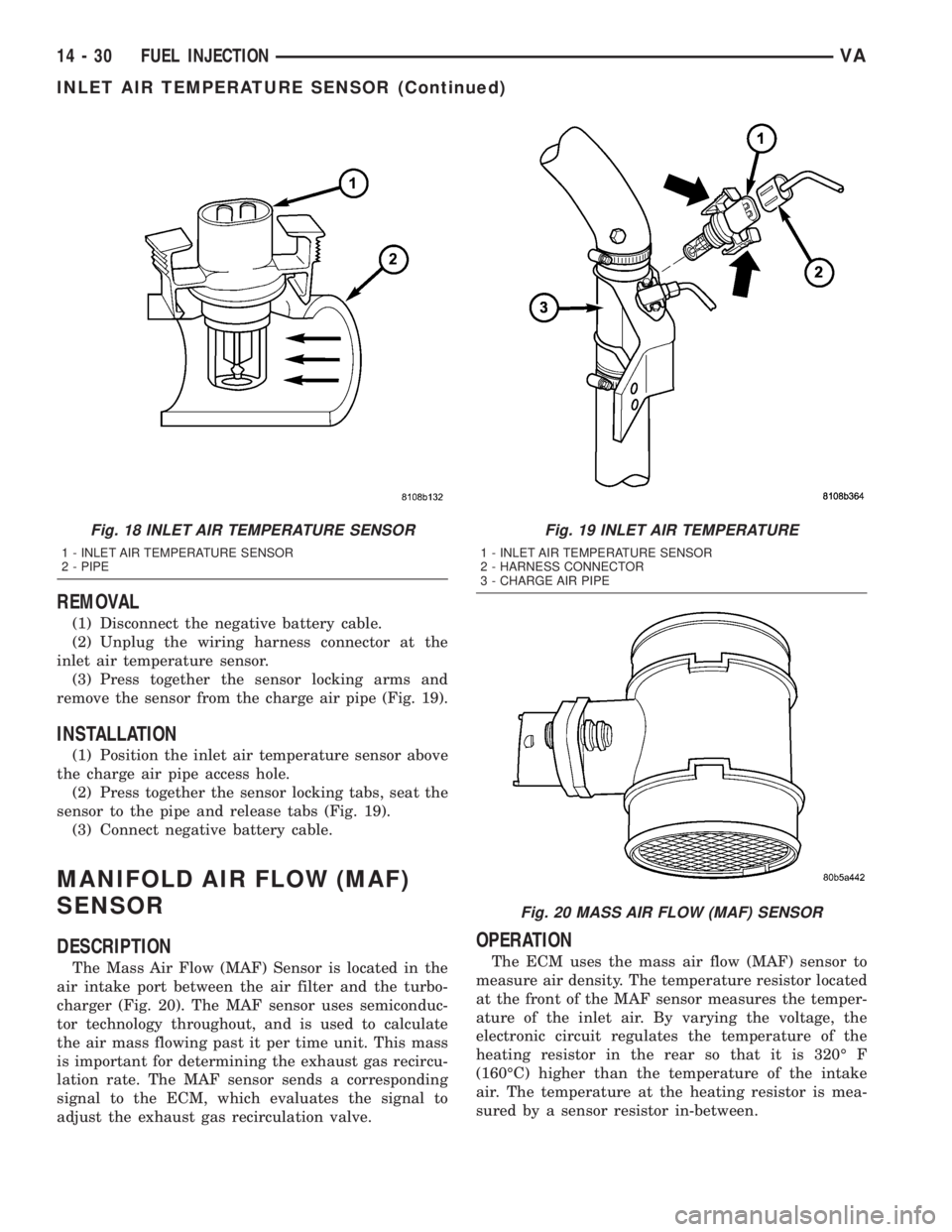
remove the sensor from the charge air pipe (Fig. 19).
INSTALLATION
(1) Position the inlet air temperature sensor above
the charge air pipe access hole.
(2) Press together the sensor locking tabs, seat the
sensor to the pipe and release tabs (Fig. 19).
(3) Connect negative battery cable.
MANIFOLD AIR FLOW (MAF)
SENSOR
DESCRIPTION
The Mass Air Flow (MAF) Sensor is located in the
air intake port between the air filter and the turbo-
charger (Fig. 20). The MAF sensor uses semiconduc-
tor technology throughout, and is used to calculate
the air mass flowing past it per time unit. This mass
is important for determining the exhaust gas recircu-
lation rate. The MAF sensor sends a corresponding
signal to the ECM, which evaluates the signal to
adjust the exhaust gas recirculation valve.
OPERATION
The ECM uses the mass air flow (MAF) sensor to
measure air density. The temperature resistor located
at the front of the MAF sensor measures the temper-
ature of the inlet air. By varying the voltage, the
electronic circuit regulates the temperature of the
heating resistor in the rear so that it is 320É F
(160ÉC) higher than the temperature of the intake
air. The temperature at the heating resistor is mea-
sured by a sensor resistor in-between.
Fig. 18 INLET AIR TEMPERATURE SENSOR
1 - INLET AIR TEMPERATURE SENSOR
2 - PIPE
Fig. 19 INLET AIR TEMPERATURE
1 - INLET AIR TEMPERATURE SENSOR
2 - HARNESS CONNECTOR
3 - CHARGE AIR PIPE
Fig. 20 MASS AIR FLOW (MAF) SENSOR
14 - 30 FUEL INJECTIONVA
INLET AIR TEMPERATURE SENSOR (Continued)
Page 859 of 1232
Because the incoming air has a cooling effect, the
greater the amount of air that flows in, then the
higher the voltage of the heating resistor. The heat-
ing resistor is therefore a measure of mass of air
flowing past. If a temperature change occurs as a
result of a increase or reduction of air flow, the ECM
corrects the voltage at the heating resistor until the
temperature difference is again achieved. This con-
trol voltage is use by the ECM as a unit measure for
metered air mass.
REMOVAL
(1) Disconnect the negative battery cable.
(2) Detach the air hose at the Manifold Air Flow
(MAF) sensor
(3) Unplug the MAF wiring harness connector.
(4) Remove the screws retaining the MAF sensor
to the air cleaner housing, and remove MAF sensor.
INSTALLATION
(1) Position the MAF sensor to air cleaner housing
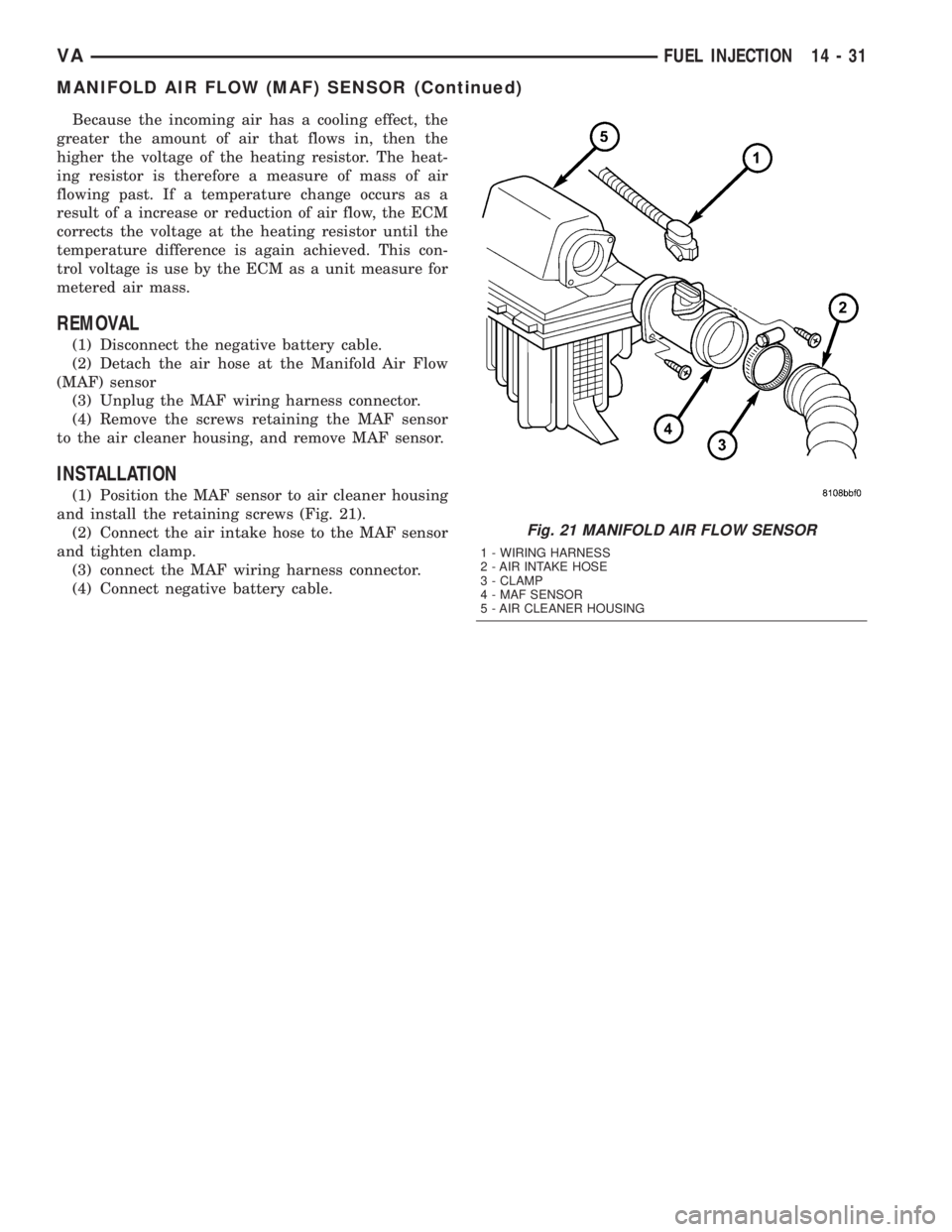
and install the retaining screws (Fig. 21).
(2) Connect the air intake hose to the MAF sensor
and tighten clamp.
(3) connect the MAF wiring harness connector.
(4) Connect negative battery cable.
Fig. 21 MANIFOLD AIR FLOW SENSOR
1 - WIRING HARNESS
2 - AIR INTAKE HOSE
3 - CLAMP
4 - MAF SENSOR
5 - AIR CLEANER HOUSING
VAFUEL INJECTION 14 - 31
MANIFOLD AIR FLOW (MAF) SENSOR (Continued)
Page 877 of 1232
TRANSMISSION
AUTOMATIC TRANSMISSION - NAG1
TABLE OF CONTENTS
page page
AUTOMATIC TRANSMISSION - NAG1
DESCRIPTION..........................2
OPERATION............................4
DIAGNOSIS AND TESTING
DIAGNOSIS AND TESTING - AUTOMATIC
TRANSMISSION......................23
DIAGNOSIS AND TESTING - PRELIMINARY . 23
DIAGNOSIS AND TESTING - ROAD
TESTING............................23
DIAGNOSIS AND TESTING - AUTOMATIC
TRANSMISSION......................24
STANDARD PROCEDURE - ALUMINUM
THREAD REPAIR......................27
REMOVAL.............................27
DISASSEMBLY.........................30
ASSEMBLY............................34
INSTALLATION.........................41
SCHEMATICS AND DIAGRAMS............47
SPECIFICATIONS - NAG1 AUTOMATIC
TRANSMISSION......................68
SPECIAL TOOLS - NAG1 AUTOMATIC
TRANSMISSION......................69
DRIVING CLUTCHES
DESCRIPTION.........................72
OPERATION...........................72
DRIVING CLUTCH K1
DISASSEMBLY.........................74
ASSEMBLY............................75
DRIVING CLUTCH K2
DISASSEMBLY.........................76
ASSEMBLY............................78
DRIVING CLUTCH K3
DISASSEMBLY.........................80
ASSEMBLY............................80
ELECTROHYDRAULIC UNIT
DESCRIPTION.........................82
OPERATION...........................87
REMOVAL.............................92
DISASSEMBLY.........................92
ASSEMBLY............................95
INSTALLATION........................100
FLUID AND FILTER
DESCRIPTION........................101
OPERATION..........................101DIAGNOSIS AND TESTING
DIAGNOSIS AND TESTING - EFFECTS OF
INCORRECT FLUID LEVEL.............102
DIAGNOSIS AND TESTING - CAUSES OF
BURNT FLUID.......................102
DIAGNOSIS AND TESTING - FLUID
CONTAMINATION....................102
STANDARD PROCEDURE
STANDARD PROCEDURE - CHECK OIL
LEVEL.............................102
STANDARD PROCEDURE - TRANSMISSION
FILL...............................103
STANDARD PROCEDURE - FLUID/FILTER
SERVICE...........................104
FREEWHEELING CLUTCH
DESCRIPTION........................105
OPERATION..........................105
DISASSEMBLY........................106
ASSEMBLY...........................107
GEARSHIFT CABLE
DIAGNOSIS AND TESTING - GEARSHIFT
CABLE.............................109
REMOVAL............................109
INSTALLATION........................109
HOLDING CLUTCHES
DESCRIPTION........................111
OPERATION..........................112
HOLDING CLUTCH B1
DISASSEMBLY........................112
ASSEMBLY...........................113
HOLDING CLUTCH B2
DISASSEMBLY........................115
ASSEMBLY...........................116
INPUT SPEED SENSORS
DESCRIPTION........................119
OPERATION..........................119
OIL PUMP
DESCRIPTION........................120
OPERATION..........................120
DISASSEMBLY........................120
ASSEMBLY...........................121
OUTPUT SHAFT BEARING
REMOVAL............................122
INSTALLATION........................122
VATRANSMISSION 21 - 1
Page 878 of 1232
OUTPUT SHAFT SEAL
REMOVAL............................125
INSTALLATION........................125
PARK LOCK CABLE
REMOVAL............................125
INSTALLATION........................126
PISTONS
DESCRIPTION........................128
OPERATION..........................128
PLANETARY GEARTRAIN
DESCRIPTION........................130
OPERATION..........................130
DISASSEMBLY........................131
ASSEMBLY...........................131
SHIFT MECHANISM
DESCRIPTION........................133
OPERATION..........................133
REMOVAL............................134
INSTALLATION........................135
SOLENOID
DESCRIPTION........................136OPERATION..........................138
TEMPERATURE SENSOR/PARK-NEUTRAL
CONTACT
DESCRIPTION
DESCRIPTION - PARK/NEUTRAL CONTACT . 139
DESCRIPTION - TRANSMISSION
TEMPERATURE SENSOR..............140
OPERATION
OPERATION - PARK/NEUTRAL CONTACT . . 140
OPERATION - TRANSMISSION
TEMPERATURE SENSOR..............141
TORQUE CONVERTER
DESCRIPTION........................141
OPERATION..........................143
REMOVAL............................146
INSTALLATION........................146
TORQUE CONVERTER HUB SEAL
REMOVAL............................147
INSTALLATION........................147
AUTOMATIC TRANSMISSION -
NAG1
DESCRIPTION
The NAG1 automatic transmission (Fig. 1) is an
electronically controlled 5-speed transmission with a
lock-up clutch in the torque converter. The ratios for
the gear stages are obtained by 3 planetary gear sets.
Fifth gear is designed as an overdrive with a high-
speed ratio.
The gears are actuated electronically/hydraulically.
The gears are shifted by means of an appropriate
combination of three multi-disc holding clutches,
three multi-disc driving clutches, and two freewheel-
ing clutches.
Electronic transmission control enables precise
adaptation of pressures to the respective operating
conditions and to the engine output during the shift
phase which results in a significant improvement in
shift quality.
Furthermore, it offers the advantage of a flexible
adaptation to various vehicle and engines.
Basically, the automatic transmission with elec-
tronic control offers the following advantages:
²Reduces fuel consumption.
²Improved shift comfort.
²More favourable step-up through the five gears.
²Increased service life and reliability.
²Lower maintenance costs.
TRANSMISSION IDENTIFICATION
The transmission name, NAG1, means New Auto-
matic Gearbox, generation 1.
The transmission can be generically identified
visually by the presence of a round 13-way connector
located near the front corner of the transmission oil
pan, on the right side. Specific transmission informa-
tion can be found stamped into a pad on the left side
of the transmission, above the oil pan rail.
TRANSMISSION GEAR RATIOS
The gear ratios for the NAG1 automatic transmis-
sion are as follows:
1st Gear.............................3.59:1
2nd Gear............................2.19:1
3rd Gear............................1.41:1
4th Gear............................1.00:1
5th Gear............................0.83:1
Reverse.............................3.16:1
TRANSMISSION HOUSING
The converter housing and transmission are made
from a light alloy. These are bolted together and cen-
tered via the outer multi-disc carrier of multi-disc
holding clutch, B1. A coated intermediate plate pro-
vides the sealing. The oil pump and the outer multi-
disc carrier of the multi-disc holding clutch, B1, are
bolted to the converter housing. The stator shaft is
pressed into it and prevented from rotating by
splines. The electrohydraulic unit is bolted to the
transmission housing from underneath. A sheet
metal steel oil pan forms the closure.
21 - 2 AUTOMATIC TRANSMISSION - NAG1VA
Page 902 of 1232
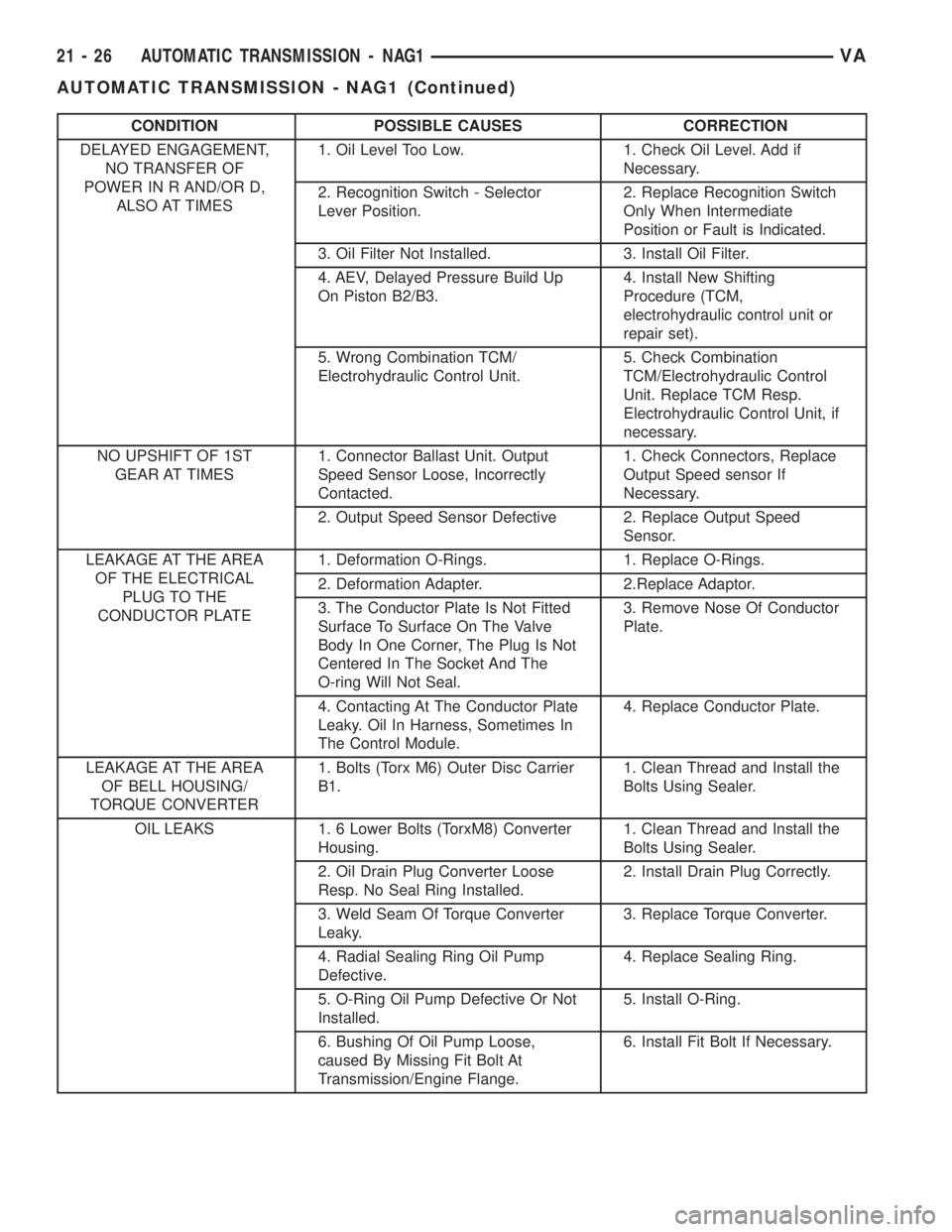
CONDITION POSSIBLE CAUSES CORRECTION
DELAYED ENGAGEMENT,
NO TRANSFER OF
POWER IN R AND/OR D,
ALSO AT TIMES1. Oil Level Too Low. 1. Check Oil Level. Add if
Necessary.
2. Recognition Switch - Selector
Lever Position.2. Replace Recognition Switch
Only When Intermediate
Position or Fault is Indicated.
3. Oil Filter Not Installed. 3. Install Oil Filter.
4. AEV, Delayed Pressure Build Up
On Piston B2/B3.4. Install New Shifting
Procedure (TCM,
electrohydraulic control unit or
repair set).
5. Wrong Combination TCM/
Electrohydraulic Control Unit.5. Check Combination
TCM/Electrohydraulic Control
Unit. Replace TCM Resp.
Electrohydraulic Control Unit, if
necessary.
NO UPSHIFT OF 1ST
GEAR AT TIMES1. Connector Ballast Unit. Output
Speed Sensor Loose, Incorrectly
Contacted.1. Check Connectors, Replace
Output Speed sensor If
Necessary.
2. Output Speed Sensor Defective 2. Replace Output Speed
Sensor.
LEAKAGE AT THE AREA
OF THE ELECTRICAL
PLUG TO THE
CONDUCTOR PLATE1. Deformation O-Rings. 1. Replace O-Rings.
2. Deformation Adapter. 2.Replace Adaptor.
3. The Conductor Plate Is Not Fitted
Surface To Surface On The Valve
Body In One Corner, The Plug Is Not
Centered In The Socket And The
O-ring Will Not Seal.3. Remove Nose Of Conductor
Plate.
4. Contacting At The Conductor Plate
Leaky. Oil In Harness, Sometimes In
The Control Module.4. Replace Conductor Plate.
LEAKAGE AT THE AREA
OF BELL HOUSING/
TORQUE CONVERTER1. Bolts (Torx M6) Outer Disc Carrier
B1.1. Clean Thread and Install the
Bolts Using Sealer.
OIL LEAKS 1. 6 Lower Bolts (TorxM8) Converter
Housing.1. Clean Thread and Install the
Bolts Using Sealer.
2. Oil Drain Plug Converter Loose
Resp. No Seal Ring Installed.2. Install Drain Plug Correctly.
3. Weld Seam Of Torque Converter
Leaky.3. Replace Torque Converter.
4. Radial Sealing Ring Oil Pump
Defective.4. Replace Sealing Ring.
5. O-Ring Oil Pump Defective Or Not
Installed.5. Install O-Ring.
6. Bushing Of Oil Pump Loose,
caused By Missing Fit Bolt At
Transmission/Engine Flange.6. Install Fit Bolt If Necessary.
21 - 26 AUTOMATIC TRANSMISSION - NAG1VA
AUTOMATIC TRANSMISSION - NAG1 (Continued)
Page 958 of 1232
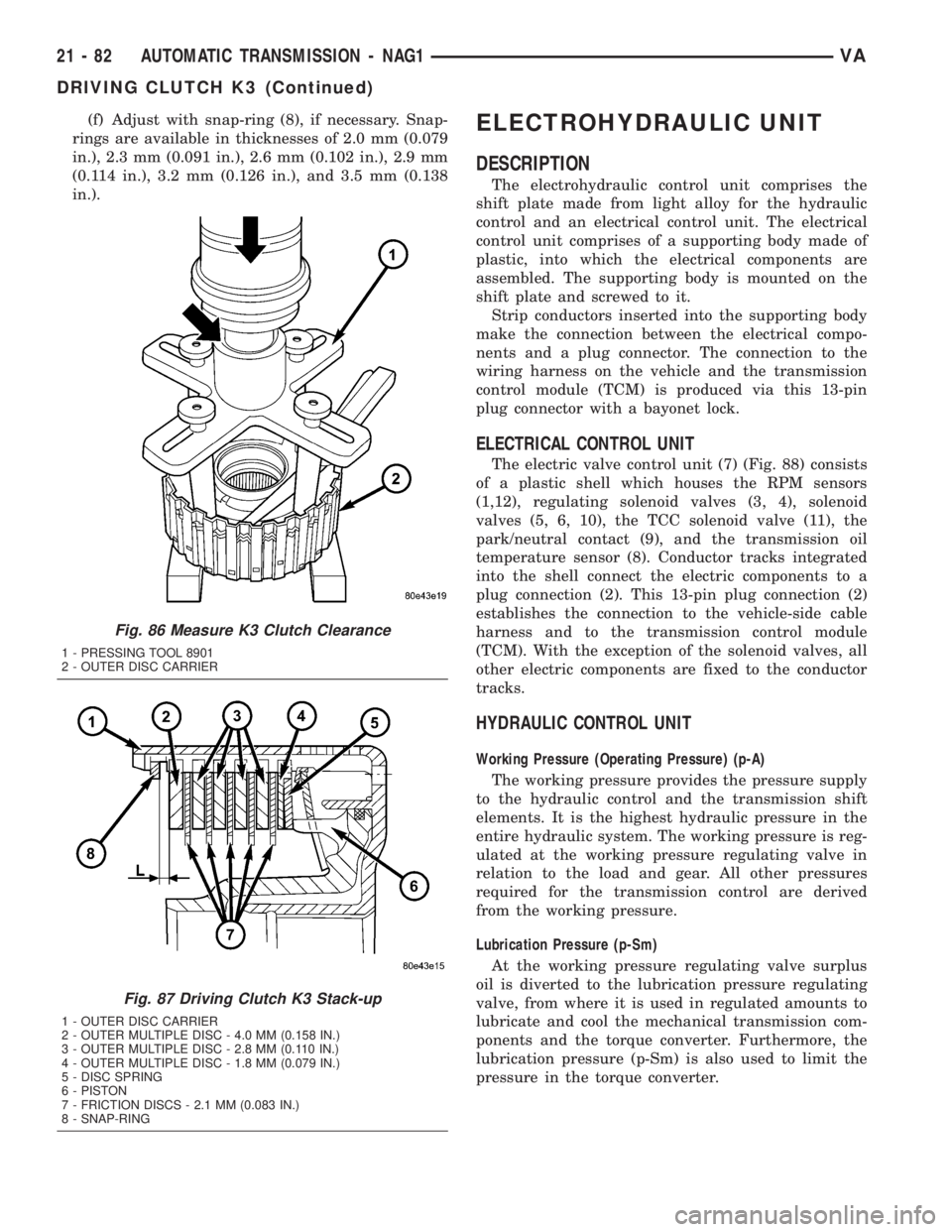
(f) Adjust with snap-ring (8), if necessary. Snap-
rings are available in thicknesses of 2.0 mm (0.079
in.), 2.3 mm (0.091 in.), 2.6 mm (0.102 in.), 2.9 mm
(0.114 in.), 3.2 mm (0.126 in.), and 3.5 mm (0.138
in.).ELECTROHYDRAULIC UNIT
DESCRIPTION
The electrohydraulic control unit comprises the
shift plate made from light alloy for the hydraulic
control and an electrical control unit. The electrical
control unit comprises of a supporting body made of
plastic, into which the electrical components are
assembled. The supporting body is mounted on the
shift plate and screwed to it.
Strip conductors inserted into the supporting body
make the connection between the electrical compo-
nents and a plug connector. The connection to the
wiring harness on the vehicle and the transmission
control module (TCM) is produced via this 13-pin
plug connector with a bayonet lock.
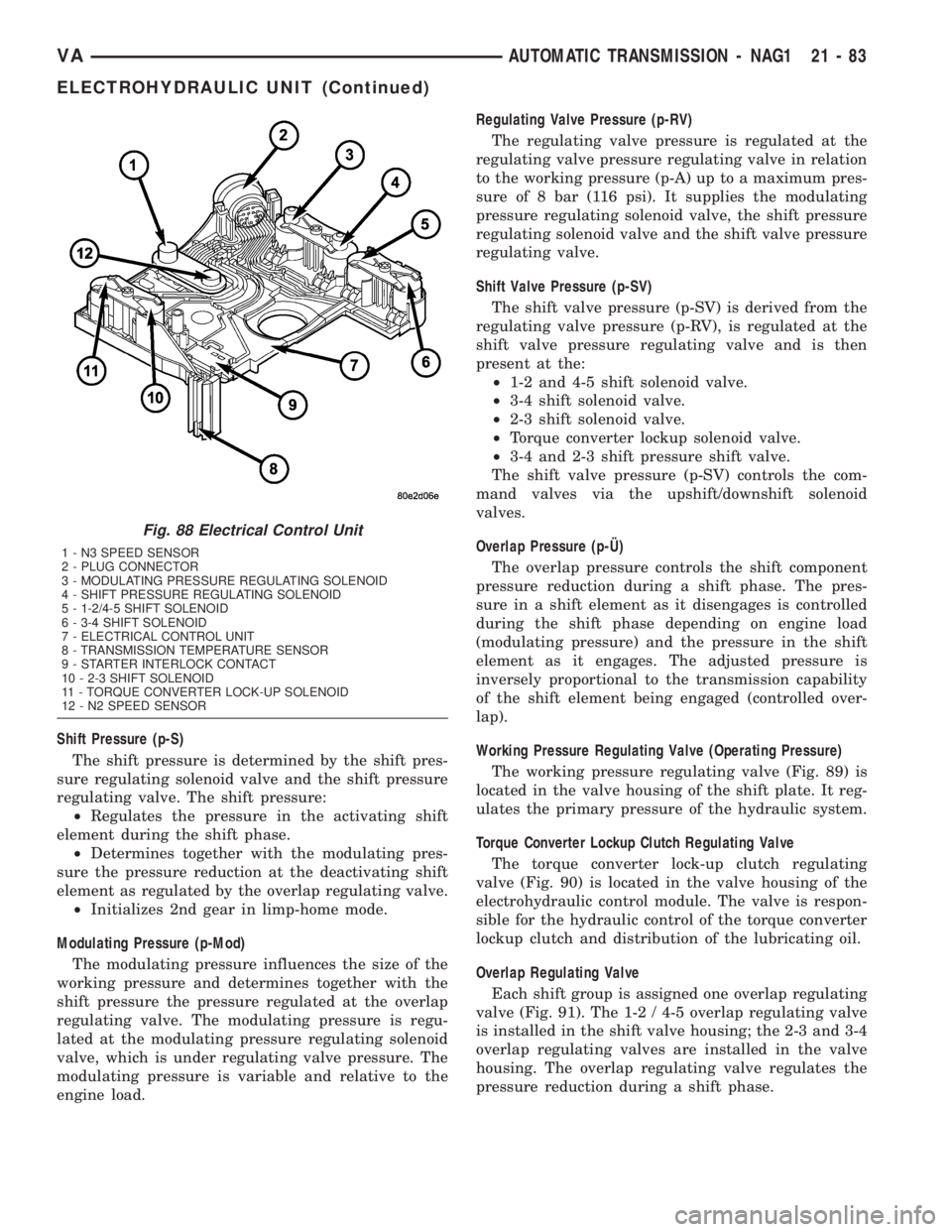
ELECTRICAL CONTROL UNIT
The electric valve control unit (7) (Fig. 88) consists
of a plastic shell which houses the RPM sensors
(1,12), regulating solenoid valves (3, 4), solenoid
valves (5, 6, 10), the TCC solenoid valve (11), the
park/neutral contact (9), and the transmission oil
temperature sensor (8). Conductor tracks integrated
into the shell connect the electric components to a
plug connection (2). This 13-pin plug connection (2)
establishes the connection to the vehicle-side cable
harness and to the transmission control module
(TCM). With the exception of the solenoid valves, all
other electric components are fixed to the conductor
tracks.
HYDRAULIC CONTROL UNIT
Working Pressure (Operating Pressure) (p-A)
The working pressure provides the pressure supply
to the hydraulic control and the transmission shift
elements. It is the highest hydraulic pressure in the
entire hydraulic system. The working pressure is reg-
ulated at the working pressure regulating valve in
relation to the load and gear. All other pressures
required for the transmission control are derived
from the working pressure.
Lubrication Pressure (p-Sm)
At the working pressure regulating valve surplus
oil is diverted to the lubrication pressure regulating
valve, from where it is used in regulated amounts to
lubricate and cool the mechanical transmission com-
ponents and the torque converter. Furthermore, the
lubrication pressure (p-Sm) is also used to limit the
pressure in the torque converter.
Fig. 86 Measure K3 Clutch Clearance
1 - PRESSING TOOL 8901
2 - OUTER DISC CARRIER
Fig. 87 Driving Clutch K3 Stack-up
1 - OUTER DISC CARRIER
2 - OUTER MULTIPLE DISC - 4.0 MM (0.158 IN.)
3 - OUTER MULTIPLE DISC - 2.8 MM (0.110 IN.)
4 - OUTER MULTIPLE DISC - 1.8 MM (0.079 IN.)
5 - DISC SPRING
6 - PISTON
7 - FRICTION DISCS - 2.1 MM (0.083 IN.)
8 - SNAP-RING
21 - 82 AUTOMATIC TRANSMISSION - NAG1VA
DRIVING CLUTCH K3 (Continued)
Page 959 of 1232
Shift Pressure (p-S)
The shift pressure is determined by the shift pres-
sure regulating solenoid valve and the shift pressure
regulating valve. The shift pressure:
²Regulates the pressure in the activating shift
element during the shift phase.
²Determines together with the modulating pres-
sure the pressure reduction at the deactivating shift
element as regulated by the overlap regulating valve.
²Initializes 2nd gear in limp-home mode.
Modulating Pressure (p-Mod)
The modulating pressure influences the size of the
working pressure and determines together with the
shift pressure the pressure regulated at the overlap
regulating valve. The modulating pressure is regu-
lated at the modulating pressure regulating solenoid
valve, which is under regulating valve pressure. The
modulating pressure is variable and relative to the
engine load.Regulating Valve Pressure (p-RV)
The regulating valve pressure is regulated at the
regulating valve pressure regulating valve in relation
to the working pressure (p-A) up to a maximum pres-
sure of 8 bar (116 psi). It supplies the modulating
pressure regulating solenoid valve, the shift pressure
regulating solenoid valve and the shift valve pressure
regulating valve.
Shift Valve Pressure (p-SV)
The shift valve pressure (p-SV) is derived from the
regulating valve pressure (p-RV), is regulated at the
shift valve pressure regulating valve and is then
present at the:
²1-2 and 4-5 shift solenoid valve.
²3-4 shift solenoid valve.
²2-3 shift solenoid valve.
²Torque converter lockup solenoid valve.
²3-4 and 2-3 shift pressure shift valve.
The shift valve pressure (p-SV) controls the com-
mand valves via the upshift/downshift solenoid
valves.
Overlap Pressure (p-š)
The overlap pressure controls the shift component
pressure reduction during a shift phase. The pres-
sure in a shift element as it disengages is controlled
during the shift phase depending on engine load
(modulating pressure) and the pressure in the shift
element as it engages. The adjusted pressure is
inversely proportional to the transmission capability
of the shift element being engaged (controlled over-
lap).
Working Pressure Regulating Valve (Operating Pressure)
The working pressure regulating valve (Fig. 89) is
located in the valve housing of the shift plate. It reg-
ulates the primary pressure of the hydraulic system.
Torque Converter Lockup Clutch Regulating Valve
The torque converter lock-up clutch regulating
valve (Fig. 90) is located in the valve housing of the
electrohydraulic control module. The valve is respon-
sible for the hydraulic control of the torque converter
lockup clutch and distribution of the lubricating oil.
Overlap Regulating Valve
Each shift group is assigned one overlap regulating
valve (Fig. 91). The 1-2 / 4-5 overlap regulating valve
is installed in the shift valve housing; the 2-3 and 3-4
overlap regulating valves are installed in the valve
housing. The overlap regulating valve regulates the
pressure reduction during a shift phase.
Fig. 88 Electrical Control Unit
1 - N3 SPEED SENSOR
2 - PLUG CONNECTOR
3 - MODULATING PRESSURE REGULATING SOLENOID
4 - SHIFT PRESSURE REGULATING SOLENOID
5 - 1-2/4-5 SHIFT SOLENOID
6 - 3-4 SHIFT SOLENOID
7 - ELECTRICAL CONTROL UNIT
8 - TRANSMISSION TEMPERATURE SENSOR
9 - STARTER INTERLOCK CONTACT
10 - 2-3 SHIFT SOLENOID
11 - TORQUE CONVERTER LOCK-UP SOLENOID
12 - N2 SPEED SENSOR
VAAUTOMATIC TRANSMISSION - NAG1 21 - 83
ELECTROHYDRAULIC UNIT (Continued)
Page 963 of 1232
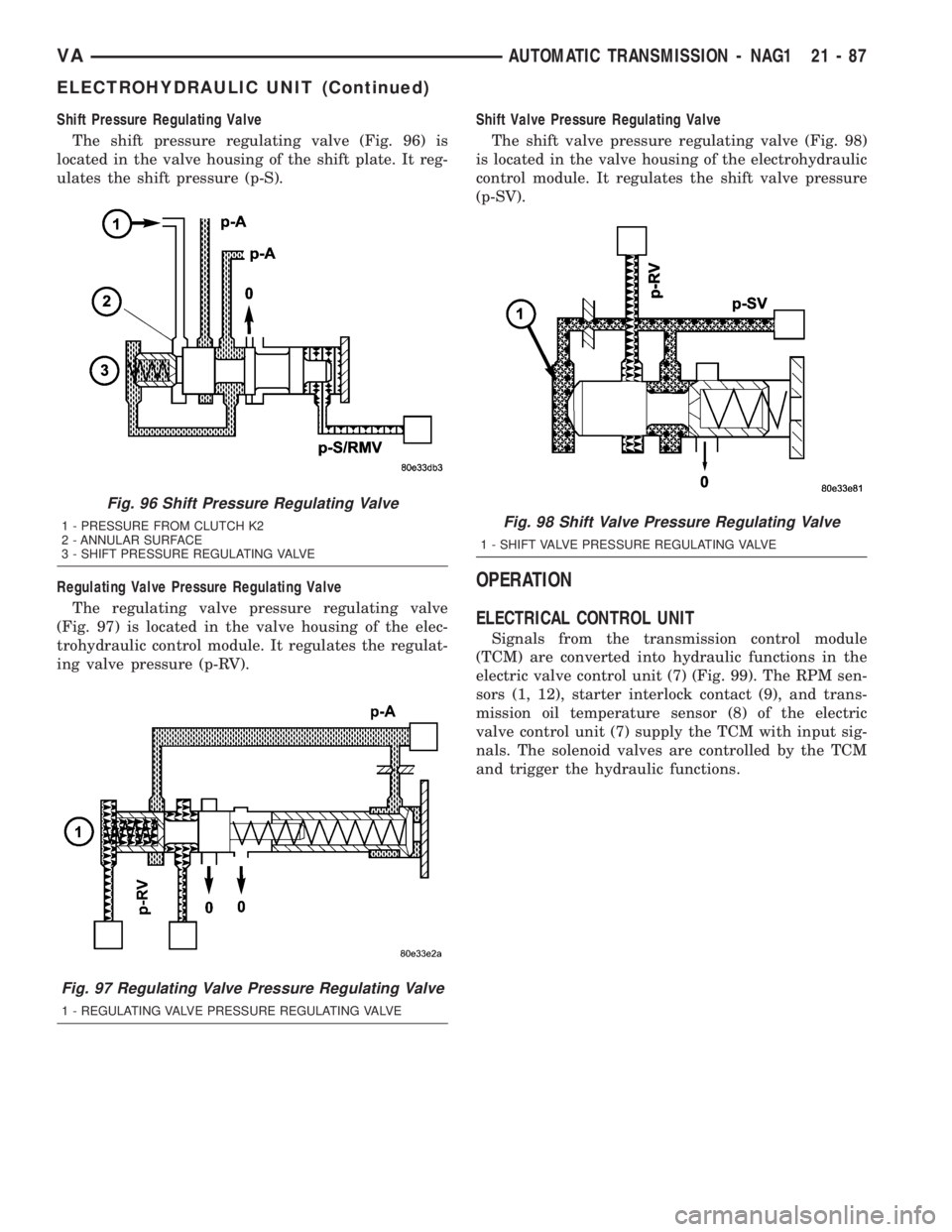
Shift Pressure Regulating Valve
The shift pressure regulating valve (Fig. 96) is
located in the valve housing of the shift plate. It reg-
ulates the shift pressure (p-S).
Regulating Valve Pressure Regulating Valve
The regulating valve pressure regulating valve
(Fig. 97) is located in the valve housing of the elec-
trohydraulic control module. It regulates the regulat-
ing valve pressure (p-RV).Shift Valve Pressure Regulating Valve
The shift valve pressure regulating valve (Fig. 98)
is located in the valve housing of the electrohydraulic
control module. It regulates the shift valve pressure
(p-SV).
OPERATION
ELECTRICAL CONTROL UNIT
Signals from the transmission control module
(TCM) are converted into hydraulic functions in the
electric valve control unit (7) (Fig. 99). The RPM sen-
sors (1, 12), starter interlock contact (9), and trans-
mission oil temperature sensor (8) of the electric
valve control unit (7) supply the TCM with input sig-
nals. The solenoid valves are controlled by the TCM
and trigger the hydraulic functions.
Fig. 96 Shift Pressure Regulating Valve
1 - PRESSURE FROM CLUTCH K2
2 - ANNULAR SURFACE
3 - SHIFT PRESSURE REGULATING VALVE
Fig. 97 Regulating Valve Pressure Regulating Valve
1 - REGULATING VALVE PRESSURE REGULATING VALVE
Fig. 98 Shift Valve Pressure Regulating Valve
1 - SHIFT VALVE PRESSURE REGULATING VALVE
VAAUTOMATIC TRANSMISSION - NAG1 21 - 87
ELECTROHYDRAULIC UNIT (Continued)