sensor MERCEDES-BENZ SPRINTER 2005 Service Repair Manual
[x] Cancel search | Manufacturer: MERCEDES-BENZ, Model Year: 2005, Model line: SPRINTER, Model: MERCEDES-BENZ SPRINTER 2005Pages: 1232, PDF Size: 39.23 MB
Page 1157 of 1232
TEMPERATURE CONTROL
DESCRIPTION
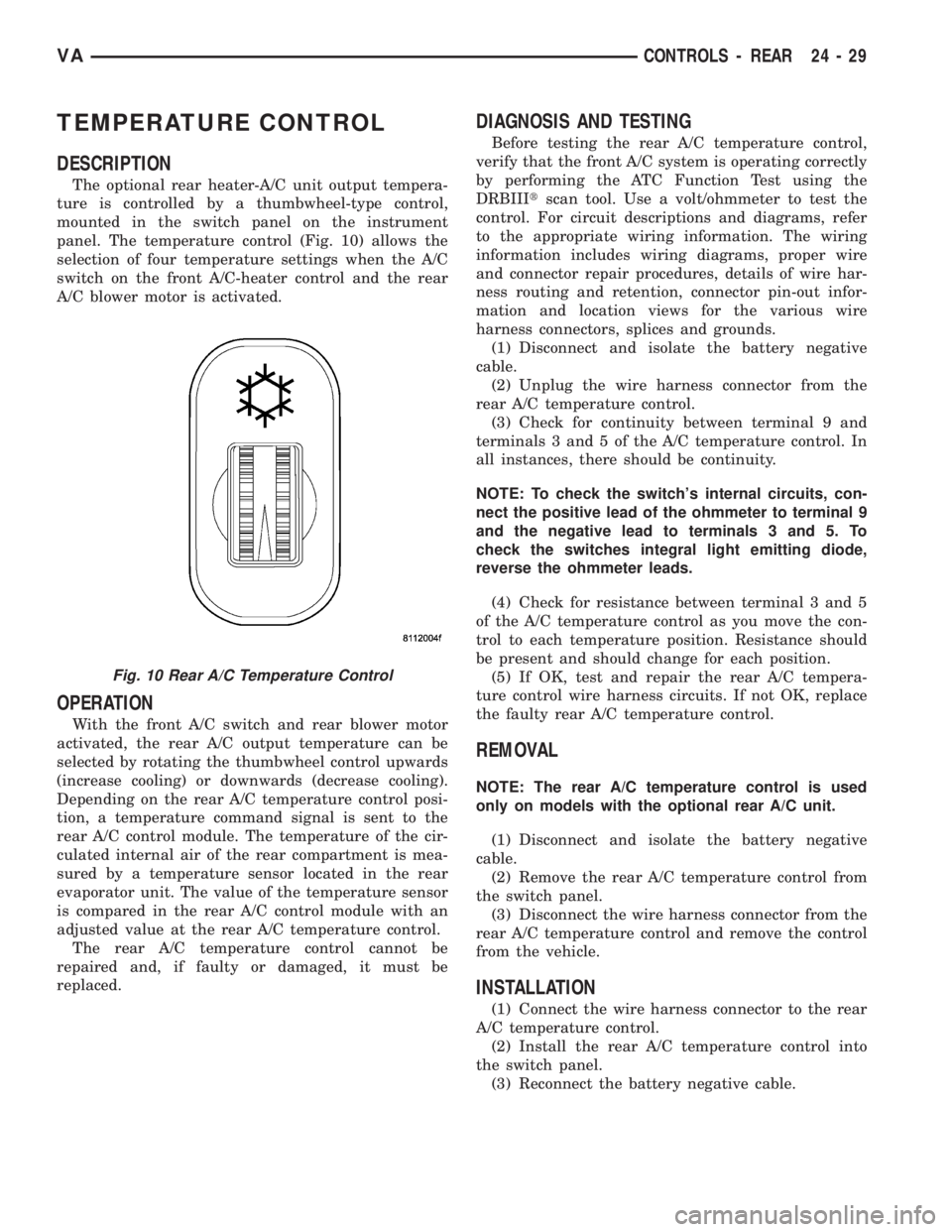
The optional rear heater-A/C unit output tempera-
ture is controlled by a thumbwheel-type control,
mounted in the switch panel on the instrument
panel. The temperature control (Fig. 10) allows the
selection of four temperature settings when the A/C
switch on the front A/C-heater control and the rear
A/C blower motor is activated.
OPERATION
With the front A/C switch and rear blower motor
activated, the rear A/C output temperature can be
selected by rotating the thumbwheel control upwards
(increase cooling) or downwards (decrease cooling).
Depending on the rear A/C temperature control posi-
tion, a temperature command signal is sent to the
rear A/C control module. The temperature of the cir-
culated internal air of the rear compartment is mea-
sured by a temperature sensor located in the rear
evaporator unit. The value of the temperature sensor
is compared in the rear A/C control module with an
adjusted value at the rear A/C temperature control.
The rear A/C temperature control cannot be
repaired and, if faulty or damaged, it must be
replaced.
DIAGNOSIS AND TESTING
Before testing the rear A/C temperature control,
verify that the front A/C system is operating correctly
by performing the ATC Function Test using the
DRBIIItscan tool. Use a volt/ohmmeter to test the
control. For circuit descriptions and diagrams, refer
to the appropriate wiring information. The wiring
information includes wiring diagrams, proper wire
and connector repair procedures, details of wire har-
ness routing and retention, connector pin-out infor-
mation and location views for the various wire
harness connectors, splices and grounds.
(1) Disconnect and isolate the battery negative
cable.
(2) Unplug the wire harness connector from the
rear A/C temperature control.
(3) Check for continuity between terminal 9 and
terminals 3 and 5 of the A/C temperature control. In
all instances, there should be continuity.
NOTE: To check the switch's internal circuits, con-
nect the positive lead of the ohmmeter to terminal 9
and the negative lead to terminals 3 and 5. To
check the switches integral light emitting diode,
reverse the ohmmeter leads.
(4) Check for resistance between terminal 3 and 5
of the A/C temperature control as you move the con-
trol to each temperature position. Resistance should
be present and should change for each position.
(5) If OK, test and repair the rear A/C tempera-
ture control wire harness circuits. If not OK, replace
the faulty rear A/C temperature control.
REMOVAL
NOTE: The rear A/C temperature control is used
only on models with the optional rear A/C unit.
(1) Disconnect and isolate the battery negative
cable.
(2) Remove the rear A/C temperature control from
the switch panel.
(3) Disconnect the wire harness connector from the
rear A/C temperature control and remove the control
from the vehicle.
INSTALLATION
(1) Connect the wire harness connector to the rear
A/C temperature control.
(2) Install the rear A/C temperature control into
the switch panel.
(3) Reconnect the battery negative cable.
Fig. 10 Rear A/C Temperature Control
VACONTROLS - REAR 24 - 29
Page 1158 of 1232
TEMPERATURE SENSOR
DESCRIPTION
The rear A/C air temperature sensor is located in
the rear evaporator housing. The rear temperature
sensor provides an air outlet temperature signal to
the rear A/C control module through a two-wire har-
ness lead and connector.
The temperature sensor cannot be adjusted or
repaired and, if faulty or damaged, it must be
replaced.
OPERATION
The rear A/C temperature sensor is a variable
resistor that operates on a five-volt reference signal
sent to it by the rear A/C control module. The resis-
tance in the sensor changes as air temperature
changes. Based upon the resistance in the sensor, a
specific voltage on the temperature sensor signal cir-
cuit is returned to the rear control module, which is
programmed to correspond to a specific temperature.
DIAGNOSIS AND TESTING
Before testing the rear air temperature sensor, ver-
ify that the front A/C system is operating correctly by
performing the ATC Function Test using the DRBIIIt
scan tool. For circuit descriptions and diagrams, refer
to the appropriate wiring information. The wiring
information includes wiring diagrams, proper wire
and connector repair procedures, details of wire har-
ness routing and retention, connector pin-out infor-
mation and location views for the various wire
harness connectors, splices and grounds.
(1) Disconnect and isolate the battery negative
cable.
(2) Unplug the wire harness connector for the rear
air temperature sensor.
(3) Measure the resistance of the temperature sen-
sor. At ±40É C (±40É F), the sensor resistance is 336
kilohms. At 55É C (131É F), the sensor resistance is
25 kilohms. The sensor resistance should read
between these two values.
(4) If OK, test and repair the rear air temperature
sensor wire harness circuits. If not OK, replace the
faulty air temperature sensor.
REMOVAL
(1) Disconnect and isolate the battery negative
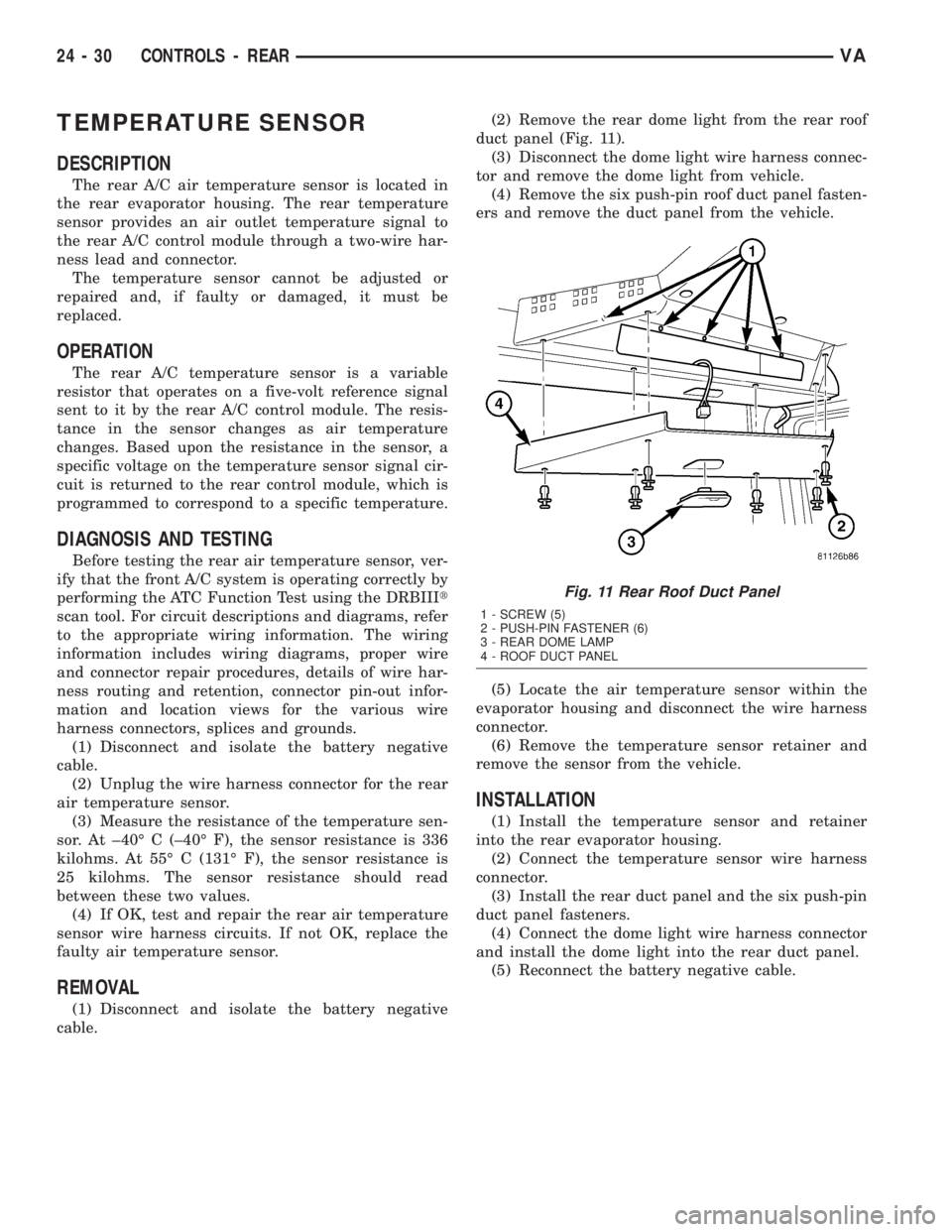
cable.(2) Remove the rear dome light from the rear roof
duct panel (Fig. 11).
(3) Disconnect the dome light wire harness connec-
tor and remove the dome light from vehicle.
(4) Remove the six push-pin roof duct panel fasten-
ers and remove the duct panel from the vehicle.
(5) Locate the air temperature sensor within the
evaporator housing and disconnect the wire harness
connector.
(6) Remove the temperature sensor retainer and
remove the sensor from the vehicle.
INSTALLATION
(1) Install the temperature sensor and retainer
into the rear evaporator housing.
(2) Connect the temperature sensor wire harness
connector.
(3) Install the rear duct panel and the six push-pin
duct panel fasteners.
(4) Connect the dome light wire harness connector
and install the dome light into the rear duct panel.
(5) Reconnect the battery negative cable.
Fig. 11 Rear Roof Duct Panel
1 - SCREW (5)
2 - PUSH-PIN FASTENER (6)
3 - REAR DOME LAMP
4 - ROOF DUCT PANEL
24 - 30 CONTROLS - REARVA
Page 1163 of 1232
(9) Disconnect the wire harness connector from the
blower motor (Refer to 24 - HEATING & AIR CON-
DITIONING/DISTRIBUTION/BLOWER MOTOR -
REMOVAL).
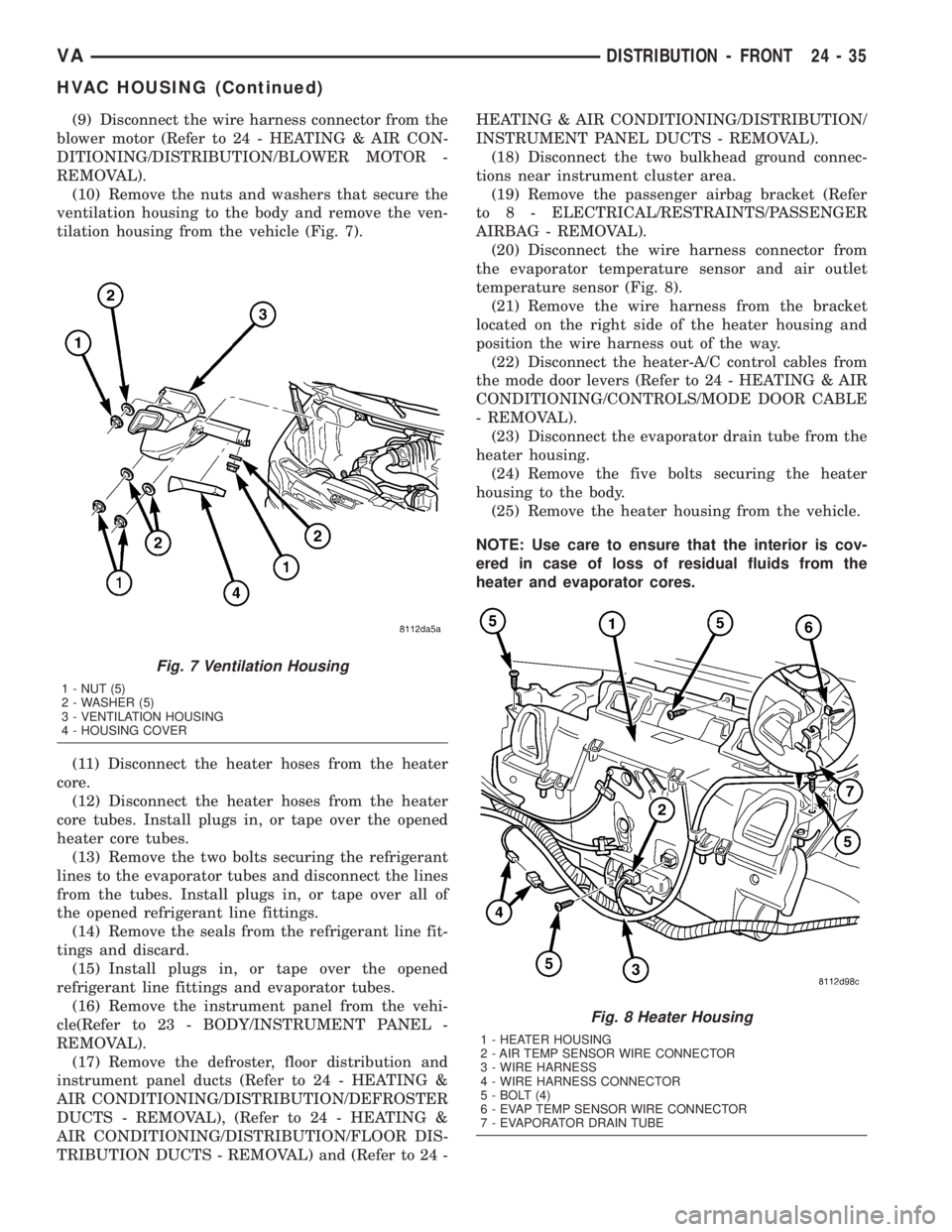
(10) Remove the nuts and washers that secure the
ventilation housing to the body and remove the ven-
tilation housing from the vehicle (Fig. 7).
(11) Disconnect the heater hoses from the heater
core.
(12) Disconnect the heater hoses from the heater
core tubes. Install plugs in, or tape over the opened
heater core tubes.
(13) Remove the two bolts securing the refrigerant
lines to the evaporator tubes and disconnect the lines
from the tubes. Install plugs in, or tape over all of
the opened refrigerant line fittings.
(14) Remove the seals from the refrigerant line fit-
tings and discard.
(15) Install plugs in, or tape over the opened
refrigerant line fittings and evaporator tubes.
(16) Remove the instrument panel from the vehi-
cle(Refer to 23 - BODY/INSTRUMENT PANEL -
REMOVAL).
(17) Remove the defroster, floor distribution and
instrument panel ducts (Refer to 24 - HEATING &
AIR CONDITIONING/DISTRIBUTION/DEFROSTER
DUCTS - REMOVAL), (Refer to 24 - HEATING &
AIR CONDITIONING/DISTRIBUTION/FLOOR DIS-
TRIBUTION DUCTS - REMOVAL) and (Refer to 24 -HEATING & AIR CONDITIONING/DISTRIBUTION/
INSTRUMENT PANEL DUCTS - REMOVAL).
(18) Disconnect the two bulkhead ground connec-
tions near instrument cluster area.
(19) Remove the passenger airbag bracket (Refer
to 8 - ELECTRICAL/RESTRAINTS/PASSENGER
AIRBAG - REMOVAL).
(20) Disconnect the wire harness connector from
the evaporator temperature sensor and air outlet
temperature sensor (Fig. 8).
(21) Remove the wire harness from the bracket
located on the right side of the heater housing and
position the wire harness out of the way.
(22) Disconnect the heater-A/C control cables from
the mode door levers (Refer to 24 - HEATING & AIR
CONDITIONING/CONTROLS/MODE DOOR CABLE
- REMOVAL).
(23) Disconnect the evaporator drain tube from the
heater housing.
(24) Remove the five bolts securing the heater
housing to the body.
(25) Remove the heater housing from the vehicle.
NOTE: Use care to ensure that the interior is cov-
ered in case of loss of residual fluids from the
heater and evaporator cores.
Fig. 7 Ventilation Housing
1 - NUT (5)
2 - WASHER (5)
3 - VENTILATION HOUSING
4 - HOUSING COVER
Fig. 8 Heater Housing
1 - HEATER HOUSING
2 - AIR TEMP SENSOR WIRE CONNECTOR
3 - WIRE HARNESS
4 - WIRE HARNESS CONNECTOR
5 - BOLT (4)
6 - EVAP TEMP SENSOR WIRE CONNECTOR
7 - EVAPORATOR DRAIN TUBE
VADISTRIBUTION - FRONT 24 - 35
HVAC HOUSING (Continued)
Page 1167 of 1232
DISTRIBUTION - REAR
TABLE OF CONTENTS
page page
AIR FILTER
REMOVAL.............................39
INSTALLATION.........................39
BLOWER MOTOR
REMOVAL.............................39INSTALLATION.........................40
REAR A/C HOUSING
REMOVAL.............................40
INSTALLATION.........................41
AIR FILTER
REMOVAL
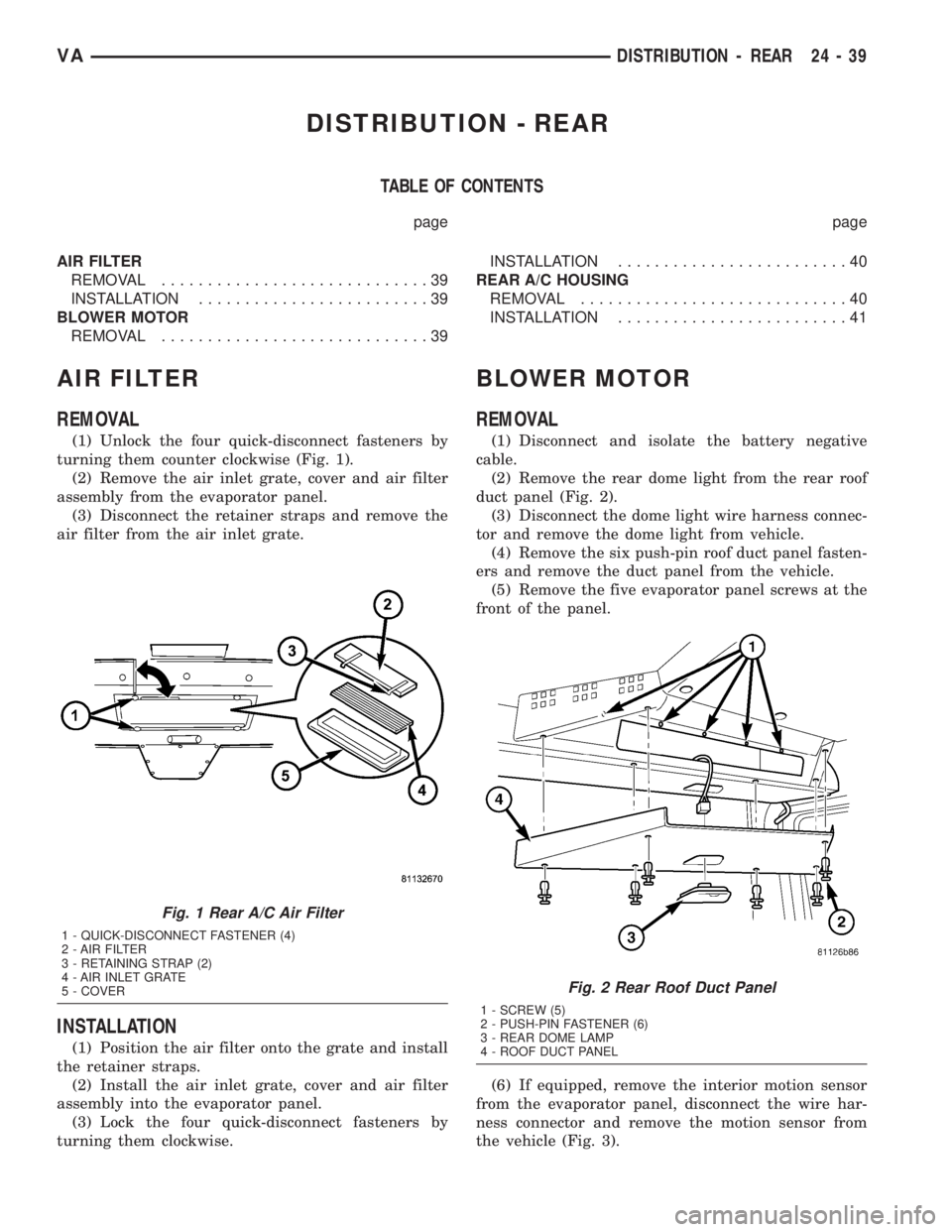
(1) Unlock the four quick-disconnect fasteners by
turning them counter clockwise (Fig. 1).
(2) Remove the air inlet grate, cover and air filter
assembly from the evaporator panel.
(3) Disconnect the retainer straps and remove the
air filter from the air inlet grate.
INSTALLATION
(1) Position the air filter onto the grate and install
the retainer straps.
(2) Install the air inlet grate, cover and air filter
assembly into the evaporator panel.
(3) Lock the four quick-disconnect fasteners by
turning them clockwise.
BLOWER MOTOR
REMOVAL
(1) Disconnect and isolate the battery negative
cable.
(2) Remove the rear dome light from the rear roof
duct panel (Fig. 2).
(3) Disconnect the dome light wire harness connec-
tor and remove the dome light from vehicle.
(4) Remove the six push-pin roof duct panel fasten-
ers and remove the duct panel from the vehicle.
(5) Remove the five evaporator panel screws at the
front of the panel.
(6) If equipped, remove the interior motion sensor
from the evaporator panel, disconnect the wire har-
ness connector and remove the motion sensor from
the vehicle (Fig. 3).
Fig. 1 Rear A/C Air Filter
1 - QUICK-DISCONNECT FASTENER (4)
2 - AIR FILTER
3 - RETAINING STRAP (2)
4 - AIR INLET GRATE
5 - COVER
Fig. 2 Rear Roof Duct Panel
1 - SCREW (5)
2 - PUSH-PIN FASTENER (6)
3 - REAR DOME LAMP
4 - ROOF DUCT PANEL
VADISTRIBUTION - REAR 24 - 39
Page 1168 of 1232
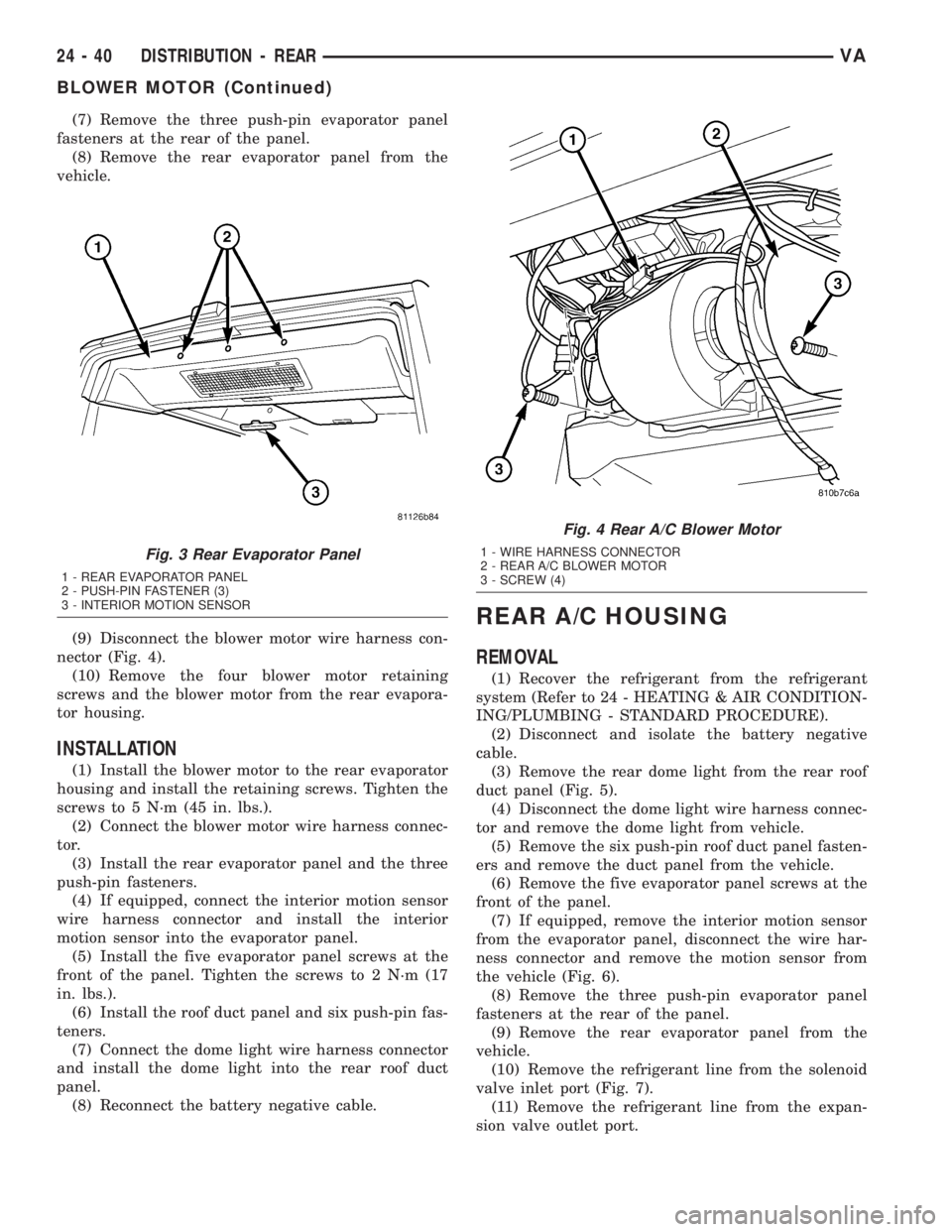
(7) Remove the three push-pin evaporator panel
fasteners at the rear of the panel.
(8) Remove the rear evaporator panel from the
vehicle.
(9) Disconnect the blower motor wire harness con-
nector (Fig. 4).
(10) Remove the four blower motor retaining
screws and the blower motor from the rear evapora-
tor housing.
INSTALLATION
(1) Install the blower motor to the rear evaporator
housing and install the retaining screws. Tighten the
screws to 5 N´m (45 in. lbs.).
(2) Connect the blower motor wire harness connec-
tor.
(3) Install the rear evaporator panel and the three
push-pin fasteners.
(4) If equipped, connect the interior motion sensor
wire harness connector and install the interior
motion sensor into the evaporator panel.
(5) Install the five evaporator panel screws at the
front of the panel. Tighten the screws to 2 N´m (17
in. lbs.).
(6) Install the roof duct panel and six push-pin fas-
teners.
(7) Connect the dome light wire harness connector
and install the dome light into the rear roof duct
panel.
(8) Reconnect the battery negative cable.
REAR A/C HOUSING
REMOVAL
(1) Recover the refrigerant from the refrigerant
system (Refer to 24 - HEATING & AIR CONDITION-
ING/PLUMBING - STANDARD PROCEDURE).
(2) Disconnect and isolate the battery negative
cable.
(3) Remove the rear dome light from the rear roof
duct panel (Fig. 5).
(4) Disconnect the dome light wire harness connec-
tor and remove the dome light from vehicle.
(5) Remove the six push-pin roof duct panel fasten-
ers and remove the duct panel from the vehicle.
(6) Remove the five evaporator panel screws at the
front of the panel.
(7) If equipped, remove the interior motion sensor
from the evaporator panel, disconnect the wire har-
ness connector and remove the motion sensor from
the vehicle (Fig. 6).
(8) Remove the three push-pin evaporator panel
fasteners at the rear of the panel.
(9) Remove the rear evaporator panel from the
vehicle.
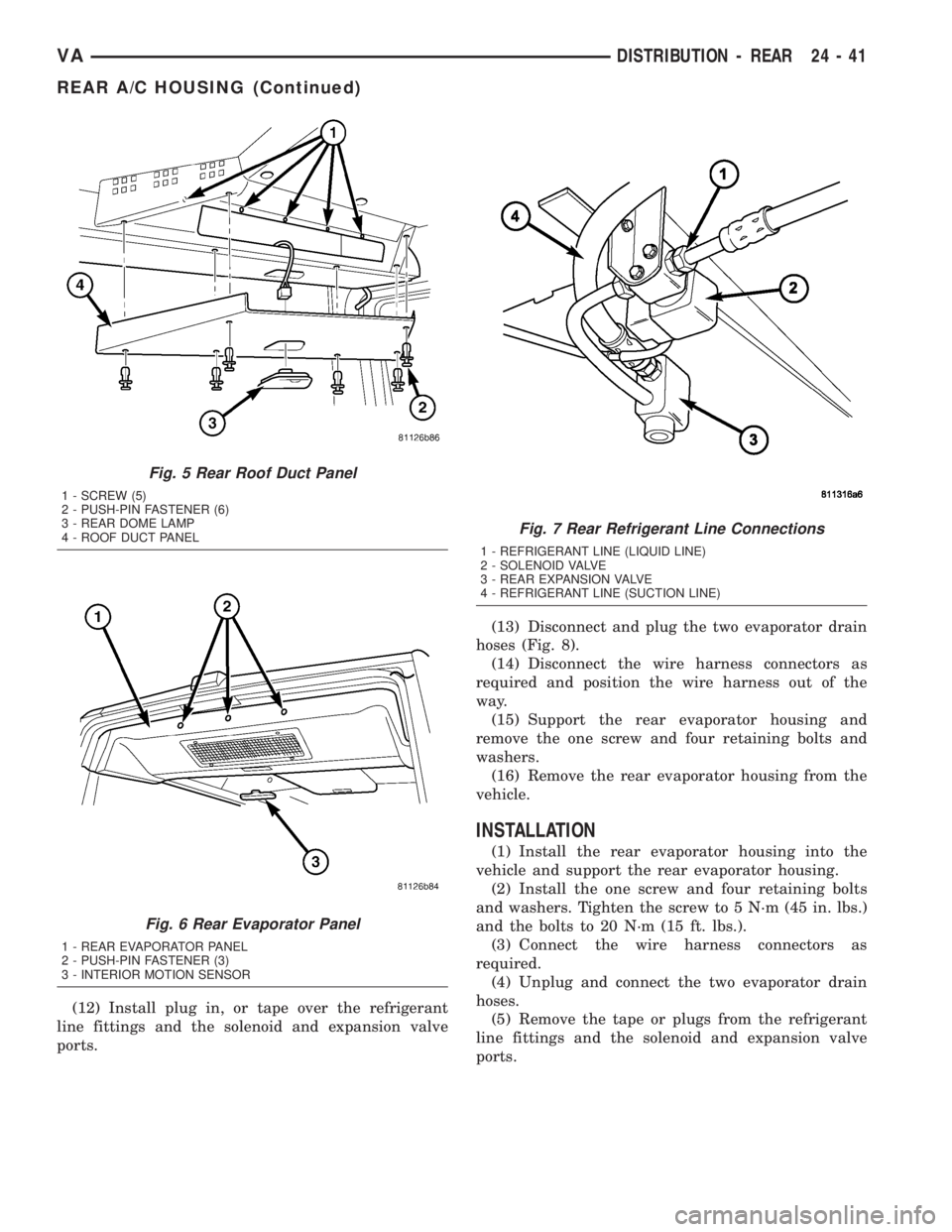
(10) Remove the refrigerant line from the solenoid
valve inlet port (Fig. 7).
(11) Remove the refrigerant line from the expan-
sion valve outlet port.
Fig. 3 Rear Evaporator Panel
1 - REAR EVAPORATOR PANEL
2 - PUSH-PIN FASTENER (3)
3 - INTERIOR MOTION SENSOR
Fig. 4 Rear A/C Blower Motor
1 - WIRE HARNESS CONNECTOR
2 - REAR A/C BLOWER MOTOR
3 - SCREW (4)
24 - 40 DISTRIBUTION - REARVA
BLOWER MOTOR (Continued)
Page 1169 of 1232
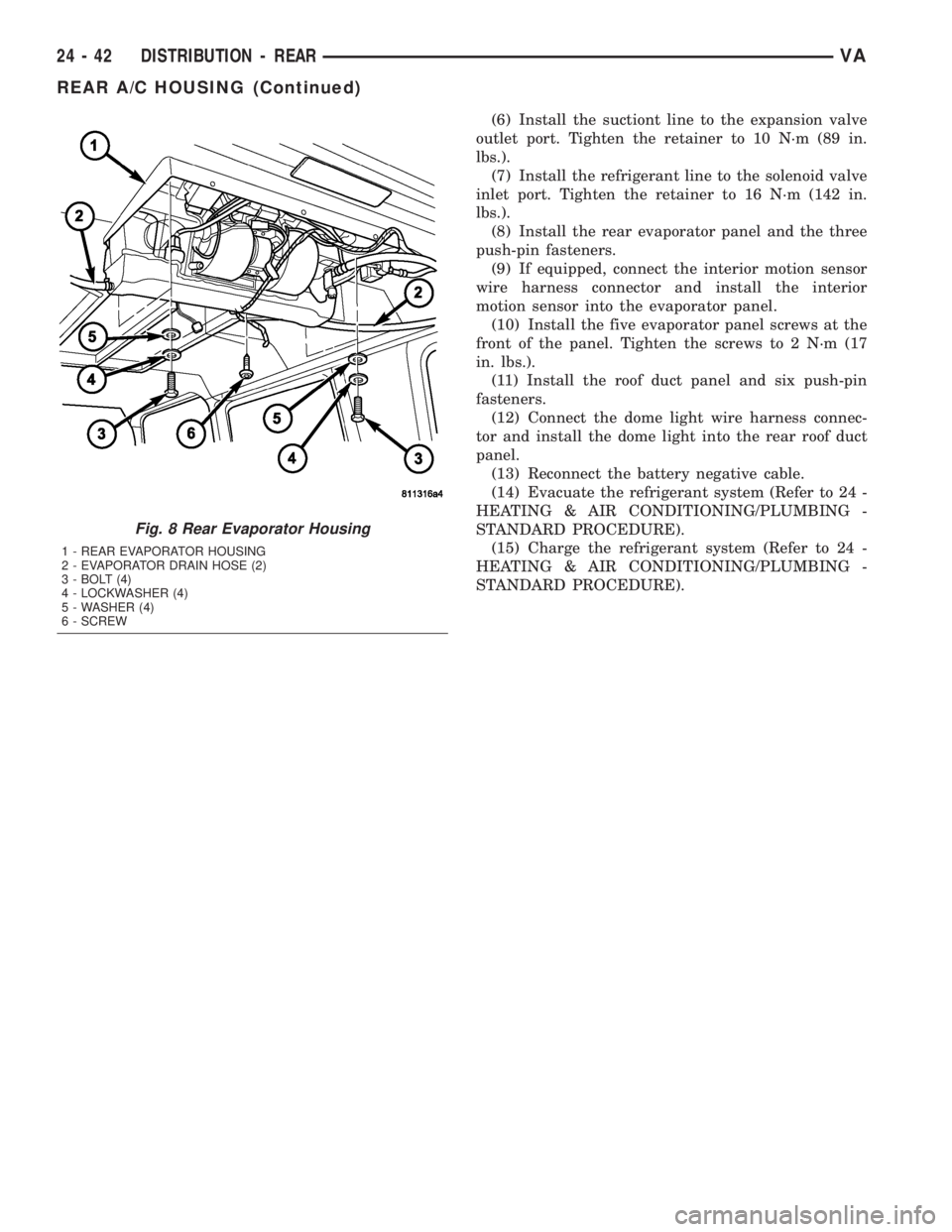
(12) Install plug in, or tape over the refrigerant
line fittings and the solenoid and expansion valve
ports.(13) Disconnect and plug the two evaporator drain
hoses (Fig. 8).
(14) Disconnect the wire harness connectors as
required and position the wire harness out of the
way.
(15) Support the rear evaporator housing and
remove the one screw and four retaining bolts and
washers.
(16) Remove the rear evaporator housing from the
vehicle.
INSTALLATION
(1) Install the rear evaporator housing into the
vehicle and support the rear evaporator housing.
(2) Install the one screw and four retaining bolts
and washers. Tighten the screw to 5 N´m (45 in. lbs.)
and the bolts to 20 N´m (15 ft. lbs.).
(3) Connect the wire harness connectors as
required.
(4) Unplug and connect the two evaporator drain
hoses.
(5) Remove the tape or plugs from the refrigerant
line fittings and the solenoid and expansion valve
ports.
Fig. 5 Rear Roof Duct Panel
1 - SCREW (5)
2 - PUSH-PIN FASTENER (6)
3 - REAR DOME LAMP
4 - ROOF DUCT PANEL
Fig. 6 Rear Evaporator Panel
1 - REAR EVAPORATOR PANEL
2 - PUSH-PIN FASTENER (3)
3 - INTERIOR MOTION SENSOR
Fig. 7 Rear Refrigerant Line Connections
1 - REFRIGERANT LINE (LIQUID LINE)
2 - SOLENOID VALVE
3 - REAR EXPANSION VALVE
4 - REFRIGERANT LINE (SUCTION LINE)
VADISTRIBUTION - REAR 24 - 41
REAR A/C HOUSING (Continued)
Page 1170 of 1232
(6) Install the suctiont line to the expansion valve
outlet port. Tighten the retainer to 10 N´m (89 in.
lbs.).
(7) Install the refrigerant line to the solenoid valve
inlet port. Tighten the retainer to 16 N´m (142 in.
lbs.).
(8) Install the rear evaporator panel and the three
push-pin fasteners.
(9) If equipped, connect the interior motion sensor
wire harness connector and install the interior
motion sensor into the evaporator panel.
(10) Install the five evaporator panel screws at the
front of the panel. Tighten the screws to 2 N´m (17
in. lbs.).
(11) Install the roof duct panel and six push-pin
fasteners.
(12) Connect the dome light wire harness connec-
tor and install the dome light into the rear roof duct
panel.
(13) Reconnect the battery negative cable.
(14) Evacuate the refrigerant system (Refer to 24 -
HEATING & AIR CONDITIONING/PLUMBING -
STANDARD PROCEDURE).
(15) Charge the refrigerant system (Refer to 24 -
HEATING & AIR CONDITIONING/PLUMBING -
STANDARD PROCEDURE).
Fig. 8 Rear Evaporator Housing
1 - REAR EVAPORATOR HOUSING
2 - EVAPORATOR DRAIN HOSE (2)
3 - BOLT (4)
4 - LOCKWASHER (4)
5 - WASHER (4)
6 - SCREW
24 - 42 DISTRIBUTION - REARVA
REAR A/C HOUSING (Continued)
Page 1183 of 1232
REMOVAL
WARNING: ON VEHICLES EQUIPPED WITH AIR-
BAGS, DISABLE THE AIRBAG SYSTEM BEFORE
ATTEMPTING ANY STEERING WHEEL, STEERING
COLUMN, OR INSTRUMENT PANEL COMPONENT
DIAGNOSIS OR SERVICE. DISCONNECT AND ISO-
LATE THE BATTERY NEGATIVE (GROUND) CABLE,
THEN WAIT TWO MINUTES FOR THE AIRBAG SYS-
TEM CAPACITOR TO DISCHARGE BEFORE PER-
FORMING FURTHER DIAGNOSIS OR SERVICE. THIS
IS THE ONLY SURE WAY TO DISABLE THE AIRBAG
SYSTEM. FAILURE TO TAKE THE PROPER PRE-
CAUTIONS COULD RESULT IN AN ACCIDENTAL
AIRBAG DEPLOYMENT AND POSSIBLE PERSONAL
INJURY.
WARNING: REVIEW THE WARNINGS AND CAU-
TIONS IN THE FRONT OF THIS SECTION BEFORE
PERFORMING THE FOLLOWING OPERATION (Refer
to 24 - HEATING & AIR CONDITIONING/PLUMBING -
WARNING) and (Refer to 24 - HEATING & AIR CON-
DITIONING/PLUMBING - CAUTION).
(1) Remove the heater housing (Refer to 24 -
HEATING & AIR CONDITIONING/DISTRIBUTION/
HVAC HOUSING - REMOVAL).
(2) Disassemble the heater housing to access the
evaporator (Refer to 24 - HEATING & AIR CONDI-
TIONING/DISTRIBUTION/HVAC HOUSING - DIS-
ASSEMBLY).
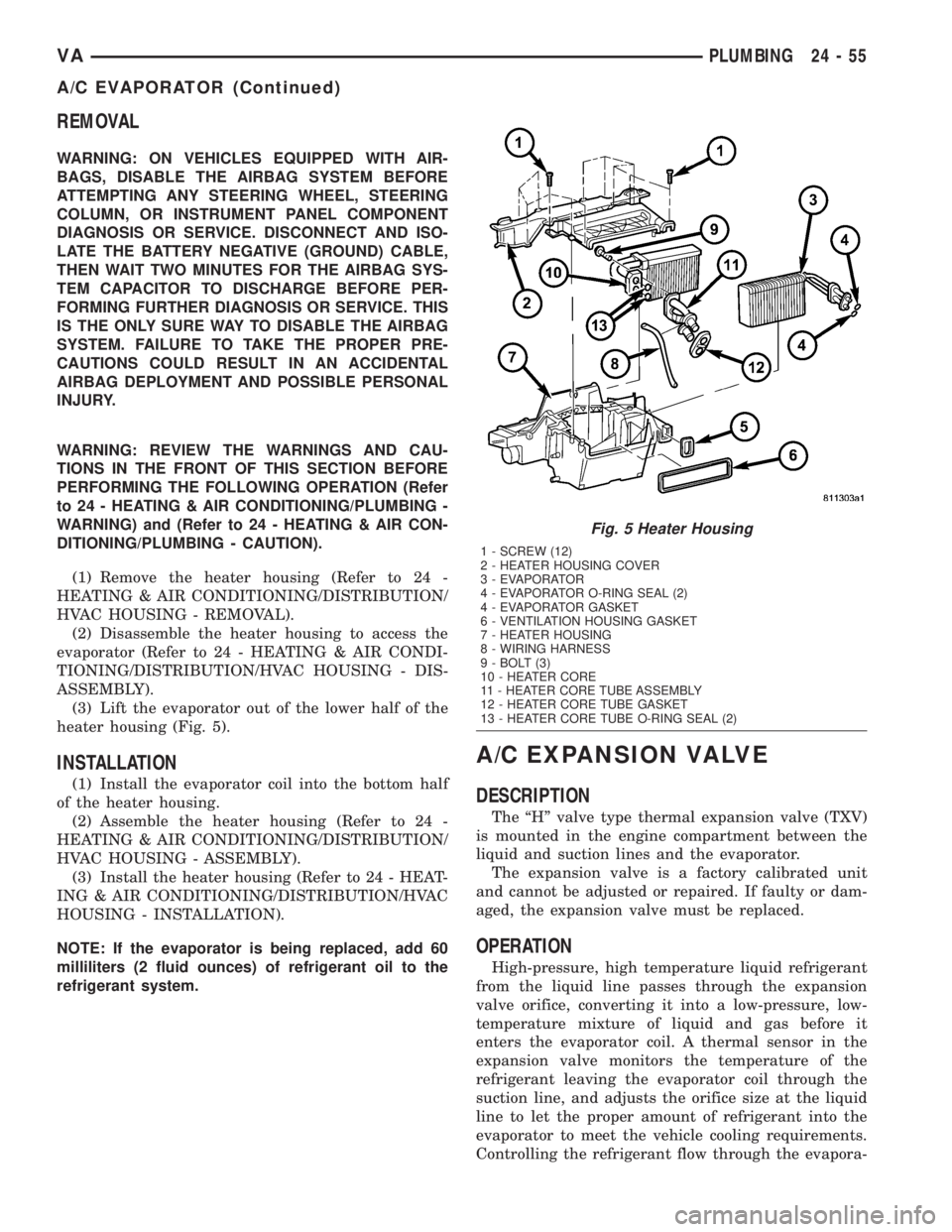
(3) Lift the evaporator out of the lower half of the
heater housing (Fig. 5).
INSTALLATION
(1) Install the evaporator coil into the bottom half
of the heater housing.
(2) Assemble the heater housing (Refer to 24 -
HEATING & AIR CONDITIONING/DISTRIBUTION/
HVAC HOUSING - ASSEMBLY).
(3) Install the heater housing (Refer to 24 - HEAT-
ING & AIR CONDITIONING/DISTRIBUTION/HVAC
HOUSING - INSTALLATION).
NOTE: If the evaporator is being replaced, add 60
milliliters (2 fluid ounces) of refrigerant oil to the
refrigerant system.
A/C EXPANSION VALVE
DESCRIPTION
The ªHº valve type thermal expansion valve (TXV)
is mounted in the engine compartment between the
liquid and suction lines and the evaporator.
The expansion valve is a factory calibrated unit
and cannot be adjusted or repaired. If faulty or dam-
aged, the expansion valve must be replaced.
OPERATION
High-pressure, high temperature liquid refrigerant
from the liquid line passes through the expansion
valve orifice, converting it into a low-pressure, low-
temperature mixture of liquid and gas before it
enters the evaporator coil. A thermal sensor in the
expansion valve monitors the temperature of the
refrigerant leaving the evaporator coil through the
suction line, and adjusts the orifice size at the liquid
line to let the proper amount of refrigerant into the
evaporator to meet the vehicle cooling requirements.
Controlling the refrigerant flow through the evapora-
Fig. 5 Heater Housing
1 - SCREW (12)
2 - HEATER HOUSING COVER
3 - EVAPORATOR
4 - EVAPORATOR O-RING SEAL (2)
4 - EVAPORATOR GASKET
6 - VENTILATION HOUSING GASKET
7 - HEATER HOUSING
8 - WIRING HARNESS
9 - BOLT (3)
10 - HEATER CORE
11 - HEATER CORE TUBE ASSEMBLY
12 - HEATER CORE TUBE GASKET
13 - HEATER CORE TUBE O-RING SEAL (2)
VAPLUMBING 24 - 55
A/C EVAPORATOR (Continued)
Page 1186 of 1232
blower motor speed controls the volume of air flowing
through the heater housing.
The heater core cannot be repaired and, if faulty or
damaged, it must be replaced.
REMOVAL
WARNING: ON VEHICLES EQUIPPED WITH AIR-
BAGS, DISABLE THE AIRBAG SYSTEM BEFORE
ATTEMPTING ANY STEERING WHEEL, STEERING
COLUMN, OR INSTRUMENT PANEL COMPONENT
DIAGNOSIS OR SERVICE. DISCONNECT AND ISO-
LATE THE BATTERY NEGATIVE (GROUND) CABLE,
THEN WAIT TWO MINUTES FOR THE AIRBAG SYS-
TEM CAPACITOR TO DISCHARGE BEFORE PER-
FORMING FURTHER DIAGNOSIS OR SERVICE. THIS
IS THE ONLY SURE WAY TO DISABLE THE AIRBAG
SYSTEM. FAILURE TO TAKE THE PROPER PRE-
CAUTIONS COULD RESULT IN AN ACCIDENTAL
AIRBAG DEPLOYMENT AND POSSIBLE PERSONAL
INJURY.
WARNING: REVIEW THE WARNINGS AND CAU-
TIONS IN THE FRONT OF THIS SECTION BEFORE
PERFORMING THE FOLLOWING OPERATION (Refer
to 24 - HEATING & AIR CONDITIONING/PLUMBING -
WARNING) and (Refer to 24 - HEATING & AIR CON-
DITIONING/PLUMBING - CAUTION).
(1) Remove the heater housing (Refer to 24 -
HEATING & AIR CONDITIONING/DISTRIBUTION/
HVAC HOUSING - REMOVAL).
(2) Disassemble the heater housing to access the
heater core (Refer to 24 - HEATING & AIR CONDI-
TIONING/DISTRIBUTION/HVAC HOUSING - DIS-
ASSEMBLY).
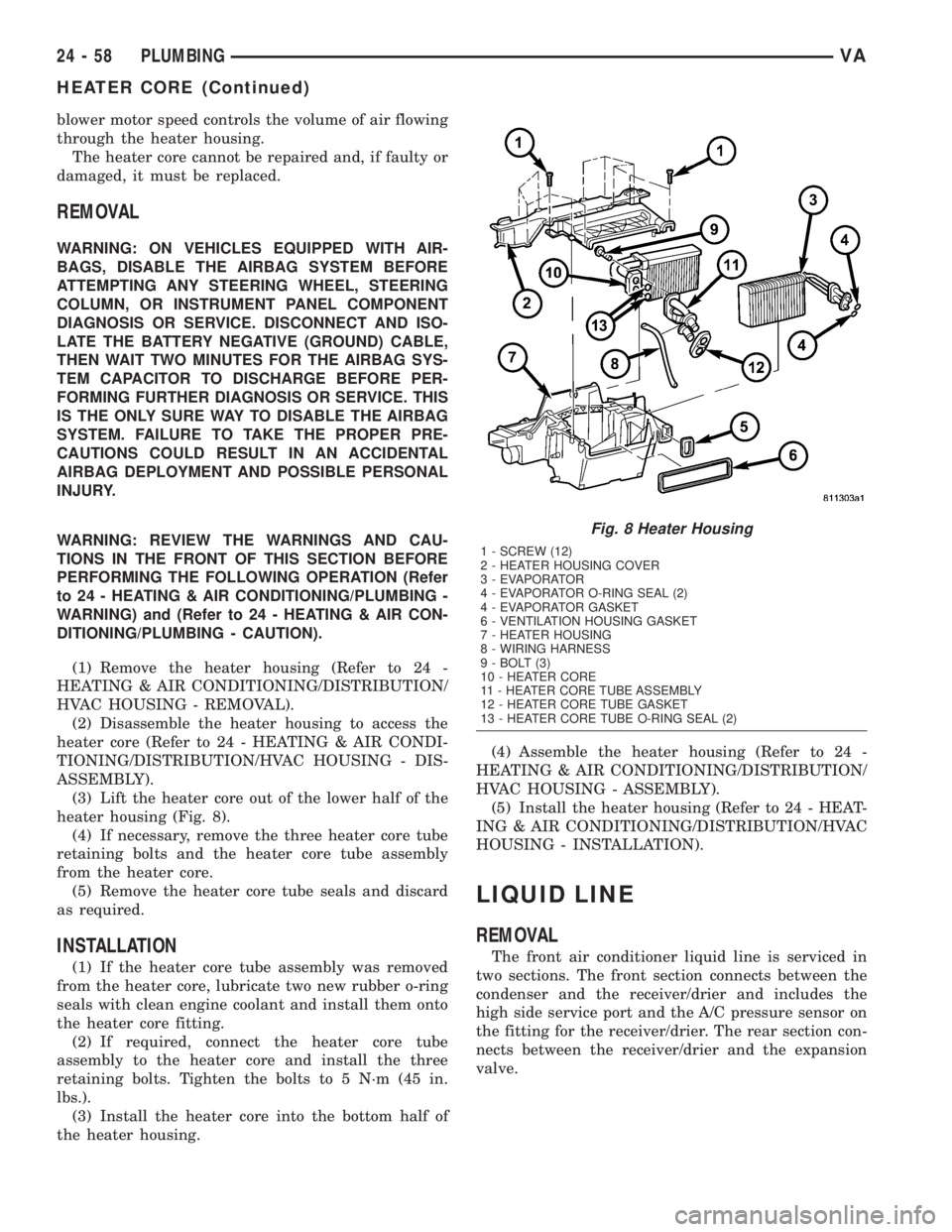
(3) Lift the heater core out of the lower half of the
heater housing (Fig. 8).
(4) If necessary, remove the three heater core tube
retaining bolts and the heater core tube assembly
from the heater core.
(5) Remove the heater core tube seals and discard
as required.
INSTALLATION
(1) If the heater core tube assembly was removed
from the heater core, lubricate two new rubber o-ring
seals with clean engine coolant and install them onto
the heater core fitting.
(2) If required, connect the heater core tube
assembly to the heater core and install the three
retaining bolts. Tighten the bolts to 5 N´m (45 in.
lbs.).
(3) Install the heater core into the bottom half of
the heater housing.(4) Assemble the heater housing (Refer to 24 -
HEATING & AIR CONDITIONING/DISTRIBUTION/
HVAC HOUSING - ASSEMBLY).
(5) Install the heater housing (Refer to 24 - HEAT-
ING & AIR CONDITIONING/DISTRIBUTION/HVAC
HOUSING - INSTALLATION).
LIQUID LINE
REMOVAL
The front air conditioner liquid line is serviced in
two sections. The front section connects between the
condenser and the receiver/drier and includes the
high side service port and the A/C pressure sensor on
the fitting for the receiver/drier. The rear section con-
nects between the receiver/drier and the expansion
valve.
Fig. 8 Heater Housing
1 - SCREW (12)
2 - HEATER HOUSING COVER
3 - EVAPORATOR
4 - EVAPORATOR O-RING SEAL (2)
4 - EVAPORATOR GASKET
6 - VENTILATION HOUSING GASKET
7 - HEATER HOUSING
8 - WIRING HARNESS
9 - BOLT (3)
10 - HEATER CORE
11 - HEATER CORE TUBE ASSEMBLY
12 - HEATER CORE TUBE GASKET
13 - HEATER CORE TUBE O-RING SEAL (2)
24 - 58 PLUMBINGVA
HEATER CORE (Continued)
Page 1187 of 1232
WARNING: REVIEW THE WARNINGS AND CAU-
TIONS IN THE FRONT OF THIS SECTION BEFORE
PERFORMING THE FOLLOWING OPERATION (Refer
to 24 - HEATING & AIR CONDITIONING/PLUMBING -
WARNING) and (Refer to 24 - HEATING & AIR CON-
DITIONING/PLUMBING - CAUTION).
FRONT SECTION
(1) Recover the refrigerant from the refrigerant
system (Refer to 24 - HEATING & AIR CONDITION-
ING/PLUMBING - STANDARD PROCEDURE).
(2) Disconnect and isolate the battery negative
cable.
(3) Remove the grille (Refer to 23 - BODY/EXTE-
RIOR/GRILLE - REMOVAL).
(4) Remove the nut that secures the liquid line fit-
ting to the condenser outlet port on the left side of
condenser.
(5) Disconnect the liquid line fitting from the con-
denser outlet port.
(6) Remove the seal from the liquid line fitting and
discard.
(7) Install plug in, or tape over the opened liquid
line fitting and the condenser outlet port.
(8) Remove the routing clip retaining nut and dis-
engage the routing clip retainer on top of the left
frame rail from the front section of the liquid line.
(9) Remove the A/C pressure sensor from the front
liquid line fitting (Refer to 24 - HEATING & AIR
CONDITIONING/CONTROLS/A/C PRESSURE
TRANSDUCER - REMOVAL).
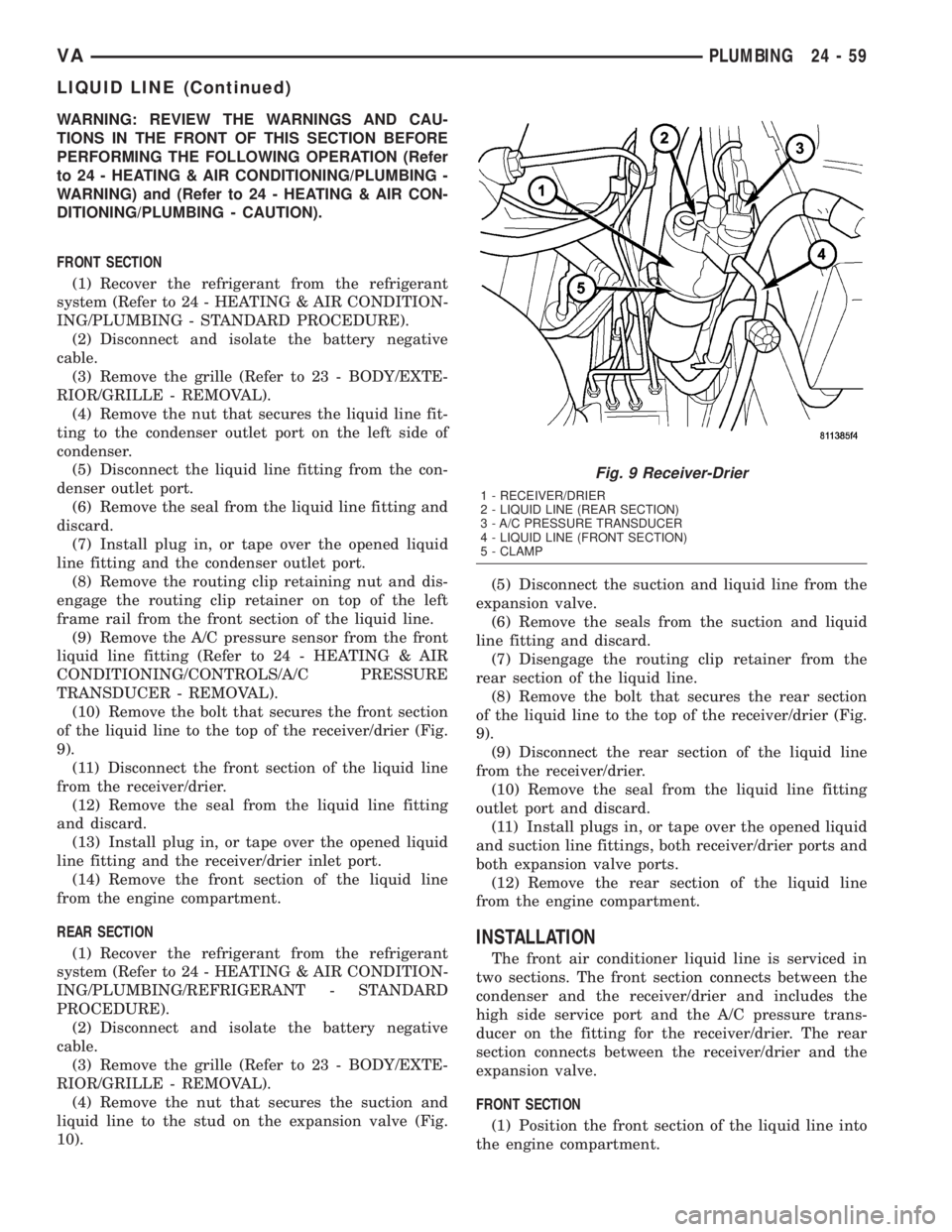
(10) Remove the bolt that secures the front section
of the liquid line to the top of the receiver/drier (Fig.
9).
(11) Disconnect the front section of the liquid line
from the receiver/drier.
(12) Remove the seal from the liquid line fitting
and discard.
(13) Install plug in, or tape over the opened liquid
line fitting and the receiver/drier inlet port.
(14) Remove the front section of the liquid line
from the engine compartment.
REAR SECTION
(1) Recover the refrigerant from the refrigerant
system (Refer to 24 - HEATING & AIR CONDITION-
ING/PLUMBING/REFRIGERANT - STANDARD
PROCEDURE).
(2) Disconnect and isolate the battery negative
cable.
(3) Remove the grille (Refer to 23 - BODY/EXTE-
RIOR/GRILLE - REMOVAL).
(4) Remove the nut that secures the suction and
liquid line to the stud on the expansion valve (Fig.
10).(5) Disconnect the suction and liquid line from the
expansion valve.
(6) Remove the seals from the suction and liquid
line fitting and discard.
(7) Disengage the routing clip retainer from the
rear section of the liquid line.
(8) Remove the bolt that secures the rear section
of the liquid line to the top of the receiver/drier (Fig.
9).
(9) Disconnect the rear section of the liquid line
from the receiver/drier.
(10) Remove the seal from the liquid line fitting
outlet port and discard.
(11) Install plugs in, or tape over the opened liquid
and suction line fittings, both receiver/drier ports and
both expansion valve ports.
(12) Remove the rear section of the liquid line
from the engine compartment.
INSTALLATION
The front air conditioner liquid line is serviced in
two sections. The front section connects between the
condenser and the receiver/drier and includes the
high side service port and the A/C pressure trans-
ducer on the fitting for the receiver/drier. The rear
section connects between the receiver/drier and the
expansion valve.
FRONT SECTION
(1) Position the front section of the liquid line into
the engine compartment.
Fig. 9 Receiver-Drier
1 - RECEIVER/DRIER
2 - LIQUID LINE (REAR SECTION)
3 - A/C PRESSURE TRANSDUCER
4 - LIQUID LINE (FRONT SECTION)
5 - CLAMP
VAPLUMBING 24 - 59
LIQUID LINE (Continued)