engine MERCEDES-BENZ SPRINTER 2005 Service Repair Manual
[x] Cancel search | Manufacturer: MERCEDES-BENZ, Model Year: 2005, Model line: SPRINTER, Model: MERCEDES-BENZ SPRINTER 2005Pages: 1232, PDF Size: 39.23 MB
Page 825 of 1232
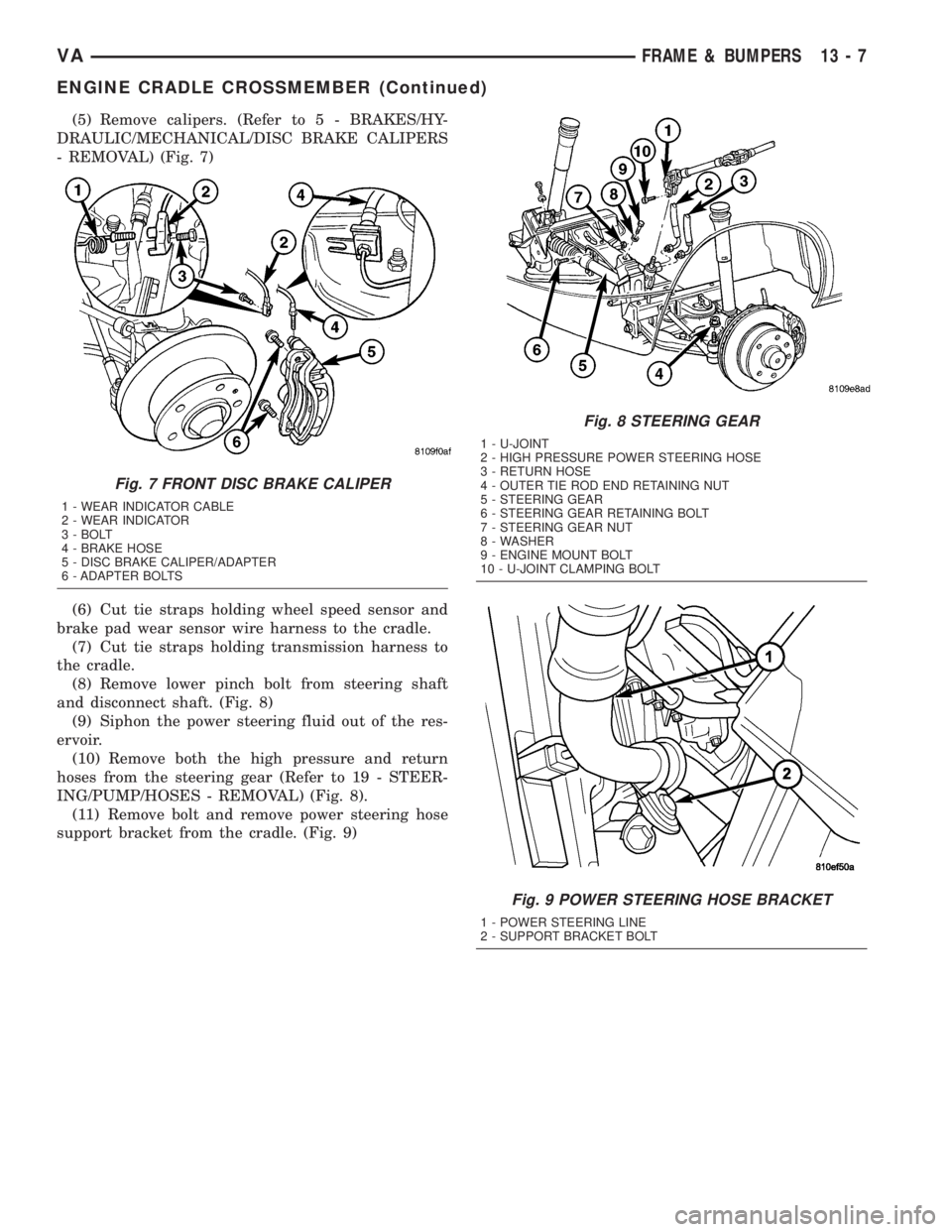
(5) Remove calipers. (Refer to 5 - BRAKES/HY-
DRAULIC/MECHANICAL/DISC BRAKE CALIPERS
- REMOVAL) (Fig. 7)
(6) Cut tie straps holding wheel speed sensor and
brake pad wear sensor wire harness to the cradle.
(7) Cut tie straps holding transmission harness to
the cradle.
(8) Remove lower pinch bolt from steering shaft
and disconnect shaft. (Fig. 8)
(9) Siphon the power steering fluid out of the res-
ervoir.
(10) Remove both the high pressure and return
hoses from the steering gear (Refer to 19 - STEER-
ING/PUMP/HOSES - REMOVAL) (Fig. 8).
(11) Remove bolt and remove power steering hose
support bracket from the cradle. (Fig. 9)
Fig. 7 FRONT DISC BRAKE CALIPER
1 - WEAR INDICATOR CABLE
2 - WEAR INDICATOR
3 - BOLT
4 - BRAKE HOSE
5 - DISC BRAKE CALIPER/ADAPTER
6 - ADAPTER BOLTS
Fig. 8 STEERING GEAR
1 - U-JOINT
2 - HIGH PRESSURE POWER STEERING HOSE
3 - RETURN HOSE
4 - OUTER TIE ROD END RETAINING NUT
5 - STEERING GEAR
6 - STEERING GEAR RETAINING BOLT
7 - STEERING GEAR NUT
8 - WASHER
9 - ENGINE MOUNT BOLT
10 - U-JOINT CLAMPING BOLT
Fig. 9 POWER STEERING HOSE BRACKET
1 - POWER STEERING LINE
2 - SUPPORT BRACKET BOLT
VAFRAME & BUMPERS 13 - 7
ENGINE CRADLE CROSSMEMBER (Continued)
Page 826 of 1232
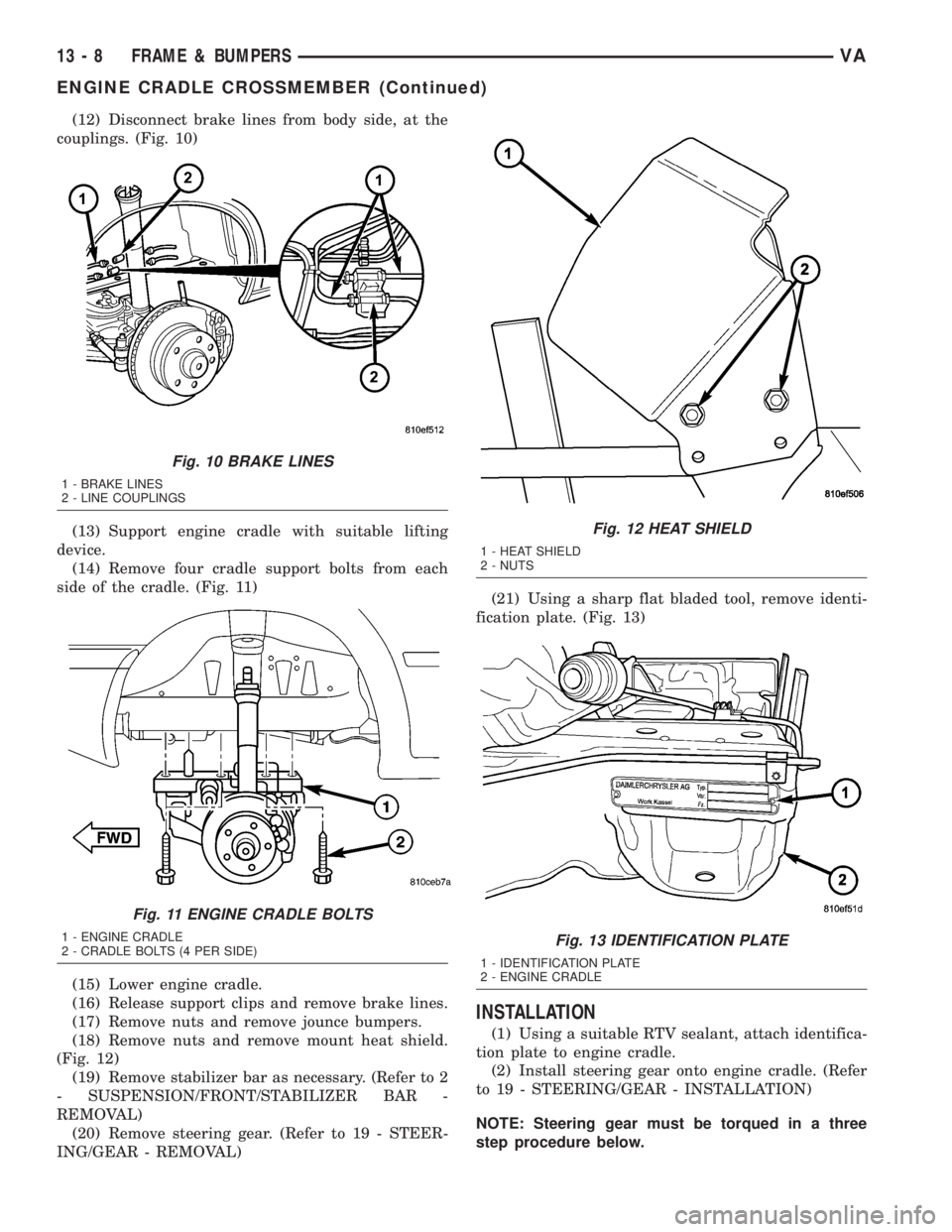
(12) Disconnect brake lines from body side, at the
couplings. (Fig. 10)
(13) Support engine cradle with suitable lifting
device.
(14) Remove four cradle support bolts from each
side of the cradle. (Fig. 11)
(15) Lower engine cradle.
(16) Release support clips and remove brake lines.
(17) Remove nuts and remove jounce bumpers.
(18) Remove nuts and remove mount heat shield.
(Fig. 12)
(19) Remove stabilizer bar as necessary. (Refer to 2
- SUSPENSION/FRONT/STABILIZER BAR -
REMOVAL)
(20) Remove steering gear. (Refer to 19 - STEER-
ING/GEAR - REMOVAL)(21) Using a sharp flat bladed tool, remove identi-
fication plate. (Fig. 13)
INSTALLATION
(1) Using a suitable RTV sealant, attach identifica-
tion plate to engine cradle.
(2) Install steering gear onto engine cradle. (Refer
to 19 - STEERING/GEAR - INSTALLATION)
NOTE: Steering gear must be torqued in a three
step procedure below.
Fig. 10 BRAKE LINES
1 - BRAKE LINES
2 - LINE COUPLINGS
Fig. 11 ENGINE CRADLE BOLTS
1 - ENGINE CRADLE
2 - CRADLE BOLTS (4 PER SIDE)
Fig. 12 HEAT SHIELD
1 - HEAT SHIELD
2 - NUTS
Fig. 13 IDENTIFICATION PLATE
1 - IDENTIFICATION PLATE
2 - ENGINE CRADLE
13 - 8 FRAME & BUMPERSVA
ENGINE CRADLE CROSSMEMBER (Continued)
Page 827 of 1232
(3) Tighten steering gear bolts in three stages as
follows.
1. Tighten to 25 N´m (18 ft. lbs.)
2. Then tighten to 45 N´m (33 ft. lbs.)
3. Then tighten bolts an additional 90É.
(4) Install stabilizer bar. (Refer to 2 - SUSPEN-
SION/FRONT/STABILIZER BAR - INSTALLATION)
(5) Install heat shield and nuts.
(6) Install jounce bumpers and install nuts.
(7) Install support clips and brake lines.
(8) Raise engine cradle into place and install bolts.
(9) Tighten bolts to 125 N´m (92 ft. lbs.).
(10) Connect brake lines at couplings and tighten
to 14 N´m (10 ft. lbs.).
(11) Position power steering hose and install sup-
port bracket bolt.
(12) Install both power steering hoses at steering
gear. (Refer to 19 - STEERING/PUMP/HOSES -
INSTALLATION)
(13) Connect steering shaft to gear and install the
lower pinch bolt.
(14) Tighten lower pinch bolt to 24 N´m (18 ft.
lbs.).
(15) Install new tie straps holding transmission
harness to cradle.
(16) Install front spring. (Refer to 2 - SUSPEN-
SION/FRONT/SPRING - INSTALLATION)
(17) Install engine mount nuts and tighten to 45
N´m (33 ft. lbs.).
(18) Install calipers. (Refer to 5 - BRAKES/HY-
DRAULIC/MECHANICAL/DISC BRAKE CALIPERS
- INSTALLATION)
(19) Install new tie straps holding wheel speed
sensors and brake pad wear sensors wire harness to
cradle.
(20) Check and align vehicle to specifications.
(Refer to 2 - SUSPENSION/WHEEL ALIGNMENT -
STANDARD PROCEDURE)
REAR CROSSMEMBER -
TRANSMISSION
REMOVAL
(1) Raise and support the vehicle. (Refer to
LUBRICATION & MAINTENANCE/HOISTING -
STANDARD PROCEDURE)
(2) Support transmission with a suitable lifting
device.
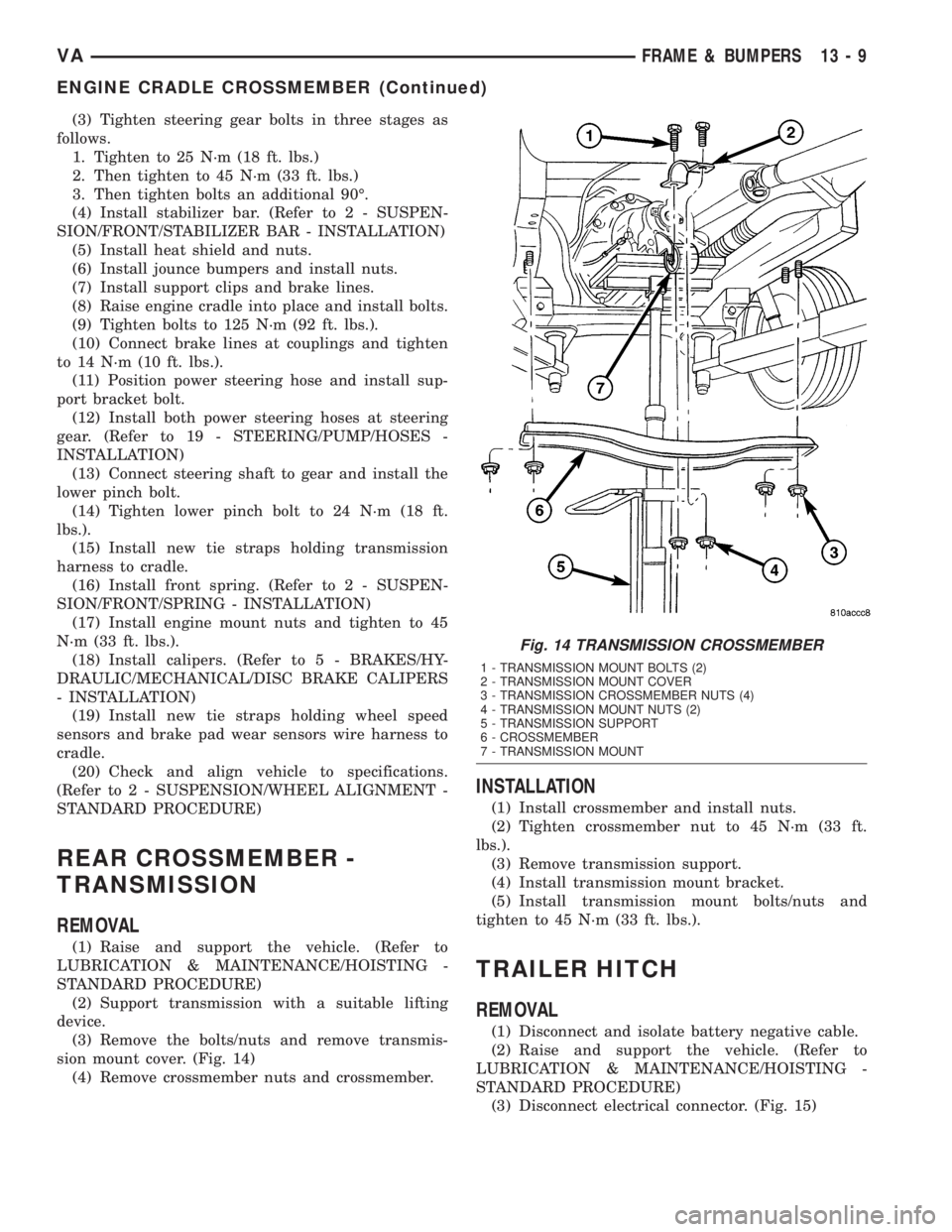
(3) Remove the bolts/nuts and remove transmis-
sion mount cover. (Fig. 14)
(4) Remove crossmember nuts and crossmember.
INSTALLATION
(1) Install crossmember and install nuts.
(2) Tighten crossmember nut to 45 N´m (33 ft.
lbs.).
(3) Remove transmission support.
(4) Install transmission mount bracket.
(5) Install transmission mount bolts/nuts and
tighten to 45 N´m (33 ft. lbs.).
TRAILER HITCH
REMOVAL
(1) Disconnect and isolate battery negative cable.
(2) Raise and support the vehicle. (Refer to
LUBRICATION & MAINTENANCE/HOISTING -
STANDARD PROCEDURE)
(3) Disconnect electrical connector. (Fig. 15)
Fig. 14 TRANSMISSION CROSSMEMBER
1 - TRANSMISSION MOUNT BOLTS (2)
2 - TRANSMISSION MOUNT COVER
3 - TRANSMISSION CROSSMEMBER NUTS (4)
4 - TRANSMISSION MOUNT NUTS (2)
5 - TRANSMISSION SUPPORT
6 - CROSSMEMBER
7 - TRANSMISSION MOUNT
VAFRAME & BUMPERS 13 - 9
ENGINE CRADLE CROSSMEMBER (Continued)
Page 829 of 1232
FUEL SYSTEM
TABLE OF CONTENTS
page page
FUEL SYSTEM
WARNING
WARNING - HIGH FUEL SYSTEM
PRESSURE...........................1
WARNING............................1
DIAGNOSIS AND TESTING
DIAGNOSIS AND TESTING - HIGH
PRESSURE FUEL LINES.................1
DIAGNOSIS AND TESTING - AIR IN FUEL
SYSTEM.............................2
STANDARD PROCEDURE
STANDARD PROCEDURES - CLEANING
FUEL SYSTEM COMPONENTS............2STANDARD PROCEDURE -
DISCONNECTING AND CONNECTING
FUEL LINES..........................2
STANDARD PROCEDURES - DRAINING
WATER FROM FUEL FILTER..............2
STANDARD PROCEDURE - LOW
PRESSURE FUEL PUMP TEST............3
FUEL DELIVERY..........................4
FUEL INJECTION........................17
FUEL SYSTEM
WARNING
WARNING - HIGH FUEL SYSTEM PRESSURE
WARNING: HIGH-PRESSURE FUEL LINES DELIVER
FUEL UNDER EXTREME PRESSURE FROM THE
INJECTION PUMP TO THE INJECTORS. THIS
MAYBE AS HIGH AS 1600BAR (23,200PSI). USE
EXTREME CAUTION WHEN INSPECTING FOR HIGH-
PRESSURE FUEL LEAKS. FUEL UNDER THIS
AMOUNT OF PRESSURE CAN PENETRATE SKIN
CAUSING PERSONAL INJURY OR DEATH. INSPECT
HIGH-PRESSURE FUEL LEAKS WITH A SHEET OF
CARDBOARD. WEAR SAFETY GOGGLES AND ADE-
QUATE PROTECTIVE CLOTHING WHEN SERVICING
FUEL SYSTEM.
WARNING
WARNING: UNDER NO CIRCUMSTANCES SHOULD
GASOLINE BE MIXED WITH DIESEL FUEL (NOT
EVEN DURING WINTER). THE HIGH PRESSURE
PUMP IS LUBRICATED BY DIESEL FUEL. IMMEDI-
ATE FUEL SYSTEM DAMAGE MAY OCCUR CAUS-
ING REPLACEMENT AND FLUSHING OF THE
COMPLETE DIESEL FUEL SYSTEM. HIGH PRES-
SURE PUMP SEIZURE WILL CAUSE METAL PARTI-
CLES TO SPREAD THROUGH OUT THE FUEL
CIRCUIT. ALL CDI FUEL SYSTEM COMPONENTS
CONNECTED TO THE FUEL CIRCUIT WILL HAVE TO
BE EXCHANGED AND THE LINES FLUSHED.
DIAGNOSIS AND TESTING
DIAGNOSIS AND TESTING - HIGH PRESSURE
FUEL LINES
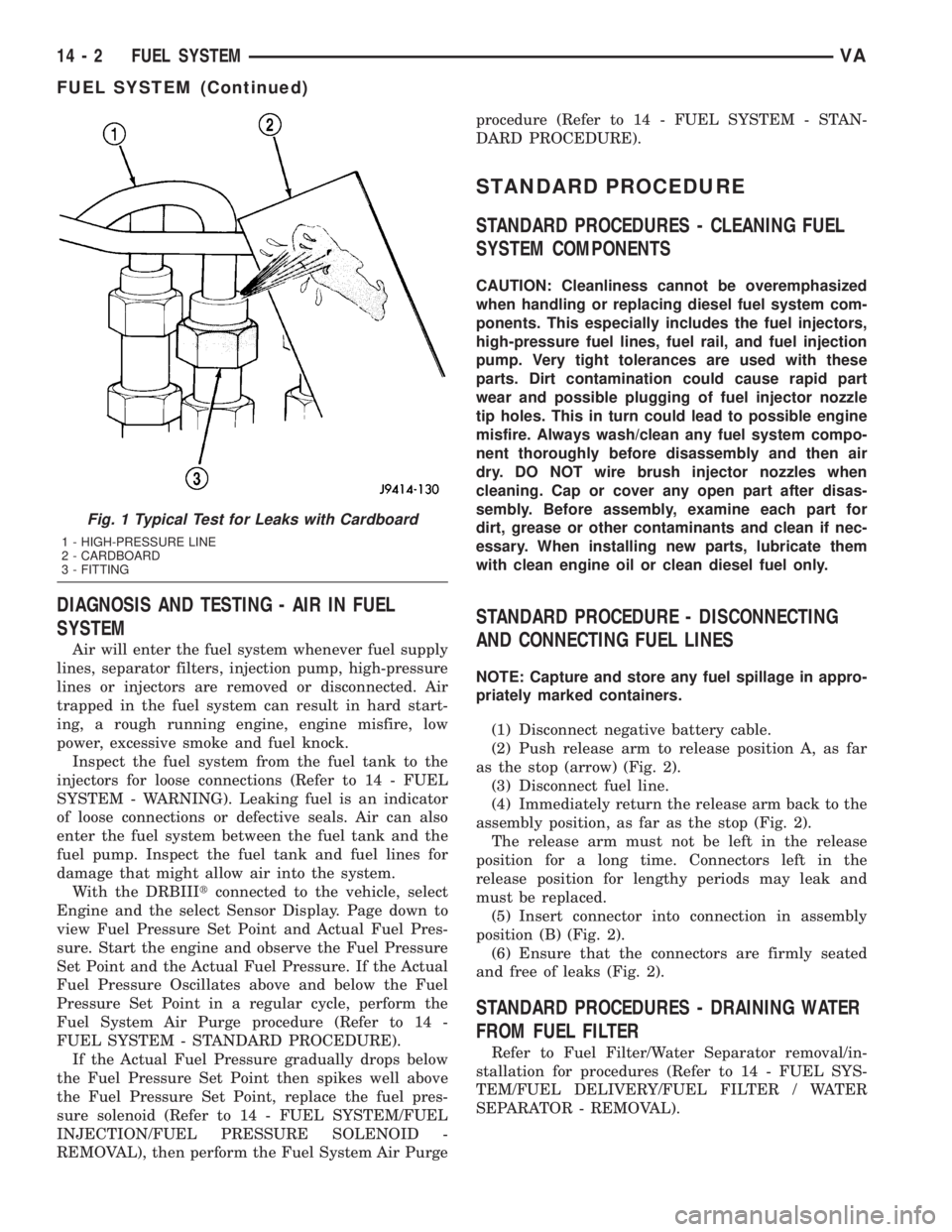
(Refer to 14 - FUEL SYSTEM - WARNING). High-
pressure fuel line leaks can cause starting problems
and poor engine performance.
WARNING: DUE TO EXTREME FUEL PRESSURES,
USE EXTREME CAUTION WHEN INSPECTING FOR
HIGH-PRESSURE FUEL LEAKS. DO NOT GET YOUR
HAND NEAR A SUSPECTED LEAK. INSPECT FOR
HIGH-PRESSURE FUEL LEAKS WITH A SHEET OF
CARDBOARD. HIGH FUEL INJECTION PRESSURE
CAN CAUSE PERSONAL INJURY IF CONTACT IS
MADE WITH THE SKIN.
Start the engine. Move the cardboard over the
high-pressure fuel lines and check for fuel spray onto
the cardboard (Fig. 1). If a high-pressure line connec-
tion is leaking, tighten the connection and perform
the Fuel System Air Purge procedure (Refer to 14 -
FUEL SYSTEM - STANDARD PROCEDURE).
Replace damaged, restricted or leaking high-pressure
fuel lines with the correct replacement line.
CAUTION: The high-pressure fuel lines cannot con-
tact each other or other components. Do not
attempt to weld high-pressure fuel lines or to repair
lines that are damaged. Only use the recommended
lines when replacement of high-pressure fuel line is
necessary.
VAFUEL SYSTEM 14 - 1
Page 830 of 1232
DIAGNOSIS AND TESTING - AIR IN FUEL
SYSTEM
Air will enter the fuel system whenever fuel supply
lines, separator filters, injection pump, high-pressure
lines or injectors are removed or disconnected. Air
trapped in the fuel system can result in hard start-
ing, a rough running engine, engine misfire, low
power, excessive smoke and fuel knock.
Inspect the fuel system from the fuel tank to the
injectors for loose connections (Refer to 14 - FUEL
SYSTEM - WARNING). Leaking fuel is an indicator
of loose connections or defective seals. Air can also
enter the fuel system between the fuel tank and the
fuel pump. Inspect the fuel tank and fuel lines for
damage that might allow air into the system.
With the DRBIIItconnected to the vehicle, select
Engine and the select Sensor Display. Page down to
view Fuel Pressure Set Point and Actual Fuel Pres-
sure. Start the engine and observe the Fuel Pressure
Set Point and the Actual Fuel Pressure. If the Actual
Fuel Pressure Oscillates above and below the Fuel
Pressure Set Point in a regular cycle, perform the
Fuel System Air Purge procedure (Refer to 14 -
FUEL SYSTEM - STANDARD PROCEDURE).
If the Actual Fuel Pressure gradually drops below
the Fuel Pressure Set Point then spikes well above
the Fuel Pressure Set Point, replace the fuel pres-
sure solenoid (Refer to 14 - FUEL SYSTEM/FUEL
INJECTION/FUEL PRESSURE SOLENOID -
REMOVAL), then perform the Fuel System Air Purgeprocedure (Refer to 14 - FUEL SYSTEM - STAN-
DARD PROCEDURE).
STANDARD PROCEDURE
STANDARD PROCEDURES - CLEANING FUEL
SYSTEM COMPONENTS
CAUTION: Cleanliness cannot be overemphasized
when handling or replacing diesel fuel system com-
ponents. This especially includes the fuel injectors,
high-pressure fuel lines, fuel rail, and fuel injection
pump. Very tight tolerances are used with these
parts. Dirt contamination could cause rapid part
wear and possible plugging of fuel injector nozzle
tip holes. This in turn could lead to possible engine
misfire. Always wash/clean any fuel system compo-
nent thoroughly before disassembly and then air
dry. DO NOT wire brush injector nozzles when
cleaning. Cap or cover any open part after disas-
sembly. Before assembly, examine each part for
dirt, grease or other contaminants and clean if nec-
essary. When installing new parts, lubricate them
with clean engine oil or clean diesel fuel only.
STANDARD PROCEDURE - DISCONNECTING
AND CONNECTING FUEL LINES
NOTE: Capture and store any fuel spillage in appro-
priately marked containers.
(1) Disconnect negative battery cable.
(2) Push release arm to release position A, as far
as the stop (arrow) (Fig. 2).
(3) Disconnect fuel line.
(4) Immediately return the release arm back to the
assembly position, as far as the stop (Fig. 2).
The release arm must not be left in the release
position for a long time. Connectors left in the
release position for lengthy periods may leak and
must be replaced.
(5) Insert connector into connection in assembly
position (B) (Fig. 2).
(6) Ensure that the connectors are firmly seated
and free of leaks (Fig. 2).
STANDARD PROCEDURES - DRAINING WATER
FROM FUEL FILTER
Refer to Fuel Filter/Water Separator removal/in-
stallation for procedures (Refer to 14 - FUEL SYS-
TEM/FUEL DELIVERY/FUEL FILTER / WATER
SEPARATOR - REMOVAL).
Fig. 1 Typical Test for Leaks with Cardboard
1 - HIGH-PRESSURE LINE
2 - CARDBOARD
3 - FITTING
14 - 2 FUEL SYSTEMVA
FUEL SYSTEM (Continued)
Page 831 of 1232
STANDARD PROCEDURE - LOW PRESSURE
FUEL PUMP TEST
NOTE: Assure fuel tank quantity and proper fuel
gauge operation. Capture any fuel spillage and
store in appropriately marked containers.
(1) Disconnect the negative battery cable.
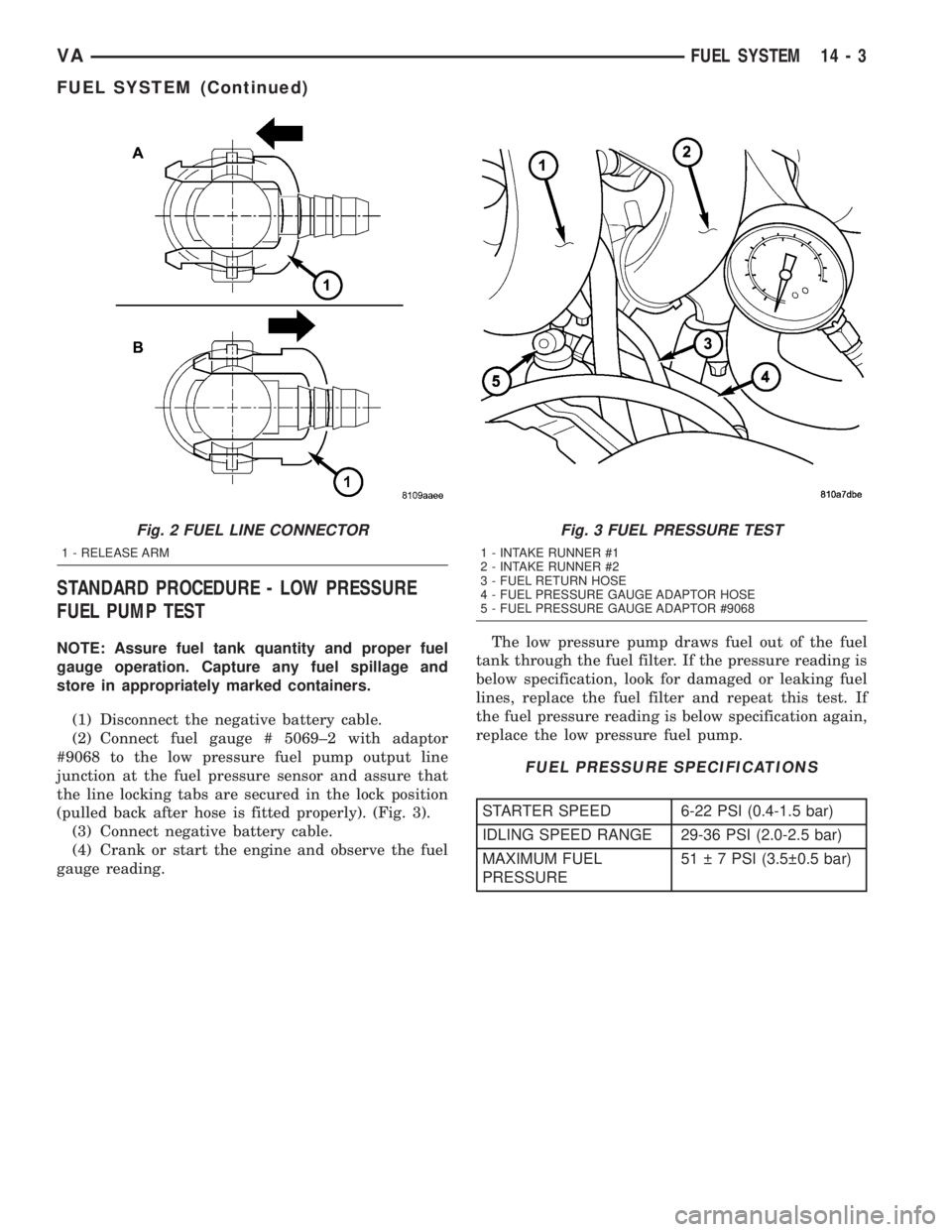
(2) Connect fuel gauge # 5069±2 with adaptor
#9068 to the low pressure fuel pump output line
junction at the fuel pressure sensor and assure that
the line locking tabs are secured in the lock position
(pulled back after hose is fitted properly). (Fig. 3).
(3) Connect negative battery cable.
(4) Crank or start the engine and observe the fuel
gauge reading.The low pressure pump draws fuel out of the fuel
tank through the fuel filter. If the pressure reading is
below specification, look for damaged or leaking fuel
lines, replace the fuel filter and repeat this test. If
the fuel pressure reading is below specification again,
replace the low pressure fuel pump.
FUEL PRESSURE SPECIFICATIONS
STARTER SPEED 6-22 PSI (0.4-1.5 bar)
IDLING SPEED RANGE 29-36 PSI (2.0-2.5 bar)
MAXIMUM FUEL
PRESSURE51 7 PSI (3.5 0.5 bar)
Fig. 2 FUEL LINE CONNECTOR
1 - RELEASE ARM
Fig. 3 FUEL PRESSURE TEST
1 - INTAKE RUNNER #1
2 - INTAKE RUNNER #2
3 - FUEL RETURN HOSE
4 - FUEL PRESSURE GAUGE ADAPTOR HOSE
5 - FUEL PRESSURE GAUGE ADAPTOR #9068
VAFUEL SYSTEM 14 - 3
FUEL SYSTEM (Continued)
Page 833 of 1232
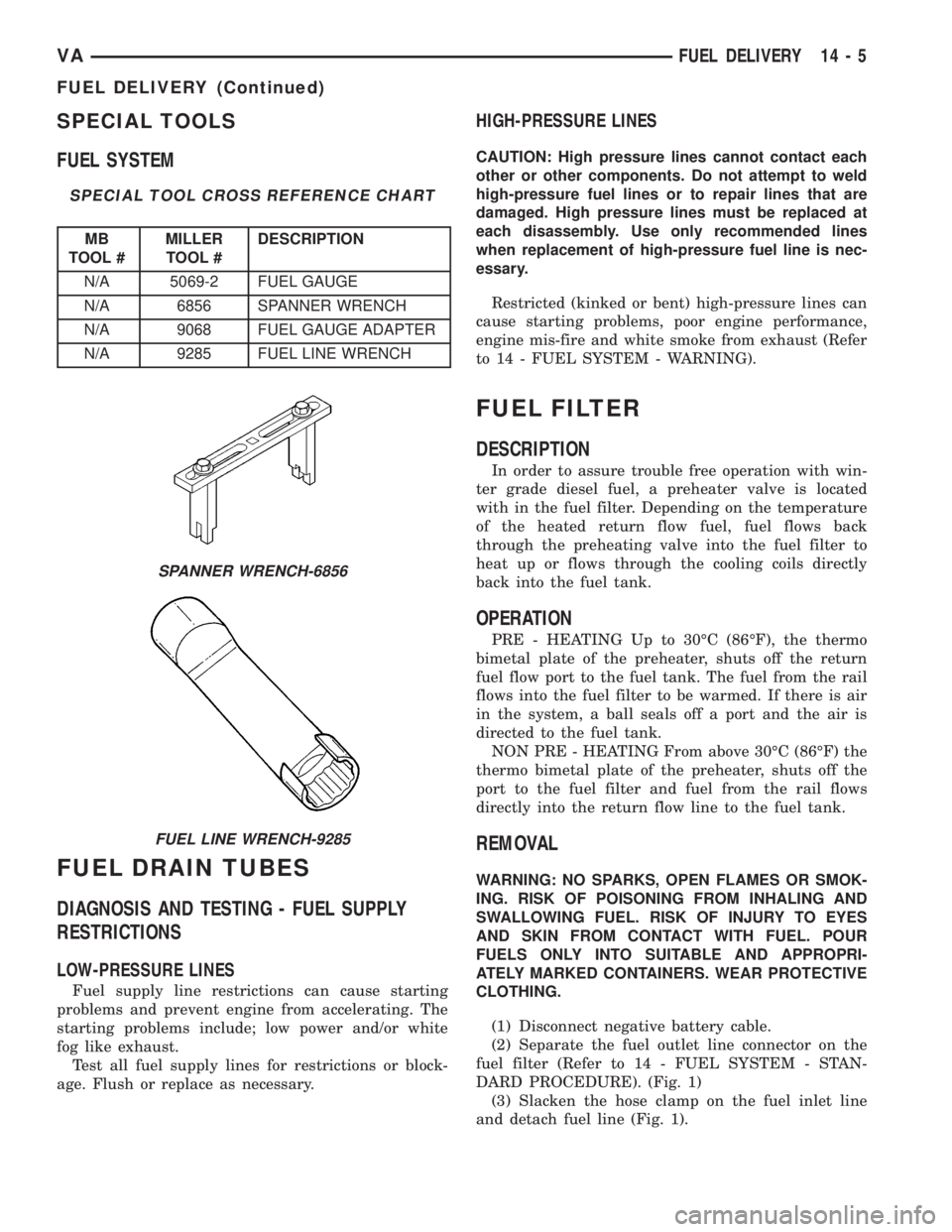
SPECIAL TOOLS
FUEL SYSTEM
SPECIAL TOOL CROSS REFERENCE CHART
MB
TOOL #MILLER
TOOL #DESCRIPTION
N/A 5069-2 FUEL GAUGE
N/A 6856 SPANNER WRENCH
N/A 9068 FUEL GAUGE ADAPTER
N/A 9285 FUEL LINE WRENCH
FUEL DRAIN TUBES
DIAGNOSIS AND TESTING - FUEL SUPPLY
RESTRICTIONS
LOW-PRESSURE LINES
Fuel supply line restrictions can cause starting
problems and prevent engine from accelerating. The
starting problems include; low power and/or white
fog like exhaust.
Test all fuel supply lines for restrictions or block-
age. Flush or replace as necessary.
HIGH-PRESSURE LINES
CAUTION: High pressure lines cannot contact each
other or other components. Do not attempt to weld
high-pressure fuel lines or to repair lines that are
damaged. High pressure lines must be replaced at
each disassembly. Use only recommended lines
when replacement of high-pressure fuel line is nec-
essary.
Restricted (kinked or bent) high-pressure lines can
cause starting problems, poor engine performance,
engine mis-fire and white smoke from exhaust (Refer
to 14 - FUEL SYSTEM - WARNING).
FUEL FILTER
DESCRIPTION
In order to assure trouble free operation with win-
ter grade diesel fuel, a preheater valve is located
with in the fuel filter. Depending on the temperature
of the heated return flow fuel, fuel flows back
through the preheating valve into the fuel filter to
heat up or flows through the cooling coils directly
back into the fuel tank.
OPERATION
PRE - HEATING Up to 30ÉC (86ÉF), the thermo
bimetal plate of the preheater, shuts off the return
fuel flow port to the fuel tank. The fuel from the rail
flows into the fuel filter to be warmed. If there is air
in the system, a ball seals off a port and the air is
directed to the fuel tank.
NON PRE - HEATING From above 30ÉC (86ÉF) the
thermo bimetal plate of the preheater, shuts off the
port to the fuel filter and fuel from the rail flows
directly into the return flow line to the fuel tank.
REMOVAL
WARNING: NO SPARKS, OPEN FLAMES OR SMOK-
ING. RISK OF POISONING FROM INHALING AND
SWALLOWING FUEL. RISK OF INJURY TO EYES
AND SKIN FROM CONTACT WITH FUEL. POUR
FUELS ONLY INTO SUITABLE AND APPROPRI-
ATELY MARKED CONTAINERS. WEAR PROTECTIVE
CLOTHING.
(1) Disconnect negative battery cable.
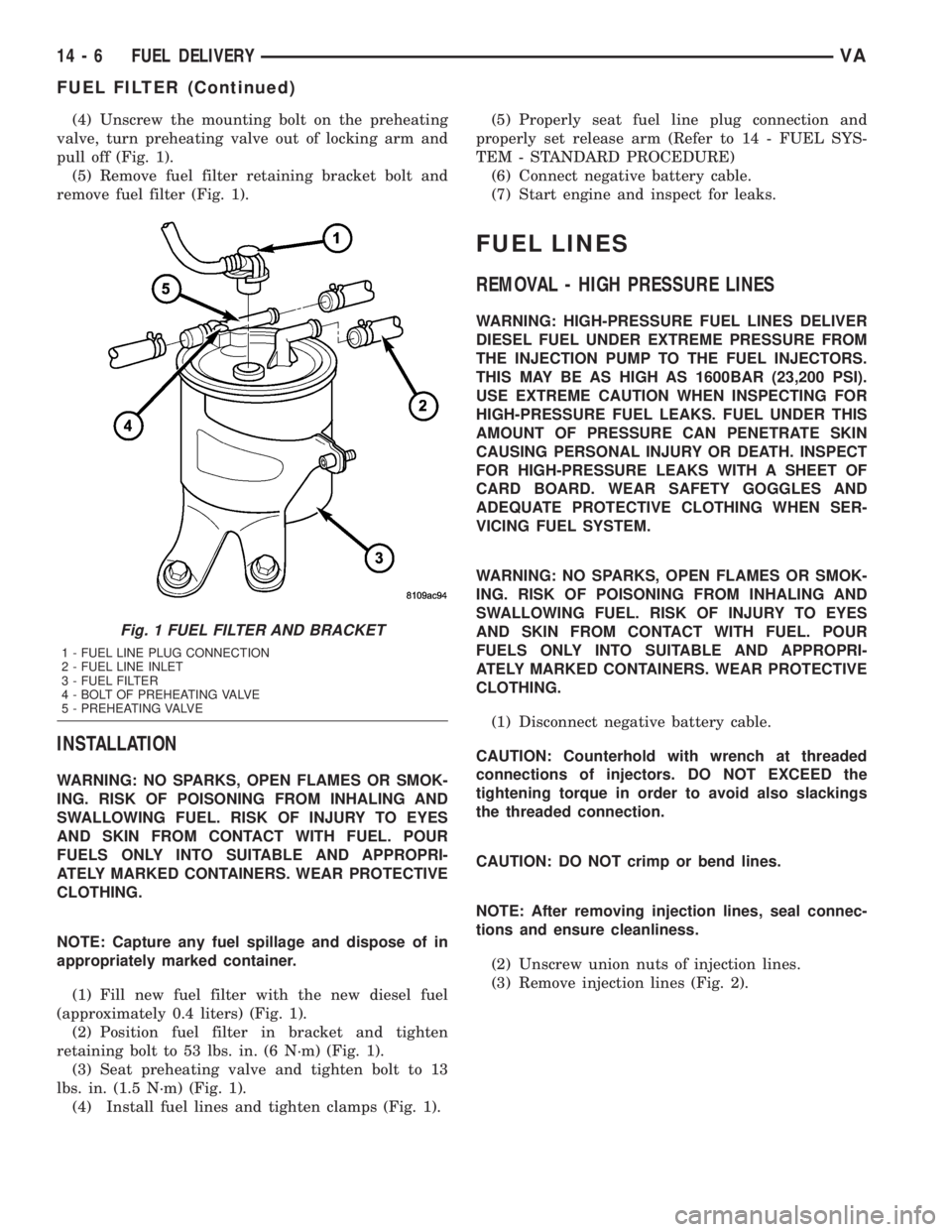
(2) Separate the fuel outlet line connector on the
fuel filter (Refer to 14 - FUEL SYSTEM - STAN-
DARD PROCEDURE). (Fig. 1)
(3) Slacken the hose clamp on the fuel inlet line
and detach fuel line (Fig. 1).
SPANNER WRENCH-6856
FUEL LINE WRENCH-9285
VAFUEL DELIVERY 14 - 5
FUEL DELIVERY (Continued)
Page 834 of 1232
(4) Unscrew the mounting bolt on the preheating
valve, turn preheating valve out of locking arm and
pull off (Fig. 1).
(5) Remove fuel filter retaining bracket bolt and
remove fuel filter (Fig. 1).
INSTALLATION
WARNING: NO SPARKS, OPEN FLAMES OR SMOK-
ING. RISK OF POISONING FROM INHALING AND
SWALLOWING FUEL. RISK OF INJURY TO EYES
AND SKIN FROM CONTACT WITH FUEL. POUR
FUELS ONLY INTO SUITABLE AND APPROPRI-
ATELY MARKED CONTAINERS. WEAR PROTECTIVE
CLOTHING.
NOTE: Capture any fuel spillage and dispose of in
appropriately marked container.
(1) Fill new fuel filter with the new diesel fuel
(approximately 0.4 liters) (Fig. 1).
(2) Position fuel filter in bracket and tighten
retaining bolt to 53 lbs. in. (6 N´m) (Fig. 1).
(3) Seat preheating valve and tighten bolt to 13
lbs. in. (1.5 N´m) (Fig. 1).
(4) Install fuel lines and tighten clamps (Fig. 1).(5) Properly seat fuel line plug connection and
properly set release arm (Refer to 14 - FUEL SYS-
TEM - STANDARD PROCEDURE)
(6) Connect negative battery cable.
(7) Start engine and inspect for leaks.
FUEL LINES
REMOVAL - HIGH PRESSURE LINES
WARNING: HIGH-PRESSURE FUEL LINES DELIVER
DIESEL FUEL UNDER EXTREME PRESSURE FROM
THE INJECTION PUMP TO THE FUEL INJECTORS.
THIS MAY BE AS HIGH AS 1600BAR (23,200 PSI).
USE EXTREME CAUTION WHEN INSPECTING FOR
HIGH-PRESSURE FUEL LEAKS. FUEL UNDER THIS
AMOUNT OF PRESSURE CAN PENETRATE SKIN
CAUSING PERSONAL INJURY OR DEATH. INSPECT
FOR HIGH-PRESSURE LEAKS WITH A SHEET OF
CARD BOARD. WEAR SAFETY GOGGLES AND
ADEQUATE PROTECTIVE CLOTHING WHEN SER-
VICING FUEL SYSTEM.
WARNING: NO SPARKS, OPEN FLAMES OR SMOK-
ING. RISK OF POISONING FROM INHALING AND
SWALLOWING FUEL. RISK OF INJURY TO EYES
AND SKIN FROM CONTACT WITH FUEL. POUR
FUELS ONLY INTO SUITABLE AND APPROPRI-
ATELY MARKED CONTAINERS. WEAR PROTECTIVE
CLOTHING.
(1) Disconnect negative battery cable.
CAUTION: Counterhold with wrench at threaded
connections of injectors. DO NOT EXCEED the
tightening torque in order to avoid also slackings
the threaded connection.
CAUTION: DO NOT crimp or bend lines.
NOTE: After removing injection lines, seal connec-
tions and ensure cleanliness.
(2) Unscrew union nuts of injection lines.
(3) Remove injection lines (Fig. 2).
Fig. 1 FUEL FILTER AND BRACKET
1 - FUEL LINE PLUG CONNECTION
2 - FUEL LINE INLET
3 - FUEL FILTER
4 - BOLT OF PREHEATING VALVE
5 - PREHEATING VALVE
14 - 6 FUEL DELIVERYVA
FUEL FILTER (Continued)
Page 835 of 1232
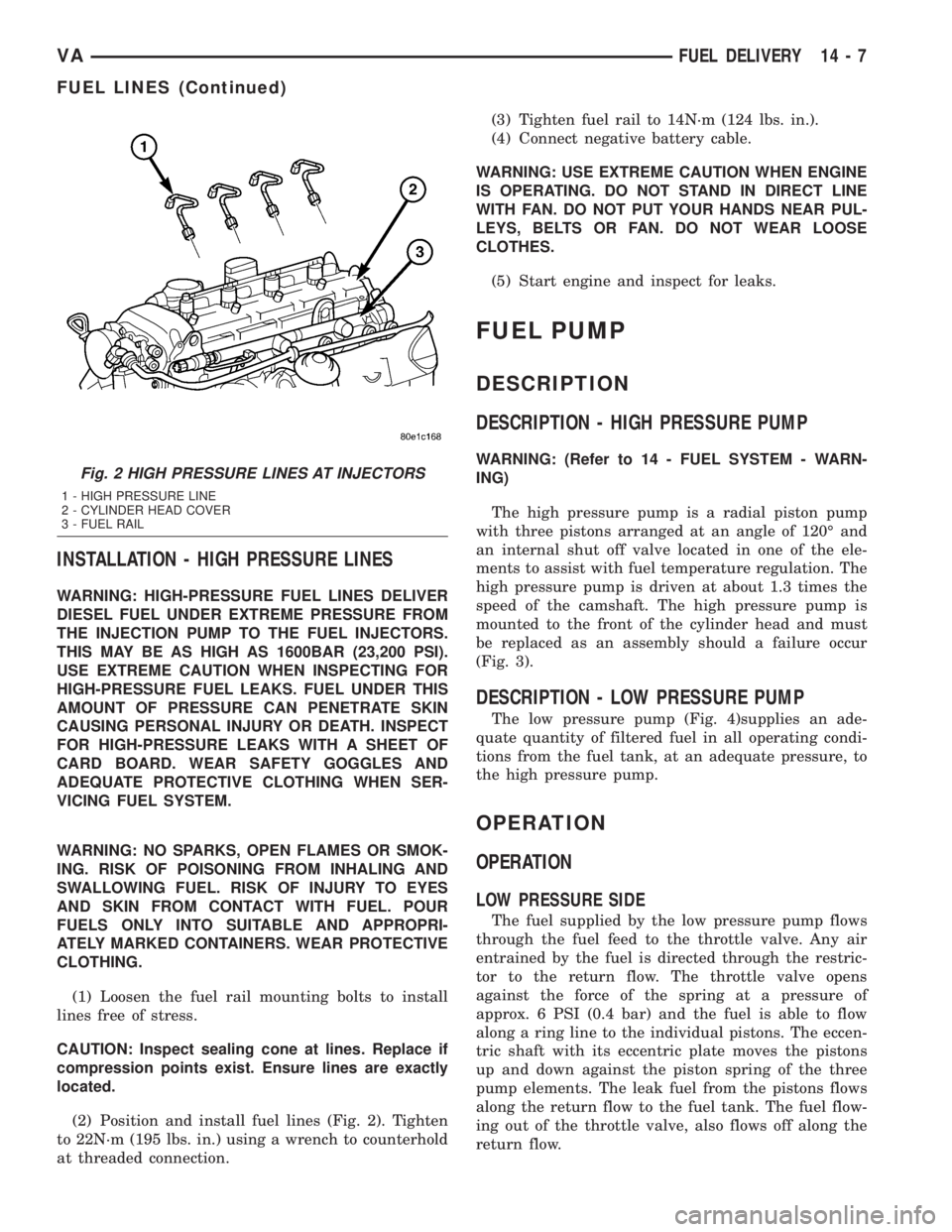
INSTALLATION - HIGH PRESSURE LINES
WARNING: HIGH-PRESSURE FUEL LINES DELIVER
DIESEL FUEL UNDER EXTREME PRESSURE FROM
THE INJECTION PUMP TO THE FUEL INJECTORS.
THIS MAY BE AS HIGH AS 1600BAR (23,200 PSI).
USE EXTREME CAUTION WHEN INSPECTING FOR
HIGH-PRESSURE FUEL LEAKS. FUEL UNDER THIS
AMOUNT OF PRESSURE CAN PENETRATE SKIN
CAUSING PERSONAL INJURY OR DEATH. INSPECT
FOR HIGH-PRESSURE LEAKS WITH A SHEET OF
CARD BOARD. WEAR SAFETY GOGGLES AND
ADEQUATE PROTECTIVE CLOTHING WHEN SER-
VICING FUEL SYSTEM.
WARNING: NO SPARKS, OPEN FLAMES OR SMOK-
ING. RISK OF POISONING FROM INHALING AND
SWALLOWING FUEL. RISK OF INJURY TO EYES
AND SKIN FROM CONTACT WITH FUEL. POUR
FUELS ONLY INTO SUITABLE AND APPROPRI-
ATELY MARKED CONTAINERS. WEAR PROTECTIVE
CLOTHING.
(1) Loosen the fuel rail mounting bolts to install
lines free of stress.
CAUTION: Inspect sealing cone at lines. Replace if
compression points exist. Ensure lines are exactly
located.
(2) Position and install fuel lines (Fig. 2). Tighten
to 22N´m (195 lbs. in.) using a wrench to counterhold
at threaded connection.(3) Tighten fuel rail to 14N´m (124 lbs. in.).
(4) Connect negative battery cable.
WARNING: USE EXTREME CAUTION WHEN ENGINE
IS OPERATING. DO NOT STAND IN DIRECT LINE
WITH FAN. DO NOT PUT YOUR HANDS NEAR PUL-
LEYS, BELTS OR FAN. DO NOT WEAR LOOSE
CLOTHES.
(5) Start engine and inspect for leaks.
FUEL PUMP
DESCRIPTION
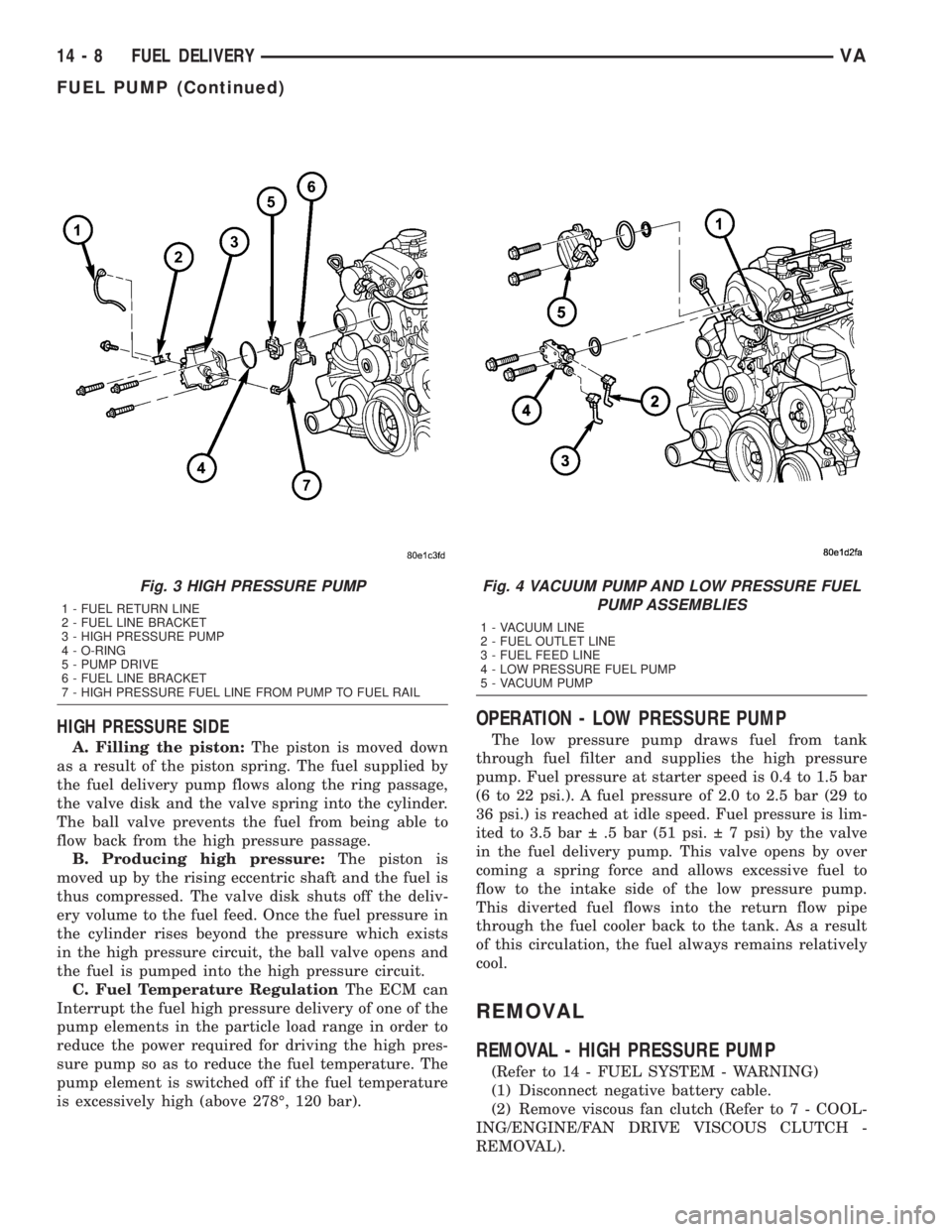
DESCRIPTION - HIGH PRESSURE PUMP
WARNING: (Refer to 14 - FUEL SYSTEM - WARN-
ING)
The high pressure pump is a radial piston pump
with three pistons arranged at an angle of 120É and
an internal shut off valve located in one of the ele-
ments to assist with fuel temperature regulation. The
high pressure pump is driven at about 1.3 times the
speed of the camshaft. The high pressure pump is
mounted to the front of the cylinder head and must
be replaced as an assembly should a failure occur
(Fig. 3).
DESCRIPTION - LOW PRESSURE PUMP
The low pressure pump (Fig. 4)supplies an ade-
quate quantity of filtered fuel in all operating condi-
tions from the fuel tank, at an adequate pressure, to
the high pressure pump.
OPERATION
OPERATION
LOW PRESSURE SIDE
The fuel supplied by the low pressure pump flows
through the fuel feed to the throttle valve. Any air
entrained by the fuel is directed through the restric-
tor to the return flow. The throttle valve opens
against the force of the spring at a pressure of
approx. 6 PSI (0.4 bar) and the fuel is able to flow
along a ring line to the individual pistons. The eccen-
tric shaft with its eccentric plate moves the pistons
up and down against the piston spring of the three
pump elements. The leak fuel from the pistons flows
along the return flow to the fuel tank. The fuel flow-
ing out of the throttle valve, also flows off along the
return flow.
Fig. 2 HIGH PRESSURE LINES AT INJECTORS
1 - HIGH PRESSURE LINE
2 - CYLINDER HEAD COVER
3 - FUEL RAIL
VAFUEL DELIVERY 14 - 7
FUEL LINES (Continued)
Page 836 of 1232
HIGH PRESSURE SIDE
A. Filling the piston:The piston is moved down
as a result of the piston spring. The fuel supplied by
the fuel delivery pump flows along the ring passage,
the valve disk and the valve spring into the cylinder.
The ball valve prevents the fuel from being able to
flow back from the high pressure passage.
B. Producing high pressure:The piston is
moved up by the rising eccentric shaft and the fuel is
thus compressed. The valve disk shuts off the deliv-
ery volume to the fuel feed. Once the fuel pressure in
the cylinder rises beyond the pressure which exists
in the high pressure circuit, the ball valve opens and
the fuel is pumped into the high pressure circuit.
C. Fuel Temperature RegulationThe ECM can
Interrupt the fuel high pressure delivery of one of the
pump elements in the particle load range in order to
reduce the power required for driving the high pres-
sure pump so as to reduce the fuel temperature. The
pump element is switched off if the fuel temperature
is excessively high (above 278É, 120 bar).
OPERATION - LOW PRESSURE PUMP
The low pressure pump draws fuel from tank
through fuel filter and supplies the high pressure
pump. Fuel pressure at starter speed is 0.4 to 1.5 bar
(6 to 22 psi.). A fuel pressure of 2.0 to 2.5 bar (29 to
36 psi.) is reached at idle speed. Fuel pressure is lim-
ited to 3.5 bar .5 bar (51 psi. 7 psi) by the valve
in the fuel delivery pump. This valve opens by over
coming a spring force and allows excessive fuel to
flow to the intake side of the low pressure pump.
This diverted fuel flows into the return flow pipe
through the fuel cooler back to the tank. As a result
of this circulation, the fuel always remains relatively
cool.
REMOVAL
REMOVAL - HIGH PRESSURE PUMP
(Refer to 14 - FUEL SYSTEM - WARNING)
(1) Disconnect negative battery cable.
(2) Remove viscous fan clutch (Refer to 7 - COOL-
ING/ENGINE/FAN DRIVE VISCOUS CLUTCH -
REMOVAL).
Fig. 3 HIGH PRESSURE PUMP
1 - FUEL RETURN LINE
2 - FUEL LINE BRACKET
3 - HIGH PRESSURE PUMP
4 - O-RING
5 - PUMP DRIVE
6 - FUEL LINE BRACKET
7 - HIGH PRESSURE FUEL LINE FROM PUMP TO FUEL RAIL
Fig. 4 VACUUM PUMP AND LOW PRESSURE FUEL
PUMP ASSEMBLIES
1 - VACUUM LINE
2 - FUEL OUTLET LINE
3 - FUEL FEED LINE
4 - LOW PRESSURE FUEL PUMP
5 - VACUUM PUMP
14 - 8 FUEL DELIVERYVA
FUEL PUMP (Continued)