engine MERCEDES-BENZ SPRINTER 2005 Service Repair Manual
[x] Cancel search | Manufacturer: MERCEDES-BENZ, Model Year: 2005, Model line: SPRINTER, Model: MERCEDES-BENZ SPRINTER 2005Pages: 1232, PDF Size: 39.23 MB
Page 837 of 1232
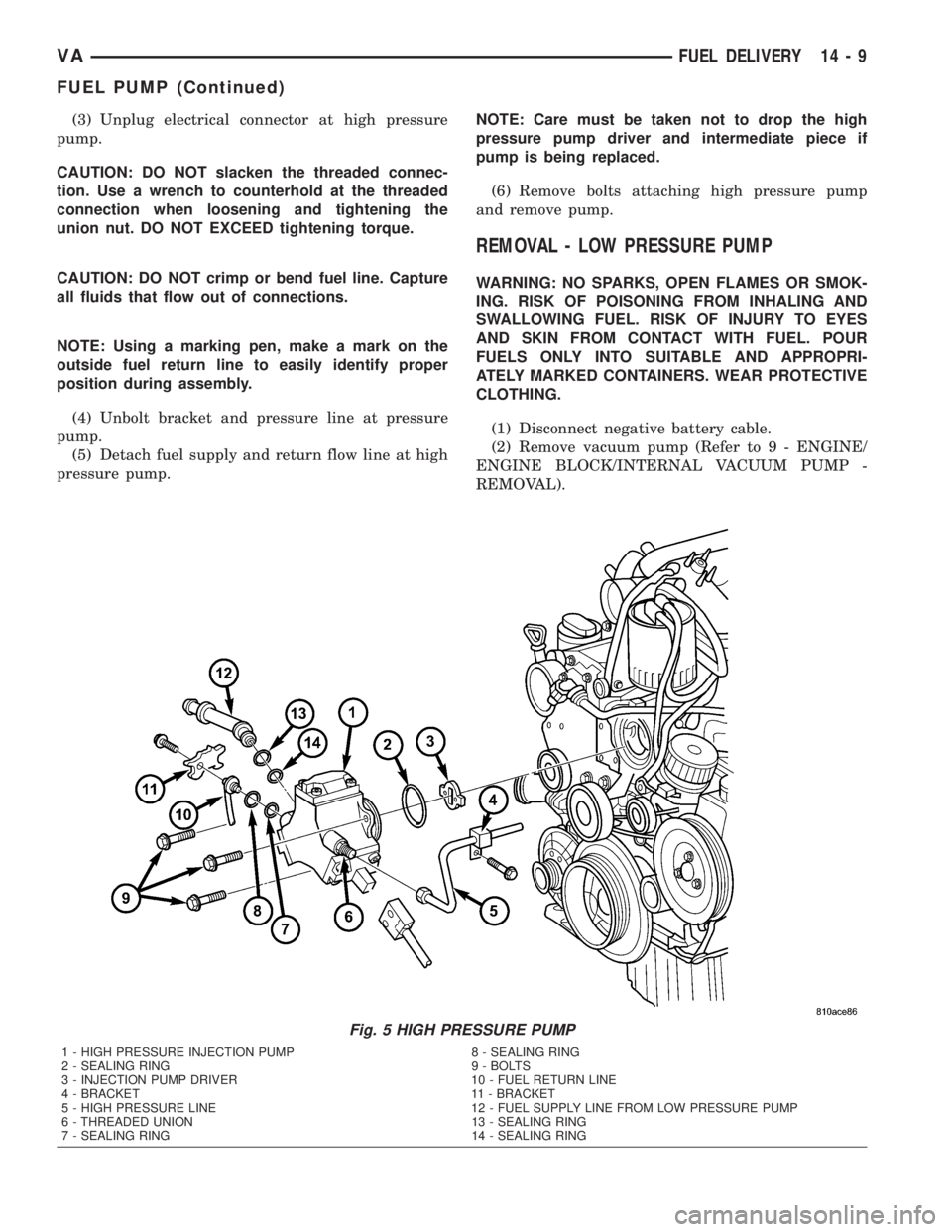
(3) Unplug electrical connector at high pressure
pump.
CAUTION: DO NOT slacken the threaded connec-
tion. Use a wrench to counterhold at the threaded
connection when loosening and tightening the
union nut. DO NOT EXCEED tightening torque.
CAUTION: DO NOT crimp or bend fuel line. Capture
all fluids that flow out of connections.
NOTE: Using a marking pen, make a mark on the
outside fuel return line to easily identify proper
position during assembly.
(4) Unbolt bracket and pressure line at pressure
pump.
(5) Detach fuel supply and return flow line at high
pressure pump.NOTE: Care must be taken not to drop the high
pressure pump driver and intermediate piece if
pump is being replaced.
(6) Remove bolts attaching high pressure pump
and remove pump.
REMOVAL - LOW PRESSURE PUMP
WARNING: NO SPARKS, OPEN FLAMES OR SMOK-
ING. RISK OF POISONING FROM INHALING AND
SWALLOWING FUEL. RISK OF INJURY TO EYES
AND SKIN FROM CONTACT WITH FUEL. POUR
FUELS ONLY INTO SUITABLE AND APPROPRI-
ATELY MARKED CONTAINERS. WEAR PROTECTIVE
CLOTHING.
(1) Disconnect negative battery cable.
(2) Remove vacuum pump (Refer to 9 - ENGINE/
ENGINE BLOCK/INTERNAL VACUUM PUMP -
REMOVAL).
Fig. 5 HIGH PRESSURE PUMP
1 - HIGH PRESSURE INJECTION PUMP 8 - SEALING RING
2 - SEALING RING 9 - BOLTS
3 - INJECTION PUMP DRIVER 10 - FUEL RETURN LINE
4 - BRACKET 11 - BRACKET
5 - HIGH PRESSURE LINE 12 - FUEL SUPPLY LINE FROM LOW PRESSURE PUMP
6 - THREADED UNION 13 - SEALING RING
7 - SEALING RING 14 - SEALING RING
VAFUEL DELIVERY 14 - 9
FUEL PUMP (Continued)
Page 838 of 1232
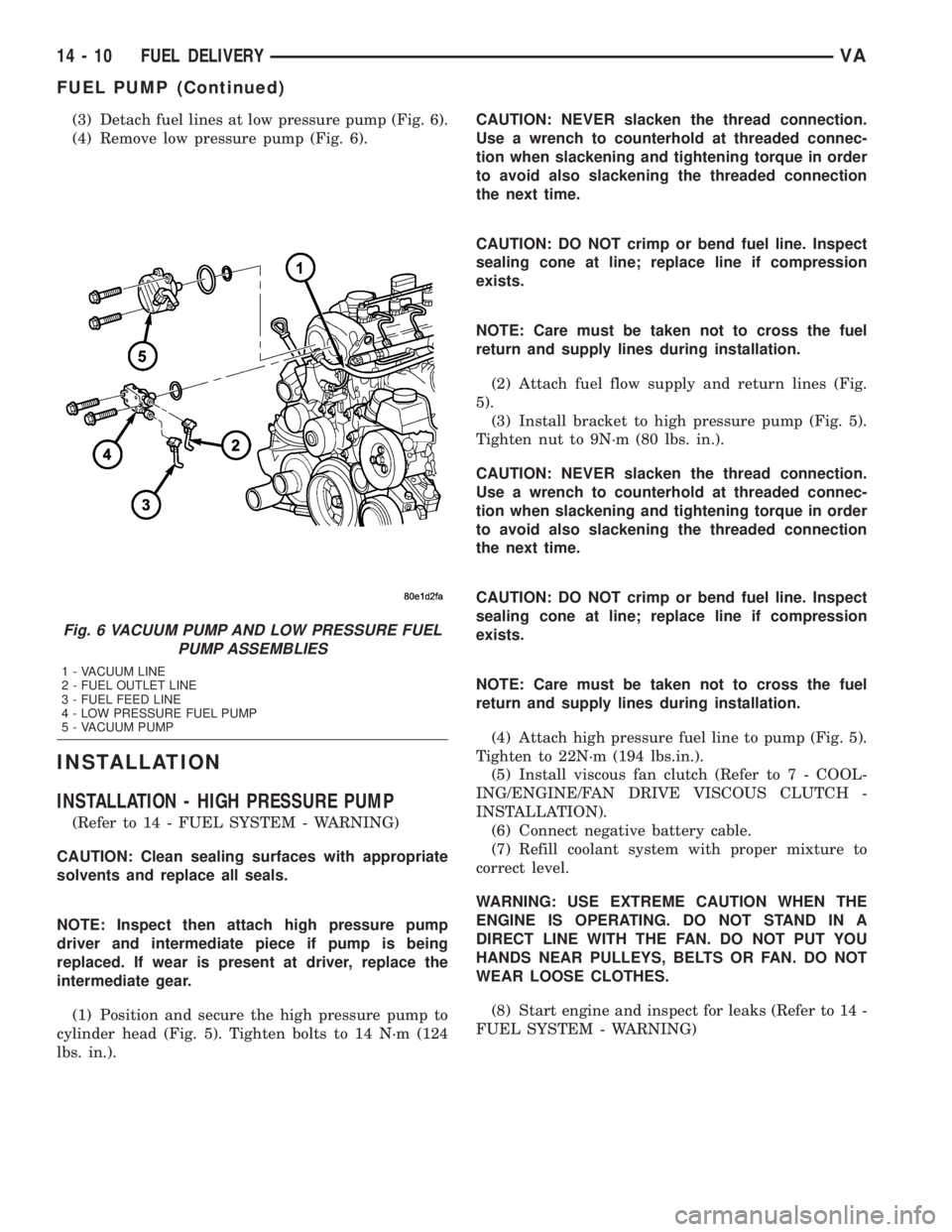
(3) Detach fuel lines at low pressure pump (Fig. 6).
(4) Remove low pressure pump (Fig. 6).
INSTALLATION
INSTALLATION - HIGH PRESSURE PUMP
(Refer to 14 - FUEL SYSTEM - WARNING)
CAUTION: Clean sealing surfaces with appropriate
solvents and replace all seals.
NOTE: Inspect then attach high pressure pump
driver and intermediate piece if pump is being
replaced. If wear is present at driver, replace the
intermediate gear.
(1) Position and secure the high pressure pump to
cylinder head (Fig. 5). Tighten bolts to 14 N´m (124
lbs. in.).CAUTION: NEVER slacken the thread connection.
Use a wrench to counterhold at threaded connec-
tion when slackening and tightening torque in order
to avoid also slackening the threaded connection
the next time.
CAUTION: DO NOT crimp or bend fuel line. Inspect
sealing cone at line; replace line if compression
exists.
NOTE: Care must be taken not to cross the fuel
return and supply lines during installation.
(2) Attach fuel flow supply and return lines (Fig.
5).
(3) Install bracket to high pressure pump (Fig. 5).
Tighten nut to 9N´m (80 lbs. in.).
CAUTION: NEVER slacken the thread connection.
Use a wrench to counterhold at threaded connec-
tion when slackening and tightening torque in order
to avoid also slackening the threaded connection
the next time.
CAUTION: DO NOT crimp or bend fuel line. Inspect
sealing cone at line; replace line if compression
exists.
NOTE: Care must be taken not to cross the fuel
return and supply lines during installation.
(4) Attach high pressure fuel line to pump (Fig. 5).
Tighten to 22N´m (194 lbs.in.).
(5) Install viscous fan clutch (Refer to 7 - COOL-
ING/ENGINE/FAN DRIVE VISCOUS CLUTCH -
INSTALLATION).
(6) Connect negative battery cable.
(7) Refill coolant system with proper mixture to
correct level.
WARNING: USE EXTREME CAUTION WHEN THE
ENGINE IS OPERATING. DO NOT STAND IN A
DIRECT LINE WITH THE FAN. DO NOT PUT YOU
HANDS NEAR PULLEYS, BELTS OR FAN. DO NOT
WEAR LOOSE CLOTHES.
(8) Start engine and inspect for leaks (Refer to 14 -
FUEL SYSTEM - WARNING)
Fig. 6 VACUUM PUMP AND LOW PRESSURE FUEL
PUMP ASSEMBLIES
1 - VACUUM LINE
2 - FUEL OUTLET LINE
3 - FUEL FEED LINE
4 - LOW PRESSURE FUEL PUMP
5 - VACUUM PUMP
14 - 10 FUEL DELIVERYVA
FUEL PUMP (Continued)
Page 839 of 1232
INSTALLATION - LOW PRESSURE PUMP
WARNING: NO SPARKS, OPEN FLAMES OR SMOK-
ING. RISK OF POISONING FROM INHALING AND
SWALLOWING FUEL. RISK OF INJURY TO EYES
AND SKIN FROM CONTACT WITH FUEL. POUR
FUELS ONLY INTO SUITABLE AND APPROPRI-
ATELY MARKED CONTAINERS. WEAR PROTECTIVE
CLOTHING.
NOTE: Clean sealing surfaces, replace seal if nec-
essary.
(1) Prime the low pressure pump with the appro-
priate fuel.
(2) Attach low pressure fuel pump to cylinder head
front cover. Tighten bolt to 9N´m (80 lbs. in.).
(3) Attach fuel lines to low pressure pump.
(4) Install vacuum pump (Refer to 9 - ENGINE/
ENGINE BLOCK/INTERNAL VACUUM PUMP -
INSTALLATION).
(5) Reconnect negative battery cable.
WARNING: USE EXTREME CAUTION WHEN THE
ENGINE IS OPERATING. DO NOT STAND IN A
DIRECT LINE WITH FAN. DO NOT PUT YOUR
HANDS NEAR PULLEYS, BELTS OR FAN. DO NOT
WEAR LOOSE CLOTHING.
(6) Start engine and inspect for leaks.
FUEL RAIL
DESCRIPTION
The fuel rail acts like a high pressure store. It is
available to all injectors for drawing fuel which has
been compressed by the injection pump. The rail
pressure sensor, rail pressure solenoid, high pressure
line, and the return flow line are attached to the fuel
rail (Fig. 7).
OPERATION
The stored fuel volume inside the rail acts as a
damper for pressure fluctuations which result
because of pulsating supply and brief large extrac-
tions of fuel during injector firing. The rail primarily
influences the atomization of fuel at the injector noz-
zle, and the accuracy of injected quantity during
injection.
REMOVAL
(Refer to 14 - FUEL SYSTEM - WARNING).
WARNING: NO SPARKS, OPEN FLAMES OR SMOK-
ING. RISK OF POISONING FROM INHALING AND
SWALLOWING FUEL. RISK OF INJURY TO EYES
AND SKIN FROM CONTACT WITH FUEL. POUR
FUELS ONLY INTO SUITABLE AND APPROPRI-
ATELY MARKED CONTAINERS. WEAR PROTECTIVE
CLOTHING.
(1) Disconnect negative battery cable.
(2) Partially drain cooling system from radiator
only.
(3) Remove thermostat housing.
(4) Disconnect engine wiring electrical connectors
from sensors restricting harness movement.
(5) Remove engine harness retaining bolts.
(6) Remove fuel temperature sensor from fuel rail.
(7) Remove fuel rail retaining bolts and disconnect
glow plug connectors.
(8) Remove front engine lift support.
CAUTION: When slackening and tightening fuel
injection line union nuts, counter hold with wrench
at threaded connection. ON NO ACCOUNT exceed
the tightening torque at any time. Do NOT crimp or
bend lines.
NOTE: After removing lines, seal connections and
ensure cleanliness.
(9) Remove injector high pressure lines (Refer to
14 - FUEL SYSTEM/FUEL DELIVERY/FUEL LINES
- REMOVAL) (Fig. 7).
(10) Remove pressure line of high pressure pump
(Fig. 7).
(11) Detach fuel return flow line to high pressure
pump at rail (Fig. 7).
(12) Detach fuel return flow line to fuel filter at
fuel filter (Fig. 7).
(13) Remove fuel rail (Fig. 7).
INSTALLATION
(Refer to 14 - FUEL SYSTEM - WARNING)
WARNING: NO FIRE, FLAMES OR SMOKING. RISK
OF POISONING FROM INHALING OR SWALLOWING
FUEL. RISK OF INJURY TO EYES AND SKIN FROM
CONTACT WITH FUEL. POUR FUELS ONLY INTO
SUITABLE AND APPROPRIATELY MARKED CON-
TAINERS. WEAR PROTECTIVE CLOTHING.
VAFUEL DELIVERY 14 - 11
FUEL PUMP (Continued)
Page 840 of 1232
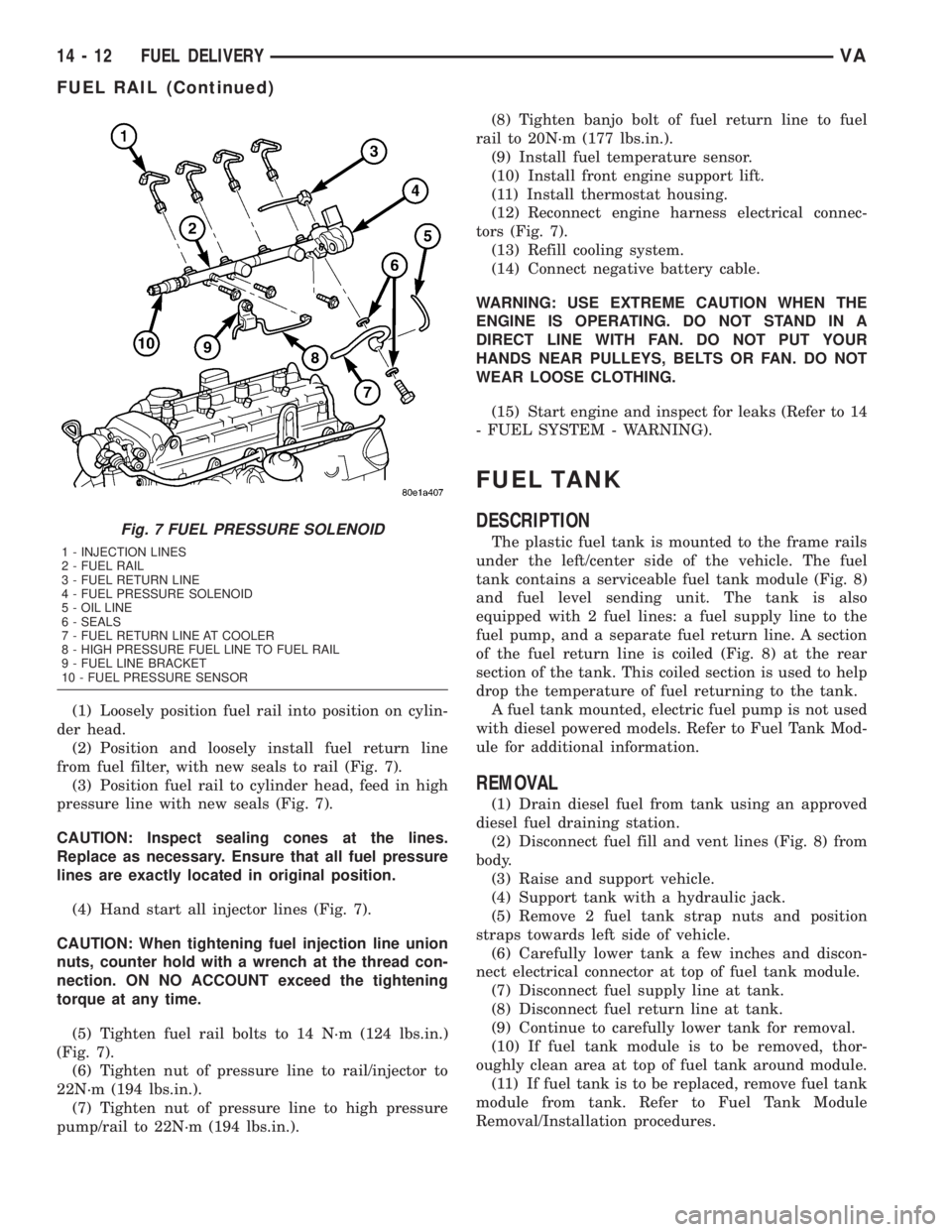
(1) Loosely position fuel rail into position on cylin-
der head.
(2) Position and loosely install fuel return line
from fuel filter, with new seals to rail (Fig. 7).
(3) Position fuel rail to cylinder head, feed in high
pressure line with new seals (Fig. 7).
CAUTION: Inspect sealing cones at the lines.
Replace as necessary. Ensure that all fuel pressure
lines are exactly located in original position.
(4) Hand start all injector lines (Fig. 7).
CAUTION: When tightening fuel injection line union
nuts, counter hold with a wrench at the thread con-
nection. ON NO ACCOUNT exceed the tightening
torque at any time.
(5) Tighten fuel rail bolts to 14 N´m (124 lbs.in.)
(Fig. 7).
(6) Tighten nut of pressure line to rail/injector to
22N´m (194 lbs.in.).
(7) Tighten nut of pressure line to high pressure
pump/rail to 22N´m (194 lbs.in.).(8) Tighten banjo bolt of fuel return line to fuel
rail to 20N´m (177 lbs.in.).
(9) Install fuel temperature sensor.
(10) Install front engine support lift.
(11) Install thermostat housing.
(12) Reconnect engine harness electrical connec-
tors (Fig. 7).
(13) Refill cooling system.
(14) Connect negative battery cable.
WARNING: USE EXTREME CAUTION WHEN THE
ENGINE IS OPERATING. DO NOT STAND IN A
DIRECT LINE WITH FAN. DO NOT PUT YOUR
HANDS NEAR PULLEYS, BELTS OR FAN. DO NOT
WEAR LOOSE CLOTHING.
(15) Start engine and inspect for leaks (Refer to 14
- FUEL SYSTEM - WARNING).
FUEL TANK
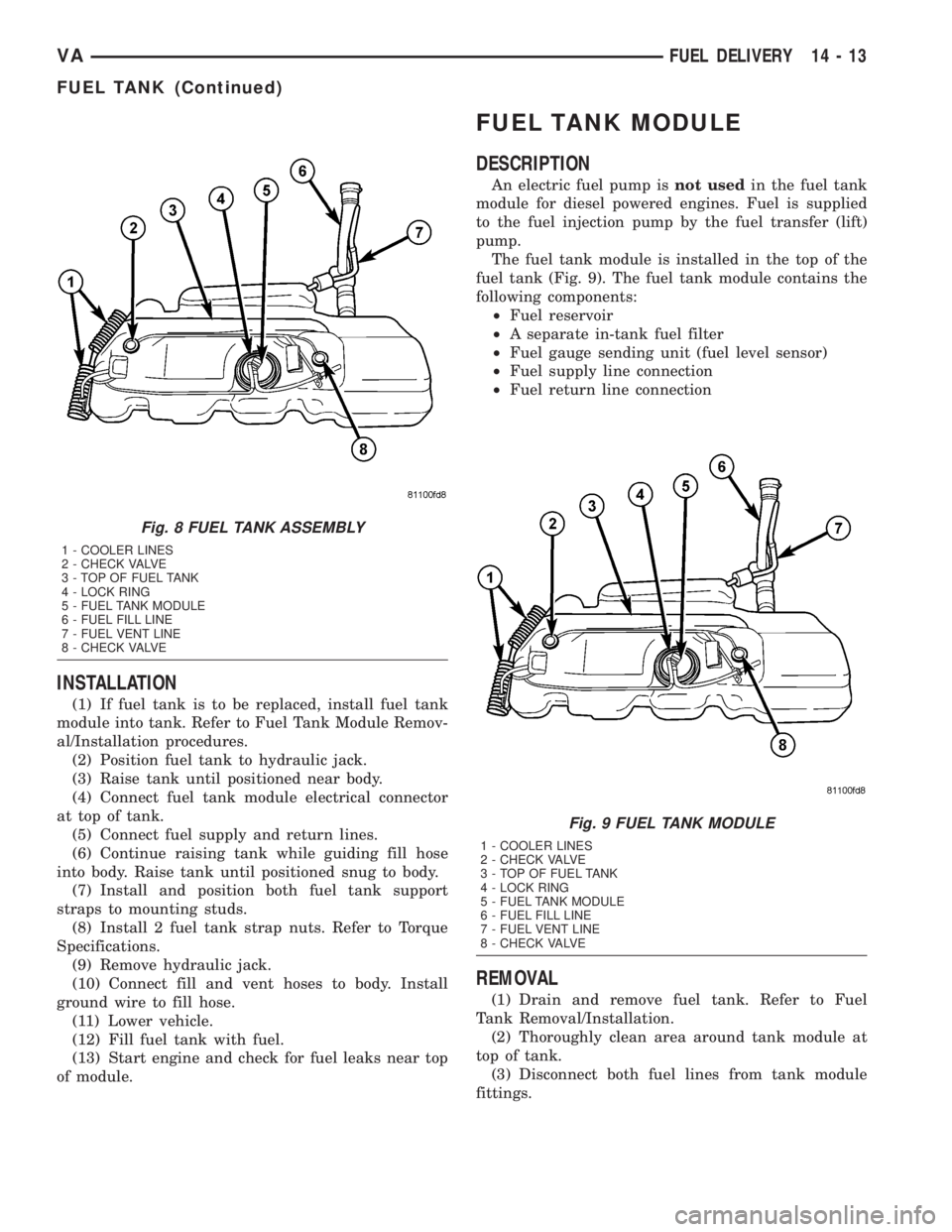
DESCRIPTION
The plastic fuel tank is mounted to the frame rails
under the left/center side of the vehicle. The fuel
tank contains a serviceable fuel tank module (Fig. 8)
and fuel level sending unit. The tank is also
equipped with 2 fuel lines: a fuel supply line to the
fuel pump, and a separate fuel return line. A section
of the fuel return line is coiled (Fig. 8) at the rear
section of the tank. This coiled section is used to help
drop the temperature of fuel returning to the tank.
A fuel tank mounted, electric fuel pump is not used
with diesel powered models. Refer to Fuel Tank Mod-
ule for additional information.
REMOVAL
(1) Drain diesel fuel from tank using an approved
diesel fuel draining station.
(2) Disconnect fuel fill and vent lines (Fig. 8) from
body.
(3) Raise and support vehicle.
(4) Support tank with a hydraulic jack.
(5) Remove 2 fuel tank strap nuts and position
straps towards left side of vehicle.
(6) Carefully lower tank a few inches and discon-
nect electrical connector at top of fuel tank module.
(7) Disconnect fuel supply line at tank.
(8) Disconnect fuel return line at tank.
(9) Continue to carefully lower tank for removal.
(10) If fuel tank module is to be removed, thor-
oughly clean area at top of fuel tank around module.
(11) If fuel tank is to be replaced, remove fuel tank
module from tank. Refer to Fuel Tank Module
Removal/Installation procedures.
Fig. 7 FUEL PRESSURE SOLENOID
1 - INJECTION LINES
2 - FUEL RAIL
3 - FUEL RETURN LINE
4 - FUEL PRESSURE SOLENOID
5 - OIL LINE
6 - SEALS
7 - FUEL RETURN LINE AT COOLER
8 - HIGH PRESSURE FUEL LINE TO FUEL RAIL
9 - FUEL LINE BRACKET
10 - FUEL PRESSURE SENSOR
14 - 12 FUEL DELIVERYVA
FUEL RAIL (Continued)
Page 841 of 1232
INSTALLATION
(1) If fuel tank is to be replaced, install fuel tank
module into tank. Refer to Fuel Tank Module Remov-
al/Installation procedures.
(2) Position fuel tank to hydraulic jack.
(3) Raise tank until positioned near body.
(4) Connect fuel tank module electrical connector
at top of tank.
(5) Connect fuel supply and return lines.
(6) Continue raising tank while guiding fill hose
into body. Raise tank until positioned snug to body.
(7) Install and position both fuel tank support
straps to mounting studs.
(8) Install 2 fuel tank strap nuts. Refer to Torque
Specifications.
(9) Remove hydraulic jack.
(10) Connect fill and vent hoses to body. Install
ground wire to fill hose.
(11) Lower vehicle.
(12) Fill fuel tank with fuel.
(13) Start engine and check for fuel leaks near top
of module.
FUEL TANK MODULE
DESCRIPTION
An electric fuel pump isnot usedin the fuel tank
module for diesel powered engines. Fuel is supplied
to the fuel injection pump by the fuel transfer (lift)
pump.
The fuel tank module is installed in the top of the
fuel tank (Fig. 9). The fuel tank module contains the
following components:
²Fuel reservoir
²A separate in-tank fuel filter
²Fuel gauge sending unit (fuel level sensor)
²Fuel supply line connection
²Fuel return line connection
REMOVAL
(1) Drain and remove fuel tank. Refer to Fuel
Tank Removal/Installation.
(2) Thoroughly clean area around tank module at
top of tank.
(3) Disconnect both fuel lines from tank module
fittings.
Fig. 8 FUEL TANK ASSEMBLY
1 - COOLER LINES
2 - CHECK VALVE
3 - TOP OF FUEL TANK
4 - LOCK RING
5 - FUEL TANK MODULE
6 - FUEL FILL LINE
7 - FUEL VENT LINE
8 - CHECK VALVE
Fig. 9 FUEL TANK MODULE
1 - COOLER LINES
2 - CHECK VALVE
3 - TOP OF FUEL TANK
4 - LOCK RING
5 - FUEL TANK MODULE
6 - FUEL FILL LINE
7 - FUEL VENT LINE
8 - CHECK VALVE
VAFUEL DELIVERY 14 - 13
FUEL TANK (Continued)
Page 844 of 1232
HI PRESSURE FUEL SHUTOFF
SOL
DESCRIPTION
The high pressure fuel injection pump has a inte-
grated shut off valve for one of the high pressure
pump elements. The ECM monitors the fuel temper-
ature and will switch off the element if the fuel tem-
perature reaches above 287ÉF (120C) with the engine
speed above 2200 rpm. The shut off valve is not ser-
viced separately.
OPERATION
The high pressure injection pump element shut off
valve interrupts the fuel high pressure delivery of
one of the injection pump elements in the part load
range. This will reduce the power required for driv-
ing the high pressure pump so as to reduce the fuel
temperature. The pump element is switched off if the
fuel temperature is excessively high forcing it to
return again to the fuel feed to cool. The element
shut off limits the increasing pressure of the injection
pump to ensure that the critical fuel temperature for
the system is not exceeded.
WATER IN FUEL SENSOR
DESCRIPTION
The water in fuel sensor if located in the bottom of
the fuel filter housing. This sensor detects the pres-
ence of water in the fuel. If water is present in the
fuel a signal is sent to the ECM and the ECM signals
the instrument cluster, over the CAN bus, to illumi-
nate the water in fuel warning.
OPERATION
The non-dielectric properties of the water allow the
sensors probes to close the electronic circuit when
water is present in the system. When diesel fuel is
present in the system, it's dielectric (does not conduct
electricity well) properties do not allow any electrical
contact between the probes. A 12V power signal is
always present in order to illuminate the indicator on
the instrument cluster. For removal and installation
procedure refer to (Refer to 14 - FUEL SYSTEM/
FUEL DELIVERY/FUEL FILTER - REMOVAL).
14 - 16 FUEL DELIVERYVA
Page 845 of 1232
FUEL INJECTION
TABLE OF CONTENTS
page page
ACCELERATOR PEDAL POSITION SENSOR
DESCRIPTION.........................17
BOOST PRESSURE SENSOR
DESCRIPTION.........................17
OPERATION...........................18
DIAGNOSIS AND TESTING - BOOST
PRESSURE SENSOR..................18
REMOVAL.............................18
INSTALLATION.........................18
CAMSHAFT POSITION SENSOR
DESCRIPTION.........................19
OPERATION...........................19
REMOVAL.............................19
INSTALLATION.........................19
CRANKSHAFT POSITION SENSOR
DESCRIPTION.........................20
OPERATION...........................20
REMOVAL.............................20
INSTALLATION.........................20
FUEL INJECTOR
DESCRIPTION
FUEL INJECTOR......................20
OPERATION...........................20
STANDARD PROCEDURE
STANDARD PROCEDURE - INJECTOR
CLASSIFICATION.....................22
STANDARD PROCEDURE - CLEANING
FUEL INJECTORS.....................22
REMOVAL.............................23
INSTALLATION.........................23
FUEL PRESSURE SENSOR
DESCRIPTION
DESCRIPTION........................25DESCRIPTION........................25
OPERATION
OPERATION.........................25
OPERATION.........................25
REMOVAL
REMOVAL...........................26
REMOVAL...........................26
INSTALLATION
INSTALLATION.......................26
INSTALLATION.......................27
FUEL PRESSURE SOLENOID
DESCRIPTION.........................27
OPERATION...........................27
REMOVAL.............................28
INSTALLATION.........................28
FUEL TEMPERATURE SENSOR
DESCRIPTION.........................29
OPERATION...........................29
REMOVAL.............................29
INSTALLATION.........................29
INLET AIR TEMPERATURE SENSOR
DESCRIPTION.........................29
OPERATION...........................29
REMOVAL.............................30
INSTALLATION.........................30
MANIFOLD AIR FLOW (MAF) SENSOR
DESCRIPTION.........................30
OPERATION...........................30
REMOVAL.............................31
INSTALLATION.........................31
ACCELERATOR PEDAL
POSITION SENSOR
DESCRIPTION
The accelerator pedal position sensor is located on
the accelerator pedal assembly. The driver supplies
the torque requirements for the engine by operating
the accelerator pedal in accordance with the desired
speed or acceleration. The pedal sensor converts the
mechanical operation of the pedal into an electrical
signal and sends the information to the ECM. The
ECM adjusts the quantity of the fuel that is injected
into the engine (Fig. 1).The accelerator pedal position sensor is serviced as
an assembly with the accelerator assembly.
BOOST PRESSURE SENSOR
DESCRIPTION
The boost pressure sensor is mounted to the charge
air pipe (Fig. 2). The sensor allows the ECM to mon-
itor intake air down stream of the turbocharger.
VAFUEL INJECTION 14 - 17
Page 846 of 1232
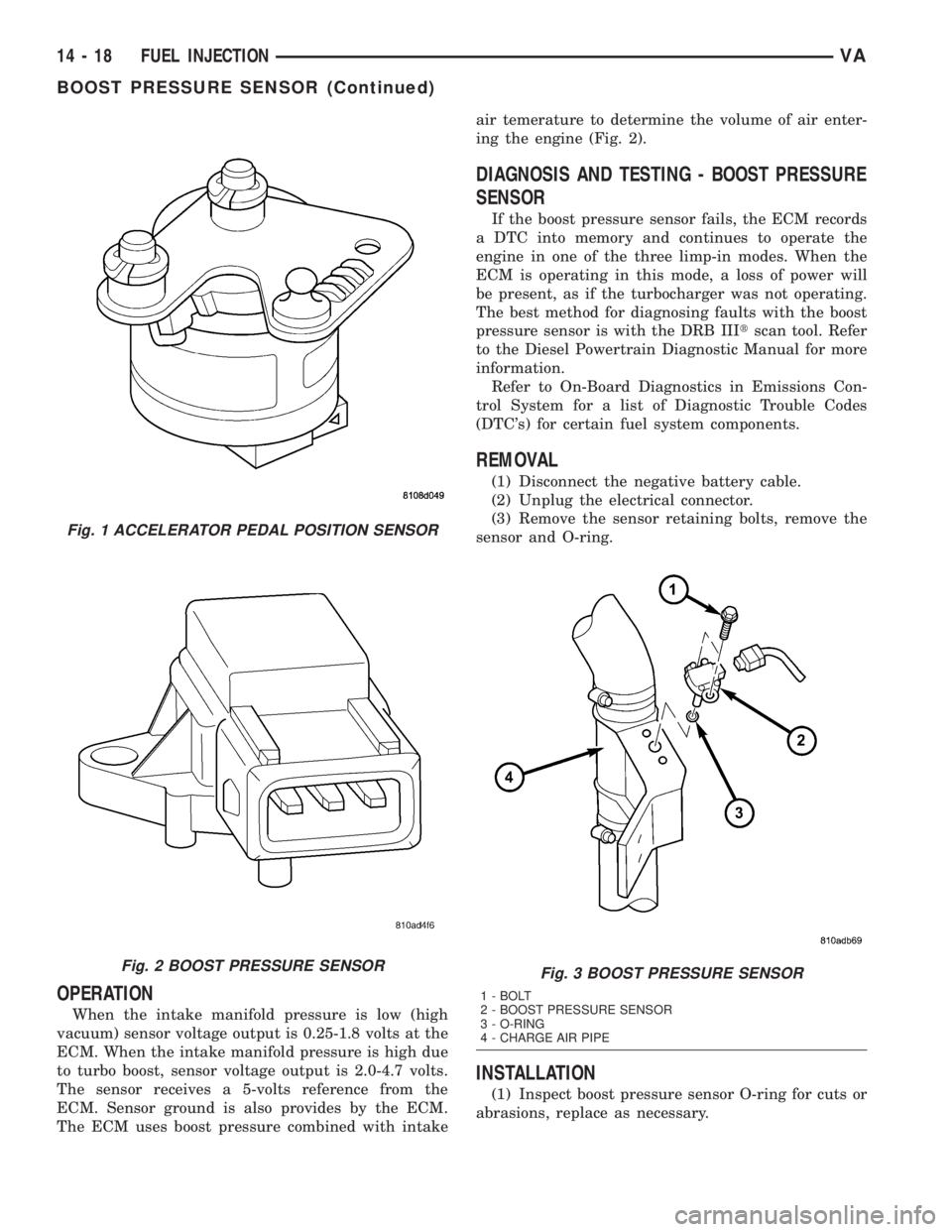
OPERATION
When the intake manifold pressure is low (high
vacuum) sensor voltage output is 0.25-1.8 volts at the
ECM. When the intake manifold pressure is high due
to turbo boost, sensor voltage output is 2.0-4.7 volts.
The sensor receives a 5-volts reference from the
ECM. Sensor ground is also provides by the ECM.
The ECM uses boost pressure combined with intakeair temerature to determine the volume of air enter-
ing the engine (Fig. 2).
DIAGNOSIS AND TESTING - BOOST PRESSURE
SENSOR
If the boost pressure sensor fails, the ECM records
a DTC into memory and continues to operate the
engine in one of the three limp-in modes. When the
ECM is operating in this mode, a loss of power will
be present, as if the turbocharger was not operating.
The best method for diagnosing faults with the boost
pressure sensor is with the DRB IIItscan tool. Refer
to the Diesel Powertrain Diagnostic Manual for more
information.
Refer to On-Board Diagnostics in Emissions Con-
trol System for a list of Diagnostic Trouble Codes
(DTC's) for certain fuel system components.
REMOVAL
(1) Disconnect the negative battery cable.
(2) Unplug the electrical connector.
(3) Remove the sensor retaining bolts, remove the
sensor and O-ring.
INSTALLATION
(1) Inspect boost pressure sensor O-ring for cuts or
abrasions, replace as necessary.
Fig. 1 ACCELERATOR PEDAL POSITION SENSOR
Fig. 2 BOOST PRESSURE SENSORFig. 3 BOOST PRESSURE SENSOR
1 - BOLT
2 - BOOST PRESSURE SENSOR
3 - O-RING
4 - CHARGE AIR PIPE
14 - 18 FUEL INJECTIONVA
BOOST PRESSURE SENSOR (Continued)
Page 847 of 1232
(2) Position the boost pressure sensor above access
hole in the charge air pipe and push down to fit flush
(Fig. 3).
(3) Install the bolts and tighten to 44 lbs. in. (5
N´m) (Fig. 3).
(4) Reconnect the sensor electrical connector (Fig.
3).
(5) Connect negative battery cable
CAMSHAFT POSITION
SENSOR
DESCRIPTION
The camshaft position sensor is mounted on the
cylinder head cover toward the rear of the engine.
The camshaft sensor utilizes a non contact method
on one segment of the camshaft to record the cam-
shaft position. When the ECM receives the signal
from this sensor, it can then detect TDC of cylinder
number one. The signal from the camshaft sensor is
only required during engine starting. Injection timing
is synchronized by means of the camshaft signal and
the crankshaft signal.
OPERATION
On the camshaft sensor's signal line, a high signal
correspons to a voltage of 11±14V. If the segment
machined into the exhaust camshaft sprocket is posi-
tioned opposite the camshaft sensor, the camshaft
signal is low, approximately 0V. This signal is used
by the engine control module (ECM) for detecting
ignition TDC of cylinder 1 as the engine rotates. If no
signal is supplied by the camshaft position sensor,
the vehicle will not start because cylinder order can
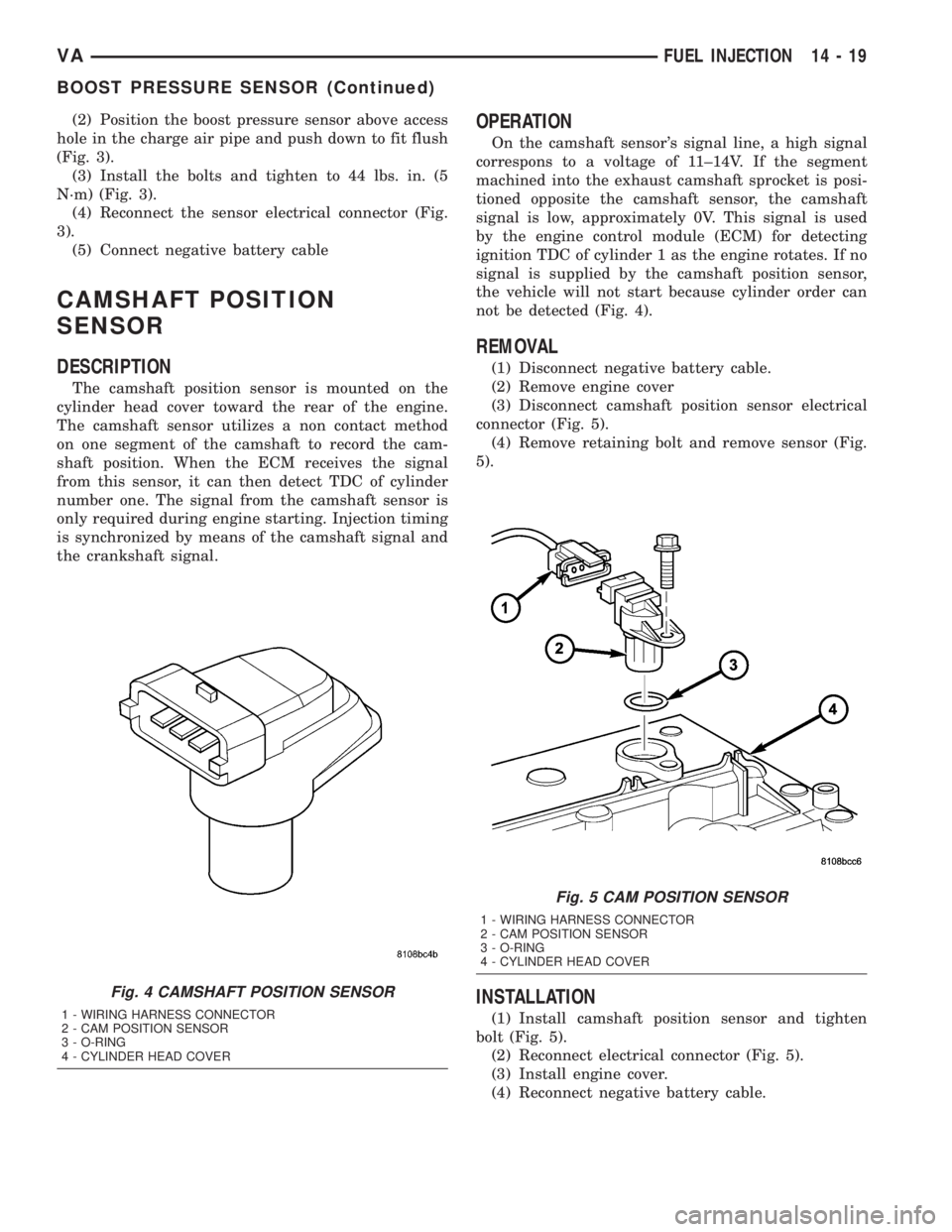
not be detected (Fig. 4).
REMOVAL
(1) Disconnect negative battery cable.
(2) Remove engine cover
(3) Disconnect camshaft position sensor electrical
connector (Fig. 5).
(4) Remove retaining bolt and remove sensor (Fig.
5).
INSTALLATION
(1) Install camshaft position sensor and tighten
bolt (Fig. 5).
(2) Reconnect electrical connector (Fig. 5).
(3) Install engine cover.
(4) Reconnect negative battery cable.
Fig. 4 CAMSHAFT POSITION SENSOR
1 - WIRING HARNESS CONNECTOR
2 - CAM POSITION SENSOR
3 - O-RING
4 - CYLINDER HEAD COVER
Fig. 5 CAM POSITION SENSOR
1 - WIRING HARNESS CONNECTOR
2 - CAM POSITION SENSOR
3 - O-RING
4 - CYLINDER HEAD COVER
VAFUEL INJECTION 14 - 19
BOOST PRESSURE SENSOR (Continued)
Page 848 of 1232
CRANKSHAFT POSITION
SENSOR
DESCRIPTION
The crankshaft position sensor is located opposite
the teeth on the flywheel and uses a non contact
method to record the position of the crankshaft. The
leading edges of each tooth on the flywheel generate
a positive signal in the position sensor, while the
trailing edges generate a negative signal. When the
crankshaft is rotating, an alternating voltage is pro-
duced as a result.
The period of the signal is the time required by the
crankshaft to turn through the gap between two fly-
wheel teeth. The clearance between the crankshaft
position sensor and the teeth of the flywheel is fixed
by the installation.
Two teeth on the flywheel are missing. The result-
ing signal gap is used by the ECM to detect the TDC
position of cylinder number one.
OPERATION
The clearance between the crankshaft position sen-
sor and the flywheel are fixed by the installation
position. Two teeth on the flywheel are missing. The
resulting gap is used by the ECM to detect DTC of
cylinder number one. The crankshaft position is cal-
culated to an accuracy of a fraction of a degree so
that the start and end of injection can occur at
exactly the right moment. The engine speed signal is
also processed by the ECM from the crankshaft sen-
sor. This signal is then transferred to other control
modules over the CAN bus.
If the crankshaft position sensor fails, the signal
that provides reference rotation is missing. Injection
may occur at the wrong time and damage the engine.
In this case, the ECM will stop triggering the injec-
tors, the engine would cut out, the engine warning
light would illuminate and the engine will not
restart.
REMOVAL
(1) Disconnect the negative battery cable.
(2) Unplug the crankshaft wiring harness connec-
tor.
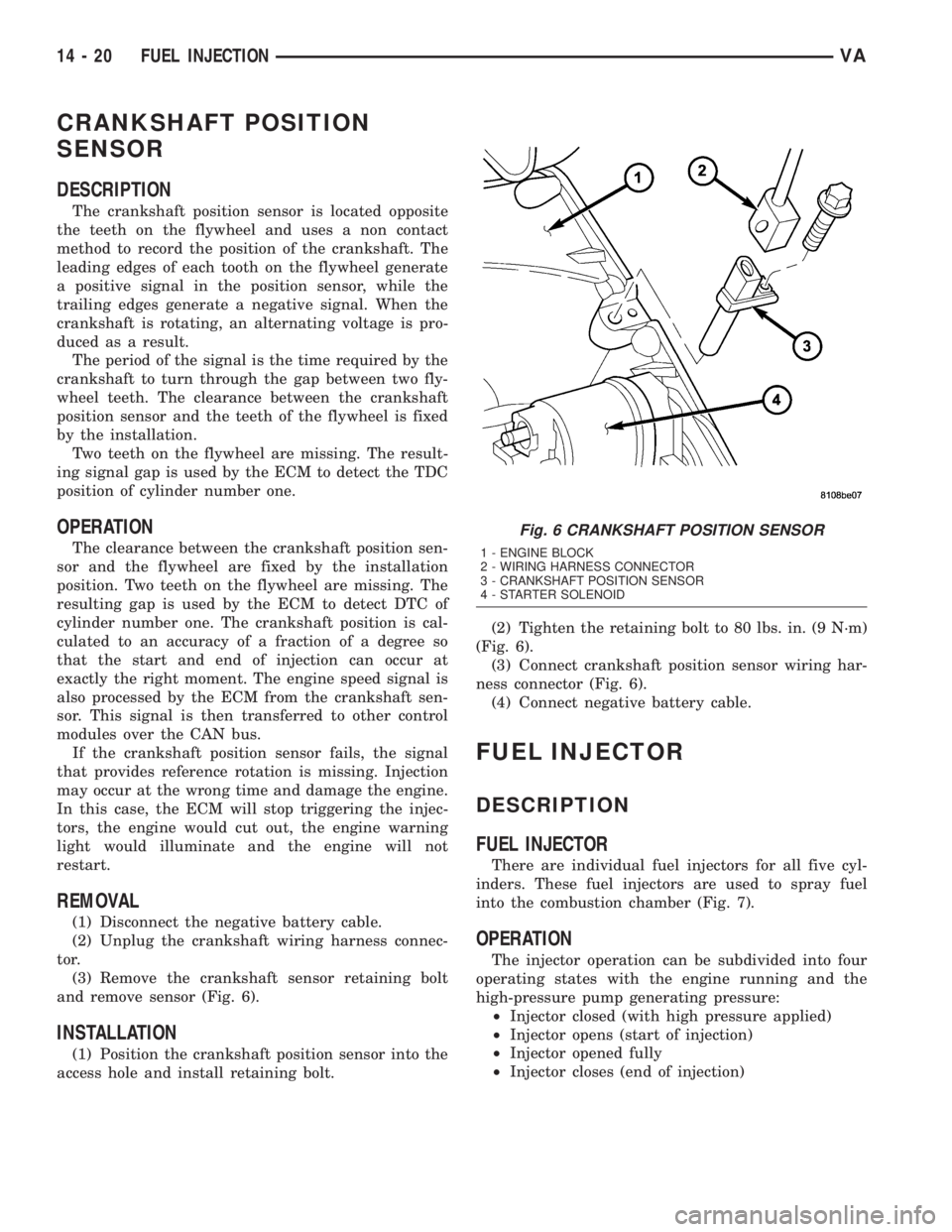
(3) Remove the crankshaft sensor retaining bolt
and remove sensor (Fig. 6).
INSTALLATION
(1) Position the crankshaft position sensor into the
access hole and install retaining bolt.(2) Tighten the retaining bolt to 80 lbs. in. (9 N´m)
(Fig. 6).
(3) Connect crankshaft position sensor wiring har-
ness connector (Fig. 6).
(4) Connect negative battery cable.
FUEL INJECTOR
DESCRIPTION
FUEL INJECTOR
There are individual fuel injectors for all five cyl-
inders. These fuel injectors are used to spray fuel
into the combustion chamber (Fig. 7).
OPERATION
The injector operation can be subdivided into four
operating states with the engine running and the
high-pressure pump generating pressure:
²Injector closed (with high pressure applied)
²Injector opens (start of injection)
²Injector opened fully
²Injector closes (end of injection)
Fig. 6 CRANKSHAFT POSITION SENSOR
1 - ENGINE BLOCK
2 - WIRING HARNESS CONNECTOR
3 - CRANKSHAFT POSITION SENSOR
4 - STARTER SOLENOID
14 - 20 FUEL INJECTIONVA