clock MERCEDES-BENZ SPRINTER 2005 Service Workshop Manual
[x] Cancel search | Manufacturer: MERCEDES-BENZ, Model Year: 2005, Model line: SPRINTER, Model: MERCEDES-BENZ SPRINTER 2005Pages: 1232, PDF Size: 39.23 MB
Page 808 of 1232
(24) Remove camshaft sprocket to timing chain tie
straps.
(25) Install guide rail and tighten low pressure
fuel pump drive to 50N´m (37 lbs. ft.).
(26) Install low pressure fuel pump (Refer to 14 -
FUEL SYSTEM/FUEL DELIVERY/FUEL INJEC-
TION PUMP - INSTALLATION).
(27) Install timing chain tensioner (Refer to 9 -
ENGINE/VALVE TIMING/TIMING BELT/CHAIN
AND SPROCKETS - INSTALLATION).
(28) Install vacuum pump (Refer to 9 - ENGINE/
ENGINE BLOCK/INTERNAL VACUUM PUMP -
INSTALLATION).
(29) Install cylinder head cover (Refer to 9 -
ENGINE/CYLINDER HEAD/CYLINDER HEAD
COVER(S) - INSTALLATION).
(30) Install engine cover (Refer to 9 - ENGINE -
INSTALLATION).
(31) Connect negative battery cable.
WARNING: USE EXTREME CAUTION WHEN THE
ENGINE IS OPERATING. DO NOT PUT YOUR
HANDS NEAR THE PULLEYS BELTS OR FAN. DO
NOT WEAR LOOSE CLOTHES.
(32) Start engine and inspect for leaks. Care must
be taken to observe the fuel system warning (Refer to
14 - FUEL SYSTEM - WARNING).
TIMING CHAIN TENSIONER
REMOVAL
(1) Disconnect negative battery cable.
CAUTION: Rotate engine at crankshaft only. DO
NOT rotate the engine with the bolt of the camshaft
sprocket. DO NOT rotate the engine counter clock-
wise.
NOTE: Markings on the camshaft and camshaft
bearing cap must be aligned.
(2) Position piston of number 1 cylinder to ignition
TDC.
(3) Remove intake air scoop.
(4) Remove accessory drive belt and idler pulley
above generator (Refer to 7 - COOLING/ACCES-
SORY DRIVE/DRIVE BELTS - REMOVAL).
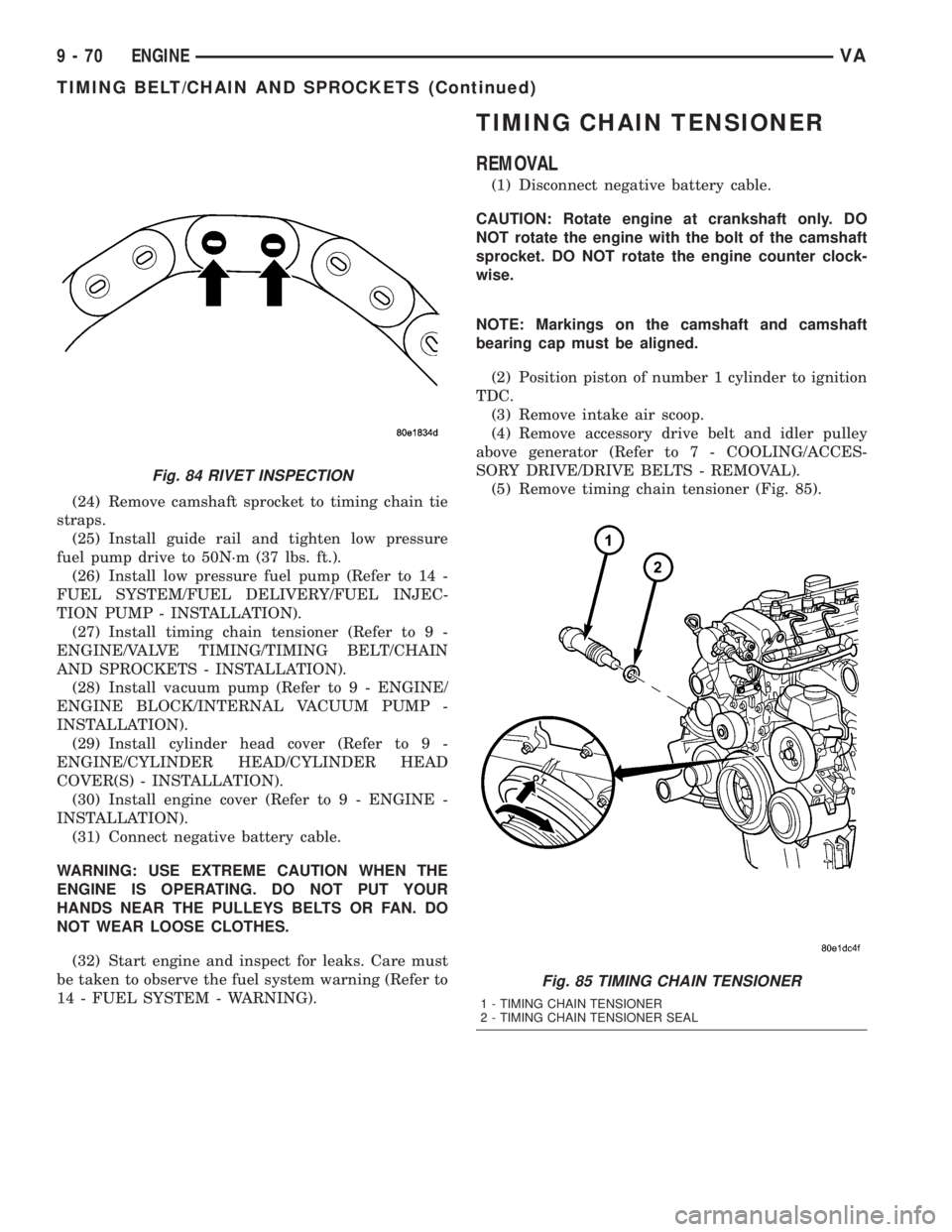
(5) Remove timing chain tensioner (Fig. 85).
Fig. 84 RIVET INSPECTION
Fig. 85 TIMING CHAIN TENSIONER
1 - TIMING CHAIN TENSIONER
2 - TIMING CHAIN TENSIONER SEAL
9 - 70 ENGINEVA
TIMING BELT/CHAIN AND SPROCKETS (Continued)
Page 865 of 1232
COLUMN
TABLE OF CONTENTS
page page
COLUMN
SPECIFICATIONS - TORQUE CHART.........5
INTERMEDIATE SHAFT
REMOVAL.............................5
INSTALLATION..........................5
KEY/LOCK CYLINDER
REMOVAL.............................6INSTALLATION..........................7
STEERING WHEEL
REMOVAL.............................7
INSTALLATION..........................7
COLUMN
SPECIFICATIONS - TORQUE CHART
TORQUE SPECIFICATIONS
DESCRIPTION N´m Ft. Lbs. In. Lbs.
Steering Wheel With
Airbag To Steering Shaft80 59 Ð
Jacket Tube For Steering
Shaft To Waist Rail25 18 221
U-Joint To Steering Gear
Shaft24 18 212
INTERMEDIATE SHAFT
REMOVAL
(1) Disconnect the ground cable from the battery.
(2) Remove the air bag module from the steering
wheel.
(3) Turn the steering wheel and lock the steering
wheel in the straight ahead position.The position
of the steering gear must not be altered again
for the entire duration of the work procedure.
(4) Remove the electrical center.
(5) Remove the steering wheel bolt.
(6) Remove the steering wheel from the steering
column.
(7) Remove the clockspring.Unscrew the retain-
ing bolts just enough to be able to remove the
clockspring. Do not twist or disassemble the
clockspring.
(8) Remove the combination switch.
(9) Disconnect the electrical connector for the igni-
tion lock.(10) Remove the spring for the brake pedal from
the steering column.
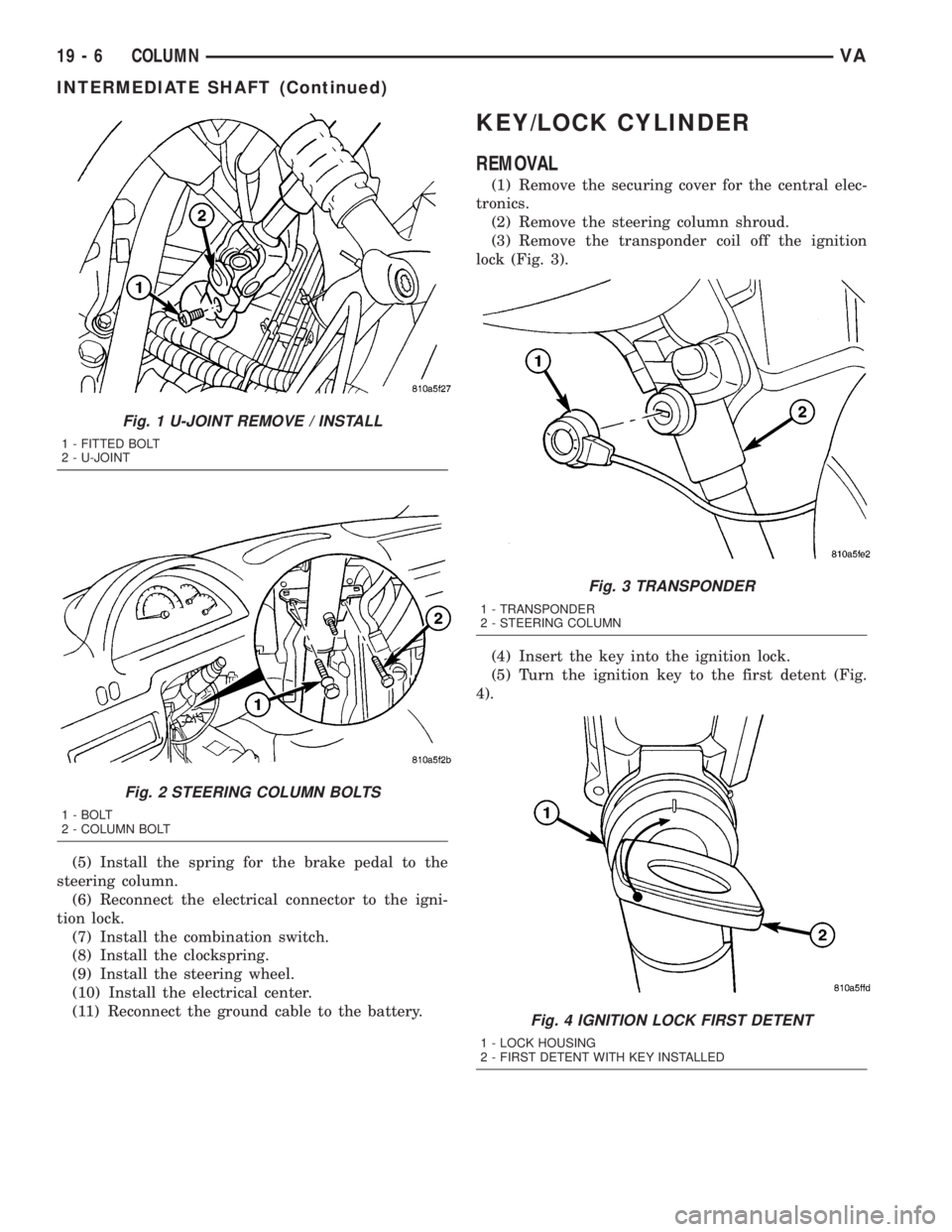
(11) Remove the fitted bolt from the universal joint
(Fig. 1).
(12) Remove the bolts in the steering column
bracket (Fig. 2).
(13) Remove the steering shaft with the universal
joint off the steering gear drive shaft (Fig. 1).
(14) Pull the steering shaft out of the rubber grom-
met in the cab floor.
INSTALLATION
(1) Install the steering shaft through the rubber
grommet in the cab floor.Ensure that the rubber
grommet is properly seated.
(2) Install the steering shaft with the universal
joint onto the steering gear shaft (Fig. 1).
(3) Install the bolts in the steering column bracket
(Fig. 2). Tighten to 24 N´m (18 ft. lbs.).
(4) Install the universal joint on the steering gear
shaft (Fig. 1). Tighten to 24 N´m (18 ft. lbs.).
VACOLUMN 19 - 5
Page 866 of 1232
(5) Install the spring for the brake pedal to the
steering column.
(6) Reconnect the electrical connector to the igni-
tion lock.
(7) Install the combination switch.
(8) Install the clockspring.
(9) Install the steering wheel.
(10) Install the electrical center.
(11) Reconnect the ground cable to the battery.
KEY/LOCK CYLINDER
REMOVAL
(1) Remove the securing cover for the central elec-
tronics.
(2) Remove the steering column shroud.
(3) Remove the transponder coil off the ignition
lock (Fig. 3).
(4) Insert the key into the ignition lock.
(5) Turn the ignition key to the first detent (Fig.
4).
Fig. 1 U-JOINT REMOVE / INSTALL
1 - FITTED BOLT
2 - U-JOINT
Fig. 2 STEERING COLUMN BOLTS
1 - BOLT
2 - COLUMN BOLT
Fig. 3 TRANSPONDER
1 - TRANSPONDER
2 - STEERING COLUMN
Fig. 4 IGNITION LOCK FIRST DETENT
1 - LOCK HOUSING
2 - FIRST DETENT WITH KEY INSTALLED
19 - 6 COLUMNVA
INTERMEDIATE SHAFT (Continued)
Page 904 of 1232
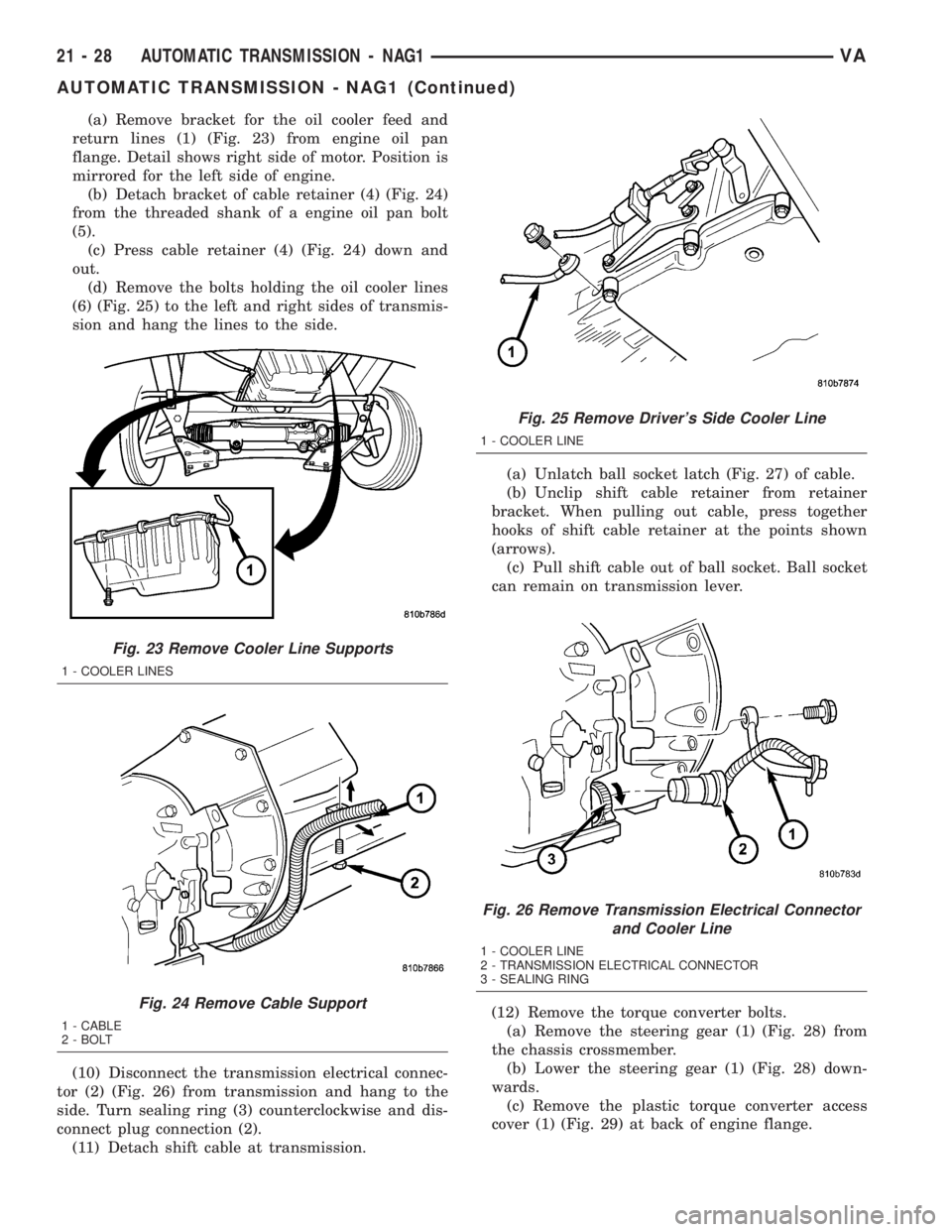
(a) Remove bracket for the oil cooler feed and
return lines (1) (Fig. 23) from engine oil pan
flange. Detail shows right side of motor. Position is
mirrored for the left side of engine.
(b) Detach bracket of cable retainer (4) (Fig. 24)
from the threaded shank of a engine oil pan bolt
(5).
(c) Press cable retainer (4) (Fig. 24) down and
out.
(d) Remove the bolts holding the oil cooler lines
(6) (Fig. 25) to the left and right sides of transmis-
sion and hang the lines to the side.
(10) Disconnect the transmission electrical connec-
tor (2) (Fig. 26) from transmission and hang to the
side. Turn sealing ring (3) counterclockwise and dis-
connect plug connection (2).
(11) Detach shift cable at transmission.(a) Unlatch ball socket latch (Fig. 27) of cable.
(b) Unclip shift cable retainer from retainer
bracket. When pulling out cable, press together
hooks of shift cable retainer at the points shown
(arrows).
(c) Pull shift cable out of ball socket. Ball socket
can remain on transmission lever.
(12) Remove the torque converter bolts.
(a) Remove the steering gear (1) (Fig. 28) from
the chassis crossmember.
(b) Lower the steering gear (1) (Fig. 28) down-
wards.
(c) Remove the plastic torque converter access
cover (1) (Fig. 29) at back of engine flange.
Fig. 23 Remove Cooler Line Supports
1 - COOLER LINES
Fig. 24 Remove Cable Support
1 - CABLE
2 - BOLT
Fig. 25 Remove Driver's Side Cooler Line
1 - COOLER LINE
Fig. 26 Remove Transmission Electrical Connector
and Cooler Line
1 - COOLER LINE
2 - TRANSMISSION ELECTRICAL CONNECTOR
3 - SEALING RING
21 - 28 AUTOMATIC TRANSMISSION - NAG1VA
AUTOMATIC TRANSMISSION - NAG1 (Continued)
Page 920 of 1232
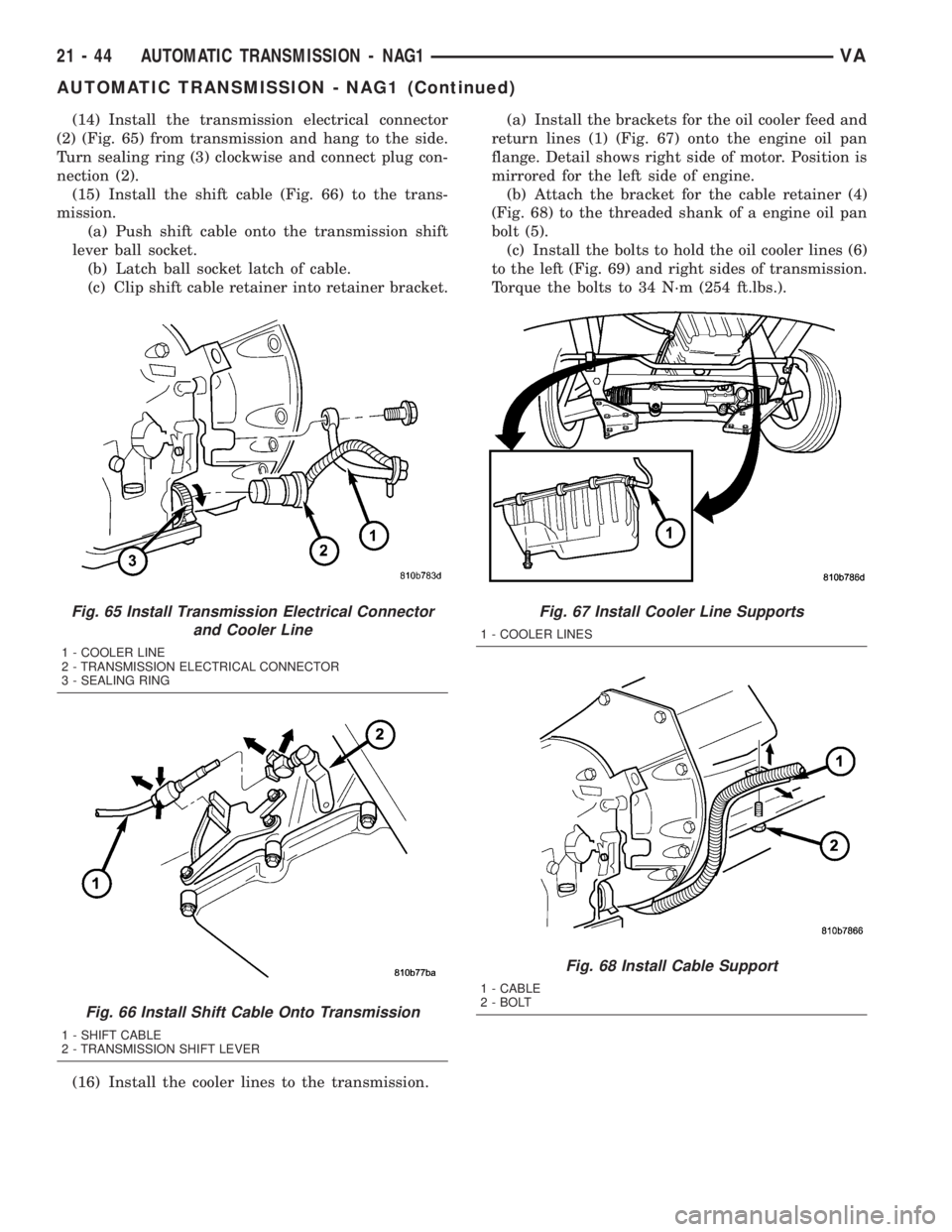
(14) Install the transmission electrical connector
(2) (Fig. 65) from transmission and hang to the side.
Turn sealing ring (3) clockwise and connect plug con-
nection (2).
(15) Install the shift cable (Fig. 66) to the trans-
mission.
(a) Push shift cable onto the transmission shift
lever ball socket.
(b) Latch ball socket latch of cable.
(c) Clip shift cable retainer into retainer bracket.
(16) Install the cooler lines to the transmission.(a) Install the brackets for the oil cooler feed and
return lines (1) (Fig. 67) onto the engine oil pan
flange. Detail shows right side of motor. Position is
mirrored for the left side of engine.
(b) Attach the bracket for the cable retainer (4)
(Fig. 68) to the threaded shank of a engine oil pan
bolt (5).
(c) Install the bolts to hold the oil cooler lines (6)
to the left (Fig. 69) and right sides of transmission.
Torque the bolts to 34 N´m (254 ft.lbs.).
Fig. 65 Install Transmission Electrical Connector
and Cooler Line
1 - COOLER LINE
2 - TRANSMISSION ELECTRICAL CONNECTOR
3 - SEALING RING
Fig. 66 Install Shift Cable Onto Transmission
1 - SHIFT CABLE
2 - TRANSMISSION SHIFT LEVER
Fig. 67 Install Cooler Line Supports
1 - COOLER LINES
Fig. 68 Install Cable Support
1 - CABLE
2 - BOLT
21 - 44 AUTOMATIC TRANSMISSION - NAG1VA
AUTOMATIC TRANSMISSION - NAG1 (Continued)
Page 968 of 1232
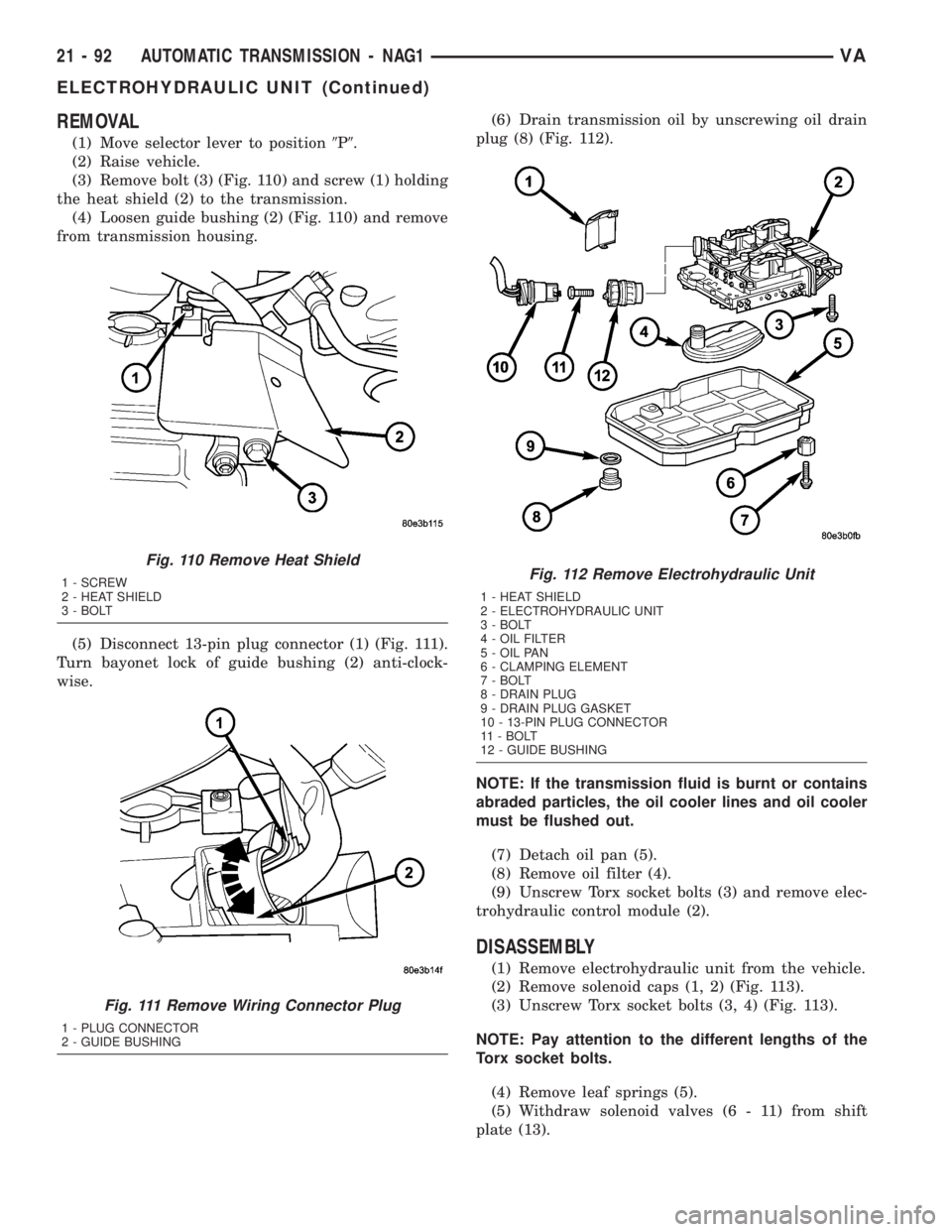
REMOVAL
(1) Move selector lever to position9P9.
(2) Raise vehicle.
(3) Remove bolt (3) (Fig. 110) and screw (1) holding
the heat shield (2) to the transmission.
(4) Loosen guide bushing (2) (Fig. 110) and remove
from transmission housing.
(5) Disconnect 13-pin plug connector (1) (Fig. 111).
Turn bayonet lock of guide bushing (2) anti-clock-
wise.(6) Drain transmission oil by unscrewing oil drain
plug (8) (Fig. 112).
NOTE: If the transmission fluid is burnt or contains
abraded particles, the oil cooler lines and oil cooler
must be flushed out.
(7) Detach oil pan (5).
(8) Remove oil filter (4).
(9) Unscrew Torx socket bolts (3) and remove elec-
trohydraulic control module (2).
DISASSEMBLY
(1) Remove electrohydraulic unit from the vehicle.
(2) Remove solenoid caps (1, 2) (Fig. 113).
(3) Unscrew Torx socket bolts (3, 4) (Fig. 113).
NOTE: Pay attention to the different lengths of the
Torx socket bolts.
(4) Remove leaf springs (5).
(5) Withdraw solenoid valves (6 - 11) from shift
plate (13).
Fig. 110 Remove Heat Shield
1 - SCREW
2 - HEAT SHIELD
3 - BOLT
Fig. 111 Remove Wiring Connector Plug
1 - PLUG CONNECTOR
2 - GUIDE BUSHING
Fig. 112 Remove Electrohydraulic Unit
1 - HEAT SHIELD
2 - ELECTROHYDRAULIC UNIT
3 - BOLT
4 - OIL FILTER
5 - OIL PAN
6 - CLAMPING ELEMENT
7 - BOLT
8 - DRAIN PLUG
9 - DRAIN PLUG GASKET
10 - 13-PIN PLUG CONNECTOR
11 - BOLT
12 - GUIDE BUSHING
21 - 92 AUTOMATIC TRANSMISSION - NAG1VA
ELECTROHYDRAULIC UNIT (Continued)
Page 976 of 1232
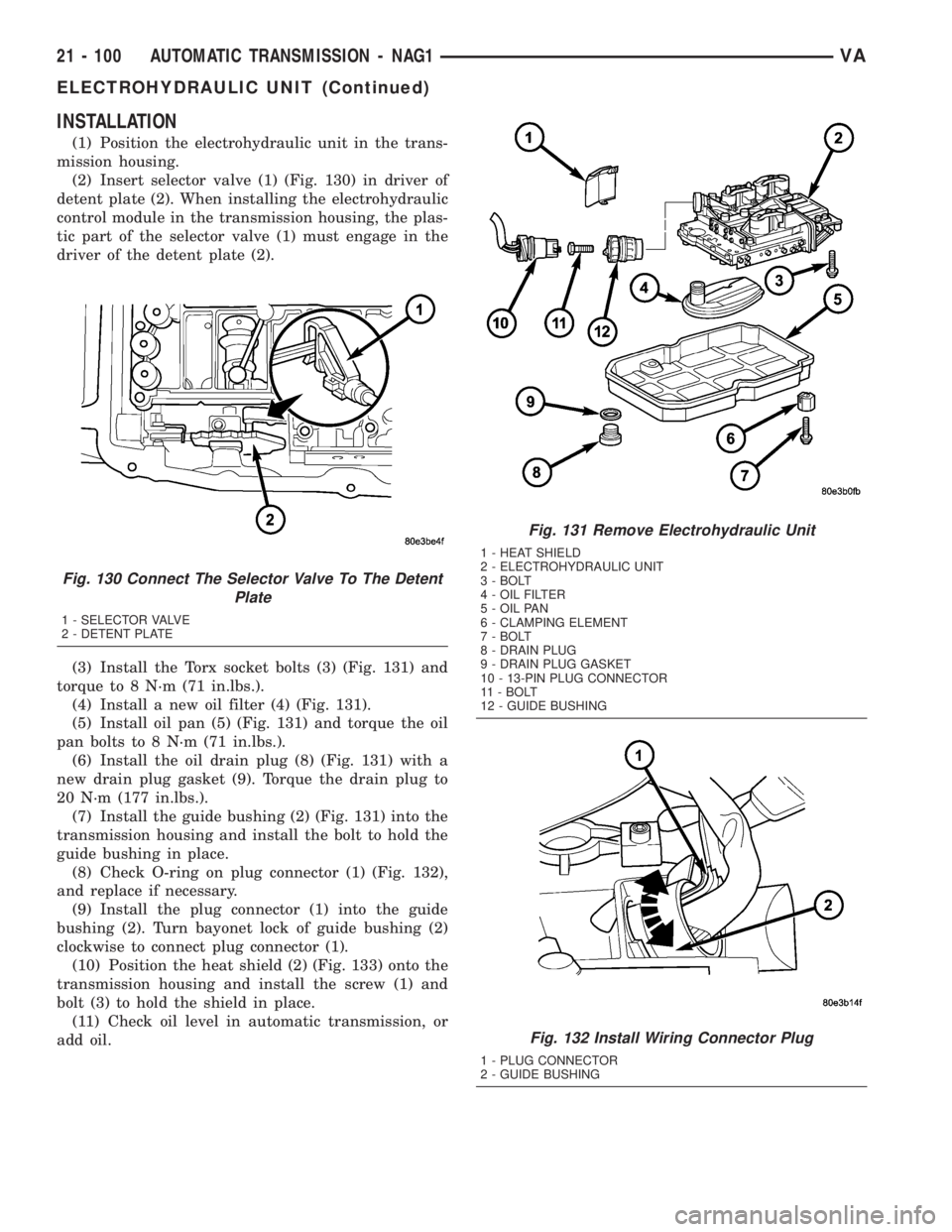
INSTALLATION
(1) Position the electrohydraulic unit in the trans-
mission housing.
(2) Insert selector valve (1) (Fig. 130) in driver of
detent plate (2). When installing the electrohydraulic
control module in the transmission housing, the plas-
tic part of the selector valve (1) must engage in the
driver of the detent plate (2).
(3) Install the Torx socket bolts (3) (Fig. 131) and
torque to 8 N´m (71 in.lbs.).
(4) Install a new oil filter (4) (Fig. 131).
(5) Install oil pan (5) (Fig. 131) and torque the oil
pan bolts to 8 N´m (71 in.lbs.).
(6) Install the oil drain plug (8) (Fig. 131) with a
new drain plug gasket (9). Torque the drain plug to
20 N´m (177 in.lbs.).
(7) Install the guide bushing (2) (Fig. 131) into the
transmission housing and install the bolt to hold the
guide bushing in place.
(8) Check O-ring on plug connector (1) (Fig. 132),
and replace if necessary.
(9) Install the plug connector (1) into the guide
bushing (2). Turn bayonet lock of guide bushing (2)
clockwise to connect plug connector (1).
(10) Position the heat shield (2) (Fig. 133) onto the
transmission housing and install the screw (1) and
bolt (3) to hold the shield in place.
(11) Check oil level in automatic transmission, or
add oil.
Fig. 130 Connect The Selector Valve To The Detent
Plate
1 - SELECTOR VALVE
2 - DETENT PLATE
Fig. 131 Remove Electrohydraulic Unit
1 - HEAT SHIELD
2 - ELECTROHYDRAULIC UNIT
3 - BOLT
4 - OIL FILTER
5 - OIL PAN
6 - CLAMPING ELEMENT
7 - BOLT
8 - DRAIN PLUG
9 - DRAIN PLUG GASKET
10 - 13-PIN PLUG CONNECTOR
11 - BOLT
12 - GUIDE BUSHING
Fig. 132 Install Wiring Connector Plug
1 - PLUG CONNECTOR
2 - GUIDE BUSHING
21 - 100 AUTOMATIC TRANSMISSION - NAG1VA
ELECTROHYDRAULIC UNIT (Continued)
Page 980 of 1232
(a) If only fluid and filter were changed, add5.0
L (10.6 pts.)of transmission fluid to transmission.
(b) If transmission was completely overhauled,
torque converter was replaced or drained, and
cooler was flushed, add7.7 L (16.3 pts.)of trans-
mission fluid to transmission.
(5) Check the transmission fluid (Refer to 21 -
TRANSMISSION/AUTOMATIC - NAG1/FLUID -
STANDARD PROCEDURE) and adjust as required.
STANDARD PROCEDURE - FLUID/FILTER
SERVICE
(1) Run the engine until the transmission oil
reaches operating temperature.
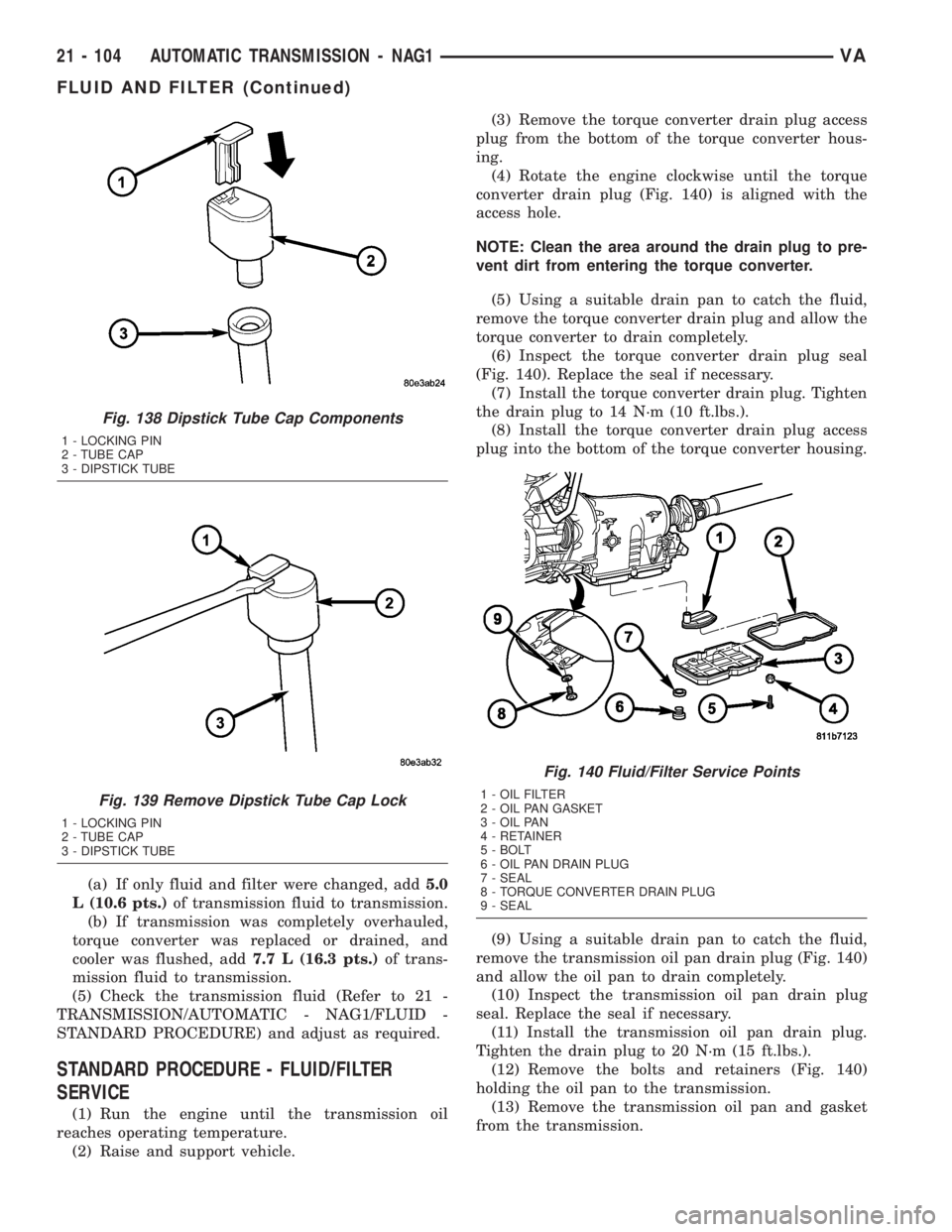
(2) Raise and support vehicle.(3) Remove the torque converter drain plug access
plug from the bottom of the torque converter hous-
ing.
(4) Rotate the engine clockwise until the torque
converter drain plug (Fig. 140) is aligned with the
access hole.
NOTE: Clean the area around the drain plug to pre-
vent dirt from entering the torque converter.
(5) Using a suitable drain pan to catch the fluid,
remove the torque converter drain plug and allow the
torque converter to drain completely.
(6) Inspect the torque converter drain plug seal
(Fig. 140). Replace the seal if necessary.
(7) Install the torque converter drain plug. Tighten
the drain plug to 14 N´m (10 ft.lbs.).
(8) Install the torque converter drain plug access
plug into the bottom of the torque converter housing.
(9) Using a suitable drain pan to catch the fluid,
remove the transmission oil pan drain plug (Fig. 140)
and allow the oil pan to drain completely.
(10) Inspect the transmission oil pan drain plug
seal. Replace the seal if necessary.
(11) Install the transmission oil pan drain plug.
Tighten the drain plug to 20 N´m (15 ft.lbs.).
(12) Remove the bolts and retainers (Fig. 140)
holding the oil pan to the transmission.
(13) Remove the transmission oil pan and gasket
from the transmission.
Fig. 138 Dipstick Tube Cap Components
1 - LOCKING PIN
2 - TUBE CAP
3 - DIPSTICK TUBE
Fig. 139 Remove Dipstick Tube Cap Lock
1 - LOCKING PIN
2 - TUBE CAP
3 - DIPSTICK TUBE
Fig. 140 Fluid/Filter Service Points
1 - OIL FILTER
2 - OIL PAN GASKET
3 - OIL PAN
4 - RETAINER
5 - BOLT
6 - OIL PAN DRAIN PLUG
7 - SEAL
8 - TORQUE CONVERTER DRAIN PLUG
9 - SEAL
21 - 104 AUTOMATIC TRANSMISSION - NAG1VA
FLUID AND FILTER (Continued)
Page 1018 of 1232
IMPELLER
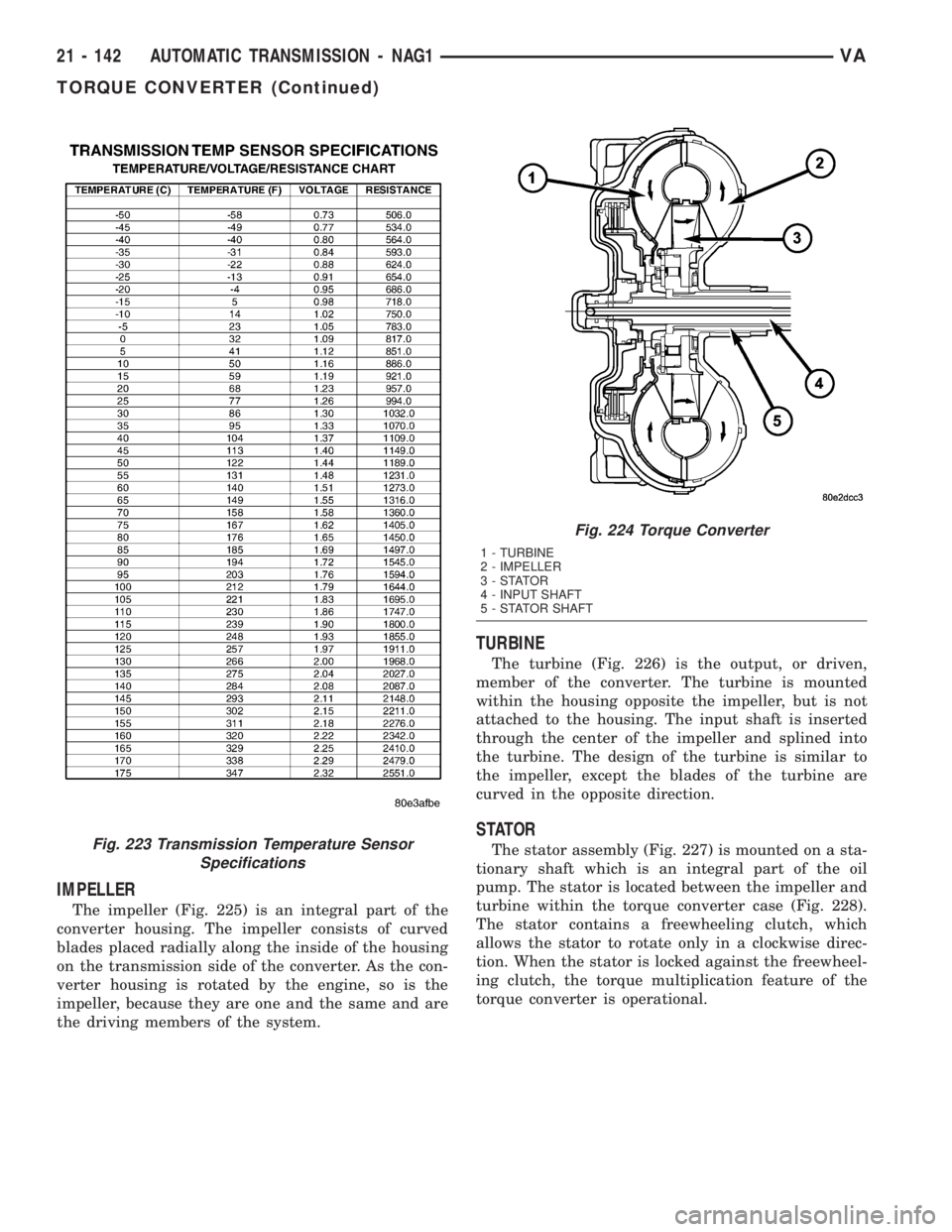
The impeller (Fig. 225) is an integral part of the
converter housing. The impeller consists of curved
blades placed radially along the inside of the housing
on the transmission side of the converter. As the con-
verter housing is rotated by the engine, so is the
impeller, because they are one and the same and are
the driving members of the system.
TURBINE
The turbine (Fig. 226) is the output, or driven,
member of the converter. The turbine is mounted
within the housing opposite the impeller, but is not
attached to the housing. The input shaft is inserted
through the center of the impeller and splined into
the turbine. The design of the turbine is similar to
the impeller, except the blades of the turbine are
curved in the opposite direction.
STATOR
The stator assembly (Fig. 227) is mounted on a sta-
tionary shaft which is an integral part of the oil
pump. The stator is located between the impeller and
turbine within the torque converter case (Fig. 228).
The stator contains a freewheeling clutch, which
allows the stator to rotate only in a clockwise direc-
tion. When the stator is locked against the freewheel-
ing clutch, the torque multiplication feature of the
torque converter is operational.Fig. 223 Transmission Temperature Sensor
Specifications
Fig. 224 Torque Converter
1 - TURBINE
2 - IMPELLER
3-STATOR
4 - INPUT SHAFT
5 - STATOR SHAFT
21 - 142 AUTOMATIC TRANSMISSION - NAG1VA
TORQUE CONVERTER (Continued)
Page 1020 of 1232
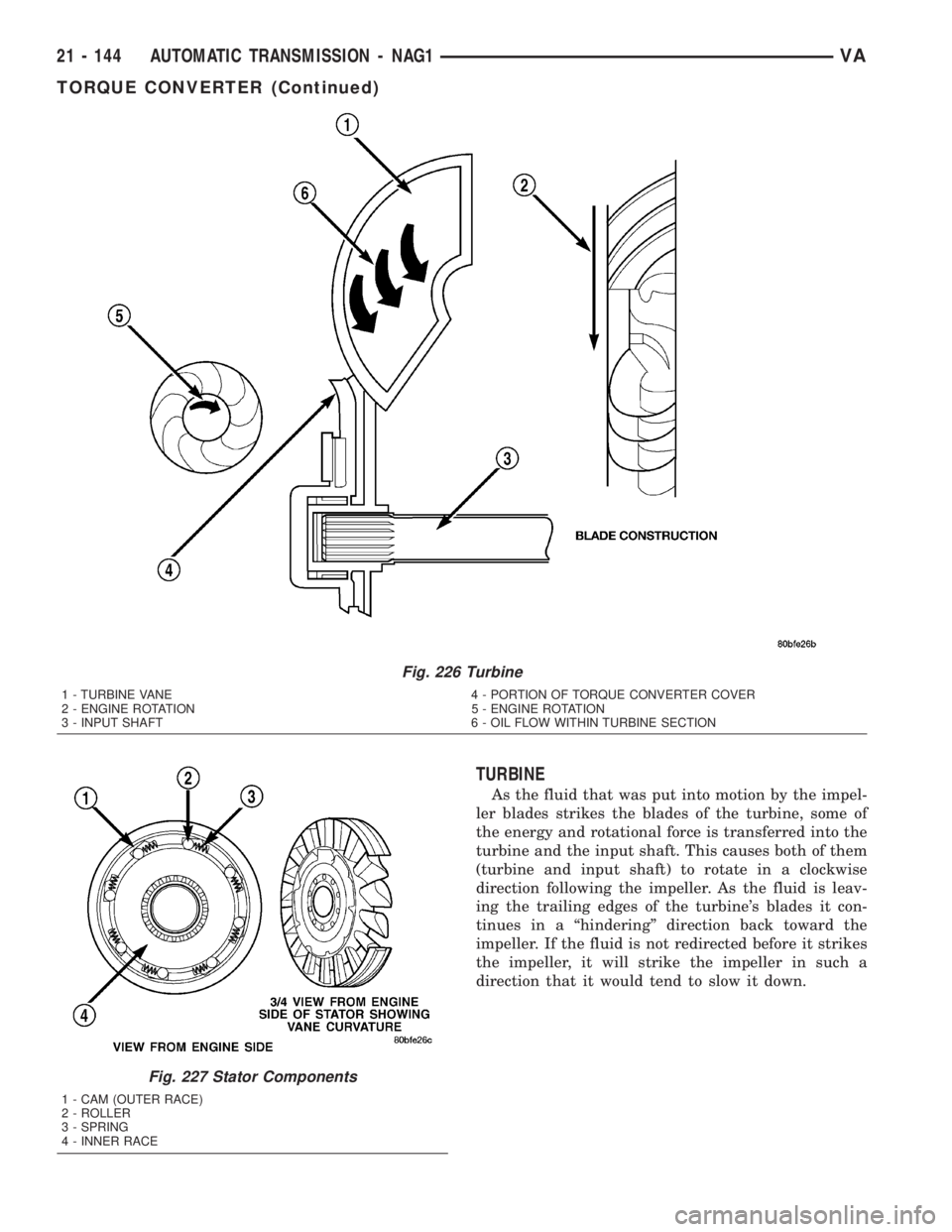
TURBINE
As the fluid that was put into motion by the impel-
ler blades strikes the blades of the turbine, some of
the energy and rotational force is transferred into the
turbine and the input shaft. This causes both of them
(turbine and input shaft) to rotate in a clockwise
direction following the impeller. As the fluid is leav-
ing the trailing edges of the turbine's blades it con-
tinues in a ªhinderingº direction back toward the
impeller. If the fluid is not redirected before it strikes
the impeller, it will strike the impeller in such a
direction that it would tend to slow it down.
Fig. 226 Turbine
1 - TURBINE VANE 4 - PORTION OF TORQUE CONVERTER COVER
2 - ENGINE ROTATION 5 - ENGINE ROTATION
3 - INPUT SHAFT 6 - OIL FLOW WITHIN TURBINE SECTION
Fig. 227 Stator Components
1 - CAM (OUTER RACE)
2 - ROLLER
3 - SPRING
4 - INNER RACE
21 - 144 AUTOMATIC TRANSMISSION - NAG1VA
TORQUE CONVERTER (Continued)