lock MERCEDES-BENZ SPRINTER 2006 Service Manual
[x] Cancel search | Manufacturer: MERCEDES-BENZ, Model Year: 2006, Model line: SPRINTER, Model: MERCEDES-BENZ SPRINTER 2006Pages: 2305, PDF Size: 48.12 MB
Page 375 of 2305
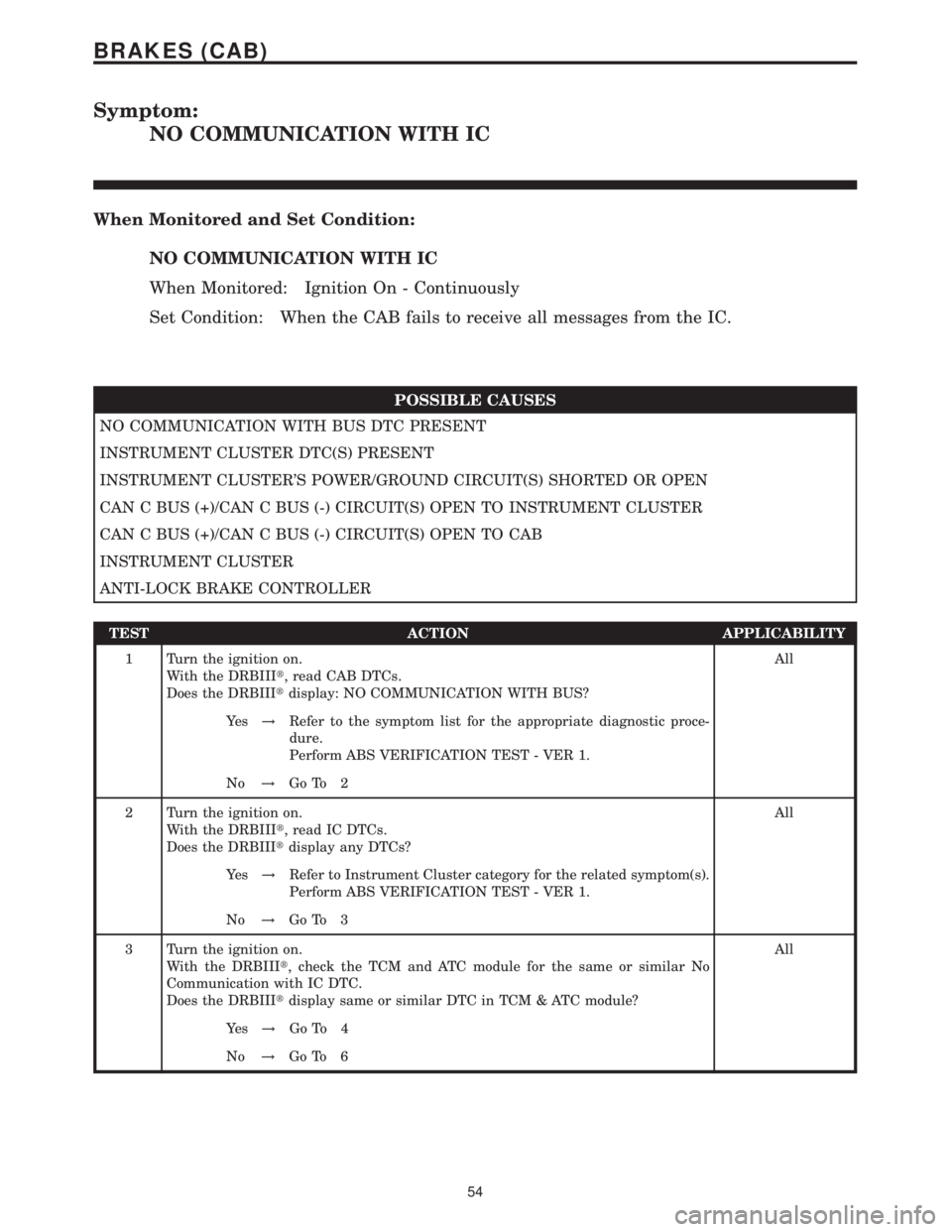
Symptom:
NO COMMUNICATION WITH IC
When Monitored and Set Condition:
NO COMMUNICATION WITH IC
When Monitored: Ignition On - Continuously
Set Condition: When the CAB fails to receive all messages from the IC.
POSSIBLE CAUSES
NO COMMUNICATION WITH BUS DTC PRESENT
INSTRUMENT CLUSTER DTC(S) PRESENT
INSTRUMENT CLUSTER'S POWER/GROUND CIRCUIT(S) SHORTED OR OPEN
CAN C BUS (+)/CAN C BUS (-) CIRCUIT(S) OPEN TO INSTRUMENT CLUSTER
CAN C BUS (+)/CAN C BUS (-) CIRCUIT(S) OPEN TO CAB
INSTRUMENT CLUSTER
ANTI-LOCK BRAKE CONTROLLER
TEST ACTION APPLICABILITY
1 Turn the ignition on.
With the DRBIIIt, read CAB DTCs.
Does the DRBIIItdisplay: NO COMMUNICATION WITH BUS?All
Ye s!Refer to the symptom list for the appropriate diagnostic proce-
dure.
Perform ABS VERIFICATION TEST - VER 1.
No!Go To 2
2 Turn the ignition on.
With the DRBIIIt, read IC DTCs.
Does the DRBIIItdisplay any DTCs?All
Ye s!Refer to Instrument Cluster category for the related symptom(s).
Perform ABS VERIFICATION TEST - VER 1.
No!Go To 3
3 Turn the ignition on.
With the DRBIIIt, check the TCM and ATC module for the same or similar No
Communication with IC DTC.
Does the DRBIIItdisplay same or similar DTC in TCM & ATC module?All
Ye s!Go To 4
No!Go To 6
54
BRAKES (CAB)
Page 376 of 2305
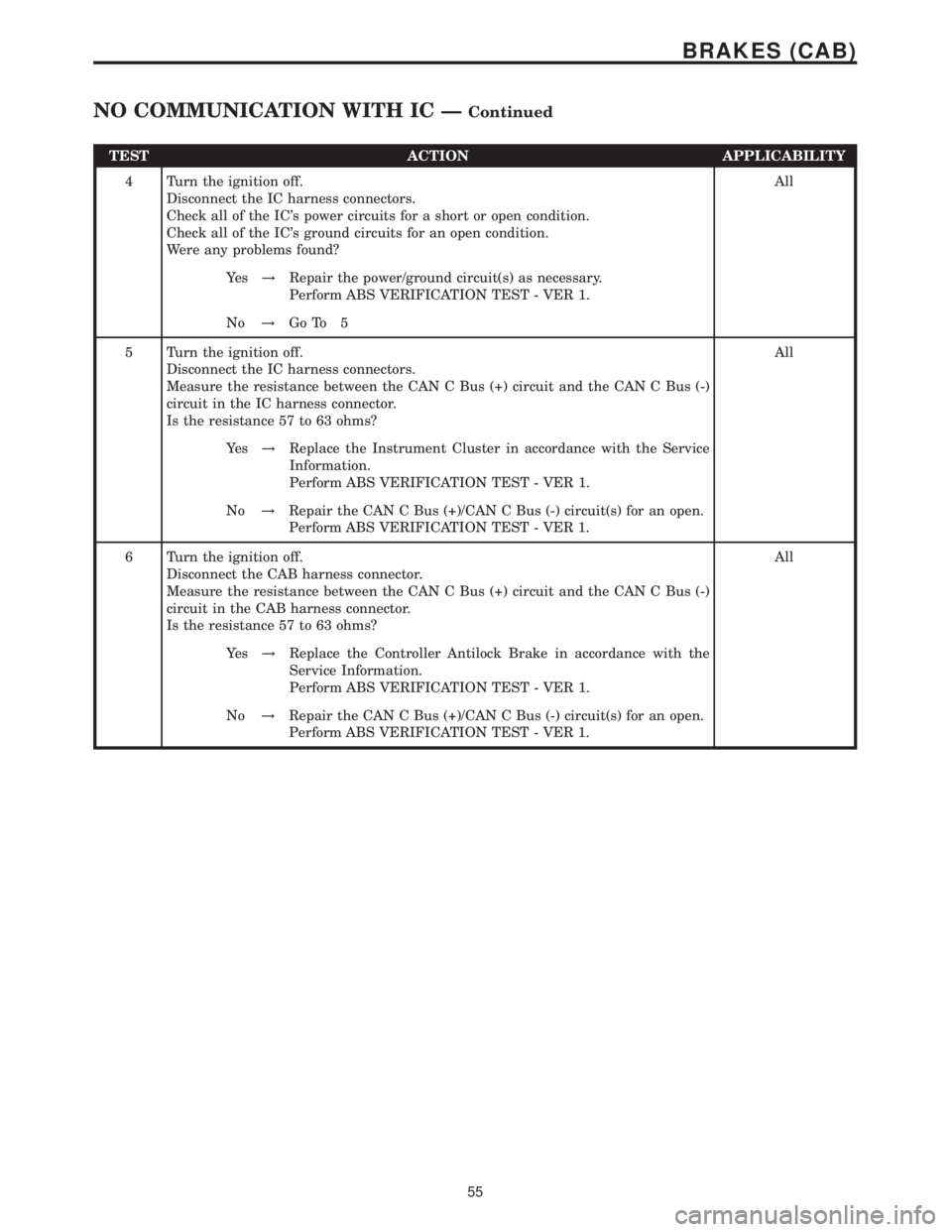
TEST ACTION APPLICABILITY
4 Turn the ignition off.
Disconnect the IC harness connectors.
Check all of the IC's power circuits for a short or open condition.
Check all of the IC's ground circuits for an open condition.
Were any problems found?All
Ye s!Repair the power/ground circuit(s) as necessary.
Perform ABS VERIFICATION TEST - VER 1.
No!Go To 5
5 Turn the ignition off.
Disconnect the IC harness connectors.
Measure the resistance between the CAN C Bus (+) circuit and the CAN C Bus (-)
circuit in the IC harness connector.
Is the resistance 57 to 63 ohms?All
Ye s!Replace the Instrument Cluster in accordance with the Service
Information.
Perform ABS VERIFICATION TEST - VER 1.
No!Repair the CAN C Bus (+)/CAN C Bus (-) circuit(s) for an open.
Perform ABS VERIFICATION TEST - VER 1.
6 Turn the ignition off.
Disconnect the CAB harness connector.
Measure the resistance between the CAN C Bus (+) circuit and the CAN C Bus (-)
circuit in the CAB harness connector.
Is the resistance 57 to 63 ohms?All
Ye s!Replace the Controller Antilock Brake in accordance with the
Service Information.
Perform ABS VERIFICATION TEST - VER 1.
No!Repair the CAN C Bus (+)/CAN C Bus (-) circuit(s) for an open.
Perform ABS VERIFICATION TEST - VER 1.
55
BRAKES (CAB)
NO COMMUNICATION WITH IC ÐContinued
Page 381 of 2305
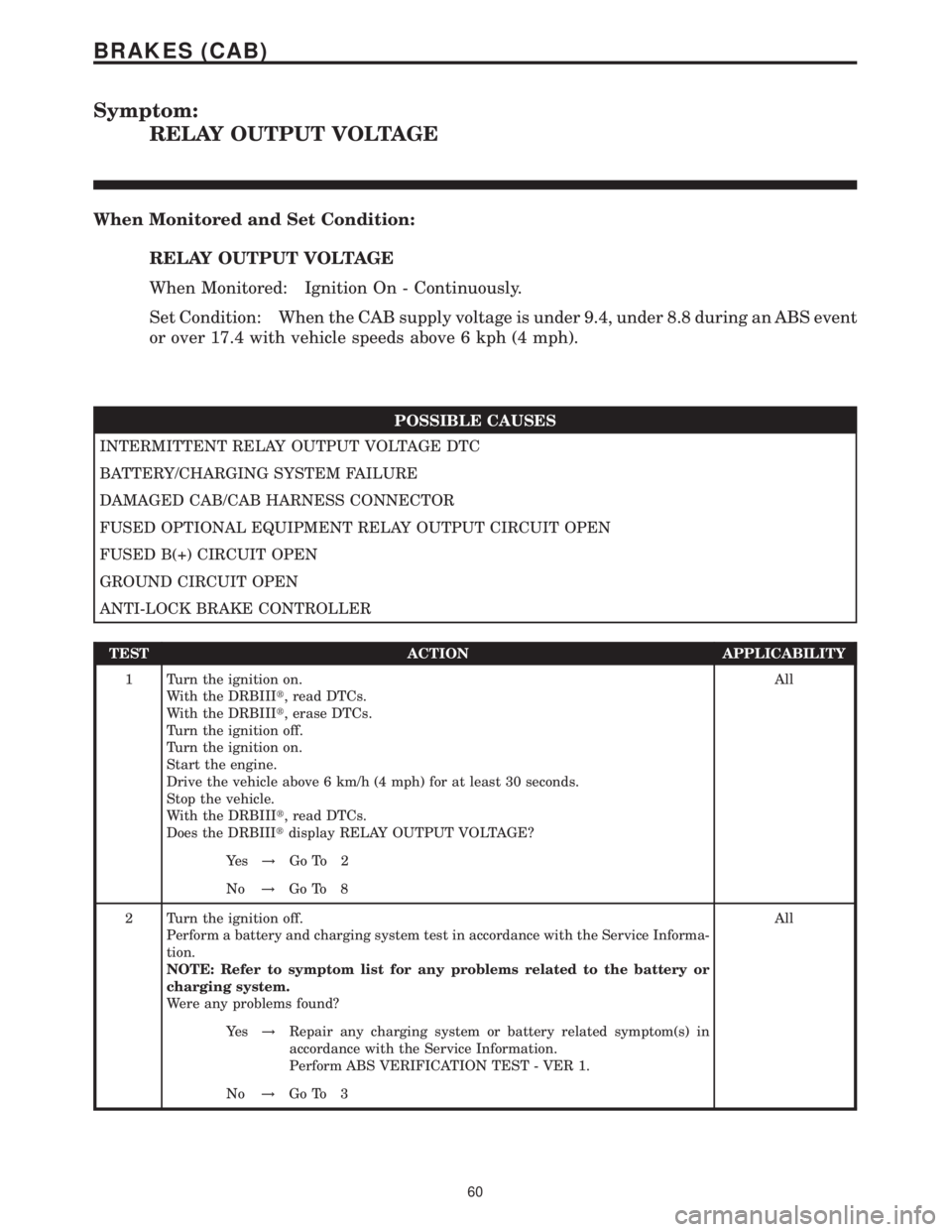
Symptom:
RELAY OUTPUT VOLTAGE
When Monitored and Set Condition:
RELAY OUTPUT VOLTAGE
When Monitored: Ignition On - Continuously.
Set Condition: When the CAB supply voltage is under 9.4, under 8.8 during an ABS event
or over 17.4 with vehicle speeds above 6 kph (4 mph).
POSSIBLE CAUSES
INTERMITTENT RELAY OUTPUT VOLTAGE DTC
BATTERY/CHARGING SYSTEM FAILURE
DAMAGED CAB/CAB HARNESS CONNECTOR
FUSED OPTIONAL EQUIPMENT RELAY OUTPUT CIRCUIT OPEN
FUSED B(+) CIRCUIT OPEN
GROUND CIRCUIT OPEN
ANTI-LOCK BRAKE CONTROLLER
TEST ACTION APPLICABILITY
1 Turn the ignition on.
With the DRBIIIt, read DTCs.
With the DRBIIIt, erase DTCs.
Turn the ignition off.
Turn the ignition on.
Start the engine.
Drive the vehicle above 6 km/h (4 mph) for at least 30 seconds.
Stop the vehicle.
With the DRBIIIt, read DTCs.
Does the DRBIIItdisplay RELAY OUTPUT VOLTAGE?All
Ye s!Go To 2
No!Go To 8
2 Turn the ignition off.
Perform a battery and charging system test in accordance with the Service Informa-
tion.
NOTE: Refer to symptom list for any problems related to the battery or
charging system.
Were any problems found?All
Ye s!Repair any charging system or battery related symptom(s) in
accordance with the Service Information.
Perform ABS VERIFICATION TEST - VER 1.
No!Go To 3
60
BRAKES (CAB)
Page 383 of 2305
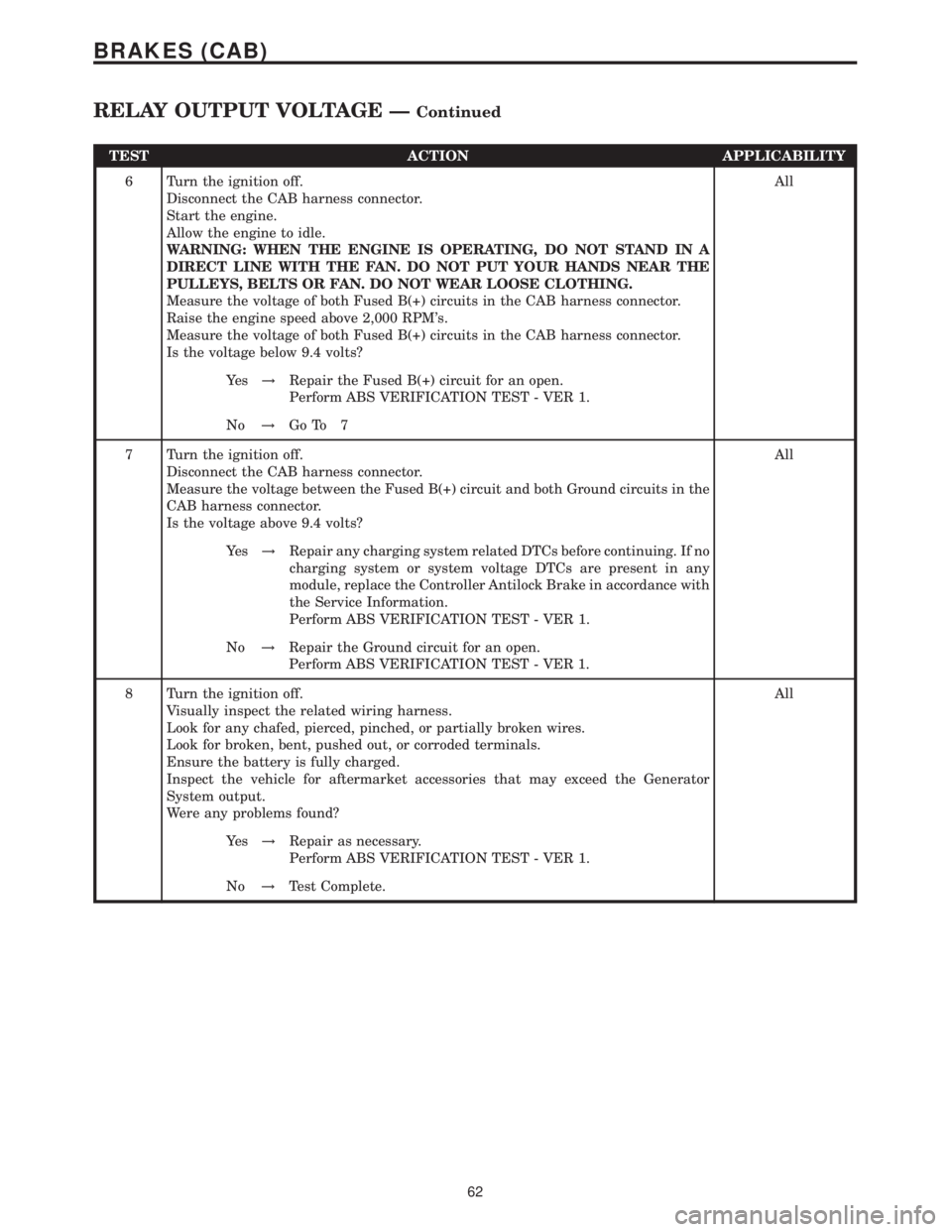
TEST ACTION APPLICABILITY
6 Turn the ignition off.
Disconnect the CAB harness connector.
Start the engine.
Allow the engine to idle.
WARNING: WHEN THE ENGINE IS OPERATING, DO NOT STAND IN A
DIRECT LINE WITH THE FAN. DO NOT PUT YOUR HANDS NEAR THE
PULLEYS, BELTS OR FAN. DO NOT WEAR LOOSE CLOTHING.
Measure the voltage of both Fused B(+) circuits in the CAB harness connector.
Raise the engine speed above 2,000 RPM's.
Measure the voltage of both Fused B(+) circuits in the CAB harness connector.
Is the voltage below 9.4 volts?All
Ye s!Repair the Fused B(+) circuit for an open.
Perform ABS VERIFICATION TEST - VER 1.
No!Go To 7
7 Turn the ignition off.
Disconnect the CAB harness connector.
Measure the voltage between the Fused B(+) circuit and both Ground circuits in the
CAB harness connector.
Is the voltage above 9.4 volts?All
Ye s!Repair any charging system related DTCs before continuing. If no
charging system or system voltage DTCs are present in any
module, replace the Controller Antilock Brake in accordance with
the Service Information.
Perform ABS VERIFICATION TEST - VER 1.
No!Repair the Ground circuit for an open.
Perform ABS VERIFICATION TEST - VER 1.
8 Turn the ignition off.
Visually inspect the related wiring harness.
Look for any chafed, pierced, pinched, or partially broken wires.
Look for broken, bent, pushed out, or corroded terminals.
Ensure the battery is fully charged.
Inspect the vehicle for aftermarket accessories that may exceed the Generator
System output.
Were any problems found?All
Ye s!Repair as necessary.
Perform ABS VERIFICATION TEST - VER 1.
No!Test Complete.
62
BRAKES (CAB)
RELAY OUTPUT VOLTAGE ÐContinued
Page 384 of 2305
Symptom:
SOLENOID RELAY
When Monitored and Set Condition:
SOLENOID RELAY
When Monitored: Ignition On - Continuously.
Set Condition: When there is a voltage deviation from the expected result of a CAB
internal self check.
POSSIBLE CAUSES
INTERMITTENT SOLENOID RELAY DTC
DAMAGED CAB/CAB HARNESS CONNECTOR
FUSED OPTIONAL EQUIPMENT RELAY OUTPUT CIRCUIT OPEN
FUSED B(+) CIRCUIT OPEN
GROUND CIRCUIT OPEN
ANTI-LOCK BRAKE CONTROLLER
TEST ACTION APPLICABILITY
1 Turn the ignition on.
With the DRBIIIt, read DTCs.
With the DRBIIIt, erase DTCs.
Turn the ignition off.
Turn the ignition on.
With the DRBIIIt, read DTCs.
Does the DRBIIItdisplay SOLENOID RELAY?All
Ye s!Go To 2
No!Go To 6
2 Turn the ignition off.
Disconnect the CAB harness connector.
Inspect the CAB/CAB harness connector for damage.
Is there any broken, bent, pushed out, corroded or spread terminals?All
Ye s!Repair as necessary.
Perform ABS VERIFICATION TEST - VER 1.
No!Go To 3
63
BRAKES (CAB)
Page 385 of 2305
TEST ACTION APPLICABILITY
3 Turn the ignition off.
Disconnect the CAB harness connector.
Turn the ignition on.
Using a 12-volt test light connected to ground, check the Fused Optional Equipment
Relay Output circuit at the CAB harness connector.
NOTE: The test light must illuminate brightly. Compare the brightness to
that of a direct connection to the battery.
Does the test light illuminate brightly?All
Ye s!Go To 4
No!Repair the Fused Optional Equipment Relay Output circuit for an
open.
Perform ABS VERIFICATION TEST - VER 1.
4 Turn the ignition off.
Disconnect the CAB harness connector.
Using a 12-volt test light connected to ground, check both Fused B(+) circuits at the
CAB harness connector.
NOTE: The test light must illuminate brightly. Compare the brightness to
that of a direct connection to the battery.
Does the test light illuminate brightly?All
Ye s!Go To 5
No!Repair the Fused B(+) circuit for an open.
Perform ABS VERIFICATION TEST - VER 1.
5 Turn the ignition off.
Disconnect the CAB harness connector.
Using a 12-volt test light connected to 12-volts, check the CAB harness connector
Ground circuits.
NOTE: The test light must illuminate brightly. Compare the brightness to
that of a direct connection to the battery.
Does the test light illuminate brightly?All
Ye s!Replace the Controller Antilock Brake in accordance with the
Service Information.
Perform ABS VERIFICATION TEST - VER 1.
No!Repair the Ground circuit for an open.
Perform ABS VERIFICATION TEST - VER 1.
6 Turn the ignition off.
Visually inspect the related wiring harness.
Look for any chafed, pierced, pinched, or partially broken wires.
Look for broken, bent, pushed out, or corroded terminals.
Were any problems found?All
Ye s!Repair as necessary.
Perform ABS VERIFICATION TEST - VER 1.
No!Test Complete.
64
BRAKES (CAB)
SOLENOID RELAY ÐContinued
Page 389 of 2305
Symptom:
STEERING ANGLE SENSOR IMPLAUSIBLE CAN SIGNAL
POSSIBLE CAUSES
STEERING ANGLE SENSOR INTERMITTENT DTC
STEERING ANGLE SENSOR CAN CIRCUIT OPEN
STEERING ANGLE SENSOR
ANTI-LOCK BRAKE CONTROLLER
TEST ACTION APPLICABILITY
1NOTE: If a system undervoltage or overvoltage DTC is set along with this
DTC, diagnose the system voltage DTC first.
NOTE: Electromagnetic (radio) interference can cause an intermittent
system malfunction by interrupting communication between the sensor
and the CAB.
NOTE: The Steering Angle Sensor is very sensitive to changes due to
alignment problems. The sensor must be recalculated using the DRBIIItif
alignment has been changed by more than 5 degrees.
Turn the ignition on.
With the DRBIIIt, erase DTCs.
Test drive the vehicle.
Using the DRBIIIt, perform the road test procedure.
With the DRBIIIt, read DTCs.
NOTE: If the ESP lamp remains illuminated after the test has completed, a
fault code will be set indicating the cause of the failure.
Does this DTC reset?All
Ye s!Go To 2
No!Go To 4
2 Turn the ignition off.
Disconnect the Steering Angle Sensor harness connector.
Disconnect the CAB harness connector.
Measure the resistance of the Steering Angle Sensor CAN(+) circuit.
Measure the resistance of the Steering Angle Sensor CAN(-) circuit.
Is the resistance above 5.0 ohms for either circuit?All
Ye s!Repair the Steering Angle Sensor CAN circuit for an open.
No!Go To 3
68
BRAKES (CAB)
Page 396 of 2305
Symptom:
SYSTEM OVERVOLTAGE
POSSIBLE CAUSES
INTERMITTENT DTC
DAMAGED CAB/CAB HARNESS CONNECTOR
GROUND CIRCUIT OPEN
ANTI-LOCK BRAKE CONTROLLER
TEST ACTION APPLICABILITY
1NOTE: Repair any Powertrain charging system DTCs before continuing.
Turn the ignition on.
With the DRBIIIt, read DTCs.
With the DRBIIIt, erase DTCs.
Turn the ignition off.
Turn the ignition on.
Start the engine.
With the DRBIIIt, read DTCs.
Does this DTC reset?All
Ye s!Go To 2
No!Go To 4
2 Turn the ignition off.
Disconnect the CAB harness connector.
Inspect the CAB/CAB harness connector for damage.
Is there any broken, bent, pushed out, corroded or spread terminals?All
Ye s!Repair as necessary.
Perform ABS VERIFICATION TEST - VER 1.
No!Go To 3
3 Turn the ignition off.
Disconnect the CAB harness connector.
Using a 12-volt test light connected to 12-volts, check the CAB harness connector
Ground circuits.
NOTE: The test light must illuminate brightly. Compare the brightness to
that of a direct connection to the battery.
Does the test light illuminate brightly?All
Ye s!Replace the Controller Antilock Brake in accordance with the
Service Information.
Perform ABS VERIFICATION TEST - VER 1.
No!Repair the Ground circuit for an open.
Perform ABS VERIFICATION TEST - VER 1.
75
BRAKES (CAB)
Page 398 of 2305
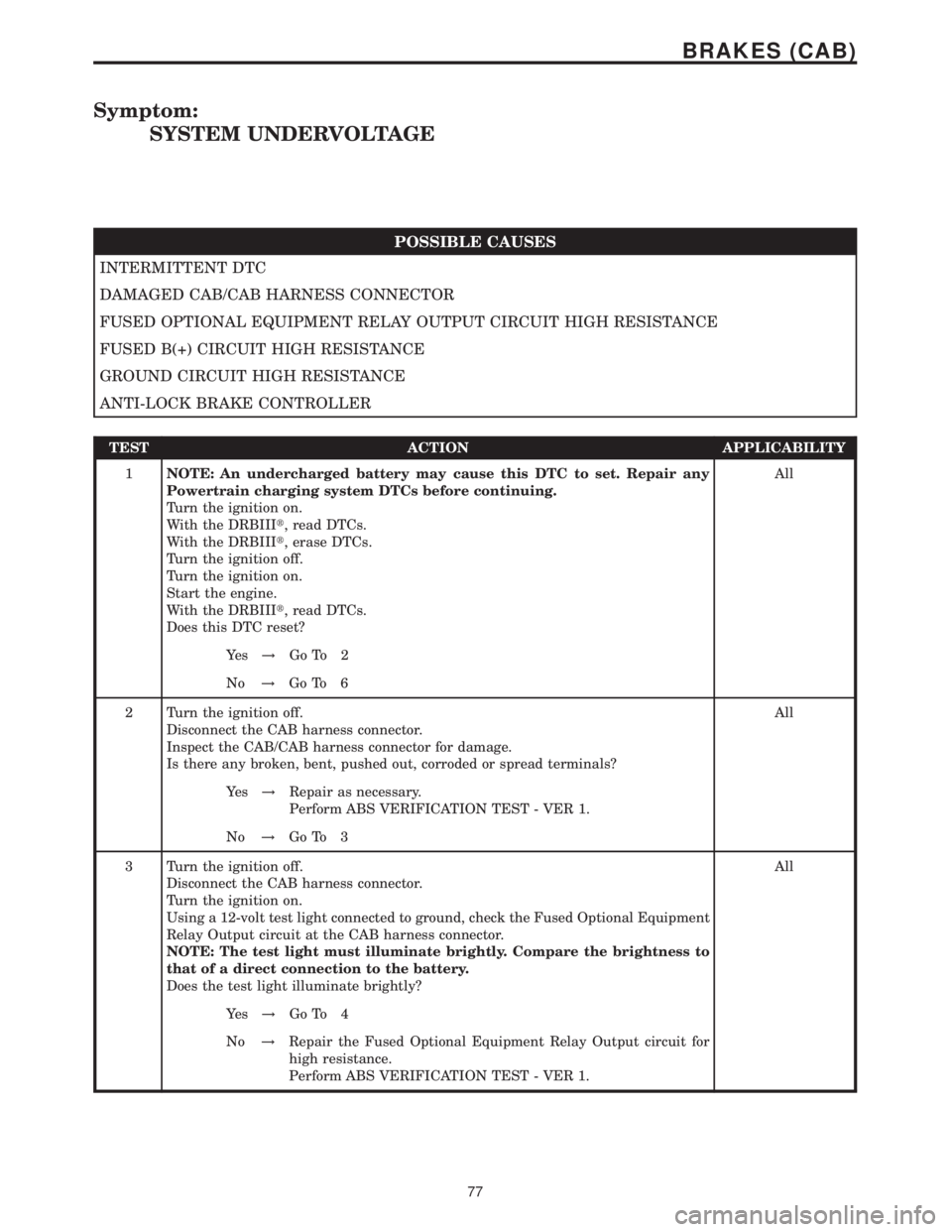
Symptom:
SYSTEM UNDERVOLTAGE
POSSIBLE CAUSES
INTERMITTENT DTC
DAMAGED CAB/CAB HARNESS CONNECTOR
FUSED OPTIONAL EQUIPMENT RELAY OUTPUT CIRCUIT HIGH RESISTANCE
FUSED B(+) CIRCUIT HIGH RESISTANCE
GROUND CIRCUIT HIGH RESISTANCE
ANTI-LOCK BRAKE CONTROLLER
TEST ACTION APPLICABILITY
1NOTE: An undercharged battery may cause this DTC to set. Repair any
Powertrain charging system DTCs before continuing.
Turn the ignition on.
With the DRBIIIt, read DTCs.
With the DRBIIIt, erase DTCs.
Turn the ignition off.
Turn the ignition on.
Start the engine.
With the DRBIIIt, read DTCs.
Does this DTC reset?All
Ye s!Go To 2
No!Go To 6
2 Turn the ignition off.
Disconnect the CAB harness connector.
Inspect the CAB/CAB harness connector for damage.
Is there any broken, bent, pushed out, corroded or spread terminals?All
Ye s!Repair as necessary.
Perform ABS VERIFICATION TEST - VER 1.
No!Go To 3
3 Turn the ignition off.
Disconnect the CAB harness connector.
Turn the ignition on.
Using a 12-volt test light connected to ground, check the Fused Optional Equipment
Relay Output circuit at the CAB harness connector.
NOTE: The test light must illuminate brightly. Compare the brightness to
that of a direct connection to the battery.
Does the test light illuminate brightly?All
Ye s!Go To 4
No!Repair the Fused Optional Equipment Relay Output circuit for
high resistance.
Perform ABS VERIFICATION TEST - VER 1.
77
BRAKES (CAB)
Page 399 of 2305
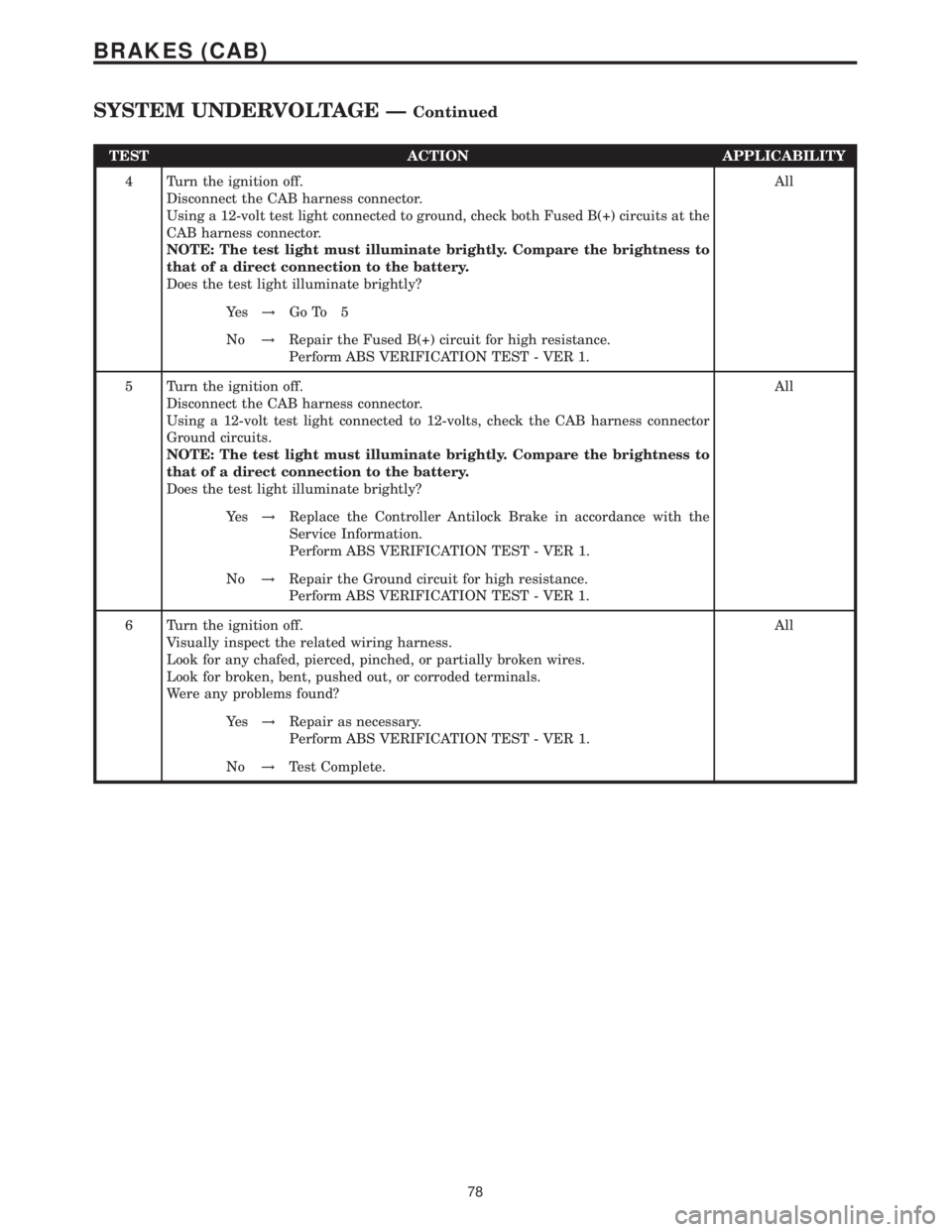
TEST ACTION APPLICABILITY
4 Turn the ignition off.
Disconnect the CAB harness connector.
Using a 12-volt test light connected to ground, check both Fused B(+) circuits at the
CAB harness connector.
NOTE: The test light must illuminate brightly. Compare the brightness to
that of a direct connection to the battery.
Does the test light illuminate brightly?All
Ye s!Go To 5
No!Repair the Fused B(+) circuit for high resistance.
Perform ABS VERIFICATION TEST - VER 1.
5 Turn the ignition off.
Disconnect the CAB harness connector.
Using a 12-volt test light connected to 12-volts, check the CAB harness connector
Ground circuits.
NOTE: The test light must illuminate brightly. Compare the brightness to
that of a direct connection to the battery.
Does the test light illuminate brightly?All
Ye s!Replace the Controller Antilock Brake in accordance with the
Service Information.
Perform ABS VERIFICATION TEST - VER 1.
No!Repair the Ground circuit for high resistance.
Perform ABS VERIFICATION TEST - VER 1.
6 Turn the ignition off.
Visually inspect the related wiring harness.
Look for any chafed, pierced, pinched, or partially broken wires.
Look for broken, bent, pushed out, or corroded terminals.
Were any problems found?All
Ye s!Repair as necessary.
Perform ABS VERIFICATION TEST - VER 1.
No!Test Complete.
78
BRAKES (CAB)
SYSTEM UNDERVOLTAGE ÐContinued