lock MERCEDES-BENZ SPRINTER 2006 Service Manual
[x] Cancel search | Manufacturer: MERCEDES-BENZ, Model Year: 2006, Model line: SPRINTER, Model: MERCEDES-BENZ SPRINTER 2006Pages: 2305, PDF Size: 48.12 MB
Page 400 of 2305
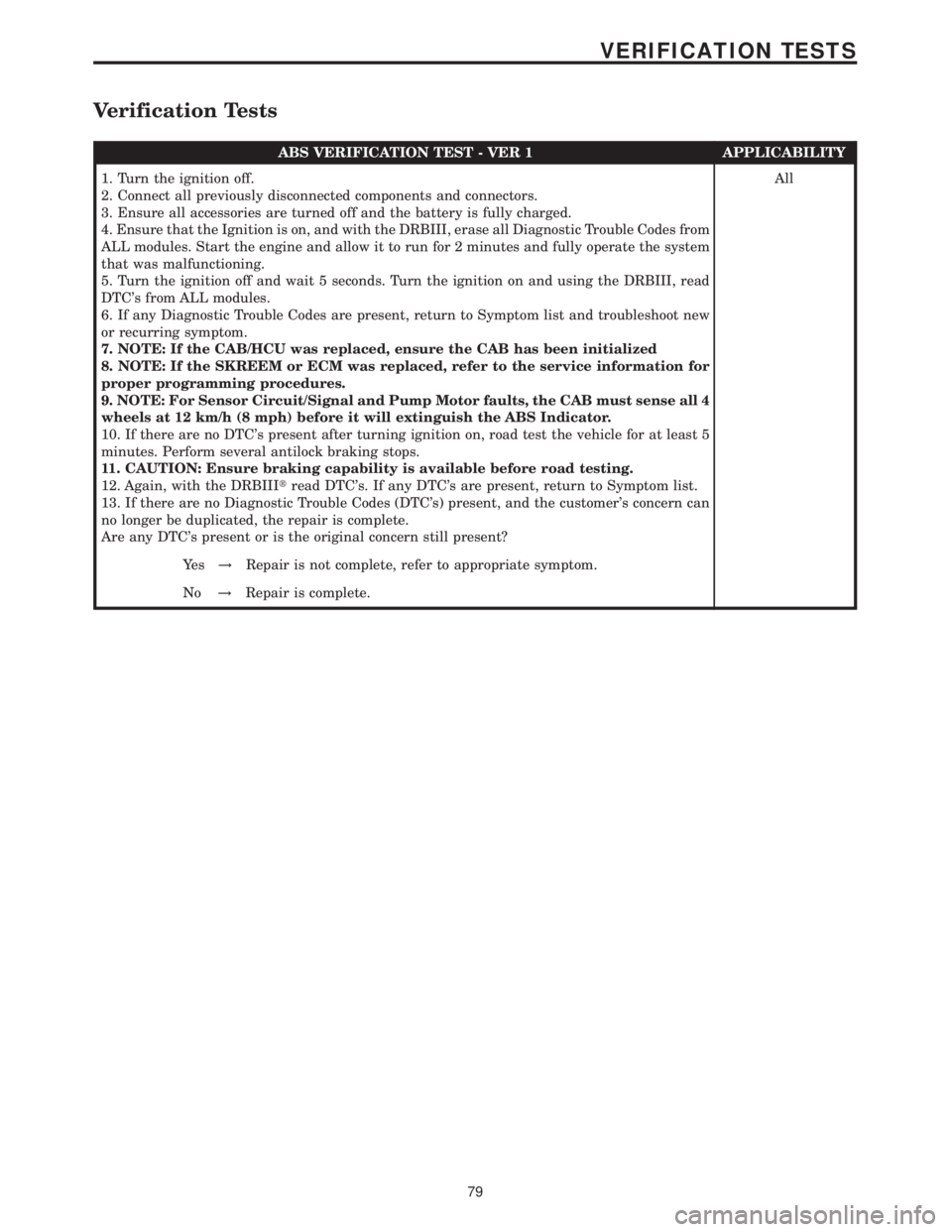
Verification Tests
ABS VERIFICATION TEST - VER 1 APPLICABILITY
1. Turn the ignition off.
2. Connect all previously disconnected components and connectors.
3. Ensure all accessories are turned off and the battery is fully charged.
4. Ensure that the Ignition is on, and with the DRBIII, erase all Diagnostic Trouble Codes from
ALL modules. Start the engine and allow it to run for 2 minutes and fully operate the system
that was malfunctioning.
5. Turn the ignition off and wait 5 seconds. Turn the ignition on and using the DRBIII, read
DTC's from ALL modules.
6. If any Diagnostic Trouble Codes are present, return to Symptom list and troubleshoot new
or recurring symptom.
7. NOTE: If the CAB/HCU was replaced, ensure the CAB has been initialized
8. NOTE: If the SKREEM or ECM was replaced, refer to the service information for
proper programming procedures.
9. NOTE: For Sensor Circuit/Signal and Pump Motor faults, the CAB must sense all 4
wheels at 12 km/h (8 mph) before it will extinguish the ABS Indicator.
10. If there are no DTC's present after turning ignition on, road test the vehicle for at least 5
minutes. Perform several antilock braking stops.
11. CAUTION: Ensure braking capability is available before road testing.
12. Again, with the DRBIIItread DTC's. If any DTC's are present, return to Symptom list.
13. If there are no Diagnostic Trouble Codes (DTC's) present, and the customer's concern can
no longer be duplicated, the repair is complete.
Are any DTC's present or is the original concern still present?All
Ye s!Repair is not complete, refer to appropriate symptom.
No!Repair is complete.
79
VERIFICATION TESTS
Page 405 of 2305
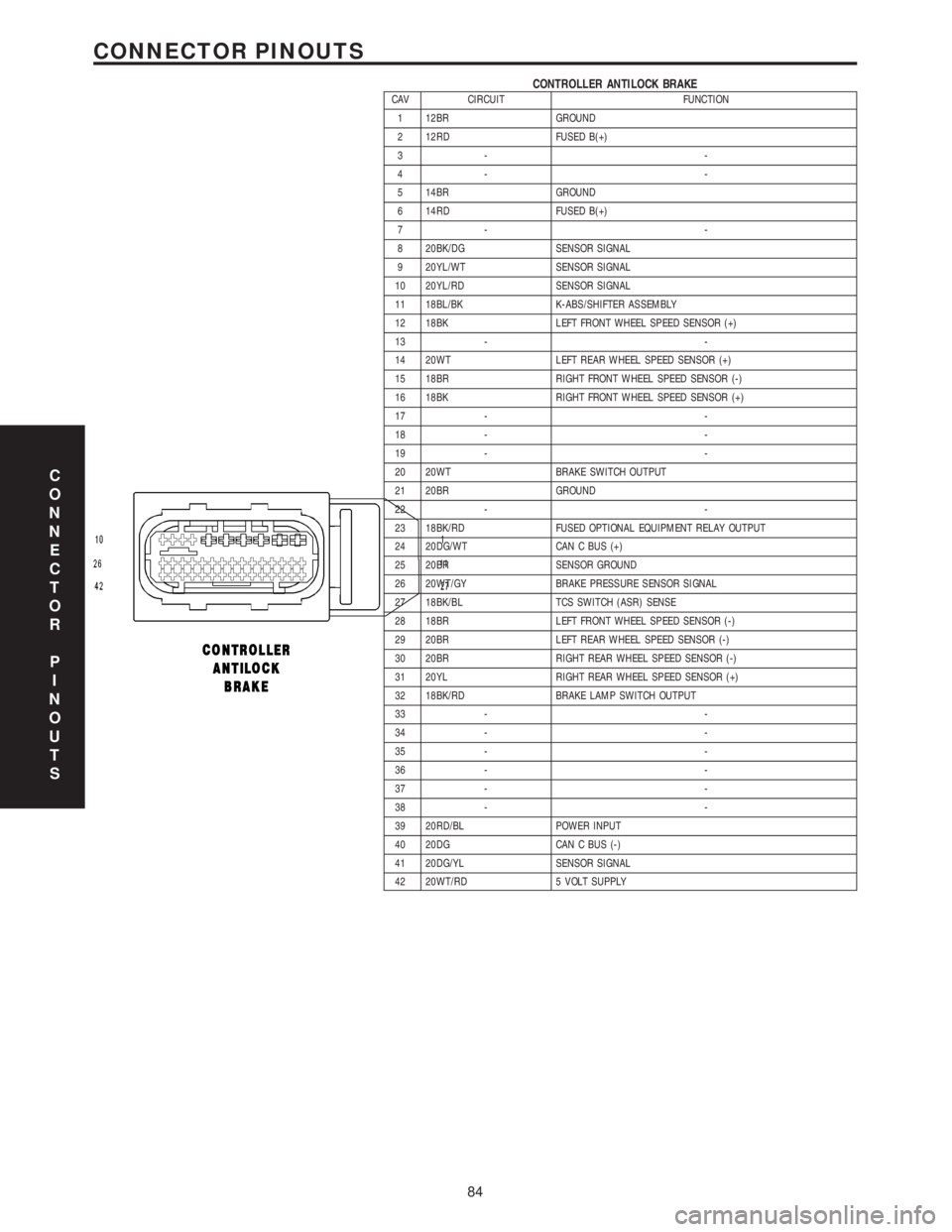
CONTROLLER ANTILOCK BRAKECAV CIRCUIT FUNCTION
1 12BR GROUND
2 12RD FUSED B(+)
3- -
4- -
5 14BR GROUND
6 14RD FUSED B(+)
7- -
8 20BK/DG SENSOR SIGNAL
9 20YL/WT SENSOR SIGNAL
10 20YL/RD SENSOR SIGNAL
11 18BL/BK K-ABS/SHIFTER ASSEMBLY
12 18BK LEFT FRONT WHEEL SPEED SENSOR (+)
13 - -
14 20WT LEFT REAR WHEEL SPEED SENSOR (+)
15 18BR RIGHT FRONT WHEEL SPEED SENSOR (-)
16 18BK RIGHT FRONT WHEEL SPEED SENSOR (+)
17 - -
18 - -
19 - -
20 20WT BRAKE SWITCH OUTPUT
21 20BR GROUND
22 - -
23 18BK/RD FUSED OPTIONAL EQUIPMENT RELAY OUTPUT
24 20DG/WT CAN C BUS (+)
25 20BR SENSOR GROUND
26 20WT/GY BRAKE PRESSURE SENSOR SIGNAL
27 18BK/BL TCS SWITCH (ASR) SENSE
28 18BR LEFT FRONT WHEEL SPEED SENSOR (-)
29 20BR LEFT REAR WHEEL SPEED SENSOR (-)
30 20BR RIGHT REAR WHEEL SPEED SENSOR (-)
31 20YL RIGHT REAR WHEEL SPEED SENSOR (+)
32 18BK/RD BRAKE LAMP SWITCH OUTPUT
33 - -
34 - -
35 - -
36 - -
37 - -
38 - -
39 20RD/BL POWER INPUT
40 20DG CAN C BUS (-)
41 20DG/YL SENSOR SIGNAL
42 20WT/RD 5 VOLT SUPPLY
C
O
N
N
E
C
T
O
R
P
I
N
O
U
T
S
84
CONNECTOR PINOUTS
Page 408 of 2305
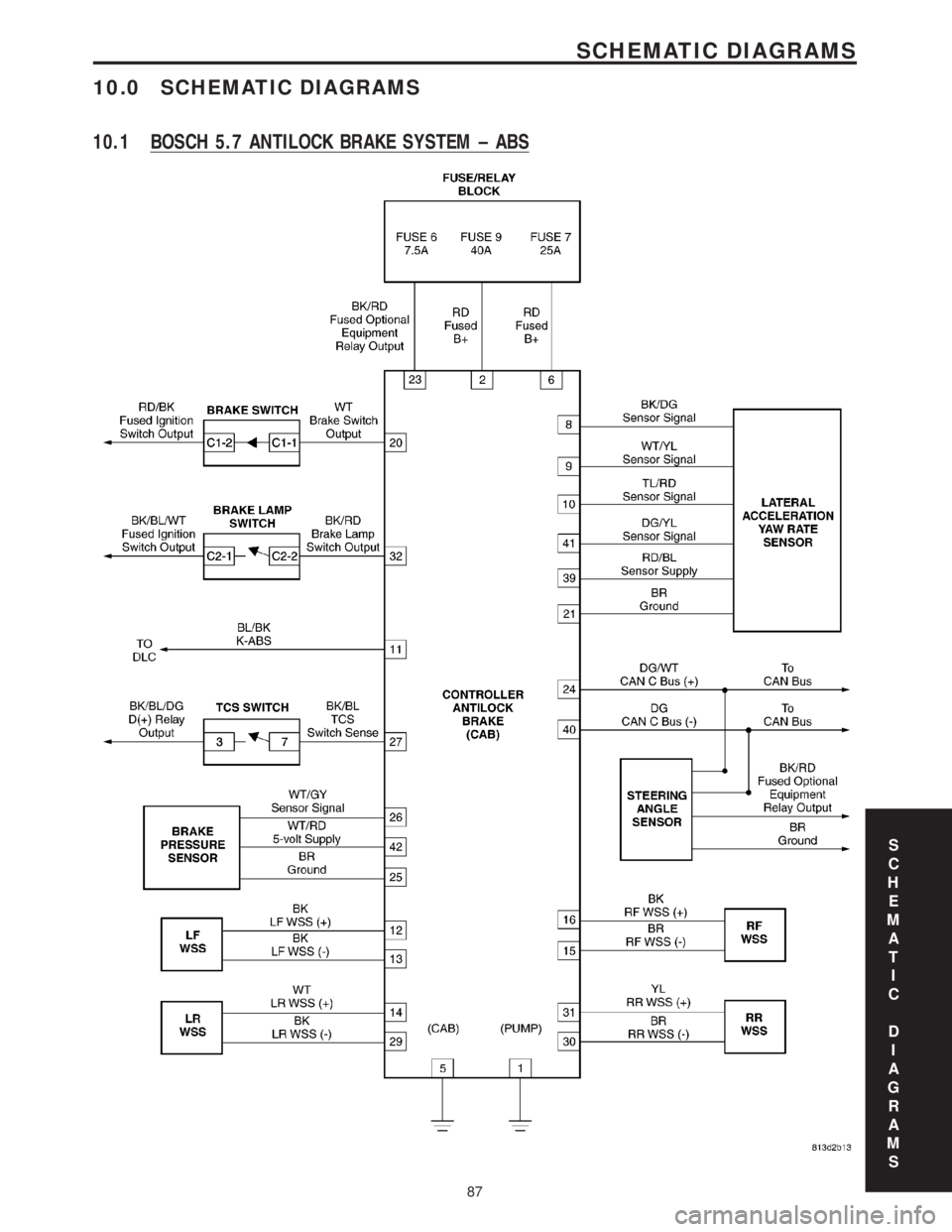
10.0 SCHEMATIC DIAGRAMS
10.1 BOSCH 5.7 ANTILOCK BRAKE SYSTEM ± ABS
S
C
H
E
M
A
T
I
C
D
I
A
G
R
A
M
S
87
SCHEMATIC DIAGRAMS
Page 421 of 2305
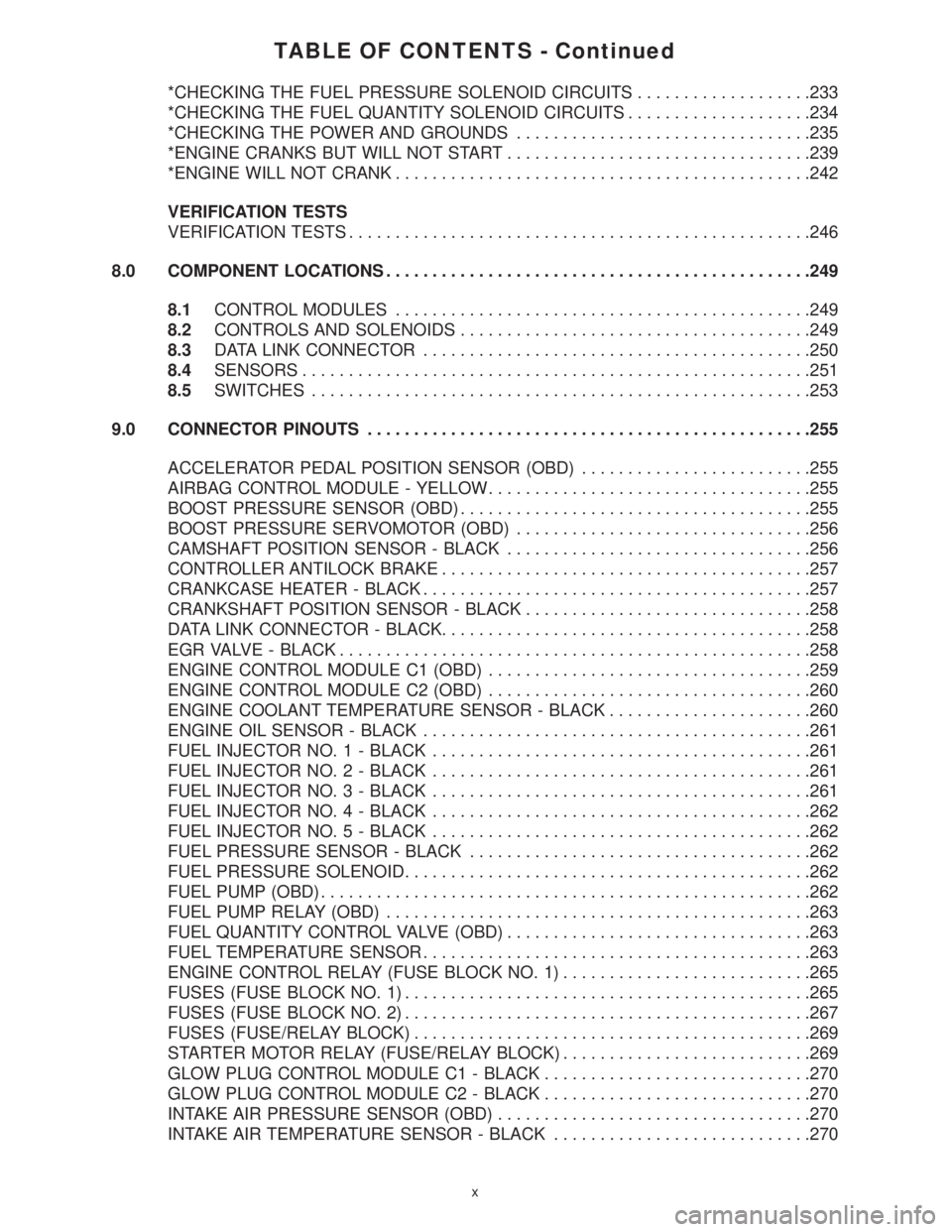
TABLE OF CONTENTS - Continued
*CHECKING THE FUEL PRESSURE SOLENOID CIRCUITS...................233
*CHECKING THE FUEL QUANTITY SOLENOID CIRCUITS....................234
*CHECKING THE POWER AND GROUNDS................................235
*ENGINE CRANKS BUT WILL NOT START.................................239
*ENGINE WILL NOT CRANK.............................................242
VERIFICATION TESTS
VERIFICATION TESTS..................................................246
8.0 COMPONENT LOCATIONS..............................................249
8.1CONTROL MODULES.............................................249
8.2CONTROLS AND SOLENOIDS......................................249
8.3DATA LINK CONNECTOR..........................................250
8.4SENSORS.......................................................251
8.5SWITCHES......................................................253
9.0 CONNECTOR PINOUTS................................................255
ACCELERATOR PEDAL POSITION SENSOR (OBD).........................255
AIRBAG CONTROL MODULE - YELLOW...................................255
BOOST PRESSURE SENSOR (OBD)......................................255
BOOST PRESSURE SERVOMOTOR (OBD)................................256
CAMSHAFT POSITION SENSOR - BLACK.................................256
CONTROLLER ANTILOCK BRAKE........................................257
CRANKCASE HEATER - BLACK..........................................257
CRANKSHAFT POSITION SENSOR - BLACK...............................258
DATA LINK CONNECTOR - BLACK........................................258
EGR VALVE - BLACK...................................................258
ENGINE CONTROL MODULE C1 (OBD)...................................259
ENGINE CONTROL MODULE C2 (OBD)...................................260
ENGINE COOLANT TEMPERATURE SENSOR - BLACK......................260
ENGINE OIL SENSOR - BLACK..........................................261
FUEL INJECTOR NO. 1 - BLACK.........................................261
FUEL INJECTOR NO. 2 - BLACK.........................................261
FUEL INJECTOR NO. 3 - BLACK.........................................261
FUEL INJECTOR NO. 4 - BLACK.........................................262
FUEL INJECTOR NO. 5 - BLACK.........................................262
FUEL PRESSURE SENSOR - BLACK.....................................262
FUEL PRESSURE SOLENOID............................................262
FUEL PUMP (OBD).....................................................262
FUEL PUMP RELAY (OBD)..............................................263
FUEL QUANTITY CONTROL VALVE (OBD).................................263
FUEL TEMPERATURE SENSOR..........................................263
ENGINE CONTROL RELAY (FUSE BLOCK NO. 1)...........................265
FUSES (FUSE BLOCK NO. 1)............................................265
FUSES (FUSE BLOCK NO. 2)............................................267
FUSES (FUSE/RELAY BLOCK)...........................................269
STARTER MOTOR RELAY (FUSE/RELAY BLOCK)...........................269
GLOW PLUG CONTROL MODULE C1 - BLACK.............................270
GLOW PLUG CONTROL MODULE C2 - BLACK.............................270
INTAKE AIR PRESSURE SENSOR (OBD)..................................270
INTAKE AIR TEMPERATURE SENSOR - BLACK............................270
x
Page 422 of 2305
TABLE OF CONTENTS - Continued
KICK DOWN SWITCH - BLACK...........................................271
MASS AIR FLOW SENSOR - BLACK......................................271
OXYGEN SENSOR (OBD)...............................................271
FUSED IGNITION SWITCH RUN-START RELAY (RELAY BLOCK)..............273
SPEED CONTROL SWITCH.............................................273
WATER IN FUEL SENSOR - BLACK.......................................273
10.0 SCHEMATIC DIAGRAMS................................................275
10.1ENGINE CONTROL MODULE.......................................275
10.2ENGINE CONTROL MODULE.......................................276
11.0 CHARTS AND GRAPHS................................................277
xi
Page 431 of 2305
3.3.4 HANDLING NO TROUBLE CODE
PROBLEMS
After reading Section 3.0 (System Description
and Functional Operation), you should have a bet-
ter understanding of the theory and operation of the
on-board diagnostics and how this relates to the
diagnosis of a vehicle that may have a driveability-
related symptom or complaint. When there are no
trouble codes present, refer to the no trouble code
(*) tests.
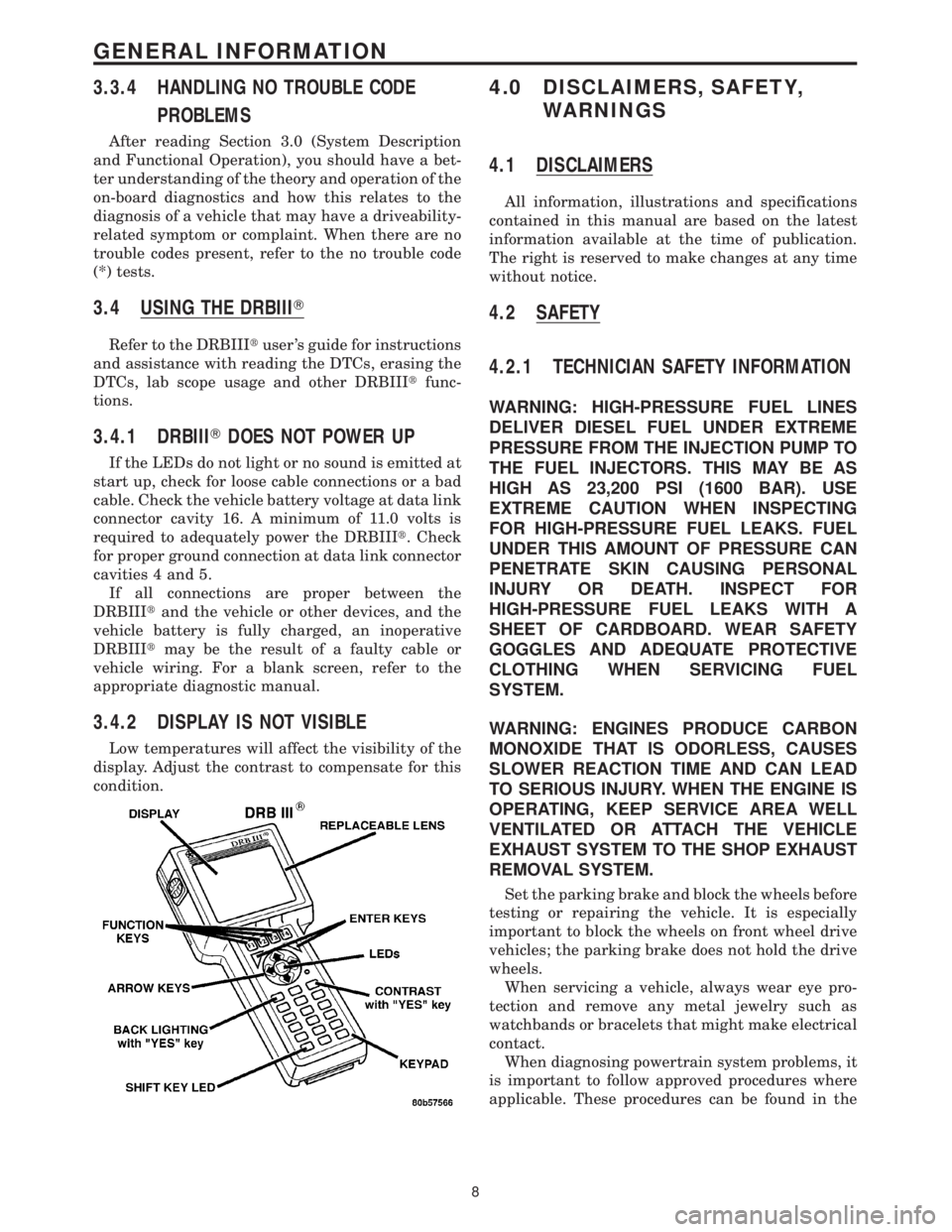
3.4 USING THE DRBIIIT
Refer to the DRBIIItuser 's guide for instructions
and assistance with reading the DTCs, erasing the
DTCs, lab scope usage and other DRBIIItfunc-
tions.
3.4.1 DRBIIITDOES NOT POWER UP
If the LEDs do not light or no sound is emitted at
start up, check for loose cable connections or a bad
cable. Check the vehicle battery voltage at data link
connector cavity 16. A minimum of 11.0 volts is
required to adequately power the DRBIIIt. Check
for proper ground connection at data link connector
cavities 4 and 5.
If all connections are proper between the
DRBIIItand the vehicle or other devices, and the
vehicle battery is fully charged, an inoperative
DRBIIItmay be the result of a faulty cable or
vehicle wiring. For a blank screen, refer to the
appropriate diagnostic manual.
3.4.2 DISPLAY IS NOT VISIBLE
Low temperatures will affect the visibility of the
display. Adjust the contrast to compensate for this
condition.
4.0 DISCLAIMERS, SAFETY,
WARNINGS
4.1 DISCLAIMERS
All information, illustrations and specifications
contained in this manual are based on the latest
information available at the time of publication.
The right is reserved to make changes at any time
without notice.
4.2 SAFETY
4.2.1 TECHNICIAN SAFETY INFORMATION
WARNING: HIGH-PRESSURE FUEL LINES
DELIVER DIESEL FUEL UNDER EXTREME
PRESSURE FROM THE INJECTION PUMP TO
THE FUEL INJECTORS. THIS MAY BE AS
HIGH AS 23,200 PSI (1600 BAR). USE
EXTREME CAUTION WHEN INSPECTING
FOR HIGH-PRESSURE FUEL LEAKS. FUEL
UNDER THIS AMOUNT OF PRESSURE CAN
PENETRATE SKIN CAUSING PERSONAL
INJURY OR DEATH. INSPECT FOR
HIGH-PRESSURE FUEL LEAKS WITH A
SHEET OF CARDBOARD. WEAR SAFETY
GOGGLES AND ADEQUATE PROTECTIVE
CLOTHING WHEN SERVICING FUEL
SYSTEM.
WARNING: ENGINES PRODUCE CARBON
MONOXIDE THAT IS ODORLESS, CAUSES
SLOWER REACTION TIME AND CAN LEAD
TO SERIOUS INJURY. WHEN THE ENGINE IS
OPERATING, KEEP SERVICE AREA WELL
VENTILATED OR ATTACH THE VEHICLE
EXHAUST SYSTEM TO THE SHOP EXHAUST
REMOVAL SYSTEM.
Set the parking brake and block the wheels before
testing or repairing the vehicle. It is especially
important to block the wheels on front wheel drive
vehicles; the parking brake does not hold the drive
wheels.
When servicing a vehicle, always wear eye pro-
tection and remove any metal jewelry such as
watchbands or bracelets that might make electrical
contact.
When diagnosing powertrain system problems, it
is important to follow approved procedures where
applicable. These procedures can be found in the
8
GENERAL INFORMATION
Page 449 of 2305
TEST ACTION APPLICABILITY
3NOTE: Inspect all air intake and turbocharger related tubes for damage,
restriction or poor connection. Any of these conditions can cause a this DTC
to set.
Turn the ignition off.
Inspect all air intake and turbocharger related tubes and connections.
Were any problems found?All
Ye s!Repair or replace as necessary.
Perform ROAD TEST VERIFICATION - VER-2.
No!Go To 4
4 With the DRBIIIt, read the active and stored DTCs for the Transmission Control
Module.
NOTE: Due to capabilities of certain controllers that use the CAN Bus, not
all modules report CAN Bus DTCs.
Is the TCM reporting active or stored CAN Bus communication DTCs related to the
Shifter Module?All
Ye s!Refer to symptom list to diagnose CAN Bus DTC in the TCM.
Perform ROAD TEST VERIFICATION - VER-2.
No!Go To 5
5 Turn the ignition off to the lock position.
Disconnect the Shifter Module harness connector.
Disconnect the ECM harness connector.
NOTE: Check connectors - Clean/repair as necessary.
Measure the resistance of both the CAN C Bus (+) circuit and the CAN C Bus (-)
circuit between the Shifter Module harness connector and ECM harness connector.
Is the resistance below 10.0 ohms for each measurement?All
Ye s!Go To 6
No!Repair the CAN C Bus (+) and/or CAN C Bus (-) circuit for an
open.
Perform ROAD TEST VERIFICATION - VER-2.
6 Turn the ignition off.
Disconnect the Intake Pressure Sensor harness connector.
Disconnect the ECM harness connectors.
Measure the resistance of the Intake Pressure Sensor Signal circuit.
Is the resistance below 10.0 ohms?All
Ye s!Go To 7
No!Repair the Intake Pressure Sensor Signal circuit for high resis-
tance.
Perform ROAD TEST VERIFICATION - VER-2.
7 Turn the ignition off.
Disconnect the Intake Pressure Sensor harness connector.
Disconnect the ECM harness connectors.
Measure the resistance of the Sensor Ground circuit.
Is the resistance below 10.0 ohms?All
Ye s!Go To 8
No!Repair the Intake Pressure Sensor Ground circuit for high resis-
tance.
Perform ROAD TEST VERIFICATION - VER-2.
26
DRIVEABILITY - DIESEL
P0105-INTAKE PRESSURE SENSOR CAN MESSAGE ERROR ÐContinued
Page 463 of 2305
Symptom List:
P0115-ENGINE COOLANT TEMP SENSOR CIRCUIT PLAUSIBILITY
P2012-ENGINE COOLANT TEMP SENSOR CIRCUIT PLAUSIBILITY
Test Note: All symptoms listed above are diagnosed using the same tests.
The title for the tests will be P0115-ENGINE COOLANT TEMP
SENSOR CIRCUIT PLAUSIBILITY.
POSSIBLE CAUSES
ECT SENSOR
ECT SENSOR - COLD
ECT SENSOR - HOT
HGH RESISTANCE IN ECT SENSOR CIRCUITS
ENGINE COLD TOO LONG
TEST ACTION APPLICABILITY
1Note: The best way to diagnose this DTC is to allow the vehicle to remain
outside overnight in order to have a completely cold soaked engine.
Note: Extremely cold outside ambient temperatures may cause this DTC to
set.
Verify that the coolant level is correct.
Start the engine.
With the DRBIIIt, set the engine RPM to 1500 and allow the engine to warm up for
10-15 minutes.
With the DRBIIIt, monitor the Engine Coolant Temperature value during the warm
up cycle. Make sure the transition of temperature change is smooth.
Did the engine temperature reach a minimum of 80É C (176É F)?All
Ye s!Go To 2
No!Refer to the Service Information for cooling system performance
diagnosis. The most probable cause is a Thermostat problem.
Also, refer to any related TSBs.
Perform ROAD TEST VERIFICATION - VER-2.
2NOTE: The engine temperature must be below 50ÉC (120ÉF) for this test.
NOTE: The thermostat must be operating correctly for this test to be valid.
With the DRBIIItin Sensors, read and note the engine coolant temperature.
Using a temperature probe, measure the engine block temperature near the ECT
Sensor.
Are the readings within 7ÉC (13ÉF) of each other?All
Ye s!Go To 3
No!Go To 4
40
DRIVEABILITY - DIESEL
Page 464 of 2305
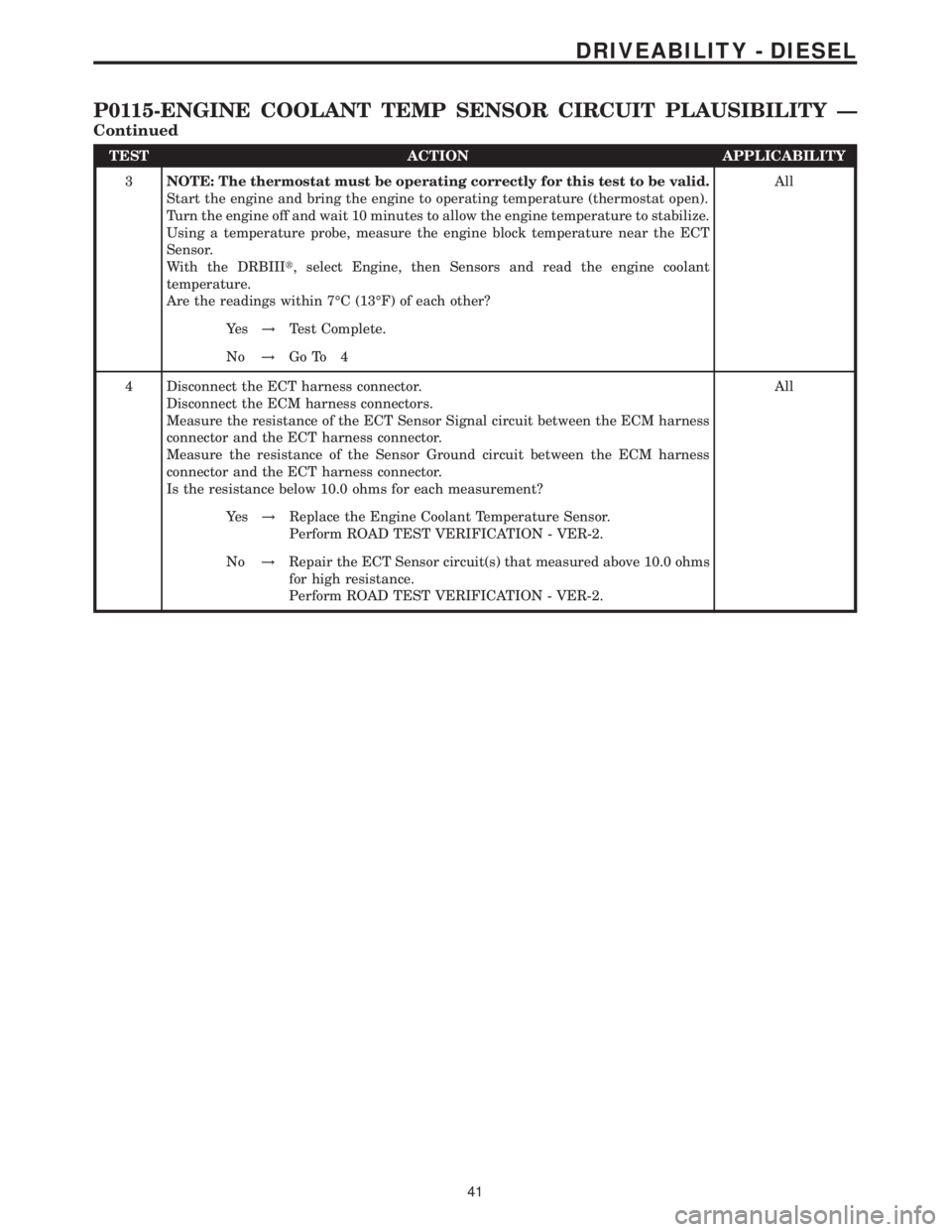
TEST ACTION APPLICABILITY
3NOTE: The thermostat must be operating correctly for this test to be valid.
Start the engine and bring the engine to operating temperature (thermostat open).
Turn the engine off and wait 10 minutes to allow the engine temperature to stabilize.
Using a temperature probe, measure the engine block temperature near the ECT
Sensor.
With the DRBIIIt, select Engine, then Sensors and read the engine coolant
temperature.
Are the readings within 7ÉC (13ÉF) of each other?All
Ye s!Test Complete.
No!Go To 4
4 Disconnect the ECT harness connector.
Disconnect the ECM harness connectors.
Measure the resistance of the ECT Sensor Signal circuit between the ECM harness
connector and the ECT harness connector.
Measure the resistance of the Sensor Ground circuit between the ECM harness
connector and the ECT harness connector.
Is the resistance below 10.0 ohms for each measurement?All
Ye s!Replace the Engine Coolant Temperature Sensor.
Perform ROAD TEST VERIFICATION - VER-2.
No!Repair the ECT Sensor circuit(s) that measured above 10.0 ohms
for high resistance.
Perform ROAD TEST VERIFICATION - VER-2.
41
DRIVEABILITY - DIESEL
P0115-ENGINE COOLANT TEMP SENSOR CIRCUIT PLAUSIBILITY Ð
Continued
Page 466 of 2305
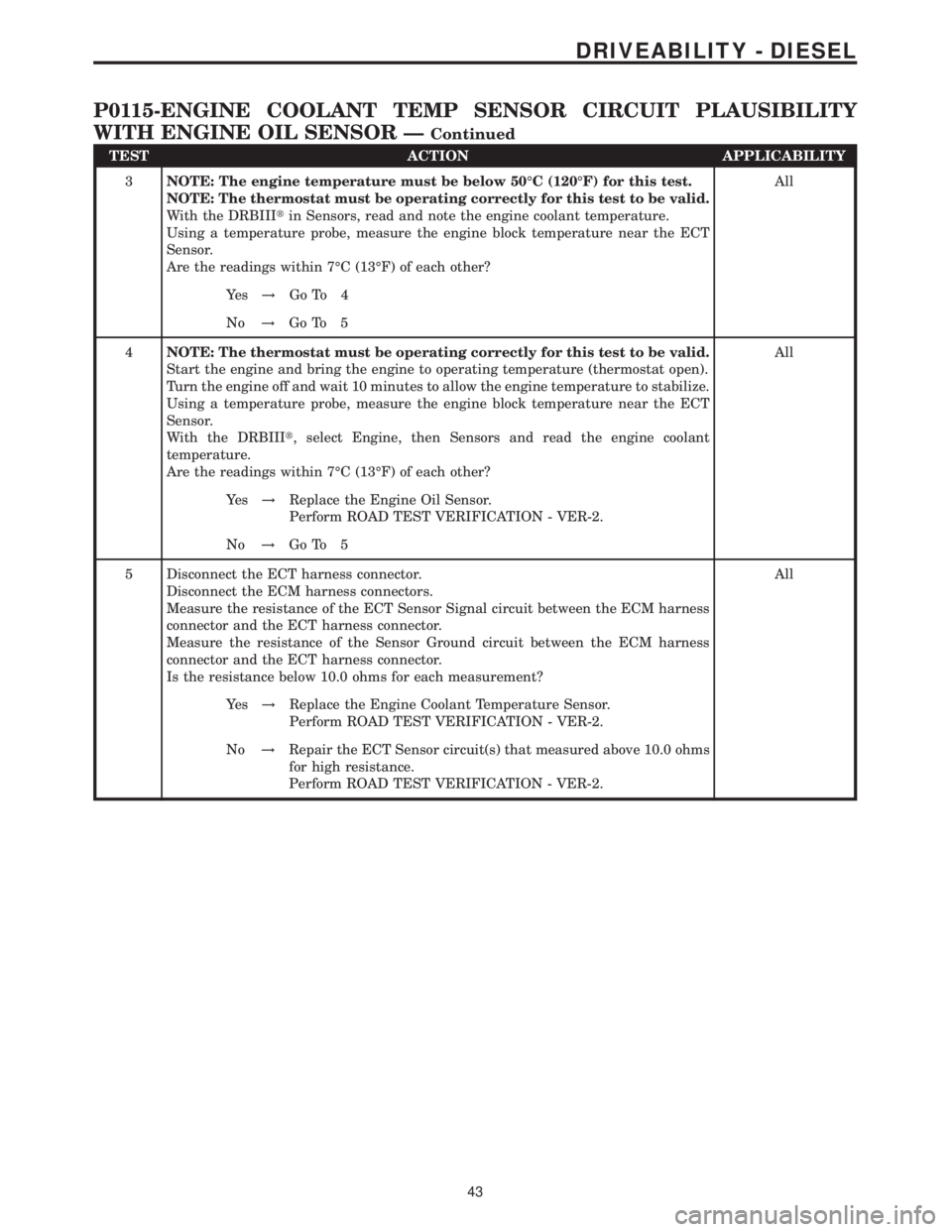
TEST ACTION APPLICABILITY
3NOTE: The engine temperature must be below 50ÉC (120ÉF) for this test.
NOTE: The thermostat must be operating correctly for this test to be valid.
With the DRBIIItin Sensors, read and note the engine coolant temperature.
Using a temperature probe, measure the engine block temperature near the ECT
Sensor.
Are the readings within 7ÉC (13ÉF) of each other?All
Ye s!Go To 4
No!Go To 5
4NOTE: The thermostat must be operating correctly for this test to be valid.
Start the engine and bring the engine to operating temperature (thermostat open).
Turn the engine off and wait 10 minutes to allow the engine temperature to stabilize.
Using a temperature probe, measure the engine block temperature near the ECT
Sensor.
With the DRBIIIt, select Engine, then Sensors and read the engine coolant
temperature.
Are the readings within 7ÉC (13ÉF) of each other?All
Ye s!Replace the Engine Oil Sensor.
Perform ROAD TEST VERIFICATION - VER-2.
No!Go To 5
5 Disconnect the ECT harness connector.
Disconnect the ECM harness connectors.
Measure the resistance of the ECT Sensor Signal circuit between the ECM harness
connector and the ECT harness connector.
Measure the resistance of the Sensor Ground circuit between the ECM harness
connector and the ECT harness connector.
Is the resistance below 10.0 ohms for each measurement?All
Ye s!Replace the Engine Coolant Temperature Sensor.
Perform ROAD TEST VERIFICATION - VER-2.
No!Repair the ECT Sensor circuit(s) that measured above 10.0 ohms
for high resistance.
Perform ROAD TEST VERIFICATION - VER-2.
43
DRIVEABILITY - DIESEL
P0115-ENGINE COOLANT TEMP SENSOR CIRCUIT PLAUSIBILITY
WITH ENGINE OIL SENSOR Ð
Continued