turn signal MERCEDES-BENZ SPRINTER 2013 MY13 Operator’s Manual
[x] Cancel search | Manufacturer: MERCEDES-BENZ, Model Year: 2013, Model line: SPRINTER, Model: MERCEDES-BENZ SPRINTER 2013Pages: 334, PDF Size: 3.88 MB
Page 95 of 334
X
To operate the high-beam flasher: turn
the key to position 1or 2in the ignition
lock.
X Pull the combinatio nswitch briefly in
directio nofarrow0006. Headlamp range adjustment
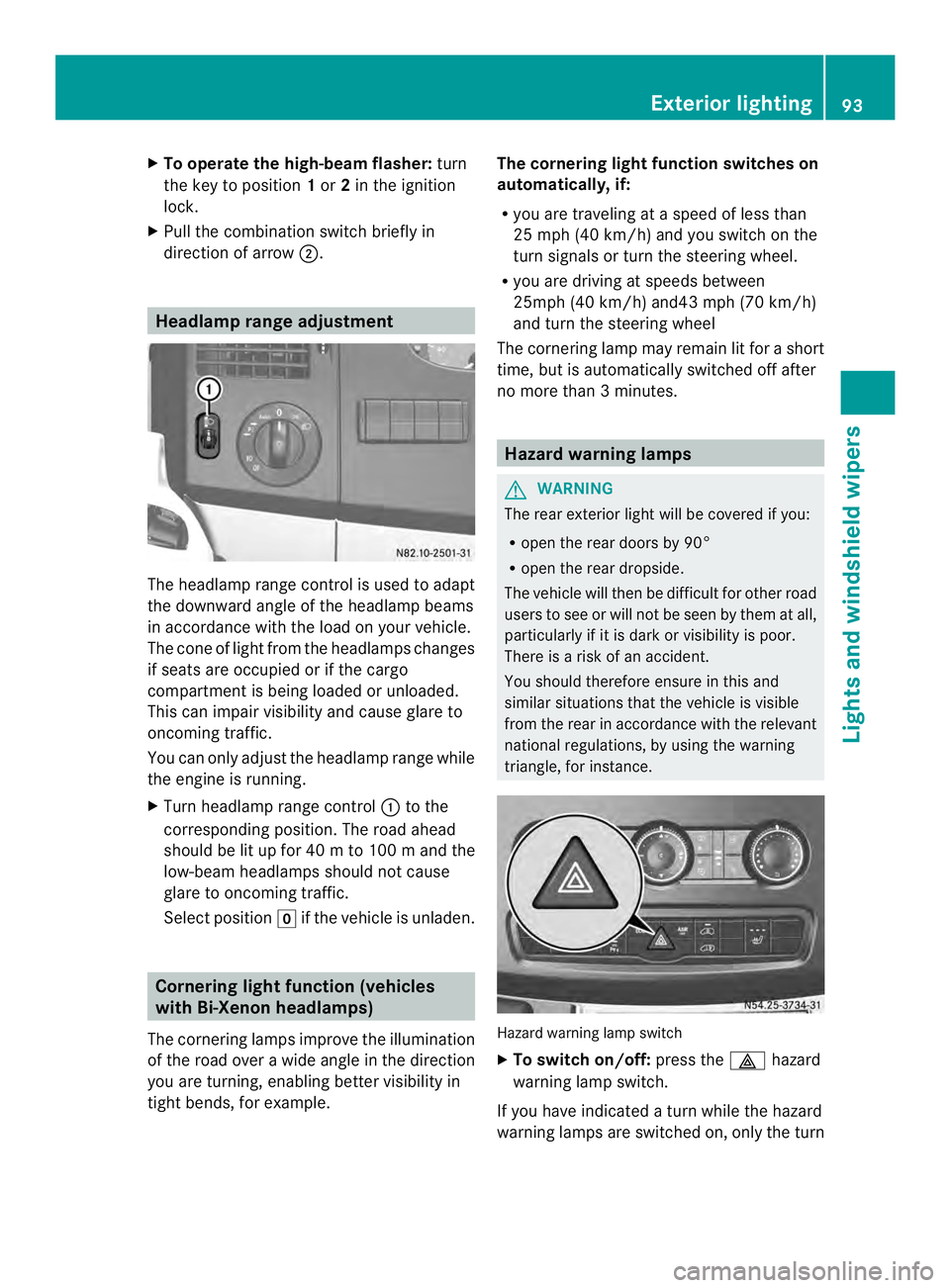
The headlamp range control is used to adapt
the downward angle of the headlamp beams
in accordance with the loadony our vehicle.
The cone of light from the headlamps changes
if seats are occupied or if the cargo
compartment is being loaded or unloaded.
This can impair visibility and cause glare to
oncoming traffic.
You can only adjust the headlamp range while
the engine is running.
X Turn headlamp range control 0005to the
corresponding position. The road ahead
should be lit up for 40 mto 100 mand the
low-bea mheadlamps should not cause
glare to oncoming traffic.
Select position 0011if the vehicle is unladen. Cornering light function (vehicles
with Bi-Xenon headlamps)
The cornering lamps improve the illumination
of the road over a wide angle in the direction
you are turning, enabling better visibility in
tight bends, for example. The cornering light function switches on
automatically, if:
R
you are traveling at a speed of less than
25 mph (40 km/h) and you switch on the
turn signals or turn the steering wheel.
R you are driving at speeds between
25mph (40 km/h) and43 mph (70 km/h)
and turn the steering wheel
The cornering lamp may remain lit for a short
time, but is automatically switched off after
no more than 3 minutes. Hazard warning lamps
G
WARNING
The rear exterior light will be covered if you:
R open the rear doors by 90°
R open the rear dropside.
The vehicle will then be difficult for other road
users to see or will not be seen by them at all,
particularly if it is dark or visibility is poor.
There is a risk of an accident.
You should therefore ensure in this and
similar situations that the vehicle is visible
from the rear in accordance with the relevant
national regulations, by using the warning
triangle, for instance. Hazard warning lamp switch
X
To switch on/off: press the0011hazard
warning lamp switch.
If you have indicated a turn while the hazard
warning lamps are switched on, only the turn Exterior lighting
93Lights and windshield wipers Z
Page 99 of 334
correctly at all times. Have the headlamp
setting checked regularly.
R Always switch off the vehicle's lighting
system before changing a bulb.
This will prevent a short circuit.
R Do not touch the glass tube of new bulbs
with your bare hands. Always use a clean,
lint-free cloth or only touch the base of the
bulb when installing.
Even minor contamination can burn into
the glass surface and reduce the service life
of the bulbs.
R Do not use a bulb that has bee ndropped or
that has scratches on its glass tube.
The bulb could may explode.
R Only use bulbs in closed lamps which have
been designed for this purpose.
R Only use spare bulbs of the same type and
with the prescribed voltage
R Protect the bulbs from moisture when in
use.
If the new bulb still does not light up, consult
a qualified specialist workshop.
R Have the LEDs and bulbs of the following
lamps changed at a qualified specialist
workshop:
- the additional turn signals in the exterior
mirrors
- the high-mounted brake lamp
- the Bi-Xenon bulbs
- front fog lamps
If you require assistance changing bulbs,
consult a qualified specialist workshop. Fron
tbulbs
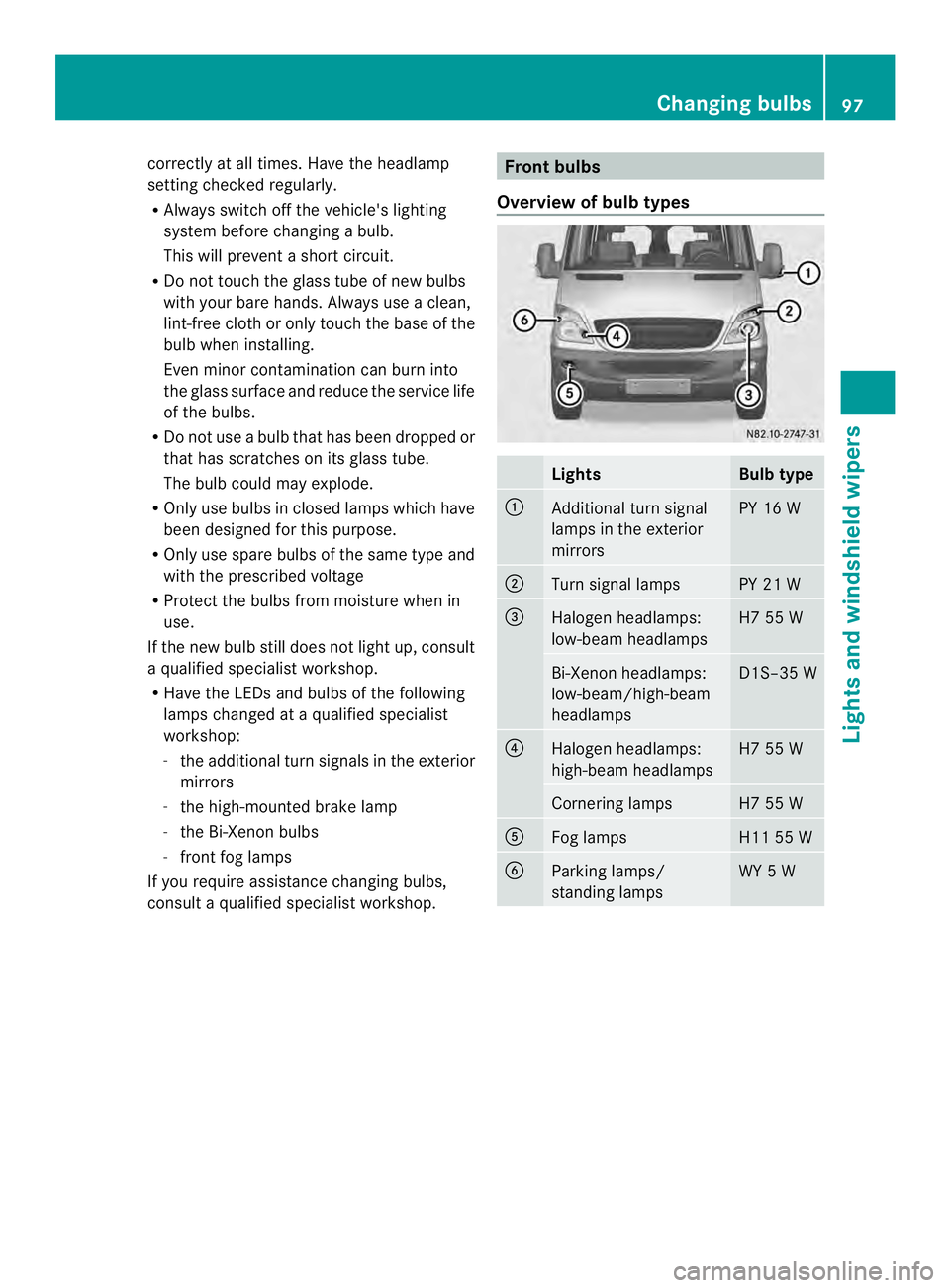
Overview of bulb types Lights Bulb type
0005
Additional turn signal
lamps in the exterior
mirrors PY 16 W
0006
Turn signal lamps PY 21 W
0026
Halogen headlamps:
low-bea mheadlamps H7 55 W
Bi-Xenon headlamps:
low-beam/high-beam
headlamps D1S–35 W
0025
Halogen headlamps:
high-beam headlamps H7 55 W
Cornering lamps H7 55 W
0023
Fog lamps H11 55 W
0024
Parking lamps/
standing lamps WY 5 WChanging bulbs
97Lights and windshield wipers Z
Page 100 of 334
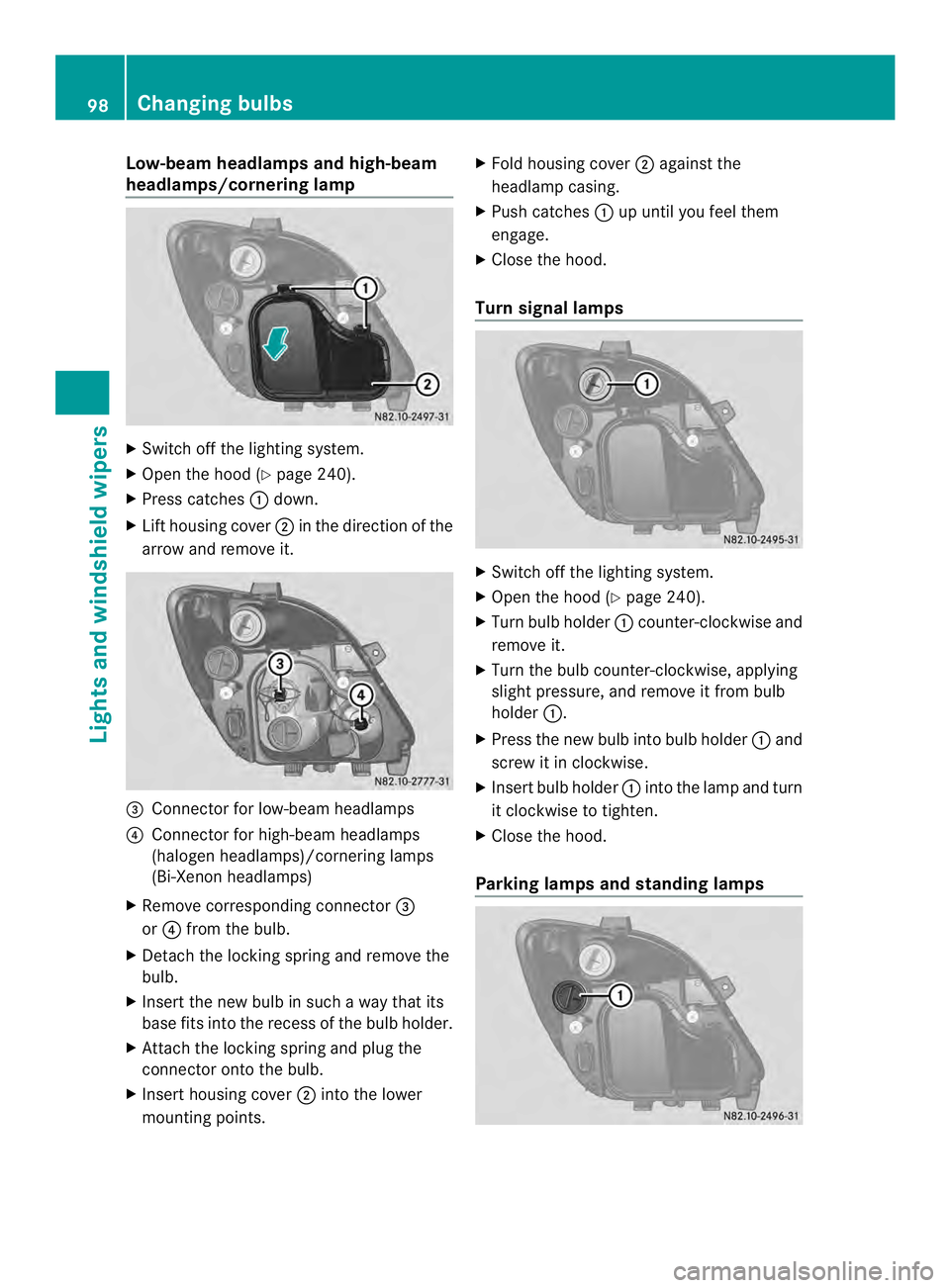
Low-beam headlamps and high-beam
headlamps/cornering lamp
X
Switch off the lighting system.
X Open the hood (Y page 240).
X Press catches 0005down.
X Lif th ousing cover 0006in the direction of the
arrow and remove it. 0026
Connector for low-beam headlamps
0025 Connector for high-beam headlamps
(halogen headlamps)/cornering lamps
(Bi-Xenon headlamps)
X Remove corresponding connector 0026
or 0025 from the bulb.
X Detach the locking spring and remove the
bulb.
X Insert the new bulb in such a way that its
base fits into the recess of the bulb holder.
X Attach the locking spring and plug the
connector onto the bulb.
X Insert housing cover 0006into the lower
mounting points. X
Fold housing cover 0006against the
headlamp casing.
X Push catches 0005up until you feel them
engage.
X Close the hood.
Turn signal lamps X
Switch off the lighting system.
X Open the hood (Y page 240).
X Turn bulb holder 0005counter-clockwise and
remove it.
X Turn the bulb counter-clockwise, applying
slight pressure, and remove it from bulb
holder 0005.
X Press the new bulb into bulb holder 0005and
screw it in clockwise.
X Insert bulb holder 0005into the lamp and turn
it clockwise to tighten.
X Close the hood.
Parking lamps and standing lamps 98
Changing bulbsLights and windshiel
dwipers
Page 101 of 334
X
Switch off the lighting system.
X Ope nthe hood (Y page 240).
X Turn housing cover 0005counter-clockwise
and remove it.
X Pull out the bulb holder with the bulb.
X Pull the bulb out of the bulb holder.
X Press a new bulb into the bulb holder.
X Insert the bulb holder into the lamp.
X Position housing cover 0005and turn it
clockwise as far as it will go.
X Close the hood. Rear bulbs (Cargo Van/Passenger
Van)
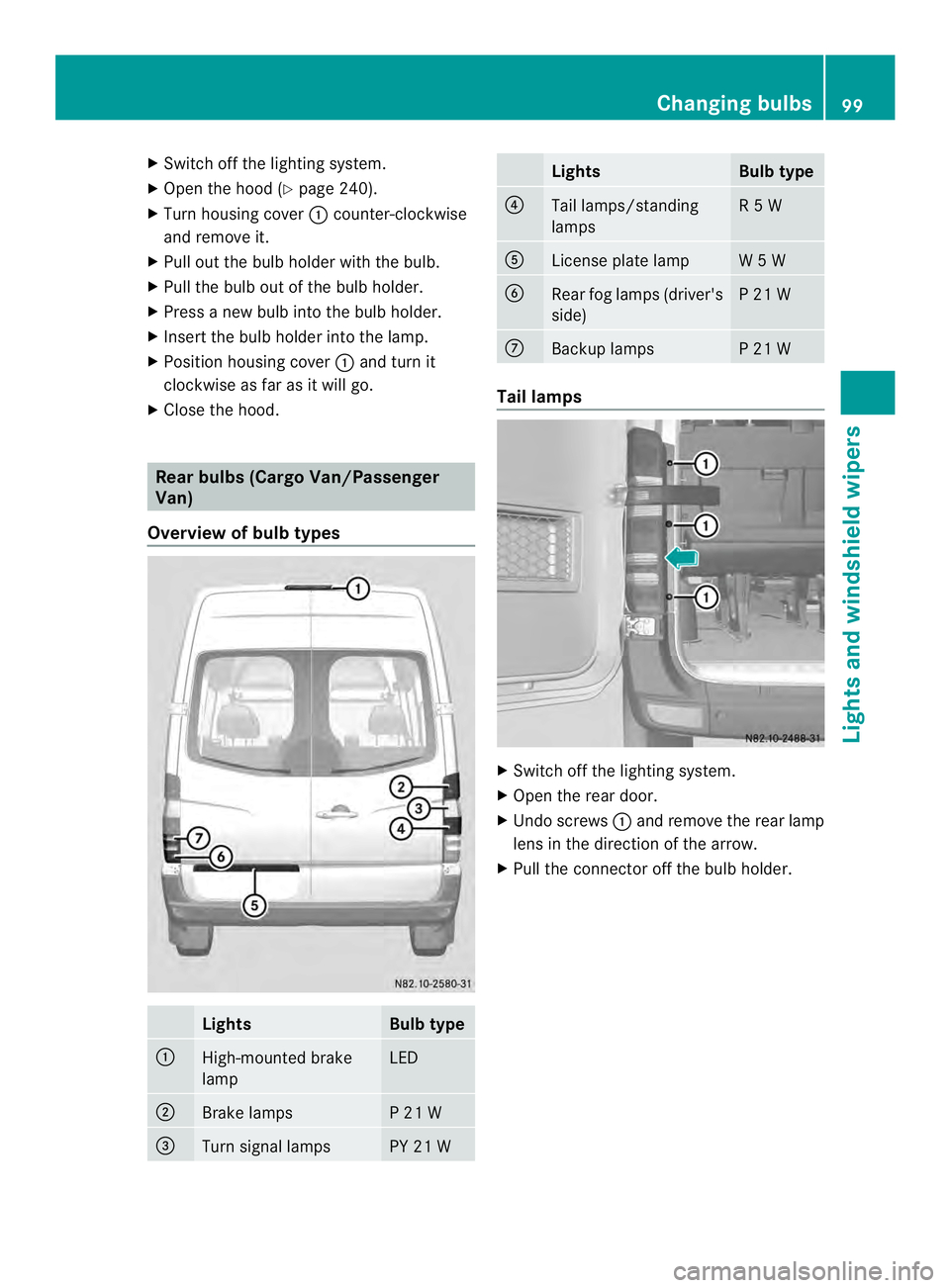
Overview of bulb types Lights Bulb type
0005
High-mounted brake
lamp LED
0006
Brake lamps P 21 W
0026
Turn signal lamps PY 21 W Lights Bulb type
0025
Tail lamps/standing
lamps R 5 W
0023
License plate lamp W 5 W
0024
Rear fog lamps (driver's
side) P 21 W
0018
Backup lamps P 21 W
Tail lamps
X
Switch off the lighting system.
X Open the rear door.
X Undo screws 0005and remove the rear lamp
lens in the direction of the arrow.
X Pull the connector off the bulb holder. Changing bulbs
99Lights and windshield wipers Z
Page 102 of 334
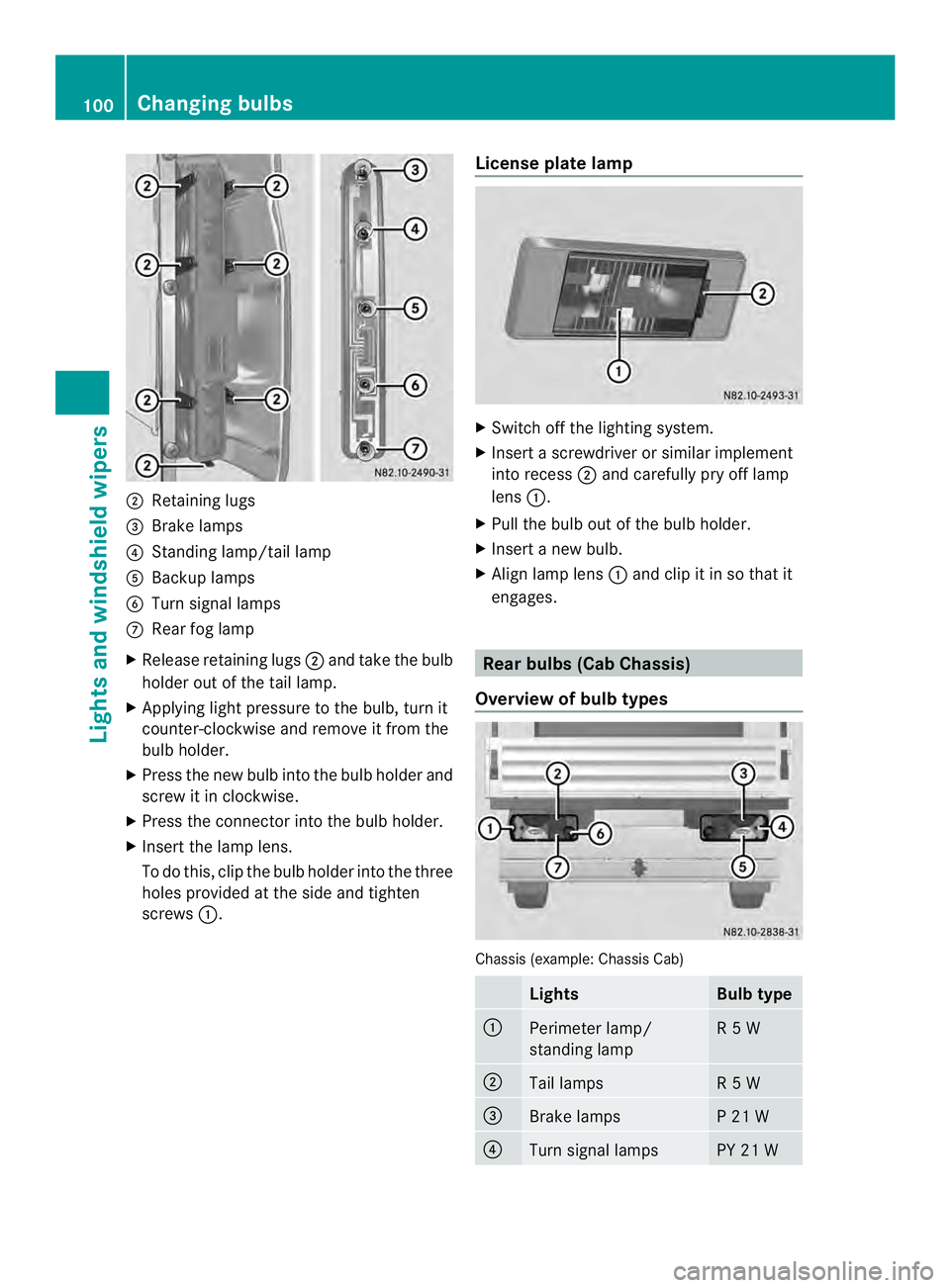
0006
Retaining lugs
0026 Brake lamps
0025 Standing lamp/tail lamp
0023 Backup lamps
0024 Turn signal lamps
0018 Rear fog lamp
X Release retaining lugs 0006and take the bulb
holder out of the tail lamp.
X Applying ligh tpressure to the bulb, turn it
counter-clockwise and remove it from the
bulb holder.
X Press the new bulb into the bulb holder and
screw it in clockwise.
X Press the connector into the bulb holder.
X Insert the lamp lens.
To do this, clip the bulbh older into the three
holes provided at the side and tighten
screws 0005. License plate lamp X
Switch off the lighting system.
X Insert a screwdriver or similar implement
into recess 0006and carefully pry off lamp
lens 0005.
X Pull the bulb out of the bulb holder.
X Insert a new bulb.
X Align lamp lens 0005and clip it in so that it
engages. Rear bulbs (Cab Chassis)
Overview of bulb types Chassis (example: Chassis Cab)
Lights Bulb type
0005
Perimeter lamp/
standing lamp R 5 W
0006
Tail lamps R 5 W
0026
Brake lamps P 21 W
0025
Turn signal lamps PY 21 W100
Changing bulbsLights and windshiel
dwipers
Page 103 of 334
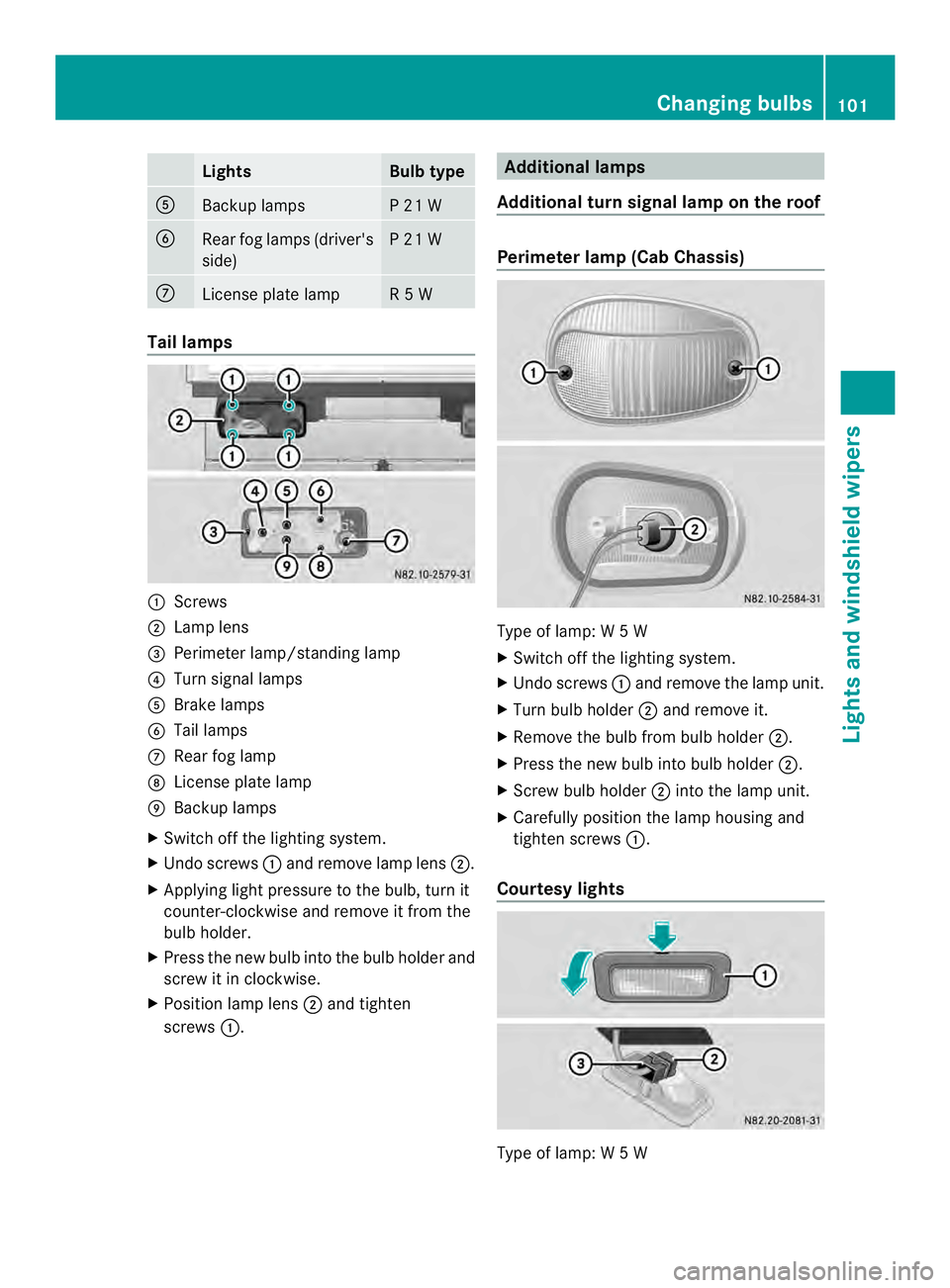
Lights Bulb type
0023
Backup lamps P 21 W
0024
Rear fog lamps (driver's
side) P 21 W
0018
License plate lamp R 5 W
Tail lamps
0005
Screws
0006 Lamp lens
0026 Perimete rlamp/standing lamp
0025 Turn signal lamps
0023 Brake lamps
0024 Tail lamps
0018 Rear fog lamp
0019 License plate lamp
001A Backup lamps
X Switch off the lighting system.
X Undo screws 0005and remove lamp lens 0006.
X Applying light pressure to the bulb, tur nit
counter-clockwise and remove it from the
bulb holder.
X Press the new bulb into the bulb holder and
screw it in clockwise.
X Position lamp lens 0006and tighten
screws 0005. Additional lamps
Additional turn signal lamp on the roof Perimete
rlamp (Cab Chassis) Type of lamp: W
5W
X Switch off the lighting system.
X Undo screws 0005and remove the lamp unit.
X Turn bulb holder 0006and remove it.
X Remove the bulb from bulb holder 0006.
X Press the new bulb into bulb holder 0006.
X Screw bulb holder 0006into the lamp unit.
X Carefully position the lamp housing and
tighten screws 0005.
Courtes ylights Type of lamp: W
5W Changing bulbs
101Lights an dwindshield wipers Z
Page 136 of 334
i
To unlock the steering, move the steering
wheel slightly while turning the key to
position 1. Preparing for a journey
Visual check of the vehicle exterior X
In particular, check the following
components on the vehicle, and on the
trailer as necessary:
R
license plates, vehicle lighting, turn
signals, brake lamps and wiper blades for
dirt and damage
R tires and wheels for firm seating, correct
tire pressure and general condition
R trailer tow hitch for play and security
i The trailer coupling is one of the most
importan tvehicle parts with regard to road
safety. The separate instructions issued by
the manufacturer pertaining to operation,
care and maintenance should be observed.
X Rectify any noticeable defects before
commencing the journey.
Checks in the vehicle Emergency equipment/first-aid kit
X
Check the equipment to make sure that it
is accessible, complete and ready for use.
The first aid and breakdown assistance
equipment is in the fron tdoor stowage
compartments and behind the driver's seat.
Vehicle lighting
X Turn the key to position 2in the ignition
lock.
X Check the lighting system with the aid of a
second person.
X Replace defective bulbs (Y page 96). Before driving off
G
WARNING
Objects in the driver's footwell may restrict
the clearance around the pedals or block a
depressed pedal. This jeopardizes the
operating and road safety of the vehicle.
There is a risk of an accident.
Stow all objects securely in the vehicle so that
they do not get into the driver's footwell.
When using floormats or carpets, make sure
that they are properly secured so that they do
not slip or obstruct the pedals. Only use non-
slip floormats. G
WARNING
Unsuitable footwear can hinder correc tusage
of the pedals, e.g.:
R shoes with thick soles
R shoes with high heels
R slippers
There is a risk of an accident.
Wear suitable footwear to ensure correct
usage of the pedals.
X Secure the load as per the loading
guidelines (Y page 232).
X Make sure that the floormats and carpets
are properly secured so that they cannot
slip and obstruct the pedals.
X Close all doors. Starting the engine
G
WARNING
Combustion engines emit poisonous exhaust
gases such as carbon monoxide. Inhaling
these exhaust gases leads to poisoning. There
is a risk of fatal injury. Therefore never leave
the engine running in enclosed spaces
without sufficient ventilation.
! Do not depress the accelerator pedal
when starting the engine.
X Before starting the engine, make sure that: 134
DrivingDriving and parking
Page 168 of 334
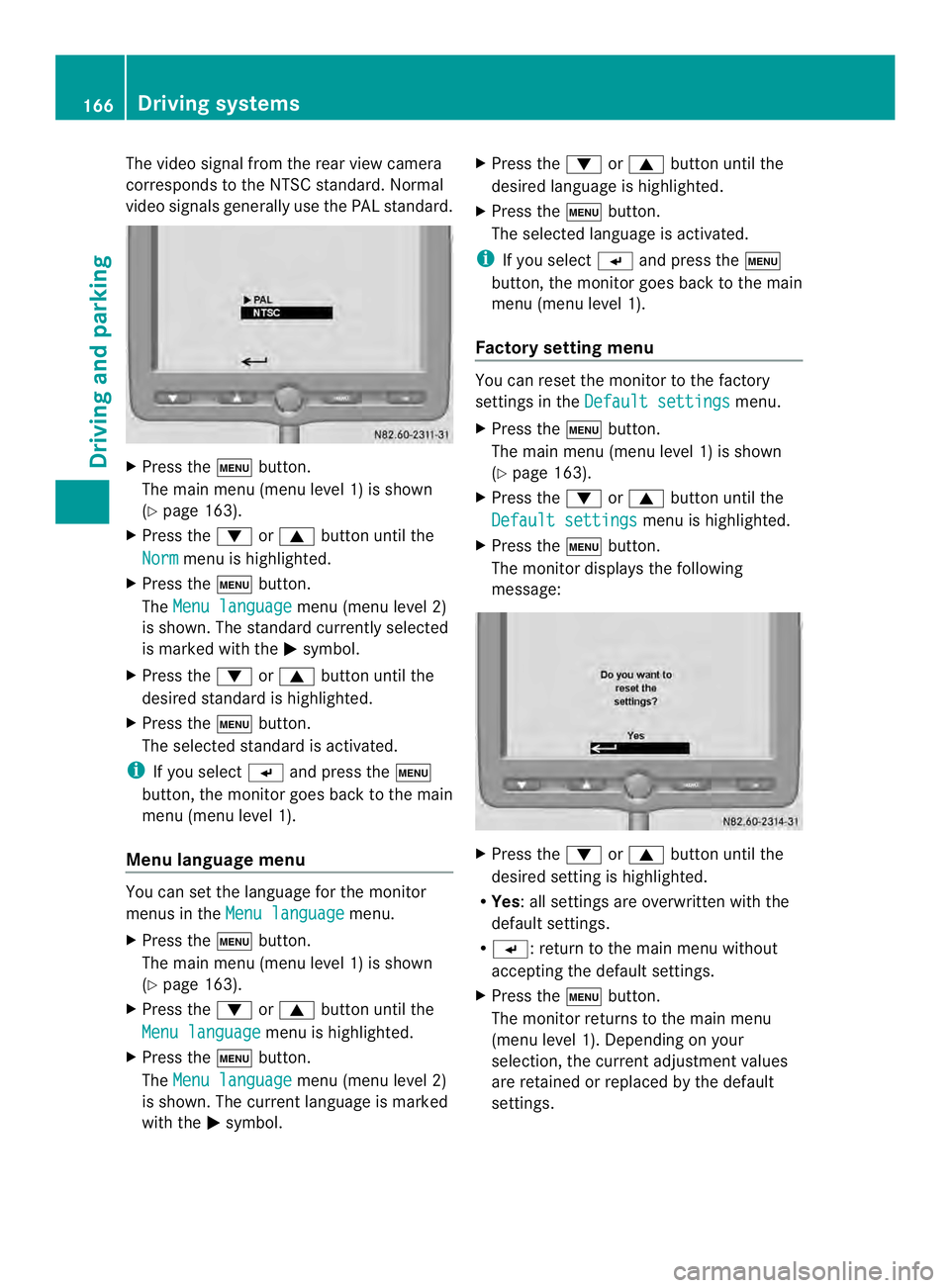
The video signal from the rear view camera
corresponds to the NTSC standard. Normal
video signals generally use the PAL standard. X
Press the 0003button.
The main menu (menu level 1) is shown
(Y page 163).
X Press the 0008or0006 button until the
Norm menu is highlighted.
X Press the 0003button.
The Menu language menu (menu level 2)
is shown. The standard currently selected
is marked with the 0004symbol.
X Press the 0008or0006 button until the
desired standard is highlighted.
X Press the 0003button.
The selected standard is activated.
i If you select 0005and press the 0003
button, the monitor goes back to the main
menu (menu level 1).
Menu language menu You can set the language for the monitor
menus in the
Menu language menu.
X Press the 0003button.
The main menu (menu level 1) is shown
(Y page 163).
X Press the 0008or0006 button until the
Menu language menu is highlighted.
X Press the 0003button.
The Menu language menu (menu level 2)
is shown. The curren tlanguage is marked
with the 0004symbol. X
Press the 0008or0006 button until the
desired language is highlighted.
X Press the 0003button.
The selected language is activated.
i If you select 0005and press the 0003
button, the monito rgoes back to the main
menu (menu level 1).
Factory setting menu You can reset the monitor to the factory
settings in the
Default settings menu.
X Press the 0003button.
The main menu (menu level 1) is shown
(Y page 163).
X Press the 0008or0006 button until the
Default settings menu is highlighted.
X Press the 0003button.
The monitor displays the following
message: X
Press the 0008or0006 button until the
desired setting is highlighted.
R Yes:a ll settings are overwritten with the
default settings.
R 0005: return to the main menu without
accepting the default settings.
X Press the 0003button.
The monitor returns to the main menu
(menu level 1). Depending on your
selection, the current adjustmen tvalues
are retained or replaced by the default
settings. 166
Driving systemsDriving and parking
Page 171 of 334
!
Depressing the brake pedal constantly
results in excessive and premature wear to
the brake pads.
Always observe the operating instructions
provided by the manufacturers of the trailer
coupling and the ball coupling.
Couple and decouple the trailer carefully.
When backing up the towing vehicle, make
sure nobody is standing between the vehicle
and the trailer.
At railer which is incorrectly coupled to the
towing vehicle could brea kaway. Acorrectly
coupled trailer must be positioned
horizontally behind the towing vehicle.
Ensure that the following weights are not
exceeded:
R the permissible noseweight
R the permissible trailer load
R the permissible rear axle load of the towing
vehicle
R the permissible gross weight of both the
towing vehicle and the trailer
R the permissible gross combination weight
The applicable permissible values that may
not be exceeded can be found:
R in your vehicle documents
R on the type plates for the trailer tow hitch
R on the type plates for the trailer
R on the vehicle identification plate
(Y page 315).
Where the values differ, the lowest is valid.
You will find values approved by the
manufacturer on the identification plates and
those for the towing vehicle in the
"Permissible trailer loads and trailer drawbar
noseweights" section (Y page 169).
Your vehicle behaves differently with a trailer
than without one.
The vehicle/trailer combination:
R is heavier
R is restricted in its acceleration and
gradient-climbing capability
R has an increased braking distance R
is more susceptible to strong crosswinds
R requires more sensitive steering
R has a larger turning circle
This may impair the handling characteristics.
When towing a trailer, always adjust your
speed to suit the road and weather
conditions. Drive carefully. Maintain a safe
distance.
If you require explanations for the information
in this Operator's Manual, contract an
authorized Sprinter Dealer.
General notes R
Observe the legally prescribed maximum
speed for vehicle/trailer combinations in
the relevant country, state or Canadian
province. Before setting off, check the
vehicle documents of the your trailer to find
out the permissible maximum speed.
This reduces the risk of accidents.
R Install only an approved trailer coupling on
your vehicle. Only use aball coupling that
is approved for your vehicle and Sprinter
trailer tow hitch. More information on the
availability, mounting and installatio nofthe
trailer electrics is available at any qualified
specialist workshop.
R The turn signals on the trailer are only
guaranteed to function when incandescent
bulbs are used. You can obtain more
information about installing the trailer
electrics at any qualified specialist
workshop.
R The trailer coupling is one of the most
important vehicle parts with regard to road
safety. The notes on operation, care and
maintenance issued by the manufacturer
should be observed.
R The bumpers of your vehicle are not
suitable for installing detachable trailer
couplings. Towing
atrailer
169Driving an d parking Z
Page 176 of 334
Checking the vehicle and trailer weight
R
Make sure the weights of the towing vehicle
and the trailer comply with the maximum
permissible values .Have the vehicle/
trailer combinatio nweighed on a calibrated
weighbridge. The vehicle/trailer
combination consists of the towing vehicle
including the driver, passengers and load,
as well as the loaded trailer.
R Check the maximum permissible gross axle
weight rating of the front and rear axles
(GAWR), the gross trailer weight (GTW), the
gross combination weight rating (GCWR)
and the noseweight of the trailer drawbar
(TWR). Trailer power supply
! Incorrect wiring of the connector plug
could, under certain circumstances, cause
malfunctions in the vehicle's other
electronic systems. We therefore
recommend having the connector plug
wired at a qualified specialist workshop.
! You can connecta ccessories with a
maximum power consumption of 240 Wto
the permanent powe rsupply.
You must no tcharge a trailer battery using
the power supply.
Your vehicle may be equipped with various
electrical installations for trailer towing.
Depending on your trailer, you may need an
adapter to connect the electrical system of
the trailer with that of the vehicle.
The trailer socket of your vehicle is equipped
at the factory with apermanen tpower supply.
The permanent power supply is on the trailer
socket pin assignment 4.
Note that the permanent power supply of the
trailer is not switched off when the on-board
voltage is low. This can completely discharge
the starter battery of your vehicle.
The turn signals on the trailer are only
guaranteed to function when incandescent
bulbs are used. Further information on the electrical
equipment currently installed on your vehicle
and on installing trailer electrics can be
obtained at any qualified specialist workshop.174
Towing
atrailerDriving an d parking