ECO mode MERCEDES-BENZ SPRINTER 2013 MY13 Operator’s Manual
[x] Cancel search | Manufacturer: MERCEDES-BENZ, Model Year: 2013, Model line: SPRINTER, Model: MERCEDES-BENZ SPRINTER 2013Pages: 334, PDF Size: 3.88 MB
Page 196 of 334
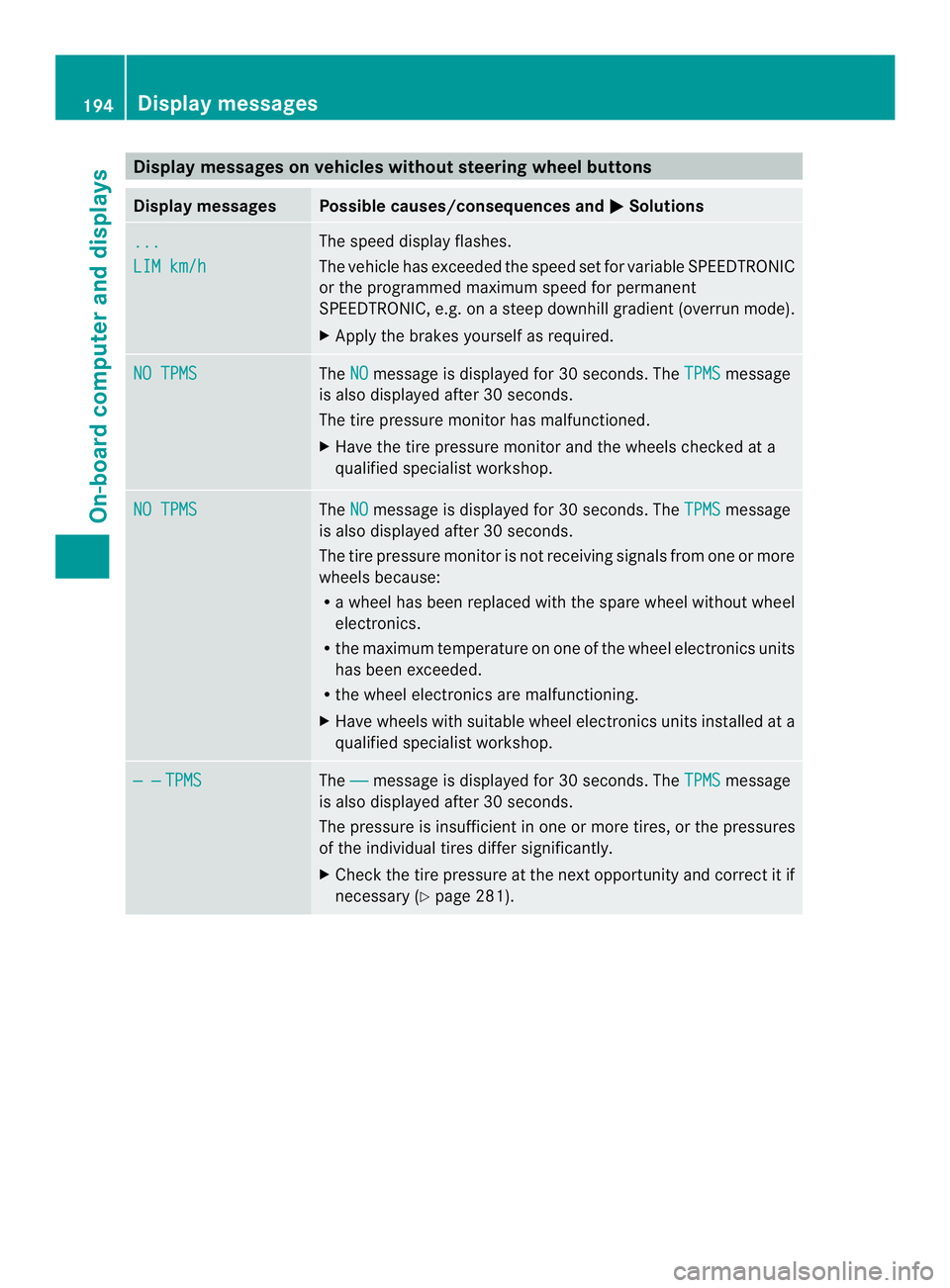
Display messages on vehicles withou
tsteering wheel buttons Display messages Possible causes/consequences and
0004 Solutions
...
LIM km/h The speed display flashes.
The vehicle has exceeded the speed se
tfor variable SPEEDTRONIC
or the programmed maximum speed for permanent
SPEEDTRONIC, e.g. on a steep downhill gradient (overrun mode).
X Apply the brakes yourself as required. NO TPMS The
NO message is displayed for 30 seconds. The
TPMS message
is also displayed after 30 seconds.
The tire pressure monitor has malfunctioned.
X Have the tire pressure monitor and the wheels checked at a
qualified specialist workshop. NO TPMS The
NO message is displayed for 30 seconds. The
TPMS message
is also displayed after 30 seconds.
The tire pressure monitor is not receiving signals from one or more
wheels because:
R a wheel has been replaced with the spare wheel without wheel
electronics.
R the maximum temperature on one of the wheel electronics units
has been exceeded.
R the wheel electronics are malfunctioning.
X Have wheels with suitable wheel electronics units installed at a
qualified specialist workshop. — — TPMS The
—— message is displayed for 30 seconds. The
TPMS message
is also displayed after 30 seconds.
The pressure is insufficient in one or more tires, or the pressures
of the individual tires differ significantly.
X Check the tire pressure at the next opportunity and correc titif
necessary (Y page 281).194
Display messagesOn-board computer and displays
Page 231 of 334
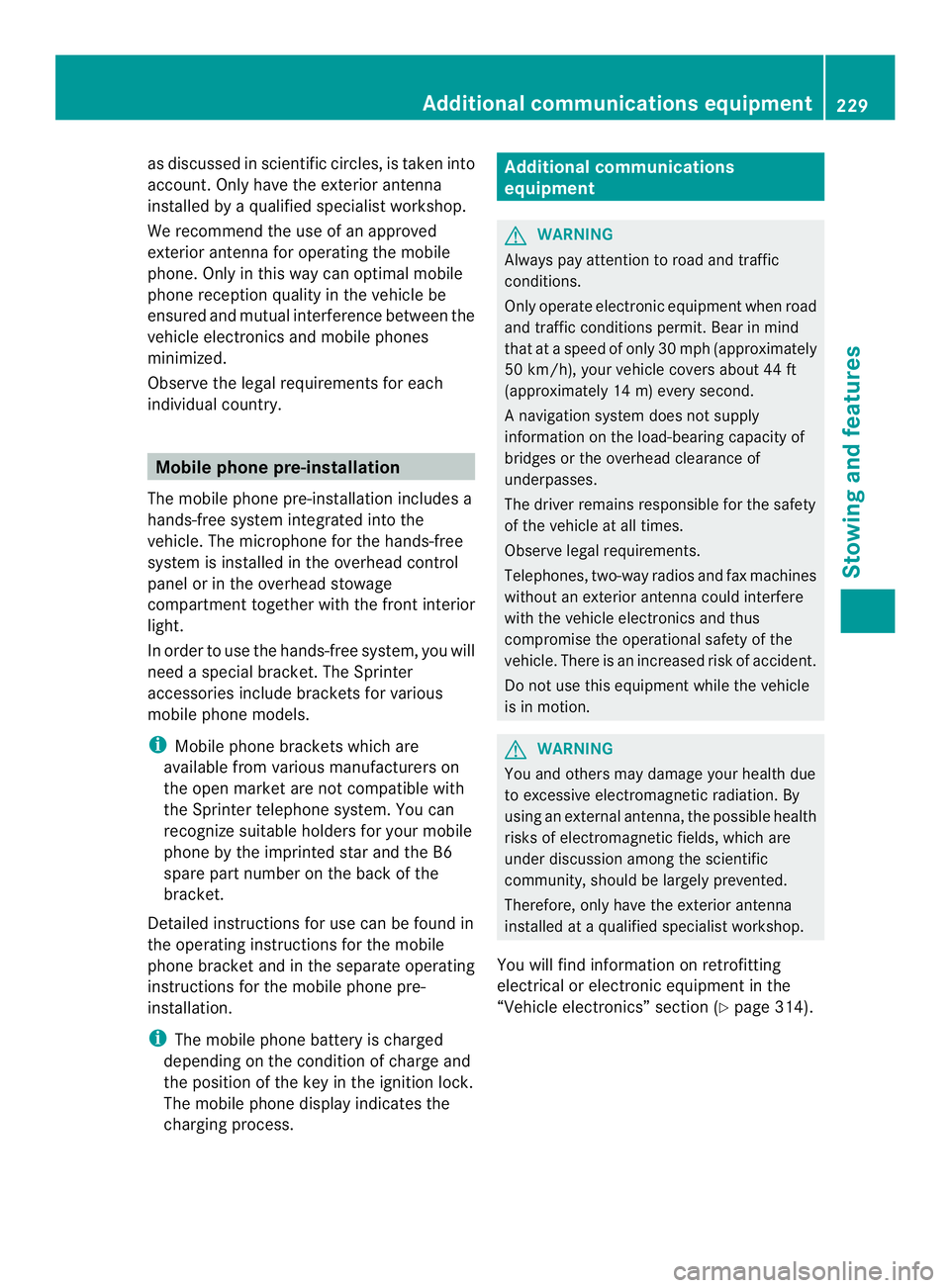
as discussed in scientific circles, is taken into
account. Only have the exterior antenna
installed by a qualified specialist workshop.
We recommend the use of an approved
exterior antenna for operating the mobile
phone. Only in this way can optimal mobile
phone reception quality in the vehicle be
ensured and mutual interference between the
vehicle electronics and mobile phones
minimized.
Observe the legal requirements for each
individual country. Mobile phone pre-installation
The mobile phone pre-installatio nincludes a
hands-free system integrated into the
vehicle. The microphone for the hands-free
system is installed in the overhead control
panel or in the overhead stowage
compartment together with the front interior
light.
In order to use the hands-free system, you will
need a special bracket. The Sprinter
accessories include brackets for various
mobile phone models.
i Mobile phone brackets which are
available from various manufacturers on
the open market are not compatible with
the Sprinter telephone system .You can
recognize suitable holders for your mobile
phone by the imprinted star and the B6
spare part number on the back of the
bracket.
Detailed instructions for use can be found in
the operating instructions for the mobile
phone bracket and in the separate operating
instructions for the mobile phone pre-
installation.
i The mobile phone battery is charged
depending on the condition of charge and
the position of the key in the ignition lock.
The mobile phone display indicates the
charging process. Additional communications
equipment
G
WARNING
Always pay attention to road and traffic
conditions.
Only operate electronic equipment when road
and traffic conditions permit. Bear in mind
that at a speed of only 30 mph (approximately
50 km/h), your vehicle covers about 44 ft
(approximately 14 m) every second.
An avigation system does no tsupply
informatio nonthe load-bearing capacity of
bridges or the overhead clearance of
underpasses.
The driver remains responsible for the safety
of the vehicle at all times.
Observe legal requirements.
Telephones, two-way radios and fax machines
without an exterior antenna could interfere
with the vehicle electronicsa nd thus
compromise the operational safety of the
vehicle. There is an increased ris kofaccident.
Do not use this equipment while the vehicle
is in motion. G
WARNING
You and others may damage your health due
to excessive electromagnetic radiation. By
using an external antenna, the possible health
risks of electromagnetic fields, which are
under discussion among the scientific
community, should be largel yprevented.
Therefore, only have the exterior antenna
installed at a qualified specialist workshop.
You will find information on retrofitting
electrical or electronic equipment in the
“Vehicle electronics” section (Y page 314). Additional communications equipment
229Stowing and features Z
Page 242 of 334
Useful information
This Operator's Manual describes all models
as well as standard and optional equipment
of your vehicle that were available at the time
of going to print. Country-specific variations
are possible. Note that your vehicle may not
be equipped with all of the described
functions. This also applies to systems and
functions relevant to safety.
Read the information on qualified specialist
workshops (Y page 26). Engine compartment
Hood
Opening the hood G
WARNING
If the hood is unlatched, it may open up when
the vehicle is in motion and block your view.
There is a risk of an accident.
Never unlatch the hood while driving. G
WARNING
Opening the hood when the engine is
overheated or when there is a fire in the
engine compartmen tcould expose you to hot
gases or other service products. There is a
risk of injury.
Let an overheated engine cool down before
opening the hood. If there is a fire in the
engine compartment, keep the hood closed
and contact the fire department. G
WARNING
Certain components in the engine
compartment, such as the engine, radiator
and parts of the exhaust system, can become
very hot. Working in the engine compartment
poses a risk of injury.
Where possible, let the engine cool down and
touch only the components described in the
following. G
WARNING
The engine compartment contains moving
components. Certain components, such as
the radiator fan, may continue to run or start
again suddenly when the ignition is off. There
is a risk of injury.
If you need to do any work inside the engine
compartment,
R switch off the ignition
R never reach into the area where there is a
risk of danger from moving components,
such as the fan rotation area
R keep clothing away from moving parts G
WARNING
The fuel injection system operates with a high
voltage. If you touch the live components, you
could receive an electric shock. There is a risk
of injury.
Never touch components of the fuel injection
system when the ignition is switched on.
The live components of the fuel injection
system are, for example, the injectors.
! Make sure that the windshield wipers are
not folded away from the windshield. You
could otherwise damage the windshield
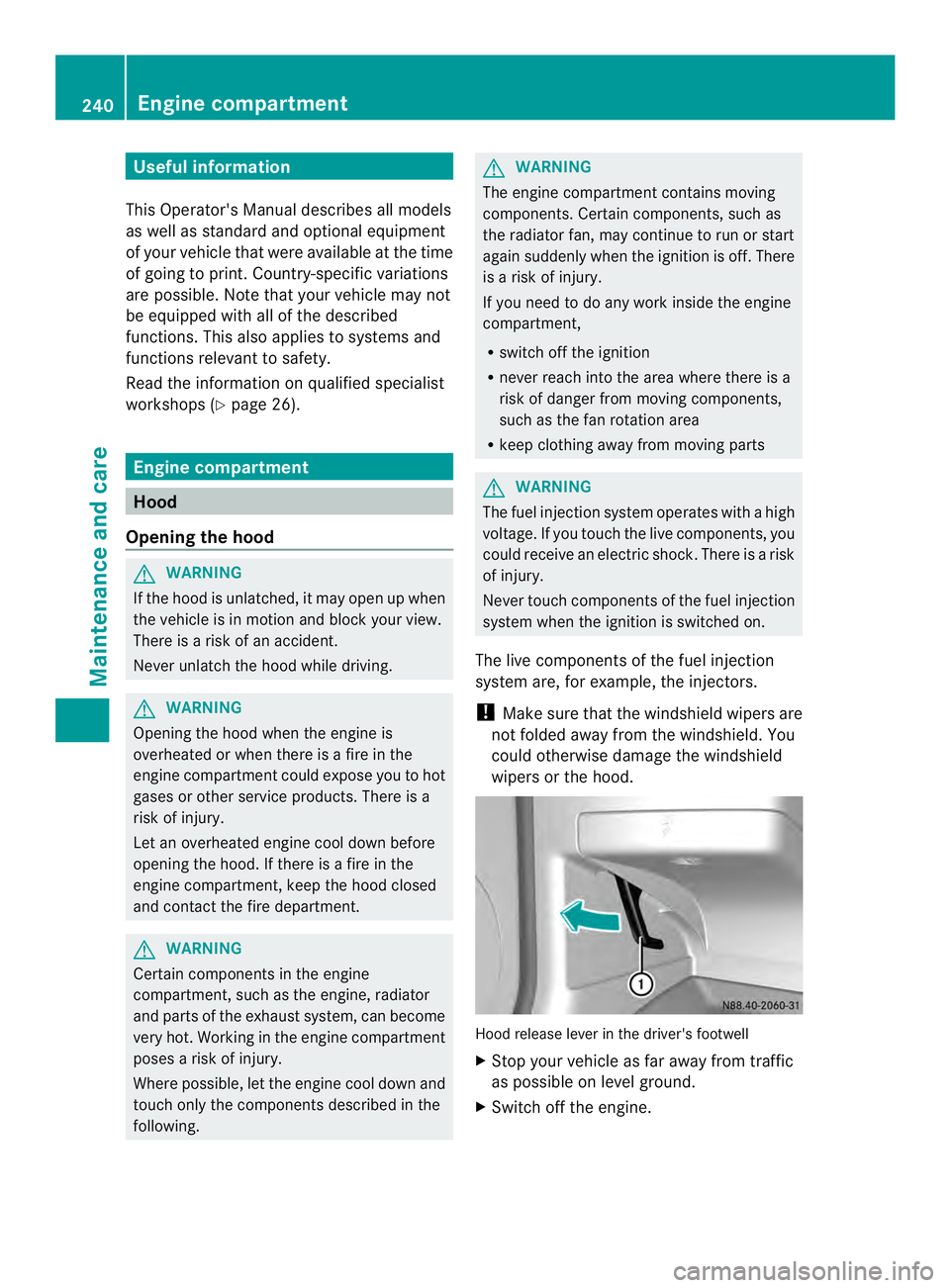
wipers or the hood. Hood release lever in the driver's footwell
X
Stop your vehicle as far away from traffic
as possible on level ground.
X Switch off the engine. 240
Engine compartmentMaintenance and care
Page 276 of 334
Useful information
This Operator's Manual describes all models
as well as standard and optional equipment
of your vehicle that were available at the time
of going to print. Country-specific variations
are possible. Note that your vehicle may not
be equipped with all of the described
functions. This also applies to systems and
functions relevant to safety.
Read the information on qualified specialist
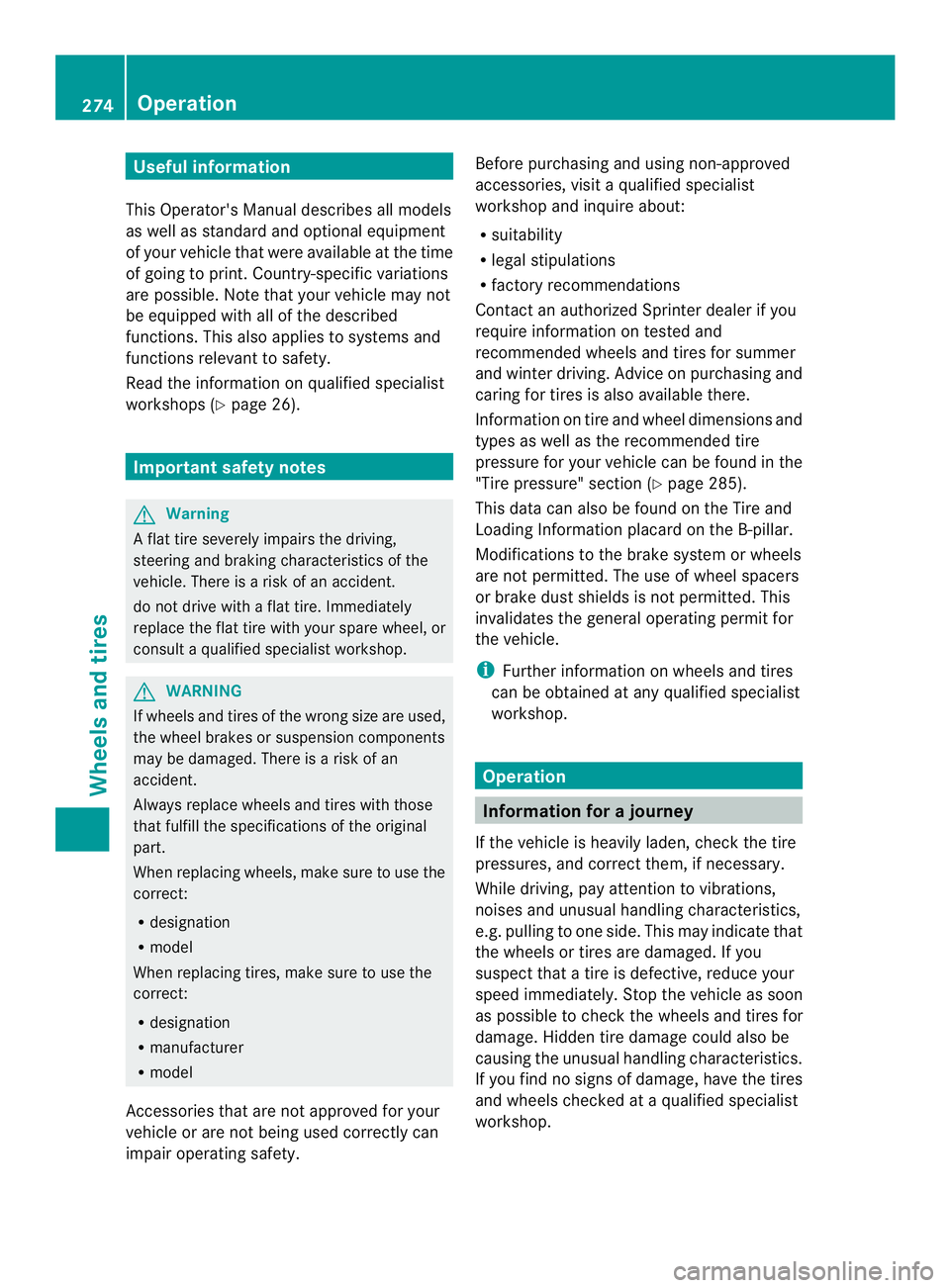
workshops (Y page 26). Important safety notes
G
Warning
Af lat tire severely impairs the driving,
steering and braking characteristics of the
vehicle. There is a risk of an accident.
do not drive with aflat tire. Immediately
replace the flat tire with your spare wheel, or
consult a qualified specialist workshop. G
WARNING
If wheels and tires of the wrong size are used,
the wheel brakes or suspension components
may be damaged. There is arisk of an
accident.
Always replace wheels and tires with those
that fulfill the specifications of the original
part.
When replacing wheels, make sure to use the
correct:
R designation
R model
When replacing tires, make sure to use the
correct:
R designation
R manufacturer
R model
Accessories that are not approved for your
vehicle or are not being used correctly can
impair operating safety. Before purchasing and using non-approved
accessories, visit a qualified specialist
workshop and inquire about:
R
suitability
R legal stipulations
R factory recommendations
Contact an authorized Sprinter dealer if you
require information on tested and
recommended wheels and tires for summer
and winter driving. Advice on purchasing and
caring for tires is also available there.
Informatio nontire and wheel dimensions and
types as well as the recommended tire
pressure for your vehicle can be found in the
"Tire pressure" section (Y page 285).
This data can also be foun donthe Tire and
Loading Information placard on the B-pillar.
Modifications to the brake system or wheels
are not permitted. The use of wheel spacers
or brake dust shields is not permitted. This
invalidates the general operating permit for
the vehicle.
i Further information on wheels and tires
can be obtained at any qualified specialist
workshop. Operation
Information for a journey
If the vehicle is heavily laden, check the tire
pressures, and correct them, if necessary.
While driving, pay attention to vibrations,
noises and unusual handling characteristics,
e.g. pulling to one side. This may indicate that
the wheels or tires are damaged. If you
suspect that a tire is defective, reduce your
speed immediately. Stop the vehicle as soon
as possible to check the wheels and tires for
damage. Hidden tire damage could also be
causing the unusual handling characteristics.
If you find no signs of damage, have the tires
and wheels checked at a qualified specialist
workshop. 274
OperationWheels and tires
Page 292 of 334
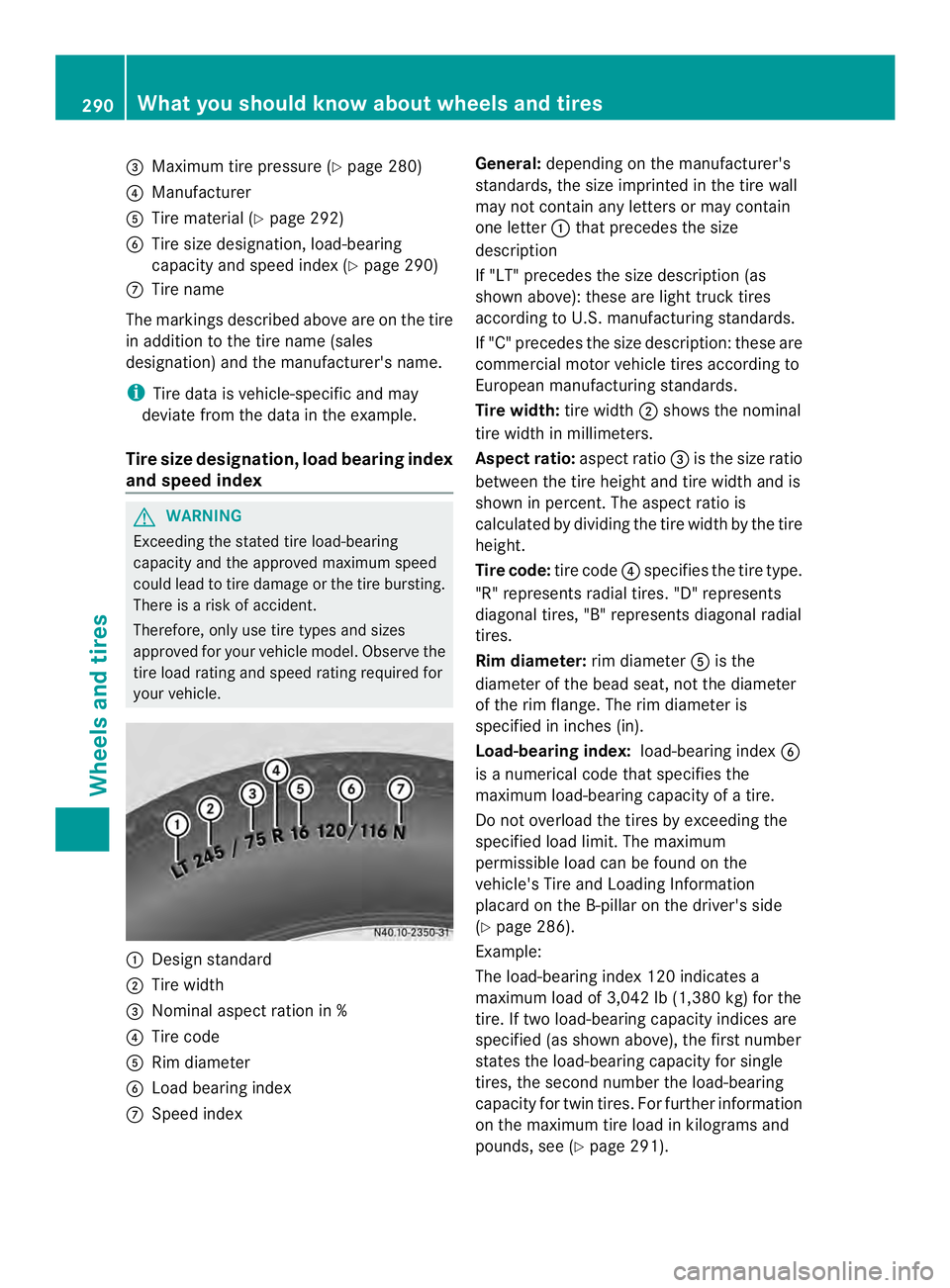
0026
Maximum tire pressure (Y page 280)
0025 Manufacturer
0023 Tire material (Y page 292)
0024 Tire size designation, load-bearing
capacity and speed index (Y page 290)
0018 Tire name
The markings described above are on the tire
in addition to the tire name (sales
designation) and the manufacturer's name.
i Tire data is vehicle-specific and may
deviate from the data in the example.
Tire size designation, load bearing index
and speed index G
WARNING
Exceeding the stated tire load-bearing
capacity and the approved maximum speed
could lead to tire damage or the tire bursting.
There is a risk of accident.
Therefore, only use tire types and sizes
approved for your vehicle model. Observe the
tire load rating and speed rating required for
your vehicle. 0005
Design standard
0006 Tire width
0026 Nominal aspect ration in %
0025 Tire code
0023 Rim diameter
0024 Load bearing index
0018 Speed index General:
depending on the manufacturer's
standards, the size imprinted in the tire wall
may not contain any letters or may contain
one letter 0005that precedes the size
description
If "LT" precedes the size description (as
shown above): these are light truck tires
according to U.S. manufacturing standards.
If "C" precedes the size description: these are
commercial motor vehicle tires according to
European manufacturing standards.
Tire width: tire width0006shows the nominal
tire width in millimeters.
Aspect ratio: aspect ratio0026is the size ratio
between the tire height and tire width and is
shown in percent.T he aspect ratio is
calculated by dividing the tire width by the tire
height.
Tire code: tire code0025specifies the tire type.
"R" represents radial tires. "D" represents
diagonal tires, "B" represents diagonal radial
tires.
Rim diameter: rim diameter0023is the
diameter of the bead seat, not the diameter
of the rim flange. The rim diameter is
specified in inches (in).
Load-bearing index: load-bearing index0024
is a numerical code that specifies the
maximum load-bearing capacity of a tire.
Do not overload the tires by exceeding the
specified load limit. The maximum
permissible load can be found on the
vehicle's Tire and Loading Information
placard on the B-pillar on the driver's side
(Y page 286).
Example:
The load-bearing index 120 indicates a
maximum load of 3,042 lb (1,380 kg) for the
tire. If two load-bearing capacity indices are
specified (as shown above), the first number
states the load-bearing capacity for single
tires, the second number the load-bearing
capacity for twin tires. For further information
on the maximum tire load in kilograms and
pounds, see (Y page 291).290
What you should know about wheels and tiresWheels and tires
Page 325 of 334
Capacities
!
Do no tadd too much oil. adding too much
engine oil can result in damage to the
engine or to the catalytic converter. Have
excess engine oil siphoned off.
Oil change including oil filter Engine oil
Approximately
13.21 US qt. (12.5 l) Information about oil consumption
!
If the vehicle is predominantly used for
short-distance driving, this could lead to a
malfunction in the automatic cleaning
function for the diesel particle filter. As a
result, fuel may accumulate in the engine
oil and cause engine failure.
Therefore, if you mainly drive short
distances, you should drive on a highway or
on rural roads for 20 minutes every
310 miles (500 km). This ensures sufficient
regeneration of the diesel particle filter.
Depending on the driving style, the vehicle
consumes a maximum of 1.0 US qt (1.0 l)of
engine oil over a distance of 620 miles
(1000 km).
Oil consumption may be higher if:
R the vehicle is new.
R you mainly operate the vehicle under
arduous operating conditions.
R you frequently drive at high engine speeds.
Regula rmaintenance is one of the
preconditions for moderate rates of
consumption.
You can only estimate th eoil consumption
after you have drive naconsiderable distance.
Check the engine oil level on a regular basis,
e.g. weekly or each time you refuel
(Y page 242). Transmission and power steering oil
Automatic transmission Service product: automatic transmission
fluid
Product name/number Maintenance
interval Shell ATF 3403/M-115
MB Sheet No. 236.10 60000 miles
(96000 km) Fuchs/Shell ATF 3353
MB Sheet No. 236.12
Further information can be obtained at any
qualified specialist workshop.
Rear axle
Service product: transmission oil
Product name/number Maintenance
interval BP Energear Hypo DC
80W-90
MB Sheet No. 235.20 10 years or
180000 miles
(288000 km) 17 Mobil Delvac Synthetic
Gear Oil 75W-90
MB Sheet No. 235.8
Further information can be obtained at any
qualified specialist workshop.
Steering
Service product: power steering fluid
Product name/number Maintenance
interval Mobil ATF-D,
Exxon Mobil Corporation
or equivalent
MB Sheet No. 236.3 —
17
The maintenance interval with the criterion (time or distance) that comes first is applicable. Service products and capacities
323Technical data Z