change time MERCEDES-BENZ SPRINTER 2013 MY13 Operator’s Manual
[x] Cancel search | Manufacturer: MERCEDES-BENZ, Model Year: 2013, Model line: SPRINTER, Model: MERCEDES-BENZ SPRINTER 2013Pages: 334, PDF Size: 3.88 MB
Page 266 of 334
Useful information
This Operator's Manual describes all models
as well as standard and optional equipment
of your vehicle that were available at the time
of going to print. Country-specific variations
are possible. Note that your vehicle may not
be equipped with all of the described
functions. This also applies to systems and
functions relevant to safety.
Read the information on qualified specialist
workshops (Y page 26). Where will I find...?
Vehicle tool kit
General notes The vehicle tool kit is in the stowage
compartment in the footwell on the co-
driver's side. For vehicles without a spare
wheel, the Premium tire sealant and the tire
inflation compressor are in the stowage
compartment in the right-hand door sill.
The vehicle tool kit consists of:
R a towing eye
R a lug wrench
R 2o pen-end wrenches
R a screwdriver with Torx ,Phillips and slotted
bits
i Vehicles without a spare wheel are not
equipped with the tools needed to change
a wheel when they leave the factory, e.g. a
jack. In the event of a flat tire, these
vehicles are equipped with a tire sealant
and a tire inflation compressor. Country-
specific variations are possible. Stowage compartment in the co-
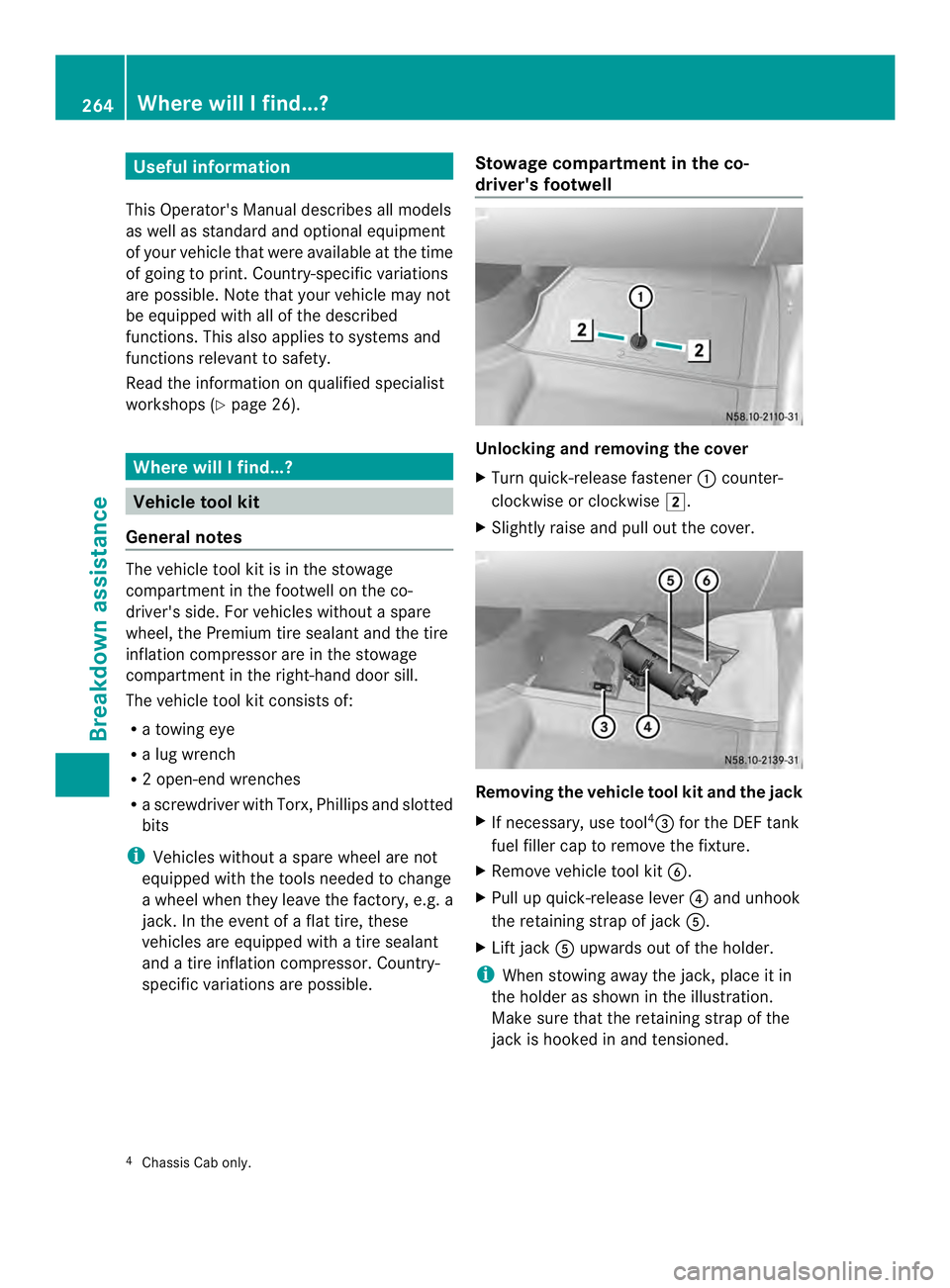
driver's footwell Unlocking and removing the cover
X
Turn quick-release fastener 0005counter-
clockwise or clockwise 0009.
X Slightly raise and pull out the cover. Removing the vehicle tool kit and the jack
X
If necessary, use tool 4
0026 for the DEF tank
fuel filler cap to remove the fixture.
X Remove vehicle tool kit 0024.
X Pull up quick-release lever 0025and unhook
the retaining strap of jack 0023.
X Lift jack 0023upwards out of the holder.
i When stowing away the jack, place it in
the holder as shown in the illustration.
Make sure that the retaining strap of the
jack is hooked in and tensioned.
4 Chassis Cab only. 264
Where will I find...?Breakdown assistance
Page 278 of 334
case, the tire is so worn that it mus
tbe
replaced. Selecting, mounting and renewing
tires
R Only mount tires and wheels of the same
type and make.
R Only mount tires of the correct size onto
the wheels.
R Break in new tires at moderate speeds for
the first 65 miles (100 km).
R Do not drive with tires which have too little
tread depth, as this significantly reduces
the traction on wet roads (hydroplaning).
R Replace the tires after 6years at the latest,
regardless of wear. This also applies to the
spare wheel. Operation in winter
General notes
Have your vehicle winterproofed at a qualified
specialist workshop at the onset of winter.
Prior to the onset of winter, ensure that snow
chains are stowed in the vehicle
(Y page 277).
Observe the notes in the "Changing a wheel"
section (Y page 302). Driving with summer tires
At temperatures below 45 ‡(+7 †), summer
tires lose elasticity and therefore traction and
braking power. Change the tires on your
vehicle to M+S tire. Using summer tires at
very cold temperatures could cause tears to
form, thereby damaging the tires
permanently. We cannot accept
responsibility for this type of damage. M+S tires
G
WARNING
Wheel and tire dimensions as well as the type
of tire can vary between the spare wheel and
the wheel to be replaced .When the spare
wheel is installed, driving characteristics may
be severely affected. There is a risk of an
accident.
In order to reduce risks:
R you should therefore adapt your driving
style and drive carefully.
R never install more than one spare wheel
that differs from the wheel to be replaced.
R only use a spare wheel that differs from the
wheel to be replaced for a short time.
R do not deactivate ESP ®
.
R have a spare wheel that differs from the
wheel that has been changed replaced at
the nearest qualified specialist workshop.
You must observe the correct wheel and
tire dimensions as well as the wheel type. G
WARNING
M+S tires with a tire tread depth of less than
000D in (4 mm) are not suitable for use in winter
and do not provide sufficient traction. There
is a risk of an accident.
M+S tires with a tread depth of less than 000D
in (4 mm) must be replaced immediately.
At temperatures below 45 ‡ (+7 †), use
winter tires or all-season tires. Both types of
tire are identified by the M+S marking.
Only winter tires bearing the 0003snowflake
symbol in addition to the M+S marking
provide the best possible grip in wintry road
conditions.
Only these tires will allow driving safety
systems such as ABS and ESP ®
to function
optimally in winter. These tires have been
developed specifically for driving in snow.
For safe driving, use M+S tires of the same
make and tread pattern on all wheels. 276
Operation in winterWheels and tires
Page 283 of 334
X
Read the tire pressure and compare it with
the recommended value on the loading
information table or th etire pressure table
(Y page 278).
X If the tire pressure is too low, increase it to
the recommended value.
X If the tire pressure is too high, release air
by pressing down the metal pin in the valve.
Use the tip of a pen, for example. Then,
chec kthe tire pressure again using the tire
pressure gauge.
X Screw the valve cap onto the valve.
X Repeatt he steps for the other tires. Tire pressure monitor
Important safety notes G
WARNING
Each tire, including the spare (if provided),
should be checked at least once a month
when cold and inflated to the pressure
recommended by the vehicle manufacturer
on the Tire and Loading Information placard
on the driver's door B-pillar or the tire
pressure label on the inside of the fuel filler
flap. If your vehicle has tires of a different size
than the size indicated on the Tire and Loading
Information placard or the tire pressure label,
you should determine the proper tire pressure
for those tires.
As an added safety feature, your vehicle has
been equipped with a tire pressure monitoring
system (TPMS) that illuminates a low tire
pressure telltale when one or more of your
tires are significantly underinflated.
Accordingly, when the low tire pressure
telltale illuminates, you should stop and check
your tires as soon as possible, and inflate
them to the proper pressure. Driving on a
significantly underinflated tire causes the tire
to overheat and can lead to tire failure.
Underinflation also reduces fuel efficiency
and tire tread life, and may affect the vehicle's
handling and stopping ability. Please note that the TPMS is not a substitute
for proper tire maintenance, and it is the
driver's responsibility to maintain correct tire
pressure, even if underinflation has not
reached the level to trigger illumination of the
TPMS low tire pressure telltale.
USA only:
Your vehicle has also been equipped with a
TPMS malfunction indicator to indicate if the
system is not operating properly. The TPMS
malfunction indicator is combined with the
low tire pressure telltale. When the system
detects a malfunction, the warning lamp will
flash for approximately a minute and then
remain continuously illuminated. This
sequence will be repeated every time the
vehicle is started as long as the malfunction
exists.
When the malfunction indicator is illuminated,
the system may not be able to detect or signal
low tire pressure as intended. TPMS
malfunctions may occur for a variety of
reasons, including the installation of
incompatible replacement or alternate tires
or wheels on the vehicle that prevent the
TPMS from functioning properly. Always
check the TPMS malfunction telltale after
replacing one or more tires or wheels on your
vehicle to ensure that the replacement or
alternate tires and wheels allow the TPMS to
continue to function properly.
Vehicles with a tire pressure monitor are
equipped with sensors in the wheels that
monitor the tire pressure of all four tires. The
tire pressure monitor monitors the pressure
in all four tires; you set this pressure when
you activate the tire pressure monitor. The
tire pressure monitor warns you when the
pressure drops in one or more of the tires. The
tire pressure monitor only functions if the
corresponding sensors are installed to all
wheels.
You should always adjust the tire pressure
according to the vehicle load. Restart the tire
pressure monitor if you change the tire
pressure. Tire pressure
281Wheels and tires Z
Page 298 of 334

Do not drive any further. Contact a qualified
specialis tworkshop. G
WARNING
The tire sealant is harmful and causes
irritation. It must not come into contact with
your skin, eyes or clothing or be swallowed.
Do not inhale TIREFIT fumes. Keep tire sealant
away from children. There is a risk of injury.
If you come into contact with the tire sealant,
observe the following:
R Rinse off the tire sealant from your skin
immediately with water.
R If the tire sealant comes into contact with
your eyes, immediately rinse them
thoroughly with clean water.
R If tire sealant is swallowed, immediately
rinse your mouth out thoroughly and drink
plenty of water. Do not induce vomiting,
and seek medical attention immediately.
R Immediately change out of clothing which
has come into contact with tire sealant.
R If an allergic reaction occurs, seek medical
attention immediately.
In addition, observe the manufacturer's
safety instructions on the sticker on the tire
inflation compressor and on the sticker on the
tire sealant bottle.
The tire sealant is water-soluble. If tire sealant
escapes, you can wash it off with water.
i Have the tire sealant replaced every
8y ears at a qualified specialist workshop.
! The tire inflation compressor should only
be connected to the 12 V socket in the
center console. You may otherwise
damage the vehicle's electrics.
! Do not operate the tire inflation
compressor for longer than 20 minutes at
a time without a break. The tire inflation
compressor may otherwise overheat.
The tire inflation compressor can be
operated again once it has cooled down. H
Environmental note
Have the used tire sealant bottle disposed of
professionally, e.g. at aqualified specialist
workshop.
X Prepare the vehicle as described
(Y page 295).
X If possible, remove the foreign object that
has pierced the tire, e.g .the screw or the
nail.
It is beneficial to the sealing process if the
foreign body that has pierced the tire is
removed.
X Remove the Premium tire sealant, the
accompanying
"max 50 mph"("max80 km/h") sticker and
the tire inflation compressor from the
stowage compartmentint he right-hand
doorway (Y page 264).
X Affix the sticker within the driver's field of
vision. Tire inflation compressor
0005
Switch
0006 Angled connecting piece
0026 Tire inflation compressor hose
0025 Flap
0023 Pressure gauge with pressure release
screw
0024 Connector with cable
X Open flap 0025on the tire inflation
compressor.
X Pull connector 0024and hose 0026with
pressure gauge 0023from the housing. 296
Flat tireWheels and tires
Page 304 of 334
and/or valve tool, warning triangle and
warning lamps in the vehicle.
X Pull away immediately.
This enables the tire sealan tto distribute
inside the tire and create a more effective
seal.
X After driving for approximately 3 minutes,
stop the vehicle at a suitable location, e.g.
at a car park or gas station.
X Check the tire pressure again.
The tire pressure must be at least
300 kPa (3.0 bar/43.5 psi). G
WARNING
If the required tire pressure is not reached
after driving for a short period, the tire is too
badly damaged. The tire sealant cannot repair
the tire in this instance. Damaged tires and a
tire pressure that is too low can significantly
impair the vehicle's braking and driving
characteristics. There is a risk of accident.
Do not continue driving. Contact a qualified
specialist workshop.
i The Mercedes-Benz Service24h
telephone numbers can be found on a
sticker in the driver's door entrance area
and in the vehicle Maintenance Booklet.
i If you check the tire pressure with the tire
inflation compressor, connect angled valve
adapter 0006on tire inflation compressor
hose 0026directly to the tire valve. The tire
pressure will increase when you switch the
tire inflation compressor on. You can
reduce the tire pressure by opening the
pressure release screw on pressure gauge
0023.
If the tire pressure is still at least 300 kPa
(3.0 bar/43.5 psi):
X If possible, inflate the tire to the
recommended tire pressure (Y page 278).
X Drive to the nearest qualified specialist
workshop as soon as possible and have the
tire and tire sealant 0019replaced. Changing wheels
Rotating the wheels
G
WARNING
Interchanging the front and rear wheels may
severely impair the driving characteristics if
the wheels or tires have different dimensions.
The wheel brakes or suspension components
may also be damaged. There is a risk of
accident.
Rotate front and rear wheels only if the wheels
and tires are of the same dimensions.
! On vehicles equipped with a tire pressure
monitor, electronic components are
located in the wheel.
Tire-mounting tools should not be used
near the valve. This could damage the
electronic components.
Only have tires changed at a qualified
specialist workshop.
Always observe the instructions and safety
notes in the "Mounting awheel" section
(Y page 303).
The wear patterns on the front and rear tires
differ, depending on the operating conditions.
Rotate the wheels before a clear wear pattern
has formed on the tires. Front tires typically
wear more on the shoulders and the rear tires
in the center.
If your vehicle's tire configuration allows, you
can rotate the wheels according to the
intervals in the tire manufacturer's warranty
book in your vehicle documents. If no
warranty book is available, the tires should be
rotated every 3,000 to 6,000 miles (5,000 to
10,000 km), or earlier if tire wear requires. Do
not change the direction of rotation.
Clean the contac tsurface softhe wheel and
the brake disc thoroughly every time a wheel
is rotated. Check the tire pressure and
reactivate the tire pressure monitor if
necessary. 302
Changing wheelsWheels and tires
Page 305 of 334
Diagra
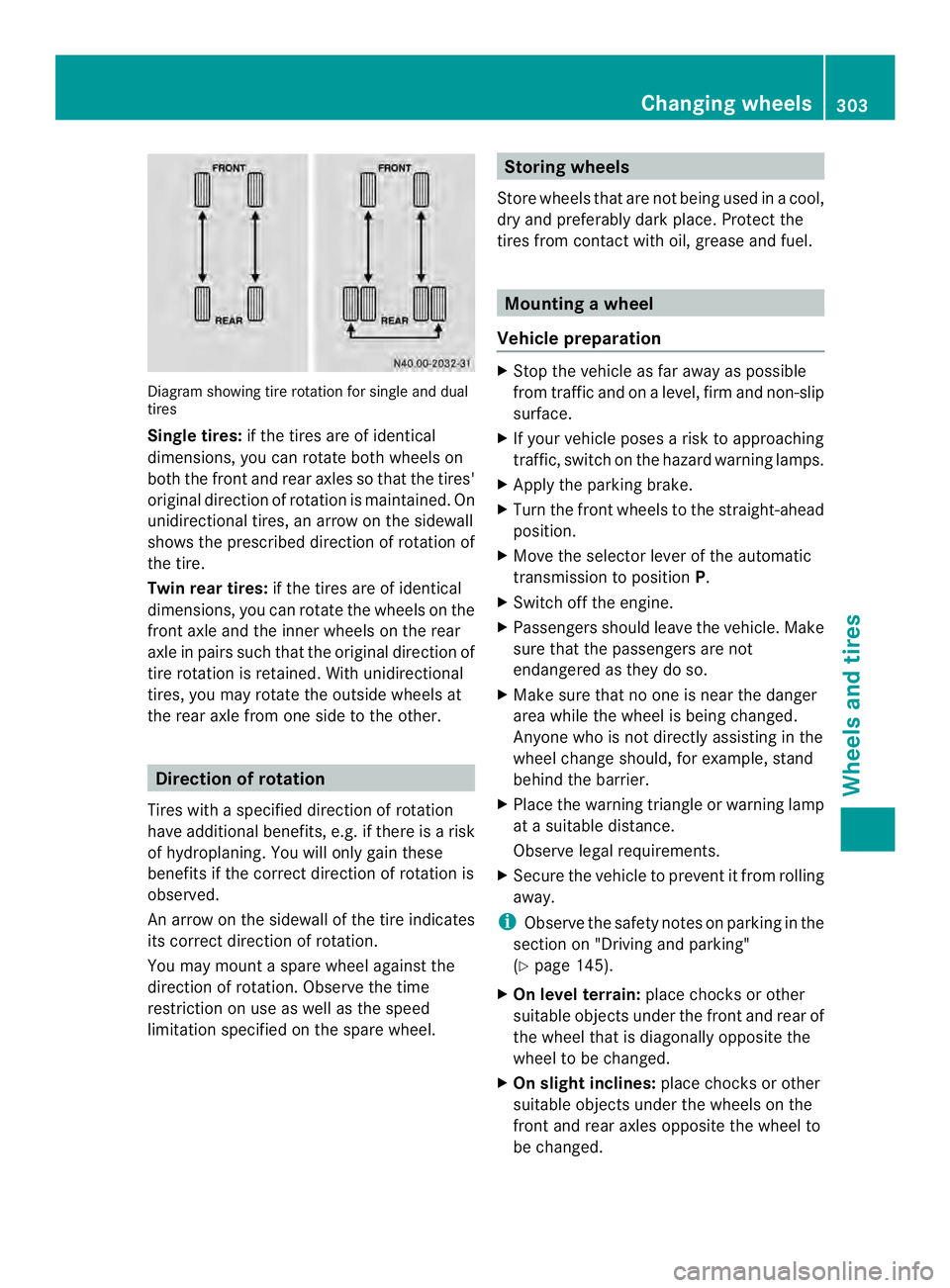
mshowing tire rotation for single and dual
tires
Single tires: if the tires are of identical
dimensions, you can rotate both wheels on
both the front and rear axles so that the tires'
original direction of rotation is maintained. On
unidirectional tires, an arrow on the sidewall
shows the prescribed direction of rotation of
the tire.
Twin rear tires: if the tires are of identical
dimensions, you can rotate the wheels on the
front axle and the inner wheels on the rear
axle in pairs such that the original direction of
tire rotation is retained. With unidirectional
tires, you may rotate the outside wheels at
the rear axle from one side to the other. Direction of rotation
Tires with a specified direction of rotation
have additional benefits, e.g. if there is a risk
of hydroplaning. You will only gain these
benefits if the correct direction of rotation is
observed.
An arrow on the sidewall of the tire indicates
its correct direction of rotation.
You may mount a spare wheel against the
direction of rotation. Observe the time
restriction on use as well as the speed
limitation specified on the spare wheel. Storing wheels
Store wheels that are not being used in a cool,
dry and preferably dark place. Protect the
tires from contact with oil, grease and fuel. Mounting
awheel
Vehicle preparation X
Stop the vehicle as far away as possible
from traffic and on a level, firm and non-slip
surface.
X If you rvehicle poses a risk to approaching
traffic, switch on the hazard warning lamps.
X Apply the parking brake.
X Turn the fron twheels to the straight-ahead
position.
X Move the selector lever of the automatic
transmission to position P.
X Switch off the engine.
X Passengers should leave the vehicle. Make
sure that the passengers are not
endangered as they do so.
X Make sure that no one is near the danger
area while the wheel is being changed.
Anyone who is not directly assisting in the
wheel change should, for example, stand
behind the barrier.
X Place the warning triangle or warning lamp
at a suitable distance.
Observe legal requirements.
X Secure the vehicle to prevent it from rolling
away.
i Observe the safety notes on parking in the
section on "Driving and parking"
(Y page 145).
X On level terrain: place chocks or other
suitable objects under the front and rear of
the wheel that is diagonally opposite the
wheel to be changed.
X On slight inclines: place chocks or other
suitable objects under the wheels on the
front and rear axles opposite the wheel to
be changed. Changing wheels
303Wheels and tires Z
Page 306 of 334
X
Take the vehicle tool kit and the jack from
the footwell on the co-driver's side
(Y page 264).
X Remove the spare wheel from the spare
wheel bracket (Y page 309). Observe the
safety notes in the "Spare wheel" section
(Y page 308).
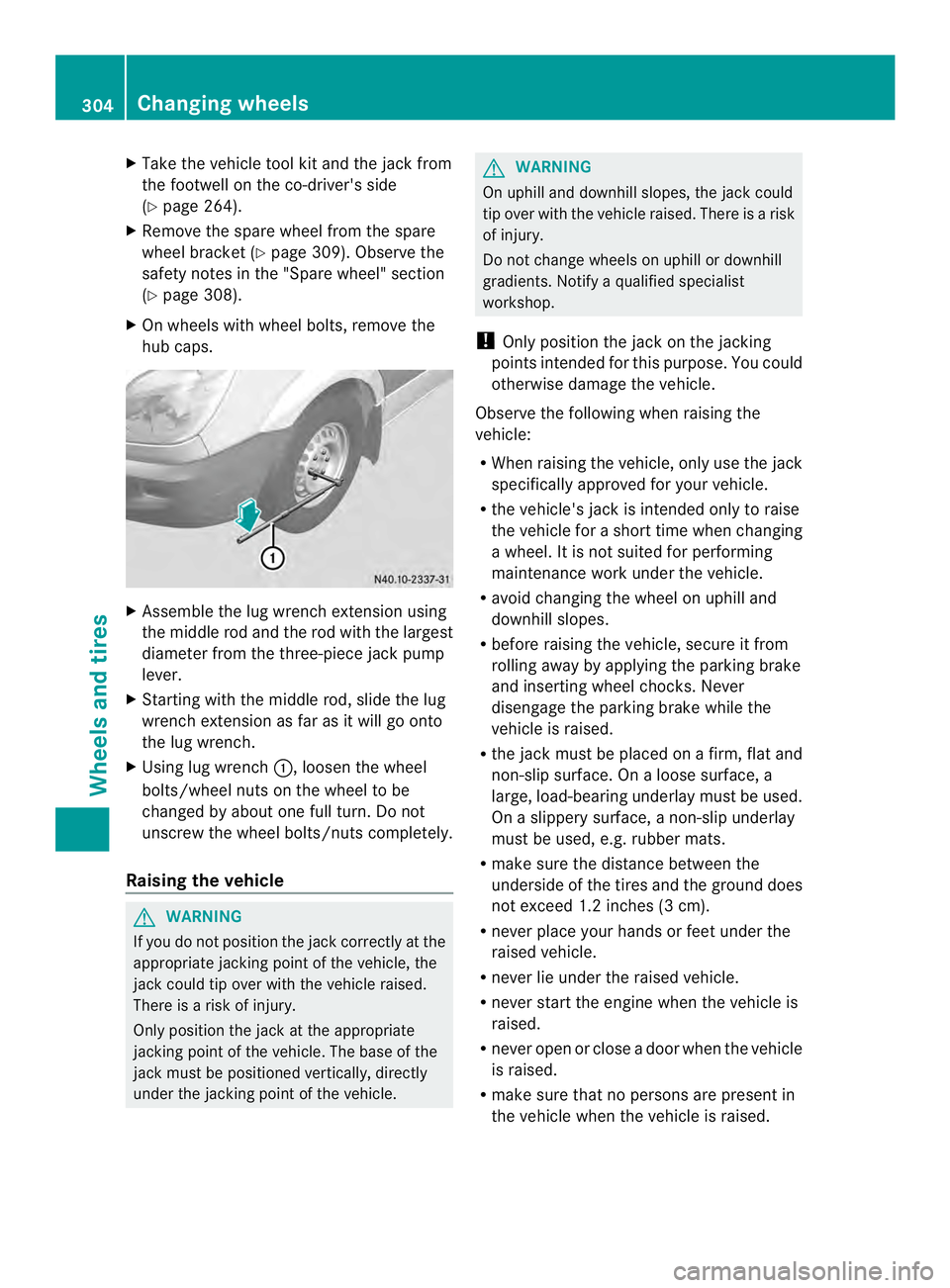
X On wheels with wheel bolts, remove the
hub caps. X
Assemble the lug wrench extension using
the middle rod and the rod with the largest
diameter from the three-piece jack pump
lever.
X Starting with the middle rod, slide the lug
wrench extension as far as it will go onto
the lug wrench.
X Using lug wrench 0005, loosen the wheel
bolts/wheel nuts on the wheel to be
changed by about one full turn. Do not
unscrew the wheel bolts/nuts completely.
Raising the vehicle G
WARNING
If you do not position the jack correctly at the
appropriate jacking point of the vehicle, the
jack could tip over with the vehicle raised.
There is a risk of injury.
Only position the jack at the appropriate
jacking point of the vehicle. The base of the
jack must be positioned vertically, directly
under the jacking point of the vehicle. G
WARNING
On uphill and downhill slopes, the jack could
tip over with the vehicle raised. There is a risk
of injury.
Do not change wheels on uphill or downhill
gradients. Notify a qualified specialist
workshop.
! Only position the jack on the jacking
points intended for this purpose. You could
otherwise damage the vehicle.
Observe the following when raising the
vehicle:
R When raising the vehicle, only use the jack
specifically approved for your vehicle.
R the vehicle's jack is intended only to raise
the vehicle for a short time when changing
a wheel. It is not suited for performing
maintenance work under the vehicle.
R avoid changing the wheel on uphill and
downhill slopes.
R before raising the vehicle, secure it from
rolling away by applying the parking brake
and inserting wheel chocks. Never
disengage the parking brake while the
vehicle is raised.
R the jack must be placed on a firm, flat and
non-slip surface. On a loose surface, a
large, load-bearing underlay must be used.
On a slippery surface, a non-slip underlay
must be used, e.g. rubber mats.
R make sure the distance between the
underside of the tires and the ground does
not exceed 1.2 inches (3 cm).
R never place your hands or feet under the
raised vehicle.
R never lie under the raised vehicle.
R never start the engine when the vehicle is
raised.
R never open or close a door when the vehicle
is raised.
R make sure that no persons are present in
the vehicle when the vehicle is raised. 304
Changing wheelsWheels and tires
Page 311 of 334
R
only use a spare wheel that differs from the
wheel to be replaced for a short time.
R do not deactivate ESP ®
.
R have a spare wheel that differs from the
wheel that has been changed replaced at
the nearest qualified specialist workshop.
You must observe the correc twheel and
tire dimensions as well as the wheel type.
When using a spare wheel of a different size,
do not exceed the maximum speed of
80 km/h. General notes
! Check the spare wheel regularly to see
that it is secure and has the prescribed tire
pressure.
The procedure for mounting the spare wheel
is described in "Mounting awheel"
(Y page 303).
The following should be checked regularly,
particularly prior to long journeys:
R the tire pressure of the spare wheel, which
should then be corrected if necessary
(Y page 278).
R the fastenings of the spare wheel bracket.
The spare wheel is located in a spare wheel
bracket under the rear of the vehicle.
Replace the tires after 6years at the latest,
regardless of wear. This also applies to the
spare wheel.
i If you have mounted a spare wheel, the
tire pressure monitor (Y page 281) will not
function for this wheel. The spare wheel is
not equipped with a sensor for monitoring
tire pressure. Removing and installing the spare
wheel
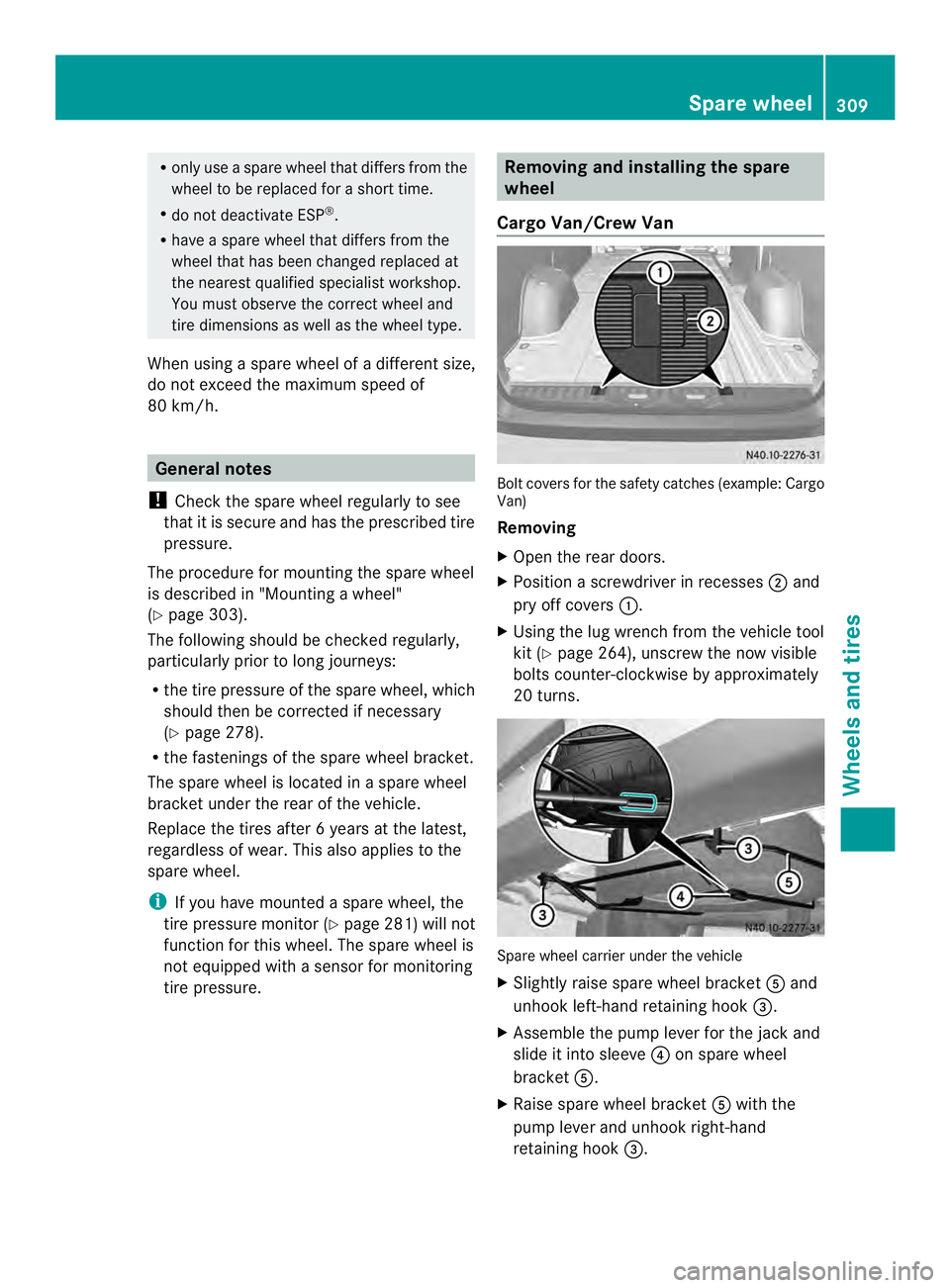
Cargo Van/Crew Van Bolt covers for the safety catches (example: Cargo
Van)
Removing
X
Open the rear doors.
X Position a screwdriver in recesses 0006and
pry off covers 0005.
X Using the lug wrench from the vehicle tool
kit (Y page 264), unscrew the now visible
bolts counter-clockwise by approximately
20 turns. Spare wheel carrier under the vehicle
X
Slightly raise spare wheel bracket 0023and
unhook left-hand retaining hook 0026.
X Assemble the pump lever for the jack and
slide it into sleeve 0025on spare wheel
bracket 0023.
X Raise spare wheel bracket 0023with the
pump lever and unhook right-hand
retaining hook 0026. Spare wheel
309Wheels and tires Z
Page 323 of 334
DEF supply reservoir content
Depending on equipment, th
eDEF supply
reservoir content may vary. Tank contents
Diesel Exhaus
tFluid (DEF) 13 Approx. 3.2 US gal (12.0 l)
Approx. 4.9 US gal (18.5 l)
Approx. 5.8 US gal (22.0 l)
14DEF consumption
Depending on the vehicle version, the DEF
consumption is:
R for the Cargo Van/Passenger Van,
approximately 2322 MPG (0.10 l/100 km)
R for the Cab Chassis, approximately
1720 MPG (0.14 l/100 km)
In each case, the stated consumption figure
is a mea nvalue between urban and extra-
urban driving cycles. The consumption figure
does no trefer to a specific vehicle, but is
provided for the purposes of comparison
between differen tvehicle types.
DEFc onsumption, like fuel consumption, is
very dependent on the driving style and the
operating conditions. This means that the real
consumption figures during operation of your
vehicle may deviate from those stated. Engine oil
General notes !
The bottles of the various engine oil types
are marked with ACEA (Association des
Constructeurs Européens d'Automobiles)
and/or API (American Petroleum Institute)
classifications. Only use approved engine
oils that conform to the following MB Specifications for Service Products and the
prescribed ACEA and/or API
classifications. Using engine oils of another
quality is not permitted and may invalidate
the New Vehicle Limited Warranty.
The use of other, non-approved engine oils
for diesel engines can cause damage to the
diesel particle filter (DPF).
Use only engine oils that have been approved
for your vehicle according to the MB
Specifications for Service Products.
The MB Specifications for Service Products
are valid for your vehicle 15
R 228.51
R 229.31
R 229.51
These are high quality engine oils which have
a positive effect on:
R engine wear
R fuel consumption
R exhaust gas emissions.
Multi-grade engine oils of the prescribed SAE
class (viscosity) may be used all year round,
taking the outside temperatures into
account.
Engine oil viscosity !
If the SAE viscosity class of the engine oil
used does not cover the outside
temperature range in which you are
operating the vehicle, it must be changed
in good time, in particular before the cold
season commences. Using an engine oil
that does not have adequate temperature
characteristics can lead to engine damage.
The temperature range information of the
SAE classification always refers to that of
fresh oil. The temperature characteristics
of the engine oil may deteriorate
13 DEF in accordance with ISO 22241. Observe the MB Specifications for Service Products, Sheet 352.0.
14 Cab Chassis only.
15 If the quality grade is not available for diesel, you may also add engine oils meeting the requirements in MB
Sheet No. 228.5, 229.3 or 229.5. The quantity to be added is then limited to a maximum of 1 qt (1 l). Service products and capacities
321Technical data Z
Page 324 of 334
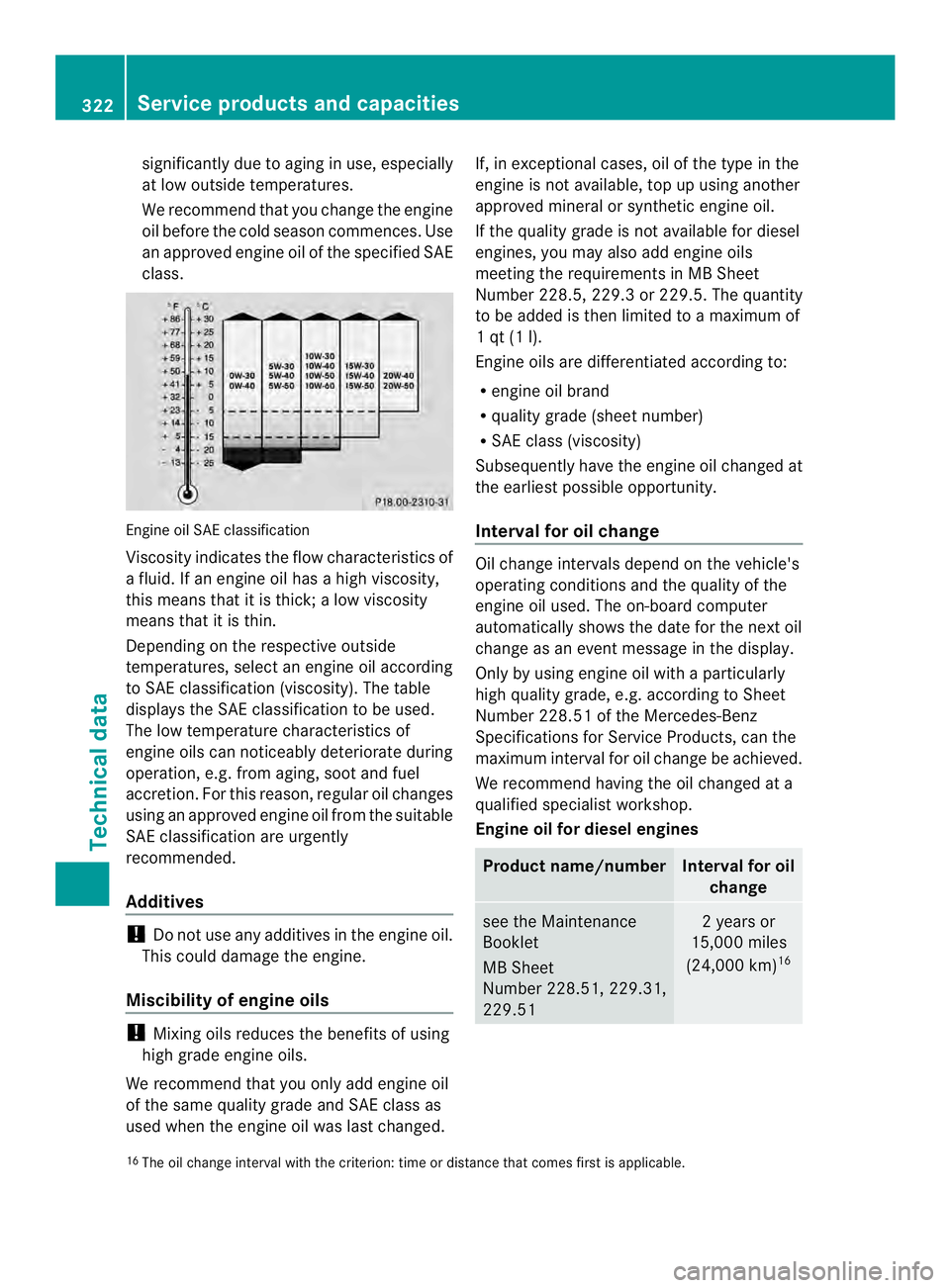
significantly due to aging in use, especially
at low outside temperatures.
We recommend that you change the engine
oil before the cold season commences. Use
an approved engine oil of the specified SAE
class.
Engine oil SAE classification
Viscosity indicates the flow characteristics of
a fluid. If an engine oil has a high viscosity,
this means that it is thick; a low viscosity
means that it is thin.
Depending on the respective outside
temperatures, select an engine oil according
to SAE classification (viscosity). The table
displays the SAE classification to be used.
The low temperature characteristics of
engine oils can noticeably deteriorate during
operation, e.g. from aging, soot and fuel
accretion. For this reason, regularo il changes
using an approved engine oil fro mthe suitable
SAE classification are urgently
recommended.
Additives !
Do not use any additives in the engine oil.
This could damage the engine.
Miscibility of engine oils !
Mixing oils reduces the benefits of using
high grade engine oils.
We recommend that you only add engine oil
of the same quality grade and SAE class as
used when the engine oil was last changed. If, in exceptional cases, oil of the type in the
engine is not available, top up using another
approved mineral or synthetic engine oil.
If the quality grade is not available for diesel
engines, you may also add engine oils
meeting the requirements in MB Sheet
Number 228.5, 229.3 or 229.5. The quantity
to be added is then limited to a maximum of
1 qt (1 l).
Engine oils are differentiated according to:
R
engine oil brand
R quality grade (sheet number)
R SAE class (viscosity)
Subsequently have the engine oil changed at
the earliest possible opportunity.
Interval for oil change Oil change intervals depend on the vehicle's
operating conditions and the quality of the
engine oil used. The on-board computer
automatically shows the date for the next oil
change as an event message in the display.
Only by using engine oil with a particularly
high quality grade, e.g. according to Sheet
Number 228.51 of the Mercedes-Benz
Specifications for Service Products, can the
maximum interval for oil change be achieved.
We recommend having the oil changed at a
qualified specialist workshop.
Engine oil for diesel engines
Product name/number Interval for oil
change see the Maintenance
Booklet
MB Sheet
Number 228.51, 229.31,
229.51 2y
ears or
15,000 miles
(24,000 km) 16 16
The oil change interval with the criterion: time or distance that comes first is applicable. 322
Service products and capacitiesTechnical data