belt MERCEDES-BENZ SPRINTER 2013 MY13 Operator’s Manual
[x] Cancel search | Manufacturer: MERCEDES-BENZ, Model Year: 2013, Model line: SPRINTER, Model: MERCEDES-BENZ SPRINTER 2013Pages: 334, PDF Size: 3.88 MB
Page 269 of 334
Jump-starting
Important safety notes
G
WARNING
During charging and jump-starting, explosive
gases can escape from the battery. There is a
risk of an explosion.
Particularly avoid fire, open flames, creating
sparks and smoking. Ensure there is sufficient
ventilation while charging and jump-starting.
Do not lean over a battery. G
WARNING
Battery acid is caustic. There is a risk of injury.
Avoid contact with the skin, eyes or clothing.
Do not inhale any battery gases. Do not lean
over the battery. Keep children away from
batteries. Wash battery acid immediately with
water and seek medical attention. G
WARNING
Non-combusted fuel can collect in the
exhaust system and ignite. There is a risk of
fire. Avoid repeated and lengthy starting
attempts.
Do not use a rapid charging device to start
the vehicle. If your vehicle's battery is
discharged, the engine can be jump-started
from another vehicle or from a donor battery
using jumper cables. For this purpose, the
vehicle has a jump-starting connection point
in the engine compartment.
The additional battery in the engine
compartmenti s not suitable for jump-starting
operations. If your vehicle requires jump-
starting, or if you use it to jump-start another
vehicle, use the jump-starting connection
point in the engine compartment.
When jump-starting, observe the following
points:
R The battery is not accessible in all vehicles.
If the other vehicle's battery is not accessible, jump-start the vehicle using a
donor battery or a jump-starting device.
R Do not start the engine if the battery is
frozen. Let the battery thaw first.
R Jump-starting may only be performed from
batteries with a nominal voltage of 12 V.
R Only use jumper cables that have a
sufficient cross-section and insulated
terminal clamps.
R If the battery is fully discharged, attach the
battery of another vehicle for a few minutes
before attempting to start. This charges the
empty battery a little.
R Make sure that the two vehicles do not
touch.
Make sure that:
R the jumper cables are not damaged.
R bare parts of the terminal clamps do not
come into contact with other metal parts
while the jumper cables are connected to
the battery.
R the jumper cables cannot come into
contact with parts such as the V-belt pulley
or the fan. These parts move when the
engine is started and while it is running.
i Jumper cables and further information
regarding jump starting can be obtained at
any qualified specialist workshop. Before connecting the jumper cables
On vehicles with a battery main switch, check
whether the battery main switch is switched
on (Y page 132).
X Apply the parking brake.
X Move the selector lever of the automatic
transmission to position P.
X Switch off all electrical consumers, e.g.
audio equipment, blower.
X Turn the key to position 0in the ignition
lock and remove it (Y page 133).
X Open the hood (Y page 240). Jump-starting
267Breakdown assistance Z
Page 294 of 334
permissible load can be found on the
vehicle's Tire and Loading Information
placard on the B-pillar on the driver's side
(Y
page 286).
i The actual values for tires are specific to
each vehicle and may deviate from the
values in the illustration.
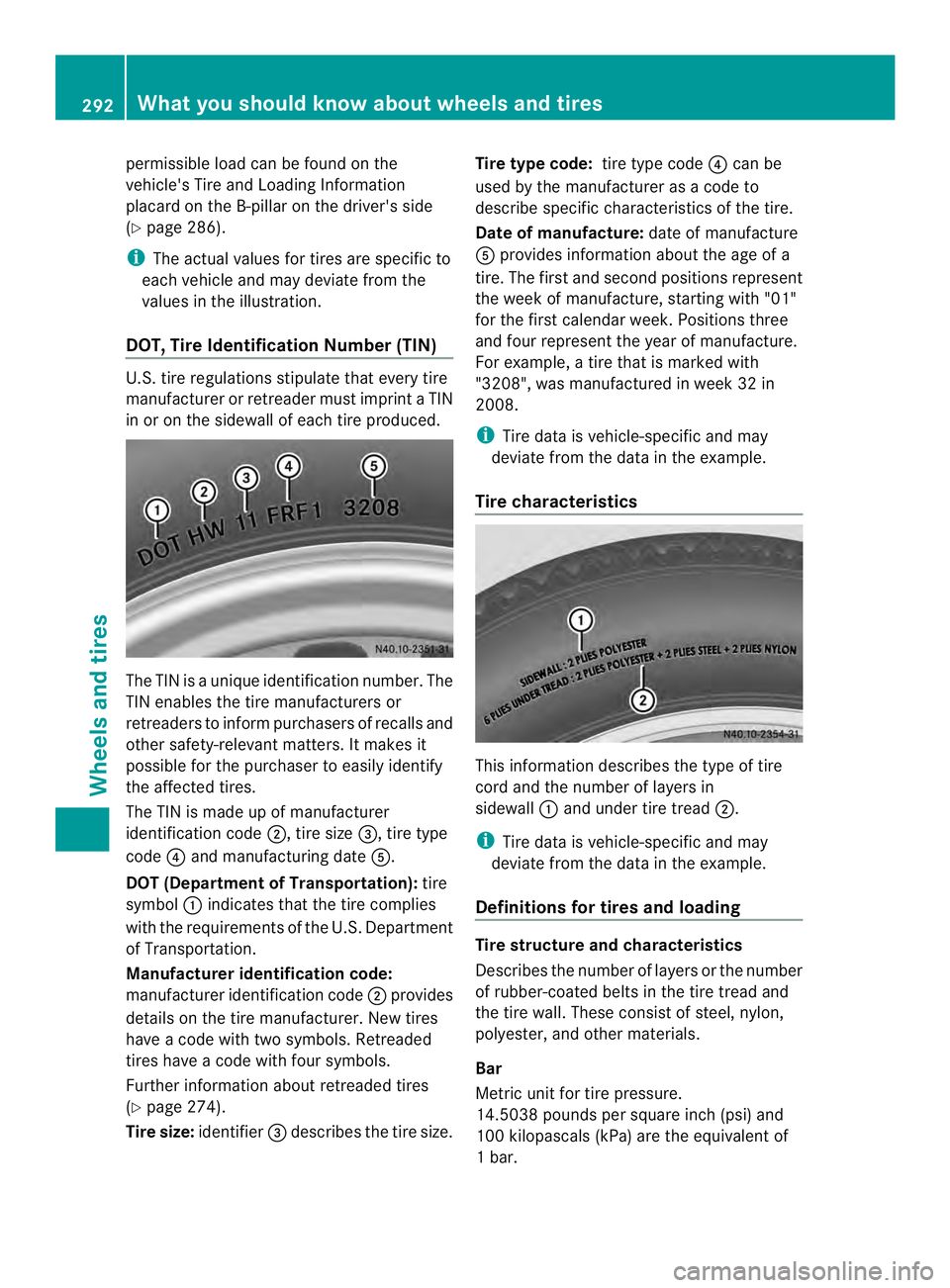
DOT, Tire Identification Number (TIN) U.S
.tire regulations stipulate that every tire
manufacturer or retreader must imprint aTIN
in or on the sidewall of each tire produced. The TIN is a unique identification number. The
TIN enables the tire manufacturers or
retreaders to inform purchasers of recalls and
other safety-relevant matters. It makes it
possible for the purchaser to easily identify
the affected tires.
The TIN is made up of manufacturer
identification code 0006, tire size0026, tire type
code 0025and manufacturing date 0023.
DOT (Department of Transportation): tire
symbol 0005indicates that the tire complies
with the requirements of the U.S. Department
of Transportation.
Manufacturer identification code:
manufacturer identification code 0006provides
details on the tire manufacturer. New tires
have a code with two symbols. Retreaded
tires have a code with four symbols.
Further information aboutr etreaded tires
(Y page 274).
Tire size: identifier0026describes the tire size. Tire type code:
tire type code0025can be
used by the manufacturer as a code to
describe specific characteristics of the tire.
Date of manufacture: date of manufacture
0023 provides information about the age of a
tire. The first and second positions represent
the week of manufacture, starting with "01"
for the first calendar week. Positions three
and four represent the year of manufacture.
For example, a tire that is marked with
"3208", was manufactured in week 32 in
2008.
i Tire data is vehicle-specific and may
deviate from the data in the example.
Tire characteristics This information describes the type of tire
cord and the number of layers in
sidewall
0005and under tire tread 0006.
i Tire data is vehicle-specific and may
deviate from the data in the example.
Definitions for tires and loading Tire structure and characteristics
Describes the number of layers or the number
of rubber-coated belts in the tire tread and
the tire wall. These consist of steel, nylon,
polyester, and other materials.
Bar
Metric unit for tire pressure.
14.5038p
ounds per square inch (psi) and
100 kilopascals (kPa) are the equivalent of
1 bar. 292
What you should know about wheels and tiresWheels and tires