lock MERCEDES-BENZ SPRINTER 2013 MY13 Operator’s Manual
[x] Cancel search | Manufacturer: MERCEDES-BENZ, Model Year: 2013, Model line: SPRINTER, Model: MERCEDES-BENZ SPRINTER 2013Pages: 334, PDF Size: 3.88 MB
Page 72 of 334
automatic locking mechanism of your vehicle
can be obtained from any authorized Sprinter
Dealer.
If the automatic lockin
gwhen driving function
is activated, there is arisk of being locked out
when the vehicle is pushed or towed.
For this reason, deactivate the automatic
locking when driving function:
R before pushing the vehicle
R before towing the vehicle
R if you are only leavin gthe vehicle for a brief
period
If activated, automatic locking is deactivated
when the vehicle is unlocked or locked using
the central locking button.
Automatic locking is reactivated after the
ignition is switched off or a door is opened
with the vehicle stationary.
Activating automatic locking when
driving X
Turn the key to position 1or 2in the ignition
lock when the doors are closed.
X For the entire vehicle: press the upper
0006 central locking button until the
indicator lamp in the button flashes four
times.
X For the sliding doors and rear doors
only: press the 0001lower central locking
button until the indicator lamp in the
0006 upper button flashes four times.
Deactivating automatic lockingw hen
driving X
Turn the key to position 1or 2in the ignition
lock whe nthe doors are closed.
X For the entire vehicle: press the0006
upper central locking button until the
indicator lamp in the button flashes twice.
X For the sliding doors and rear doors
only: press the 0001lower central locking
button until the indicator lamp in the
0006 upper button flashes twice. Driver's door and co-driver's door
! Only open the doors when road and traffic
conditions permit. Make sure that there is
sufficient clearance when opening the
doors. Otherwise, you could damage your
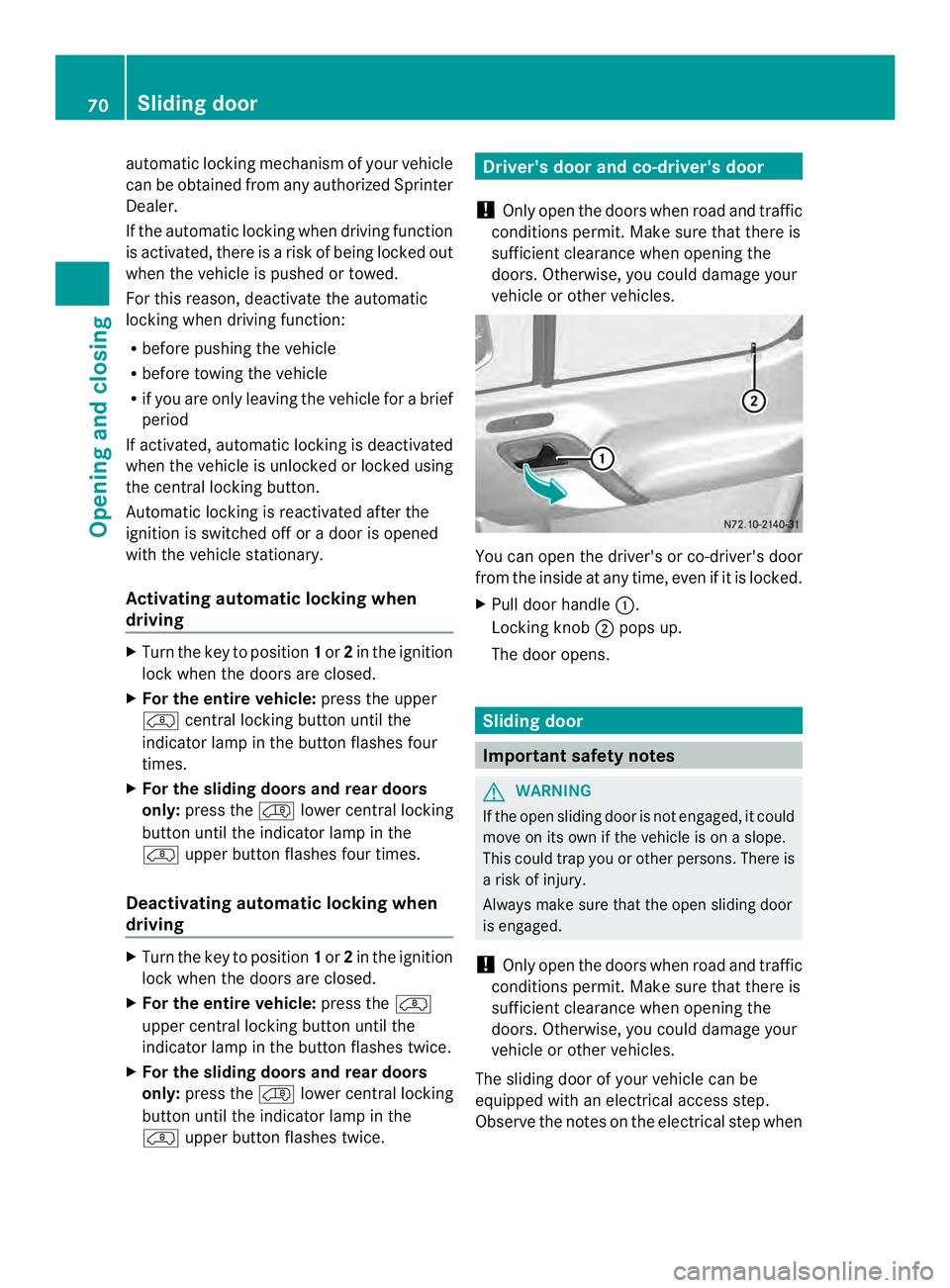
vehicle or other vehicles. You can open the driver's or co-driver's door
from the inside at any time, even if it is locked.
X
Pull door handle 0005.
Locking knob 0006pops up.
The door opens. Sliding door
Important safety notes
G
WARNING
If the open sliding door is not engaged, it could
move on its own if the vehicle is on a slope.
This could trap you or other persons. There is
a risk of injury.
Always make sure that the open sliding door
is engaged.
! Only open the doors when road and traffic
conditions permit. Make sure that there is
sufficient clearance when opening the
doors. Otherwise, you could damage your
vehicle or other vehicles.
The sliding door of your vehicle can be
equipped with an electrical access step.
Observe the notes on the electrical step when 70
Sliding doorOpening and closing
Page 73 of 334
opening and closing the sliding door
(Y
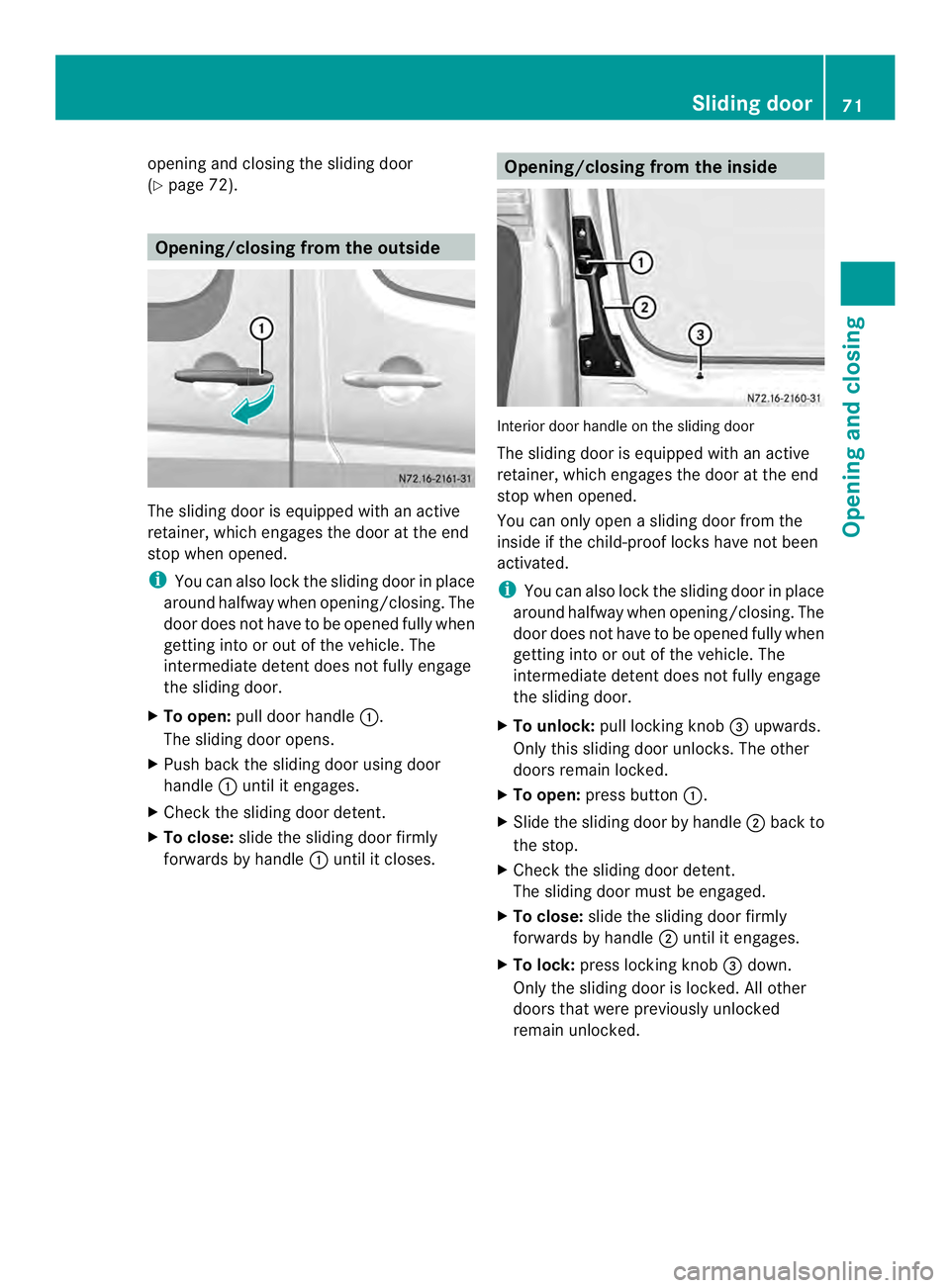
page 72). Opening/closing from the outside
The sliding door is equipped with an active
retainer, which engages the door at the end
stop when opened.
i You can also lock the sliding door in place
around halfway when opening/closing. The
door does not have to be opened fully when
getting into or out of the vehicle. The
intermediate detent does not fully engage
the sliding door.
X To open: pull door handle 0005.
The sliding door opens.
X Push back the sliding door using door
handle 0005until it engages.
X Check the sliding door detent.
X To close: slide the sliding door firmly
forwards by handle 0005until it closes. Opening/closing from the inside
Interior door handle on the sliding door
The sliding door is equipped with an active
retainer, which engages the door at the end
stop when opened.
You can only open a sliding door from the
inside if the child-proof locks have not been
activated.
i
You can also lock the sliding door in place
around halfway when opening/closing. The
door does not have to be opened fully when
getting into or out of the vehicle. The
intermediate detent does not fully engage
the sliding door.
X To unlock: pull locking knob 0026upwards.
Only this sliding door unlocks. The other
doors remain locked.
X To open: press button 0005.
X Slide the sliding door by handle 0006back to
the stop.
X Check the sliding door detent.
The sliding door must be engaged.
X To close: slide the sliding door firmly
forwards by handle 0006until it engages.
X To lock: press locking knob 0026down.
Only the sliding door is locked. All other
doors that were previously unlocked
remain unlocked. Sliding door
71Opening and closing Z
Page 74 of 334
Electrical closing assist
If your vehicle is equipped with electrical
closing assist, you will require less force to
close the sliding door. Electrical step
Important safety notes
If you do no tuse the grab handle and the step,
you could injure yourselfw hen getting in and
out of the vehicle.
In order to reduce risks:
R draw the passengers' attention to the
electrical step. Wait until the electrical step
is fully extended.
R do not jump out of the vehicle.
R only use the grab handle and step. Only
they are designed for such a load.
R keep grab handles, access steps and entry
sills free from dirt, e.g. mud, clay, snow and
ice. Operation and obstacle detection
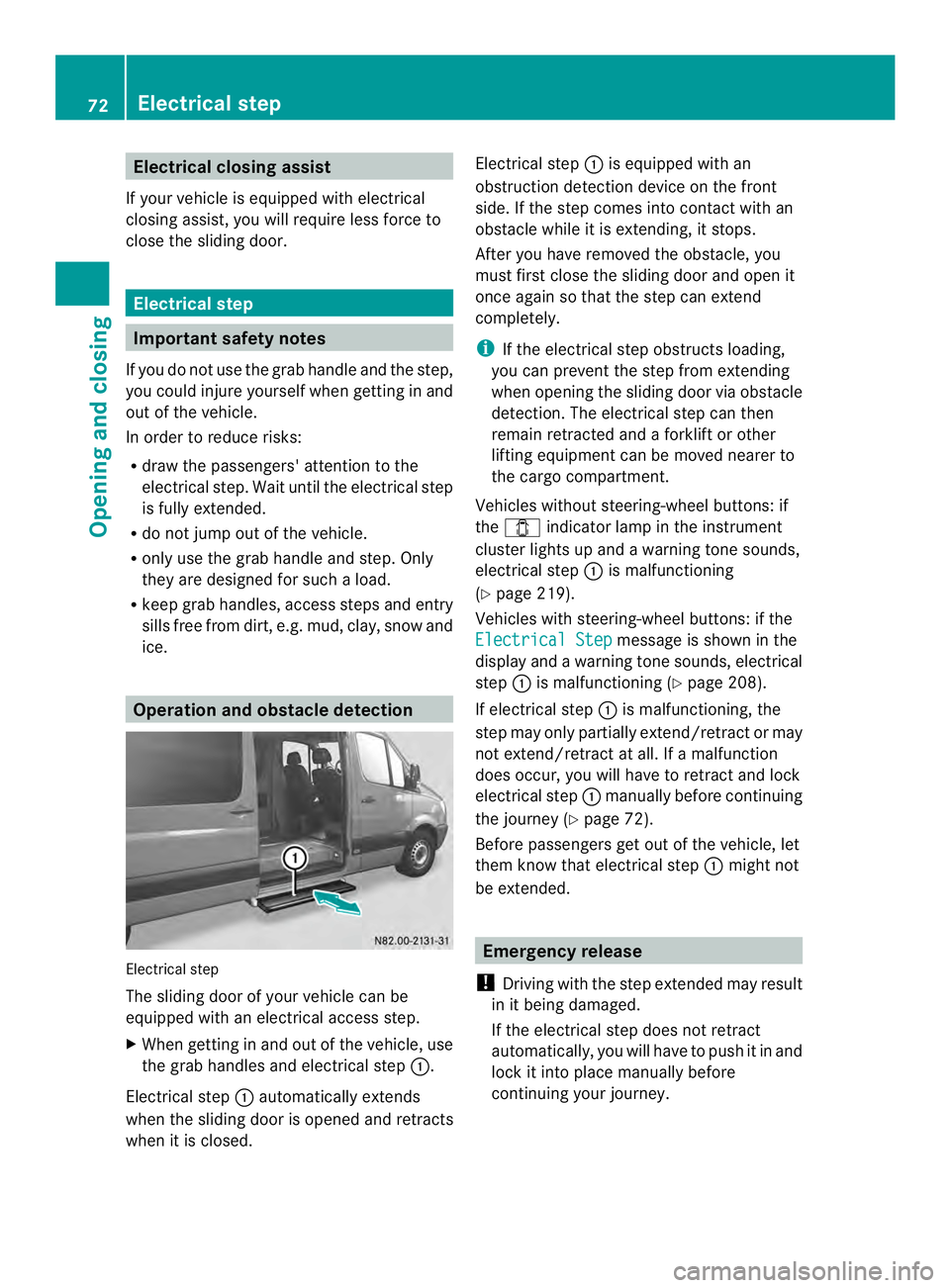
Electrical step
The sliding door of your vehicle can be
equipped with an electrical access step.
X When getting in and out of the vehicle, use
the grab handles and electrical step 0005.
Electrical step 0005automatically extends
when the sliding door is opened and retracts
when it is closed. Electrical step
0005is equipped with an
obstruction detection device on the front
side. If the step comes into contact with an
obstacle while it is extending, it stops.
After you have removed the obstacle, you
must first close the sliding door and open it
once again so that the step can extend
completely.
i If the electrical step obstructs loading,
you can prevent the step from extending
when opening the sliding door via obstacle
detection. The electrical step can then
remain retracted and aforklift or other
lifting equipment can be moved nearer to
the cargo compartment.
Vehicles without steering-wheel buttons: if
the 0004 indicator lamp in the instrument
cluster lights up and a warning tone sounds,
electrical step 0005is malfunctioning
(Y page 219).
Vehicles with steering-wheel buttons: if the
Electrical Step message is shown in the
display and a warning tones ounds, electrical
step 0005is malfunctioning (Y page 208).
If electrical step 0005is malfunctioning, the
step may only partially extend/retract or may
not extend/retract at all. If a malfunction
does occur, you will have to retrac tand lock
electrical step 0005manually before continuing
the journey (Y page 72).
Before passengers ge tout of the vehicle, let
them know that electrical step 0005might not
be extended. Emergency release
! Driving with the step extended may result
in it being damaged.
If the electrical step does not retract
automatically, you will have to push it in and
loc kiti nto place manually before
continuing your journey. 72
Electrical stepOpening and closing
Page 75 of 334
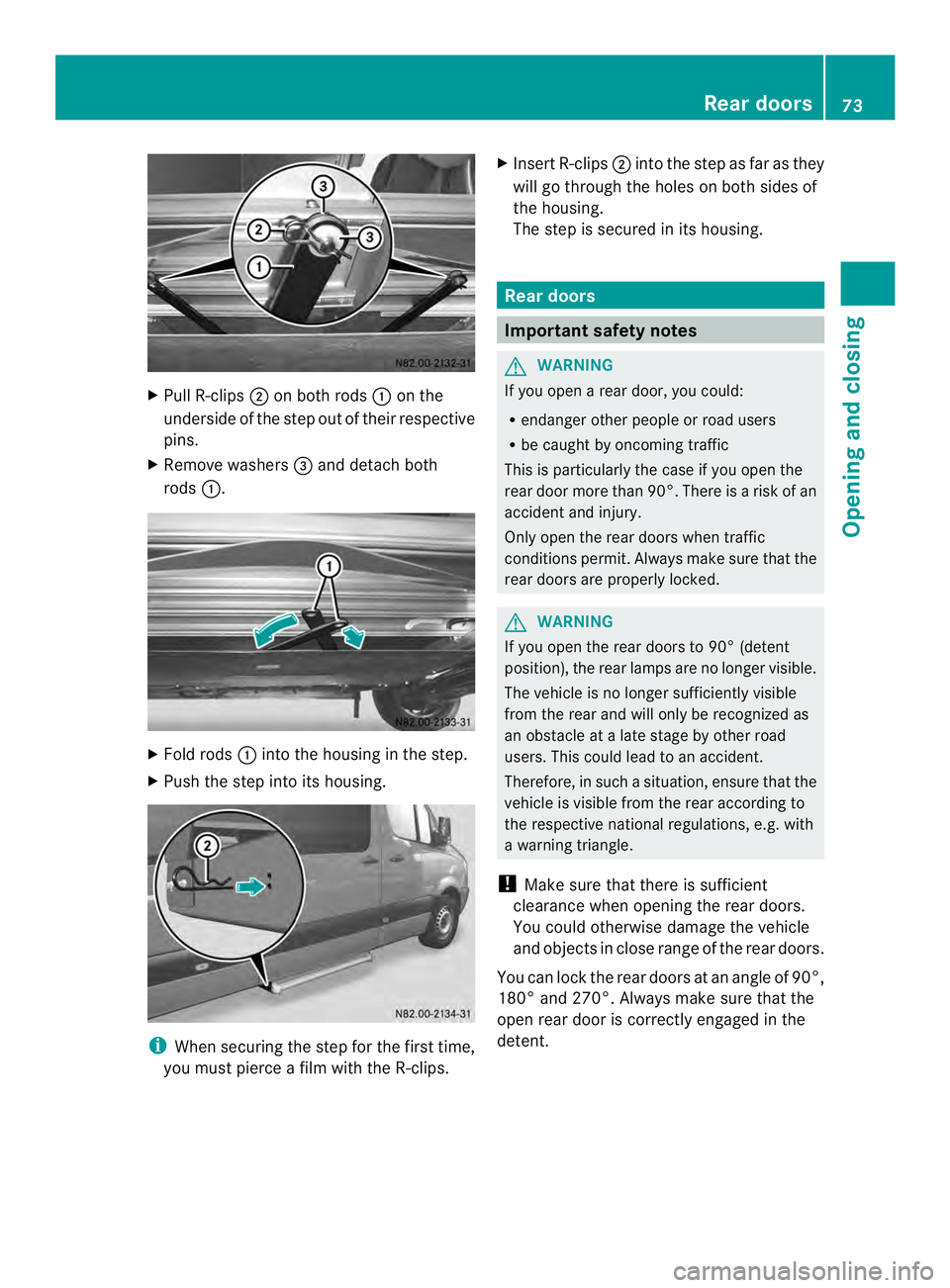
X
Pull R-clips 0006on both rods 0005on the
underside of the step out of their respective
pins.
X Remove washers 0026and detach both
rods 0005. X
Fold rods 0005into the housing in the step.
X Push the step into its housing. i
When securing the step for the first time,
you must pierce a film with the R-clips. X
Inser tR-clips 0006into the step as fa ras they
will go through the holes on both sides of
the housing.
The step is secured in its housing. Rear doors
Important safety notes
G
WARNING
If you open a rear door, you could:
R endanger other people or road users
R be caught by oncoming traffic
This is particularly the case if you open the
rear door more than 90°. There is a risk of an
accident and injury.
Only open the rear doors when traffic
conditions permit. Always make sure that the
rear doors are properly locked. G
WARNING
If you open the rear doors to 90° (detent
position), the rear lamps are no longer visible.
The vehicle is no longer sufficiently visible
from the rear and will only be recognized as
an obstacle at a late stage by other road
users. This could lead to an accident.
Therefore, in such a situation, ensure that the
vehicle is visible from the rear according to
the respective national regulations, e.g. with
a warning triangle.
! Make sure that there is sufficient
clearance when opening the rear doors.
You could otherwise damage the vehicle
and objects in close range of the rear doors.
You can lock the rear doors at an angle of 90°,
180° and 270°. Always make sure that the
open rear door is correctly engaged in the
detent. Rear doors
73Opening and closing Z
Page 77 of 334
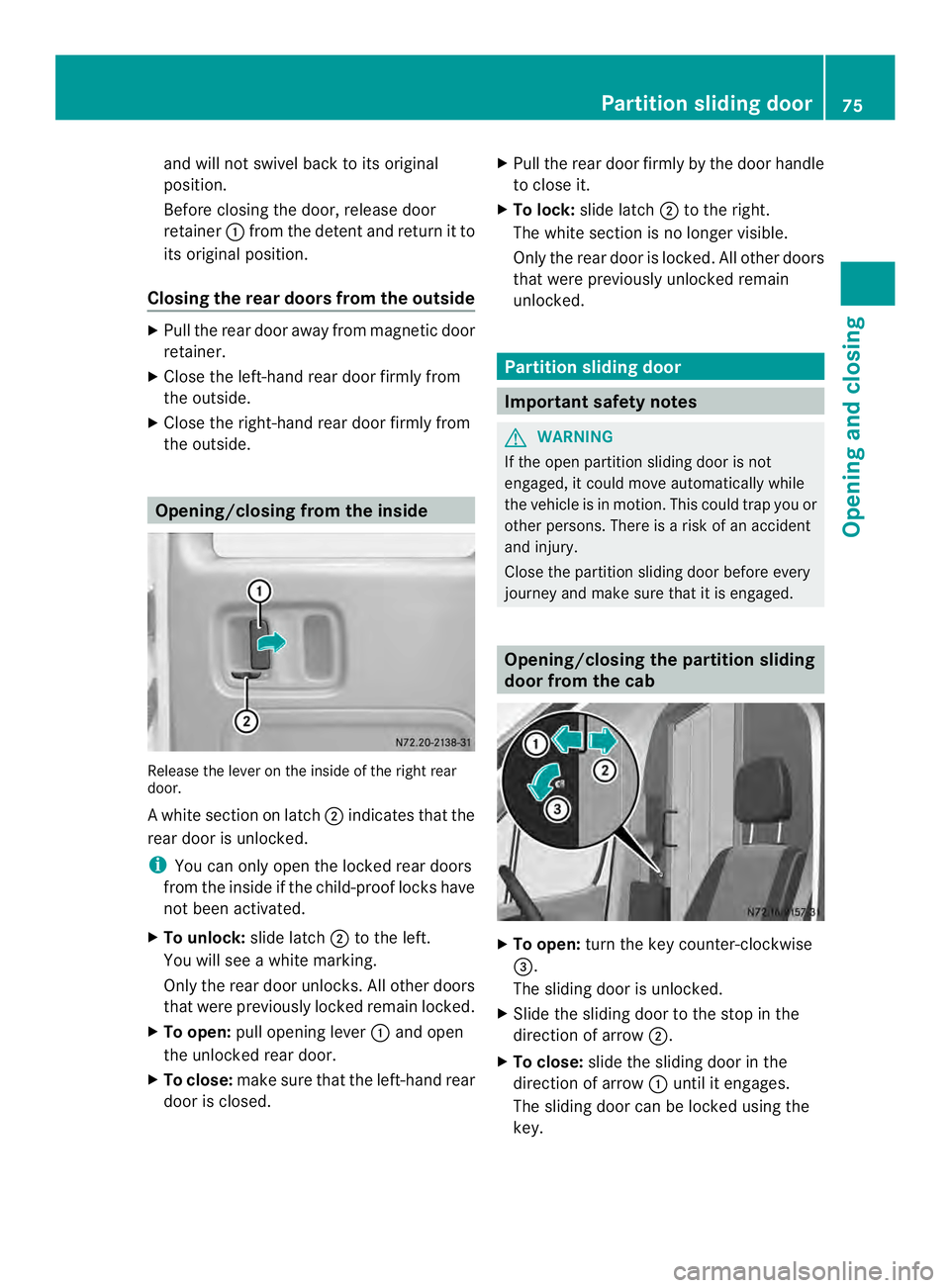
and will no
tswivel back to its original
position.
Before closing the door, release door
retainer 0005from th edetent and return it to
its original position.
Closing the rear doors from the outside X
Pull the rear door away from magnetic door
retainer.
X Close the left-hand rear door firmly from
the outside.
X Close the right-hand rear door firmly from
the outside. Opening/closing from the inside
Release the lever on the inside of the right rear
door.
Aw
hite section on latch 0006indicates that the
rear door is unlocked.
i You can only open the locked rear doors
from the inside if the child-proof locks have
not been activated.
X To unlock: slide latch0006to the left.
You will see a white marking.
Only the rear door unlocks. All other doors
that were previously locked remain locked.
X To open: pull opening lever 0005and open
the unlocked rear door.
X To close: make sure that the left-hand rear
door is closed. X
Pull the rear door firmly by the door handle
to close it.
X To lock: slide latch 0006to the right.
The white section is no longer visible.
Only the rear door is locked. All other doors
that were previously unlocked remain
unlocked. Partition sliding door
Important safety notes
G
WARNING
If the open partition sliding door is not
engaged, it could move automatically while
the vehicle is in motion. This could trap you or
other persons. There is a risk of an accident
and injury.
Close the partition sliding door before every
journey and make sure that it is engaged. Opening/closing the partition sliding
door from the cab
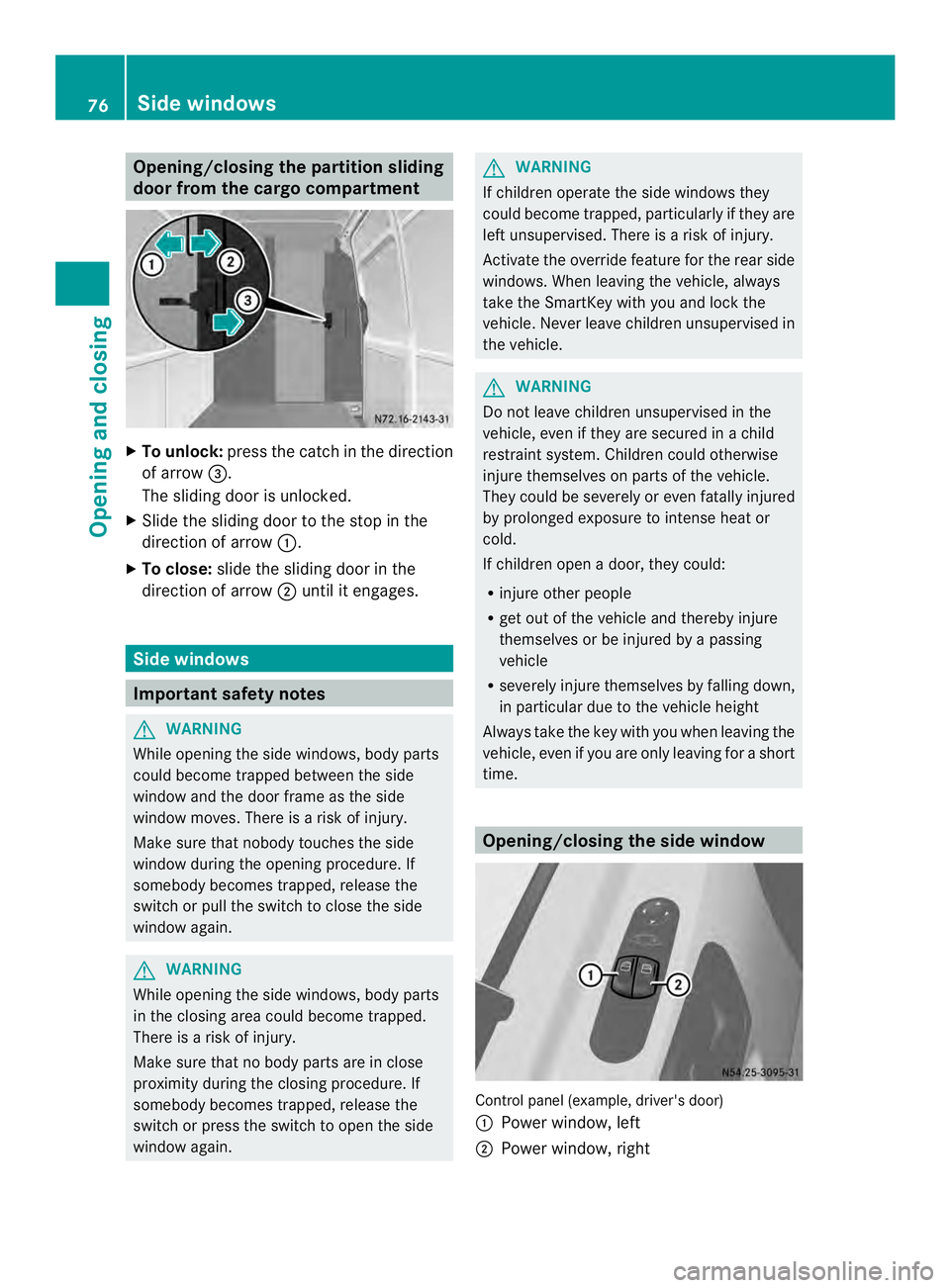
X
To open: turn the key counter-clockwise
0026.
The sliding door is unlocked.
X Slide the sliding door to the stop in the
direction of arrow 0006.
X To close: slide the sliding door in the
direction of arrow 0005until it engages.
The sliding door can be locked using the
key. Partition sliding door
75Opening and closing Z
Page 78 of 334
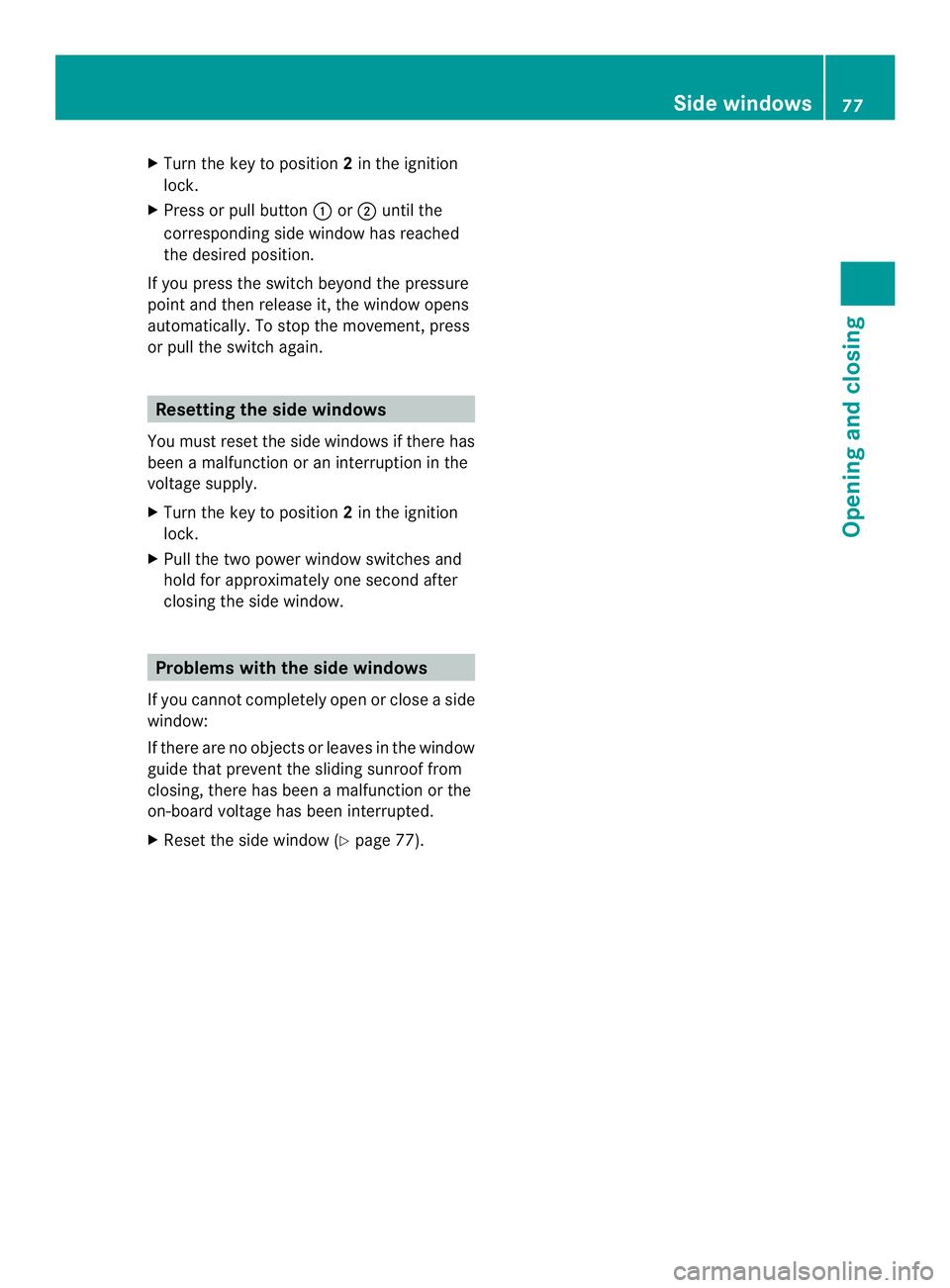
Opening/closing the partition sliding
door from the cargo compartment
X
To unlock: press the catch in the direction
of arrow 0026.
The sliding door is unlocked.
X Slide the sliding door to the stop in the
direction of arrow 0005.
X To close: slide the sliding door in the
direction of arrow 0006until it engages. Side windows
Important safety notes
G
WARNING
While opening the side windows, body parts
could become trapped between the side
window and the door frame as the side
window moves. There is a risk of injury.
Make sure that nobody touches the side
window during the opening procedure. If
somebody becomes trapped, release the
switch or pull the switch to close the side
window again. G
WARNING
While opening the side windows, body parts
in the closing area could become trapped.
There is a risk of injury.
Make sure that no body parts are in close
proximity during the closing procedure. If
somebody becomes trapped, release the
switch or press the switch to open the side
window again. G
WARNING
If children operate the side windows they
could become trapped, particularly if they are
left unsupervised. There is a risk of injury.
Activate the override feature for the rear side
windows. When leaving the vehicle, always
take the SmartKey with you and lock the
vehicle. Never leave children unsupervised in
the vehicle. G
WARNING
Do not leave children unsupervised in the
vehicle, even if they are secured in a child
restraint system. Children could otherwise
injure themselves on parts of the vehicle.
They could be severely or even fatally injured
by prolonged exposure to intense heat or
cold.
If children open a door, they could:
R injure other people
R get out of the vehicle and thereby injure
themselves or be injured by a passing
vehicle
R severely injure themselves by falling down,
in particular due to the vehicle height
Always take the key with you when leaving the
vehicle, even if you are only leaving for a short
time. Opening/closing the side window
Control panel (example, driver's door)
0005
Power window, left
0006 Power window, right 76
Side windowsOpening and closing
Page 79 of 334
X
Turn the key to position 2in the ignition
lock.
X Press or pull button 0005or0006 until the
corresponding side window has reached
the desired position.
If you press the switch beyond the pressure
point and then release it, the window opens
automatically. To stop the movement, press
or pull the switch again. Resetting the side windows
You must reset the side windows if there has
been a malfunction or an interruption in the
voltage supply.
X Turn the key to position 2in the ignition
lock.
X Pull the two power window switches and
hold for approximately one second after
closing the side window. Problems with the side windows
If you cannot completely open or close a side
window:
If there are no objects or leaves in the window
guide that prevent the sliding sunroof from
closing, there has been a malfunction or the
on-board voltage has been interrupted.
X Reset the side window (Y page 77). Side windows
77Opening and closing Z
Page 82 of 334
Useful information
This Operator's Manual describes all models
as well as standard and optional equipment
of your vehicle that were available at the time
of going to print. Country-specific variations
are possible. Note that your vehicle may not
be equipped with all of the described
functions. This also applies to systems and
functions relevant to safety.
Read the information on qualified specialist
workshops (Y page 26). Seats
Important safety notes
G
WARNING
If the driver's seat is not engaged, it could
move unexpectedly while the vehicle is in
motion. This could cause you to lose control
of the vehicle. There is a risk of an accident.
Always make sure that the driver's seat is
engaged before starting the engine. G
WARNING
When you adjust a seat, you or other vehicle
occupants could become trapped, e.g. on the
seat guide rail. There is arisk of injury.
Make sure when adjusting aseat that no one
has any body parts in the sweep of the seat. G
WARNING
If head restraints are not installed and
adjusted correctly, they cannot provide
protection as intended. There is an increased
risk of injury in the head and neck area, e.g.
in the event of an accident or when braking.
Always drive with the head restraints
installed. Before driving off, make sure for
every vehicle occupant that the center of the
head restraint supports the back of the head
at about eye level. Observe also the safety notes in the sections
on "Air bags" (Y
page 44) and "Children in the
vehicle" ( Ypage 50).
Do not change over the head restraints for the
fron tand rea rseats. Otherwise, it will not be
possible to correctly adjust the height and
angle of the head restraints.
Use the head restraint pad to adjust the head
restraint so that it is as close as possible to
the back of your head.
Before the journey, make sure the head
restraints have been correctly set for each of
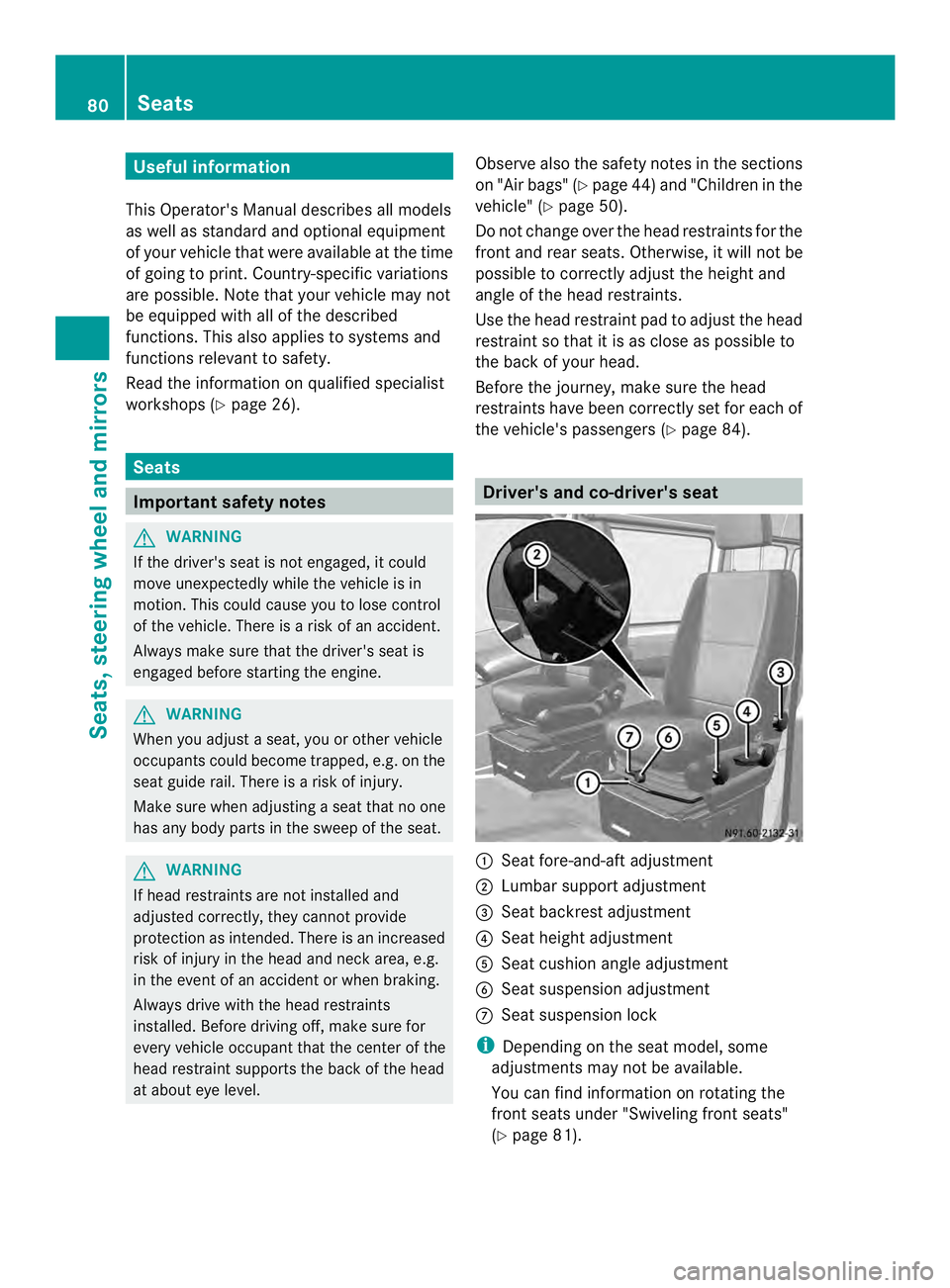
the vehicle's passengers (Y page 84). Driver's and co-driver's seat
0005
Seat fore-and-aft adjustment
0006 Lumbar support adjustment
0026 Seat backrest adjustment
0025 Seat height adjustment
0023 Seat cushion angle adjustment
0024 Seat suspension adjustment
0018 Seat suspension lock
i Depending on the seat model, some
adjustments may not be available.
You can find information on rotating the
fron tseats under "Swiveling fron tseats"
(Y page 81). 80
SeatsSeats, steering wheel and mirrors
Page 83 of 334
X
To adjust the seat fore-and-aft
position: pull lever0005up.
X Slide the sea tforwards or back until you
can depress the pedals.
X Release lever 0005.
X Slide the seat forwards or back until you
hear it engage.
X To adjust the backrest: turn handwheel
0026 towards the front.
The seat backrest moves to a vertical
position.
X Turn handwheel 0026towards the rear.
The seat backrest tilts towards the rear.
X To adjust the seat height: press or pull
lever 0025repeatedly until you have reached
the desired seat height.
X To adjust the seat angle: turn handwheel
0023 towards the front.
The front of the seat cushion is lowered.
X Turn handwheel 0023towards the rear.
The front of the seat cushion is raised.
i The lumbar support allows you to use the
backrest to increase the support provided
to the lumbar spine.
When the lumbar support is correctly
adjusted, it reduces strain on your back
while driving.
X To adjust the lumbar support: turn
handwheel 0006upwards.
This increases the support provided to the
lumbar region.
X Turn handwheel 0006downwards.
This reduces the support provided to the
lumbar region. The seat suspension must be adapted to your
body weight. Adjust the seat suspension only
while the seat is unoccupied.
X
To adjust the seat suspension: take your
weight off the seat.
X Using handwheel 0024, set your body weight
(40 to 120 kg) for optimum seat
suspension.
The seat suspension will become more rigid
the higher you set the weight. It will then
not move as far.
If the seat moves up and down frequently and
to a great extent, you can lock the seat in the
lower movemen trange.
X To engage the seat suspension lock:
turn lever 0018downwards.
When it next moves, th eseat will lock in
position.
i The seat suspension lock will only engage
if your body weight equals or exceeds the
weight selected for the seat suspension.
X To release the seat suspension lock:
turn lever 0018upwards.
The seat can now move up and down again. Swiveling front seats
G
WARNING
You could lose control of your vehicle if you
do the following while driving:
R adjust the driver's seat, head restraint,
steering wheel or mirrors
R fasten the seat belt
There is a risk of an accident.
Adjust the driver's seat, head restraint,
steering wheel and mirror and fasten your
seat belt before starting the engine. G
WARNING
If the driver's and co-driver's seats are not
engaged facing the direction of travel while
driving, the restraint systems may not be able Seats
81Seats, steering wheel and mirrors
Z
Page 85 of 334
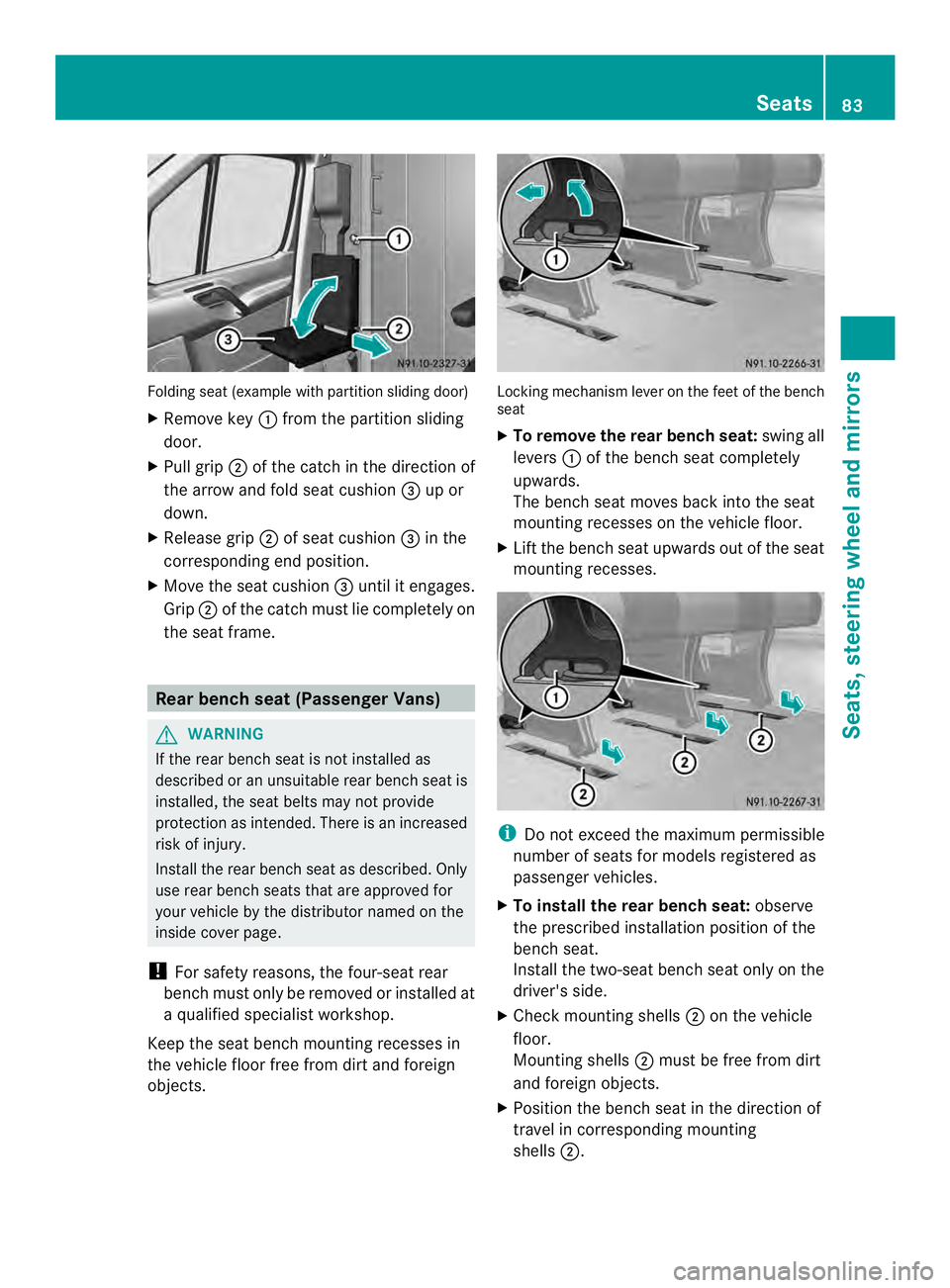
Folding sea
t(example with partition sliding door)
X Remove key 0005from the partition sliding
door.
X Pull grip 0006of the catch in the direction of
the arrow and fold seat cushion 0026up or
down.
X Release grip 0006of seat cushion 0026in the
corresponding end position.
X Move the seat cushion 0026until it engages.
Grip 0006of the catch must lie completely on
the seat frame. Rear bench seat (Passenger Vans)
G
WARNING
If the rear bench seat is not installed as
described or an unsuitable rear bench seat is
installed, the seat belts may not provide
protection as intended. There is an increased
risk of injury.
Install the rear bench seat as described. Only
use rear bench seats that are approved for
your vehicle by the distributor named on the
inside cover page.
! For safety reasons, the four-seat rear
bench must only be removed or installed at
a qualified specialist workshop.
Keep the seat bench mounting recesses in
the vehicle floor free from dirt and foreign
objects. Locking mechanism lever on the feet of the bench
seat
X
To remove the rear bench seat: swing all
levers 0005of the bench seat completely
upwards.
The bench seat moves back into the seat
mounting recesses on the vehicle floor.
X Lift the bench seat upwards out of the seat
mounting recesses. i
Do not exceed the maximum permissible
number of seats for models registered as
passenger vehicles.
X To install the rear bench seat: observe
the prescribed installation position of the
bench seat.
Install the two-seat bench seat only on the
driver's side.
X Check mounting shells 0006on the vehicle
floor.
Mounting shells 0006must be free from dirt
and foreign objects.
X Position the bench seat in the direction of
travel in corresponding mounting
shells 0006. Seats
83Seats, steering wheel and mirrors Z