lock MERCEDES-BENZ SPRINTER 2013 MY13 Operator’s Manual
[x] Cancel search | Manufacturer: MERCEDES-BENZ, Model Year: 2013, Model line: SPRINTER, Model: MERCEDES-BENZ SPRINTER 2013Pages: 334, PDF Size: 3.88 MB
Page 22 of 334
Trailer loads and drawbar
noseweights
...................................... 173
Trailer towing PARKTRONI C................................. 160
Permissible trailer loads and
drawba rnoseweights ............169, 173
Transmission
see Automatic transmission
Transmission oil ................................ 323
Transport Loading guidelines .........................232
Vehicle .......................................... .271
Transportation
Rail ................................................ 150
Transport by rail ................................ 150
Transporting Load distribution ............................ 234
Securing aload .............................. 234
Trim pieces (cleaning instructions) .260
Trip computer (on-board
computer) .......................................... 189
Trip meter see Trip odometer
Trip odometer
Display (vehicles without steering
wheel buttons) ............................... 178
Display (vehicles with steering
wheel buttons) ............................... 182
Resetting ....................................... 177
see Trip computer (on-board computer)
Turn signals
Changing bulbs (front) .....................98
Changing bulbs (rear) ..............99, 101
Switching on/off .............................. 92
Turn signals (Chassis Cab)
Changing bulbs (rear) ....................100
Twin co-driver's seat
Folding tabl e.................................. 225
Stowag ecompartmen t.................. 224
Two-way radios
Type approval/frequency ..............314
TWR (Tongue Weight Rating)
(definition) ......................................... 295 U
Unlocking From inside the vehicle (central
unlocking button) ............................. 69 V
Vehicle Correct use ...................................... 26
Data acquisition ............................... 29
Display message ............................ 208
Electronics ..................................... 314
Equipment ....................................... 23
Individual settings (vehicles with
steering wheel buttons) .................183
Limited Warranty ............................. 29
Loading .......................................... 286
Locking (SmartKey) .......................... 64
Lowering ........................................ 307
Maintenance .................................... 23
Operating safety .............................. 24
Parking for a long period ................ 147
Pulling away ................................... 135
Raising ........................................... 304
Registration ..................................... 23
Reporting problems .........................28
Securing from rolling away ............145
Towing away .................................. 268
Transporting .................................. 271
Unlocking (SmartKey) ......................64
Vehicle battery
see Battery (vehicle)
Vehicle bodies
General notes .................................. 27
Vehicle data ....................................... 326
Vehicle identification number .......... 315
Vehicle identification plate ..............315
Vehicle tool kit .................................. 264
Voltage supply Fuse s............................................. 271 W
Warning and indicator lamps Brakes ........................................... 211
Check Engine ................................. 216
Coolant .......................................... 215
Diesel Exhaus tFluid (DEF) .............213 20
Index
Page 34 of 334
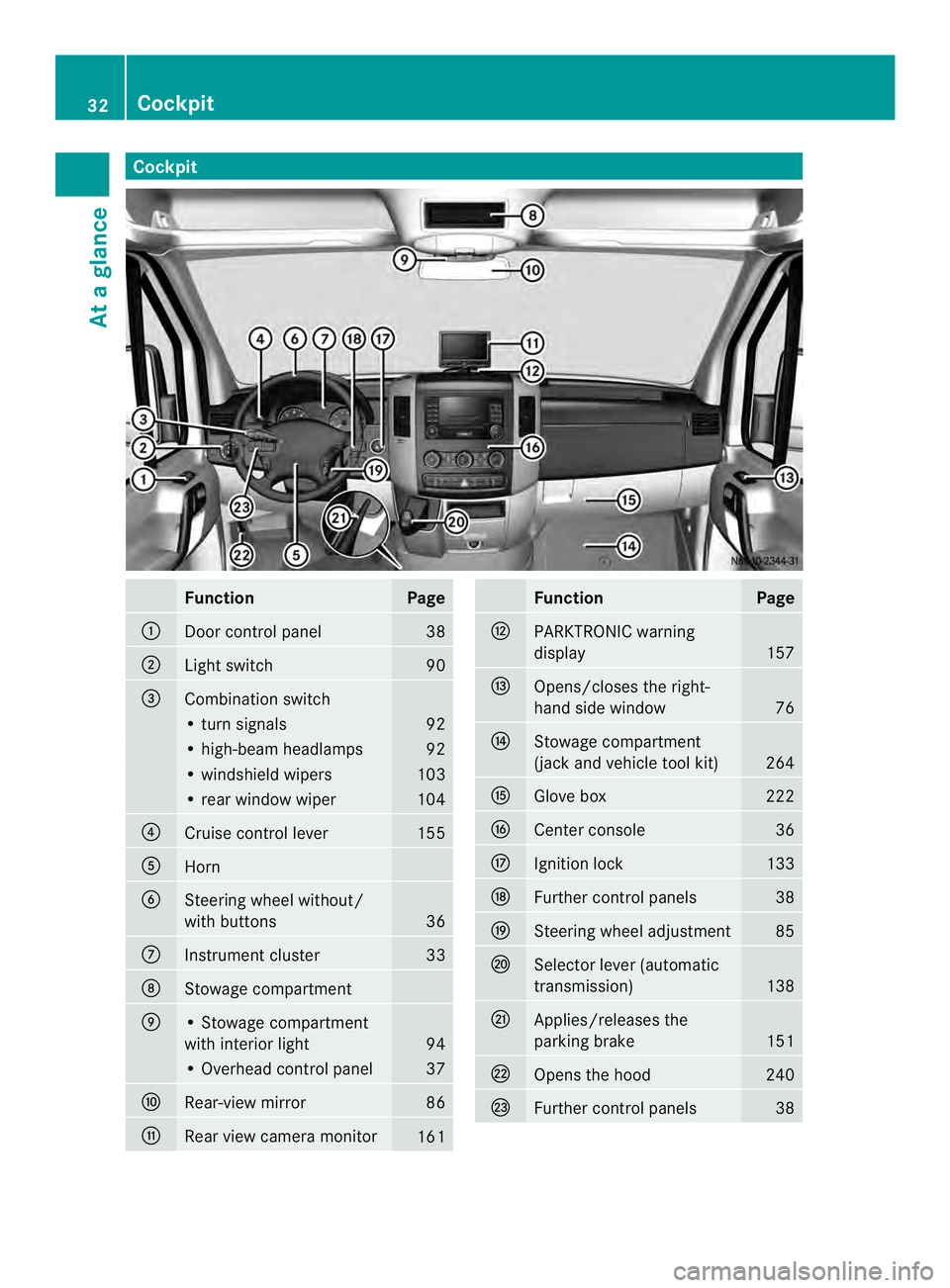
Cockpit
Function Page
0005
Door control panel 38
0006
Ligh
tswitch 90
0026
Combinatio
nswitch • tur
nsignals 92
• high-beam headlamps 92
• windshield wipers 103
• rear window wiper 104
0025
Cruise control lever 155
0023
Horn
0024
Steering wheel without/
with buttons
36
0018
Instrument cluster 33
0019
Stowage compartment
001A
• Stowage compartment
with interior light
94
• Overhead control panel 37
001B
Rear-view mirror 86
001C
Rear view camera monitor
161 Function Page
001D
PARKTRONIC warning
display 157
001E
Opens/closes the right-
hand side window
76
001F
Stowage compartment
(jac kand vehicle tool kit) 264
0020
Glove box 222
0021
Center console 36
0022
Ignitio
nlock 133
0028
Further control panels 38
0029
Steering wheel adjustment 85
002A
Selector lever (automatic
transmission)
138
002B
Applies/releases the
parking brake
151
002C
Opens the hood 240
0014
Further control panels 3832
CockpitAt a glance
Page 39 of 334
Function Page
0006
Activates/deactivates ASR 58
0006
0001
Central locking, interior/
rear compartment
69
0023
• Stowage compartmen
tor • CD changer, see separate
operating instructions or
0024
Cup holder with: 226
• ashtray 227
• cigarette lighter 227
0018
12 V socket 228 Overhea
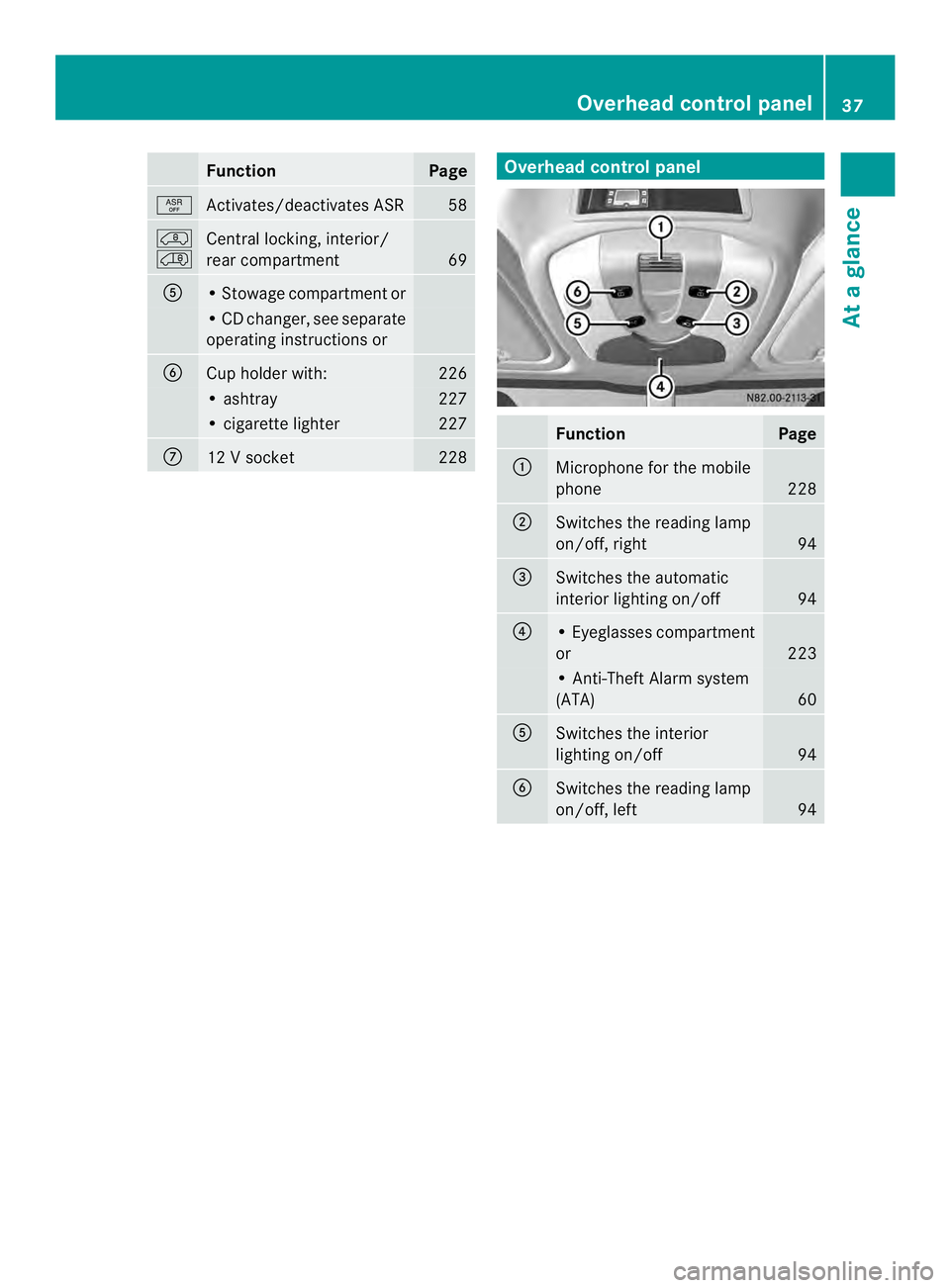
dcontrol panel Function Page
0005
Microphone for the mobile
phone
228
0006
Switches the reading lamp
on/off, right
94
0026
Switches the automatic
interio
rlighting on/off 94
0025
• Eyeglasses compartment
or
223
• Anti-Theft Alarm system
(ATA)
60
0023
Switches the interior
lighting on/off
94
0024
Switches the reading lamp
on/off, left
94Overhead control panel
37At a glance
Page 41 of 334
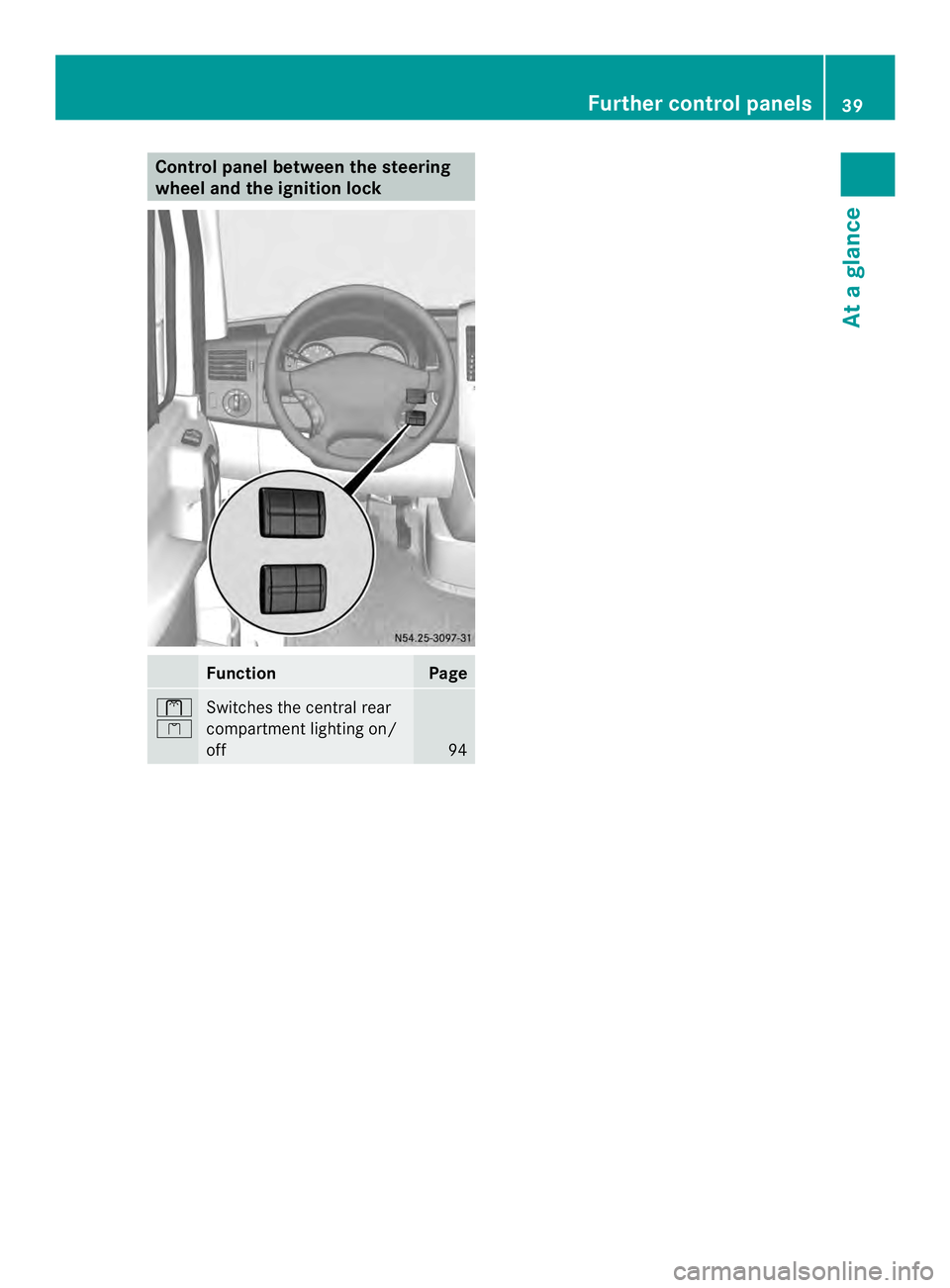
Control panel between the steering
wheel and the ignition lock Function Page
000D
000A
Switches the central rear
compartment lighting on/
off
94 Further control panels
39At a glance
Page 43 of 334
Useful information
..............................42
Occupant safety .................................. 42
Child restraint systems ......................50
Child-proof locks ................................. 54
Driving safet ysystems ....................... 56
Emergency exit ................................... 59
Theft deterrent locking system .........60 41Safety
Page 56 of 334
Make sure that:
R
the Top Tether hook 0026is hooked into
Top Tether anchorage 0006, as shown
R the Top Tether belt 0025is not twisted
X Tighten Top Tether belt 0025.Comply with the
manufacturer's installation instructions
when doing so.
X If necessary, push the head restraint back
down slightly. Make sure that you do not
interfere with the correct routing of Top
Tether belt 0025. Special seat belt retractor
G
WARNING
If the seat belt is released while driving, the
child restraint system will no longer be
secured properly. The special seat belt
retractor is disabled and the inertia real draws
in a portion of the seat belt. The seat belt
cannot be immediately refastened. There is
an increased risk of injury, possibly even fatal.
Stop the vehicle immediately, paying
attention to road and traffic conditions.
Reactivate the special seat belt retractor and
secure the child restraint system properly.
All seat belts in the vehicle, except the
driver's seat belt, are equipped with a special
seat belt retractor. When activated, the
special seat belt retractor ensures that the
seat belt cannot slacken once the child seat
is secured.
X To activate the special seat belt
retractor: install the child restraint
system. Observe the child-seat
manufacturer's installation instructions
when doing so.
X Pull the seat belt smoothly from the inertia
reel.
X Engage the belt tongue in the seat belt
buckle. X
Extend the seat belt fully and then allow the
inertia reel to retract the belt.
Ar atcheting noise can be heard when the
belt is retracting; this indicates activation
of the special seat belt retractor.
X Press the child restraint system down
firmly into the seat to avoid any play.
X To disable the special seat belt
retractor: press the seat belt buckle
release butto nand allow the belt to retract
fully.
The sea tbelt can be used in the normal
manner again. Child-proof locks
Important safety notes
G
WARNING
If the child restraint system is subjected to
direct sunlight, parts may get very hot.
Children may burn themselves on these parts,
particularly on the metal parts of the child
restraint system. There is a risk of injury.
If you leave the vehicle, taking the child with
you, always ensure that the child restraint
system is not exposed to direct sunlight.
Protect it with a blanket, for example. If the
child restraint system has been exposed to
direct sunlight, let it cool down before
securing the child in it. Never leave children
unattended in the vehicle.
You can activate the child-proof lock for the
sliding door ( Ypage 55) and for the rear
door (Y page 55). 54
Child-proof locksSafety
Page 57 of 334
Child-proof locks for the sliding door/
rear door G
WARNING
If childre nare traveling in the vehicle, they
could:
R open doors, thus endangering other people
or road users
R exit the vehicle and be caught by oncoming
traffic
R operate vehicle equipment and become
trapped
There is a risk of an accident and injury.
Always activate the child-proof locks and
override feature if children are traveling in the
vehicle. When leaving the vehicle, always take
the key with you and lock the vehicle. Never
leave children unattended in the vehicle.
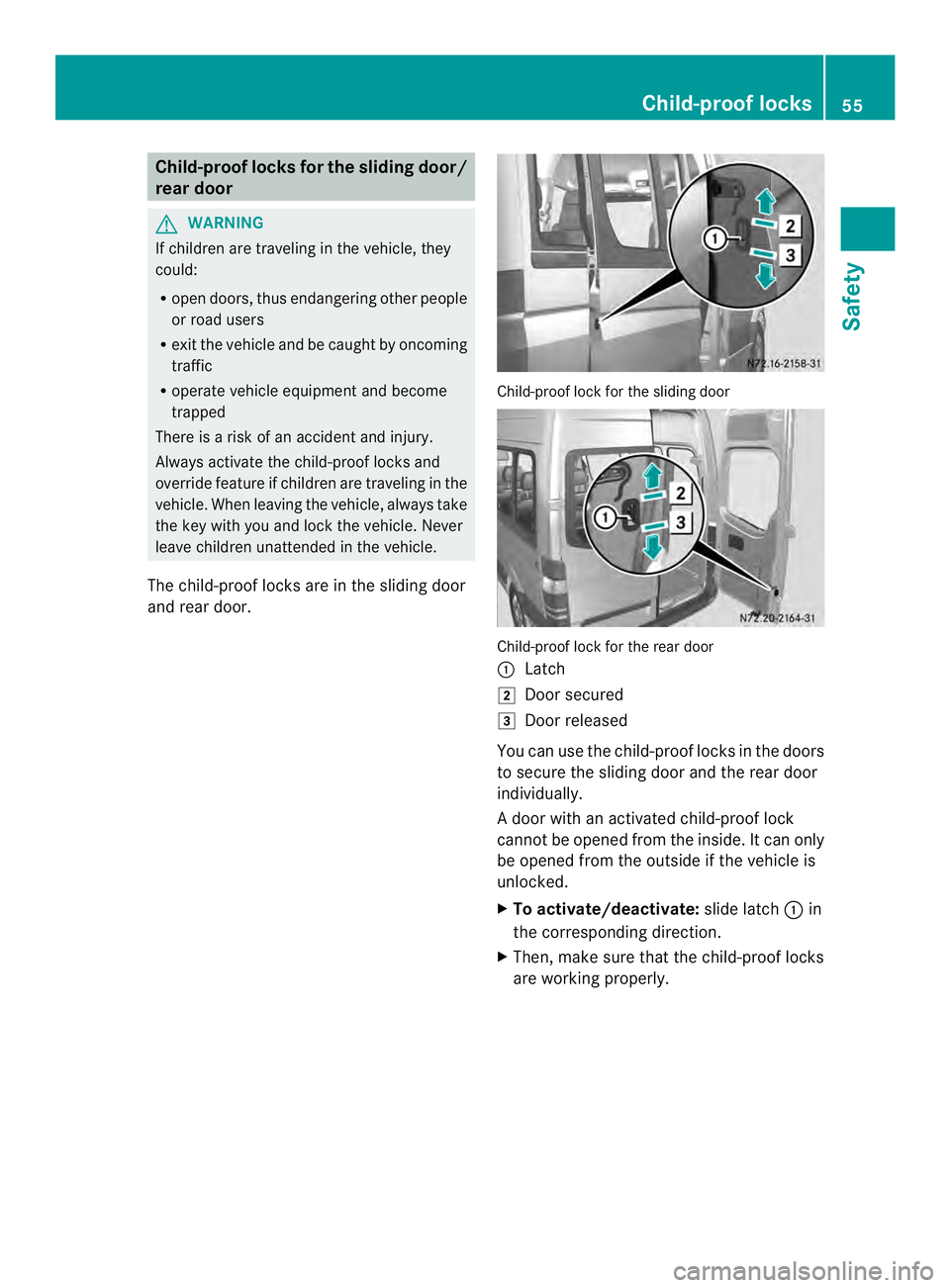
The child-proof locks are in the sliding door
and rear door. Child-proo
flock for the sliding door Child-proof lock for the rear door
0005
Latch
0009 Door secured
000A Door released
You can use the child-proof locks in the doors
to secure the sliding door and the rear door
individually.
Ad oor with an activated child-proof lock
cannot be opened from the inside. It can only
be opened from the outside if the vehicle is
unlocked.
X To activate/deactivate: slide latch0005in
the corresponding direction.
X Then, make sure that the child-proof locks
are working properly. Child-proof locks
55Safety Z
Page 58 of 334
Driving safet
ysystems Driving safety systems overview
In this section, you will find information about
the following driving safety systems:
R ABS ( Anti-lock BrakingSystem)
R BAS ( Brake Assist System)
R ASR (Acceleration SkidControl)
R ESP ®
(Electronic StabilityProgram)
R EBD ( Electronic Brake Force Distribution) Important safety notes
If you fail to adapt yourd riving style or if you
are inattentive, the driving safety systems can
neither reduce the risk of accident nor
override the laws of physics. Driving safety
systems are merely aids designed to assist
driving. You are responsible for the distance
to the vehicle in front, for vehicle speed and
for braking in good time. Always adapt your
driving style to the prevailing road and
weather conditions and maintai nasufficient,
safe distance from other road users. Drive
carefully.
The driving safety systems described can only
attain their maximum effectiveness when
there is optimum contact between the tires
and the road can. Therefore pay special
attention to the information on tires, the
recommended minimum tire tread, etc., in
the "Wheels and tires" section (Y page 274).
In wintry driving conditions, always use winter
tires (M+S tires) and if necessary, snow
chains. Only in this way will the driving safety
systems described in this section work as
effectively as possible. ABS (Anti-lock Braking System)
Important safety notes Note the section on 'Important safety notes'
(Y
page 56). G
WARNING
If ABS is faulty, the wheels could lock when
braking. The steerability and braking
characteristics may be severely impaired.
Additionally, further driving safety systems
are deactivated. There is an increased danger
of skidding and accidents.
Drive on carefully. Have ABS checked
immediately at a qualified specialist
workshop.
If ABS is malfunctioning, other systems will
also fail, including driving safety systems.
Observe the information relating to the 000E
(Y page 210) warning lamp.
ABS regulates brake pressure in such a way
that the wheels do not lock when you brake.
This allows you to continue steering the
vehicle when braking.
ABS acts from a speed of about 5 mph
(8 km/h) upwards, regardless of road surface
conditions. ABS works on slippery surfaces,
even when you only brake gently.
The yellow 000Ewarning lamp in the
instrument cluster lights up when the ignition
is switched on. The lamp goes out when the
engine starts running.
Braking X
If ABS intervenes: continue to depress the
brake pedal with force until the braking
situation is over.
X To make a full brake application:
depress the brake pedal with full force.
If ABS intervenes when braking, you will feel
a pulsating in the brake pedal.
The pulsating brake pedal can be an
indication of hazardous road conditions and
functions as a reminder to take extra care
while driving. BAS (Brake AssistS
ystem)
Note the section on 'Important safety notes'
(Y page 56). 56
Driving safety systemsSafety
Page 59 of 334
G
WARNING
If BAS is malfunctioning, the braking distance
in an emergency braking situation is
increased. There is a risk of an accident.
In an emergency braking situation, depress
the brake pedal with full force. ABS prevents
the wheels from locking.
Vehicles without steering wheel buttons: if
the BAS driving safety system is
malfunctioning, the 000Awarning lamp lights
up while the engine is running (Y page 210).
BAS operates in emergency braking
situations. If you depress the brake quickly,
BAS automatically increases the brake
pressure, thereby reducing the stopping
distance.
The brakes will function as usual once you
release the brake pedal. BAS is deactivated. EBD (electronic brake force
distribution)
Note the section on 'Important safety notes'
(Y page 56). G
WARNING
If EBD has malfunctioned, the rear wheels can
still lock, e.g. under full braking. This
increases the risk of skidding and an accident.
You should therefore adapt yourd riving style
to the different handling characteristics. Have
the brake system checked at a qualified
specialist workshop.
EBD monitors and controls the brake
pressure to the rear wheels. This enables EBD
to improve handling during braking.
Observe the information on warning and
indicator lamps (Y page 210). ESP
®
(Electronic Stability Program)
Note the section on 'Important safety notes'
(Y page 56). G
WARNING
If ESP ®
is malfunctioning it willn ot provide
any vehicle stabilization. There is an increased
risk of skidding or of an accident.
Exercise caution when continuing to drive.
Have ESP ®
checked at a qualified specialist
workshop.
! Only operate the vehicle briefly
(maximum of 10 seconds) on a brake
dynamometer. The key must be turned to
position 1in the ignition lock during this
time. You could otherwise damage the
drive train or the brake system.
! Do not run the vehicle on a roller
dynamometer (e.g. for performance tests).
If you must operate the vehicle on a roller
dynamometer, please consult a qualified
specialist workshop in advance. You could
otherwise damage the drive train or the
brake system.
If you activate or deactivate ESP ®
in a vehicle
with engageable all-wheel drive, ESP ®
will be
deactivated for the duration of the
activation/deactivation process.
If ESP ®
is malfunctioning, the 0002indicator
lamp lights up while the engine is running and
the engine power may be reduced
(Y page 210).
ESP ®
monitors driving stability and detects a
tendency of the vehicle to understeer or
oversteer (skidding) in good time. If ESP ®
detects that the vehicle is deviating from the
direction desired by the driver, one or more
wheels are braked to stabilize the vehicle. The
engine output is also modified to keep the
vehicle on the desired course within physical
limits. ESP ®
greatly assists you when driving
on wet or slippery road surfaces. ESP ®
also
stabilizes the vehicle when braking.
The 000D warning lamp in the instrument
cluster flashes when ESP ®
is intervening. Driving safety systems
57Safety Z
Page 61 of 334
If you deactivate ASR:
R
engine torque is not limited and the drive
wheels are able to spin. The spinning
wheels will then achieve a cutting effect for
better traction.
R traction control remains active through
brake intervention. If a drive wheel attains
its tire traction limitb ecause one side of the
road is slippery, for example, that wheel is
braked. The traction is then increased in
this situation.
R active brake intervention by ESP ®
to
increase driving stability remains active.
The 000D warning lamp in the instrument
cluster flashes when ESP ®
is intervening. Emergency exit
Emergency exit window
G
WARNING
The emergency exit window cannot be locked
in place. You risk injury if you exit the vehicle
through the emergency exit window.
R Make sure that nobody becomes trapped,
both when closing and when opening the
emergency exit window.
R The opened emergency exit window must
be held in place by another person.
Pay attention to traffic conditions. G
WARNING
If the emergency exit window is unlocked
while driving, it could open and slam shut and
consequently fall down. There is a risk of an
accident and injury.
Before starting off, make sure that the
emergency exit window is locked and the
locking pins are undamaged.
! Make sure there is sufficien tclearance
when opening the emergency exit window.
Hold the open window in position. You
could otherwise damage the emergency
exit window. The emergency exit window is intended for
use in an emergency only and must not be
opened unless the vehicle is stationary. The
emergency exit window is the firs
twindow
behind the driver's seat on the driver's side.
It is marked by the "Emergency Exit" label.
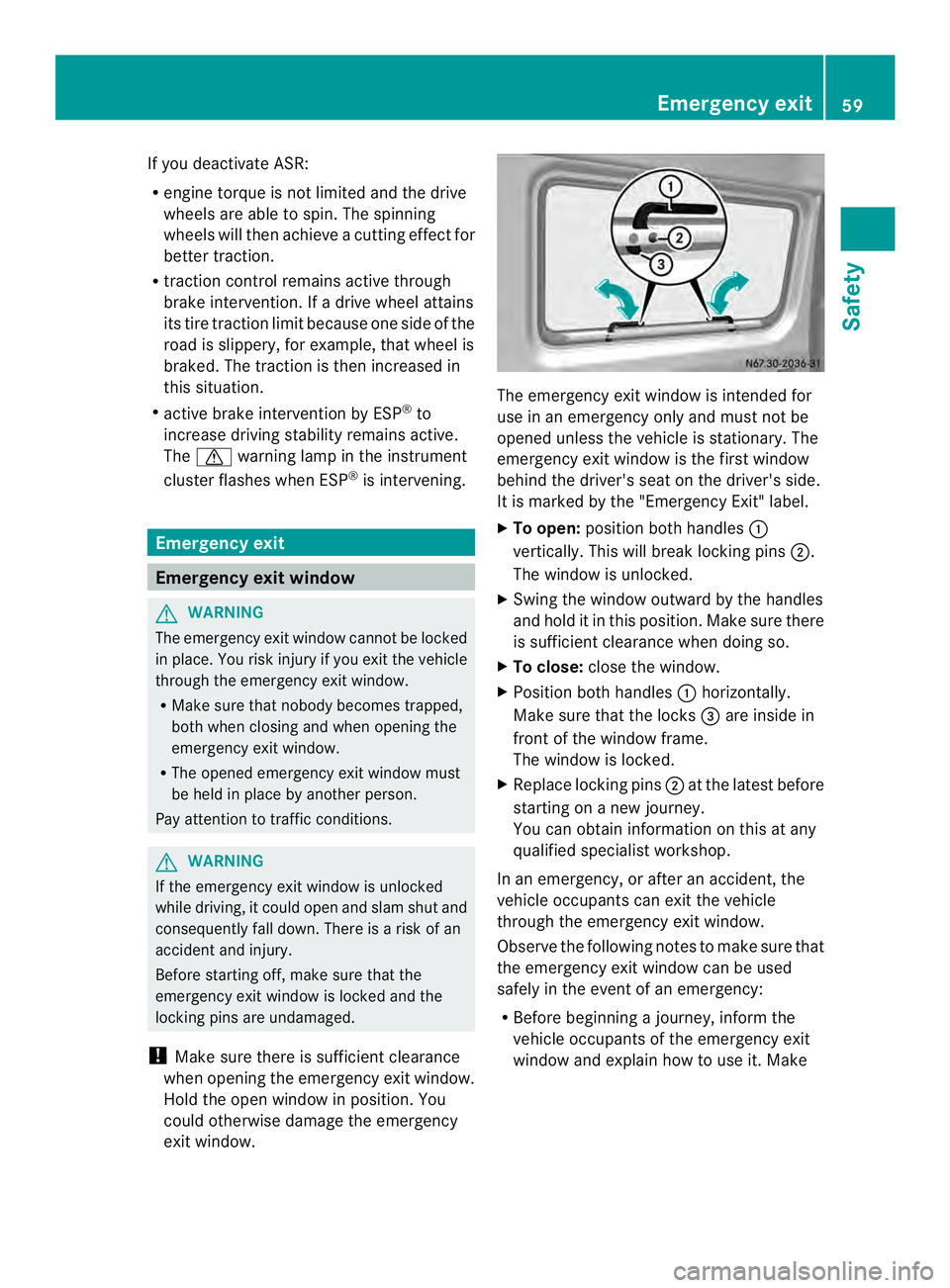
X To open: position both handles 0005
vertically. This will break locking pins 0006.
The window is unlocked.
X Swing the window outward by the handles
and hold it in this position. Make sure there
is sufficien tclearance when doing so.
X To close: close the window.
X Position both handles 0005horizontally.
Make sure that the locks 0026are inside in
front of the window frame.
The window is locked.
X Replace locking pins 0006at the lates tbefore
starting on a new journey.
You can obtain information on this at any
qualified specialist workshop.
In an emergency, or after an accident, the
vehicle occupants can exit the vehicle
through the emergency exit window.
Observe the following notes to make sure that
the emergency exit window can be used
safely in the event of an emergency:
R Before beginning a journey, inform the
vehicle occupants of the emergency exit
window and explain how to use it. Make Emergency exit
59Safety Z