check engine MERCEDES-BENZ SPRINTER 2013 MY13 Operator’s Manual
[x] Cancel search | Manufacturer: MERCEDES-BENZ, Model Year: 2013, Model line: SPRINTER, Model: MERCEDES-BENZ SPRINTER 2013Pages: 334, PDF Size: 3.88 MB
Page 247 of 334
G
WARNING
Coolant contains glycol and is therefore toxic.
Do not swallow the coolant. See a doctor
immediately if you swallow coolant.
Make sure that coolant does not come into
contact with skin, eyesorc lothing. In case of
contac twith eyes, rinse immediately with
plenty of clean water .Clean affected areas of
skin and clothing with soap and water
immediately. Change any affected clothing
immediately. G
WARNING
If antifreeze comes into contact with hot
components in the engine compartment, it
may ignite. There is a risk of fire and injury.
Let the engine cool down before you add
antifreeze. Make sure that antifreeze is not
spilled nex tto the filler neck.T horoughly
clean the antifreeze from components before
starting the engine.
! Take care not to spill any coolant on
painted surfaces. You could otherwise
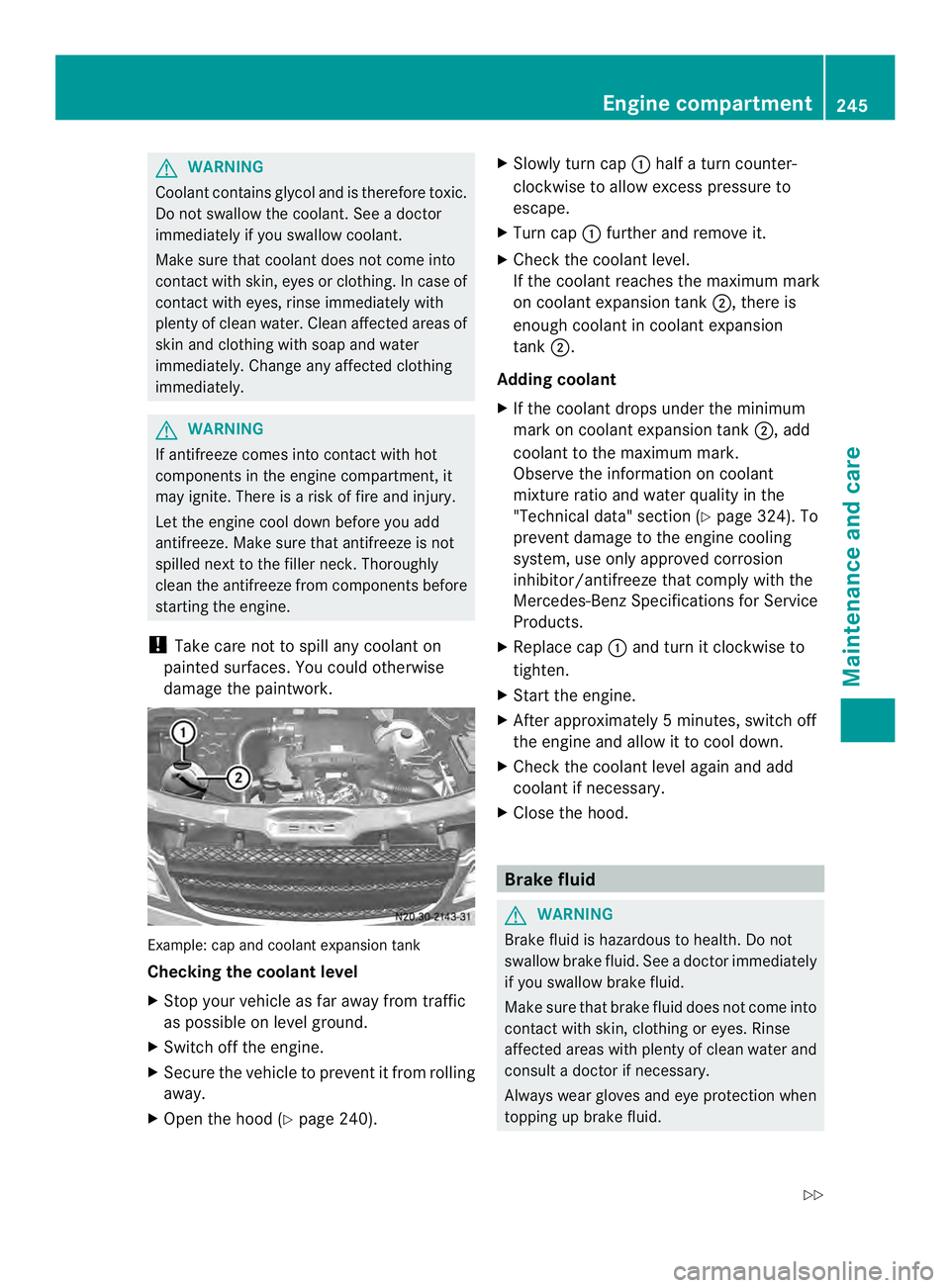
damage the paintwork. Example: cap and coolant expansion tank
Checking the coolant level
X
Stop your vehicle as far away from traffic
as possible on level ground.
X Switch off the engine.
X Secure the vehicle to prevent it from rolling
away.
X Open the hood (Y page 240). X
Slowly turn cap 0005half a turn counter-
clockwise to allow excess pressure to
escape.
X Turn cap 0005further and remove it.
X Check the coolant level.
If the coolant reaches the maximum mark
on coolant expansion tank 0006, there is
enough coolant in coolant expansion
tank 0006.
Adding coolant
X If the coolant drops under the minimum
mark on coolant expansion tank 0006, add
coolant to the maximum mark.
Observe the information on coolant
mixture ratio and water quality in the
"Technical data" section (Y page 324). To
prevent damage to the engine cooling
system, use only approved corrosion
inhibitor/antifreeze that comply with the
Mercedes-Benz Specifications for Service
Products.
X Replace cap 0005and turn it clockwise to
tighten.
X Start the engine.
X After approximately 5minutes, switch off
the engine and allow it to cool down.
X Check the coolan tlevel again and add
coolant if necessary.
X Close the hood. Brake fluid
G
WARNING
Brake fluid is hazardous to health. Do not
swallow brake fluid. See adoctor immediately
if you swallow brake fluid.
Make sure that brake fluid does not come into
contact with skin, clothing or eyes. Rinse
affected areas with plenty of clean water and
consult a doctor if necessary.
Always wear gloves and eye protection when
topping up brake fluid. Engine compartment
245Maintenance and care
Z
Page 248 of 334
Store brake fluid only in the original closed
container and keep it out of the reach of
children. Comply with safety regulations
when handling brake fluid.
! Brake fluid corrodes paint, plastic and
rubber .Ifpaint, plastic or rubbe rhas come
into contact with brake fluid, rinse with
wate rimmediately. G
WARNING
The brake fluid constantly absorbs moisture
from the air. This lowers the boiling point of
the brake fluid. If the boiling point of the brake
fluid is too low, vapo rpockets may form in the
brake system when the brakes are applied
hard. This would impair braking efficiency.
There is a risk of an accident.
You should have the brake fluid renewed at
the specified intervals.
! If the brake fluid level in the brake fluid
reservoir has fallen to the MIN mark or
below, check the brake system
immediately for leaks. Also check the
thickness of the brake linings. Visit a
qualified specialist workshop immediately.
Do not add brake fluid. This does not
correct the malfunction.
Have the brake fluid renewed every two
years.
Observe the information on brake fluid in the
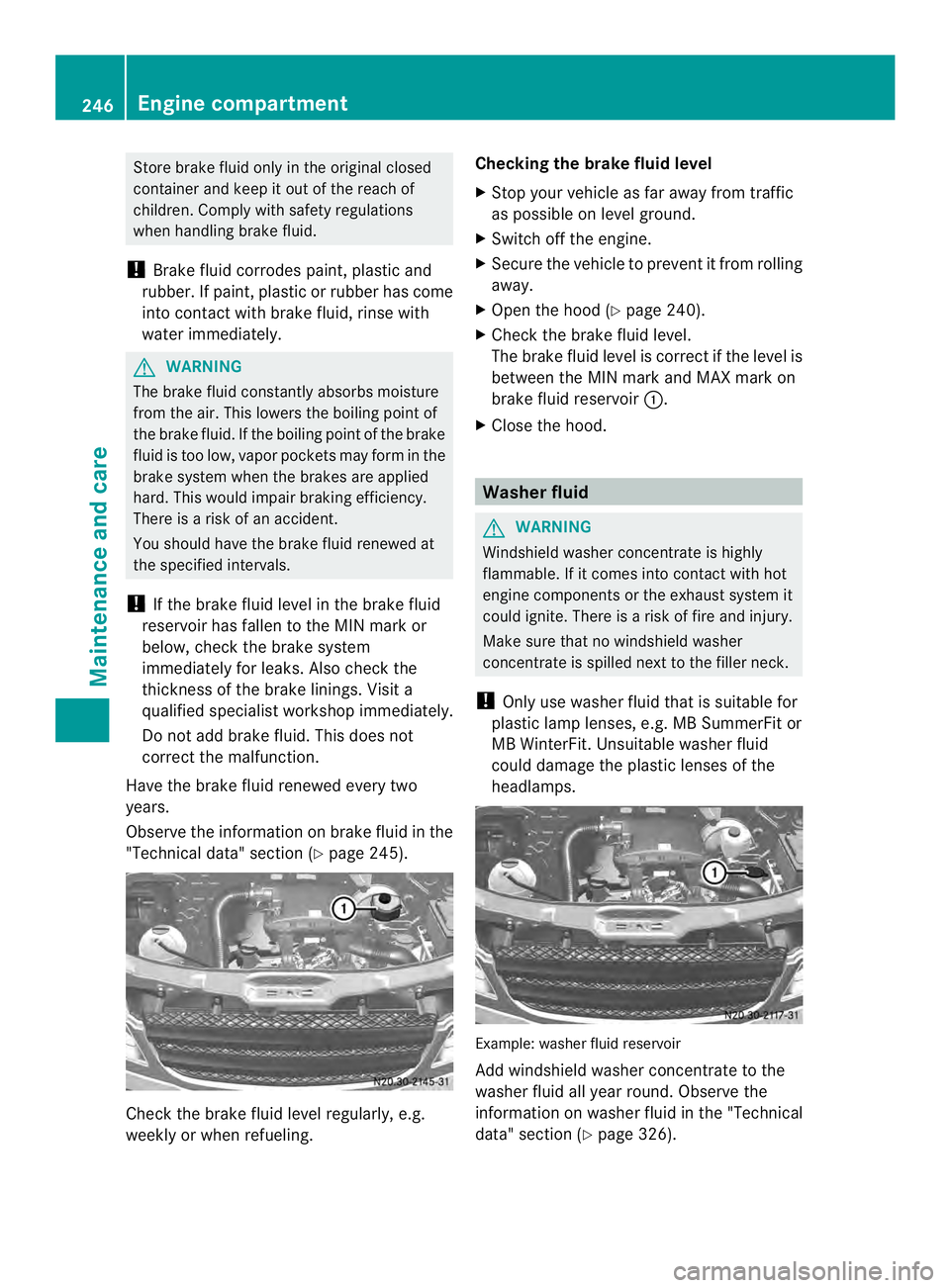
"Technical data" section ( Ypage 245). Check the brake fluid level regularly, e.g.
weekly or when refueling. Checking the brake fluid level
X
Stop your vehicle as far away from traffic
as possible on level ground.
X Switch off the engine.
X Secure the vehicle to prevent it from rolling
away.
X Open the hood (Y page 240).
X Check the brake fluid level.
The brake fluid level is correc tifthe level is
between the MIN mark and MAX mark on
brake fluid reservoir 0005.
X Close the hood. Washer fluid
G
WARNING
Windshield washer concentrate is highly
flammable. If it comes into contact with hot
engine components or the exhaust system it
could ignite. There is a risk of fire and injury.
Make sure that no windshield washer
concentrate is spilled next to the filler neck.
! Only use washer fluid that is suitable for
plastic lamp lenses, e.g. MB SummerFit or
MB WinterFit. Unsuitable washer fluid
could damage the plastic lenses of the
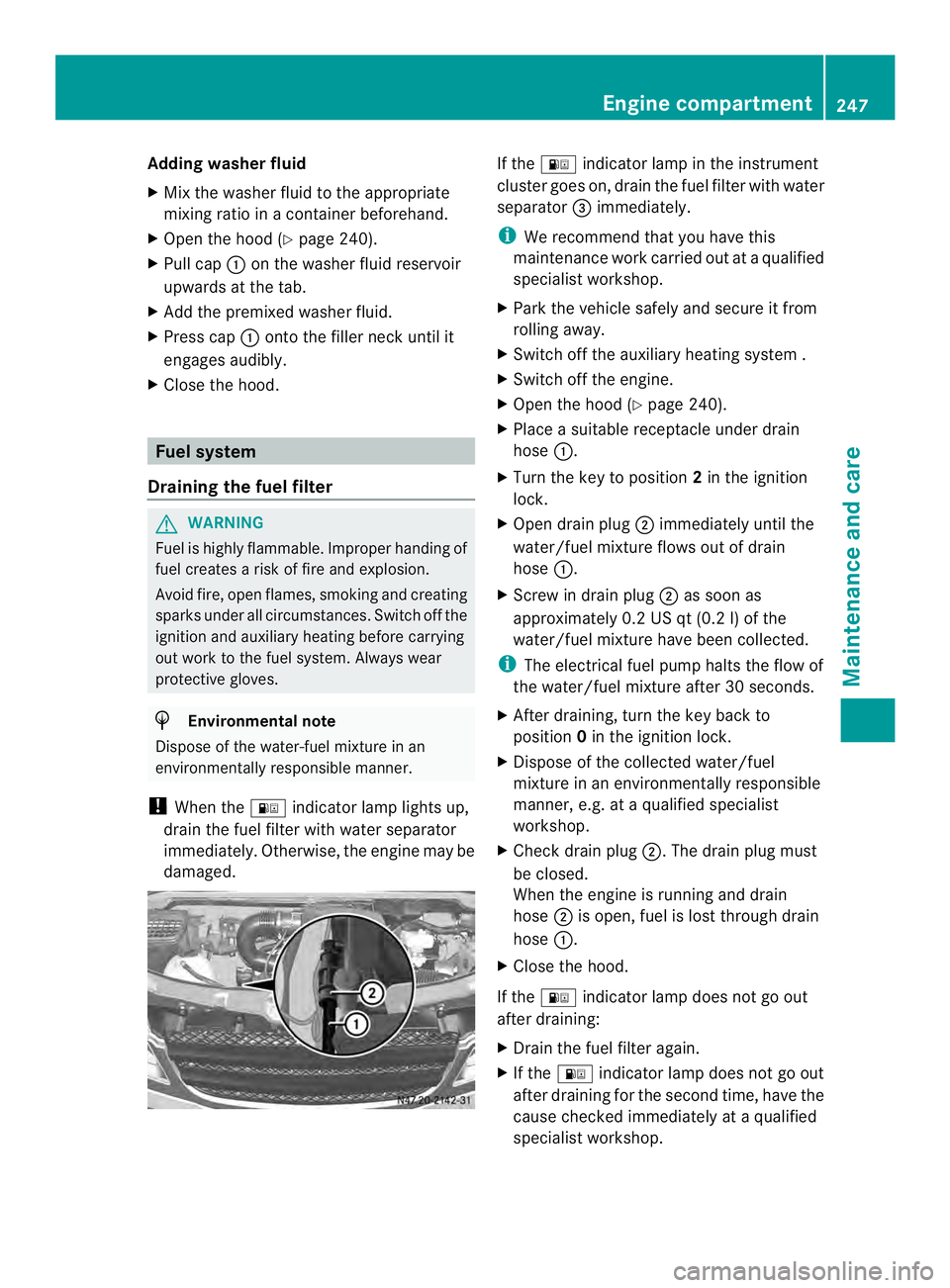
headlamps. Example: washer fluid reservoir
Add windshield washer concentrate to the
washer fluid all year round. Observe the
information on washer fluid in the "Technical
data" section (Y
page 326).246
Engine compartmentMaintenance and care
Page 249 of 334
Adding washer fluid
X
Mix the washe rfluid to the appropriate
mixing ratio in a container beforehand.
X Open the hood (Y page 240).
X Pull cap 0005on the washer fluid reservoir
upwards at the tab.
X Add the premixed washer fluid.
X Press cap 0005onto the filler neck until it
engages audibly.
X Close the hood. Fuel system
Draining the fuel filter G
WARNING
Fuel is highly flammable. Improper handing of
fuel creates a risk of fire and explosion.
Avoid fire, open flames ,smoking and creating
sparks under all circumstances. Switch off the
ignitio nand auxiliary heating before carrying
ou tw ork to the fuel system. Always wear
protective gloves. H
Environmental note
Dispose of the water-fuel mixture in an
environmentally responsible manner.
! When the 000Eindicator lamp lights up,
drain the fuel filter with water separator
immediately. Otherwise, the engine may be
damaged. If the
000E indicator lamp in the instrument
cluster goes on, drain the fuel filter with water
separator 0026immediately.
i We recommend that you have this
maintenance work carried out at a qualified
specialist workshop.
X Park the vehicle safely and secure it from
rolling away.
X Switch off the auxiliary heating system .
X Switch off the engine.
X Open the hood (Y page 240).
X Place a suitable receptacle under drain
hose 0005.
X Turn the key to position 2in the ignition
lock.
X Open drain plug 0006immediately until the
water/fuel mixture flows out of drain
hose 0005.
X Screw in drain plug 0006as soon as
approximately 0.2 US qt (0.2 l) of the
water/fuel mixture have been collected.
i The electrical fuel pump halts the flow of
the water/fuel mixture after 30 seconds.
X After draining, turn the key back to
position 0in the ignition lock.
X Dispose of the collected water/fuel
mixture in an environmentally responsible
manner, e.g. at a qualified specialist
workshop.
X Check drain plug 0006.The drain plug must
be closed.
When the engine is running and drain
hose 0006is open, fuel is lost through drain
hose 0005.
X Close the hood.
If the 000E indicator lamp does not go out
after draining:
X Drain the fuel filter again.
X If the 000E indicator lamp does not go out
after draining for the second time, have the
cause checked immediately at a qualified
specialist workshop. Engine compartment
247Maintenance and care Z
Page 250 of 334
Vehicle interior
Air filter for the rear-compartment air
conditioning
! Regularly check the ai rfilters for visible
dirt .Clean or replace a dirty filter mat .The
dirt may otherwise lead to damage to the
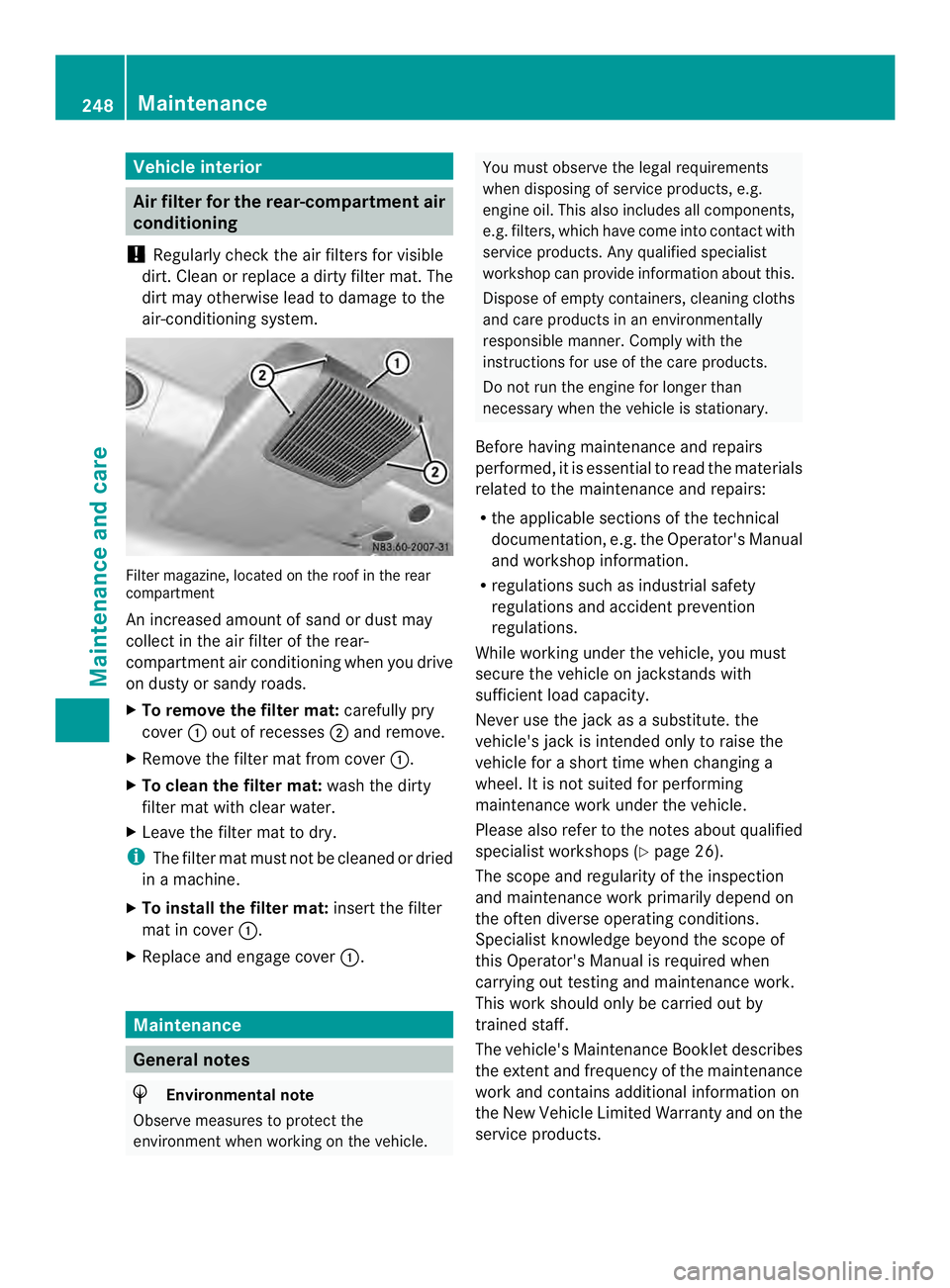
air-conditioning system. Filter magazine, located on the roof in the rear
compartment
An increased amount of sand or dust may
collect in the air filter of the rear-
compartmenta
ir conditioning when you drive
on dusty or sandy roads.
X To remove the filter mat: carefully pry
cover 0005out of recesses 0006and remove.
X Remove the filter mat from cover 0005.
X To clean the filter mat: wash the dirty
filter mat with clear water.
X Leave the filter mat to dry.
i The filter mat must not be cleaned or dried
in a machine.
X To install the filter mat: insert the filter
mat in cover 0005.
X Replace and engage cover 0005.Maintenance
General notes
H
Environmental note
Observe measures to protect the
environment when working on the vehicle. You must observe the legal requirements
when disposing of service products, e.g.
engine oil. This also includes all components,
e.g. filters, which have come into contac twith
service products. Any qualified specialist
workshop can provide information about this.
Dispose of empty containers, cleaning cloths
and care products in an environmentally
responsible manner. Comply with the
instructions for use of the care products.
Do not run the engine for longer than
necessary when the vehicle is stationary.
Before having maintenance and repairs
performed, it is essential to read the materials
related to the maintenance and repairs:
R the applicable sections of the technical
documentation, e.g. the Operator's Manual
and workshop information.
R regulations such as industrial safety
regulations and accident prevention
regulations.
While working under the vehicle, you must
secure the vehicle on jackstands with
sufficient load capacity.
Never use the jac kasas ubstitute .the
vehicle's jack is intended only to raise the
vehicle for a short time when changing a
wheel. It is not suited for performing
maintenance work under the vehicle.
Please also refer to the notes about qualified
specialist workshops (Y page 26).
The scope and regularity of the inspection
and maintenance work primarily depend on
the often diverse operating conditions.
Specialist knowledge beyond the scope of
this Operator's Manual is required when
carrying out testing and maintenance work.
This work should only be carried out by
trained staff.
The vehicle's Maintenance Booklet describes
the extenta nd frequency of the maintenance
work and contains additional informatio non
the New Vehicle Limited Warranty and on the
service products. 248
MaintenanceMaintenance and care
Page 252 of 334
message appears in the display,f
or
example:
R 0002 Service A due in ... days R
0002 Service A due in ... mi (km )
Battery
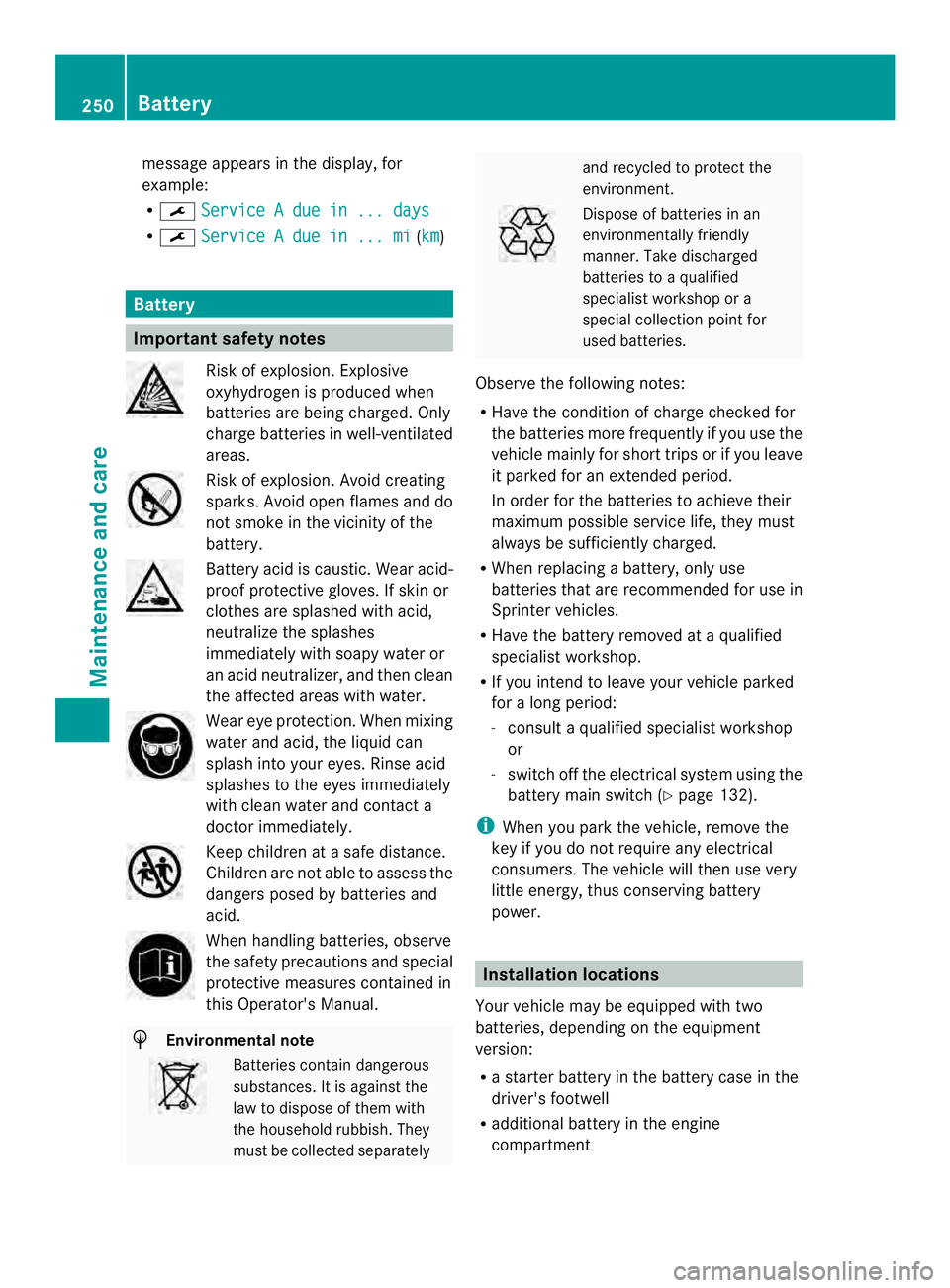
Important safety notes
Risk of explosion. Explosive
oxyhydrogen is produced when
batteries are being charged. Only
charge batteries in well-ventilated
areas.
Risk of explosion. Avoid creating
sparks. Avoid open flames and do
not smoke in the vicinity of the
battery.
Battery acid is caustic. Wear acid-
proof protective gloves. If skin or
clothes are splashed with acid,
neutralize the splashes
immediately with soapy water or
an acid neutralizer, and then clean
the affected areas with water.
Wear eye protection. When mixing
water and acid, the liquid can
splash into your eyes. Rinse acid
splashes to the eyes immediately
with clean water and contact a
doctor immediately.
Keep children at a safe distance.
Children are not able to assess the
dangers posed by batteries and
acid.
When handling batteries, observe
the safety precautions and special
protective measures contained in
this Operator's Manual. H
Environmental note Batteries contain dangerous
substances. It is against the
law to dispose of them with
the household rubbish. They
must be collected separately and recycled to protect the
environment.
Dispose of batteries in an
environmentally friendly
manner
.Take discharged
batteries to a qualified
specialist workshop or a
special collectio npoint for
used batteries.
Observe the following notes:
R Have the condition of charge checked for
the batteries more frequently if you use the
vehicle mainly for short trips or if you leave
it parked for an extended period.
In order for the batteries to achieve their
maximum possible service life, they must
always be sufficiently charged.
R When replacing a battery, only use
batteries that are recommended for use in
Sprinter vehicles.
R Have the battery removed at a qualified
specialist workshop.
R If you intend to leave your vehicle parked
for a long period:
-consult a qualified specialist workshop
or
- switch off the electrical system using the
battery main switch (Y page 132).
i When you park the vehicle, remove the
key if you do not require any electrical
consumers .The vehicle will then use very
little energy, thus conserving battery
power. Installation locations
Your vehicle may be equipped with two
batteries, depending on the equipment
version:
R a starter battery in the battery case in the
driver's footwell
R additional battery in the engine
compartment 250
BatteryMaintenance and care
Page 269 of 334
Jump-starting
Important safety notes
G
WARNING
During charging and jump-starting, explosive
gases can escape from the battery. There is a
risk of an explosion.
Particularly avoid fire, open flames, creating
sparks and smoking. Ensure there is sufficient
ventilation while charging and jump-starting.
Do not lean over a battery. G
WARNING
Battery acid is caustic. There is a risk of injury.
Avoid contact with the skin, eyes or clothing.
Do not inhale any battery gases. Do not lean
over the battery. Keep children away from
batteries. Wash battery acid immediately with
water and seek medical attention. G
WARNING
Non-combusted fuel can collect in the
exhaust system and ignite. There is a risk of
fire. Avoid repeated and lengthy starting
attempts.
Do not use a rapid charging device to start
the vehicle. If your vehicle's battery is
discharged, the engine can be jump-started
from another vehicle or from a donor battery
using jumper cables. For this purpose, the
vehicle has a jump-starting connection point
in the engine compartment.
The additional battery in the engine
compartmenti s not suitable for jump-starting
operations. If your vehicle requires jump-
starting, or if you use it to jump-start another
vehicle, use the jump-starting connection
point in the engine compartment.
When jump-starting, observe the following
points:
R The battery is not accessible in all vehicles.
If the other vehicle's battery is not accessible, jump-start the vehicle using a
donor battery or a jump-starting device.
R Do not start the engine if the battery is
frozen. Let the battery thaw first.
R Jump-starting may only be performed from
batteries with a nominal voltage of 12 V.
R Only use jumper cables that have a
sufficient cross-section and insulated
terminal clamps.
R If the battery is fully discharged, attach the
battery of another vehicle for a few minutes
before attempting to start. This charges the
empty battery a little.
R Make sure that the two vehicles do not
touch.
Make sure that:
R the jumper cables are not damaged.
R bare parts of the terminal clamps do not
come into contact with other metal parts
while the jumper cables are connected to
the battery.
R the jumper cables cannot come into
contact with parts such as the V-belt pulley
or the fan. These parts move when the
engine is started and while it is running.
i Jumper cables and further information
regarding jump starting can be obtained at
any qualified specialist workshop. Before connecting the jumper cables
On vehicles with a battery main switch, check
whether the battery main switch is switched
on (Y page 132).
X Apply the parking brake.
X Move the selector lever of the automatic
transmission to position P.
X Switch off all electrical consumers, e.g.
audio equipment, blower.
X Turn the key to position 0in the ignition
lock and remove it (Y page 133).
X Open the hood (Y page 240). Jump-starting
267Breakdown assistance Z
Page 325 of 334
Capacities
!
Do no tadd too much oil. adding too much
engine oil can result in damage to the
engine or to the catalytic converter. Have
excess engine oil siphoned off.
Oil change including oil filter Engine oil
Approximately
13.21 US qt. (12.5 l) Information about oil consumption
!
If the vehicle is predominantly used for
short-distance driving, this could lead to a
malfunction in the automatic cleaning
function for the diesel particle filter. As a
result, fuel may accumulate in the engine
oil and cause engine failure.
Therefore, if you mainly drive short
distances, you should drive on a highway or
on rural roads for 20 minutes every
310 miles (500 km). This ensures sufficient
regeneration of the diesel particle filter.
Depending on the driving style, the vehicle
consumes a maximum of 1.0 US qt (1.0 l)of
engine oil over a distance of 620 miles
(1000 km).
Oil consumption may be higher if:
R the vehicle is new.
R you mainly operate the vehicle under
arduous operating conditions.
R you frequently drive at high engine speeds.
Regula rmaintenance is one of the
preconditions for moderate rates of
consumption.
You can only estimate th eoil consumption
after you have drive naconsiderable distance.
Check the engine oil level on a regular basis,
e.g. weekly or each time you refuel
(Y page 242). Transmission and power steering oil
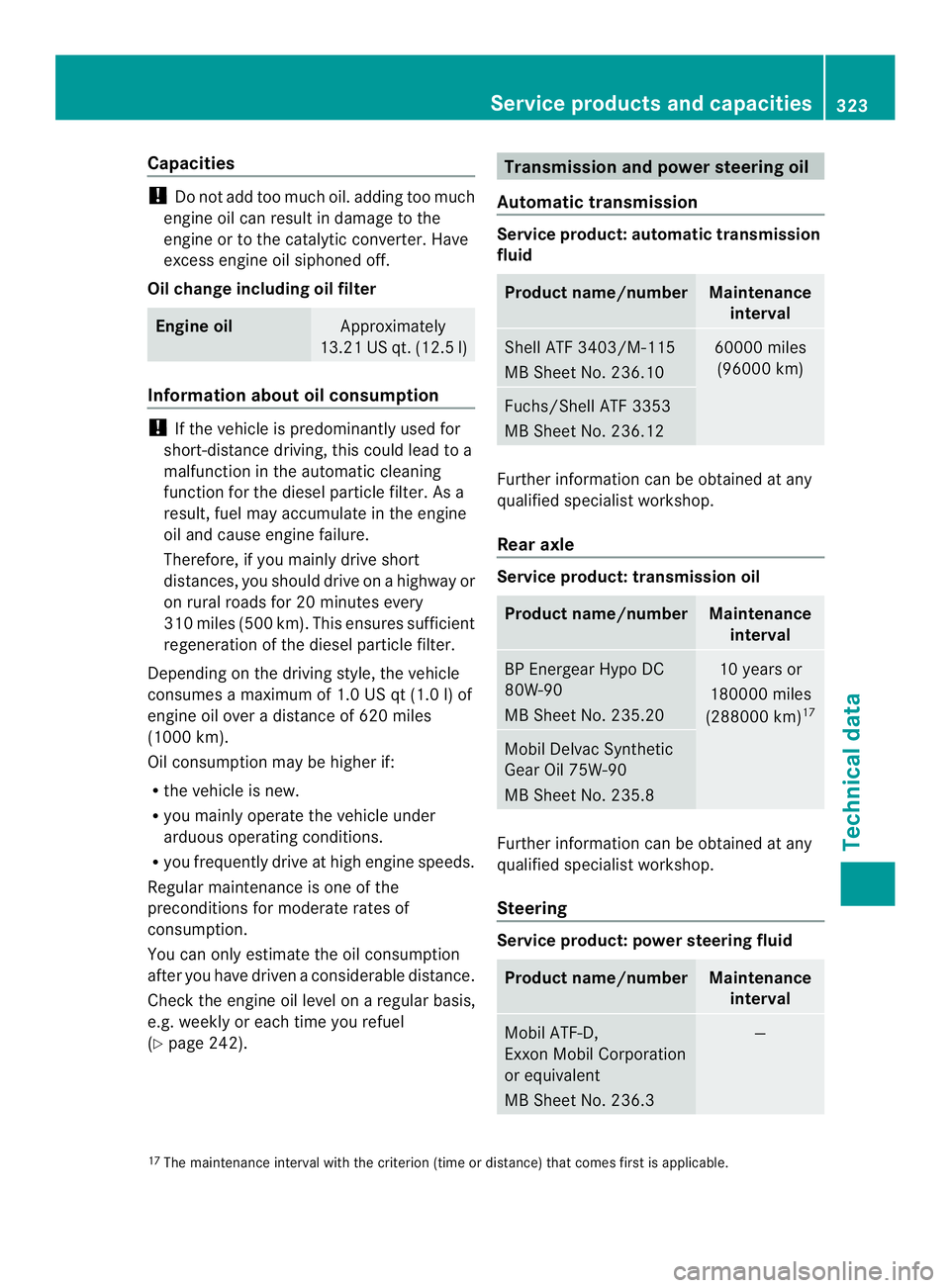
Automatic transmission Service product: automatic transmission
fluid
Product name/number Maintenance
interval Shell ATF 3403/M-115
MB Sheet No. 236.10 60000 miles
(96000 km) Fuchs/Shell ATF 3353
MB Sheet No. 236.12
Further information can be obtained at any
qualified specialist workshop.
Rear axle
Service product: transmission oil
Product name/number Maintenance
interval BP Energear Hypo DC
80W-90
MB Sheet No. 235.20 10 years or
180000 miles
(288000 km) 17 Mobil Delvac Synthetic
Gear Oil 75W-90
MB Sheet No. 235.8
Further information can be obtained at any
qualified specialist workshop.
Steering
Service product: power steering fluid
Product name/number Maintenance
interval Mobil ATF-D,
Exxon Mobil Corporation
or equivalent
MB Sheet No. 236.3 —
17
The maintenance interval with the criterion (time or distance) that comes first is applicable. Service products and capacities
323Technical data Z
Page 326 of 334
The steering is maintenance-free. Further
information can be obtained at any qualified
specialist workshop.
Brake fluid
G
WARNING
Brake fluid is hazardous to health. Do not
swallow brake fluid. See adoctor immediately
if you swallow brake fluid.
Make sure that brake fluid does not come into
contact with skin, clothing or eyes. Rinse
affected areas with plenty of clean water and
consult a doctor if necessary.
Always wear gloves and eye protection when
topping up brake fluid.
Store brake fluid only in the original closed
container and keep it out of the reach of
children. Comply with safety regulations
when handling brake fluid. G
WARNING
The brake fluid constantly absorbs moisture
from the air. This lowers the boiling point of
the brake fluid. If the boiling point of the brake
fluid is too low, vapor pockets may form in the
brake system when the brakes are applied
hard. This would impair braking efficiency.
There is a risk of an accident.
You should have the brake fluid renewed at
the specified intervals.
! Brake fluid corrodes paint, plastic and
rubber. If paint, plastic or rubber has come
into contact with brake fluid, rinse with
water immediately.
Only use brake fluids approved for Sprinter
vehicles. Always check for the identification
DOT 4plus.
Information about approved brake fluids can
be found in the Maintenance Booklet or
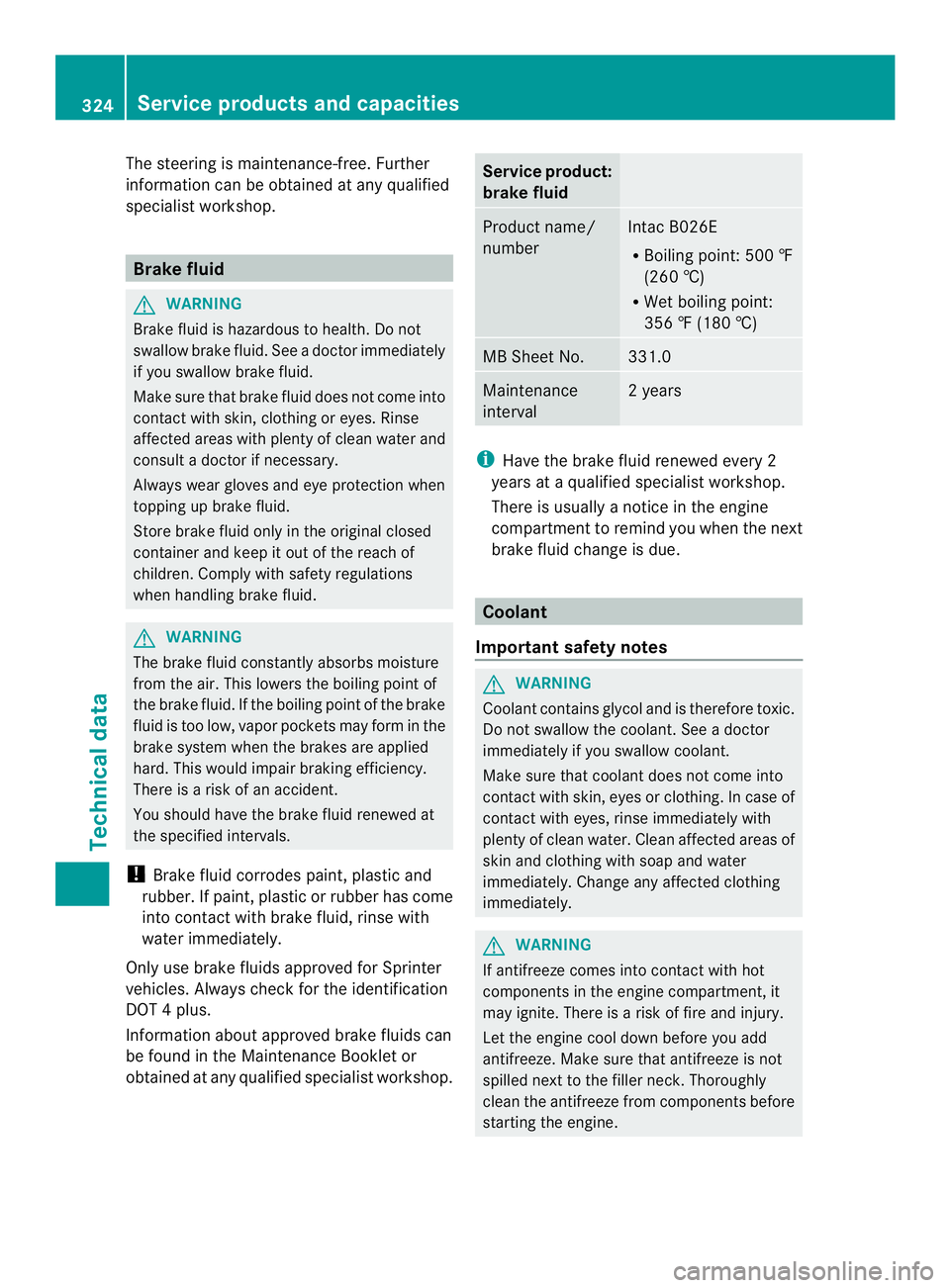
obtained at any qualified specialist workshop. Service product:
brake fluid Produc
tname/
number Intac B026E
R
Boiling point: 500 ‡
(260 †)
R Wet boiling point:
356 ‡ (180 †) MB Sheet No. 331.0
Maintenance
interval 2y
ears i
Have the brake fluid renewed every 2
years at a qualified specialist workshop.
There is usually a notice in the engine
compartment to remind you when the next
brake fluid change is due. Coolant
Important safety notes G
WARNING
Coolant contains glycol and is therefore toxic.
Do not swallow the coolant .See a doctor
immediately if you swallow coolant.
Make sure that coolant does not come into
contact with skin, eyes or clothing. In case of
contact with eyes, rinse immediately with
plenty of clean water. Clean affected areas of
skin and clothing with soap and water
immediately. Change any affected clothing
immediately. G
WARNING
If antifreeze comes into contact with hot
components in the engine compartment, it
may ignite. There is a risk of fire and injury.
Let the engine cool down before you add
antifreeze. Make sure that antifreeze is not
spilled nextt o the filler neck.T horoughly
clean the antifreeze from components before
starting the engine. 324
Service products and capacitiesTechnical data
Page 327 of 334
!
Take care not to spill any coolant on
painted surfaces. You could otherwise
damage the paintwork.
Coolant additive with corrosion/
antifreeze protection !
Use only approved antifreeze/corrosion
inhibitor that complies with MB
Specification for Service Products, Sheet
Number 325. Using other, non-approved
antifreeze/corrosion inhibitors may cause
damage to the coolant system and reduce
the engine's service life.
Coolant is a mixture of water and antifreeze/
corrosion inhibitor. It performs the following
tasks:
R corrosion protection
R antifreeze protection
R raises the boiling point
When the vehicle is first delivered, it is filled
with a coolant mixture that ensures adequate
antifreeze and corrosion protection. Coolant
must be used in the system all yearr ound to
ensure anti-corrosion protection and a raised
boiling point –even in countries with high
outside temperatures.
To prevent damage to the engine cooling
system, use only approved corrosion
inhibitor/antifreeze that comply with the
Mercedes-Benz Specifications for Service
Products. You will find information about
approved corrosio ninhibitor/antifreeze for
your vehicle in the Maintenance Booklet.
We recommend corrosion inhibitor/
antifreeze tha tmeets the requirements in MB
Specifications for Service Products Sheet
Number 325.
Check the antifreeze/corrosion inhibitor
concentration in the coolant every six
months. The percentage of corrosion inhibitor/
antifreeze additive in the engine cooling
system should:
R
be at least 50%. This way, the engine
cooling system is protected against
freezing down to approximately -35 ‡
(-37 †).
R not exceed 55% (antifreeze protection
down to -49 ‡ [-45 †]). Otherwise, heat
will not be dissipated as effectively.
If there has been coolant loss, do not refill
only with water. If the vehicle has lost coolant,
add equal parts water and corrosion
inhibitor/antifreeze additive. The water used
as part of the coolant mixture must fulfill
certain requirements; these are usually
fulfilled by drinking water. If the water quality
is not sufficient, you must treat the water.
Further information can be obtained at any
qualified specialist workshop.
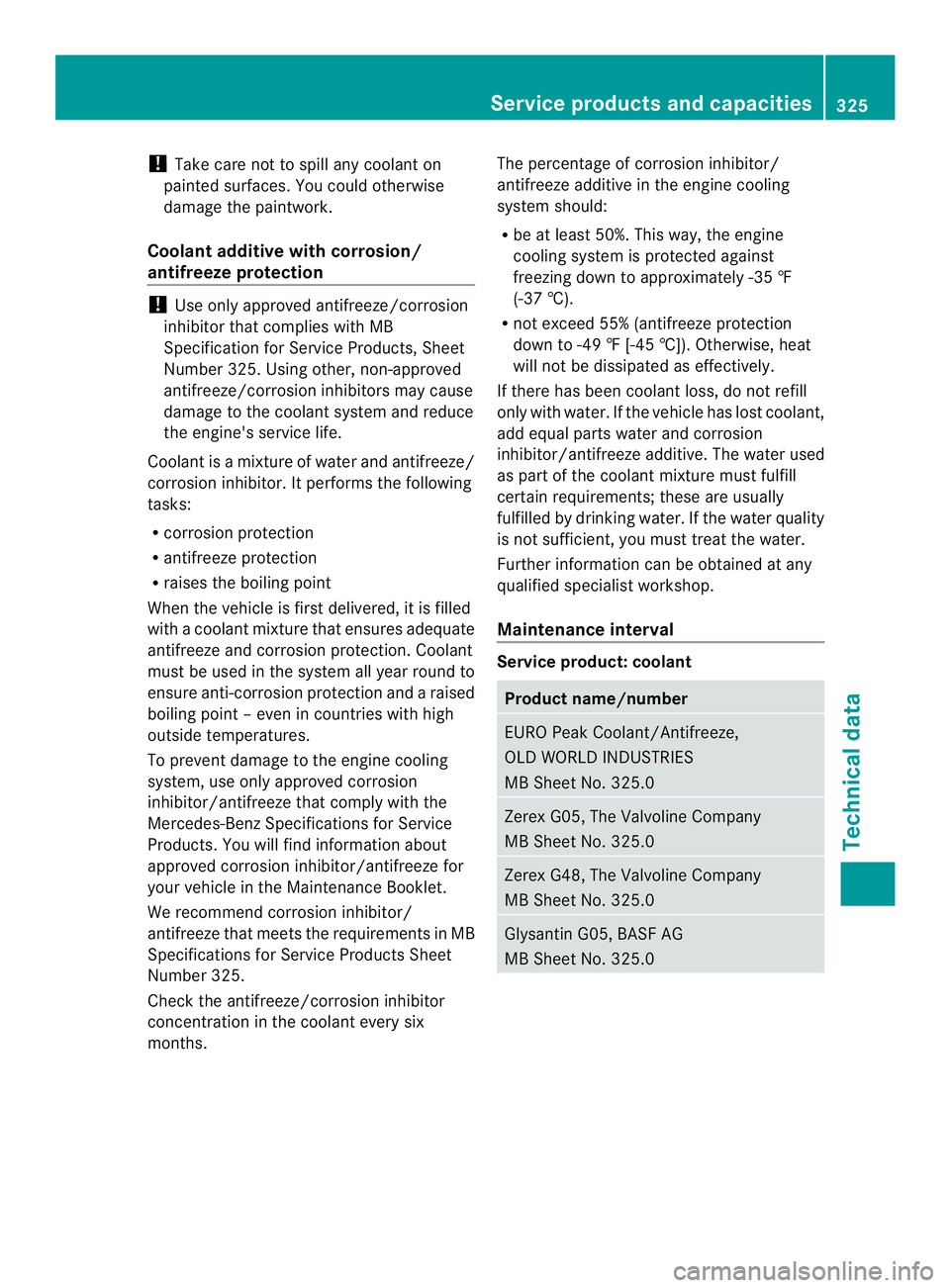
Maintenance interval Service product: coolant
Product name/number
EURO Peak Coolant/Antifreeze,
OLD WORLD INDUSTRIES
MB Sheet No. 325.0
Zerex G05, The Valvoline Company
MB Sheet No. 325.0
Zerex G48, The Valvoline Company
MB Sheet No. 325.0
Glysantin G05, BASF AG
MB Sheet No. 325.0Service products and capacities
325Technical data Z