instrument cluster MERCEDES-BENZ SPRINTER 2013 MY13 Operator’s Manual
[x] Cancel search | Manufacturer: MERCEDES-BENZ, Model Year: 2013, Model line: SPRINTER, Model: MERCEDES-BENZ SPRINTER 2013Pages: 334, PDF Size: 3.88 MB
Page 9 of 334
Rear fog lamp (Chassis Cab)
..........100
Rea rinterior light ........................... 102
Standing lamps (front) .....................98
Standing lamps (rear, Chassis
Cab) ............................................... 100
Standing lamps (rear) ..............99, 101
Tai llamps ................................ 99, 101
Tail lamps (Chassis Cab) ................100
Turn signals (front) ...........................98
Turn signals (rear, Chassis Cab) ..... 100
Turn signals (rear) ....................99, 101
Warning and indicator lamps .........219
see Replacing bulbs
Child-proof locks
Important safety notes ....................54
Rea rdoor ......................................... 55
Sliding door ..................................... 55
Children
In the vehicle ................................... 50
Restraint systems ............................ 50
Specia lseat belt retractor ...............54
Child seat
LATCH-type (ISOFIX) child seat
anchors ............................................ 52
Top Tether ....................................... 53
Chock ................................................. 147
Cigarette lighter ................................ 227
Cleaning Mirro rturn signal ........................... 259
Trailer tow hitch ............................. 260
Climate control
Air-conditioning system .................110
Auxiliary heating ............................ 118
Checking/cleaning the airf ilter
(rear-compartment air
conditioning) .................................. 248
Cooling with air dehumidification ..113
Defrosting the windows .................114
Heating .......................................... 109
Important safety notes ..................108
Operating the cargo compartment
airv ents. ........................................ 129
Overview of systems ......................108
Problems with the windshield
heating .......................................... 115
Problem with the rear window
defroster ........................................ 116Rear-compartment air
conditioning
................................... 112
Rear-compartment heating ............111
Reheat function (air
dehumidification) ........................... 114
Setting the aird istribution.............113
Setting the airflow .........................114
Setting the airv ents...................... 117
Setting the temperature ................113
Switching air-recirculation mode
on/off ............................................ 116
Switching on/off ........................... 112
Switching the rear window
defroster on/off ............................ 116
Switching windshield heating on/
off .................................................. 115
Cockpit
Overview .......................................... 32
see Instrument cluster
COMAND display
Cleaning ......................................... 260
Combination switch ............................92
Communications equipment Operation ....................................... 229
Type approval/frequency ..............314
Consumption statistics (on-board
computer) .......................................... 190
Control panel Above the windshield .......................37
Center console ................................ 36
Climate control ................................ 36
Driver's door .................................... 38
Left and righ tside of the steering
wheel ............................................... 38
Conversions/equipment ....................27
Conversions and accessories see Add-on equipment
Coolan t(engine)
Adding ........................................... 245
Checking the leve l......................... 244
Displaying the temperature (on-
board computer) ............................ 182
Display message ............................ 205
Filling capacity ............................... 326
Important safety notes ..................244
Cooling
see Climate control Index
7
Page 13 of 334
Diesel at very low outside
temperatures
................................. 318
Display message ............................ 205
Driving tips .................................... 148
Flow improver ................................ 318
Fuel gauge ..................................... 177
Important safety notes ..................317
Problem (malfunction) ...................143
Quality (diesel )............................... 317
Refueling ........................................ 142
Showing the range (on-board
computer with steering wheel
buttons) ......................................... 190
Showing the range (vehicles with
steering wheel buttons) .................190
Tank content/reserve fuel .............317
Fuel filter with water separator
draining ......................................... 247
Indicator lamp ................................ 218
Fuel gauge ......................................... 177
Fuel tank Problem (malfunction) ...................143
Fuel tank content
Reserve, display message ..............205
Fuses .................................................. 271G
Gasoline Reserve fuel warning lamp .............216
General driving tips
Driving short distances ..................149
Genuine .............................................. 314
Glove box ........................................... 222
GTW (Gross Trailer Weight)
(definition) ......................................... 293
Guarantee ............................................ 23H
Hazard warning lamps ........................93
Headlamps Adding fluid to cleaning system .....246
Cleaning system (function) ..............94
Fogging up ....................................... 94
see Automatic headlamp mode
Headliner (cleaning instructions) ....261 Head restraints
Adjusting ......................................... 84
Heating
see Climate control
High-beam headlamps
Changing bulbs ................................ 98
Switching on/off .............................. 92
Hood
Closing .......................................... .241
Display message ............................ 209
Indicator lamp ................................ 219
Opening ......................................... 240
Hydroplaning ..................................... 151 I
Immobilizer .......................................... 60
Indicator lamp see Warning and indicator lamps
Indicators
see Turn signals
Insectp rotection on the radiator ......28
Installing/removing the ball
coupling ............................................. 170
Instrument cluster Fuel gag e....................................... 177
Important safety notes ..................176
Instrument cluster lighting .............177
Outside temperature displa y.......... 177
Overview .......................................... 33
Speedometer ................................. 177
Tachometer ................................... 177
Warning and indicator lamps ...........34
Instrument cluster lighting ..............177
Instrument lighting see Instrument cluster lighting
Interior lighting ................................... 94
Changing the bulbs ........................102
Front ................................................ 94
Motio ndetectors ............................. 96
Notes on replacing bulbs ...............102
Switching the rear compartment
lighting on centrall y......................... 95
Interior motion sensor
Arming ............................................. 61
Deactivating .................................... .61
Function ........................................... 61
Switching off .................................... 61 Index
11
Page 19 of 334
Important safety notes
....................64
Loss ................................................. 68
Problem (malfunction) .....................68
SmartKey positions (ignition lock) ..133
Snow chains ...................................... 277
Sockets .............................................. 228
Spare wheel General notes ................................ 309
Important safety notes ..................308
Removing/mounting ..................... .309
Specialist workshop ............................ 26
Special seat bel tretractor .................. 54
Speed ,controlling
see Cruise control
Speedometer
Digital (vehicles without steering
wheel buttons )............................... 178
Digital (vehicles with steering
wheel buttons) ............................... 186
Selecting display unit (vehicles
with steering- wheel buttons) ........185
see Instrument cluster
Sprinter Dealer
see Qualified specialist workshop
SRS (Supplemental Restraint
System)
Display message ............................ 201
Introduction ..................................... 42
Warning lamp ................................. 214
Warning lamp (function) ................... 42
Standing lamps
Changing bulbs (front) .....................98
Changing bulbs (rear) ..............99, 101
Standing lamps (Chassis Cab)
Changing bulbs (rear) ....................100
Starting (engine) ................................ 134
Start-off assist Display message ............................ 198
Steering wheel
Adjusting ......................................... 85
Button overview ............................... 36
Cleaning ......................................... 260
Step
see Electrical step
Sticker
Warning notes .................................. 26 Stowage spaces
see Stowage spaces and stowage
compartments
Stowage spaces and stowage
compartments
Eyeglasses compartment ...............223
Glove box ...................................... .222
Important safety notes ..................222
Paper holder .................................. 225
Stowage compartment above the
windshield ..................................... 224
Stowage compartment in the
center console ............................... 223
Stowage compartment in the
dashboard ...................................... 223
Stowage space above the
headliner ........................................ 224
Stowage space unde rthe rear
bench seat ..................................... 224
Stowage space unde rthe twin co-
driver's seat ................................... 224
Summer tires ..................................... 276
Supplemental Restraint System see SRS (Supplemental Restraint
System)
Switching off the alarm (ATA) ............60
Switching the heater booster
function on/off .................................. 125
Switching the surround lighting
on/off (on-board computer) .............187
Switch unit see Control panel
Swivel seat .......................................... .81 T
Tachometer ........................................ 177
Tail lamps Changing bulb s........................ 99, 101
see Lights
Tail lamps (Chassis Cab)
Changing bulbs .............................. 100
Tank
see Fuel tank Index
17
Page 34 of 334
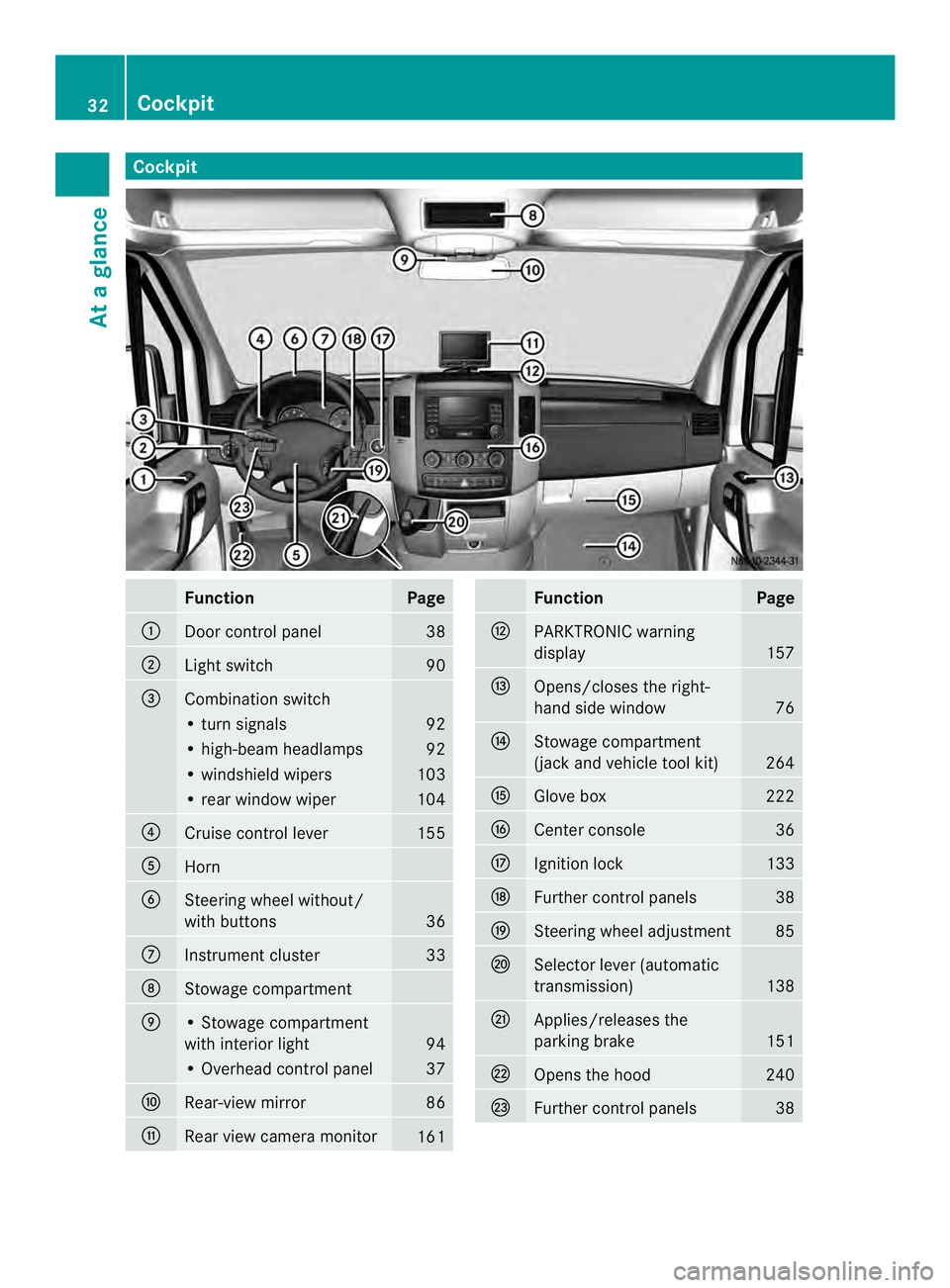
Cockpit
Function Page
0005
Door control panel 38
0006
Ligh
tswitch 90
0026
Combinatio
nswitch • tur
nsignals 92
• high-beam headlamps 92
• windshield wipers 103
• rear window wiper 104
0025
Cruise control lever 155
0023
Horn
0024
Steering wheel without/
with buttons
36
0018
Instrument cluster 33
0019
Stowage compartment
001A
• Stowage compartment
with interior light
94
• Overhead control panel 37
001B
Rear-view mirror 86
001C
Rear view camera monitor
161 Function Page
001D
PARKTRONIC warning
display 157
001E
Opens/closes the right-
hand side window
76
001F
Stowage compartment
(jac kand vehicle tool kit) 264
0020
Glove box 222
0021
Center console 36
0022
Ignitio
nlock 133
0028
Further control panels 38
0029
Steering wheel adjustment 85
002A
Selector lever (automatic
transmission)
138
002B
Applies/releases the
parking brake
151
002C
Opens the hood 240
0014
Further control panels 3832
CockpitAt a glance
Page 35 of 334
Instrumen
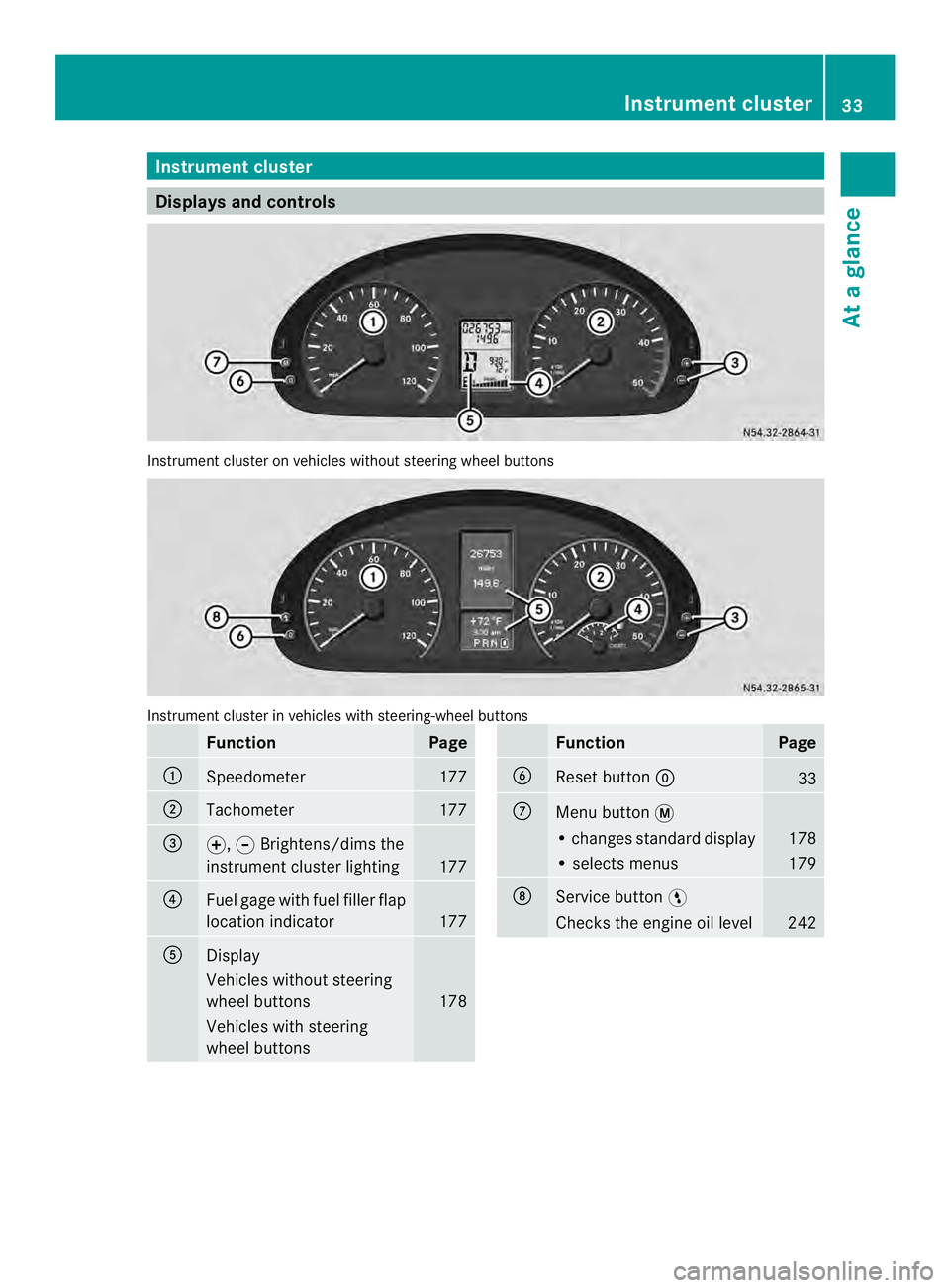
tcluster Displays and controls
Instrument cluster on vehicles without steering wheel buttons
Instrument cluster in vehicles with steering-wheel buttons
Function Page
0005
Speedometer 177
0006
Tachometer 177
0026
000E,
000FBrightens/dims the
instrumen tcluster lighting 177
0025
Fuel gage with fuel filler flap
location indicator
177
0023
Display
Vehicles without steering
wheel buttons
178
Vehicles with steering
wheel buttons Function Page
0024
Reset button
0007 33
0018
Menu button
0004 • changes standard display 178
• selects menus 179
0019
Service button
0012 Checks the engine oil level 242Instrument cluster
33At a glance
Page 36 of 334
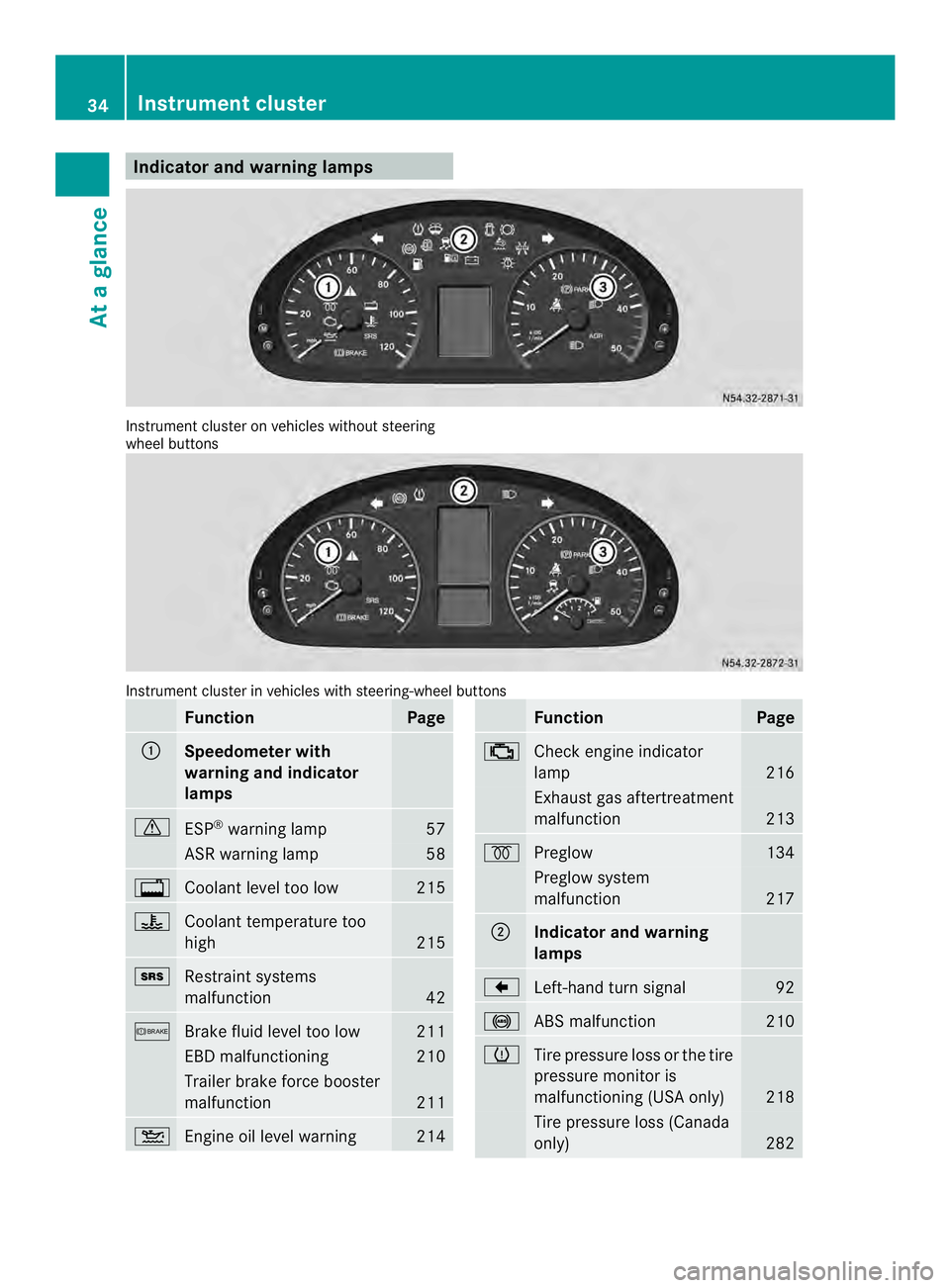
Indicator and warning lamps
Instrumen
tcluster on vehicles without steering
wheel buttons Instrument cluster in vehicles with steering-wheel buttons
Function Page
0005
Speedometer with
warning and indicator
lamps
000D
ESP
®
warning lamp 57
ASR warning lamp 58
001A
Coolant level too low 215
0014
Coolant temperature too
high
215
0008
Restraint systems
malfunction
42
0008
Brake fluid level too low 211
EBD malfunctioning 210
Trailer brake force booster
malfunction
211
001D
Engine oil level warning 214 Function Page
0018
Check engine indicator
lamp 216
Exhaust gas aftertreatment
malfunction 213
000D
Preglow 134
Preglow system
malfunction
217
0006
Indicator and warning
lamps
0002
Left-hand turn signal 92
000E
ABS malfunction 210
000A
Tire pressure loss or the tire
pressure monitor is
malfunctioning (USA only) 218
Tire pressure loss (Canada
only) 28234
Instrument clusterAt a glance
Page 37 of 334
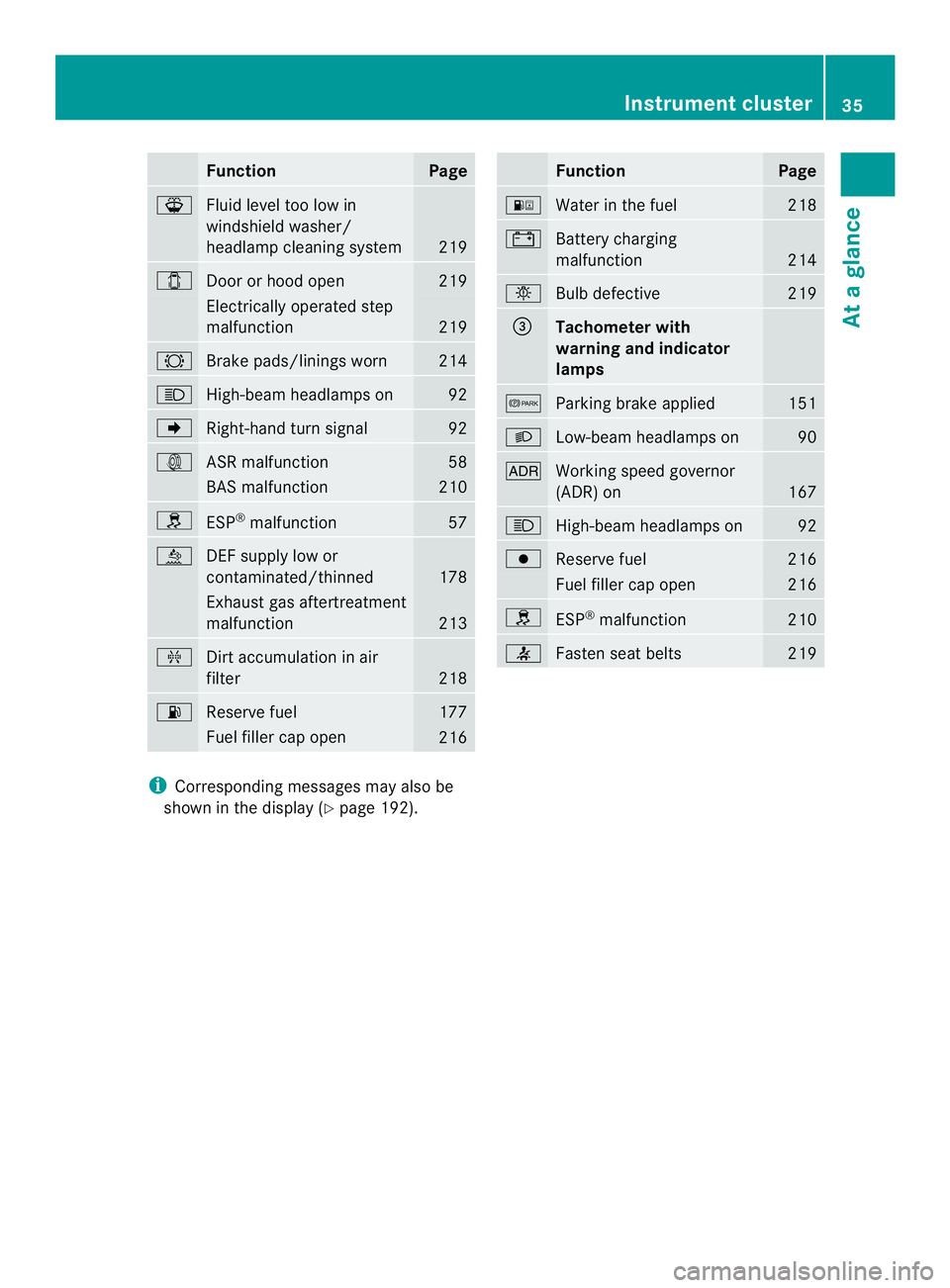
Function Page
000F
Fluid level too low in
windshield washer/
headlamp cleaning system
219
0004
Door or hood open 219
Electrically operated step
malfunction
219
0005
Brake pads/linings worn 214
0003
High-beam headlamps on 92
0003
Right-hand tur
nsignal 92
000A
ASR malfunction 58
BAS malfunction 210
0002
ESP
®
malfunction 57
0009
DE
Fs upply low or
contaminated/thinned 178
Exhaust gas aftertreatment
malfunction
213
0013
Dirt accumulation in air
filter
218
000A
Reserve fuel 177
Fuel fille
rcap open 216 Function Page
000E
Water in the fuel 218
0010
Battery charging
malfunction
214
0002
Bulb defective 219
0026
Tachometer with
warning and indicator
lamps
000B
Parking brake applied 151
0004
Low-beam headlamps on 90
0004
Working speed governor
(ADR) on
167
0003
High-beam headlamps on 92
0006
Reserve fuel 216
Fuel fille
rcap open 216
0002
ESP
®
malfunction 210
0014
Faste
nseat belts 219
i
Corresponding messages may also be
shown in the display (Y page 192). Instrument cluster
35At a glance
Page 45 of 334
When you switch on the ignition, the
0008
warning lamp in the instrument cluster lights
up for approximately 4seconds.
A malfunction has occurred if the 0008
warning lamp:
R does not light up when you switch on the
ignition, or
R does not go out within a few seconds of
switching on the ignition, or
R lights up again
Safet yguidelines for seat belts,
Emergency Tensioning Devices (ETDs)
and air bags G
WARNING
R Damaged sea tbelts or seat belts that have
been subjected to stress in an accident
must be replaced and their anchoring
points must also be checked. Only use seat
belts which have been installed or supplied
by a qualified specialist workshop.
R Air bags and pyrotechnic Emergency
Tensioning Devices (ETDs) contain
perchlorate material, which may require
special handling and regard for the
environment. Check with your local
government's disposal guidelines.
California residents, see
www.dtsc.ca.gov/HazardousWaste/
Perchlorate/index.cfm.
R Air bags and ETDs are designed to function
on a one-time-only basis. An air bag or ETD
that has deployed must be replaced.
R Do not pass seat belts over sharp edges.
They could tear.
R Do not make any modification that could
change the effectiveness of the seat belts.
R Do not bleach or dye seat belts as this may
severely weaken them. In a crash they may
not be able to provide adequate protection.
R No modifications of any kind may be made
to any components or wiring of the SRS.
R Do not change or remove any component
or part of the SRS. R
Do not install additional paneling, seat
covers, badges etc.o ver the steering wheel
hub, co-driver's front air bag cover,
outboard sides of the seat backrests, door
trim panels, or door frame trims.
R Do not install additional electrical/
electronic equipment on or near SRS
components and wiring.
R Keep the area between air bags and
occupants free of objects (e.g. packages,
purses, umbrellas etc.).
R Do not hang items such as coat hangers
from the coat hooks or handles over the
door. These items may be thrown around in
the vehicle and cause head and other
injuries when the window curtai nair bag is
deployed.
R Air bag system components will be hot after
an air bag has inflated. Do not touch them.
R Never place your feet on the instrument
panel or on the seat. Always keep both feet
on the floor in front of the seat.
R Improper repair work creates a risk of
rendering the SRS inoperative or causing
unintended air bag deployment. Work on
the SRS must therefore only be performed
by qualified technicians. Please contac ta
qualified specialist workshop.
R For your protection and the protection of
others, when scrapping the air bag unit or
ETD, our safety instructions must be
followed. These instructions are available
from any authorized Sprinter Dealer.
R Given the considerable deployment speed,
required inflation volume, and the material
of the air bags, there is the possibility of
abrasions or other, potentially more serious
injuries resulting from air bag deployment.
If you sell your vehicle, we strongly
recommend that you infor mthe subsequent
owner that the vehicle is equipped with SRS.
Also refer them to the applicable section in
the Operator's Manual. Occupant safety
43Safety Z
Page 58 of 334
Driving safet
ysystems Driving safety systems overview
In this section, you will find information about
the following driving safety systems:
R ABS ( Anti-lock BrakingSystem)
R BAS ( Brake Assist System)
R ASR (Acceleration SkidControl)
R ESP ®
(Electronic StabilityProgram)
R EBD ( Electronic Brake Force Distribution) Important safety notes
If you fail to adapt yourd riving style or if you
are inattentive, the driving safety systems can
neither reduce the risk of accident nor
override the laws of physics. Driving safety
systems are merely aids designed to assist
driving. You are responsible for the distance
to the vehicle in front, for vehicle speed and
for braking in good time. Always adapt your
driving style to the prevailing road and
weather conditions and maintai nasufficient,
safe distance from other road users. Drive
carefully.
The driving safety systems described can only
attain their maximum effectiveness when
there is optimum contact between the tires
and the road can. Therefore pay special
attention to the information on tires, the
recommended minimum tire tread, etc., in
the "Wheels and tires" section (Y page 274).
In wintry driving conditions, always use winter
tires (M+S tires) and if necessary, snow
chains. Only in this way will the driving safety
systems described in this section work as
effectively as possible. ABS (Anti-lock Braking System)
Important safety notes Note the section on 'Important safety notes'
(Y
page 56). G
WARNING
If ABS is faulty, the wheels could lock when
braking. The steerability and braking
characteristics may be severely impaired.
Additionally, further driving safety systems
are deactivated. There is an increased danger
of skidding and accidents.
Drive on carefully. Have ABS checked
immediately at a qualified specialist
workshop.
If ABS is malfunctioning, other systems will
also fail, including driving safety systems.
Observe the information relating to the 000E
(Y page 210) warning lamp.
ABS regulates brake pressure in such a way
that the wheels do not lock when you brake.
This allows you to continue steering the
vehicle when braking.
ABS acts from a speed of about 5 mph
(8 km/h) upwards, regardless of road surface
conditions. ABS works on slippery surfaces,
even when you only brake gently.
The yellow 000Ewarning lamp in the
instrument cluster lights up when the ignition
is switched on. The lamp goes out when the
engine starts running.
Braking X
If ABS intervenes: continue to depress the
brake pedal with force until the braking
situation is over.
X To make a full brake application:
depress the brake pedal with full force.
If ABS intervenes when braking, you will feel
a pulsating in the brake pedal.
The pulsating brake pedal can be an
indication of hazardous road conditions and
functions as a reminder to take extra care
while driving. BAS (Brake AssistS
ystem)
Note the section on 'Important safety notes'
(Y page 56). 56
Driving safety systemsSafety
Page 59 of 334
G
WARNING
If BAS is malfunctioning, the braking distance
in an emergency braking situation is
increased. There is a risk of an accident.
In an emergency braking situation, depress
the brake pedal with full force. ABS prevents
the wheels from locking.
Vehicles without steering wheel buttons: if
the BAS driving safety system is
malfunctioning, the 000Awarning lamp lights
up while the engine is running (Y page 210).
BAS operates in emergency braking
situations. If you depress the brake quickly,
BAS automatically increases the brake
pressure, thereby reducing the stopping
distance.
The brakes will function as usual once you
release the brake pedal. BAS is deactivated. EBD (electronic brake force
distribution)
Note the section on 'Important safety notes'
(Y page 56). G
WARNING
If EBD has malfunctioned, the rear wheels can
still lock, e.g. under full braking. This
increases the risk of skidding and an accident.
You should therefore adapt yourd riving style
to the different handling characteristics. Have
the brake system checked at a qualified
specialist workshop.
EBD monitors and controls the brake
pressure to the rear wheels. This enables EBD
to improve handling during braking.
Observe the information on warning and
indicator lamps (Y page 210). ESP
®
(Electronic Stability Program)
Note the section on 'Important safety notes'
(Y page 56). G
WARNING
If ESP ®
is malfunctioning it willn ot provide
any vehicle stabilization. There is an increased
risk of skidding or of an accident.
Exercise caution when continuing to drive.
Have ESP ®
checked at a qualified specialist
workshop.
! Only operate the vehicle briefly
(maximum of 10 seconds) on a brake
dynamometer. The key must be turned to
position 1in the ignition lock during this
time. You could otherwise damage the
drive train or the brake system.
! Do not run the vehicle on a roller
dynamometer (e.g. for performance tests).
If you must operate the vehicle on a roller
dynamometer, please consult a qualified
specialist workshop in advance. You could
otherwise damage the drive train or the
brake system.
If you activate or deactivate ESP ®
in a vehicle
with engageable all-wheel drive, ESP ®
will be
deactivated for the duration of the
activation/deactivation process.
If ESP ®
is malfunctioning, the 0002indicator
lamp lights up while the engine is running and
the engine power may be reduced
(Y page 210).
ESP ®
monitors driving stability and detects a
tendency of the vehicle to understeer or
oversteer (skidding) in good time. If ESP ®
detects that the vehicle is deviating from the
direction desired by the driver, one or more
wheels are braked to stabilize the vehicle. The
engine output is also modified to keep the
vehicle on the desired course within physical
limits. ESP ®
greatly assists you when driving
on wet or slippery road surfaces. ESP ®
also
stabilizes the vehicle when braking.
The 000D warning lamp in the instrument
cluster flashes when ESP ®
is intervening. Driving safety systems
57Safety Z