tow MERCEDES-BENZ SPRINTER 2015 MY15 Operator’s Manual
[x] Cancel search | Manufacturer: MERCEDES-BENZ, Model Year: 2015, Model line: SPRINTER, Model: MERCEDES-BENZ SPRINTER 2015Pages: 334, PDF Size: 5.94 MB
Page 20 of 334
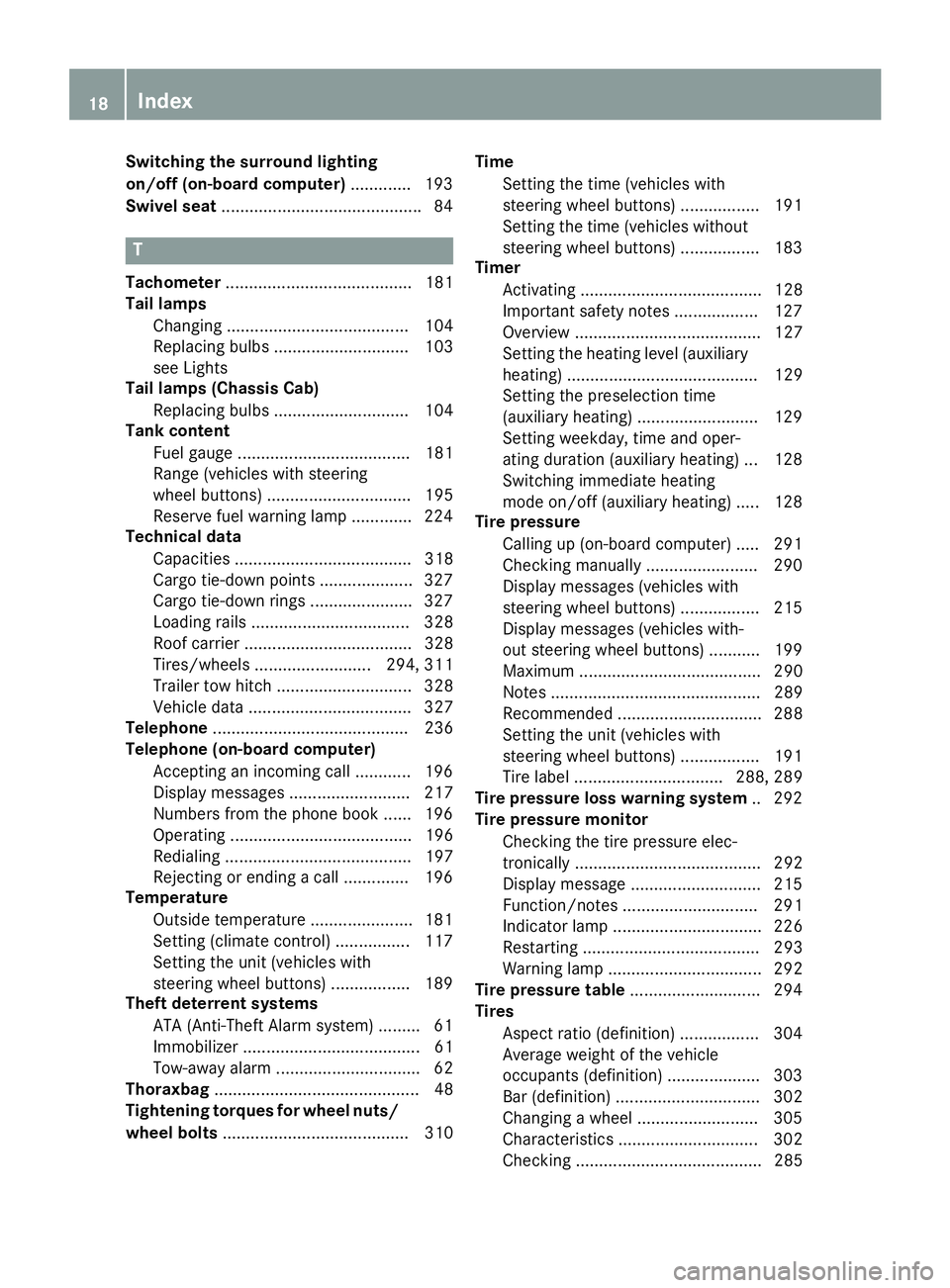
Switching the surround lighting
on/off (on-board computer)
.............193
Swivel seat .......................................... .84T
Tachometer ........................................ 181
Tail lamps
Changing ....................................... 104
Replacing bulb s............................. 103
see Lights
Tail lamps (Chassis Cab)
Replacing bulb s............................. 104
Tank content
Fuel gaug e..................................... 181
Range (vehicles with steering
wheel buttons) ............................... 195
Reserve fuel warning lamp ............. 224
Technical data
Capacities ...................................... 318
Cargo tie-down points .................... 327
Cargo tie-down rings ...................... 327
Loading rails .................................. 328
Roof carrier .................................... 328
Tires/wheels ......................... 294, 311
Trailer tow hitch ............................. 328
Vehicle data ................................... 327
Telephone .......................................... 236
Telephone (on-board computer)
Accepting an incoming cal l............ 196
Display messages .......................... 217
Numbers from the phone book ...... 196
Operating ....................................... 196
Redialing ........................................ 197
Rejecting or ending a call .............. 196
Temperature
Outside temperature ...................... 181
Setting (climate control )................ 117
Setting the unit (vehicles with
steering wheel buttons) ................. 189
Theft deterrent systems
ATA (Anti-Theft Alarm system) ......... 61
Immobilizer ...................................... 61
Tow-away alarm ............................... 62
Thoraxbag ............................................ 48
Tightening torques for wheel nuts/
wheel bolts ........................................ 310 Time
Setting the time (vehicles with
steering wheel buttons) ................. 191
Setting the time (vehicles without steering wheel buttons) ................. 183
Timer
Activating ....................................... 128
Important safety notes .................. 127
Overview ........................................ 127
Setting the heating level (auxiliary
heating) ......................................... 129
Setting the preselection time
(auxiliary heating) .......................... 129
Setting weekday, time and oper-
ating duration (auxiliary heating) ... 128
Switching immediate heating
mode on/off (auxiliary heating) ..... 128
Tire pressure
Calling up (on-board computer) ..... 291
Checking manually ........................ 290
Display messages (vehicles with
steering wheel buttons) ................. 215
Display messages (vehicles with-
out steering wheel buttons) ........... 199
Maximum ....................................... 290
Notes ............................................. 289
Recommended ............................... 288
Setting the unit (vehicles with
steering wheel buttons) ................. 191
Tire labe l................................ 288, 289
Tire pressure loss warning system .. 292
Tire pressure monitor
Checking the tire pressure elec-
tronically ........................................ 292
Display message ............................ 215
Function/note s............................. 291
Indicator lamp ................................ 226
Restarting ...................................... 293
Warning lamp ................................. 292
Tire pressure table ............................ 294
Tires
Aspect ratio (definition) ................. 304
Average weight of the vehicle
occupants (definition) .................... 303
Bar (definition) ............................... 302
Changing a whee l.......................... 305
Characteristics .............................. 302
Checking ........................................ 285 18
Index
Page 21 of 334
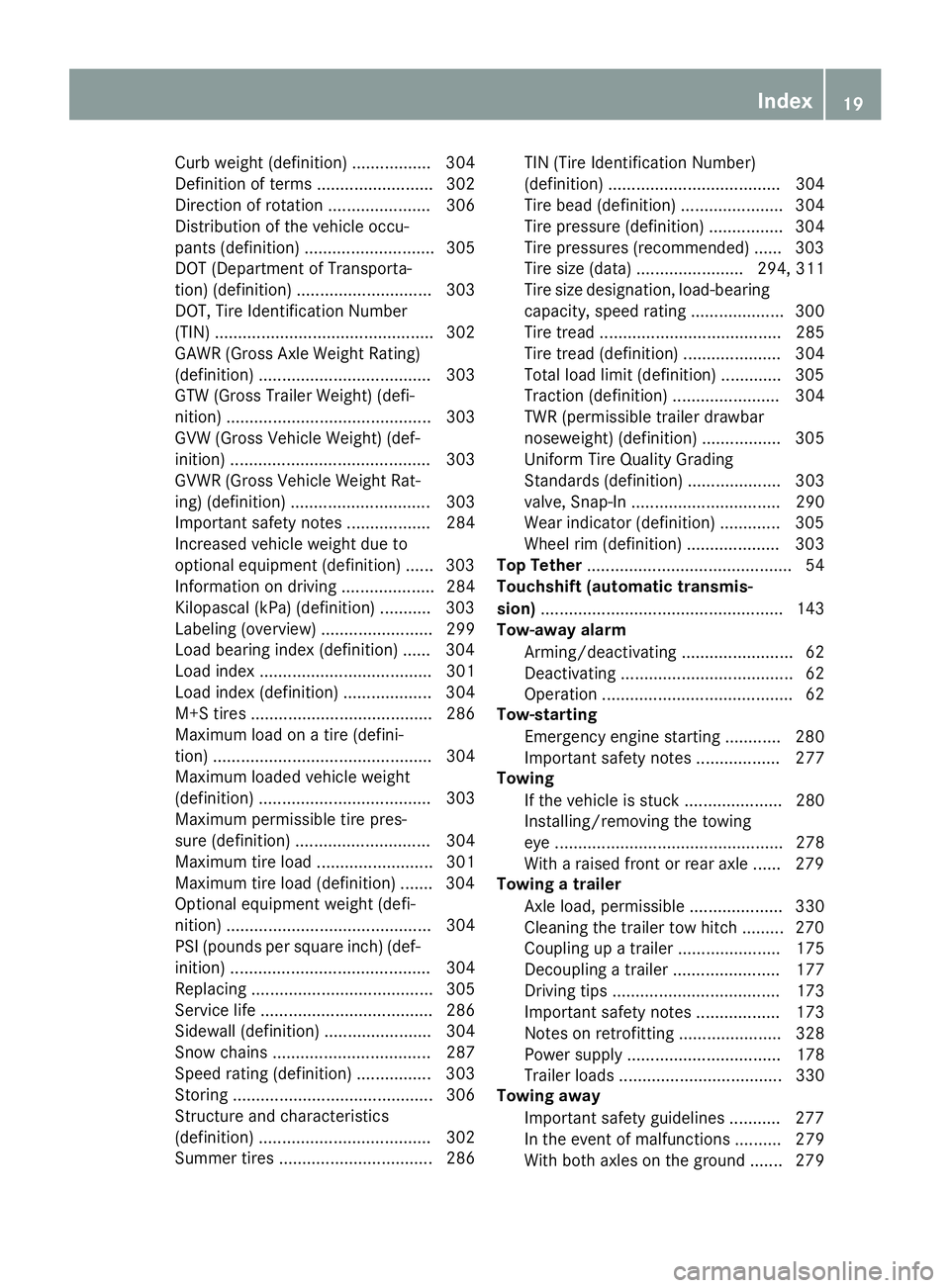
Curb weight (definition
)................. 304
Definition of terms ......................... 302
Direction of rotation ...................... 306
Distribution of the vehicle occu-
pants (definition) ............................ 305
DOT (Department of Transporta-
tion) (definition) ............................. 303
DOT, Tire Identification Number
(TIN) ............................................... 302
GAWR (Gross Axle Weight Rating)
(definition) ..................................... 303
GTW (Gross Trailer Weight) (defi-
nition) ............................................ 303
GVW (Gross Vehicle Weight) (def-
inition) ........................................... 303
GVWR (Gross Vehicle Weight Rat-
ing) (definition) .............................. 303
Important safety notes .................. 284
Increased vehicle weight due to
optional equipment (definition) ...... 303
Information on driving .................... 284
Kilopascal (kPa) (definition) ........... 303
Labeling (overview) ........................ 299
Load bearing index (definition) ...... 304
Load index ..................................... 301
Load index (definition) ................... 304
M+S tire s....................................... 286
Maximum load on a tire (defini-
tion) ............................................... 304
Maximum loaded vehicle weight
(definition) ..................................... 303
Maximum permissible tire pres-
sure (definition) ............................. 304
Maximum tire load ......................... 301
Maximum tire load (definition) ....... 304
Optional equipment weight (defi-
nition) ............................................ 304
PSI (pounds per square inch) (def-
inition) ........................................... 304
Replacing ....................................... 305
Service life ..................................... 286
Sidewall (definition) ....................... 304
Snow chains .................................. 287
Speed rating (definition) ................ 303
Storing ........................................... 306
Structure and characteristics
(definition) ..................................... 302
Summer tire s................................. 286 TIN (Tire Identification Number)
(definition) ..................................... 304
Tire bead (definition) ...................... 304
Tire pressure (definition) ................ 304
Tire pressures (recommended) ...... 303
Tire size (data) ....................... 294, 311
Tire size designation, load-bearing capacity, speed rating .................... 300
Tire tread ....................................... 285
Tire tread (definition) ..................... 304
Total load limit (definition) ............. 305
Traction (definition) ....................... 304
TWR (permissible trailer drawbar
noseweight) (definition) ................. 305
Uniform Tire Quality Grading
Standards (definition) .................... 303
valve, Snap-In ................................ 290
Wear indicator (definition) ............. 305
Wheel rim (definition) .................... 303
Top Tether ............................................ 54
Touchshift (automatic transmis-
sion) .................................................... 143
Tow-away alarm
Arming/deactivating ........................ 62
Deactivating ..................................... 62
Operation ......................................... 62
Tow-starting
Emergency engine starting ............ 280
Important safety notes .................. 277
Towing
If the vehicle is stuck ..................... 280
Installing/removing the towing
eye ................................................. 278
With a raised front or rear axle ...... 279
Towing a trailer
Axle load, permissibl e.................... 330
Cleaning the trailer tow hitch ......... 270
Coupling up a traile r...................... 175
Decoupling a trailer ....................... 177
Driving tip s.................................... 173
Important safety notes .................. 173
Notes on retrofitting ...................... 328
Power supply ................................. 178
Trailer load s................................... 330
Towing away
Important safety guidelines ........... 277
In the event of malfunctions .......... 279
With both axles on the ground ....... 279 Index
19
Page 22 of 334
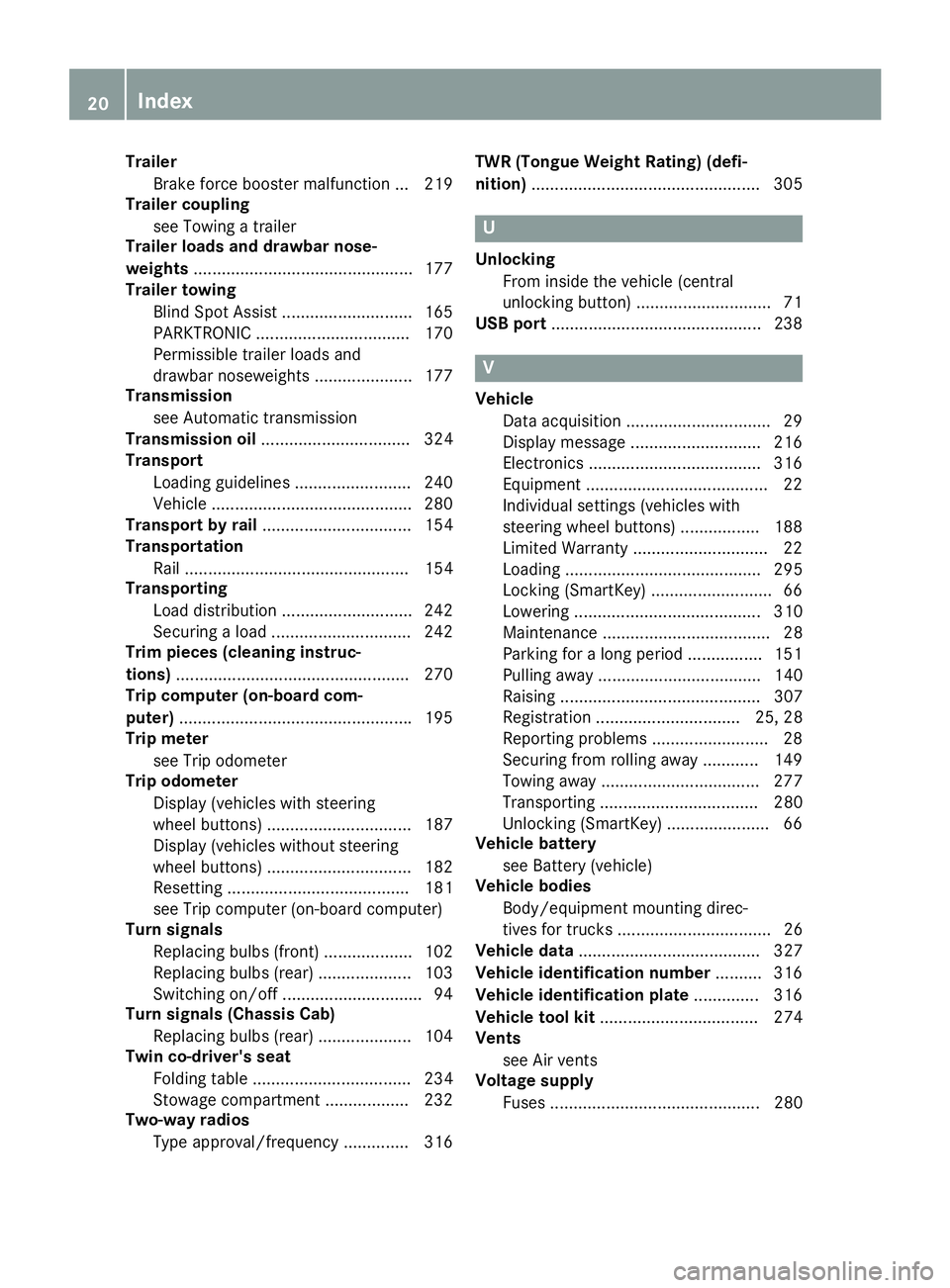
Trailer
Brake force booster malfunction ... 219
Trailer coupling
see Towing a trailer
Trailer loads and drawbar nose-
weights .............................................. .177
Trailer towing
Blind Spot Assist ............................ 165
PARKTRONIC ................................. 170
Permissible trailer loads and
drawbar noseweights ..................... 177
Transmission
see Automatic transmission
Transmission oil ................................ 324
Transport
Loading guidelines ......................... 240
Vehicle .......................................... .280
Transport by rail ................................ 154
Transportation
Rail ................................................ 154
Transporting
Load distribution ............................ 242
Securing a load .............................. 242
Trim pieces (cleaning instruc-
tions) ................................................. .270
Trip computer (on-board com-
puter) ................................................. .195
Trip meter
see Trip odometer
Trip odometer
Display (vehicles with steering
wheel buttons) ............................... 187
Display (vehicles without steeringwheel buttons) ............................... 182
Resetting ....................................... 181
see Trip computer (on-board computer)
Turn signals
Replacing bulbs (front) ................... 102
Replacing bulbs (rear) .................... 103
Switching on/off .............................. 94
Turn signals (Chassis Cab)
Replacing bulbs (rear) .................... 104
Twin co-driver's seat
Folding table .................................. 234
Stowage compartment .................. 232
Two-way radios
Type approval/frequency .............. 316 TWR (Tongue Weight Rating) (defi-
nition)
................................................. 305 U
Unlocking From inside the vehicle (central
unlocking button) ............................ .71
USB port .............................................2 38 V
Vehicle Data acquisition ............................... 29
Display message ............................ 216
Electronics ..................................... 316
Equipment ....................................... 22
Individual settings (vehicles with
steering wheel buttons) ................. 188
Limited Warranty ............................ .22
Loading .......................................... 295
Locking (SmartKey) .......................... 66
Lowering ........................................ 310
Maintenance .................................... 28
Parking for a long period ................ 151
Pulling away ................................... 140
Raising ........................................... 307
Registration ............................... 25, 28
Reporting problems ......................... 28
Securing from rolling away ............ 149
Towing away .................................. 277
Transporting .................................. 280
Unlocking (SmartKey )...................... 66
Vehicle battery
see Battery (vehicle)
Vehicle bodies
Body/equipment mounting direc-
tives for trucks ................................. 26
Vehicle data ....................................... 327
Vehicle identification number .......... 316
Vehicle identification plate .............. 316
Vehicle tool kit .................................. 274
Vents
see Air vents
Voltage supply
Fuses ............................................. 280 20
Index
Page 34 of 334
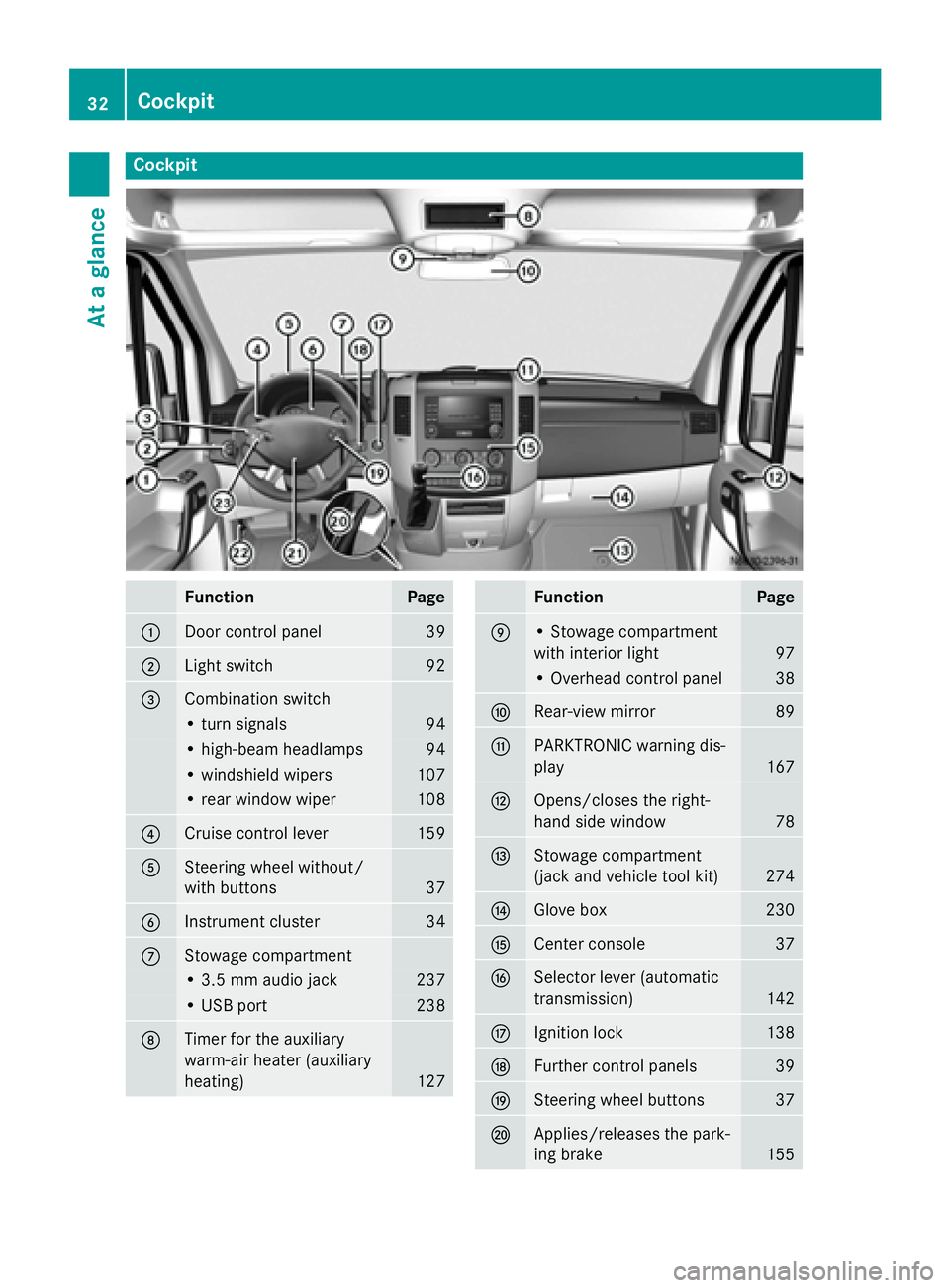
Cockpit
Function Page
0043
Door control panel 39
0044
Light switch 92
0087
Combination switch
• turn signals 94
• high-beam headlamps 94
• windshield wipers 107
• rear window wiper 108
0085
Cruise control lever 159
0083
Steering wheel without/
with buttons
37
0084
Instrument cluster 34
006B
Stowage compartment
• 3.5 mm audio jack 237
• USB port 238
006C
Timer for the auxiliary
warm-air heater (auxiliary
heating)
127 Function Page
006D
• Stowage compartment
with interior light
97
• Overhead control panel 38
006E
Rear-view mirror 89
006F
PARKTRONIC warning dis-
play
167
0070
Opens/closes the right-
hand side window
78
0071
Stowage compartment
(jack and vehicle tool kit)
274
0072
Glove box 230
0073
Center console 37
0074
Selector lever (automatic
transmission)
142
0075
Ignition lock 138
0076
Further control panels 39
0077
Steering wheel buttons 37
0078
Applies/releases the park-
ing brake
15532
CockpitAt a glance
Page 39 of 334
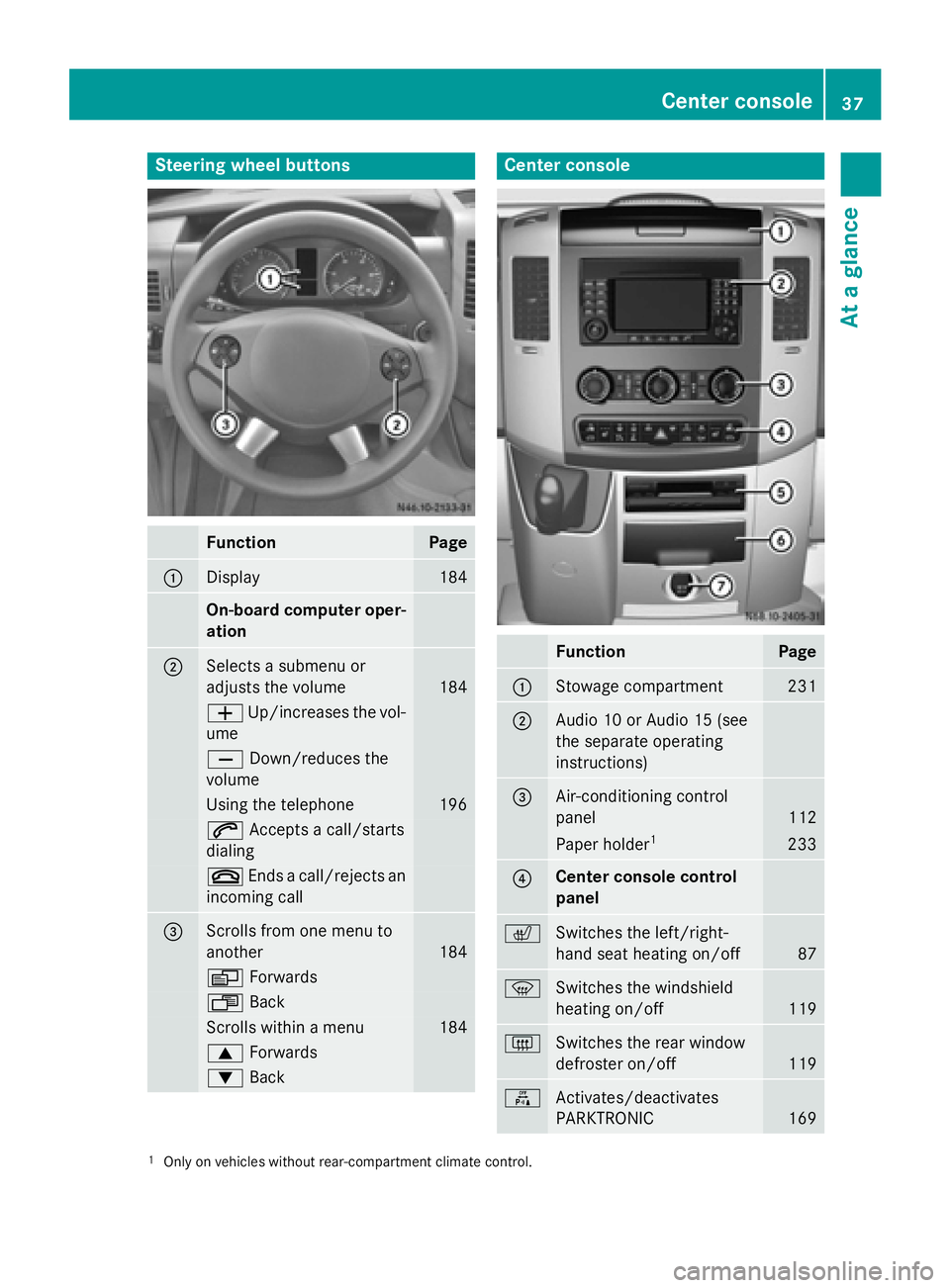
Steering wheel buttons
Function Page
0043
Display 184
On-board computer oper-
ation 0044
Selects a submenu or
adjusts the volume
184
0081
Up/increases the vol-
ume 0082
Down/reduces the
volume Using the telephone 196
0061
Accepts a call/starts
dialing 0076
Ends a call/rejects an
incoming call 0087
Scrolls from one menu to
another
184
0080
Forwards 007F
Back Scrolls within a menu 184
0063
Forwards 0064
Back Center console
Function Page
0043
Stowage compartment 231
0044
Audio 10 or Audio 15 (see
the separate operating
instructions)
0087
Air-conditioning control
panel
112
Paper holder
1 233
0085 Center console control
panel
0072
Switches the left/right-
hand seat heating on/off
87
0085
Switches the windshield
heating on/off
119
0071
Switches the rear window
defroster on/off
119
0069
Activates/deactivates
PARKTRONIC
169
1
Only on vehicles without rear-compartment climate control. Center console
37At a glance
Page 40 of 334
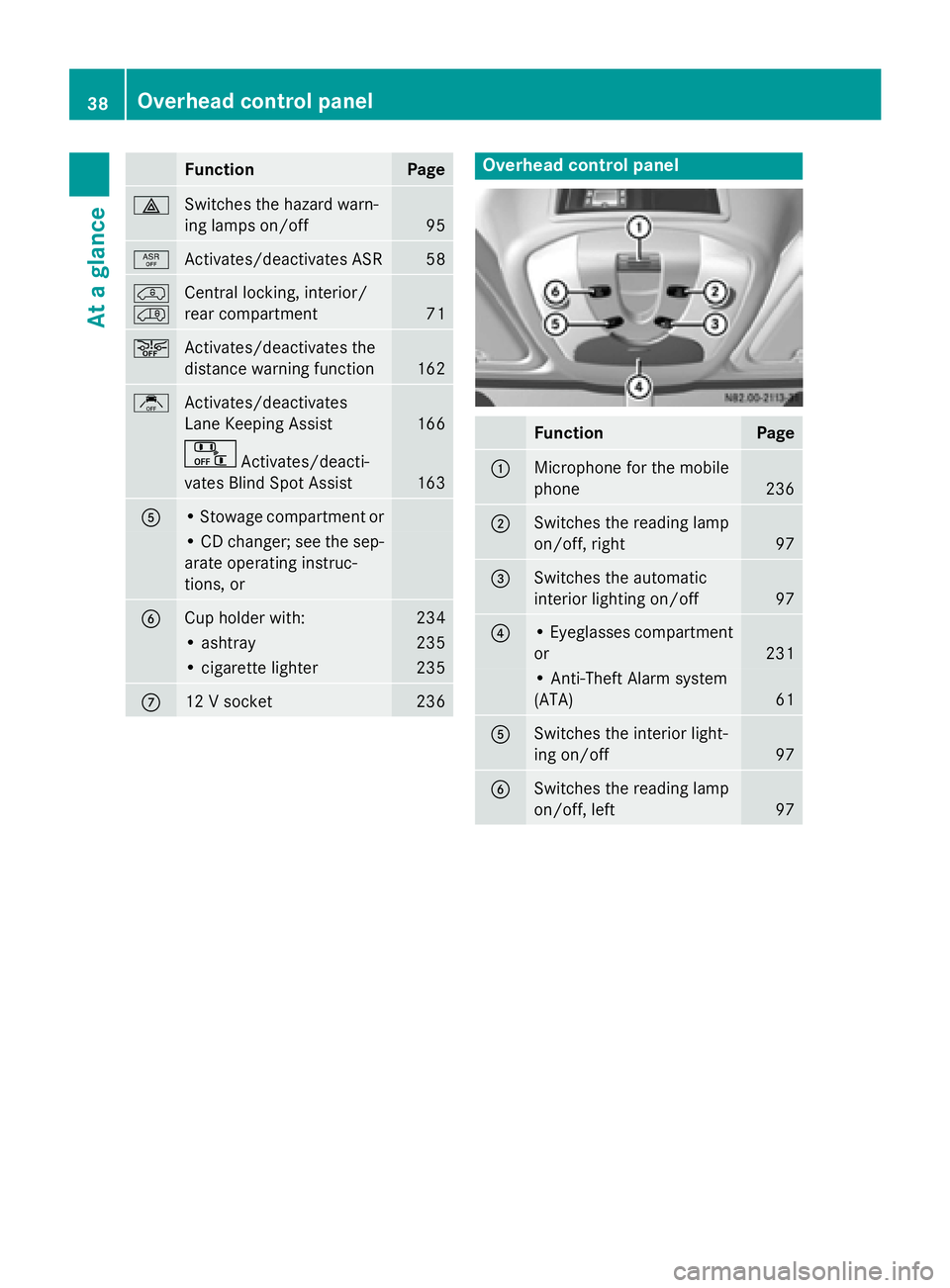
Function Page
002F
Switches the hazard warn-
ing lamps on/off
95
00E3
Activates/deactivates ASR 58
00BF
00C0
Central locking, interior/
rear compartment
71
00D4
Activates/deactivates the
distance warning function
162
j
Activates/deactivates
Lane Keeping Assist
166
Activates/deacti-
vates Blind Spot Assist 163
0083
• Stowage compartment or
• CD changer; see the sep-
arate operating instruc-
tions, or 0084
Cup holder with: 234
• ashtray 235
• cigarette lighter 235
006B
12 V socket 236 Overhead control panel
Function Page
0043
Microphone for the mobile
phone 236
0044
Switches the reading lamp
on/off, right 97
0087
Switches the automatic
interior lighting on/off 97
0085
• Eyeglasses compartment
or 231
• Anti-Theft Alarm system
(ATA)
61
0083
Switches the interior light-
ing on/off 97
0084
Switches the reading lamp
on/off, left 9738
Overhead control panelAt a glance
Page 48 of 334
X
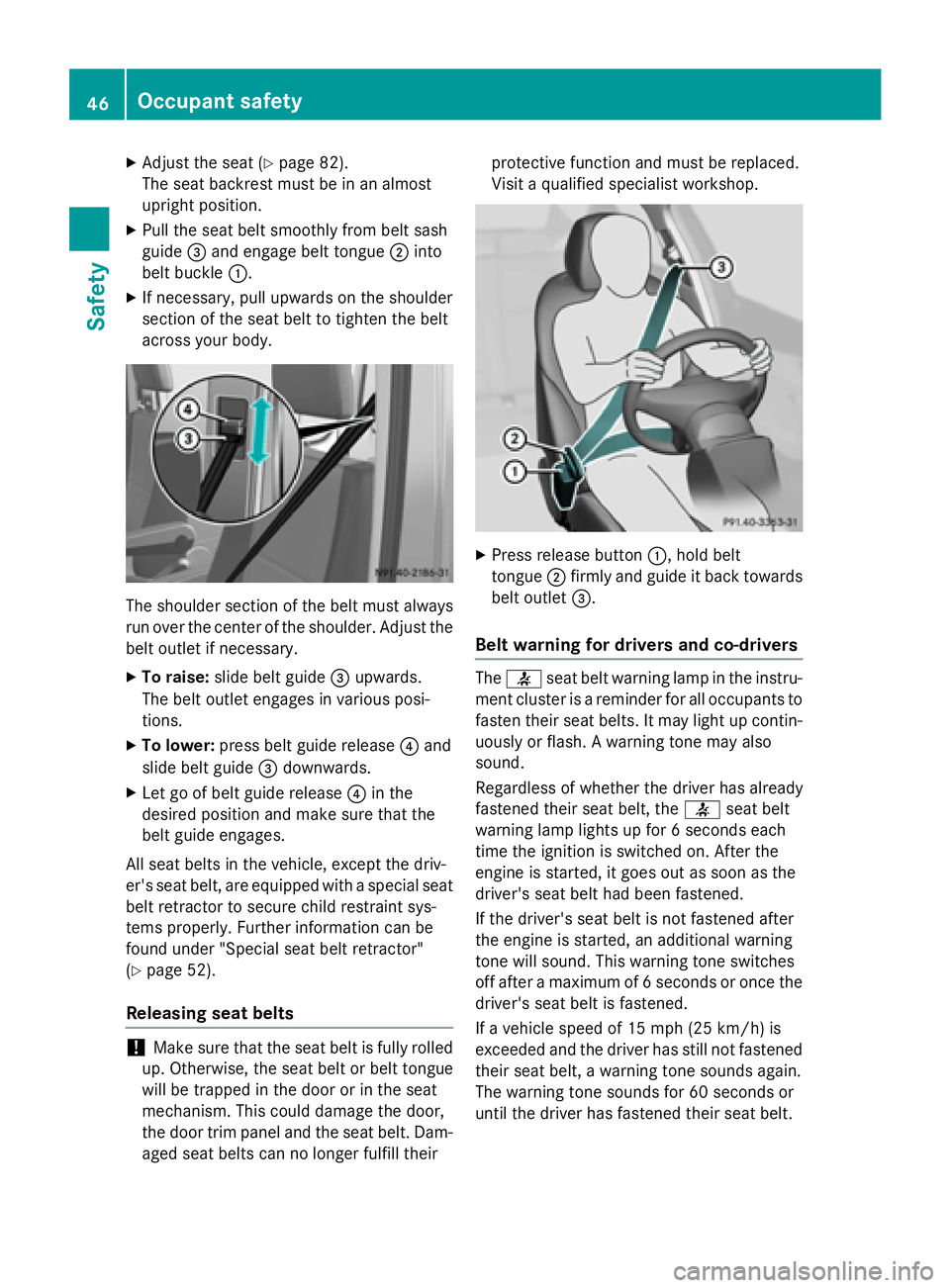
Adjust the seat (Y page 82).
The seat backrest must be in an almost
upright position.
X Pull the seat belt smoothly from belt sash
guide 0087and engage belt tongue 0044into
belt buckle 0043.
X If necessary, pull upwards on the shoulder
section of the seat belt to tighten the belt
across your body. The shoulder section of the belt must always
run over the center of the shoulder. Adjust the
belt outlet if necessary.
X To raise: slide belt guide 0087upwards.
The belt outlet engages in various posi-
tions.
X To lower: press belt guide release 0085and
slide belt guide 0087downwards.
X Let go of belt guide release 0085in the
desired position and make sure that the
belt guide engages.
All seat belts in the vehicle, except the driv-
er's seat belt, are equipped with a special seat belt retractor to secure child restraint sys-
tems properly. Further information can be
found under "Special seat belt retractor"
(Y page 52).
Releasing seat belts !
Make sure that the seat belt is fully rolled
up. Otherwise, the seat belt or belt tongue
will be trapped in the door or in the seat
mechanism. This could damage the door,
the door trim panel and the seat belt. Dam-
aged seat belts can no longer fulfill their protective function and must be replaced.
Visit a qualified specialist workshop.
X
Press release button 0043, hold belt
tongue 0044firmly and guide it back towards
belt outlet 0087.
Belt warning for drivers and co-drivers The
0076 seat belt warning lamp in the instru-
ment cluster is a reminder for all occupants to
fasten their seat belts. It may light up contin-
uously or flash. A warning tone may also
sound.
Regardless of whether the driver has already
fastened their seat belt, the 0076seat belt
warning lamp lights up for 6 second s each
time the ignition is switched on. After the
engine is started, it goes out as soon as the
driver's seat belt had been fastened.
If the driver's seat belt is not fastened after
the engine is started, an additional warning
tone will sound. This warning tone switches
off after a maximum of 6 seconds or once the
driver's seat belt is fastened.
If a vehicle speed of 15 mph (25 km/h) is
exceeded and the driver has still not fastened their seat belt, a warning tone sounds again.
The warning tone sounds for 60 seconds or
until the driver has fastened their seat belt. 46
Occupant safetySafety
Page 51 of 334
Thorax bags are only available in combination
with individual seats on the driver's and co-
driver's side.
When deployed, thorax bag 0043offers addi-
tional thorax protection. However, it does not protect the:
R head
R neck
R arms
The thorax bag is deployed on the side of the impact.
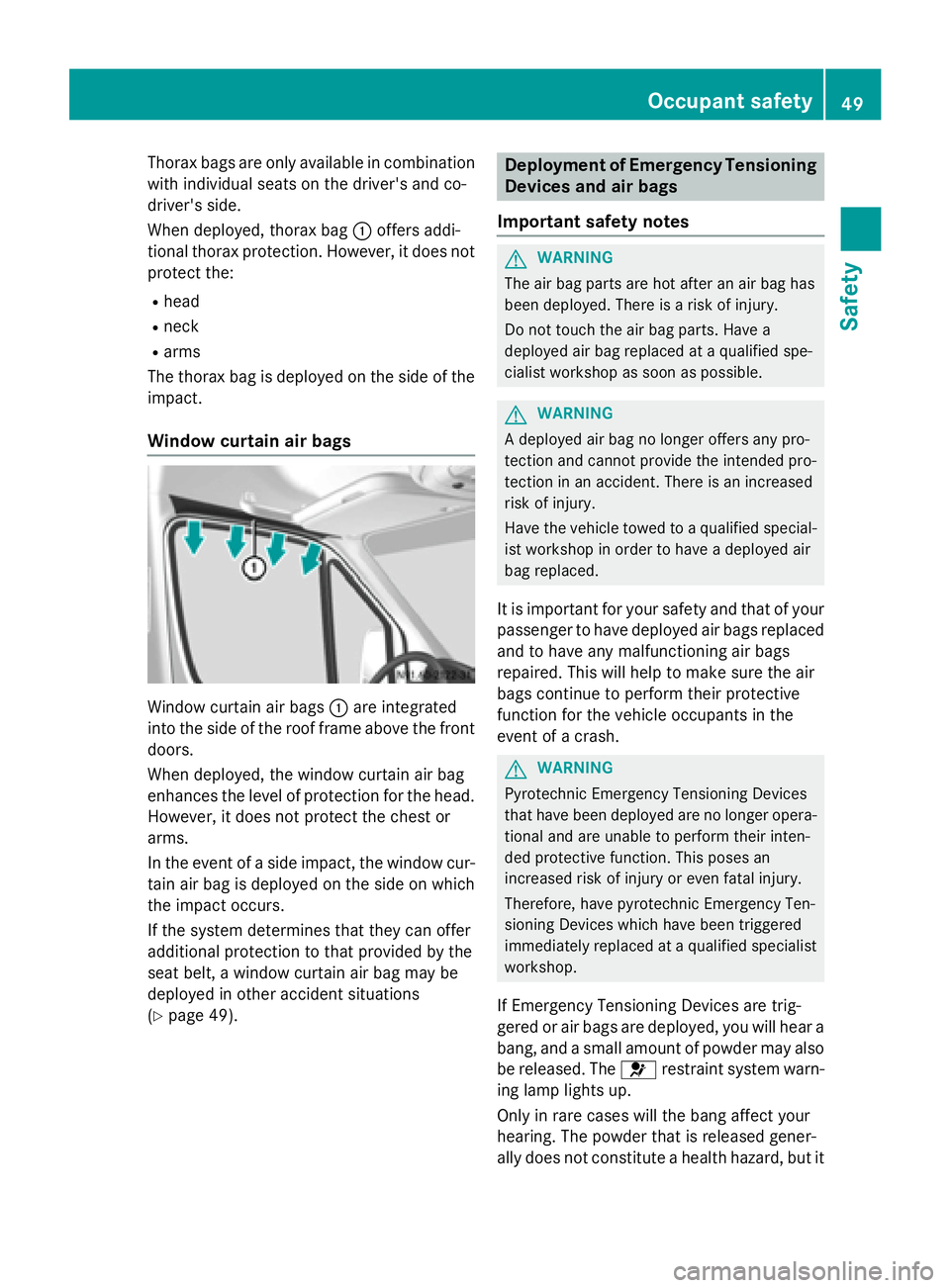
Window curtain air bags Window curtain air bags
0043are integrated
into the side of the roof frame above the front
doors.
When deployed, the window curtain air bag
enhances the level of protection for the head.
However, it does not protect the chest or
arms.
In the event of a side impact, the window cur- tain air bag is deployed on the side on which
the impact occurs.
If the system determines that they can offer
additional protection to that provided by the
seat belt, a window curtain air bag may be
deployed in other accident situations
(Y page 49). Deployment of Emergency Tensioning
Devices and air bags
Important safety notes G
WARNING
The air bag parts are hot after an air bag has
been deployed. There is a risk of injury.
Do not touch the air bag parts. Have a
deployed air bag replaced at a qualified spe-
cialist workshop as soon as possible. G
WARNING
A deployed air bag no longer offers any pro-
tection and cannot provide the intended pro-
tection in an accident. There is an increased
risk of injury.
Have the vehicle towed to a qualified special- ist workshop in order to have a deployed air
bag replaced.
It is important for your safety and that of your
passenger to have deployed air bags replaced and to have any malfunctioning air bags
repaired. This will help to make sure the air
bags continue to perform their protective
function for the vehicle occupants in the
event of a crash. G
WARNING
Pyrotechnic Emergency Tensioning Devices
that have been deployed are no longer opera- tional and are unable to perform their inten-
ded protective function. This poses an
increased risk of injury or even fatal injury.
Therefore, have pyrotechnic Emergency Ten-
sioning Devices which have been triggered
immediately replaced at a qualified specialist workshop.
If Emergency Tensioning Devices are trig-
gered or air bags are deployed, you will hear a
bang, and a small amount of powder may also be released. The 0075restraint system warn-
ing lamp lights up.
Only in rare cases will the bang affect your
hearing. The powder that is released gener-
ally does not constitute a health hazard, but it Occupant safety
49Safety Z
Page 54 of 334
A booster seat may be necessary to achieve
proper seat belt positioning for children over
41 lbs (18 kg) or until they reach a height
where a lap/shoulder belt can be fastened
properly without a booster seat. Special seat belt retractor
G
WARNING
If the seat belt is released while driving, the
child restraint system will no longer be
secured properly. The special seat belt retrac- tor is disabled and the inertia real draws in a
portion of the seat belt. The seat belt cannot
be immediately refastened. There is an
increased risk of injury, possibly even fatal.
Stop the vehicle immediately, paying atten-
tion to road and traffic conditions. Reactivate
the special seat belt retractor and secure the
child restraint system properly.
All seat belts in the vehicle, except the driv-
er's seat belt, are equipped with a special seat belt retractor. When activated, the special
seat belt retractor ensures that the seat belt
cannot slacken once the child seat is secured.
Installing a child restraint system:
X Make sure you observe the child restraint
system manufacturer's installation instruc- tions.
X Pull the seat belt smoothly from the belt
outlet.
X Engage seat belt tongue in belt buckle.
Activating the special seat belt retractor:
X Pull the seat belt out fully and let the inertia
reel retract it again.
While the seat belt is retracting, you should hear a ratcheting sound. The special seat
belt retractor is enabled.
X Push the child restraint system down so
that the seat belt is tight and does not
loosen. Removing a child restraint system/deactivat-
ing the special seat belt retractor:
X Make sure you observe the child restraint
system manufacturer's installation instruc- tions.
X Press the belt buckle release button, hold
the belt tongue and guide it back towards
the belt outlet.
The special seat belt retractor is deactiva-
ted. Child restraint system
The use of seat belts and child restraint sys-
tems is required by law in:
R all 50 states
R the U.S. territories
R the District of Columbia
R all Canadian provinces
You can obtain further information about the correct child restraint system from any
authorized Sprinter Dealer. G
WARNING
If the child restraint system is installed incor- rectly on a suitable seat, it cannot protect as
intended. The child cannot then be restrained in the event of an accident, heavy braking or
sudden changes of direction. There is an
increased risk of injury, possibly even fatal.
Make sure that you observe the child restraint
system manufacturer's installation instruc-
tions and the notes on use. Please ensure,
that the base of the child restraint system is
always resting completely on the seat cush-
ion. Never place objects, e.g. cushions, under or behind the child restraint system. Only use
child restraint systems with the original cover
designed for them. Only replace damaged
covers with genuine covers. G
WARNING
If the child restraint system is installed incor- rectly or is not secured, it can come loose in
the event of an accident, heavy braking or a 52
Children in the vehicleSafety
Page 55 of 334
sudden change in direction. The child
restraint system could be thrown about, strik- ing vehicle occupants. There is an increased
risk of injury, possibly even fatal.
Always install child restraint systems prop-
erly, even if they are not being used. Make
sure that you observe the child restraint sys-
tem manufacturer's installation instructions.
You will find further information on stowing
objects, luggage or loads under "Loading
guidelines" (Y page 240). G
WARNING
Child restraint systems or their securing sys-
tems which have been damaged or subjected to a load in an accident can no longer protect
as intended. The child cannot then be
restrained in the event of an accident, heavy
braking or sudden changes of direction. There is an increased risk of injury, possibly even
fatal.
Replace child restraint systems which have
been damaged or subjected to a load in an
accident as soon as possible. Have the secur-
ing systems on the child restraint system
checked at a qualified specialist workshop,
before you install a child restraint system
again.
The securing systems of child restraint sys-
tems are:
R the seat belt system
R the LATCH-type (ISOFIX) securing rings
R the Top Tether anchorages
i If it is absolutely necessary to carry a child
on the front-passenger seat, be sure to
observe the information on "Child restraint
systems on the front-passenger seat"
(Y page 55).
All child restraint systems must meet the fol- lowing standards:
R U.S. Federal Motor Vehicle Safety Stand-
ards 213 and 225
R Canadian Motor Vehicle Safety Standards
213 and 210.2 Confirmation that the child restraint system
corresponds to the standards can be found
on an instruction label on the child restraint
system. This confirmation can also be found
in the installation instructions that are inclu-
ded with the child restraint system.
Observe the warning labels in the vehicle inte-
rior and on the child restraint system. LATCH-type (ISOFIX) child seat secur-
ing system G
WARNING
LATCH-type (ISOFIX) child restraint systems
do not offer sufficient protective effect for
children whose weight is greater than 48 lbs
(22 kg) who are secured using the safety belt integrated in the child restraint system. In the
event of an accident, a child might not be
restrained correctly. This poses an increased
risk of injury or even fatal injury.
If the child weighs more than 48 lbs (22 kg),
only use LATCH-type (ISOFIX) child restraint
systems with which the child is also secured
with the vehicle seat belt. Also secure the
child restraint system with the Top Tether
belt, if available.
Always comply with the manufacturer's
installation and operating instructions for the child restraint system used.
Before every trip, make sure that the LATCH- type (ISOFIX) child restraint system is
engaged correctly in both LATCH-type (ISO-
FIX) securing rings
! When installing the child restraint system,
make sure that the seat belt for the middle seat does not get trapped. The seat belt
could otherwise be damaged. Children in the vehicle
53Safety Z