tow MERCEDES-BENZ SPRINTER 2015 MY15 Operator’s Manual
[x] Cancel search | Manufacturer: MERCEDES-BENZ, Model Year: 2015, Model line: SPRINTER, Model: MERCEDES-BENZ SPRINTER 2015Pages: 334, PDF Size: 5.94 MB
Page 64 of 334
Tow-away alarm
Operation A visual and audible alarm is triggered if the
inclination of the vehicle changes when the
tow-away alarm is armed. This can be the
case if the vehicle is raised on one side, for
example.
Arming/disarming The tow-away alarm is automatically armed
approximately 20 second
s after you lock the
vehicle.
The tow-away alarm is automatically deacti-
vated when you unlock the vehicle.
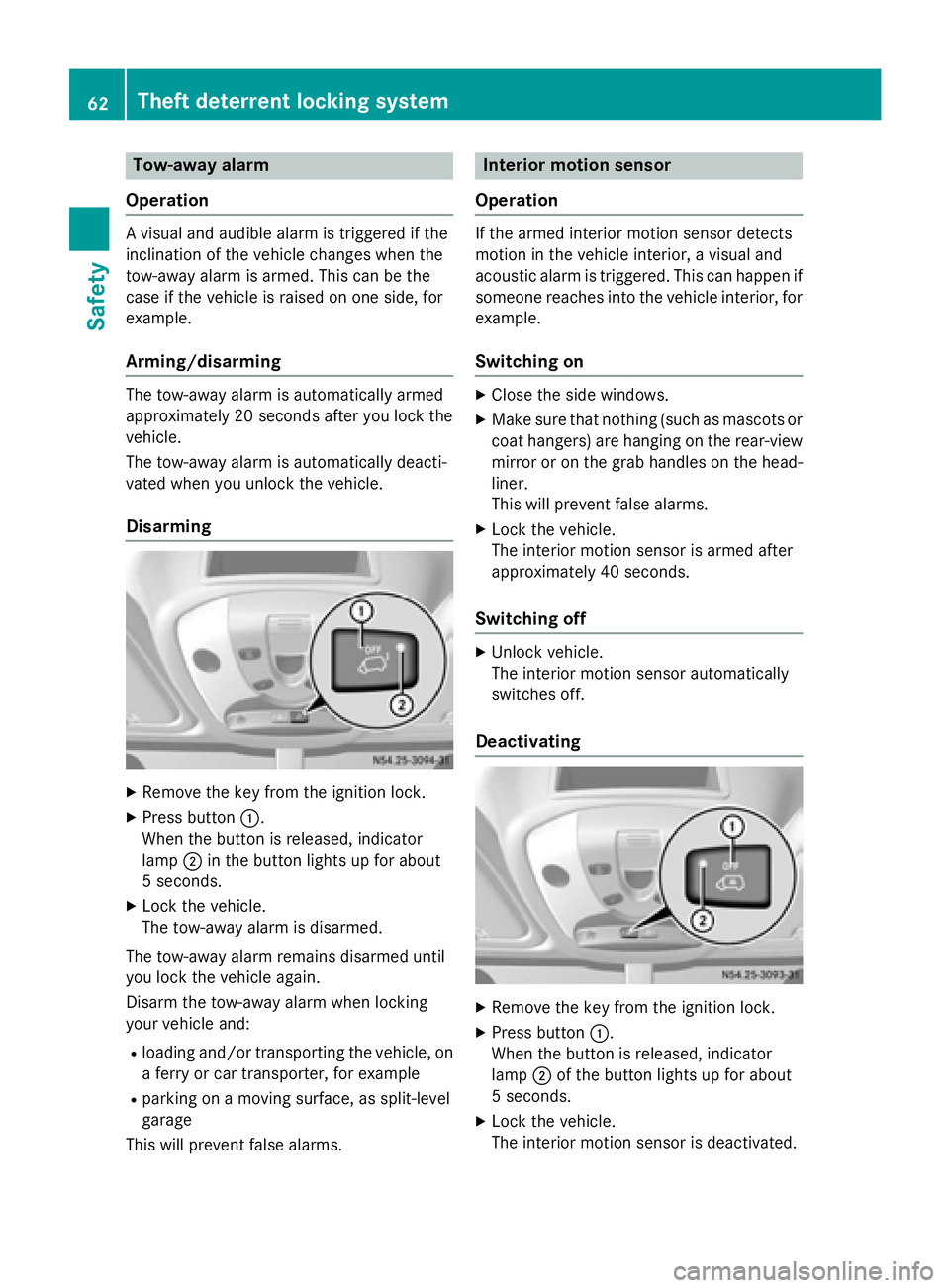
Disarming X
Remove the key from the ignition lock.
X Press button 0043.
When the button is released, indicator
lamp 0044in the button lights up for about
5 second s.
X Lock the vehicle.
The tow-away alarm is disarmed.
The tow-away alarm remains disarmed until
you lock the vehicle again.
Disarm the tow-away alarm when locking
your vehicle and: R loading and/or transporting the vehicle, on
a ferry or car transporter, for example
R parking on a moving surface, as split-level
garage
This will prevent false alarms. Interior motion sensor
Operation If the armed interior motion sensor detects
motion in the vehicle interior, a visual and
acoustic alarm is triggered. This can happen if
someone reaches into the vehicle interior, for example.
Switching on X
Close the side windows.
X Make sure that nothing (such as mascots or
coat hangers) are hanging on the rear-view
mirror or on the grab handles on the head- liner.
This will prevent false alarms.
X Lock the vehicle.
The interior motion sensor is armed after
approximately 40 seconds.
Switching off X
Unlock vehicle.
The interior motion sensor automatically
switches off.
Deactivating X
Remove the key from the ignition lock.
X Press button 0043.
When the button is released, indicator
lamp 0044of the button lights up for about
5 seconds.
X Lock the vehicle.
The interior motion sensor is deactivated. 62
Theft deterrent locking systemSafety
Page 74 of 334
mechanism of your vehicle can be obtained
from any authorized Sprinter Dealer.
If the automatic locking when driving function
is activated, there is a risk of being locked out
when the vehicle is pushed or towed.
For this reason, deactivate the automatic
locking when driving function:
R before pushing the vehicle
R before towing the vehicle
If activated, automatic locking is deactivated
when the vehicle is unlocked or locked using
the central locking button.
Automatic locking is reactivated after the
ignition is switched off or a door is opened
with the vehicle stationary.
Activating automatic locking when driv- ing X
Turn the key to position 1or 2in the ignition
lock when the doors are closed.
X For the entire vehicle: press the upper
00BF central locking button until the indi-
cator lamp in the button flashes four times.
X For the sliding doors and rear doors
only: press the 00C0lower central locking
button until the indicator lamp in the 00BF
upper button flashes four times.
Deactivating automatic locking when
driving X
Turn the key to position 1or 2in the ignition
lock when the doors are closed.
X For the entire vehicle: press the00BF
upper central locking button until the indi-
cator lamp in the button flashes twice.
X For the sliding doors and rear doors
only: press the 00C0lower central locking
button until the indicator lamp in the 00BF
upper button flashes twice. Driver's door and co-driver's door
! Only open the doors when road and traffic
conditions permit. Make sure that there is
sufficient clearance when opening the
doors. Otherwise, you could damage your
vehicle or other vehicles. You can open the driver's or co-driver's door
from the inside at any time, even if it is locked.
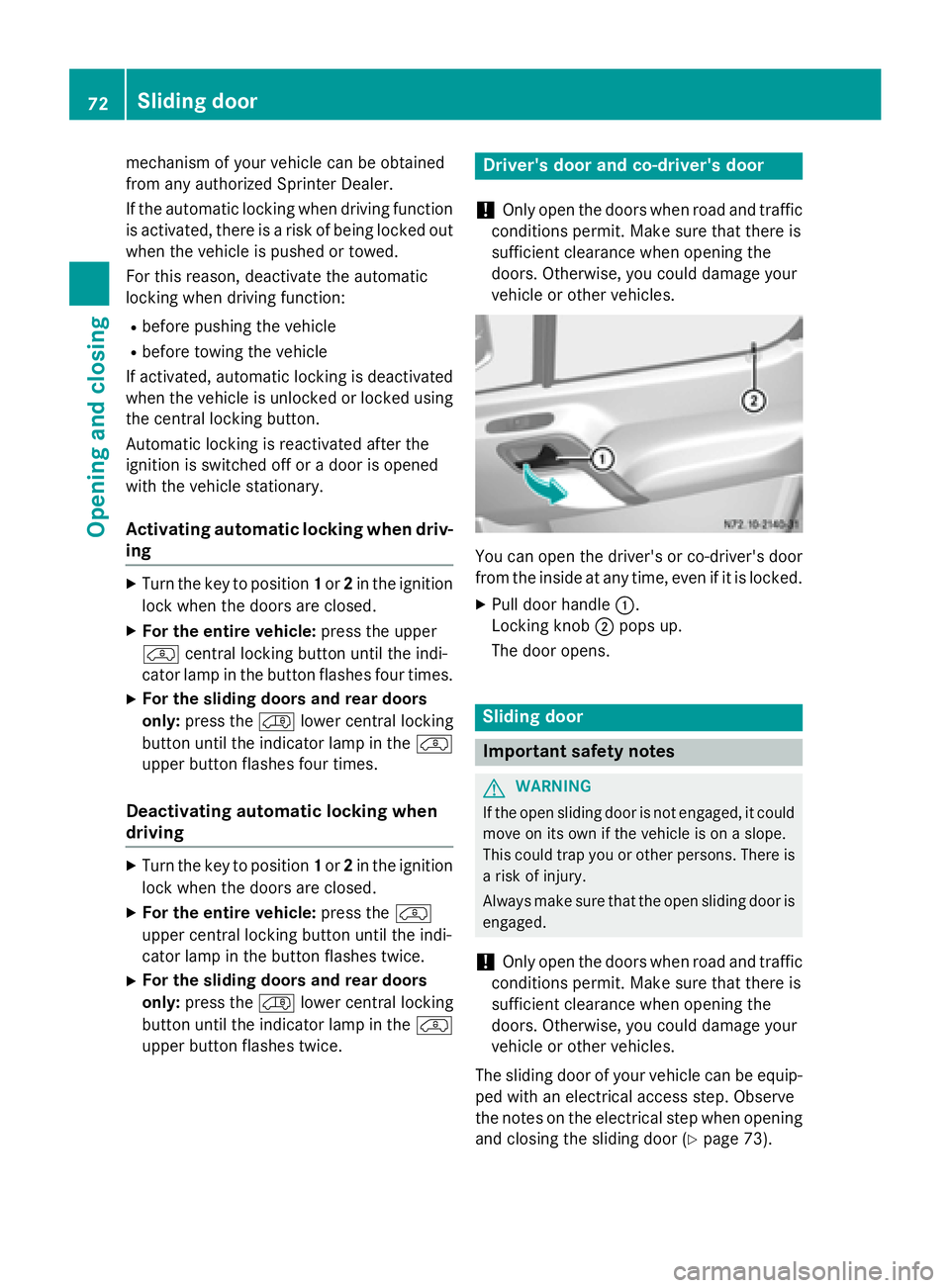
X Pull door handle 0043.
Locking knob 0044pops up.
The door opens. Sliding door
Important safety notes
G
WARNING
If the open sliding door is not engaged, it could move on its own if the vehicle is on a slope.
This could trap you or other persons. There is a risk of injury.
Always make sure that the open sliding door is
engaged.
! Only open the doors when road and traffic
conditions permit. Make sure that there is
sufficient clearance when opening the
doors. Otherwise, you could damage your
vehicle or other vehicles.
The sliding door of your vehicle can be equip-
ped with an electrical access step. Observe
the notes on the electrical step when opening and closing the sliding door (Y page 73).72
Sliding doorOpening and closing
Page 85 of 334
R
Adjust the head restraint so that it supports
the back of the head at eye level.
R The distance from the pedals should be
such that you can depress them fully.
Observe also the safety notes in the section
on "Air bags" (Y page 47)and "Children in the
vehicle" (Y page 51).
If you swap over the head restraints for the
front and rear seats, you will not be able to
adjust the height and angle of the head
restraints to the correct position.
Use the head restraint pad to adjust the head
restraint so that it is as close as possible to
the back of your head.
Before the journey, make sure the head
restraints have been correctly set for each of the vehicle's passengers (Y page 86).Driver's and co-driver's seat
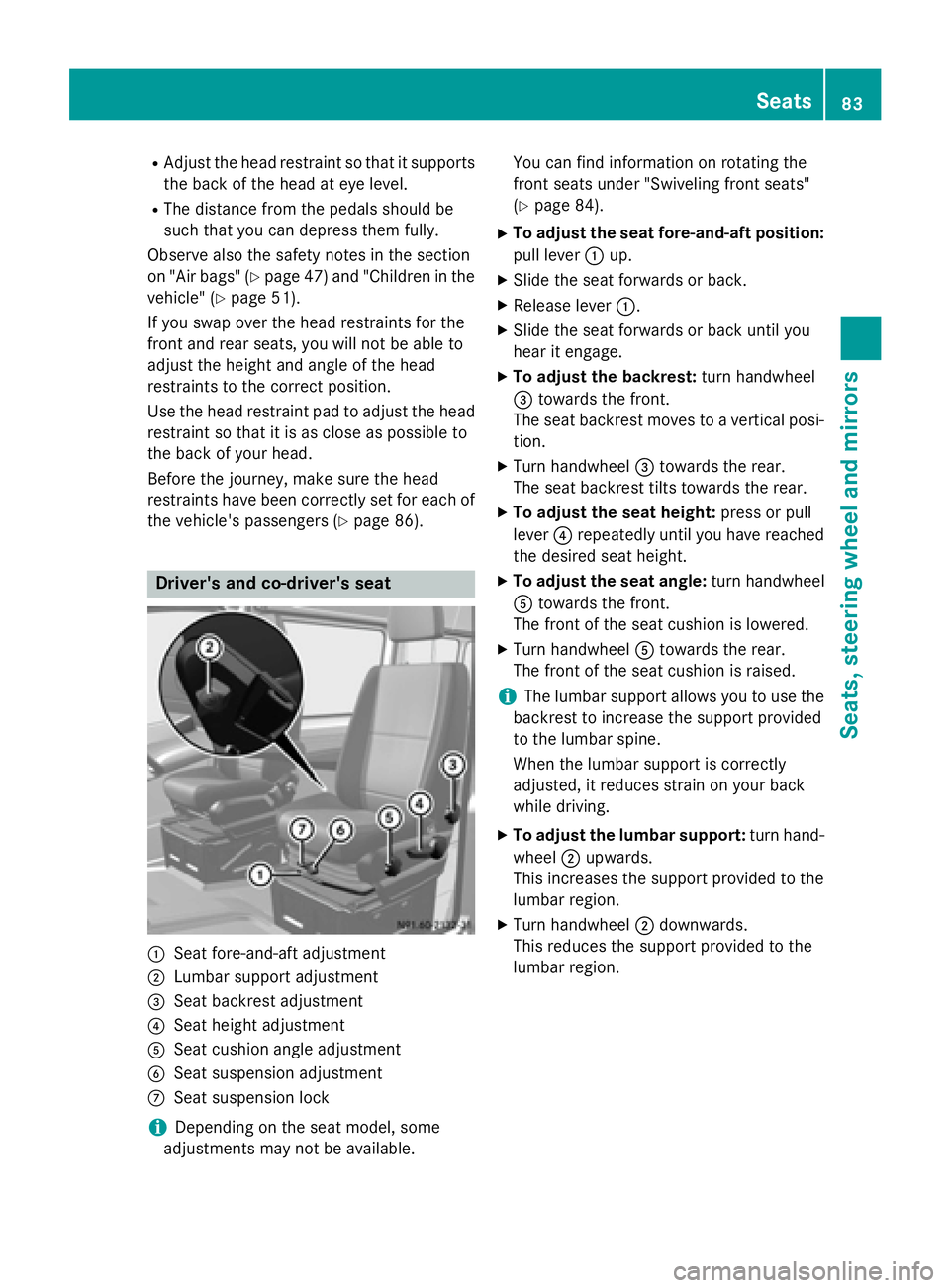
0043
Seat fore-and-aft adjustment
0044 Lumbar support adjustment
0087 Seat backrest adjustment
0085 Seat height adjustment
0083 Seat cushion angle adjustment
0084 Seat suspension adjustment
006B Seat suspension lock
i Depending on the seat model, some
adjustments may not be available. You can find information on rotating the
front seats under "Swiveling front seats"
(Y
page 84).
X To adjust the seat fore-and-aft position:
pull lever 0043up.
X Slide the seat forwards or back.
X Release lever 0043.
X Slide the seat forwards or back until you
hear it engage.
X To adjust the backrest: turn handwheel
0087 towards the front.
The seat backrest moves to a vertical posi-
tion.
X Turn handwheel 0087towards the rear.
The seat backrest tilts towards the rear.
X To adjust the seat height: press or pull
lever 0085repeatedly until you have reached
the desired seat height.
X To adjust the seat angle: turn handwheel
0083 towards the front.
The front of the seat cushion is lowered.
X Turn handwheel 0083towards the rear.
The front of the seat cushion is raised.
i The lumbar support allows you to use the
backrest to increase the support provided
to the lumbar spine.
When the lumbar support is correctly
adjusted, it reduces strain on your back
while driving.
X To adjust the lumbar support: turn hand-
wheel 0044upwards.
This increases the support provided to the
lumbar region.
X Turn handwheel 0044downwards.
This reduces the support provided to the
lumbar region. Seats
83Seats, steering wheel and mirrors Z
Page 86 of 334
The seat suspension must be adapted to your
body weight. Adjust the seat suspension only while the seat is unoccupied.
X To adjust the seat suspension: take your
weight off the seat.
X Using handwheel 0084, set your body weight
(40 to 120 kg) for optimum seat suspen-
sion.
The seat suspension will become more rigid the higher you set the weight. It will then
not move as far.
If the seat moves up and down frequently and
to a great extent, you can lock the seat in the lower range.
X To engage the seat suspension lock:
turn lever 006Bupwards.
When it next moves, the seat will lock in
position.
X To release the seat suspension lock:
turn lever 006Bto the right.
The seat can now move up and down again. Swiveling front seats
G
WARNING
If the driver's and co-driver's seats are not
engaged facing the direction of travel while
driving, the restraint systems may not be able to provide the intended protection. There is an
increased risk of injury, possibly even fatal.
Engage the driver's and co-driver's seats so
they are facing the direction of travel before
starting the engine.
! When rotating the seats, make sure that
there is sufficient space to do so.
Move the seat forward or back first. This
will help to avoid contact with other parts of
the interior.
Push the handbrake lever down to the stop.
The parking brake or handbrake lever could
otherwise be damaged. Seat release (example: co-driver's seat)
The driver's seat and co-driver's seat can be
rotated by 50° and 180°.
The seats engage when facing in the direction of travel as well as when facing in the oppositedirection and also engage at an angle of 50°
to the door.
X Make sure that the parking brake has been
engaged and that the handbrake lever has
been pushed down to the stop
(Y page 150).
X Adjust the steering wheel to provide the
necessary space to rotate and adjust the
driver's seat (Y page 88).
X Before rotating, push the co-driver's seat
forwards (Y page 83).
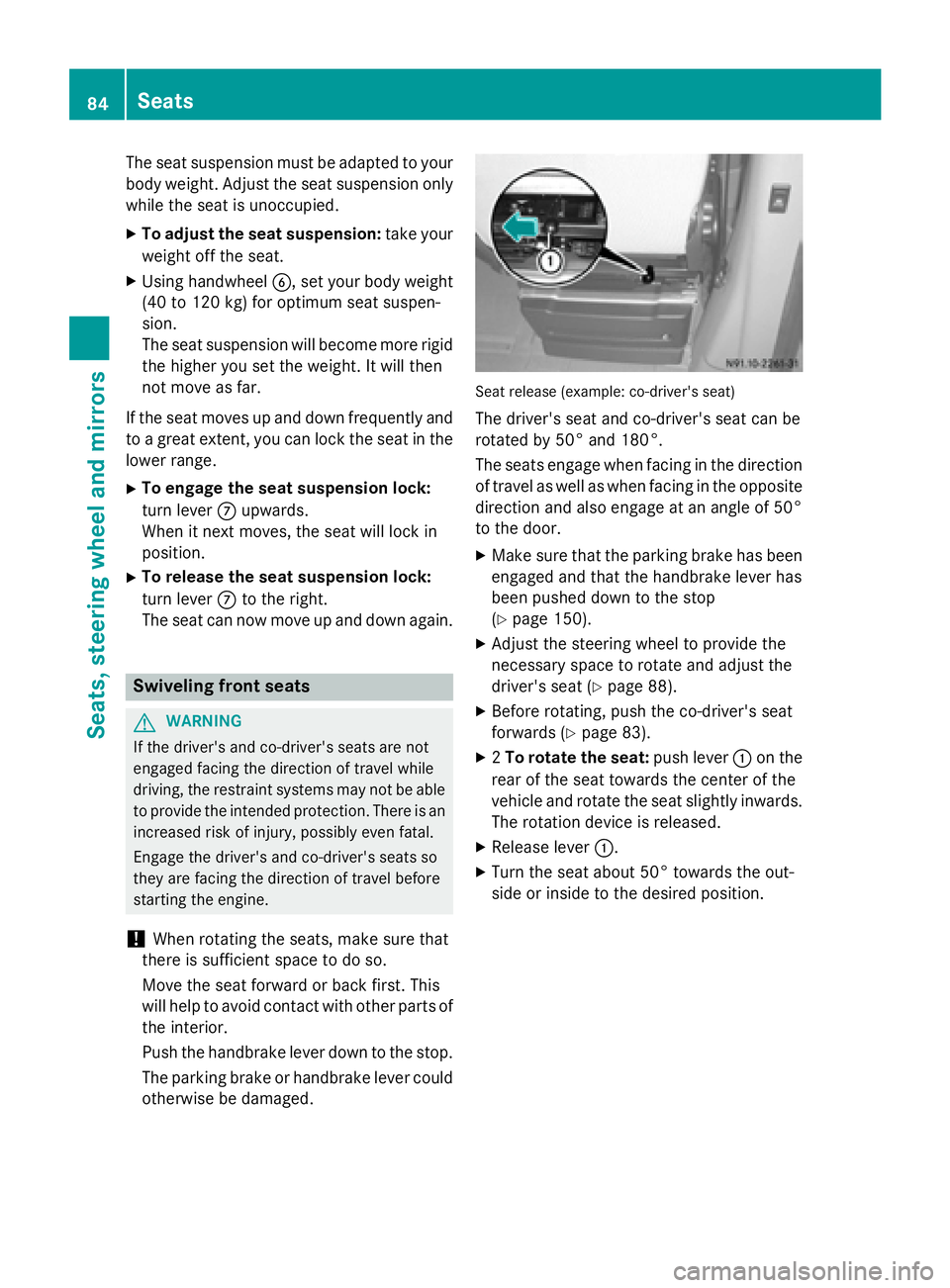
X 2To rotate the seat: push lever0043on the
rear of the seat towards the center of the
vehicle and rotate the seat slightly inwards. The rotation device is released.
X Release lever 0043.
X Turn the seat about 50° towards the out-
side or inside to the desired position. 84
SeatsSeats, steering wheel and mirrors
Page 87 of 334
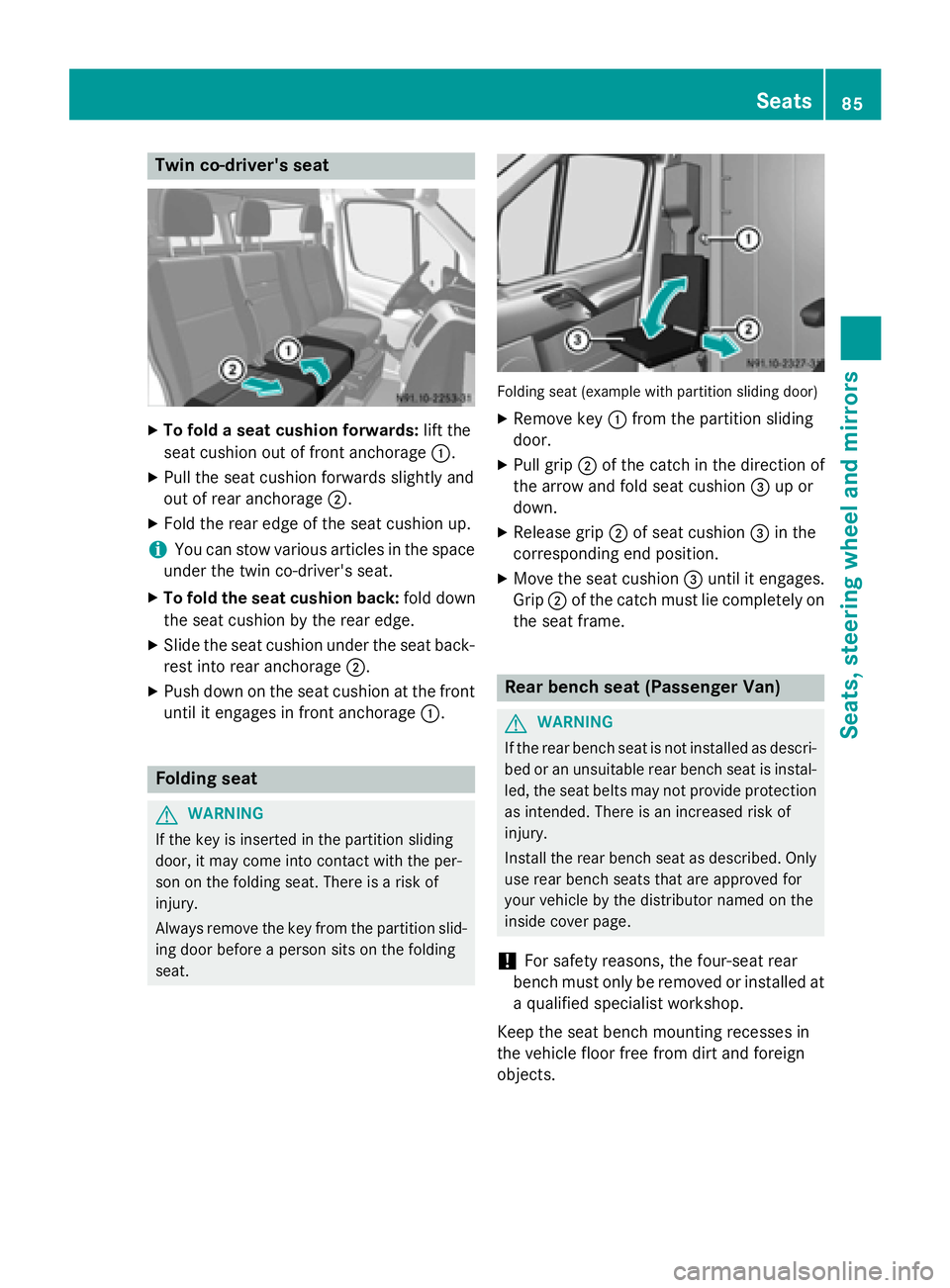
Twin co-driver's seat
X
To fold a seat cushion forwards: lift the
seat cushion out of front anchorage 0043.
X Pull the seat cushion forwards slightly and
out of rear anchorage 0044.
X Fold the rear edge of the seat cushion up.
i You can stow various articles in the space
under the twin co-driver's seat.
X To fold the seat cushion back: fold down
the seat cushion by the rear edge.
X Slide the seat cushion under the seat back-
rest into rear anchorage 0044.
X Push down on the seat cushion at the front
until it engages in front anchorage 0043.Folding seat
G
WARNING
If the key is inserted in the partition sliding
door, it may come into contact with the per-
son on the folding seat. There is a risk of
injury.
Always remove the key from the partition slid- ing door before a person sits on the folding
seat. Folding seat (example with partition sliding door)
X Remove key 0043from the partition sliding
door.
X Pull grip 0044of the catch in the direction of
the arrow and fold seat cushion 0087up or
down.
X Release grip 0044of seat cushion 0087in the
corresponding end position.
X Move the seat cushion 0087until it engages.
Grip 0044of the catch must lie completely on
the seat frame. Rear bench seat (Passenger Van)
G
WARNING
If the rear bench seat is not installed as descri- bed or an unsuitable rear bench seat is instal-
led, the seat belts may not provide protection as intended. There is an increased risk of
injury.
Install the rear bench seat as described. Only
use rear bench seats that are approved for
your vehicle by the distributor named on the
inside cover page.
! For safety reasons, the four-seat rear
bench must only be removed or installed at
a qualified specialist workshop.
Keep the seat bench mounting recesses in
the vehicle floor free from dirt and foreign
objects. Seats
85Seats, steering wheel and mirrors Z
Page 120 of 334
007C
Directs air to the windshield, the air
vents and into the footwell
007D Directs air to the air vents and into
the footwell
Adjusting X
Switch on climate control (Y page 116).
X Set air-distribution control 0085for the heat-
ing (Y page 113 )or air-conditioning system
0083 (Ypage 114) to the corresponding sym-
bol. Setting the airflow
X Switch on climate control (Y page 116).
X Vehicle with heating/rear-compart-
ment heating: set airflow control 0044of the
heating (Y page 113) or of the rear-com-
partment heating (Y page 115) to the
desired level.
X Vehicle with air conditioning/rear-com-
partment air conditioning: press the
0095 button to reduce or the 0097button
to increase the airflow.
The blower speeds are shown in bars next
to the buttons. Defrosting the windows
You can use the "defrosting" function to
defrost the windshield or to demist the inside of the windshield and the side windows.
Only use the following settings until the win-
dows are clear again.
X Vehicle with window heating: switch on
the front (Y page 119) and/or rear window
defroster (Y page 119) .
X Switch on climate control (Y page 116).
Vehicle with heating
X Set temperature control 0043and airflow
control 0044to0085 (Ypage 113).
X Set air-distribution control 0085to007E
0085 (Ypage 113). X
Close the center air vents (Y page 121) and
the air outlets for the headroom and the
rear compartment (Y page 121).
X Direct the side air vents towards the side
windows and open the defroster vents for
the side windows (Y page 121).
Vehicle with air conditioning X Set temperature control 0043to
0085 (Ypage 114).
X Press the 0097button until the maximum
blower output is reached.
All bars in the display next to the button
light up.
X Set air-distribution control 0083to007E
0085 (Ypage 114).
X Close the center air vents (Y page 121) and
the air outlets for the headroom and the
rear compartment (Y page 121).
X Direct the side air vents towards the side
windows and open the defroster vents for
the side windows (Y page 121). Clearing condensation from the win-
dows
Windows fogged up on the inside You should only select this setting until the
windows are clear again.
X Vehicle with window heating: switch on
the front (Y page 119) and/or rear window
defroster (Y page 119) .
X Switch on climate control (Y page 116).
X Switch off air-recirculation mode
(Y page 120).
Vehicle with heating
X Set temperature control 0043to a higher tem-
perature (Y page 113).
X Set airflow control 0044to a higher blower
setting. It should be set at least to level two
(Y page 113).
X Set air-distribution control 0085to007E
0085 (Ypage 113). 118
Operating the climate control systemClimate control
Page 137 of 334
Useful information
............................136
Breaking-in notes .............................. 136
Driving ............................................... 136
Automatic transmission ...................142
Refueling ............................................ 145
Parking ............................................... 149
Driving tips ........................................ 151
Driving systems ................................ 159
Working mode ................................... 172
Towing a trailer ................................. 173 135Driving and parking
Page 140 of 334
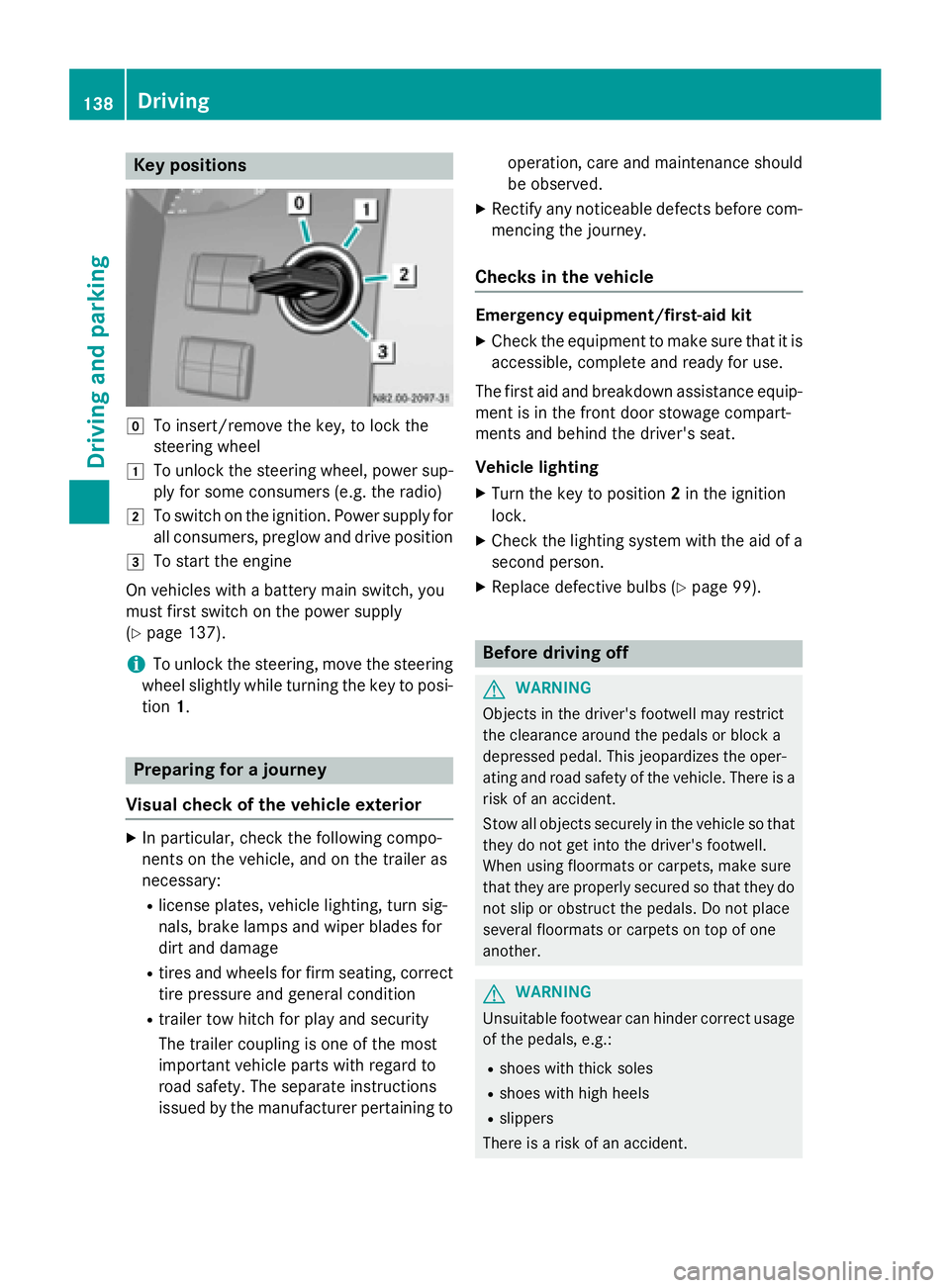
Key positions
005A
To insert/remove the key, to lock the
steering wheel
0047 To unlock the steering wheel, power sup-
ply for some consumers (e.g. the radio)
0048 To switch on the ignition. Power supply for
all consumers, preglow and drive position
0049 To start the engine
On vehicles with a battery main switch, you
must first switch on the power supply
(Y page 137).
i To unlock the steering, move the steering
wheel slightly while turning the key to posi- tion 1. Preparing for a journey
Visual check of the vehicle exterior X
In particular, check the following compo-
nents on the vehicle, and on the trailer as
necessary:
R license plates, vehicle lighting, turn sig-
nals, brake lamps and wiper blades for
dirt and damage
R tires and wheels for firm seating, correct
tire pressure and general condition
R trailer tow hitch for play and security
The trailer coupling is one of the most
important vehicle parts with regard to
road safety. The separate instructions
issued by the manufacturer pertaining to operation, care and maintenance should
be observed.
X Rectify any noticeable defects before com-
mencing the journey.
Checks in the vehicle Emergency equipment/first-aid kit
X Check the equipment to make sure that it is
accessible, complete and ready for use.
The first aid and breakdown assistance equip-
ment is in the front door stowage compart-
ments and behind the driver's seat.
Vehicle lighting
X Turn the key to position 2in the ignition
lock.
X Check the lighting system with the aid of a
second person.
X Replace defective bulbs (Y page 99). Before driving off
G
WARNING
Objects in the driver's footwell may restrict
the clearance around the pedals or block a
depressed pedal. This jeopardizes the oper-
ating and road safety of the vehicle. There is a risk of an accident.
Stow all objects securely in the vehicle so that
they do not get into the driver's footwell.
When using floormats or carpets, make sure
that they are properly secured so that they do not slip or obstruct the pedals. Do not place
several floormats or carpets on top of one
another. G
WARNING
Unsuitable footwear can hinder correct usage of the pedals, e.g.:
R shoes with thick soles
R shoes with high heels
R slippers
There is a risk of an accident. 138
DrivingDriving and pa
rking
Page 144 of 334
Problem
Possible causes/consequences and
0050
0050Solutions The engine does not
start.
The starter motor can-
not be heard. The on-board voltage is too low. The battery is too weak or dis-
charged.
X Jump-start the vehicle (Y page 276).
If the engine cannot be jump-started, the starter motor is faulty.
X Consult a qualified specialist workshop. The engine does not
start.
The starter motor can-
not be heard. The battery is discharged or faulty.
X Check the battery for damage.
X Charge the battery (Y page 263).Automatic transmission
Important safety notes
G
WARNING
If the engine speed is above the idling speed
and you engage transmission position Dor R,
the vehicle could pull away suddenly. There is a risk of an accident.
When engaging transmission position Dor R,
always firmly depress the brake pedal and do not simultaneously accelerate.
! Vehicles with automatic transmission
may roll only briefly in the neutral position
N. Prolonged rolling of the wheels, e.g.
when being towed, will result in transmis-
sion damage.
i Be sure to observe the instructions in the
"Tow-starting and towing away" section
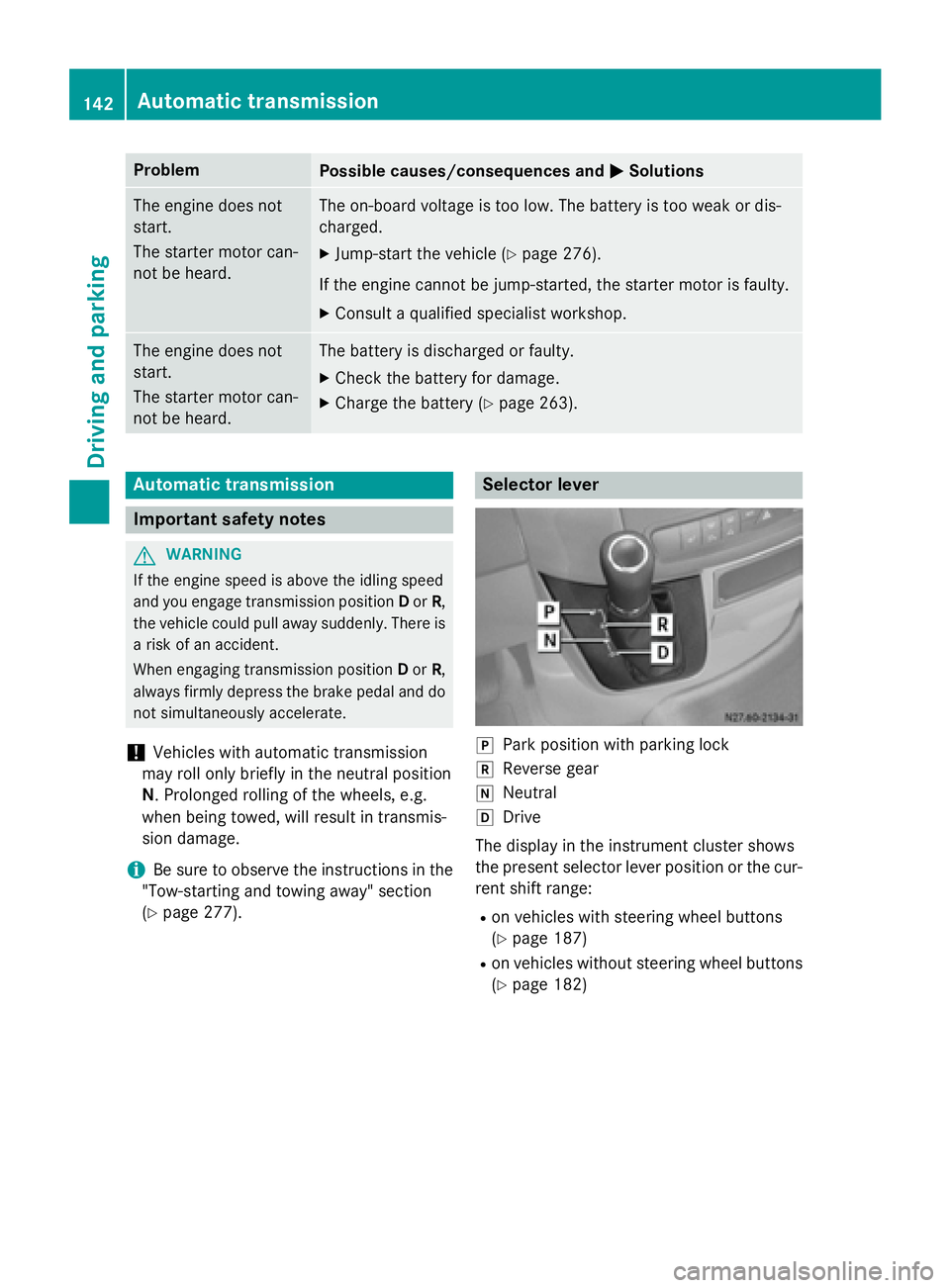
(Y page 277). Selector lever
005D
Park position with parking lock
005E Reverse gear
005C Neutral
005B Drive
The display in the instrument cluster shows
the present selector lever position or the cur-
rent shift range:
R on vehicles with steering wheel buttons
(Y page 187)
R on vehicles without steering wheel buttons
(Y page 182) 142
Automatic transmissionDriving and parking
Page 145 of 334
Selector lever positions
0045 Park position
This prevents the vehicle from roll-
ing away when stopped. Only move
the selector lever to Pif the vehicle
is stationary.
You can only remove the key when the selector lever is in this position.
The selector lever is locked in posi- tion Pif the key is removed.
The parking lock should not be
used as a brake when parking.
Always apply the parking brake as
well once you have parked the vehi-
cle. 0046 Reverse gear
Only move the selector lever to
R
when the vehicle is stationary. 0044 Neutral
No power is transmitted from the
engine to the drive wheels. Releas-
ing the brakes will allow you to
move the vehicle freely, e.g. by
pushing.
Do not move the selector lever to N
while driving. The automatic trans-
mission could otherwise be dam-
aged.
If ASR is deactivated or ESP ®
has
malfunctioned: only move the
selector lever to Nif the vehicle is
in danger of skidding, e.g. on icy
roads. 003A Drive
The automatic transmission
changes gear itself. All forward
gears are available.
You can influence the gearshifts
and shift gears yourself or limit the
shift range. Changing gear
The 5-speed automatic transmission adapts
to your individual driving style by continu-
ously adjusting its shift points. These shift
point adjustments take into account the cur-
rent operating and driving conditions. If the
operating or driving conditions change, the
automatic transmission reacts by adjusting
the gearshift program.
When the selector lever is in position D, the
automatic transmission selects the individual gears automatically. This depends on:
R any restriction in the shift range
(Y page 144)
R the position of the accelerator pedal
R the road speed Touchshift
When the selector lever is in position D, you
can perform gearshifts yourself.
X To shift down: press the selector lever to
the left towards D–.
The automatic transmission shifts to the
next gear down, depending on the gear cur-
rently engaged. The shift range is also
restricted.
i The automatic transmission does not shift
down if you press the selector lever
towards D–while traveling at too high a
speed. This protects the engine from over-
revving.
X To shift up: briefly press the selector lever
to the right towards D+.
The automatic transmission shifts to the
next gear up, depending on the current
gearshift program. This also extends the
shift range. Automatic transmission
143Driving and parking Z