tow MERCEDES-BENZ SPRINTER 2015 MY15 Operator’s Manual
[x] Cancel search | Manufacturer: MERCEDES-BENZ, Model Year: 2015, Model line: SPRINTER, Model: MERCEDES-BENZ SPRINTER 2015Pages: 334, PDF Size: 5.94 MB
Page 272 of 334
X
Clean access step in the bumper 0043with a
power washer.
Cleaning the trailer tow hitch !
Do not clean the ball coupling with a
power washer. Do not use solvents.
! Observe the notes on care in the Opera-
tor's Manual for the trailer tow hitch and
the ball coupling manufacturer.
You can also have the maintenance work on
the ball coupling and the trailer tow hitch car-
ried out by a qualified specialist workshop. Interior
Cleaning with power washers !
When using liquids to clean the vehicle
interior, observe the following points:
R Under no circumstances use power
washers.
R Make sure that no fluids enter or remain
in gaps and cavities.
R Ensure sufficient ventilation when clean-
ing.
R Make sure that the vehicle interior is
completely dry after cleaning.
Cleaning the display !
For cleaning, do not use any of the fol-
lowing:
R alcohol-based thinner or gasoline
R abrasive cleaning agents
R commercially-available household clean-
ing agents
These may damage the display surface. Do not put pressure on the display surface
when cleaning. This could lead to irrepara-
ble damage to the display. X
Switch off the audio equipment and let the
display cool down.
X Clean the display surface with a commer-
cially available microfiber cloth and cleaner
for TFT/LCD displays.
X Dry the display surface using a dry micro-
fiber cloth.
Cleaning the plastic trim G
WARNING
Care products and cleaning agents containing solvents cause surfaces in the cockpit to
become porous. As a result, plastic parts may
come loose in the event of air bag deploy-
ment. There is a risk of injury.
Do not use any care products and cleaning
agents to clean the cockpit.
! Do not affix the following to plastic surfa-
ces:
R stickers
R films
R scented oil bottles or similar items
You can otherwise damage the plastic.
! Do not allow cosmetics, insect repellent
or sunscreen to come into contact with the
plastic trim. This maintains the high-quality look of the surfaces.
X Wipe the plastic trim and the cockpit with a
damp, lint-free cloth, e.g. a microfiber
cloth.
X Heavy soiling: use a mild detergent or care
products and cleaning agents recommen-
ded and approved by Mercedes-Benz.
Cleaning the steering wheel and selec-
tor lever X
Thoroughly wipe with a damp cloth.
Cleaning the trim elements !
Do not use solvent-based cleaning agents
such as tar remover, wheel cleaners, pol- 270
CareMaintenance and care
Page 275 of 334
Useful information
............................274
Where will I find...? ...........................274
Flat tire .............................................. 276
Jump-starting .................................... 276
Tow-starting and towing away ........277
Electrical fuses ................................. 280 273Roadside Assistance
Page 276 of 334
Useful information
This Operator's Manual describes all models
as well as standard and optional equipment of your vehicle that were available at the time of going to print. Country-specific variations are
possible. Note that your vehicle may not be
equipped with all of the described functions.
This also applies to systems and functions
relevant to safety.
Read the information on qualified specialist
workshops (Y page 25). Where will I find...?
Vehicle tool kit
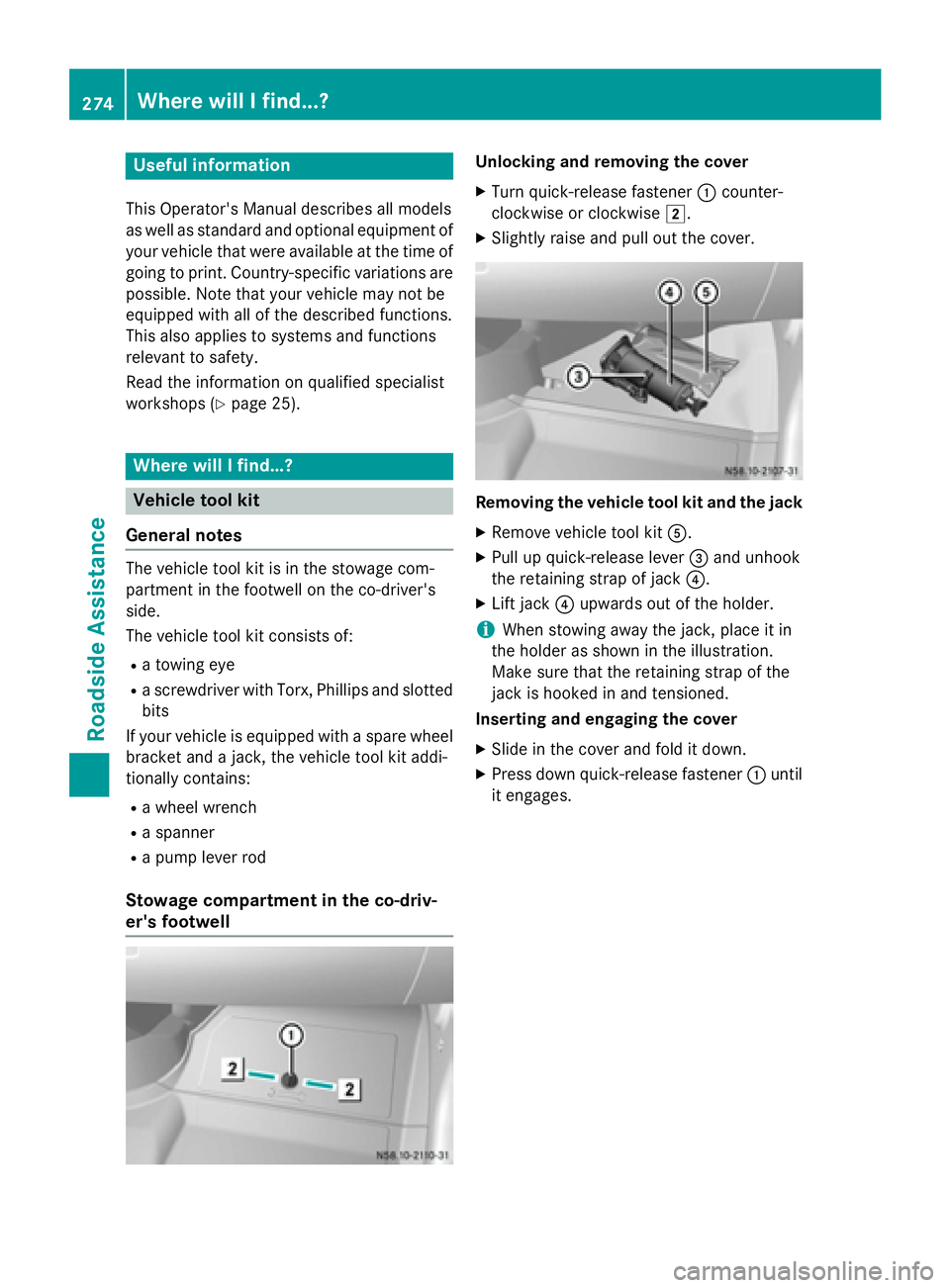
General notes The vehicle tool kit is in the stowage com-
partment in the footwell on the co-driver's
side.
The vehicle tool kit consists of:
R a towing eye
R a screwdriver with Torx, Phillips and slotted
bits
If your vehicle is equipped with a spare wheel bracket and a jack, the vehicle tool kit addi-
tionally contains:
R a wheel wrench
R a spanner
R a pump lever rod
Stowage compartment in the co-driv-
er's footwell Unlocking and removing the cover
X Turn quick-release fastener 0043counter-
clockwise or clockwise 0048.
X Slightly raise and pull out the cover. Removing the vehicle tool kit and the jack
X Remove vehicle tool kit 0083.
X Pull up quick-release lever 0087and unhook
the retaining strap of jack 0085.
X Lift jack 0085upwards out of the holder.
i When stowing away the jack, place it in
the holder as shown in the illustration.
Make sure that the retaining strap of the
jack is hooked in and tensioned.
Inserting and engaging the cover
X Slide in the cover and fold it down.
X Press down quick-release fastener 0043until
it engages. 274
Where will I find...?Roadside Assistance
Page 279 of 334
R
Only use jumper cables that have a suffi-
cient cross-section and insulated terminal
clamps.
R If the battery is fully discharged, attach the
battery of another vehicle for a few minutes before attempting to start. This charges the
empty battery a little.
R Make sure that the two vehicles do not
touch.
Make sure that:
R the jumper cables are not damaged.
R bare parts of the terminal clamps do not
come into contact with other metal parts
while the jumper cables are connected to
the battery.
R the jumper cables cannot come into con-
tact with parts such as the V-belt pulley or
the fan. These parts move when the engine
is started and while it is running.
i Jumper cables and further information
regarding jump starting can be obtained at any qualified specialist workshop. Before connecting the jumper cables
On vehicles with a battery main switch, check whether the battery main switch is switched
on (Y page 137).
X Apply the parking brake.
X Move the selector lever of the automatic
transmission to position P.
X Switch off all electrical consumers, e.g.
audio equipment, blower.
X Turn the key to position 0in the ignition
lock and remove it (Y page 138).
X Open the hood (Y page 248). Tow-starting and towing away
Important safety notes
G
WARNING
Functions relevant to safety are restricted or
no longer available if:
R the engine is not running.
R the brake system or the power steering is
malfunctioning.
R there is a malfunction in the voltage supply
or the vehicle's electrical system.
If your vehicle is being towed, much more
force may be necessary to steer or brake.
There is a risk of an accident.
In such cases, use a tow bar. Before towing,
make sure that the steering moves freely. G
WARNING
You can no longer steer the vehicle if the
steering wheel lock has been engaged. There is a risk of an accident.
Always switch off the ignition when towing the
vehicle with a tow cable or a tow bar. G
WARNING
When towing or tow-starting another vehicle
and its weight is greater than the permissible gross weight of your vehicle, the:
R the towing eye could detach itself
R the vehicle/trailer combination could roll-
over.
There is a risk of an accident.
When towing or tow-starting another vehicle,
its weight should not be greater than the per- missible gross weight of your vehicle.
Information on the gross vehicle weight can
be found on the vehicle identification plate
(Y page 316).
! Only secure the tow rope or tow bar at the
towing eyes. Otherwise, the vehicle could
be damaged. Tow-starting and towing away
277Roadside Assistance Z
Page 280 of 334
!
Observe the following points when towing
with a tow rope:
R Secure the tow rope on the same side on
both vehicles.
R Ensure that the tow cable is not longer
than legally permitted. Mark the tow
cable in the middle, e.g. with a white
cloth (30 x 30 cm). This will make other
road users aware that the vehicle is being towed.
R Only secure the tow cable to the towing
eye.
R Observe the brake lamps of the towing
vehicle while driving. Always maintain a
distance so that the tow rope does not
sag.
R Do not use steel cables or chains to tow
your vehicle. You could otherwise dam-
age the vehicle.
! Do not use the towing eye for recovery,
this could damage the vehicle. If in doubt,
recover the vehicle with a crane.
! When towing, pull away slowly and
smoothly. If the tractive power is too high,
the vehicles could be damaged.
When towing away, you must observe the
legal requirements for the country in which
you are currently driving.
It is preferable to have the vehicle transpor-
ted on a transporter or trailer instead of tow-
ing it.
The automatic transmission selector lever
must be in the Nposition when towing the
vehicle.
The battery must be connected and charged.
Otherwise, you:
R cannot turn the key in the ignition lock to
position 2
R cannot move the selector lever to position
N on vehicles with automatic transmission
Before the vehicle is towed, switch off the
automatic locking feature (Y page 71). You
could otherwise lock yourself out of the vehi-
cle when pushing or towing away the vehicle. Installing/removing the towing eye
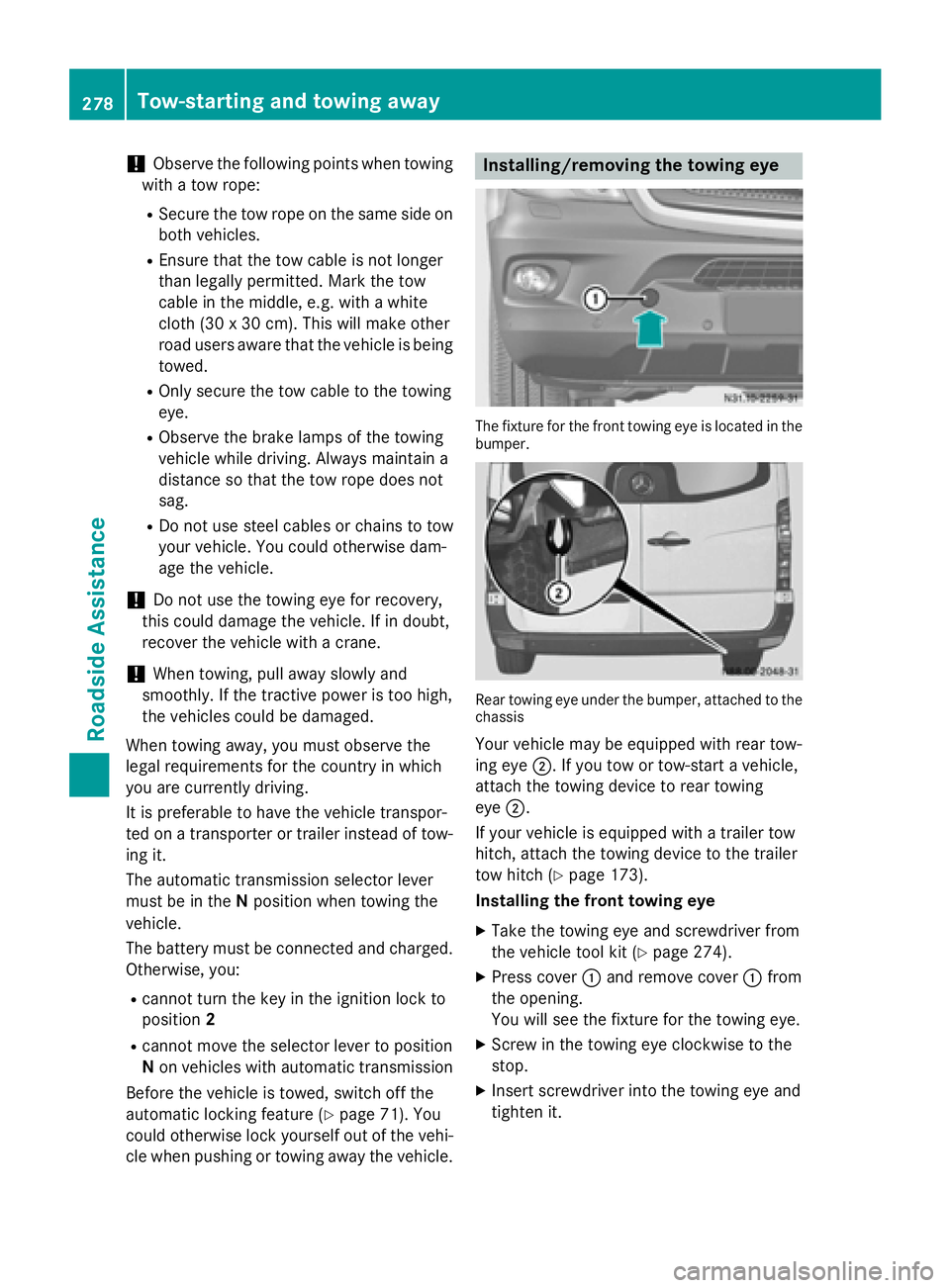
The fixture for the front towing eye is located in the
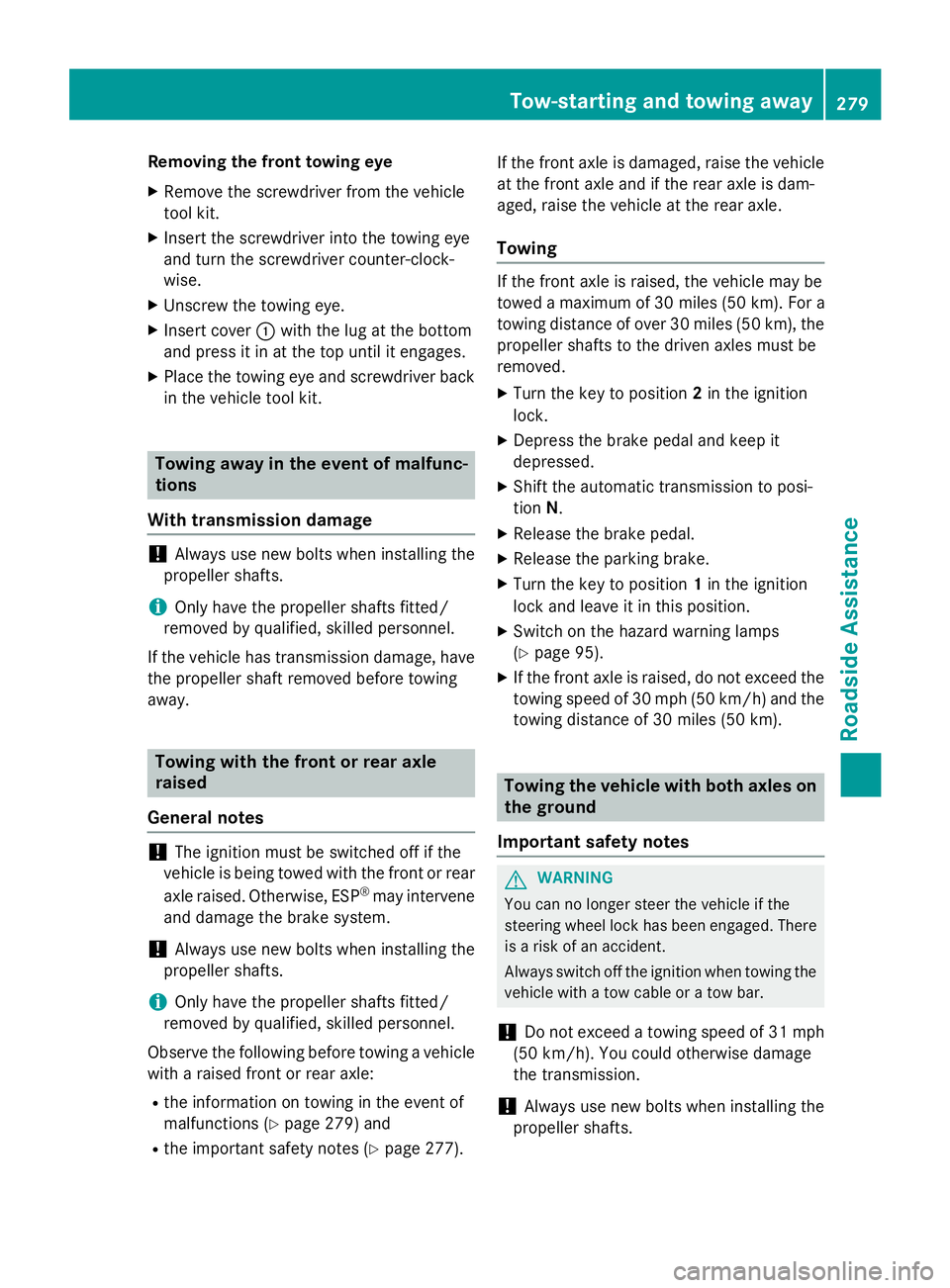
bumper. Rear towing eye under the bumper, attached to the
chassis
Your vehicle may be equipped with rear tow-
ing eye 0044. If you tow or tow-start a vehicle,
attach the towing device to rear towing
eye 0044.
If your vehicle is equipped with a trailer tow
hitch, attach the towing device to the trailer
tow hitch (Y page 173).
Installing the front towing eye
X Take the towing eye and screwdriver from
the vehicle tool kit (Y page 274).
X Press cover 0043and remove cover 0043from
the opening.
You will see the fixture for the towing eye.
X Screw in the towing eye clockwise to the
stop.
X Insert screwdriver into the towing eye and
tighten it. 278
Tow-starting and towing awayRoadside Assistance
Page 281 of 334
Removing the front towing eye
X
Remove the screwdriver from the vehicle
tool kit.
X Insert the screwdriver into the towing eye
and turn the screwdriver counter-clock-
wise.
X Unscrew the towing eye.
X Insert cover 0043with the lug at the bottom
and press it in at the top until it engages.
X Place the towing eye and screwdriver back
in the vehicle tool kit. Towing away in the event of malfunc-
tions
With transmission damage !
Always use new bolts when installing the
propeller shafts.
i Only have the propeller shafts fitted/
removed by qualified, skilled personnel.
If the vehicle has transmission damage, have
the propeller shaft removed before towing
away. Towing with the front or rear axle
raised
General notes !
The ignition must be switched off if the
vehicle is being towed with the front or rear
axle raised. Otherwise, ESP ®
may intervene
and damage the brake system.
! Always use new bolts when installing the
propeller shafts.
i Only have the propeller shafts fitted/
removed by qualified, skilled personnel.
Observe the following before towing a vehicle
with a raised front or rear axle:
R the information on towing in the event of
malfunctions (Y page 279) and
R the important safety notes (Y page 277).If the front axle is damaged, raise the vehicle
at the front axle and if the rear axle is dam-
aged, raise the vehicle at the rear axle.
Towing If the front axle is raised, the vehicle may be
towed a maximum of 30 miles (50 km). For a
towing distance of over 30 miles (50 km), the propeller shafts to the driven axles must be
removed.
X Turn the key to position 2in the ignition
lock.
X Depress the brake pedal and keep it
depressed.
X Shift the automatic transmission to posi-
tion N.
X Release the brake pedal.
X Release the parking brake.
X Turn the key to position 1in the ignition
lock and leave it in this position.
X Switch on the hazard warning lamps
(Y page 95).
X If the front axle is raised, do not exceed the
towing speed of 30 mph (50 km/h) and the towing distance of 30 miles (50 km). Towing the vehicle with both axles on
the ground
Important safety notes G
WARNING
You can no longer steer the vehicle if the
steering wheel lock has been engaged. There is a risk of an accident.
Always switch off the ignition when towing the
vehicle with a tow cable or a tow bar.
! Do not exceed a towing speed of 31 mph
(50 km/h). You could otherwise damage
the transmission.
! Always use new bolts when installing the
propeller shafts. Tow-starting and towing away
279Roadside Assistance Z
Page 282 of 334
i
Only have the propeller shafts fitted/
removed by qualified, skilled personnel.
Before towing the vehicle, observe the fol-
lowing:
R the information on towing in the event of
malfunctions (Y page 279) and
R the important safety notes (Y page 277).
Towing You may only tow the vehicle a maximum dis-
tance of 30 miles (50 km). For a towing dis-
tance of over 30 miles (50 km), the propeller
shafts to the driven axles must be removed.
X Turn the key to position 2in the ignition
lock.
X Depress the brake pedal and keep it
depressed.
X Shift the automatic transmission to posi-
tion N.
X Release the brake pedal.
X Release the parking brake.
X Leave the key in position 2in the ignition
lock.
X Switch on the hazard warning lamps
(Y page 95).
X Do not exceed the towing speed of 30 mph
(50 km/h) and the towing distance of
30 miles (50 km). Recovering a vehicle that is stuck
! When recovering a vehicle that has
become stuck, pull it as smoothly and
evenly as possible. Excessive tractive
power could damage the vehicles.
If the drive wheels get trapped on loose or
muddy ground, recover the vehicle with the
utmost care. This is especially the case if the
vehicle is laden.
Never attempt to recover a vehicle with a
trailer attached. Pull out the vehicle backwards, if possible,
using the tracks it made when it became
stuck. Transporting the vehicle
! You may only secure the vehicle by the
wheels, not by parts of the vehicle such as
axle or steering components. Otherwise,
the vehicle could be damaged. Tow-starting (emergency engine
starting)
Vehicles with automatic transmission !
Vehicles with automatic transmission
must not be tow-started. You could other-
wise damage the automatic transmission.
You can find information on jump-starting
under "Jump-starting“ (Y page 276). Electrical fuses
G
WARNING
If you manipulate or bridge a faulty fuse or if
you replace it with a fuse with a higher amper- age, the electric cables could be overloaded.
This could result in a fire. There is a risk of an
accident and injury.
Always replace faulty fuses with the specified
new fuses having the correct amperage.
! Only use fuses that have been approved
for Sprinter vehicles and that have the
required fuse rating for the systems con-
cerned. Components or systems could oth- erwise be damaged.
The fuses in your vehicle switch off defective power circuits. If a fuse blows, all the com-
ponents on the circuit and their functions will
cease to operate.
Blown fuses must be replaced with fuses of
the same rating, which you can recognize by
the color and fuse rating. Observe the infor- 280
Electrical fusesRoadside Assistance
Page 288 of 334
approximately
00CDin(1.6 mm). If th is is the
case, the tire is so worn that it must be
replaced. Selecting, mounting and renewing
tires
R Only mount tires and wheels of the same
type and make.
R Only mount tires of the correct size onto
the wheels.
R Break in new tires at moderate speeds for
the first 65 miles (100 km).
R Do not drive with tires which have too little
tread depth, as this significantly reduces
the traction on wet roads (hydroplaning).
R Replace the tires after 6 years at the latest,
regardless of wear. This also applies to the spare wheel. Operation in winter
General notes
Have your vehicle winterproofed at a qualified specialist workshop at the onset of winter.
Prior to the onset of winter, ensure that snow
chains are stowed in the vehicle
(Y page 287).
Also observe the notes in the "Changing a
wheel" section (Y page 305). Driving with summer tires
At temperatures below 45 ‡(+7 †), summer
tires lose elasticity and therefore traction and braking power. Change the tires on your vehi-cle to M+S tire. Using summer tires at very
cold temperatures could cause tears to form,
thereby damaging the tires permanently. We
cannot accept responsibility for this type of
damage. M+S tires
G
WARNING
Wheel and tire dimensions as well as the type of tire can vary between the spare wheel and
the wheel to be replaced. When the spare
wheel is mounted, driving characteristics may be severely affected. There is a risk of an acci-
dent.
In order to reduce risks:
R you should therefore adapt your driving
style and drive carefully.
R never mount more than one spare wheel
that differs from the wheel to be replaced.
R only use a spare wheel that differs from the
wheel to be replaced for a short time.
R do not deactivate ESP ®
.
R have a spare wheel that differs from the
wheel that has been changed replaced at
the nearest qualified specialist workshop.
You must observe the correct wheel and
tire dimensions as well as the wheel type. G
WARNING
M+S tires with a tire tread depth of less than
00CF in (4 mm) are not suitable for use in winter
and do not provide sufficient traction. There is
a risk of an accident.
M+S tires with a tread depth of less than 00CFin
(4 mm) must be replaced immediately.
Use winter tires or all-season tires at temper-
atures below 45 ‡ (+7 †). Both types of tire
are identified by the M+S marking.
Only winter tires bearing the 004Dsnowflake
symbol in addition to the M+S marking pro-
vide the best possible grip in wintry road con- ditions.
Only these tires will allow driving safety sys-
tems such as ABS and ESP ®
to function opti-
mally in winter. These tires have been devel-
oped specifically for driving in snow.
For safe driving, use M+S tires of the same
make and tread pattern on all wheels. 286
Operation in winterWheels and tires
Page 299 of 334
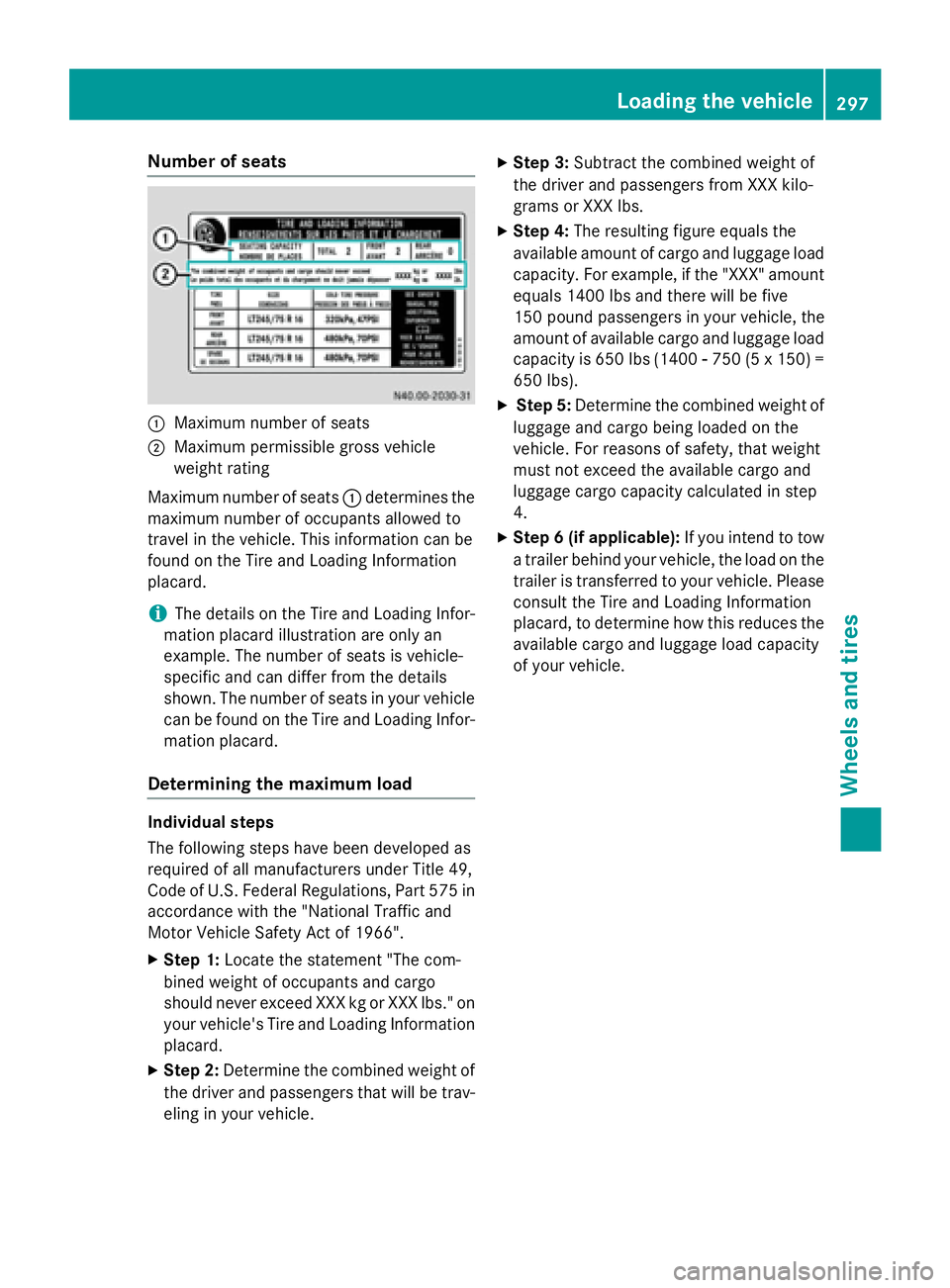
Number of seats
0043
Maximum number of seats
0044 Maximum permissible gross vehicle
weight rating
Maximum number of seats 0043determines the
maximum number of occupants allowed to
travel in the vehicle. This information can be
found on the Tire and Loading Information
placard.
i The details on the Tire and Loading Infor-
mation placard illustration are only an
example. The number of seats is vehicle-
specific and can differ from the details
shown. The number of seats in your vehicle can be found on the Tire and Loading Infor-
mation placard.
Determining the maximum load Individual steps
The following steps have been developed as
required of all manufacturers under Title 49,
Code of U.S. Federal Regulations, Part 575 in accordance with the "National Traffic and
Motor Vehicle Safety Act of 1966".
X Step 1: Locate the statement "The com-
bined weight of occupants and cargo
should never exceed XXX kg or XXX lbs." on your vehicle's Tire and Loading Information
placard.
X Step 2: Determine the combined weight of
the driver and passengers that will be trav-
eling in your vehicle. X
Step 3: Subtract the combined weight of
the driver and passengers from XXX kilo-
grams or XXX lbs.
X Step 4: The resulting figure equals the
available amount of cargo and luggage load
capacity. For example, if the "XXX" amount
equals 1400 lbs and there will be five
150 pound passengers in your vehicle, the
amount of available cargo and luggage load capacity is 650 lb s(1400 00F8750 (5 x 150) =
650 lbs).
X Step 5: Determine the combined weight of
luggage and cargo being loaded on the
vehicle. For reasons of safety, that weight
must not exceed the available cargo and
luggage cargo capacity calculated in step
4.
X Step 6 (if applicable): If you intend to tow
a trailer behind your vehicle, the load on the
trailer is transferred to your vehicle. Please
consult the Tire and Loading Information
placard, to determine how this reduces the available cargo and luggage load capacity
of your vehicle. Loading the vehicle
297Wheels and tires Z
Page 301 of 334
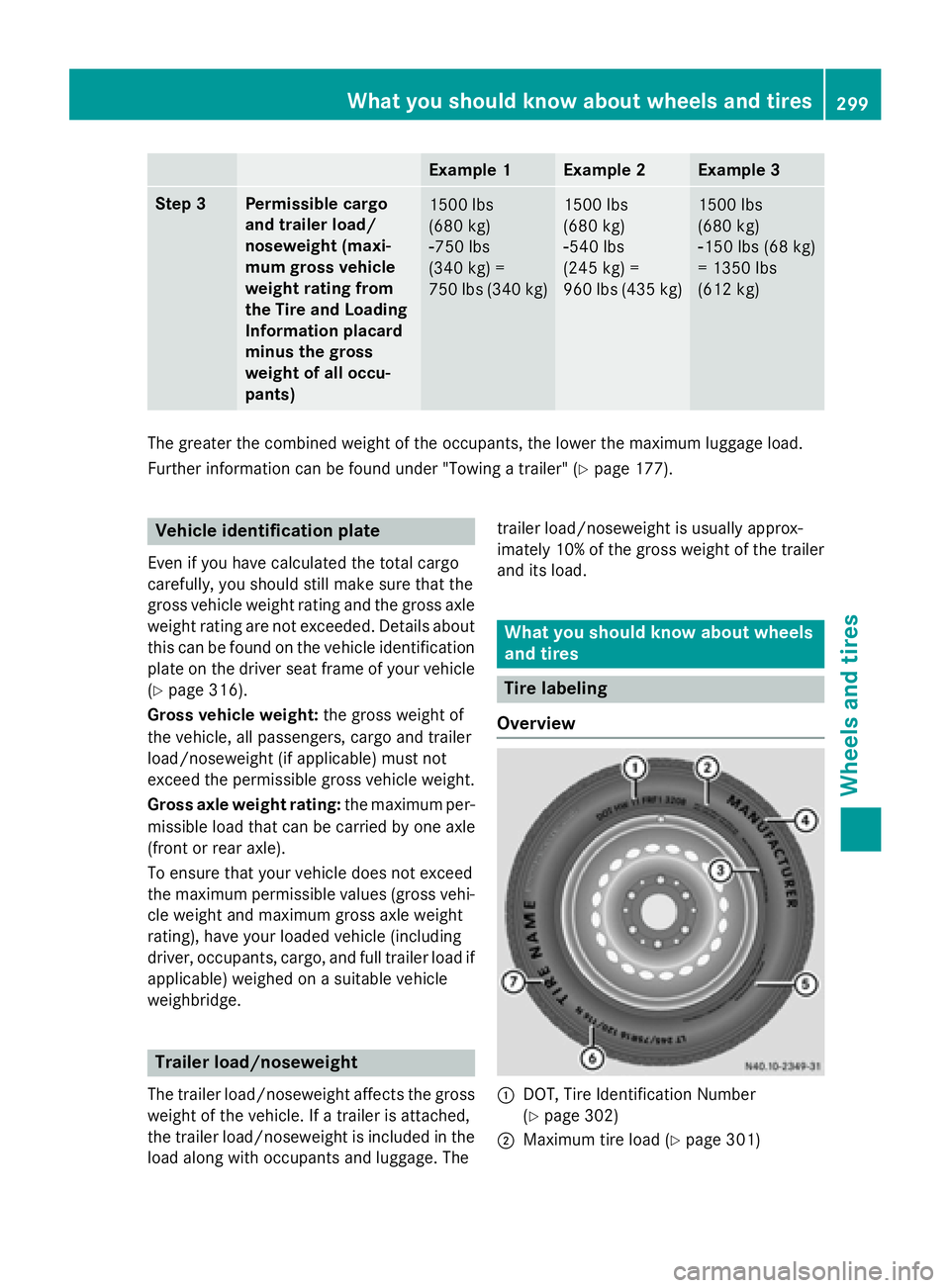
Example 1 Example 2 Example 3
Step 3 Permissible cargo
and trailer load/
noseweight (maxi-
mum gross vehicle
weight rating from
the Tire and Loading
Information placard
minus the gross
weight of all occu-
pants)
1500 lbs
(680 kg)
00F8750 lbs
(340 kg) =
750 lbs (340 kg) 1500 lbs
(680 kg)
00F8540 lbs
(245 kg) =
960 lbs (435 kg) 1500 lbs
(680 kg)
00F8150 lbs (68 kg)
= 1350 lbs
(612 kg) The greater the combined weight of the occupants, the lower the maximum luggage load.
Further information can be found under "Towing a trailer" (Y page 177).Vehicle identification plate
Even if you have calculated the total cargo
carefully, you should still make sure that the
gross vehicle weight rating and the gross axle weight rating are not exceeded. Details about
this can be found on the vehicle identification plate on the driver seat frame of your vehicle
(Y page 316).
Gross vehicle weight: the gross weight of
the vehicle, all passengers, cargo and trailer
load/noseweight (if applicable) must not
exceed the permissible gross vehicle weight.
Gross axle weight rating: the maximum per-
missible load that can be carried by one axle
(front or rear axle).
To ensure that your vehicle does not exceed
the maximum permissible values (gross vehi-
cle weight and maximum gross axle weight
rating), have your loaded vehicle (including
driver, occupants, cargo, and full trailer load if applicable) weighed on a suitable vehicle
weighbridge. Trailer load/noseweight
The trailer load/noseweight affects the gross
weight of the vehicle. If a trailer is attached,
the trailer load/noseweight is included in the
load along with occupants and luggage. The trailer load/noseweight is usually approx-
imately 10% of the gross weight of the trailer
and its load. What you should know about wheels
and tires Tire labeling
Overview 0043
DOT, Tire Identification Number
(Ypage 302)
0044 Maximum tire load (Y page 301) What you should know about wheels and tires
299Wheels and tires Z