warning MERCEDES-BENZ SPRINTER 2019 MY19 with 7” screen
[x] Cancel search | Manufacturer: MERCEDES-BENZ, Model Year: 2019, Model line: SPRINTER, Model: MERCEDES-BENZ SPRINTER 2019Pages: 354, PDF Size: 6.15 MB
Page 238 of 354
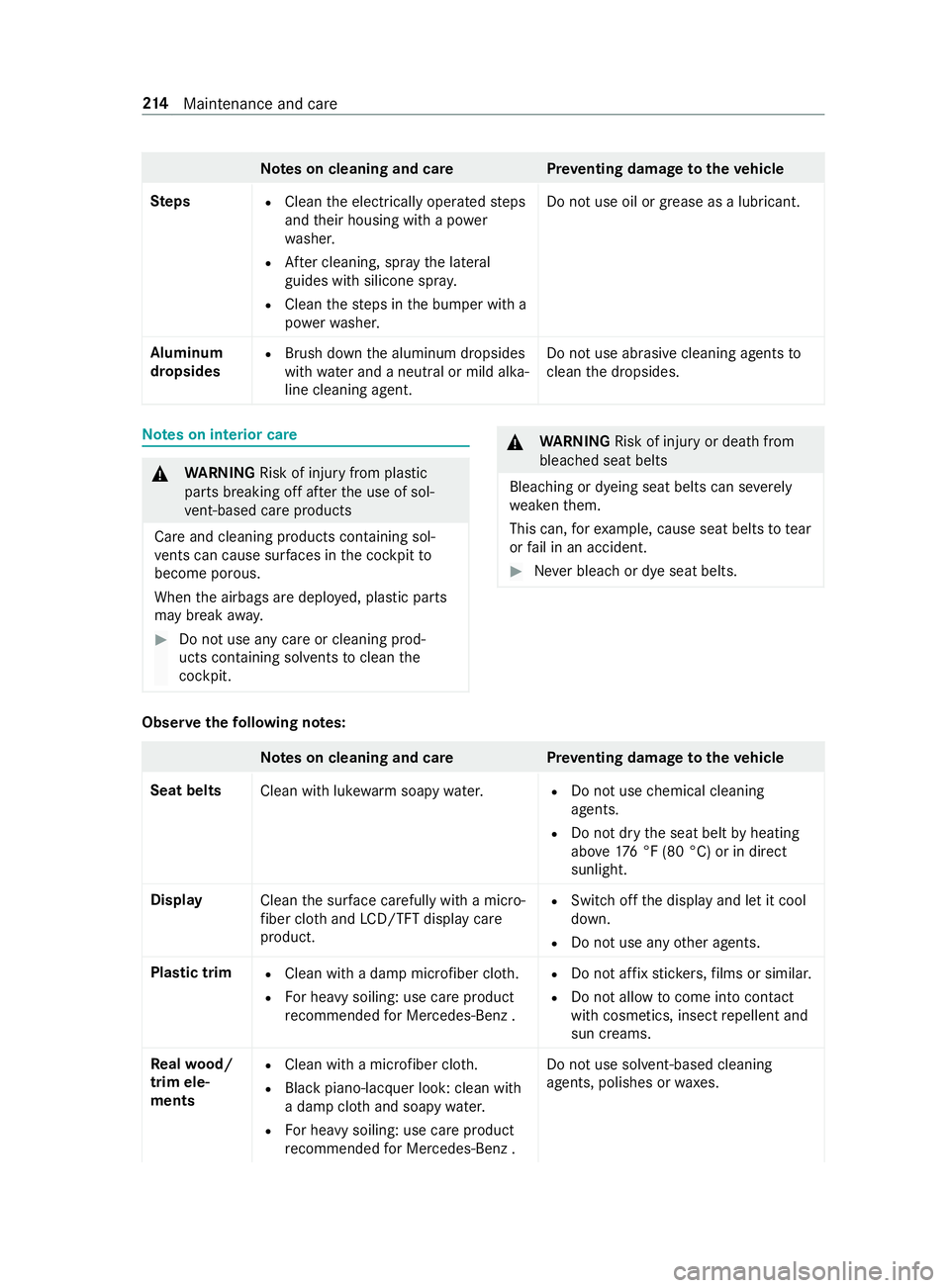
Note
s on cleaning and car ePreve nting damage totheve hicle
Ste ps
R
Clean the electrically operated steps
and their housing with a po wer
wa sher.
R After cleaning, spr aythe lateral
guides with silicone spr ay.
R Clean thesteps in the bumper with a
po we rwa sher. Do not use oil or grease as a lubricant.
Aluminum
dropsides R
Brush down the aluminum dropsides
with water and a neutral or mild alka‐
line cleaning agent. Do not use abrasive cleaning agents
to
clean the dropsides. Note
s on interior care &
WARNING Risk of inju ryfrom pla stic
parts breaking off af terth e use of sol‐
ve nt-based care products
Ca reand cleaning products con taining sol‐
ve nts can cause su rfaces in the cockpit to
become porous.
When the airbags are deplo yed, plastic parts
may break away. #
Do not use any care or cleaning prod‐
ucts containing sol vents toclean the
cockpit. &
WARNING Risk of inju ryor death from
bleached seat belts
Bleaching or dyeing seat belts can se verely
we aken them.
This can, forex ample, cause seat belts totear
or fail in an accident. #
Never blea chor dye seat belts. Obser
vethefo llowing no tes: Note
s on cleaning and car ePreve nting damage totheve hicle
Seat belts Clean with lukewarmsoapy water. R
Do not use chemical cleaning
agents.
R Do not dry the seat belt byheating
abo ve176 °F (80 °C) or in direct
sunlight.
Display Cleanthe sur face carefully wi tha mic ro‐
fi ber clo thand LCD/TFT displ aycare
product. R
Switch off the display and let it cool
down.
R Do not use any other agents.
Plastic trim R
Clean with a damp microfiber clo th.
R For heavy soiling: use care product
re commended for Mercedes-Benz . R
Do not af fix st icke rs,fi lms or similar.
R Do not allow tocome into contact
wi th cosmetics, insect repellent and
sun creams.
Re alwo od/
trim ele‐
ments R
Clean with a mic rofiber clo th.
R Blackpiano-lacquer look: clean with
a damp clo thand soapy water.
R For heavy soiling: use care product
re commended for Mercedes-Benz . Do not use sol
vent-based cleaning
agents, polishes or waxes. 214
Maintenance and care
Page 240 of 354
Emer
gency Re
moving the saf etyve st The saf
etyve st is located in thestow age com‐
partment in the driver's door. #
Remo vethe saf etyve st from thestow age
compartment.
% Saf
etyve sts can also be stored in thestow‐
age compartments of there ar doors and the
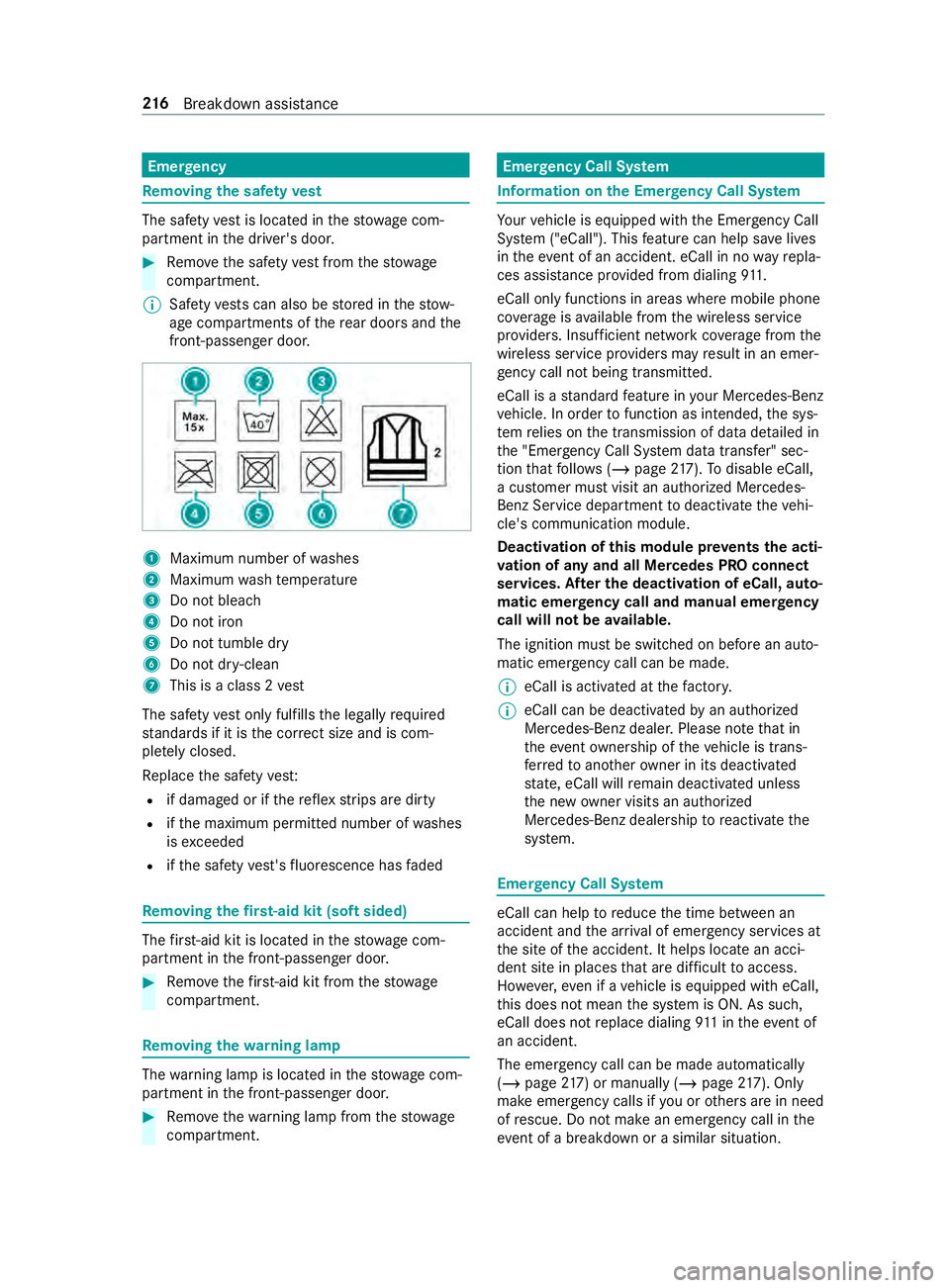
front-passenger door. 1
Maximum number of washes
2 Maximum wash temp erature
3 Do not bleach
4 Do not iron
5 Do not tumble dry
6 Do not dr y-clean
7 This is a class 2 vest
The saf etyve st only fulfills the legally required
st andards if it is the cor rect size and is com‐
ple tely closed.
Re place the saf etyve st:
R if damaged or if there flex strips are dirty
R ifth e maximum permitted number of washes
is exc eeded
R ifth e saf etyve st's fluorescence has faded Re
moving the firs t-aid kit (soft sided) The
firs t-aid kit is located in thestow age com‐
partment in the front-passenger door. #
Remo vethefirs t-aid kit from thestow age
compartment. Re
moving the warning lamp The
warning lamp is located in thestow age com‐
partment in the front-passenger door. #
Remo vethewa rning lamp from thestow age
compartment. Emer
gency Call Sy stem Information on
the Emer gency Call Sy stem Yo
ur vehicle is equipped with the Emer gency Call
Sy stem ("eCall"). This feature can help sa velives
in theeve nt of an accident. eCall in no wayre pla‐
ces assis tance pr ovided from dialing 911.
eCall only functions in areas where mobile phone
co verage isavailable from the wireless service
pr ov iders. Insuf ficient network co verage from the
wireless service pr oviders may result in an emer‐
ge ncy call not being transmitted.
eCall is a standard feature in your Mercedes-Benz
ve hicle. In order tofunction as intended, the sys‐
te m relies on the transmission of data de tailed in
th e "Emer gency Call Sy stem data transfer" sec‐
tion that follo ws ( /page 217). Todisable eCall,
a cus tomer must visit an authorized Mercedes-
Benz Service depa rtment todeactivate theve hi‐
cle's communication module.
Deactivation of this module pr events the acti‐
va tion of any and all Mercedes PRO connect
se rvices. Af ter the deacti vation of eCall, auto‐
matic eme rgency call and manual emer gency
call will not be available.
The ignition must be switched on before an auto‐
matic emer gency call can be made.
% eCall is acti
vated at thefa ctor y.
% eCall can be deactivated
byan authorized
Mercedes-Benz dealer. Please no tethat in
th eeve ntow nership of theve hicle is trans‐
fe rred toano ther ow ner in its deacti vated
st ate, eCall will remain deactivated unless
th e new owner visits an au thorized
Mercedes-Benz dealership toreactivate the
sy stem. Emer
gency Call Sy stem eCall can help
toreduce the time between an
accident and the ar riva l of emer gency services at
th e site of the accident. It helps locate an acci‐
dent site in places that are dif ficult toaccess.
Ho wever,eve n if a vehicle is equipped with eCall,
th is does not mean the sy stem is ON. As such,
eCall does not replace dialing 911 in theeve nt of
an accident.
The emergency call can be made au tomatical ly
( / page 217) or manually (/ page217). Only
make emergency calls if you or others are in need
of rescue. Do not make an emer gency call in the
eve nt of a breakdown or a similar situation. 216
Breakdown assis tance
Page 242 of 354
SA
's Cus tomer Assis tance Center at 800-FOR-
MERC.
Fo r Canada, please contact MBC’s Cust omer
Assis tance Center at 1-800-387-0 100.
Cust omer requ ests for co vered information
should be submitted via the same channels.
Fo r accident clarification purposes, thefo llowing
measures can be take n up toan hour af terthe
emer gency call has been initia ted:
R The cur rent vehicle position can be de ter‐
mined
R Avo ice connection totheve hicle occupants
can be es tablished Flat tire
Note
s onflat tires &
WARNING Risk of an accident when driv‐
ing wi thaflat tire
A flat tire greatly impairs driving characteris‐
tics, as well as steering and braking. #
Do not drive with a flat tire. #
Remo vetheflat tire and ins tallthe
spare wheel or consult a qualified spe‐
cialist workshop. In
theeve nt of a flat tire you ha vethefo llowing
possibilities depending on your vehicle's equip‐
ment:
R Vehicles with Mercedes PRO connec t:in
th eeve nt of a flat tire, you can call Roadside
Assis tance via theRo adside Assis tance call
button in theov erhead cont rol panel
(/ page 171).
R Allvehicles: change the wheel
(/ page 251). Batte
ry Note
s onthe12 V battery &
WARNING Risk of an accident due to
wo rkcar ried out incor rectly on the bat‐
te ry
Wo rkcar ried out incor rectly on the battery
can, forex ample, lead toa short circuit. This
can lead tofunction restrictions in saf ety-re l‐
eva nt sy stems, forex ample the lighting sys‐
te m, ABS (anti-lock braking sy stem) or ESP ® (Elect
ronic Stability Prog ram). The operating
saf ety of your vehicle may be restricted.
Yo u could lose control of theve hicle in the
fo llowing situations:
R when braking
R intheeve nt of ab rupt steering maneuvers
and/or when theve hicle's speed is not
adap tedto thero ad conditions #
Intheeve nt of a sho rtcircuit or a simi‐
lar incident, contact a qualified special‐
ist workshop immediately. #
Do not continue driving. #
Always ha vewo rkon the battery car ried
out at a qualified specialist workshop. R
Further information on ABS (/ page137)
R Further information on ESP ®
(/ page 138)
Me rcedes-Benz recommends that you ha vethe
12 V battery replaced at a qualified specialist
wo rkshop, e.g. at an authorized Mercedes-Benz
Center.
Should youwa nttoreplace the battery yourself,
obse rveth efo llowing information:
R Alwaysre place a defective battery with a bat‐
te ry which fulfills theve hicle's specific
re qu irements.
R Use de tach able parts such as theve nt hose,
elbow fitting or term inal co ver from the bat‐
te ry to be replaced.
R Make sure that theve nt hose is al ways con‐
nected toits original opening on the battery
side.
Ins tallth eex isting or newly supplied stop
plugs.
Otherwise, gases or battery acid could
escape.
R Make sure that the de tach able parts are con‐
nec ted in the same way as before.
Fo r saf etyre asons, Mercedes-Benz recommends
th at you only use bat teries that ha vebeen tested
and appr ovedfo ryo ur vehicle byMercedes-Benz.
These batteries pr ovide inc reased impact pr otec‐
tion topreve ntvehicle occupants from suf fering
acid bu rns should the battery be damaged in an
accident. 218
Breakdown assis tance
Page 243 of 354
&
WARNING Risk ofexplosion due toelec‐
tros tatic charge
Electros tatic charge can cause spa rks which
may ignite the highly flammable gas mixture
in the batter y. #
Todischar geany electrostatic charge
th at may ha vebuilt up, touch the me tal
ve hicle body before handling the bat‐
te ry. The highly
flammable gas mixture is created while
th e battery is charging and when jump-s tarting. &
WARNING Danger of chemical burns
from the battery acid
Battery acid is caustic. #
Avoid contact with the skin, eyes or
clo thing. #
Do not lean overth e batter y. #
Do not inhale battery gases. #
Keep children away from the batter y. #
Immedia tely rinse battery acid off thor‐
oughly with plenty of clean water and
seek medical attention immediately. +
ENVIRONMENTAL
NOTEEnvironmental
damage caused byimproper disposal of
batteries Bat
teries contain pollutants. It is
illegal todispose of them with the household
ru bbish. #
Dispose of batteries in an
environmen tally responsible manner.
Ta ke dischar ged batteries toaqu alified
specialist workshop or toa collection
point for used batteries. If
th e12 V battery has tobe connected, con tact a
qu alified specialist workshop.
Obser vethe saf ety no tes and pr otective meas‐
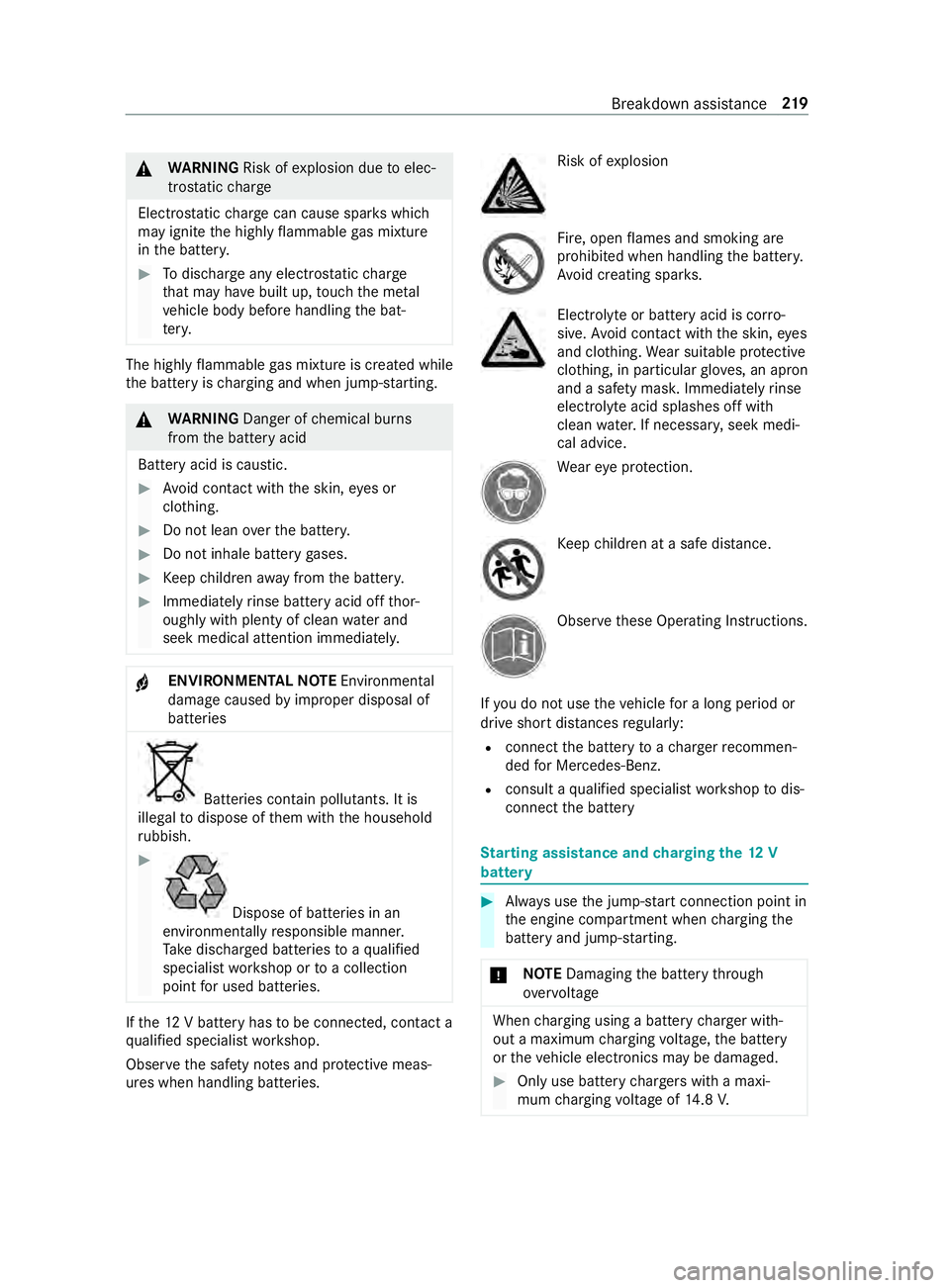
ures when handling batteries. Risk of
explosion Fire, open
flames and smoking are
prohibited when handling the batter y.
Av oid creating spar ks. Electrolyte
or battery acid is cor ro‐
sive. Avoid contact with the skin, eyes
and clo thing. Wear suitable pr otective
clo thing, in particular glove s, an apron
and a saf ety mas k.Immedia tely rinse
electrolyte acid splashes off wi th
clean water.If necessar y,seek medi‐
cal advice. We
areye pr otection. Ke
ep children at a safe dis tance. Obser
vethese Operating Instructions.
If yo u do not use theve hicle for a long period or
drive short dis tances regular ly:
R connect the battery toach arge rre commen‐
ded for Mercedes-Benz.
R consult a qualified specialist workshop todis‐
connect the battery St
arting assistance and charging the12 V
battery #
Always use the jump-s tart connection point in
th e engine compartment when charging the
battery and jump-s tarting.
* NO
TEDamaging the battery thro ugh
ove rvoltage When
charging using a battery charge r with‐
out a maximum charging voltage, the battery
or theve hicle electronics may be damaged. #
Only use battery charge rs with a maxi‐
mum charging voltage of 14.8 V. Breakdown assis
tance 219
Page 244 of 354
&
WARNING Risk ofexplosion from hydro‐
ge nga s igniting
A battery generates hydrogen gas during the
ch arging process. If there is a short circuit or
spar ksstart toform ,th ere is a danger of the
hy drogen gas igniting. #
Make sure that the positive term inal of
th e connected battery does not come
into contact with vehicle parts. #
Never place me tal objects or tools on a
batter y. #
When connecting and disconnecting the
batter y,yo u must obse rveth e described
order forth e battery clamps. #
When giving starting assistance, alw ays
make sure that you on lyconnect battery
te rm inals with identical polarity. #
During starting assis tance, you must
obse rveth e described order for con‐
necting and disconnecting the jumper
cables. #
Do not connect or disconnect the bat‐
te ry cla mp s while the engine is running. &
WARNING Risk ofexplosion during
ch arging process and starting assis tance
During thech arging process and starting
assis tance, the battery may release an explo‐
sive gas mixture. #
Avoid fire , open flames, creating spar ks
and smoking. #
Make sure that there is suf ficient venti‐
lation du ring thech arging process and
during starting assis tance. #
Do not lean over a batter y. &
WARNING Risk ofexplosion from a fro‐
zen battery
A dischar ged battery may freeze at temp era‐
tures slightly abo veor below freezing point.
During starting assis tance or battery charg‐
ing, battery gas may be released. #
Alwaysth aw a frozen battery out first
before charging it or per form ing starting
assis tance. If
th ewa rning/indicator lamps do not light up in
th e instrument display around or below freezing point, it is
very likely that the discharged battery
has frozen.
In this case, obser vethefo llowing points:
R do not give theve hicle starting assis tance or
ch arge the battery
R the service life of a battery that has been
th awe d may be reduced drastically
R thest art-up behavior may de teriorate, partic‐
ularly at low temp eratures
R it is recommended that you ha veath awed
battery checked at a qualified specialist work‐
shop
* NO
TEDama gecaused bynume rous or
ex tended attempts tostart the engine Nume
rous or extended attempts tostart the
engine may damage the catalytic con verter
due tonon-combu sted fuel. #
Avoid numerous and extended attem pts
to start the engine. Obser
vethefo llowing points during starting
assis tance and when charging the battery:
R only use undamaged jumper cables/charging
cables with a suf ficient cross-section and
insula tedte rm inal clamps
R non-insulated parts of thete rm inal clamps
must not come into con tact wi thother me tal
parts while the jumper cables/charging
cables are connected tothe battery/jump-
st art connection point
R the jumper cables/charging cable must not
come into contact with any parts which may
mo vewhen the engine is running
R alwa ys make sure that nei ther you nor the
battery is electros tatically charged
R alwayske ep away from fire and open flames
R do not lean over a battery
R when charging: only use a battery charger
th at has been tested and appr ovedby
Mercedes-Benz and read the operating
instructions foryo ur charge r before charging
th e batter y.
Obser vethe additional following points during
st arting assis tance:
R starting assis tance may only be pr ovided
using batteries with a nominal voltage of 12 V
R theve hicles must not touch each other 220
Breakdown assis tance
Page 245 of 354
R
vehicles with a gasoline engine: only per‐
fo rm starting assis tance when the engine and
ex haust sy stem are cold #
Vehicles with a battery main switch: check
whe ther the battery main switch is switched
on (/ page114). #
Secu retheve hicle using the parking brake. #
Vehicles with automatic transmission:
shift the transmission toposition 005D. #
Switch off the ignition and all electrical con‐
sumers. #
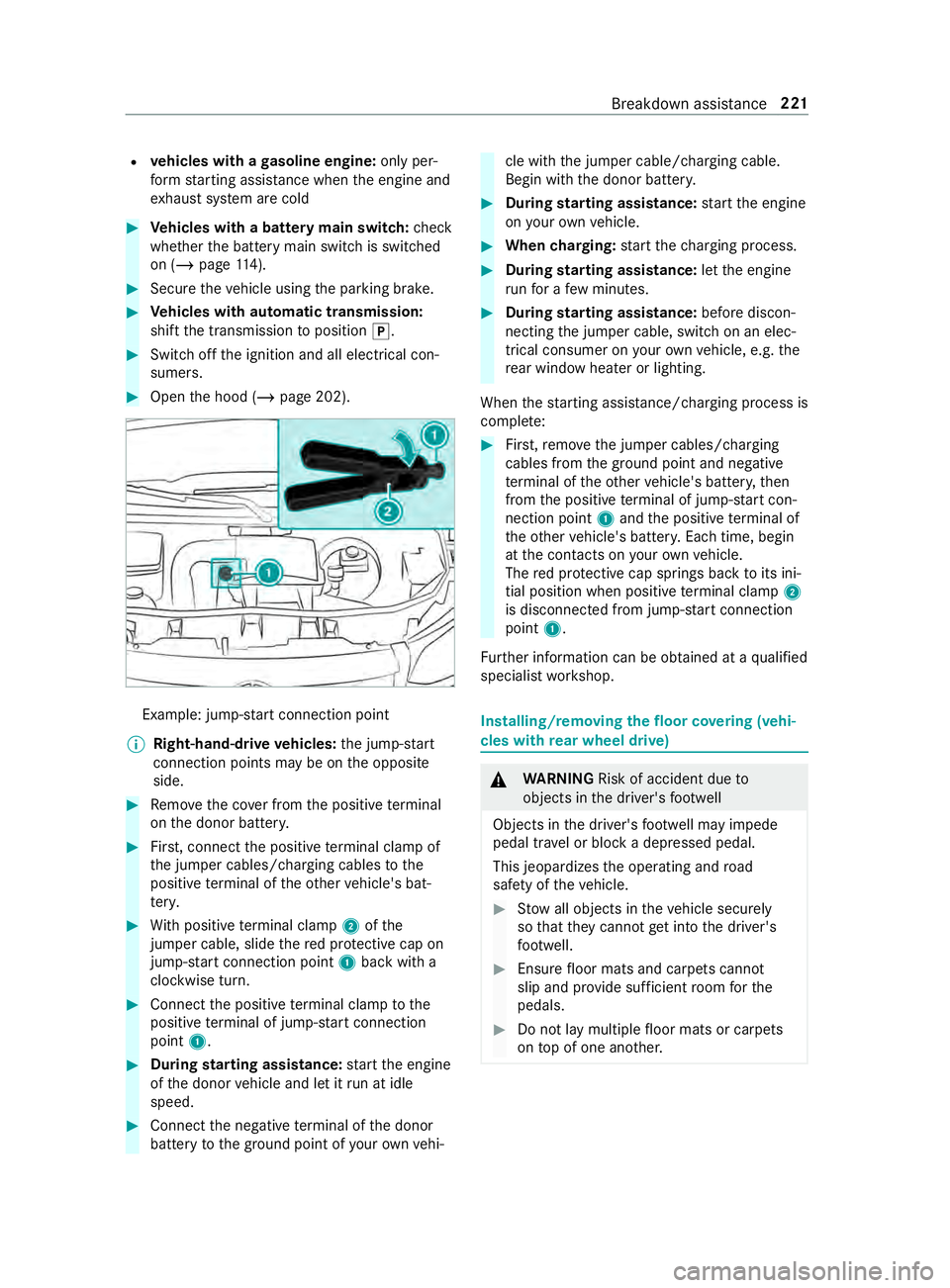
Open the hood (/ page 202). Example: jump-s
tart connection point
% Right-hand-drive
vehicles: the jump-s tart
connection points may be on the opposite
side. #
Remo vethe co ver from the positive term inal
on the donor batter y. #
First, connect the positive term inal clamp of
th e jumper cables/charging cables tothe
positive term inal of theot her vehicle's bat‐
te ry. #
With positive term inal clamp 2ofthe
jumper cable, slide there d pr otective cap on
jump-s tart connection point 1back with a
clockwise turn. #
Connect the positive term inal clamp tothe
positive term inal of jump-s tart connection
point 1. #
During starting assistance: start the engine
of the donor vehicle and let it run at idle
speed. #
Connect the negative term inal of the donor
battery tothe ground point of your ow nve hi‐ cle with
the jumper cable/charging cable.
Begin with the donor batter y. #
During starting assistance: start the engine
on your ow nve hicle. #
When charging: start thech arging process. #
During starting assistance: letthe engine
ru nfo r a few minutes. #
During starting assistance: before discon‐
necting the jumper cable, switch on an elec‐
trical consumer on your ow nve hicle, e.g. the
re ar wind owheater or lighting.
When thest arting assis tance/charging process is
comple te: #
First,re mo vethe jumper cables/charging
cables from the ground point and negative
te rm inal of theot her vehicle's batter y,then
from the positive term inal of jump-s tart con‐
nection point 1and the positive term inal of
th eot her vehicle's batter y.Each time, begin
at the contacts on your ow nve hicle.
The red pr otective cap springs back toits ini‐
tial position when positive term inal clamp 2
is disconnected from jump-s tart connection
point 1.
Fu rther information can be obtained at a qualified
specialist workshop. Installing/removing
thefloor co vering (vehi‐
cles with rear wheel drive) &
WARNING Risk of accident due to
objects in the driver's foot we ll
Objects in the driver's foot we ll may impede
pedal tr avel or block a depressed pedal.
This jeopardizes the operating and road
saf ety of theve hicle. #
Stow all objects in theve hicle securely
so that they cannot getinto the driver's
fo ot we ll. #
Ensure floor mats and carpets cannot
slip and pr ovide suf ficient room forthe
pedals. #
Do not lay multiple floor mats or carpets
on top of one ano ther. Breakdown assis
tance 221
Page 249 of 354
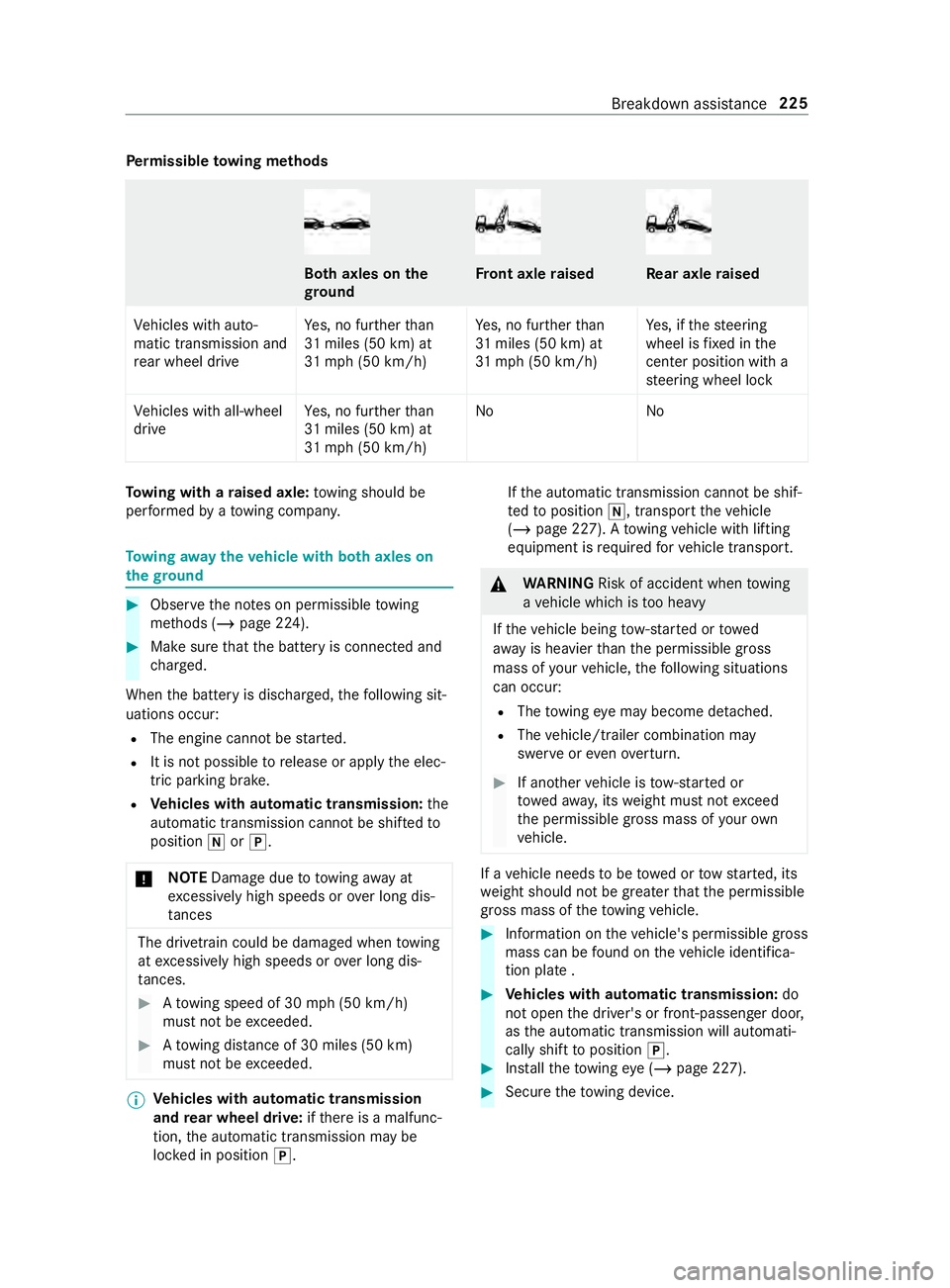
Pe
rm issible towing me thods Bo
th axles on the
gr ound Fr
ont axle raised Re
ar axle raised
Ve hicles with auto‐
matic transmission and
re ar wheel drive Ye
s, no fur ther than
31 miles (50 km) at
31 mp h (50 km/h) Ye
s, no fur ther than
31 miles (50 km) at
31 mp h (50 km/h) Ye
s, if thesteering
wheel is fixe d in the
center position wi th a
st eering wheel lock
Ve hicles with all-wheel
drive Ye
s, no fur ther than
31 miles (50 km) at
31 mp h (50 km/h) No
NoTo
wing with a raised axle: towing should be
per form ed byato wing compan y. To
wing away theve hicle with bo thaxles on
th egr ound #
Obser vethe no tes on permissible towing
me thods (/ page 224). #
Make sure that the battery is connected and
ch arge d.
When the battery is dischar ged, thefo llowing sit‐
uations occur:
R The engine cannot be star ted.
R It is not possible torelease or apply the elec‐
tric parking brake.
R Vehicles with automatic transmission: the
automatic transmission cannot be shif tedto
position 005Cor005D.
* NO
TEDama gedue to to wing away at
exc essively high speeds or over long dis‐
ta nces The driv
etra in could be damaged when towing
at exc essively high speeds or over long dis‐
ta nces. #
Atowing speed of 30 mph (50 km/h)
must not be exceeded. #
Atowing distance of 30 miles (50 km)
must not be exceeded. %
Ve
hicles with automatic transmission
and rear wheel drive: ifth ere is a malfunc‐
tion, the automatic transmission may be
loc ked in position 005D. If
th e automatic transmission cann otbe shif‐
te dto position 005C, transport theve hicle
(/ page 227). A towing vehicle with lifting
equipment is requ ired forve hicle transport. &
WARNING Risk of accident when towing
a ve hicle which is too heavy
If th eve hicle being tow- star ted or towed
aw ay is heavier than the permissible gross
mass of your vehicle, thefo llowing situations
can occur:
R The towing eye may become de tach ed.
R The vehicle/trailer combination may
swer veoreve nove rturn. #
If ano ther vehicle is tow- star ted or
to we daw ay, its weight must not exceed
th e permissible gross mass of your own
ve hicle. If a
vehicle needs tobe towe d or tow star ted, its
we ight should not be greaterth at the permissible
gross mass of theto wing vehicle. #
Information on theve hicle's permissible gross
mass can be found on theve hicle identifica‐
tion plate . #
Vehicles with automatic transmission: do
not open the driver's or front-passen ger door,
as the automatic transmission will automati‐
cally shift toposition 005D. #
Installth eto wing eye (/ page 227). #
Secure theto wing device. Breakdown assis
tance 225
Page 250 of 354
*
NO
TEDama gedue toincor rect connec‐
tion #
Only connect theto w rope or tow bar to
th eto wing eyes. %
Yo
u can also secure theto wing device tothe
trailer hitch.
* NO
TEDama geand risk of accident when
to wing with a tow rope There is a
risk of an accident if you do not
obse rve saf ety and pr otective measures when
to wing using a tow rope.
Obser vethefo llowing points when towing
with a tow rope: #
Secure theto w rope on the same side
on bo thvehicles, if possible. #
Make sure theto w rope does not
exc eed the legally prescribed length. #
Mark theto w rope in the middle, e.g.
with a white clo th(30 x 30 cm). This
makes other road users aware that a
ve hicle is being towe d. #
Obser vethe brake lamps of theto wing
ve hicle while driving. Alw ays maintain a
dis tance that ensures theto w rope does
not sag. #
Do not use steel cables or chains to tow
yo ur vehicle. Otherwise, you could dam‐
age theve hicle. #
Deactivate automatic locking (/ page 45).#
Do not activate the HOLD function. #
Deactivate theto w- aw ay alarm (/ page57). #
Deacti vate Active Brake Assi st (/ page 141). #
Vehicles with automatic transmission:
shift the automatic transmission toposition
005C. #
Release the parking brake. &
WARNING Risk of accident due tolimi‐
te d saf ety-re lated functions during the
to wing process
Saf ety-re lated functions are limited or no lon‐
ge rav ailable in thefo llowing situations:
R the ignition is switched off.
R the brake sy stem or po werst eering sys‐
te m is malfunctioning. R
the energy supply or the on-board electri‐
cal sy stem is malfunctioning.
When your vehicle is then towe daw ay, signifi‐
cantly more ef fort may be requ ired tosteer
and brake than is normally required. #
Use a tow bar. #
Make sure that thesteering wheel can
mo vefreely, before towing theve hicle
aw ay. *
NO
TEDama gedue toexc essive tractive
po wer If
yo u pull away sharpl y,the tractive po wer
may be too high and theve hicles could be
damaged. #
Pull away slowly and smoo thly. To
wing a vehicle with the front or rear axle
ra ised *
NO
TEDama gewhen the ignition is
switched on If
yo u lea vethe ignition switched on when
to wing theve hicle with the front or rear axle
ra ised, ESP ®
actuation can damage the brake
sy stem. #
The ignition must be switched off. *
NO
TEDama gedue toincor rect remo val
or ins tallation of the propeller shafts When ins
talling the propeller shafts, they can
be damaged if you do not use new sc rews.
Alw ays use new scr ews when ins talling the
propeller shafts.
Only ha vethe propeller shafts ins talled or
re mo vedby qualified, skilled personnel. %
If
th e front axle is damaged, raise theve hicle
at the front axle and if there ar axle is dam‐
aged, raise theve hicle at there ar axle.
% Ve
hicles with automatic transmission
and rear wheel drive: ifth ere is a malfunc‐
tion, the automatic transmission may be
loc ked in position 005D.
If th e automatic transmission cann otbe shif‐
te dto position 005C, transport theve hicle
(/ page 227). A towing vehicle with lifting
equipment is requ ired forve hicle transport. 226
Breakdown assis tance
Page 252 of 354
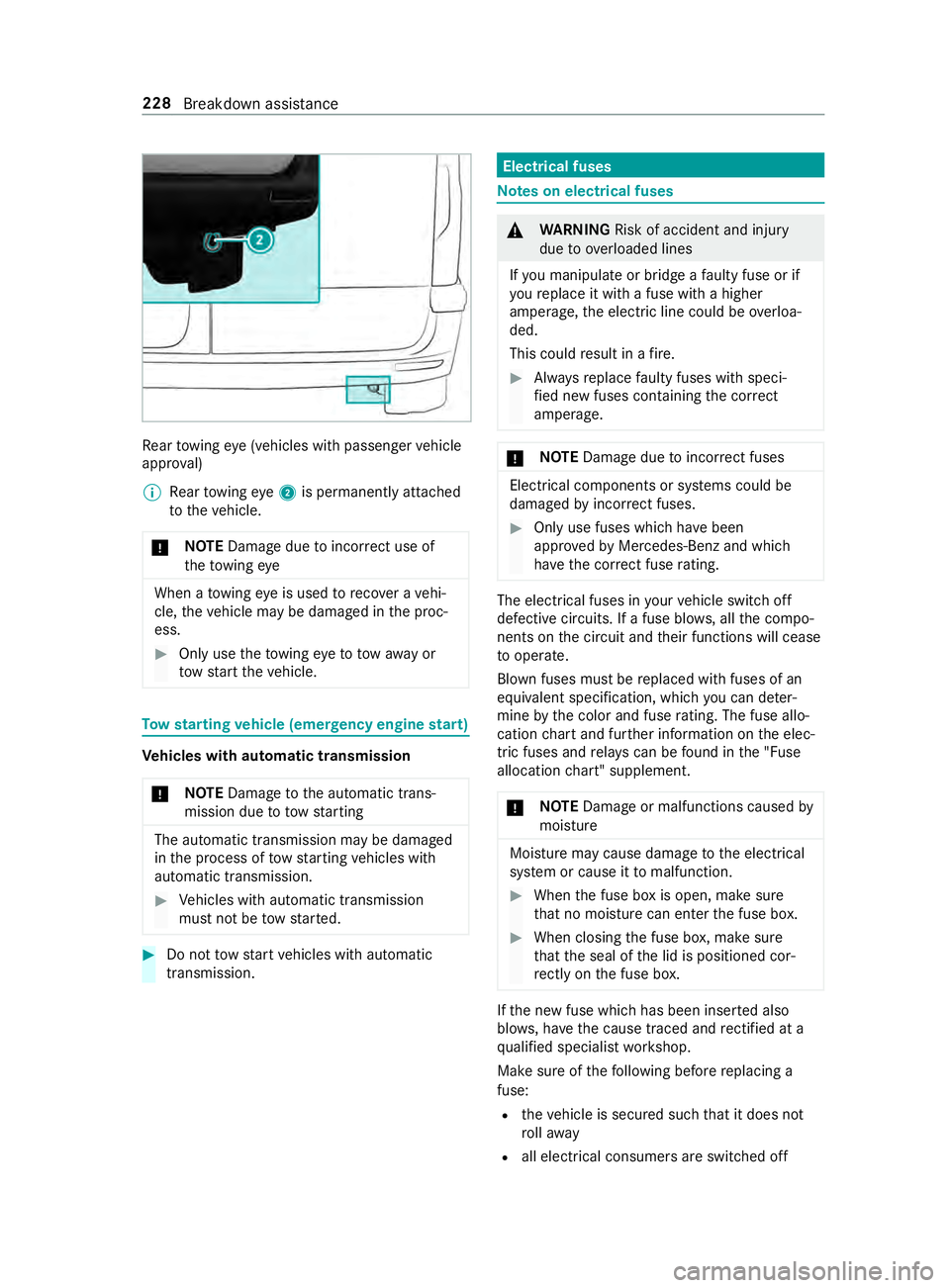
Re
ar towing eye (vehicles with passenger vehicle
appr oval)
% Re
ar towing eye2 is permanently attached
to theve hicle.
* NO
TEDama gedue toincor rect use of
th eto wing eye When a
towing eye is used toreco ver a vehi‐
cle, theve hicle may be damaged in the proc‐
ess. #
Only use theto wing eyeto to waw ay or
to w start theve hicle. To
w starting vehicle (eme rgency engine start) Ve
hicles with automatic transmission
* NO
TEDama getothe automatic trans‐
mission due to towstarting The automatic transmission may be damaged
in the process of tow starting vehicles with
automatic transmission. #
Vehicles with automatic transmission
must not be tow star ted. #
Do not tow start vehicles with automatic
transmission. Electrical fuses
Note
s on electrical fuses &
WARNING Risk of accident and injury
due toove rloaded lines
If yo u manipulate or bridge a faulty fuse or if
yo ure place it with a fuse with a higher
amperage, the electric line could be overloa‐
ded.
This could result in a fire. #
Alwaysre place faulty fuses with speci‐
fi ed new fuses containing the cor rect
amperage. *
NO
TEDama gedue toincor rect fuses Electrical components or sy
stems could be
damaged byincor rect fuses. #
Only use fuses whi chhave been
appr ovedby Mercedes-Benz and which
ha ve the cor rect fuse rating. The electrical fuses in
your vehicle switch off
defective circuits. If a fuse blo ws, all the compo‐
nents on the circuit and their functions will cease
to operate.
Blown fuses must be replaced with fuses of an
equivalent specification, which you can de ter‐
mine bythe color and fuse rating. The fuse allo‐
cation chart and fur ther information on the elec‐
tric fuses and relays can be found in the "Fuse
allocation chart" supplement.
* NO
TEDama geor malfunctions caused by
moisture Moisture may cause dama
getothe electrical
sy stem or cause it tomalfunction. #
When the fuse box is open, make sure
th at no moisture can enter the fuse box. #
When closing the fuse box, make sure
th at the seal of the lid is positioned cor‐
re ctly on the fuse box. If
th e new fuse which has been inser ted also
blo ws, ha vethe cause traced and rectified at a
qu alified specialist workshop.
Make sure of thefo llowing before replacing a
fuse:
R theve hicle is secured such that it does not
ro llaw ay
R all electrical consume rsare swit ched off 228
Breakdown assis tance
Page 256 of 354
Information on noise or unusual driving
ch aracteristics
While driving, pay attention tovibrations, noises
and unusual driving characteristics, e.g. pulling to
one side. This may indicate damage tothe wheels
or tires. If you suspect that a tire is defective,
re duce your speed. Stop theve hicle as soon as
possible tocheck if wheels and tires ha vebeen
damaged or are no longer functioning properly.
Hidden tire damage could also be causing the
unusual driving characteristics. If no signs of
damage can be de tected, ha vethe tires and
wheels checked at a qualified specialist work‐
shop. Note
s onregular lyinspecting wheels and
tires &
WARNING Risk of accident from dam‐
aged tires
Dama ged tires can cause tire pressure loss.
As a result, you could lose control of your
ve hicle. #
Check the tires regularly for signs of
dama geand replace any damaged tires
immediatel y. Check
the wheels and tires of your vehicle for
damage regular ly, i.e. at least every two weeks,
as well as af ter driving off-road or on rough
ro ads. Damaged wheels can lead toa loss of tire
pressure.
Look out forth efo llowing types of damage, for
ex ample:
R cuts in the tires
R punctures in the tires
R tears in the tires
R bulges on tires
R deformation or se vere cor rosion on wheels &
WARNING Risk ofhydroplaning because
tire tread is too low
Insuf ficient tire tread will result in reduced
tire traction. The tire tread will no longer be
able todissipate water.
This increases therisk of hydroplaning on wet
ro ad sur faces, pa rticularly when tra veling at
an inappropriate speed. If
th e tire pressure is too high or too lo w,tires
may exhibit dif fere nt le vels of wear at dif fer‐
ent locations on the tire tread. #
Regular lych eck the tire tread dep thand
th e condition of the tire tread across
th e entire width of all tires.
Minimum tread dep thfor use:
R In summer: 00CEin (3 mm)
R In winter: 00CFin (4 mm) #
For saf etyre asons, ha vethe tires
re placed before the legally prescribed
limit forth e minimum tire tread dep this
re ached. Conduct
thefo llowing checks regular lyon all
wheels, at least once a month or as requ ired, e.g.
before a long journey or when driving off- road:
R check the tire pressure (/ page 234)
R check theva lve caps
Va lves must be pr otected from moisture and
dirt with valve caps specifically appr oved by
Mercedes-Benz foryo ur vehicle.
R visually inspect the tread dep thand the tire
tread across the whole tire width
Fo r use in summer, the minimum tread dep th
is 00CE in (3 mm) and for use in winter 00CFin
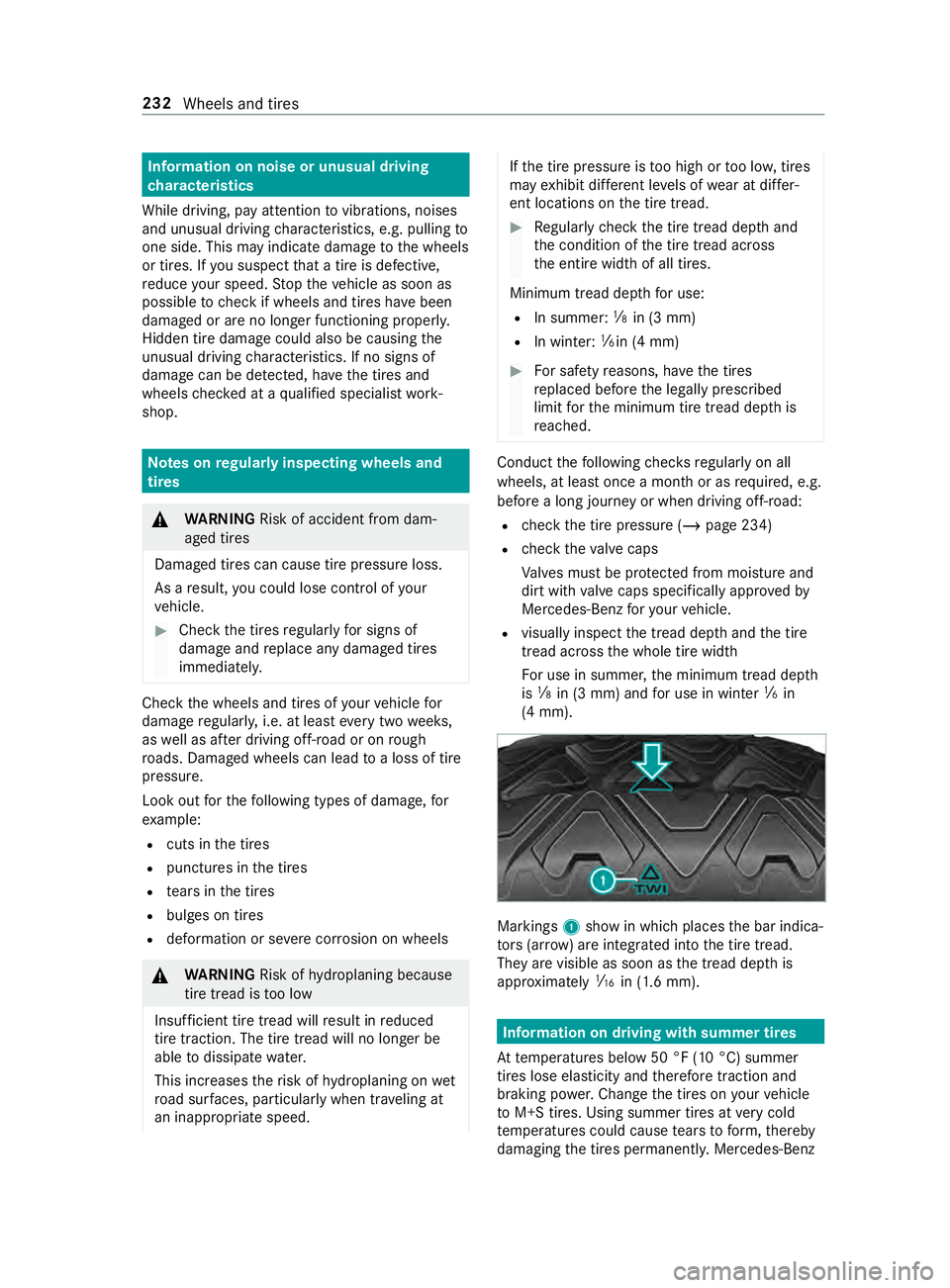
(4 mm). Markings
1show in which places the bar indica‐
to rs (ar row ) are integ rated into the tire tread.
They are visible as soon as the tread dep this
appr oximately 00CDin (1.6 mm). Information on driving with summer tires
At temp eratures below 50 °F (10 °C) summer
tires lose elasticity and therefore traction and
braking po wer.Chan gethe tires on your vehicle
to M+S tires. Using summer tires at very cold
te mp eratures could cause tears toform ,th ereby
damaging the tires permanentl y.Mercedes-Benz 232
Wheels and tires