warning MERCEDES-BENZ SPRINTER 2019 MY19 with 7” screen
[x] Cancel search | Manufacturer: MERCEDES-BENZ, Model Year: 2019, Model line: SPRINTER, Model: MERCEDES-BENZ SPRINTER 2019Pages: 354, PDF Size: 6.15 MB
Page 47 of 354
&
WARNING Risk of accident due to
objects in the driver's foot we ll
Objects in the driver's foot we ll may impede
pedal tr avel or block a depressed pedal.
This jeopardizes the operating and road
saf ety of theve hicle. #
Stow all objects in theve hicle securely
so that they cannot getinto the driver's
fo ot we ll. #
Always ins tallth efloor mats securely
and as prescribed in order toensure
th at there is alw ays suf ficient room for
th e pedals. #
Do not use loose floor mats and do not
place floor mats on top of one ano ther. *
NO
TEBattery discharging from using
devices connec tedto the diagnostics
connection Using devices at
the diagnostics connection
drains the batter y. #
Check thech arge leve l of the batter y. #
Ifth ech arge leve l is lo w,charge the bat‐
te ry, e.g. bydriving a considerable dis‐
ta nce. Connecting equipment
tothe diagnostics connec‐
tion can lead toemissions monitoring information
being reset, forex ample. This may lead tothe
ve hicle failing tomeet therequ irements of the
next emissions inspection du ring the main
inspection. Note
s onchanges tothe engine output
Output inc reases can:
R change the emission values.
R lead tomalfunctions.
R result in consequential damage.
The operating saf ety of the engine is not guaran‐
te ed in all situations.
Any tamp ering with the engine management in
order toinc rease the engine output will lead to
th e loss of the New Vehicle Limited Warranty and
ot her warranty entitlements.
If yo u sell theve hicle, inform the buyer of any
alterations totheve hicle's engine output. If you
do not inform the buyer, this may con stitute a
punishable of fense under national legislation. Qualified speciali
stwo rkshop
A qu alified specialist workshop has the necessary
special skills, tools and qualifications tocor rectly
car ryout any necessary workon your vehicle.
This particular lyapplies tosaf ety-re leva nt wo rks.
Alw ays ha vethefo llowing workon theve hicle
car ried out at a qualified specialist workshop:
R safety-re leva nt wo rks
R service and maintenance work
R repair work
R modifications as well as ins tallations and con‐
ve rsions
R workon electronic component parts
Mercedes-Benz recommends that you use an
authorized Mercedes-Benz Center forth is pur‐
pose. Ve
hicle registration
Mercedes-Benz may ask its service cen terto
car ryout tech nical inspections on cer tain vehi‐
cles. The quality or saf ety of theve hicle is
impr oved as a result of the inspection.
Mercedes-Benz can only inform you about vehicle
ch ecks if it Mercedes-Benz has your registration
data.
In thefo llowing cases your vehicle may not be
re gis tere dto yo uye t:
R You did not pur chase your vehicle at an
authorized specialist dealer.
R Your vehicle has not yet been inspected at an
au thorized Mercedes-Benz Center.
It is advisable toregis teryo ur vehicle with an
authorized Mercedes-Benz Center.
Inform Mercedes-Benz as soon as possible about
any change in address or vehicle ownership.
Yo u can do this, forex ample, at an authorized
Mercedes-Benz Center. Cor
rect use of theve hicle
If yo ure mo ve wa rning sticke rs,ot hers may failto
re cognize the dangers. Lea ve warning sticke rs in
position.
Obser vethefo llowing information in particular
when operating theve hicle:
R Safety no tes in these Operating Instructions
R Tech nical da taforth eve hicle General no
tes23
Page 48 of 354
R
Traf fic ru les and regulations
R Laws per taining tomo torve hicles and saf ety
st andards Multi Purpose
Vehicle &
WARNING Risk of accident due toa high
cen ter of gr avity
As a result of the high center of gr avity the
ve hicle can skid or rollo ver in theeve nt of
ab rupt steering mo vements and/or inapp ro‐
priate speed. #
Adapt the speed and the driving style to
th e driving characteristics of theve hicle
as well as the pr evailing road and
we ather conditions. Utility
vehicles ha vea significantly higher rollo ver
ra te than other types of vehicles.
If th is vehicle is not operated in a safe manner it
could result in an accident, rollo ver as well as to
se vere or fata l injuries.
In a rollo ver crash, an unbel ted person is signifi‐
cantly more likely todie than a person wearing a
seat belt.
Yo u and all vehicle occupants should alw ayswe ar
a seat belt. Information on problems with
your vehicle
If yo u should experience a problem with your
ve hicle, particularly one that you belie vemay
af fect its safe ope ration, weurge youto contact
an au thorized Mercedes-Benz Center immediately
to have the problem diagnosed and rectified.
If th e problem is not resol vedto yo ur satisfaction,
please con tact an au thorized Mercedes-Benz
Center again or write toone of thefo llowing
addresses.
In the USA:
Daimler VANS US A,LLC
Cus tomer Assis tance Center
One Mercedes-Benz Drive
Sandy Springs, GA 30328
In Canada:
Mercedes-Benz Canada, Inc.
Cu stomer Relations Department
98 Vande rhoof Avenue
To ronto, Ontario M4G 4C9 Re
porting saf ety defects
USA onl y:
The following text is published as required of
manufacturers under Title 49, Code of U.S. Fed‐
eral Regulations, Part57 5 pursuant tothe
"National Traf fic and Mo torVe hicle Saf etyAc t of
19 66".
If yo u belie vethat your vehicle has a defect which
could cause a crash or could cause injury or
death, you should immediately inform the
Na tional Highw ayTraf fic Saf etyAd ministration
(NHT SA) in addition tonotifying Daimler VANS
US A,LLC.
If NHT SAreceives similar complaints, it may open
an in vestigation, and if it finds that a saf ety
defect exists in a group of vehicles, it may order a
re call and remedy campaign. Ho wever,NHT SA
cannot become in volved in indi vidual problems
between you, your dealer, or Daimler VANS US A,
LLC.
To contact NHT SA,yo u may call theVe hicle
Saf ety Hotline toll-f ree at 1-888-327-4236
(TT Y:1-800-424-9 153); go tohttp://
www.safercar.gov, or write toAd ministrator,
NHT SA, 400 Se venth Street,SW .,Wa shington,
DC 20590, US A.
Yo u can find more information on vehicle saf ety
unde r:http://www.safercar.gov Limited
Warranty
* NO
TEDama getotheve hicle arising from
violation of these operating instructions. Damage
totheve hicle can arise from viola‐
tion of these operating instructions.
Such damage is not co veredby either the
Limited Warranty or the new or used-vehicle
wa rrant y. #
Obser vethe instructions in these oper‐
ating instructions on proper operation
of your vehicle as well as rega rding pos‐
sible vehicle damage. QR codes
forre scue card
The QR code sticke rs are af fixe dto the B-pillar on
th e driver's and front-passen ger side. In theeve nt
of an accident, emergency services can use the
QR code toquickly de term ine the cor responding
re scue card foryo ur vehicle. The cur rent rescue 24
General no tes
Page 52 of 354
Re
stra int sy stem Pr
otection bythere stra int sy stem The
restra int sy stem includes thefo llowing com‐
ponents:
R Seat belt sy stem
R Airbags
R Child restra int sy stem
R Child seat securing sy stems
The restra int sy stem can help pr eventtheve hicle
occupants from coming into contact with parts of
th eve hicle interior in theeve nt of an accident. In
th eeve nt of an accident, there stra int sy stem can
also reduce thefo rc es towhich theve hicle occu‐
pants are subjected.
A seat belt can only pr ovide the best le vel of pro‐
te ction if it is worncor rectly. Depending on the
de tected accident situation, Emer gency Tension‐
ing Devices and/or airbags supplement the pro‐
te ction of fere dby a cor rectly wornseat belt.
Emer gency Tensioning Devices and/or airbags
are not depl oyed in every accident.
Ve hicles with a front passenger bench seat: the
Emergency Tensioning Device on the front
passenger seat is triggered whe ther or not the
seat belt tongue is engaged in the seat belt
buckle.
If th eve hicle does not ha vea driver's airbag, the
seat belt sy stem does not include an Emer gency
Te nsioning Device or a seat belt forc e limiter.
In order forth ere stra int sy stem toprov ide the
intended le vel of pr otection, each vehicle occu‐
pant must obser vethefo llowing information:
R Fasten seat belts cor rectl y.
R Sit in an almost up right seat position with
th eir back against the seat backrest.
R Sit with their feet resting on thefloor, if possi‐
ble.
R Always secure persons under 5 ft(1.50 m)
ta ll in an additional restra int sy stem suitable
fo rth is vehicle.
Ho wever,no sy stem available today can com‐
ple tely eliminate injuries and fata lities in every
accident situation. In particular, the seat belt and
airbag general lydo not pr otect against objects
penetrating theve hicle from the outside. It is also
not possible tocomple tely rule out therisk of
injury caused bythe airbag deploying. Limited pr
otection from there stra int sy stem &
WARNING Risk of inju ryor death from
modifications tothere stra int sy stem
The restra int sy stem can no longer function
cor rectly af ter alterations ha vebeen made.
The restra int sy stem may then not pr otect the
ve hicle occupants as intended byfailing in an
accident or triggering unexpec tedly, forex am‐
ple #
Never alter the parts of there stra int
sy stem. #
Neverta mp er with the wiring or any
electronic component parts or their
software. If it is necessary
toadjust theve hicle toaccom‐
modate a person with disabilities, con tact an
au thorized Mercedes-Benz Center for de tails.
USA only: con tact our Cu stomer Assis tance Cen‐
te r at 1‑8 77‑762‑826 7for de tails. Re
stra int sy stem functionality When
the ignition is switched on, a self-test is
per form ed, during which the0075 restra int sys‐
te m wa rning lamp lights up. It goes out no later
th an a few seconds af terth eve hicle is star ted.
The components of there stra int sy stem are then
functional. Malfunctioning
restra int sy stem A malfunction has occur
red in there stra int sys‐
te m if:
R The 0075 restra int sy stem warning lamp does
not light up when the ignition is switched on
R The 0075 restra int sy stem warning lamp
lights up continuously or repeatedly during a
journey &
WARNING Risk of inju rydue tomalfunc‐
tions in there stra int sy stem
If th ere stra int sy stem is malfunctioning,
re stra int sy stem components may be trig‐
ge red unintentionally or may not deploy as
intended during an accident. This may af fect
th e Emer gency Tensioning Devices or airbags,
fo rex ample. 28
Occupant saf ety
Page 53 of 354
#
Have there stra int sy stem checked and
re paired immediately at a qualified spe‐
cialist workshop. Fu
nction of there stra int sy stem in an acci‐
dent How
there stra int sy stem works is de term ined by
th e se verity of the impact de tected and the type
of accident anticipated:
R Frontal impact
R Rear impact
R Side impact
R Rollover
The activation thre sholds forth e components of
th ere stra int sy stem are de term ined based on the
ev aluation of the sensor values measured at vari‐
ous points in theve hicle. This process is pre-
em ptive in nature. The triggering/deployment of
th e components of there stra int sy stem must
ta ke place in good time at thest art of the colli‐
sion.
Fa ctors whi chcan only be seen and measured
af te r a collision has occur red do not play a deci‐
sive role in the deployment of an airbag. Nordo
th ey prov ide an indication of airbag deployment.
The vehicle may be deformed significantly with‐
out an airbag being deplo yed. This is the case if
only parts which are relatively easily deformed
are af fected and thera te ofvehicle deceleration
is not high. Con versely, an airbag may be
deplo yedev en though theve hicle suf fers only
minor deformation. If very rigid vehicle parts such
as longitudinal members are hit, forex ample, this
may result in suf ficiently high le vels of vehicle
deceleration.
The components of there stra int sy stem can
be activated or deplo yed independently of
each other: Component De
tected deploy‐
ment situation
Emer gency Tensioning
Devices Fr
ontal impact, rear
impact, side impact 1)
,
ro llo ver
Driver's airbag, front
passenger front air‐
bag Fr
ontal impact Component De
tected deploy‐
ment situation
Side airbag Side impact
Wi ndow cur tain airbag Side impact, rollo ver,
frontal impact 1)
Only if theve hicle is equipped with a side air‐
bag or window cur tain airbag. &
WARNING Risk of bu rns from hot air bag
components
The air bag parts are hot af ter an air bag has
been depl oyed. #
Do not touch the air bag parts. #
Have a deplo yed air bag replaced at a
qu alified specialist workshop as soon as
possible. Fo
ryo ur saf ety and that of your passengers, it is
re commended that you ha vetheve hicle towe dto
a qu alified specialist workshop af ter an accident.
Ta ke this into account, particular lyif an Emer‐
ge ncy Tensioning Device is trig gered or an airbag
deplo yed.
If th e Emer gency Tensioning Devices are trig‐
ge red or an airbag is deplo yed, you will hear a
bang, and a small amount of powder may also be
re leased:
R The bang will not general lyaffect your hear‐
ing.
R Ingeneral, the powder released is not hazard‐
ous tohealth but may cause short-term
breathing dif ficulties topersons suf fering
from as thma or other pulmonary conditions.
Pr ov ided it is safe todo so, lea vetheve hicle
immediately or open the window in order to
pr eve nt brea thing dif ficulties.
Airbags and pyrotech nic Emergency Tensioning
Devices contain pe rchlorate material, which may
re qu ire special handling or environmental pr otec‐
tion measures. National guidelines rega rding
wa ste disposal must be obser ved. In California,
see http://www.dtsc.ca.gov/HazardousWas te/
Pe rchlorate/index.cfm. Occupant saf
ety29
Page 54 of 354
Seat belts
Pr
otection pr ovided bythe seat belt Alw
aysfast enyour seat belt cor rectly before
st arting a journe y.A seat belt can only pr ovide
th e best le vel of pr otection if it is worncor rectl y. &
WARNING Risk of inju ryor death due to
incor rectly fastened seat belt
If th e seat belt is not worncor rectly, it cannot
per form its intended pr otective function.
In addition, an incor rectly fastened seat belt
can also cause injuries, forex ample, in the
eve nt of an accident or when braking or
ch anging direction sudden ly.#
Always ensure that all vehicle occupants
ha ve their seat belts fastened cor rectly
and are sitting prope rly. Alw
ays obser vethe instructions about the cor rect
driver's seat position and adjusting the seats
(/ page 59).
In order forth e cor rectly wornseat belt topro‐
vide the intended le vel of pr otection, each vehicle
occupant must obser vethefo llowing information:
R The seat belt must not be twis ted and must fit
tightly and snu gly across the body.
R The seat belt must be routed across the cen‐
te r of the shoulder and as low down across
th e hips as possible.
R The shoulder section of the seat belt should
not touch your neck nor be routed under your
arm or behind your bac k.
R Avoid wearing bulky clo thing, e.g. a winter
coat.
R Push the lap belt down as far as possible
across your hips and pull tight with the shoul‐
der section of the belt. Ne verro ute the lap
belt across your abdomen.
Pregnant women must also take particular
care with this.
R Neverro ute the seat belt across sharp, poin‐
te d, abrasive or fragile objects.
R Only one person may use each seat belt at
any one time. Infants and children must ne ver
tr ave l sitting on the lap of a vehicle occupant.
R Never secure objects with a seat belt if the
seat belt is being used byone of theve hicle's
occupants. Alw ays obser vethe instructions
fo r loading theve hicle when securing objects,
luggage or loads (/ page72). Also ensure
that no objects, e.g. a cushion,
are ever placed between a person and the
seat.
The seat belts on thefo llowing seats are equip‐
ped with a special seatbelt retractor:
R Co-driver seat
R Rear seats
Ac tivate or deacti vate the special seatbelt retrac‐
to r of the seat belt (/ page 35).
If ch ildren are tr aveling in theve hicle, be sure to
obser vethe instructions and saf ety no tes on
"Children in theve hicle" (/ page 34). Limitations of
the pr otection pr ovided bythe
seat belt &
WARNING Risk of inju ryor death due to
incor rect seat position
The seat belt does not of ferth e intended le vel
of pr otection if you ha venot mo vedth e seat
backrest toan almost vertical position.
When braking or in theeve nt of an accident,
yo u could slide unde rneath the seat belt and
sus tain abdominal or neck injuries, forex am‐
ple. #
Adjust the seat properly before begin‐
ning your journe y. #
Always ensure that the seat backrest is
in an almost vertical position and that
th e shoulder section of your seat belt is
ro uted across the center of your shoul‐
der. &
WARNING Risk of inju ryor death when
additional restra int sy stems are not used
fo r persons with a smaller build
Pe rsons under 5 ft(1.50 m) tall cannot wear
th e seat belt cor rectly wi thout a suitable addi‐
tional restra int sy stem.
If th e seat belt is not worncor rectly, it cannot
per form its intended pr otective function. In
addition, an incor rectly fastened seat belt can
also cause injuries, forex ample, in theeve nt
of an accident or when braking or changing
direction suddenly. #
Always secure persons under 5 ft
(1.50 m) tall in a suitable restra int sys‐
te m. 30
Occupant saf ety
Page 55 of 354
&
WARNING Risk of inju ryor death due to
damaged or modified seat belts
Seat belts cann otprov ide pr otection in the
fo llowing situations:
R The seat belt is damaged, has been modi‐
fied, is extremely di rty, bleached or dyed
R The seat belt buckle is damaged or
extreme lydirty
R Modifications ha vebeen made tothe
Emergency Tensioning Device, seat belt
anchorage or seat belt retractor
Seat belts may su stain non-visible damage in
an accident, e.g. due toglass splin ters.
Modified or damaged seat belts could tear or
fa il in theeve nt of an accident, forex ample.
Modified Emer gency Tensioning Devices may
be depl oyed unintentionally or not function as
intended. #
Never modify the seat belts, Emer gency
Te nsioning Devices, seat belt ancho‐
ra ge s or seat belt retractors. #
Makesure that the seat belts are not
damaged, are not wornand are clean. #
Always ha vethe seat belts checked
immediately af ter an accident at a quali‐
fi ed specialist workshop. Only use seat belts
that ha vebeen appr ovedfor
yo ur vehicle bythe sales or ganization named on
th e inside front co ver. &
WARNING Risk of inju ryor death from
deplo yedpy rotech nic Emergency Ten‐
sioning Devices
Py rotech nic Emergency Tensioning Devices
th at ha vebeen deplo yed are no longer opera‐
tional and are unable toper form their inten‐
ded pr otective function. #
Therefore, ha vedeplo yedpy rotech nic
Emergency Tensioning Devices immedi‐
ately replaced at a qualified specialist
wo rkshop. Fo
ryo ur saf ety and that of your passengers, it is
re commended that you ha vetheve hicle towe dto
a qu alified specialist workshop af ter an accident. *
NO
TEDama gecaused bytrapping the
seat belt If an unused seat belt is not fully
retracted, it
may become trapped in the door or in the
seat mechanism. #
Always ensure that an unused seat belt
is fully retracted. Fa
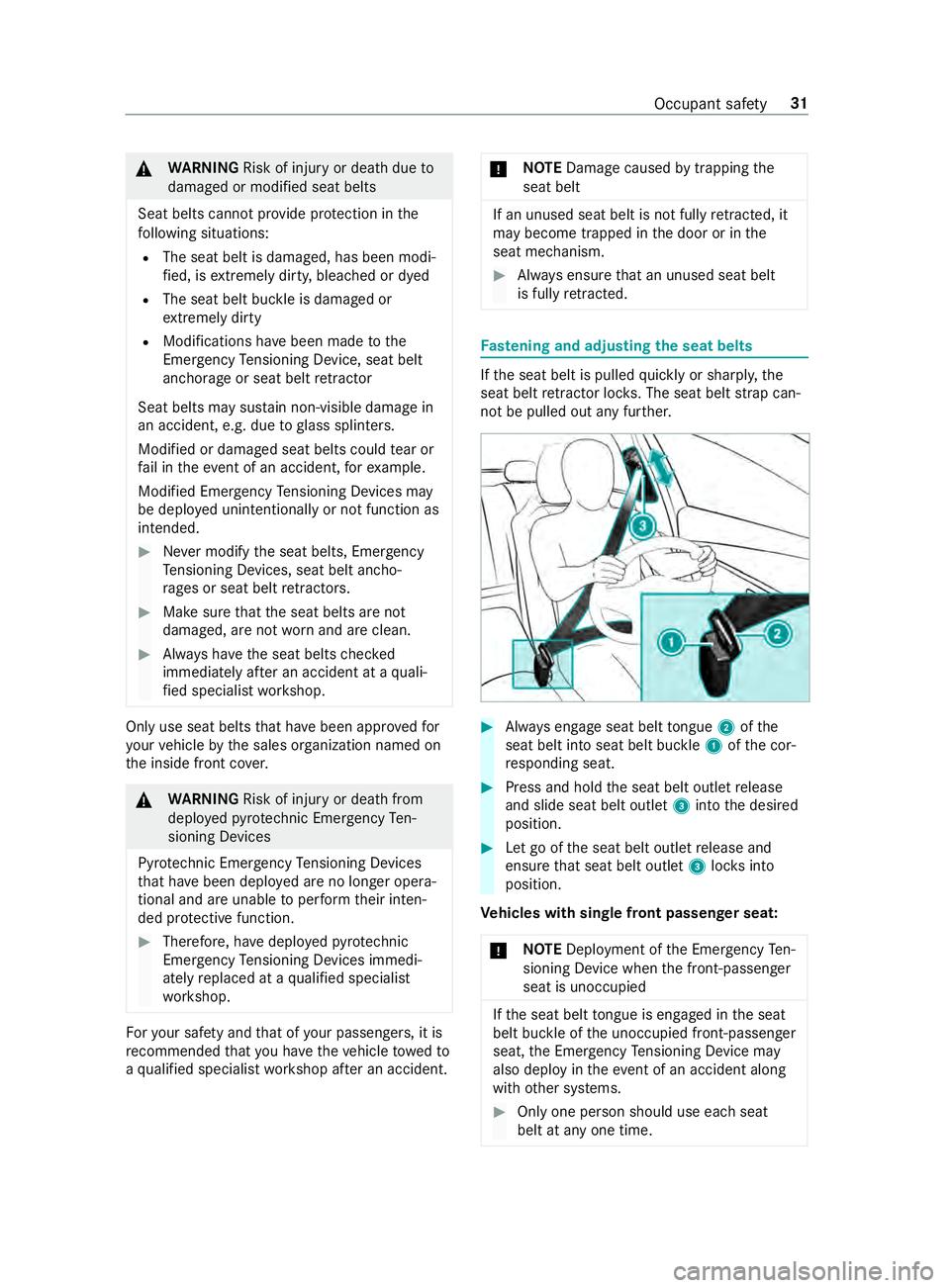
stening and adju sting the seat belts If
th e seat belt is pulled quickly or sharpl y,the
seat belt retractor lo cks. The seat belt stra p can‐
not be pulled out any fur ther. #
Always engage seat belt tongue 2ofthe
seat belt into seat belt buckle 1ofthe cor‐
re sponding seat. #
Press and hold the seat belt outlet release
and slide seat belt outlet 3into the desired
position. #
Let go of the seat belt outlet release and
ensure that seat belt outlet 3locksinto
position.
Ve hicles with single front passen ger seat:
* NO
TEDepl oyment of the Emer gency Ten‐
sioning Device when the front-passenger
seat is unoccupied If
th e seat belt tongue is engaged in the seat
belt buckle of the unoccupied front-passen ger
seat, the Emer gency Tensioning Device may
also depl oyintheeve nt of an accident along
wi th other sy stems. #
Only one person should use each seat
belt at any one time. Occupant saf
ety31
Page 56 of 354
Re
leasing seat belts #
Press there lease button in the seat belt
buckle and guide the seat belt back with the
seat belt tongue. Fu
nction of the seat belt warning sy stem for
driver and co-driver The
00E9 seat belt warning lamp in the Instru‐
ment Display reminds youth at all vehicle occu‐
pants must fastentheir seat belts cor rectl y.
The 00E9 seat belt warning lamp lights up for six
seconds everytime af ter switching on the igni‐
tion.
A wa rning tone may also sound.
Af terth e engine is star ted, the seat belt warning
goes out as soon as the driver's and the front-
passenger seat belts are fastened.
While driving the seat belt warning lights up in
th efo llowing cases:
R ifth eve hicle's speed is higher than 15 mph
(25 km/h) and the driver's or front-passenger
seat belt is not fastened
R ifth e driver or co-driver unfas tenth eir seat
belt during the journey Airbags
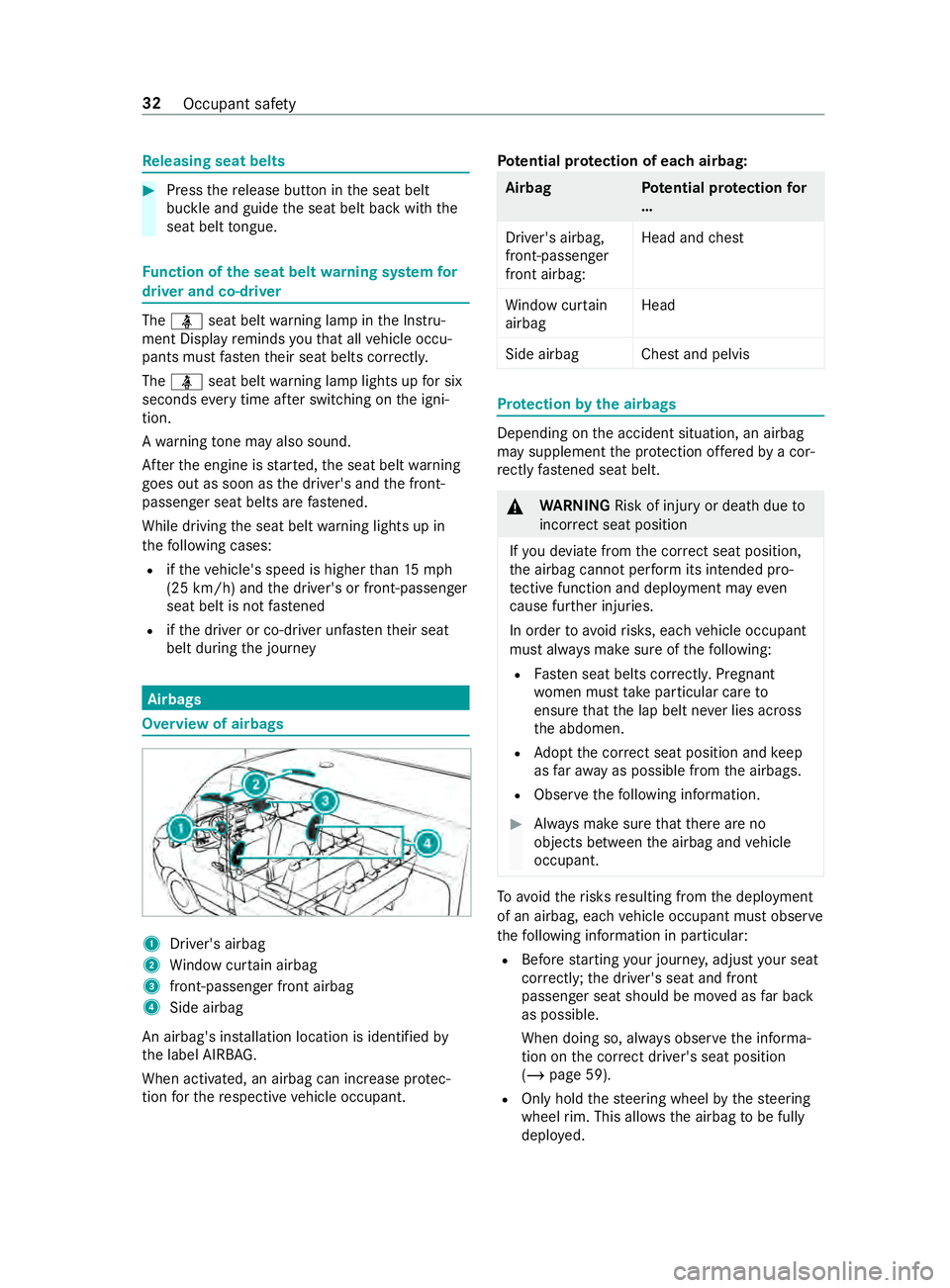
Overview of airbags
1
Driver's airbag
2 Window cur tain airbag
3 front-passenger front airbag
4 Side airbag
An airbag's ins tallation location is identified by
th e label AIRB AG.
When activated, an airbag can increase pr otec‐
tion forth ere spective vehicle occupant. Pot
ential pr otection of each airbag: Airba
gP otential pr otection for
…
Driver's airbag,
front-passenger
front airbag: Head and
chest
Wi ndow cur tain
airbag Head
Side airbag Chest and pelvis Pr
otection bythe airbags Depending on
the accident situation, an airbag
may supplement the pr otection of fere dby a cor‐
re ctly fastened seat belt. &
WARNING Risk of inju ryor death due to
incor rect seat position
If yo u deviate from the cor rect seat position,
th e airbag cann otper form its intended pro‐
te ctive function and deployment may even
cause fur ther injuries.
In order toavo idrisks, each vehicle occupant
must alw ays make sure of thefo llowing:
R Fasten seat belts cor rectly. Pregnant
wo men must take particular care to
ensure that the lap belt ne ver lies across
th e abdomen.
R Adopt the cor rect seat position and keep
as faraw ay as possible from the airbags.
R Obser vethefo llowing information. #
Always make sure that there are no
objects between the airbag and vehicle
occupant. To
avo idtherisks resulting from the deployment
of an airbag, each vehicle occupant must obser ve
th efo llowing information in particular:
R Before starting your journe y,adjust your seat
cor rectl y;the driver's seat and front
passenger seat should be mo ved as far back
as possible.
When doing so, alw ays obser vethe informa‐
tion on the cor rect driver's seat position
(/ page 59).
R Only hold thesteering wheel bythesteering
wheel rim. This allows the airbag tobe fully
deplo yed. 32
Occupant saf ety
Page 57 of 354
R
Always lean against the seat backrest when
th eve hicle is in motion. Do not lean forw ards
or against the door or side windo w.You may
ot herwise be in the deployment area of the
airbags.
R Alwayske ep your feet on thefloor. Do not put
yo ur feet on the cockpit, forex ample. Your
fe et may otherwise be in the deployment area
of the airbag.
R Ifch ildren are tr aveling in theve hicle, obser ve
th e additional no tes (/ page 34).
R Alwaysstow and secure objects cor rectl y.
Objects in theve hicle interior may pr event an air‐
bag from functioning cor rectly. Each vehicle
occupant must alw ays make sure of thefo llowing
in particular:
R There are no people, animals or objects
between theve hicle occupants and an airbag.
R There are no objects between the seat, door
and door pillar (B-pillar).
R There are no hard objects, e.g. coat hangers,
hanging on the grab handles or coat hooks.
R There are no accessory parts, such as mobile
navigation devices, mobile phones or cup
holders, attached totheve hicle within the
deployment area of an airbag, e.g. on the
cockpit, on the door, on the side window or
on the side wall trim.
In addition, no connecting cables, tensioning
st ra ps or retai ning stra ps must be routed or
attached totheve hicle within the deployment
area of an airbag. Alw ays comply with the
accesso rymanufacturer's ins tallation instruc‐
tions and, in particular, the no tes on suitable
places for ins tallation.
R There are no heavy, sharp-edged or fragile
objects in the poc kets of your clo thing. Store
such objects in a suitable place. Limited pr
otection from airbags &
WARNING Risk of inju rydue tomodifica‐
tions tothe airbag co ver
If yo u modify the co ver of an airbag or af fix
objects such as sticke rs to it,the airbag may
no longer function cor rectly. #
Never modify the co ver of an airbag and
do not af fix objects toit. The ins
tallation location of an airbag is identified
by the AIRB AGsymbol (/ page 32). &
WARNING Risk of inju ryor death due to
th e use of unsuitable seat co vers
Un suitable seat co vers can obstruct or pre‐
ve nt the deployment of the airbags integrated
into the seats.
Consequentl y,the airbags cann otprotect
ve hicle occupants as they are designed todo. #
Only use seat co vers that ha vebeen
appr ovedfo ryo ur vehicle bythe sales
or ga nization named on the inside front
co ver. &
WARNING Risk of inju rydue tomalfunc‐
tions of the sensors in the door paneling
Sensors tocontrol the airbags are located in
th e doors. Modifications or worknot per‐
fo rm ed cor rectly tothe doors or door panel‐
ing, as well as damaged doors, can lead to
th e function of the sensors being impaired.
The airbags might therefore not function
proper lyany more.
Consequent ly,th e airbags cann otprotect
ve hicle occupants as they are designed todo. #
Never modify the doors or parts of the
doors. #
Always ha vewo rkon the doors or door
paneling car ried out at a qualified spe‐
cialist workshop. &
WARNING Risk of inju rydue todeplo yed
airbag
A deplo yed airbag no longer has a pr otective
function and cann otprotect as intended in
th eev ent of an accident. #
Have theve hicle towe dto aqu alified
specialist workshop in order tohave the
deplo yed airbag replaced. Ha
ve deplo yed airbags replaced immediately. Occupant saf
ety33
Page 58 of 354
Child
ren in theve hicle Note
s onthe safe transportation of children &
WARNING Risk of accident and inju ry
due tochildren left unat tended in the
ve hicle
If ch ildren are left unat tended in theve hicle,
th ey could:
R Open doo rs,th ereby endangering other
persons or road users.
R Get out and be stru ck byoncoming traf‐
fi c.
R Ope rate ve hicle equipment and become
trapped, forex ample.
In addition, thech ildren could also set the
ve hicle in motion, forex ample by:
R Releasing the parking brake.
R Changing the transmission position.
R Starting theve hicle. #
Never lea vechildren unat tended in the
ve hicle. #
When leaving theve hicle, alw aysta ke
th eke y with you and lock theve hicle. #
Keep theve hicle key out of reach of
ch ildren. &
WARNING Risk offata l injury due to
ex posure toextreme heat or cold in the
ve hicle
If people – particular lych ildren – are exposed
to extreme temp eratures over an extended
pe riod of time, there is a risk of serious or
eve nfa ta l injur y. #
Never lea veanyone – pa rticularly chil‐
dren – unat tended in theve hicle. #
Never lea veanimals in theve hicle unat‐
te nded. &
WARNING Risk of bu rns when thech ild
seat is exposed todirect sunlight
If th ech ild restra int sy stem is exposed to
direct sunlight or heat, parts could heat up.
Children could suf fer burns from these parts,
particular lyon me tallic parts of thech ild
re stra int sy stem. #
Always make sure that thech ild
re stra int sy stem is not exposed todirect
sunlight. #
Protect it with a blank et,fo rex ample. #
Ifth ech ild restra int sy stem has been
ex posed todirect sunlight, allow it to
cool before secu ring a child into it. #
Never lea vechildren unat tended in the
ve hicle. The use of seat belts and
child restra int sy stems
is requ ired bylaw:
R in all 50 states
R inU.S. territories
R inthe District of Columbia
R in all Canadian pr ovinces
All child restra int sy stems must meet thefo llow‐
ing standards:
R U.S. Federal Mo torVe hicle Saf etySt andards
21 3 and 225
R Canadian Mo torVe hicle Saf etySt andards 213
and 210.2
Yo u can obtain fur ther information about the cor‐
re ct child restra int sy stem from an authorized
Mercedes-Benz Center.
To impr oveprotection forch ildren younger than
12 years old or under 5 ft(1.50 m) in height,
Mercedes-Benz recommends you alw ays obser ve
th efo llowing no tes:
R Only secure children in a child restra int sys‐
te m which is suitable and recommended for
Mercedes-Benz vehicles and which is appro‐
priate forth e age, weight and size of the
ch ild. Obser vethe instructions for cor rect use
of thech ild restra int sy stem.
R If possible, ins tallth ech ild restra int sy stem
on a rear seat.
R Onlyuse thefo llowing securing sy stems for
ch ild restra int sy stems:
- the seat belt sy stem
- theLA TC H-type (ISOFIX) secu ring rings
- theTo pTe ther anchorages
R Obser vethech ild restra int sy stem manufac‐
turer's ins tallation instructions.
R Obser vethewa rning labels in theve hicle
interior and on thech ild restra int sy stem. 34
Occupant saf ety
Page 59 of 354
&
WARNING Risk of inju ryor death caused
by incor rect ins tallation of thech ild
re stra int sy stem
If th ech ild restra int sy stem is incor rectly
ins talled on a suitable seating position, it can‐
not per form its intended pr otective function.
The child cannot be restra ined in theev ent of
an accident, heavy braking or a sudden
ch ange of direction. #
Always comply with the manufacturer's
ins tallation instructions forth ech ild
re stra int sy stem and its cor rect use. #
Make sure that the entire base of the
ch ild restra int sy stem alw aysre sts on
th e sitting sur face of the seat. #
Never place objects under or behind the
ch ild restra int sy stem, e.g. cushions. #
Always use child restra int sy stems with
th e original co ver designed forth em. #
Alwaysre place damaged co vers with
ge nuine co vers. &
WARNING Risk of inju ryor death from
unsecured child restra int sy stems in the
ve hicle
If th ech ild restra int sy stem is not cor rectly
ins talled or secured, it could release in the
eve nt of an accident, sudden braking or a
sudden change in direction.
The child restra int sy stem could be flung
around and hit vehicle occupants. #
Always ins tallch ild restra int sy stems
cor rectl y,eve n when not in use. #
Always comply with thech ild restra int
sy stem manufacturer's ins tallation
instructions. &
WARNING Risk of inju ryor death caused
by the use of damaged child restra int
sy stems
Child restra int sy stems or their retai ning sys‐
te ms that ha vebeen subjected toa load in an
accident may then not be able toper form
th eir intended pr otective function.
The child cannot be restra ined in theev ent of
an accident, heavy braking or a sudden
ch ange of direction. #
Alwaysre place child restra int sy stems
immediately that ha vebeen damaged or
in vo lved in an ac cident. #
Have the securing sy stems forth ech ild
re stra int sy stems checked at a qualified
specialist workshop before ins talling a
ch ild restra int sy stem again. A boos
ter seat may be necessary toachie ve
proper seat belt positioning forch ildren over
40 lbs (18 kg) until they reach a height where a
th re e-point seat belt fits properly wi thout a boos‐
te r seat.
The following no tes must be obser ved:
R When ins talling a child restra int sy stem on
th e co-driver seat, obser vethe information on
ch ild restra int sy stems on the co-driver seat
(/ page 38).
R Safety no tes on the seat belt (/ page 30).
R Information on the cor rect use of the seat
belt (/ page31). Ac
tivating/deactivating the seat belt's child
special seat belt retractor &
WARNING Risk of inju ryor death if a
seat belt is unfas tened while theve hicle
is in motion
If th e seat belt is released while theve hicle is
in motion, thech ild restra int sy stem is no lon‐
ge r cor rectly secu red. The child seat saf ety
fe ature is deactivated and the seat belt is
dr aw n in a bit bythe inertia reel.
It is therefore not possible toengage the seat
belt again. #
Pull over and stop theve hicle safely as
soon as possible, paying attention to
ro ad and traf fic conditions. #
Activate thech ild seat saf etyfe ature
again and cor rectly secu rethech ild
re stra int sy stem. When enabled,
the special seat belt retractor
ensures that the seat belts of the front passenger
seat and rear seats do not slac ken once thech ild
re stra int sy stem is secured.
The seat belts on thefo llowing seats are equip‐
ped with a special seat belt retractor:
R Front passenger seat
R Rear seats Occupant saf
ety35