lock MERCEDES-BENZ SPRINTER 2019 MY19 with 7” screen
[x] Cancel search | Manufacturer: MERCEDES-BENZ, Model Year: 2019, Model line: SPRINTER, Model: MERCEDES-BENZ SPRINTER 2019Pages: 354, PDF Size: 6.15 MB
Page 81 of 354
Arming/disarming
theto w- aw ay alarm Arming/disarming
#
Lock theve hicle with thekey.
The tow- aw ay alarm is automatically armed
af te r about 40 seconds: #
Open theve hicle with thekey.
The tow- aw ay alarm is deactivated.
The tow- aw ay alarm is only armed when thefo l‐
lowing components are closed:
R the driver's door and the front-passenger
door
R the side doors
R there ar-end doors
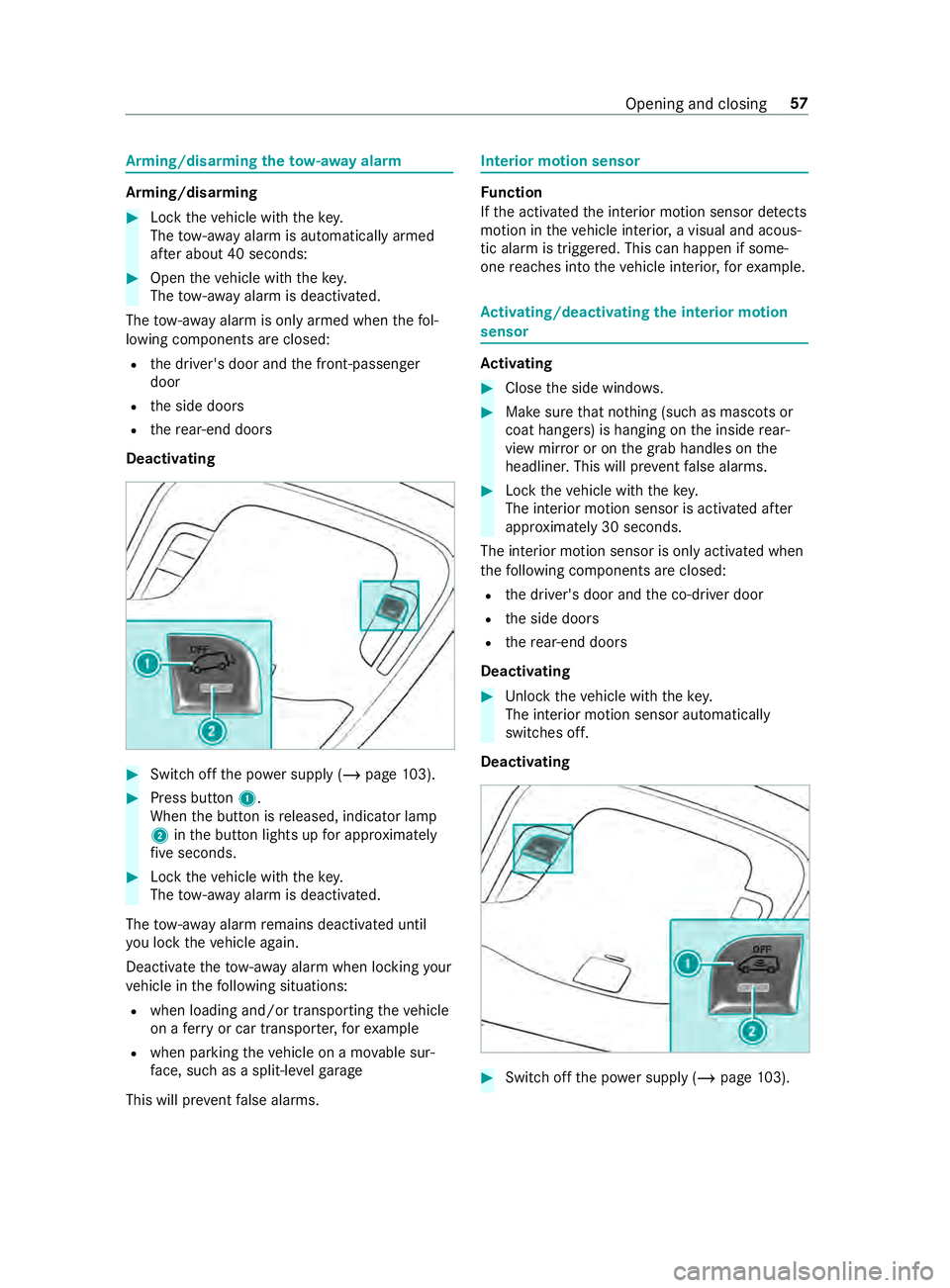
Deactivating #
Swit choff the po wer supply (/ page103). #
Press but ton1.
When the button is released, indicator lamp
2 inthe button lights up for appro ximately
fi ve seconds. #
Lock theve hicle with thekey.
The tow- aw ay alarm is deactivated.
The tow- aw ay alarm remains deactivated until
yo u lock theve hicle again.
Deactivate theto w- aw ay alarm when locking your
ve hicle in thefo llowing situations:
R when loading and/or transporting theve hicle
on a ferry or car transpor ter,fo rex ample
R when parking theve hicle on a mo vable sur‐
fa ce, such as a split-le velga rage
This will pr eventfalse alarms. Interior motion sensor
Fu
nction
If th e activated the interior motion sensor de tects
motion in theve hicle interior, a visual and acous‐
tic alarm is triggered. This can happen if some‐
one reaches into theve hicle interior, forex ample. Ac
tivating/deactivating the in terior motion
sensor Ac
tivating #
Close the side windo ws. #
Make sure that no thing (such as masc ots or
coat hangers) is hanging on the inside rear‐
view mir ror or on the grab handles on the
headliner. This will pr event false alarms. #
Lock theve hicle with thekey.
The interior motion sensor is activated af ter
appr oximately 30 seconds.
The interior motion sensor is only activated when
th efo llowing components are closed:
R the driver's door and the co-driver door
R the side doors
R there ar-end doors
Deactivating #
Unlock theve hicle with thekey.
The interior motion sensor automatically
switches off.
Deactivating #
Switch off the po wer supply (/ page103). Opening and closing
57
Page 82 of 354
#
Press button 1.
When the button is released, indicator lamp
2 inthe button lights up for about five sec‐
onds. #
Lock theve hicle with thekey.
The interior motion sensor is deactivated.
The interior motion sensor remains deactivated
until you lock theve hicle again.
Deactivate the interior motion sensor when lock‐
ing your vehicle in thefo llowing situations:
R ifth ere are people or animals remaining
inside
R ifth e side windo wsremain open
R when transporting theve hicle on a ferry or
car transpor ter,fo rex ample
This will pr eventfalse alarms. 58
Opening and closing
Page 83 of 354
Cor
rect driver's seat position &
WARNING Risk of inju ryfrom adju sting
th eve hicle settings while theve hicle is in
motion
Yo u could lose control of theve hicle in the
fo llowing situations:
R ifyo u adjust the driver's seat, the head
re stra int, thesteering wheel or the mir ror
while theve hicle is in motion
R ifyo ufast enyour seat belt while theve hi‐
cle is in motion #
Before starting the engine: adjust the
driver's seat, the head restra int, the
st eering wheel or the mir ror and fasten
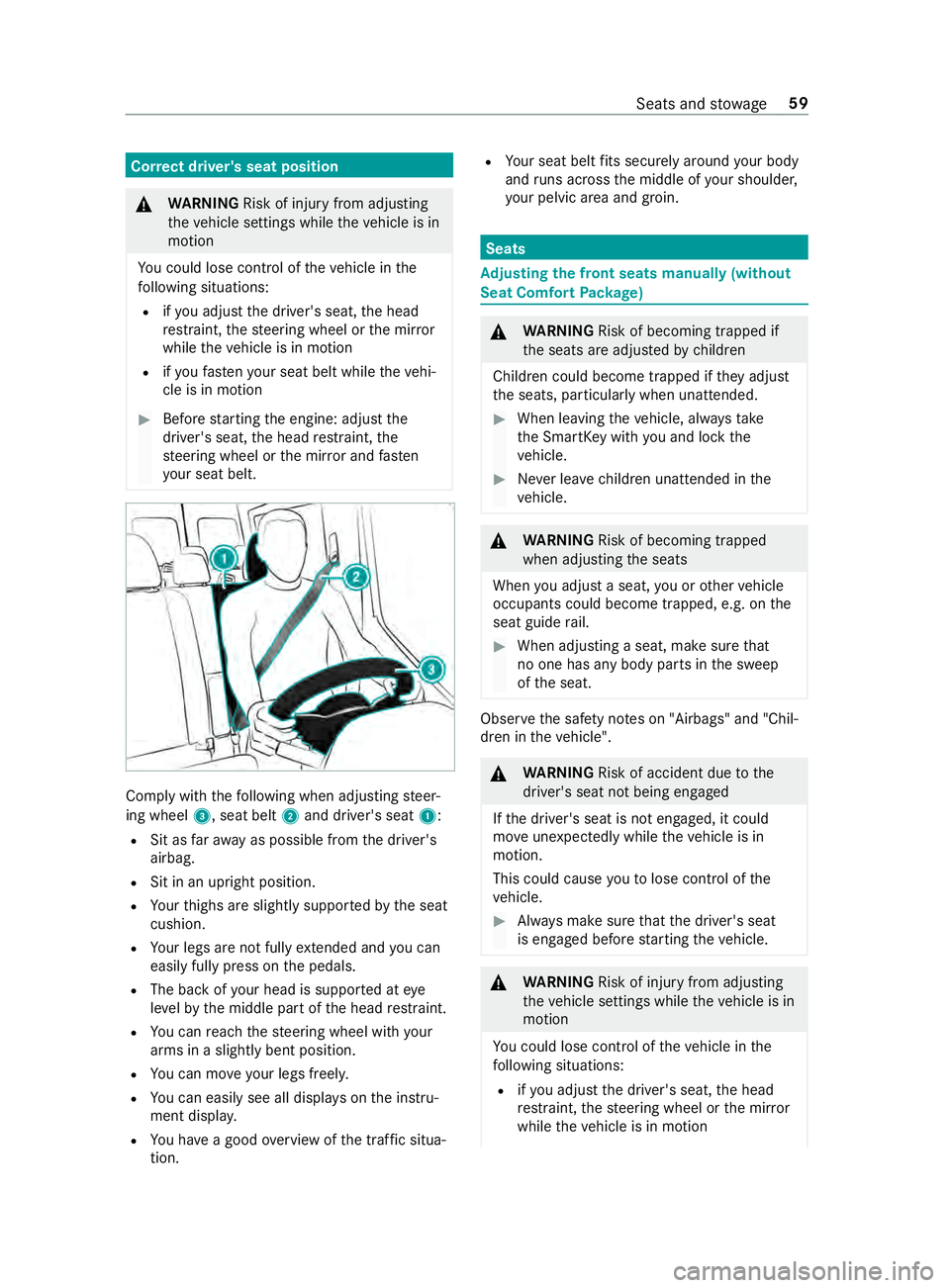
yo ur seat belt. Comply with
thefo llowing when adjusting steer‐
ing wheel 3, seat belt 2and driver's seat 1:
R Sit as faraw ay as possible from the driver's
airbag.
R Sit in an upright position.
R Your thighs are slight lysuppor tedby the seat
cushion.
R Your legs are not fully extended and you can
easily fully press on the pedals.
R The back of your head is suppo rted at eye
le ve lby the middle part of the head restra int.
R You can reach thesteering wheel with your
arms in a slightly bent position.
R You can mo veyour legs freel y.
R You can easily see all displ ays on the instru‐
ment displa y.
R You ha vea good overview of the traf fic situa‐
tion. R
Your seat belt fits securely around your body
and runs across the middle of your shoulder,
yo ur pelvic area and groin. Seats
Ad
justing the front seats manually (without
Seat Comfort Package) &
WARNING Risk of becoming trapped if
th e seats are adjus tedby children
Children could become trapped if they adjust
th e seats, particular lywhen unat tended. #
When le aving theve hicle, alw aysta ke
th e SmartK eywith you and lock the
ve hicle. #
Never lea vechildren unat tended in the
ve hicle. &
WARNING Risk of becoming trapped
when adjusting the seats
When you adjust a seat, you or other vehicle
occupants could become trapped, e.g. on the
seat guide rail. #
When adjusting a seat, make sure that
no one has any body parts in the sweep
of the seat. Obser
vethe saf ety no tes on "Airbags" and "Chil‐
dren in theve hicle". &
WARNING Risk of accident due tothe
driver's seat not being engaged
If th e driver's seat is not engaged, it could
mo veunexpectedly while theve hicle is in
motion.
This could cause youto lose control of the
ve hicle. #
Always make sure that the driver's seat
is engaged before starting theve hicle. &
WARNING Risk of inju ryfrom adju sting
th eve hicle settings while theve hicle is in
motion
Yo u could lose control of theve hicle in the
fo llowing situations:
R ifyo u adjust the driver's seat, the head
re stra int, thesteering wheel or the mir ror
while theve hicle is in motion Seats and
stowage 59
Page 85 of 354
Ad
justing the front seats manually (with Seat
Comfort Package) &
WARNING Risk of becoming trapped if
th e seats are adjus tedby children
Children could become trapped if they adjust
th e seats, particularly when unattended. #
When leaving theve hicle, alw aysta ke
th e SmartK eywith you and lock the
ve hicle. #
Never lea vechildren unat tended in the
ve hicle. &
WARNING Risk of becoming trapped
when adjusting the seats
When you adjust a seat, you or other vehicle
occupants could become trapped, e.g. on the
seat guide rail. #
When adjusting a seat, make sure that
no one has any body parts in the sweep
of the seat. Obser
vethe saf ety no tes on "Airbags" and "Chil‐
dren in theve hicle". &
WARNING Risk of accident due tothe
driver's seat not being engaged
If th e driver's seat is not engaged, it could
mo veunexpectedly while theve hicle is in
motion.
This could cause youto lose control of the
ve hicle. #
Always make sure that the driver's seat
is engaged before starting theve hicle. &
WARNING Risk of inju ryfrom adju sting
th eve hicle settings while theve hicle is in
motion
Yo u could lose control of theve hicle in the
fo llowing situations:
R ifyo u adjust the driver's seat, the head
re stra int, thesteering wheel or the mir ror
while theve hicle is in motion
R ifyo ufast enyour seat belt while theve hi‐
cle is in motion #
Before starting the engine: adjust the
driver's seat, the head restra int, the
st eering wheel or the mir ror and fasten
yo ur seat belt. &
WARNING Risk of becoming trapped if
th e seat height is adjus ted carelessly
If yo u adjust the seat height carelessly, you or
ot her vehicle occupants could be trapped and
th ereby injured.
Children in particular could accidentally press
th e electrical seat adjustment buttons and
become trapped. #
While moving the seats, make sure that
hands or other body parts do not get
under the le ver assembly of the seat
adjustment sy stem. &
WARNING Risk of inju rydue tohead
re stra ints which are not ins talled or are
adjus ted incor rectly
If head restra ints are not ins talled or are
adjus ted incor rectly, the head restra ints can‐
not pr ovide pr otection as intended.
There is an increased risk of injury in the
head and neck area, e.g. in theeve nt of an
accident or when braking. #
Always drive with the head restra ints
ins talled. #
Before driving off, make sure forev ery
ve hicle occupant that the center of the
head restra int supports the back of the
head at about eye le vel. Do not inter
change the head restra ints of the
front and rear seats. Otherwise, you will not be
able toadjust the height and angle of the head
re stra ints cor rectl y.
Ad just the head restra int fore -and-aft position so
th at it is as close as possible tothe back of your
head. &
WARNING Risk of inju ryor death due to
incor rect seat position
The seat belt does not of ferth e intended le vel
of pr otection if you ha venot mo vedth e seat
backrest toan almost vertical position.
When braking or in theeve nt of an accident,
yo u could slide unde rneath the seat belt and
sus tain abdominal or neck injuries, forex am‐
ple. #
Adjust the seat properly before begin‐
ning your journe y. #
Always ensure that the seat backrest is
in an almost vertical position and that Seats and
stowage 61
Page 86 of 354
th
e shoulder section of your seat belt is
ro uted across the center of your shoul‐
der. *
NO
TEDama getothe seats when moving
th e seats back The seats may be damaged
byobjects when
moving the seats bac k. #
When moving the seats bac k,make sure
th at there are no objects in thefo ot we ll,
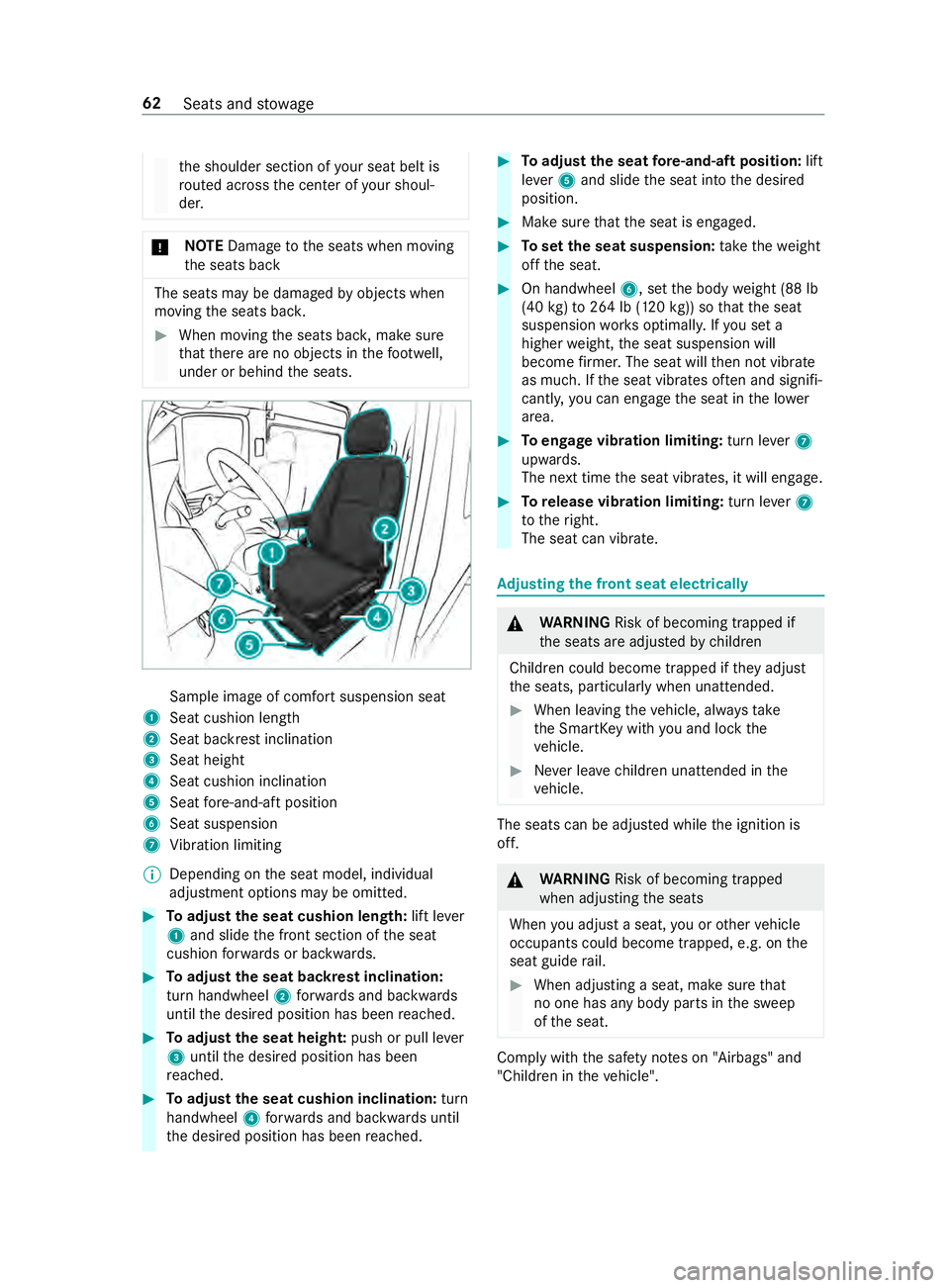
under or behind the seats. Sample image of comfort suspension seat
1 Seat cushion length
2 Seat backrest inclination
3 Seat height
4 Seat cushion inclination
5 Seat fore -and-aft position
6 Seat suspension
7 Vibration limiting
% Depending on
the seat model, individual
adjustment options may be omitted. #
Toadjust the seat cushion length: lift lever
1 and slide the front section of the seat
cushion forw ards or backwards. #
Toadjust the seat backrest inclination:
turn handwheel 2forw ards and backwards
until the desired position has been reached. #
Toadjust the seat heigh t:push or pull le ver
3 until the desired position has been
re ached. #
Toadjust the seat cushion inclination: turn
handwheel 4forw ards and backwards until
th e desired position has been reached. #
Toadjust the seat fore -and-aft position: lift
le ve r5 and slide the seat into the desired
position. #
Make sure that the seat is engaged. #
Toset the seat suspension: take thewe ight
off the seat. #
On handwheel 6, setthe body weight (88 lb
(40 kg)to 264 lb (120 kg)) so that the seat
suspension works optimall y.Ifyo u set a
higher weight, the seat suspension will
become firm er. The seat will then not vibrate
as much. If the seat vibrates of ten and signifi‐
cantly, you can engage the seat in the lo wer
area. #
Toengage vibration limiting: turn lever7
upwards.
The next time the seat vibrates, it will engage. #
Torelease vibration limiting: turn lever7
to theright.
The seat can vibrate. Ad
justing the front seat electrically &
WARNING Risk of becoming trapped if
th e seats are adjus tedby children
Children could become trapped if they adjust
th e seats, particularly when unattended. #
When leaving theve hicle, alw aysta ke
th e SmartK eywith you and lock the
ve hicle. #
Never lea vechildren unat tended in the
ve hicle. The seats can be adjus
ted while the ignition is
off. &
WARNING Risk of becoming trapped
when adjusting the seats
When you adjust a seat, you or other vehicle
occupants could become trapped, e.g. on the
seat guide rail. #
When adjusting a seat, make sure that
no one has any body parts in the sweep
of the seat. Comply with
the saf ety no tes on "Airbags" and
"Children in theve hicle". 62
Seats and stowage
Page 88 of 354
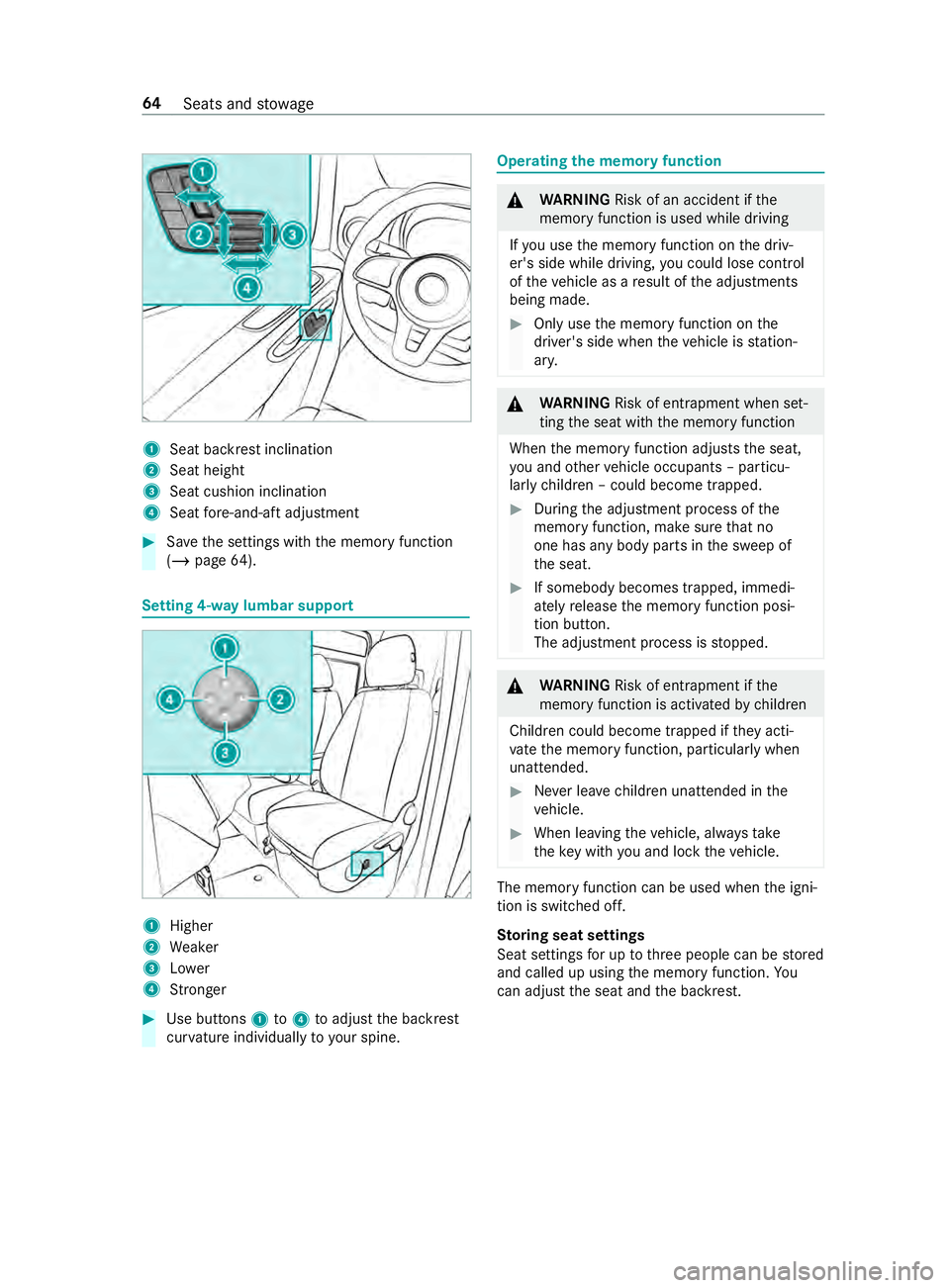
1
Seat ba ckrest inclination
2 Seat height
3 Seat cushion inclination
4 Seat fore -and-aft adjustment #
Save the settings with the memory function
(/ page 64). Setting 4-w
aylumbar support 1
Higher
2 Weaker
3 Lower
4 Stronger #
Use buttons 1to4 toadjust the backrest
cur vature individual lyto yo ur spine. Operating
the memory function &
WARNING Risk of an accident if the
memory function is used while driving
If yo u use the memory function on the driv‐
er's side while driving, you could lose control
of theve hicle as a result of the adjustments
being made. #
Only use the memory function on the
driver's side when theve hicle is station‐
ar y. &
WARNING Risk of entrapment when set‐
ting the seat with the memory function
When the memory function adjusts the seat,
yo u and other vehicle occupants – particu‐
lar lych ildren – could become trapped. #
During the adjustment process of the
memory function, make sure that no
one has any body parts in the sweep of
th e seat. #
If somebody becomes trapped, immedi‐
ately release the memory function posi‐
tion button.
The adjustment process is stopped. &
WARNING Risk of entrapment if the
memory function is activated bychildren
Children could become trapped if they acti‐
va te the memory function, particularly when
unattended. #
Never lea vechildren unat tended in the
ve hicle. #
When leaving theve hicle, alw aysta ke
th eke y with you and lock theve hicle. The memory function can be used when
the igni‐
tion is switched off.
St oring seat settings
Seat settings for up tothre e people can be stored
and called up using the memory function. Yo u
can adjust the seat and the backrest. 64
Seats and stowage
Page 90 of 354
Ad
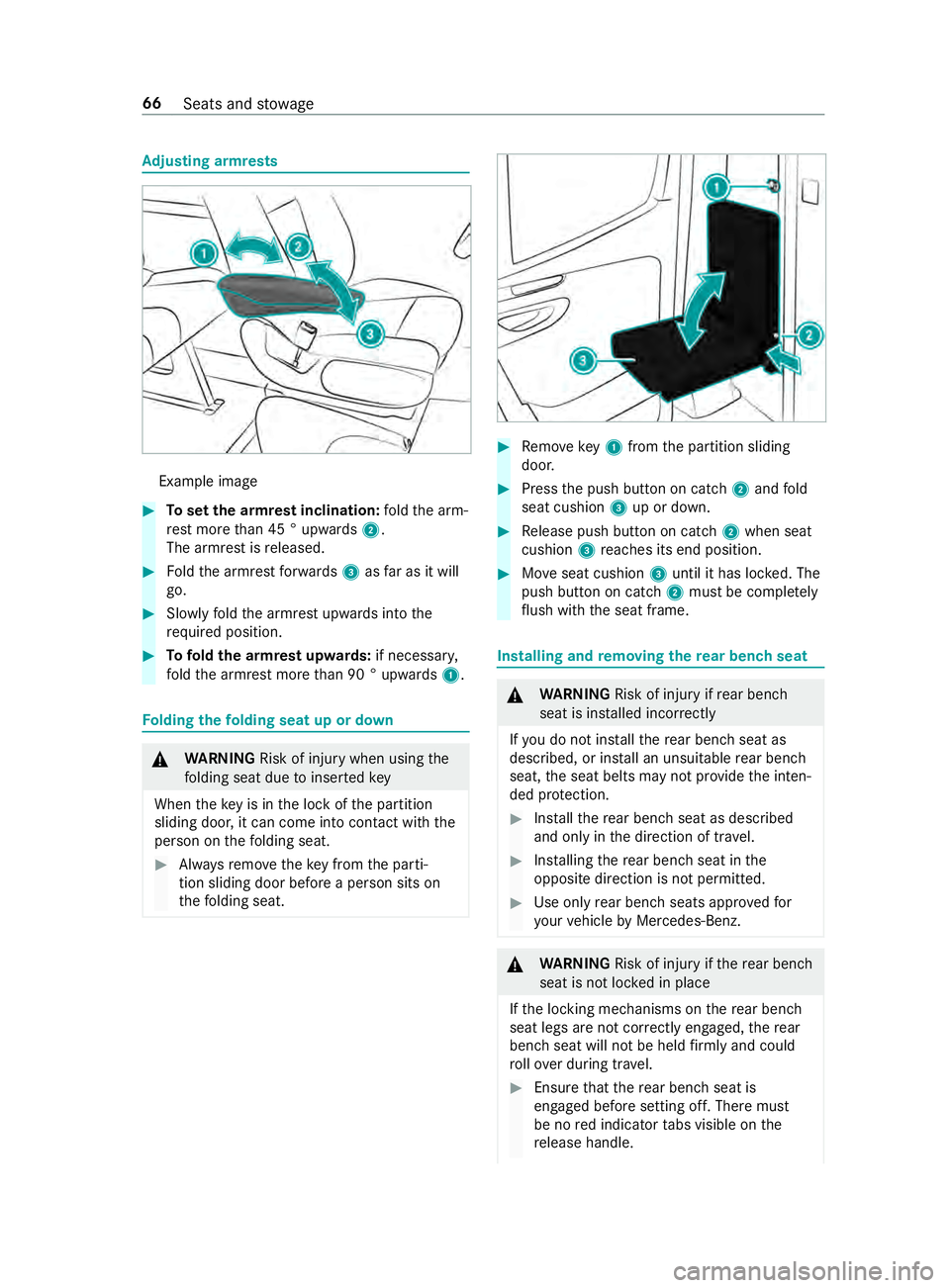
justing armrests Example ima
ge #
Toset the armrest inclination: fold the arm‐
re st more than 45 ° upwards 2.
The armrest is released. #
Foldthe armrest forw ards 3asfar as it will
go. #
Slowly fold the armrest upwards into the
re qu ired position. #
Tofold the armrest up wards: if necessar y,
fo ld the armrest more than 90 ° upwards 1. Fo
lding thefo lding seat up or down &
WARNING Risk of inju rywhen using the
fo lding seat due toinser tedkey
When theke y is in the lock of the partition
sliding door, it can come into contact with the
person on thefo lding seat. #
Alwaysre mo vetheke y from the parti‐
tion sliding door before a person sits on
th efo lding seat. #
Remo vekey1 from the partition sliding
door. #
Press the push button on catch 2and fold
seat cushion 3up or down. #
Release push button on cat ch2 when seat
cushion 3reaches its end position. #
Moveseat cushion 3until it has loc ked. The
push button on catch 2must be comple tely
fl ush with the seat frame. Installing and
removing the rear ben chseat &
WARNING Risk of inju ryifre ar ben ch
seat is ins talled incor rectly
If yo u do not ins tallth ere ar ben chseat as
described, or ins tall an unsuitable rear ben ch
seat, the seat belts may not pr ovide the inten‐
ded pr otection. #
Installth ere ar ben chseat as described
and only in the direction of tra vel. #
Installing there ar ben chseat in the
opposite direction is not permitted. #
Use only rear ben chseats appr ovedfor
yo ur vehicle byMercedes-Benz. &
WARNING Risk of inju ryifth ere ar ben ch
seat is not loc ked in place
If th e locking mechanisms on there ar ben ch
seat legs are not cor rectly engaged, there ar
ben chseat will not be held firm lyand could
ro llove r during tr avel. #
Ensure that there ar ben chseat is
engaged before setting off. There must
be no red indicator tabs visible on the
re lease handle. 66
Seats and stowage
Page 93 of 354
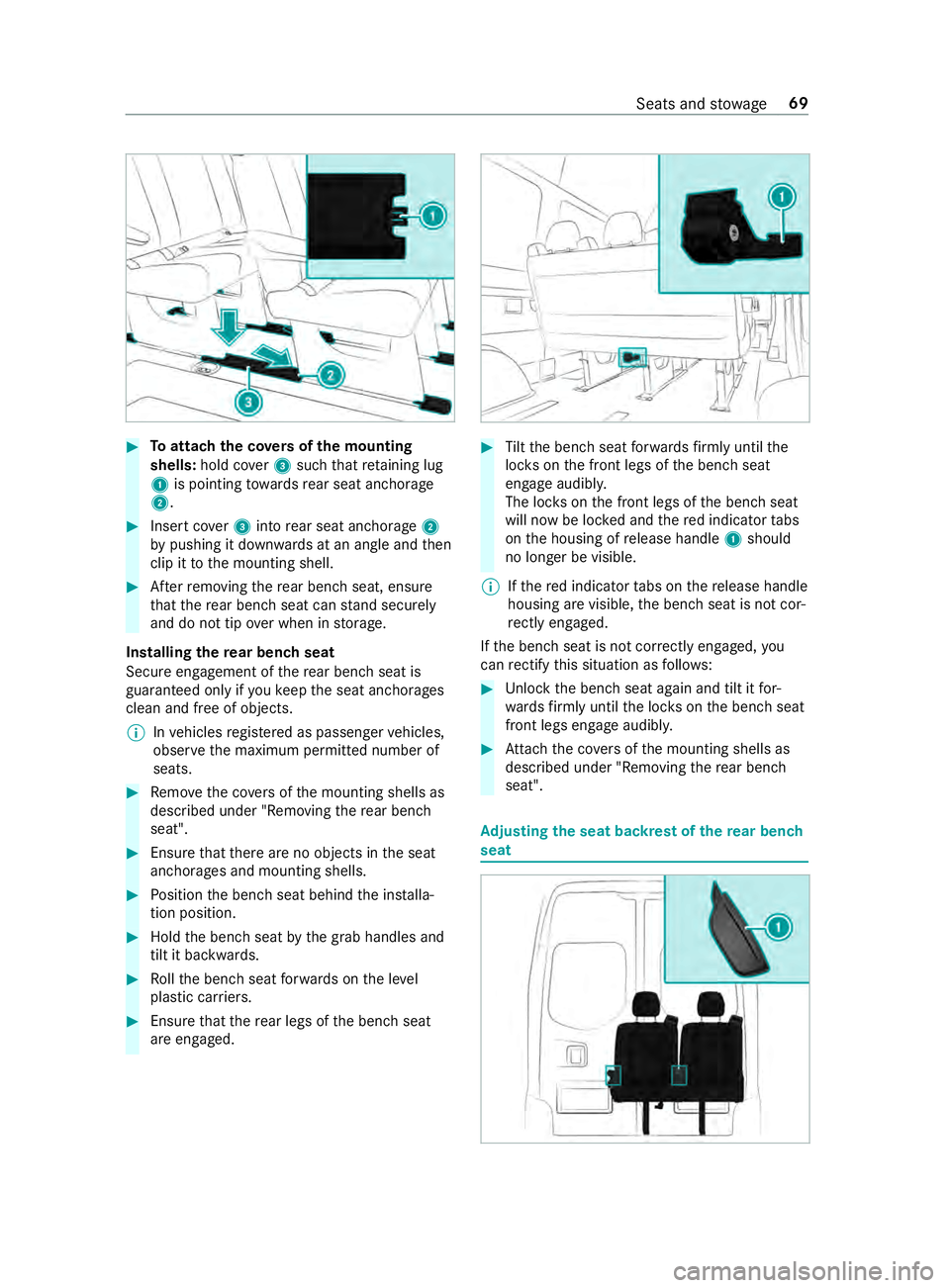
#
Toattach the co vers of the mounting
shells: hold cover3 such that retaining lug
1 is pointing towa rdsre ar seat anchorage
2. #
Insert co ver3 into rear seat anchorage 2
by pushing it down wards at an angle and then
clip it tothe mounting shell. #
Afterre moving there ar ben chseat, ensure
th at there ar ben chseat can stand securely
and do not tip over when in storage.
Installing there ar ben chseat
Secure engagement of there ar ben chseat is
guaranteed only if youke ep the seat anchorages
clean and free of objects.
% In
vehicles regis tere d as passenger vehicles,
obser vethe maximum permitted number of
seats. #
Remo vethe co vers of the mounting shells as
described under "Removing there ar ben ch
seat". #
Ensure that there are no objects in the seat
anchorages and mounting shells. #
Position the bench seat behind the ins talla‐
tion position. #
Hold the bench seat bythe grab handles and
tilt it backwards. #
Rollth e bench seat forw ards on the le vel
plastic car riers. #
Ensure that there ar legs of the bench seat
are engaged. #
Tilt th e bench seat forw ards firm lyuntil the
loc kson the front legs of the bench seat
engage audibly.
The loc kson the front legs of the bench seat
will now be loc ked and there d indicator tabs
on the housing of release handle 1should
no longer be visible.
% If
th ere d indicator tabs on there lease handle
housing are visible, the bench seat is not cor‐
re ctly engaged.
If th e bench seat is not cor rectly engaged, you
can rectify this situation as follo ws: #
Unlock the bench seat again and tilt it for‐
wa rdsfirm ly until the loc kson the bench seat
front legs engage audibly. #
Attach the co vers of the mounting shells as
described under "Removing there ar ben ch
seat". Ad
justing the seat backrest of the rear ben ch
seat Seats and
stowage 69
Page 95 of 354
To
protect against overheating, the seat heating
may be temp orarily deactivated af ter it is
switched on repeatedly.
* NO
TEDama getothe seats caused by
objects or documents when the seat
heater is switched on When
the seat heater is switched on, over‐
heating can occur due toobjects or docu‐
ments placed on the seats e.g. seat cushions
or child seats. This could cause damage to
th e seat sur face. #
Make sure that no objects or docu‐
ments are on the seats when the seat
heater is switched on. Re
quirements:
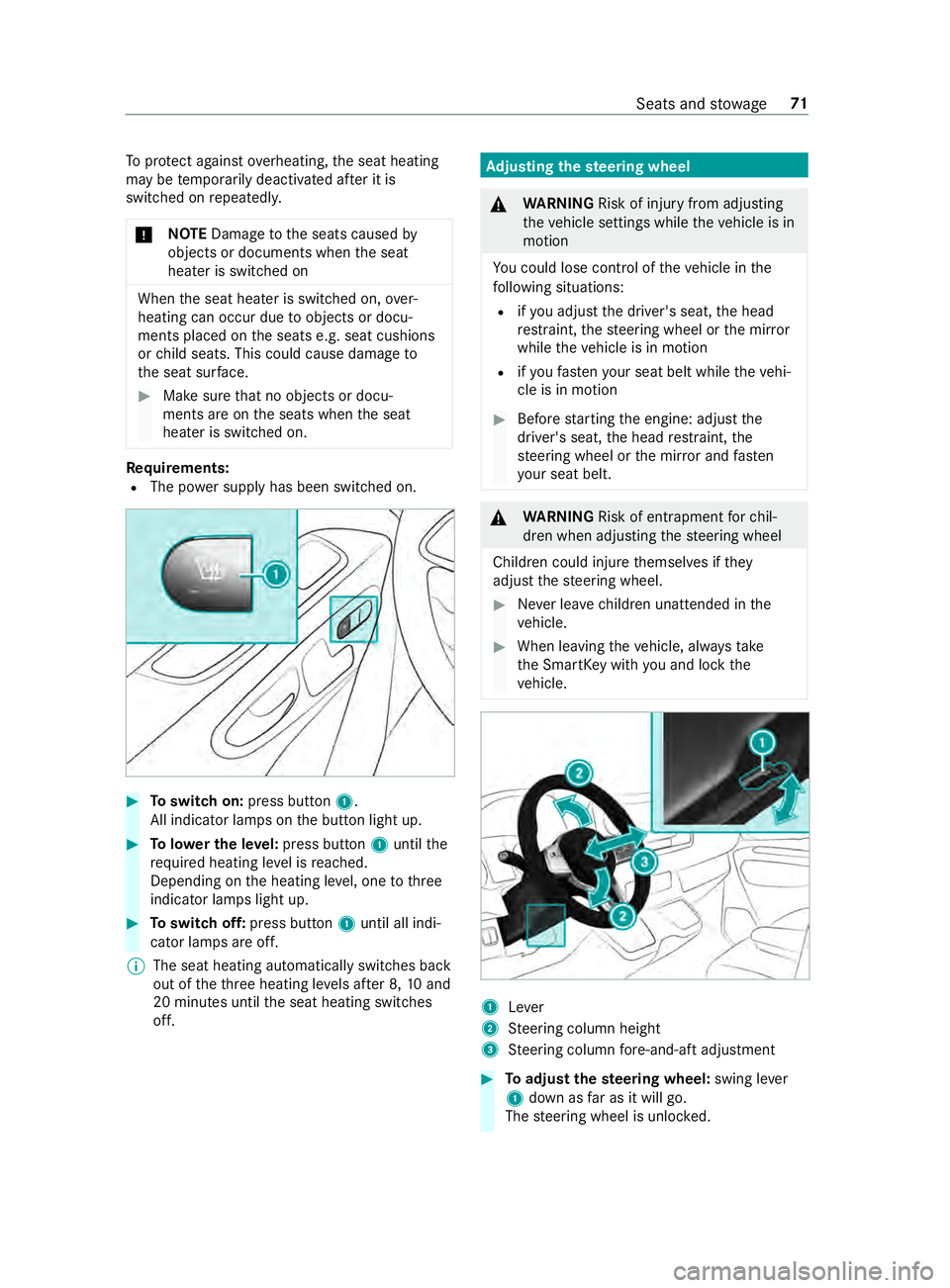
R The po wer supp lyhas been switched on. #
Toswitch on: press button 1.
All indicator lamps on the button light up. #
Tolowe r the le vel:press button 1until the
re qu ired heating le vel is reached.
Depending on the heating le vel, one tothree
indicator lamps light up. #
Toswitch off: press button 1until all indi‐
cator lamps are off.
% The seat heating automatically switches back
out of
theth re e heating le vels af ter 8, 10and
20 minutes until the seat heating switches
off. Ad
justing the steering wheel &
WARNING Risk of inju ryfrom adju sting
th eve hicle settings while theve hicle is in
motion
Yo u could lose control of theve hicle in the
fo llowing situations:
R ifyo u adjust the driver's seat, the head
re stra int, thesteering wheel or the mir ror
while theve hicle is in motion
R ifyo ufast enyour seat belt while theve hi‐
cle is in motion #
Before starting the engine: adjust the
driver's seat, the head restra int, the
st eering wheel or the mir ror and fasten
yo ur seat belt. &
WARNING Risk of entrapment forch il‐
dren when adjusting thesteering wheel
Children could injure themselves if they
adjust thesteering wheel. #
Never lea vechildren unat tended in the
ve hicle. #
When leaving theve hicle, alw aysta ke
th e SmartK eywith you and lock the
ve hicle. 1
Lever
2 Steering column height
3 Steering column fore -and-aft adjustment #
Toadjust thest eering wheel: swing lever
1 down as far as it will go.
The steering wheel is unloc ked. Seats and
stowage 71
Page 97 of 354
pants). The
values are specified on theve hi‐
cle identification plate on the B-pillar.
R the load must not pr otru de abo vethe upper
edge of the seat backrests.
R if possible, alw ays transport the load in the
cargo compa rtment.
R fastenthe load tothe tie-down eyes and
spread the load as evenly as possible.
R use tie-down eyes and fastening components
which are suitable forth ewe ight and size of
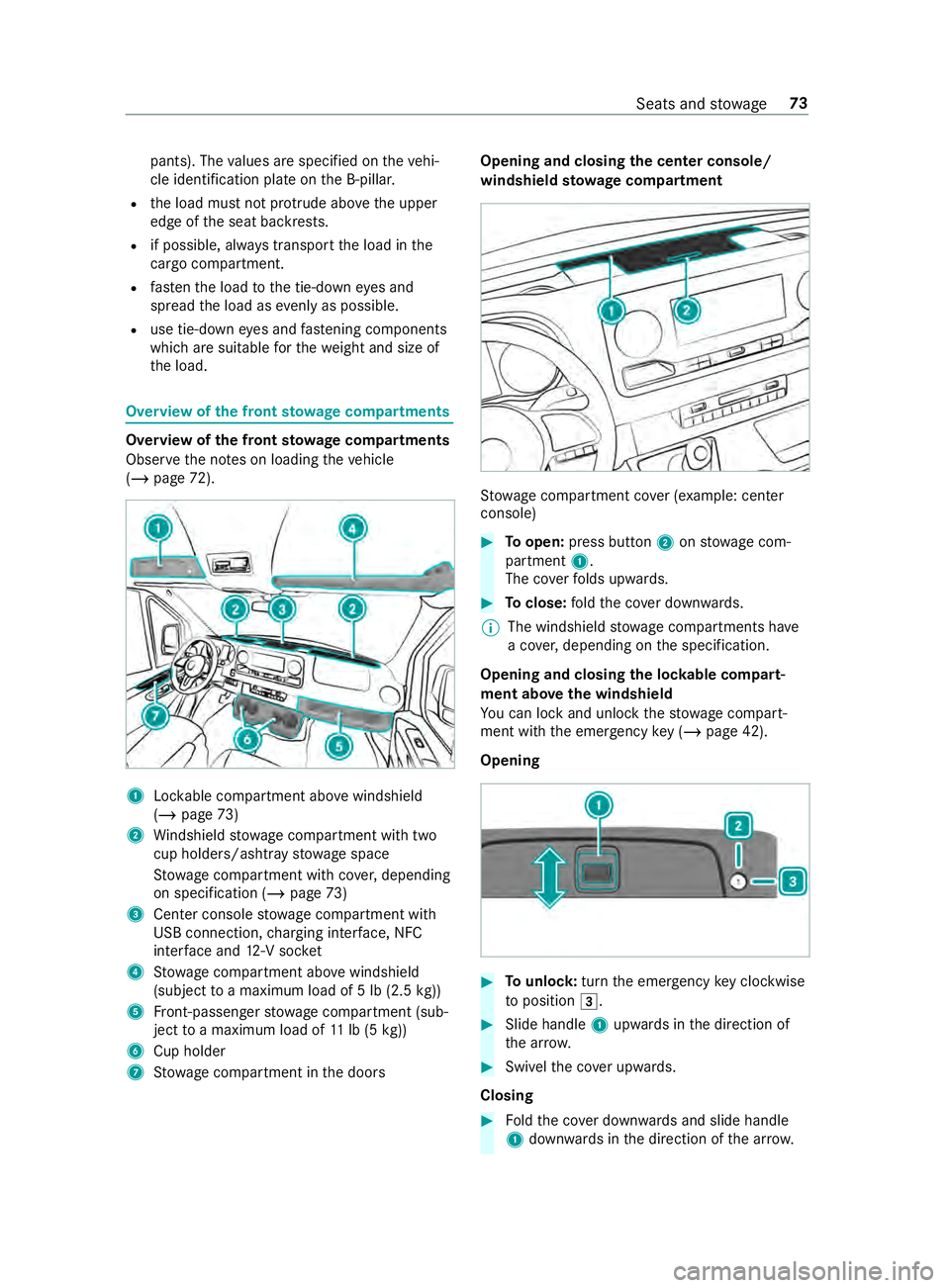
th e load. Overview of
the front stowage compa rtments Overvi
ewofthe front stowage compa rtments
Obser vethe no tes on loading theve hicle
(/ page 72). 1
Lockable compartment abo vewindshield
(/ page 73)
2 Windshield stowage compartment with two
cup holde rs/ashtr aystow age space
St ow age compartment with co ver,depending
on specification (/ page73)
3 Center console stowage compartment with
USB connection, charging inter face, NFC
inter face and 12-V soc ket
4 Stow age compartment abo vewindshield
(subject toa maximum load of 5 lb (2.5 kg))
5 Front-passenger stowage compartment (sub‐
ject toa maximum load of 11lb (5 kg))
6 Cup holder
7 Stow age compartment in the doors Opening and closing
the center console/
windshield stowage compa rtment St
ow age compartment co ver (e xamp le: cen ter
console) #
Toopen: press button 2onstow age com‐
partment 1.
The co verfo lds upwards. #
Toclose: fold the co ver down wards.
% The windshield
stowage compartments ha ve
a co ver,depending on the specification.
Opening and closing the loc kable compart‐
ment abo vethe windshield
Yo u can lock and unlo ck thestow age compart‐
ment with the emer gency key (/ page 42).
Opening #
Tounlo ck:turn the emer gency key clo ckwise
to position 0049. #
Slide handle 1upwards in the direction of
th e ar row. #
Swivelth e co ver upwards.
Closing #
Foldthe co ver down wards and slide handle
1 down wards inthe direction of the ar row. Seats and
stowage 73