light MERCEDES-BENZ SPRINTER 2019 MY19 with 7” screen
[x] Cancel search | Manufacturer: MERCEDES-BENZ, Model Year: 2019, Model line: SPRINTER, Model: MERCEDES-BENZ SPRINTER 2019Pages: 354, PDF Size: 6.15 MB
Page 147 of 354
Ra
ising and lo weringtheve hicle le vel Using
there mo tecontrol
The remo tecontrol is loca ted in a holder on the
B‑pillar on the driver's side. Remo vethere mo te
control from the holder before use. Elect
ronic le vel control per form s a self-check reg‐
ularly when it is activated and while in use. Indi‐
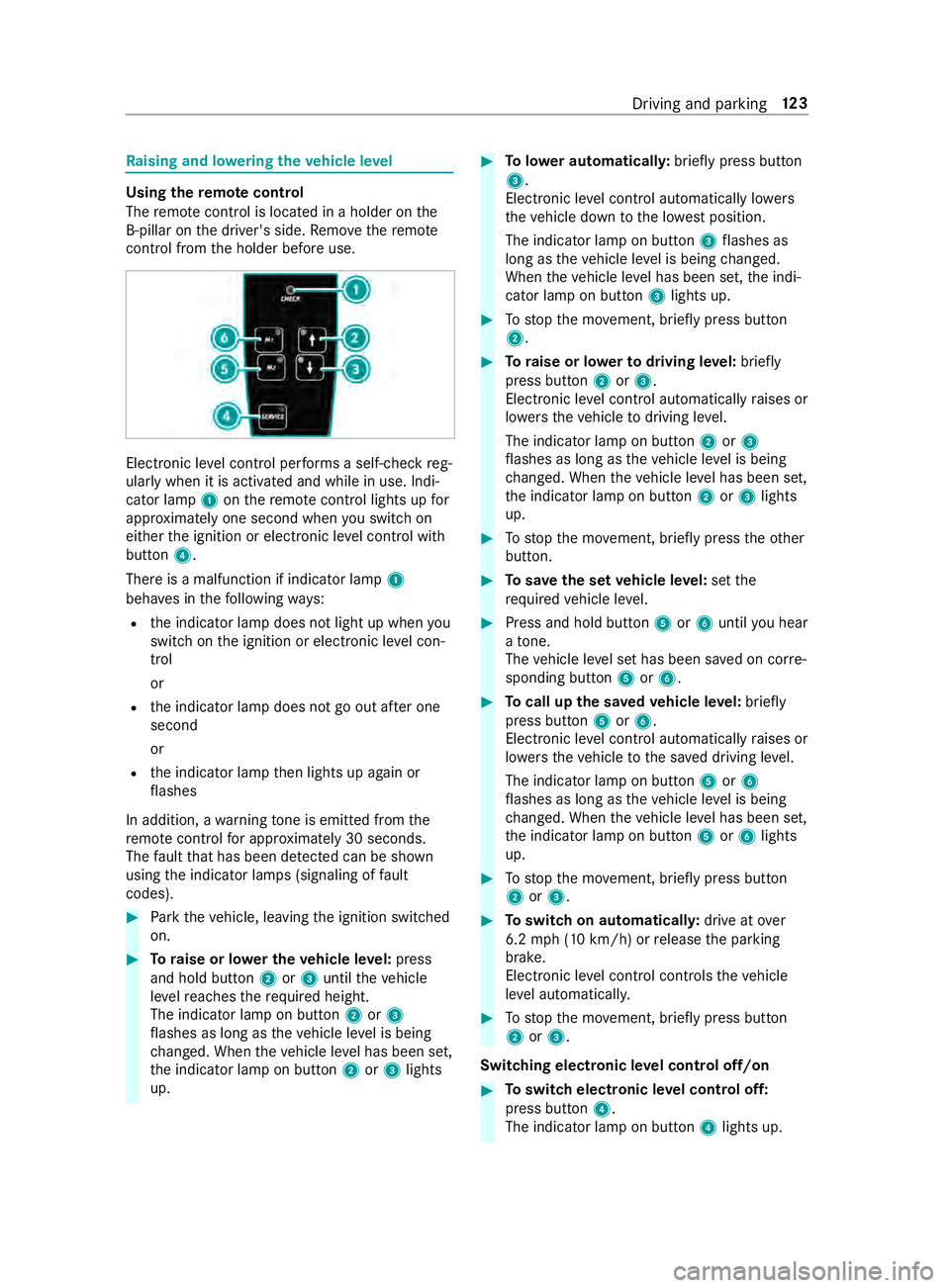
cator lamp 1onthere mo tecontrol lights up for
appr oximately one second when you swit chon
either the ignition or electronic le vel control with
button 4.
There is a malfunction if indicator lamp 1
beha ves in thefo llowing ways:
R the indicator lamp does not light up when you
switch on the ignition or electronic le vel con‐
trol
or
R the indicator lamp does not go out af ter one
second
or
R the indicator lamp then lights up again or
fl ashes
In addition, a warning tone is emitted from the
re mo tecontrol for appro ximately 30 seconds.
The fault that has been de tected can be shown
using the indicator lamps (signaling of fault
codes). #
Park theve hicle, leaving the ignition switched
on. #
Toraise or lo wer the vehicle le vel:press
and hold button 2or3 until theve hicle
le ve lre aches therequ ired height.
The indicator lamp on button 2or3
fl ashes as long as theve hicle le vel is being
ch anged. When theve hicle le vel has been set,
th e indicator lamp on button 2or3 lights
up. #
Tolowe r automatical ly:brie fly press but ton
3 .
Electronic le vel control automatically lo wers
th eve hicle down tothe lo west position.
The indicator lamp on button 3flashes as
long as theve hicle le vel is being changed.
When theve hicle le vel has been set, the indi‐
cator lamp on button 3lights up. #
Tostop the mo vement, brief lypress button
2. #
Toraise or lo werto driving le vel:brief ly
press button 2or3.
Elect ronic le vel control automatically raises or
lo we rstheve hicle todriving le vel.
The indicator lamp on button 2or3
fl ashes as long as theve hicle le vel is being
ch anged. When theve hicle le vel has been set,
th e indicator lamp on button 2or3 lights
up. #
Tostop the mo vement, brief lypress theot her
button. #
Tosave the set vehicle le vel:set the
re qu ired vehicle le vel. #
Press and hold button 5or6 until you hear
a to ne.
The vehicle le vel set has been sa ved on cor re‐
sponding button 5or6. #
Tocall up the sa vedve hicle le vel:briefly
press button 5or6.
Electronic le vel control automatically raises or
lo we rstheve hicle tothe sa ved driving le vel.
The indicator lamp on button 5or6
fl ashes as long as theve hicle le vel is being
ch anged. When theve hicle le vel has been set,
th e indicator lamp on button 5or6 lights
up. #
Tostop the mo vement, brief lypress button
2 or3. #
Toswitch on automaticall y:drive at over
6.2 mph (10 km/h) or release the parking
brake.
Elect ronic le vel control controls theve hicle
le ve l automaticall y. #
Tostop the mo vement, brief lypress button
2 or3.
Switching electronic le vel control off/on #
Toswitch electronic le vel control off:
press button 4.
The indicator lamp on button 4lights up. Driving and parking
12 3
Page 157 of 354

Obser
vethefo llowing points toensure that the
ve hicle is properly secured against rolling away
unin tentionally: #
Always apply the parking brake. #
Vehicles with automatic transmission:
engage transmission position 005D.#
On uphill or downhill inclines: turnthe
front wheels towa rdsth e curb. #
On uphill or downhill inclines: securethe
re ar axle with a chock or an object without
sharp edges.
% Yo
u can operate the side windo wsforfive
minutes af teryo u ha veswitched off theve hi‐
cle. Manual parking brake
Applying/releasing
the handbrake le ver &
WARNING Risk of skidding or an acci‐
dent bybraking with the parking brake
If yo u ha vetobrake your vehicle with the
parking brake, the braking dis tance is consid‐
erab lylonger and the wheels may loc k.There
is an increased risk of skidding and/or acci‐
dent. #
Only brake theve hicle with the parking
brake if the service brake has failed. #
Inthis case, do not apply the parking
brake with too much forc e. #
Ifth e wheels loc k,immediately release
th e parking brake as much as required
fo rth e wheels toturn again. &
WARNING Risk offire and an accident if
th e parking brake is not released
If th e parking brake is not fully released when
driving, thefo llowing situations can occur:
R The parking brake can overheat and cause
a fire
R The parking brake can lose its holding
function #
Comple tely release the parking brake
before driving off. The brake lights do not light up when
you brake
th eve hicle with the parking brake.
Generally, you may only apply the parking brake
when theve hicle is stationar y. #
Toapply the pa rking brake: pull handbrake
le ve r1 up as far as the last possible de tent.
When the engine is running, the0049
and 0024 (USA) or 0024(Canada) indicator
lamps in the Instrument Display light up. If
th eve hicle is in motion, a warning tone
sounds.
% In
vehicles with a folding handbrake le ver,
yo u can then press handbrake le ver1 down
as far as it will go. #
Torelease the pa rking brake: onvehicles
with a folding handbrake le ver,firs t pull hand‐
brake le ver1 up as far as it will go. #
Pull handbrake le ver1 slightly and press
re lease knob 2. #
Guide handbrake le ver1 down toas far as it
will go.
The 0049 and0024 (USA) or 0024(Canada)
indica tor lamps in the Instrument Display go
out.
Fo lding the handbrake le ver up or down (only
in vehicles with a folding handbrake le ver)
Re quirements:
R The handbrake le ver is applied. #
Tofold down the handbrake le ver:push the
handbrake le ver down as far as it will go. #
Toraise the handbrake le ver:pull the hand‐
brake le ver up as far as it will go. Driving and parking
13 3
Page 158 of 354
Pe
rforming emer gency braking with the hand‐
brake le ver If, in
exceptional cases, the service brake fails,
yo u may use the parking brake toper form emer‐
ge ncy braking. #
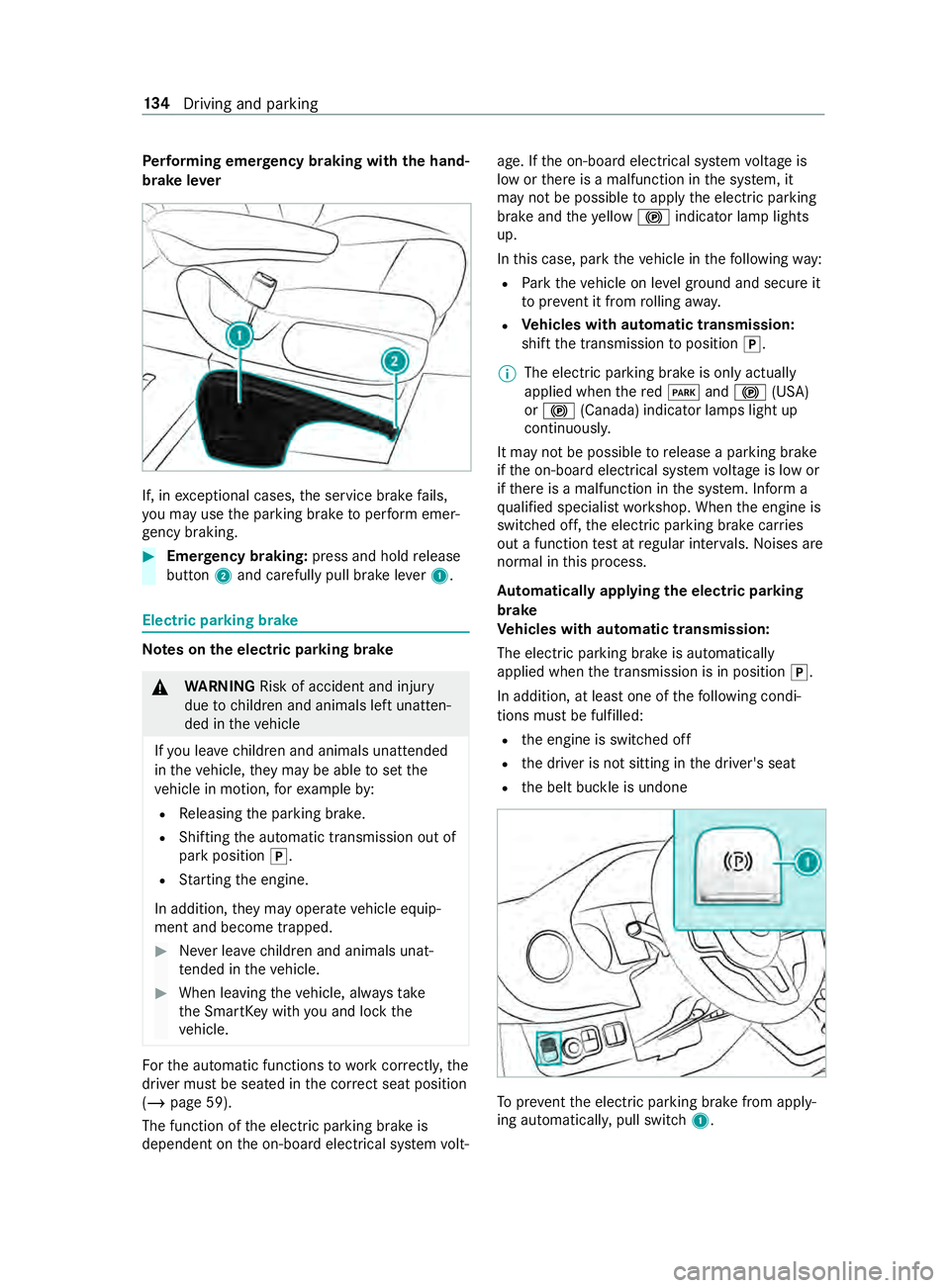
Eme rgency braking: press and hold release
button 2and carefully pull brake le ver1. Electric parking brake
Note
s onthe electric pa rking brake &
WARNING Risk of accident and inju ry
due tochildren and animals left unat ten‐
ded in theve hicle
If yo u lea vechildren and animals unat tended
in theve hicle, they may be able toset the
ve hicle in motion, forex ample by:
R Releasing the parking brake.
R Shifting the automatic transmission out of
park position 005D.
R Starting the engine.
In addition, they may operate vehicle equip‐
ment and become trapped. #
Never lea vechildren and animals unat‐
te nded in theve hicle. #
When leaving theve hicle, alw aysta ke
th e SmartK eywith you and lock the
ve hicle. Fo
rth e automatic functions towo rkcor rectl y,the
driver must be seated in the cor rect seat position
(/ page 59).
The function of the electric parking brake is
dependent on the on-board electrical sy stem volt‐ age. If
the on-board electrical sy stem voltage is
low or there is a malfunction in the sy stem, it
may not be possible toapply the electric parking
brake and theye llow 0024 indicator lamp lights
up.
In this case, park theve hicle in thefo llowing way:
R Park theve hicle on le velground and secure it
to prev ent it from rolling away.
R Ve
hicles with automatic transmission:
shift the transmission toposition 005D.
% The electric parking brake is only actually
applied when
there d0049 and0024 (USA)
or 0024 (Canada) indicator lamps light up
continuousl y.
It may not be possible torelease a parking brake
if th e on-board electrical sy stem voltage is low or
if th ere is a malfunction in the sy stem. Inform a
qu alified specialist workshop. When the engine is
switched off, the electric parking brake car ries
out a function test at regular inter vals. Noises are
normal in this process.
Au tomatically applying the electric parking
brake
Ve hicles with automatic transmission:
The electric parking brake is auto matically
applied when the transmission is in position 005D.
In addition, at least one of thefo llowing condi‐
tions must be fulfilled:
R the engine is switched off
R the driver is not sitting in the driver's seat
R the belt buckle is undone To
prev ent the electric parking brake from apply‐
ing automaticall y,pull switch 1. 134
Driving and pa rking
Page 159 of 354
The electric parking brake is also automatically
applied if Active Dis tance Assi stDISTRONIC has
brought theve hicle toast andstill.
In addition, at least one of thefo llowing condi‐
tions must be fulfilled:
R the engine is switched off
R the driver is not sitting in the driver's seat
R the belt buckle is undone
R there is a sy stem malfunction
R the po wer supply is insuf ficient
R theve hicle is stationary for a long time
The red0049 and0024 (USA) or 0024(Canada)
indicator lamp in the instrument display lights up.
The electric parking brake is only actually applied
when there d0049 and0024 (USA) or 0024
(Canada) indicator lamps light up continuousl y.
Re leasing the electric pa rking brake automat‐
ically
Ve hicles with automatic transmission:
The electric parking brake of your vehicle is
re leased when all of thefo llowing conditions are
fulfilled:
R The driver is sitting in the driver's seat.
R The driver is belted.
R The engine is running.
R The transmission is in position 005Bor005E and
yo u depress the accelera tor
or
Yo u swit chfrom transmission position 005Dto
position 005Bor005E. You must also depress the
accelerator if tra veling on steep uphill gradi‐
ents.
R Ifth e transmission is in position 005E,there ar-
end doors must be closed.
App lying/releasing the electric pa rking brake
manually &
WARNING Risk of accident and inju ry
due tochildren and animals left unat ten‐
ded in theve hicle
If yo u lea vechildren and animals unat tended
in theve hicle, they may be able toset the
ve hicle in motion, forex ample by:
R Releasing the parking brake.
R Shifting the automatic transmission out of
park position 005D. R
Starting the engine.
In addition, they may operate vehicle equip‐
ment and become trapped. #
Never lea vechildren and animals unat‐
te nded in theve hicle. #
When leaving theve hicle, alw aysta ke
th e SmartK eywith you and lock the
ve hicle. #
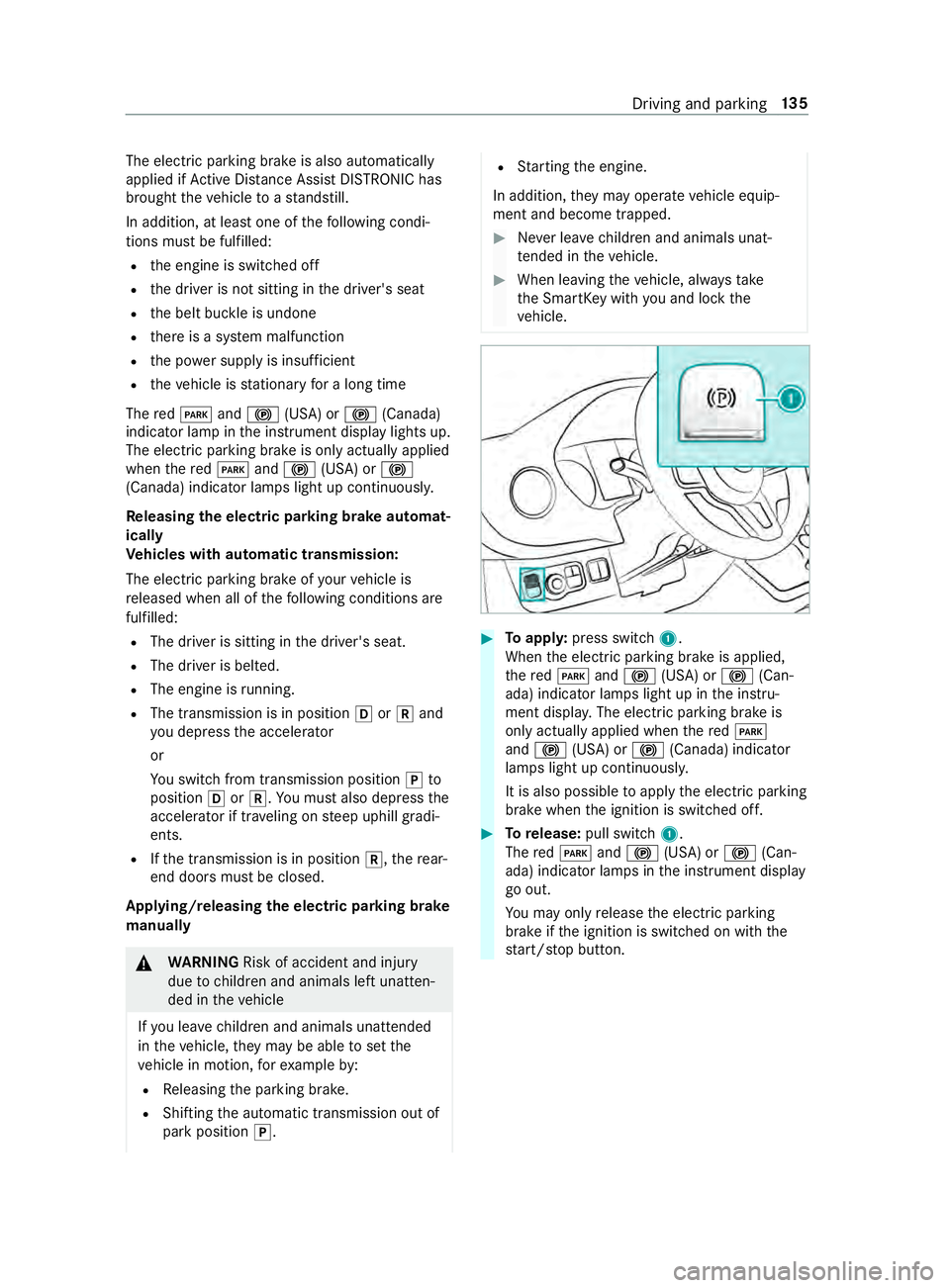
Toappl y:press switch 1.
When the electric parking brake is applied,
th ere d0049 and0024 (USA) or 0024(Can‐
ada) indicator lamps light up in the instru‐
ment displa y.The electric parking brake is
only actually applied when there d0049
and 0024 (USA) or 0024(Canada) indicator
lamps light up continuousl y.
It is also possible toapply the electric parking
brake when the ignition is switched off. #
Torelease: pull switch 1.
The red0049 and0024 (USA) or 0024(Can‐
ada) indicator lamps in the instrument display
go out.
Yo u may on lyrelease the electric parking
brake if the ignition is switched on with the
st art/ stop button. Driving and parking
13 5
Page 161 of 354
Depending on
theve hicle's equipment, thera dar
sensors are integrated behind the bumpers
and/or behind thera diator grill. Keep these parts
free of dirt, ice and slush (/ page212). The se n‐
sors must not be co vered, forex ample bybicycle
ra ck s, overhanging loads or sticke rs. Af ter a colli‐
sion, ha vethe function of thera dar sensors
ch ecked at a qualified specialist workshop as
damage (bo thvisible or non-visible) may ha ve
occur redto the bumper or radiator trim. Fu
nction of driving sy stems and driving
saf ety sy stems In
this section, you will find information about the
fo llowing driving sy stems and driving saf ety sys‐
te ms:
R ABS ( Anti-lock braking system)
(/ page 137)
R ASC (Acceleration SkidControl)
(/ page 137)
R BAS (B rake Assist System) (/ page137)
R ESP ®
(Electronic Stability Program)
(/ page 138)
R EBD ( Electronic Brakeforce Distribution)
(/ page 139)
R Active Brake Assi st (/ page 139)
R Cruise co ntrol (/ page 141)
R Active Dis tance Assi stDISTRONIC
(/ page 143)
R Hill start assist
R HOLD function (/ page145)
R Parking Assist PARKTRONIC ( /page 145)
R Rear view camera (/ page147)
R 360° Camera (/ page149)
R ATTENTION ASSIST (/ page151)
R Blind Sp otAssi st (/ page 152)
R Active Lane Keeping Assist (/ page155) Fu
nctions of ABS (Anti-lock Braking Sy stem) Obser
vethe impor tant sa fety guidelines forthe
driving saf ety sy stem.
ABS cont rols the brake pressure in critical situa‐
tions:
R the wheels are pr evented from lo cking when
braking, e.g. during maximum full-s top brak‐
ing or when there is insuf ficient tire traction. R
thesteerability of theve hicle in term s of
ph ysical possibilities is ensured when brak‐
ing.
R ABS is active from speeds of appr ox. 3 mph
(5 km/h). On a slippery road sur face, ABS
inter venes even if you on lybrake gently.
Sy stem limitations
If th ere is a malfunction and theye llow 0025 ABS
wa rning lamp lights up continuously in the instru‐
ment display af terst arting the engine, ABS may
be impaired or inoperative.
If ABS inter venes, you will feel a pulsing in the
brake pedal. The pulsating brake pedal may be an
indication of hazardous road conditions and func‐
tions as a reminder totake extra care while driv‐
ing.
If ABS in terv enes: keep the brake pedal firm ly
depressed until the braking situation has passed.
To car ryout maximum full-s top braking:
dep ress the brake pedal with full forc e. Fu
nction of BAS (Brake Assist Sy stem) &
WARNING Risk of an accident caused by
a malfunction in BAS (Brake Assi stSys‐
te m)
If BA S is malfunctioning, the braking dis tance
in an emergency braking situation is
increased. #
Depress the brake pedal with full force
in emer gency braking situations. ABS
pr eve nts the wheels from locking. BA
S suppo rts yo u with additional braking forc e in
an emer gency braking situation.
If yo u depress the brake pedal quickl y,BA S is
acti vated:
R BAS au tomatically boosts the braking forc e of
th e brakes
R BAS can sho rten the braking dis tance
R ABS pr events the wheels from locking
When youre lease the brake pedal, the brakes
function as usual again. BAS is deactivated. Fu
nctions of ASR (Acceleration Skid Control) ASR can neither
reduce therisk of an accident
nor override the la wsof ph ysics if the driver does
not pay attention when pulling away or accelerat‐
ing. ASR is only an aid. Alw ays adapt your driving Driving and parking
137
Page 162 of 354
st
yle to suit the pr evailing road and weather con‐
ditions.
If yo u activate or deactivate the all-wheel drive in
a ve hicle with this option, ASR will be deactivated
fo rth e duration of the activation/deactivation
process.
Ve hicles without steering wheel but tons: if
ASR is malfunctioning, the00E5 indicator lamp
lights up while the engine is running and the
engine output may be reduced (/ page 23).
ASR impr oves traction, i.e. the transfer of po wer
from the tires tothero ad sur face, for a sus tained
period and, thereb y,also impr ovesth e driving
st ability of theve hicle. If the driving wheels start
to spin, ASR brakes individual drive wheels and
limits the engine torque. ASRthus significantly
assists you when pulling away and accelerating,
especially on wet or slippe ryroads.
If traction on thero ad sur face is not suf ficient,
eve n ASR will not allow youto pull away without
dif ficulty. The type of tires and totalwe ight of the
ve hicle as well as the gradient of thero ad also
play a crucial role.
If ASR inter venes, the00E5 warning lamp in the
instrument display flashes. Fu
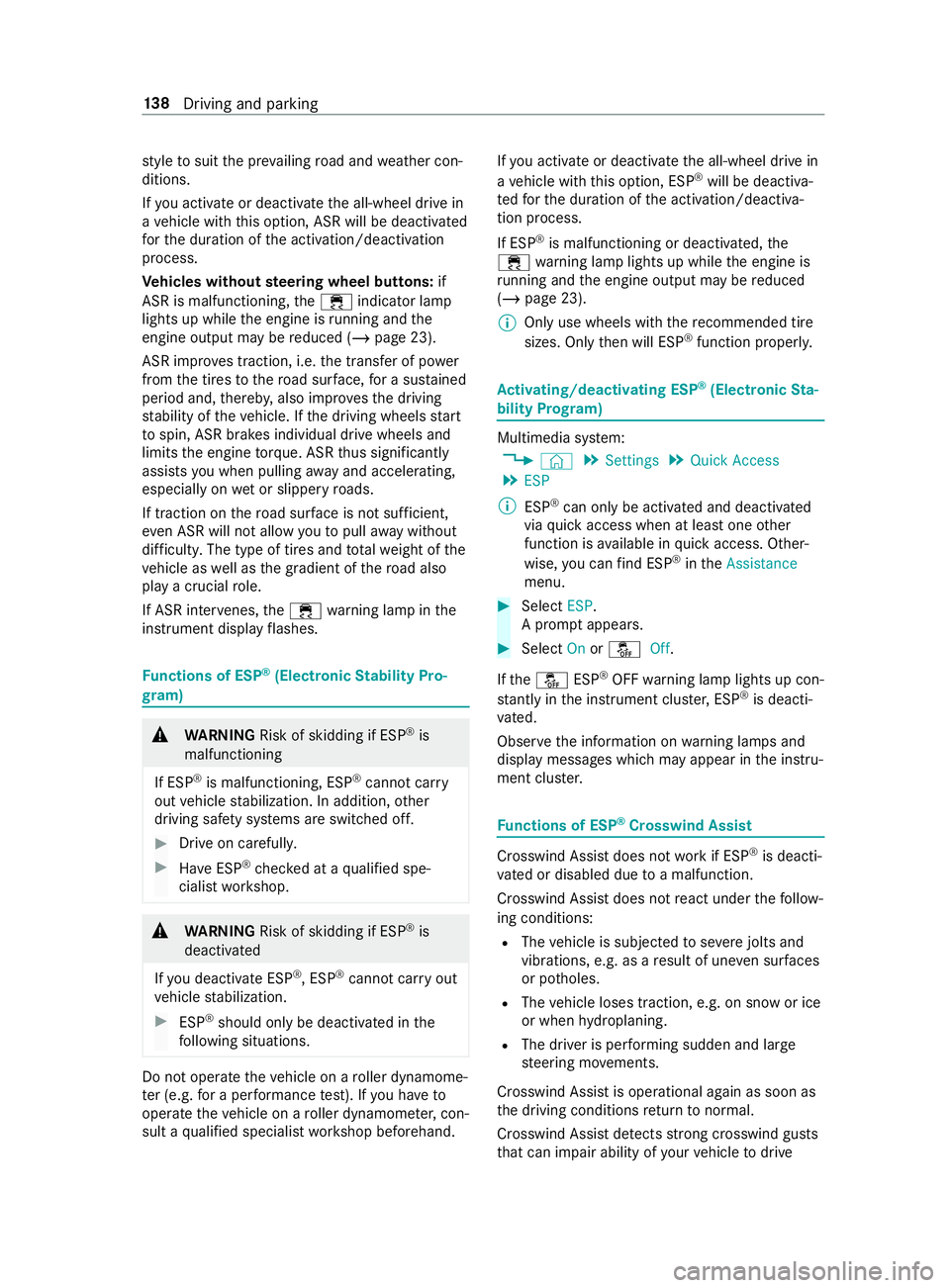
nctions of ESP ®
(Electronic Stability Pro‐
gr am) &
WARNING Risk of skidding if ESP ®
is
malfunctioning
If ESP ®
is malfunctioning, ESP ®
cannot car ry
out vehicle stabilization. In addition, other
driving saf ety sy stems are switched off. #
Drive on carefull y. #
Have ESP ®
ch ecked at a qualified spe‐
cialist workshop. &
WARNING Risk of skidding if ESP ®
is
deactivated
If yo u deactivate ESP ®
, ESP ®
cannot car ryout
ve hicle stabilization. #
ESP ®
should only be deactivated in the
fo llowing situations. Do not opera
tetheve hicle on a roller dynamome‐
te r (e.g. for a per form ance test). If you ha veto
operate theve hicle on a roller dynamom eter, con‐
sult a qualified specialist workshop beforehand. If
yo u activate or deactivate the all-wheel drive in
a ve hicle with this option, ESP ®
will be deactiva‐
te dfo rth e duration of the activation/deactiva‐
tion process.
If ESP ®
is malfunctioning or deactivated, the
00E5 warning lamp lights up while the engine is
ru nning and the engine output may be reduced
(/ page 23).
% Only use wheels with
there commended tire
sizes. Only then will ESP ®
function properly. Ac
tivating/deactivating ESP ®
(Electronic Sta‐
bility Prog ram) Multimedia sy
stem:
4 © 5
Settings 5
Quick Access
5 ESP
% ESP®
can only be activated and deactivated
via quick access when at least one other
function is available in quick access. Other‐
wise, you can find ESP ®
in theAssistance
menu. #
Select ESP.
A prom ptappears. #
Select Onor00BB Off.
If th e00BB ESP®
OFF warning lamp lights up con‐
st antly in the instrument clus ter,ESP ®
is deacti‐
va ted.
Obser vethe information on warning lamps and
display messages which may appear in the instru‐
ment clus ter. Fu
nctions of ESP ®
Crosswind Assist Crosswind Assist does not
workif ESP ®
is deacti‐
va ted or disabled due toa malfunction.
Crosswind Assist does not react under thefo llow‐
ing conditions:
R The vehicle is subjected tosevere jolts and
vib rations, e.g. as a result of une ven su rfaces
or po tholes.
R The vehicle loses traction, e.g. on snow or ice
or when hydroplaning.
R The driver is per form ing sudden and lar ge
st eering mo vements.
Crosswind Assist is operational again as soon as
th e driving conditions return tonormal.
Crosswind Assi stdetects stro ng crosswind gu sts
th at can impair ability of your vehicle todrive 13 8
Driving and pa rking
Page 164 of 354
#
Always pay careful attention tothe traf‐
fi c situation; do not relyonActive Brake
Assi stalone. Active Brake Assi stis only
an aid. The driver of theve hicle is
re sponsible forke eping a suf ficiently
safe dis tance totheve hicle in front, for
ve hicle speed and for braking in good
time. #
Be prepare dto brake or swer veif nec‐
essar y. Also obser
vethe sy stem limitations of Active
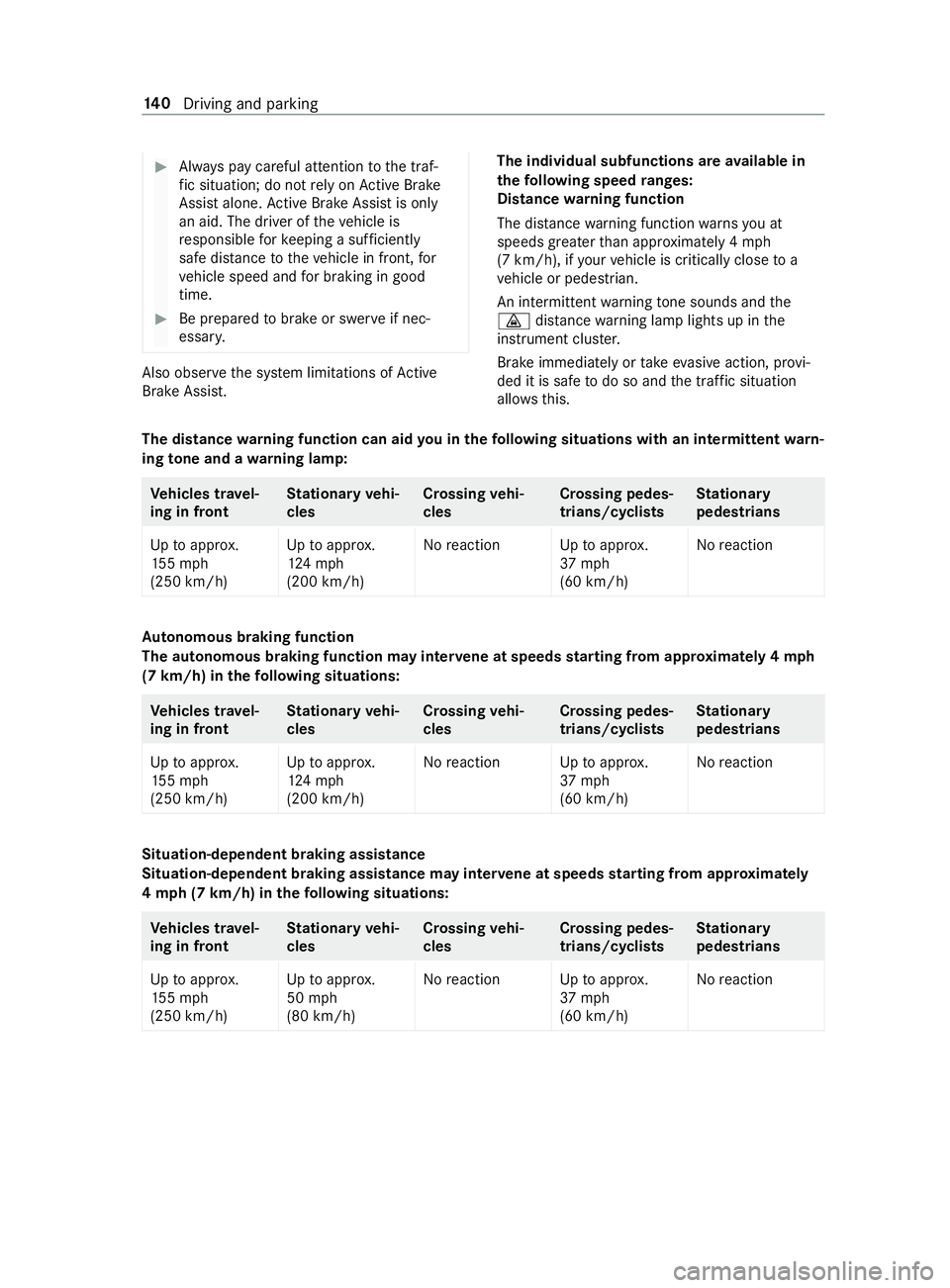
Brake Assi st. The individual subfunctions are
available in
th efo llowing speed ranges:
Distance warning function
The dis tance warning function warnsyo u at
speeds greater than appr oximately 4 mph
(7 km/h), if your vehicle is critically close to a
ve hicle or pedestrian.
An intermittent warning tone sounds and the
00BA distance warning lamp lights up in the
instrument clus ter.
Brake immedia tely or take eva sive action, pr ovi‐
ded it is safe todo so and the tra ffic situation
allo ws th is.
The distance warning function can aid you in thefo llowing situations with an intermit tent wa rn‐
ing tone and a warning lamp: Ve
hicles tr avel‐
ing in front St
ationary vehi‐
cles Crossing
vehi‐
cles Crossing pedes‐
trians/cycli
stsSt
ationary
pedestrians
Up toappr ox.
15 5mph
(250 km/h) Up
toappr ox.
12 4mph
(200 km/h) No
reaction Uptoappr ox.
37 mph
(60 km/h) No
reaction Au
tonomous braking function
The autonomous braking function may inter vene at speeds starting from appr oxima tely 4mph
(7 km/h) in thefo llowing situations: Ve
hicles tr avel‐
ing in front St
ationary vehi‐
cles Crossing
vehi‐
cles Crossing pedes‐
trians/cycli
stsSt
ationary
pedestrians
Up toappr ox.
15 5mph
(250 km/h) Up
toappr ox.
12 4mph
(200 km/h) No
reaction Uptoappr ox.
37 mph
(60 km/h) No
reaction Situation-dependent braking assistance
Situation-dependent braking assistance may inter vene at speeds starting from appr oxima tely
4 mp h (7 km/h) in thefo llowing situations: Ve
hicles tr avel‐
ing in front St
ationary vehi‐
cles Crossing
vehi‐
cles Crossing pedes‐
trians/cycli
stsSt
ationary
pedestrians
Up toappr ox.
15 5mph
(250 km/h) Up
toappr ox.
50 mph
(80 km/h) No
reaction Uptoappr ox.
37 mph
(60 km/h) No
reaction 14 0
Driving and pa rking
Page 167 of 354
#
Todeactivate cruise control: pushrock er
switch 3(CNCL) down.
If cruise cont rol is deactivated, it can be reactiva‐
te d as follo ws:
R rock er switch 2(SET+) or (SET-) stores the
cur rent speed and theve hicle maintains this
speed
R rock er switch 3(RES) calls up the last speed
st ored and theve hicle maintains this speed
% Ifyo u brake, deactivate ESP ®
or if ESP ®
inter‐
ve nes, cruise control is deacti vated.
When you swit choff theve hicle, the last
speed stored is cleared. Ac
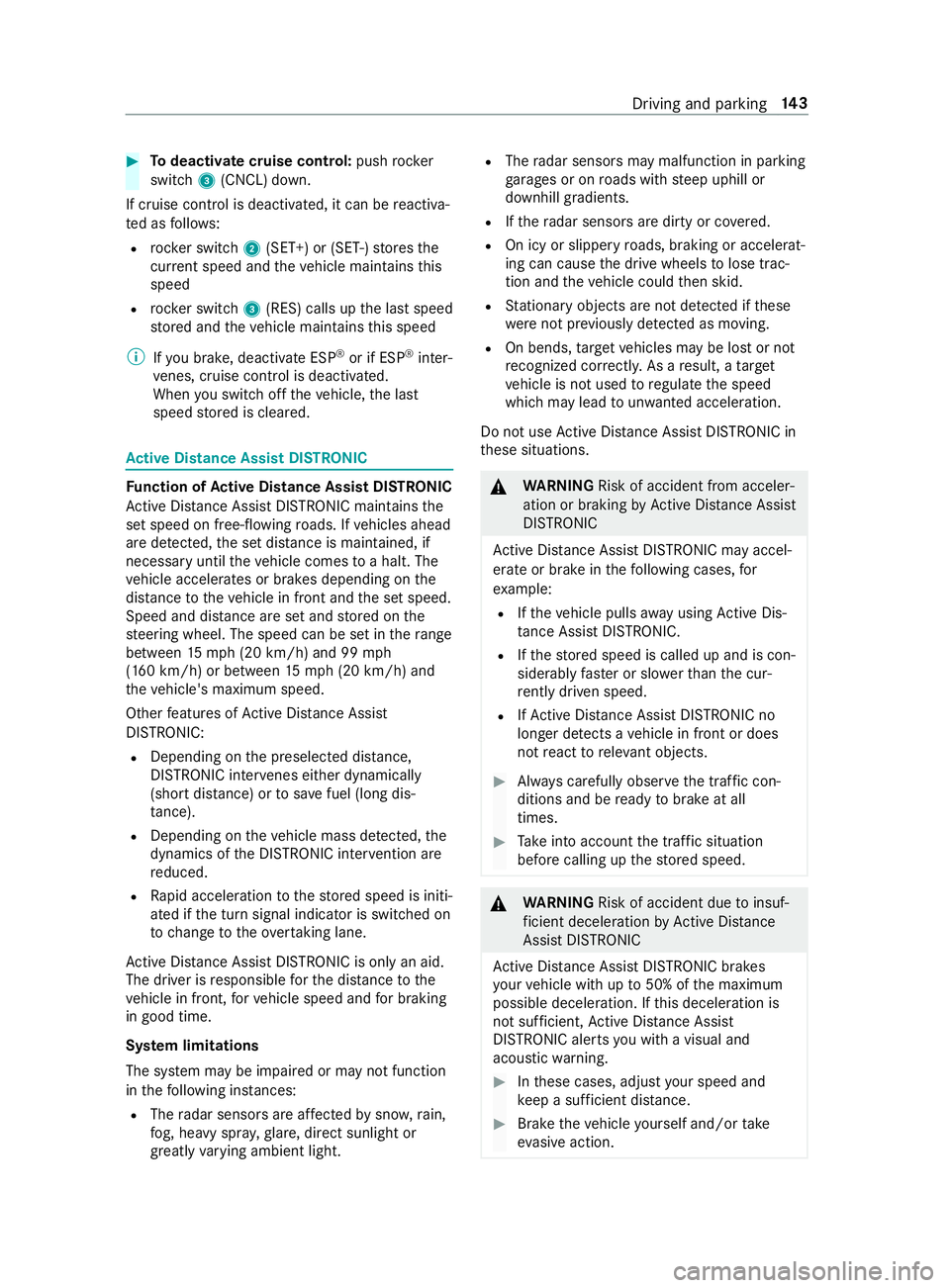
tive Di stance Assist DISTRO NICFu
nction of Active Di stance Assist DISTRO NIC
Ac tive Dis tance Assi stDISTRONIC maintains the
set speed on free-flowing roads. If vehicles ahead
are de tected, the set dis tance is maintained, if
necessa ryuntil theve hicle comes toa halt. The
ve hicle accelerates or brakes depending on the
dis tance totheve hicle in front and the set speed.
Speed and dis tance are set and stored on the
st eering wheel. The speed can be set in thera nge
between 15mp h (20 km/h) and 99 mph
(160 km/h) or between 15mp h (20 km/h) and
th eve hicle's maximum speed.
Other features of Active Dis tance Assi st
DISTRONIC:
R Depending on the preselected dis tance,
DISTRONIC inter venes ei ther dynamically
(short dis tance) or tosave fuel (long dis‐
ta nce).
R Depending on theve hicle mass de tected, the
dynamics of the DISTRONIC inter vention are
re duced.
R Rapid acceleration tothestored speed is initi‐
ated if the turn signal indicator is switched on
to change totheov ertak ing lane.
Ac tive Dis tance Assi stDISTRONIC is only an aid.
The driver is responsible forth e dis tancetothe
ve hicle in front, forve hicle speed and for braking
in good time.
Sy stem limitations
The sy stem may be impaired or may not function
in thefo llowing ins tances:
R The radar sensors are af fected bysno w,rain,
fo g, heavy spr ay,gl are, direct sunlight or
greatly varying ambient light. R
The radar sensors may malfunction in parking
ga rage s or on roads with steep uphill or
downhill gradients.
R Ifth era dar sensors are dirty or co vered.
R On icy or slippery roads, braking or accelerat‐
ing can cause the drive wheels tolose trac‐
tion and theve hicle could then skid.
R Stationary objects are not de tected if these
we renot pr eviously de tected as moving.
R On bends, target vehicles may be lost or not
re cognized cor rectl y.As a result, a target
ve hicle is not used toregulate the speed
which may lead tounwa nted accele ration.
Do not use Active Dis tance Assi stDISTRONIC in
th ese situations. &
WARNING Risk of accident from acceler‐
ation or braking byActive Dis tance Assi st
DISTRONIC
Ac tive Dis tance Assi stDISTRONIC may accel‐
erate or brake in thefo llowing cases, for
ex ample:
R Ifth eve hicle pulls away using Active Dis‐
ta nce Assi stDISTRONIC.
R Ifth estored speed is called up and is con‐
siderably faster or slo werth an the cur‐
re ntly driven speed.
R IfAc tive Dis tance Assi stDISTRONIC no
longer de tects a vehicle in front or does
not react toreleva nt objects. #
Always carefully obser vethe traf fic con‐
ditions and be ready tobrake at all
times. #
Take into account the tra ffic situation
before calling up thestored speed. &
WARNING Risk of accident due toinsuf‐
fi cient deceleration byActive Dis tance
Assi stDISTRONIC
Ac tive Dis tance Assi stDISTRONIC brakes
yo ur vehicle with up to50% of the maximum
possible deceleration. If this deceleration is
not suf ficient, Active Dis tance Assi st
DISTRONIC alerts you with a visual and
acoustic warning. #
Inthese cases, adjust your speed and
ke ep a suf ficient dis tance. #
Brake theve hicle yourself and/or take
ev asive action. Driving and parking
14 3
Page 171 of 354
Re
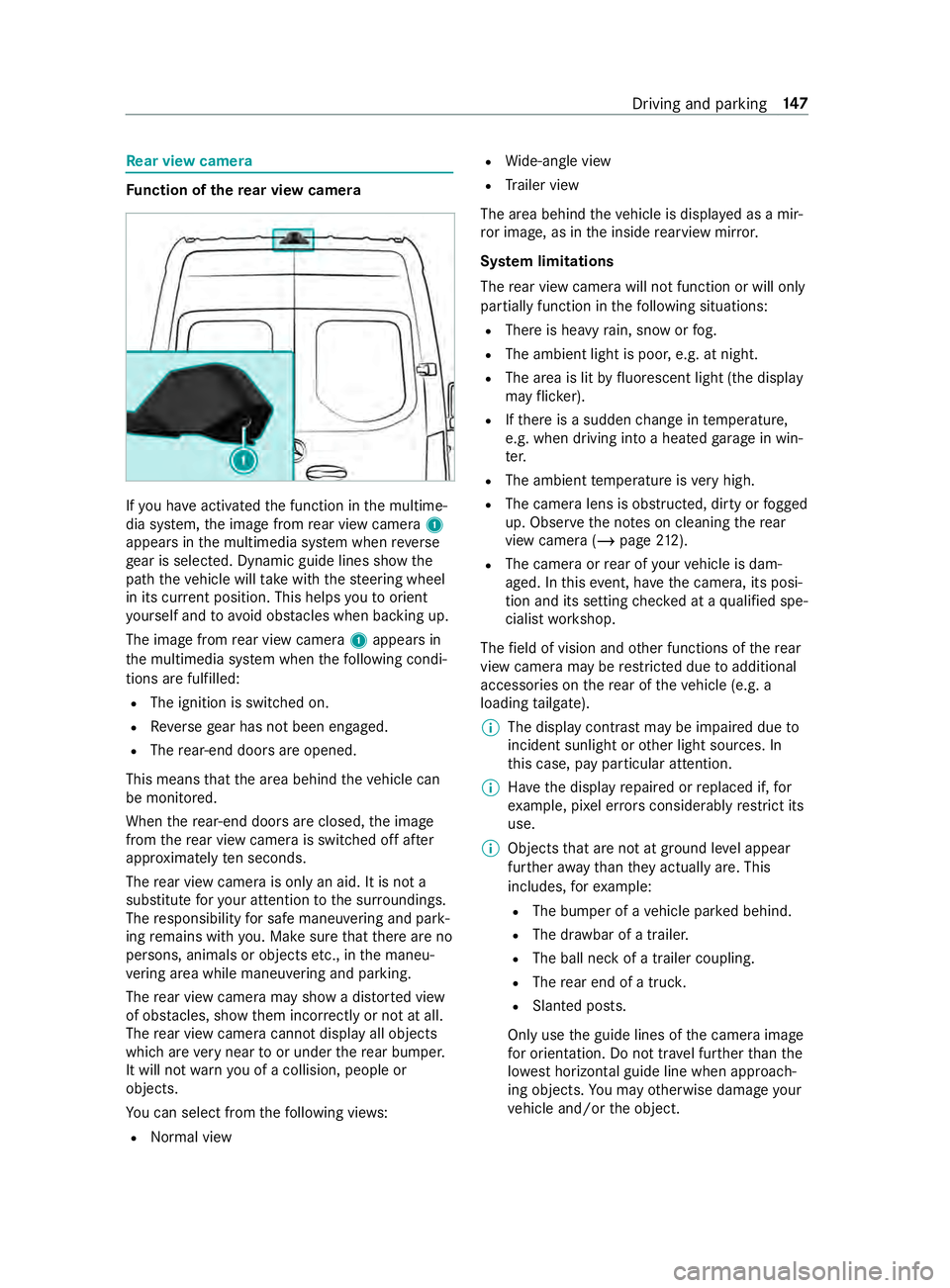
ar view camera Fu
nction of there ar view camera If
yo u ha veactivated the function in the multime‐
dia sy stem, the image from rear view camera 1
appears in the multimedia sy stem when reve rse
ge ar is selec ted. Dynamic guide lines show the
path theve hicle will take with thesteering wheel
in its cur rent position. This helps youto orient
yo urself and toavo id obs tacles when ba cking up.
The image from rear view camera 1appears in
th e multimedia sy stem when thefo llowing condi‐
tions are fulfilled:
R The ignition is switched on.
R Reversege ar has not been engaged.
R The rear-end doors are opened.
This means that the area behind theve hicle can
be monitored.
When there ar-end doors are closed, the image
from there ar view camera is swit ched off af ter
appr oximately ten seconds.
The rear view camera is only an aid. It is not a
substitute foryo ur attention tothe sur roundings.
The responsibility for safe maneu vering and pa rk‐
ing remains with you. Make sure that there are no
persons, animals or objects etc., in the maneu‐
ve ring area while maneuvering and pa rking.
The rear view camera may show a dis torted view
of obs tacles, show them incor rectly or not at all.
The rear view camera cannot display all objects
which are very near toor under there ar bumper.
It will not warnyou of a collision, people or
objects.
Yo u can select from thefo llowing vie ws:
R Norma l view R
Wide-angle view
R Trailer view
The area behind theve hicle is displa yed as a mir‐
ro r image, as in the inside rearview mir ror.
Sy stem limitations
The rear view camera will not function or will only
partially function in thefo llowing situations:
R There is heavy rain, snow or fog.
R The ambient light is poor, e.g. at night.
R The area is lit byfluorescent light (the displ ay
may flic ke r).
R Ifth ere is a sudden change in temp erature,
e.g. when driving into a heated garage in win‐
te r.
R The ambient temp erature is very high.
R The camera lens is obstructed, dirty or fogged
up. Obser vethe no tes on cleaning there ar
view camera (/ page212).
R The camera or rear of your vehicle is dam‐
aged. In this event, ha vethe camera, its posi‐
tion and its setting checked at a qualified spe‐
cialist workshop.
The field of vision and other functions of there ar
view camera may be restricted due toadditional
accesso ries on there ar of theve hicle (e.g. a
loading tailgate).
% The display contrast may be impaired due
to
incident sunlight or other light sources. In
th is case, pay particular attention.
% Ha
ve the display repaired or replaced if, for
ex ample, pixel er rors considerably restrict its
use.
% Objects that are not at ground le vel appear
fur ther aw ay than they actually are. This
includes, forex ample:
R The bumper of a vehicle par ked behind.
R The dr awbar of a trailer.
R The ball neck of a trailer coupling.
R The rear end of a truc k.
R Slanted posts.
Only use the guide lines of the camera image
fo r orientation. Do not tr avel fur ther than the
lo west horizontal guide line when approach‐
ing objects. You may otherwise damage your
ve hicle and/or the object. Driving and parking
147
Page 174 of 354
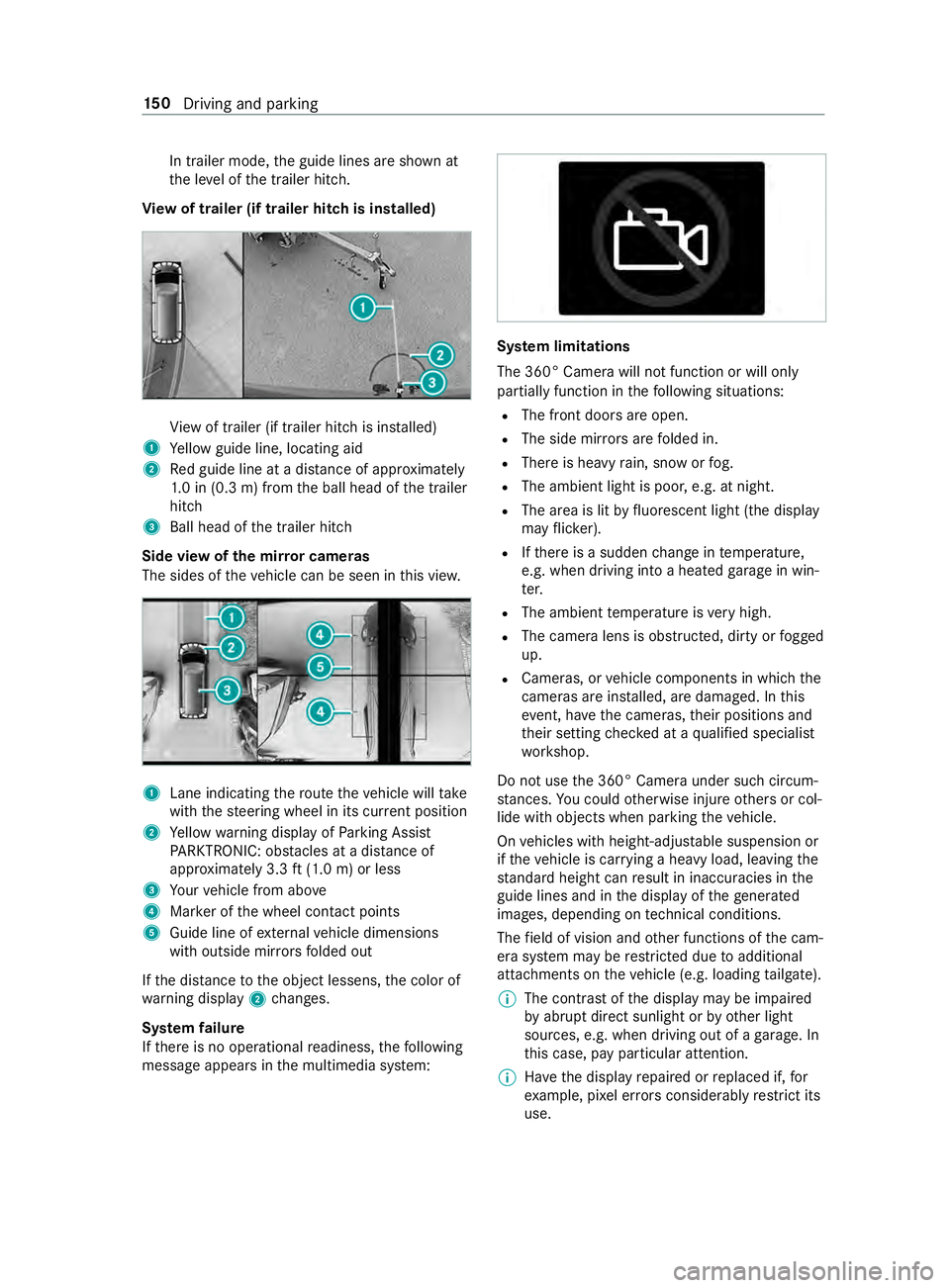
In trailer mode,
the guide lines are shown at
th e le vel of the trailer hitch.
Vi ew of trailer (if trailer hit chis installed) Vi
ew of trailer (if trailer hitch is ins talled)
1 Yellow guide line, locating aid
2 Red guide line at a dis tance of appr oximately
1. 0 in (0.3 m) from the ball head of the trailer
hitch
3 Ball head of the trailer hitch
Side view of the mir ror came ras
The sides of theve hicle can be seen in this vie w. 1
Lane indicating thero ute theve hicle will take
with thesteering wheel in its cur rent position
2 Yellow warning display of Parking Assist
PA RKTRONIC: obstacles at a dis tance of
appr oximately 3.3 ft(1.0 m) or less
3 Your vehicle from abo ve
4 Marker of the wheel contact points
5 Guide line of extern al vehicle dimensions
with outside mir rors folded out
If th e dis tance tothe object lessens, the color of
wa rning display 2changes.
Sy stem failure
If th ere is no operational readiness, thefo llowing
message appears in the multimedia sy stem: Sy
stem limitations
The 360° Camera will not function or will only
partially function in thefo llowing situations:
R The front doors are open.
R The side mir rors are folded in.
R There is heavy rain, snow or fog.
R The ambient light is poor, e.g. at night.
R The area is lit byfluorescent light (the displ ay
may flic ke r).
R Ifth ere is a sudden change in temp erature,
e.g. when driving into a heated garage in win‐
te r.
R The ambient temp erature is very high.
R The camera lens is obstructed, dirty or fogged
up.
R Cameras, or vehicle components in which the
came ras are ins talled, are damaged. In this
eve nt, ha vethe cameras, their positions and
th eir setting checked at a qualified specialist
wo rkshop.
Do not use the 360° Camera under such circum‐
st ances. You could otherwise injure others or col‐
lide with objects when parking theve hicle.
On vehicles with height-adjus table suspension or
if th eve hicle is car rying a heavy load, leaving the
st andard height can result in inaccuracies in the
guide lines and in the display of thege nerated
ima ges, depending on tech nical conditions.
The field of vision and other functions of the cam‐
era sy stem may be restricted due toadditional
attachments on theve hicle (e.g. loading tailgate).
% The contrast of
the display may be impaired
by abrupt direct sunlight or by other light
sources, e.g. when driving out of a garage . In
th is case, pay particular attention.
% Ha
ve the display repaired or replaced if, for
ex ample, pixel er rors considerably restrict its
use. 15 0
Driving and pa rking