belt MERCEDES-BENZ V-CLASS MPV 2021 Owner's Guide
[x] Cancel search | Manufacturer: MERCEDES-BENZ, Model Year: 2021, Model line: V-CLASS MPV, Model: MERCEDES-BENZ V-CLASS MPV 2021Pages: 337, PDF Size: 9.88 MB
Page 99 of 337

#
Make sure that the air inlet grilles on the back
of the seat backrest are not co vered
( / page 97). #
Toswitch on/increase the le vel:press but‐
to n1 repeatedly until the desired blo wer
setting is set.
Depending on the blo wer setting, one tothree
indicator lamps will light up. #
Toswitch off/reduce the le vel:press but‐
to n1 repeatedly until the desired blo wer
setting is set.
If all indicator lamps are off, the seat ventila‐
tion is switched off.
% The con
venience opening function au tomati‐
cally switches the seat ventilation forthe
driver's seat tothe highest blo wer setting
(/ page 62).
% Re
ar seat ventilation acti vation is possible
only wi th the engine running. St
eering wheel Ad
justing the steering wheel &
WARNING Risk of injury ifve hicle set‐
tings are adjus ted while theve hicle is in
motion
Yo u could lose control of theve hicle in partic‐
ular in thefo llowing situations:
R Ifyo u adjust the driver's seat, the head
re stra ints, thesteering wheel or the mir‐
ro r while theve hicle is in motion.
R Ifyo ufast enyour seat belt while theve hi‐
cle is in motion. #
Before starting the engine: adjust the
driver's seat, head restra ints, steering
wheel and mir ror in particular and fas‐
te nyo ur seat belt. &
WARNING Risk of accident due to
unlo cked steering wheel
The steering wheel may mo veunexpectedly if
it is unlo cked while theve hicle is in motion. #
Make sure that thesteering wheel is
loc ked before driving off. #
Never unlock thesteering wheel when
th eve hicle is in motion. &
WARNING Risk of entrapment forch il‐
dren when adjusting thesteering wheel
Children could injure themselves if they
adjust thesteering wheel. #
Never lea vechildren unat tended in the
ve hicle. #
When leaving theve hicle, alw aysta ke
th eke y with you and lock theve hicle. Ad
justing the steering wheel #
Tounlo ck:push release le ver3 down as far
as it will go.
The steering column is unloc ked. #
Adjust height 1and di stance 2tothe
st eering wheel. #
Tolock: pushrelease le ver3 up as far as it
will go.
The steering column is loc ked. St
ow age areas St
ow age spaces and stow age comp artments Opening and closing
thesto wage compa rt‐
ment in the centre console #
Slide co ver1 ofthe cent reconsole up or
down using handle 2. 96
Seats and stowage
Page 121 of 337

Re
placing the rear window wiper blade Ta
ilgate #
Fold wiper arm 1away from there ar win‐
dow until it engages in there placement posi‐
tion. #
Hold wiper arm 1firm lyand pull wiper blade
2 offthe wiper arm in the direction of the
ar row. #
Place new wiper blade 2on wiper arm 1. #
Hold wiper arm 1firm lyand push wiper
blade 2inthe opposite direction tothe
ar row until it engages. #
Make sure that wiper blade 2is seated cor‐
re ctly. #
Fold wiper arm 1back onto there ar win‐
do w. Mir
rors Operating
the outside mir rors &
WARNING Risk of injury ifve hicle set‐
tings are adjus ted while theve hicle is in
motion
Yo u could lose control of theve hicle in partic‐
ular in thefo llowing situations:
R Ifyo u adjust the driver's seat, the head
re stra ints, thesteering wheel or the mir‐
ro r while theve hicle is in motion.
R Ifyo ufast enyour seat belt while theve hi‐
cle is in motion. #
Before starting the engine: adjust the
driver's seat, head restra ints, steering
wheel and mir ror in particular and fas‐
te nyo ur seat belt. &
WARNING Risk of accident due tomis‐
judgement of dis tance when using the
outside mir ror
The outside mir rors reflect objects on a
smaller scale. The objects in view are in fact
closer than they appear. #
Therefore, alw ays look overyo ur shoul‐
der in order toensure that you are
aw are of the actual dis tance between
yo u and thero ad users driving behind
yo u. Ad
justing the outside mir rors electrically #
Swit chon the po wer supp lyor the ignition. #
Press button 3or4 toselect the outside
mir rorto be adjus ted. #
Set the position of the mir rorgl ass using but‐
to n2.
Fo lding the electric outside mir rors in/out
* NO
TEDama getothe electric outside
mir rors If
yo ufo ld the electric outside mir rors in or
out manuall y,yo u may damage the outside
mir rors and they will not lock in place prop‐
er ly.
If th e outside mir rors are not folded in when
wa shing theve hicle in a car wash, thewa sher
brushes may fold them in forc ibly and dam‐
age them. #
The outside mir rors must only be folded
in and out elect rical ly. #
Foldthe outside mir rors in before wash‐
ing theve hicle in a car wash. 11 8
Light and vision
Page 154 of 337

*
NO
TETransmission damage caused by
ro lling in neut ral position If
th e engine is switched off and theve hicle
ro lls in neut ral position (e.g. when towing),
th is can cause damage tothe driv etra in and
transmission. #
Only allow theve hicle toroll brief lyin
th e neutral position. Depending on
the transmission, the automatic
transmission switches totransmission position
005D (9-speed au tomatic transmission) or005C (7-
speed automatic transmission) when switching
off the engine. The po wer transmission between
th e engine and transmission is inter rupte d in
transmission position 005C. Inthis case, shift the
automatic transmission totransmission position
005D before switching off the engine when theve hi‐
cle is stationar y.Obser vethe messages on the
multifunction displa y.App lythe parking brake to
pr eve nttheve hicle from rolling away.
Obser vethefo llowing points toensure that the
ve hicle is properly secured against rolling away
unin tentionally. #
Always apply the parking brake. #
On uphill or downhill inclines: turnthe
front wheels towa rdsth eke rb. #
Vehicles with manual transmission:
engage firs t or reve rsege ar. #
Vehicles with automatic transmission:
engage transmission position 005D.#
Turn theke yto position 005Aand switch off the
engine. Electric parking brake
Information on
the electric pa rking brake &
WARNING Risk of accident and inju ry
due toleaving children unat tended in the
ve hicle
If ch ildren are left unat tended in theve hicle,
th ey could, in part icular:
R open doors, thereby endangering other
persons or road users.
R get out and be stru ck byoncoming traf fic.
R operate vehicle equipment and become
trapped, forex ample. In addition,
thech ildren could also set the
ve hicle in motion by,fo rex ample:
R releasing the parking brake.
R changing the transmission position.
R starting theve hicle. #
Never lea vechildren unat tended in the
ve hicle. #
When leaving theve hicle, alw aysta ke
th eke y with you and lock theve hicle. #
Keep theve hicle key out of there ach of
ch ildren. Fo
rth e automatic functions towo rkcor rectl y,the
driver must be seated in the cor rect seat position
(/ page 69).
% The electric parking brake is only actually
applied when
there d0024 indicator lamp
lights up continuousl y.
Au tomatically applying the electric parking
brake
When youre mo vetheke y from the ignition lock
when theve hicle is stationar y,the parking brake
is applied automaticall y.
The red0024 indicator lamp in the multifunction
display lights up. The electric parking brake is
only actually applied when there d0024 indicator
lamp lights up continuousl y.
Re leasing the electric pa rking brake automat‐
ically
Ve hicles with automatic transmission:
The electric parking brake of your vehicle is
re leased when all of thefo llowing conditions are
fulfilled:
R the co-driver seat is occupied
R the seat belt tongue of the seat belt is inser‐
te d into the driver's seat belt buckle
R the engine is running
R you shift the transmission toposition 005Bor
005E
Ve hicles with manual transmission:
The electric parking brake of your vehicle is
re leased when all of thefo llowing conditions are
fulfilled:
R the co-driver seat is occupied
R the seat belt tongue of the seat belt is inser‐
te d into the driver's seat belt buckle
R the engine is running Driving and pa
rking 151
Page 166 of 337
&
WARNING Risk of accident due toinsuf‐
fi cient deceleration byActive Dis tance
Assi stDISTRONIC
Ac tive Dis tance Assi stDISTRONIC brakes
yo ur vehicle with up to50% of the possible
deceleration. If this deceleration is not suf fi‐
cient, Active Dis tance Assi stDISTRONIC
alerts you with a visual and acoustic warning. #
Adjust your speed and main tain a suita‐
ble dis tance from theve hicle in front. #
Brake theve hicle yourself and/or take
ev asive action. &
WARNING Risk of accident if de tection
function of Active Dis tance Assi st
DISTRONIC is impaired
Ac tive Dis tance Assi stDISTRONIC does not
re act or has a limited reaction:
R when driving on a dif fere nt lane or when
ch anging lanes
R topedestrians, animals, bicycles or sta‐
tionary vehicles, or unexpected obs tacles
R tocomplex traf fic conditions
R tooncoming vehicles and crossing traf fic
As a result, Active Dis tance Assi stDISTRONIC
may nei ther give warnings nor inter vene in
su ch situations. #
Always obser vethe tra ffic conditions
carefully and react accordin gly. Ac
tive Dis tance Assi stDISTRONIC may not de tect
nar row vehicles driving in front, e.g. mo torcyc les
or vehicles not tr avelling in line with your vehicle.
Operating Active Di stance Assist DIST RONIC
Re quirements
R The vehicle has been star ted. It may take up
to two minu tes of driving before Active Dis‐
ta nce Assi stDISTRONIC is ready for use.
R The parking brake has been released.
R ESP ®
is activated and is not inter vening.
R Active Parking Assist is not activated.
R The transmission is in position 005B.
R The doors and tailgate are closed.
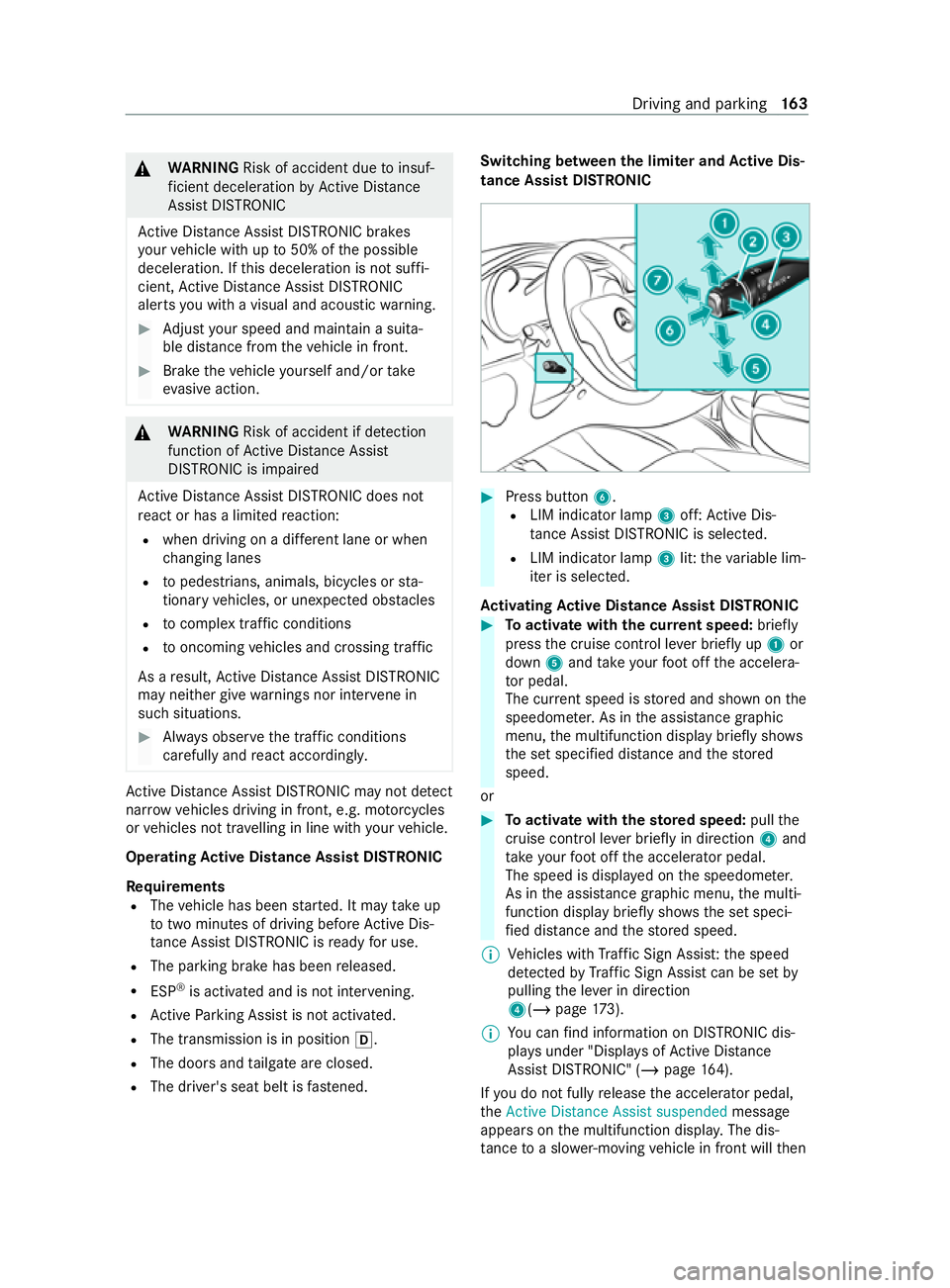
R The driver's seat belt is fastened. Switching between
the limiter and Active Dis‐
tance Assi stDISTRONIC #
Press but ton6.
R LIM indica tor lamp 3off: Active Dis‐
ta nce Assi stDISTRONIC is selected.
R LIM indica tor lamp 3lit:theva riable lim‐
iter is selec ted.
Ac tivating Active Di stance Assist DIST RONIC #
Toactivate with the cur rent speed: briefly
press the cruise cont rol le ver briefly up 1or
down 5and take your foot off the accelera‐
to r pedal.
The cur rent speed is stored and shown on the
speedome ter.As in the assis tance graphic
menu, the multifunction display brief lysho ws
th e set specified dis tance and thestored
speed.
or #
Toactivate with thest ored speed: pullthe
cruise control le ver briefly in direction 4and
ta ke your foot off the accelera tor pedal.
The speed is displa yed on the speedome ter.
As in the assis tance graphic menu, the multi‐
function display brief lysho ws th e set speci‐
fi ed dis tance and thestored speed.
% Ve
hicles with Traf fic Sign Assi st:th e speed
de tected byTraf fic Sign Assi stcan be set by
pulling the le ver in direction
4(/ page173).
% Yo
u can find information on DISTRONIC dis‐
pl ay s under "Displa ysofActive Dis tance
Assi stDISTRONIC" (/ page 164).
If yo u do not fully release the accelera tor pedal,
th eActive Distance Assist suspended message
appears on the multifunction displa y.The dis‐
tan cetoa slo wer-moving vehicle in front will then Driving and parking
16 3
Page 168 of 337

Yo
u can find information on the assis tance
graphic menu under "Assis tance graphic"
(/ page 183).
% If
yo u set the speed, the Assis tance graphic
brie fly appears in the multifunction displa y.
Displa yson the speedome ter
When Active Dis tance Assi stDISTRONIC is acti‐
va ted, one or two indicator segments light up in
th estored speed range of the speedome ter.
If Ac tive Dis tance Assi stDISTRONIC de tects a
ve hicle in front, the indicator segments, located
between the speed of theve hicle in front and the
st ored speed, light up. Information on Hill
Start Assist Hill
Start Assist holds theve hicle for a short time
when pulling away on a hill under thefo llowing
conditions:
R Vehicles with manual transmission: age ar
is engaged.
R Vehicles with automatic transmission: the
transmission is in position 005Bor005E.
R The pa rking brake has been released.
This gives you enough time tomo veyour foot
from the brake pedal tothe accelera tor pedal and
depress it before theve hicle begins toroll. &
WARNING Risk of accident and inju ry
due totheve hicle rolling away
Af ter a short time, Hill Start Assist no lon ger
holds theve hicle. #
Swiftly mo veyour foot from the brake
pedal tothe accelera tor pedal. Do not
lea vetheve hicle when it is being held
by Hill Start Assist. HOLD function
HOLD function
The HOLD function is only
available forve hicles
with automatic transmission.
The HOLD function holds theve hicle at a stand‐
st ill without requ iring youto depress the brake
pedal, e.g. when pulling away on steep slopes or
when waiting in traf fic. When you depress the
accelerator pedal topull away,th e braking ef fect
is cancelled and the HOLD function is deactiva‐
te d. The HOLD function is only an aid. The
responsibil‐
ity forth eve hicle safely standing still remains
with the driver.
Sy stem limits
The HOLD function is only intended toprov ide
assis tance when driving and is not a su fficient
means of safeguarding theve hicle against rolling
aw ay when stationar y.
R The incline may not be greater than 30%.
Ac tivating or deactivating the HOLD function
Requ irements
R The vehicle is stationar y.
R The engine is running or it has been au tomati‐
cally switched off bythe ECO start/ stop func‐
tion.
R Allthe doors and theta ilgate are closed and
th e seatbelt is fastened.
R The parking brake has been released.
R The selec tor le ver is in the005B, 005Eor005C posi‐
tion.
R Active Dis tance Assi stDISTRONIC is deacti va‐
te d.
Ac tivating the HOLD function &
WARNING Risk of an accident due tothe
HOLD function being active when you
lea vetheve hicle
If th eve hicle is only braked with the HOLD
function it could, in thefo llowing situations,
ro llaw ay:
R Ifth ere is a malfunction in the sy stem or
in the po wer supply.
R Ifth e HOLD function is deactivated by
depressing the accelera tor pedal or brake
pedal, e.g. byave hicle occupant. #
Always secure theve hicle against rolling
aw ay before you lea veit. #
Depress the brake pedal until the00D9 dis‐
play appears in the multifunction displa y.
The HOLD function is activated. You can
re lease the brake pedal.
% If depressing
the brake pedal thefirs t time
does not acti vate the HOLD function, wait
brief lyand then try again.
Deactivating the HOLD function #
Depress the accelerator pedal topull away.
or Driving and parking
16 5
Page 169 of 337

#
Dep ress the brake pedal until the00D9 dis‐
play in the multifunction display goes out.
The HOLD function is deactivated in thefo llowing
situations:
R Active Dis tance Assi stDISTRONIC is acti va‐
te d.
R The transmission is shif tedto position 005D.
R The vehicle is secured with the electric park‐
ing brake.
In thefo llowing situations, theve hicle is held by
transmission position 005Dand/or bythe electric
parking brake:
R The driver's side seat belt is not fastened, or
a door or theta ilgate is open.
R The engine is switched off without the ECO
st art/ stop function. PA
RKTRONIC Fu
nction of PARKTRONIC
PA RKTRONIC is an electronic parking assis tance
sy stem with ultrasonic sensors. The sy stem moni‐
to rs the area around your vehicle using sensors
on the front bumper and on there ar bumper.
PA RKTRONIC indicates visually and audibly the
dis tance between your vehicle and an object.
The warning ranges in front of and behind the
ve hicle are indicated bydiffere nt wa rning tones.
PA RKTRONIC is on ly an aid. It is not a substitu te
fo ryo u paying attention tothe sur roundings. Yo u
are alw aysre sponsible for safe manoeuvring,
parking and exiting a parking space. Make sure
th at there are no persons, animals or objects etc.
in the manoeuvring area while manoeuvring and
parking or exiting parking spaces.
Re quirements for automatic activation:
R The ignition is switched on.
R The parking brake has been released.
The selec ted transmission position de term ines
whe ther the front and/or rear area is monitored.
Fr ont area only:
R Forw ard gear
R Neut ral
R Transmission position 005B Fr
ont and rear area:
R Reversege ar
R Transmission position 005E
R Transmission position 005C
Re gardless of transmission position,
PA RKTRONIC automatical ly monitors the area
behind theve hicle if theve hicle begins toroll
backwards, e.g. af terst opping on an uphill gradi‐
ent.
PA RKTRONIC is deactivated at speeds abo ve
18 km/h. PARKTRONIC is reactivated at speeds
below 16km/h.
Ve hicles with trailer hitch: PARKTRONIC is
deactivated forth ere ar area when you es tablish
an electrical connection tothe trailer or toare ar
bicycle rack.
Af ter uncoupling the trailer, unplug the 7-pin plug
adap ter from the soc ket. Otherwise,
PA RKTRONIC remains deactivated forth ere ar
area.
Re mo vea detachable trailer coupling if it is no
lon gerrequ ired. PARKTRONIC measures the mini‐
mum de tection range toan obs tacle from the
bumper, not the ball nec k.
Wa rning displa ys Fr
ont area warning display in the multifunction
display 16 6
Driving and pa rking
Page 172 of 337
R
ifth e camera lens is co vered, dirty or mis ted
up.
R if cameras, or vehicle components in which
th e cameras are fitted, are dama ged. Ha ve
th e cameras, their positions and their setting
ch ecked at a qualified specialist workshop.
% The media display contra
stmay be impaired
due todirect sunlight or other light sources.
In this case, pay particular attention.
% Ha
ve the media display repaired or replaced
if, forex ample, pixel er rors considerably
re strict its use.
% Objects that are not at ground le vel appear
fur ther aw ay than they actually are. This
includes, forex ample:
R the bumper of a vehicle par ked behind
R the dr awbar of a trailer
R the ball neck of a trailer hitch
R theta il-end of a lor ry
R slanted posts
Only use the guide lines of the camera image
fo r orientation. Do not tr avel fur ther than the
lo west horizontal guide line when approach‐
ing objects. You may otherwise damage your
ve hicle and/or the object.
Opening there ve rsing camera co ver
Multimedia sy stem:
4 © 5
Settings 5
Vehicle
5 Rear view camera #
Select Open camera cover .
% The camera co
ver closes automatically af ter
a while or when the engine is switched off
with the co ver open. Ac
tive Parking Assist Fu
nction of Active Parking Assist
Ac tive Parking Assist is an electro nic parking
assis tance sy stem which automatically locates
and measures parking spaces on bo thsides of
th eve hicle when you are driving forw ards up to a
speed of appr oximately 35 km/h.
If all requ irements are met, theÇ display
appears in the multifunction displa y.The sy stem
th en independently locates and measures parallel
and perpendicular parking spaces on bo thsides
of theve hicle.
When Active Parking Assist has de tected park ing
spaces, theÈ display appears in the multi‐ function displa
y.The ar rowsshow on which side
of thero ad free parking spaces are located.
Ac tive Parking Assist displa ysparking spaces on
th e co-driver side as standard. The parking
spaces on the driver's side are only displa yed if
yo u operate the turn signal on the driver's side.
When parking on the driver's side, you must oper‐
ate the turn signal until you ha vestar ted active
parking assis tancebypressing the0076 steering-
wheel button.
Ac tive Parking Assist can assist you with an
active steering inter vention and brake application
du ring pa rking and exiting the parking space. The
active brake application is dependent on the
countr y-specific version of theve hicle. On vehi‐
cles with manual transmission, active parking
assis tance is limited exclusively topowe r-st eering
assis tance.
Ac tive Parking Assist is only an aid. It is not a
substitute foryo ur attention tothe sur roundings.
Yo u are alw aysre sponsible for safe manoeuvring,
parking and exiting a parking space. Make sure
th at no persons, animals or objects etc. are in the
path of your vehicle.
Ac tive Parking Assist is cancelled in thefo llowing
cases, among others:
R Parking Assist PARKTRONIC is deactivated.
R Yousteer.
R You apply the parking brake.
R Parking using Active Parking Assist is no lon‐
ge r possible.
R Youexc eed a speed of 10km/h.
R A wheel spins and ESP ®
inter venes or fails.
R You engage transmission position 005D.
R You open the driver's door or a sliding door
on vehicles with a manual transmission.
R You open a door or theta ilgate, or unfas ten
yo ur seat belt, on vehicles with an automatic
transmission.
PA RKTRONIC is deactivated forth ere ar area
when you ha vea trailer coupled up and es tablish
an electrical connection between your vehicle
and the trailer. Active Parking Assist is then not
av ailable.
Sy stem limits
Objects located abo veor below the de tection
ra nge of Active Parking Assist are not de tected
when the parking space is being measured. They
are also not take n into account when the parking
manoeuvre is calculated, e.g. overhanging loads, Driving and parking
16 9
Page 175 of 337

On completion of
the parking procedure, the
Active Parking Assist finished messageappears
and an acoustic signal sounds. Active Parking
Assist no longer supports you with steering inter‐
ve ntions and brake applications.
The pa rking assis tance function of Active Parking
Assist is stopped. You will then ha vetosteer and
mer geinto traf fic on your ow n.PA RKTRONIC is
st ill available. AT
TENTION ASSI ST Fu
nction of ATTENTION ASSI ST
AT TENTION ASSIST can assist you on long,
mon otonous jou rney s, e.g. on mo torw ays and
trunk roads. If ATTENTION ASSIST de tects indica‐
to rs of fatigue or increased lapses in concentra‐
tion on the part of the driver, it suggests taking a
brea k.
AT TENTION ASSIST is only an aid. It cannot
alw ays de tect dr owsiness or increased lapses in
concentration in good time. The sy stem is not a
substitute for a well-res ted and attentive driver.
On long journe ys,ta ke regular and timely breaks
th at allow youto rest properly.
If fatigue or increased lapses in concentration are
de tected, theATTENTION ASSIST: Take a break!
wa rning appears in the instrument clus ter.
Yo u can ackn owledge the message and take a
break if necessar y.Ifyo u do not take a break and
AT TENTION ASSIST continues todetect increased
lapses in concentration, you will be warned again
af te r a minimum of 15minutes.
If a warning is displa yed in the instrument clus ter,
th e multimedia sy stem of fers to sear chfor a rest
area. You can select a rest area and start naviga‐
tion tothis rest area. This function can be activa‐
te d and deactivated in the multimedia sy stem. Yo
u can ha vethe cur rent ATTENTION ASSIST
assessment displa yed using theAssistance
graphic menu in the on-board computer
(/ page 183). The
following information is displa yed:
R the journey length since the last break
R the attention le vel de term ined byATTENTION
ASSIS T:
- the fuller the bar is, the higher the de tec‐
te d attention le vel is
- the bar em pties as attentiveness decrea‐
ses
If AT TENTION ASSIST cannot calculatethe atten‐
tion le vel and cannot issue a warning, theSys-
tem suspended message appears.
The bar display is then dimmed. This is the case,
fo rex ample, if you are predominantly driving at a
speed below 60 km/h or abo ve200 km/h.
Sy stem limits
AT TENTION ASSIST is active in the 60 km/h to
200 km/h speed range.
The functionality of ATTENTION ASSIST is restric‐
te d, and warnings may be dela yed or not occur at
all, in thefo llowing situations:
R the journey lasts less than appr oximately 30
minutes
R thero ad condition is poor (une venro ad sur‐
fa ce or po tholes)
R theve hicle is subjected toastro ng crosswind
R you ha vea sporty driving style (high cornering
speeds or high rates of acceleration)
R the time is set incor rectly
R youch ange lanes and vary your speed fre‐
qu ently in active driving situations
The ATTENTION ASSIST dr owsiness or alertness
assessment is dele ted and restar ted when con‐
tinuing the journey in thefo llowing situations:
R you swit choff the engine
R you unfas tenyo ur seat belt and open the driv‐
er's door (e.g. change drivers or take a break)
Deactivating or activating ATTENTION ASSI ST
On-board computer:
4 00E2 5
Settings 5
Assistance
5 ATTENTION ASSIST #
Change the setting and confirm using the
0076 button.
When ATTENTION ASSIST is deactivated, the
00AD andOFF symbols appear in the assis‐
ta nce graphic in the multifunction displa y. 17 2
Driving and pa rking
Page 216 of 337
R
ifav ailable, use a load pr otection net to
secure the load (/ page216).
R use tie-down eyes and fastening components
which are suitable forth ewe ight and size of
th e load.
Obser vethe operating instructions of the manu‐
fa cturer when using load secu ring aids or lashing
material and the no tes on their expiration dates.
In thefo llowing cases, load securing aids or lash‐
ing materials are wornout, should not be used
and must be replaced:
R there is missing or illegible identification
R there is cord breakage or damage toload-
bearing seams or other traces of cracking
R there are cuts, holes, deformations, crushed
areas or other damage
R there is damage tocla mp ing elements or fas‐
te ners
If th e luggage compartment floor or loading area
are damaged in theeve nt of an accident, ha ve
th e tie-down eyes and the lashing material
ch ecked at a specialist workshop.
Even if you adhere toall the loading guidelines,
an increased load increases therisk of injury in
th eeve nt of an accident.
Before loading
Check and, when necessa ry, adjust the tyre pres‐
sure (/ page 250).
When loading
Obser vethefo llowing when loading theve hicle:
R Neverex ceed the permissible axle load or the
ve hicle's permissible gross mass.
The vehicle's kerb we ight is inc reased if
accesso ries or optional equipment are fitted.
This reduces the maximum pa yload.
R Obser vethe no tes on load distribution
(/ page 213).
R Obse rveth e no tes on load securing
(/ page 214) and the legal requ irements of
th e count ryin which you are cur rently driving.
R Obser vethe information on the car rier sys‐
te ms (/ page219). Af
ter loading
Obser vethefo llowing af ter loading theve hicle:
R Check that the luggage and/or load is secure
before everyjou rney and at regular inter vals
on long trips.
R Close all doors and theta ilgate.
R Adjust thera nge of the headlamps according
to theve hicle load (/ page106).
R Adjust the tyre pressure according tothe
ve hicle load (/ page 250).
R Adapt your driving style according totheve hi‐
cle load. Load distribution
* NO
TEDama getothefloor co vering due
to une ven loading Excessive point loading on
the load compart‐
ment floor or on the load area can negatively
af fect the driving characteristics and could
damage thefloor co vering. #
Distribute the load evenly. When doing
so, ensure that theove rall centre of
gr av ity of the load is alw ays as low and
close tothe cent reas possible and
between the axles near there ar axle. Obse
rveth efo llowing no tes:
R Always transport loads in the load compart‐
ment and with the seat backrests folded up
and proper lyloc ked in position.
R Always place the load against the front or rear
seat backrests.
R Movelarge and heavy loads as far as possible
to wa rdsth e front of theve hicle in the direc‐
tion of tra vel, against the front or rear seats.
St ow loads flush with there ar or front seats.
R Additionally secure the load with suitable load
securing aids or lashing material.
R The load must not pr otru de abo vethe upper
edge of the seat backrests.
R Transport loads behind seats that are not
occupied.
R Ifth ere ar ben chseat is not occupied, insert
th e seat belts crosswise into the seat belt
buckle of the opposite seat belt. Tr
ansporting 213
Page 231 of 337

#
Do not use a high-p ressure cleaner with
a ro und-spr aynozzle. #
Keep thewate r jet moving cons tantly
while cleaning. #
Do not clean thefo llowing components
with the high-pressure cleaner:
R electrical components
R plug connectors
R reve rsing camera
R drivetra in
R seals
R hoses *
NO
TEDama gecaused bythe use of a
high-pressure cleaner in theve hicle inte‐
ri or The pressurised
water created bythe high-
pressure cleaner and the associated spr ay
could cause considerable damage totheve hi‐
cle. #
Never use a high-pressu recleaner in the
ve hicle interior. *
NO
TEDama getothe emissions cont rol
sy stem due toimproper cleaning Cleaning
the sy stem when it is warm orthe
direct ef fect of water jets in theex haust pipe
can damage the emissions cont rol sy stem. #
Clean the sy stem only when it is cold. #
Do not direct thewate r jet into the
ex haust pipe. Wa
shing the engine
* NO
TEDama geand malfunctions due to
wa shing the engine #
Toprev ent damage and malfunctions of
th e engine, obser vethefo llowing
points:
R when using high-pressure or steam
cleaners, do not point thewa ter jet
directly at electrical components
and the end of electric cables.
R make sure that no water enters the
ve nt and ventilation openings. R
use prese rvative agents in the
engine af terwa shing the engine.
R protect the belt drive from preser va‐
tion agents. Wa
shing theve hicle byhand Obser
vethe legal requ irements, forex ample in
many countries washing byhand is only allo wed
at specially designated wash ba ys. #
Washtheve hicle with luk ewarm wate r and a
soft car sponge. When doing so, do not
ex pose theve hicle todirect sunlight. #
Use a mild cleaning agent, e.g. a Mercedes-
Benz appr oved car shampoo. #
Carefully spr aytheve hicle with water and dry
off with a leath er cloth. Do not point the
wate r jet directly into the air inlet grille.
When operating theve hicle in winter, remo veall
traces of road salt deposits carefully and as soon
as possible. Note
s on care of paint and matt finish *
NO
TEPaint wo rkdamage and cor rosion
due toinadequate care Fa
ilure toprom ptly and thoroughly remo ve
dirt from bird droppings or other residue
could result in paintwork damage and cor ro‐
sion at a later date. #
Clean dirt off paint and matt finish thor‐
oughly and as soon as possible. Obser
vethe no tes on cleaning and care toavo id
paint workdamage.
Pa int
R Insect remains: soak with insect remo ver and
th en wash off.
R Bird droppings: soak with water and then
wa sh off.
R Tree resin, oils, fuels and greases: remo veby
ru bbing gently wi tha clo thsoaked in petro‐
leum ether or lighter fluid.
R Coolant and brake fluid: remo vewith a moist
clo thand clean water.
R Tarst ains: use tarre mo ver.
R Wax: use silicone remo ver. 228
Maintenance and care