torque MITSUBISHI 3000GT 1991 Service Manual
[x] Cancel search | Manufacturer: MITSUBISHI, Model Year: 1991, Model line: 3000GT, Model: MITSUBISHI 3000GT 1991Pages: 1146, PDF Size: 76.68 MB
Page 771 of 1146
SERVICE BRAKES - Service Adiustment Procedures
i14LO29C
1Al 0781
14LO291141029
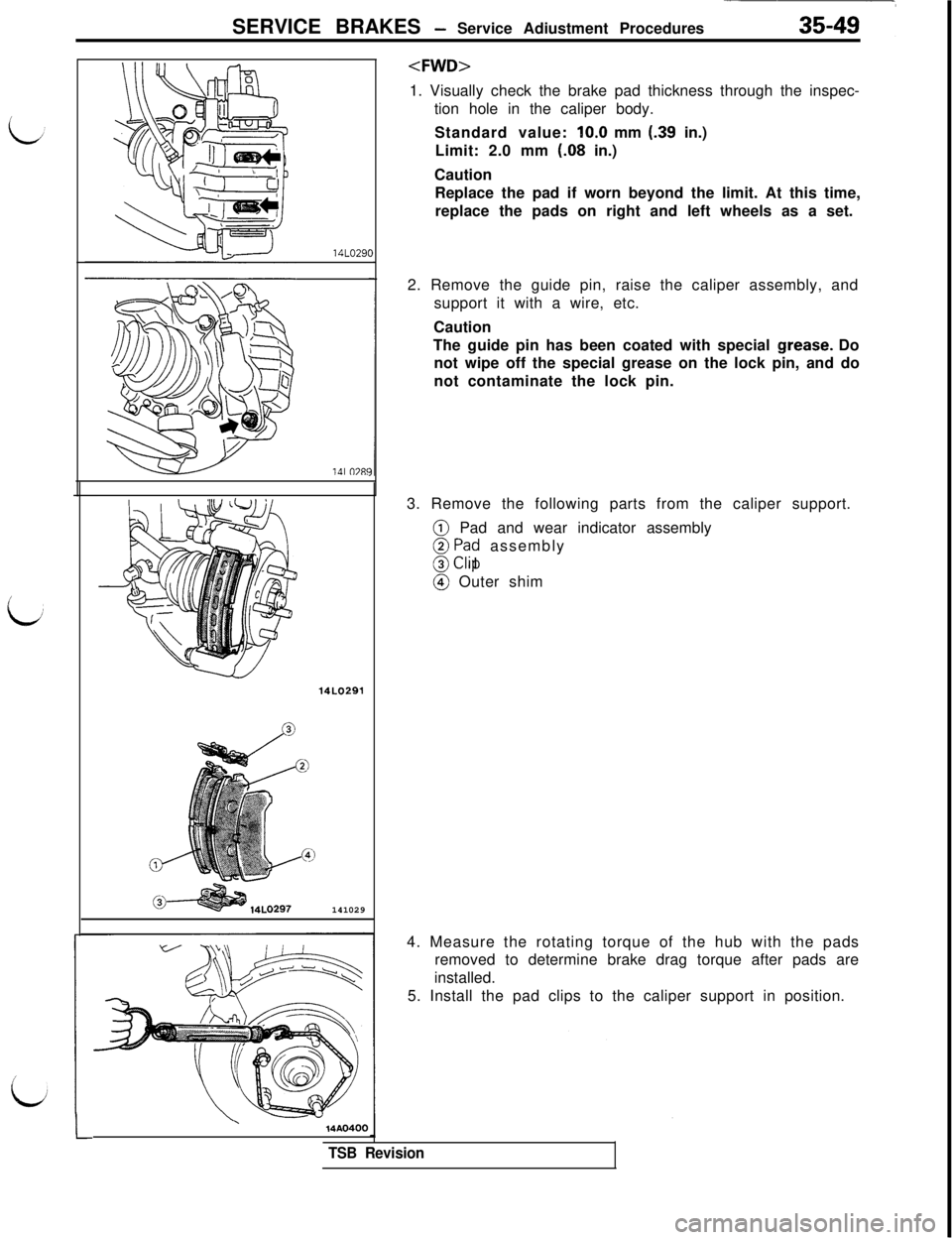
tion hole in the caliper body.
Standard value: IO.0 mm
(.39 in.)
Limit: 2.0 mm (.08 in.)
Caution
Replace the pad if worn beyond the limit. At this time,
replace the pads on right and left wheels as a set.
2. Remove the guide pin, raise the caliper assembly, and
support it with a wire, etc.
Caution
The guide pin has been coated with special
Igrease. Do
not wipe off the special grease on the lock pin, and do
not contaminate the lock pin.
3. Remove the following parts from the caliper support.@ Pad and wear indicator assembly
8 F$$ assembly
3 I@ Outer shim
4. Measure the rotating torque of the hub with the pads
removed to determine brake drag torque after pads are
installed.
5. Install the pad clips to the caliper support in position.
\14AO400
TSB Revision
Page 772 of 1146
35-50SERVICE BRAKES - Service Adjustment Procedures
Pad pin
1 AFnn97
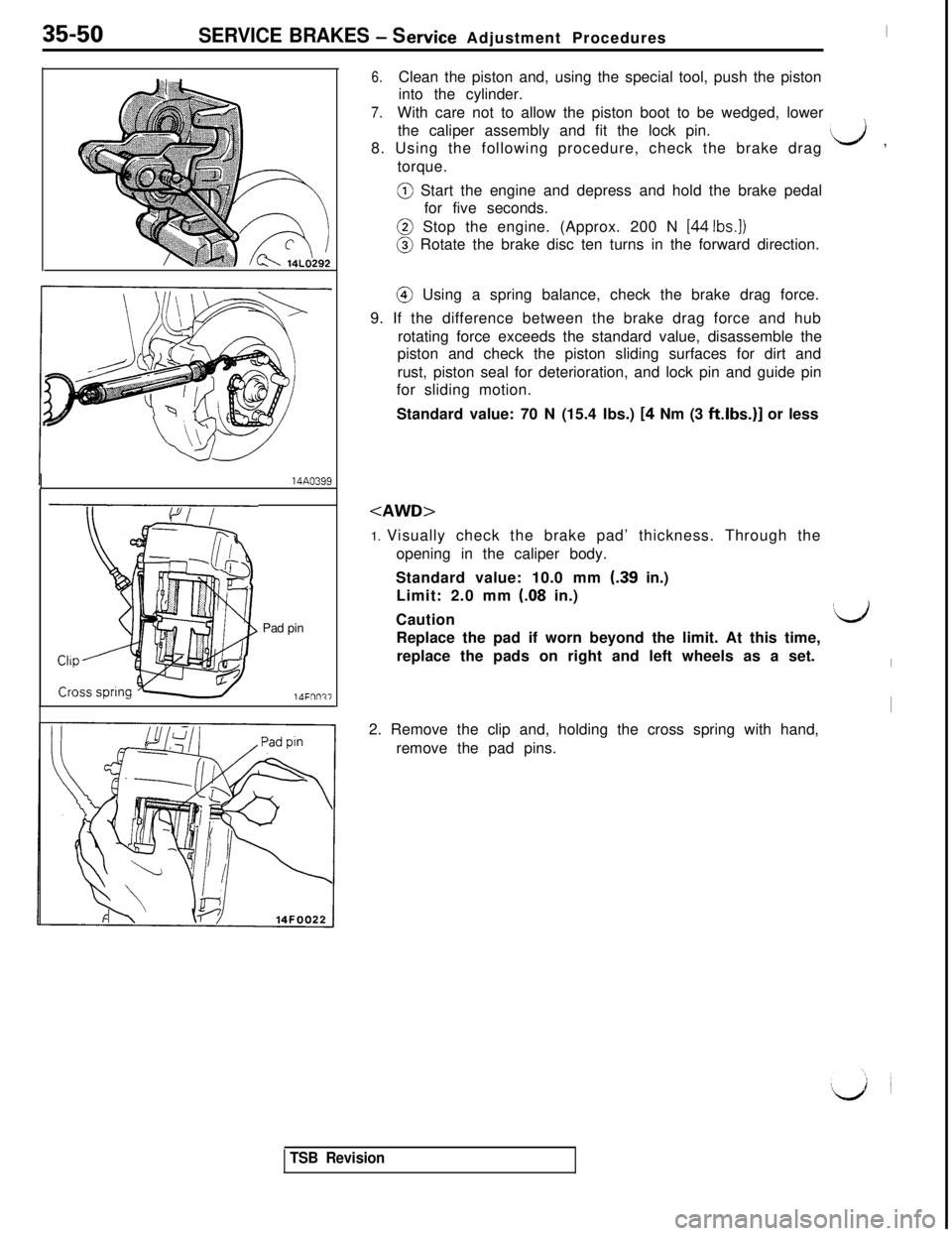
6.Clean the piston and, using the special tool, push the piston
into the cylinder.
7.With care not to allow the piston boot to be wedged, lower
the caliper assembly and fit the lock pin.
8. Using the following procedure, check the brake drag
‘d ,
torque.@ Start the engine and depress and hold the brake pedal
for five seconds.@ Stop the engine. (Approx. 200 N
[44 Ibs.])@ Rotate the brake disc ten turns in the forward direction.@ Using a spring balance, check the brake drag force.
9. If the difference between the brake drag force and hub
rotating force exceeds the standard value, disassemble the
piston and check the piston sliding surfaces for dirt and
rust, piston seal for deterioration, and lock pin and guide pin
for sliding motion.
Standard value: 70 N (15.4 Ibs.)
[4 Nm (3 ftlbs.)] or less
opening in the caliper body.
Standard value: 10.0 mm
(-39 in.)
Limit: 2.0 mm
(.08 in.)
Caution
‘L&iReplace the pad if worn beyond the limit. At this time,
replace the pads on right and left wheels as a set.
I2. Remove the clip and, holding the cross spring with hand,
remove the pad pins.
TSB Revision
Page 773 of 1146
SERVICE BRAKES - Service Adjustment Procedures35-51
iPad assembly
Shim A
Shim B
3‘IShim B
Shim A
14FOO9i.
_-TSB RevisionGrease
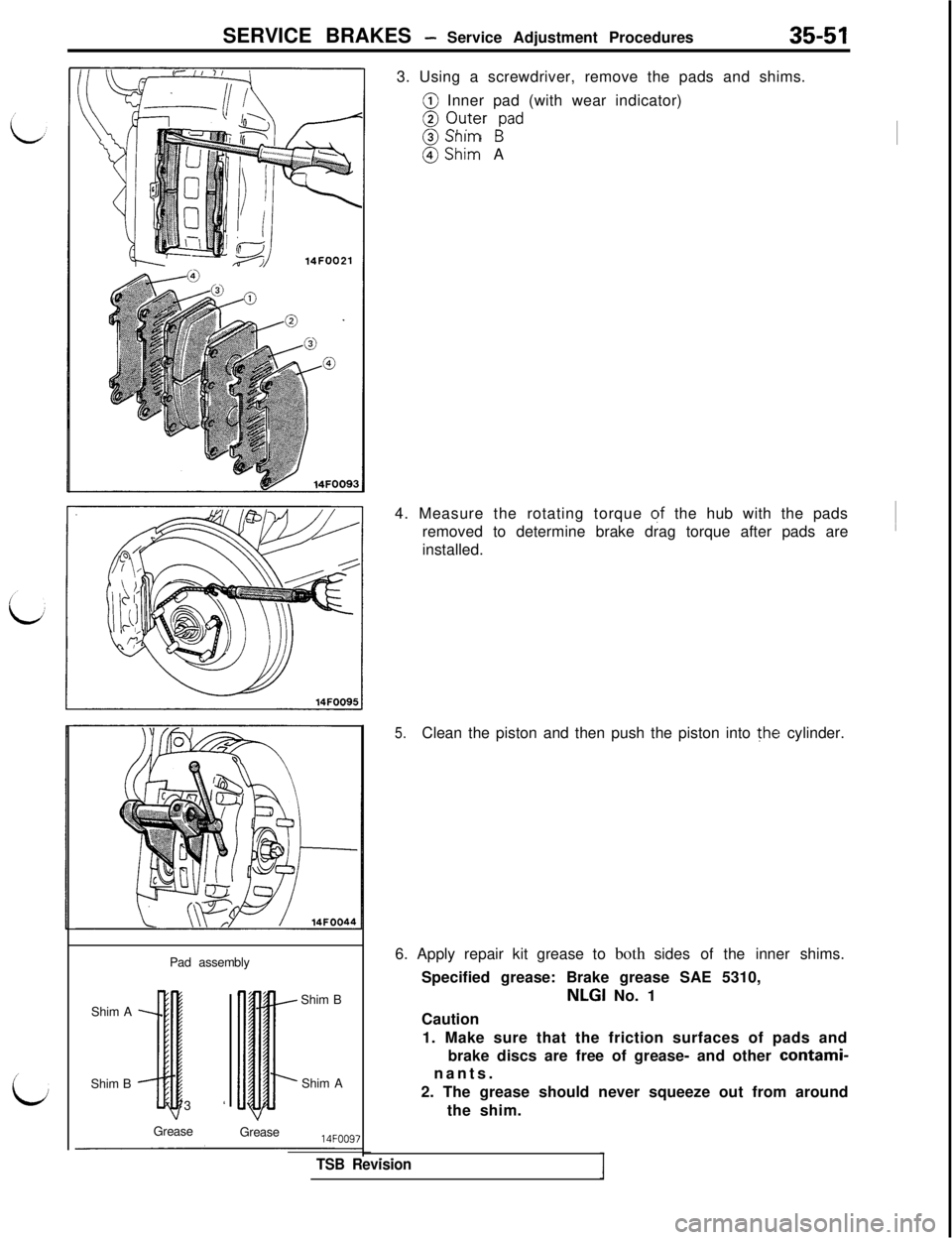
Grease3. Using a screwdriver, remove the pads and shims.
@ Inner pad (with wear indicator)
8 C$+r ;ad
(iJ Sh:: A
4. Measure the rotating torque
qf the hub with the pads
removed to determine brake drag torque after pads are~
installed.
5.Clean the piston and then push the piston into the cylinder.
6. Apply repair kit grease to both sides of the inner shims.
Specified grease: Brake grease SAE 5310,NLGI No. 1
Caution
1. Make sure that the friction surfaces of pads and
brake discs are free of grease- and other
contami-nants.
2. The grease should never squeeze out from around
the shim.
Page 774 of 1146
35-52SERVICE BRAKES - Service Adjustment Procedures
14FOO94
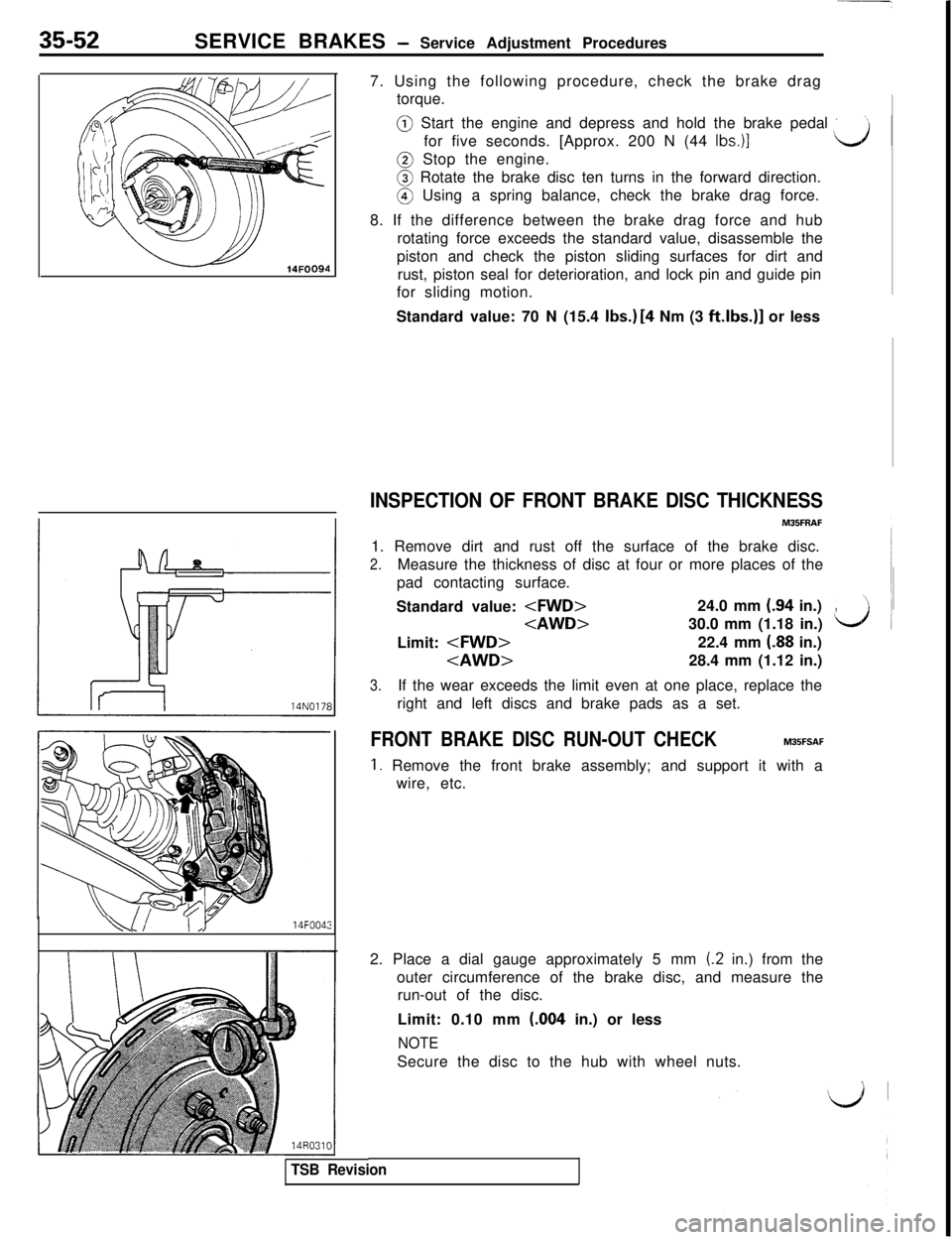
k.!! I14FOO427. Using the following procedure, check the brake drag
torque.@ Start the engine and depress and hold the brake pedal
’for five seconds. [Approx. 200 N (44
Ibs.)]@ Stop the engine.@ Rotate the brake disc ten turns in the forward direction.@ Using a spring balance, check the brake drag force.
8. If the difference between the brake drag force and hub
rotating force exceeds the standard value, disassemble the
piston and check the piston sliding surfaces for dirt and
rust, piston seal for deterioration, and lock pin and guide pin
for sliding motion.
Standard value: 70 N (15.4
Ibs.) [4 Nm (3 ft.lbs.)] or less
INSPECTION OF FRONT BRAKE DISC THICKNESS1. Remove dirt and rust off the surface of the brake disc.
2.Measure the thickness of disc at four or more places of the
pad contacting surface.
Standard value:
,Limit:
3.If the wear exceeds the limit even at one place, replace the
right and left discs and brake pads as a set.
FRONT BRAKE DISC RUN-OUT CHECKM35FSAF
1. Remove the front brake assembly; and support it with a
wire, etc.
TSB Revision2. Place a dial gauge approximately 5 mm
(.2 in.) from the
outer circumference of the brake disc, and measure the
run-out of the disc.
Limit: 0.10 mm (.004 in.) or less
NOTESecure the disc to the hub with wheel nuts.
Page 776 of 1146
SERVICE BRAKES - Service Adjustment Procedures
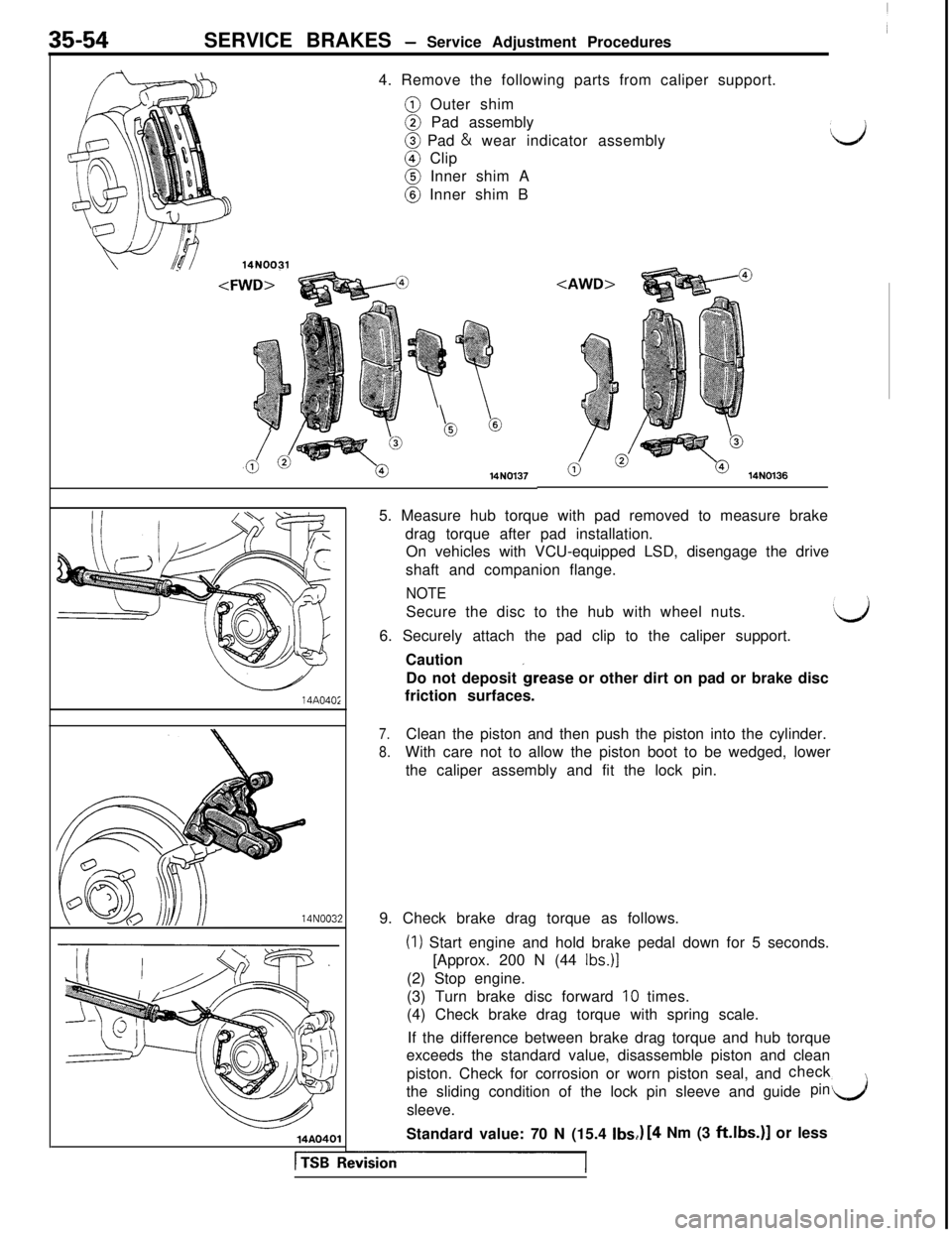
4. Remove the following parts from caliper support.@ Outer shim@ Pad assembly@ Pad & wear indicator assembly@ Clip@ Inner shim A@ Inner shim B
d
14N0031
/0014N013714A040;14N003:
14AO401
l%FLision
14N01365. Measure hub torque with pad removed to measure brake
drag torque after pad installation.
On vehicles with VCU-equipped LSD, disengage the drive
shaft and companion flange.
NOTESecure the disc to the hub with wheel nuts.
6. Securely attach the pad clip to the caliper support.
Caution
Do not deposit
&ease or other dirt on pad or brake disc
friction surfaces.
7.Clean the piston and then push the piston into the cylinder.
8.With care not to allow the piston boot to be wedged, lower
the caliper assembly and fit the lock pin.
9. Check brake drag torque as follows.
(I) Start engine and hold brake pedal down for 5 seconds.
[Approx. 200 N (44
Ibs.)](2) Stop engine.
(3) Turn brake disc forward
10 times.
(4) Check brake drag torque with spring scale.
If the difference between brake drag torque and hub torque
exceeds the standard value, disassemble piston and clean
piston. Check for corrosion or worn piston seal, andcheck
the sliding condition of the lock pin sleeve and guide
pinl/jsleeve.
Standard value: 70 N (15.4
Ibs,,) [4 Nm (3 ft.lbs.)] or less
Page 780 of 1146
35-58SERVICE BRAKES - Service Adjustment Procedures
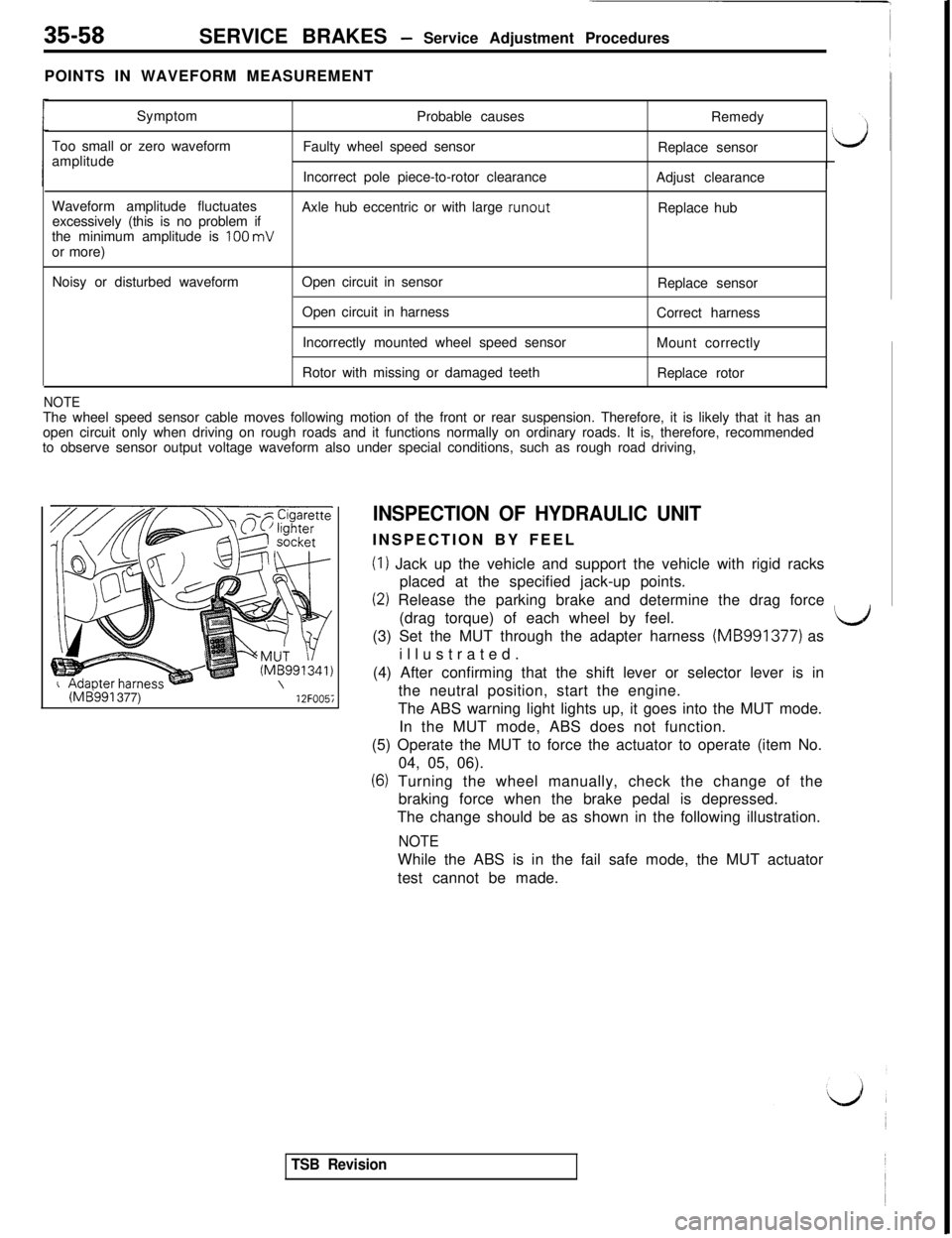
POINTS IN WAVEFORM MEASUREMENT
Symptom
Too small or zero waveform
amplitudeProbable causes
Faulty wheel speed sensorRemedy
Replace sensor
Incorrect pole piece-to-rotor clearance
Adjust clearance
Waveform amplitude fluctuates
excessively (this is no problem ifAxle hub eccentric or with large runout
Replace hub
the minimum amplitude is
100 mV
or more)
Noisy or disturbed waveformOpen circuit in sensor
Open circuit in harness
Incorrectly mounted wheel speed sensor
Rotor with missing or damaged teethReplace sensor
Correct harness
Mount correctly
Replace rotor
NOTEThe wheel speed sensor cable moves following motion of the front or rear suspension. Therefore, it is likely that it has an
open circuit only when driving on rough roads and it functions normally on ordinary roads. It is, therefore, recommended
to observe sensor output voltage waveform also under special conditions, such as rough road driving,
(ME!991 377)12FOO5i
INSPECTION OF HYDRAULIC UNITINSPECTION BY FEEL
(I) Jack up the vehicle and support the vehicle with rigid racks
placed at the specified jack-up points.
(2) Release the parking brake and determine the drag force
(drag torque) of each wheel by feel.
LJ(3) Set the MUT through the adapter harness (MB991377) as
illustrated.
(4) After confirming that the shift lever or selector lever is in
the neutral position, start the engine.
The ABS warning light lights up, it goes into the MUT mode.
In the MUT mode, ABS does not function.
(5) Operate the MUT to force the actuator to operate (item No.
04, 05, 06).
(6) Turning the wheel manually, check the change of the
braking force when the brake pedal is depressed.
The change should be as shown in the following illustration.
NOTEWhile the ABS is in the fail safe mode, the MUT actuator
test cannot be made.
TSB Revision
Page 796 of 1146
35-74
SERVICE BRAKES - Front Disc Brake
INSPECTIONM35LCAEl Check disc for wear. (Refer to
P.35-52.)l Check disc for runout. (Refer to
P.35-52, 53.)Il Check disc for damage.14A040C
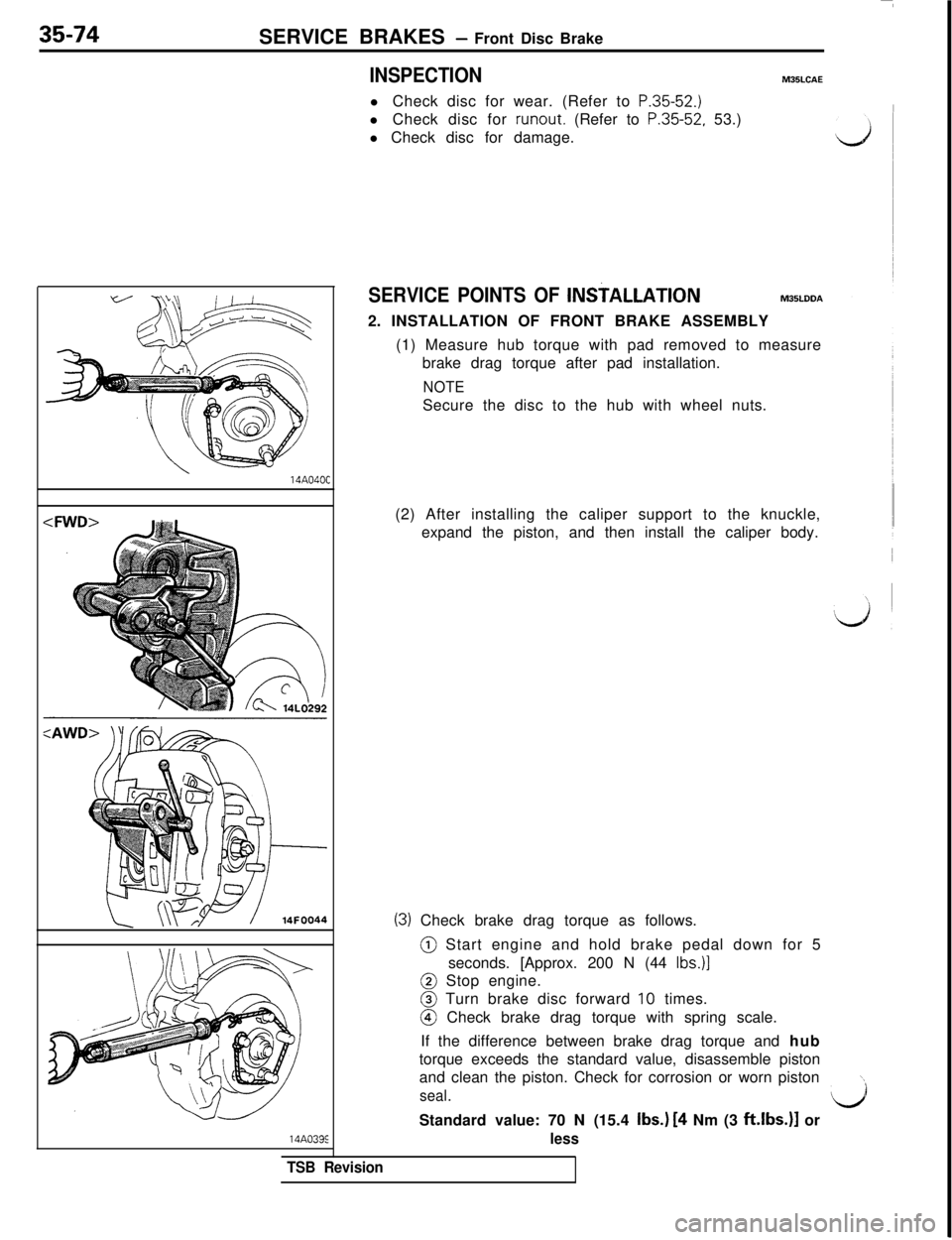
(2) After installing the caliper support to the knuckle,
expand the piston, and then install the caliper body.
(3) Check brake drag torque as follows.@ Start engine and hold brake pedal down for 5
seconds. [Approx. 200 N (44
Ibs.)]@ Stop engine.@ Turn brake disc forward
10 times.@ Check brake drag torque with spring scale.
If the difference between brake drag torque and hub
torque exceeds the standard value, disassemble piston
and clean the piston. Check for corrosion or worn piston
\\
seal.l/iStandard value: 70 N (15.4 Ibs.)
[4 Nm (3 ft.lbs.)l or14A033E
less
SERVICE POINTS OF lNS?ALLATlONM35LDDA2. INSTALLATION OF FRONT BRAKE ASSEMBLY
(1) Measure hub torque with pad removed to measure
brake drag torque after pad installation.
NOTESecure the disc to the hub with wheel nuts.
TSB Revision
Page 813 of 1146
SERVICE BRAKES - Wheel SDeed Sensor lABSI35-91
/
i
lARnlA6
14N012‘
3
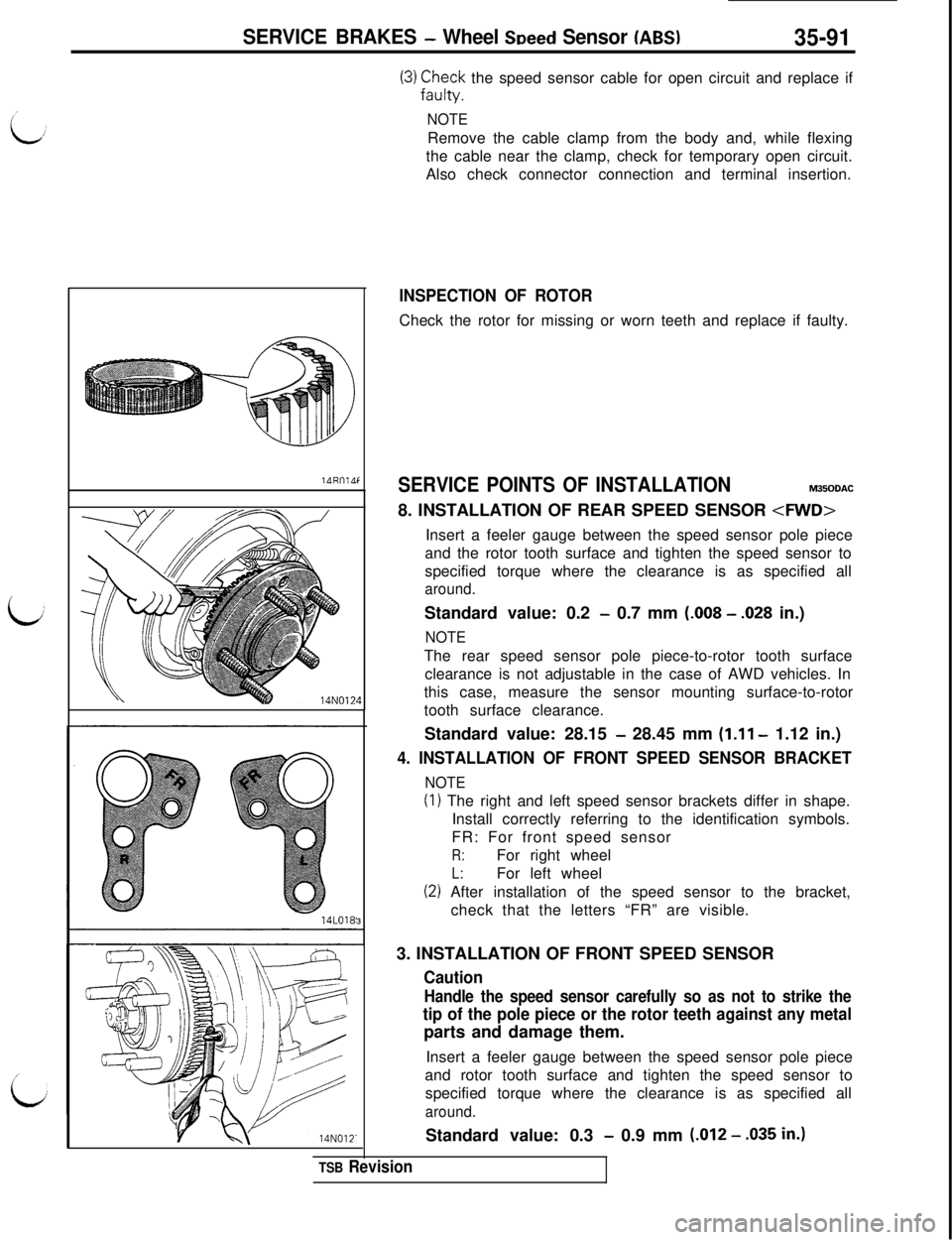
(3) zue$ the speed sensor cable for open circuit and replace if
NOTERemove the cable clamp from the body and, while flexing
the cable near the clamp, check for temporary open circuit.
Also check connector connection and terminal insertion.
INSPECTION OF ROTORCheck the rotor for missing or worn teeth and replace if faulty.
SERVICE POINTS OF INSTALLATIONM350DAC8. INSTALLATION OF REAR SPEED SENSOR
and the rotor tooth surface and tighten the speed sensor to
specified torque where the clearance is as specified all
around.Standard value: 0.2
- 0.7 mm (.008 - .028 in.)
NOTEThe rear speed sensor pole piece-to-rotor tooth surface
clearance is not adjustable in the case of AWD vehicles. In
this case, measure the sensor mounting surface-to-rotor
tooth surface clearance.
Standard value: 28.15
- 28.45 mm (1.11 - 1.12 in.)
4. INSTALLATION OF FRONT SPEED SENSOR BRACKET
NOTE
(I) The right and left speed sensor brackets differ in shape.
Install correctly referring to the identification symbols.
FR: For front speed sensor
R:For right wheel
L:For left wheel
(2) After installation of the speed sensor to the bracket,
check that the letters “FR” are visible.
3. INSTALLATION OF FRONT SPEED SENSOR
Caution
Handle the speed sensor carefully so as not to strike the
tip of the pole piece or the rotor teeth against any metalparts and damage them.
Insert a feeler gauge between the speed sensor pole piece
and rotor tooth surface and tighten the speed sensor to
specified torque where the clearance is as specified all
around.Standard value: 0.3
- 0.9 mm (.012 - .035 in.)
TSB Revision
Page 829 of 1146
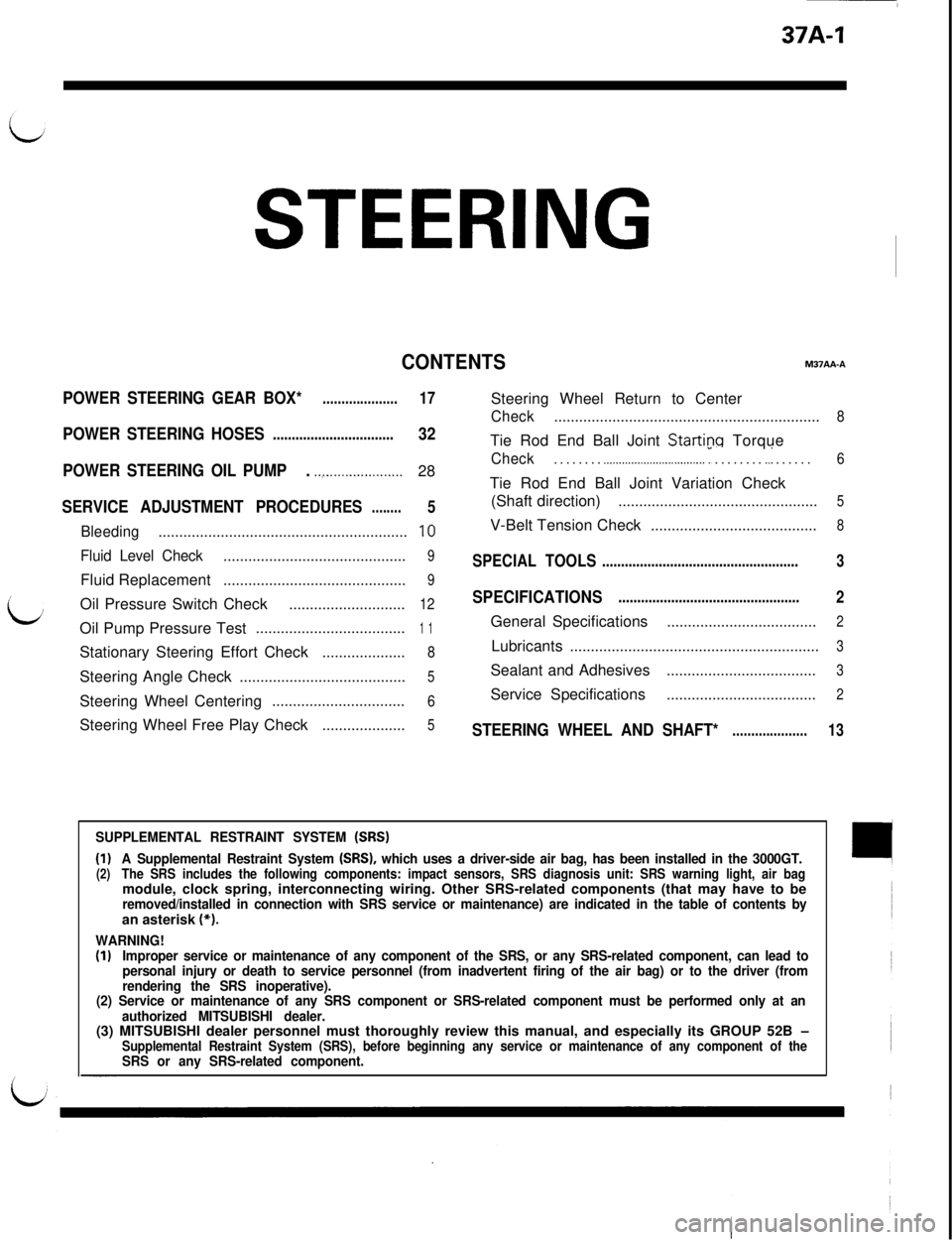
37A-1
STEERING
CONTENTSM37AA-A
POWER STEERING GEAR BOX*....................17Steering Wheel Return to Center
Check................................................................8
POWER STEERING HOSES................................32Tie Rod End Ball Joint Startinq Torque
POWER STEERING OIL PUMP. .._....................28Check. . . . . . . . .._.............................. r . . . . . . . . ..I . . . . . .6Tie Rod End Ball Joint Variation Check
SERVICE ADJUSTMENT PROCEDURES5(Shaft direction)................................................5........
Bleeding............................................................10V-Belt Tension Check........................................8
Fluid Level Check............................................9SPECIAL TOOLS....................................................3Fluid Replacement
............................................9
/
bOil Pressure Switch Check
SPECIFICATIONS2............................12................................................Oil Pump Pressure Test
....................................1 1General Specifications....................................2Stationary Steering Effort Check
....................8Lubricants............................................................3Steering Angle Check
5Sealant and Adhesives....................................3........................................Steering Wheel Centering
6Service Specifications....................................2................................Steering Wheel Free Play Check
....................5STEERING WHEEL AND SHAFT*....................13
SUPPLEMENTAL RESTRAINT SYSTEM (SRS)
(1)A Supplemental Restraint System (SRS), which uses a driver-side air bag, has been installed in the 3000GT.(2)The SRS includes the following components: impact sensors, SRS diagnosis unit: SRS warning light, air bagmodule, clock spring, interconnecting wiring. Other SRS-related components (that may have to be
removed/installed in connection with SRS service or maintenance) are indicated in the table of contents byan asterisk (*).
WARNING!(I)Improper service or maintenance of any component of the SRS, or any SRS-related component, can lead to
personal injury or death to service personnel (from inadvertent firing of the air bag) or to the driver (from
rendering the SRS inoperative).
(2) Service or maintenance of any SRS component or SRS-related component must be performed only at an
authorized MITSUBISHI dealer.(3) MITSUBISHI dealer personnel must thoroughly review this manual, and especially its GROUP 52B
-Supplemental Restraint System (SRS), before beginning any service or maintenance of any component of theSRS or any SRS-related component.
Page 830 of 1146
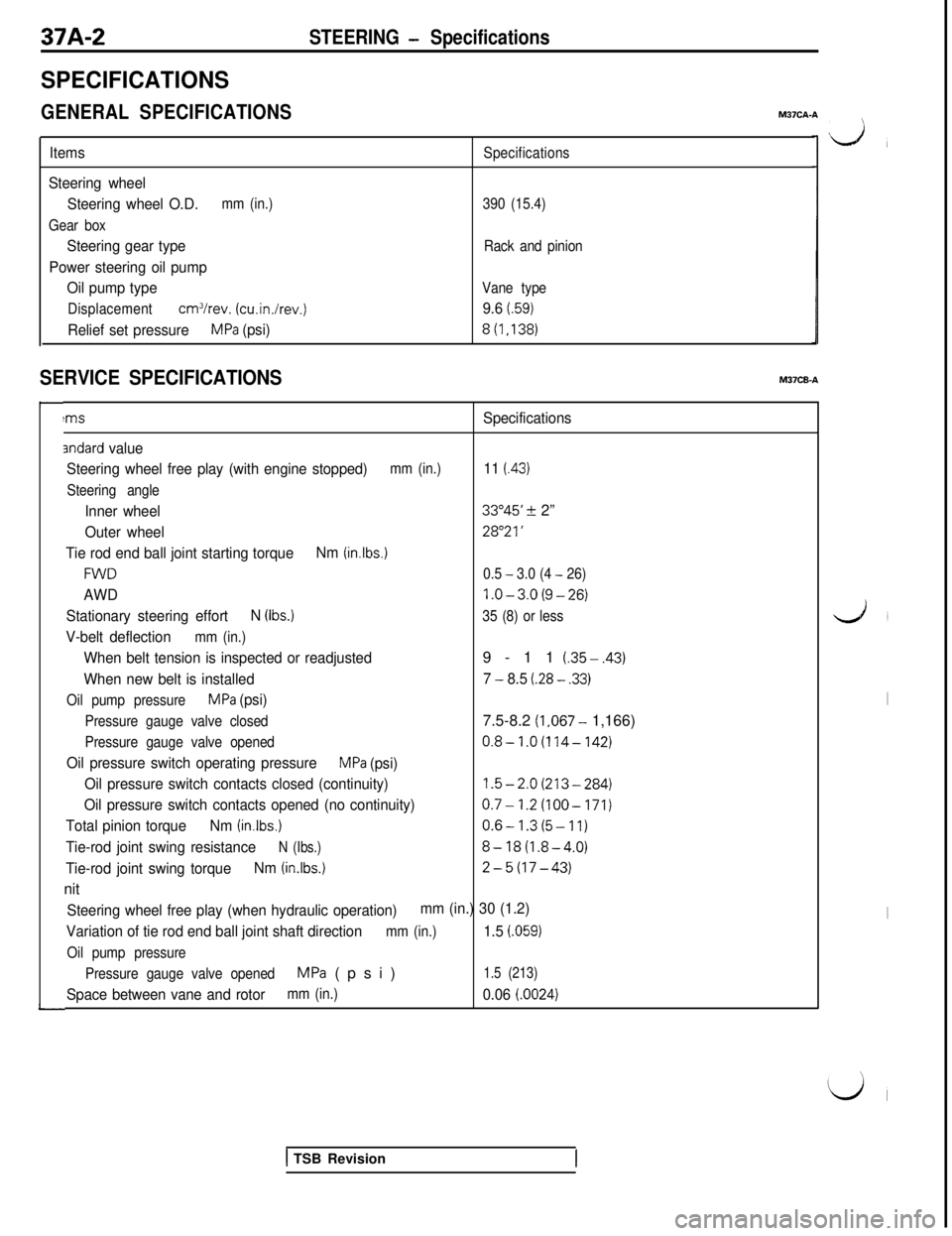
37A-2SPECIFICATIONS
STEERING - Specifications
GENERAL SPECIFICATIONS
M37CA-A
LA,Items
Steering wheel
Steering wheel O.D.
mm (in.)
Gear box
Steering gear type
Power steering oil pump
Oil pump type
Displacementcm3/rev. (cu.in./rev.)
Relief set pressureMPa (psi)
Specifications
390 (15.4)
Rack and pinion
Vane type
9.6 t.59)
8(1,138)
SERVICE SPECIFICATIONSM37CB-A
!msSpecifications
andard value
Steering wheel free play (with engine stopped)
mm (in.)11 (43)
Steering angle
Inner wheel33”45’ 2 2”
Outer wheel28”21’
Tie rod end ball joint starting torqueNm (in.lbs.)
FWD0.5 - 3.0 (4 - 26)
AWDl.O-3.0(9-26)
Stationary steering effortN (Ibs.)35 (8) or less
V-belt deflectionmm (in.)
When belt tension is inspected or readjusted9-11 (.35-.43)
When new belt is installed7 - 8.5 (.28 - .33)
Oil pump pressureMPa (psi)
Pressure gauge valve closed7.5-8.2 (1,067- 1,166)
Pressure gauge valve opened0.8-1.0(114-142)
Oil pressure switch operating pressureMPa (psi)
Oil pressure switch contacts closed (continuity)
1.5-2.0(213-284)
Oil pressure switch contacts opened (no continuity)0.7-1.2(100-171)
Total pinion torqueNm (in.lbs.)0.6-1.3(5-11)
Tie-rod joint swing resistanceN (Ibs.)8-18(1.8-4.0)
Tie-rod joint swing torqueNm (in.lbs.)2-5(17-43)nit
Steering wheel free play (when hydraulic operation)mm (in.) 30 (1.2)
Variation of tie rod end ball joint shaft direction
mm (in.)1.5 i.059)
Oil pump pressure
Pressure gauge valve opened
MPa (psi)1.5 (213)
Space between vane and rotormm (in.)0.06 (0024)
LJ’
I
I
L’l
1 TSB Revision