torque MITSUBISHI 3000GT 1991 Service Manual
[x] Cancel search | Manufacturer: MITSUBISHI, Model Year: 1991, Model line: 3000GT, Model: MITSUBISHI 3000GT 1991Pages: 1146, PDF Size: 76.68 MB
Page 862 of 1146
37B-24-WHEEL STEERING SYSTEM (4WS) -Specifications / Special Tools
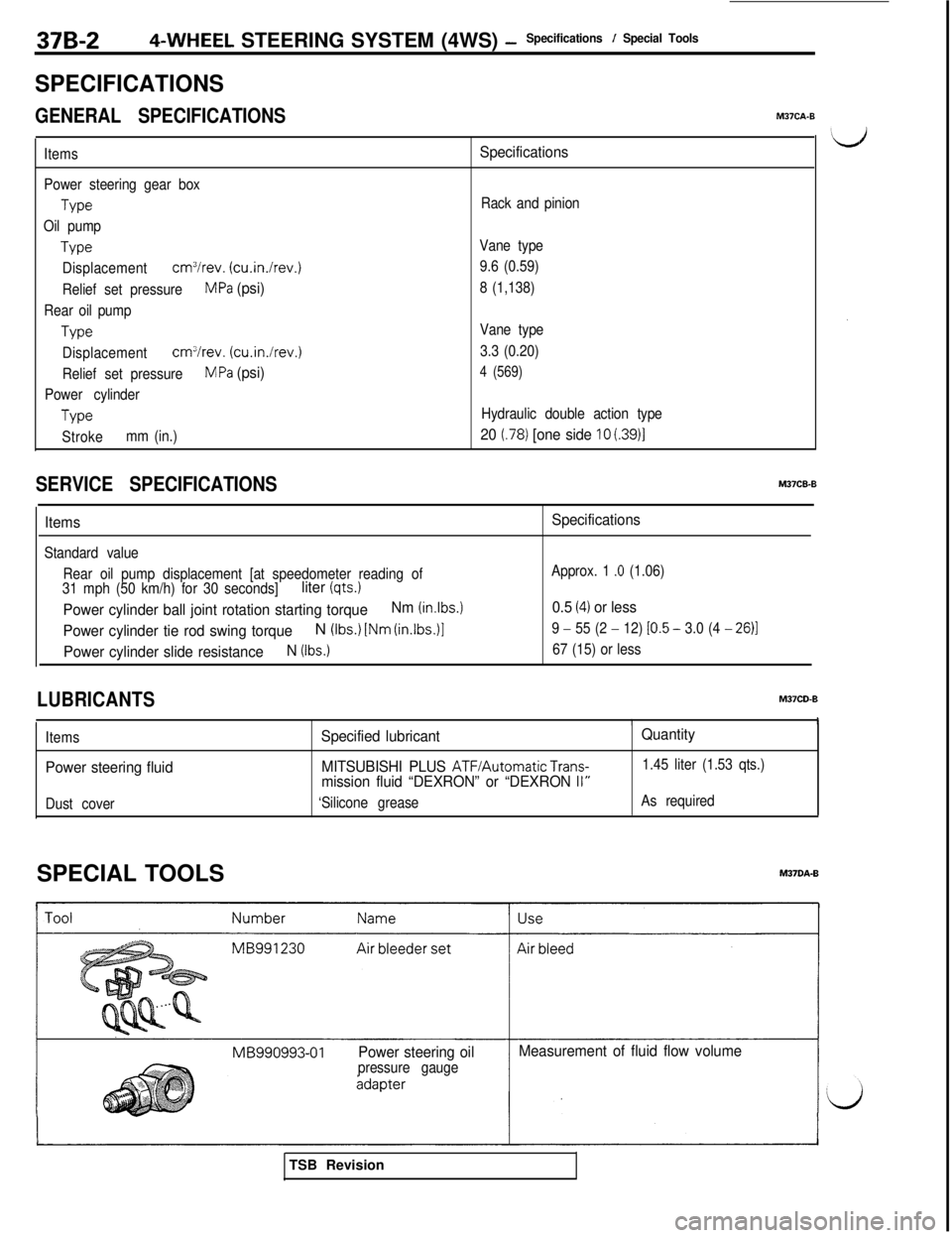
SPECIFICATIONS
GENERAL SPECIFICATIONSM37CA-B
Items
Power steering gear box
Type
Oil pump
Type
Displacement
cm”/rev. (cu.in./rev.)
Relief set pressure
MPa (psi)
Rear oil pump
Type
Displacement
cm’/rev. (cu.in./rev.)
Relief set pressure
MPa (psi)
Power cylinder
Type
Strokemm (in.)
Specifications
Rack and pinion
Vane type
9.6 (0.59)
8 (1,138)
Vane type
3.3 (0.20)
4 (569)
Hydraulic double action type
20 i.78) [one side 10 (.39)1
SERVICE SPECIFICATIONSM37CEB
Items
Standard value
Specifications
Rear oil pump displacement [at speedometer reading of
31 mph (50 km/h) for 30 seconds]liter (qts.)
Power cylinder ball joint rotation starting torqueNm (in.lbs.)
Power cylinder tie rod swing torqueN (Ibs.) [Nm (in.lbs.)]
Power cylinder slide resistanceN (Ibs.)
Approx. 1 .O (1.06)
0.5 (4) or less
9 - 55 (2 - 12) IO.5 - 3.0 (4 - 26)l
67 (15) or less
LUBRICANTSM37CD.B
,II
Items
Power steering fluid
Dust cover
Specified lubricant
MITSUBISHI PLUS
ATFiAutomatic Trans-mission fluid “DEXRON” or “DEXRON II”
‘Silicone grease
Quantity
1.45 liter (1.53 qts.)
As requiredSPECIAL TOOLS
M37DA-6
MB990993-01Power steering oilpressure gauge
Measurement of fluid flow volumeTSB Revision
Page 863 of 1146

4-WHEEL STEERING SYSTEM (4WS) - Troubleshooting
TROUBLESHOOTING
37B-3
M37EMKBefore inspecting, check the following items:
l Oil pump drive belt tension
lEnsure that the suspension has not been mod-@Power steering fluid level, and air in the system
ified
l Engine
Idle soeed and even idle
lTire and wheel size, specifications, air pressure,
l Oil leakage
balance and amount of wear
l Steering wheel type
l Wheel alignment
Malfunction symptom
4WS does not operateMalfunctioning system
Power cylinderInspection item
Tie rod swing torque
Power cylinder slide resistance
Rear oil pump
Flow volume check
Control valve
-
Poor steering feelingSteering gears and linkage
Rack cracks or deformationFeeling of friction in steering
Poor steering return
Steering wheel efforts
excessive
Control valve
Oil leakage from control valve jornt
Rear wheels cannot be
steered
Poor rear wheels return
Hydraulic pressure for rear
wheel is constantly high
Long rear wheel steering
delayPoor steering response
Poor steering returnPower cylinder
Oil lineOil reservoir
Control valve
Power cylinder
Rear oil pump
Power cylinder
Oil leakage from piston rod
Pressure hose breakage
Oil reservoir deformation or oil leakage
Stuck control valve spool
Stuck power cylinder
Relief valve remains open
Excessive power cylinder friction-
Looseness in power cylinder tie rod ball jo.int
Ball joint dust cover cracks
Poor rear wheel steeringresponsePoor rear wheel steeringrange
Poor steerability (extremetire wear)Control valve
Power cylinder
Rear oil pump
Power cylinder
Oil leakage from control valve spool
Oil leakage from power cylinder
Extreme oil pump internal wear
Tie rod length improperly adjusted after toe-inadjustment
[ TSB Revision
Page 865 of 1146
4-WHEEL STEERING SYSTEM (4WS) -Service Adjustment Procedures37B-5
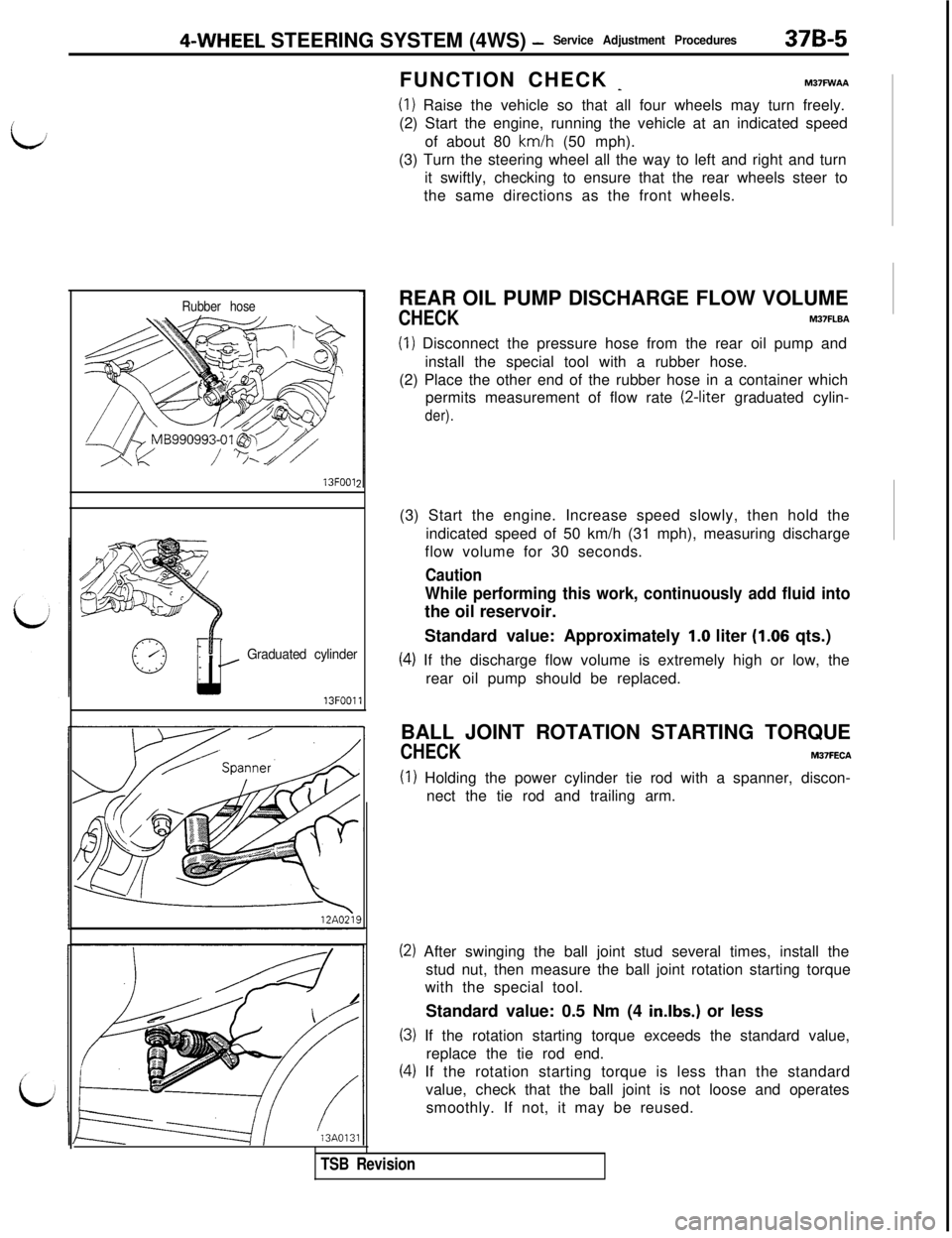
Rubber hose
13FOOl
Graduated cylinder13FOOllFUNCTION CHECK
_M37FWAA
(1) Raise the vehicle so that all four wheels may turn freely.
(2) Start the engine, running the vehicle at an indicated speed
of about 80
km/h (50 mph).
(3) Turn the steering wheel all the way to left and right and turn
it swiftly, checking to ensure that the rear wheels steer to
the same directions as the front wheels.
REAR OIL PUMP DISCHARGE FLOW VOLUME
CHECKM37FLBA
(1) Disconnect the pressure hose from the rear oil pump and
install the special tool with a rubber hose.
(2) Place the other end of the rubber hose in a container which
permits measurement of flow rate (2-liter graduated cylin-
der).(3) Start the engine. Increase speed slowly, then hold the
indicated speed of 50 km/h (31 mph), measuring discharge
flow volume for 30 seconds.
Caution
While performing this work, continuously add fluid intothe oil reservoir.
Standard value: Approximately
1.0 liter (1.06 qts.)
(4) If the discharge flow volume is extremely high or low, the
rear oil pump should be replaced.
BALL JOINT ROTATION STARTING TORQUE
CHECKM37FECA
(1) Holding the power cylinder tie rod with a spanner, discon-
nect the tie rod and trailing arm.
(2) After swinging the ball joint stud several times, install the
stud nut, then measure the ball joint rotation starting torque
with the special tool.
Standard value: 0.5 Nm (4
in.lbs.) or less
(3) If the rotation starting torque exceeds the standard value,
replace the tie rod end.
(4) If the rotation starting torque is less than the standard
value, check that the ball joint is not loose and operates
smoothly. If not, it may be reused.
TSB Revision
Page 867 of 1146
4-WHEEL STEERING SYSTEM (4WS) - Power Cylinder378-712AOlOE
IlZAO2;91
3A009
Wire
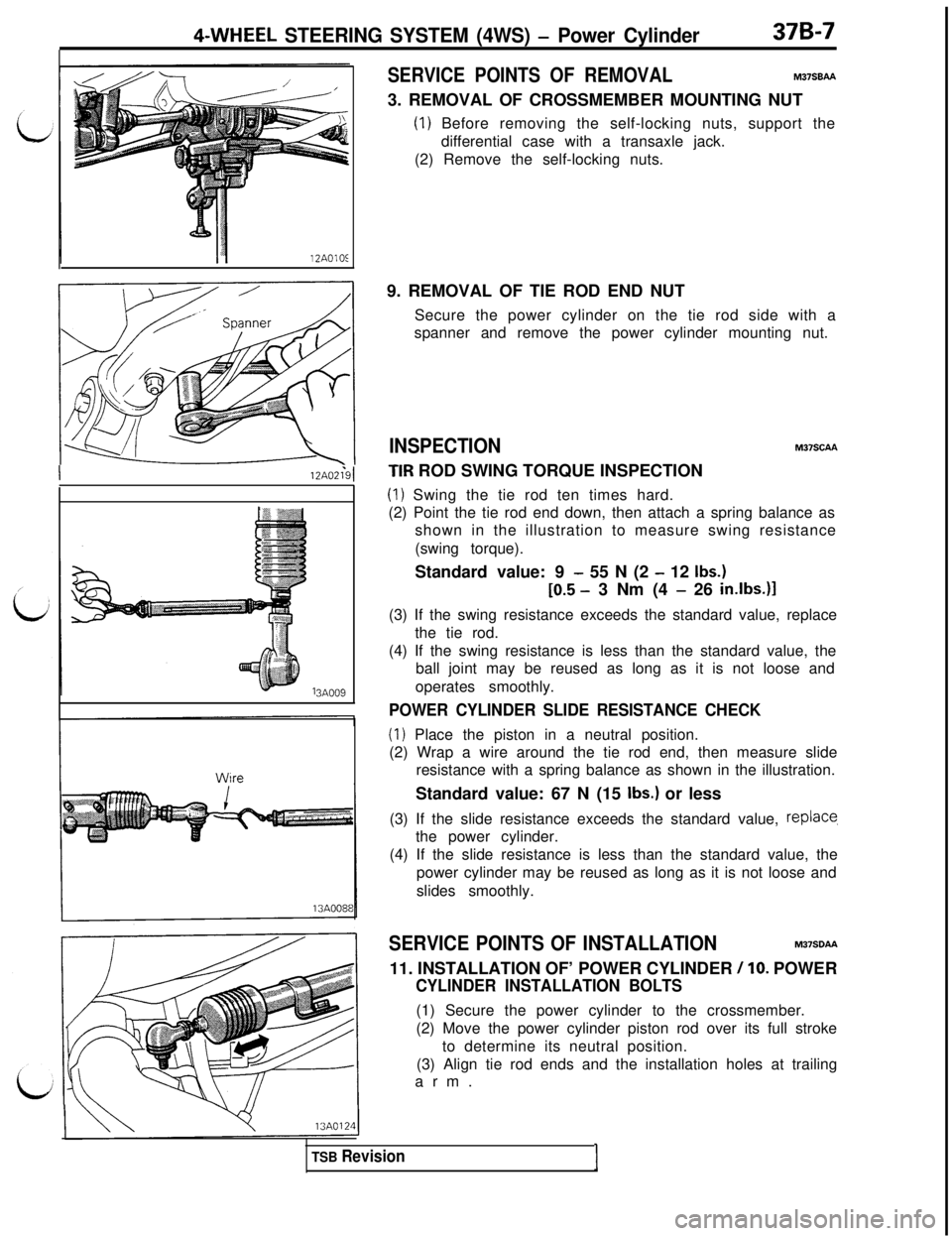
SERVICE POINTS OF REMOVALM37SBM3. REMOVAL OF CROSSMEMBER MOUNTING NUT
(1) Before removing the self-locking nuts, support the
differential case with a transaxle jack.
(2) Remove the self-locking nuts.
9. REMOVAL OF TIE ROD END NUT
Secure the power cylinder on the tie rod side with a
spanner and remove the power cylinder mounting nut.
INSPECTIONM37SCM
TIR ROD SWING TORQUE INSPECTION
(1) Swing the tie rod ten times hard.
(2) Point the tie rod end down, then attach a spring balance as
shown in the illustration to measure swing resistance
(swing torque).
Standard value: 9
- 55 N (2 - 12 Ibs.)
[0.5 - 3 Nm (4 - 26 in.lbs.)l(3) If the swing resistance exceeds the standard value, replace
the tie rod.
(4) If the swing resistance is less than the standard value, the
ball joint may be reused as long as it is not loose and
operates smoothly.
POWER CYLINDER SLIDE RESISTANCE CHECK
(1) Place the piston in a neutral position.
(2) Wrap a wire around the tie rod end, then measure slide
resistance with a spring balance as shown in the illustration.
Standard value: 67 N (15
Ibs.) or less
(3) If the slide resistance exceeds the standard value,
replace,the power cylinder.
(4) If the slide resistance is less than the standard value, the
power cylinder may be reused as long as it is not loose and
slides smoothly.
SERVICE POINTS OF INSTALLATIONM37SDP911. INSTALLATION OF’ POWER CYLINDER
/ 10. POWER
CYLINDER INSTALLATION BOLTS(1) Secure the power cylinder to the crossmember.
(2) Move the power cylinder piston rod over its full stroke
to determine its neutral position.
(3) Align tie rod ends and the installation holes at trailing
arm.
TSB RevisionI
Page 940 of 1146
51-2
SPECIFICATIONSEXTERIOR
- Specifications
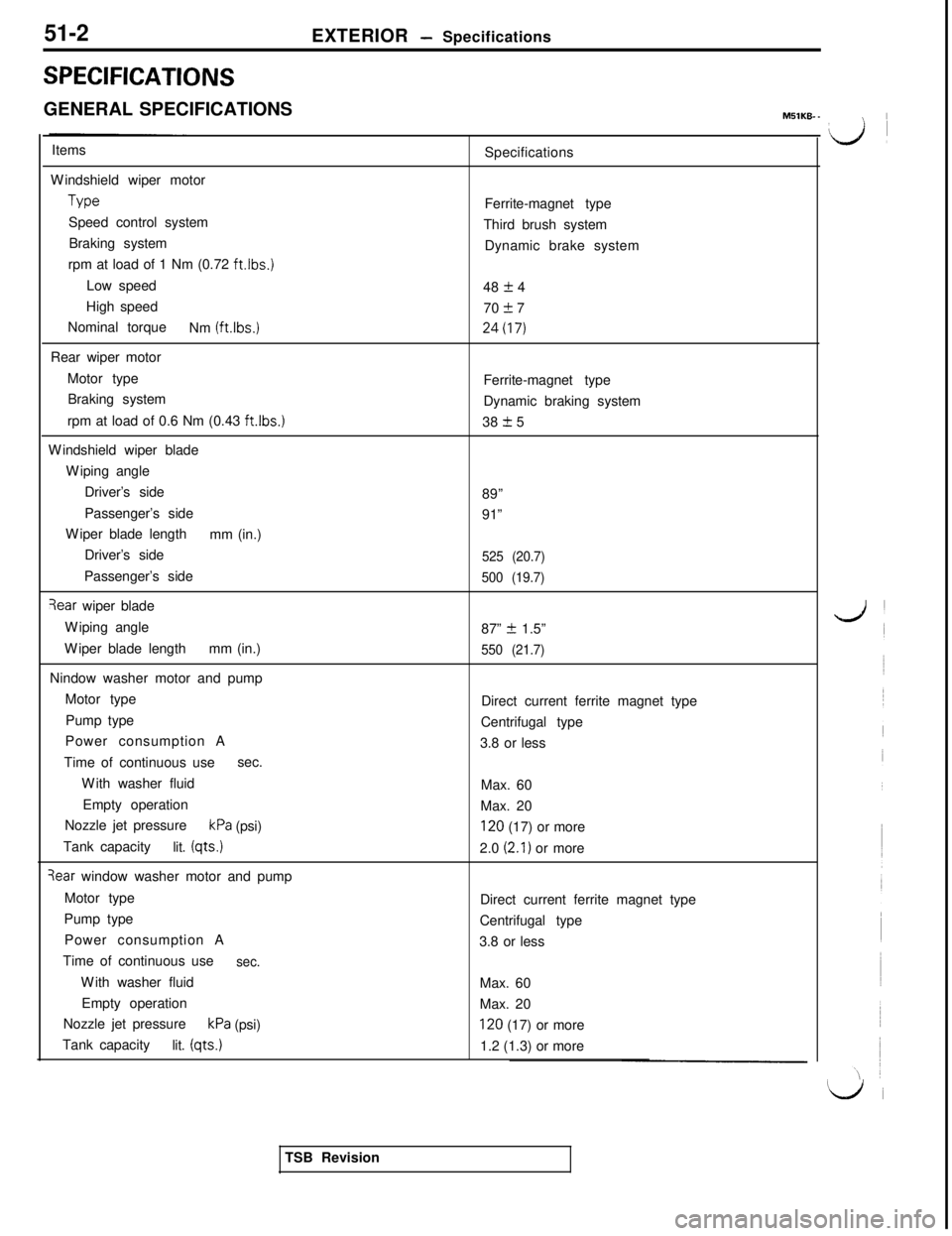
GENERAL SPECIFICATIONSMSlKB-
-\ IItems
Windshield wiper motorType
Speed control system
Braking system
rpm at load of 1 Nm (0.72
ft.lbs.)Low speed
High speed
Nominal torque
Nm (ft.lbs.)
Rear wiper motor
Motor type
Braking system
rpm at load of 0.6 Nm (0.43
ft.lbs.)Windshield wiper blade
Wiping angle
Driver’s side
Passenger’s side
Wiper blade length
mm (in.)
Driver’s side
Passenger’s side
Tear wiper blade
Wiping angle
Wiper blade lengthmm (in.)
Nindow washer motor and pump
Motor type
Pump type
Power consumption A
Time of continuous usesec.
With washer fluid
Empty operation
Nozzle jet pressure
kPa (psi)
Tank capacity
lit.
(qts.)
3ear window washer motor and pump
Motor type
Pump type
Power consumption A
Time of continuous use
sec.With washer fluid
Empty operation
Nozzle jet pressure
kPa (psi)
Tank capacity
lit. (qts.)Specifications
Ferrite-magnet type
Third brush system
Dynamic brake system
48
_+ 4
70
2 724(17)
Ferrite-magnet type
Dynamic braking system
38
+ 5
89”
91”
525 (20.7)
500 (19.7)87”
k 1.5”
550 (21.7)Direct current ferrite magnet type
Centrifugal type
3.8 or less
Max. 60
Max. 20
120 (17) or more
2.0
(2.1) or more
Direct current ferrite magnet type
Centrifugal type
3.8 or less
Max. 60
Max. 20
120 (17) or more
1.2 (1.3) or more
LJ
L/iTSB Revision
Page 983 of 1146
INTERIOR - Troubleshootinn52A-5OPERATION
l If the driver fastens the seat belt with the
ignition switch placed in the “ON” position, the
seat belt switch in the seat belt buckle is turned
“ON” to operate the seat belt solenoid in the
retractor.
lThis will reduce the seat belt rewinding torque
to minimize a sense of oppression given by the
belt.
lOwing to the timer function of the ETACS unit,
the seat belt solenoid is kept in operation for 30
seconds after turning off the ignition switch,
with due consideration to elimination of the
sudden rise in a sense of oppression caused by
the belt immediately after the ignition switch is
turned off.
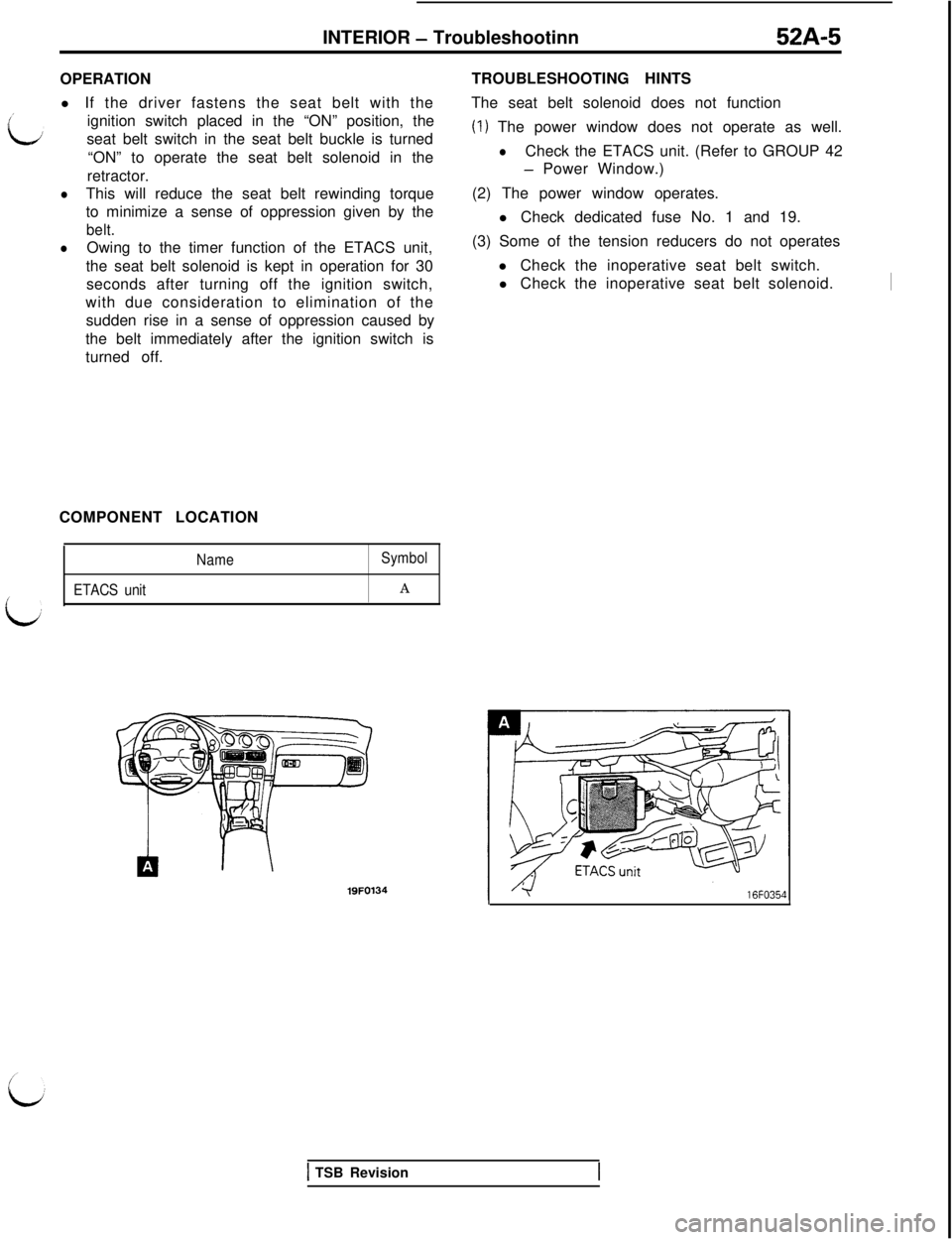
COMPONENT LOCATION
ETACS unitNameSymbolA19FO134TROUBLESHOOTING HINTS
The seat belt solenoid does not function
(I) The power window does not operate as well.
lCheck the ETACS unit. (Refer to GROUP 42-Power Window.)
(2) The power window operates.
l Check dedicated fuse No. 1 and 19.
(3) Some of the tension reducers do not operates
l Check the inoperative seat belt switch.
l Check the inoperative seat belt solenoid.
I
1 TSB Revision
Page 997 of 1146
INTERIOR - Front Seat52A-19INSPECTION
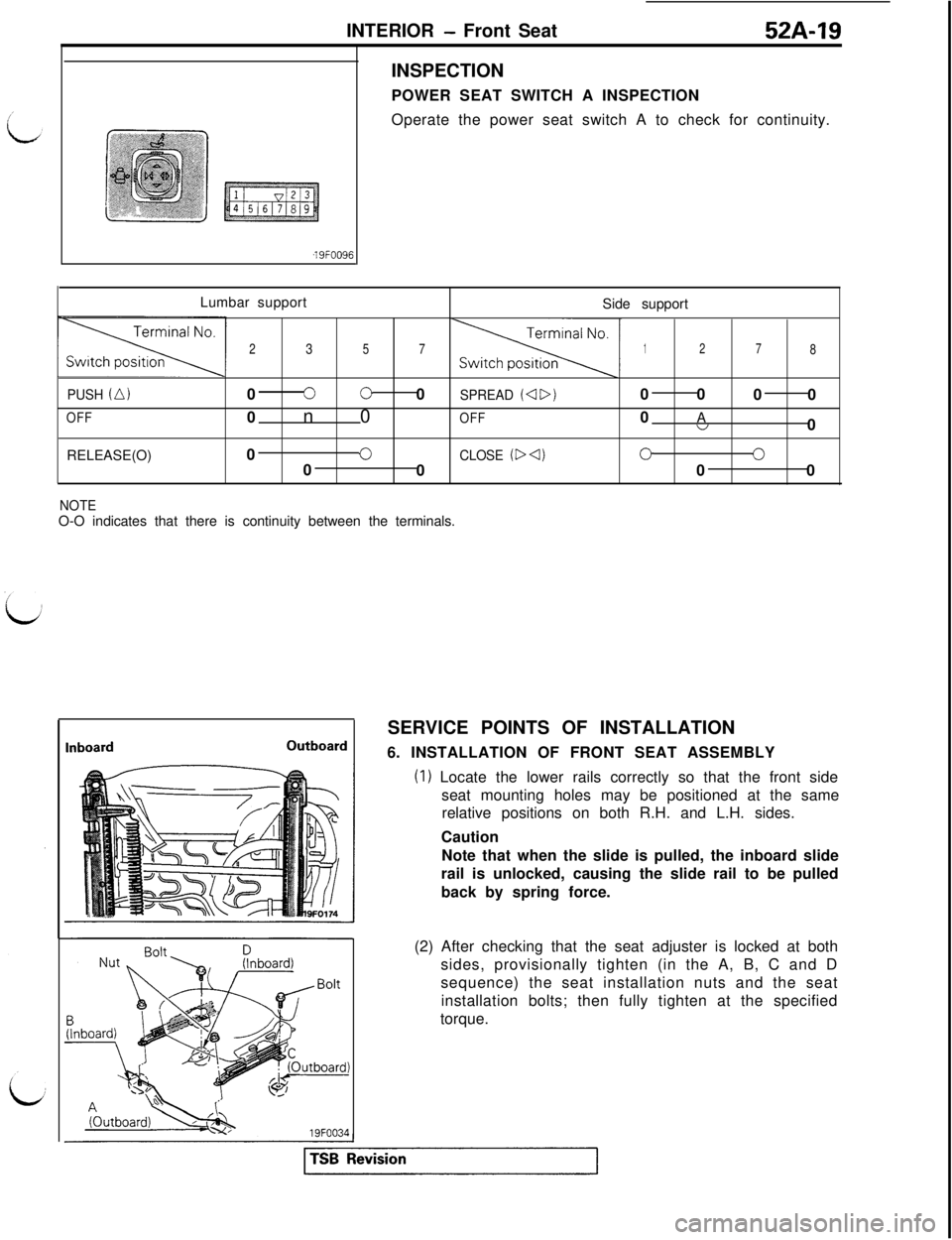
POWER SEAT SWITCH A INSPECTION
Operate the power seat switch A to check for continuity.
,19FOO9lLumbar support
Side support
23571278
PUSH (A,0300SPREAD (4D)00
00
OFF0n0OFF0A”0
RELEASE(O)0
0CLOSE (D 4)000
000
NOTEO-O indicates that there is continuity between the terminals.
InboardOutboard19FOO34SERVICE POINTS OF INSTALLATION
6. INSTALLATION OF FRONT SEAT ASSEMBLY
(I) Locate the lower rails correctly so that the front side
seat mounting holes may be positioned at the same
relative positions on both R.H. and L.H. sides.
Caution
Note that when the slide is pulled, the inboard slide
rail is unlocked, causing the slide rail to be pulled
back by spring force.
(2) After checking that the seat adjuster is locked at both
sides, provisionally tighten (in the A, B, C and D
sequence) the seat installation nuts and the seat
installation bolts; then fully tighten at the specified
torque.
Page 1099 of 1146
HEATERS AND MANUAL AIR CbNDlTlONER -Service Adjustment Procedures 55 17
ADJUSTMENT PROCEDURES(1) Select a quiet area for testing. Duplicate conditions as much
as possible. Switch compressor on and off several times to
clearly identify compressor noise.
To duplicate high ambient conditions (high head pressure),
restrict air flow through condenser. Install manifold gauge
set to make sure discharge pressure doesn’t exceed 2,070
kPa (300 psi).
(2) Tighten all compressor mounting bolts, clutch mounting
bolt, and compressor drive belt. Check to assure clutch coil
is tight (no rotation or wobble).
(3) Check refrigerant hoses for rubbing or interference that can
cause unusual noises.
(4) Check refrigerant charge. (See “Charging System”.)
(5) Recheck compressor noise as in Step 1.
(6) If noise still exists, loosen compressor mounting bolts and
retorque. Repeat Step 1.
(7) If noise continues, replace compressor and repeat Step 1.
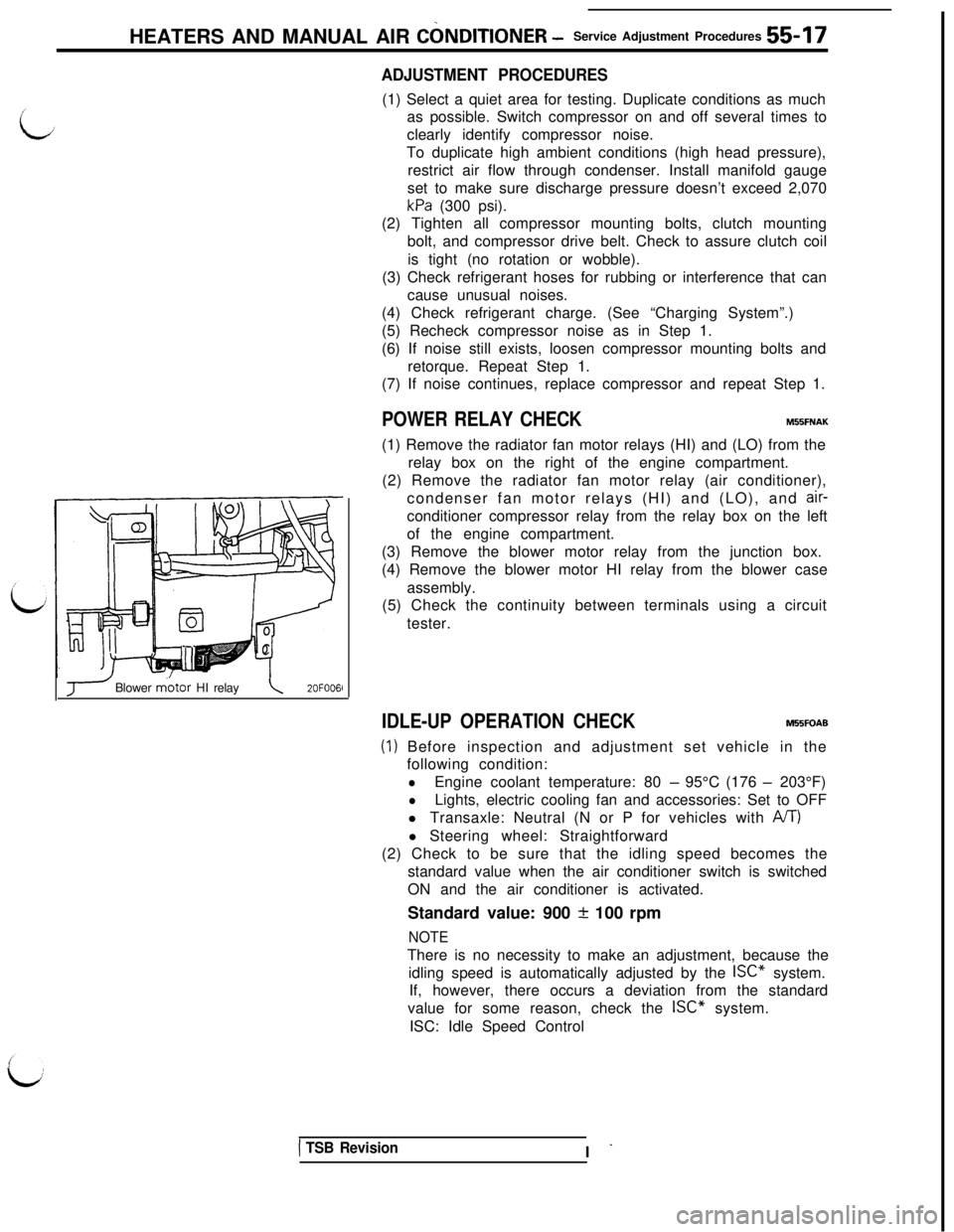
POWER RELAY CHECKMBBFNAK(1) Remove the radiator fan motor relays (HI) and (LO) from the
relay box on the right of the engine compartment.
(2) Remove the radiator fan motor relay (air conditioner),
condenser fan motor relays (HI) and (LO), and
air-conditioner compressor relay from the relay box on the left
of the engine compartment.
(3) Remove the blower motor relay from the junction box.
(4) Remove the blower motor HI relay from the blower case
assembly.
(5) Check the continuity between terminals using a circuit
tester.
J Blower m.otor HI relay\2OFOO6l
IDLE-UP OPERATION CHECKM55FOAB
(1) Before inspection and adjustment set vehicle in the
following condition:
lEngine coolant temperature: 80 - 95°C (176 - 203°F)
lLights, electric cooling fan and accessories: Set to OFF
l Transaxle: Neutral (N or P for vehicles with
A/T)l Steering wheel: Straightforward
(2) Check to be sure that the idling speed becomes the
standard value when the air conditioner switch is switched
ON and the air conditioner is activated.
Standard value: 900
+ 100 rpm
NOTEThere is no necessity to make an adjustment, because the
idling speed is automatically adjusted by the ISC” system.
If, however, there occurs a deviation from the standard
value for some reason, check the ISC” system.
ISC: Idle Speed Control
1 TSB RevisionI -
Page 1144 of 1146
55-62FULL AUTO AIR CONDITIONER
ICompressor. Condenser, Condenser Fan Motor, Refrigerant
- Line and Engine Coolant Temperature Switch / Other Parts
COMPRESSOR, CONDENSER, CONDENSER FAN MOTOR, RE-
FRIGERANT LINE AND ENGINE COOLANT TEMPERATURE SWITCH
M55TA-B4
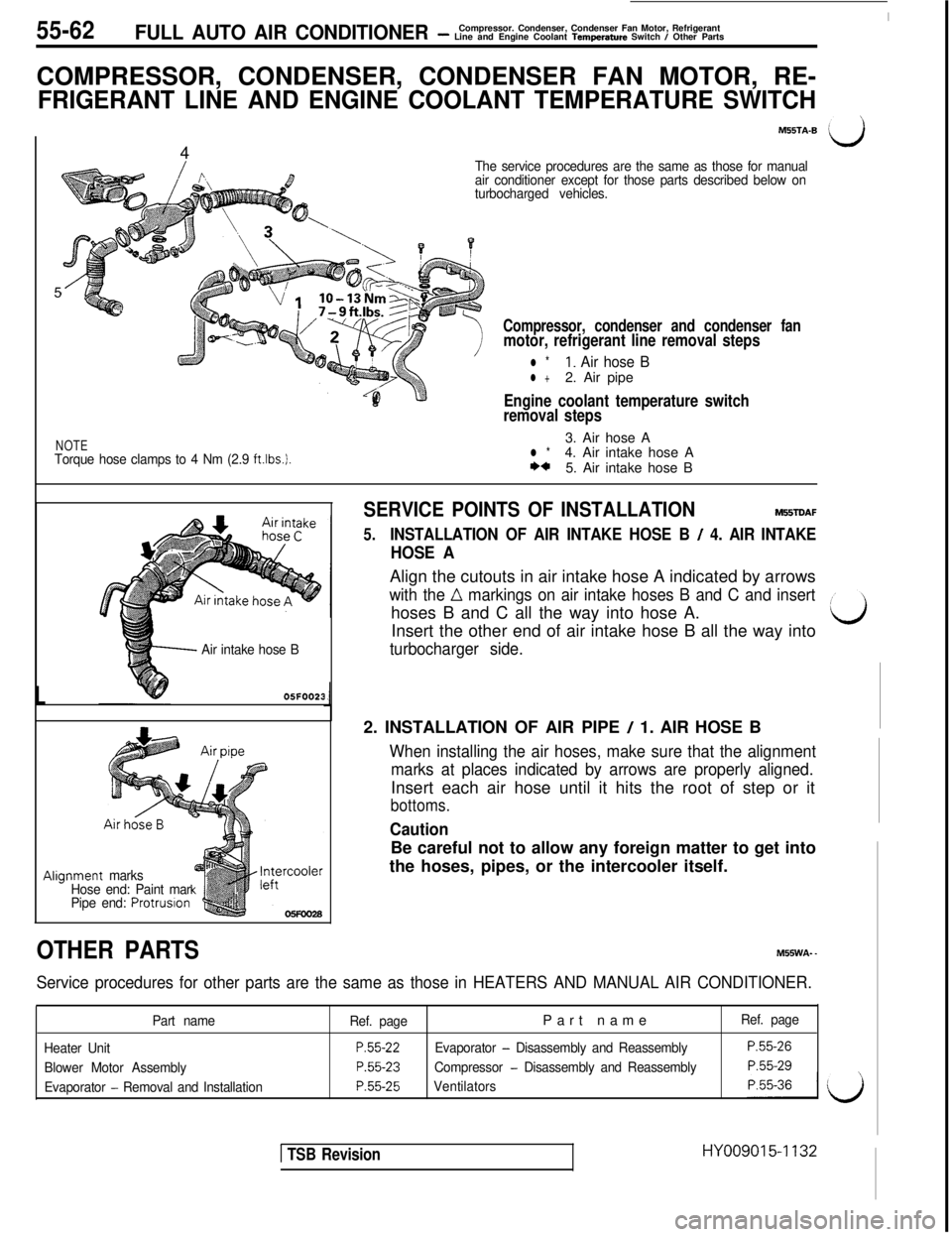
The service procedures are the same as those for manual
air conditioner except for those parts described below on
turbocharged vehicles.5
Compressor, condenser and condenser fanmotor, refrigerant line removal steps
l *I. Air hose Bl +2. Air pipe
ii
Engine coolant temperature switch
removal steps
NOTETorque hose clamps to 4 Nm (2.9 ftlbs.).3. Air hose Al *4. Air intake hose A*a5. Air intake hose B
L
Air intake hose B
OSFOO23
Align7ment marks
Hose end: Paint mar
Pipe end:
Protrusron
OTHER PARTS
SERVICE POINTS OF INSTALLATIONM55iDAF
5.INSTALLATION OF AIR INTAKE HOSE B / 4. AIR INTAKE
HOSE AAlign the cutouts in air intake hose A indicated by arrows
with the n markings on air intake hoses B and C and inserthoses B and C all the way into hose A.
Insert the other end of air intake hose B all the way into
turbocharger side.2. INSTALLATION OF AIR PIPE
/ 1. AIR HOSE B
When installing the air hoses, make sure that the alignment
marks at places indicated by arrows are properly aligned.Insert each air hose until it hits the root of step or it
bottoms.
CautionBe careful not to allow any foreign matter to get into
the hoses, pipes, or the intercooler itself.M55WA-
-
Service procedures for other parts are the same as those in HEATERS AND MANUAL AIR CONDITIONER.
Part name
Ref. page
Heater Unit
P.55-22
Blower Motor AssemblyP.55-23
Evaporator - Removal and InstallationP.55-25Part name
Evaporator - Disassembly and Reassembly
Compressor
- Disassembly and Reassembly
VentilatorsRef. page
P.55-26
P.55-29
1 TSB RevisionHY009015-1132