fuel MITSUBISHI 3000GT 1991 Service Manual
[x] Cancel search | Manufacturer: MITSUBISHI, Model Year: 1991, Model line: 3000GT, Model: MITSUBISHI 3000GT 1991Pages: 1146, PDF Size: 76.68 MB
Page 259 of 1146
FUEL SYSTEM - Fuel Filter13453
FUEL FILTERM13VA-.
/REMOVAL AND INSTALLATION
i&J
L
/Il Removal of Residual Pressure from
Post-installation Operation
l Checking for Fuel Leakage
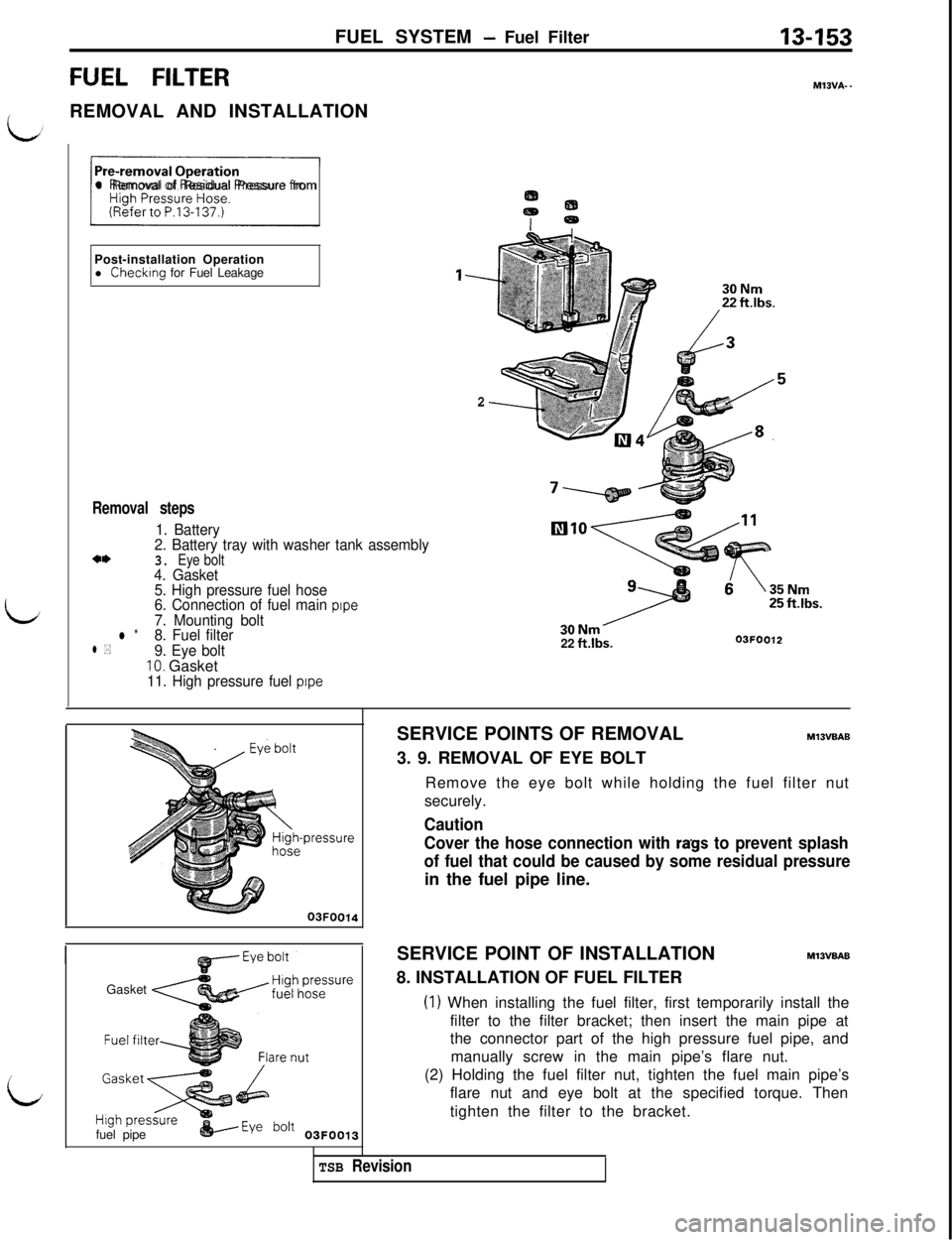
Removal steps
1. Battery
2. Battery tray with washer tank assembly
3. Eye bolt4. Gasket
5. High pressure fuel hose
6. Connection of fuel main
pipe7. Mounting boltl *8. Fuel filterl *9. Eye bolt10. Gasket11. High pressure fuel pipe
l---
222 ft.lbs.03FOO12
Gasket
fuel pipe
&----Eye bo’t 03FOO13SERVICE POINTS OF REMOVAL
MlSVBAB3. 9. REMOVAL OF EYE BOLT
Remove the eye bolt while holding the fuel filter nut
securely.
Caution
Cover the hose connection with
rags to prevent splash
of fuel that could be caused by some residual pressurein the fuel pipe line.
SERVICE POINT OF INSTALLATION
M13VBAB8. INSTALLATION OF FUEL FILTER
(1) When installing the fuel filter, first temporarily install the
filter to the filter bracket; then insert the main pipe at
the connector part of the high pressure fuel pipe, and
manually screw in the main pipe’s flare nut.
(2) Holding the fuel filter nut, tighten the fuel main pipe’s
flare nut and eye bolt at the specified torque. Then
tighten the filter to the bracket.
TSB Revision
Page 260 of 1146
13-154FUEL SYSTEM - Detonation Sensor
DETONATION SENSORREMOVAL AND INSTALLATION
Pre-removal and Post-installation Operation
l Release and Installation of the Air Intake Plenum
(Refer to GROUP
15-Air Intake Plenum.)
l Removal and Installation of the Intake Manifold
(Refer to GROUP 15
- Intake Manifold.)
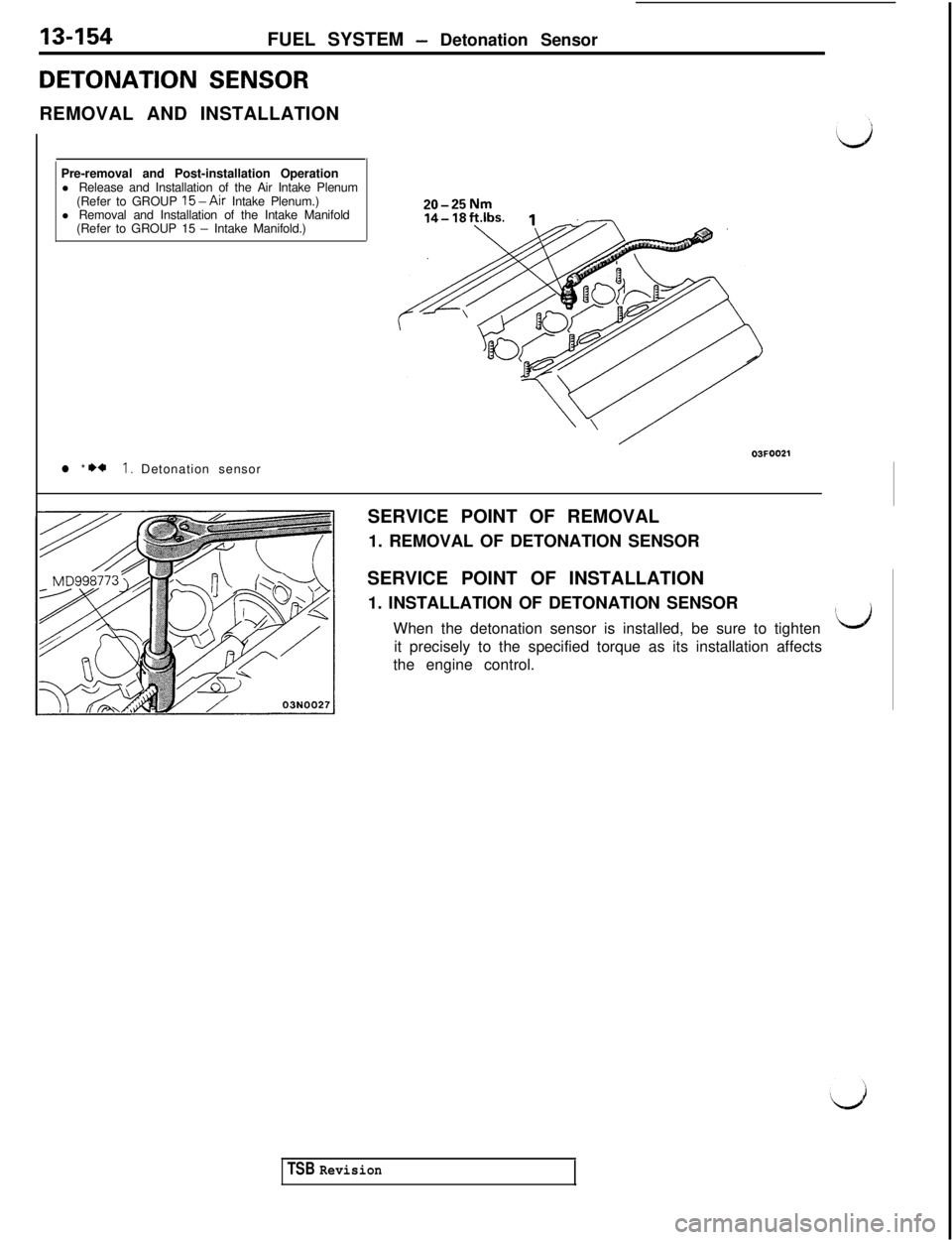
l * +*I. Detonation sensor
20-25NmSERVICE POINT OF REMOVAL
1. REMOVAL OF DETONATION SENSOR
SERVICE POINT OF INSTALLATION
1. INSTALLATION OF DETONATION SENSOR
When the detonation sensor is installed, be sure to tighten
Idit precisely to the specified torque as its installation affects
the engine control.
TSB Revision
Page 326 of 1146
15-16INTAKE AND EXHAUST - Intake Manifold
INTAKE MANIFOLD
REMOVAL AND INSTALLATION
Pre-removal Operationl Release of Residual Pressure fromHigh Pressure Fuel Hose(Refer to GROUP 13-ServiceAdjustment Procedures.)l Draining of Engine Coolant (Refer
to GROUP 00 -Maintenance Service,)
l Removal of Air Intake Plenum(Referto P.15-13, 14.)5Nm
lo-13Nm4 ft.lbs.8-9ftJbs. w2\I
Post-installation Operationl Installation of Air Intake Plenum
(Refer to P.1.5-13. 14.)l Filling of Engine Coolant
(Refer to GROUP 00 - Maintenance
Service.)
l Adjustment of Accelerator Cable(Referto GROUP 13-EngineControl.). Checkina for Fuel Leakage6
5
2 :‘;bs.)
gp,.qgs ~-zt!EJ8OSFOO24
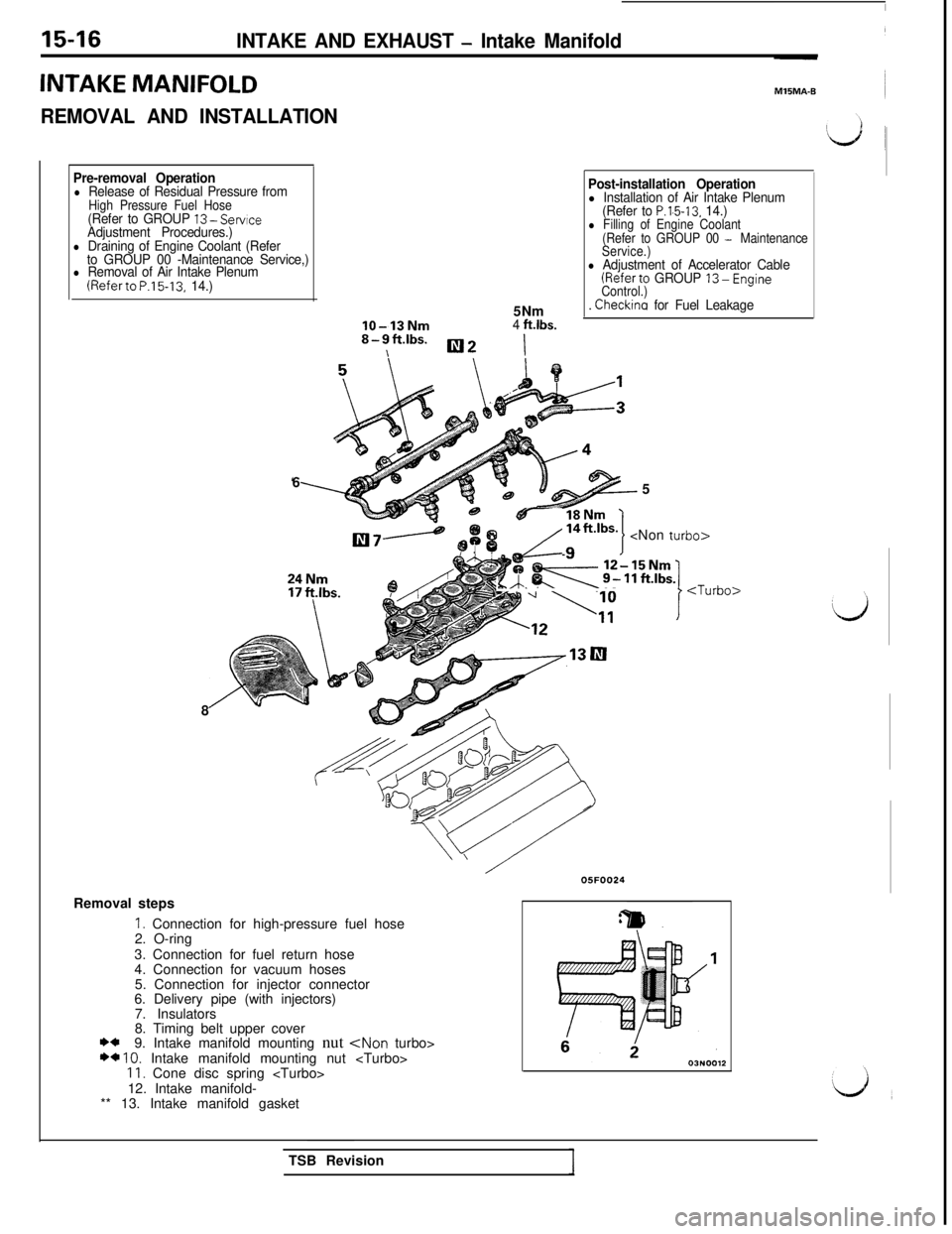
Removal steps
I. Connection for high-pressure fuel hose
2. O-ring
3. Connection for fuel return hose
4. Connection for vacuum hoses
5. Connection for injector connector
6. Delivery pipe (with injectors)
7. Insulators
8. Timing belt upper cover
I)*9. Intake manifold mounting nut
12. Intake manifold-
** 13. Intake manifold gasket
TSB Revision
Page 345 of 1146
17-1
EMISSIONCONTROL
.~
CATALYTIC CONVERTER............................:...Inspection
............................................................Removal and Installation
................................
CONTENTSM17.U. -
CRANKCASE EMISSION CONTROL
SYSTEM. . . . . . . . . . . . . . . . . . . . . . . . . . . . . . . . . . .ComponentsLocation
. . . . . . . . . . . . . . . . . . . . . . . . . . . . . . . . . . . .Crankcase Ventilation System Inspection
._..Positive Crankcase Ventilation Valve
. . . . . . . . . . . .
EVAPORATIVE EMISSION CONTROL
SYSTEM................................................................Air Conditioner Switch
....................................Air Flow Sensor, Engine Coolant
Temperature Sensor and Intake Air
Temperature Sensor
........................................Canister
............................................................Components Location
....................................
FuelFiller CapInspection................................OverfillLimiter (Two-way Valve)
....................Purge Control Solenoid Valve
........................Purge Control System Inspection
............................................................Purge Control Valve
........................
PurgePort VacuumCheck................................14
14
14
6
10
10
10
6
10
10
9
7
8
9
9EXHAUST GAS RECIRCULATION
(EGR)
SYSTEM. . . . . ..____._.._........__........_____.........................Air-FuelRatio Control (MPI) System. . . . . . . .
Components Location
. . . . . . . . . . . . . . . . . . . . . . . . . . . . . . . . . . . .EGR Control Solenoid Valve
. . . . . . . .EGR Valve
EGR Valve Control Vacuum Check
SPECIFICATIONS................................................General Specifications
....................................Service Specifications
....................................
TROUBLESHOOTING. . . . . . . . . . . . . . . . . ..______...............
VACUUM HOSES................................................Inspection
............................................................Installation
........................................................VacuumHosesRouting
....................................
11
14
11
13
12
13
13
12
2
2
22
Page 346 of 1146

17-2EMISSION CONTROL - Specifications / Troubleshooting
SPECIFICATIONS
GENERAL SPECIFICATIONSMl’ICA- -\
Items
Crankcase emission control systemSpecifications
Closed type with positive crankcase ventilationvalve
Evaporative emission control systemCanister storage type
Canister
Charcoal type
Purge control solenoid valve
ON/OFF solenoid valve
Exhaust emission control system
Exhaust gas recirculation system
EGR valveVacuum-activated diaphragm type
EGR temperature sensor
EGR control solenoid valve
Catalytic converter
Monolith type
Location
Under floor
Turbocharger outlet (front bank and rear bank,)
and under floor
SERVICE SPECIFICATIONSMl7CB-.
ItemsSpecifications
Purge control solenoid valve coil resistance
036 - 44 [at 20°C (68”F)I\
EGR temperature sensor resistancekfl60 - 83 [at 50°C (I 22”F)]
11 - 14 [at 100°C (212”F)l
EGR control solenoid valve coil resistance1236 - 44 [at 20°C (68”F)lI
TROUBLESHOOTING
Symptom
Engine will not start
or hard to start
Rough idle or engine
stalls
Probable cause
Vacuum hose disconnected or damaged
The EGR valve is not closed
Malfunction of the purge control solenoid valve
The EGR valve is not closed
Vacuum hose disconnected or damaged
Malfunction of the positive crankcase ventilationvalveRemedy
Repair or replace
Repair or replace
Repair or replace
Repair or replace
Repair or replace
Replace
Malfunction of the purge control systemCheck the system; if there is a
problem, check its component parts
Engine hesitates or3oor acceleration
Zxcessive oil:onsumptron
Malfunction of the exhaust gas recirculation
system
Positive crankcase ventilation line cloggedCheck the system; if there is a
problem, check its component parts
Check positive crankcase
ventila-tion system
Ioor fuel mileageMalfunction of the exhaust gas recirculation
systemTSB RevisionCheck the system; if there is a
problem, check its component parts
d
Page 347 of 1146
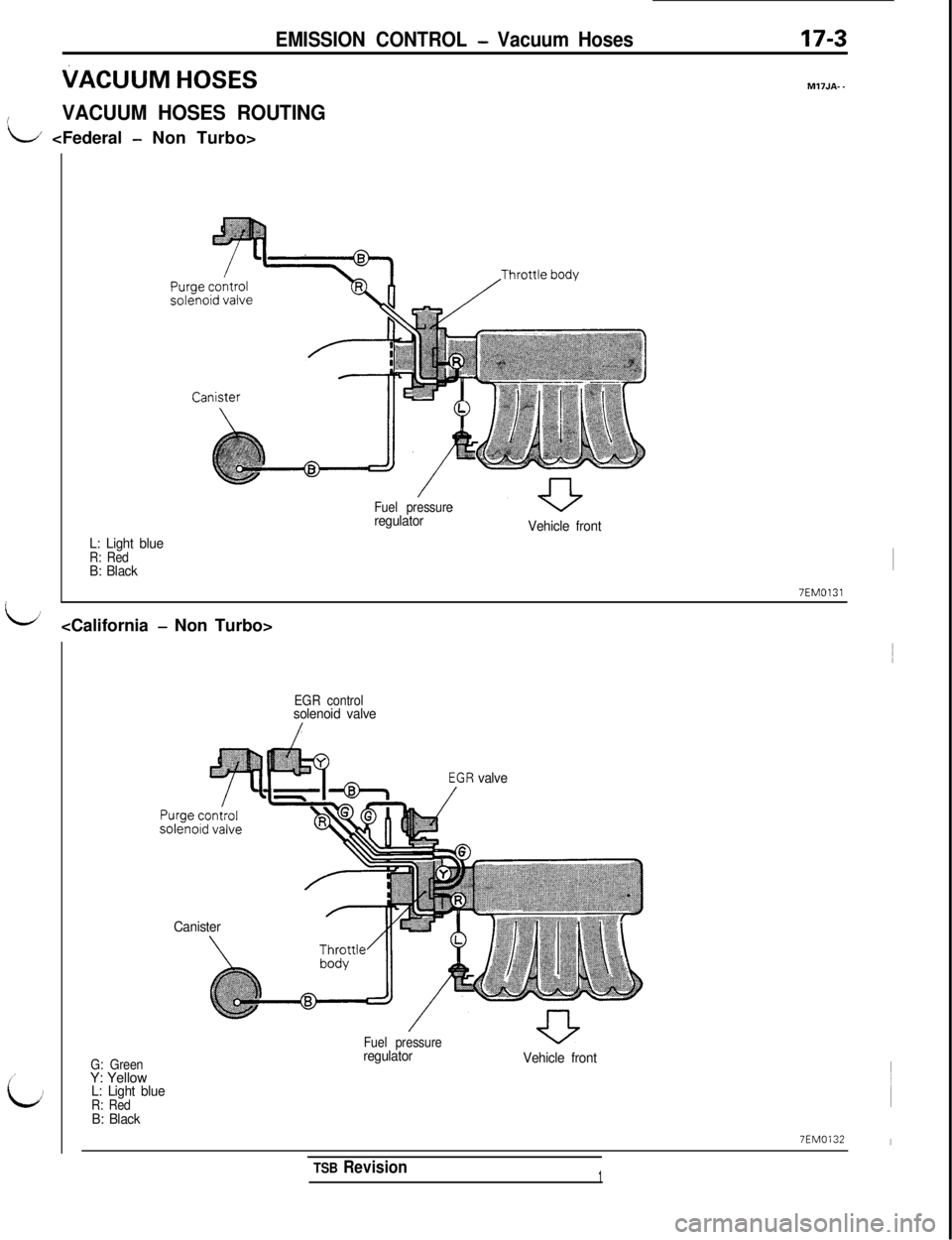
EMISSION CONTROL - Vacuum Hoses
VACUUM 1-10sEs
lVACUUM HOSES ROUTING
L//
17-3M17JA-
-
I’
Li
Fuel pressureregulator
Vehicle front
id
L: Light blueR: RedB: Black
7EM0131
EGR controlsolenoid valve
r-c,cud valve/
Canister
/Fuel pressureregulator
v
Vehicle frontG: GreenY: Yellow
L: Light blueR: RedB: Black
TSB Revision
7EM0132I
1
Page 348 of 1146
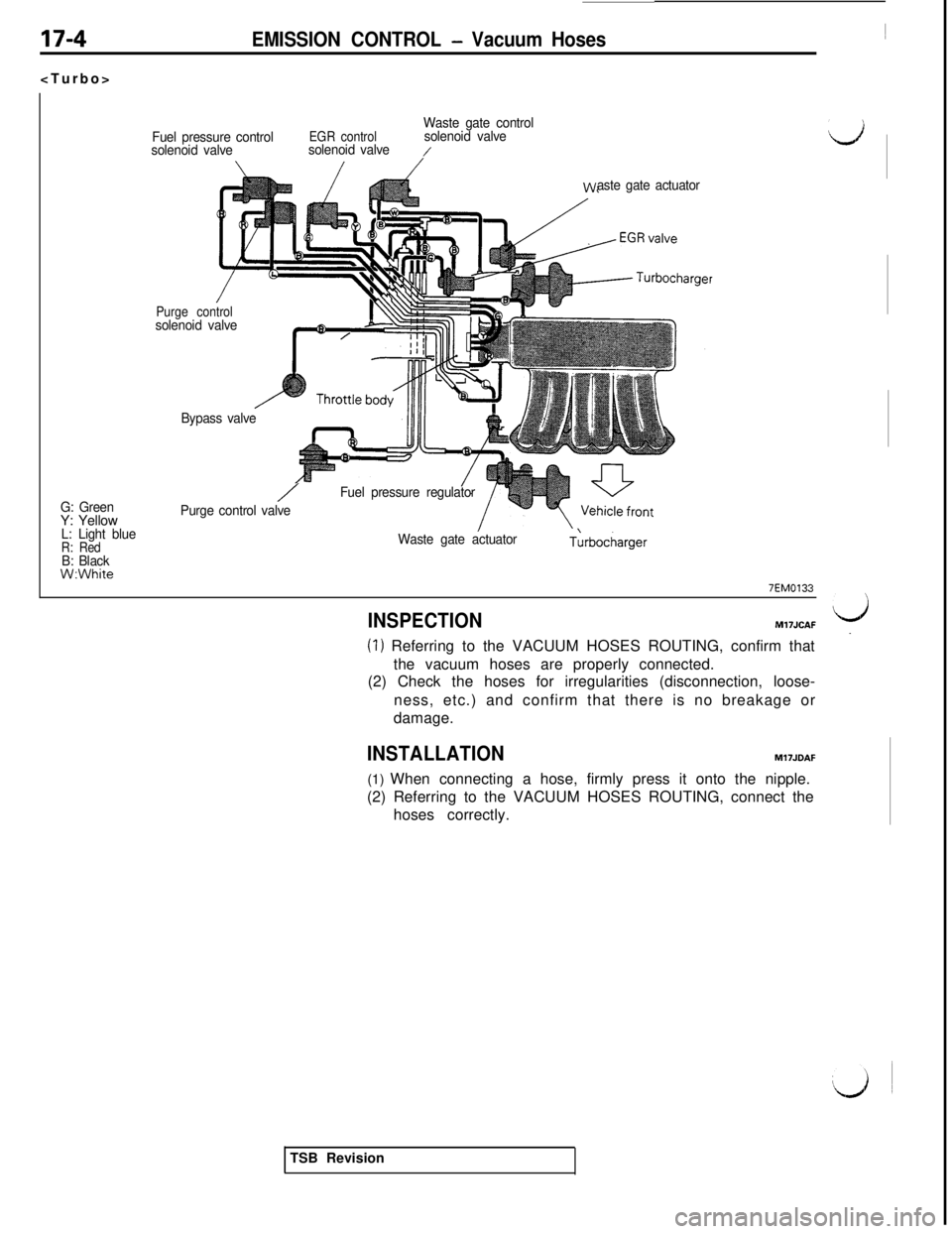
17-4EMISSION CONTROL - Vacuum Hoses
Fuel pressure control
solenoid valveEGR controlWaste gate control
solenoid valve
solenoid valve
/\,i
aste gate actuator
G: GreenY: Yellow
L: Light blueR: RedB: BlackW:White
Purge controlsolenoid valve
Bypass valve
/Fuel pressure regulator
Purge control valve
Waste gate actuator
TLrbocharger7EM0133
INSPECTIONM17JCAF +’
(1) Referring to the VACUUM HOSES ROUTING, confirm that
the vacuum hoses are properly connected.
(2) Check the hoses for irregularities (disconnection, loose-
ness, etc.) and confirm that there is no breakage or
damage.
INSTALLATIONM17JDAF(1) When connecting a hose, firmly press it onto the nipple.
(2) Referring to the VACUUM HOSES ROUTING, connect the
hoses correctly.
TSB Revision
Page 354 of 1146
17-10EMISSION CONTROL - Evaporative Emission Control System
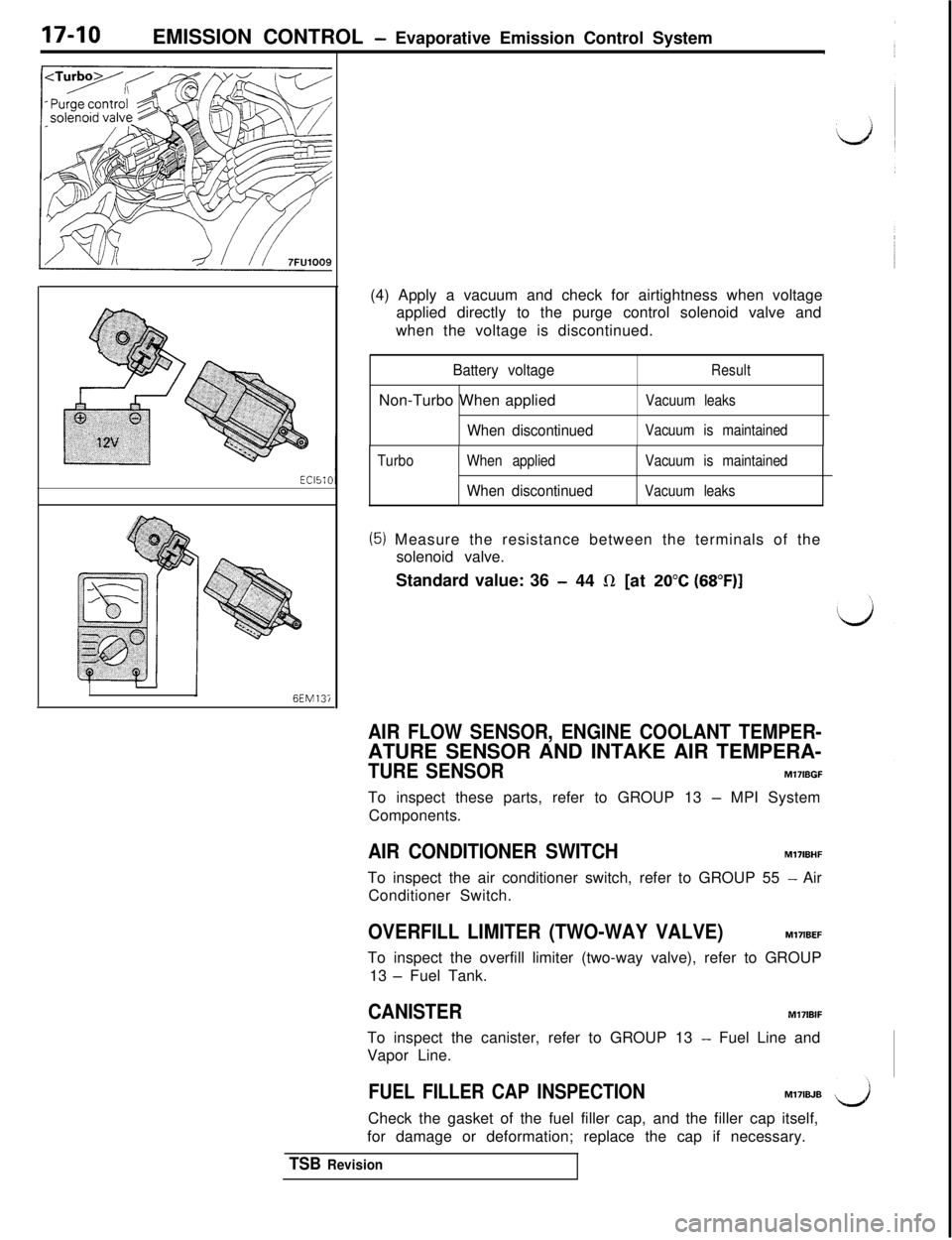
I-6EM13i(4) Apply a vacuum and check for airtightness when voltage
applied directly to the purge control solenoid valve and
when the voltage is discontinued.
Battery voltageResultNon-Turbo When applied
Vacuum leaks
When discontinuedVacuum is maintained
TurboWhen applied
When discontinued
Vacuum is maintained
Vacuum leaks
(5) Measure the resistance between the terminals of the
solenoid valve.
Standard value: 36
- 44 R [at 20°C (68”F)]
AIR FLOW SENSOR, ENGINE COOLANT TEMPER-ATURE SENSOR AND INTAKE AIR TEMPERA-
TURE SENSORM17lBGFTo inspect these parts, refer to GROUP 13
- MPI System
Components.
AIR CONDITIONER SWITCHMl7IBHF
To inspect the air conditioner switch, refer to GROUP 55
- Air
Conditioner Switch.
OVERFILL LIMITER (TWO-WAY VALVE)M17IBEFTo inspect the overfill limiter (two-way valve), refer to GROUP
13
- Fuel Tank.
CANISTERM17lBIFTo inspect the canister, refer to GROUP 13
- Fuel Line and
Vapor Line.
FUEL FILLER CAP INSPECTIONM17IBJBCheck the gasket of the fuel filler cap, and the filler cap itself,
for damage or deformation; replace the cap if necessary.
TSB Revision
Page 358 of 1146
17-14 EMISSION CONTROL -Exhaust Gas Recirculation (EGR) System / Catalytic Converter
6EM01871
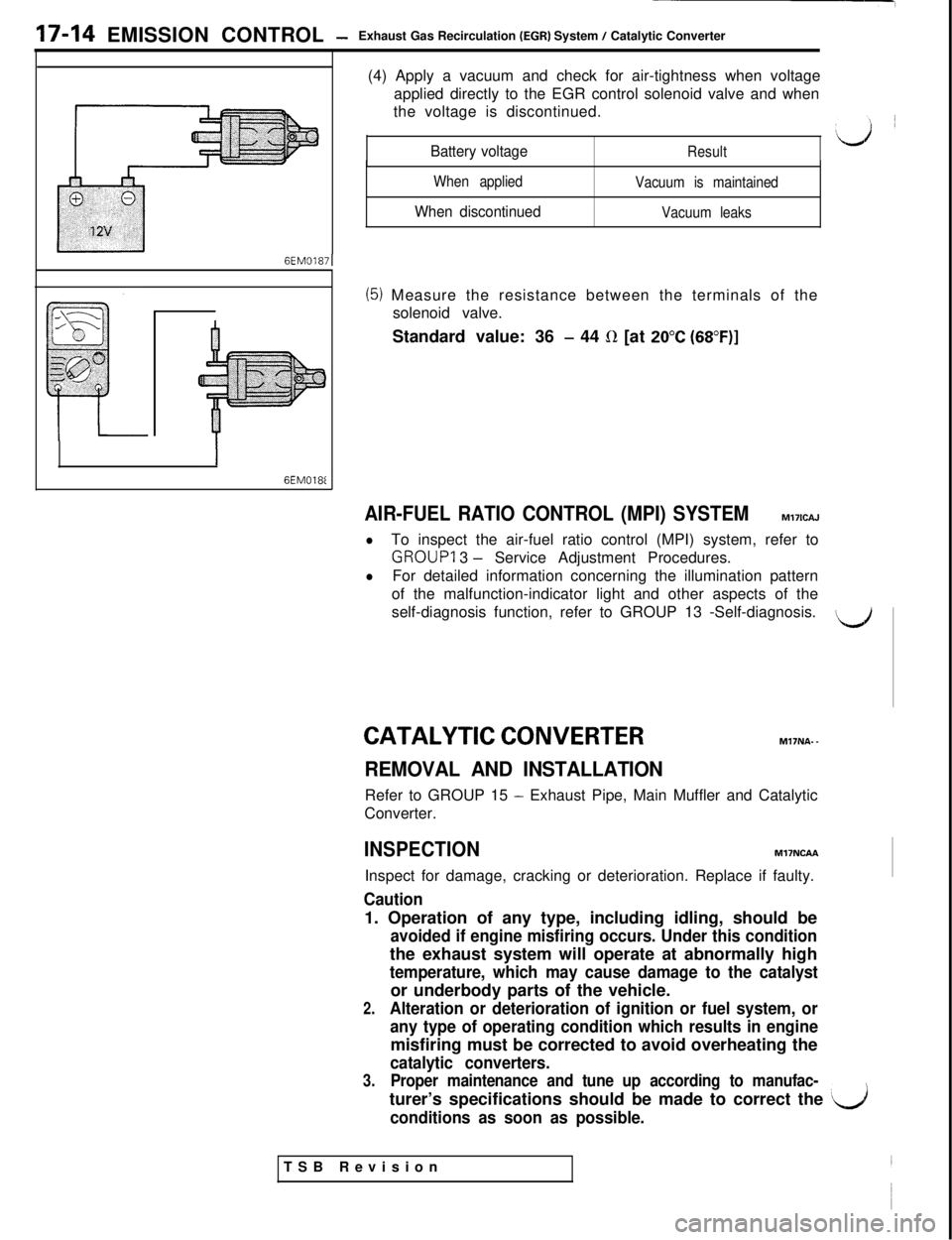
6EM0181(4) Apply a vacuum and check for air-tightness when voltage
applied directly to the EGR control solenoid valve and when
the voltage is discontinued.
Battery voltageResult
When applied
When discontinued
Vacuum is maintained
Vacuum leaks
(5) Measure the resistance between the terminals of the
solenoid valve.
Standard value: 36
- 44 R [at 20°C (68”F)]
AIR-FUEL RATIO CONTROL (MPI) SYSTEMM17ICAJ
lTo inspect the air-fuel ratio control (MPI) system, refer to
GROUP1 3 - Service Adjustment Procedures.
lFor detailed information concerning the illumination pattern
of the malfunction-indicator light and other aspects of the
self-diagnosis function, refer to GROUP 13 -Self-diagnosis.
\.J
CATALYTIC CONVERTERMl7N& -
REMOVAL AND INSTALLATIONRefer to GROUP 15
- Exhaust Pipe, Main Muffler and Catalytic
Converter.
INSPECTIONMl7NCAA
Inspect for damage, cracking or deterioration. Replace if faulty.
Caution1. Operation of any type, including idling, should be
avoided if engine misfiring occurs. Under this conditionthe exhaust system will operate at abnormally high
temperature, which may cause damage to the catalystor underbody parts of the vehicle.
2.Alteration or deterioration of ignition or fuel system, or
any type of operating condition which results in enginemisfiring must be corrected to avoid overheating the
catalytic converters.
3.Proper maintenance and tune up according to manufac-turer’s specifications should be made to correct the
‘bi
conditions as soon as possible.TSB Revision
Page 483 of 1146
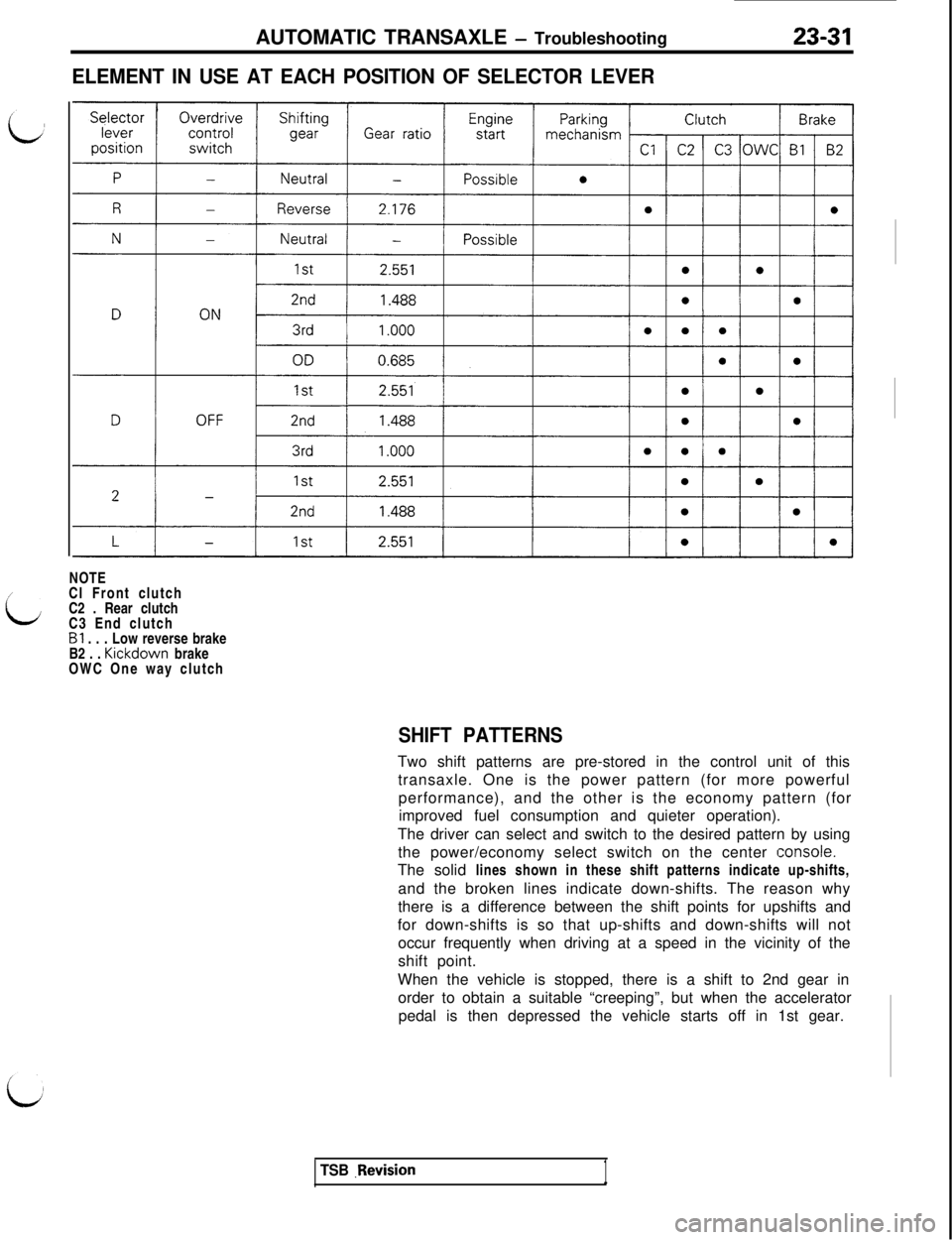
AUTOMATIC TRANSAXLE - Troubleshooting
ELEMENT IN USE AT EACH POSITION OF SELECTOR LEVER
23-31NOTE
/
LCl Front clutch
C2 . Rear clutch
C3 End clutch
Bl . . . Low reverse brake
B2 . . Kickdown brake
OWC One way clutch
SHIFT PATTERNSTwo shift patterns are pre-stored in the control unit of this
transaxle. One is the power pattern (for more powerful
performance), and the other is the economy pattern (for
improved fuel consumption and quieter operation).
The driver can select and switch to the desired pattern by using
the power/economy select switch on the center
Iconsole.The solid lines shown in these shift patterns indicate up-shifts,
and the broken lines indicate down-shifts. The reason why
there is a difference between the shift points for upshifts and
for down-shifts is so that up-shifts and down-shifts will not
occur frequently when driving at a speed in the vicinity of the
shift point.
When the vehicle is stopped, there is a shift to 2nd gear in
order to obtain a suitable “creeping”, but when the accelerator
pedal is then depressed the vehicle starts off in 1st gear.
TSB .Revision1