ECU MITSUBISHI 3000GT 1991 User Guide
[x] Cancel search | Manufacturer: MITSUBISHI, Model Year: 1991, Model line: 3000GT, Model: MITSUBISHI 3000GT 1991Pages: 1146, PDF Size: 76.68 MB
Page 170 of 1146
13-64FUEL SYSTEM - 0
n-vehicle Inspection of MPI Components
7FUO670
Apply sealant
7FUO67’SENSOR INSPECTION
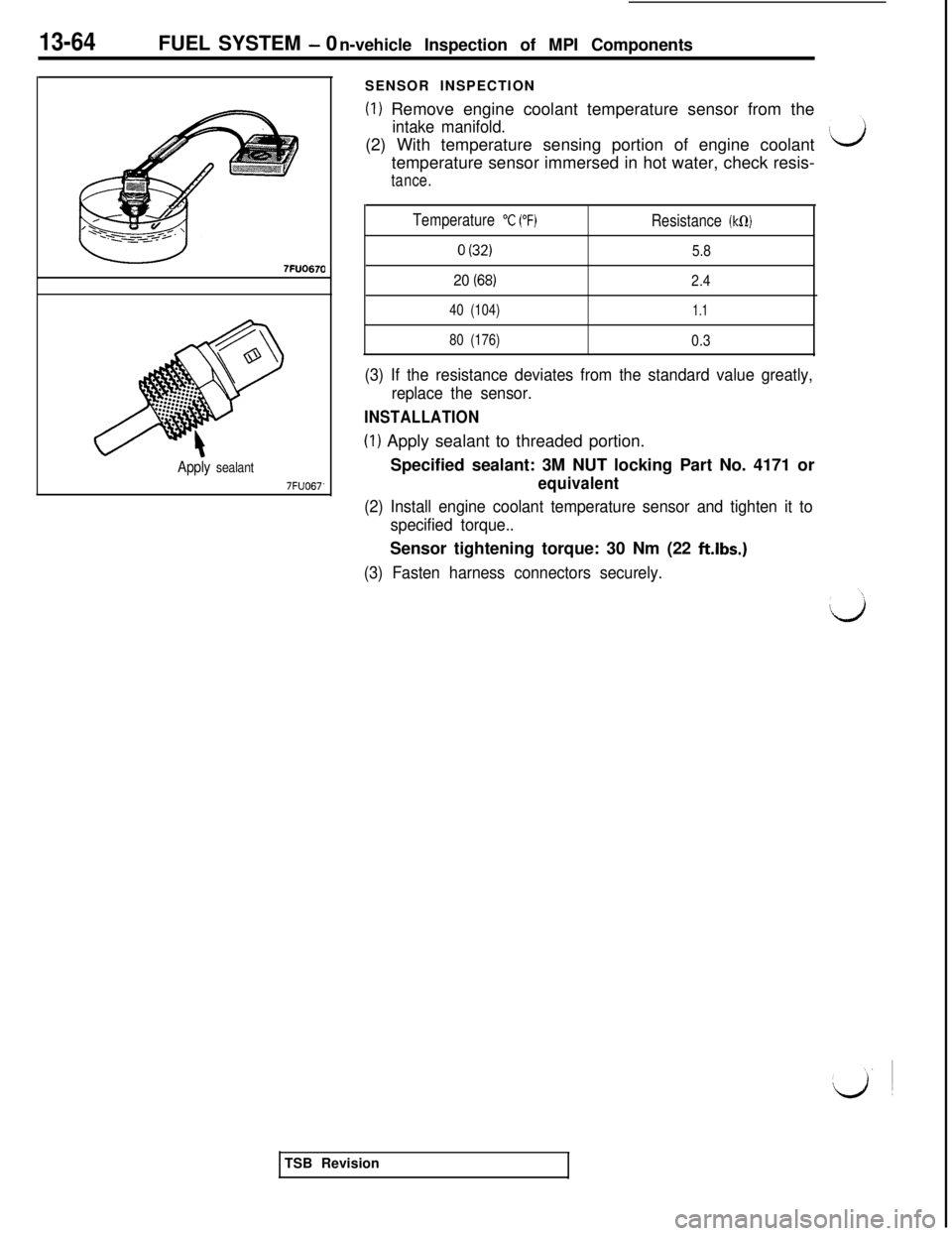
(1) Remove engine coolant temperature sensor from the
intake manifold.(2) With temperature sensing portion of engine coolant
temperature sensor immersed in hot water, check resis-
tance.
Temperature
“C (“F)Resistance (kCI)
0 (32)5.8
20 (68)2.4
40 (104)1.1
80 (176)0.3
(3) If the resistance deviates from the standard value greatly,
replace the sensor.
INSTALLATION
(1) Apply sealant to threaded portion.
Specified sealant: 3M NUT locking Part No. 4171 or
equivalent
(2) Install engine coolant temperature sensor and tighten it to
specified torque..Sensor tightening torque: 30 Nm (22
ft.lbs.)
(3) Fasten harness connectors securely.TSB Revision
Page 239 of 1146
FUEL SYSTEM - On-vehicle Inspection of MPI Components
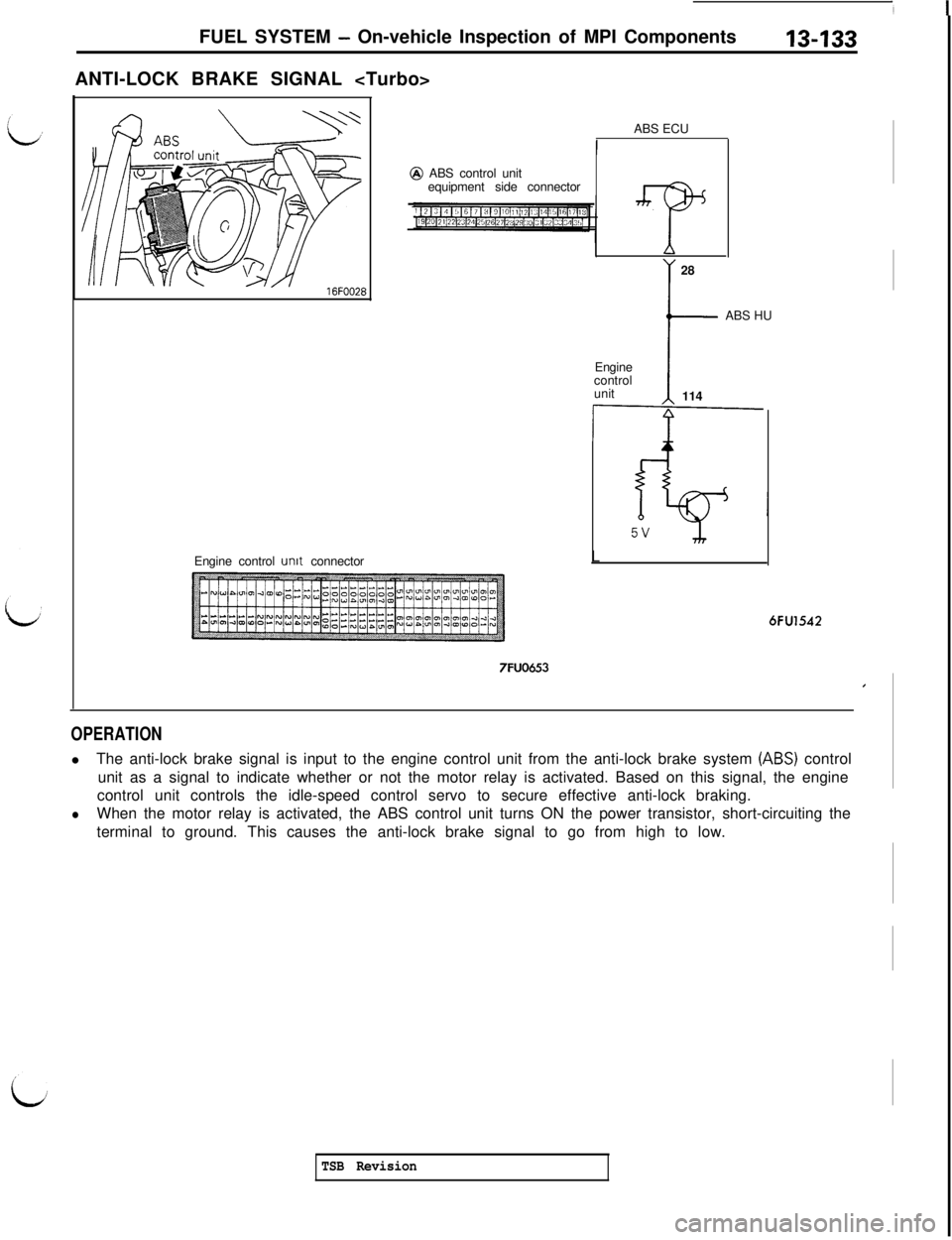
ANTI-LOCK BRAKE SIGNAL
Engine control
unit connectorABS ECU@ ABS control unit
equipment side connector
A28
tABS HU
Engine
control
unit
114
/L6FU1542
7FUO653,
OPERATIONlThe anti-lock brake signal is input to the engine control unit from the anti-lock brake system
(ABS) control
unit as a signal to indicate whether or not the motor relay is activated. Based on this signal, the engine
control unit controls the idle-speed control servo to secure effective anti-lock braking.
lWhen the motor relay is activated, the ABS control unit turns ON the power transistor, short-circuiting the
terminal to ground. This causes the anti-lock brake signal to go from high to low.
TSB Revision
Page 253 of 1146
FUEL SYSTEM - Fuel Tank13-147
Rubber hose
ngn
03FOOl
9
OSFOOB
05FOO7SERVICE POINT OF REMOVAL
MlBGBAK
12. DISCONNECTION OF HIGH PRESSURE FUEL HOSEDisconnect the hose from body main pipe first and then
from fuel pump.
Caution
Cover the hose connection with rags to prevent splash
of fuel that could be caused by some residual pressurein the fuel pipe line.
INSPECTION
MlBGCAMl Check the hoses and the pipes for crack or damage.
l Check the fuel tank cap for malfunction.
l Check the fuel tank for deformation, corrosion or crack.
l Check the fuel tank for dust or foreign material.
NOTEIf the inside of the fuel tank is to be cleaned, use any one of
the following:
(1) Kerosene
(2) Trichloroethylene
(3) A neutral emulsion type detergent
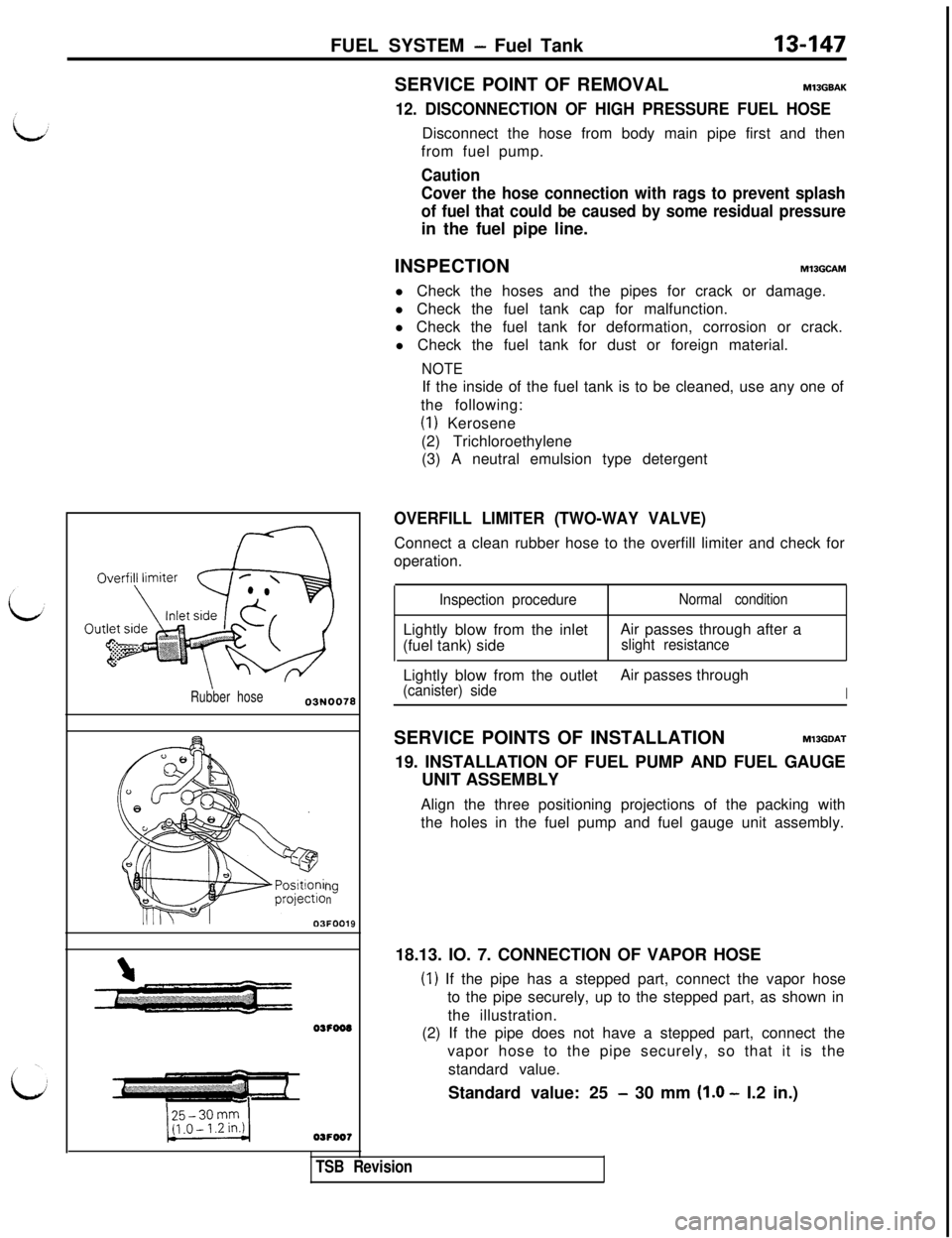
OVERFILL LIMITER (TWO-WAY VALVE)Connect a clean rubber hose to the overfill limiter and check for
operation.
Inspection procedureLightly blow from the inlet
(fuel tank) sideNormal conditionAir passes through after a
slight resistanceLightly blow from the outletAir passes through
(canister) sideISERVICE POINTS OF INSTALLATION
MlSGDAT19. INSTALLATION OF FUEL PUMP AND FUEL GAUGE
UNIT ASSEMBLY
Align the three positioning projections of the packing with
the holes in the fuel pump and fuel gauge unit assembly.
TSB Revision18.13. IO. 7. CONNECTION OF VAPOR HOSE
(1) If the pipe has a stepped part, connect the vapor hose
to the pipe securely, up to the stepped part, as shown in
the illustration.
(2) If the pipe does not have a stepped part, connect the
vapor hose to the pipe securely, so that it is the
standard value.
Standard value: 25
- 30 mm (1.0 - I.2 in.)
Page 254 of 1146
13-148FUEL SYSTEM - Fuel Tank
Canistide
Do3041Flare nut
Se&e side
0310430%
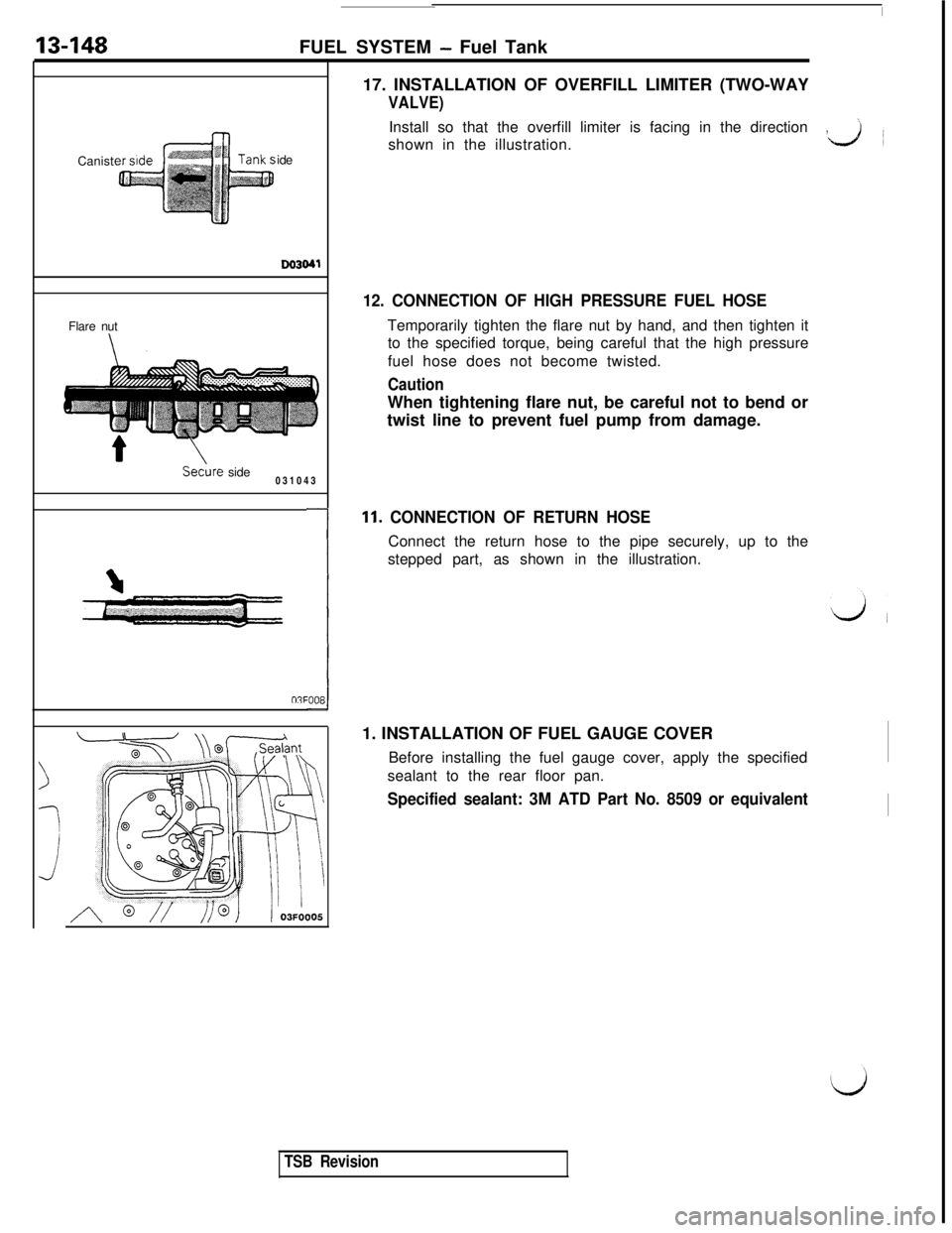
e:00817. INSTALLATION OF OVERFILL LIMITER (TWO-WAY
VALVE)Install so that the overfill limiter is facing in the direction
’,~
shown in the illustration.L.&l
12. CONNECTION OF HIGH PRESSURE FUEL HOSETemporarily tighten the flare nut by hand, and then tighten it
to the specified torque, being careful that the high pressure
fuel hose does not become twisted.
CautionWhen tightening flare nut, be careful not to bend or
twist line to prevent fuel pump from damage.
11. CONNECTION OF RETURN HOSEConnect the return hose to the pipe securely, up to the
stepped part, as shown in the illustration.
1. INSTALLATION OF FUEL GAUGE COVER
Before installing the fuel gauge cover, apply the specified
sealant to the rear floor pan.
Specified sealant: 3M ATD Part No. 8509 or equivalent
TSB Revision
Page 256 of 1146
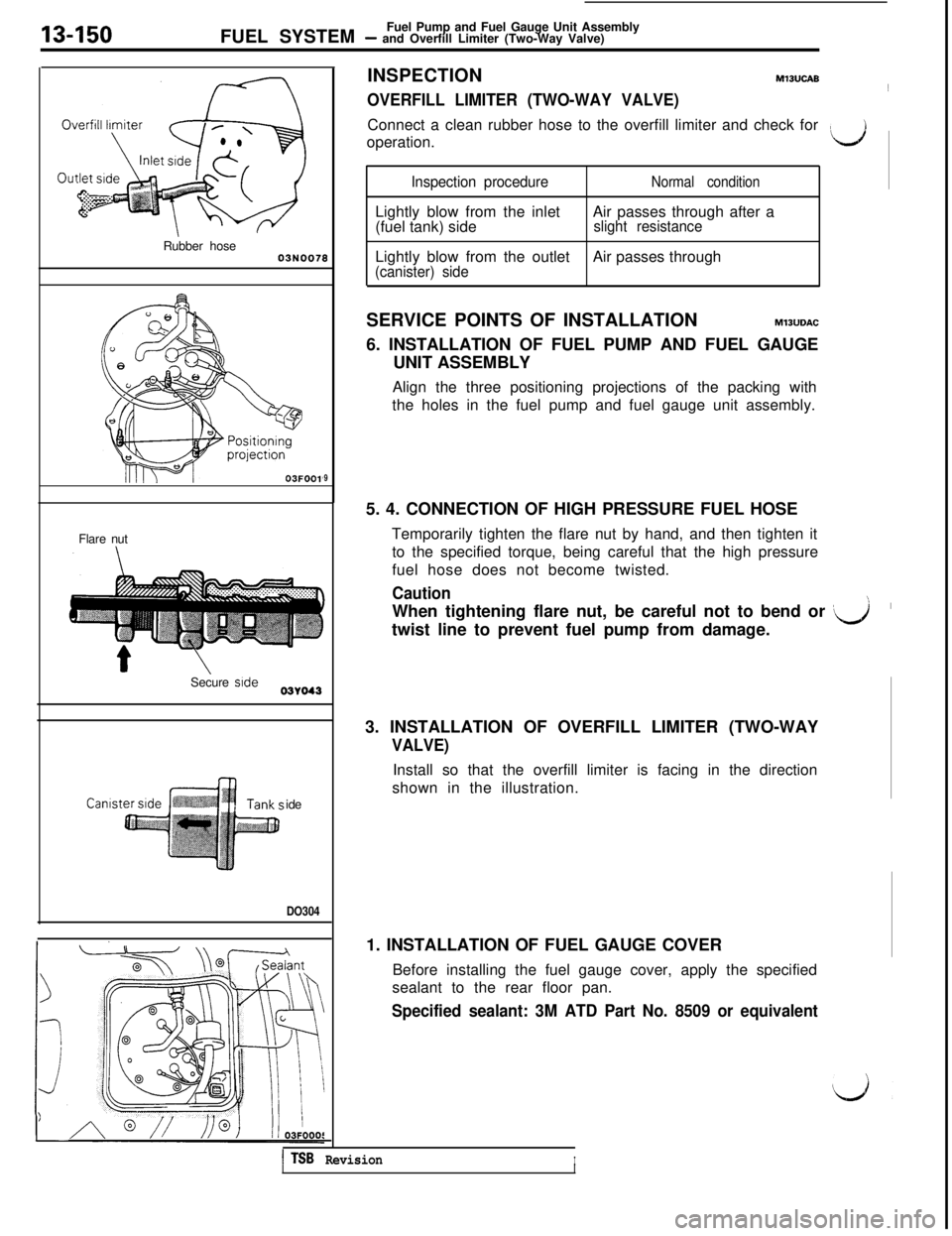
13-150FUEL SYSTEMFuel Pump and Fuel Gauge Unit Assembly- and Overfill Limiter (Two-Way Valve)
Rubber hose
9Flare nut
Secure side
03Yo43Camst
ide
DO304INSPECTION
MlBUCAB
OVERFILL LIMITER (TWO-WAY VALVE)~
Connect a clean rubber hose to the overfill limiter and check for
operation.
‘d
Inspection procedureNormal conditionLightly blow from the inlet
(fuel tank) sideAir passes through after a
slight resistanceLightly blow from the outlet
(canister) sideAir passes through
SERVICE POINTS OF INSTALLATION
M13UDAC6. INSTALLATION OF FUEL PUMP AND FUEL GAUGE
UNIT ASSEMBLY
Align the three positioning projections of the packing with
the holes in the fuel pump and fuel gauge unit assembly.
5. 4. CONNECTION OF HIGH PRESSURE FUEL HOSE
Temporarily tighten the flare nut by hand, and then tighten it
to the specified torque, being careful that the high pressure
fuel hose does not become twisted.
CautionWhen tightening flare nut, be careful not to bend or
[J’twist line to prevent fuel pump from damage.\3. INSTALLATION OF OVERFILL LIMITER (TWO-WAY
VALVE)Install so that the overfill limiter is facing in the direction
shown in the illustration.
1. INSTALLATION OF FUEL GAUGE COVER
Before installing the fuel gauge cover, apply the specified
sealant to the rear floor pan.
Specified sealant: 3M ATD Part No. 8509 or equivalent
1 TSB RevisionIII
Page 258 of 1146
13-152FUEL SYSTEM- Fuel Line and Vapor Line
03FOO3
05FOO735 Nm7r; ft
Ihr-k” ._..I_.
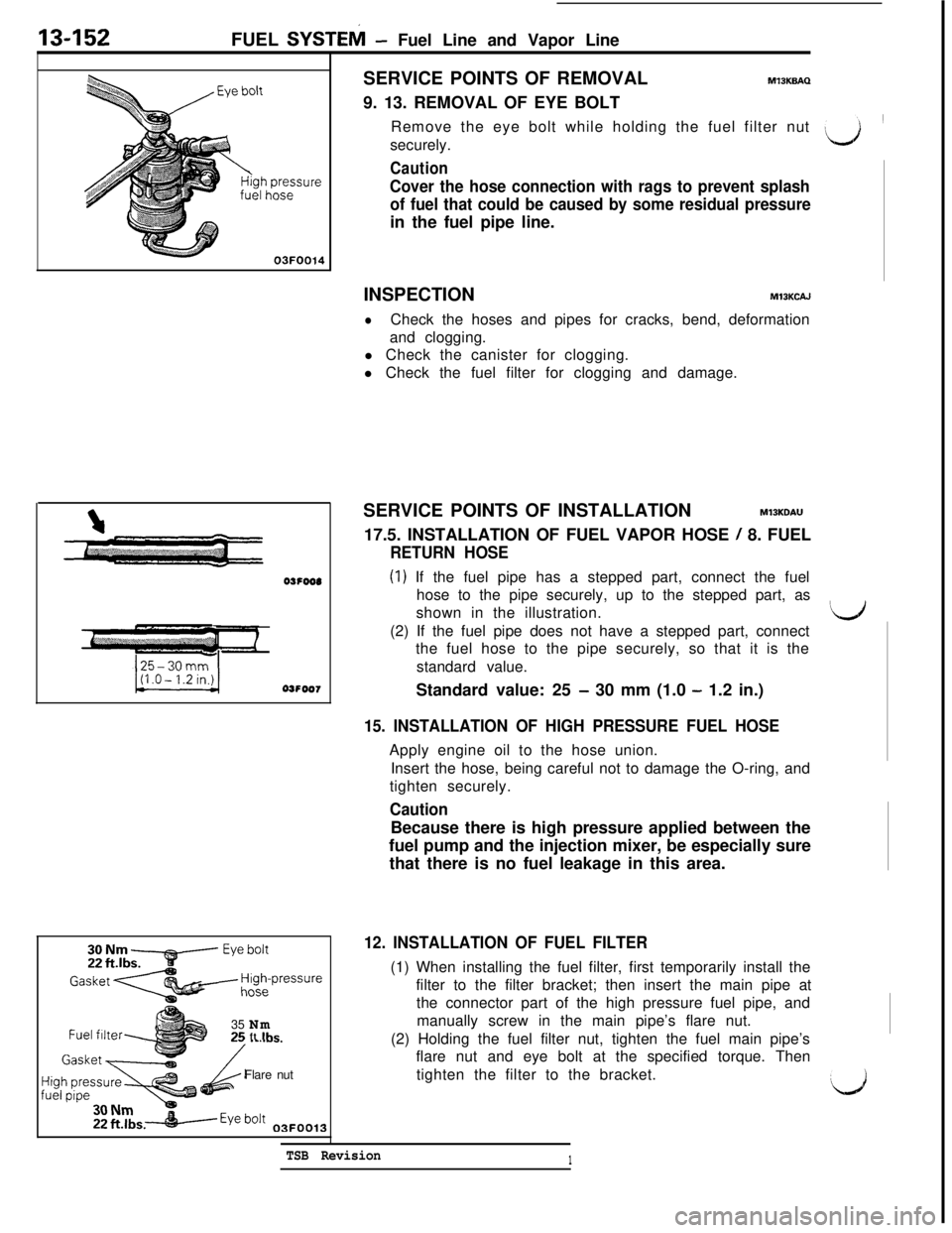
@dFlare nut,xSERVICE POINTS OF REMOVAL
MlBKBAQ9. 13. REMOVAL OF EYE BOLT
Remove the eye bolt while holding the fuel filter nut
\securely.
Caution
Cover the hose connection with rags to prevent splash
of fuel that could be caused by some residual pressurein the fuel pipe line.
INSPECTION
MIBKCAJ
lCheck the hoses and pipes for cracks, bend, deformation
and clogging.
l Check the canister for clogging.
l Check the fuel filter for clogging and damage.
SERVICE POINTS OF INSTALLATION
MlSKDAU17.5. INSTALLATION OF FUEL VAPOR HOSE
/ 8. FUEL
RETURN HOSE
(1) If the fuel pipe has a stepped part, connect the fuel
hose to the pipe securely, up to the stepped part, as
shown in the illustration.
Iti(2) If the fuel pipe does not have a stepped part, connect
the fuel hose to the pipe securely, so that it is the
standard value.
Standard value: 25
- 30 mm (1.0 - 1.2 in.)
15. INSTALLATION OF HIGH PRESSURE FUEL HOSEApply engine oil to the hose union.
Insert the hose, being careful not to damage the O-ring, and
tighten securely.
CautionBecause there is high pressure applied between the
fuel pump and the injection mixer, be especially sure
that there is no fuel leakage in this area.
12. INSTALLATION OF FUEL FILTER(1) When installing the fuel filter, first temporarily install the
filter to the filter bracket; then insert the main pipe at
the connector part of the high pressure fuel pipe, and
manually screw in the main pipe’s flare nut.
(2) Holding the fuel filter nut, tighten the fuel main pipe’s
flare nut and eye bolt at the specified torque. Then
tighten the filter to the bracket.
TSB Revision1
‘d
Page 259 of 1146
FUEL SYSTEM - Fuel Filter13453
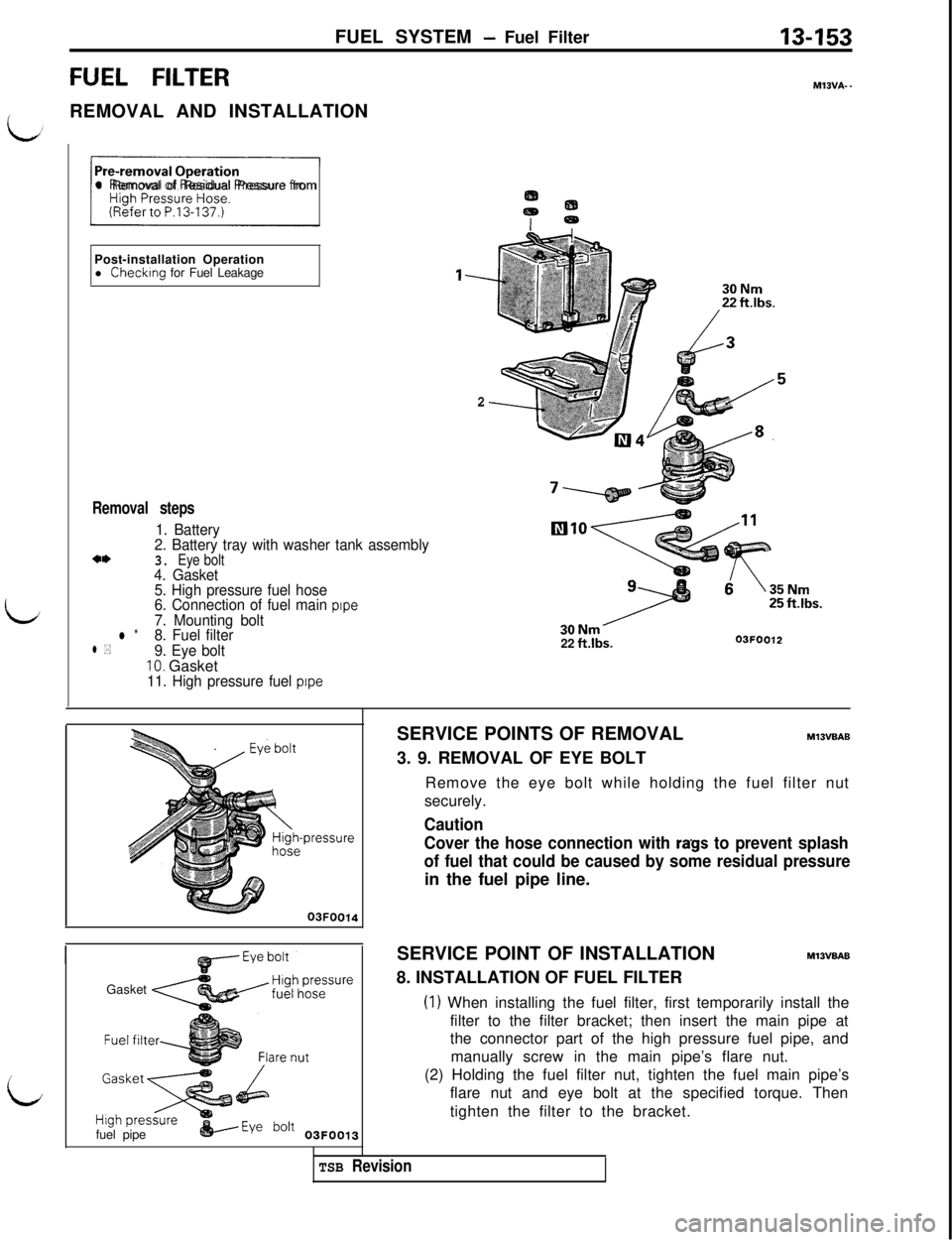
FUEL FILTERM13VA-.
/REMOVAL AND INSTALLATION
i&J
L
/Il Removal of Residual Pressure from
Post-installation Operation
l Checking for Fuel Leakage
Removal steps
1. Battery
2. Battery tray with washer tank assembly
3. Eye bolt4. Gasket
5. High pressure fuel hose
6. Connection of fuel main
pipe7. Mounting boltl *8. Fuel filterl *9. Eye bolt10. Gasket11. High pressure fuel pipe
l---
222 ft.lbs.03FOO12
Gasket
fuel pipe
&----Eye bo’t 03FOO13SERVICE POINTS OF REMOVAL
MlSVBAB3. 9. REMOVAL OF EYE BOLT
Remove the eye bolt while holding the fuel filter nut
securely.
Caution
Cover the hose connection with
rags to prevent splash
of fuel that could be caused by some residual pressurein the fuel pipe line.
SERVICE POINT OF INSTALLATION
M13VBAB8. INSTALLATION OF FUEL FILTER
(1) When installing the fuel filter, first temporarily install the
filter to the filter bracket; then insert the main pipe at
the connector part of the high pressure fuel pipe, and
manually screw in the main pipe’s flare nut.
(2) Holding the fuel filter nut, tighten the fuel main pipe’s
flare nut and eye bolt at the specified torque. Then
tighten the filter to the bracket.
TSB Revision
Page 262 of 1146
13-156ENGINE CONTROL - Service Adjustment Procedures
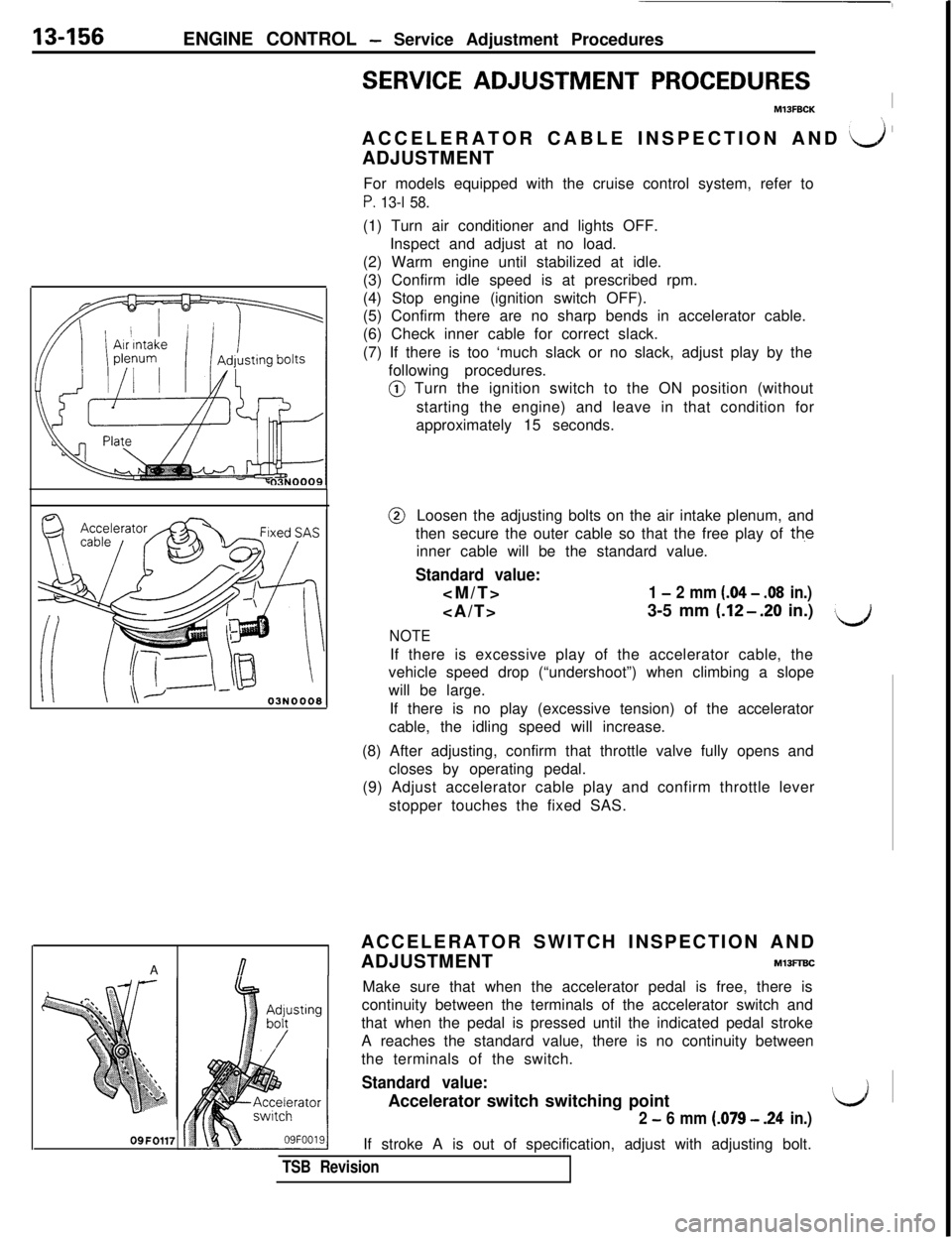
SERVICE ADJUSTMENT PROCEDURES
M13FBCKIACCELERATOR CABLE INSPECTION AND
a ’ADJUSTMENT
For models equipped with the cruise control system, refer to
P. 13-l 58.(1) Turn air conditioner and lights OFF.
Inspect and adjust at no load.
(2) Warm engine until stabilized at idle.
(3) Confirm idle speed is at prescribed rpm.
(4) Stop engine (ignition switch OFF).
(5) Confirm there are no sharp bends in accelerator cable.
(6) Check inner cable for correct slack.
(7) If there is too ‘much slack or no slack, adjust play by the
following procedures.@ Turn the ignition switch to the ON position (without
starting the engine) and leave in that condition for
approximately 15 seconds.@Loosen the adjusting bolts on the air intake plenum, and
then secure the outer cable so that the free play of
th,einner cable will be the standard value.
Standard value:
1 - 2 mm (.04 - .08 in.)3-5 mm
(.12-.20 in.)
NOTE
\JIf there is excessive play of the accelerator cable, the
vehicle speed drop (“undershoot”) when climbing a slope
will be large.
If there is no play (excessive tension) of the accelerator
cable, the idling speed will increase.
(8) After adjusting, confirm that throttle valve fully opens and
closes by operating pedal.
(9) Adjust accelerator cable play and confirm throttle lever
stopper touches the fixed SAS.
ACCELERATOR SWITCH INSPECTION AND
A
nADJUSTMENTMlBFlBC
09FO117Make sure that when the accelerator pedal is free, there is
;$ustingcontinuity between the terminals of the accelerator switch and
/that when the pedal is pressed until the indicated pedal stroke
A reaches the standard value, there is no continuity between
the terminals of the switch.
Standard value:Accelerator switch switching point
2 - 6 mm (.079 - .24 in.)If stroke A is out of specification, adjust with adjusting bolt.
TSB Revision
\
‘LJ ~
Page 267 of 1146
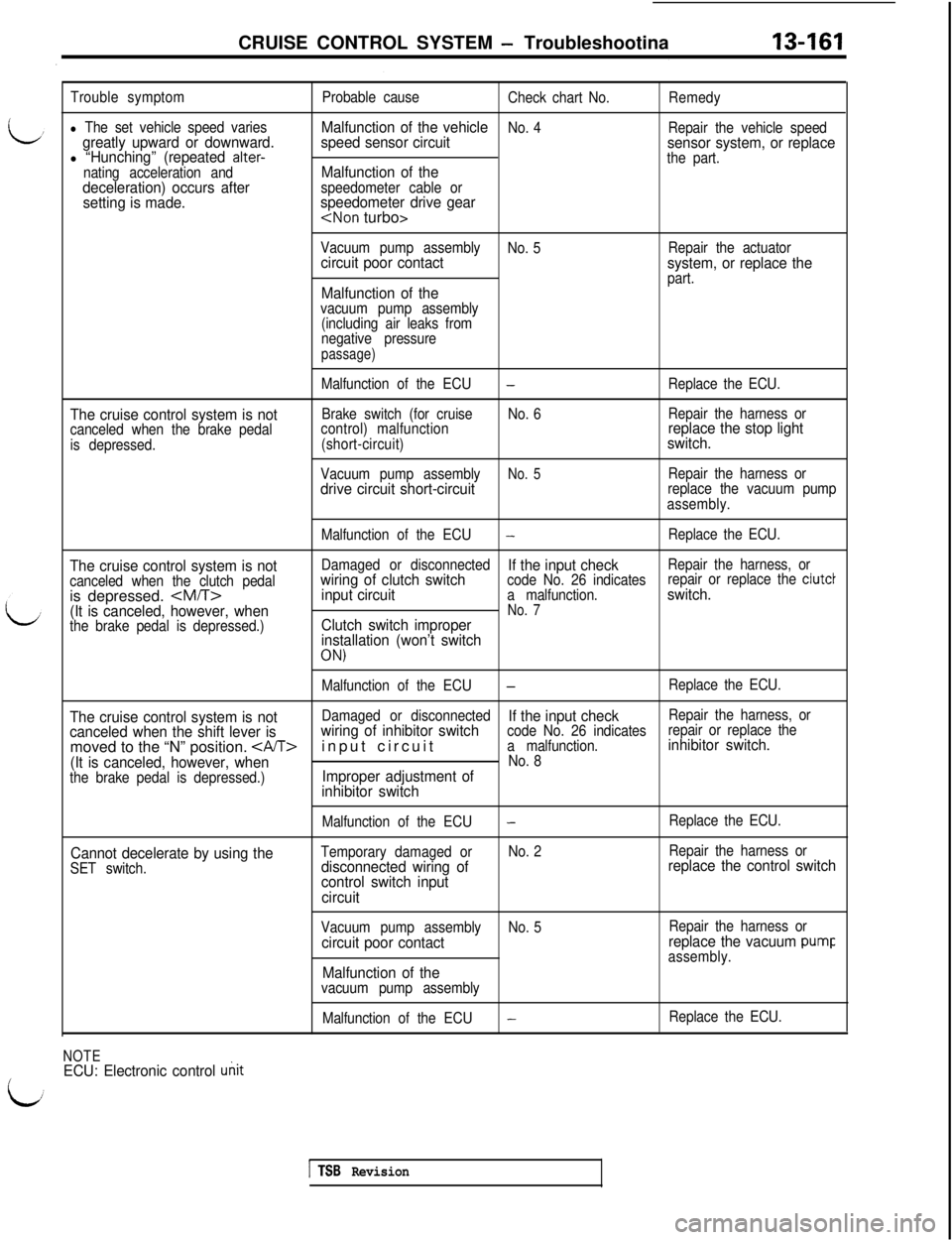
CRUISE CONTROL SYSTEM - Troubleshootina13461
Trouble symptom
l The set vehicle speed variesgreatly upward or downward.l “Hunching” (repeated alter-
nating acceleration and
deceleration) occurs after
setting is made.
Probable cause
Check chart No.Remedy
Malfunction of the vehicleNo. 4Repair the vehicle speedspeed sensor circuit
sensor system, or replacethe part.Malfunction of thespeedometer cable orspeedometer drive gear
Vacuum pump assembly
No. 5Repair the actuatorcircuit poor contact
system, or replace thepart.Malfunction of thevacuum pump assembly
(including air leaks from
negative pressure
passage)
The cruise control system is notcanceled when the brake pedal
is depressed.Malfunction of the ECU
-Replace the ECU.
Brake switch (for cruiseNo. 6Repair the harness or
control) malfunction
replace the stop light
(short-circuit)switch.
Vacuum pump assemblyNo. 5Repair the harness ordrive circuit short-circuitreplace the vacuum pump
assembly.
The cruise control system is notcanceled when the clutch pedalis depressed.
-Replace the ECU.
Damaged or disconnected
If the input checkRepair the harness, orwiring of clutch switchcode No. 26 indicatesrepair or replace the clutch
input circuita malfunction.switch.No. 7Clutch switch improper
installation (won’t switch
ON)
Malfunction of the ECU-Replace the ECU.
The cruise control system is notDamaged or disconnectedIf the input checkRepair the harness, or
canceled when the shift lever iswiring of inhibitor switchcode No. 26 indicatesrepair or replace themoved to the “N” position.
input circuita malfunction.inhibitor switch.
(It is canceled, however, when
No. 8
the brake pedal is depressed.)Improper adjustment of
inhibitor switch
Cannot decelerate by using the
SET switch.Malfunction of the ECU
Temporary damaged ordisconnected wiring of
control switch input
circuit
-
No. 2Replace the ECU.
Repair the harness orreplace the control switch
Vacuum pump assemblyNo. 5Repair the harness orcircuit poor contactreplace the vacuum puml:assembly.
Malfunction of thevacuum pump assembly
Malfunction of the ECU
-Replace the ECU.
NOTEECU: Electronic control unit
1 TSB Revision
Page 268 of 1146
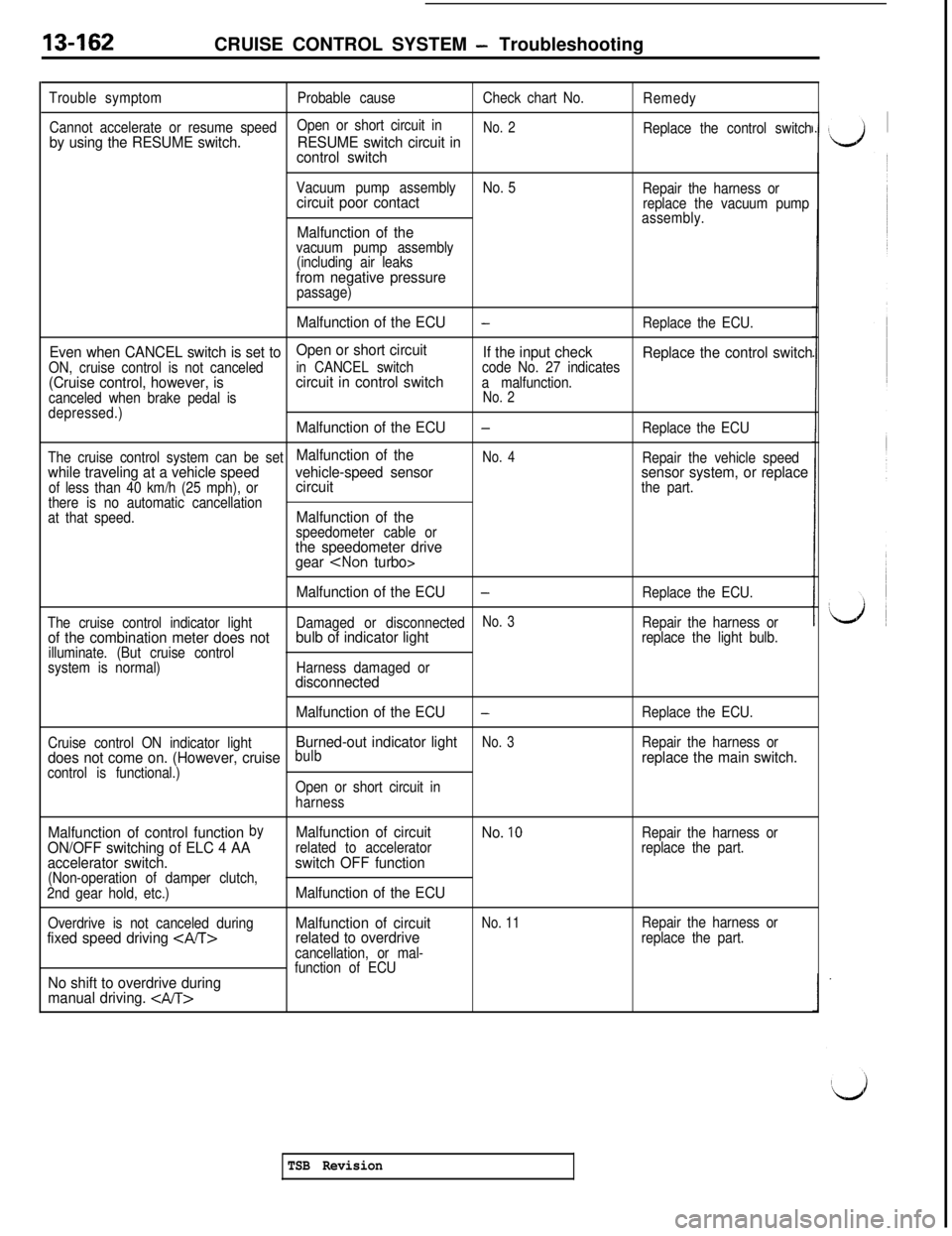
13-162CRUISE CONTROL SYSTEM - Troubleshooting
Trouble symptomProbable causeCheck chart No.
Remedy
Cannot accelerate or resume speedOpen or short circuit in
No. 2by using the RESUME switch.RESUME switch circuit inReplace the control switch
control switch
Vacuum pump assemblyNo. 5circuit poor contactRepair the harness or
replace the vacuum pump
Malfunction of thevacuum pump assembly
(including air leaks
from negative pressurepassage)assembly.
Malfunction of the ECU-Replace the ECU.
Even when CANCEL switch is set toON, cruise control is not canceled
Open or short circuit
in CANCEL switchIf the input check
Replace the control switch
(Cruise control, however, iscode No. 27 indicatescircuit in control switch
canceled when brake pedal isa malfunction.
depressed.)No. 2
Malfunction of the ECU-Replace the ECU
The cruise control system can be set
Malfunction of theNo. 4while traveling at a vehicle speedvehicle-speed sensorRepair the vehicle speed
of less than 40 km/h (25 mph), or
circuitsensor system, or replace
there is no automatic cancellationthe part.
at that speed.Malfunction of thespeedometer cable orthe speedometer drive
gear
Malfunction of the ECU
-Replace the ECU.
The cruise control indicator light
No. 3
of the combination meter does notDamaged or disconnectedbulb of indicator lightRepair the harness or
illuminate. (But cruise controlreplace the light bulb.
system is normal)Harness damaged or
disconnected
Malfunction of the ECU
-Replace the ECU.
Cruise control ON indicator light
No. 3
does not come on. (However, cruiseBurned-out indicator lightbulbRepair the harness or
control is functional.)replace the main switch.
Open or short circuit in
harness
Malfunction of control functionby
ON/OFF switching of ELC 4 AA
accelerator switch.
(Non-operation of damper clutch,
2nd gear hold, etc.)
Overdrive is not canceled during
fixed speed driving
No shift to overdrive during
manual driving.
Malfunction of circuitrelated to acceleratorswitch OFF function
Malfunction of the ECU
Malfunction of circuit
related to overdrive
cancellation, or mal-
function of ECU
No. IO
No. 11Repair the harness or
replace the part.
Repair the harness or
replace the part.
TSB Revision