air condition MITSUBISHI 3000GT 1991 User Guide
[x] Cancel search | Manufacturer: MITSUBISHI, Model Year: 1991, Model line: 3000GT, Model: MITSUBISHI 3000GT 1991Pages: 1146, PDF Size: 76.68 MB
Page 69 of 1146
ENGINE - Enaine AssemblvII-19
Engine mount bracketSERVICE POINTS OF REMOVALMllSBEH
15. DISCONNECTION OF Ail? CONDITIONER COMPRES-SOR
/ 16. POWER STEERING OIL PUMP
Disconnect air conditioner compressor and power steering
oil pump (with the hose).
NOTEThe removed air conditioner compressor and power steer-
ing oil pump should be fastened (by using rope, etc.) in
.aposition that will not interfere with the removal/installation
of the engine assembly.
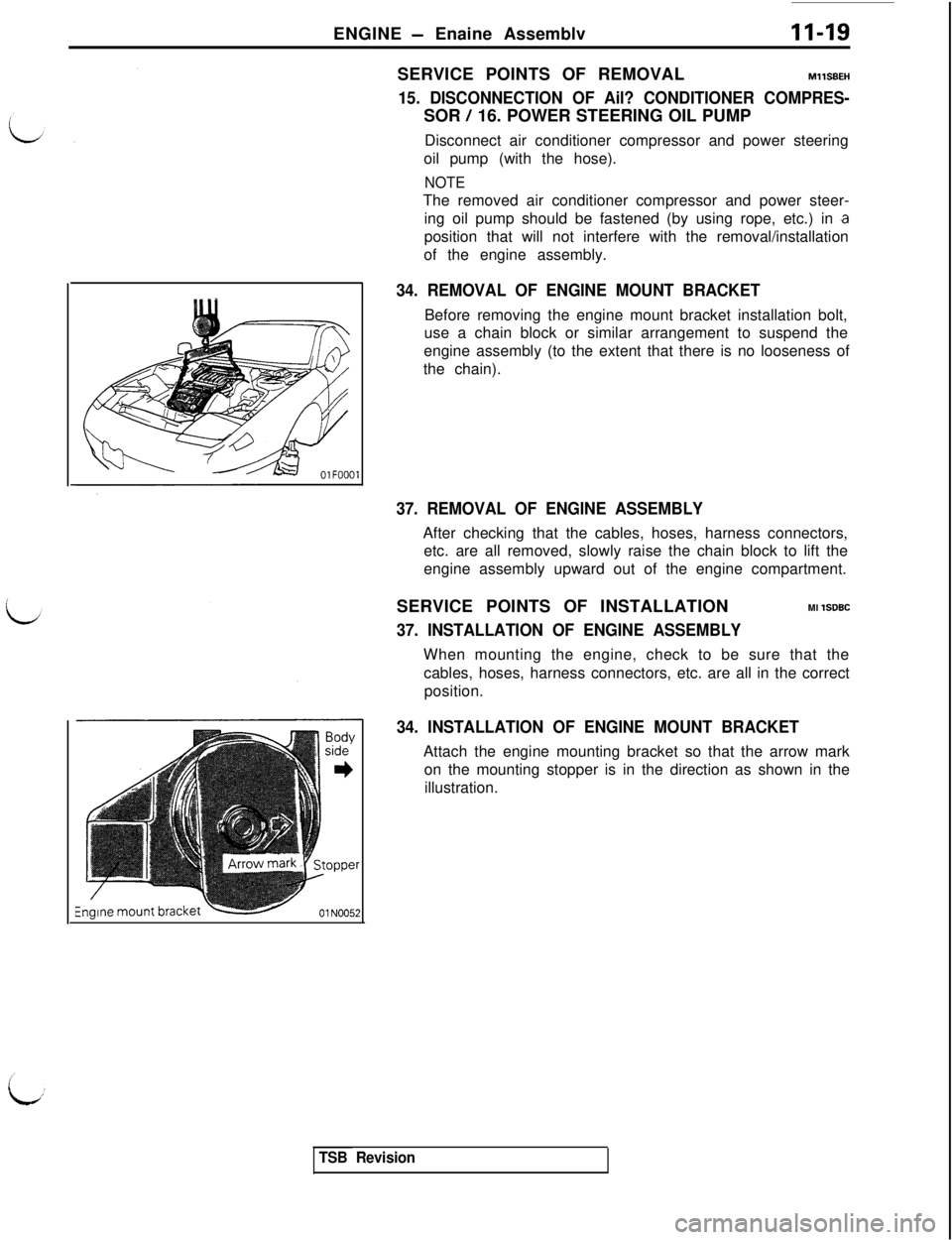
34. REMOVAL OF ENGINE MOUNT BRACKETBefore removing the engine mount bracket installation bolt,
use a chain block or similar arrangement to suspend the
engine assembly (to the extent that there is no looseness of
the chain).
37. REMOVAL OF ENGINE ASSEMBLYAfter checking that the cables, hoses, harness connectors,
etc. are all removed, slowly raise the chain block to lift the
engine assembly upward out of the engine compartment.
SERVICE POINTS OF INSTALLATIONMl
1SDBC
37. INSTALLATION OF ENGINE ASSEMBLYWhen mounting the engine, check to be sure that the
cables, hoses, harness connectors, etc. are all in the correct
position.
34. INSTALLATION OF ENGINE MOUNT BRACKETAttach the engine mounting bracket so that the arrow mark
on the mounting stopper is in the direction as shown in the
illustration.
TSB Revision
Page 76 of 1146
11-26ENGINE - Timing Belt
TIMING BELT
REMOVAL AND INSTALLATION
MllKA-BI
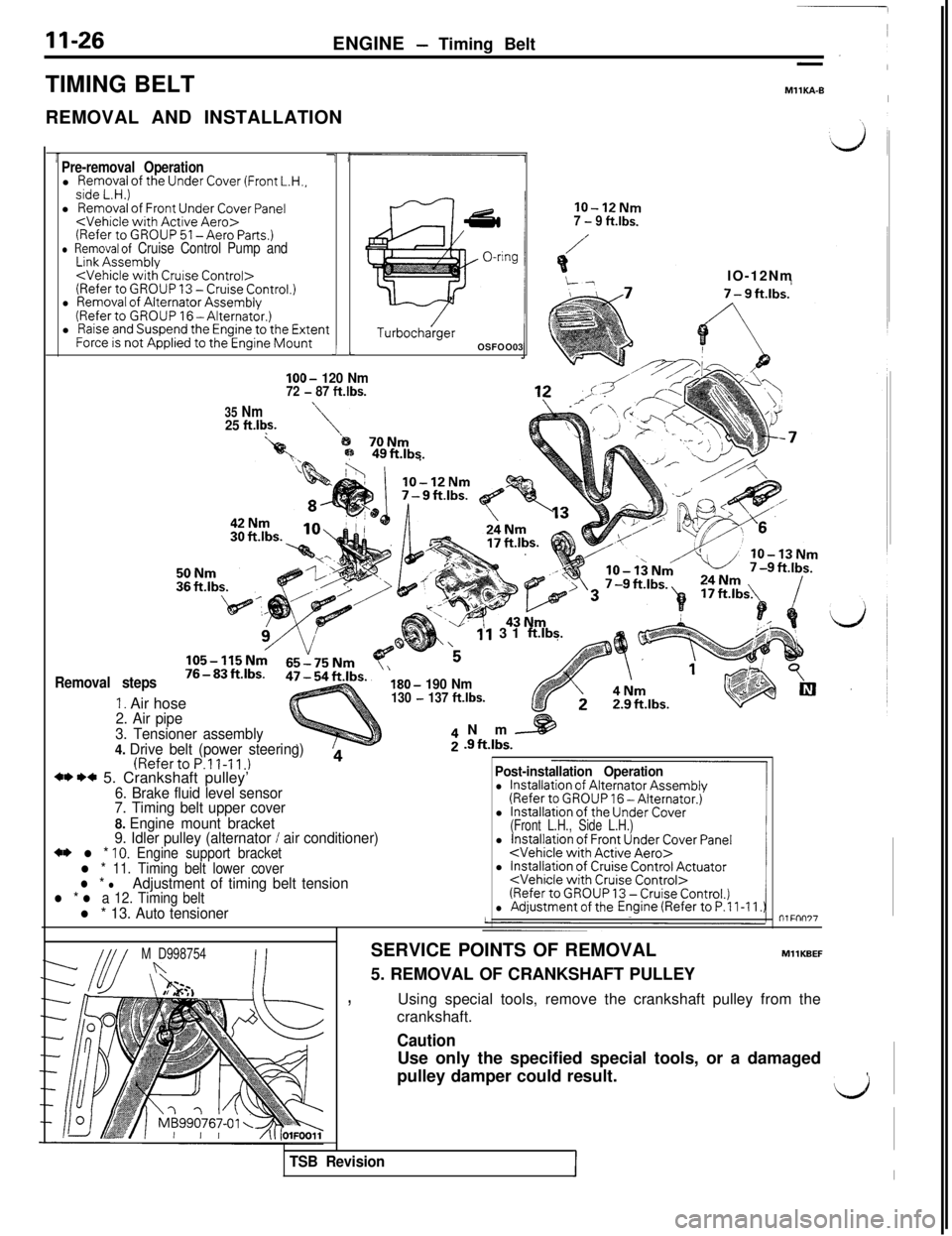
Pre-removal Operationl Removal of the Under Cover (Front L.H.,side L.H.)l Removal of Front Under Cover Panel
l Raise and Suspend the Engine to the ExtentForce is not Applied to the Engine Mounti LIOO-
120 Nm72 - 87 ft.lbs.
35 Nm25 ft.l$.
TurbochargerOSFOO03
lo-12Nm7 - 9 ft.lbs.
Removal steps
1. Air hose
11 31 ftlbs.
‘5IO-12Nm
B;p 49ftJbs.
\
180- 190 Nm130 - 137 ft.lbs.
2. Air pipe
3. Tensioner assembly
4. Drive belt (power steering)
(RefertoP.ll-11.)4** I)* 5. Crankshaft pulley’6. Brake fluid level sensor
7. Timing belt upper cover
8. Engine mount bracket
9. Idler pulley (alternator
/ air conditioner)+* l * 10. Engine support bracketl * 11. Timing belt lower coverl * lAdjustment of timing belt tensionl * l a 12. Timing beltl * 13. Auto tensionerNm
[email protected].
Post-installation Operation
l Installation of Alternator Assembly(Refer to GROUP 16 -Alternator.)
l Installation of the Under Cover(Front L.H., Side L.H.)l Installation of Front Under Cover Panel
l Installation of Cruise Control Actuator
M D998754nSERVICE POINTS OF REMOVAL
5. REMOVAL OF CRANKSHAFT PULLEYMllKBEF
,Using special tools, remove the crankshaft pulley from the
crankshaft.
TSB RevisionII
CautionUse only the specified special tools, or a damaged
pulley damper could result.
,
LJ
Page 107 of 1146
FUEL
SYSTEM
CONTENTSM13AA- _
CRUISE CONTROL SYSTEM. . . . . . . . . . . . . . . . . . . . . . . . . . . .158SPECIFICATIONS. . . . . . . .._._....................................................155
CRUISE CONTROL SYSTEM*................................................185
SERVICE ADJUSTMENT PROCEDURES............................178
Cruise Control Cables Inspection and Adjustment........178Cruise Control SystemInspection....................................179individual Parts Inspection....................................................181
SPECIAL TOOLS........................................................................159
SPECIFICATIONS....................................................................158
General Specifications........................................................158Service Specifications........................................................158
TROUBLESHOOTING............................................................159
Check Chart............................................................................163Harness and Components Layout....................................176Preliminary Inspection........................................................159Self-diagnosis Checking........................................................172Troubleshooting Quick Reference Chart............................159
ENGINE CONTROL............................................155
ENGINE CONTROL................................................................157
SERVICE ADJUSTMENT PROCEDURES............................156
Accelerator Cable Inspection and Adjustment................156Accelerator Switch Inspection and Adjustment................156
Service Specifications........................................................
155
TROUBLESHOOTING............................................................
155
Accelerator Cable and Accelerator Pedal........................155
FUEL SYSTEM....................................................3
DETONATION SENSOR........................................................154
FUEL FILTER............................................................................
153
FUEL LINE AND VAPOR LINE................................................151
FUEL PUMP AND FUEL GAUGE UNIT ASSEMBLYAND OVERFILL LIMITER (TWO-WAY VALVE)................149
FUEL TANK.................................................................................146
GENERAL INFORMATION
....................................................
3
MPI System Diagram............................................................3
INJECTOR................................................................................141
ON-VEHICLE INSPECTION OF MPI COMPONENTS........36
Active Exhaust Control Unit
SUPPLEMENTAL RESTRAINT SYSTEM (SRS)
(1)A Supplemental Restraint System (SRS), which uses a driver-side air bag, has been installed in the 3000GT.(2)The SRS includes the following components: impact sensors, SRS diagnosis unit: SRS warning light, air bagmodule, clock spring, interconnecting wiring. Other SRS-related components (that may have to be
removed/installed in connection with SRS service or maintenance) are indicated in the table of contents byan asterisk (*).
WARNING!(I)Improper service or maintenance of any component of the SRS, or any SRS-related component, can lead to
personal injury or death to service personnel (from inadvertent firing of the air bag) or to the driver (from
rendering the SRS inoperative).
(2) Service or maintenance of any SRS component or SRS-related component must be performed only at anauthorized MITSUBISHI dealer.
(3) MITSUBISHI dealer personnel must thoroughly review this manual, and especially its GROUP
528 -Supplemental Restraint System (SRS), before beginning any service or maintenance of any component of theSRS or any SRS-related component.
Page 113 of 1146
FUEL SYSTEM - SDecifications
L
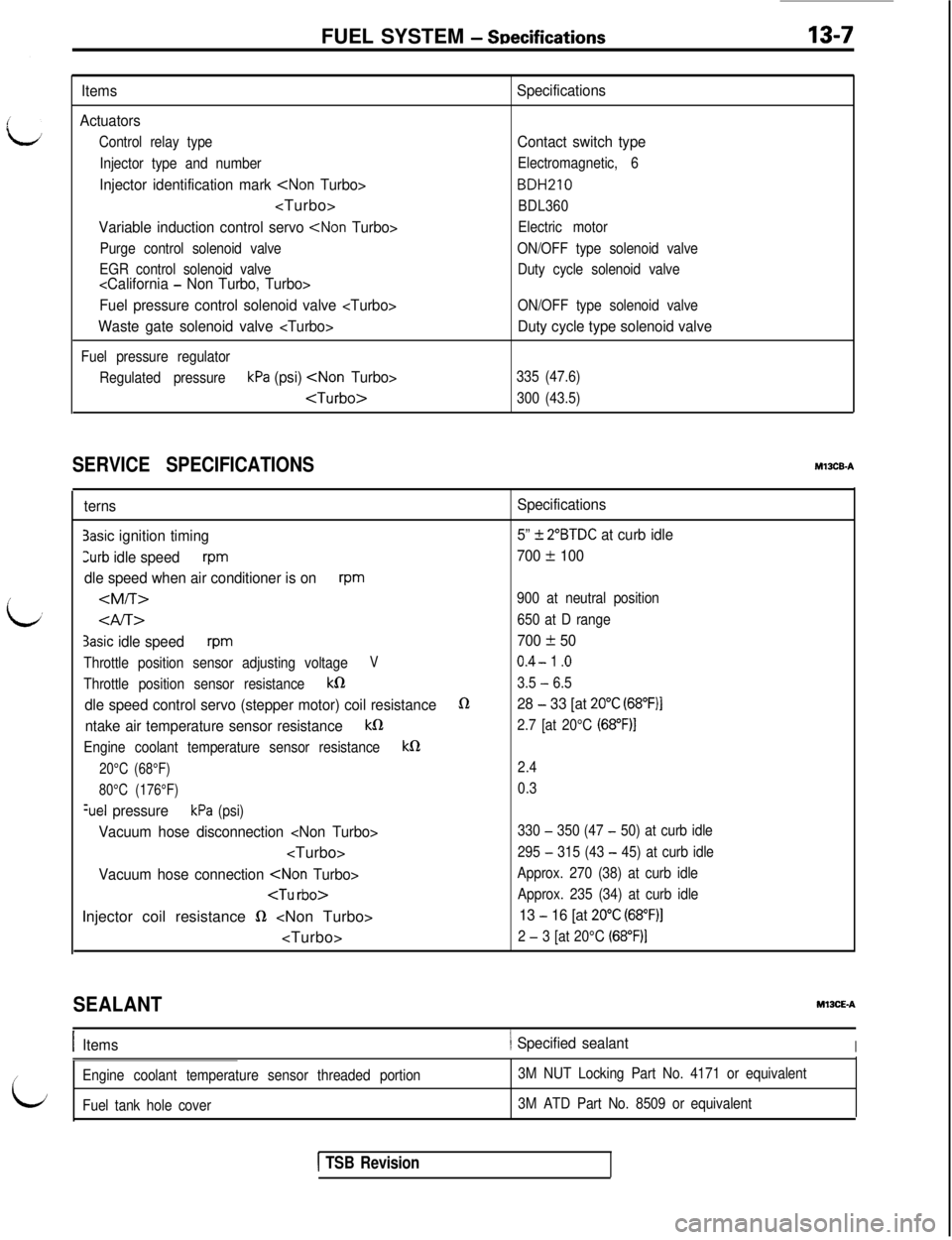
Items
Actuators
Control relay type
Injector type and number
Injector identification mark
Variable induction control servo
Purge control solenoid valve
EGR control solenoid valve
Fuel pressure control solenoid valve
Waste gate solenoid valve
Fuel pressure regulator
Regulated pressure
kPa (psi)
Specifications
Contact switch type
Electromagnetic, 6
BDH210
BDL360
Electric motor
ON/OFF type solenoid valve
Duty cycle solenoid valve
ON/OFF type solenoid valve
Duty cycle type solenoid valve
335 (47.6)
300 (43.5)
SERVICE SPECIFICATIONS
i
ternsSpecifications
3asic ignition timing5” -t 2”BTDC at curb idle
3urb idle speedrpm700 * 100
dle speed when air conditioner is on
rpm
3asic idle speedrpm700 + 50
Throttle position sensor adjusting voltageV0.4- 1 .o
Throttle position sensor resistancek03.5 - 6.5
dle speed control servo (stepper motor) coil resistance028 - 33 [at 20°C (68”F)I
ntake air temperature sensor resistancekfi2.7 [at 20°C (68”F)I
Engine coolant temperature sensor resistancekQ
20°C (68°F)
2.4
80°C (176°F)0.3
%el pressurekPa (psi)
Vacuum hose disconnection
295 - 315 (43 - 45) at curb idle
Vacuum hose connection
Sz
2 - 3 [at 20°C (68”F)I
SEALANTMlXE-A
IItems1 Specified sealantI
/
L
Engine coolant temperature sensor threaded portion3M NUT Locking Part No. 4171 or equivalent
Fuel tank hole cover3M ATD Part No. 8509 or equivalent
1 TSB Revision
Page 115 of 1146
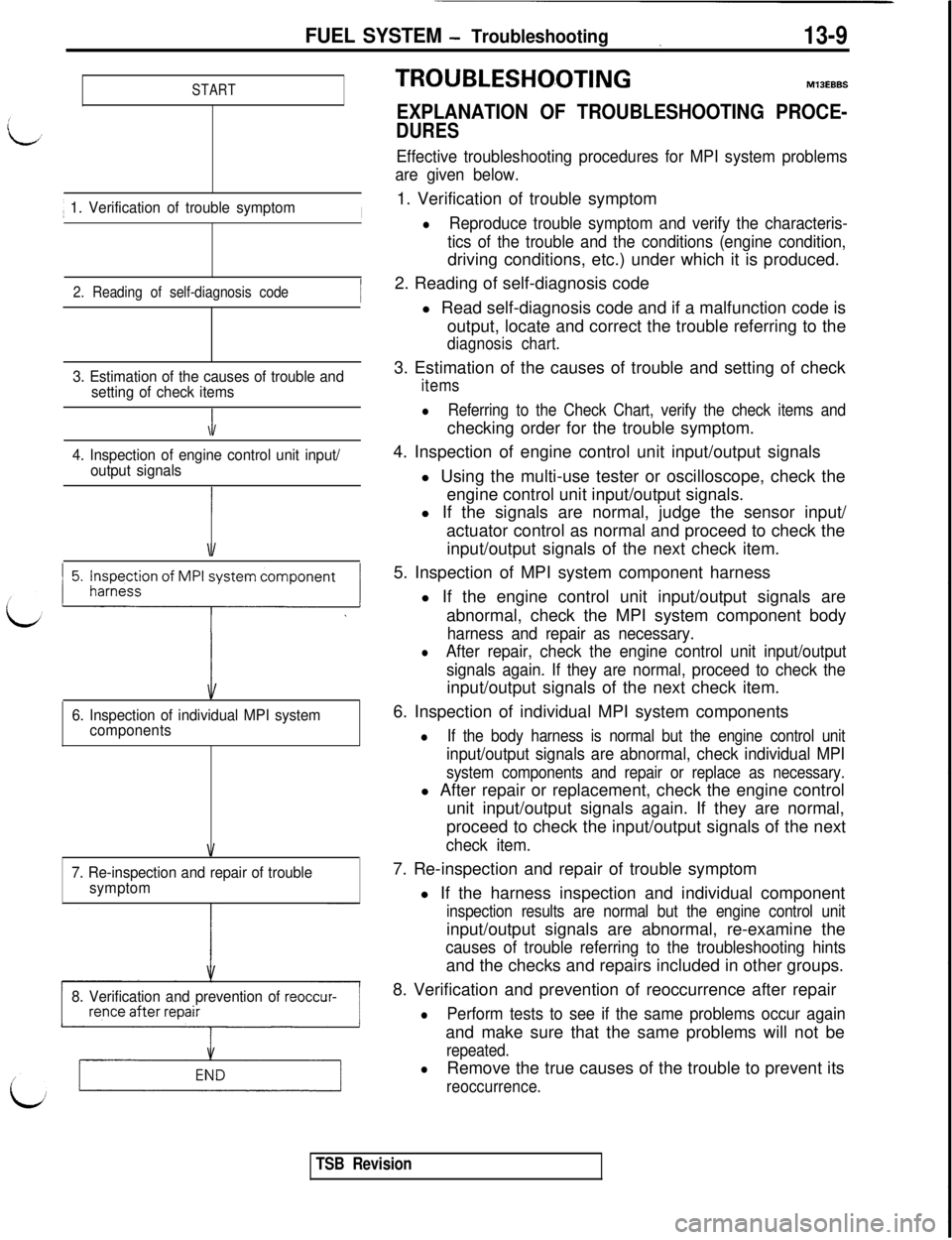
FUEL SYSTEM - Troubleshooting13-9
START1
1. Verification of trouble symptomI
2. Reading of self-diagnosis code
3. Estimation of the causes of trouble and
setting of check items
\1
4. Inspection of engine control unit input/
output signals
\1
5. Inspection of MPI system component
LL
6. Inspection of individual MPI system
components
7. Re-inspection and repair of trouble
symptom
8. Verification and prevention of
reoccur-
TROUBLESHO.OTlNGMlBEBBS
EXPLANATION OF TROUBLESHOOTING PROCE-
DURES
Effective troubleshooting procedures for MPI system problems
are given below.1. Verification of trouble symptom
lReproduce trouble symptom and verify the characteris-
tics of the trouble and the conditions (engine condition,driving conditions, etc.) under which it is produced.
2. Reading of self-diagnosis code
l Read self-diagnosis code and if a malfunction code is
output, locate and correct the trouble referring to the
diagnosis chart.3. Estimation of the causes of trouble and setting of check
items
lReferring to the Check Chart, verify the check items andchecking order for the trouble symptom.
4. Inspection of engine control unit input/output signals
l Using the multi-use tester or oscilloscope, check the
engine control unit input/output signals.
l If the signals are normal, judge the sensor input/
actuator control as normal and proceed to check the
input/output signals of the next check item.
5. Inspection of MPI system component harness
l If the engine control unit input/output signals are
abnormal, check the MPI system component body
harness and repair as necessary.
lAfter repair, check the engine control unit input/output
signals again. If they are normal, proceed to check theinput/output signals of the next check item.
6. Inspection of individual MPI system components
lIf the body harness is normal but the engine control unit
input/output signals are abnormal, check individual MPI
system components and repair or replace as necessary.l After repair or replacement, check the engine control
unit input/output signals again. If they are normal,
proceed to check the input/output signals of the next
check item.7. Re-inspection and repair of trouble symptom
l If the harness inspection and individual component
inspection results are normal but the engine control unitinput/output signals are abnormal, re-examine the
causes of trouble referring to the troubleshooting hintsand the checks and repairs included in other groups.
8. Verification and prevention of reoccurrence after repair
lPerform tests to see if the same problems occur againand make sure that the same problems will not be
repeated.
lRemove the true causes of the trouble to prevent its
reoccurrence.
TSB Revision
Page 121 of 1146
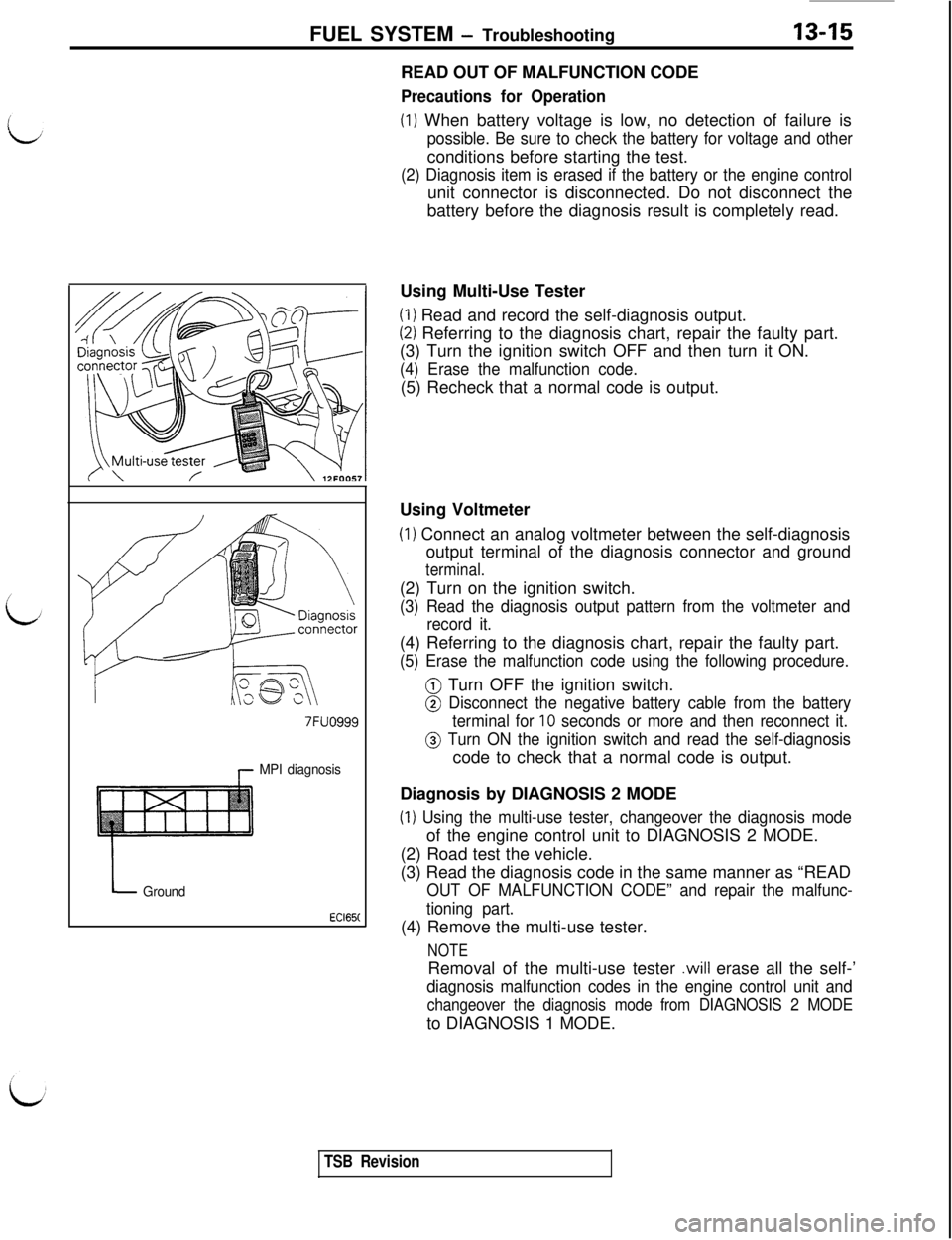
FUEL SYSTEM - Troubleshooting13-15READ OUT OF MALFUNCTION CODE
Precautions for Operation
(1) When battery voltage is low, no detection of failure is
possible. Be sure to check the battery for voltage and otherconditions before starting the test.
(2) Diagnosis item is erased if the battery or the engine controlunit connector is disconnected. Do not disconnect the
battery before the diagnosis result is completely read.
Using Multi-Use Tester
(I) Read and record the self-diagnosis output.
(2) Referring to the diagnosis chart, repair the faulty part.
(3) Turn the ignition switch OFF and then turn it ON.
(4) Erase the malfunction code.(5) Recheck that a normal code is output.
7FUO999
r MPI diagnosis
L Ground
EC165(Using Voltmeter(I) Connect an analog voltmeter between the self-diagnosis
output terminal of the diagnosis connector and ground
terminal.(2) Turn on the ignition switch.
(3) Read the diagnosis output pattern from the voltmeter and
record it.(4) Referring to the diagnosis chart, repair the faulty part.
(5) Erase the malfunction code using the following procedure.
@ Turn OFF the ignition switch.
@ Disconnect the negative battery cable from the battery
terminal for
10 seconds or more and then reconnect it.
@ Turn ON the ignition switch and read the self-diagnosiscode to check that a normal code is output.
Diagnosis by DIAGNOSIS 2 MODE
(1) Using the multi-use tester, changeover the diagnosis modeof the engine control unit to DIAGNOSIS 2 MODE.
(2) Road test the vehicle.
(3) Read the diagnosis code in the same manner as “READ
OUT OF MALFUNCTION CODE” and repair the malfunc-
tioning part.(4) Remove the multi-use tester.
NOTERemoval of the multi-use tester
.will erase all the self-’
diagnosis malfunction codes in the engine control unit and
changeover the diagnosis mode from DIAGNOSIS 2 MODEto DIAGNOSIS 1 MODE.
TSB Revision
Page 128 of 1146
13-22FUEL SYSTEM - Troubleshooting
J/B
(MULTI-PURPOSEFUSE@>TAIL LIGHTRELAYiE;;FGER ikli$IC
5I7
>
;;iZ;CATED gJ
0\IC-69
[1:
J/B&I
w
8 A-36
7
DIODE*Ire E-31I ’1IT6 A-67C-52
r-----IY
6I1
J
CA
7
.i
tc
POWER TRANSISTOR
ENGINE
COOLANT
TEMPERATURE.SWITCH
(FOR AIR
CONDITIONER)AIR~X$Il$T~ONER
UNITKX35-AC-R05025-NY
TSB Revision
Page 135 of 1146
![MITSUBISHI 3000GT 1991 User Guide FUEL SYSTEM - Troubleshooting13-29
ENGINE
CONTROL
RELAYF
1 7=2
c----IIIIIIII2,(2Io FUEL
) SE
PRESSURE
SOLENOID
VALVE
IfII
I
I
I
I
J
]i#&B,D i
A-20
1
WASTE
GATE
SOLENOIDVALVE
/
7 EGRi ~XE~~OID
I
; A-21](/img/19/57085/w960_57085-134.png "MITSUBISHI 3000GT 1991 User Guide FUEL SYSTEM - Troubleshooting13-29
ENGINE
CONTROL
RELAYF
1 7=2
c----IIIIIIII2,(2Io FUEL
) SE
PRESSURE
SOLENOID
VALVE
IfII
I
I
I
I
J
]i#&B,D i
A-20
1
WASTE
GATE
SOLENOIDVALVE
/
7 EGRi ~XE~~OID
I
; A-21")
FUEL SYSTEM - Troubleshooting13-29
ENGINE
CONTROL
RELAYF
1 7=2
c----IIIIIIII2,(2Io FUEL
) SE
PRESSURE
SOLENOID
VALVE
IfII
I
I
I
I
J
]i#&B,D i
A-20
1
WASTE
GATE
SOLENOIDVALVE
/
7 EGRi ~XE~~OID
I
; A-21
L
1 A-70
j A-72
f ENGINEj jXICI$ROL
I
-------13s
3.------
s
10
/\1
>
J
c
”-_-
1 A-18
3P
~;~E&DIAGNOSIS #Fjhl;;ON
CONNECTORADJUSTMENT
EFfq&@gCONNECTOR
d
Efpggggg]
I B-OS
ENGINE
COOLANT
Q&;EEATURE ,,'I/\FOR AIR)/@ICONDITIONEROFF --xOlJ
POWER STEERING;tK;BESSURETSB Revision
Page 147 of 1146
FUEL SYSTEM - On-vehicle Inspection of MPI Components13-41
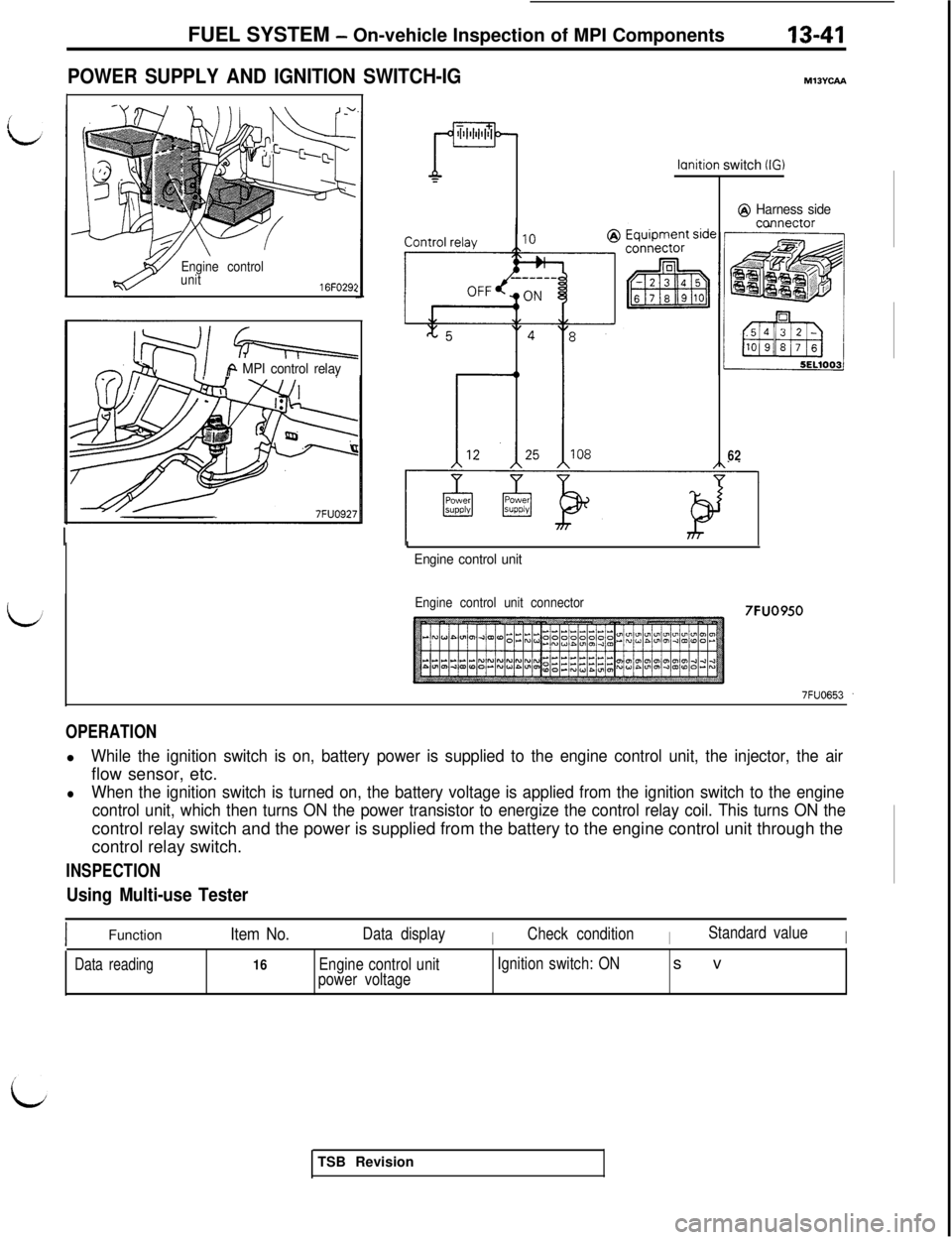
POWER SUPPLY AND IGNITION SWITCH-IG
Engine control
unit
16FO29:
Q-i=++=
iA MPI control relay
ml3Yuu
lcmition switch (IG)
@ Harness sideccmnector
62
I
Engine control unit
Engine control unit connector7FUO950
OPERATIONl
While the ignition switch is on, battery power is supplied to the engine control unit, the injector, the airflow sensor, etc.
lWhen the ignition switch is turned on, the battery voltage is applied from the ignition switch to the engine
control unit, which then turns ON the power transistor to energize the control relay coil. This turns ON thecontrol relay switch and the power is supplied from the battery to the engine control unit through the
control relay switch.
INSPECTION
Using Multi-use Tester
IFunctionItem No.Data displayICheck conditionIStandard valueI
Data reading16Engine control unit
power voltageIgnition switch: ONsv
TSB Revision
Page 152 of 1146
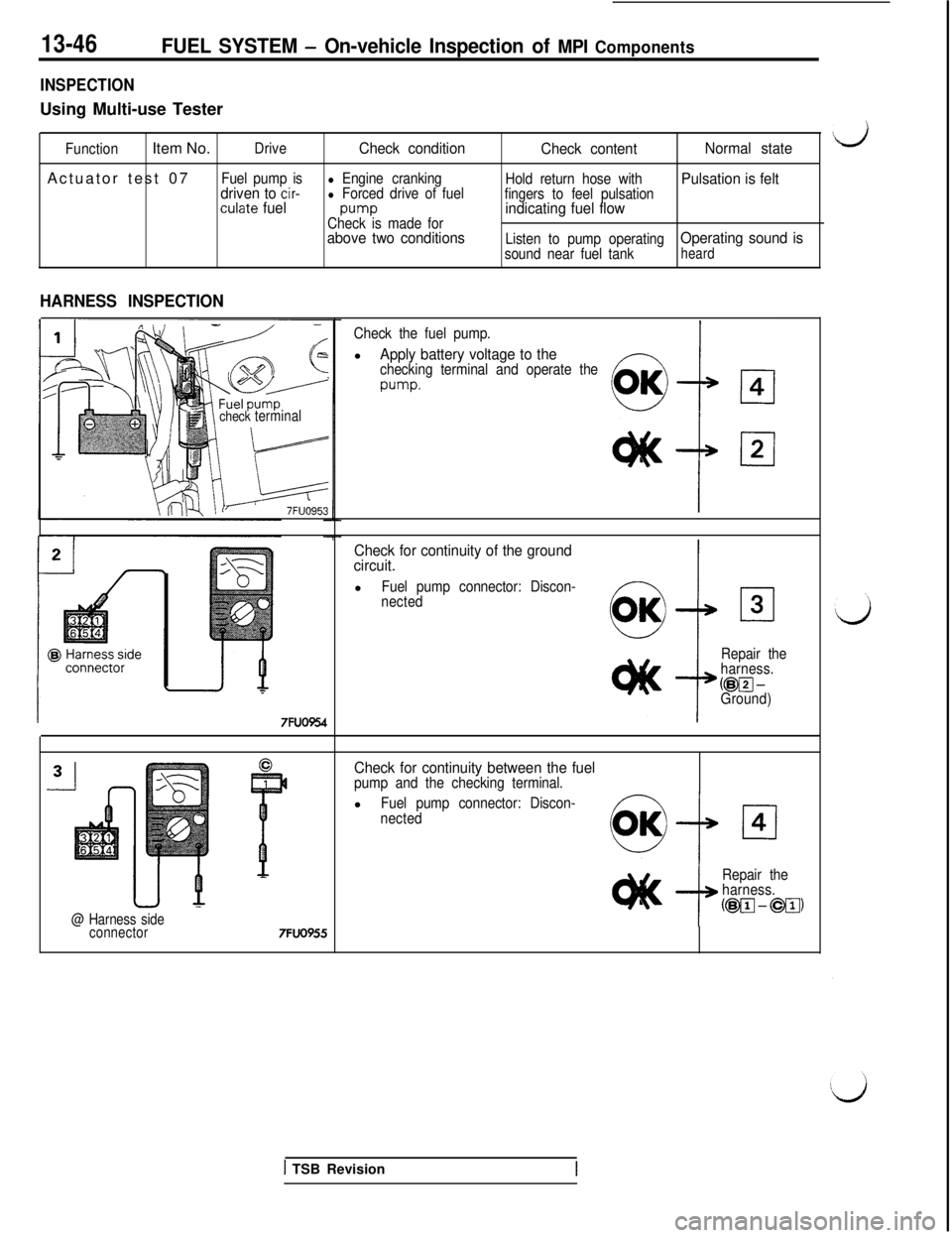
13-46FUEL SYSTEM - On-vehicle Inspection of MPI Components
INSPECTIONUsing Multi-use Tester
FunctionItem No.DriveCheck condition
Check contentNormal statedActuator test 07
Fuel pump isl Engine cranking
Hold return hose withPulsation is felt
driven to cir-l Forced drive of fuelculate fuelfingers to feel pulsation
pump
Check is made forindicating fuel flow
above two conditions
Listen to pump operating
sound near fuel tankOperating sound isheard
HARNESS INSPECTION
check terminal
7FUO954
@ Harness side
connector7FUO955
Check the fuel pump.l
Apply battery voltage to thechecking terminal and operate the
w-w
Check for continuity of the ground
circuit.l
Fuel pump connector: Discon-
nected
Repair the
harness.
@FJ-Ground)
Check for continuity between the fuelpump and the checking terminal.l
Fuel pump connector: Discon-
nectedcl4
Repair the
harness.
@vJ-@g)
1 TSB Revision