air condition MITSUBISHI 3000GT 1991 Workshop Manual
[x] Cancel search | Manufacturer: MITSUBISHI, Model Year: 1991, Model line: 3000GT, Model: MITSUBISHI 3000GT 1991Pages: 1146, PDF Size: 76.68 MB
Page 309 of 1146
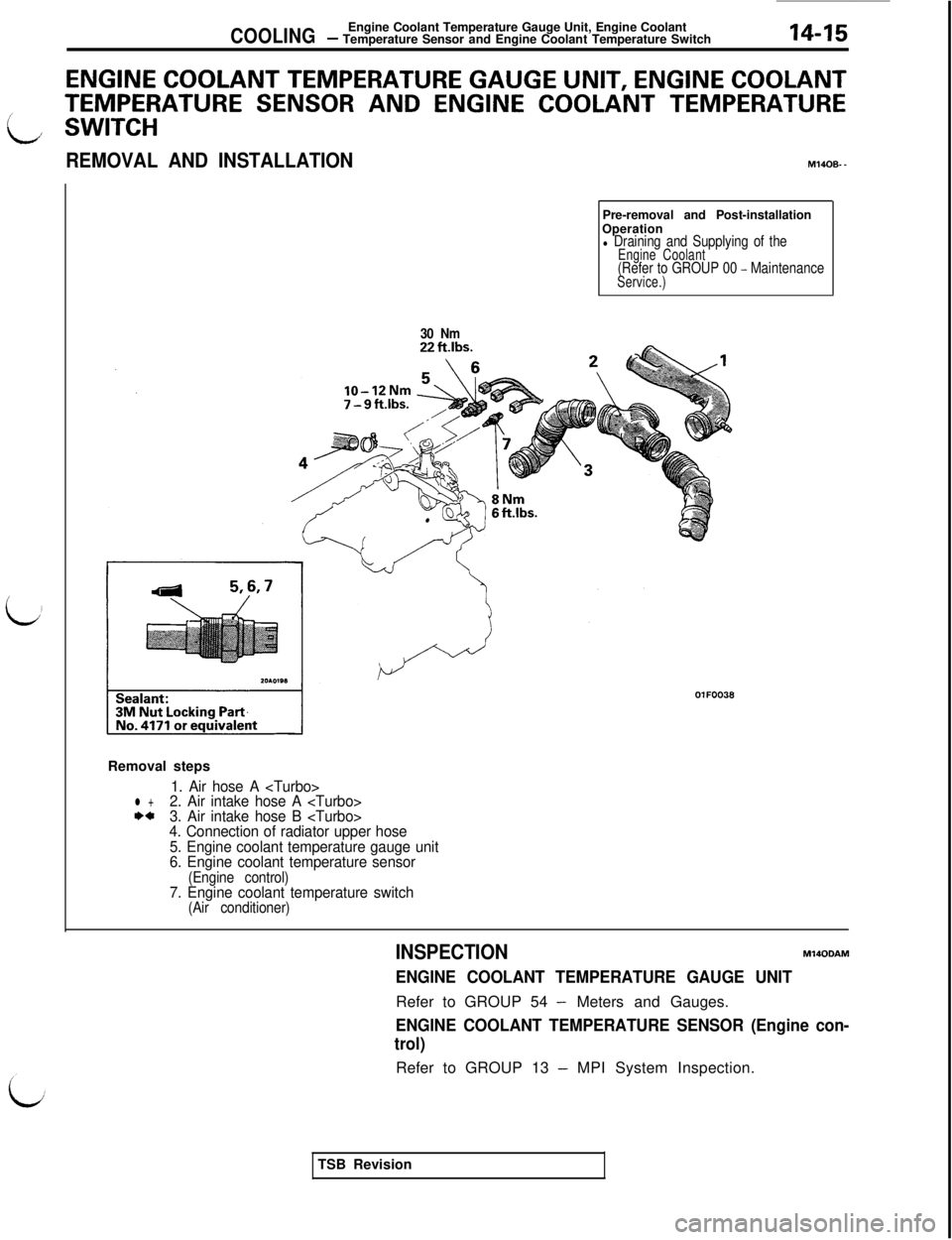
COOLINGEngine Coolant Temperature Gauge Unit, Engine Coolant- Temperature Sensor and Engine Coolant Temperature Switch14-15
ENGINE COOLANT TEMPERATURE GAUGE UNIT, ENGINE COOLANT
TEMPERATURE SENSOR AND ENGINE COOLANT TEMPERATURE
L,SWITCH
REMOVAL AND INSTALLATIONM140B. -Pre-removal and Post-installation
Operation
l Draining and Supplying of theEngine Coolant(Refer to GROUP 00 - MaintenanceService.)
30 NmOlFOO38
Removal steps
1. Air hose A
4. Connection of radiator upper hose
5. Engine coolant temperature gauge unit
6. Engine coolant temperature sensor
(Engine control)7. Engine coolant temperature switch(Air conditioner)
INSPECTIONM140DAM
ENGINE COOLANT TEMPERATURE GAUGE UNITRefer to GROUP 54
- Meters and Gauges.
ENGINE COOLANT TEMPERATURE SENSOR (Engine con-
trol)Refer to GROUP 13
- MPI System Inspection.
TSB Revision
Page 310 of 1146
14-16
I
COOLINGEngine Coolant Temperature Gauge Unit, Engine Coolant- Temperature Sensor and Engine Coolant Temperature SwitchI
Air Intake hose B
05FOO2:
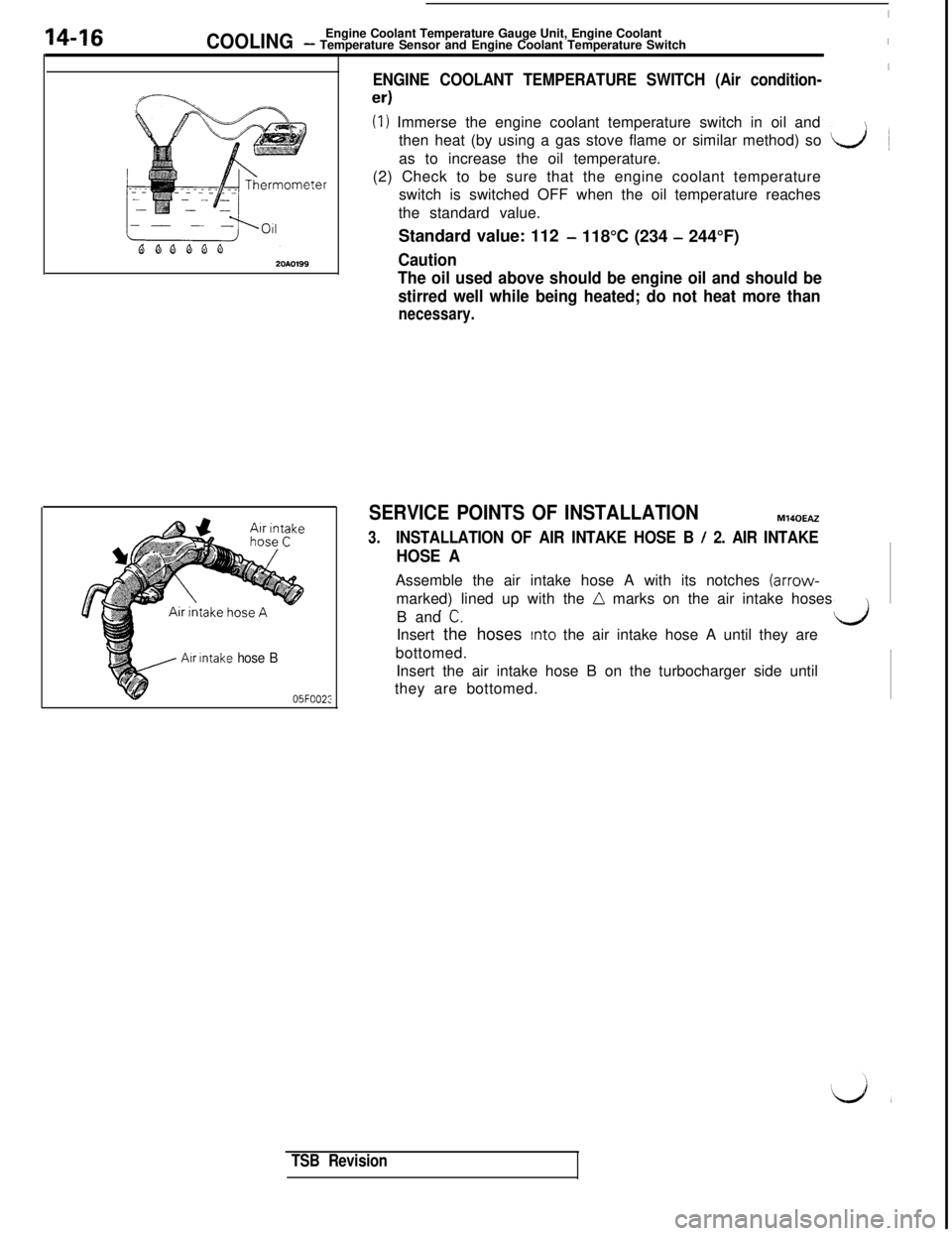
ENGINE COOLANT TEMPERATURE SWITCH (Air condition-I
4
(1) Immerse the engine coolant temperature switch in oil and
then heat (by using a gas stove flame or similar method) so
as to increase the oil temperature.
L.2~(2) Check to be sure that the engine coolant temperature
switch is switched OFF when the oil temperature reaches
the standard value.
Standard value: 112
- 118°C (234 - 244°F)
Caution
The oil used above should be engine oil and should be
stirred well while being heated; do not heat more than
necessary.
SERVICE POINTS OF INSTALLATIONM140EAz
3.INSTALLATION OF AIR INTAKE HOSE B / 2. AIR INTAKE
HOSE AB and L. Assemble the air intake hose A with its notches (arrow-
marked) lined up with the
n marks on the air intake hoses
. -dInsert the hoses Into the air intake hose A until they are
bottomed.
Insert the air intake hose B on the turbocharger side until
they are bottomed.
TSB Revision
Page 318 of 1146
INTAKE AND EXHAUST - Service Adiustment Procedures
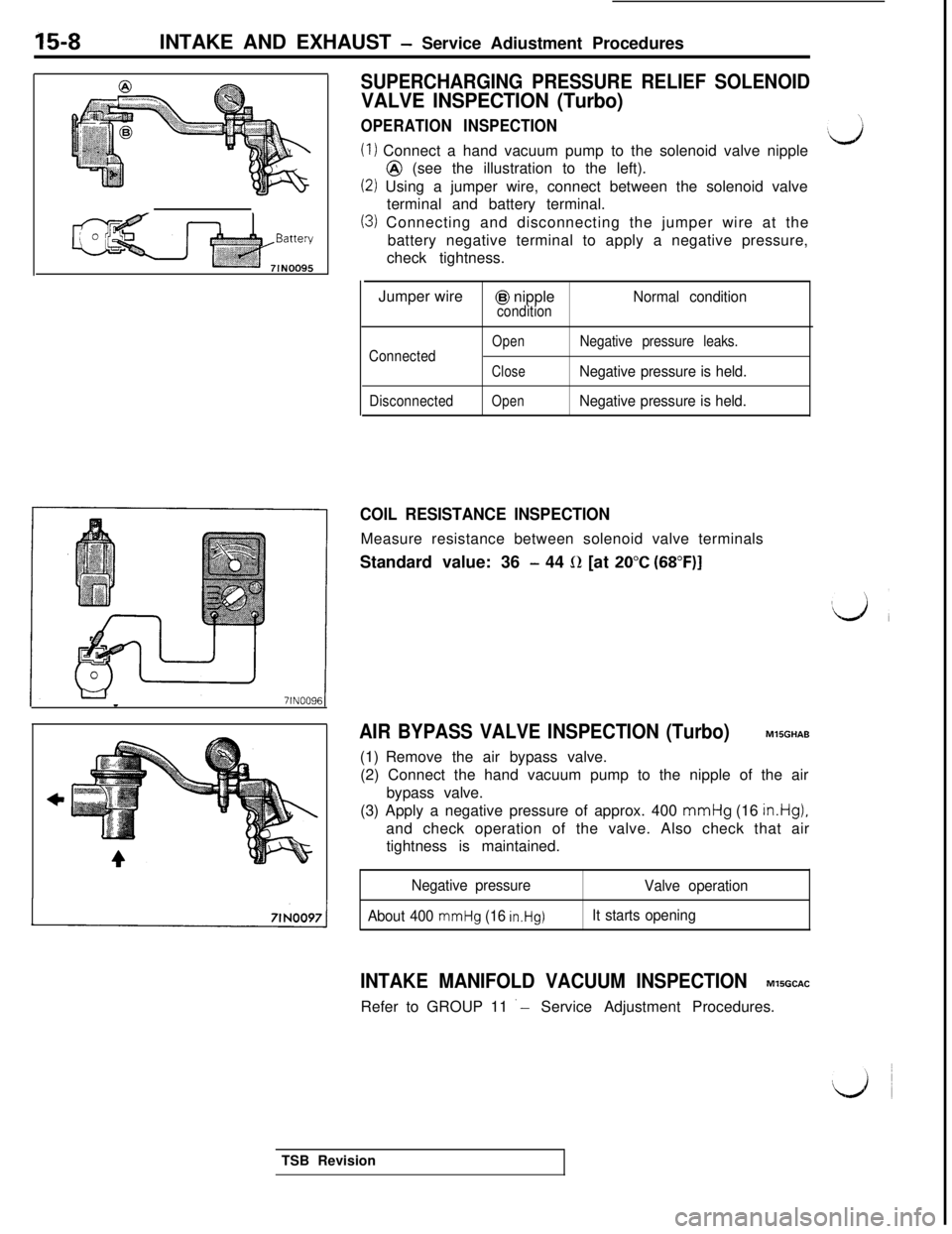
SUPERCHARGING PRESSURE RELIEF SOLENOID
VALVE INSPECTION (Turbo)
OPERATION INSPECTION
(1) Connect a hand vacuum pump to the solenoid valve nipple@ (see the illustration to the left).
(2) Using a jumper wire, connect between the solenoid valve
terminal and battery terminal.
(3) Connecting and disconnecting the jumper wire at the
battery negative terminal to apply a negative pressure,
check tightness.
Jumper wire
@I nippleNormal conditioncondition
Connected
Disconnected
OpenNegative pressure leaks.
CloseNegative pressure is held.
OpenNegative pressure is held.
COIL RESISTANCE INSPECTIONMeasure resistance between solenoid valve terminals
Standard value: 36
- 44 0 [at 20°C (68”F)I
AIR BYPASS VALVE INSPECTION (Turbo)MlSGHAB
(1) Remove the air bypass valve.
(2) Connect the hand vacuum pump to the nipple of the air
bypass valve.
(3) Apply a negative pressure of approx. 400 mmHg (16
in.Hg),and check operation of the valve. Also check that air
tightness is maintained.
Negative pressure
About 400
mmHg (16 in.Hg)
Valve operation
It starts opening
INTAKE MANIFOLD VACUUM INSPECTIONM’ISGCACRefer to GROUP 11
‘- Service Adjustment Procedures.
TSB Revision
Page 328 of 1146
15-18INTAKE AND EXHAUST - Turbocharger (Front)
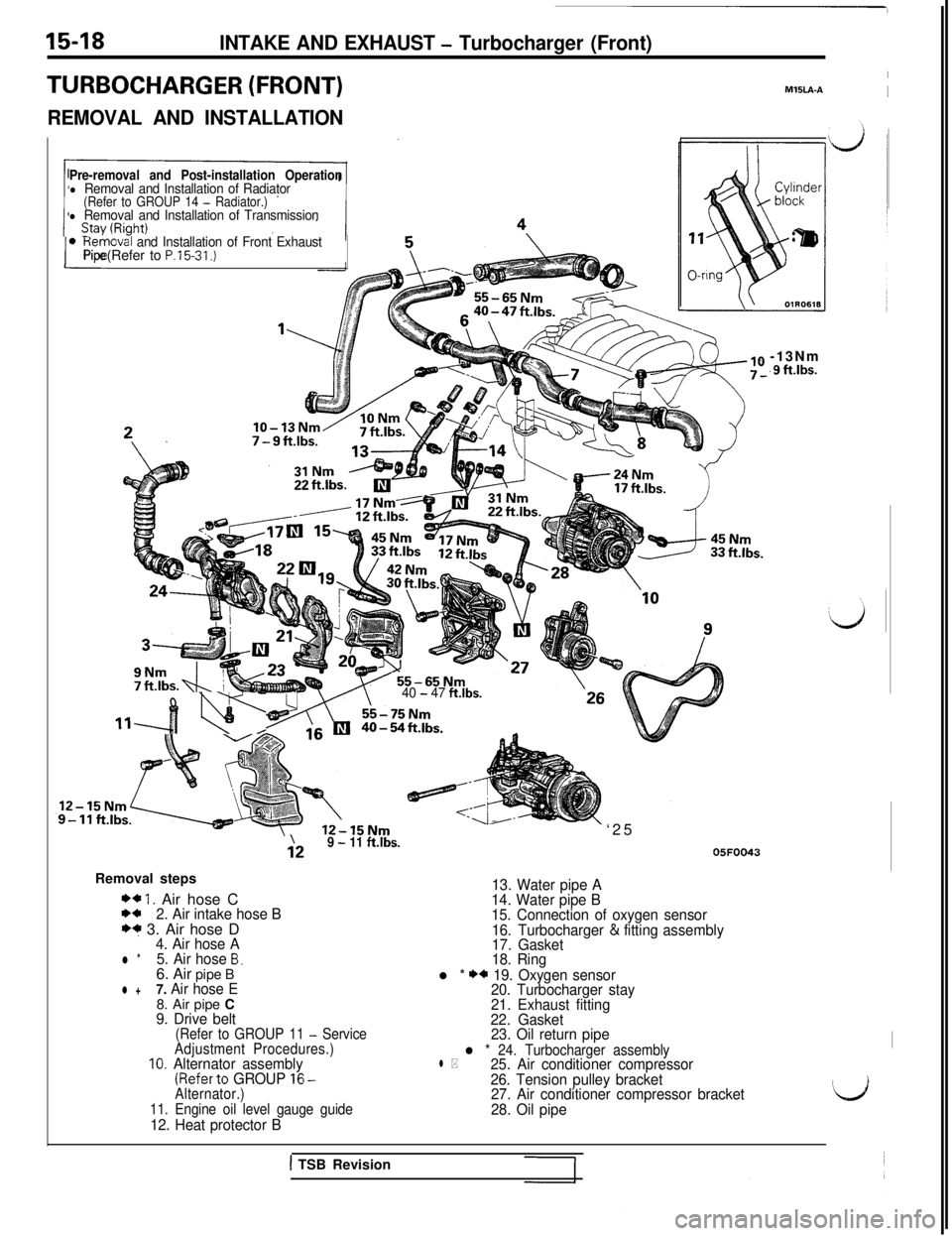
TURBOCHARGER (FRONT)
REMOVAL AND INSTALLATION
Pre-removal and Post-installation Operationl Removal and Installation of Radiator(Refer to GROUP 14 - Radiator.)l Removal and Installation of Transmission
l Rerr
IPipeioval and Installation of Front Exhaust(Refer to P.15-31.)
lJl QG!?
IMlSLA-AI
40 - 47 ft.lbs.
1\29 - 11 ft.lbs.Removal steps
** 1. Air hose C*+2. Air intake hose B*+ 3. Air hose D4. Air hose Al *5. Air hose B.6. Air pipe B
l +7. Air hose E8. Air pipe C
9. Drive belt(Refer to GROUP 11 - Service
Adjustment Procedures.)
10. Alternator assembly(Referto GROUP 16-Alternator.)
11. Engine oil level gauge guide
12. Heat protector B-13Nm
‘9 ft.lbs.
-‘25
05FOO43
13. Water pipe A
14. Water pipe B
15. Connection of oxygen sensor
16. Turbocharger
& fitting assembly
17. Gasket
18. Ring
l * ** 19. Oxygen sensor
20. Turbocharger stay
21. Exhaust fitting
22. Gasket
23. Oil return pipe
l * 24. Turbocharger assemblyl *25. Air conditioner compressor
26. Tension pulley bracket
27. Air conditioner compressor bracket
28. Oil pipe
I
LJ
1 TSB Revision
Page 329 of 1146
INTAKE AND EXHAUST - Turbocharger (Front)15-19
05FOO2(
SERVICE POINTS OF REMOVALM15LBAE
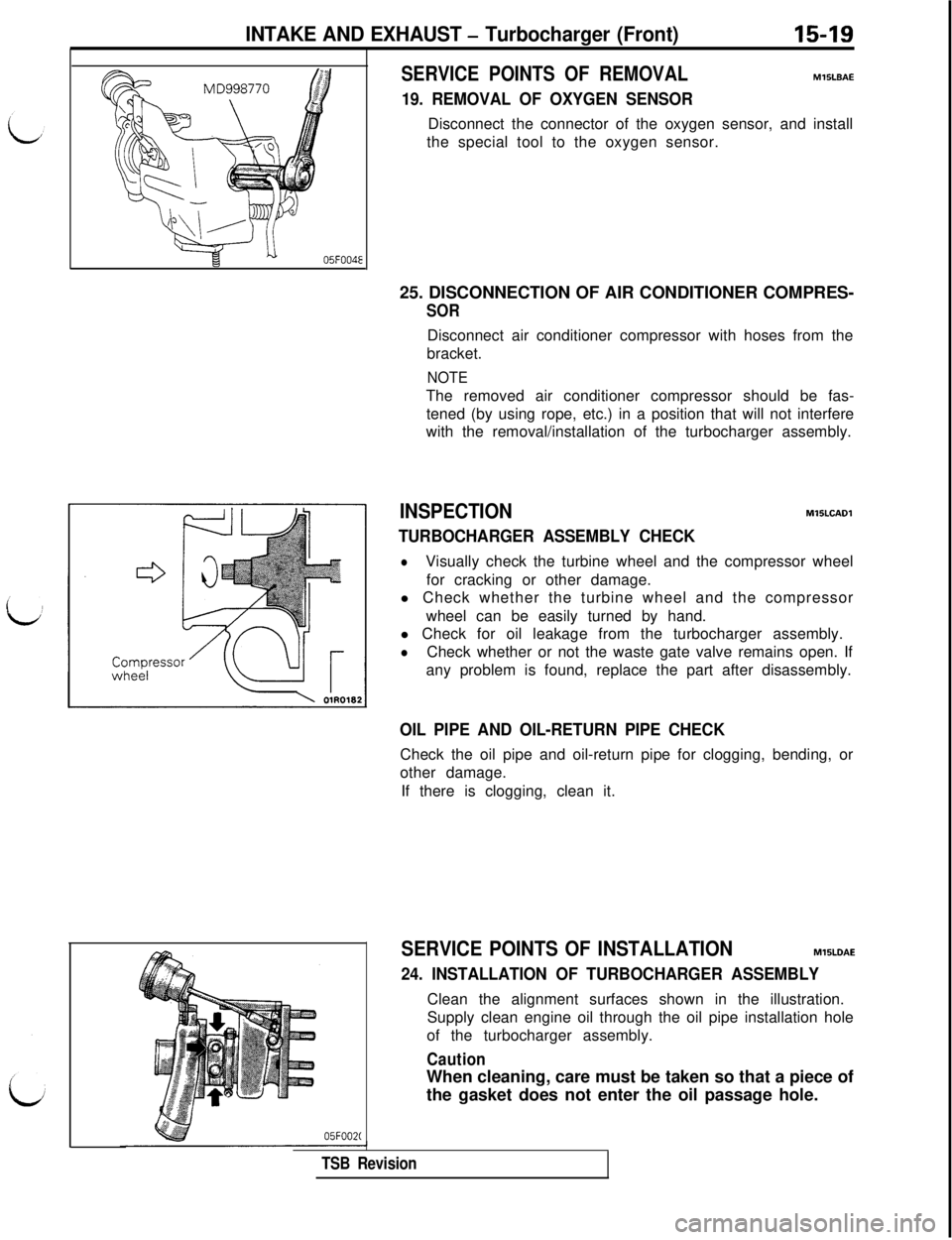
19. REMOVAL OF OXYGEN SENSORDisconnect the connector of the oxygen sensor, and install
the special tool to the oxygen sensor.
25. DISCONNECTION OF AIR CONDITIONER COMPRES-
SORDisconnect air conditioner compressor with hoses from the
bracket.
NOTEThe removed air conditioner compressor should be fas-
tened (by using rope, etc.) in a position that will not interfere
with the removal/installation of the turbocharger assembly.
INSPECTION
TURBOCHARGER ASSEMBLY CHECKMlSLCADl
lVisually check the turbine wheel and the compressor wheel
for cracking or other damage.
l Check whether the turbine wheel and the compressor
wheel can be easily turned by hand.
l Check for oil leakage from the turbocharger assembly.
lCheck whether or not the waste gate valve remains open. If
any problem is found, replace the part after disassembly.
OIL PIPE AND OIL-RETURN PIPE CHECKCheck the oil pipe and oil-return pipe for clogging, bending, or
other damage.
If there is clogging, clean it.
SERVICE POINTS OF INSTALLATIONMllLDAE
24. INSTALLATION OF TURBOCHARGER ASSEMBLYClean the alignment surfaces shown in the illustration.
Supply clean engine oil through the oil pipe installation hole
of the turbocharger assembly.
CautionWhen cleaning, care must be taken so that a piece of
the gasket does not enter the oil passage hole.
TSB Revision
Page 337 of 1146
INTAKE AND EXHAUST - Exhaust Manifold
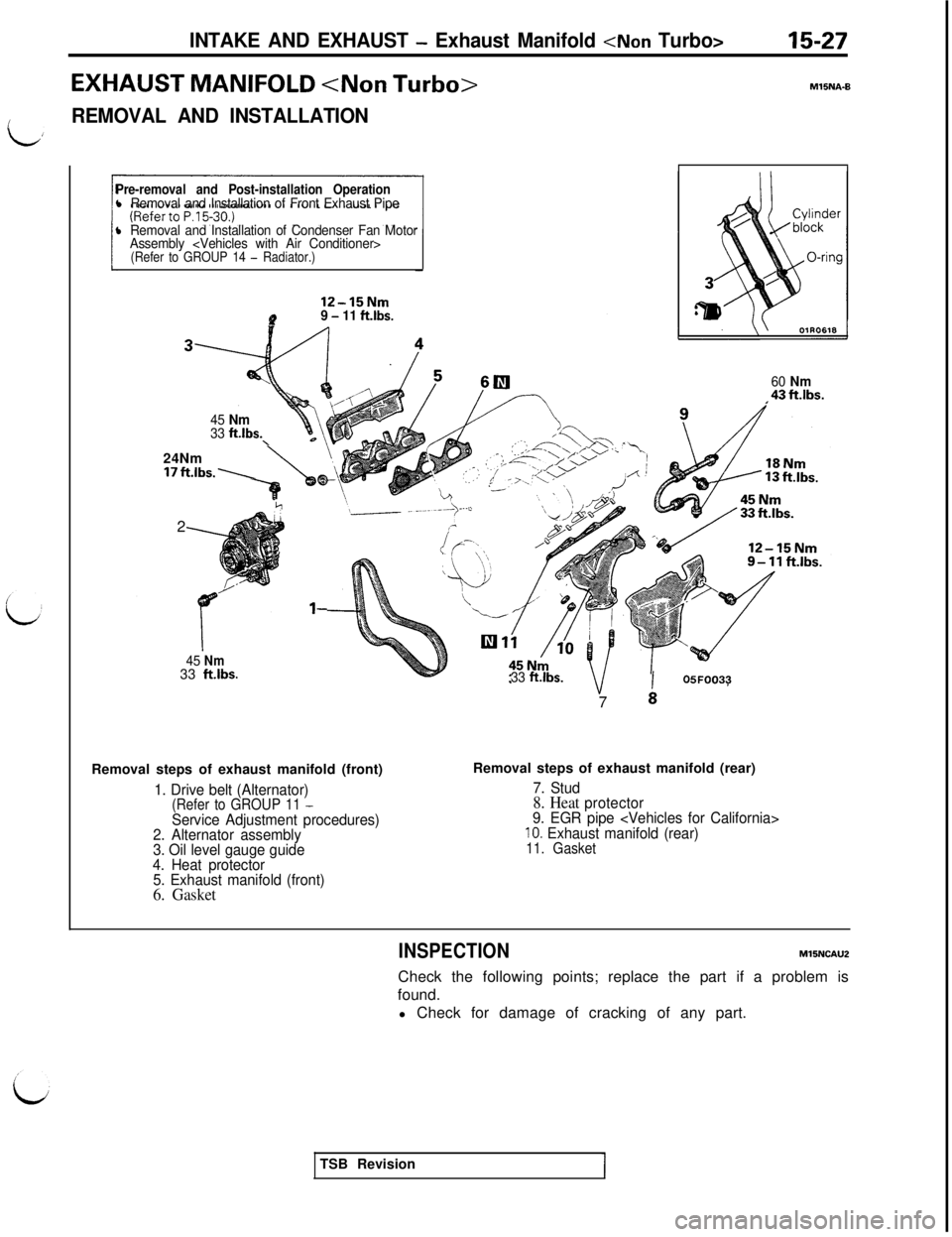
EXHAUST MANIFOLD
iREMOVAL AND INSTALLATION
Pre-removal and Post-installation Operationl Removal and Installation of Front Exhaust Pipe
l Removal and Installation of Condenser Fan Motor
Assembly
(Refer to GROUP 14 - Radiator.)
12-15Nm
P9 - 11 ft.lbs.
45 Nm33 ft.lbs.\24Nm
17ft.lbs.1
Li2
l-
45 Nm33 ft.lbs.
MSNA-8Removal steps of exhaust manifold (front)
1. Drive belt (Alternator)(Refer to GROUP 11 -Service Adjustment procedures)
2. Alternator assembly
3. Oil level gauge guide
4. Heat protector
5. Exhaust manifold (front)
6. Gasket
60 Nm,43 ft.lbs.
33 ftlbs.1 05F00337
8Removal steps of exhaust manifold (rear)
7. Stud
8. Heat protector
9. EGR pipe
IO. Exhaust manifold (rear)11. Gasket
INSPECTIONhllSNCAU2
Check the following points; replace the part if a problem is
found.
l Check for damage of cracking of any part.
TSB Revision
I
Page 345 of 1146
17-1
EMISSIONCONTROL
.~
CATALYTIC CONVERTER............................:...Inspection
............................................................Removal and Installation
................................
CONTENTSM17.U. -
CRANKCASE EMISSION CONTROL
SYSTEM. . . . . . . . . . . . . . . . . . . . . . . . . . . . . . . . . . .ComponentsLocation
. . . . . . . . . . . . . . . . . . . . . . . . . . . . . . . . . . . .Crankcase Ventilation System Inspection
._..Positive Crankcase Ventilation Valve
. . . . . . . . . . . .
EVAPORATIVE EMISSION CONTROL
SYSTEM................................................................Air Conditioner Switch
....................................Air Flow Sensor, Engine Coolant
Temperature Sensor and Intake Air
Temperature Sensor
........................................Canister
............................................................Components Location
....................................
FuelFiller CapInspection................................OverfillLimiter (Two-way Valve)
....................Purge Control Solenoid Valve
........................Purge Control System Inspection
............................................................Purge Control Valve
........................
PurgePort VacuumCheck................................14
14
14
6
10
10
10
6
10
10
9
7
8
9
9EXHAUST GAS RECIRCULATION
(EGR)
SYSTEM. . . . . ..____._.._........__........_____.........................Air-FuelRatio Control (MPI) System. . . . . . . .
Components Location
. . . . . . . . . . . . . . . . . . . . . . . . . . . . . . . . . . . .EGR Control Solenoid Valve
. . . . . . . .EGR Valve
EGR Valve Control Vacuum Check
SPECIFICATIONS................................................General Specifications
....................................Service Specifications
....................................
TROUBLESHOOTING. . . . . . . . . . . . . . . . . ..______...............
VACUUM HOSES................................................Inspection
............................................................Installation
........................................................VacuumHosesRouting
....................................
11
14
11
13
12
13
13
12
2
2
22
Page 351 of 1146
EMISSION CONTROL - Evaporative Emission Control System17-7
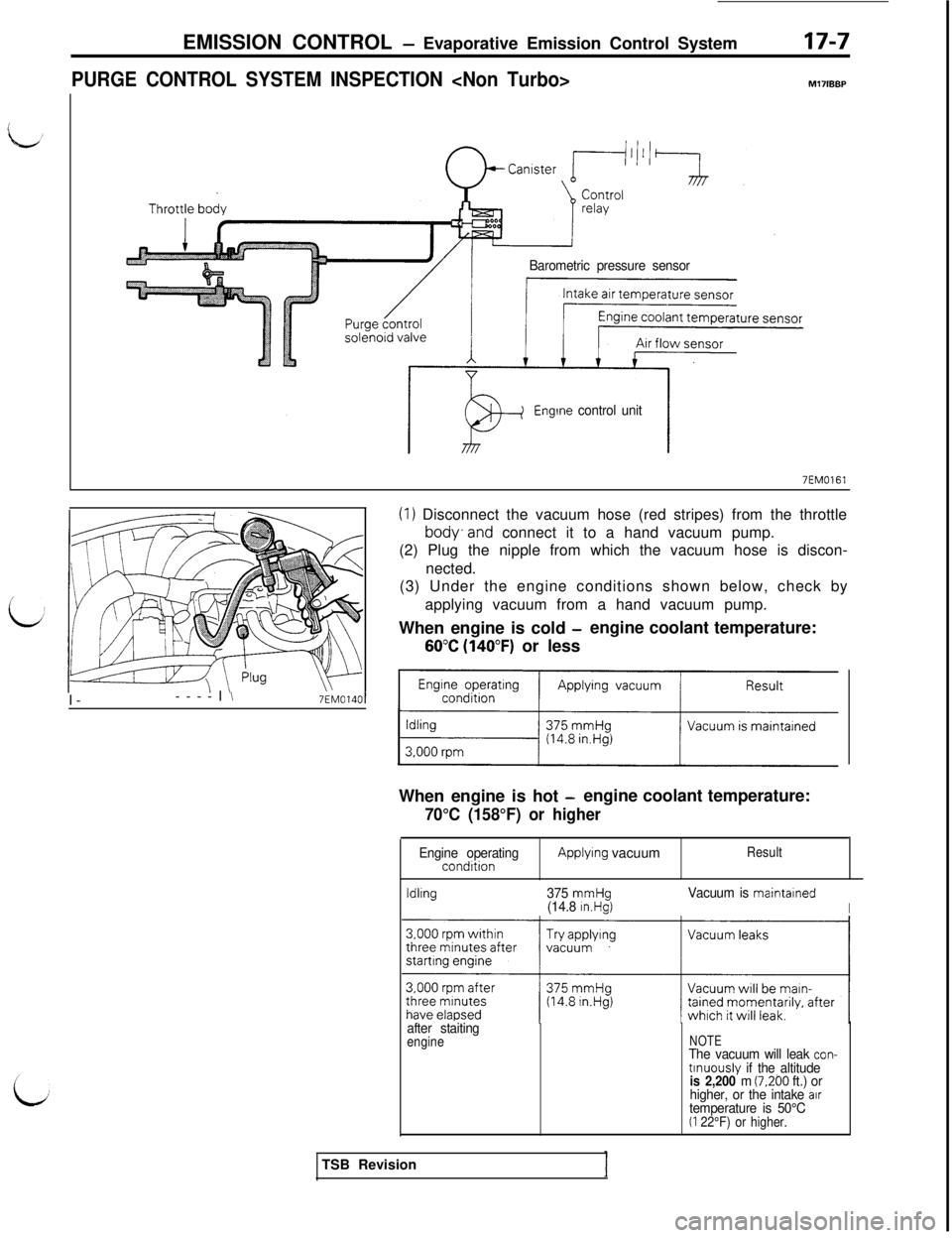
PURGE CONTROL SYSTEM INSPECTION
Barometric pressure sensor
Engine control unit
7EM0161I-----I
\7EM0140t
(1) Disconnect the vacuum hose (red stripes) from the throttle
body,and connect it to a hand vacuum pump.
(2) Plug the nipple from which the vacuum hose is discon-
nected.
(3) Under the engine conditions shown below, check by
applying vacuum from a hand vacuum pump.
When engine is cold
-engine coolant temperature:
60°C (140°F) or less
When engine is hot
-engine coolant temperature:
70°C (158°F) or higher
Engine operatingcondttionApplying vacuumResult
ldllng375 mmHg(14.8 In.Hg)Vacuum is maintalned
I
after staitingengineNOTEThe vacuum will leak con-tenuously if the altitudeis 2,200 m (7.200 ft.) or
higher, or the intake airtemperature is 50°C(I 22°F) or higher.TSB Revision
Page 352 of 1146

17-8EMISSION CONTROL - Evaporative Emission Control System
PURGE CONTROL SYSTEM INSPECTION
Canister
Purge control
valve\
PI IrnQ rnntrnlI.1 I
kXffo~~~~r~~ ’ I I-J
relay
Barometric pressure sensor
Intake air temperature sensor
Engine coolant temperature sensor
II1 I IAir flow sensor
Engine control unit
6EM0215(1) Disconnect the purge air hose from the air intake hose, and
plug the air intake hose. Then, connect the hand vacuum
pump to the purge air hose.
(2) Under the engine conditions shown below, check by
applying vacuum from a hand vacuum pump.
When engine is cold
-engine coolant temperature:
60°C (140°F) or less
Engine operating
conditionApplying vacuumResult
Idling
375 mmHgVacuum is maintained
3,000 rpm(14.8 in.Hg)When engine is hot
-engine coolant temperature:
70°C (158°F) or higher
Engine operating
condition
Idling
3,000 rpm within
three minutes after
starting engine
3,000 rpm after
three minutes
have elapsedafter startingengine
Applying vacuum
375
mmHg(14.8 in.Hg)
Try applyingvacuum
375
mmHg(14.8 in.Hg)
Result
Vacuum is marntained
Vacuum leaks
Vacuum WIII be main-tained momentarily, after
which it will leak.
NOTEThe vacuum WIII leak con-
tinuously if the altitude
is 2,200 m
(7,200 ft.) orhrgher. or the Intake arrtemperature is 50°C(122°F) or higher.
1 TSB Revision
Page 353 of 1146
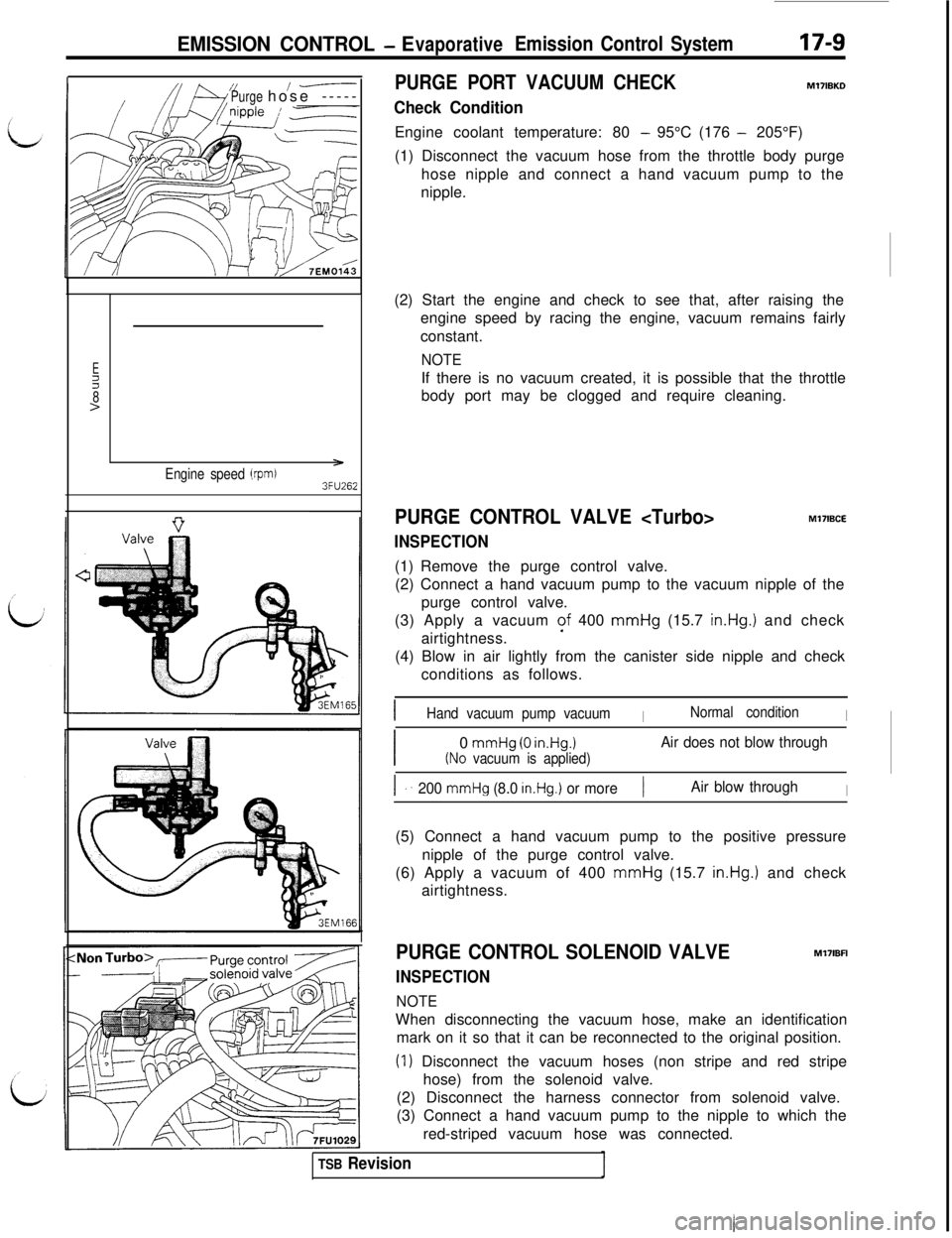
EMISSION CONTROL - EvaporativeEmission Control System
Purge/-----hose -----PURGE PORT VACUUM CHECK
Check Condition
17-9
M17lBKDEngine coolant temperature: 80
- 95°C (176 - 205°F)
(1) Disconnect the vacuum hose from the throttle body purge
hose nipple and connect a hand vacuum pump to the
nipple.
Ez8>
Engine speed (rprd3FU262(2) Start the engine and check to see that, after raising the
engine speed by racing the engine, vacuum remains fairly
constant.
NOTEIf there is no vacuum created, it is possible that the throttle
body port may be clogged and require cleaning.
PURGE CONTROL VALVE
INSPECTIONMl7IBCE
(1) Remove the purge control valve.
(2) Connect a hand vacuum pump to the vacuum nipple of the
purge control valve.
(3) Apply a vacuum of 400 mmHg (15.7
in.Hg.1 and check
airtightness.
(4) Blow in air lightly from the canister side nipple and check
conditions as follows.
IHand vacuum pump vacuumINormal conditionI
I0
mmHg (0 in.Hg.1Air does not blow through
(No vacuum is applied)
I ..200 mmHg (8.0 in.Hg.) or more1Air blow throughI(5) Connect a hand vacuum pump to the positive pressure
nipple of the purge control valve.
(6) Apply a vacuum of 400 mmHg (15.7
in.Hg.1 and check
airtightness.
PURGE CONTROL SOLENOID VALVE
INSPECTION
NOTEMl7lBFI
When disconnecting the vacuum hose, make an identification
mark on it so that it can be reconnected to the original position.
(I) Disconnect the vacuum hoses (non stripe and red stripe
hose) from the solenoid valve.
(2) Disconnect the harness connector from solenoid valve.
(3) Connect a hand vacuum pump to the nipple to which the
red-striped vacuum hose was connected.
TSB Revision