steering MITSUBISHI 3000GT 1991 User Guide
[x] Cancel search | Manufacturer: MITSUBISHI, Model Year: 1991, Model line: 3000GT, Model: MITSUBISHI 3000GT 1991Pages: 1146, PDF Size: 76.68 MB
Page 46 of 1146
00-42GENERAL - Maintenance Service
14UOO729. Install the radiator cap securely.
10.
Start’the engine and warm up until the thermostat opens.
11. Race the engine up to around 3,000 rpm several times, then
stop the engine.,12. When the enkine has cooled down, remove the radiator cap
L/and add coolant up to the brim. Add coolant to the reserve
tank up to the FULL line.
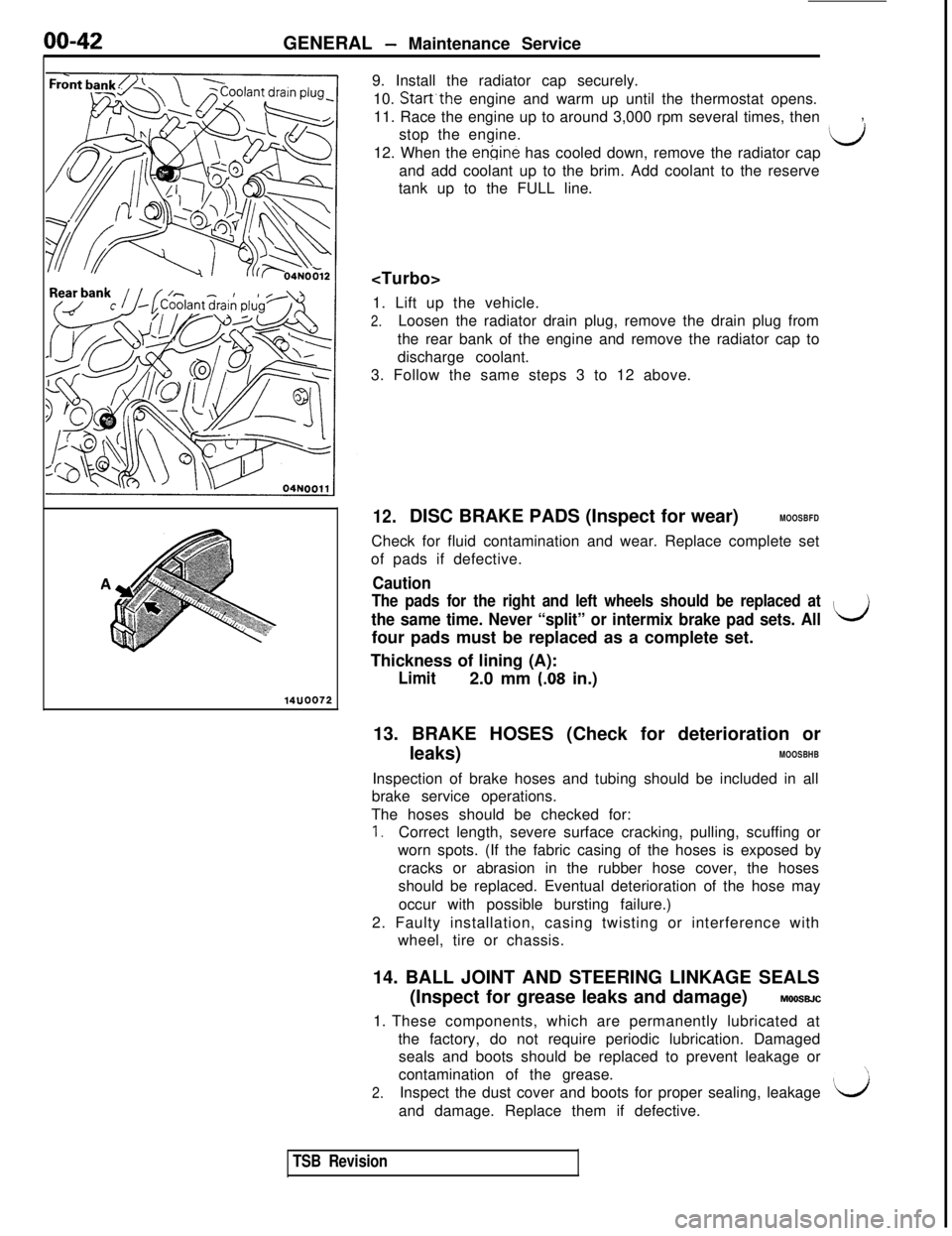
1. Lift up the vehicle.
2.Loosen the radiator drain plug, remove the drain plug from
the rear bank of the engine and remove the radiator cap to
discharge coolant.
3. Follow the same steps 3 to 12 above.
12.DISC BRAKE PADS (Inspect for wear)MOOSBFDCheck for fluid contamination and wear. Replace complete set
of pads if defective.
Caution
The pads for the right and left wheels should be replaced atIIthe same time. Never “split” or intermix brake pad sets. AllUfour pads must be replaced as a complete set.
Thickness of lining (A):
Limit2.0 mm (.08 in.)
13. BRAKE HOSES (Check for deterioration or
leaks)
MOOSBHBInspection of brake hoses and tubing should be included in all
brake service operations.
The hoses should be checked for:
1.Correct length, severe surface cracking, pulling, scuffing or
worn spots. (If the fabric casing of the hoses is exposed by
cracks or abrasion in the rubber hose cover, the hoses
should be replaced. Eventual deterioration of the hose may
occur with possible bursting failure.)
2. Faulty installation, casing twisting or interference with
wheel, tire or chassis.
14. BALL JOINT AND STEERING LINKAGE SEALS
(Inspect for grease leaks and damage)
MOOSglC1. These components, which are permanently lubricated at
the factory, do not require periodic lubrication. Damaged
seals and boots should be replaced to prevent leakage or
contamination of the grease.
2.Inspect the dust cover and boots for proper sealing, leakageIdand damage. Replace them if defective.
TSB Revision
Page 48 of 1146
00-44
GENERAL - Main Sealant and Adhesive Table
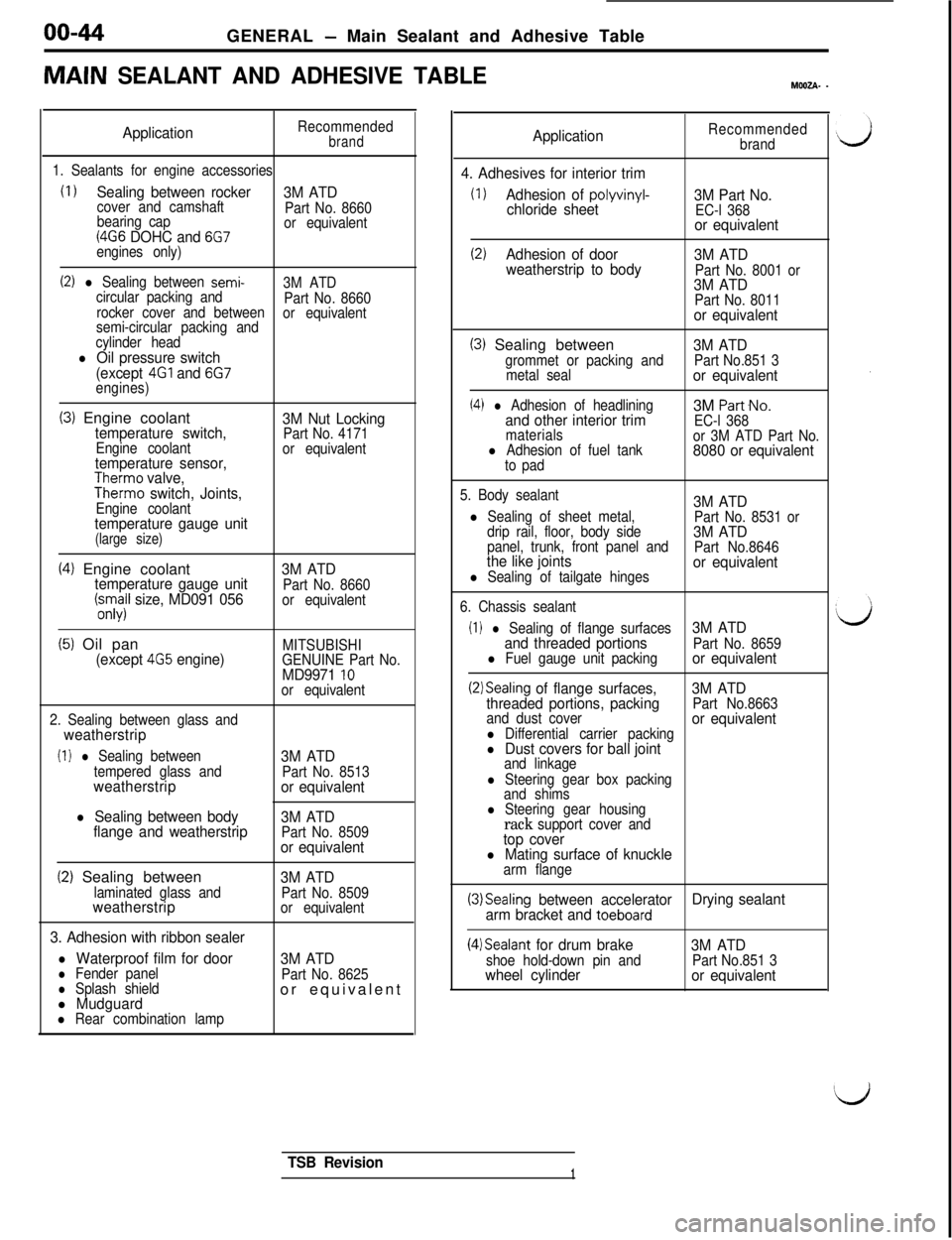
MAIN SEALANT AND ADHESIVE TABLEMWZA- -
ApplicationRecommendedbrand
1. Sealants for engine accessories
(I 1Sealing between rocker
3M ATDcover and camshaft
Part No. 8660
bearing cap
(4G6 DOHC and 6G7or equivalent
engines only)
(2) l Sealing between semi-3M ATD
circular packing and
Part No. 8660
rocker cover and between
semi-circular packing andor equivalent
cylinder head
l Oil pressure switch
(except 4Gl and 6G7engines)
(3) Engine coolanttemperature switch,Engine coolanttemperature sensor,Therm0 valve,Therm0 switch, Joints,Engine coolanttemperature gauge unit(large size)
3M Nut LockingPart No. 4171
or equivalent
(4) Engine coolanttemperature gauge unit(;.s;il size, MD091 0563M ATDPart No. 8660
or equivalent
(5) Oil pan(except 4G5 engine)MITSUBISHI
GENUINE Part No.
MD9971 10or equivalent
2. Sealing between glass and
weatherstrip
(I 1 l Sealing between
tempered glass and
weatherstrip
l Sealing between body
flange and weatherstrip3M ATD
Part No. 8513or equivalent
3M ATD
Part No. 8509or equivalent
(2) Sealing betweenlaminated glass andweatherstrip
3. Adhesion with ribbon sealer
l Waterproof film for doorl Fender panell Splash shieldl Mudguardl Rear combination lamp
3M ATDPart No. 8509
or equivalent
3M ATDPart No. 8625or equivalent
ApplicationRecommended
brand
4. Adhesives for interior trim
(1)Adhesion of polyvinyl-chloride sheet3M Part No.EC-l 368or equivalent
(2)Adhesion of door
3M ATD
weatherstrip to body
Part No. 8001 or3M ATDPart No. 8011or equivalent
(3) Sealing betweengrommet or packing and
metal seal
(4) l Adhesion of headliningand other interior trimmaterialsl Adhesion of fuel tank
to pad
3M ATDPart No.851 3or equivalent3M
Part-No.
EC-l 368
or 3M ATD Part No.
8080 or equivalent
5. Body sealant3M ATDl Sealing of sheet metal,
Part No. 8531 or
drip rail, floor, body side3M ATDpanel, trunk, front panel and
Part No.8646the like jointsl Sealing of tailgate hingesor equivalent
6. Chassis sealant
(I 1 l Sealing of flange surfaces3M ATD
and threaded portions
Part No. 8659l Fuel gauge unit packingor equivalent
(2)Sealing of flange surfaces,3M ATD
threaded portions, packingPart No.8663
and dust cover
l Differential carrier packingor equivalent
l Dust covers for ball jointand linkage
l Steering gear box packing
and shims
l Steering gear housingrack support cover andtop coverl Mating surface of knucklearm flange
(3)Sealing between accelerator
arm bracket and toeboardDrying sealant
(4)Sealant for drum brakeshoe hold-down pin andwheel cylinder3M ATDPart No.851 3or equivalent
TSB Revision1
Page 49 of 1146
GENERAL - Main Sealant and Adhesive Table
I,i
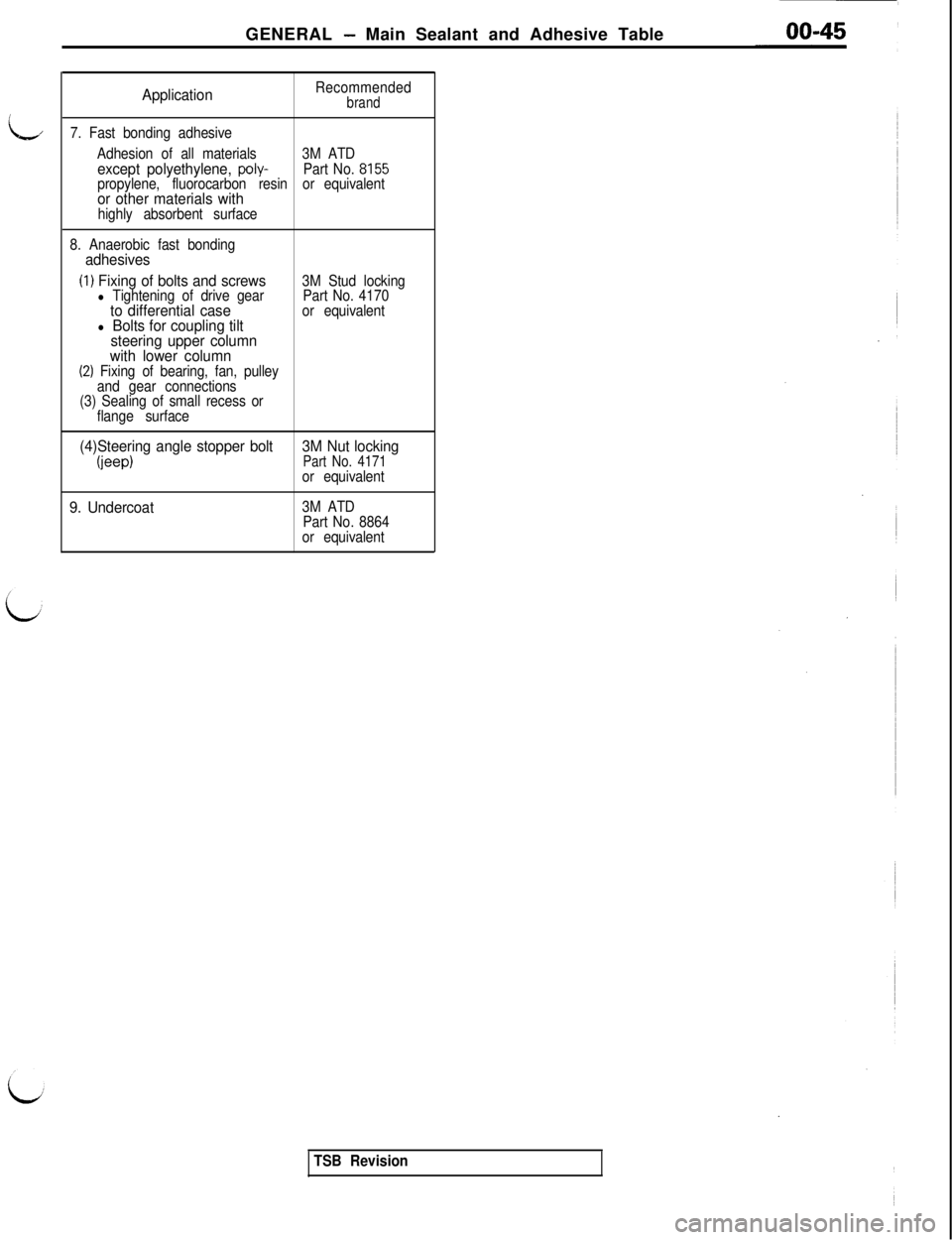
ApplicationRecommendedbrand
7. Fast bonding adhesive
Adhesion of all materials3M ATD
except polyethylene, poly-Part No. 8155propylene, fluorocarbon resinor equivalentor other materials withhighly absorbent surface
8. Anaerobic fast bonding
adhesives
(I) Fixing of bolts and screws3M Stud lockingl Tightening of drive gearPart No. 4170to differential caseor equivalentl Bolts for coupling tilt
steering upper column
with lower column
(2) Fixing of bearing, fan, pulley
and gear connections
(3) Sealing of small recess or
flange surface
(4)Steering angle stopper bolt
(jeep)
3M Nut lockingPart No. 4171or equivalent
9. Undercoat3M ATD
Part No. 8864
or equivalent
TSB Revision
Page 57 of 1146
ENGINE - Specifications
/
L
L/
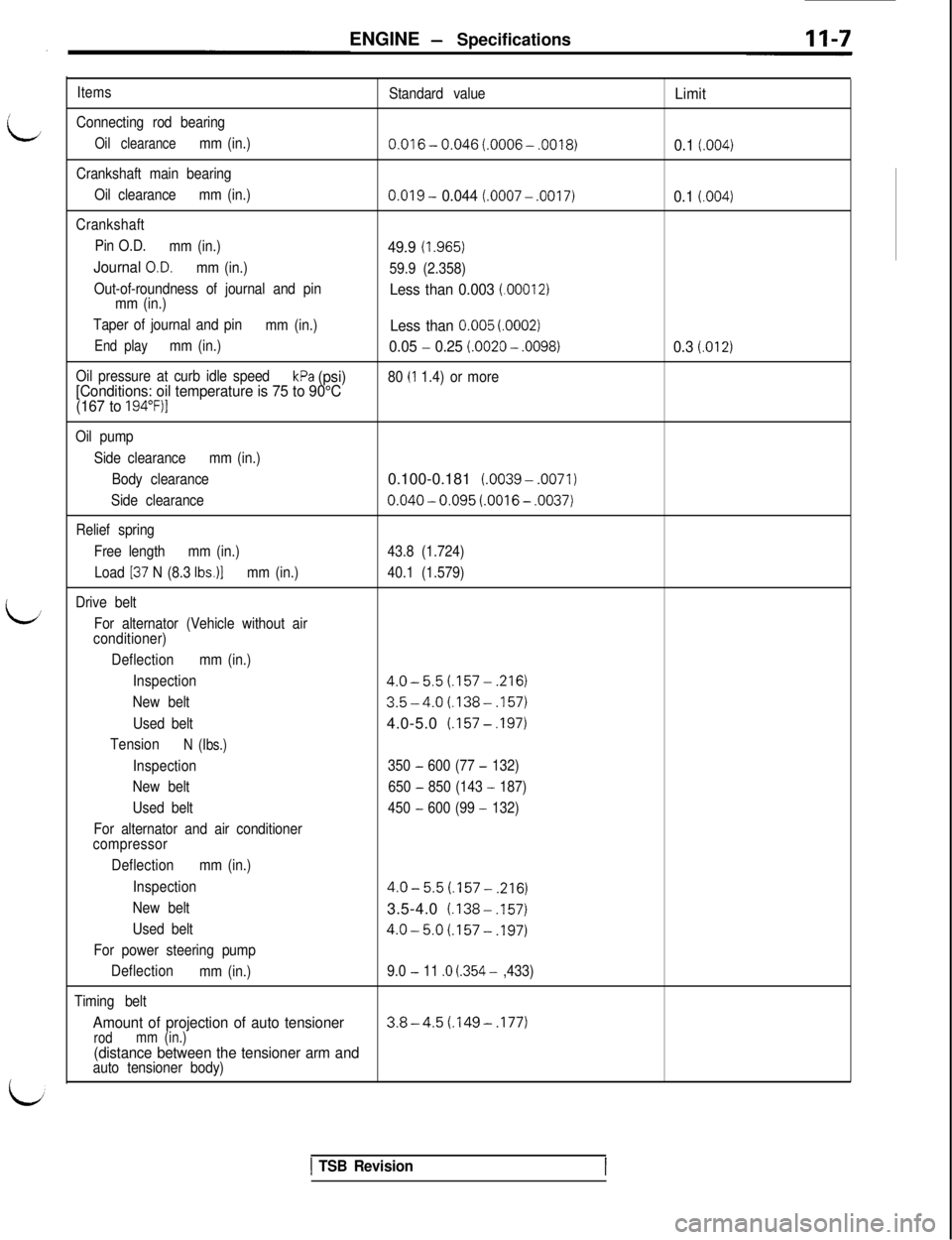
Items
Connecting rod bearing
Oil clearancemm (in.)
Crankshaft main bearing
Oil clearancemm (in.)
Crankshaft
Pin O.D.
mm (in.)
Journal O.D.mm (in.)
Out-of-roundness of journal and pin
mm (in.)
Taper of journal and pin
mm (in.)
End playmm (in.)
Oil pressure at curb idle speed
kPa (psi)
[Conditions: oil temperature is 75 to 90°C
(167 to
194”F)l
Standard value
0.016- 0.046 (.0006- .0018)
0.019 - 0.044 (.0007 - .0017)
49.9 (I ,965)
59.9 (2.358)
Less than 0.003 (.00012)
Less than 0.005 (0002)
0.05 - 0.25 (0020 - .0098)
80 (I 1.4) or more
Limit
0.1
(.004)
0.1 (.004)
0.3 (.012)
Oil pump
Side clearancemm (in.)
Body clearance0.100-0.181 (.0039-.0071)
Side clearance0.040 - 0.095 (.0016 - .0037)
Relief spring
Free lengthmm (in.)43.8 (1.724)
Load
137 N (8.3 Ibs.)]mm (in.)40.1 (1.579)
Drive belt
For alternator (Vehicle without air
conditioner)
Deflectionmm (in.)
Inspection
4.0-5.5(.157-,216)
New belt3.5-4.0(.138-,157)
Used belt4.0-5.0 (.157- ,197)
TensionN (Ibs.)
Inspection350 - 600 (77 - 132)
New belt650
- 850 (143 - 187)
Used belt450
- 600 (99 - 132)
For alternator and air conditioner
compressor
Deflectionmm (in.)
Inspection
4.0-5.5(.157-,216)
New belt3.5-4.0 (1388.157)
Used belt4.0-5.0(.157-,197)
For power steering pump
Deflection
mm (in.)9.0
- 11 .o (354 - ,433)
Timing belt
Amount of projection of auto tensioner3.8-4.5(.149-,177)rodmm (in.)(distance between the tensioner arm andauto tensioner body)
1 TSB Revision
Page 62 of 1146
II-12ENGINE - Service Adjustment Procedures-
r
AdJl
bolt
Alternator wllev
haft
Fixing nutOlFOOO8
Alternator pulley
Adjusting bolt
/Crankshaftpulley
Air contionercompressorpulleyw Tension pulleyFlxtng nutOlN007.
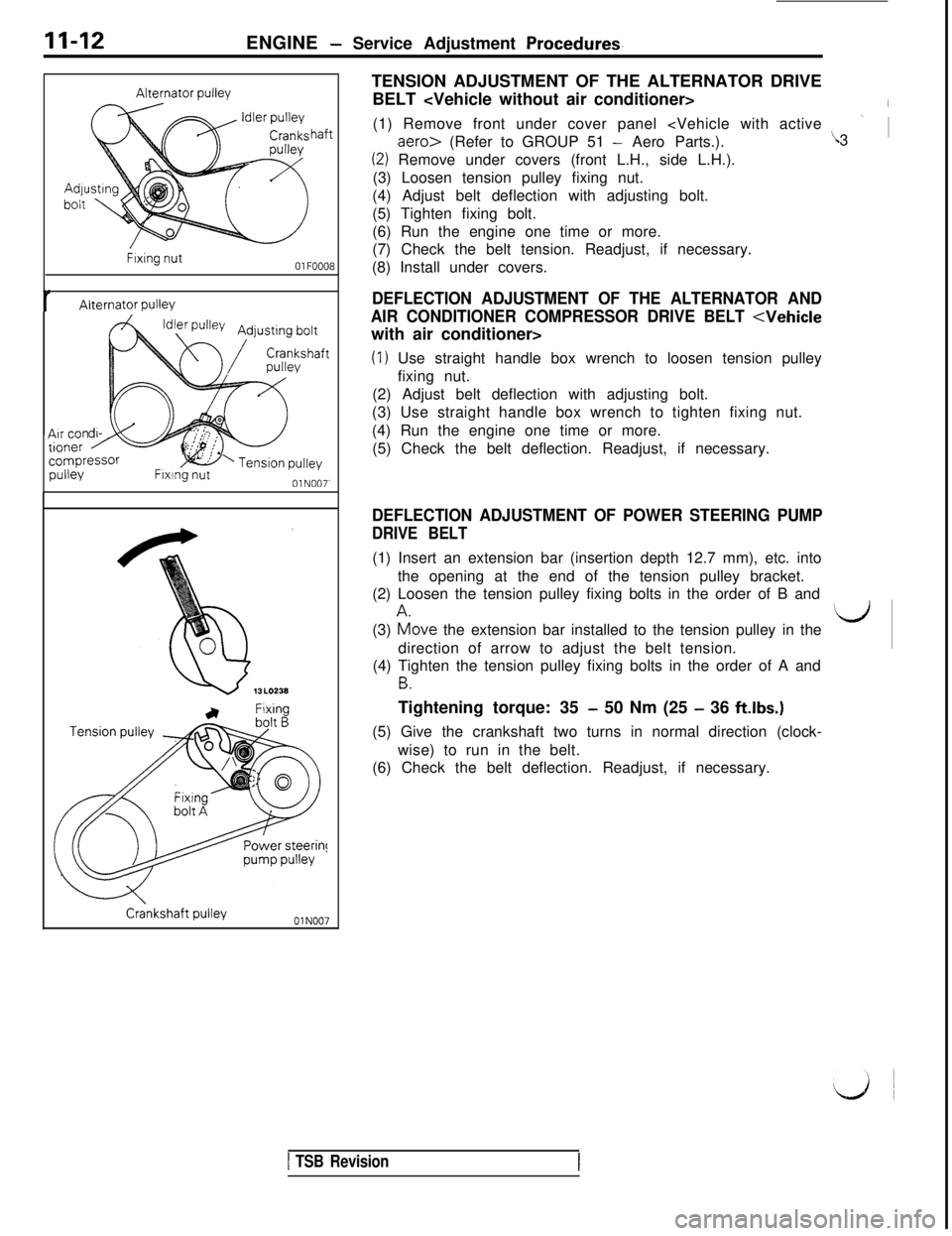
Crankshaft pulleyOlN007TENSION ADJUSTMENT OF THE ALTERNATOR DRIVE
BELT
I(1) Remove front under cover panel
aero> (Refer to GROUP 51 - Aero Parts.).\\
3 ’
(2) Remove under covers (front L.H., side L.H.).
(3) Loosen tension pulley fixing nut.
(4) Adjust belt deflection with adjusting bolt.
(5) Tighten fixing bolt.
(6) Run the engine one time or more.
(7) Check the belt tension. Readjust, if necessary.
(8) Install under covers.
DEFLECTION ADJUSTMENT OF THE ALTERNATOR AND
AIR CONDITIONER COMPRESSOR DRIVE BELT
(1) Use straight handle box wrench to loosen tension pulley
fixing nut.
(2) Adjust belt deflection with adjusting bolt.
(3) Use straight handle box wrench to tighten fixing nut.
(4) Run the engine one time or more.
(5) Check the belt deflection. Readjust, if necessary.
DEFLECTION ADJUSTMENT OF POWER STEERING PUMP
DRIVE BELT(1) Insert an extension bar (insertion depth 12.7 mm), etc. into
the opening at the end of the tension pulley bracket.
(2) Loosen the tension pulley fixing bolts in the order of B and
(3)
iove the extension bar installed to the tension pulley in the‘LJdirection of arrow to adjust the belt tension.
(4) Tighten the tension pulley fixing bolts in the order of A and
8.Tightening torque: 35
- 50 Nm (25 - 36 ftlbs,)(5) Give the crankshaft two turns in normal direction (clock-
wise) to run in the belt.
(6) Check the belt deflection. Readjust, if necessary.
1 TSB Revision
Page 63 of 1146
ENGINE - Service Adiustment ProceduresII-13
I_ ianltion tlminaI!H Connector for Igdpstment 6rown)
4tll II -7FUO9371IGNITION TIMING ADJUSTMENTMllFLAF
(1) The vehicle should be prepared as follows before the
inspection and adjustment.
lEngine coolant temperature: 80 - 95°C (176 - 205°F)
l Lights, electric cooling fan and accessories: OFF
l Transaxle: neutral
(P for A/T)l Steering wheel: neutral position
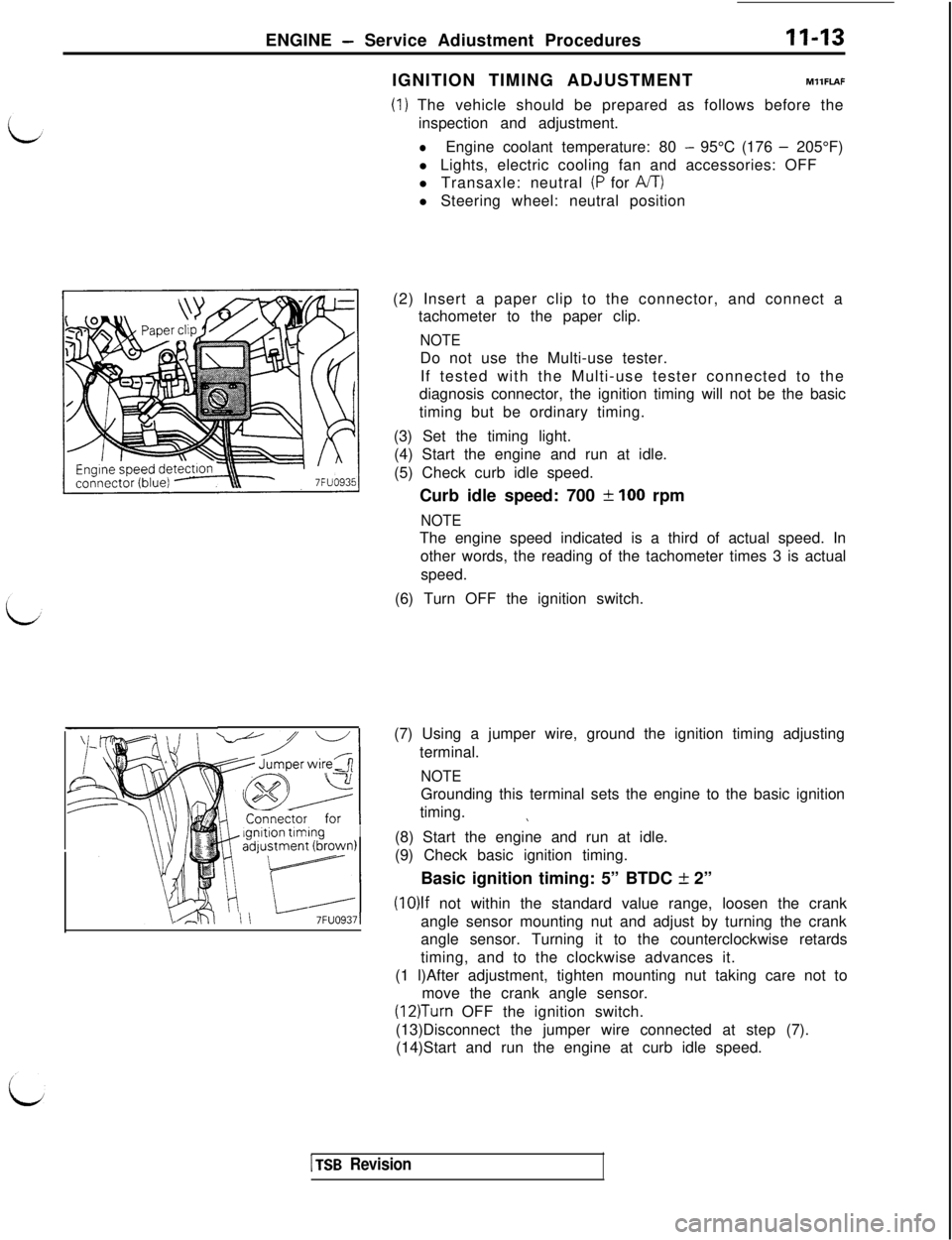
(2) Insert a paper clip to the connector, and connect a
tachometer to the paper clip.
NOTEDo not use the Multi-use tester.
If tested with the Multi-use tester connected to the
diagnosis connector, the ignition timing will not be the basic
timing but be ordinary timing.
(3) Set the timing light.
(4) Start the engine and run at idle.
(5) Check curb idle speed.
Curb idle speed: 700
f 100 rpm
NOTEThe engine speed indicated is a third of actual speed. In
other words, the reading of the tachometer times 3 is actual
speed.
(6) Turn OFF the ignition switch.
(7) Using a jumper wire, ground the ignition timing adjusting
terminal.
NOTEGrounding this terminal sets the engine to the basic ignition
timing.
\(8) Start the engine and run at idle.
(9) Check basic ignition timing.
Basic ignition timing: 5” BTDC
k 2”
(10)lf not within the standard value range, loosen the crank
angle sensor mounting nut and adjust by turning the crank
angle sensor. Turning it to the counterclockwise retards
timing, and to the clockwise advances it.
(1 l)After adjustment, tighten mounting nut taking care not to
move the crank angle sensor.
(12)Turn OFF the ignition switch.
(13)Disconnect the jumper wire connected at step (7).
(14)Start and run the engine at curb idle speed.
1 TSB Revision
Page 64 of 1146
11-14ENGINE - Service Adjustment Procedures
(15)Check to be sure that the idling ignition timing is the correct
timing.
Actual ignition timing: Approx. 15” BTDC
NOTE:d
(1) Ignition timing is variable even under normal operation.
(2) And it is automatically advanced at higher altitudes.
CURB IDLE SPEED INSPECTIONMllFMAB
(1) The vehicle should be prepared as follows before the
inspection.
lEngine coolant temperature: 80 - 95°C (176 - 205°F)
l Lights, electric cooling fan and accessories: OFF
l Transaxle: neutral
(P for A/T)l Steering wheel: neutral position
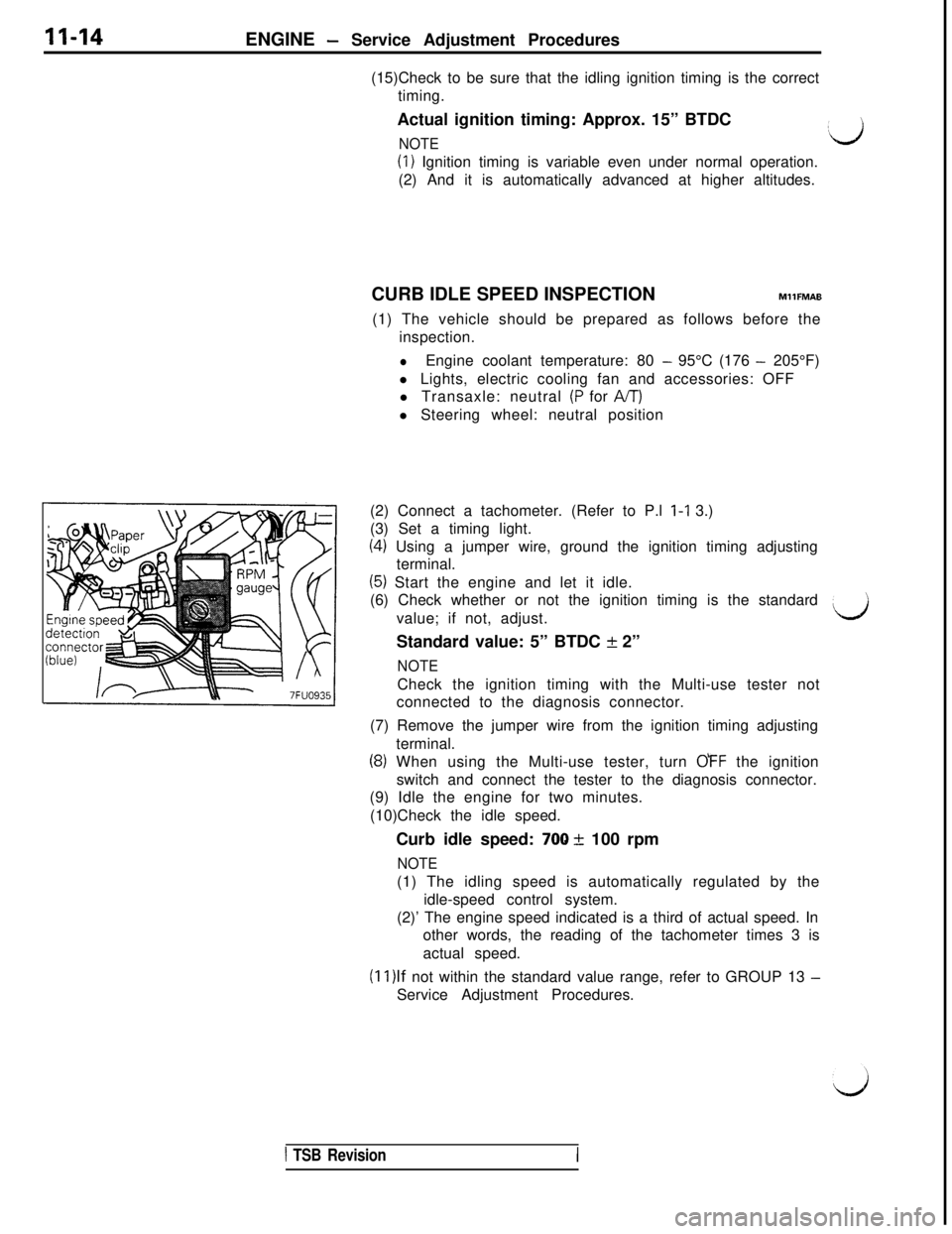
(2) Connect a tachometer. (Refer to P.l l-1 3.)
(3) Set a timing light.
(4) Using a jumper wire, ground the ignition timing adjusting
terminal.
(5) Start the engine and let it idle.
(6) Check whether or not the ignition timing is the standard
value; if not, adjust.
Standard value: 5” BTDC + 2”
NOTECheck the ignition timing with the Multi-use tester not
connected to the diagnosis connector.
(7) Remove the jumper wire from the ignition timing adjusting
terminal.
(8) When using the Multi-use tester, turn OFF the ignition
switch and connect the tester to the diagnosis connector.
(9) Idle the engine for two minutes.
(10)Check the idle speed.
Curb idle speed:
700 + 100 rpm
NOTE(1) The idling speed is automatically regulated by the
idle-speed control system.
(2)’ The engine speed indicated is a third of actual speed. In
other words, the reading of the tachometer times 3 is
actual speed.
(1l)lf not within the standard value range, refer to GROUP 13 -Service Adjustment Procedures.
d
1 TSB RevisionI
Page 66 of 1146
11-16ENGINE - Service Adjustment Procedures
MANIFOLD VACUUM INSPECTION
MllFNAR
(1) The vehicle should be repaired as follows before the
inspection.
lEngine coolant temperature: 80 - 95°C (176 - 205°F)‘dl Lights, electric cooling fan, and accessories: OFF
l Transaxle: Neutral
(P for A/T)l Steering wheel: neutral position
(2) Connect a tachometer. (Refer to P.l l-l 3.)
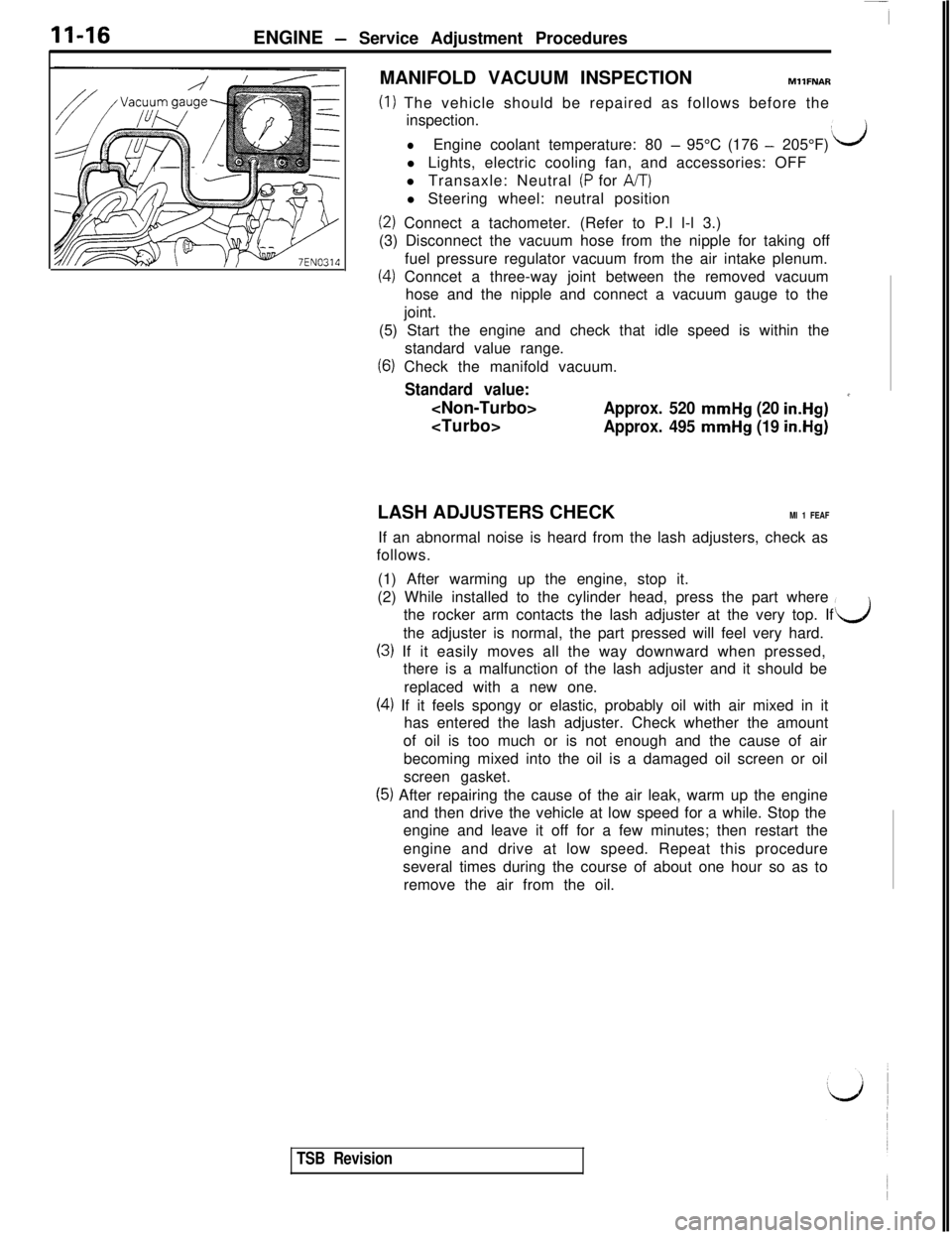
(3) Disconnect the vacuum hose from the nipple for taking off
fuel pressure regulator vacuum from the air intake plenum.
(4) Conncet a three-way joint between the removed vacuum
hose and the nipple and connect a vacuum gauge to the
joint.
(5) Start the engine and check that idle speed is within the
standard value range.
(6) Check the manifold vacuum.
Standard value:
*
Approx. 495 mmHg (19 in.Hg)LASH ADJUSTERS CHECK
Ml 1 FEAFIf an abnormal noise is heard from the lash adjusters, check as
follows.
(1) After warming up the engine, stop it.
(2) While installed to the cylinder head, press the part where
the rocker arm contacts the lash adjuster at the very top. If
the adjuster is normal, the part pressed will feel very hard.
d
(3) If it easily moves all the way downward when pressed,
there is a malfunction of the lash adjuster and it should be
replaced with a new one.
(4) If it feels spongy or elastic, probably oil with air mixed in it
has entered the lash adjuster. Check whether the amount
of oil is too much or is not enough and the cause of air
becoming mixed into the oil is a damaged oil screen or oil
screen gasket.
(5) After repairing the cause of the air leak, warm up the engine
and then drive the vehicle at low speed for a while. Stop the
engine and leave it off for a few minutes; then restart the
engine and drive at low speed. Repeat this procedure
several times during the course of about one hour so as to
remove the air from the oil.
TSB Revision
Page 67 of 1146
ENGINE - Engine AssemblyII-17
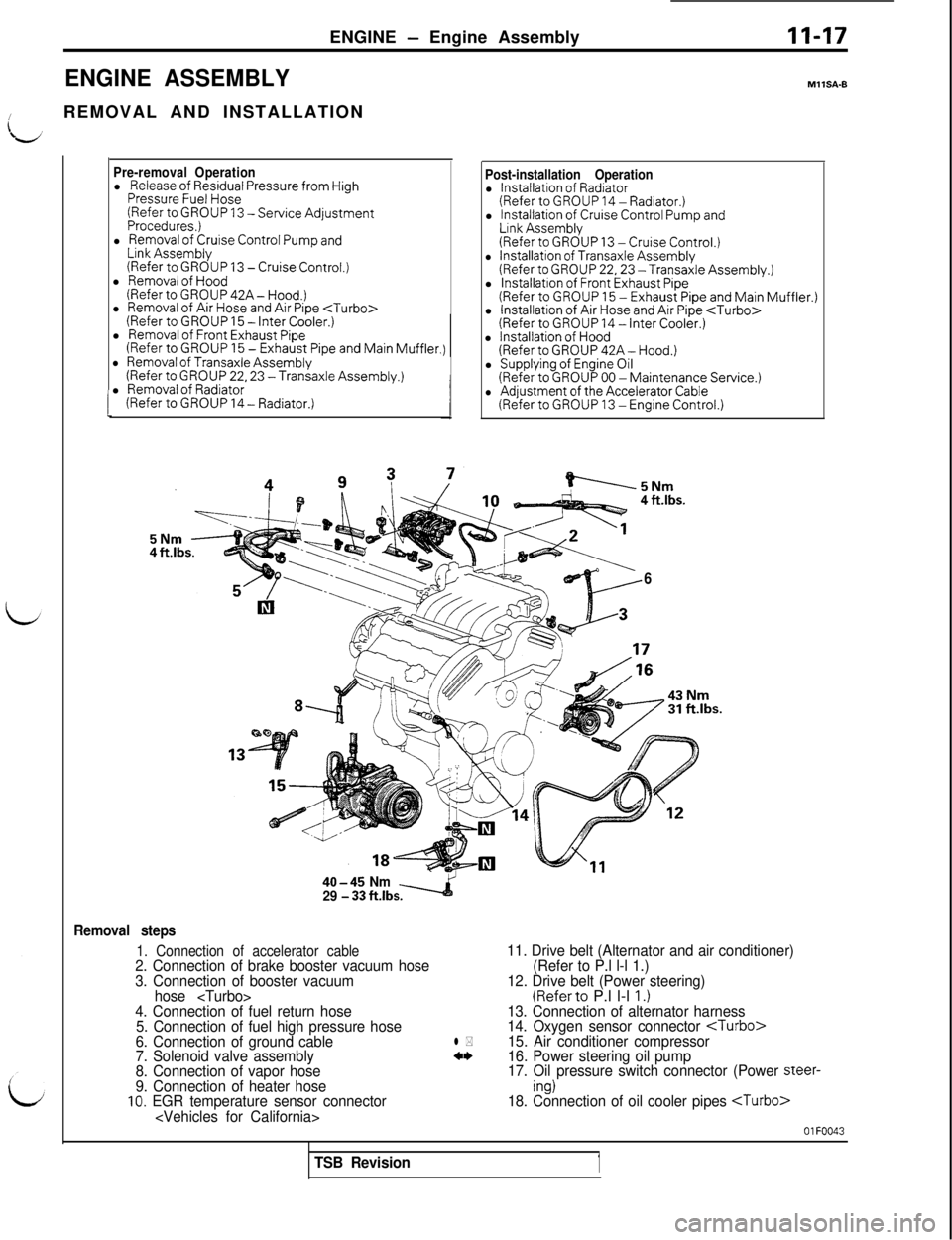
ENGINE ASSEMBLY
/REMOVAL AND INSTALLATION
I
Pre-removal Operationl Release of Residual Pressure from HighPressure Fuel Hose(Refer to GROUP 13 -Service AdjustmentProcedures,)l Removal of Cruise Control Pump andLink Assembly(Refer to GROUP 13 - Cruise Control.)l Removal of Hood(RefertoGROUP42A-Hood.)
l
Removal of Air Hose and Air Pipe
Post-installation Operationl Installation of Radiator(Refer to GROUP 14 - Radiator.)l Installation of Cruise Control Pump andLink Assembly(Refer to GROUP 13 -Cruise Control.)l Installation of Transaxle Assembly(Refer to GROUP 22,23 -Transaxle Assembly.)l lnstallatron of Front Exhaust Pipe(Refer to GROUP 15 - Exhaust Pipe and Main Muffler.)l Installation of Air Hose and Air Pipe
MllSA-B
4 ft.lbs.
6
40-45 Nm
29 - 33 fklbs.
Removal steps
1. Connection of accelerator cable11. Drive belt (Alternator and air conditioner)
2. Connection of brake booster vacuum hose(Refer to P.l l-l 1.)
3. Connection of booster vacuum12. Drive belt (Power steering)
hose
(Referto P.l l-l I.)4. Connection of fuel return hose13. Connection of alternator harness
5. Connection of fuel high pressure hose14. Oxygen sensor connector
6. Connection of ground cablel *15. Air conditioner compressor
7. Solenoid valve assembly4w
16. Power steering oil pump
8. Connection of vapor hose17. Oil pressure switch connector (Power steer-9. Connection of heater hoseing)10. EGR temperature sensor connector18. Connection of oil cooler pipes
OlFOO43
TSB Revision1
Page 69 of 1146
ENGINE - Enaine AssemblvII-19
Engine mount bracketSERVICE POINTS OF REMOVALMllSBEH
15. DISCONNECTION OF Ail? CONDITIONER COMPRES-SOR
/ 16. POWER STEERING OIL PUMP
Disconnect air conditioner compressor and power steering
oil pump (with the hose).
NOTEThe removed air conditioner compressor and power steer-
ing oil pump should be fastened (by using rope, etc.) in
.aposition that will not interfere with the removal/installation
of the engine assembly.
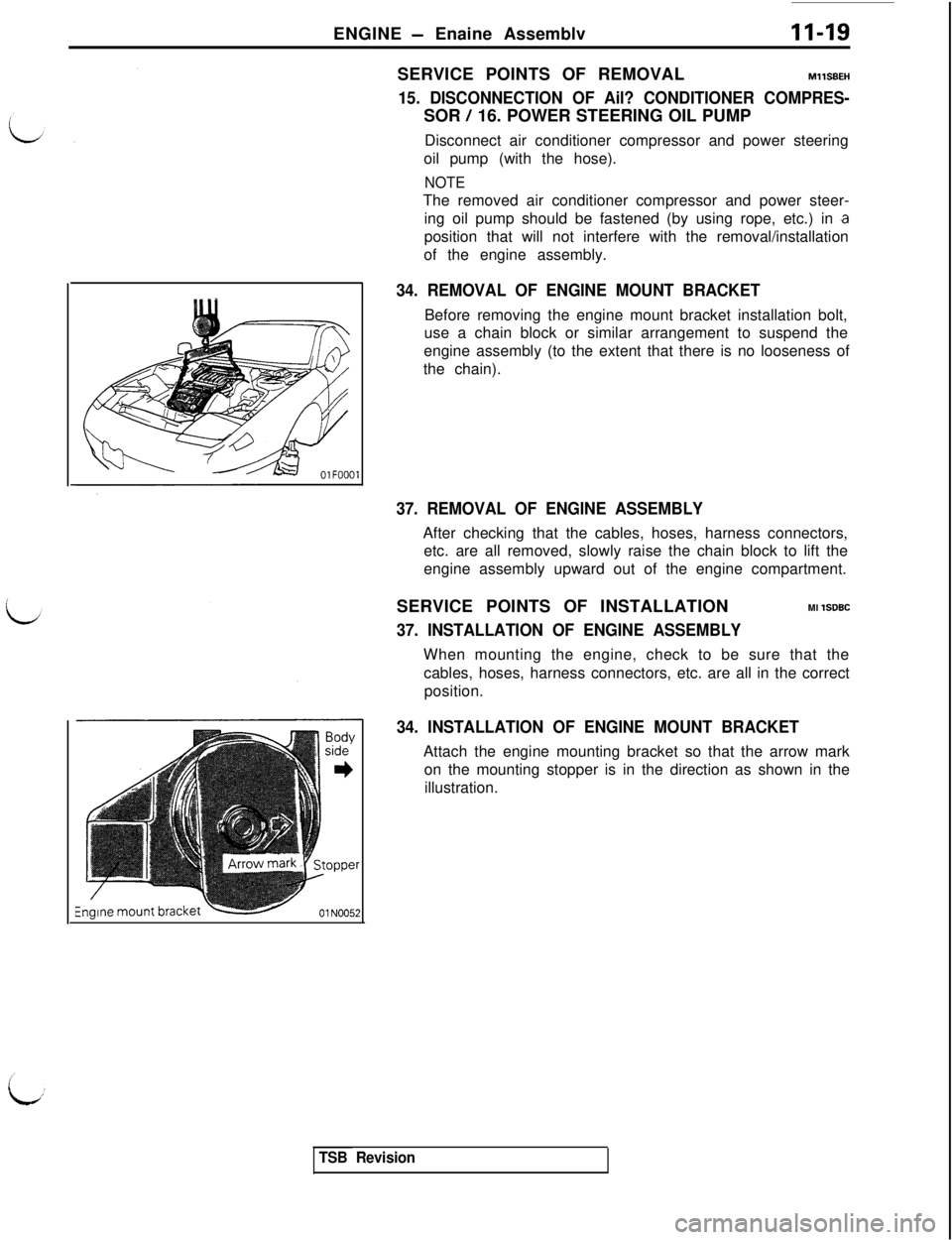
34. REMOVAL OF ENGINE MOUNT BRACKETBefore removing the engine mount bracket installation bolt,
use a chain block or similar arrangement to suspend the
engine assembly (to the extent that there is no looseness of
the chain).
37. REMOVAL OF ENGINE ASSEMBLYAfter checking that the cables, hoses, harness connectors,
etc. are all removed, slowly raise the chain block to lift the
engine assembly upward out of the engine compartment.
SERVICE POINTS OF INSTALLATIONMl
1SDBC
37. INSTALLATION OF ENGINE ASSEMBLYWhen mounting the engine, check to be sure that the
cables, hoses, harness connectors, etc. are all in the correct
position.
34. INSTALLATION OF ENGINE MOUNT BRACKETAttach the engine mounting bracket so that the arrow mark
on the mounting stopper is in the direction as shown in the
illustration.
TSB Revision