steering MITSUBISHI 3000GT 1991 Workshop Manual
[x] Cancel search | Manufacturer: MITSUBISHI, Model Year: 1991, Model line: 3000GT, Model: MITSUBISHI 3000GT 1991Pages: 1146, PDF Size: 76.68 MB
Page 666 of 1146
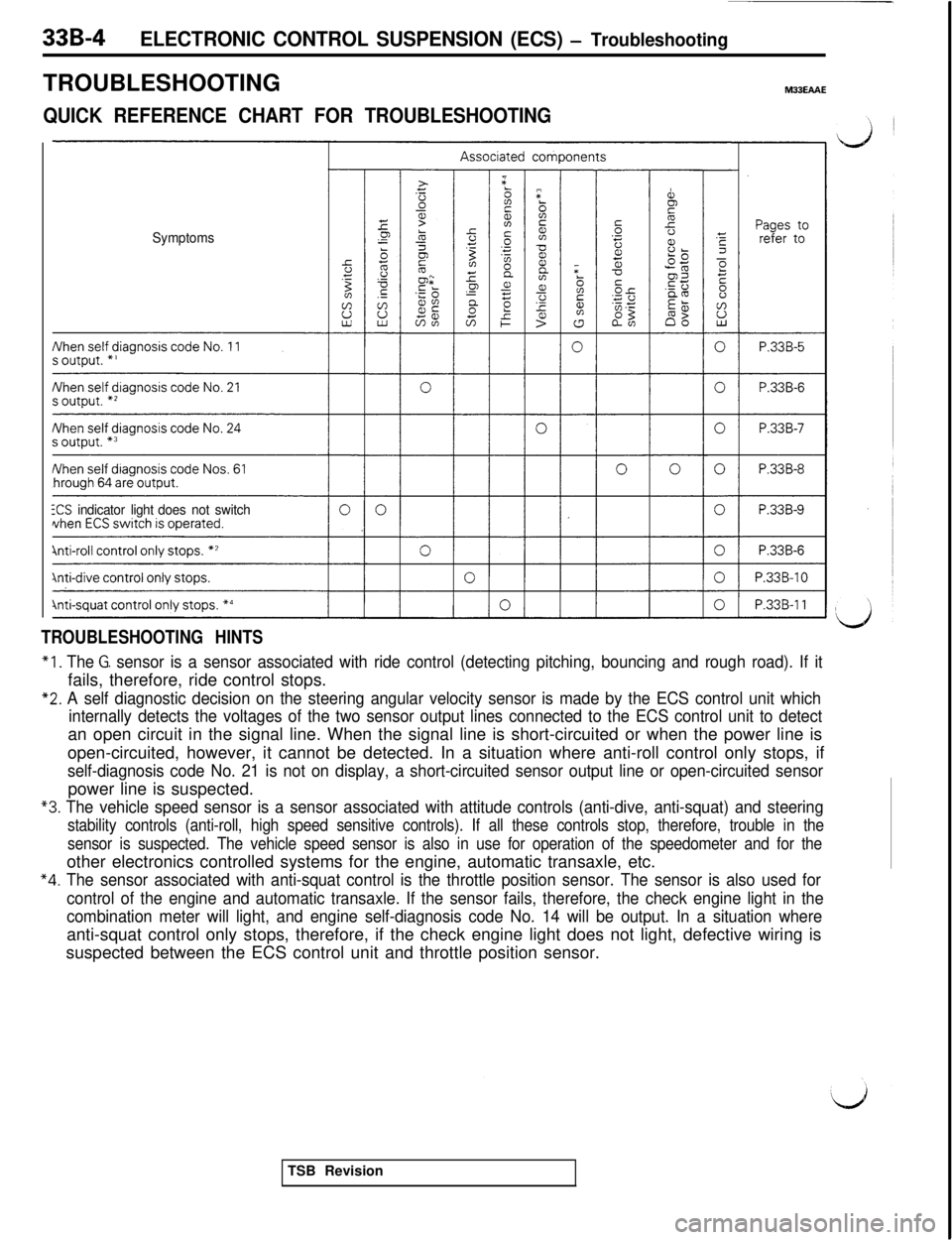
33B-4ELECTRONIC CONTROL SUSPENSION (ECS) - TroubleshootingTROUBLESHOOTING
M33EAAE
QUICK REFERENCE CHART FOR TROUBLESHOOTING
SymptomsXS
indicator lightdoes not switch
TROUBLESHOOTING HINTS
“1. The G. sensor is a sensor associated with ride control (detecting pitching, bouncing and rough road). If itfails, therefore, ride control stops.
“2. A self diagnostic decision on the steering angular velocity sensor is made by the ECS control unit which
internally detects the voltages of the two sensor output lines connected to the ECS control unit to detectan open circuit in the signal line. When the signal line is short-circuited or when the power line is
open-circuited, however, it cannot be detected. In a situation where anti-roll control only stops, if
self-diagnosis code No. 21 is not on display, a short-circuited sensor output line or open-circuited sensorpower line is suspected.
“3. The vehicle speed sensor is a sensor associated with attitude controls (anti-dive, anti-squat) and steering
stability controls (anti-roll, high speed sensitive controls). If all these controls stop, therefore, trouble in the
sensor is suspected. The vehicle speed sensor is also in use for operation of the speedometer and for theother electronics controlled systems for the engine, automatic transaxle, etc.
“4. The sensor associated with anti-squat control is the throttle position sensor. The sensor is also used for
control of the engine and automatic transaxle. If the sensor fails, therefore, the check engine light in the
combination meter will light, and engine self-diagnosis code No. 14 will be output. In a situation whereanti-squat control only stops, therefore, if the check engine light does not light, defective wiring is
suspected between the ECS control unit and throttle position sensor.
TSB Revision
Page 668 of 1146
33B-6ELECTRONIC CONTROL SUSPENSION (ECS) - Troubleshooting
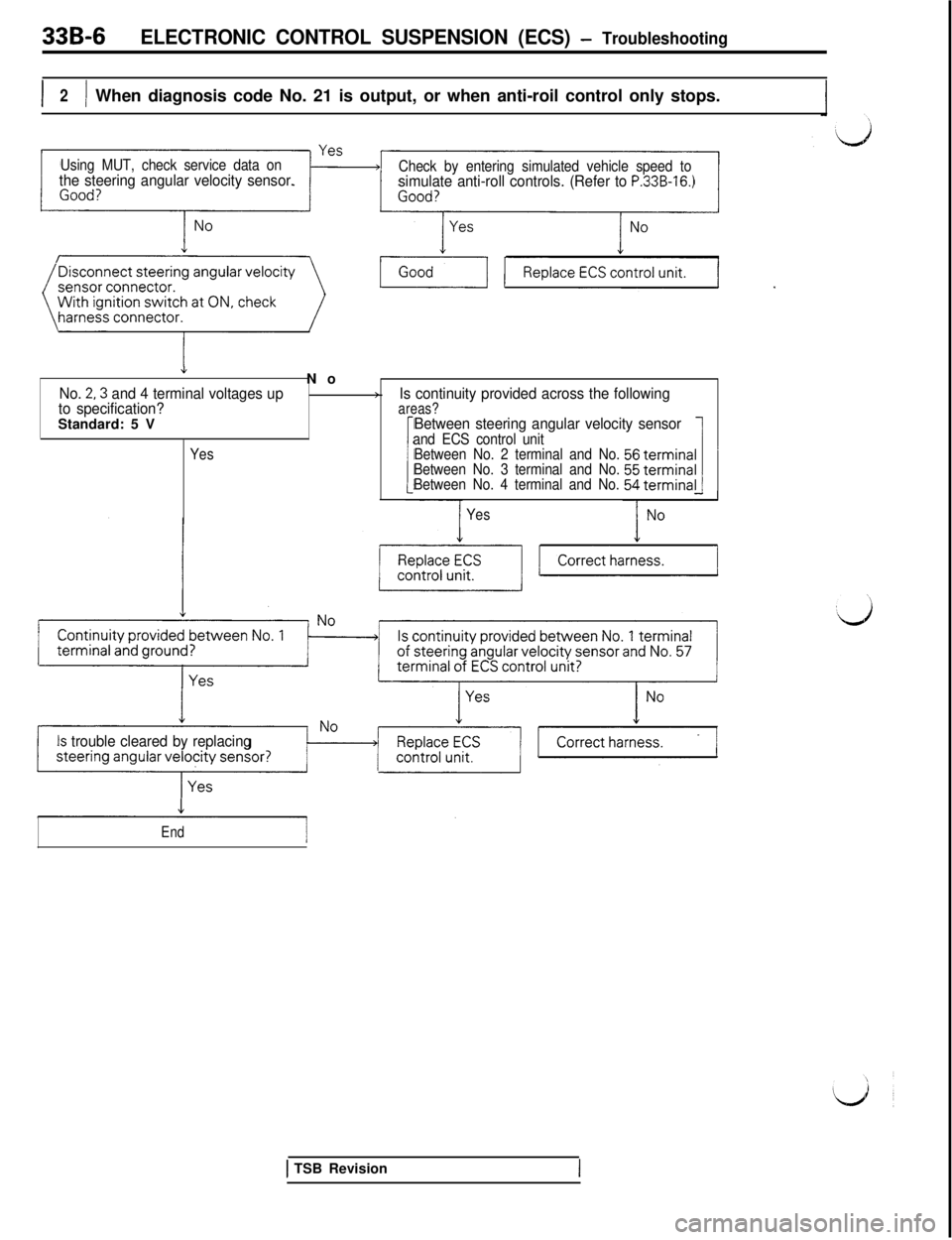
I I2When diagnosis code No. 21 is output, or when anti-roil control only stops.
Using MUT, check service data onthe steering angular velocity sensor.Check by entering simulated vehicle speed tosimulate anti-roll controls. (Refer to P.33B-16.)
+No
No. 2,3 and 4 terminal voltages up
to specification?Standard: 5 V
Yes
>Is continuity provided across the followingareas?Between steering angular velocity sensorand ECS control unit
Between No. 2 terminal and No.!Between No. 3 terminal and No.
Between No. 4 terminal and No.
Yes
Is trouble cleared by replacing
End
1 TSB RevisionI
Page 674 of 1146
33B-12ELECTRONIC CONTROL SUSPENSION (EC9 - i?:~~u:‘?s*men*
12FOOOESERVICE ADJUSTMENT PROCEDURES
I
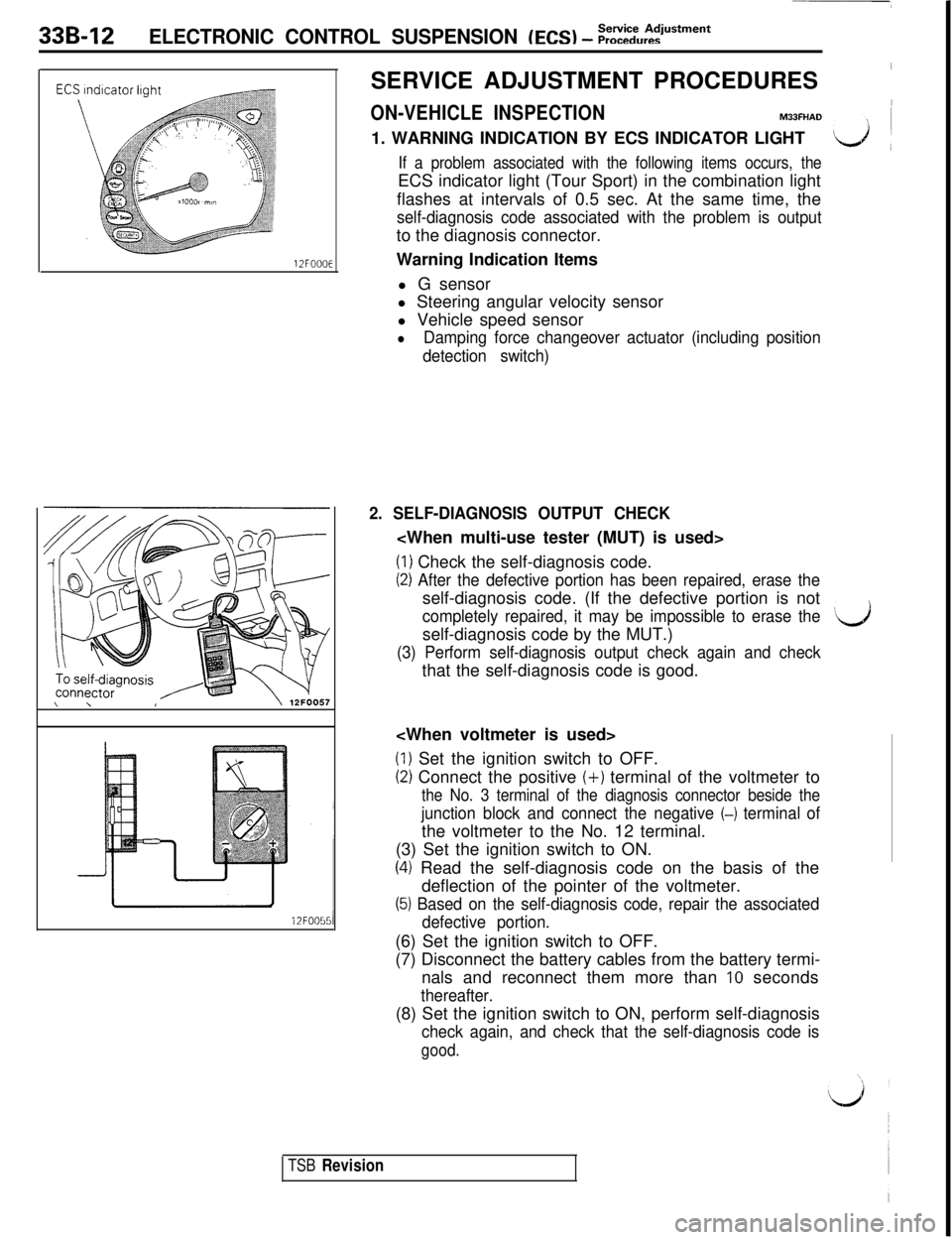
ON-VEHICLE INSPECTIONIM33FHAD1. WARNING INDICATION BY ECS INDICATOR LIGHT
If a problem associated with the following items occurs, theECS indicator light (Tour Sport) in the combination light
flashes at intervals of 0.5 sec. At the same time, the
self-diagnosis code associated with the problem is outputto the diagnosis connector.
Warning Indication Items
l G sensor
l Steering angular velocity sensor
l Vehicle speed sensor
lDamping force changeover actuator (including position
detection switch)
2. SELF-DIAGNOSIS OUTPUT CHECK
(I) Check the self-diagnosis code.
(2) After the defective portion has been repaired, erase theself-diagnosis code. (If the defective portion is not
completely repaired, it may be impossible to erase the’self-diagnosis code by the MUT.)d
(3) Perform self-diagnosis output check again and checkthat the self-diagnosis code is good.
(1) Set the ignition switch to OFF.
(2) Connect the positive (+) terminal of the voltmeter to
the No. 3 terminal of the diagnosis connector beside the
junction block and connect the negative (--) terminal ofthe voltmeter to the No. 12 terminal.
(3) Set the ignition switch to ON.
(4) Read the self-diagnosis code on the basis of the
deflection of the pointer of the voltmeter.
(5) Based on the self-diagnosis code, repair the associated
defective portion.(6) Set the ignition switch to OFF.
(7) Disconnect the battery cables from the battery termi-
nals and reconnect them more than
10 seconds
thereafter.(8) Set the ignition switch to ON, perform self-diagnosis
check again, and check that the self-diagnosis code is
good.
TSB Revision
Page 675 of 1146
![MITSUBISHI 3000GT 1991 Workshop Manual Service AdjustmentELECTRONIC CONTROL SUSPENSION (ECS) - Procedures33B-13Fail Safe and Diagnosis List
Output Code
Diagnosis Item
Fail SafeCode No.Indication Pattern
0[Good]
[Good]
l-l
11G sensor defect](/img/19/57085/w960_57085-674.png "MITSUBISHI 3000GT 1991 Workshop Manual Service AdjustmentELECTRONIC CONTROL SUSPENSION (ECS) - Procedures33B-13Fail Safe and Diagnosis List
Output Code
Diagnosis Item
Fail SafeCode No.Indication Pattern
0[Good]
[Good]
l-l
11G sensor defect")
Service AdjustmentELECTRONIC CONTROL SUSPENSION (ECS) - Procedures33B-13Fail Safe and Diagnosis List
Output Code
Diagnosis Item
Fail SafeCode No.Indication Pattern
0[Good]
[Good]
l-l
11G sensor defective*l Ride controls (pinching and bouncingcontrol, bad road detection control) sl:op.
21Steering angularvelocity sensor open-circuited*
l Anti-roll control stops.
24Vehicle speed sensor*nn open-crrcurtedl Steering stability controls (anti-roll, high
speed sensitive controls) and attitude
controls (anti-dive, anti-squat) stop.l Shock absorber damping force fixed
F. L. damping forcefl-~-~-j 11c$i;z;;Fr actuator
R. R. damping force
I /
64 j-jMJ-~-~-~ ~t$ec~Z$rn&ftYrrZ& /
NOTE(1)Control stop, warning indication and fixed damping force return to normal when the ignition switch is set to OFF.
When any of the problems marked* occurs, if no subsequent problem occurs (for example, when the problem IStransient) normal operation will be restored even if the ignition switch is not set to OFF.(2)Even if control stop warning indication and fixed damping force return to normal as described above, the
self-diagnosis code’is stored in the memory in the ECS control unrt.
(3)The self-diagnosis code can be force-cleared by use of the MUT or by stopping the power supply to the ECS controlunit. In addition
it is automatically cleared if the ON/OFF control of the ignition swatch is repeated 60 times after the
self-diagnosis code has been output, provided that no new self-diagnosis code is output during the period.TSB Revision
Page 676 of 1146
339-l 4ELECTRONIC CONTROL SUSPENSION (ECS) - ~;:i%?tment
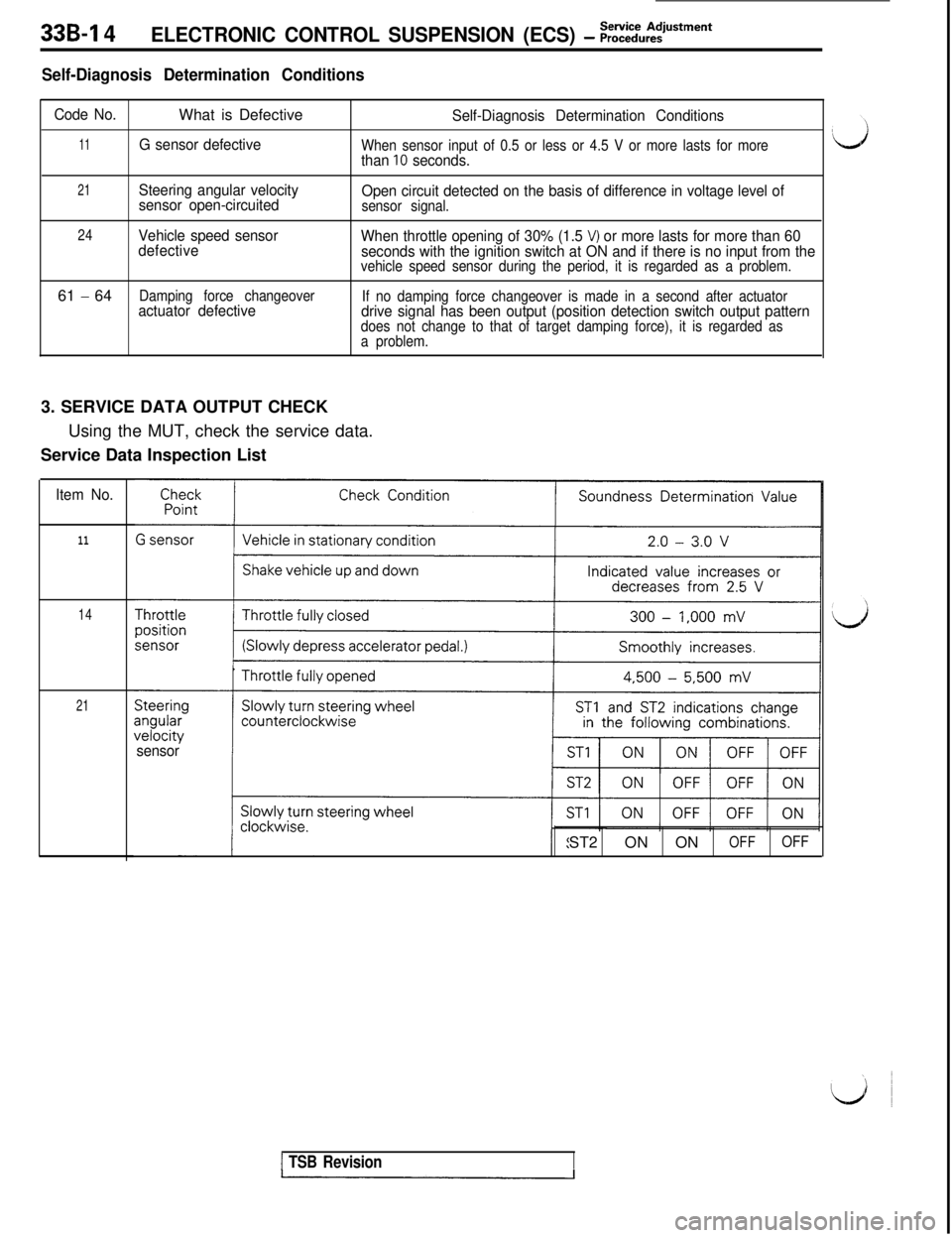
Self-Diagnosis Determination Conditions
Code No.What is DefectiveSelf-Diagnosis Determination Conditions
11G sensor defectiveWhen sensor input of 0.5 or less or 4.5 V or more lasts for morethan 10 seconds.
21Steering angular velocity
sensor open-circuitedOpen circuit detected on the basis of difference in voltage level of
sensor signal.
24Vehicle speed sensor
defectiveWhen throttle opening of 30% (1.5 V) or more lasts for more than 60
seconds with the ignition switch at ON and if there is no input from the
vehicle speed sensor during the period, it is regarded as a problem.61
- 64Damping force changeoveractuator defectiveIf no damping force changeover is made in a second after actuatordrive signal has been output (position detection switch output patterndoes not change to that of target damping force), it is regarded as
a problem.3. SERVICE DATA OUTPUT CHECK
Using the MUT, check the service data.
Service Data Inspection List
Item No.
11
14
21
sensorST2 ON ON
OFFOFF
1 TSB Revision
Page 678 of 1146
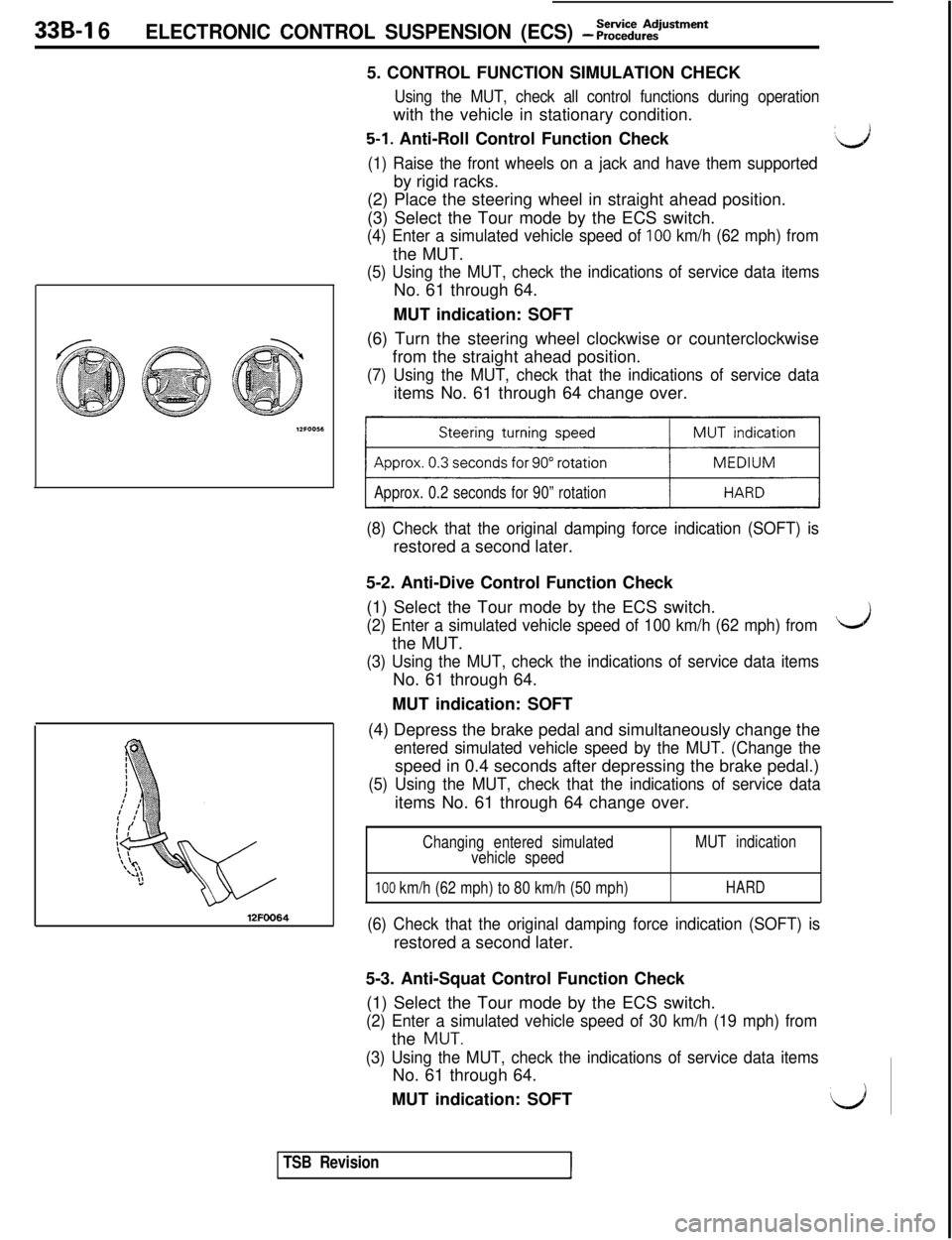
339-l 6ELECTRONIC CONTROL SUSPENSION (ECS) - ;;:%,:?‘Stment5. CONTROL FUNCTION SIMULATION CHECK
Using the MUT, check all control functions during operationwith the vehicle in stationary condition.
5-1. Anti-Roll Control Function Check:d
(1) Raise the front wheels on a jack and have them supportedby rigid racks.
(2) Place the steering wheel in straight ahead position.
(3) Select the Tour mode by the ECS switch.
(4) Enter a simulated vehicle speed of 100 km/h (62 mph) fromthe MUT.
(5) Using the MUT, check the indications of service data itemsNo. 61 through 64.
MUT indication: SOFT
12FOO64(6) Turn the steering wheel clockwise or counterclockwise
from the straight ahead position.
(7) Using the MUT, check that the indications of service dataitems No. 61 through 64 change over.
Approx. 0.2 seconds for 90” rotation
(8) Check that the original damping force indication (SOFT) isrestored a second later.
5-2. Anti-Dive Control Function Check
(1) Select the Tour mode by the ECS switch.
(2) Enter a simulated vehicle speed of 100 km/h (62 mph) fromthe MUT.
(3) Using the MUT, check the indications of service data itemsNo. 61 through 64.
MUT indication: SOFT
(4) Depress the brake pedal and simultaneously change the
entered simulated vehicle speed by the MUT. (Change thespeed in 0.4 seconds after depressing the brake pedal.)
(5) Using the MUT, check that the indications of service dataitems No. 61 through 64 change over.
Changing entered simulated
vehicle speedMUT indication
100 km/h (62 mph) to 80 km/h (50 mph)HARD
(6) Check that the original damping force indication (SOFT) isrestored a second later.
Ls5-3. Anti-Squat Control Function Check
(1) Select the Tour mode by the ECS switch.
(2) Enter a simulated vehicle speed of 30 km/h (19 mph) fromthe
MUT.
(3) Using the MUT, check the indications of service data itemsNo. 61 through 64.
MUT indication: SOFT
l/i
TSB Revision
Page 681 of 1146
ELECTRONIC CONTROL SUSPENSION (ECS)ECS Switch I Steering Angular Velocity- Sensor I G Sensor I Vehicle Speed Sensor3:3B-19
12FOO6t3INSPECTION12FOO71
i
\\12FOO72
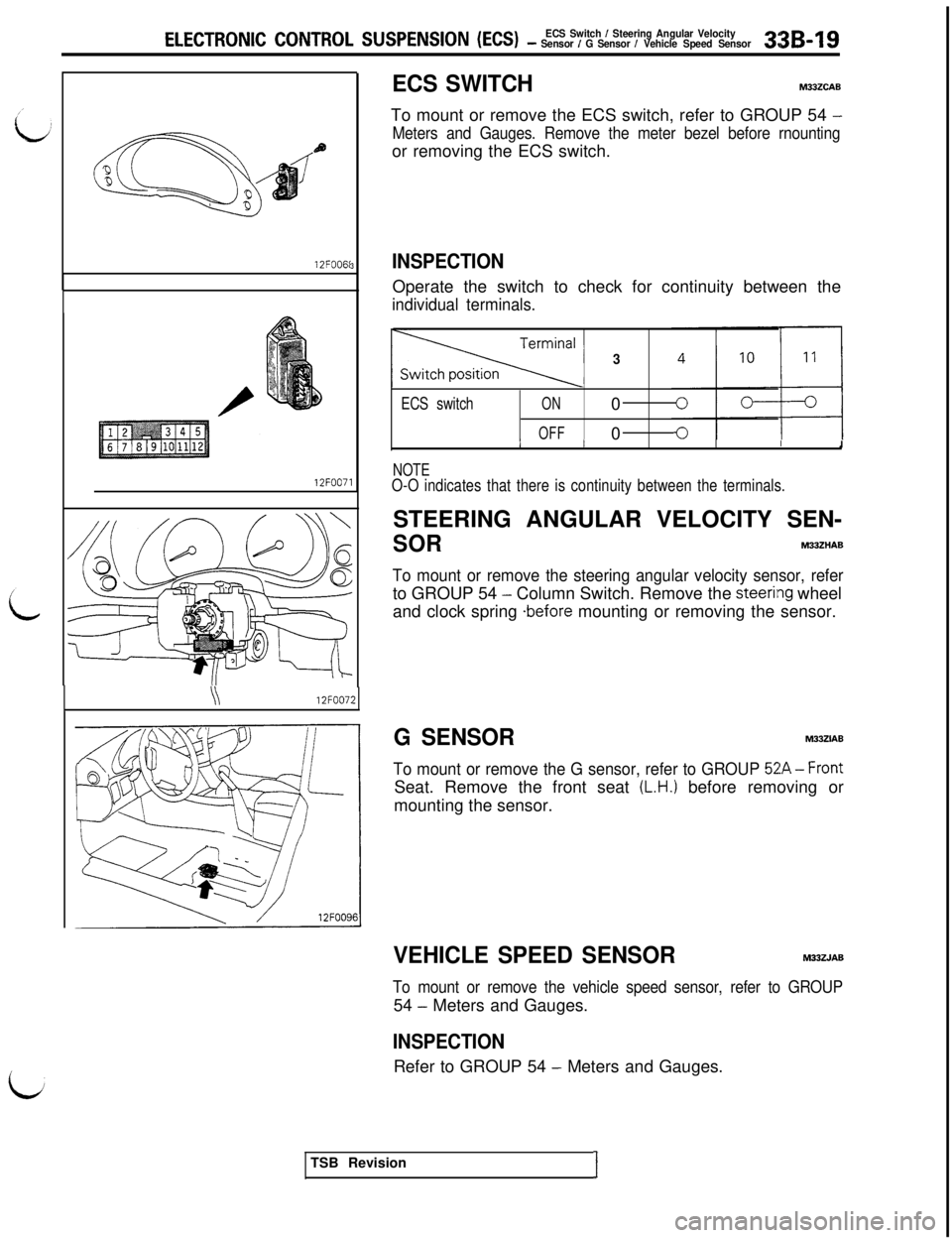
ECS SWITCHMUZCAB
To mount or remove the ECS switch, refer to GROUP 54
-
Meters and Gauges. Remove the meter bezel before rnountingor removing the ECS switch.
Operate the switch to check for continuity between the
individual terminals.
3
ECS switchON0
OFF0IIIIII1
NOTEO-O indicates that there is continuity between the terminals.STEERING ANGULAR VELOCITY SEN-
SORM33ZHAB
To mount or remove the steering angular velocity sensor, referto GROUP 54
- Column Switch. Remove the steerilng wheel
and clock spring
*before mounting or removing the sensor.
G SENSORM33ZIAB
To mount or remove the G sensor, refer to GROUP 52A-Front
Seat. Remove the front seat
(L.H.) before removing or
mounting the sensor.
VEHICLE SPEED SENSORM33ZJAB
To mount or remove the vehicle speed sensor, refer to GROUP54
- Meters and Gauges.
INSPECTIONRefer to GROUP 54
- Meters and Gauges.
TSB Revision
I
Page 685 of 1146
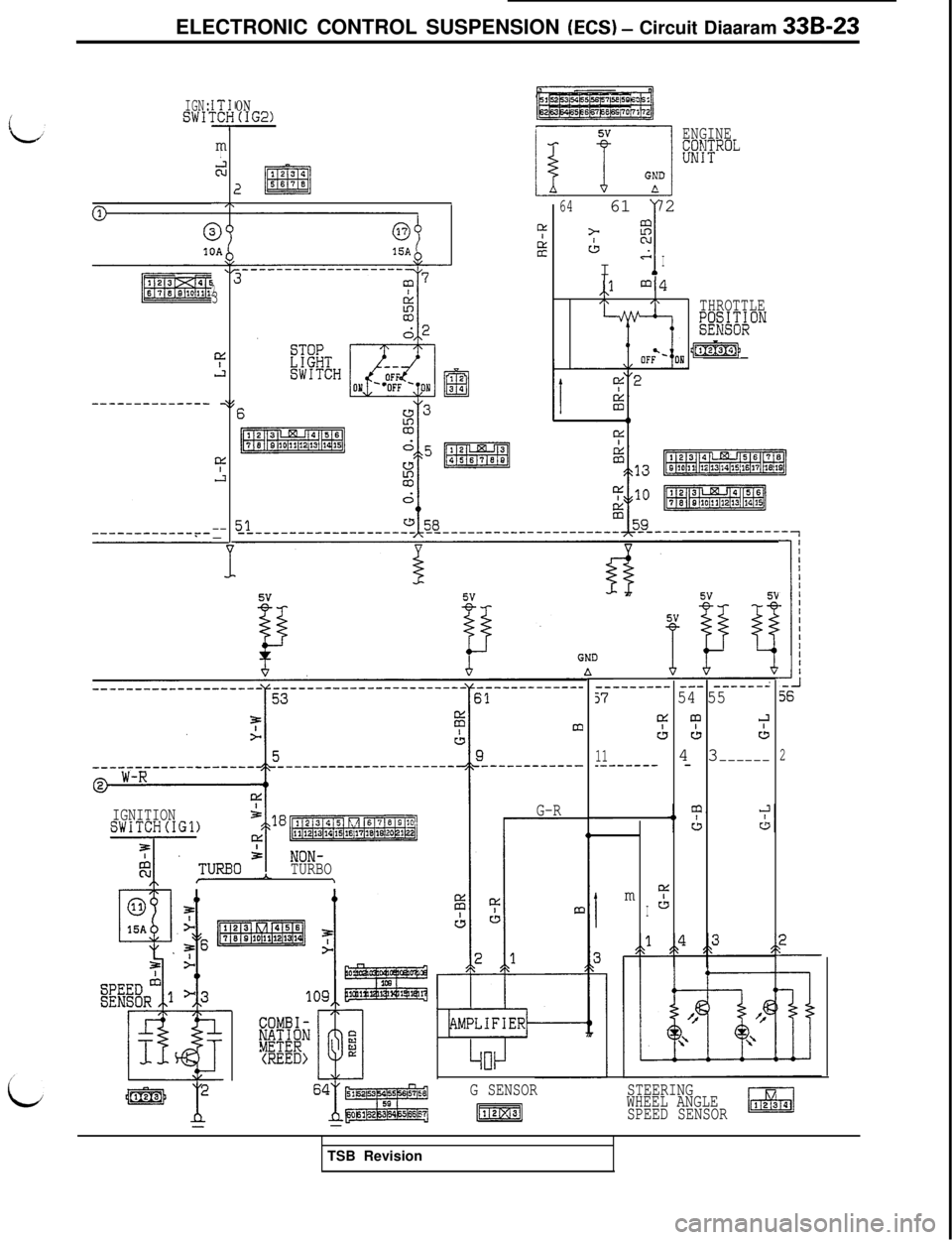
ELECTRONIC CONTROL SUSPENSION (ECS) - Circuit Diaaram 33B-23
IGN:sw1::A?-m
I&
177
i '
3
I
2YJ
-+d
T-J
---
ON(IG2)SV
el
ENGINEf"BTROL
GNDIfi
1234
J333256‘78
6461 72>
I
I
CLL2c
I
,Jm4,\/\THROTTLE;;;EI;;ON
4-1
jV
f
. I
!i
ss’
2
___--_--- _-- ------2354 55F
"pLl
cl w&
114 3__------ -------
I
nimCL
IGNITIONSWITCH(IG1)18Bl
NON-TURBO\
G-R
COMBI-
%kiN'(REED>
G SENSOR
lf?EzJi
STEERING
WHEEL ANGLE
SPEED SENSOR
liZI1 2 3aTSB Revision
Page 710 of 1146
34-24REAR SUSPENSION
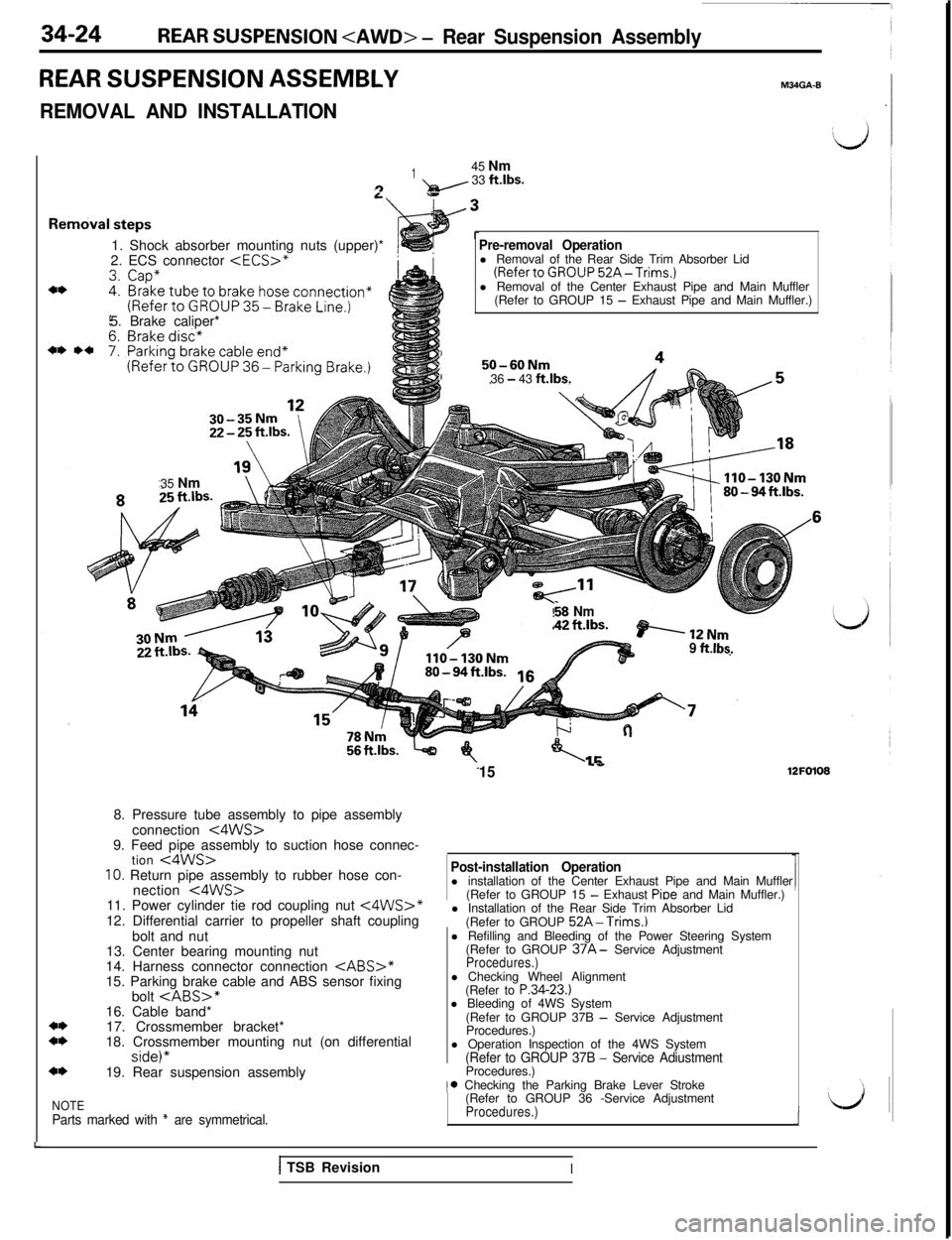
REAR SUSPENSION ASSEMBLY
REMOVAL AND INSTALLATION
M34GA-B
L
Rel
145 Nm9- 33 ftlbs.
1. Shock absorber mounting nuts (upper)*
2. ECS connector
(RefertoGROUP52A-Trims.)l Removal of the Center Exhaust Pipe and Main Muffler
(Refer to GROUP 15
- Exhaust Pipe and Main Muffler.)
5. Brake caliper*
1,50-60NmI36 - 43 ft.lbs.35 Nm
$8 Nm“?C,ILc. ashwez I,..“=.BP’----12Nm9 ftlbs.
15..e12FO1088. Pressure tube assembly to pipe assembly
connection
<4WS>9. Feed pipe assembly to suction hose connec-
tion
<4WS>10. Return pipe assembly to rubber hose con-
nection t4WS>11. Power cylinder tie rod coupling nut <4WS>*12. Differential carrier to propeller shaft coupling
bolt and nut
Post-installation Operationl installation of the Center Exhaust Pipe and Main Muffler
(Refer to GROUP 15
- Exhaust Pioe and Main Muffler.)
l Installation of the Rear Side Trim Absorber Lid
(Refer to GROUP
52A-Trims.)13. Center bearing mounting nut
14. Harness connector connection
CABS>*15. Parking brake cable and ABS sensor fixingl Refilling and Bleeding of the Power Steering System
(Refer to GROUP
37A- Service AdjustmentProcedures.)bolt
17. Crossmember bracket*
18. Crossmember mounting nut (on differential
side)”19. Rear suspension assemblyl Checking Wheel Alignment
(Refer to P.34-23.)
l Bleeding of 4WS System
(Refer to GROUP 37B
- Service Adjustment
Procedures.)
l Operation Inspection of the 4WS System
(Refer to GROUP 37B - Service AdiustmentProcedures.)
NOTEParts marked with * are symmetrical.
,* Checking the Parking Brake Lever Stroke
(Refer to GROUP 36 -Service Adjustment
Procedures.)i
1 TSB RevisionI
Page 729 of 1146
SERVICE BRAKES -Anti-lock Braking System Troubleshooting35-7
ANTI-LOCK BRAKING SYSTEM TROUBLESHOOTlilGPARTICULAR PHENOMENA OF THE
LANTI-LOCK BRAKING SYSTEMModels equipped with the anti-lock braking system
(ABS) may exhibit one or more of the following
phenomena from time to time, but none of these
are abnormal.
(1) A pulsing feeling in the brake pedal, or vibration
of the body or the steering wheel, when the
anti-lock braking system is activated by sudden
braking or by braking on a slippery road surface.
.9ctually, this phenomenon is an indication that
the anti-lock braking system is functioning nor-
mally.(2) When the vehicle speed reaches approximately
6 km/h (4 mph) after the engine is started and
the vehicle starts off (for the first time), a
whining motor noise may be heard from the
engine compartment if the vehicle is traveling in
a quiet place, but this noise is simply the result
of a self-check being made of the anti-lock
braking system operation.
TROUBLESHOOTING METHODSProblems related to the anti-lock braking system
(ABS) can be classified into two general categories:
problems in the electrical system and those in the
Lhydraulic system.For problems in the electrical system, the
self-diagnosis function is built into the electronic control
unit (E.C.U.) causing the ABS warning light to
illuminate as a warning to the driver. In this instance,
checks can be made by using the multi-use tester
and oscilloscope.
Problems in the hydraulic system (poor braking,
etc.) can be located in the same way as for ordinary
brakes. There is, however, the necessity to check to
determine whether the problem is related to ordin-
ary brake components or to the components related
to the ABS. To make this check, use the multi-use
tester.
HOW TO USE THE TROUBLESHOOTING
FLOW CHART(1) Using the flow chart, check the ABS warning
light light-up sequence. Read the diagnosis
codes and check the condition of braking opera-
tion.
(2) Following the check chart listed in the remedy
column, perform the checks. There are [Explana-
tion] and [Hint] in each check chart. Refer to
them when troubleshooting.
NOTEECU: Electronic control unit
HU: Hydraulic unit
MUT: Multi-use tester
1 TSB Revision