steering MITSUBISHI 3000GT 1991 Owner's Manual
[x] Cancel search | Manufacturer: MITSUBISHI, Model Year: 1991, Model line: 3000GT, Model: MITSUBISHI 3000GT 1991Pages: 1146, PDF Size: 76.68 MB
Page 76 of 1146
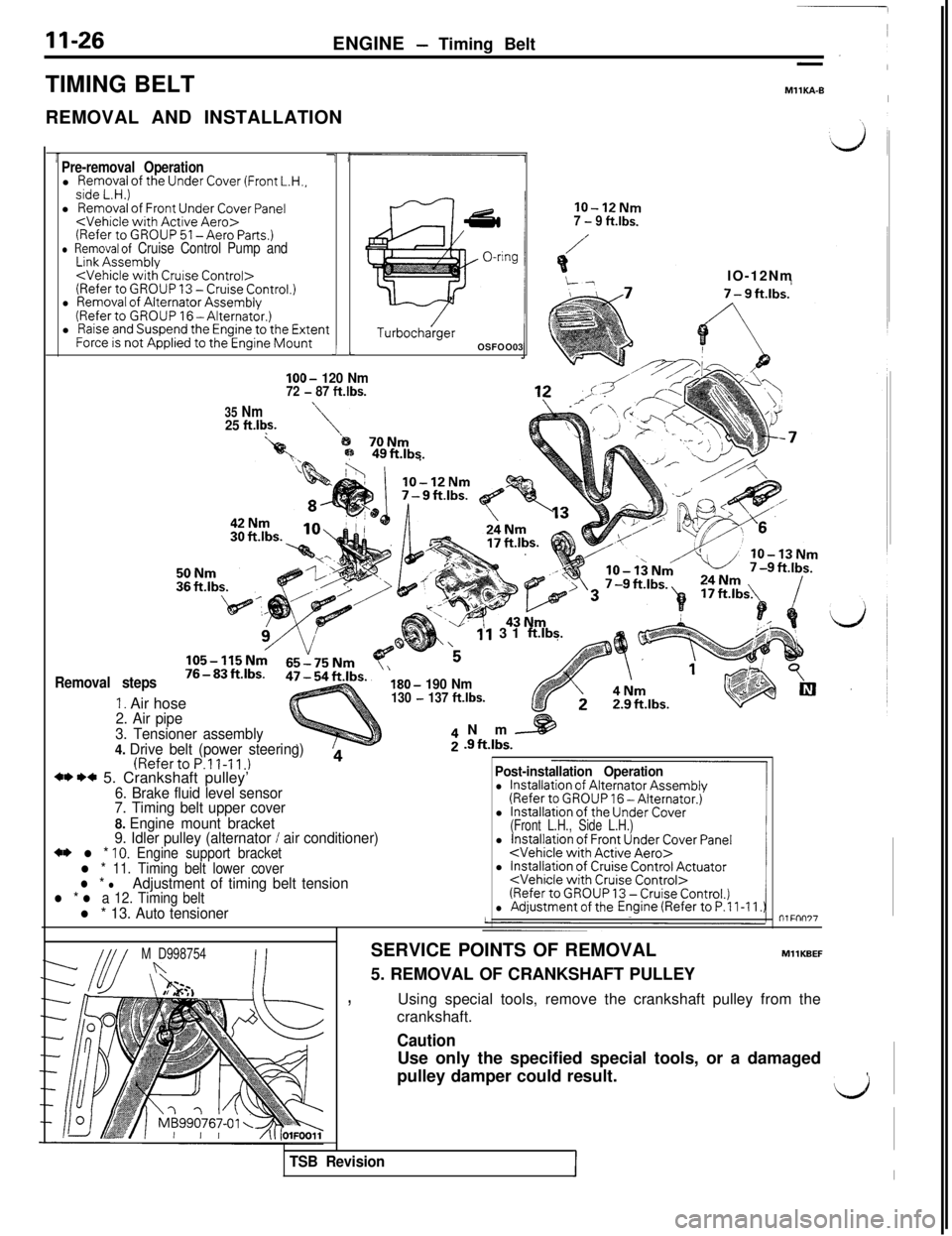
11-26ENGINE - Timing Belt
TIMING BELT
REMOVAL AND INSTALLATION
MllKA-BI
Pre-removal Operationl Removal of the Under Cover (Front L.H.,side L.H.)l Removal of Front Under Cover Panel
l Raise and Suspend the Engine to the ExtentForce is not Applied to the Engine Mounti LIOO-
120 Nm72 - 87 ft.lbs.
35 Nm25 ft.l$.
TurbochargerOSFOO03
lo-12Nm7 - 9 ft.lbs.
Removal steps
1. Air hose
11 31 ftlbs.
‘5IO-12Nm
B;p 49ftJbs.
\
180- 190 Nm130 - 137 ft.lbs.
2. Air pipe
3. Tensioner assembly
4. Drive belt (power steering)
(RefertoP.ll-11.)4** I)* 5. Crankshaft pulley’6. Brake fluid level sensor
7. Timing belt upper cover
8. Engine mount bracket
9. Idler pulley (alternator
/ air conditioner)+* l * 10. Engine support bracketl * 11. Timing belt lower coverl * lAdjustment of timing belt tensionl * l a 12. Timing beltl * 13. Auto tensionerNm
[email protected].
Post-installation Operation
l Installation of Alternator Assembly(Refer to GROUP 16 -Alternator.)
l Installation of the Under Cover(Front L.H., Side L.H.)l Installation of Front Under Cover Panel
l Installation of Cruise Control Actuator
M D998754nSERVICE POINTS OF REMOVAL
5. REMOVAL OF CRANKSHAFT PULLEYMllKBEF
,Using special tools, remove the crankshaft pulley from the
crankshaft.
TSB RevisionII
CautionUse only the specified special tools, or a damaged
pulley damper could result.
,
LJ
Page 108 of 1146
13-2
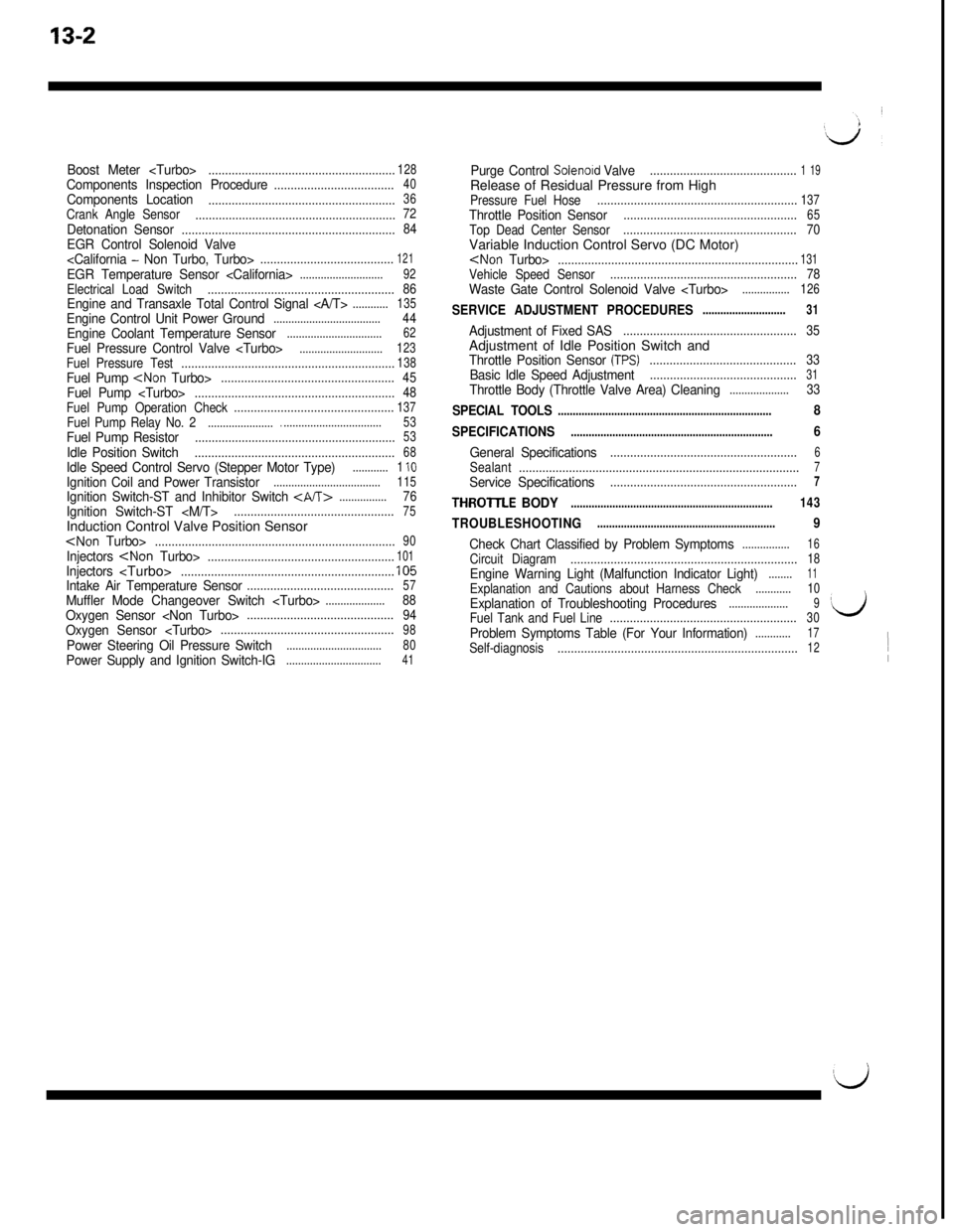
Boost Meter
Components Location........................................................36
Crank Angle Sensor
............................................................72Detonation Sensor................................................................84EGR Control Solenoid Valve
EGR Temperature Sensor
Fuel Pump Operation Check................................................137Fuel Pump Relay No. 2........................................................53Fuel Pump Resistor............................................................53
Idle Position Switch............................................................68Idle Speed Control Servo (Stepper Motor Type)............1 IOIgnition Coil and Power Transistor....................................115Ignition Switch-ST and Inhibitor Switch ................76Ignition Switch-ST
Injectors
94
Oxygen Sensor
Power Steering Oil Pressure Switch................................80Power Supply and Ignition Switch-IG................................41
Purge Control Solenord Valve............................................1 19Release of Residual Pressure from High
Pressure Fuel Hose............................................................137Throttle Position Sensor....................................................65Top Dead Center Sensor....................................................70Variable Induction Control Servo (DC Motor)
SERVICE ADJUSTMENT PROCEDURES............................31
Adjustment of Fixed SAS....................................................35Adjustment of Idle Position Switch and
Throttle Position Sensor (TPS)............................................33Basic Idle Speed Adjustment............................................31Throttle Body (Throttle Valve Area) Cleaning....................33
SPECIAL TOOLS........................................................................8
SPECIFICATIONS
....................................................................6
General Specifications........................................................6Sealant....................................................................................7Service Specifications........................................................7
THROlTLE BODY....................................................................143
TROUBLESHOOTING............................................................9
Check Chart Classified by Problem Symptoms................16Circuit Diagram....................................................................18Engine Warning Light (Malfunction Indicator Light)........11Explanation and Cautions about Harness Check............10Explanation of Troubleshooting Procedures....................9Fuel Tank and Fuel Line........................................................30
Problem Symptoms Table (For Your Information)............17Self-diagnosis........................................................................12)
I
Page 123 of 1146
FUEL SYSTEM - Troubleshootina13-17
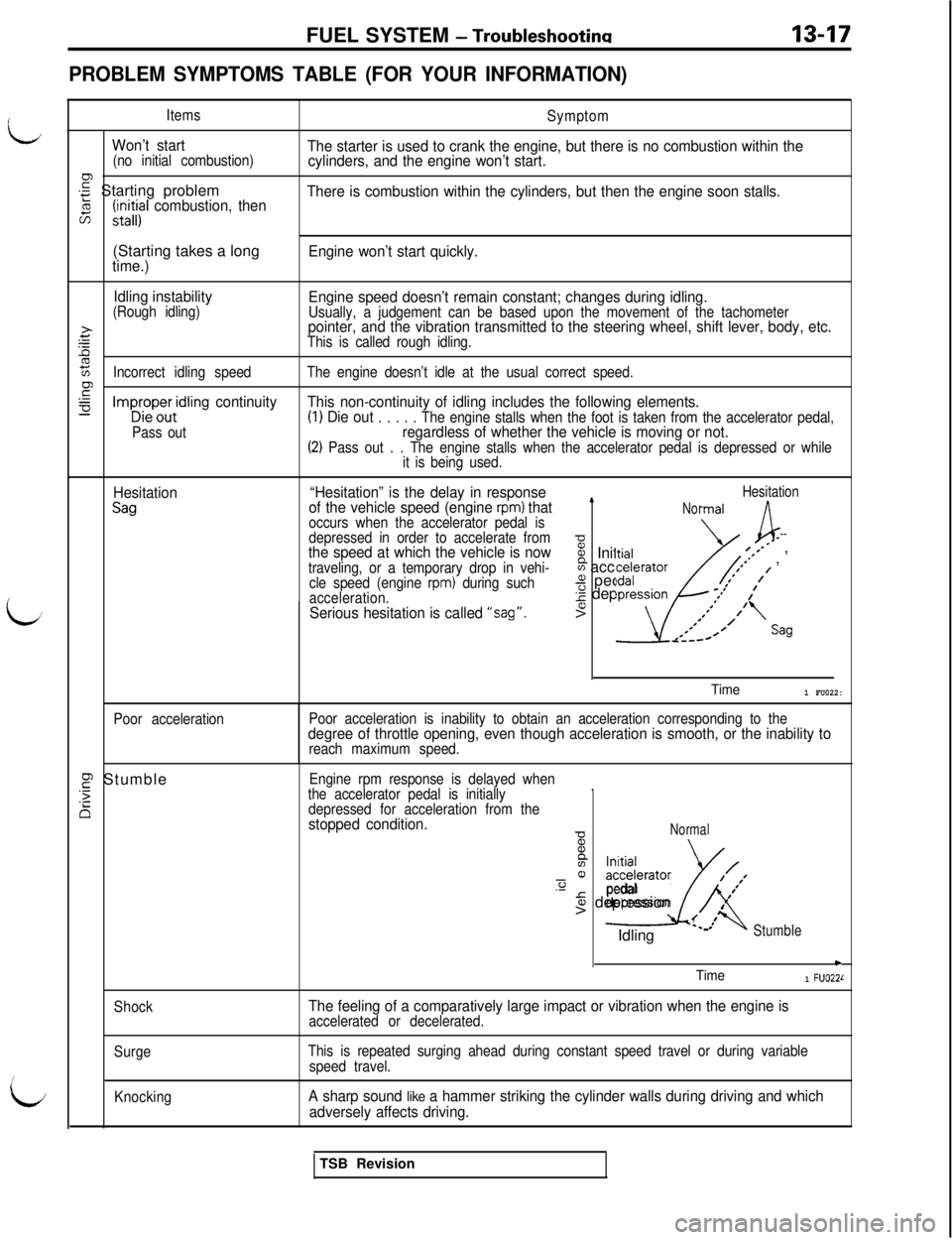
PROBLEM SYMPTOMS TABLE (FOR YOUR INFORMATION)
I;
L
/
L/
Items
Won’t start(no initial combustion)-g Starting problem
2(i;il;i combustion, then
Symptom
The starter is used to crank the engine, but there is no combustion within the
cylinders, and the engine won’t start.
There is combustion within the cylinders, but then the engine soon stalls.(Starting takes a long
time.)Engine won’t start quickly.
Idling instability
(Rough idling)Engine speed doesn’t remain constant; changes during idling.Usually, a judgement can be based upon the movement of the tachometer
>.rpointer, and the vibration transmitted to the steering wheel, shift lever, body, etc.
EThis is called rough idling.
s0
Incorrect idling speedThe engine doesn’t idle at the usual correct speed.
F.-=e-ImpDr;p;ertidling continuityThis non-continuity of idling includes the following elements.(1) Die outPass out. . . . . The engine stalls when the foot is taken from the accelerator pedal,regardless of whether the vehicle is moving or not.(2) Pass out . . The engine stalls when the accelerator pedal is depressed or while
it is being used.
Hesitation
Sag
“Hesitation” is the delay in responseHesitation
of the vehicle speed (engine rpm) thatLNormaloccurs when the accelerator pedal is
depressed in order to accelerate from---
the speed at which the vehicle is nowx\a,r- ,
traveling, or a temporary drop in vehi-g Initialv) accelerator**’ ,8’ /cle speed (engine rpm) during such+ pedal/,’ /
’
acceleration.2 depression
Serious hesitation is called “sag”.2
1“*’.’
/’ ,’I&L-e**’Ii Sag
Poor acceleration
Time1 FU022:
Poor acceleration is inability to obtain an acceleration corresponding to thedegree of throttle opening, even though acceleration is smooth, or the inability toreach maximum speed.
0, Stumble.F
‘iIn
Engine rpm response is delayed when
the accelerator pedal is initially.
depressed for acceleration from thestopped condition.
$Normal
x
:Initial
3acceleratorI//
c
-7
pedal2 depression,#’,
4,/Idling *--’Stumble
Shock
cTime1 FUO22L
The feeling of a comparatively large impact or vibration when the engine isaccelerated or decelerated.
SurgeThis is repeated surging ahead during constant speed travel or during variable
speed travel.
Knocking
A sharp sound like a hammer striking the cylinder walls during driving and which
adversely affects driving.TSB Revision
Page 135 of 1146
![MITSUBISHI 3000GT 1991 Owners Manual FUEL SYSTEM - Troubleshooting13-29
ENGINE
CONTROL
RELAYF
1 7=2
c----IIIIIIII2,(2Io FUEL
) SE
PRESSURE
SOLENOID
VALVE
IfII
I
I
I
I
J
]i#&B,D i
A-20
1
WASTE
GATE
SOLENOIDVALVE
/
7 EGRi ~XE~~OID
I
; A-21](/img/19/57085/w960_57085-134.png "MITSUBISHI 3000GT 1991 Owners Manual FUEL SYSTEM - Troubleshooting13-29
ENGINE
CONTROL
RELAYF
1 7=2
c----IIIIIIII2,(2Io FUEL
) SE
PRESSURE
SOLENOID
VALVE
IfII
I
I
I
I
J
]i#&B,D i
A-20
1
WASTE
GATE
SOLENOIDVALVE
/
7 EGRi ~XE~~OID
I
; A-21")
FUEL SYSTEM - Troubleshooting13-29
ENGINE
CONTROL
RELAYF
1 7=2
c----IIIIIIII2,(2Io FUEL
) SE
PRESSURE
SOLENOID
VALVE
IfII
I
I
I
I
J
]i#&B,D i
A-20
1
WASTE
GATE
SOLENOIDVALVE
/
7 EGRi ~XE~~OID
I
; A-21
L
1 A-70
j A-72
f ENGINEj jXICI$ROL
I
-------13s
3.------
s
10
/\1
>
J
c
”-_-
1 A-18
3P
~;~E&DIAGNOSIS #Fjhl;;ON
CONNECTORADJUSTMENT
EFfq&@gCONNECTOR
d
Efpggggg]
I B-OS
ENGINE
COOLANT
Q&;EEATURE ,,'I/\FOR AIR)/@ICONDITIONEROFF --xOlJ
POWER STEERING;tK;BESSURETSB Revision
Page 137 of 1146
SERVICE ADJUSTMENT PROCEDURES
MlBFHSU
BASIC IDLE SPEED ADJUSTMENT
NOTE(1) The basic idle speed has been factory-adjusted with the
speed adjusting screw (SAS) and does not normally require
adjustment.(2) If the adjustment is required, first check that the ignition
plug, injector,
ISC servo, and compression pressure are
normal.
(1) Before starting the inspection and adjustment procedures,set the vehicle in the following conditions:
l
Engine coolant temperature: 80 to 95°C (176 to 205°F)l Lights, electric cooling fan, accessories: OFF
lTransaxle: Neutral (P range on vehicles with automatic
transaxle)l Steering wheel: Straightforward position
(2) When using the multi-use tester, connect it to the diagnosis
connector.
NOTEThe connection of the multi-use tester grounds the
self-
diagnosis/data transmission selector terminal.
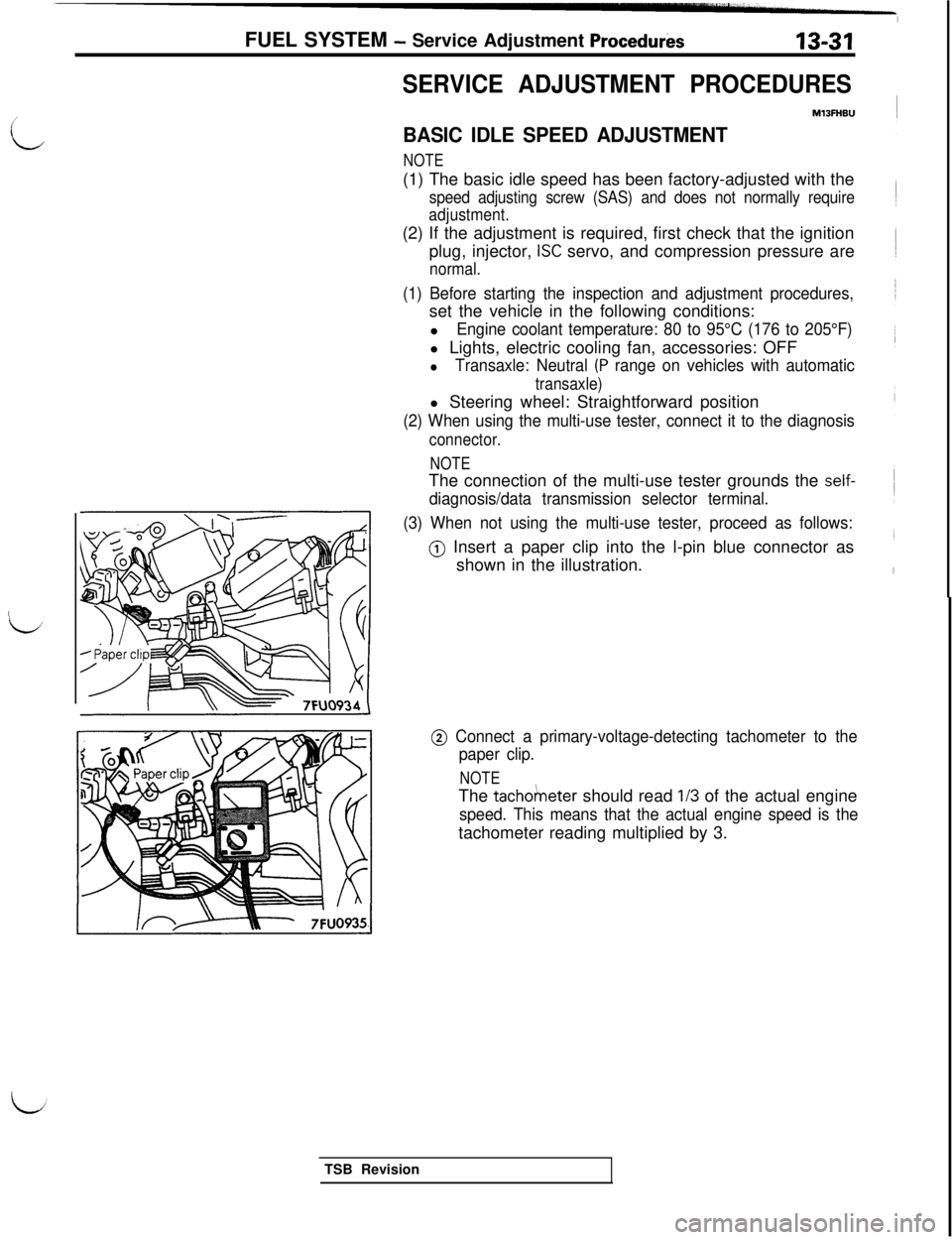
(3) When not using the multi-use tester, proceed as follows:
@) Insert a paper clip into the l-pin blue connector as
shown in the illustration. FUEL SYSTEM
- Service Adjustment Procedurks13-31
i
@ Connect a primary-voltage-detecting tachometer to the
paper clip.
NOTEThe
tacho/neter should read l/3 of the actual engine
speed. This means that the actual engine speed is thetachometer reading multiplied by 3.
TSB Revision
Page 161 of 1146
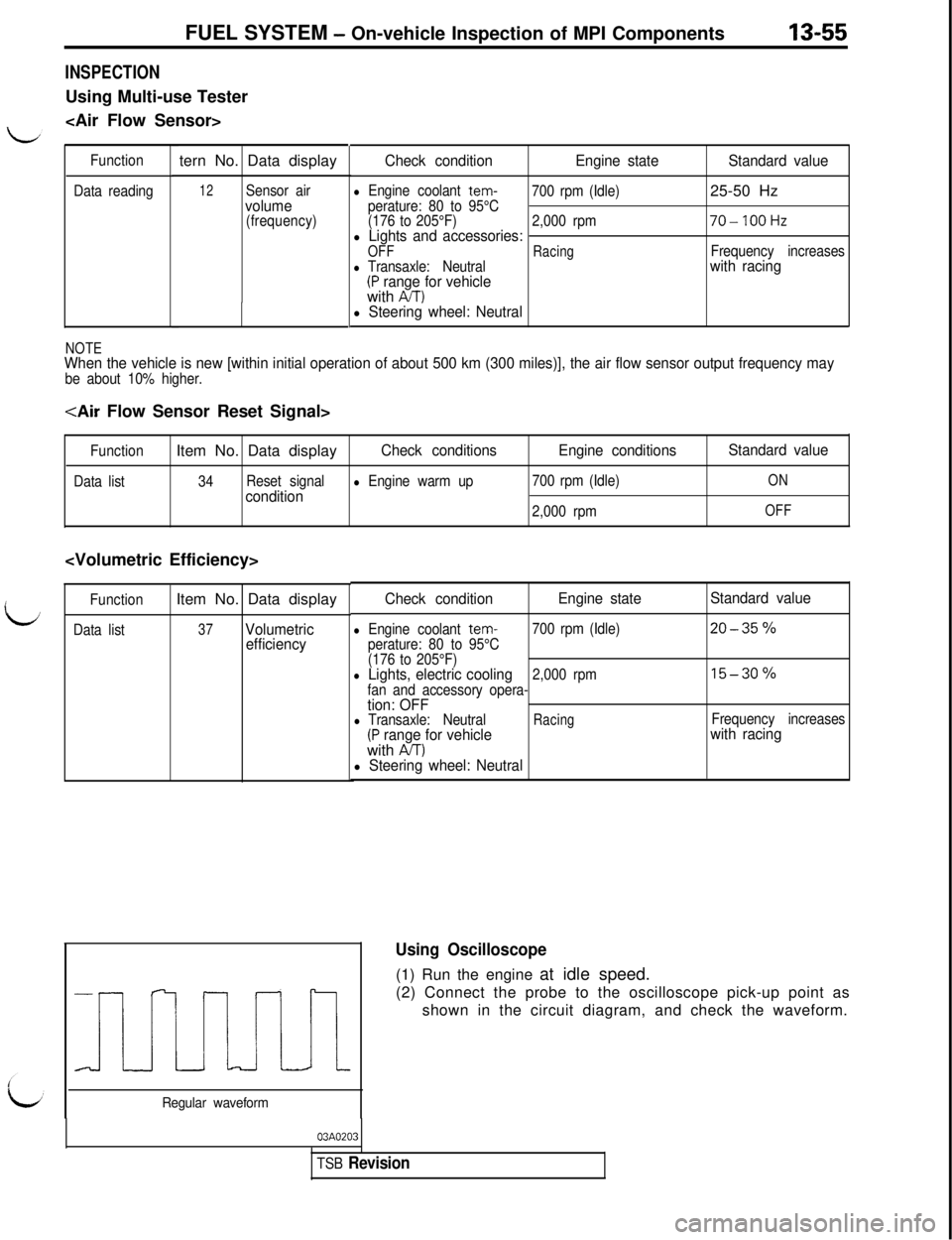
FUEL SYSTEM - On-vehicle Inspection of MPI Components13-55
INSPECTIONUsing Multi-use Tester
Function
Data readingtern No. Data display
12Sensor airvolume(frequency)
Check conditionEngine stateStandard value
l Engine coolant tem-
700 rpm (Idle)25-50 Hzperature: 80 to 95°C
(176 to 205°F)2,000 rpm70-IOOHzl Lights and accessories:OFFRacingFrequency increasesl Transaxle: Neutralwith racing(P range for vehiclewith AIT)l Steering wheel: Neutral
NOTEWhen the vehicle is new [within initial operation of about 500 km (300 miles)], the air flow sensor output frequency maybe about 10% higher.
Function
Data listItem No. Data displayCheck conditionsEngine conditionsStandard value
34Reset signall Engine warm up700 rpm (Idle)ON
condition2,000 rpmOFF
L;
FunctionItem No. Data display
Data list37Volumetric
efficiencyCheck conditionEngine stateStandard valuel Engine coolant tem-700 rpm (Idle)20-35%
perature: 80 to 95°C
(176 to 205°F)
l Lights, electric cooling2,000 rpm15-30%
fan and accessory opera-tion: OFFl Transaxle: NeutralRacingFrequency increases
(P range for vehiclewith racingwith &T)
l Steering wheel: Neutral
Using Oscilloscope(1) Run the engine at idle speed.
(2) Connect the probe to the oscilloscope pick-up point as
shown in the circuit diagram, and check the waveform.
Regular waveform
03A0203
TSB Revision
Page 186 of 1146

13-80FUEL SYSTEM - 0
n-vehicle Inspection of MPI Components
POWER STEERING OIL PRESSURE SWITCHMlOYQAA
B
$-
Engine control unit
'107
@ Harness side
connector
ml-
Power steering oil
Pressure switch
7FUO536700-2.000 1.500-2.000(100-284) (213-284)Pressure [kPa (psi)]
0, l.oIu
OPERATIONl
The power steering oil pressure switch converts presence/absence of power steering load into low/high
voltage and inputs it to the engine control unit, which then controls the idle speed control servo based on
this signal.l The battery voltage in the engine control unit is applied through a resistor to the power steering oil
pressure switch. Steering operation causes the power steering oil pressure to increase, turning the
switch on. As a result, continuity is produced between the battery voltage applied and ground. This
causes the power steering oil pressure terminal voltage to go from high to low.
TSB Revision
Page 187 of 1146
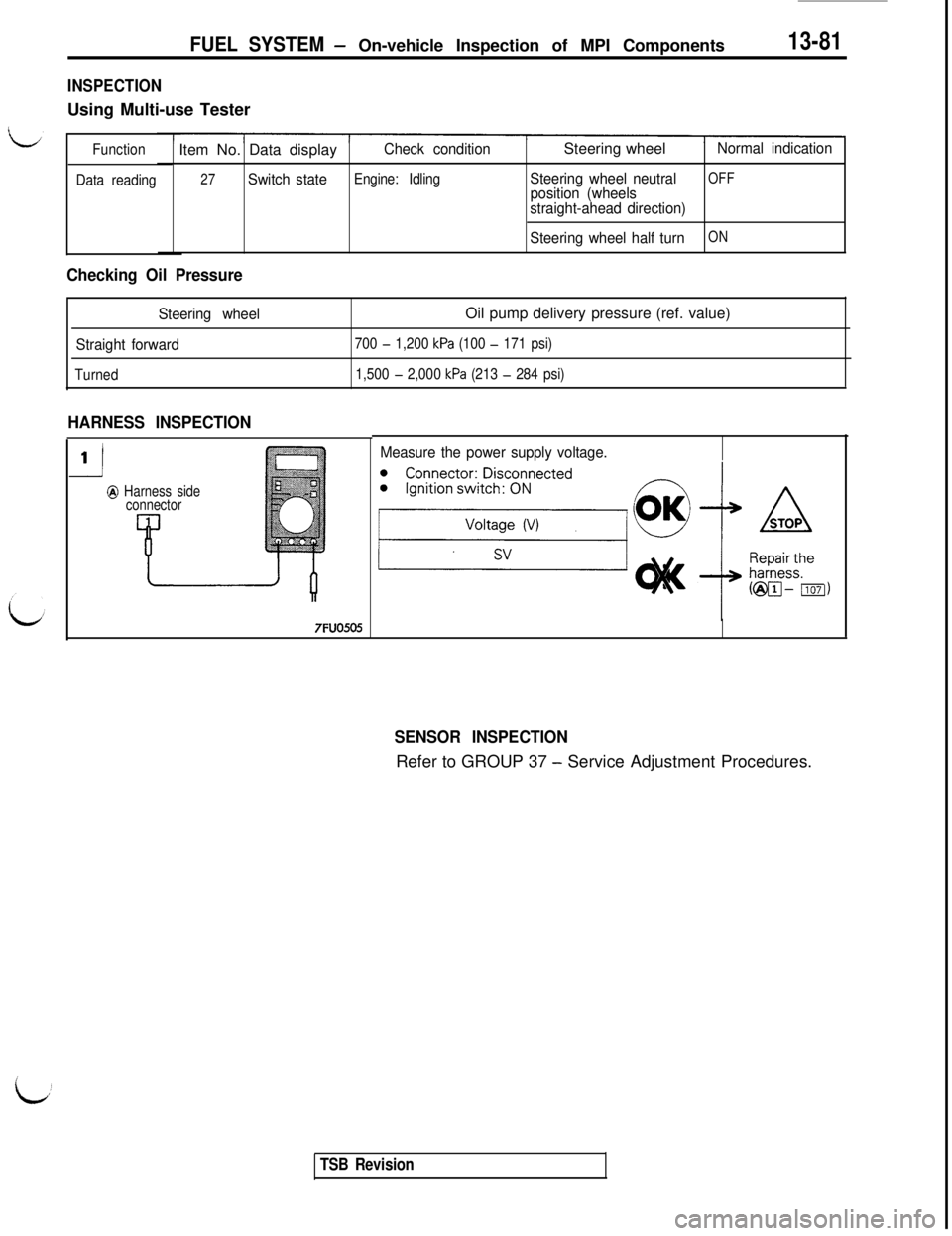
FUEL SYSTEM- On-vehicle Inspection of MPI Components13-81
INSPECTIONUsing Multi-use Tester
Function
Data readingItem No. Data displayCheck conditionSteering wheelNormal indication
27Switch stateEngine: IdlingSteering wheel neutralOFFposition (wheels
straight-ahead direction)
Steering wheel half turn
ON
Checking Oil Pressure
Steering wheelOil pump delivery pressure (ref. value)
Straight forward700 - 1,200 kPa (100 - 171 psi)
Turned1,500
- 2,000 kPa (213 - 284 psi)
HARNESS INSPECTION
i1
@ Harness side
connector
Measure the power supply voltage.
SENSOR INSPECTIONRefer to GROUP 37
- Service Adjustment Procedures.
TSB Revision
Page 208 of 1146
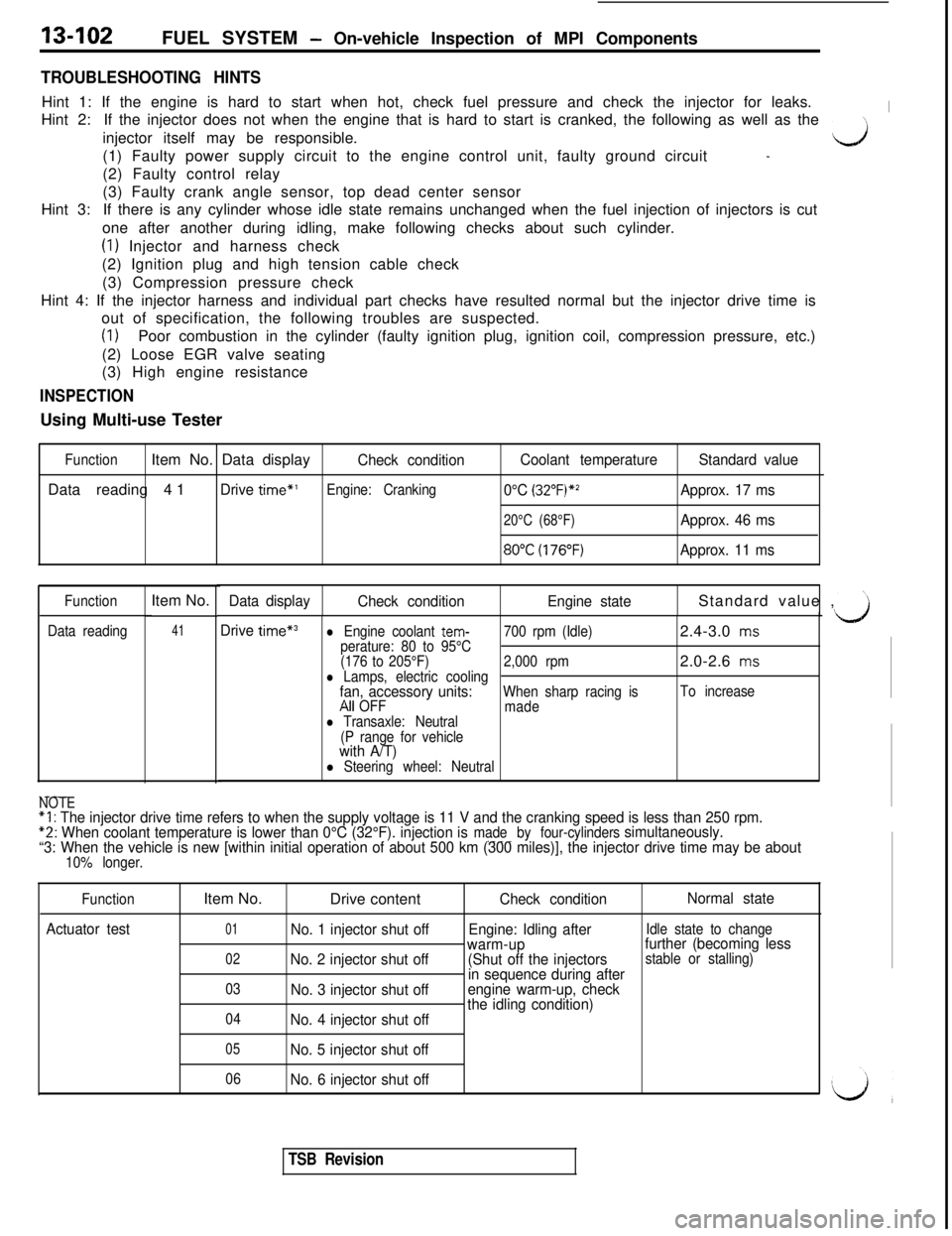
13-102FUEL SYSTEM - On-vehicle Inspection of MPI Components
TROUBLESHOOTING HINTSHint 1: If the engine is hard to start when hot, check fuel pressure and check the injector for leaks.
Hint 2:If the injector does not when the engine that is hard to start is cranked, the following as well as the
Iinjector itself may be responsible.
(1) Faulty power supply circuit to the engine control unit, faulty ground circuit
\-J
-(2) Faulty control relay
Hint 3:(3) Faulty crank angle sensor, top dead center sensor
If there is any cylinder whose idle state remains unchanged when the fuel injection of injectors is cut
one after another during idling, make following checks about such cylinder.
(1) Injector and harness check
(2) Ignition plug and high tension cable check
(3) Compression pressure check
Hint 4: If the injector harness and individual part checks have resulted normal but the injector drive time is
out of specification, the following troubles are suspected.
(1)Poor combustion in the cylinder (faulty ignition plug, ignition coil, compression pressure, etc.)
(2) Loose EGR valve seating
(3) High engine resistance
INSPECTIONUsing Multi-use Tester
FunctionItem No. Data displayCheck conditionCoolant temperatureStandard valueData reading 41
Drive time”’Engine: Cranking0°C (32”F)*zApprox. 17 ms
20°C (68°F)Approx. 46 ms
8O"C(176"F)Approx. 11 ms
Function
Data readingItem No.Data display
41Drive time*3l Engine coolant tem-perature: 80 to 95°C700 rpm (Idle)2.4-3.0 ms
(176 to 205°F)2,000 rpm2.0-2.6
msl Lamps, electric coolingfan, accessory units:When sharp racing isTo increaseAll OFF
madel Transaxle: Neutral
(P range for vehicle
with A/T)l Steering wheel: Neutral
Check conditionEngine stateStandard value ,
.---NOTE“I : The injector drive time refers to when the supply voltage is 11 V and the cranking speed is less than 250 rpm.*2: When coolant temperature is lower than 0°C (32°F). injection ismade by four-cylinders.---simultaneously.
“3: When the vehicle is new [within initial operation of about 500 km (300 miles)], the injector drive time may be about
10% longer.
Function
Actuator testItem No.
Drive content
Check conditionNormal state
01No. 1 injector shut offEngine: Idling afterIdle state to change
02No. 2 injector shut offwarm-up
(Shut off the injectorsfurther (becoming less
in sequence during afterstable or stalling)
03
No. 3 injector shut offengine warm-up, check
04No. 4 injector shut offthe idling condition)
05No. 5 injector shut off
06No. 6 injector shut off
TSB Revision
Page 212 of 1146
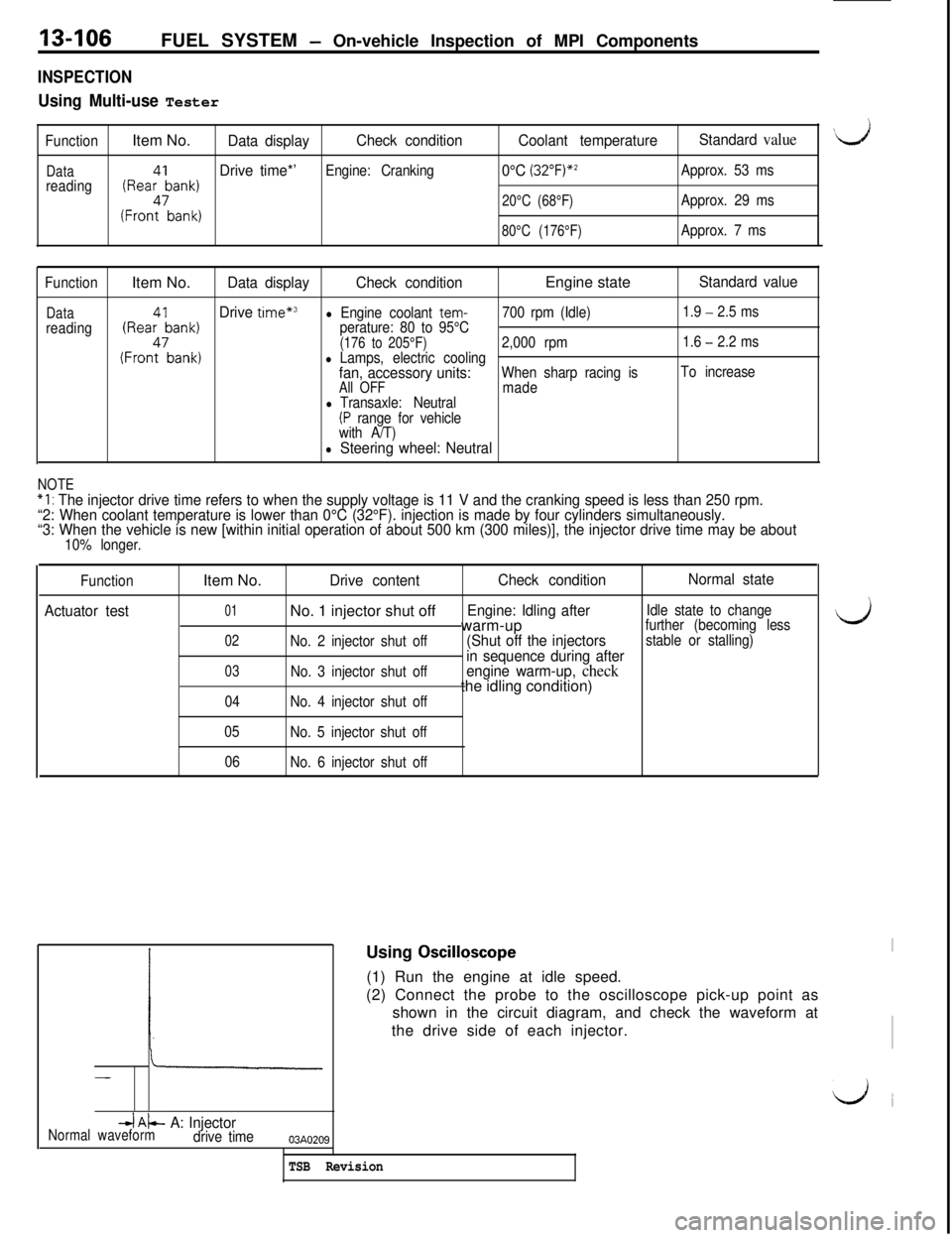
13-106FUEL SYSTEM - On-vehicle Inspection of MPI Components
INSPECTION
Using Multi-use Tester
FunctionItem No.Data displayCheck conditionCoolant temperatureStandard value‘L,,,J
DataDrive time*’0°C (32’F)*’readingiRea:bankiEngine: CrankingApprox. 53 ms
(FronT7bank)20°C (68°F)
Approx. 29 ms
80°C (176°F)Approx. 7 ms
FunctionItem No.
Data displayCheck conditionEngine stateStandard value
Datareading(Reaebank)Drive time*3l Engine coolant tem-700 rpm (Idle)1.9 - 2.5 ms
perature: 80 to 95°C
(Front7banki(176 to 205°F)2,000 rpm1.6 - 2.2 ms
l Lamps, electric coolingfan, accessory units:To increase
All OFFWhen sharp racing is
made
l Transaxle: Neutral(P range for vehicle
with A/T)
l Steering wheel: Neutral
NOTE“I : The injector drive time refers to when the supply voltage is 11 V and the cranking speed is less than 250 rpm.
“2: When coolant temperature is lower than 0°C (32°F). injection is made by four cylinders simultaneously.
“3: When the vehicle is new [within initial operation of about 500 km (300 miles)], the injector drive time may be about
10% longer.
Function
Actuator testItem No.
Drive contentCheck conditionNormal state
01No. 1 injector shut offEngine: Idling afterIdle state to changewarm-upfurther (becoming less
02No. 2 injector shut off(Shut off the injectorsstable or stalling)
03in sequence during afterNo. 3 injector shut offengine warm-up, checkthe idling condition)
04No. 4 injector shut off
05
No. 5 injector shut off
06
No. 6 injector shut off
\,iUsing
OscillqscopeI(1) Run the engine at idle speed.
(2) Connect the probe to the oscilloscope pick-up point as
shown in the circuit diagram, and check the waveform at
the drive side of each injector.~
-
LJ
4 AL A: InjectorNormal waveformdrive time03A0209
TSB Revision