steering MITSUBISHI 3000GT 1991 Workshop Manual
[x] Cancel search | Manufacturer: MITSUBISHI, Model Year: 1991, Model line: 3000GT, Model: MITSUBISHI 3000GT 1991Pages: 1146, PDF Size: 76.68 MB
Page 786 of 1146
35-64SERVICE BRAKES - Brake Pedal
BRAKE PEDAL
REMOVAL AND INSTALLATIONM35GA-
-
Post-installation Operationl Installation of Steering Column
Assembly
(Refer to GROUP
37A-SteeringWheel and Shaft.)l Clutch Pedal Adjustment
(Refer to GROUP 21 -Clutch Pedal.)
l Brake Pedal Adjustment
(Refer to
P.3545.)
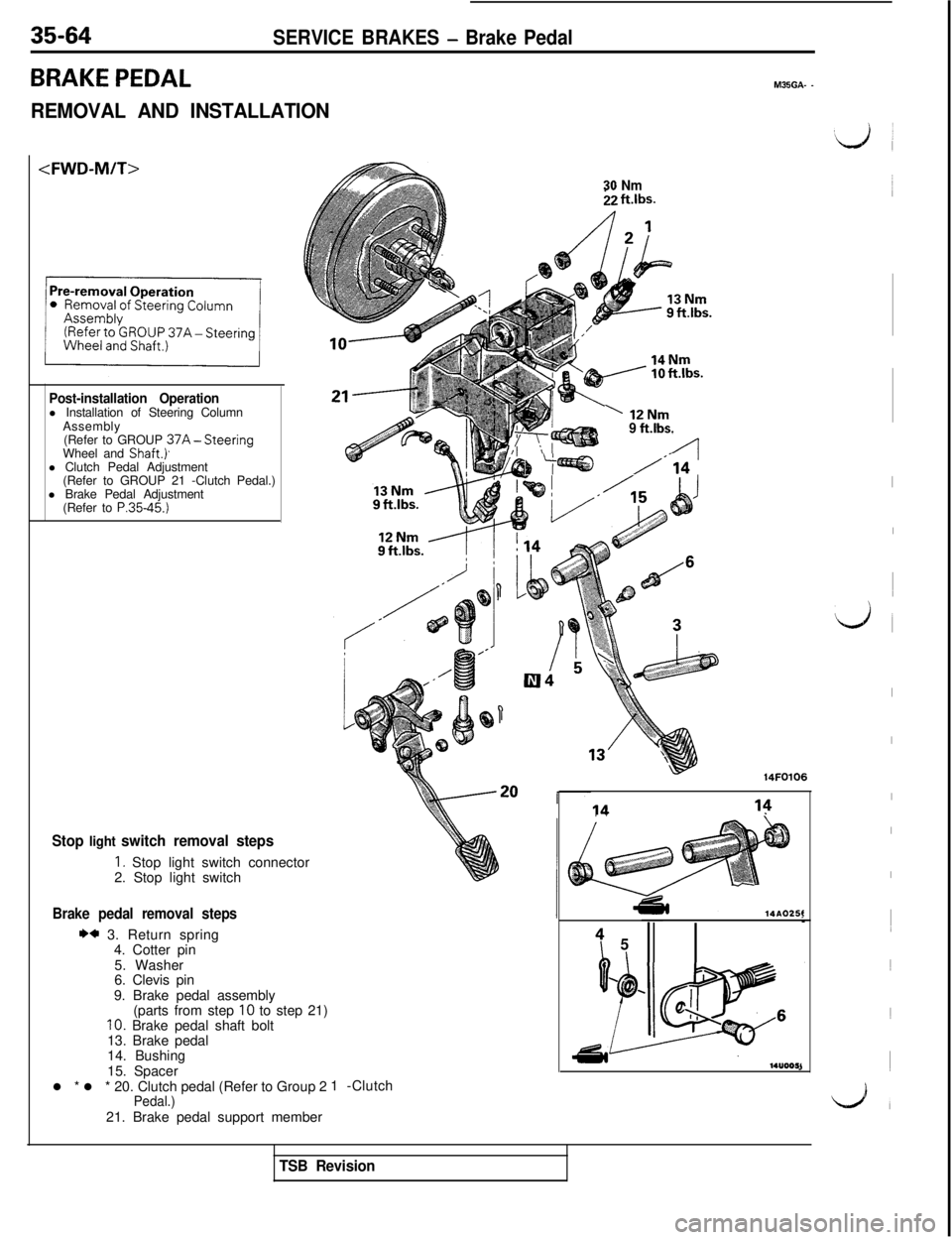
Stop light switch removal steps
I. Stop light switch connector
2. Stop light switch
Brake pedal removal steps
I)* 3. Return spring
4. Cotter pin
5. Washer
6. Clevis pin
9. Brake pedal assembly
(parts from step
10 to step 21)10. Brake pedal shaft bolt
13. Brake pedal
14. Bushing
15. Spacer
l * l * 20. Clutch pedal (Refer to Group 2
Pedal.)1 -Clutch
21. Brake pedal support member
30 Nmftlbs.
’ 12Nm9 ft.lbs.
c-iA.14
14FO10614
l?
14AO2564 5
%
,36il4”OOS,
. .
I
I~
d
I
I
I
I
I~11~
d,
TSB Revision
Page 829 of 1146
37A-1
STEERING
CONTENTSM37AA-A
POWER STEERING GEAR BOX*....................17Steering Wheel Return to Center
Check................................................................8
POWER STEERING HOSES................................32Tie Rod End Ball Joint Startinq Torque
POWER STEERING OIL PUMP. .._....................28Check. . . . . . . . .._.............................. r . . . . . . . . ..I . . . . . .6Tie Rod End Ball Joint Variation Check
SERVICE ADJUSTMENT PROCEDURES5(Shaft direction)................................................5........
Bleeding............................................................10V-Belt Tension Check........................................8
Fluid Level Check............................................9SPECIAL TOOLS....................................................3Fluid Replacement
............................................9
/
bOil Pressure Switch Check
SPECIFICATIONS2............................12................................................Oil Pump Pressure Test
....................................1 1General Specifications....................................2Stationary Steering Effort Check
....................8Lubricants............................................................3Steering Angle Check
5Sealant and Adhesives....................................3........................................Steering Wheel Centering
6Service Specifications....................................2................................Steering Wheel Free Play Check
....................5STEERING WHEEL AND SHAFT*....................13
SUPPLEMENTAL RESTRAINT SYSTEM (SRS)
(1)A Supplemental Restraint System (SRS), which uses a driver-side air bag, has been installed in the 3000GT.(2)The SRS includes the following components: impact sensors, SRS diagnosis unit: SRS warning light, air bagmodule, clock spring, interconnecting wiring. Other SRS-related components (that may have to be
removed/installed in connection with SRS service or maintenance) are indicated in the table of contents byan asterisk (*).
WARNING!(I)Improper service or maintenance of any component of the SRS, or any SRS-related component, can lead to
personal injury or death to service personnel (from inadvertent firing of the air bag) or to the driver (from
rendering the SRS inoperative).
(2) Service or maintenance of any SRS component or SRS-related component must be performed only at an
authorized MITSUBISHI dealer.(3) MITSUBISHI dealer personnel must thoroughly review this manual, and especially its GROUP 52B
-Supplemental Restraint System (SRS), before beginning any service or maintenance of any component of theSRS or any SRS-related component.
Page 830 of 1146
37A-2SPECIFICATIONS
STEERING - Specifications
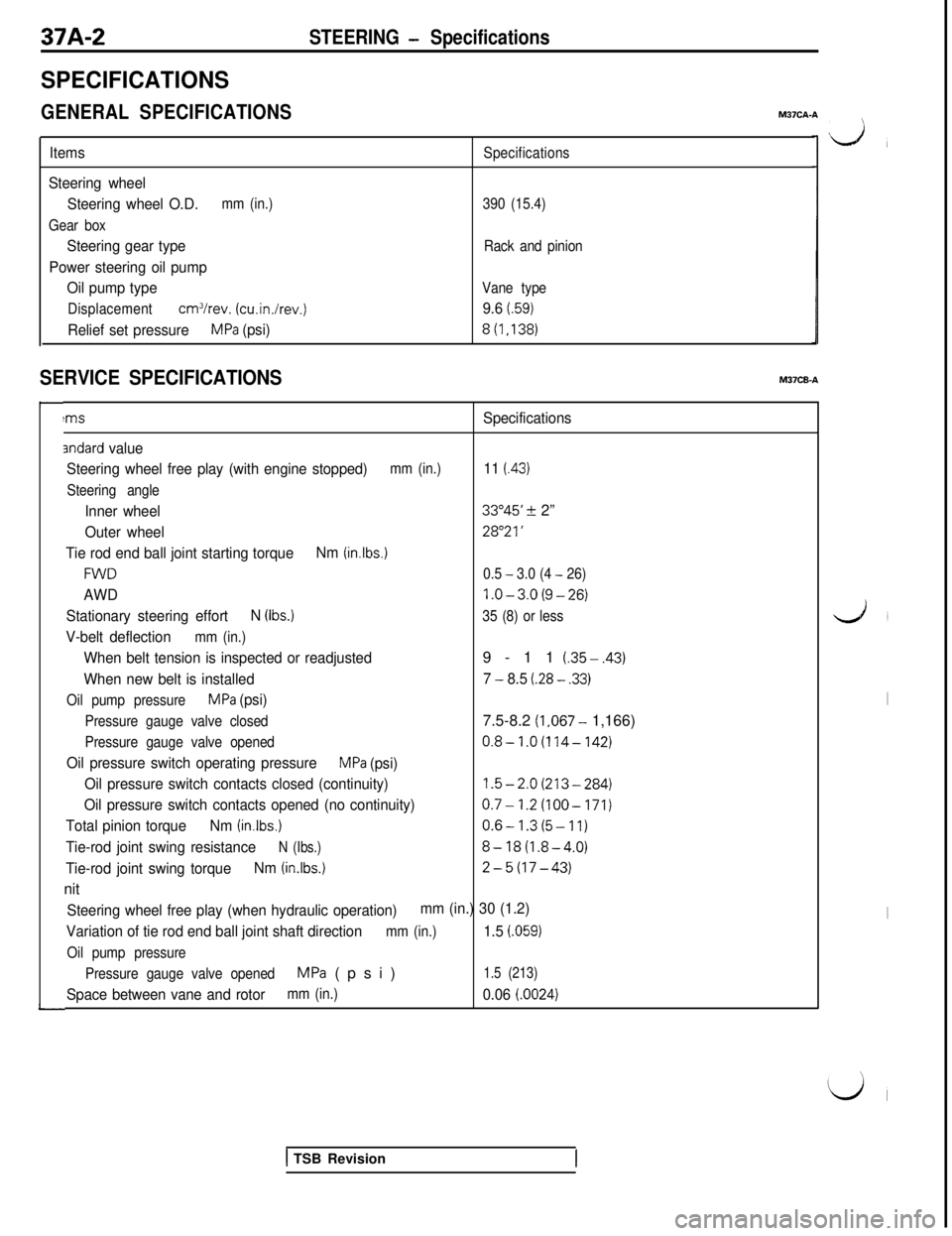
GENERAL SPECIFICATIONS
M37CA-A
LA,Items
Steering wheel
Steering wheel O.D.
mm (in.)
Gear box
Steering gear type
Power steering oil pump
Oil pump type
Displacementcm3/rev. (cu.in./rev.)
Relief set pressureMPa (psi)
Specifications
390 (15.4)
Rack and pinion
Vane type
9.6 t.59)
8(1,138)
SERVICE SPECIFICATIONSM37CB-A
!msSpecifications
andard value
Steering wheel free play (with engine stopped)
mm (in.)11 (43)
Steering angle
Inner wheel33”45’ 2 2”
Outer wheel28”21’
Tie rod end ball joint starting torqueNm (in.lbs.)
FWD0.5 - 3.0 (4 - 26)
AWDl.O-3.0(9-26)
Stationary steering effortN (Ibs.)35 (8) or less
V-belt deflectionmm (in.)
When belt tension is inspected or readjusted9-11 (.35-.43)
When new belt is installed7 - 8.5 (.28 - .33)
Oil pump pressureMPa (psi)
Pressure gauge valve closed7.5-8.2 (1,067- 1,166)
Pressure gauge valve opened0.8-1.0(114-142)
Oil pressure switch operating pressureMPa (psi)
Oil pressure switch contacts closed (continuity)
1.5-2.0(213-284)
Oil pressure switch contacts opened (no continuity)0.7-1.2(100-171)
Total pinion torqueNm (in.lbs.)0.6-1.3(5-11)
Tie-rod joint swing resistanceN (Ibs.)8-18(1.8-4.0)
Tie-rod joint swing torqueNm (in.lbs.)2-5(17-43)nit
Steering wheel free play (when hydraulic operation)mm (in.) 30 (1.2)
Variation of tie rod end ball joint shaft direction
mm (in.)1.5 i.059)
Oil pump pressure
Pressure gauge valve opened
MPa (psi)1.5 (213)
Space between vane and rotormm (in.)0.06 (0024)
LJ’
I
I
L’l
1 TSB Revision
Page 831 of 1146
STEERING -Specifications / Special Tools37A-3
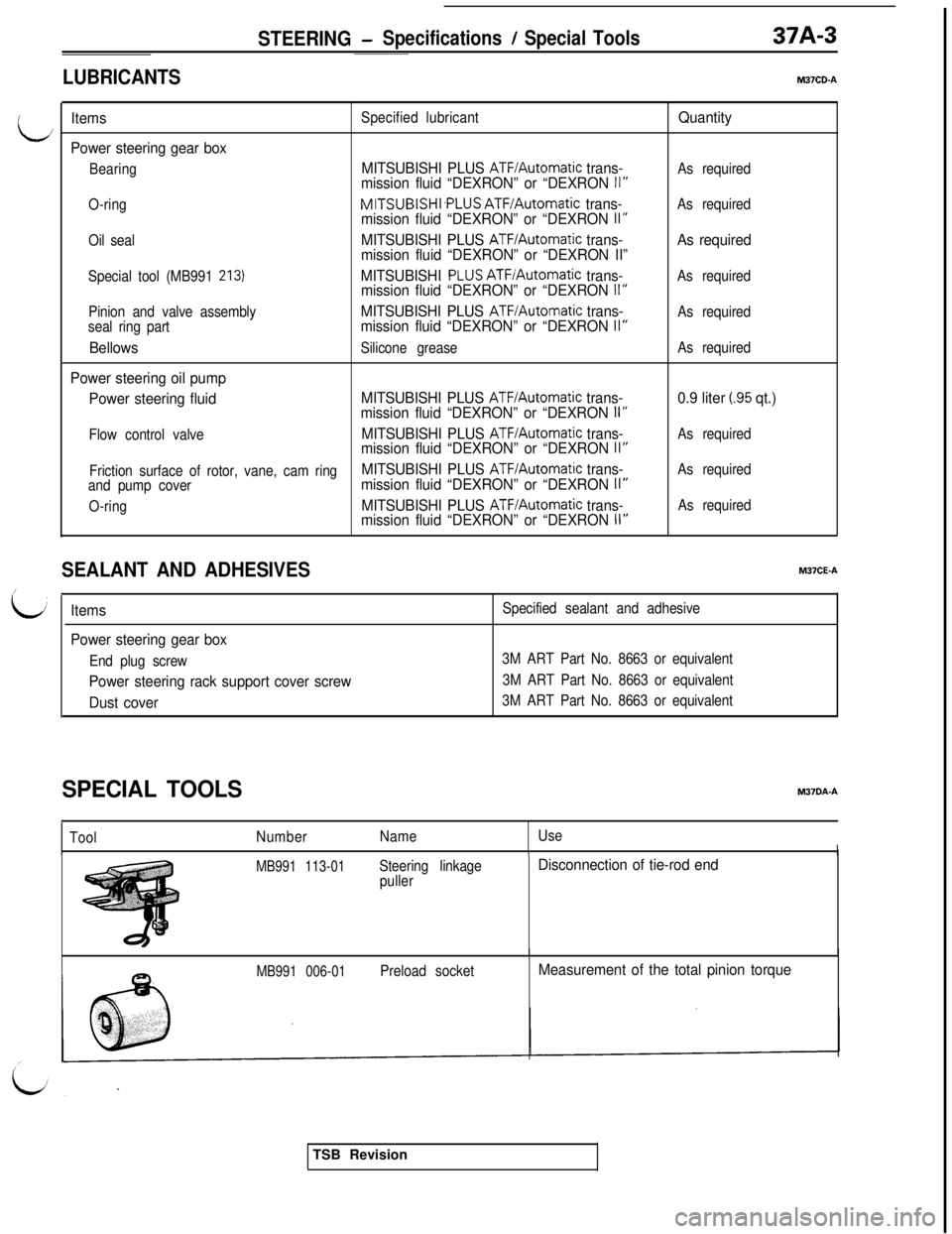
LUBRICANTSM37CD-A
L
/
b
ItemsSpecified lubricantQuantity
Power steering gear box
BearingMITSUBISHI PLUS ATF/Automatic trans-As requiredmission fluid “DEXRON” or “DEXRON II”
O-ringMlTSUBlSHl.PLUS ATF/Automatic trans-As requiredmission fluid “DEXRON” or “DEXRON II”
Oil sealMITSUBISHI PLUS ATF/Automatic trans-As required
mission fluid “DEXRON” or “DEXRON II”
Special tool (MB991 213)MITSUBISHI PLUSATFIAutomatic trans-As requiredmission fluid “DEXRON” or “DEXRON II”
Pinion and valve assemblyMITSUBISHI PLUS ATF/Automatic trans-As required
seal ring partmission fluid “DEXRON” or “DEXRON II”
BellowsSilicone greaseAs required
Power steering oil pump
Power steering fluidMITSUBISHI PLUS
ATF/Automatic trans-0.9 liter (.95 qt.)
mission fluid “DEXRON” or “DEXRON II”
Flow control valveMITSUBISHI PLUS ATF/Automatic trans-As requiredmission fluid “DEXRON” or “DEXRON II”
Friction surface of rotor, vane, cam ringMITSUBISHI PLUS ATF/Automatic trans-As required
and pump covermission fluid “DEXRON” or “DEXRON II”
O-ringMITSUBISHI PLUS ATF/Automatic trans-As requiredmission fluid “DEXRON” or “DEXRON II”
SEALANT AND ADHESIVESM37CE-A
Items
Power steering gear box
End plug screw
Power steering rack support cover screw
Dust cover
Specified sealant and adhesive
3M ART Part No. 8663 or equivalent
3M ART Part No. 8663 or equivalent
3M ART Part No. 8663 or equivalent
SPECIAL TOOLSM37DA.A
ToolNumberNameUseII
MB991 113-01Steering linkage
pullerDisconnection of tie-rod end
MB991 006-01Preload socketMeasurement of the total pinion torqueTSB Revision
Page 832 of 1146
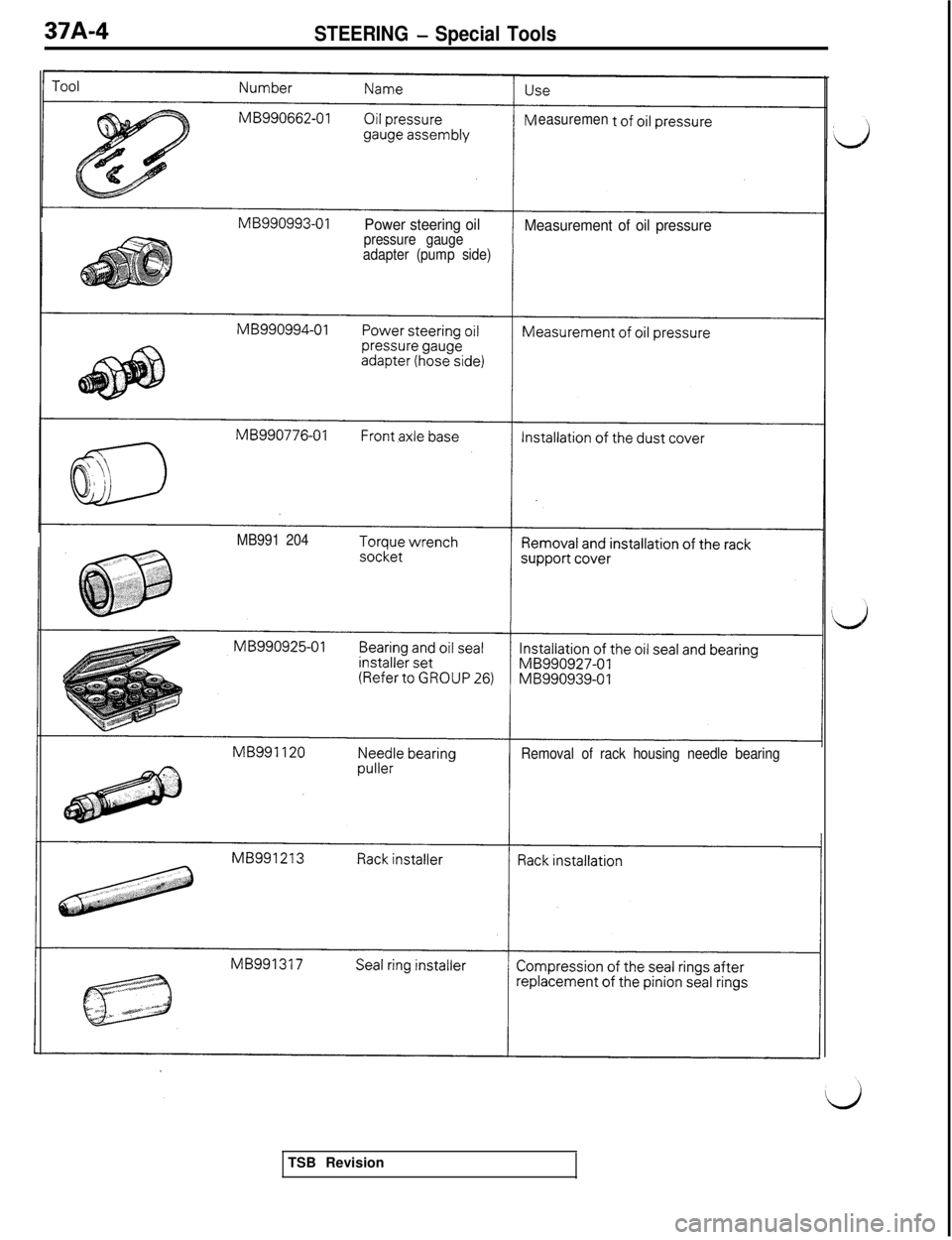
37A-4STEERING - Special Tools
easuremen
MB990993-01Power steering oilpressure gauge
adapter (pump side)Measurement of oil pressure
MB991 204
Removal of rack housing needle bearingTSB Revision
Page 833 of 1146
STEERING 2 Service Adjustment Procedures37A-5
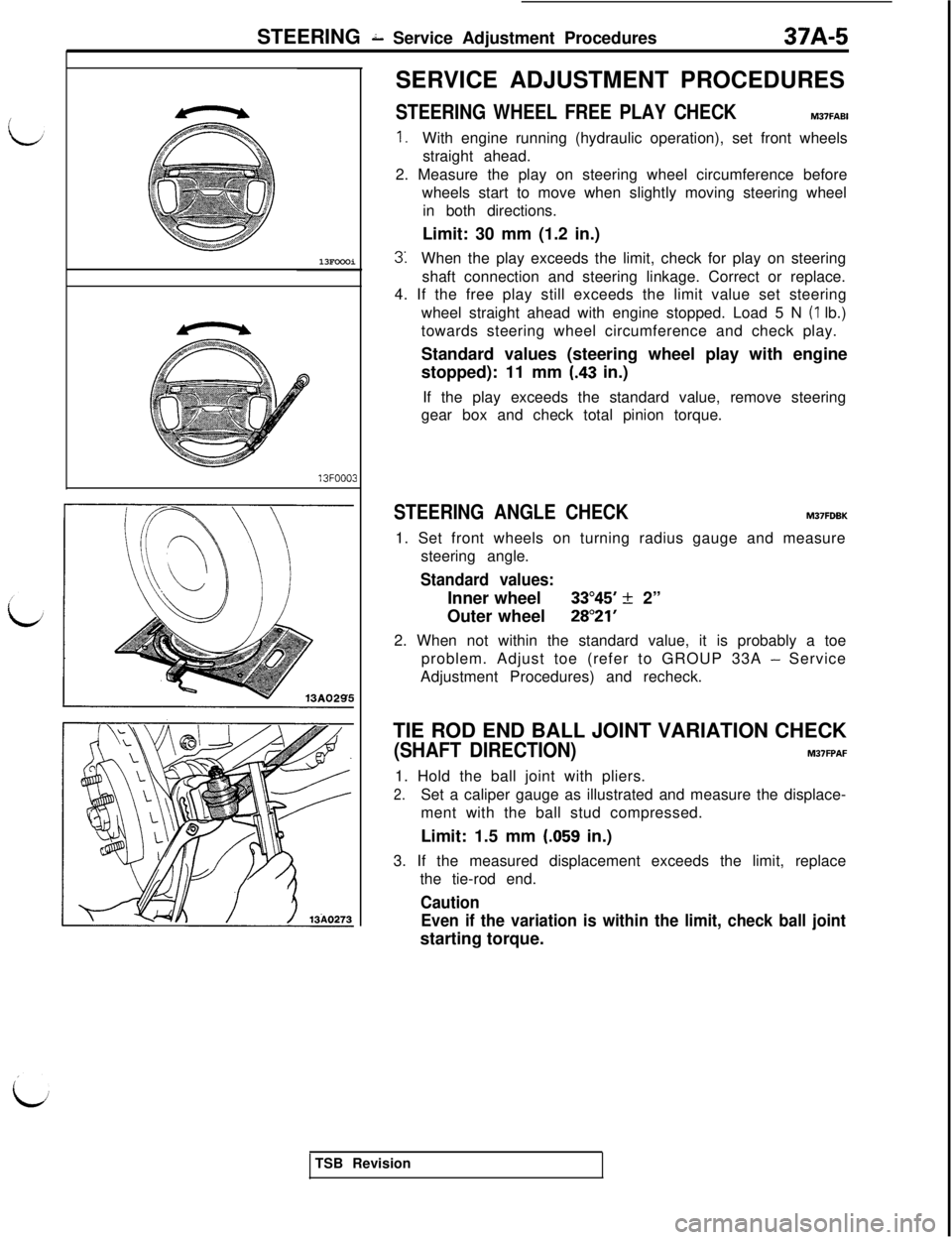
13FOOOi13FOOO3SERVICE ADJUSTMENT PROCEDURES
STEERING WHEEL FREE PLAY CHECKM37FABI
1.With engine running (hydraulic operation), set front wheels
straight ahead.
2. Measure the play on steering wheel circumference before
wheels start to move when slightly moving steering wheel
in both directions.
Limit: 30 mm (1.2 in.)
3:When the play exceeds the limit, check for play on steering
shaft connection and steering linkage. Correct or replace.
4. If the free play still exceeds the limit value set steering
wheel straight ahead with engine stopped. Load 5 N
(1 lb.)
towards steering wheel circumference and check play.
Standard values (steering wheel play with engine
stopped): 11 mm
(.43 in.)
If the play exceeds the standard value, remove steering
gear box and check total pinion torque.
STEERING ANGLE CHECKM37FDBK1. Set front wheels on turning radius gauge and measure
steering angle.
Standard values:Inner wheel
33”45’ k 2”
Outer wheel
28”21’2. When not within the standard value, it is probably a toe
problem. Adjust toe (refer to GROUP 33A
- Service
Adjustment Procedures) and recheck.
TIE ROD END BALL JOINT VARIATION CHECK
(SHAFT DIRECTION)M37FPAF1. Hold the ball joint with pliers.
2.Set a caliper gauge as illustrated and measure the displace-
ment with the ball stud compressed.
Limit: 1.5 mm
(.059 in.)
3. If the measured displacement exceeds the limit, replace
the tie-rod end.
Caution
Even if the variation is within the limit, check ball jointstarting torque.
TSB Revision
Page 834 of 1146
STEERING - Service Adjustment Procedures13G005E
Tape or markon steering
wheel hub
13FOO4:
Lines atstraight-position-ahead
Dotted linesshow wheel
at desired
positlon
Tape or mark
on
steenngwheel rim
tanceRuler 7’off-center13FOO4;
36 splines
13W589/13FOO45
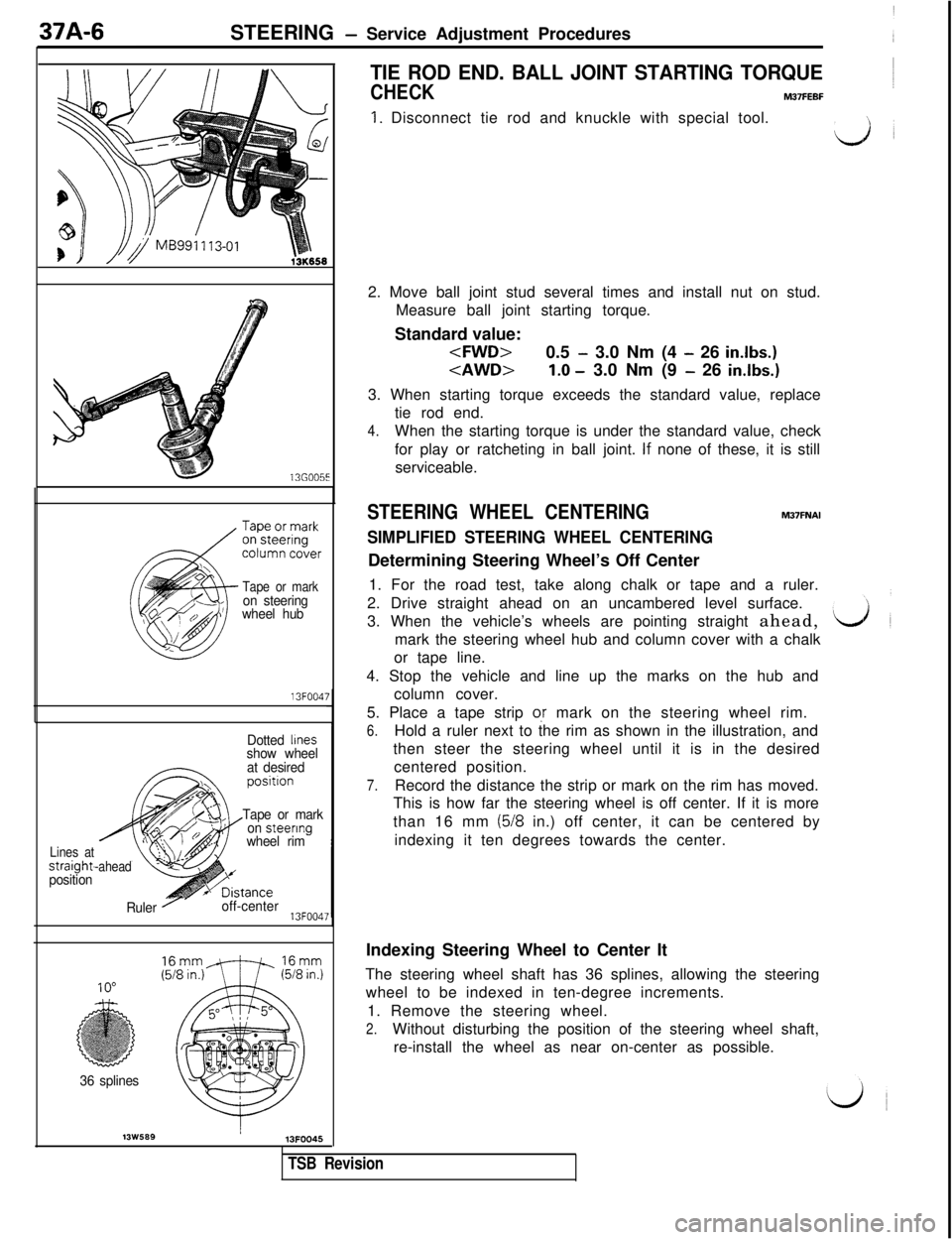
TIE ROD END. BALL JOINT STARTING TORQUE
CHECK~M37FEBF
1. Disconnect tie rod and knuckle with special tool.~
LJ2. Move ball joint stud several times and install nut on stud.
Measure ball joint starting torque.
Standard value:
tie rod end.
4.When the starting torque is under the standard value, check
for play or ratcheting in ball joint.
If none of these, it is still
serviceable.
STEERING WHEEL CENTERINGM37FNAI
SIMPLIFIED STEERING WHEEL CENTERINGDetermining Steering Wheel’s Off Center
1. For the road test, take along chalk or tape and a ruler.
2. Drive straight ahead on an uncambered level surface.
3. When the vehicle’s wheels are pointing straight ahead,
mark the steering wheel hub and column cover with a chalk
or tape line.
4. Stop the vehicle and line up the marks on the hub and
column cover.
5. Place a tape strip
01 mark on the steering wheel rim.
6.Hold a ruler next to the rim as shown in the illustration, and
then steer the steering wheel until it is in the desired
centered position.
7.Record the distance the strip or mark on the rim has moved.
This is how far the steering wheel is off center. If it is more
than 16 mm
(518 in.) off center, it can be centered by
indexing it ten degrees towards the center.
Indexing Steering Wheel to Center It
The steering wheel shaft has 36 splines, allowing the steering
wheel to be indexed in ten-degree increments.
1. Remove the steering wheel.
2.Without disturbing the position of the steering wheel shaft,
re-install the wheel as near on-center as possible.
TSB Revision
Page 835 of 1146
STEERING - Service Adjustment Procedures37A-7
L
i
13FOO46
Steering wheel off center left
13K11l13FOO48
Offcenter to leftOff center to left
Off center to rightOff center to right
Turn both tie rods in the same direction.13R055E
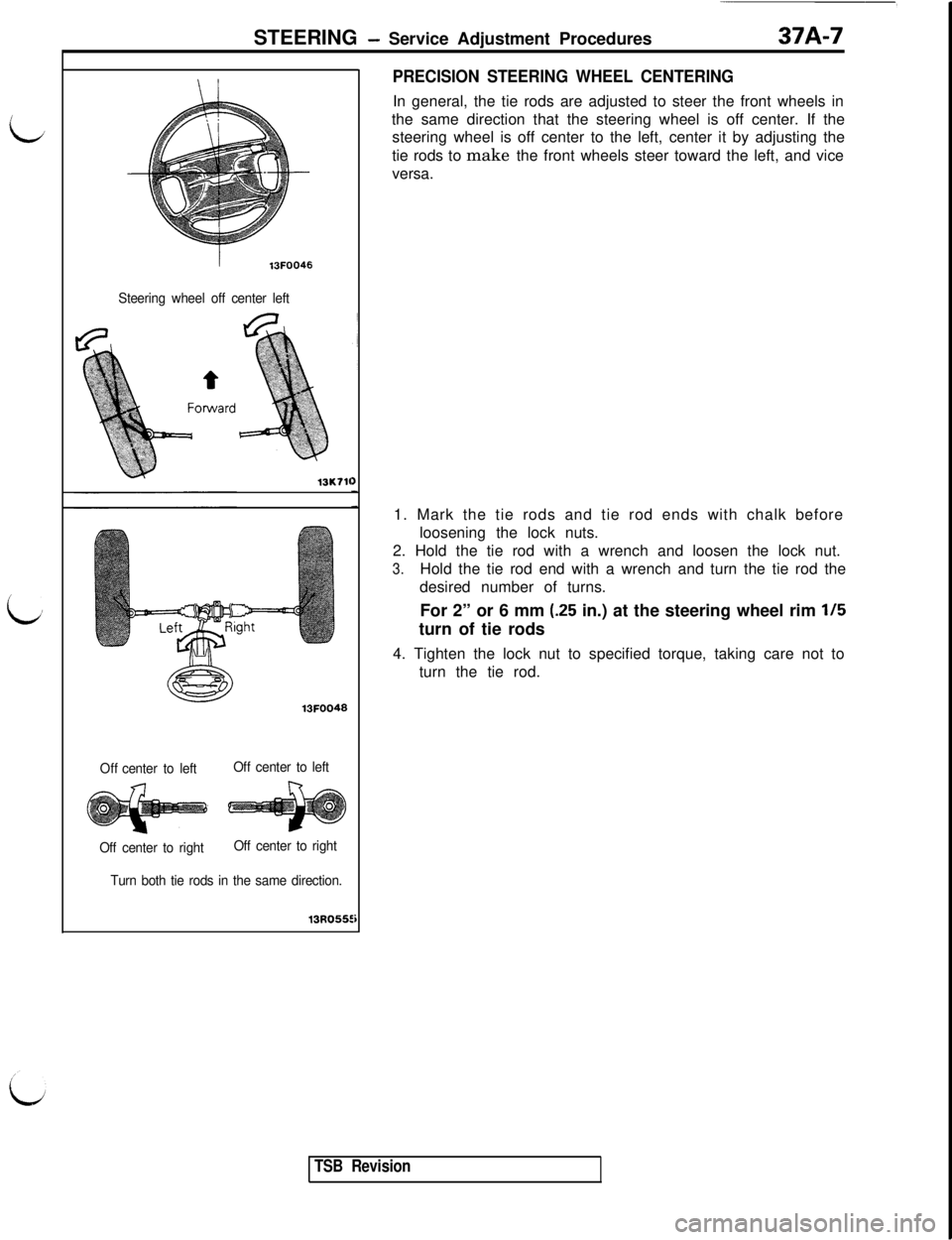
PRECISION STEERING WHEEL CENTERINGIn general, the tie rods are adjusted to steer the front wheels in
the same direction that the steering wheel is off center. If the
steering wheel is off center to the left, center it by adjusting the
tie rods to make the front wheels steer toward the left, and vice
versa.
1. Mark the tie rods and tie rod ends with chalk before
loosening the lock nuts.
2. Hold the tie rod with a wrench and loosen the lock nut.
3.Hold the tie rod end with a wrench and turn the tie rod the
desired number of turns.
For 2” or 6 mm
(.25 in.) at the steering wheel rim l/5turn of tie rods
4. Tighten the lock nut to specified torque, taking care not to
turn the tie rod.
TSB Revision
Page 836 of 1146
37A-8STEERING - Service Adjustment Procedures13FOOO3
13FOOOl
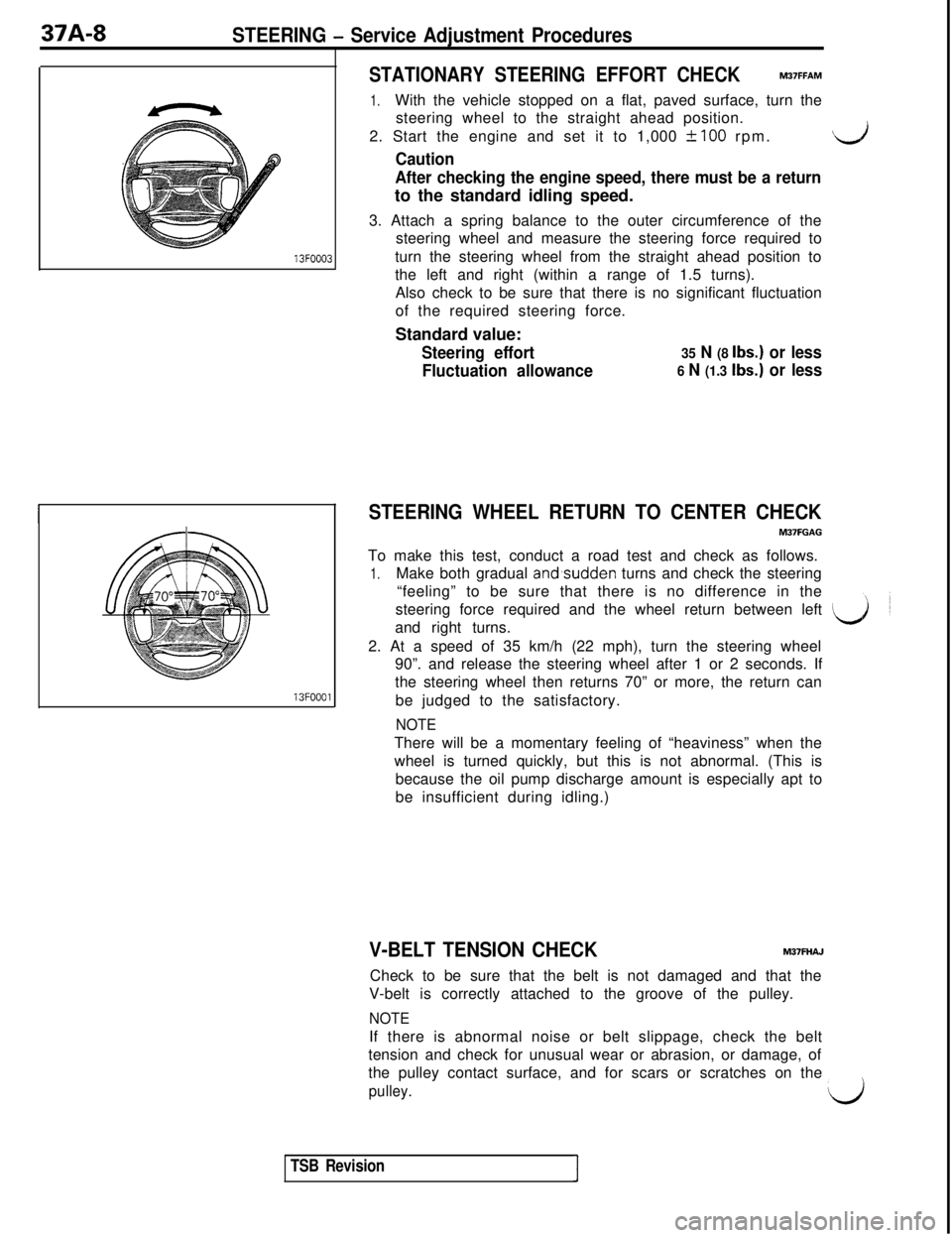
STATIONARY STEERING EFFORT CHECKM37FFAM
1.With the vehicle stopped on a flat, paved surface, turn the
steering wheel to the straight ahead position.
2. Start the engine and set it to 1,000
+ 100 rpm.d
Caution
After checking the engine speed, there must be a returnto the standard idling speed.
3. Attach a spring balance to the outer circumference of the
steering wheel and measure the steering force required to
turn the steering wheel from the straight ahead position to
the left and right (within a range of 1.5 turns).
Also check to be sure that there is no significant fluctuation
of the required steering force.
Standard value:
Steering effort35 N (8 Ibs.) or less
Fluctuation allowance
6 N (1.3 Ibs.) or less
STEERING WHEEL RETURN TO CENTER CHECK
M37FGACiTo make this test, conduct a road test and check as follows.
1.Make both gradual and,sudden turns and check the steering
“feeling” to be sure that there is no difference in the
steering force required and the wheel return between left
and right turns.
2. At a speed of 35 km/h (22 mph), turn the steering wheel
90”. and release the steering wheel after 1 or 2 seconds. If
the steering wheel then returns 70” or more, the return can
be judged to the satisfactory.
NOTEThere will be a momentary feeling of “heaviness” when the
wheel is turned quickly, but this is not abnormal. (This is
because the oil pump discharge amount is especially apt to
be insufficient during idling.)
V-BELT TENSION CHECKM37FHAJCheck to be sure that the belt is not damaged and that the
V-belt is correctly attached to the groove of the pulley.
NOTEIf there is abnormal noise or belt slippage, check the belt
tension and check for unusual wear or abrasion, or damage, of
the pulley contact surface, and for scars or scratches on the
pulley.d
TSB RevisionI
Page 837 of 1146
STEERING - Service Adjustment Procedures37A-9
LL:13N002E
FluId f[uctuatlon
While
engineWhile engme
runningstopped13uo13:
Return ho
Vinyl hose13AO142
j
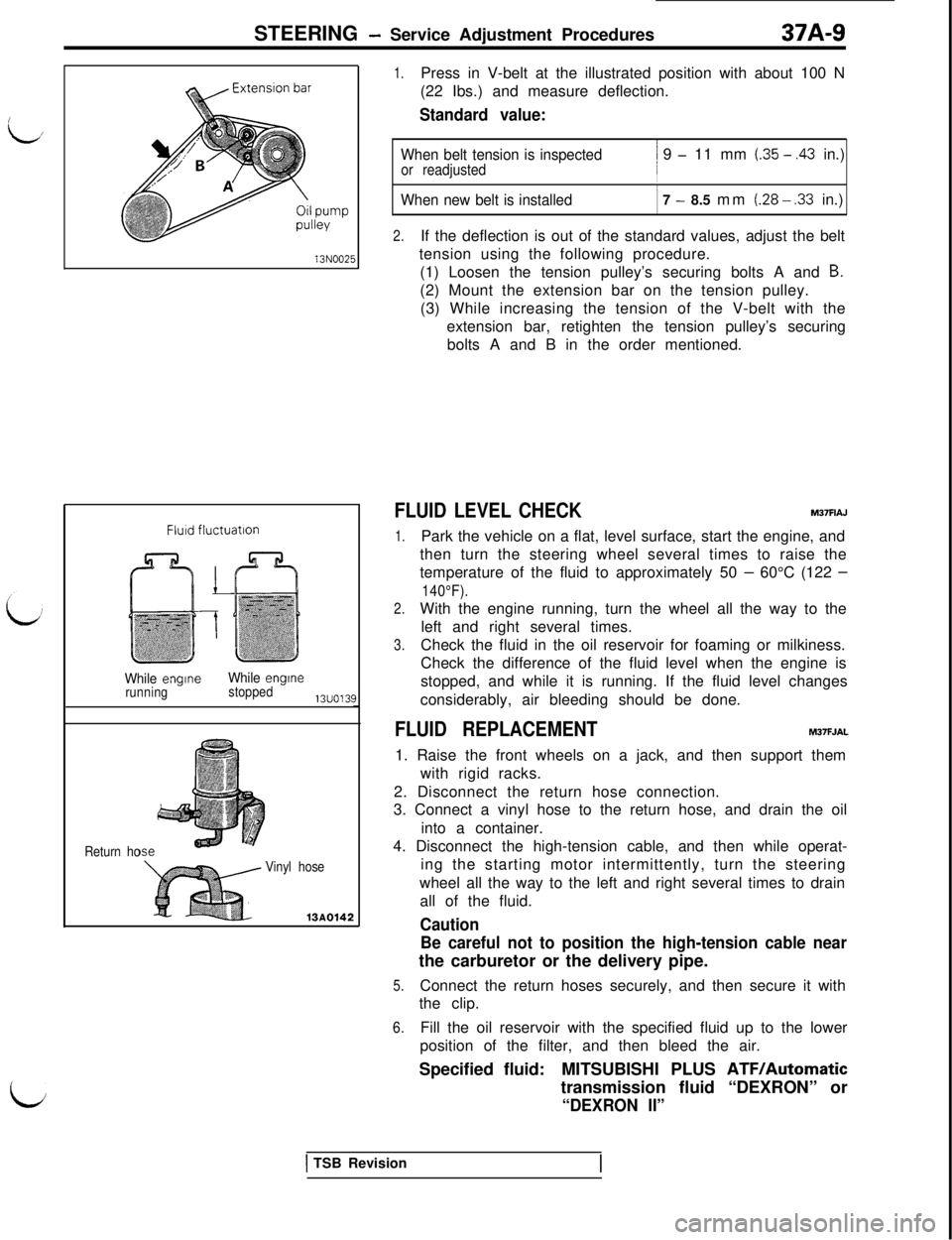
1.Press in V-belt at the illustrated position with about 100 N
(22 Ibs.) and measure deflection.
Standard value:
When belt tension is inspectedor readjusted
When new belt is installed
/ 9 - 11 mm (.35 - .43 in.)
I
’ 7 - 8.5 mm (.28 - .33 in.)
2.If the deflection is out of the standard values, adjust the belt
tension using the following procedure.
(1) Loosen the tension pulley’s securing bolts A and
B.(2) Mount the extension bar on the tension pulley.
(3) While increasing the tension of the V-belt with the
extension bar, retighten the tension pulley’s securing
bolts A and B in the order mentioned.
FLUID LEVEL CHECKM37FlAJ
1.Park the vehicle on a flat, level surface, start the engine, and
then turn the steering wheel several times to raise the
temperature of the fluid to approximately 50
- 60°C (122 -
140°F).
2.With the engine running, turn the wheel all the way to the
left and right several times.
3.Check the fluid in the oil reservoir for foaming or milkiness.
Check the difference of the fluid level when the engine is
stopped, and while it is running. If the fluid level changes
considerably, air bleeding should be done.
FLUID REPLACEMENTM37FJAL1. Raise the front wheels on a jack, and then support them
with rigid racks.
2. Disconnect the return hose connection.
3. Connect a vinyl hose to the return hose, and drain the oil
into a container.
4. Disconnect the high-tension cable, and then while operat-
ing the starting motor intermittently, turn the steering
wheel all the way to the left and right several times to drain
all of the fluid.
Caution
Be careful not to position the high-tension cable nearthe carburetor or the delivery pipe.
5.Connect the return hoses securely, and then secure it with
the clip.
6.Fill the oil reservoir with the specified fluid up to the lower
position of the filter, and then bleed the air.
Specified fluid:MITSUBISHI PLUS ATF/Automatic
transmission fluid “DEXRON” or
“DEXRON II”
1 TSB Revision