engine MITSUBISHI 3000GT 1991 Service Manual
[x] Cancel search | Manufacturer: MITSUBISHI, Model Year: 1991, Model line: 3000GT, Model: MITSUBISHI 3000GT 1991Pages: 1146, PDF Size: 76.68 MB
Page 270 of 1146
13-164CRUISE CONTROL SYSTEM - Troubleshooting
2Inspection of control switch circuit
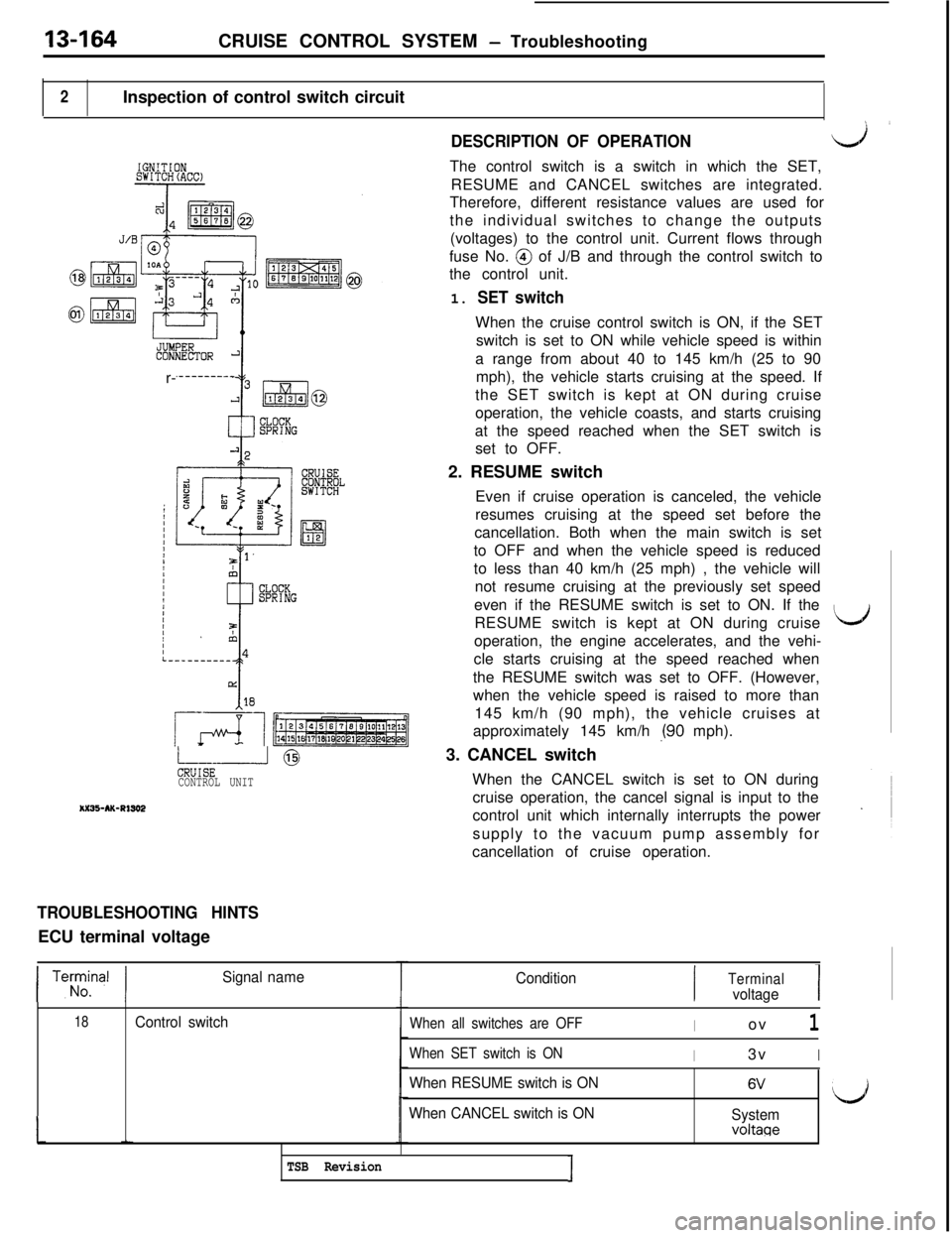
IGNITIONSWITCHtACC)
*X35-AK-R1302r-
._--------
LE- @CONTROL UNIT
TROUBLESHOOTING HINTSECU terminal voltage
DESCRIPTION OF OPERATIONdThe control switch is a switch in which the SET,
RESUME and CANCEL switches are integrated.
Therefore, different resistance values are used for
the individual switches to change the outputs
(voltages) to the control unit. Current flows through
fuse No. @ of J/B and through the control switch to
the control unit.
1. SET switchWhen the cruise control switch is ON, if the SET
switch is set to ON while vehicle speed is within
a range from about 40 to 145 km/h (25 to 90
mph), the vehicle starts cruising at the speed. If
the SET switch is kept at ON during cruise
operation, the vehicle coasts, and starts cruising
at the speed reached when the SET switch is
set to OFF.
2. RESUME switch
Even if cruise operation is canceled, the vehicle
resumes cruising at the speed set before the
cancellation. Both when the main switch is set
to OFF and when the vehicle speed is reduced
to less than 40 km/h (25 mph) , the vehicle will
not resume cruising at the previously set speed
even if the RESUME switch is set to ON. If the
RESUME switch is kept at ON during cruise
LJoperation, the engine accelerates, and the vehi-
cle starts cruising at the speed reached when
the RESUME switch was set to OFF. (However,
when the vehicle speed is raised to more than
145 km/h (90 mph), the vehicle cruises at
approximately 145 km/h {90 mph).
3. CANCEL switch
When the CANCEL switch is set to ON during
cruise operation, the cancel signal is input to the
control unit which internally interrupts the power
supply to the vacuum pump assembly for
cancellation of cruise operation.
18Control switchSignal name
L
Condition
I
Terminalvoltage1
When all switches are OFFIov1
When SET switch is ONI3vI
When RESUME switch is ON
When CANCEL switch is ON6Vd
Systemvoltage
TSB RevisionJ
Page 275 of 1146
Page 282 of 1146
13-176CRUISE CONTROL SYSTEM - Troubleshooting
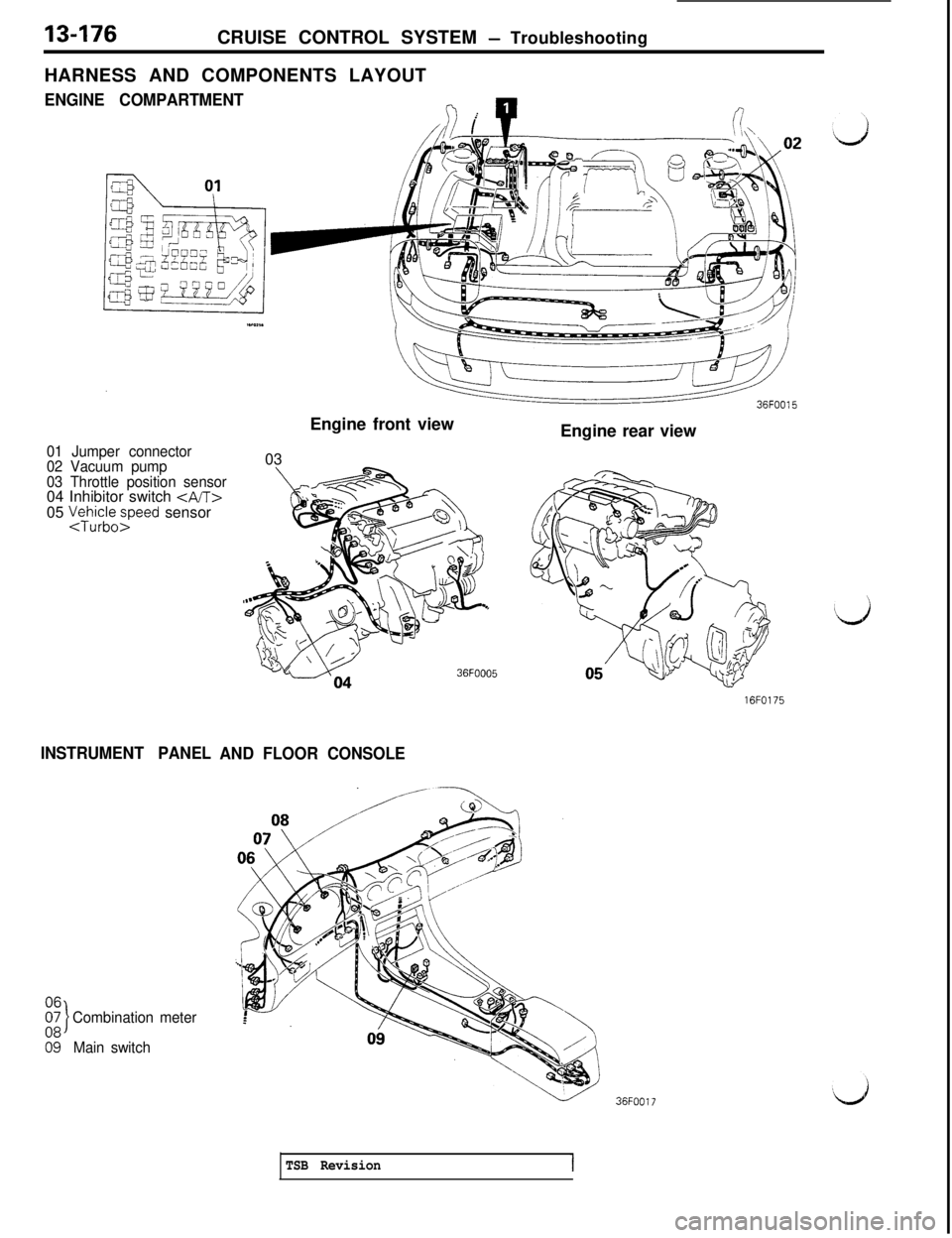
HARNESS AND COMPONENTS LAYOUT
ENGINE COMPARTMENT
01 Jumper connector
02 Vacuum pump
03 Throttle position sensor04 Inhibitor switch
05
VeTkFo;peed sensor
INSTRUMENT PANEL
AND FLOOR CONSOLE
Combination meter
Main switchEngine front view
03
36FOOO5Engine rear view
16FO175
36FOO17
TSB Revision
Page 284 of 1146
13-I 78CRUISE CONTROL SYSTEM - Service Adjustment ProceduresSERVICE
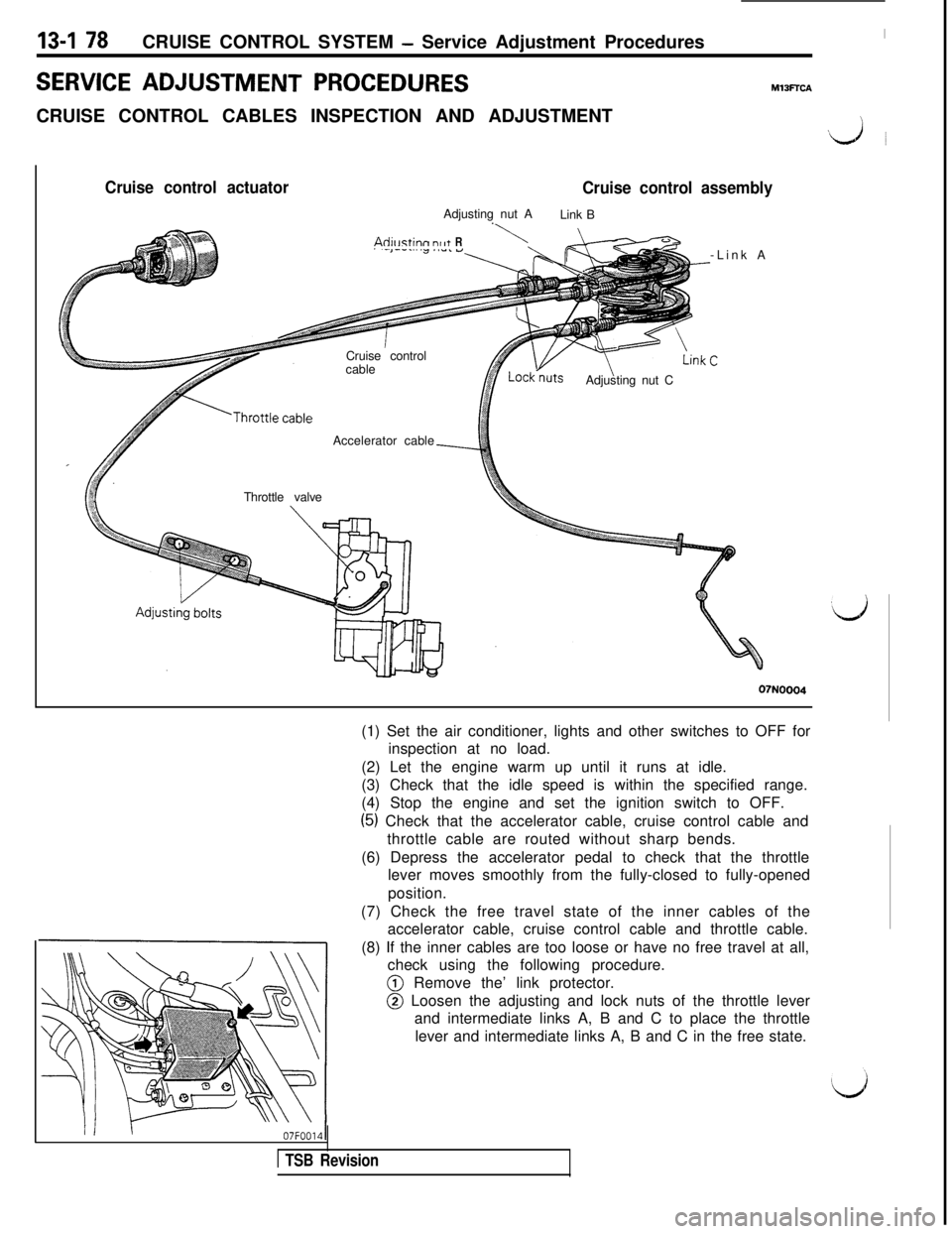
ADJUSTMENT PROCEDURESCRUISE CONTROL CABLES INSPECTION AND ADJUSTMENT
I
MlSFTCA
‘\J ~
Cruise control actuator
Cruise control assemblyAdjusting nut A
Link B
.
Adillstinn nr~+ R\Cruise control
cable
Adjusting nut C
Accelerator cable
Throttle valve-Link A
07N0004(1) Set the air conditioner, lights and other switches to OFF for
inspection at no load.
(2) Let the engine warm up until it runs at idle.
(3) Check that the idle speed is within the specified range.
(4) Stop the engine and set the ignition switch to OFF.
(5) Check that the accelerator cable, cruise control cable and
throttle cable are routed without sharp bends.
(6) Depress the accelerator pedal to check that the throttle
lever moves smoothly from the fully-closed to fully-opened
position.
(7) Check the free travel state of the inner cables of the
accelerator cable, cruise control cable and throttle cable.
(8) If the inner cables are too loose or have no free travel at all,
check using the following procedure.@ Remove the’ link protector.
@ Loosen the adjusting and lock nuts of the throttle lever
and intermediate links A, B and C to place the throttle
lever and intermediate links A, B and C in the free state.
1 TSB Revision
Page 285 of 1146
CRUISE CONTROL SYSTEM - Service Adjustment Procedures13-179Adjusting nut C
07NOOlELink Blever
07N0019Link
B07NOOlE
y,jj--ww ,03LO122
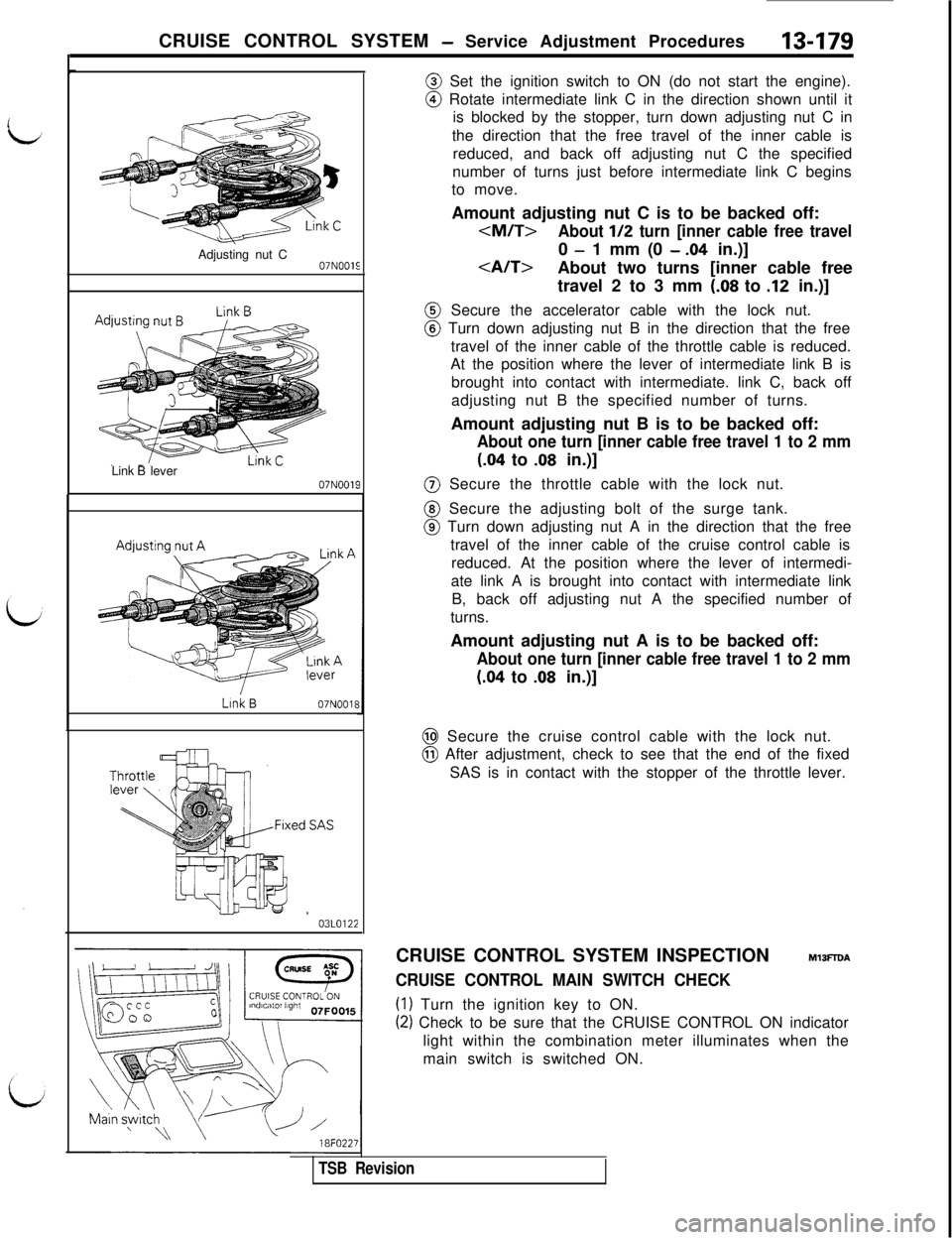
\\ \18FO2.2'@ Set the ignition switch to ON (do not start the engine).@ Rotate intermediate link C in the direction shown until it
is blocked by the stopper, turn down adjusting nut C in
the direction that the free travel of the inner cable is
reduced, and back off adjusting nut C the specified
number of turns just before intermediate link C begins
to move.
Amount adjusting nut C is to be backed off:
- 1 mm (0 - .04 in.)]
About two turns [inner cable free
travel 2 to 3 mm
(.08 to .12 in.)]@ Secure the accelerator cable with the lock nut.@ Turn down adjusting nut B in the direction that the free
travel of the inner cable of the throttle cable is reduced.
At the position where the lever of intermediate link B is
brought into contact with intermediate. link C, back off
adjusting nut B the specified number of turns.
Amount adjusting nut B is to be backed off:
About one turn [inner cable free travel 1 to 2 mm
(.04 to .08 in.)]@ Secure the throttle cable with the lock nut.@ Secure the adjusting bolt of the surge tank.@ Turn down adjusting nut A in the direction that the free
travel of the inner cable of the cruise control cable is
reduced. At the position where the lever of intermedi-
ate link A is brought into contact with intermediate link
B, back off adjusting nut A the specified number of
turns.
Amount adjusting nut A is to be backed off:
About one turn [inner cable free travel 1 to 2 mm
(.04 to .08 in.)]@ Secure the cruise control cable with the lock nut.@ After adjustment, check to see that the end of the fixed
SAS is in contact with the stopper of the throttle lever.
CRUISE CONTROL SYSTEM INSPECTION
MlBFlDA
CRUISE CONTROL MAIN SWITCH CHECK
(1) Turn the ignition key to ON.
(2) Check to be sure that the CRUISE CONTROL ON indicator
light within the combination meter illuminates when the
main switch is switched ON.
TSB Revision
Page 295 of 1146
COOLINGCONTENTS
M14AA..
ENGINE COOLANT TEMPERATURE GAUGE
UNIT, ENGINE COOLANT TEMPERATURESENSOR AND ENGINE COOLANT
TEMPERATURE SWITCH. . . . . . . . . . . . . . . . . . . . . . . . . . . . . . .._.__15
RADIATOR. . . . . . . . . . . . . . . . . . . . . . . . . . . . . . . . . . . . . . . . . . . . . . . . . . . . . . . . . . . .8
SERVICE ADJUSTMENT PROCEDURES . . . . . . . .7Cap Pressure Test
. . . . . . . . . . . . . . . . . . . . . . . . . . . . . . . . . . .._.......7Engine Coolant Concentration Test
. . . . . . . . . . . . . . . .‘7
L,Engine Coolant Leak Check
. . . . . . . . . . . . . . . . . . . . . . . . . . . .7Engine Coolant Replacement
. . . . . . . . . . . . . . . . . . . . . . . .7
SPECIFICATIONS. . . . . . . . . . . . .._.................................General Specifications
. ..___....___._...___.__............Lubricant
. . . . . . . . . . . . . . . . . . . . . . . . . . . . . . .._.................._........Sealant and Adhesive
. . . . . . . . . . . . . . . . .._...........Service Specifications
. . . . . . . . . . . . . . . . . . . . . . . . . .
THERMOSTAT. . . ..__......................_.._...................
TROUBLESHOOTING. . . . . . . . . . . . . . . . . . . . . . . . . . . . . . . . . . .._...No Rise in Temperature
Overheat
WATER PUMP, WATER PIPE AND WATER
HOSE. . . . _......_........_ _.._ .._..... . . . . . . . . . . . ._. . . . . . . . . . . . . . . . .
2
2
2
3
2
11
3
13
Page 296 of 1146
14-2COOLING - SDecifications
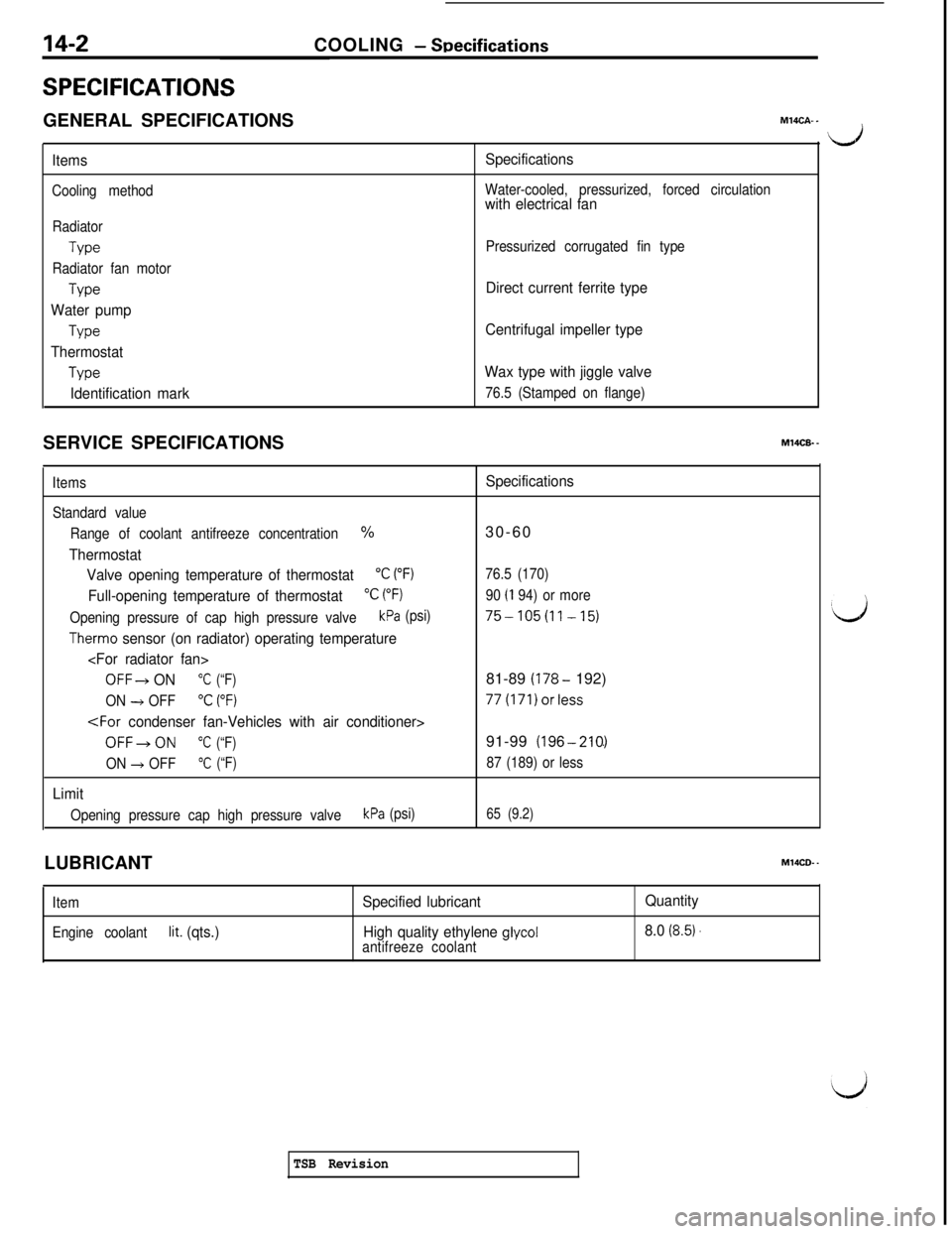
SPECIFICATIONSGENERAL SPECIFICATIONSMMCA..
Items
Cooling method
Radiator
Type
Radiator fan motor
Type
Water pump
Type
Thermostat
Type
Identification markSpecifications
Water-cooled, pressurized, forced circulationwith electrical fan
Pressurized corrugated fin type
Direct current ferrite type
Centrifugal impeller type
Wax type with jiggle valve
76.5 (Stamped on flange)
dSERVICE SPECIFICATIONS
Items
Standard valueSpecifications
Range of coolant antifreeze concentration%30-60
Thermostat
Valve opening temperature of thermostat
“C (“F)
Full-opening temperature of thermostat“C (“F)
Opening pressure of cap high pressure valvekPa (psi)
Therm0 sensor (on radiator) operating temperature
OFF-t ON“C (“F)
ON -+ OFF“C (“F)
OFF-ON“C (“F)
ON + OFF“C (“F)
Limit
76.5 (170)
90
(I 94) or more
75-105(11-15)81-89
(178- 192)77(171)orless
91-99
(196-210.)
87 (189) or less
Opening pressure cap high pressure valve
kPa (psi)65 (9.2)LUBRICANT
MlQCD- -
ItemSpecified lubricantQuantity
Engine coolantlit. (qts.)High quality ethylene glycol8.0 (8.5).
antifreeze coolant
‘d
TSB Revision
Page 297 of 1146

COOLING - Specifications / Troubleshooting
SEALANT AND ADHESIVE14-3
MMCE- -
/
id
ItemsSpecified sealants and adhesive/
Engine coolant temperature gauge unit
Engine coolant temperature sensor (Engine control)
Engine coolant temperature sensor (Air conditioner)3M Nut Locking Part No. 4171
TROUBLESHOOTING
L
MllEAAL
Symptom
OverheatProbable cause
Insufficient engine coolant
Too high an anti-freeze concentration
Inoperative electric cooling fan
Faulty thermosensor
Faulty electrical motor
Faulty radiator fan relayRemedy
Replenish
Correct anti-freeze concentration
Replace
Damaged or blocked (insufficiently ventilated)
radiator finsCorrect
Water leaks
Damaged radiator core joint
Corroded or cracked hoses
(radiator hose, heater hose, etc.)
Faulty cap valve or setting of spring
Cracked thermostat housing
Loose water pump mounting bolt or leaking
gasket
Replace
Loose bolt or leaking gasket in water outlet
I
Correct or replacefitting
Loose bolt or leaking gasket in water inletfitting
Loose thermostat housing bolts or leakingfrom gasket
Retorque bolts or replace gasket
Faulty automatic transaxle oil cooler operation
Blocked or collapsed hose and pipeReplace
Loose hose and pipe connectionCorrect
Faulty thermostat operationReplace
Faulty water pump operationReplace
Water passage clogged with slime or rust depositClean
or foreign substance
No rise in temperature
Faulty thermostatReplace
( TSB Revision
Page 300 of 1146
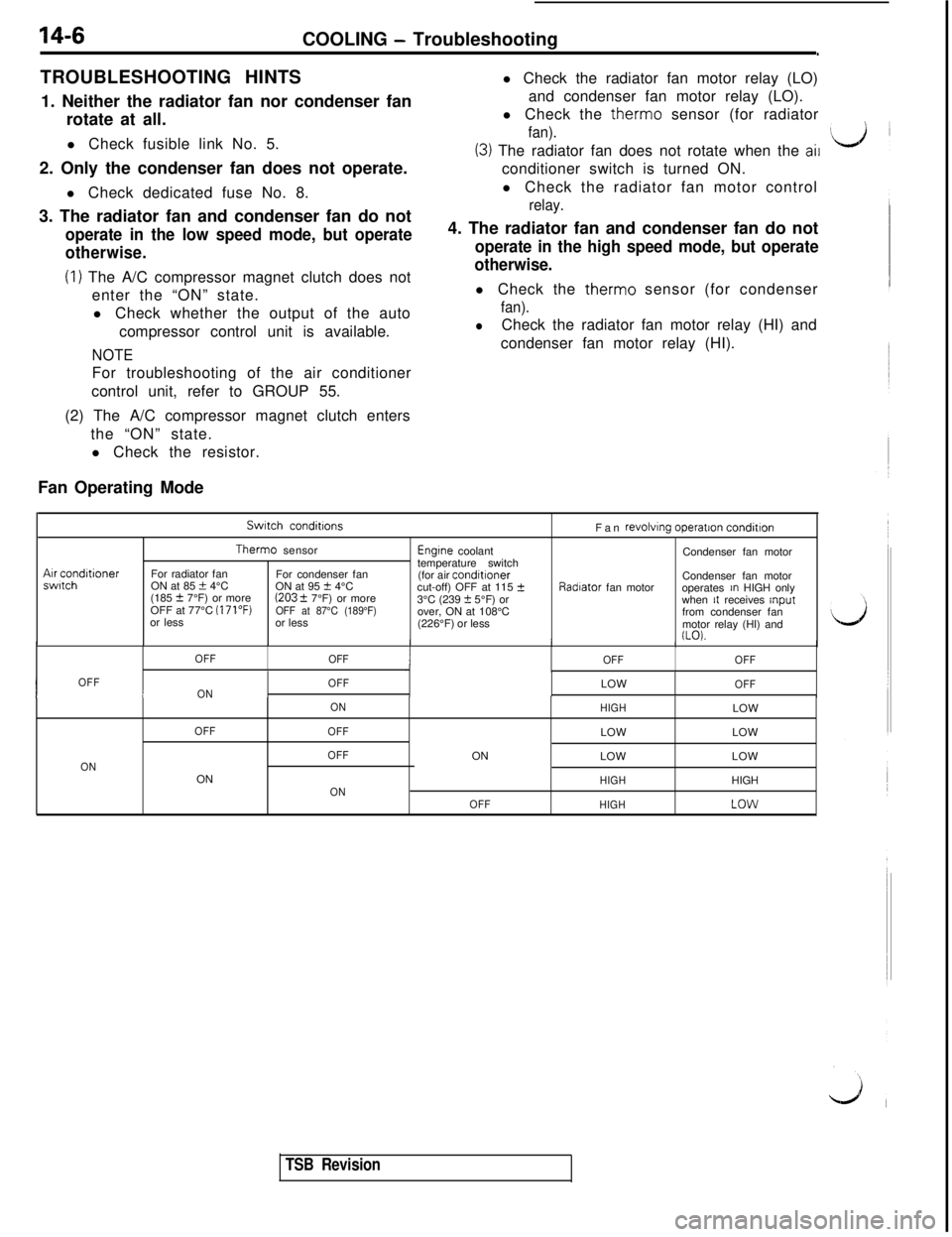
14-6COOLING - Troubleshooting.TROUBLESHOOTING HINTS
1. Neither the radiator fan nor condenser fan
rotate at all.
l Check fusible link No. 5.
2. Only the condenser fan does not operate.
l Check dedicated fuse No. 8.
3. The radiator fan and condenser fan do not
operate in the low speed mode, but operate
otherwise.
(1) The A/C compressor magnet clutch does not
enter the “ON” state.
l Check whether the output of the auto
compressor control unit is available.
NOTEFor troubleshooting of the air conditioner
control unit, refer to GROUP 55.
(2) The A/C compressor magnet clutch enters
the “ON” state.
l Check the resistor.
Fan Operating Model Check the radiator fan motor relay (LO)
and condenser fan motor relay (LO).
l Check the therm0 sensor (for radiator
fan).
(3) The radiator fan does not rotate when the ailconditioner switch is turned ON.
l Check the radiator fan motor control
relay.4. The radiator fan and condenser fan do not
operate in the high speed mode, but operate
otherwise.l Check the therm0 sensor (for condenser
fan).
lCheck the radiator fan motor relay (HI) and
condenser fan motor relay (HI).Air
conditionerswitch
Switch conditionsTherm0 sensor
For radiator fan
For condenser fan
ON at 85
k 4°C
ON at 95 t 4°C
(185 f 7°F) or more(203 + 7°F) or more
OFF at 77°C (171°F)
OFF at 87°C (189°F)or less
or lessEngine coolant
temperature switch
(for air conditioner
cut-off) OFF at 115
+3°C (239 2 5°F) or
over, ON at 108°C
(226°F) or lessFan revolving operation
conditionCondenser fan motor
Condenser fan motorRadiator fan motor
operates
In HIGH only
when it receives input
from condenser fan
motor relay (HI) and
U-0).I/I/
OFF
OFF
OFFOFF
IOFFIOFF
ONLOWOFF
ON
HIGHLOW
OFF
OFFLOWLOW
OFF
ONON
LOWLOW
ON
HIGH
ONHIGH
OFF
HIGHLOW
TSB Revision
Page 301 of 1146
COOLING - Service Adiustment Procedures.14-7
SERVICE ADJUSTMENT PROCEDURES
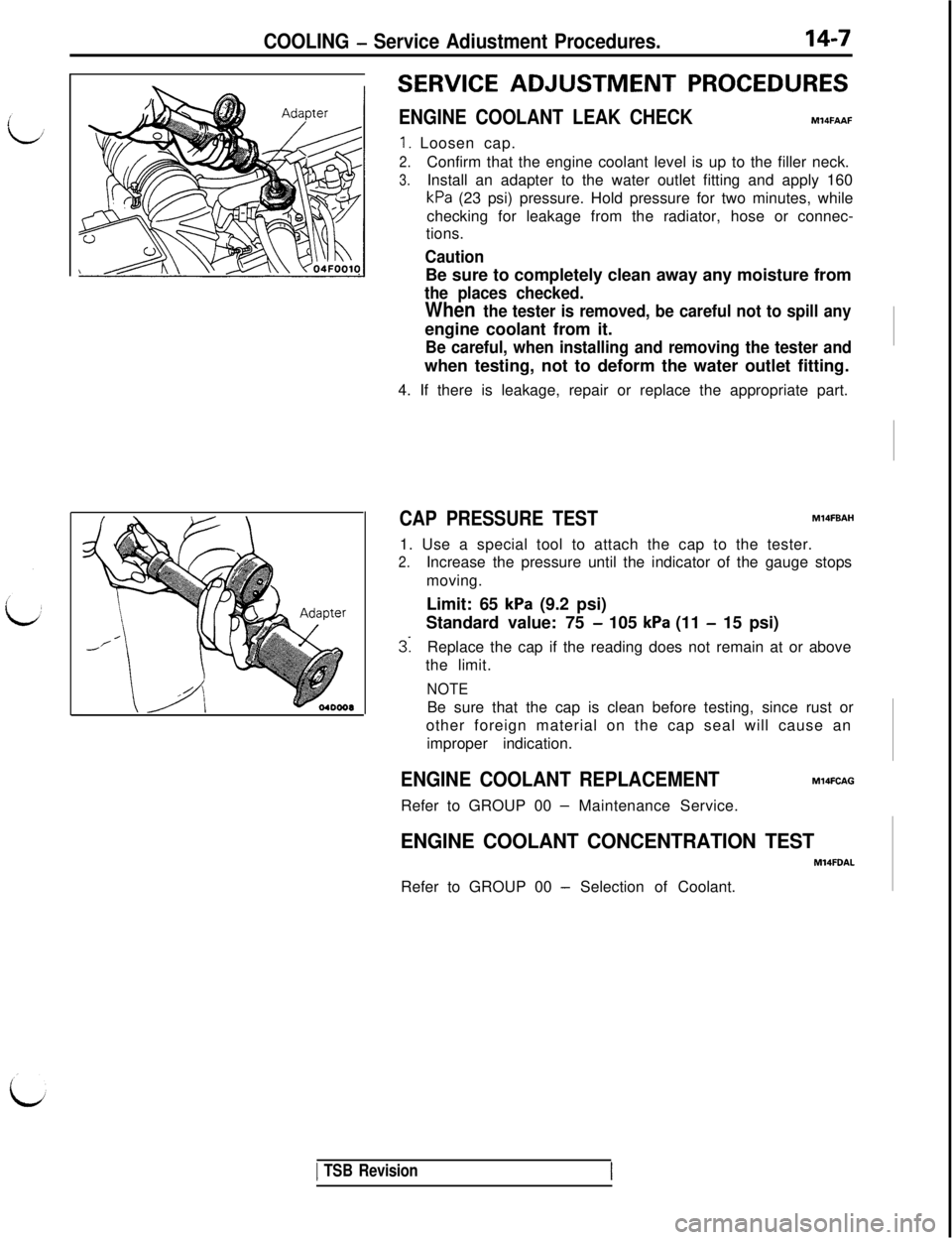
ENGINE COOLANT LEAK CHECKMl4FAAF
1. Loosen cap.
2.Confirm that the engine coolant level is up to the filler neck.
3.Install an adapter to the water outlet fitting and apply 160
kPa (23 psi) pressure. Hold pressure for two minutes, while
checking for leakage from the radiator, hose or connec-
tions.
CautionBe sure to completely clean away any moisture from
the places checked.
When the tester is removed, be careful not to spill anyengine coolant from it.
Be careful, when installing and removing the tester andwhen testing, not to deform the water outlet fitting.
4. If there is leakage, repair or replace the appropriate part.
CAP PRESSURE TESTM14FBAH1. Use a special tool to attach the cap to the tester.
2.Increase the pressure until the indicator of the gauge stops
moving.
Limit: 65
kPa (9.2 psi)
Standard value: 75
- 105 kPa (11 - 15 psi)
3:Replace the cap if the reading does not remain at or above
the limit.
NOTEBe sure that the cap is clean before testing, since rust or
other foreign material on the cap seal will cause an
improper indication.
ENGINE COOLANT REPLACEMENTM14FCAGRefer to GROUP 00
- Maintenance Service.
ENGINE COOLANT CONCENTRATION TEST
M14FDALRefer to GROUP 00
- Selection of Coolant.
1 TSB Revision