engine MITSUBISHI 3000GT 1991 Service Manual
[x] Cancel search | Manufacturer: MITSUBISHI, Model Year: 1991, Model line: 3000GT, Model: MITSUBISHI 3000GT 1991Pages: 1146, PDF Size: 76.68 MB
Page 304 of 1146
14-10COOLING - Radiator
r-----I
113
EY
4 :
2 :
i.-.-..i
0312161908
Ionnector04FOOO8
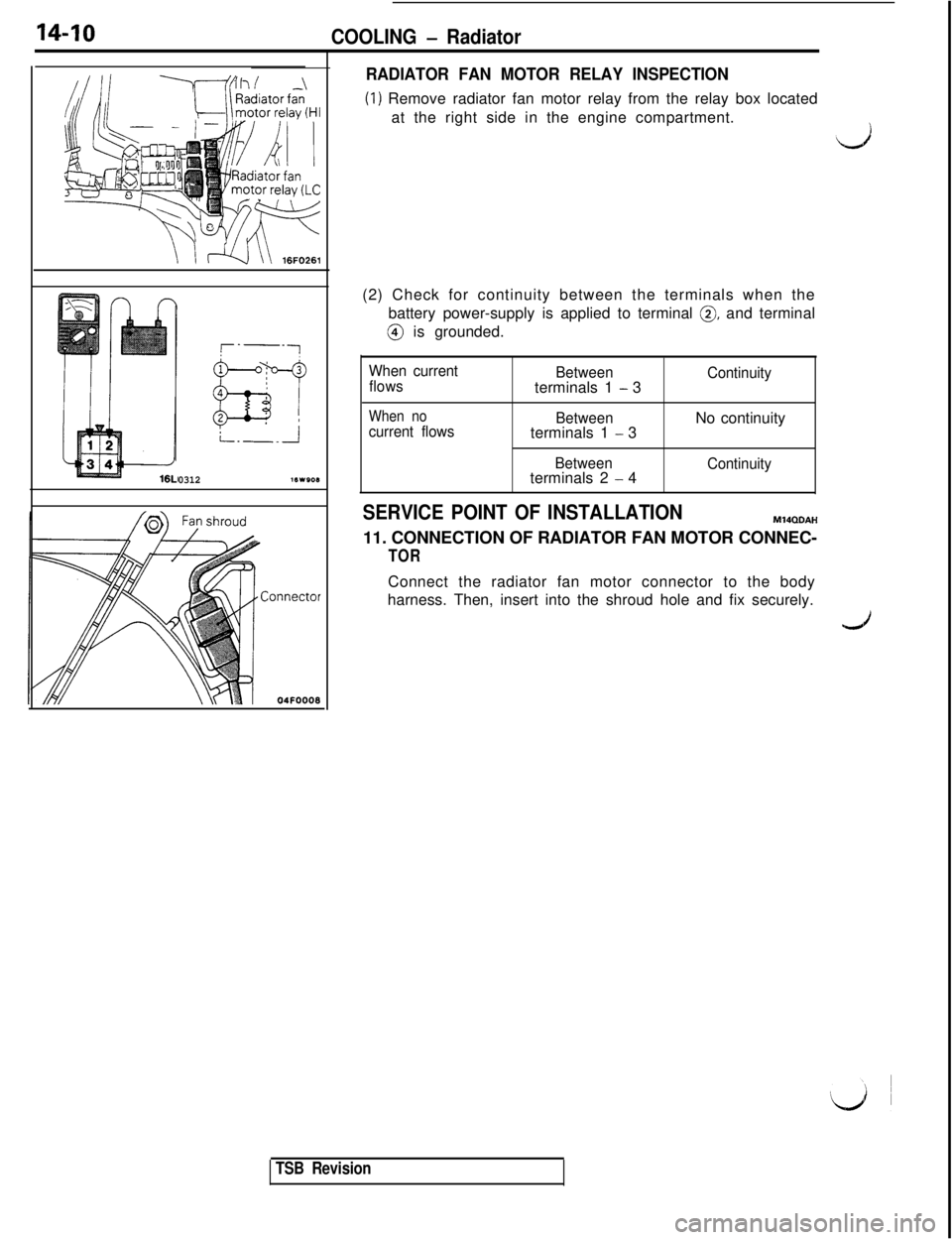
RADIATOR FAN MOTOR RELAY INSPECTION
(1) Remove radiator fan motor relay from the relay box located
at the right side in the engine compartment.
Ll(2) Check for continuity between the terminals when the
battery power-supply is applied to terminal
0, and terminal@ is grounded.
When current
flowsBetweenterminals 1
- 3Continuity
When nocurrent flowsBetweenterminals 1 - 3No continuity
Betweenterminals 2 - 4Continuity
SERVICE POINT OF INSTALLATIONM14QDAH
11. CONNECTION OF RADIATOR FAN MOTOR CONNEC-
TORConnect the radiator fan motor connector to the body
harness. Then, insert into the shroud hole and fix securely.
TSB Revision
Page 307 of 1146
COOLING - Water Pump, Water Pipe and Water Hose
WATER PUMP, WATER PIPE AND WATER HOSE
14-13
M14MB-B
/REMOVAL AND INSTALLATION
Pre-removal and Post-installation
Operation
l Draining and Supplying of the Engine Coolant
(Refer to GROUP 00 - Maintenance Service.)l Removal and Installation of Power Transistor
Unit and Ignition Coil
(Refer to GROUP 16 - Engine Electrical)l Removal and lnstallatlon of Timing Belt
(Refer to GROUP 11 -Timing Belt)17-20 Nm17-20 Nm
12-14ft.lbs.
1
12-15Nm9-11 ft.1bs.q
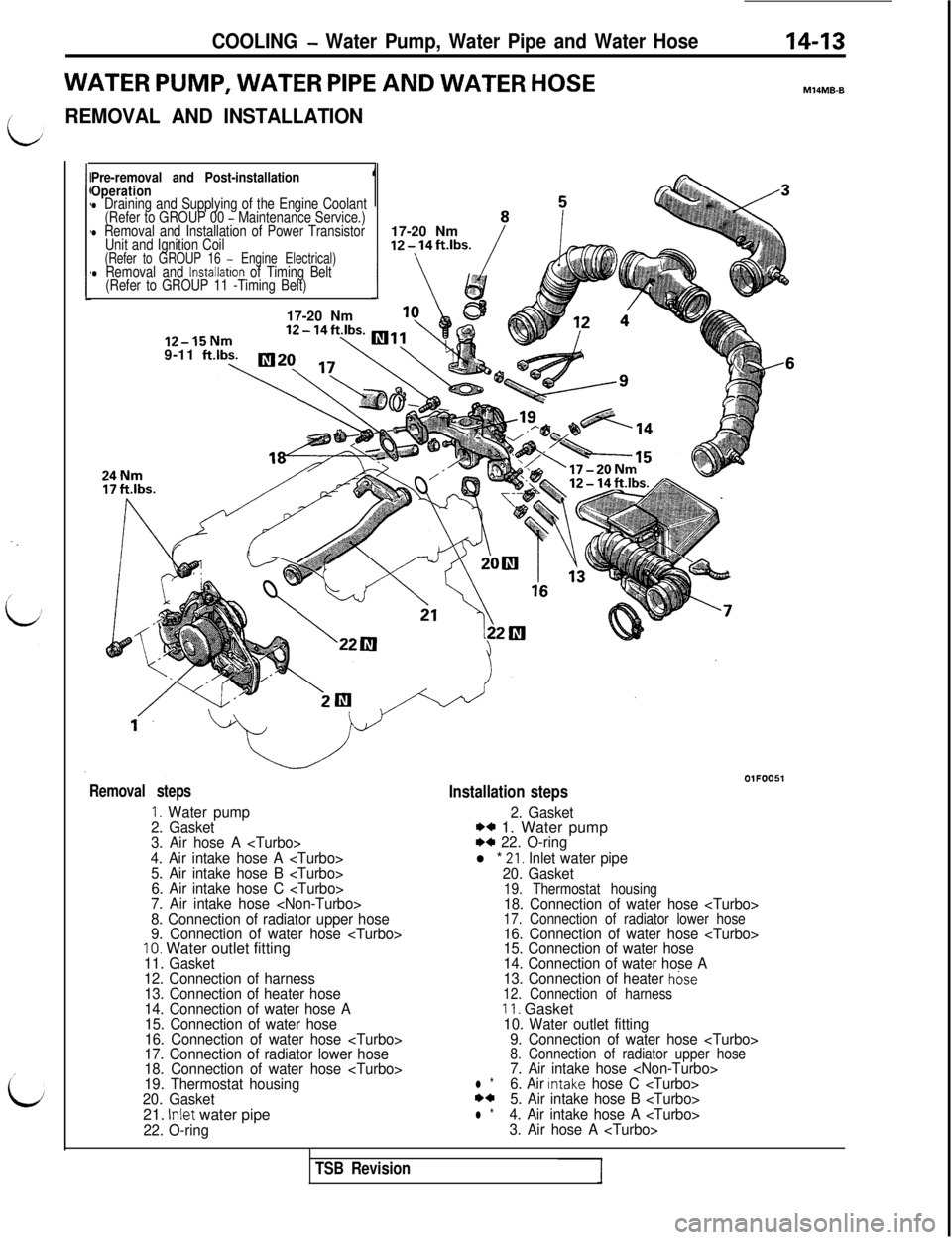
Removal steps
1. Water pump
2. Gasket
3. Air hose A
4. Air intake hose A
5. Air intake hose B
6. Air intake hose C
7. Air intake hose
8. Connection of radiator upper hose
9. Connection of water hose
IO. Water outlet fitting11. Gasket
12. Connection of harness
13. Connection of heater hose
14. Connection of water hose A
15. Connection of water hose
16. Connection of water hose
17. Connection of radiator lower hose
18. Connection of water hose
19. Thermostat housing
20. Gasket21.
Her water pipe22. O-ringOlFOO51
Installation steps
2. Gasket** 1. Water pumpI)+ 22. O-ring
l * 21. Inlet water pipe
20. Gasket
19. Thermostat housing18. Connection of water hose
15. Connection of water hose
14. Connection of water hose A
13. Connection of heater h&e
12. Connection of harness11. Gasket10. Water outlet fitting
9. Connection of water hose
8. Connection of radiator upper hose7. Air intake hose
3. Air hose A
TSB Revision
Page 308 of 1146
COOLING - Water Pump, Water Pipe and Water Hose
INSPECTION
WATER PUMP
I
MIQMDAOZIf any of the following irregularities are observed, replace the
LJwater pump as an assembly.
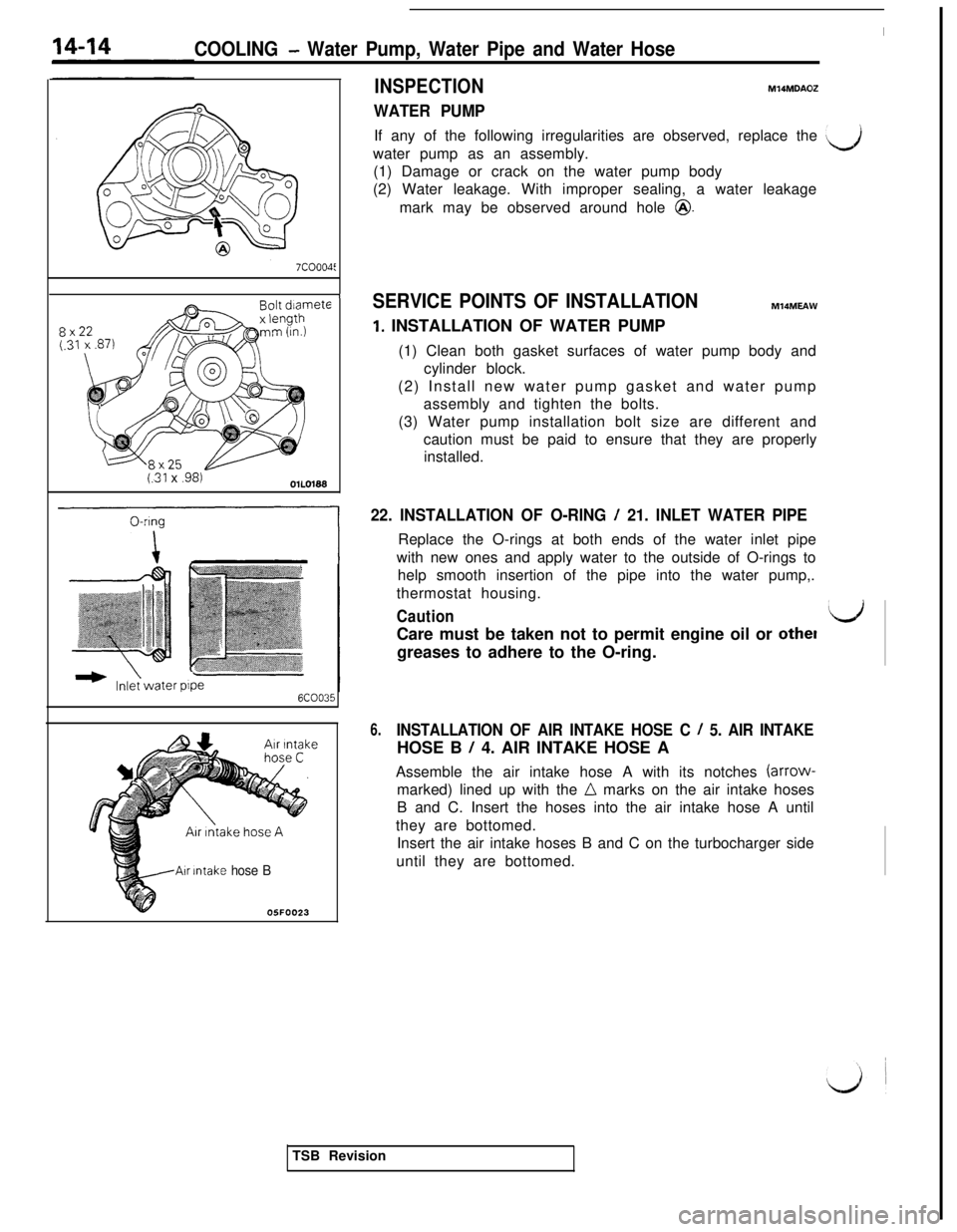
(1) Damage or crack on the water pump body
(2) Water leakage. With improper sealing, a water leakage
mark may be observed around hole
@.
,
(.31 x .98)OlLO188
6COO35
Air intake hose BOSFOO23
SERVICE POINTS OF INSTALLATION
1. INSTALLATION OF WATER PUMPM14MEAW
(1) Clean both gasket surfaces of water pump body and
cylinder block.
(2) Install new water pump gasket and water pump
assembly and tighten the bolts.
(3) Water pump installation bolt size are different and
caution must be paid to ensure that they are properly
installed.
22. INSTALLATION OF O-RING / 21. INLET WATER PIPEReplace the O-rings at both ends of the water inlet pipe
with new ones and apply water to the outside of O-rings to
help smooth insertion of the pipe into the water pump,.
thermostat housing.
CautionLJCare must be taken not to permit engine oil or
othergreases to adhere to the O-ring.
6.INSTALLATION OF AIR INTAKE HOSE C / 5. AIR INTAKEHOSE B
/ 4. AIR INTAKE HOSE A
Assemble the air intake hose A with its notches (arrow-
marked) lined up with the
D marks on the air intake hoses
B and C. Insert the hoses into the air intake hose A until
they are bottomed.
Insert the air intake hoses B and C on the turbocharger side
until they are bottomed.
TSB Revision
Page 309 of 1146
COOLINGEngine Coolant Temperature Gauge Unit, Engine Coolant- Temperature Sensor and Engine Coolant Temperature Switch14-15
ENGINE COOLANT TEMPERATURE GAUGE UNIT, ENGINE COOLANT
TEMPERATURE SENSOR AND ENGINE COOLANT TEMPERATURE
L,SWITCH
REMOVAL AND INSTALLATIONM140B. -Pre-removal and Post-installation
Operation
l Draining and Supplying of theEngine Coolant(Refer to GROUP 00 - MaintenanceService.)
30 NmOlFOO38
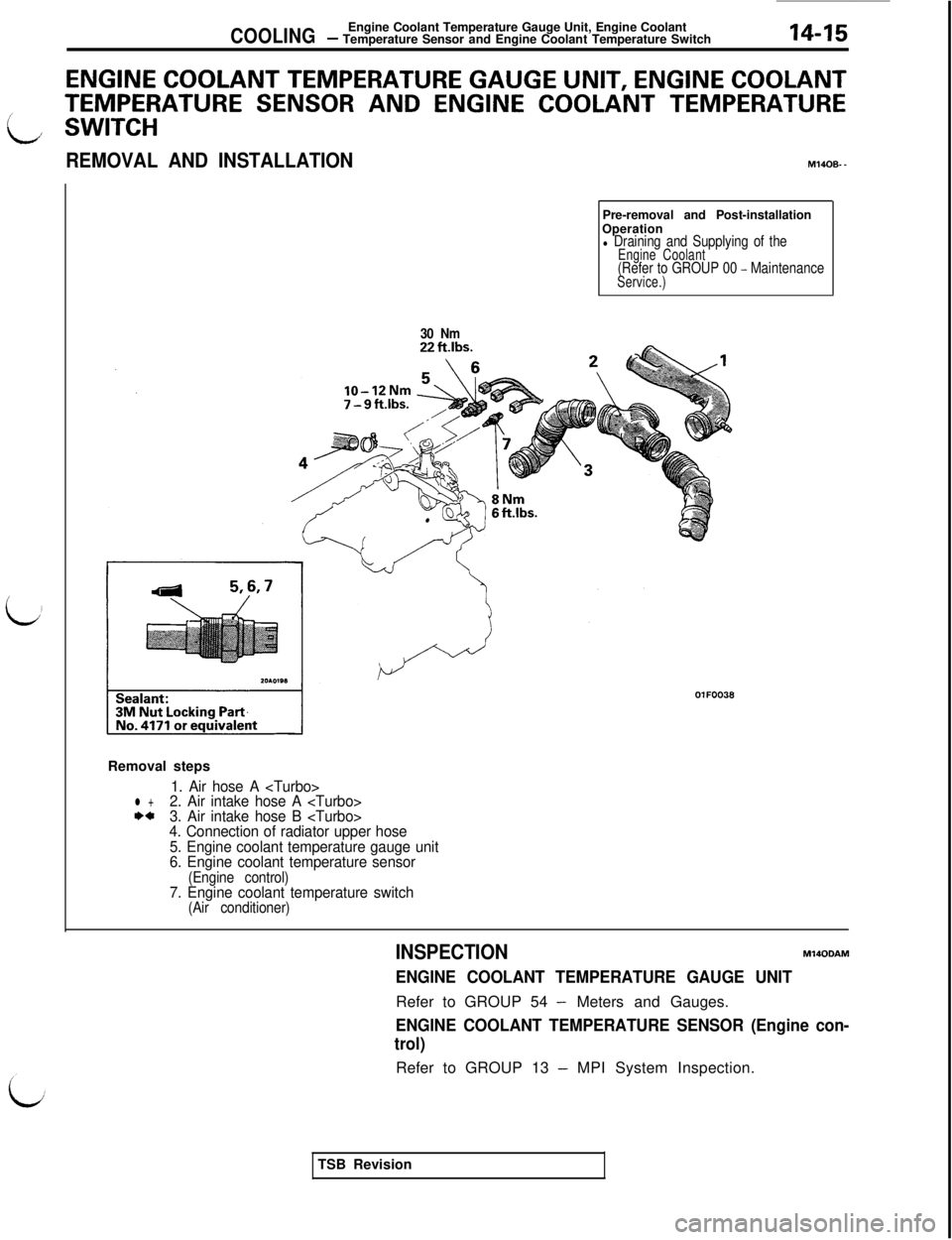
Removal steps
1. Air hose A
4. Connection of radiator upper hose
5. Engine coolant temperature gauge unit
6. Engine coolant temperature sensor
(Engine control)7. Engine coolant temperature switch(Air conditioner)
INSPECTIONM140DAM
ENGINE COOLANT TEMPERATURE GAUGE UNITRefer to GROUP 54
- Meters and Gauges.
ENGINE COOLANT TEMPERATURE SENSOR (Engine con-
trol)Refer to GROUP 13
- MPI System Inspection.
TSB Revision
Page 310 of 1146
14-16
I
COOLINGEngine Coolant Temperature Gauge Unit, Engine Coolant- Temperature Sensor and Engine Coolant Temperature SwitchI
Air Intake hose B
05FOO2:
ENGINE COOLANT TEMPERATURE SWITCH (Air condition-I
4
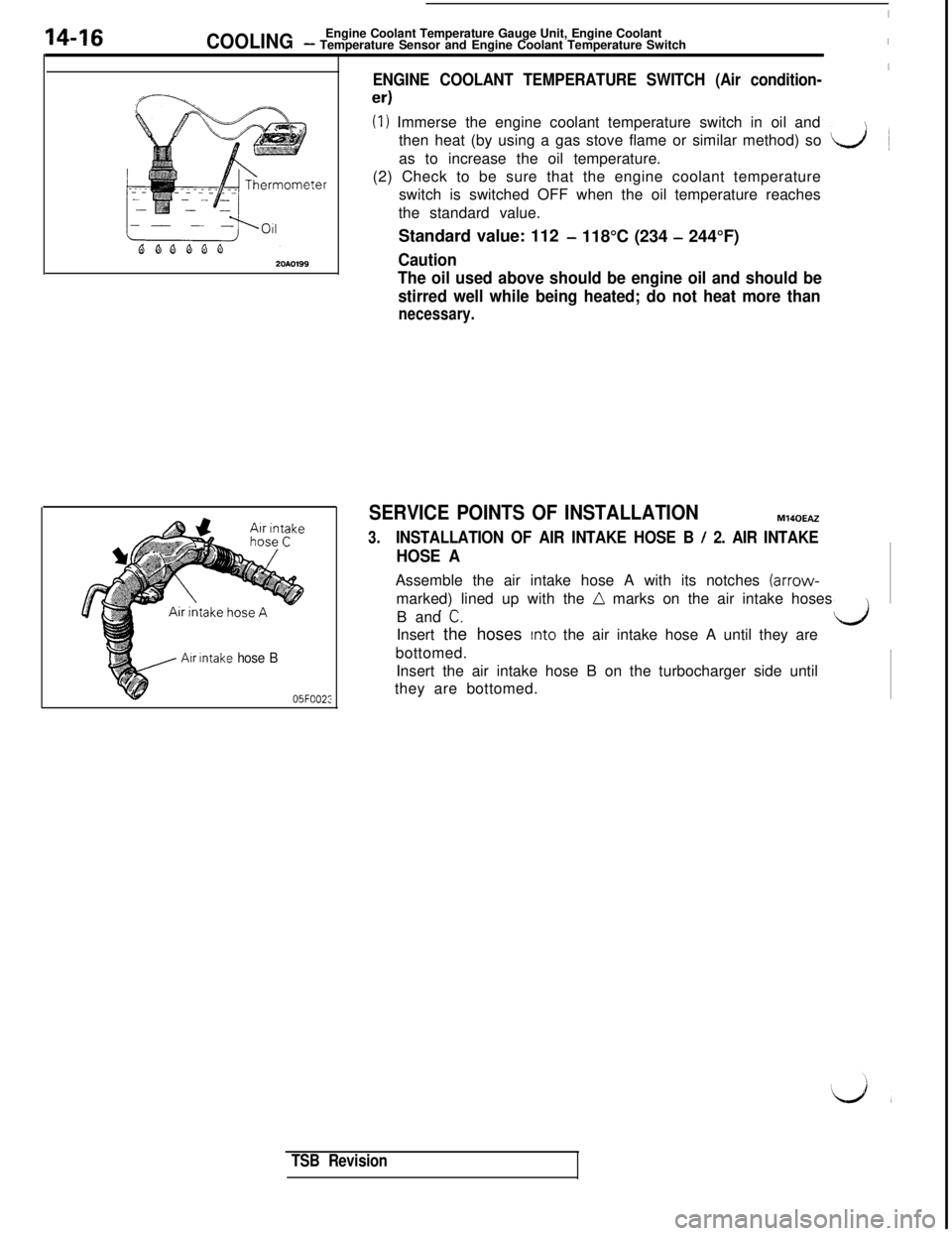
(1) Immerse the engine coolant temperature switch in oil and
then heat (by using a gas stove flame or similar method) so
as to increase the oil temperature.
L.2~(2) Check to be sure that the engine coolant temperature
switch is switched OFF when the oil temperature reaches
the standard value.
Standard value: 112
- 118°C (234 - 244°F)
Caution
The oil used above should be engine oil and should be
stirred well while being heated; do not heat more than
necessary.
SERVICE POINTS OF INSTALLATIONM140EAz
3.INSTALLATION OF AIR INTAKE HOSE B / 2. AIR INTAKE
HOSE AB and L. Assemble the air intake hose A with its notches (arrow-
marked) lined up with the
n marks on the air intake hoses
. -dInsert the hoses Into the air intake hose A until they are
bottomed.
Insert the air intake hose B on the turbocharger side until
they are bottomed.
TSB Revision
Page 315 of 1146
INTAKE AND EXHAUST -Troubleshooting (Active Exhaust.System)15-5
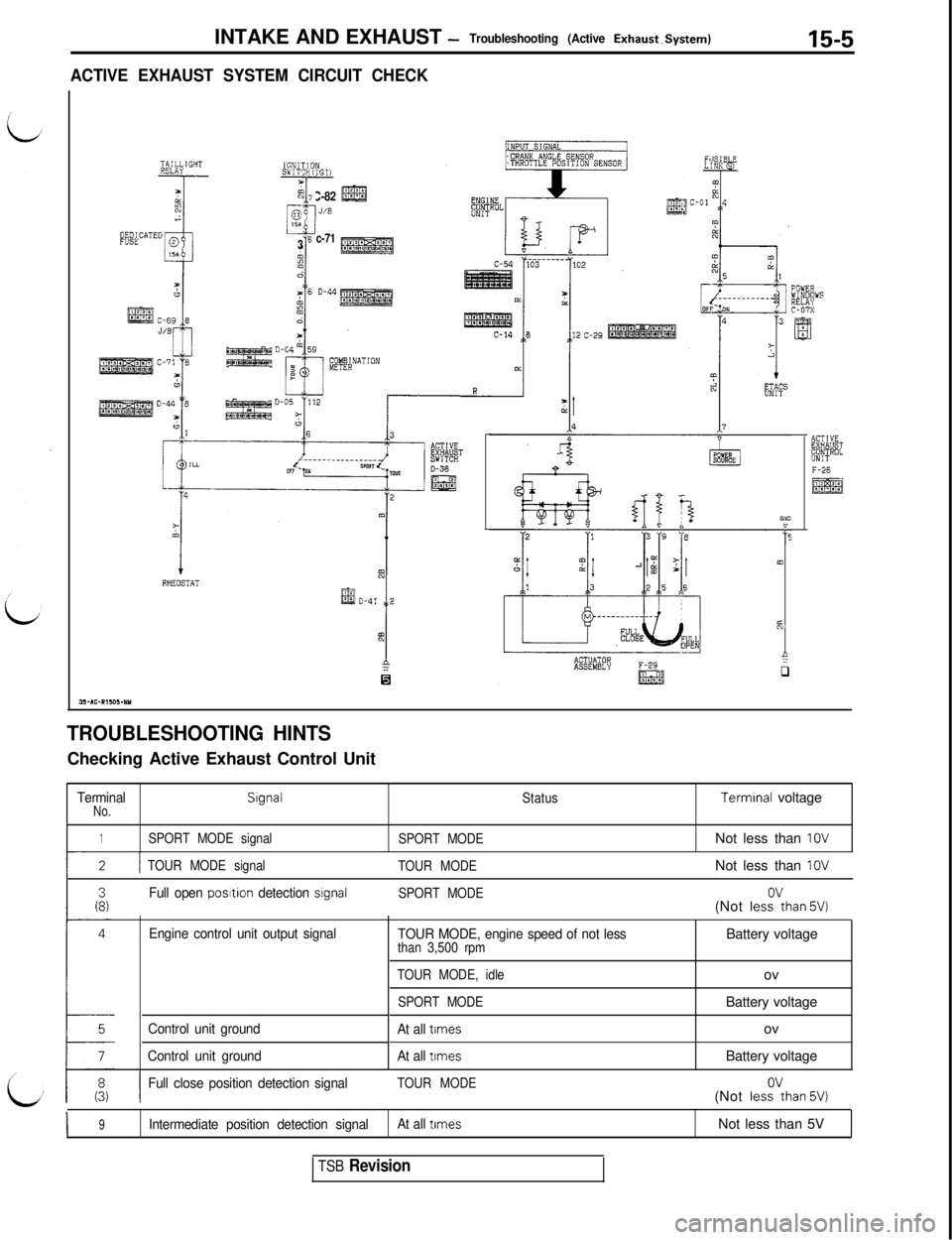
ACTIVE EXHAUST SYSTEM CIRCUIT CHECK
5= i C-82
-i
@g
0J/S1%
‘I
‘6 c-71
3
1
+RHEOSTATmACTUATOR
1::ASSEMBLYF-29
&$jq
ACTlYEFXoQBIlBZ"NIT
TROUBLESHOOTING HINTSChecking Active Exhaust Control Unit
TerminalNo.Signal
StatusTerminal voltage
1SPORT MODE signal
SPORT MODENot less than IOV
I-2 TTOUR MODE signal
TOUR MODENot less than IOV
Full open posrtion detection srgnalSPORT MODE(Not lesi’than 5V)
Engine control unit output signal
Control unit ground
Control unit groundTOUR MODE, engine speed of not lessthan 3,500 rpm
TOUR MODE, idle
SPORT MODE
At all times
At all
trmesBattery voltage
ov
Battery voltage
ov
Battery voltage
IFull close position detection signalTOUR MODE(Not lesk?than 5V)
I9Intermediate position detection signalAt all timesNot less than 5V
TSB Revision
Page 316 of 1146
15-6INTAKE AND EXHAUST - Service Adjustment Procedures
Variable rnductiorcontrol servoconnectors
6FU1277
Open
Close
71 NO105
SERVICE ADJUSTMENT PROCEDURESMlSGlAA
VARIABLE INDUCTION CONTROL SYSTEM IN-
d
SPECTION (Non Turbo)
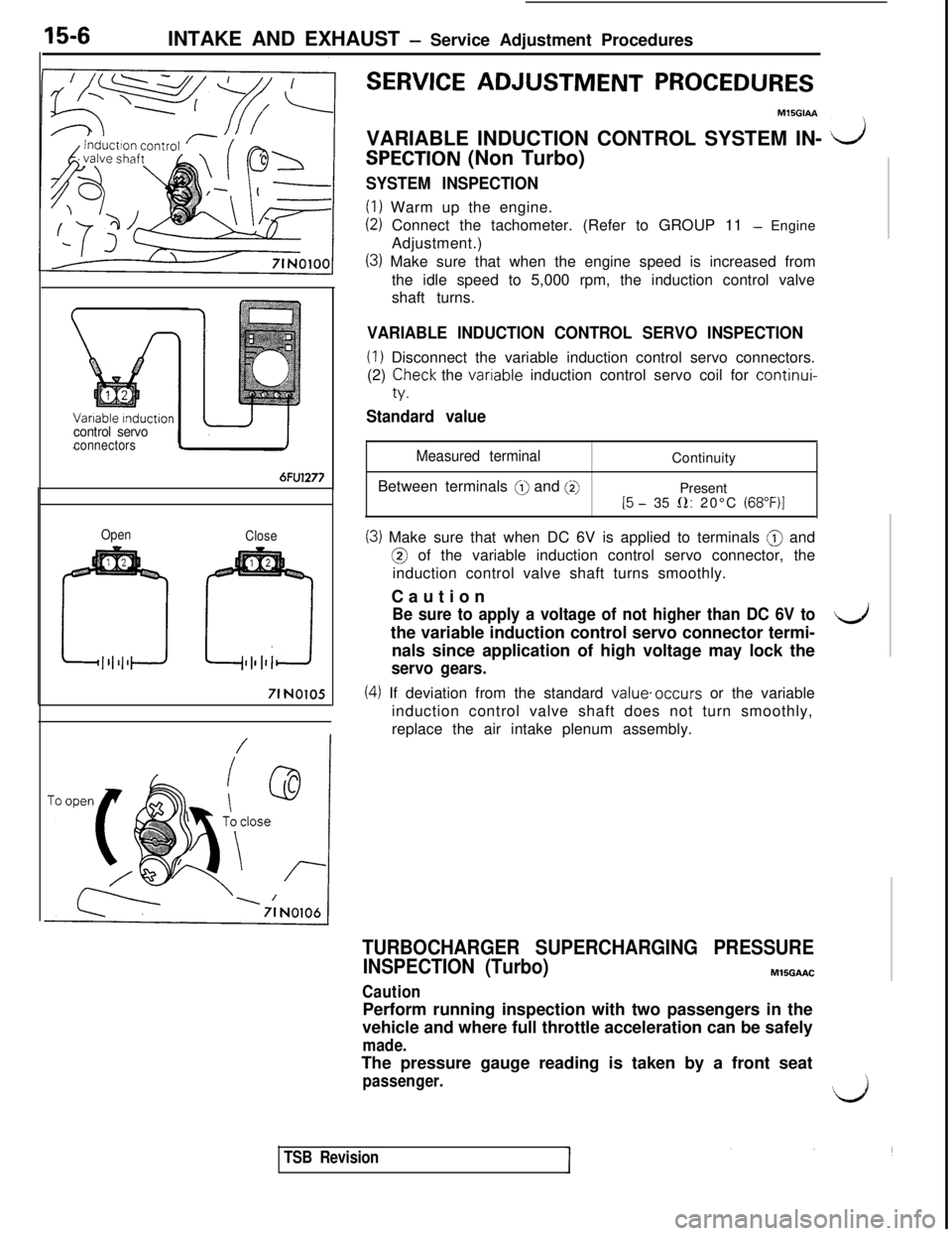
SYSTEM INSPECTION
(1) Warm up the engine.
(2) Connect the tachometer. (Refer to GROUP 11 - Engine
Adjustment.)
(3) Make sure that when the engine speed is increased from
the idle speed to 5,000 rpm, the induction control valve
shaft turns.
VARIABLE INDUCTION CONTROL SERVO INSPECTION
(1) Disconnect the variable induction control servo connectors.
(2)
Teck the vanable induction control servo coil for continui-
Standard value
Measured terminalBetween terminals
@ and @]Continuity
Present
15 - 35 0: 20°C (68”F)I
(3) Make sure that when DC 6V is applied to terminals @ and@ of the variable induction control servo connector, the
induction control valve shaft turns smoothly.
Caution
Be sure to apply a voltage of not higher than DC 6V tothe variable induction control servo connector termi-4nals since application of high voltage may lock the
servo gears.
(4) If deviation from the standard value.occurs or the variable
induction control valve shaft does not turn smoothly,
replace the air intake plenum assembly.
TURBOCHARGER SUPERCHARGING PRESSURE
INSPECTION (Turbo)MlSGAAC
CautionPerform running inspection with two passengers in the
vehicle and where full throttle acceleration can be safely
made.The pressure gauge reading is taken by a front seat
passenger.‘,k,i
TSB Revision
Page 317 of 1146
INTAKE AND EXHAUST - Service Adiustment Procedures15-7
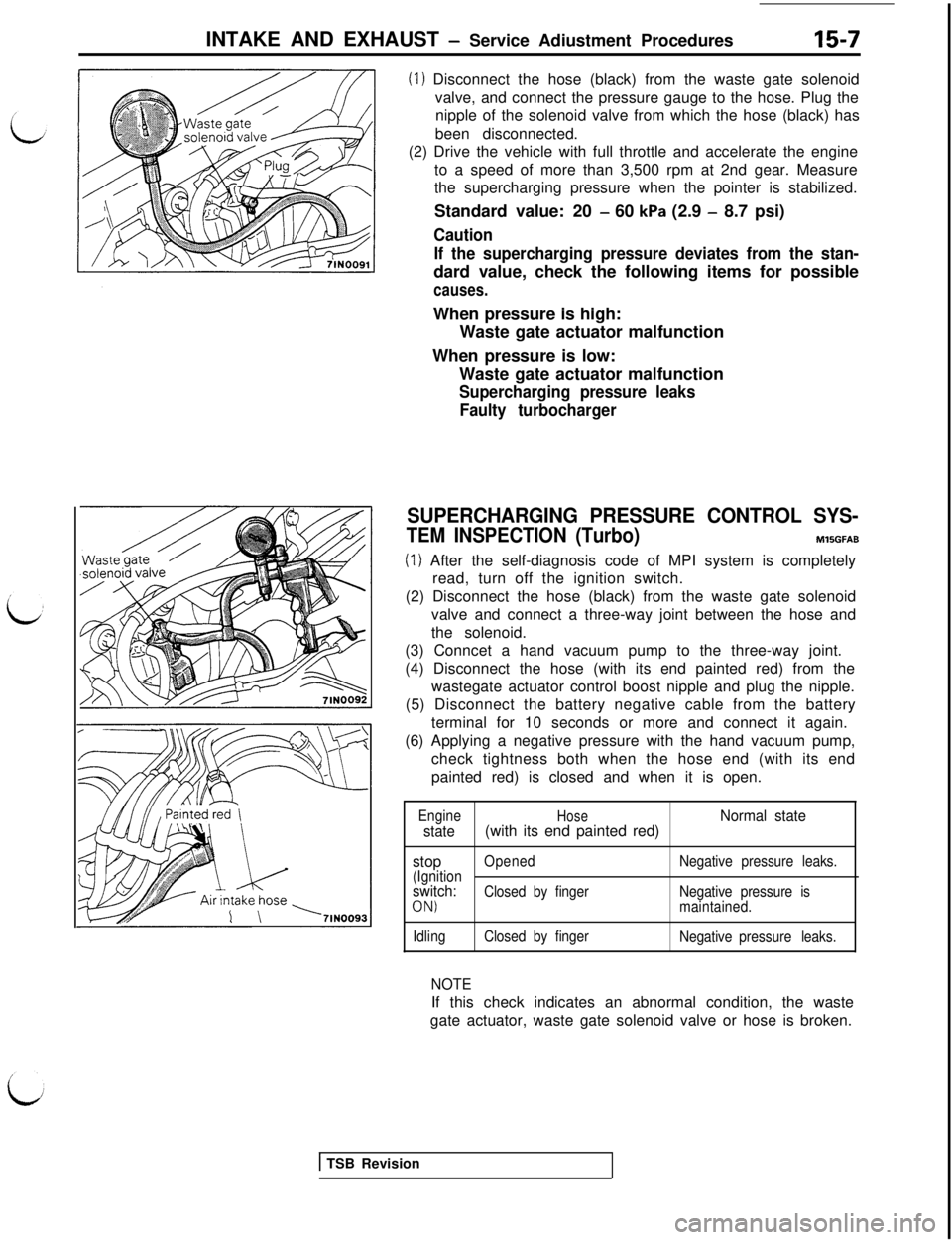
(1) Disconnect the hose (black) from the waste gate solenoid
valve, and connect the pressure gauge to the hose. Plug the
nipple of the solenoid valve from which the hose (black) has
been disconnected.
(2) Drive the vehicle with full throttle and accelerate the engine
to a speed of more than 3,500 rpm at 2nd gear. Measure
the supercharging pressure when the pointer is stabilized.
Standard value: 20
- 60 kPa (2.9 - 8.7 psi)
Caution
If the supercharging pressure deviates from the stan-dard value, check the following items for possible
causes.When pressure is high:
Waste gate actuator malfunction
When pressure is low:
Waste gate actuator malfunction
Supercharging pressure leaks
Faulty turbocharger
SUPERCHARGING PRESSURE CONTROL SYS-
TEM INSPECTION (Turbo)MlSGFAB
(1) After the self-diagnosis code of MPI system is completely
read, turn off the ignition switch.
(2) Disconnect the hose (black) from the waste gate solenoid
valve and connect a three-way joint between the hose and
the solenoid.
(3) Conncet a hand vacuum pump to the three-way joint.
(4) Disconnect the hose (with its end painted red) from the
wastegate actuator control boost nipple and plug the nipple.
(5) Disconnect the battery negative cable from the battery
terminal for 10 seconds or more and connect it again.
(6) Applying a negative pressure with the hand vacuum pump,
check tightness both when the hose end (with its end
painted red) is closed and when it is open.
EngineHoseNormal state
state(with its end painted red)
stop
OpenedNegative pressure leaks.
(Ignition
switch:Closed by fingerNegative pressure is
ON)maintained.
IdlingClosed by finger
Negative pressure leaks.
NOTEIf this check indicates an abnormal condition, the waste
gate actuator, waste gate solenoid valve or hose is broken.
1 TSB Revision
Page 321 of 1146
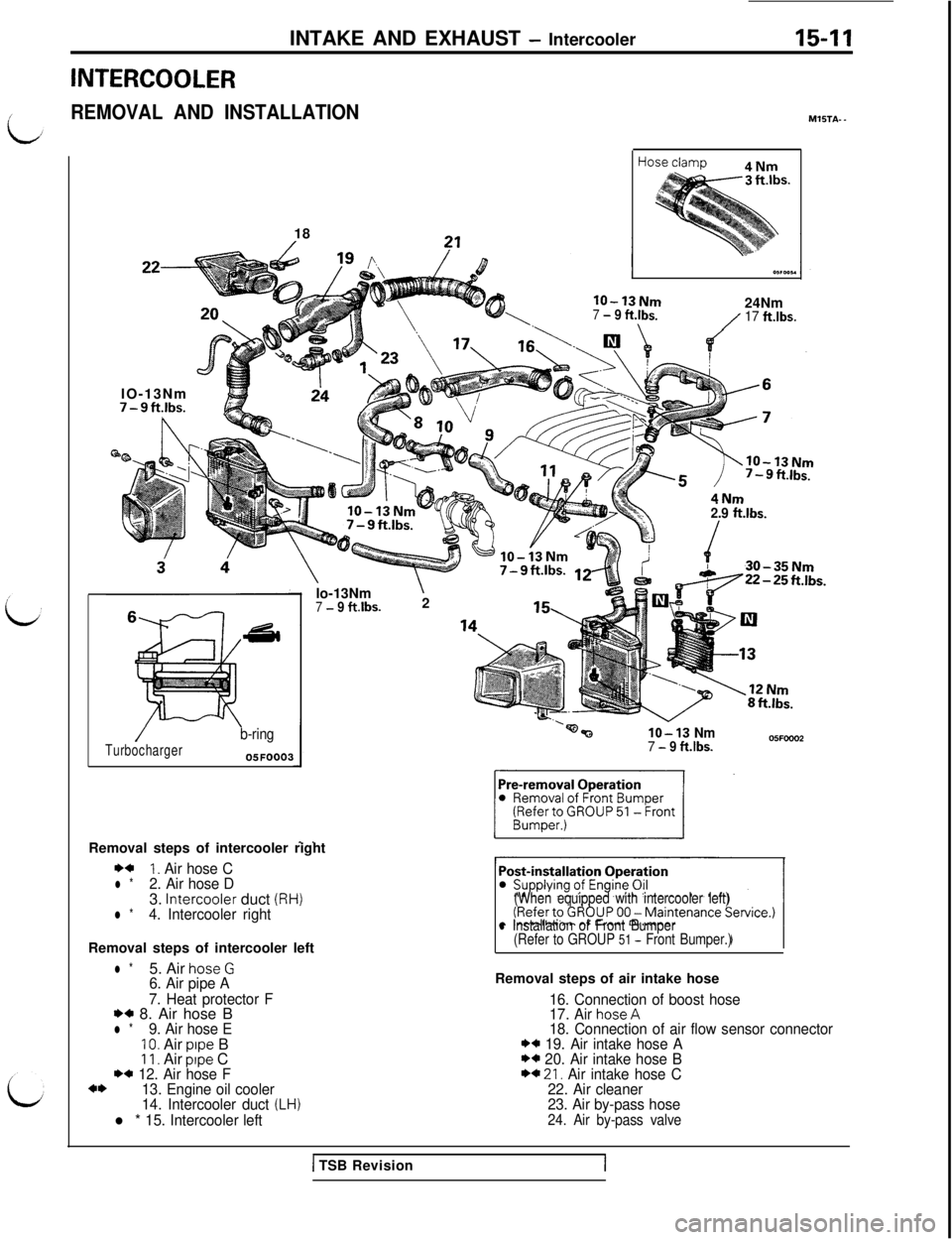
INTAKE AND EXHAUST - Intercooler
INTERCOOLER
/REMOVAL AND INSTALLATION18
/?1IO-13Nm
7-9ftJbs.
/Turbocharger
b-ring
05FOOO3MlSTA-
-
I
lo-13Nm7 - 9 ft.lbs.
OSPDOU24Nm
/ 17 ft.lbs.
ANm
7-.9 ft.lbs.
. .-...2.9 ft.lbs.lo-13Nm
’7 - 9 ft.lbs.2
_ .
Removal steps of intercooler right
**I. Air hose Cl *2. Air hose D3. Intercooler duct (RH)l *4. Intercooler rightRemoval steps of intercooler left
l *5. Air hoseG
6. Air pipe A
7. Heat protector F
I)* 8. Air hose Bl *9. Air hose E10. Air pipe BII. Air pope C** 12. Air hose F*I)13. Engine oil cooler
14. Intercooler duct (LH)
l * 15. Intercooler left
lo-13 Nm7 - 9 ft.lbs.OSFOC.02
(When equipped with intercooler left)
l Installation of Front Bumper
(Refer to GROUP 51 - Front Bumper.)Removal steps of air intake hose
16. Connection of boost hose
17. Air hoseA
18. Connection of air flow sensor connector
I)* 19. Air intake hose A** 20. Air intake hose B*a 21. Air intake hose C
22. Air cleaner
23. Air by-pass hose
24. Air by-pass valve
1 TSB Revision
Page 322 of 1146
15-12INTAKE AND EXHAUST - lntercooier
SERVICE POINT OF REMOVALMlSTSAC
13. REMOVAL OF ENGINE OIL COOLERIDisconnect the hose from the engine oil cooler and remove
the engine oil cooler only.
IL)
INSPECTIONMISTCAB
lCheck the intercooler fins for bending, damage, or foreign
matter.
lCheck the intercooler hoses for cracking, damage, or wear.
Air Intake hose B
Air hose
05FOO21
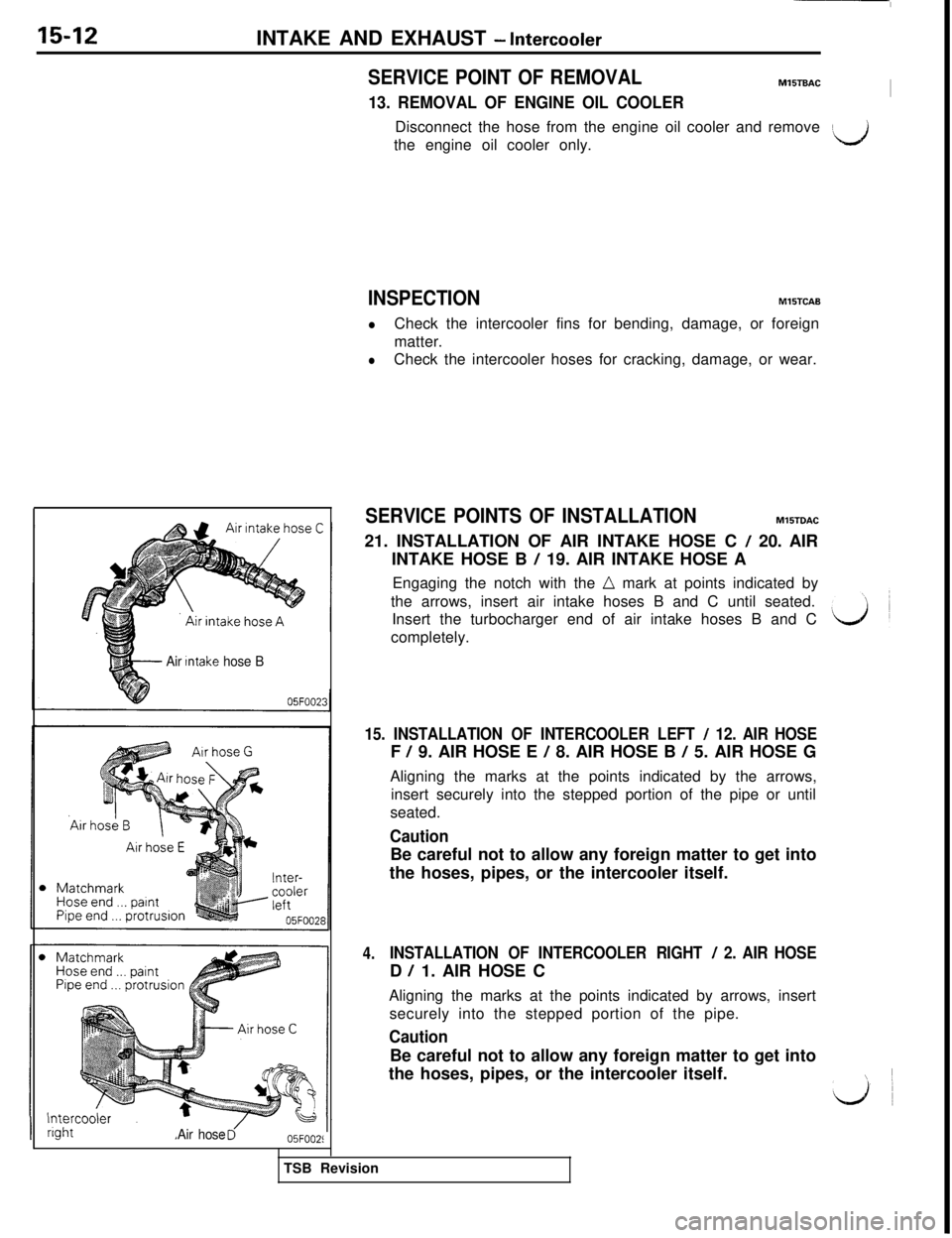
SERVICE POINTS OF INSTALLATIONMlSTDAC
21. INSTALLATION OF AIR INTAKE HOSE C
/ 20. AIR
INTAKE HOSE B
/ 19. AIR INTAKE HOSE A
Engaging the notch with the
n mark at points indicated by
the arrows, insert air intake hoses B and C until seated.
Insert the turbocharger end of air intake hoses B and C
completely.
15. INSTALLATION OF INTERCOOLER LEFT / 12. AIR HOSEF
/ 9. AIR HOSE E / 8. AIR HOSE B / 5. AIR HOSE G
Aligning the marks at the points indicated by the arrows,
insert securely into the stepped portion of the pipe or until
seated.
CautionBe careful not to allow any foreign matter to get into
the hoses, pipes, or the intercooler itself.
4.INSTALLATION OF INTERCOOLER RIGHT / 2. AIR HOSED
/ 1. AIR HOSE C
Aligning the marks at the points indicated by arrows, insert
securely into the stepped portion of the pipe.
CautionBe careful not to allow any foreign matter to get into
the hoses, pipes, or the intercooler itself.
1 ~
LJ~TSB Revision