ESP MITSUBISHI DIAMANTE 1900 User Guide
[x] Cancel search | Manufacturer: MITSUBISHI, Model Year: 1900, Model line: DIAMANTE, Model: MITSUBISHI DIAMANTE 1900Pages: 408, PDF Size: 71.03 MB
Page 114 of 408
ENGINEANDENGINEOVERHAUL 3-53
16. Torque the bearing cap bolts in the following
sequence: No. 3, No. 2, No. 1 and No. 4 to 85 inch
Ibs. (10 Nm).
17. Repeat the sequence increasing the torque to
14 ft. Ibs. (20 Nm).
18. Remove the auto lash adjuster retainer tools
from the rocker arms.
19. Install the camshaft sprocket and bolt.
20. Using camshaft sprocket holding tool
MB9g67 and MD998719 or equivalent, hold the
sprocket and tighten the bolt to 65 ft. Ibs. (90 Nm).
21. Install the timing belt and valve covers.
22. Using a new O-ring, install the distributor ex-
tension housing.
23. Install the intake manifold plenum stay
bracket.
24. Install the distributor assembly Be sure to
align the rotor and distributor housing matchmarks.
25. Connect the negative battery cable and check
for leaks.
3.5L Engine
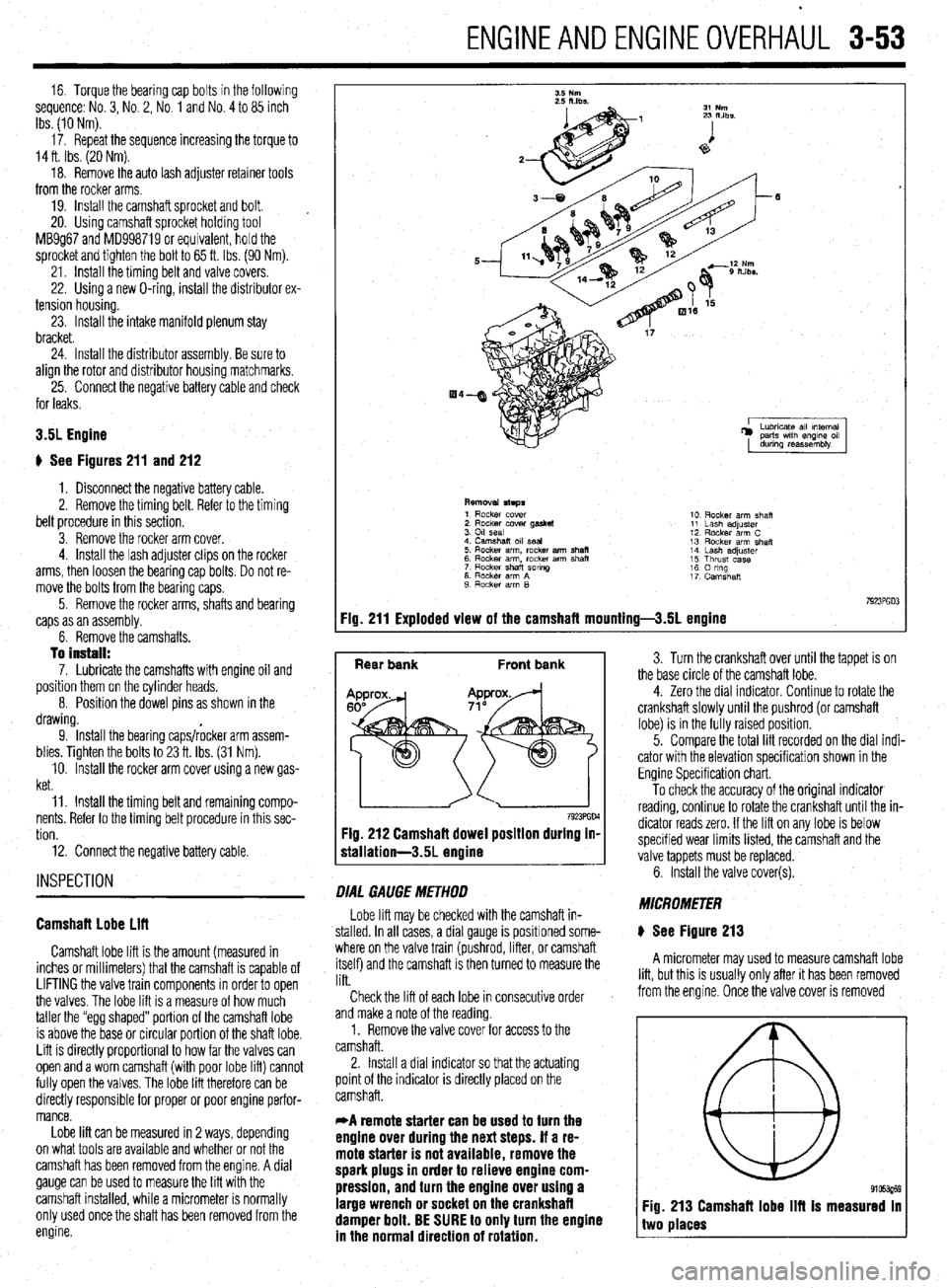
+ See Figures 211 and 212
1. Disconnect the negative battery cable.
2. Remove the timing belt. Refer to the timing
belt procedure in this section.
3. Remove the rocker arm cover.
4. Install the lash adjuster clips on the rocker
arms, then loosen the bearing cap bolts. Do not re-
move the bolts from the bearing caps.
5. Remove the rocker arms, shafts and bearing
caps as an assembly.
6. Remove the camshafts.
To install: 7. Lubricate the camshafts with engine oil and
position them on the cylinder heads.
8. Position the dowel Dins as shown in the
drawing.
9. Install the bearing caps/rocker arm assem-
blies. Tighten the bolts to 23 ft. Ibs. (31 Nm).
10. hstall the rocker arm cover using a new gas-
ket.
11. Install the timing belt and remaining compo-
nents Refer to the timing belt procedure in this sec-
tion.
12. Connect the negative battery cable.
INSPECTION
Camshaft Lobe Liff
Camshaft lobe lift is the amount (measured in
inches or millimeters) that the camshaft is capable of
LIFTING the valve train components in order to open
the valves. The lobe lift is a measure of how much
taller the “egg shaped” portion of the camshaft lobe
is above the base or circular portion of the shaft lobe.
Lift is directly proportional to how far the valves can
open and a worn camshaft (with poor lobe lift) cannot
fully open the valves. The lobe lift therefore can be
directly responsible for proper or poor engine perfor-
mance.
Lobe lift can be measured in 2 ways, depending
on what tools are available and whether or not the
camshaft has been removed from the engine. A dial
gauge can be used to measure the lift with the
camshaft installed, while a micrometer is normally
only used once the shaft has been removed from the
engine.
10 Rocker arm shaft
11 Lash ad,uster
12 Rocker arm C
13 Rocker arm six,,
14 Lash adluster
15 Thrust case
16 orng
17 Camshan
:ig. 211 Exploded view of the camshaft mounting-3.51 engine 1923PGD
Rear bank Front bank
7923PGD4 Fig. 212 Camshaft dowel position during in-
stallation-3.51 engine
DIAL GAUGE METHOD
Lobe lift may be checked with the camshaft in-
stalled. In all cases, a dial gauge is positroned some-
where on the valve train (pushrod, lifter, or camshaft
itself) and the camshaft is then turned to measure the
lift.
Check the lift of each lobe in consecutive order
and make a note of the reading.
1. Remove the valve cover for access to the
camshaft.
2. Install a dial indicator so that the actuating
point of the indicator is directly placed on the
camshaft.
*A remote starter can be used to turn the
engine over during the next steps. If a re-
mote starter is not available, remove the
spark plugs in order to relieve engine com-
pression, and turn the engine over using a
large wrench or socket on the crankshaft
damper bolt. BE SURE to only turn the engine
in the normal direction of rotation.
3. Turn the crankshaft over until the tappet is on
the base circle of the camshaft lobe.
4. Zero the dial indicator. Continue to rotate the
crankshaft slowly until the pushrod (or camshaft
lobe) is in the fully raised position.
5. Compare the total lift recorded on the dial indi-
cator with the elevation specification shown in the
Engine Specification chart.
To check the accuracy of the original indicator
reading, continue to rotate the crankshaft until the in-
dicator reads zero. If the lift on any lobe is below
specified wear limits listed, the camshaft and the
valve tappets must be replaced.
6. Install the valve cover(s).
MICROMETER
) See Figure 213
A micrometer may used to measure camshaft lobe
lift, but this is usually only after it has been removed
from the engine. Once the valve cover is removed
I
@
Fig. 213 Camshaff lobe IIR Is measured In
Page 118 of 408
ENGINEANDENGINEOVERHAUL 3-57
Anything that generates heat and/or friction WIII
eventually burn or wear out (for example, a light bulb
generates heat, therefore its life span is limited). With
this in mind, a running engine generates tremendous
amounts of both; friction is encountered by the mov-
ing and rotating parts inside the engine and heat is
created by friction and combustion of the fuel How-
ever, the engine has systems designed to help reduce
the effects of heat and friction and provide added
longevrty. The oiling system reduces the amount of
friction encountered by the moving parts inside the
engine, while the cooling system reduces heat cre-
ated by friction and combustion If either system is
not maintained, a break-down will be inevitable.
Therefore, you can see how regular maintenance can
affect the service life of your vehicle, If you do not
drain, flush and refill your cooling system at the
proper intervals, deposits WIII begin to accumulate in
the radiator, thereby reducing the amount of heat it
can extract from the coolant The same applies to
your oil and filter; If it is not changed often enough it
becomes laden with contaminates and is unable to
properly lubricate the engine. This increases friction
and wear.
There are a number of methods for evaluating the
condition of your engine. A compression test can re-
veal the condition of your pistons, piston rings,
cylinder bores, head gasket(s), valves and valve
seats. An oil pressure test can warn you of possible
engine bearing, or oil pump failures. Excessrve oil
consumption, evidence of oil in the engine air intake
area and/or bluish smoke from the tailpipe may indi-
cate worn piston rings, worn valve guides and/or
valve seals. As a general rule, an engine that uses no
more than one quart of oil every 1000 miles is in
good condition. Engines that use one quart of oil or
more in less than 1000 miles should first be checked
for oil leaks. If any oil leaks are present, have them
fixed before determining how much oil is consumed
by the engine, especrally if blue smoke is not visible
at the tailpipe
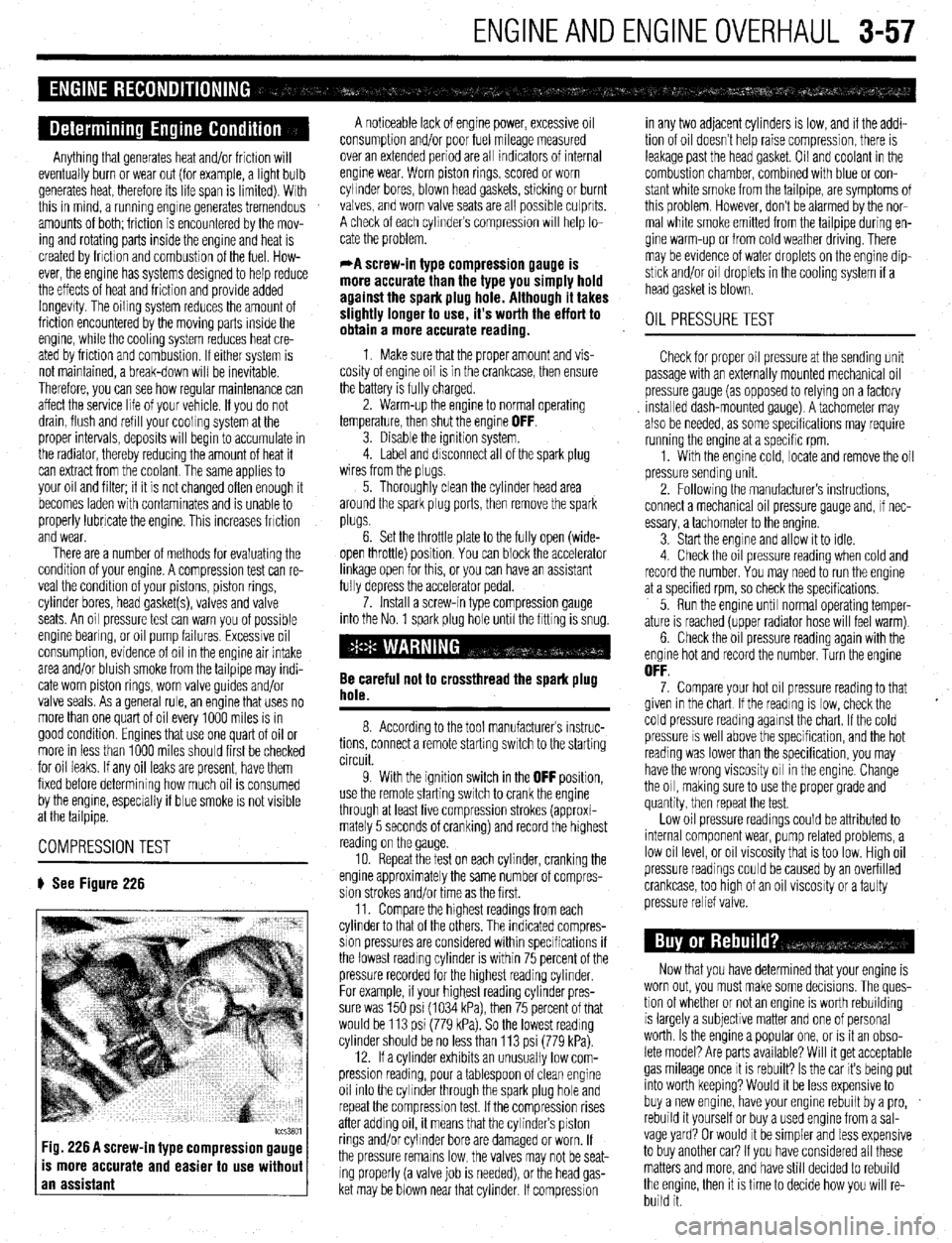
COMPRESSION TEST
# See Figure 226
tccs3801 Fig. 226 A screw-in type compression gauge
is more accurate and easier to use without
an assistant
A noticeable lack of engine power, excessive oil
consumption and/or poor fuel mileage measured
over an extended period are all indicators of internal
engine wear. Worn piston rings, scored or worn
cylinder bores, blown head gaskets, sticking or burnt
valves, and worn valve seats are all possible culprits.
A check of each cylinders compression WIII help lo-
cate the problem.
*A screw-in type compression gauge is
more accurate than the type you simply hold
against the spark plug hole. Although it takes
slightly longer to use, it’s worth the effort to
obtain a more accurate reading.
1 Make sure that the proper amount and vis-
cosity of engine oil is in the crankcase, then ensure
the battery is fully charged.
2. Warm-up the engine to normal operating
temperature, then shut the engine
OFF. 3. Disable the ignition system.
4. Label and disconnect all of the spark plug
wires from the plugs,
5. Thoroughly clean the cylinder head area
around the spark plug ports, then remove the spark
plugs.
6. Set the throttle plate to the fully open (wide-
open throttle) position You can block the accelerator
linkage open for this, or you can have an assistant
fully depress the accelerator pedal.
7. Install a screw-in type compression gauge
into the No. 1 spark plug hole until the fitting is snug.
Be careful not to crossthread the spark plug
hole.
8. According to the tool manufacturers instruc-
tions, connect a remote starting switch to the starting
circuit.
9. With the ignition switch in the
OFF position,
use the remote starting switch to crank the engine
through at least five compression strokes (approxi-
mately 5 seconds of cranking) and record the highest
reading on the gauge
10. Repeat the test on each cylinder, cranking the
engine approximately the same number of compres-
sion strokes and/or time as the first.
11. Compare the hrghest readings from each
cylinder to that of the others. The indicated compres-
sion pressures are considered within specifications if
the lowest reading cylinder is within 75 percent of the
pressure recorded for the highest reading cylinder
For example, if your highest reading cylinder pres-
sure was 150 psi (1034 kPa), then 75 percent of that
would be 113 psi (779 kPa). So the lowest reading
cylinder should be no less than 113 psi (779 kPa).
12. If a cylinder exhibits an unusually low com-
pression reading, pour a tablespoon of clean engine
oil into the cylinder through the spark plug hole and
repeat the compression test. If the compression rises
after adding oil, it means that the cylinder’s piston
rings and/or cylinder bore are damaged or worn, If
the pressure remains low, the valves may not be seat-
ing properly (a valve job is needed), or the head gas-
ket may be blown near that cylinder. If compression in any two adjacent cylinders is low, and if the addi-
tion of oil doesn’t help raise compression, there is
leakage past the head gasket. Oil and coolant in the
combustion chamber, combined with blue or con-
stant white smoke from the tailpipe, are symptoms of
this problem. However, don’t be alarmed by the nor-
mal white smoke emitted from the tailpipe during en-
gine warm-up or from cold weather driving. There
may be evidence of water droplets on the engine dip-
stick and/or oil droplets in the cooling system if a
head gasket is blown.
OIL PRESSURETEST
Check for proper oil pressure at the sending unit
passage with an externally mounted mechanical oil
pressure gauge (as opposed to relying on a factory
Installed dash-mounted gauge). A tachometer may
also be needed, as some specifications may require
running the engine at a specific rpm.
1. With the engine cold, locate and remove the oil
pressure sending unit.
2. Followrng the manufacturers instructions,
connect a mechanical oil pressure gauge and, if nec-
essary, a tachometer to the engine.
3 Start the engine and allow it to idle.
4 Check the oil pressure reading when cold and
record the number. You may need to run the engine
at a specified rpm, so check the specifications,
5. Run the engine until normal operating temper-
ature is reached (upper radiator hose will feel warm)
6. Check the oil pressure reading again with the
engine hot and record the number. Turn the engine
OFF. 7. Compare your hot oil pressure reading to that
given in the chart If the reading is low, check the
cold pressure reading against the chart. If the cold
pressure IS well above the specification, and the hot
reading was lower than the specification, you may
have the wrong viscosity oil in the engine. Change
the oil, making sure to use the proper grade and
quantity, then repeat the test.
Low oil pressure readings could be attributed to
internal component wear, pump related problems, a
low oil level, or oil viscosity that is too low. High oil
pressure readings could be caused by an overfilled
crankcase, too htgh of an oil viscosity or a faulty
pressure relief valve.
Now that you have determined that your engine is
worn out, you must make some decisions. The ques-
tion of whether or not an engine IS worth rebuilding
is largely a subjective matter and one of personal
worth. Is the engine a popular one, or IS it an obso-
lete model? Are parts available? Will it get acceptable
gas mileage once It is rebuilt? Is the car its being put
into worth keeping? Would it be less expensive to
buy a new engine, have your engine rebuilt by a pro,
rebuild it yourself or buy a used engine from a sal-
vage yard? Or would It be simpler and less expensive
to buy another car? If you have considered all these
matters and more, and have still decided to rebuild
the engine, then it is time to decide how you will re-
build it.
Page 119 of 408
3-58 ENGINEANDENGINEOVERHAUL '
*The editors at Chilton feel that most engine
machining should be performed by a profes-
sional machine shop. Don’t think of it as
wasting money, rather, as an assurance that
the job has been done right the first time.
There are many expensive and specialized
tools required to perform such tasks as bor-
ing and honing an engine block or having a
valve job done on a cylinder head. Even in-
specting the parts requires expensive mi-
crometers and gauges to properly measure
wear and clearances. Also, a machine shop
can deliver to you clean, and ready to as-
semble parts, saving you time and aggrava-
tion. Your maximum savings will come from
performing the removal, disassembly, as-
sembly and installation of the engine and
purchasing or renting only the tools required
to perform the above tasks. Depending on
the particular circumstances, you may save
40 to 60 percent of the cost doing these your-
self.
A complete rebuild or overhaul of an engine in-
volves replacing all of the moving parts (pistons,
rods, crankshaft, camshaft, etc.) with new ones and
machining the non-moving wearing surfaces of the
block and heads. Unfortunately, this may not be cost
effective. For instance, your crankshaft may have
been damaged or worn, but it can be machined un-
dersize for a minimal fee.
So, as you can see, you can replace everything in-
side the engine, but, it is wiser to replace only those
parts which are really needed, and, if possible, repair
the more expensive ones. Later in this section, we
will break the engine down into its two main compo-
nents: the cylinder head and the engine block. We
will discuss each component, and the recommended
parts to replace during a rebuild on each. spect the component, buy the necessary parts and OVERHAULTIPS
deliver these to a shop for actual machine work.
Much of the assembly work (crankshaft, bearings, Aluminum has become extremely popular for use
piston rods, and other components) is well within the in engines, due to its low weight. Observe the follow-
scope of the do-it-yourself mechanic’s tools and abil- ing precautions when handling aluminum parts:
ities. You will have to decide for yourself the depth of
l Never hot tank aluminum parts (the caustic hot
involvement you desire in an engine repair or rebuild. 6nk solution will eat the aluminum.
l Remove all aluminum parts (identification tag,
TOOLS etc.) from engine parts prior to the tanking.
l Always coat threads lightly with engine oil or
The tools required for an engine overhaul or parts
anti-seize compounds before installation, to prevent
replacement will depend on the depth of your in-
seizure.
volvement. With a few exceptions, they will be the
l Never overtighten bolts or spark plugs espe-
tools found in a mechanic’s tool kit (see Section 1 of
this manual). More in-depth work will require some cially in aluminum threads.
When assembling the engine, any parts that will
or all of the following:
be exposed to frictional contact must be prelubed to
l A dial indicator (reading in thousandths)
provide lubrication at initial start-up. Any product
mounted on a universal base
specifically formulated for this purpose can be used,
l Micrometers and telescope gauges
* Jaw and screw-type pullers but engine oil is not recommended as a prelube in
most cases.
‘ Scraper
When semi-permanent (locked, but removable) in-
l Valve spring compressor
stallation of bolts or nuts is desired, threads should l Ring groove cleaner l Piston ring expander and compressor be cleaned and coated with Loctite@ or another simi- l Ridge reamer , lar, commercial non-hardening sealant. l Cylinder hone or glaze breaker l Plastigage@ l Engine stand
The use of most of these tools is illustrated in
this section. Many can be rented for a one-time use
from a local parts jobber or tool supply house spe-
cializing in automotive work.
Occasionally, the use of special tools is called for.
See the information on Special Tools and the Safety
Notice in the front of this book before substituting
another tool. CLEANING
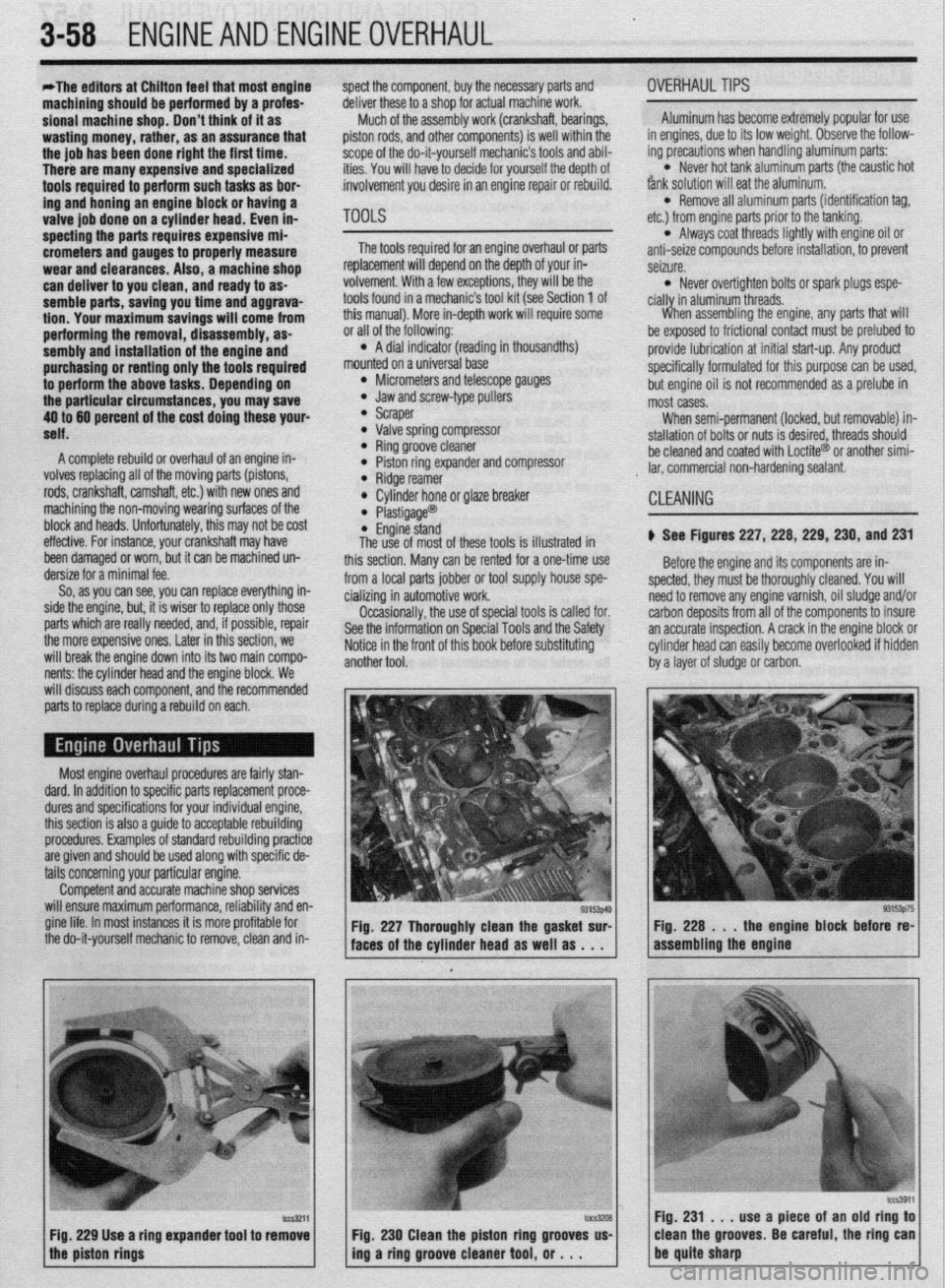
) See Figures 227, 228, 229, 230, and 231
Before the engine and its components are in-
spected, they must be thoroughly cleaned. You will
need to remove anv enaine varnish, oil sludoe and/or
c arbon deposits from ail of the componentsio insure
a In accurate inspection. A crack in the engine block or
c :ylinder head can easily become overlooked if hidden
t ry a layer of sludge or carbon.
Most engine overhaul procedures are fairly stan-
dard. In addition to specific parts replacement proce-
dures and specifications for your individual engine,
this section is also a guide to acceptable rebuilding
procedures. Examples of standard rebuilding practice
are given and should be used along with specific de-
tails concerning your particular engine.
Competent and accurate machine shop services
will ensure maximum performance, reliability and en-
gine life. In most instances it is more profitable for
the do-it-yourself mechanic to remove, clean and in- Fig. 227 Thoroughly clean the gasket sur-
faces of the cylinder head as well as . . .
Fig. 229 Use a ring expander tool to remove
the piston rings
fccs3911 ::“,z s,rpuse,a piece of fn old ring to 1
clean the grooves Be careful the ring can
230 Clean the piston ring grooves us-
ing a ring groove cleaner tool, or . . .
Page 120 of 408
ENGINEAND ENGINEOVERHAUL 3-59
Most of the cleaning process can be carried out
with common hand tools and readily available sol-
vents or solutions. Carbon deposits can be chipped
away using a hammer and a hard wooden chisel. Old
gasket material and varnish or sludge can usually be
removed using a scraper and/or cleaning solvent. Ex-
tremely stubborn deposits may require the use of a
power drill wrth a wire brush. If using a wire brush,
use extreme care around any critical machined sur-
faces (such as the gasket surfaces, bearing saddles,
cylinder bores, etc.). USE OF A WIRE BRUSH IS NOT
RECOMMENDED ON ANY ALUMINUM COMPO-
NENTS Always follow any safety recommendations
given by the manufacturer of the tool and/or solvent.
You should always wear eye protection during any
cleaning process involvrng scraping, chipping or
spraying of solvents.
An alternative to the mess and hassle of cleaning
the parts yourself is to drop them off at a local garage
or machine shop. They will, more than likely, have
the necessary equrpment to properly clean all of the
parts for a nominal fee.
Always wear eye protection during any clean-
ing process involving scraping, chipping or
spraying of solvents.
Remove any oil galley plugs, freeze plugs and/or
pressed-in bearings and carefully wash and degrease
all of the engine components including the fasteners
and bolts. Small parts such as the valves, springs,
etc., should be placed in a metal basket and allowed
to soak. Use pipe cleaner type brushes, and clean all
passageways in the components. Use a ring ex-
pander and remove the rings from the pistons. Clean
the piston ring grooves with a special tool or a piece
of broken ring Scrape the carbon off of the top of the
piston. You should never use a wire brush on the
pistons. After preparing all of the piston assemblies
in this manner, wash and degrease them again.
Use extreme care when cleaning around the
cylinder head valve seats. A mistake or slip
may cost you a new seat.
When cleaning the cylinder head, remove carbon
from the combustron chamber with the valves in-
stalled. This will avoid damaging the valve seats.
:ig. 234 Drill out the damaged threads with
he specified size bit. Be sure to drill corn.
rletely through the hole or to the bottom oi
I blind hole REPAIRING DAMAGEDTHREADS
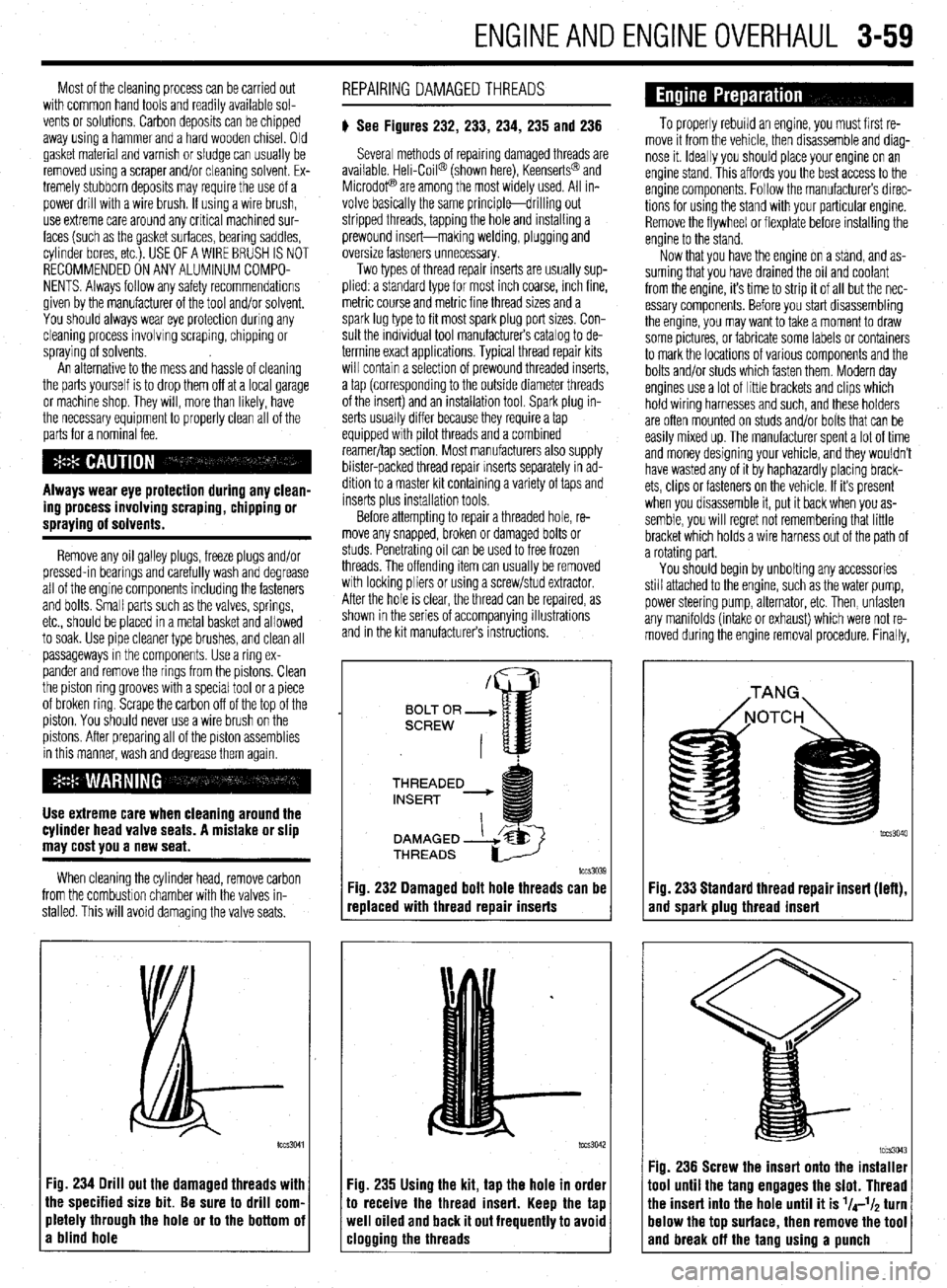
# See Figures 232, 233, 234, 235 and 236
Several methods of repairing damaged threads are
available Heli-Coil@ (shown here), Keenserts@ and
Microdop are among the most widely used. All in-
volve basically the same principle-drilling out
stripped threads, tapping the hole and installing a
prewound insert-making welding, plugging and
oversize fasteners unnecessary.
Two types of thread repair inserts are usually sup-
plied: a standard type for most inch coarse, rnch fine,
metric course and metrrc fine thread sizes and a
spark lug type to fit most spark plug port sizes. Con-
sult the individual tool manufacturers catalog to de-
termine exact applications. Typical thread repair kits
will contain a selection of prewound threaded inserts,
a tap (corresponding to the outside diameter threads
of the insert) and an installation tool. Spark plug in-
serts usually differ because they require a tap
equipped wrth pilot threads and a combined
reamer/tap section. Most manufacturers also supply
blister-packed thread repair Inserts separately in ad-
dition to a master kit containing a variety of taps and
inserts plus installation tools
Before attempting to repair a threaded hole, re-
move any snapped, broken or damaged bolts or
studs. Penetrating oil can be used to free frozen
threads. The offending item can usually be removed
with locking pliers or using a screw/stud extractor.
After the hole is clear, the thread can be reparred, as
shown in the series of accompanying illustrations
and in the krt manufacturers instructions.
THREADED
lCCS3039
replaced with thread repair inserts
:ig. 235 Using the kit, tap the hole in order
o receive the thread insert. Keep the tap
veil oiled and back it out frequently to avoid
:logging the threads
To properly rebuild an engine, you must first re-
move it from the vehicle, then disassemble and diag-
nose it. Ideally you should place your engine on an
engine stand. This affords you the best access to the
engine components. Follow the manufacturers direc-
tions for using the stand with your particular engine.
Remove the flywheel or flexplate before installing the
engine to the stand.
Now that you have the engine on a stand, and as-
suming that you have drained the oil and coolant
from the engine, it’s time to strip it of all but the nec-
essary components. Before you start disassembling
the engine, you may want to take a moment to draw
some pictures, or fabricate some labels or containers
to mark the locations of various components and the
bolts and/or studs which fasten them. Modern day
engines use a lot of little brackets and clips which
hold wiring harnesses and such, and these holders
are often mounted on studs and/or bolts that can be
easily mixed up. The manufacturer spent a lot of time
and money designing your vehicle, and they wouldn’t
have wasted any of it by haphazardly placing brack-
ets, clips or fasteners on the vehicle. If it’s present
when you disassemble it, put it back when you as-
semble, you will regret not remembering that little
bracket which holds a wire harness out of the path of
a rotating part.
You should begin by unbolting any accessories
still attached to the engine, such as the water pump,
power steering pump, alternator, etc. Then, unfasten
any manifolds (intake or exhaust) which were not re-
moved during the engine removal procedure. Finally,
Fig. 233 Standard thread repair insert (left),
and spark plug thread insert
im3043 Fig. 236 Screw the insert onto the installer
1001 until the tang engages the slot. Thread
‘he insert into the hole until it is l/4-l/~ turn
lelow the top surface, then remove the tool
and break off the tano usina a uunch
Page 123 of 408
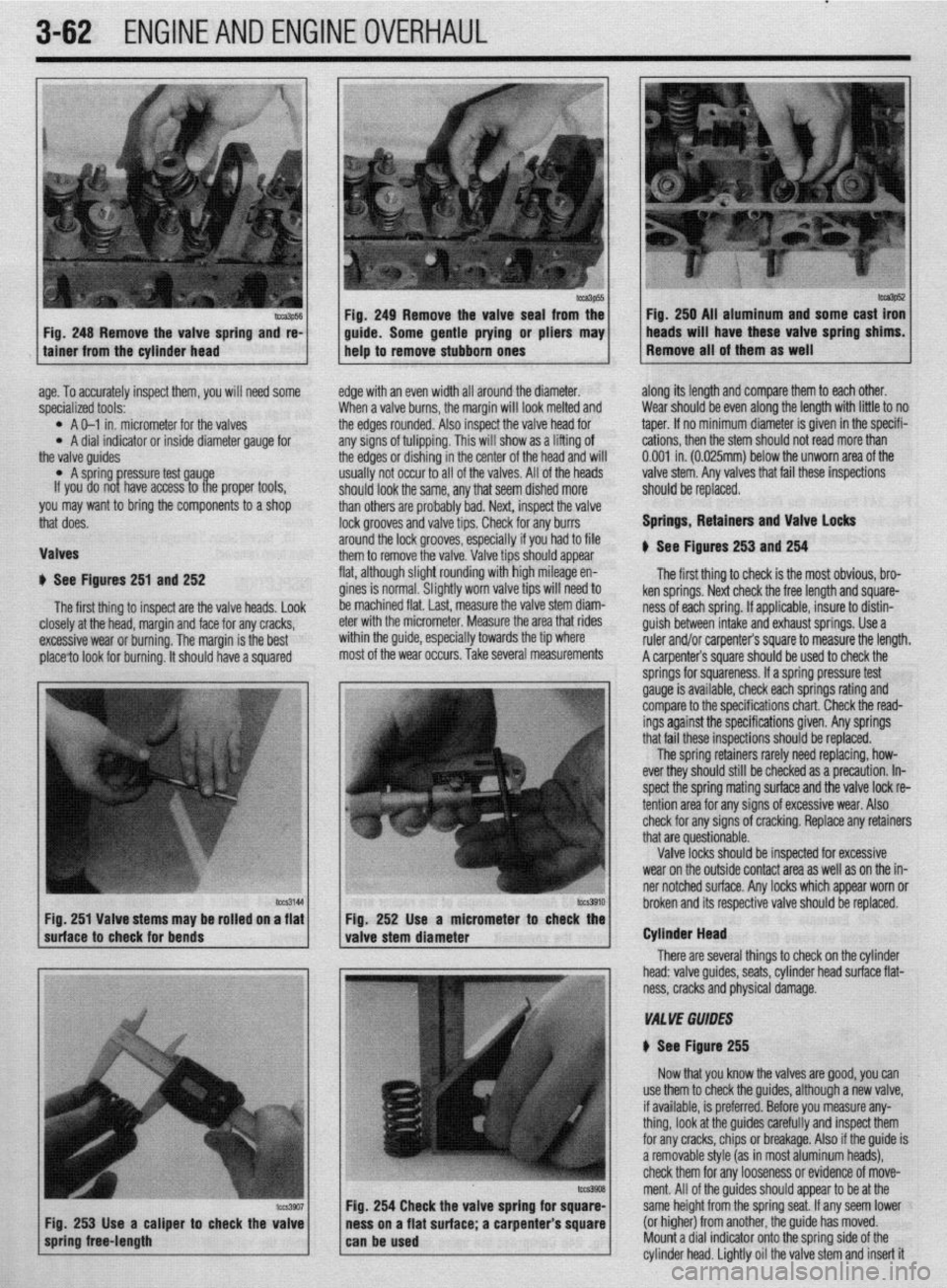
.
3-62 ENGINEANDENGINEOVERHAUL
lge. To accurately inspect them, you will need some
,pecialized tools:
l A O-l in. micrometer for the valves l A dial indicator or inside diameter gauge for
he valve guides
l A spring ressure test gau e
If you do no P Yl have access to t e proper tools,
‘ou may want to bring the components to a shop
hat does.
lalves
1 See Figures 251 and 252
The first thing to inspect are the valve heads. Look
E :losely at the head, margin and face for any cracks,
rxcessive wear or burning. The margin is the best
)lace?o look for burning. It should have a squared E
c
edge with an even width all around the diameter.
When a valve burns, the margin will look melted and
the edges rounded. Also inspect the valve head for
any signs of tulipping. This will show as a lifting of
the edges or dishing in the center of the head and will
usually not occur to all of the valves. All of the heads
should look the same, any that seem dished more
than others are probably bad. Next, inspect the valve
lock grooves and valve tips. Check for any burrs
around the lock grooves, especially if you had to file
them to remove the valve. Valve tips should appear
flat, although slight rounding with high mileage en-
gines is normal. Slightly worn valve tips will need to
be machined flat. last, measure the valve stem diam-
eter with the micrometer. Measure the area that rides
within the guide, especially towards the tip where
most of the wear occurs. Take several measurements along its length and compare them to each other.
Wear should be even along the length with little to no
taper. If no minimum diameter is given in the specifi-
cations, then the stem should not read more than
0.001 in. (0.025mm) below the unworn area of the
valve stem. Any valves that fail these inspections
should be replaced.
Springs, Retainers and Valve Locks
$ See Figures 253 and 254
The first thing to check is the most obvious, bro-
ken springs. Next check the free length and square-
ness of each spring. If applicable, insure to distin-
guish between intake and exhaust springs. Use a
ruler and/or carpenter’s square to measure the length.
A carpenter’s square should be used to check the
lCZS3144
I I hrnknn itc Fig. 251 Valve stems may be rolled on a flat Fio. 252 Use a micrometer
suhace to check for bends
valve stem diameter r to check the
I
There are seve Cylinder Head
ral things to check on the cylinder
head: valve guides, seats, cylinder head surface flat-
ness, cracks and physical damage.
VA1 YE GUIDES
N See Figure 255
Now that you know the valves are good, you can
254 Check the valve spring fo
s on a flat surface; a carpenter use them to check the guides, although a new valve,
if available, is preferred. Before you measure any-
thing, look at the guides carefully and inspect them
for any cracks, chips or breakage. Also if the guide is
a removable style (as in most aluminum heads),
check them for any looseness or evidence of move-
ment. All of the guides should appear to be at the
same height from the spring seat. If any seem lower
(or higher) from another, the guide has moved.
Mount a dial indicator onto the sorina side of the
cylinder head. Lightly oil the valve stem and insert it
Page 124 of 408
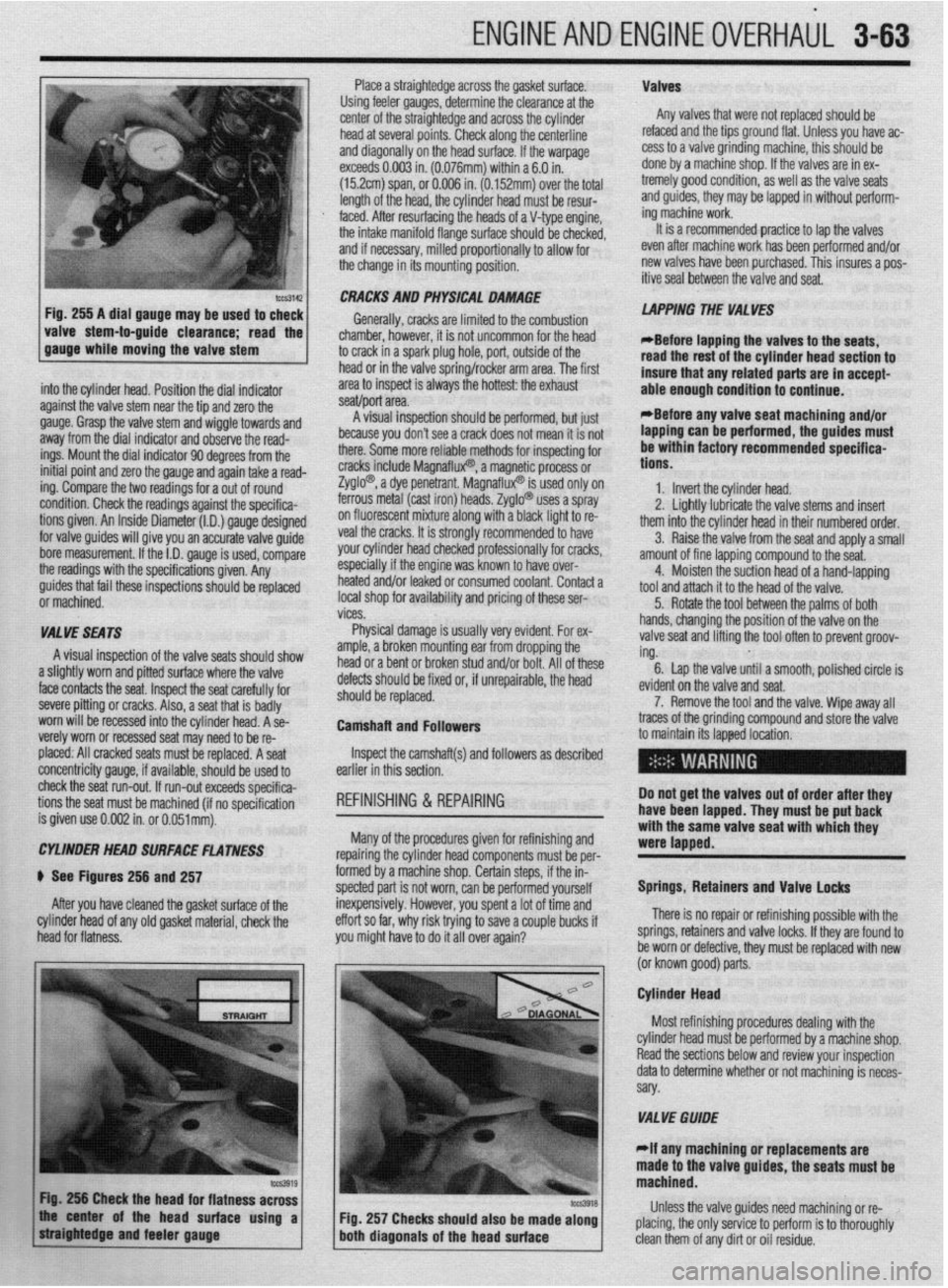
ENGINEANDENGINEOVERHAUL 3-63
Place a straightedge across the gasket surface. Valves
Using feeler gauges, determine the clearance at the
center of the straightedge and across the cylinder Any valves that were not replaced should be
head at several points. Check along the centerline refaced and the tips ground flat. Unless you have ac-
and diagonally on the head surface. If the warpage cess to a valve grinding machine, this should be
exceeds 0.003 in. (0.076mm) within a 6.0 in. done by a machine shop. If the valves are in ex-
(152cm) span, or 0.006 in. (0.152mm) over the total tremely good condition, as well as the valve seats
length of the head, the cylinder head must be resur- and guides, they may be lapped in without petform-
,
I mg macnme worK.
4
It is a recnmmended practice to lap the valves faced. After resurfacing the heads of a V-type engine
the intake manifold flange surface should be checker,
and if necessary, milled proportionally to allow for
the change in its mounting position. _ - _ _ _ .- - - _
even after machine work has been p&formed and/or
new valves have been purchased. This insures a pos-
itive seal between the valve and seat.
-guide clearance; the 1
read
. .
into the cylinder head. Position the dial indicator
against the valve stem near the tie and zero the
gauge. Grasp the valve stem and’wiggle towards and
away from the dial indicator and observe the read-
ings. Mount the dial indicator 90 degrees from the
initial point and zero the gauge and again take a read-
ing. Compare the two readings for a out of round
condition. Check the readings against the specifica-
tions given. An Inside Diameter (I.D.) gauge designed
for valve guides will give you an accurate valve guide
bore measurement. If the I.D. gauge is used, compare
the readings with the specifications given. Any CRACKS AND PHYSICAL DAMAGE
Generally, cracks are limited to the combustion
chamber, hbwever, it is not uncommon for the head
to crack in a spark plug hole, port, outside of the
head or in the valve spring/rocker arm area. The first
area to inspect is always the hottest: the exhaust
.I *
seawpon area.
8 I .,“““I llly”Lv”l~ .ml”“l” - plr”llll”“, ““I ,“a’
because you don’t see a crack does not mean it is not
there. Some more reliable methods for inspecting for
cracks include Magnaflux? a magn$i,c process or
Zyglo? a dye penetrant. Ma{ -’
InatluxW IS used only on
ferrous metal (cast iron) heat Is. Zyglo@ uses a spray
on fluorescent mixture along with a black light to re-
veal the cracks. It is strongly recommended to have
your cylinder head checked professionally for cracks,
especially if the engine was known to have over-
I .* I,. ..^.. LAPPING THE VALVES
*Before iaoaino the valves to the seats,
read the rest of the cylinder head section to
insure that any related parts are in accept-
able enough condition to continue.
*Before anv valve seat machining and/or
lapping can be performed, the guides must
be within factory recommended specifica-
tions.
1. Invert the cylinder head.
2. Linhtlv Iuhrir;rB the valve stems and insert
-. _ ~ . . . . . .--.._-._
them into the cylinder head in their numbered order.
3. Raise the valve from the seat and apply a small
amount of fine lanninn compound to the seat.
4.
i guides that fail these inspections should be replaced nearea analor ieaKea or consumea coolant. Contact a Moisten the suction head of a hand-lapping
tool and attach it to the head of the valve.
i or machined. local shop for availability and pricing of these ser-
5. Rotate the tool between the palms of both
I vices.
I
VALVE SEATS Physical damage is usually very evident. For ex- hands, changing the position of the valve on the
valve seat and lifting the tool often to prevent groov-
A visual inspection of the valve seats should show
amnb P hrnbn mntlntinn ear from dropping the I and/or bolt. All of these ing.
.a,... . 6. Lap the valve until a smooth, polished circle is
a slightly worn and pitted surface where the valve
face contacts the seat. Inspect the seat carefully for
severe pitting or cracks. Also, a seat that is badly
worn will be recessed into the cylinder head. A se-
verely worn or recessed seat may need to be re- uetecIs SIIOUIO oe nxea or, IT unrepairaole, me neaa
should be replaced.
Camshaft and Followers evid
7
traces of the grinding corn
to maintain its lapped loca lent on the valve and seat.
‘. Remove the tool and the valve. Wipe away all
pound and store the valve
placed: All cracked seats must be replaced. A seat
concentricity gauge, if available, should be used to
check the seat run-out. If run-out exceeds specifica-
tions the seat must be machined (if no soecification
is given use 0.002 in. or O.O51mt$. Inspect the camshaft(s) and followers as described
earlier in this section.
REFINISHING & REPAIRING Do not get the valves out of order after they
have been lapped. They must be put back
: ..^^ I... --I:^:-L!-- --A
Many of the procedures gIveI
WI WIIIIISIIIIIIJ ~IIU repairing the cylinder head components must be per-
formed by a machine shop. Certain steps, if the in-
spected part is not worn, can be performed yourself
inexpensively. However, you spent a lot of time and
effort so far, why risk trying to save a couple bucks if
you might have to do it all over again?
I- with the same valve seat with which they
were lapped.
Springs, Retainers and Valve locks
There is no repair or refinishing possible with the
springs, retainers and valve locks. If they are found to
be worn or defective, they must be replaced with new
lor known nnod narts CYLtNDEt? HEAD SURFACE FLATNESS
) See Figures 256 and 257
After you have cleaned the gasket surface of the
cylinder head of any old gasket material, check the
head for flatness.
\- - a---r r- .-.
Cylinder Head
Most refinishing procedures dealing with the
VALVE GWDE
elf any machining or replacements are
e valve guides, the seats must be
Fig. 257 Checks should also be made along Unless the valve guides need machining or re-
placing, the only service to perform is to thoroughly‘
clean them of any dirt or oil residue.
Page 125 of 408
.
3-64 ENGINEANDENGINEOVERHAUL
There are only two types of valve guides used on
automobile engines: the replaceable-type (all alu-
minum heads) and the cast-in integral-type (most
cast iron heads). There are four recommended meth-
ods for repairing worn guides.
. Knurling
l Inserts l Reaming oversize l Replacing
Knurling is a process in which metal is displaced
and raised, thereby reducing clearance, giving a true
center, and providing oil control. It is the least ex-
pensive way of repairing the valve guides. However,
it is not necessarily the best, and in some cases, a
knurled valve guide will not stand up for more than
a short time. It requires a special knurlizer and pre-
cision reaming tools to obtain proper clearances. It
would not be cost effective to purchase these tools,
unless you plan on rebuilding several of the same
cylinder head.
Installing a guide insert involves machining the
guide to accept a bronze insert. One style is the coil-
type which is installed into a threaded guide. Another
is the thin-walled insert where the guide is reamed machined.
If the seats are in good condition, the valves can
be lapped to the seats, and the cylinder head assem-
bled. See the valves section for instructions on lap-
ping.
If the valve seats are worn, cracked or damaged,
they must be serviced by a machine shop. The valve
seat must be perfectly centered to the valve guide,
which requires very accurate machining.
CYLINDER HEAD SURFACE
If the cylinder head is warped, it must be ma-
chined flat. If the warpage is extremely severe, the
head may need to be replaced. In some instances, it
may be possible to straighten a warped head enough
to allow machining. In either case, contact a profes-
sional machine sh& for service. Cup Type Camshafl Followers
To install the springs, retainers and valve locks on
heads which have these components recessed into
the camshaft followers bore, you will need a small
I” .1.1.“1.“”
., ,, just after compressing the spring but before the *Any OHC cylinder head that shows exces-
sive warpage should have the camshaft bear-
ing journals align bored after the cylinder
head has been resurfaced. screwdriver-type tool, some clean white grease and a
lot of patience. You will also need the C-clamp style
spring compressor and the OHC tool used to disas-
semble the head.
1. Lightly lubricate the valve stems and insert all
of the valves into the cylinder head. If possible, main-
tain their original locations.
2. If equipped, install any valve spring shims
which were removed.
3. If equipped, install the new valve seals, keep-
ing the following in mind:
l If the valve seal presses over the guide,
lightly lubricate the outer guide surfaces.
l If the seal is an 0-rina tvoe. it rc rn+#fld
valve locks.
4. Place thevalve spring and retainer over the
stem.
5. Position the spring compressor and the OHC
tool, then compress the spring.
6. Using a small screwdriver as a spatula, fill
the valve stem side of the lock with white grease. Use
the excess grease on the screwdriver to fasten the
lock to the driver.
7. Carefully install the valve lock, which is stuck
to the end of the screwdriver, to the valve stem then
press on it with the screwdriver until the grease
squeezes out. The valve lock should now be stuck to
the stem.
8. Repeat Steps 6 and 7 for the remaining valve
lock. :
oversize to accept a split-sleeve insert. After the in-
sert is installed, a special tool is then run through the
guide to expand the insert, locking it to the guide.
The insert is then reamed to the standard size for
proper valve clearance.
Reamina for oversize valves restores normal clear- Failure to align bore the camshaft bearing
journals could result in severe engine dam-
age including but not limited to: valve and
oiston damage. connectinu rod damaoe,
iamshaft and/or crankshaft breakage,
antes and provides a true valve seat. Most cast-in
i tvpe guides can be reamed to accept an valve with an CRACKS AND PHYSICAL DAMAGE
oversize stem. The cost factor for this can become
quite high as you will need to purchase the reamer
and new, oversize stem valves for all guides which
were reamed. Oversizes are generally 0.003 to 0.030
in. (0.076 to 0.762mm), with 0.015 in. (0.381mm)
being the most common.
To replace cast-in type valve guides, they must be
drilled out, then reamed to accept replacement
guides, This must be done on a fixture which will al-
low centering and leveling off of the original valve
seat or quide, otherwise a serious guide-to-seat mis-
alignment may occur making it impossible to prop-
erly machine the seat.
Replaceable-type guides are pressed into the
cylinder head. A hammer and a stepped drift or
punch may be used to install and remove the guides.
Before removing the guides, measure the protrusion
on the spring side of the head and record it for instal-
tation. Use the stepped drift to hammer out the old
guide from the combustion chamber side of the head.
when in~llfng, determine whether or not the guide
also seals a water jacket in the head, and if it does,
use the ~o~ended sealing agent. If there is no
water jacket grease the valve guide and its bore. Use
the stepped drift, and hammer the new guide into the
cylinder head from the spring side of the cylinder
head. A stack af washers the same thickness as the
measured Eaton may help the installation Certain cracks can be repaired in both cast iron
and aluminum heads. For cast iron, a tapered
threaded insert is installed along the length of the
crack. Aluminum can also use the tapered inserts,
however welding is the preferred method. Some
physical damage can be repaired through brazing or
welding. Contact a machine shop to get expert advict
for your particular dilemma.
ASSEMBLY
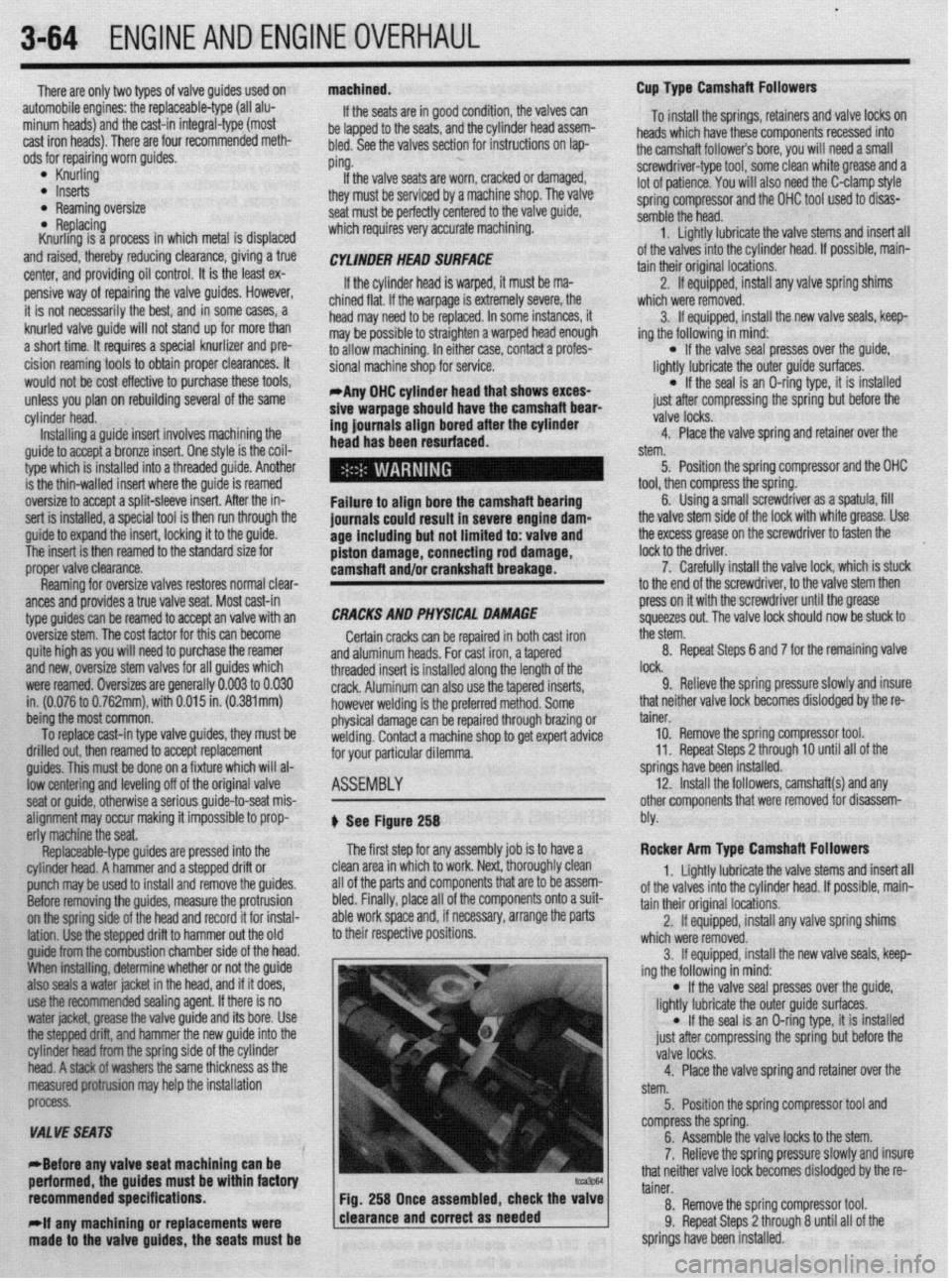
+ See Figure 258
The first step for any assembly job is to have a
clean area in which to work. Next, thoroughly clean
all of the parts and components that are to be assem-
bled. Finally, place all of the components onto a suit-
able work space and, if necessary, arrange the parts
to their respective positions.
process.
VALVE SEATS
*Before any valve seat maChining can be
aerformed. the guides must be within factory
recommended specifications.
-
1 Fig. 258 Once assembled, check the valve
;
rlf any machtning or replacements were 1 clearance and correct as needed
I
made to the valve guides, the seats must be 9. Relieve the spring pressure slowly and insure
that neither valve lock becomes dislodged by the re-
tainer.
10. Remove the spring compressor tool.
11. Repeat Steps 2 through 10 until all of the
springs have been installed.
12. Install the followers, camshaft(s) and any
other components that were removed for disassem-
bly.
Rocker Arm Type Camshaft Followers
1. Lightly lubricate the valve stems and insert all
of the valves into the cylinder head. If possible, main-
tain their original locations.
2. If equipped, install any valve spring shims
which were removed.
3. If equipped, install the new valve seals, keep-
ing the following in mind:
l If the valve seal presses over the guide,
lightly lubricate the outer guide surfaces.
l If the seal is an O-ring type, it is installed
just after compressing the spring but before the
valve locks.
4. Place the valve spring and retainer over the
stem.
5. Position the spring compressor tool and
compress the spring.
6. Assemble the valve locks to the stem.
7. Relieve the spring pressure slowly and insure
that neither valve lock becomes dislodged by the re-
tainer.
8. Remove the spring compressor tool.
9. Repeat Steps 2 through 8 until all of the
springs have been installed.
Page 126 of 408
I)
ENGINEANDENGINEOVERHAUL 3-65
10. Install the camshaft(s), rockers, shafts and
any other components that were removed for disas-
sembly.
GENERAL INFORMATION ways number 1. However, depending on the engine
placement, the front of the engine could either be the
flywheel or damper/pulley end. Generally the front of
the engine faces the front of the vehicle. Use a num-
ber punch or scribe and also mark the main bearing
caps from front to rear with the front most cap being
number 1 (if there are five caps, mark them 1 through
5, front to rear).
A thorough overhaul or rebuild of an engine block
would include replacing the pistons, rings, bearings,
timing belt/chain assembly and oil pump. For OHV
engines also include a new camshaft and lifters. The
block would then have the cylinders bored and honed
oversize (or if using removable cylinder sleeves, new
sleeves installed) and the crankshaft would be cut
undersize to provide new wearing surfaces and per-
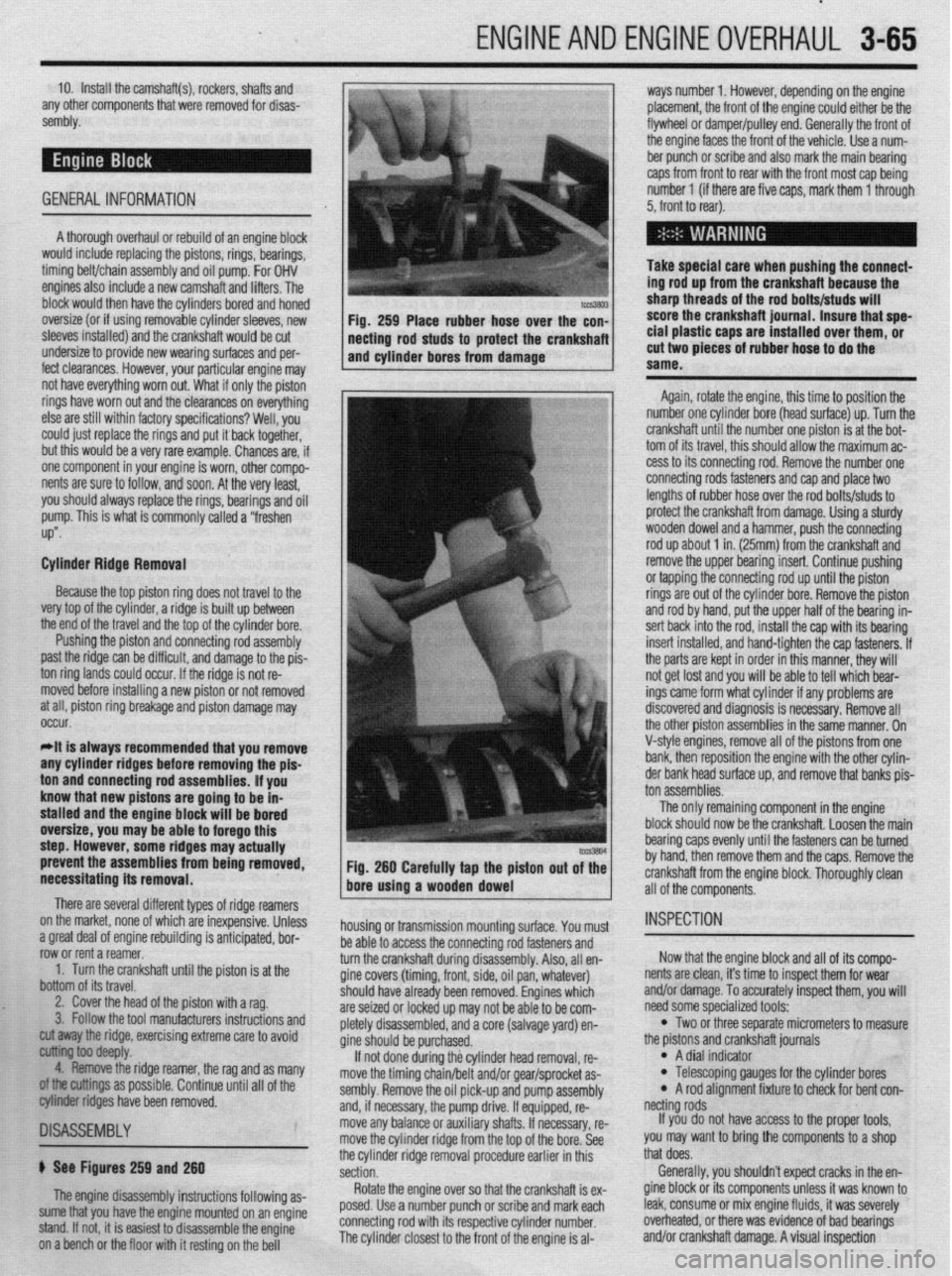
feet clearances. However, your particular engine may Take special care when pushing the connect-
ing rod up from the crankshaft because the
sharp threads of the rod bolts/studs will
score the crankshaft journal. Insure that spe-
cial plastic caps are installed over them, or
cut two pieces of rubber hose to do the
same.
Again, rotate the engine, this time to position the
number one cylinder bore (head surface) up. Turn the
crankshaft until the number one piston is at the bot-
tom of its travel, this should allow the maximum ac-
cess to its connecting rod. Remove the number one
connecting rods fasteners and cap and place two
lengths of rubber hose over the rod bolts/studs to
protect the crankshaft from damage. Using a sturdy
wooden dowel and a hammer, push the connecting
rod up about 1 in. (25mm) from the crankshaft and
remove the upper bearing insert. Continue pushing
or tapping the connecting rod up until the piston
rings are out of the cylinder bore. Remove the piston
and rod by hand, put the upper half of the bearing in-
sert back into the rod, install the cap with its bearing
insert installed, and hand-tighten the cap fasteners. If
the parts are kept in order in this manner, they will
not get lost and you will be able to tell which bear-
ings came form what cylinder if any problems are
discovered and diagnosis is necessary. Remove all
the other piston assemblies in the same manner. On
V-style engines, remove all of the pistons from one
bank, then reposition the engine with the other cylin-
der bank head surface up, and remove that banks nis-
prevent the assemblies from being removed,
necessitating its removal. Fig. 260 Carefully tap the piston out of the
bore using a wooden dowel
There are several different types of ridge reamers
on the market, none of which are inexpensive, Unless
.3 “me.+ ,-ins, rdnnn;nn mh~lil.-linn ;I nn+:n:nnL.* l.^W
a ylwx “Gal “I cllylllc Ir;““ll”llly 13 dllLILlpxC”, ““I- row or rent a reamer.
1. Turn the crankshaft until the piston is at the
bottom of its travel.
2. Cover the head of the piston with a rag.
3. Follow the tool manufacturers instructions and housing or transmission mounting surface. You must
1 as many
II of the
~1SA~E~BLY
b See Figures 259 and 260
The engine disassembly instructions following as-
sume that you have the engine mounted on an engine
stand. If not, it is easiest to disassemble the engine
on a bench or the floor with it resting on the bell be able to access the connecting rod fasteners and
turn the crankshaft during disassembly. Also, all en-
gine covers (timing, front, side, oil pan, whatever)
should
are sei2
nletelv have already been removed. Engines which
,ed or locked up may not be able to be com-
r’-‘-‘, disassembled, and a core (salvage yard) en-
gine sh ould be purchased.
If no
t done during the cylinder head removal, re-
move the timing chain/belt and/or gear/sprocket as-
sembly. Remove the oil pick-up and pump assembly
and, if necessary, the pump drive. If equipped, re-
move any balance or auxiliary shafts. If necessary, re-
move the cylinder ridge from the top of the bore. See
the cylinder ridge removal procedure earlier in this
section.
Rotate the engine over so that the crankshaft is ex-
posed. Use a number punch or scribe and mark each
connecting rod with its respective cylinder number.
The cylinder closest to the front of the engine is al- cut away the ridge, exercising extreme care to avoid
~ ioo deepfy.
4. Remove the ridge reamer, the rag and
armings as possible. Continue until a
biter ridges have been removed. ton assemblies.
The only remaining component in the engine
block should now be the crankshaft. Loosen the main
bearing caps evenly until the fasteners can be turned
by hand, then remove them and the caps. Remove the
crankshaft from the engine block. Thoroughly clean
all of the components.
INSPECTION
Now that the engine block and all of its compo-
nents are clean, it’s time to inspect them for wear
and/or damage. To accurately inspect them, you will
need some specialized tools:
l Two or three separate micrometers to measure
the prstons and crankshaft journals
l A dial indicator l Telescoping gauges for the cylinder bores l A rod alignment fixture to check for bent con-
netting rods
If you do not have access to the proper tools,
you may want to bring the components to a shop
that does.
Generally, you shouldn’t expect cracks in the en-
gine block or its components unless it was known to
leak, consume or mix engine fluids, it was severely
overheated, or there was evidence of bad bearings
and/or crankshaft damage. A visual inspection
Page 127 of 408
3-66 ENGINEANDENGINEOVERHAUL
should be performed on all of the components, but
just because you don’t see a crack does not mean it
is not there. Some more reliable methods for inspect-
ing for cracks include Magnaflux? a magnetic
process or Zyglo@‘, a dye penetrant. Magnaflux@ is
used only on ferrous metal (cast iron). Zyglo@ uses a
spray on fluorescent mixture along with a black light
to reveal the cracks. It is strongly recommended to
have your engine block checked professionally for
cracks, especially if the engine was known to have
overheated and/or leaked or consumed coolant. Con-
tact a local shop for availability and pricing of these
services.
Engine Block
ENGINE BLOCK BEARING ALIGNMENT
Remove the main bearing caps and, if still in:
stalled, the main bearing inserts. Inspect all of the
main bearing saddles and caps for damage, burrs or
high spots. If damage is found, and it is caused from
a spun main bearing, the block will need to be align-
bored or, if severe enough, replacement. Any burrs or
high spots should be carefully removed with a metal
file.
Place a straightedge on the bearing saddles, in the
engine block, along the centerline of the crankshaft. If
any clearance exists between the straightedge and the
saddles, the block must be align-bored.
Align-boring consists of machining the main
bearing saddles and caps by means of a flycutter that
runs through the bearing saddles.
DECK FLATNESS
The top of the engine block where the cylinder
head mounts is called the deck. Insure that the deck
surface is clean of dirt, carbon deposits and old gas-
ket material. Place a straightedge across the surface
of the deck along its centerline and, using feeler
gauges, check the clearance along several points. Re-
peat the checking procedure with the straightedge
placed along both diagonals of the deck surface. If
the reading exceeds 0.003 in. (0.076mm) within a 6.0
in. (152cm) span, or 0.006 in. (0.152mm) over the
total length of the deck, it must be machined.
CYLINDER BORES
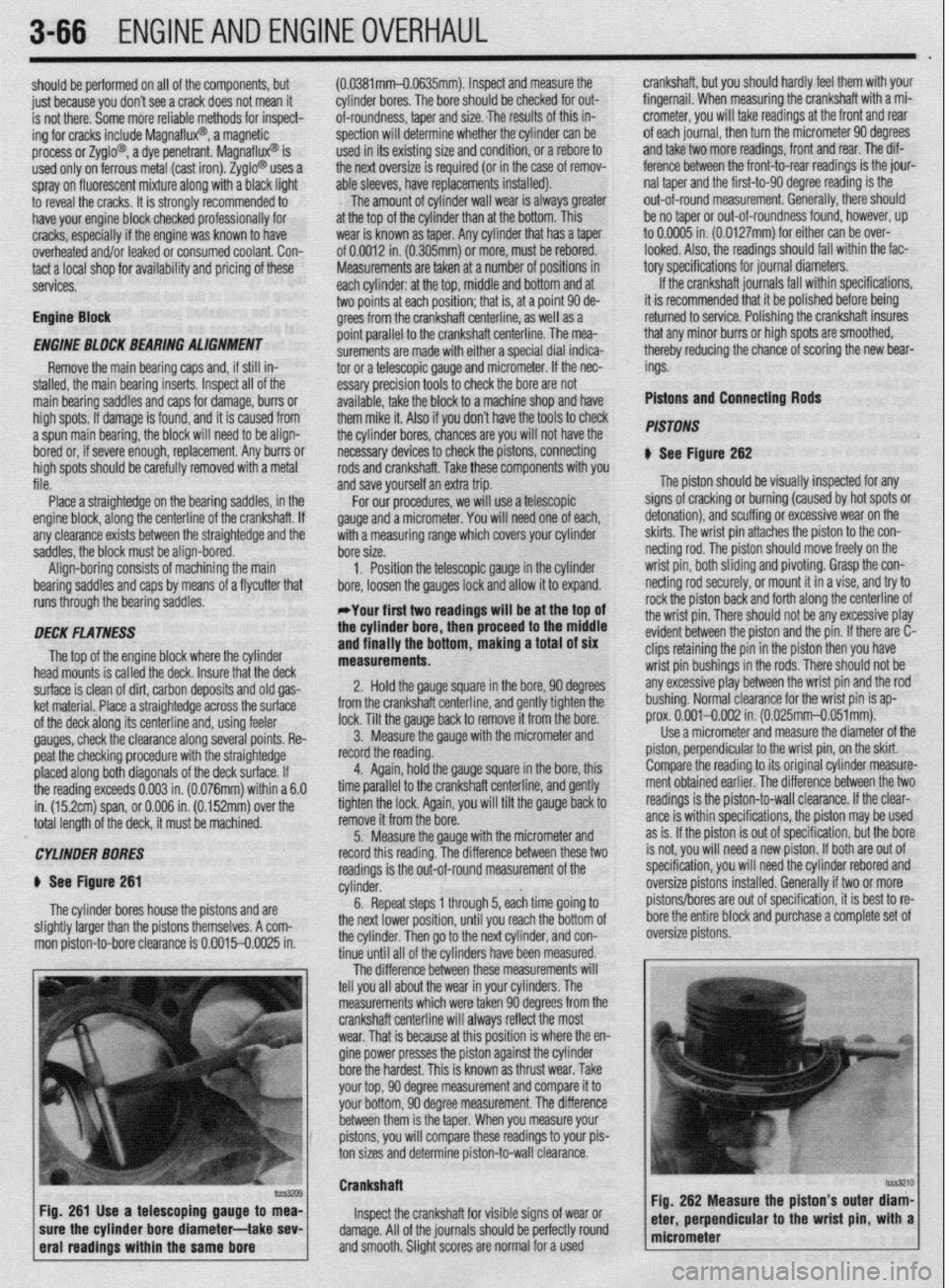
$ See Figure 261
The cylinder bores house the pistons and are
slightly larger than the pistons themselves. A com-
mon piston-to-bore clearance is 0.0015-0.0025 in. (0.0381mm-O.0635mm). Inspect and measure the
cylinder bores. The bore should be checked for out-
of-roundness, taper and size. The results of this in-
spection will determine whether thecylinder can be
used in its existing size and condition, or a rebore to
the next oversize is required (or in the case of remov-
able sleeves, have replacements installed).
The amount of cylinder wall wear is always greater
at the top of the cylinder than at the bottom. This
wear is known as taper. Any cylinder that has a taper
of 0.0012 in. (0.305mm) or more, must be rebored.
Measurements are taken at a number of positions in
each cylinder: at the top, middle and bottom and at
two points at each position; that is, at a point 90 de-
grees from the crankshaft centerline, as well as a
point parallel to the crankshaft centerline. The mea-
surements are made with either a special dial indica-
tor or a telescopic gauge and micrometer. If the nec-
essary precision tools to check the bore are not
available, take the block to a machine shop and have
them mike it. Also if you don’t have the tools to check
the cylinder bores, chances are you will not have the
necessary devices to check the pistons, connecting
rods and crankshaft. Take these components with you
and save yourself an extra trip.
For our procedures, we will use a telescopic
gauge and a micrometer. You will need one of each,’
with a measuring range which covers your cylinder
bore size.
1, Position the telescopic gauge in the cylinder
bore, loosen the gauges lock and allow it to expand.
*Your first two readings will be at the top of
the cylinder bore, then proceed to the middle
and finally the bottom, making a total of six
measurements.
2. Hold the gauge square in the bore, 90 degrees
from the crankshaft centerline, and gently tighten the
lock. Tilt the gauge back to remove it from the bore.
3. Measure the gauge with the micrometer and
record the reading.
4. Again, hold the gauge square in the bore, this
time parallel to the crankshaft centerline, and gently
tighten the lock. Again, you will tilt the gauge back to
remove it from the bore.
5. Measure the gauge with the micrometer and
record this reading. The difference between these two
readings is the out-of-round measurement of the
cylinder.
6. Repeat steps 1 through 5, each time going to
the next lower position, until you reach the bottom of
the cylinder. Then go to the next cylinder, and con-
tinue until all of the cylinders have been measured.
The difference between these measurements will
tell you all about the wear in your cylinders. The
measurements which were taken 90 degrees from the
crankshaft centerline will always reflect the most
wear.,That is because at this position is where the en-
gine power presses the piston against the cylinder
bore the hardest. This is known as thrust wear. Take
your top, 90 degree measurement and compare it to
your bottom, 90 degree measurement. The difference
between them is the taper. When you measure your
pistons, you will compare these readings to your pis-
ton sizes and determine piston-to-wall clearance. crankshaft, but you should hardly feel them with your
fingernail. When measuring the crankshaft with a mi-
crometer, you will take readings at the front and rear
of each journal, then turn the micrometer 90 degrees
and take two more readings, front and rear. The dif-
ference between the front-to-rear readings is the jour-
nal taper and the first-to-90 degree reading is the
out-of-round measurement. Generally, there should
be no taper or out-of-roundness found, however, up
to 0.0005 in. (0.0127mm) for either can be over-
looked. Also, the readings should fall within the fac-
tory specifications for journal diameters.
If the crankshaft journals fall within specifications,
it is recommended that it be polished before being
returned to service. Polishing the crankshaft insures
that any minor burrs or high spots are smoothed,
thereby reducing the chance of scoring the new bear-
ings.
Pistons and Connecting Rods
PISTONS
N See Figure 262
The piston should be visually inspected for any
signs of cracking or burning (caused by hot spots or
detonation), and scuffing or excessive wear on the
skirts. The wrist pin attaches the piston to the con-
netting rod. The piston should move freely on the
wrist pin, both sliding and pivoting. Grasp the con-
netting rod securely, or mount it in a vise, and try to
rock the piston back and forth along the centerline of
the wrist pin. There should not be any excessive play
evident between the piston and the pin. If there are C-
clips retaining the pin in the piston then you have
wrist pin bushings in the rods. There should not be
any excessive play between the wrist pin and the rod
bushing. Normal clearance for the wrist pin is ap-
prox. 0.001-0.002 in. (0.025mm-0.051mm).
Use a micrometer and measure the diameter of the
piston, perpendicular to the wrist pin, on the skirt.
Compare the reading to its original cylinder measure-
ment obtained earlier. The difference between the two
readings is the piston-to-wall clearance. If the clear-
ante is within specifications, the piston may be used
as is. If the piston is out of specification, but the bore
is not, you will need a new piston. If both are out of
specification, you will need the cylinder rebored and
oversize pistons installed. Generally if two or more
pistons/bores are out of specification, it is best to re-
bore the entire block and purchase a complete set of
oversize pistons.
Crankshaft
Inspect the crankshaft for visible signs of wear or
damage. All of the journals should be perfectly round
and smooth. Slight scores are normal for a used
Page 128 of 408
ENGINEANDENGINEOVERHAUL 3-67
CONNECTING ROD
You should have the connecting rod checked for
StraiQhtness at a machine shop. If the connecting rod
is bent, it will unevenly wear the bearing and piston,
as well as place greater stress on these components.
Any bent or twisted connecting rods must be re-
placed. If the rods are straight and the wrist pin clear-
ance is within specifications, then only the bearing
end of the rod need be checked. Place the connecting
rod into a vice, with the bearing inserts in place, in-
stall the cap to the rod and torque the fasteners to
specifications. Use a telescoping gauge and carefully
measure the inside diameter of the bearings. Com-
pare this reading to the rods original crankshaft jour-
nal diameter measurement. The difference is the oil
clearance. If the oil clearance is not within specifica-
tions, install new bearings in the rod and take another
.
specifica- L
need to
shop as the pistons must be installed in the con measurement. it the Clearance is still out of :
tions, and the crankshaft is not, the rod will
be reconditioned by a machine shop.
*You can also use Plastigage’
@to check the
bearing clearances. The assen- . ...= - _______
Mm sectinn has complete instructions on its use.
Camshaft
Inspect the camshaft and lifters/followers as de
scribed earlier in this section.
Bearings
All of the enaine bearinos should be visuallv in-
~~~ I~ .- - -- ..-_-..,
spected for we; and/or damage. The bearing should
look evenly worn all around with no deep scores or
pits. If the bearing is severely worn, scored, pitted or
heat blued, then the bearing, and the components
that use it, should be brought to a machine shop for
block. ,ect
relationshipto the rod or engine damage can occur,
Pistons and Connecting Rods
I
b See Fiaute 264 --- --*------
Only pistons with the wrist pin retained by C-clips
are serviceable by the home-mechanic. Press fit pis-
tons require special presses and/or heaters to re- I”
rr
rove/install the connecting rod and should only be
PC srformed by a machine shop.
All pistons will have a mark indicating the direc-
tir 9n to the front of the engine and the must be in-
stalled into the engine in that manner. Usually it is a
notch or arrow on the top of the piston, or it may be
the letter F cast or stamped into the piston.
ASEtiBlY
1
crankshaft. Replace any freeze or oil galley plugs
which were removed during disassembly.
Crankshaft
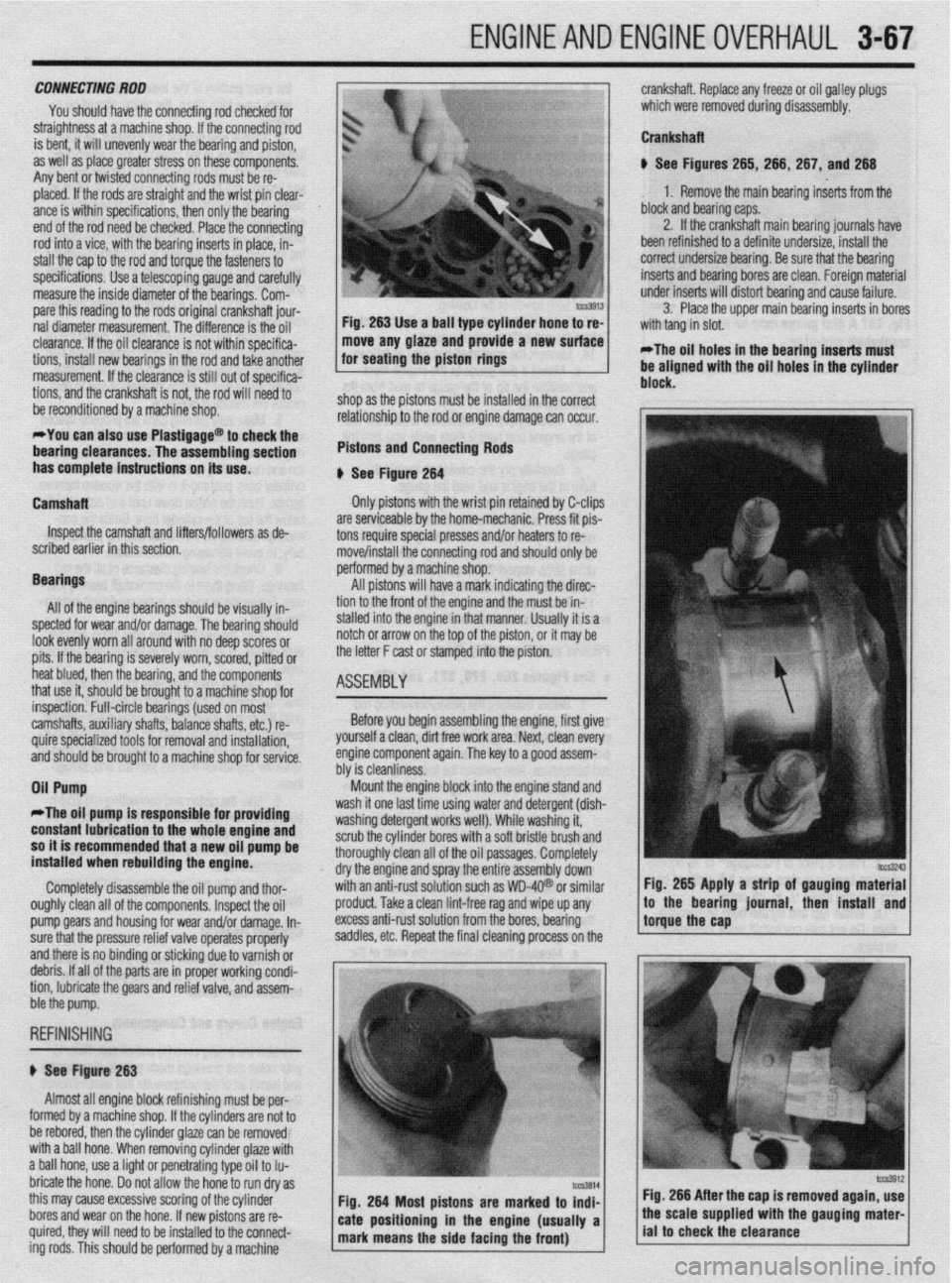
u See Figures 265, 266, 267, and 266
1. Remove the main bearing inserts from the
block and bearing caps.
2. If the crankshaft main bearing journals have
been refinished to a definite undersize, install the
correct undersize bearina. Be sure that the bearina
inserts and bearing bores are clean. Foreign mateiial
under inserts will distort bearinq and cause failure.
3. Place the upper main bearing inserts in bores
*The oil holes in the bearing inserts must
be aligned with the oil holes in the cylinder
. . .
inspection. Full-circle bearings (used on most
camshafts, auxiliary shafts, balance shafts, etc.) re-
quire specialized tools for removal and installation, ’
and should be brought to a machine shop for service.
Oil Pump Before you begin assembling the engine, first give
yourself a clean, dirt free work area. Next, clean every
engine component again. The key to a QOOd assem-
hhr io da~nlinmw “‘I Ia ~rGiOllll,lc7.Ja. Mount the engine block into the engine stand and
II
*The oil pump is responsible fo
r providing wasn It one last time usmg water and detergent (dish-
unrhinn rldarnant ~nrirc well), While washing it, with a soft bristle brush and
: oil oassaoes. Comoletelv constant lubrication to the whole engine and 1ILl.M 0, ,y “GSGl ycx II ““1 n
so it is recommended that a new oil pump be scrub the cylinder bore:
installed when rebuilding the engine. thoroughly clean all oft
dry the engine and spra
Completely disassemble the oil pump and thor- with an anti-rust solutio
oughly clean all of the components. Inspect the oil
pro
pump Qears and housing for wear and/or damage. In- exe
sure that the pressure relief valve operates properly sac
and there is no binding or sticking due to varnish or
debris. If all of the parts are in proper working condi-
tion, lubricate the gears and relief valve, and assem-
r
j ht
y the entire assembly down’
in such as WD-4Q@ or similar Fig. 265 Apply a strip of gauging material
Iduct. Take a clean lint-free rag and wipe up any
less anti-rust solution from the bores, bearing
Idles, etc. Repeat the final cleaning process on the !torguethe~~p * ,’ / to the bearmg lournal, then mstall and
ble the pump.
REFINISHING
# See Figure 263
Almost all engine block refinishing must be per-
I
IUIIII~U uy a macnme snap. ir me cynnoers are nor ro
be rebored, then the cylinder glaze can be removed
with a ball hone. When removing cylinder glaze with
a ball hone, use a light or penetrating type oil to Iu-
bricate the hone. Do not allow the hone to run dry as
this may cause excessive scoring of the cylinder
bores and wear on the hone. If new pistons are re-
quired, they will need to be installed to the connect-
ing rods. This should be oerformed bv a machine Fig. 266 After the cap is removed again, use