boot MITSUBISHI DIAMANTE 1900 User Guide
[x] Cancel search | Manufacturer: MITSUBISHI, Model Year: 1900, Model line: DIAMANTE, Model: MITSUBISHI DIAMANTE 1900Pages: 408, PDF Size: 71.03 MB
Page 284 of 408
DRIVETRAIN 7-5
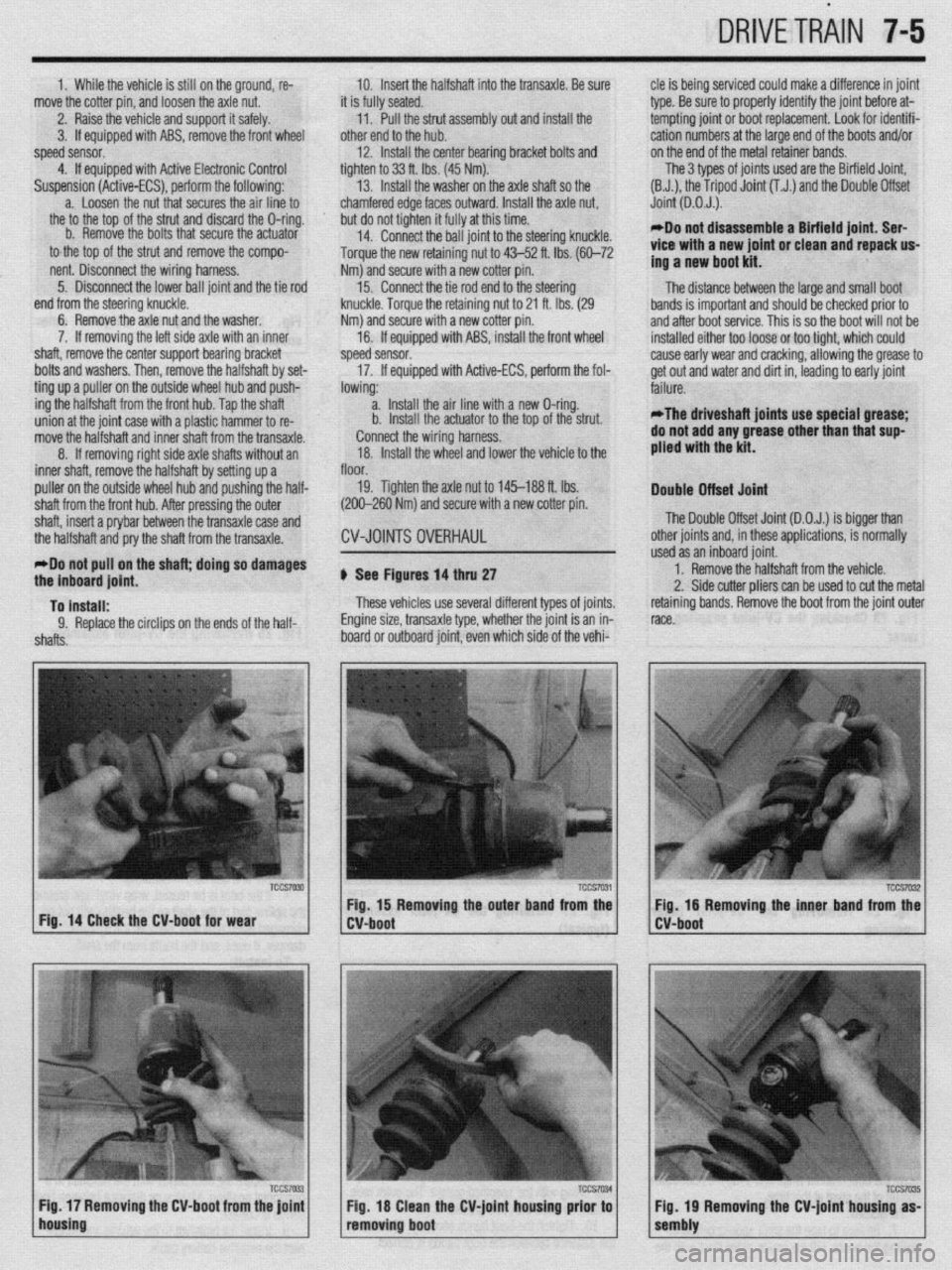
1, While the vehicle is still on the ground, re- IO. Insert the halfshaft into the tram&e. Be sure cle is being serviced could make a difference in joint
move the cotter pin, and loosen the axle nut. it is fully seated. type. Be sure to properly identify the joint before at-
2. Raise the vehicle and support it safely. 1 I. Pull the strut assembly out and install the tempting joint or boot replacement. Look for identifi-
3. If equipped with ABS, remove the front wheel other end to the hub. cation numbers at the large end of the boots and/or
speed sensor. 12. Install the center bearing bracket bolts and on the end of the metal retainer bands.
4. If equipped with Active Electronic Control tighten to 33 ft. Ibs. (45 Nm). The 3 types of joints used are the Birfield Joint,
Suspension (Active-ECS), perform the following: 13. Install the washer on the axle shaft so the (B.J.), the Tripod Joint (T.J.) and the Double Offset
a. Loosen the nut that secures the air line to chamfered edge faces outward. Install the axle nut, Joint (D.O.J.).
the to the top of the strut and discard the O-ring.
b. Remove the bolts that secure the actuator but do not tighten it fully at this time.
14. Connect the ball joint to the steering knuckle. *Do not disassemble a Birfield joint. Ser-
to.the top of the strut and remove the compo-
Torque the new retaining nut to 43-52 ft. Ibs. (68-72 vice with a new joint or clean and repack us-
nent. Disconnect the wiring harness.
Nm) and secure with a new cotter pin. ing a new boot kit.
5. Disconnect the lower ball joint and the tie rod
15. Connect the tie rod end to the steering
The distance between the large and small boot
end from the steering knuckle.
knuckle. Torque the retaining nut to 21 ft. Ibs. (29
bands is important and should be checked prior to
6. Remove the axle nut and the washer.
Nm) and secure with a new cotter pin.
and after boot service. This is so the boot will not be
7. If removing the left side axle with an inner 16. If equipped with ABS, install the front wheel
installed either too loose or too tight, which could
shaft, remove the center support bearing bracket speed sensor.
cause early wear and cracking, allowing the grease to
bolts and washers. Then, remove the halfshaft by set-
17. If equipped with Active-KS, perform the fol- get out and water and dirt in, leading to early joint
ting up a puller on the outside wheel hub and push-
lowing:
failure.
ing the halfshaft from the front hub. Tap the shaft a. Install the air line with a new O-ring.
union at the joint case with a plastic hammer to re- b. Install the actuator to the top of the strut. *The drfveshaft joints use special grease;
move the halfshaft and inner shaft from the transaxle. Connect the wiring harness. do not add any grease other than that sup-
8. If removing right side axle shafts without an 18. Install the wheel and lower the vehicle to the plied with the kit.
inner shaft, remove the halfshaft by setting up a floor.
puller on the outside wheel hub and pushing the half- 19. Tighten the axle nut to 145-188 ft. Ibs.
Double Offset Joint
shaft from the front hub. After pressing the outer (200-260 Nm) and secure with a new cotter pin.
shaft, insert a prybar between the transaxle case and The Double Offset Joint (D.O.J.) is bigger than
the halfshaft and pry the shaft from the transaxle.
CV-JOINTS OVERHAUL other joints and, in these applications, is normally
*Do not pull on the shaft; doing so damages used as an inboard joint.
the inboard joint. b See Figures 14 thru 27 1. Remove the halfshaft from the vehicle.
2. Side cutter pliers can be used to cut the metal
To install: These vehicles use several different types of joints. retaining bands. Remove the boot from the joint outer
9. Replace the circlips on the ends of the half- Engine size, transaxle type, whether the joint is an in- race.
shafts. board or outboard joint, even which side of the vehi-
TCCS7030 TCCS7031
I I TCCS7032 Fig. 15 Removing the outer band from the
Fig. 16 Removing the inner band from the
Fig. 14 Check the CV-boot for wear
W-boot
lho~sing IFi7~ / Fig 17 Removing the CV-boot from the joint 1 1 CV-boot
TCCS7035 Fig 18 Clean the CV-joint housing prior to
removing boot Tccs7W 1 1 sembiy Fig 19 Removing the CV-joint housing as-
Page 285 of 408
-
7-6 DRIVETRAIN
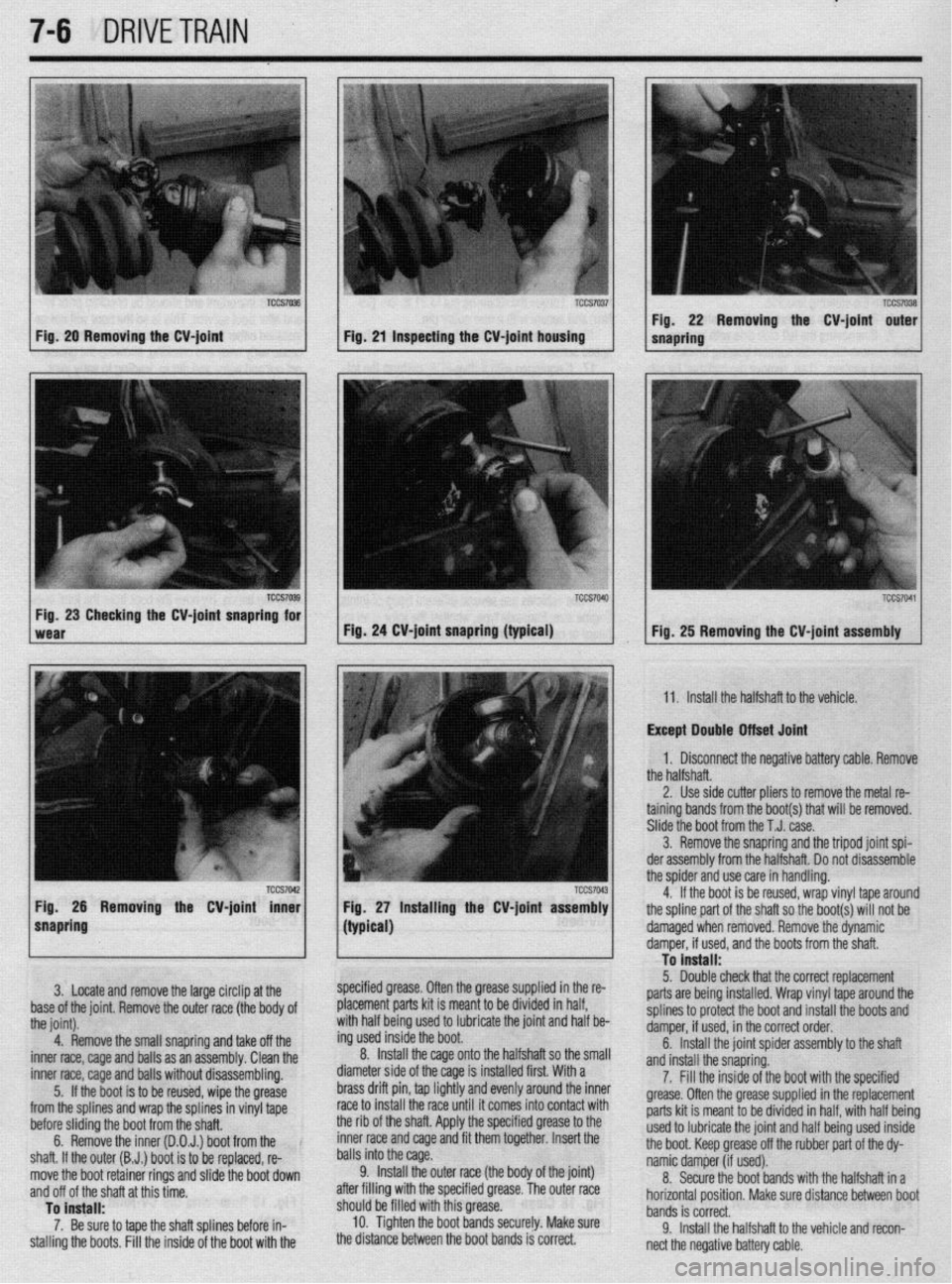
fig. 20 Removing the CV-joint Fig. 21 inspecting the M-joint housing
TCCS7042 1 Fig. 26 Removing the CV-joint inner
snapring Fig, 27 installing the CV-joint assembly Removing the CV-joint outer
Fig. 25 Removing the CV-joint assembly
11. Install the halfshaft to the vehicle.
Except Double Otfset Joint
1. Disconnect the neaative batterv cable. Remove
the halfshaft. - ’
2. Use side cutter oliers to remove the metal re-
taining bands from the boot(s) that will be removed.
Slide the boot from the T.J. case.
3. Remove the snapring and the tripod joint spi-
der assembly from the halfshaft. Do not disassemble
the spider and use care in handling.
4. If the boot is be reused, wrap vinyl tape around
the spline part of the shaft so the boot(s) will not be
I
3. Locate and remove the large circlip at the ’
base of the joint. Remove the outer race (the body of
the joint).
4. Remove the small snapring and take off the
inner race, cage and balls as an assembly. Clean the
inner race, cage and balls without disassembling.
5. If the boot is to be reused. wioe the arease
from the splines and wrap the splfnes in vin$ tape
before sliding the boot from the shaft.
6. Remove the inner (D.O.J.) boot from the
shaft. If the outer (B.J.) boot is to be replaced, re-
move the boot retainer rings and slide the boot down
and off of the shaft at this time.
To install:
7. Be sure to tape the shaft splines before in-
stalling the boots. Fill the inside of the boot with the (typiW
1
specified grease. Often the grease supplied in the re-
placement parts kit is meant to be divided in half,
with half being used to lubricate the joint and half be-
ing used inside the boot.
Install the cage onto the halfshaft so the small 8.
diameter side of the cage is installed first. With a
brass drift pin, tap lightly and e ’ ’ ‘* ’
nemy arouna me Inner
race to install the race until it comes into contact with
the rib of the shaft. Apply the specified grease to the
inner race and cage and fit them together. Insert the
balls into the cage.
9. Install the outer race (the body of the joint)
after filling with the specified grease. The outer race
should be filled with this greas e.
10. Tighten the boot bands
securely. Make sure
the distance between the boot t,, IuJ IJ ,,“I lGbl. \onrlo i.i *nrro”+ damaged when removed. Remove the dynamic
To install: damper, if used, and the boots from the shaft.
5. -
Double check that the correct replacement
parts are being installed. Wrap vinyl tape around the
splines to protect the boot and install the boots and
damper, if used, in the correct order,
6. Install the joint spider assembly to the shaft
and ipctdl the cnmrinn 7. Fill the inside ofthe boot with the specified
grease. Often the grease supplied in the replacement
parts kit is meant to be divided in half, with half being
used to lubricate the joint and half being used inside
the boot. Keep grease off the rubber part of the dy-
namic damper (if used).
8. Secure the boot bands with the halfshaft in a
horizontal position. Make sure distance between boot
bands is correct.
9. Install the halfshaft to the vehicle and recon-
nect
the negative battery cable.
Page 293 of 408
7-14 DRIVETRAIN
The only model covered by this manual equipped
with a transfer case is the 1990-93 AWD Galant. assembly. Place a drain pan under the rear of the
transfer assembly to catch any fluid that leaks out.
3. Usinq a flat-bladed prying tool, carefully re-
REMOVAL &INSTALLATION
move the ofi seal from the transfer dust seal guard
To install: 4. Using proper size seal driver tool, install the
seal into the dust seal quard and the transfer assem-
blv.
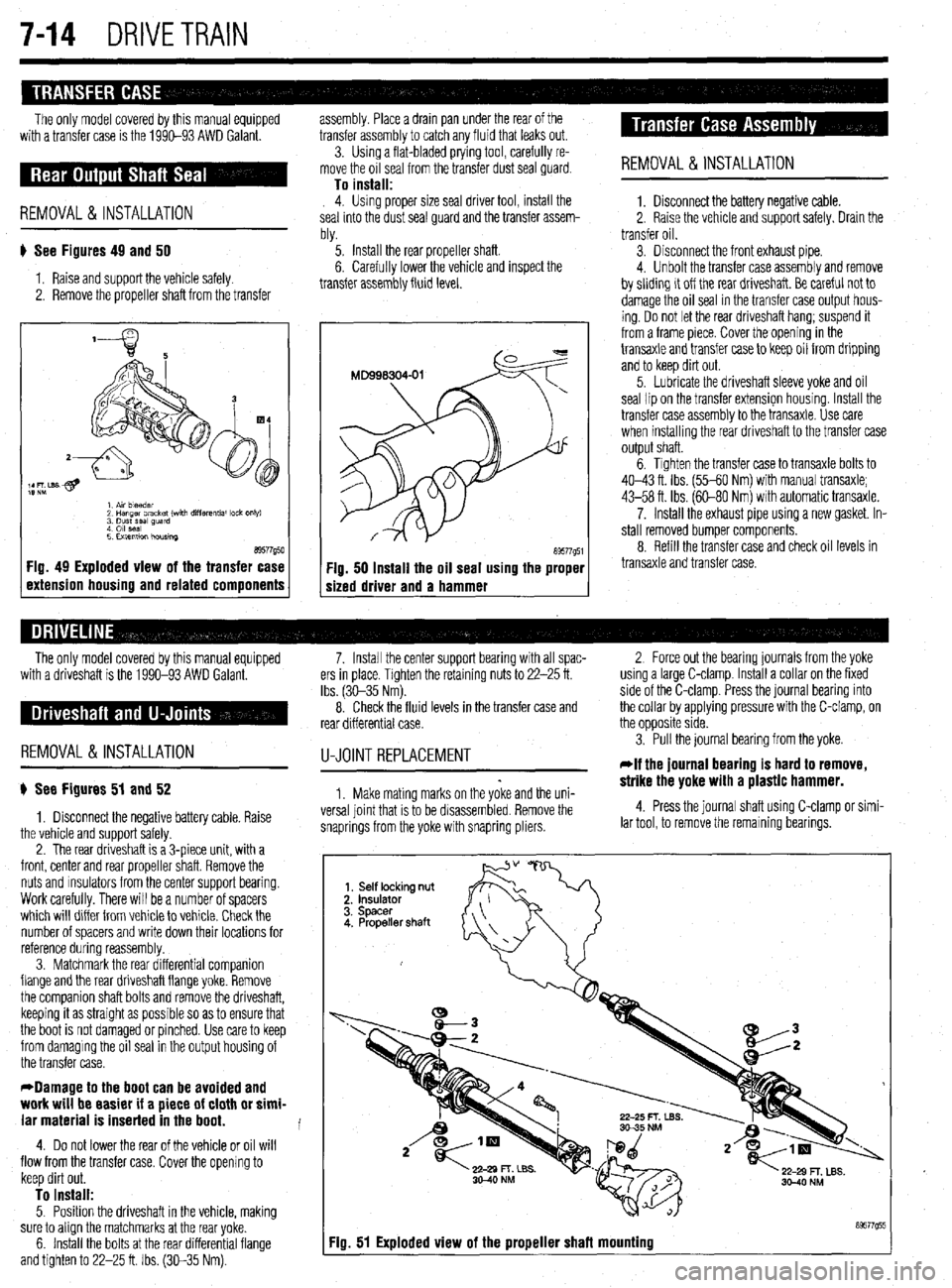
# See Figures 49 and 50
1. Raise and support the vehicle safely.
2. Remove the propeller shaft from the transfer ‘5. Install the rear propeller shaft.
6. Carefully lower the vehicle and inspect the
transfer assembly fluid level.
a9577g50 1 Fig. 49 Exploded view of the transfer case
1 extension housing and related components a9577g51 Fig. 50 Install the oil seal using the proper
sized driver and a hammer REMOVAL &INSTALLATION
1. Disconnect the battery negative cable.
2. Raise the vehicle and support safely. Drain the
transfer oil.
3. Disconnect the front exhaust pipe.
4. Unbolt the transfer case assembly and remove
by sliding it off the rear driveshaft. Be careful not to
damage the oil seal in the transfer case output hous-
ing. Do not let the rear driveshaft hang; suspend it
from a frame piece. Cover the opening in the
transaxle and transfer case to keep oil from dripping
and to keep dirt out.
5. Lubricate the driveshaft sleeve yoke and oil
seal lipan the transfer extension housing. Install the
transfer case assembly to the transaxle. Use care
when installing the rear driveshaft to the transfer case
output shaft.
6. Tighten the transfer case to transaxle bolts to
40-43 ft. Ibs. (55-60 Nm) with manual transaxle;
43-58 ft. Ibs. (60-80 Nm) with automatic transaxle.
7. Install the exhaust pipe using a new gasket. In-
stall removed bumper components.
8. Refill the transfer case and check oil levels in
transaxle and transfer case.
The only model covered by this manual equipped
with a driveshaft is the 1990-93 AWD Galant.
REMOVAL &INSTALLATION
) See Figures 51 and 52
1. Disconnect the negative battery cable. Raise
the vehicle and support safely.
2. The rear driveshaft is a 3-piece unit, with a
front, center and rear propeller shaft. Remove the
nuts and msulators from the center support bearing.
Work carefully. There will be a number of spacers
which will differ from vehicle to vehicle. Check the
number of spacers and write down their locations for
reference during reassembly.
3. Matchmark the rear differential companion
flange and the rear driveshaft flange yoke. Remove
the companion shaft bolts and remove the driveshaft,
keeping it as straight as possible so as to ensure that
the boot is not damaged or pinched. Use care to keep
from damaging the oil seal in the output housing of
the transfer case.
*Damage to the boot can be avoided and
work will be easier if a piece of cloth or simi-
lar material is inserted in the boot.
4. Do not lower the rear of the vehicle or oil will
flow from the transfer case. Cover the opening to
keep dirt out.
To install: 5. Position the driveshaft in the vehicle, making
sure to align the matchmarks at the rear yoke.
6. Install the bolts at the rear differential flange
and tighten to 22-25 ft. Ibs. (30-35 Nm). 7. Install the center support bearing with all spac- 2 Force out the bearing journals from the yoke
ers in place. Tighten the retaining nuts to 22-25 ft. using a large C-clamp. Install a collar on the fixed
Ibs. (3C-35 Nm). side of the C-clamp. Press the journal bearing into
8. Check the fluid levels in the transfer case and the collar by applying pressure with the C-clamp, on
rear differential case. the opposite side.
U-JOINTREPLACEMENT
1. Make mating marks on the yoke and the uni-
versa1 joint that is to be disassembled. Remove the
snaprings from the yoke with snapring pliers. 3. Pull the journal bearing from the yoke.
rlf the journal bearing is hard to remove,
strike the yoke with a plastic hammer.
4. Press the journal shaft using C-clamp or simi-
lar tool, to remove the remaining bearings.
Fiu. 51 Exploded view of the proueller shafl mounting
Page 294 of 408
DRIVETRAiN 7-15
MATING MARKS
/
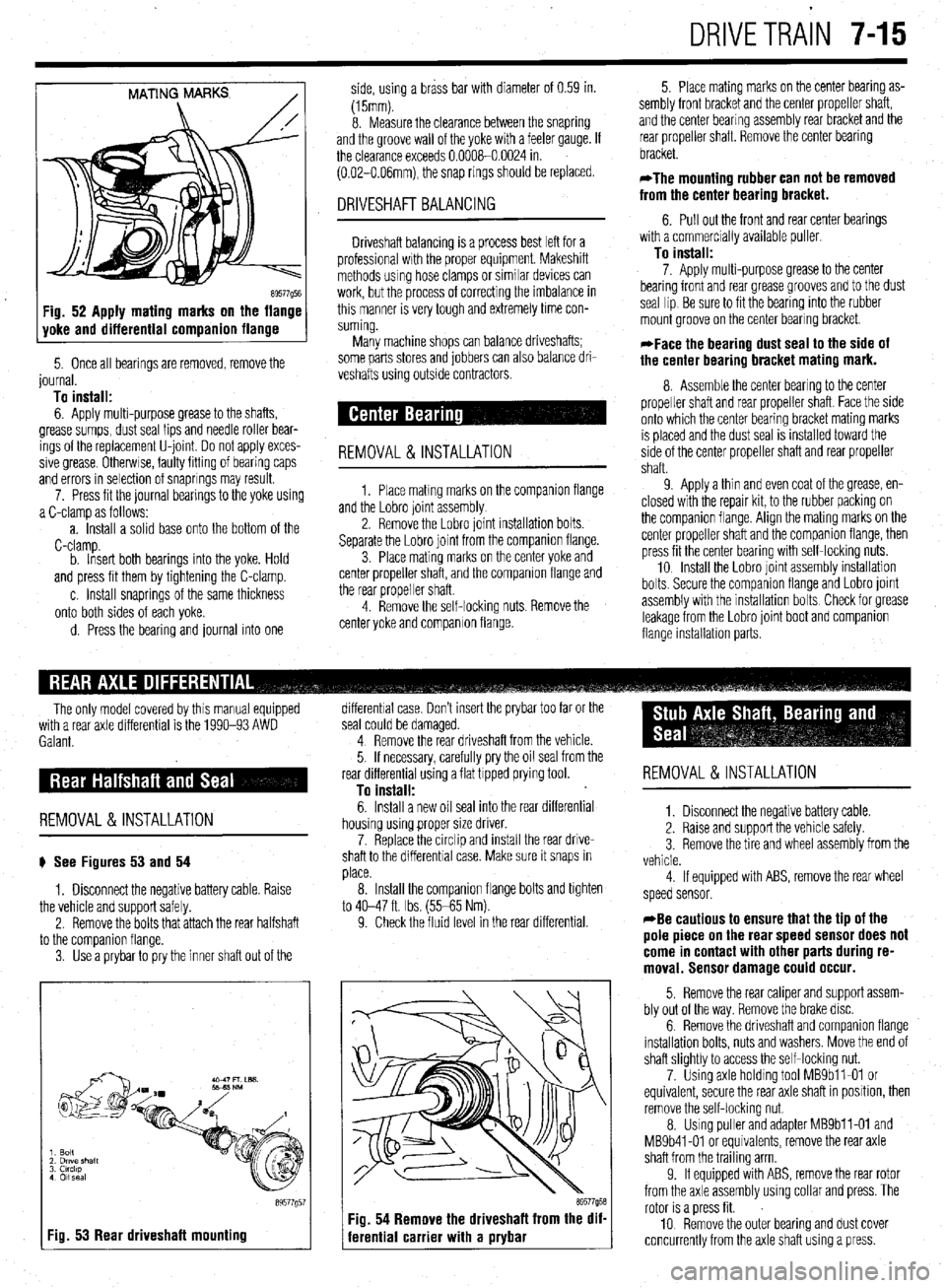
89577Q5E Fig. 52 Apply mating marks on the flange
yoke and differential companion flange
5. Once all bearings are removed, remove the
journal.
To install:
6. Apply multi-purpose grease to the shafts,
grease sumps, dust seal lips and needle roller bear-
ings of the replacement U-joint Do not apply exces-
sive grease Otherwse, faulty fitting of bearing caps
and errors in selection of snaprings may result.
7. Press fit the journal bearings to the yoke using
a C-clamp as follows:
a. Install a solid base onto the bottom of the
C-clamp.
b. Insert both bearings into the yoke. Hold
and press fit them by tightening the C-clamp.
c. Install snaprings of the same thickness
onto both sides of each yoke.
d. Press the bearing and journal into one side, using a brass bar with diameter of 0.59 in.
(15mm).
8. Measure the clearance between the snapring
and the groove wall of the yoke with a feeler gauge. If
the clearance exceeds 0.0008-0.0024 in.
(0.02-O.O6mm), the snap rings should be replaced.
DRIVESHAFT BALANCING
Driveshaft balancing is a process best left for a
professional wrth the proper equipment. Makeshift
methods using hose clamps or similar devices can
work, but the process of correcting the imbalance in
this manner is very tough and extremely time con-
suming.
Many machine shops can balance driveshafts;
some parts stores and jobbers can also balance dri-
veshafts using outside contractors.
REMOVAL&INSTALLATION
1. Place matmg marks on the companron flange
and the Lobro joint assembly
2. Remove the Lobro joint installation bolts.
Separate the Lobro joint from the companion flange.
3. Place mating marks on the center yoke and
center propeller shaft, and the companion flange and
the rear propeller shaft.
4. Remove the self-locking nuts. Remove the
center yoke and companion flange. 5. Place mating marks on the center bearing as-
sembly front bracket and the center propeller shaft,
and the center bearing assembly rear bracket and the
rear propeller shaft. Remove the center bearing
bracket.
*The mounting rubber can not be removed
from the center bearing bracket.
6. Pull out the front and rear center bearings
with a commercially available puller
To install:
7. Apply multi-purpose grease to the center
bearing front and rear grease grooves and to the dust
seal lip Be sure to fit the bearing into the rubber
mount groove on the center bearing bracket.
*Face the bearing dust seal to the side of
the center bearing bracket mating mark.
8. Assemble the center bearing to the center
propeller shaft and rear propeller shaft. Face the side
onto which the center bearing bracket mating marks
IS placed and the dust seal is installed toward the
side of the center propeller shaft and rear propeller
shaft.
9 Apply a thin and even coat of the grease, en-
closed with the repair kit, to the rubber packing on
the companion flange. Align the mating marks on the
center propeller shaft and the companion flange, then
press fit the center bearing with self-locking nuts.
10 Install the Lobro joint assembly installation
bolts. Secure the companron flange and Lobro joint
assembly with the installation bolts Check for grease
leakage from the Lobro joint boot and companion
flange installabon parts.
The only model covered by this manual equipped
with a rear axle differential is the 1990-93 AWD
Galant.
REMOVAL &INSTALLATION
# See Figures 53 and 54
1. Disconnect the negative battery cable. Raise
the vehicle and support safely.
2. Remove the bolts that attach the rear halfshaft
to the comoanion flanae.
3. Use’a prybar topry the inner shaft out of the
I Fig. 53 Rear driveshaft mounting
89577g5
differential case. Don’t insert the prybar too far or the
seal could be damaged.
4 Remove the rear driveshaft from the vehicle.
5. If necessary, carefully pry the oil seal from the
rear differential using a flat tipped prying tool.
To install:
6. Install a new oil seal into the rear differential
housing using proper size driver.
7. Replace the circlip and install the rear drive-
shaft to the differential case. Make sure it snaps in
place.
8. Install the companion flange bolts and tighten
to 40-47 ft. Ibs. (55-65 Nm).
9. Check the fluid level in the rear differential.
69577958 Fig. 54 Remove the driveshaft from the dif-
ferential carrier with a prybar
REMOVAL &INSTALLATION
1. Disconnect the negative battery cable.
2. Raise and support the vehicle safely.
3 Remove the tire and wheel assembly from the
vehicle.
4 If equipped with ABS, remove the rear wheel
speed sensor.
*Be cautious to ensure that the tip of the
pole piece on the rear speed sensor does not
come in contact with other parts during re-
moval. Sensor damage could occur.
5. Remove the rear caliper and support assem-
bly out of the way. Remove the brake disc.
6. Remove the driveshaft and companion flange
installation bolts, nuts and washers. Move the end of
shaft slightly to access the self-locking nut.
7. Using axle holding tool MBSbll-01 or
equivalent, secure the rear axle shaft in position, then
remove the self-locking nut.
8. Using puller and adapter MBSbll-01 and
MB9b41-01 or equivalents, remove the rear axle
shaft from the trailing arm
9. If equipped with ABS, remove the rear rotor
from the axle assembly using collar and press. The
rotor is a press fit.
10 Remove the outer bearing and dust cover
concurrently from the axle shaft using a press.
Page 328 of 408
.
8132 SUSPENSION AND STEERING
(42 Nm) on Mirage and 36-39 ft. tbs. (49-53 Nm)
on Galant and Diamante models.
19. Have the front end alignment checked, and
adjusted if necessary.
Inner Tie Rods
11. Loosen the inner tie rod end nut from the
steering gear and remove the inner tie rod end.
To install: 12. Using a new lock plate, install the tie rod end
and tighten the tie rod to 65 ft. Ibs. (90 Nm). REMOVAL &INSTALLATION 13. Bend the tabs of the new lock plate to secure
1. Raise the front of the vehicle and support it
on jackstands.
2. Remove the wheel.
3. Remove the cotter pin and the outer tie rod
ball joint stud nut. Note the position of the steering
linkage.
4. Wire brush the threads on the tie rod shaft
and lubricate with penetrating oil.
5. Using a suitable ball joint separator tool, re-
move the tie rod ball joint from the steering knuckle.
6. Loosen the locknut and remove the tie rod
end from the tie rod. Count the number of complete
turns it takes to completely remove it.
7. Remove the tie rod-to-steering gear locknut.
8. Remove the clamps that secure the flexible
boot to the steering gear.
9. Slide the boot from the inner tie rod and re-
move the boot.
IO. Bend the lock plate tabs from the inner tie rod
end nut. the inner tie rod end.
14. Slide the boot onto the steering gear and se-
cure it with new clamps.
15. Install the outer tie rod end to the steering
gear locknut.
16. Install the outer tie rod end, turning it in ex-
actly as many turns as it was to remove the old one.
Make sure it is correctly positioned in relationship to
the steering linkage.
22. Have a front end alignment performed. 17. Connect the outer tie rod end to the steering
knuckle and install the castle nut. Tighten the nut to
25 ft. Ibs. (34 Nm,) on the Mirage and 21 ft. Ibs. (29
Nm) on the Galant and Diamante models.
18. Install a new cotter pin to the castle nut.
19. Tighten the tie rod end locking nut to 30 ft.
Ibs. (42 Nm) on the Mirage and 36-39 ft. Ibs. (49-53
Nm) on the Galant and Diamante models.
20. Install the wheel and tire assembly.
21. Lower the vehicle.
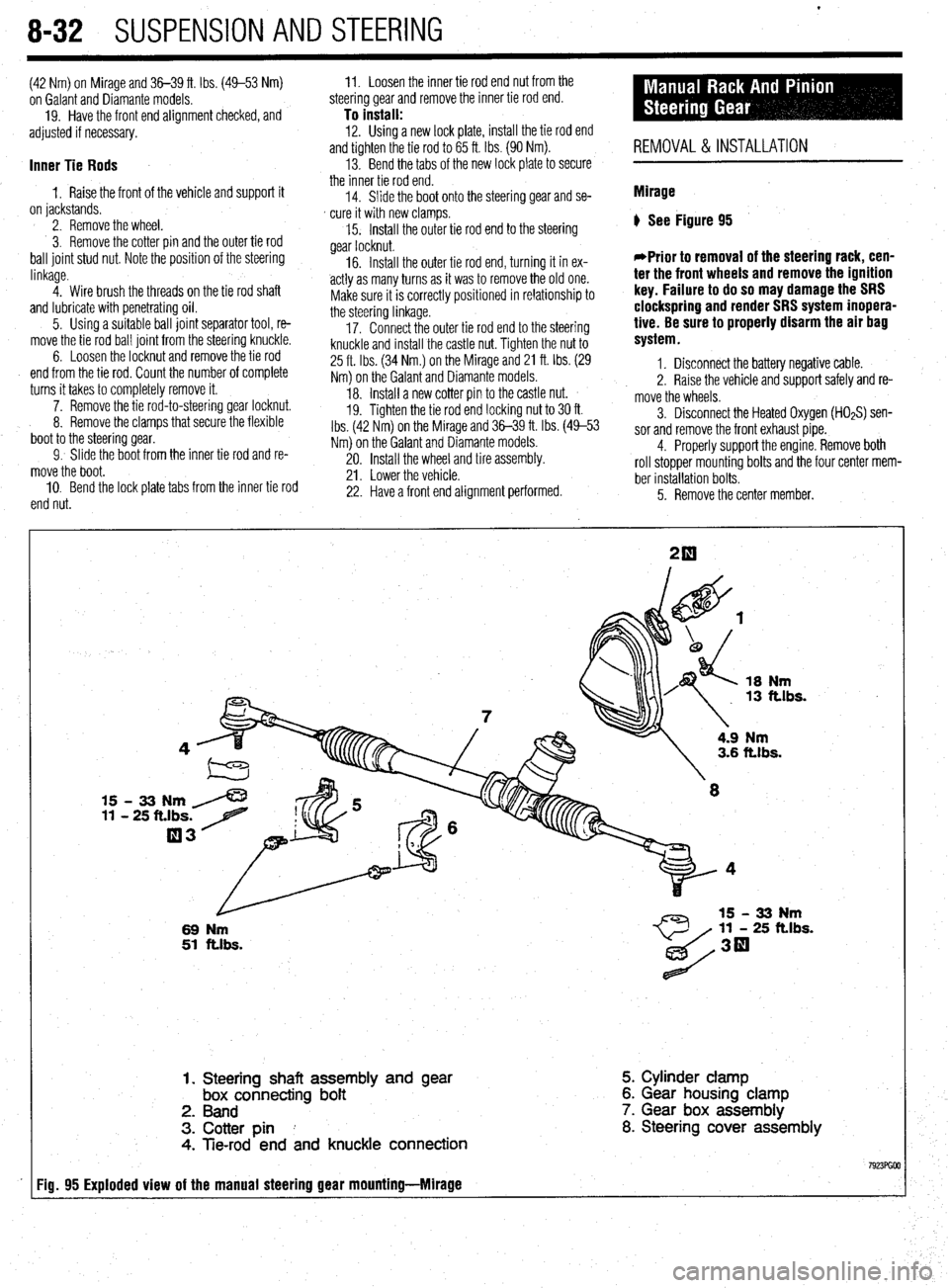
Mirage
) See Figure 95
*Prior to removal of the steering rack, cen-
ter the front wheels and remove the ignition
key. Failure to do so may damage the SRS
clockspring and render SRS system inopera-
tive. Be sure to properly disarm the air bag
system.
1. Disconnect the battery negative cable.
2. Raise the vehicle and support safely and re-
move the wheels.
5. Remove the center member. 3. Disconnect the Heated Oxygen (HOzS) sen-
sor and remove the front exhaust pipe.
4. Properly support the engine. Remove both
roll stopper mounting bolts and the four center mem-
ber installation bolts.
18
Nm 13 ft.lbs.
15 - 33 Nm /
11 - 25 ft.lbs. 7
03
L
69 Nm
51 ftlbs.
4.9 Nm 3.6 ft.lbs.
11 - 25 ft.lbs.
1. Steering shaft assembly and
gear box connecting bolt
2. Band
3. Cotter pin I
4. Tie-rod end and knuckle connection 5. Cylinder clamp
6. Gear housing clamp
7. Gear box assembly
8. Steering cover assembly
Fig. 95 Exploded view of the manual steering gear mounting-Mlrage
Page 329 of 408
SUSPENSION AND STEERING 8-33
*Matchmark the pinion input shaft of the
rack to the lower steering column joint for in-
stallation purposes.
6. Remove the pinch bolt holding the lower
steering column joint to the rack and pinion input
shaft.
7. Remove the cotter pins and disconnect the tie
rod ends from the steering knuckle.
8. Remove the rack and pinion steering assem-
bly and its rubber mounts from the right side of the
vehicle.
To install: 9. Align the matchmarks of the input shaft and
install the rack to the vehicle.
10. Secure the rack using the retainer clamps and
bolts. Tighten the bolts to 51 ft. Ibs. (70 Nm).
11. Tighten the steering column pinch bolt to 13
ft. Ibs. (18 Nm).
12. Install the center member.
13. Install the front exhaust pipe.
14. Connect the HO$ sensor.
15. Connect the tie rod ends to the steering
knuckles and tighten the castle nuts to 25 ft. Ibs. (34
Nm). Install new cotter pins.
16. Install the wheels and connect the negative
battery cable.
17. Have a front end alignment performed.
REMOVAL &INSTALLATION
Diamante
FRONT
*Prior to removal of the steering gear box,
center the front wheels and remove the igni-
tion key. Failure to do so may damage the
SRS clock spring and render SRS system in-
operative.
1. Disconnect the negative battery cable.
2. Disconnect the front exhaust pipe.
3. If equipped with AWD, remove the transfer
case assembly.
4. Remove the bolt holding the lower steering
column joint to the rack and pinion input shaft.
5. Remove the cotter pins and disconnect the tie
rod ends.
6. Remove the left and right frame members.
7. Remove the stabilizer bar bracket.
8. If equipped with four-wheel steering, discon-
nect the lines going to the rear pump.
9. Remove the rack and pinion steering assem-
bly and its rubber mounts. Move the rack to the right
to remove it from the crossmember.
To install: IO. Install the rack and mounting bolts. Tighten
the bolts to 51 ft. Ibs. (70 Nm). When installing the
rubber rack mounts, align the projection of the
mounting rubber with the indentation in the cross:
member. Install the pinch bolt.
11. Connect the pressure and return lines to the
rack and to the rear pump, if equipped.
12. Install the frame members and tighten the
bolts to 43-51 ft. Ibs. (60-70 Nm).
13. Connect the tie rods and install new cotter
pins. 14. Install the transfer case and front exhaust
pipe.
15. Refill the reservoir and bleed the system.
16. Have a front end alignment performed.
REAR
1. Disconnect the negative battery cable.
2. Raise the vehicle and support safely.
3. Drain the power steering fluid.
4. Remove the main muffler assembly.
5. Remove the rear shock absorber lower
mounting bolts.
6. Using the proper equipment, support the
weight of the rear differential. Remove the 2 small
crossmember brackets.
7. Remove the large self-locking crossmember
mounting nuts on the differential side.
8. Remove the oil line clamp bolts.
9. Remove the pressure tubes.
IO. Hold the tie rod ends stationary and remove
the tie rod end nuts. Remove the tie rod ends from
the trailing arms.
11. Remove the mounting bolts and remove the
rear steering gear.
To install: 12. Secure the unit to the crossmember. Move
the power cylinder piston rod over its full stroke to
determine its neutral position.
13. Align the tie rod ends with the holes in the
trailing arms and install the nuts. Adjust the length of
the tie rods with the nuts if necessary. The difference
in length between the 2 tie rod ends should not ex-
ceed 0.04 in. (1 mm). The nuts’ torque specification is
42 ft. Ibs. (58 Nm).
14. Replace the O-rings and install the pressure
tubes. Clamp in place.
15. Install the large self-locking crossmember
mounting nuts on the differential side. Tighten to
80-94 ft. Ibs. (110-130 Nm).
16. Remove the support equipment.
17. Install the 2 small crossmember brackets.
18. Install the shock mounting bolts.
19. Install the muffler assembly.
20. Refill the reservoir and bleed the system.
21. Have a front end alignment performed. _
Galant
1990-93 MODELS
1. Disconnect the negative battery cable.
2. Drain the power steering fluid.
3. Raise the vehicle and support safely.
4. Remove the bolt holding lower steering col-
umn joint to the rack and pinion input shaft.
5. Remove the transfer case, if equipped.
6. Remove the cotter pins and using the proper
tools, separate the tie rod ends from the steering
knuckle.
7. Locate the triangular brace near the stabilizer
bar brackets on the crossmember and remove both
the brace and the stabilizer bar bracket.
8. Support the center crossmember.
9. Remove the through-bolt from the round roll
stopper and remove the rear bolts from the center
crossmember.
10. Disconnect the front exhaust pipe, if
equipped with FWD.
11. Disconnect the power steering fluid pressure
pipe and return hose from the rack fittings. Plug the
fittings to prevent excess fluid leakage. 12. Lower the crossmember slightly.
13. Remove the rack and pinion steering assem-
bly and its rubber mounts. Move the rack to the right
to remove from the crossmember. Tilt the assembly
downward and remove from the left side of the vehi-
cle. Use caution to avoid damaging the boots.
To install: 14. Install the rack and install the mounting bolts. Tighten the mounting bolts to 43-58 ft. Ibs. (60-80
Nm). When installing the rubber rack mounts, align
the projection of the mounting rubber with the inden-
tation in the crossmember.
15. Connect the power steering fluid lines to the
rack.
16. Connect the exhaust pipe, if removed.
17. Raise the crossmember into position. Install
the center member mounting bolts and tighten to 72
ft. Ibs. (100 Nm). Install the roll stopper bolt and new
nut. Tighten nut to 47 ft. Ibs. (65 Nm).
18. Install the stabilizer bar brackets and brace.
19. Connect the tie rod ends and tighten nuts to
25 ft. Ibs. (34 Nm).
20. Install the transfer case, if removed. Check
and fill fluid.
21. Refill the reservoir with power steering fluid
and bleed the system.
22. Have a front end alignment performed.
1994-M MODELS
+ See Figure 96
Prior to removal of the steering gear box,
center the front wheels and remove the igni-
tion key. Failure to do so may damage the
SRS clock spring and render SRS system in-
operative.
1. Disconnect the negative battery cable.
2. Raise and properly support the vehicle.
3. Remove both front wheel assemblies.
4. Remove the bolt holding lower steering col-
umn joint to the rack and pinion input shaft.
5. Remove the stabilizer bar.
6. Remove the cotter pins, and using joint sepa-
rator MB991 113 or equivalent, disconnect the tie rod
ends from the steering knuckle.
7. On vehicles equipped with Electronic Control
Power steering (EPS), detach the wiring harness from
the solenoid connector.
8. Locate the two triangular braces near the
crossmember and remove both.
9. Support the center crossmember. Remove the
through-bolt from the front round roll stopper and re-
move the bolts securing the center crossmember.
10. Remove the center crossmember. ,
Il. Properly support the engine and remove the
rear roll stopper through-bolt.
12. Disconnect the power steering fluid pressure
pipe and return hose from the rack fittings. Plug the
fittings to prevent excessive fluid leakage.
13. Remove the clamp bolts and the two bolts se-
curing the rack assembly to the chassis.
14. Remove the rack and pinion steering assem-
bly and its rubber mounts.
*When removing the rack and pinion as-
sembly, tilt the assembly to the vehicle side
of the compression lower arm and remove
from the left side of the vehicle.
Page 338 of 408
9-2 BRAKES
Hydraulic systems are used to actuate the brakes
of all modern automobiles. The system transports the
power required to force the frictional surfaces of the
braking system together from the pedal to the indi-
vidual brake units at each wheel. A hydraulic system
is used for two reasons.
First, fluid under pressure can be carried to all
parts of an automobile by small pipes and flexible
hoses without taking up a significant amount of room
or posing routing problems.
Second, a great mechanical advantage can be
given to the brake pedal end of the system, and the
foot pressure required to actuate the brakes can be
reduced by making the surface area of the master
cylinder pistons smaller than that of any of the pis-
tons in the wheel cylinders or calipers.
The master cylinder consists of a fluid reservoir
along with a double cylinder and piston assembly.
Double type master cylinders are designed to sepa-
rate the front and rear braking systems hydraulically
in case of a leak. The master cylinder converts me-
chanical motion from the pedal into hydraulic pres-
sure within the lines. This pressure is translated back
into mechanical motion at the wheels by either the
wheel cylinder (drum brakes) or the caliper (disc
brakes).
Steel lines carry the brake fluid to a point on the
vehicle’s frame near each of the vehicle’s wheels. The
fluid is then carried to the calipers and wheel cylin-
ders by flexible tubes in order to allow for suspen-
sion and steering movements.
In drum brake systems, each wheel cylinder con-
tains two pistons, one at either end, which push out-
ward in opposite directions and force the brake shoe
into contact with the drum.
In disc brake systems, the cylinders are part of the
calipers. At least one cylinder in each caliper is used
to force the brake pads against the disc.
All pistons employ some type of seal, usually
made of rubber, to minimize fluid leakage. A rubber
dust boot seals the outer end of the cylinder against
dust and dirt. The boot fits around the outer end of
the piston on disc brake calipers, and around the
brake actuating rod on wheel cylinders.
The hydraulic system operates as follows: When at
rest, the entire system, from the piston(s) in the mas-
ter cylinder to those in the wheel cylinders or
calipers, is full of brake fluid. Upon application of the
brake pedal, fluid trapped in front of the master cylin-
der piston(s) is forced through the lines to the wheel
cylinders. Here, it forces the pistons outward, in the
case of drum brakes, and inward toward the disc, in
the case of disc brakes. The motion of the pistons is
opposed by return springs mounted outside the
cylinders in drum brakes, and by spring seals, in disc
brakes.
Upon release of the brake pedal, a spring located
inside the master cylinder immediately returns the
master cylinder pistons to the normal position. The
pistons contain check valves and the master cylinder
I
has compensating ports drilled in it. These are un-
covered as the pistons reach their normal position.
The piston check valves allow fluid to flow toward the
wheel cylinders or calipers as the pistons withdraw.
Then, as the return springs force the brake pads or
shoes into the released position, the excess fluid
reservoir through the compensating ports. It is during the time the pedal is in the released position that any
fluid that has leaked out of the system will be re-
placed through the compensating ports.
Dual circuit master cylinders employ two pistons,
located one behind the other, in the same cylinder.
The primary piston is actuated directly by mechanical
linkage from the brake pedal through the power
booster. The secondary piston is actuated by fluid
trapped between the two pistons. If a leak develops in
front of the secondary piston, it moves forward until it
bottoms against the front of the master cylinder, and
the fluid trapped between the pistons will operate the
rear brakes. If the rear brakes develop a leak, the pri-
mary piston will move forward until direct contact
with the secondary piston takes place, and it will
force the secondary piston to actuate the front brakes.
In either case, the brake pedal moves farther when the
brakes are applied, and less braking power is avail-
able.
All dual circuit systems use a switch to warn the
driver when only half of the brake system is opera-
tional. This switch is usually located in a valve body
which is mounted on the firewall or the frame below
the master cylinder. A hydraulic piston receives pres-
sure from both circuits, each circuits pressure being
applied to one end of the piston. When the pressures
are in balance, the piston remains stationary. When
one circuit has a leak, however, the greater pressure
in that circuit during application of the brakes will
push the piston to one side, closing the switch and
activating the brake warning light.
In disc brake systems, this valve body also con-
tains a metering valve and, in some cases, a propor-
tioning valve. The metering valve keeps pressure
from traveling to the disc brakes on the front wheels
until the brake shoes on the rear wheels have con-
tacted the drums, ensuring that the front brakes will
never be used alone. The proportioning valve con-
trols the pressure to the rear brakes to lessen the
chance of rear wheel lock-up during very hard brak-
ing.
Warning lights may be tested by depressing the
brake pedal and holding it while opening one of the
wheel cylinder bleeder screws. If this does not cause
the light to go on, substitute a new lamp, make conti-
nuity checks, and, finally, replace the switch as nec-
essary.
The hydraulic system may
be checked for leaks by applying pressure to the pedal gradually and steadily.
If the pedal sinks very slowly to the floor, the system
has a leak. This is not to be confused with a springy
or spongy feel due to the compression of air within
the lines. If the system leaks, there will be a gradual
change in the position of the pedal with a constant
pressure.
Check for leaks along all lines and at wheel cylin-
ders. If no external leaks are apparent, the problem is
inside the master cylinder,
DISC BRAKES
Instead of the traditional expanding brakes that
press outward against a circular drum, disc brake
systems utilize a disc (rotor) with brake pads posi-
tioned on either side of it. An easily-seen analogy is
the hand brake arrangement on a bicycle. The pads
squeeze onto the rim of the bike wheel, slowing its
motion. Automobile disc brakes use the identical principle but apply the braking effort to a separate
disc instead of the wheel.
The disc (rotor) is a casting, usually equipped with
cooling fins between the two braking surfaces. This
enables air to circulate between the braking surfaces
making them less sensitive to heat buildup and more
resistant to fade. Dirt and water do not drastically af-
fect braking action since contaminants are thrown off
by the centrifugal action of the rotor or scraped off
the by the pads. Also, the equal clamping action of
the two brake pads tends to ensure uniform, straight
line stops. Disc brakes are inherently self-adjusting.
There are three general types of disc brake:
1. A fixed caliper.
2. A floating caliper.
3. A sliding caliper.
The fixed caliper design uses two pistons
mounted on either side of the rotor (in each side of
the caliper). The caliper is mounted rigidly and does
not move.
The sliding and floating designs are quite similar.
In fact, these two types are often lumped together. In
both designs, the pad on the inside of the rotor is
moved into contact with the rotor by hydraulic force.
The caliper, which is not held in a fixed position,
moves slightly, bringing the outside pad into contact
with the rotor. There are various methods of attaching
floating calipers. Some pivot at the bottom or top,
and some slide on mounting bolts. In any event, the
end result is the same.
DRUM BRAKES
Drum brakes employ two brake shoes mounted on
a stationary backing plate. These shoes are posi-
tioned inside a circular drum which rotates with the
wheel assembly. The shoes are held in place by
springs. This allows them to slide toward the drums
(when they are applied) while keeping the linings and
drums in alignment. The shoes are actuated by a
wheel cylinder which is mounted at the top of the
backing plate. When the brakes are applied, hydraulic
pressure forces the wheel cylinder’s actuating links
outward. Since these links bear directly against the
top of the brake shoes, the tops of the shoes are then
forced against the inner side of the drum. This action
forces the bottoms of the two shoes to contact the
brake drum by rotating the entire assembly slightly
(known as servo action). When pressure within the
wheel cylinder is relaxed, return springs pull the
shoes back away from the drum.
Most modern drum brakes are designed to self-
adjust themselves during application when the vehi-
cle is moving in reverse. This motion causes both
shoes to rotate very slightly with the drum, rocking
an adjusting lever, thereby causing rotation of the ad-
justing screw. Some drum brake systems are de-
signed to self-adjust during application whenever the
brakes are applied. This on-board adjustment system
reduces the need for maintenance adjustments and
keeps both the brake function and pedal feel satisfac-
tory.
POWER BOOSTERS
Virtually all modern vehicles use a vacuum as-
sisted power brake system to multiply the braking
force and reduce pedal effort. Since vacuum is always
available when the engine is operating, the system is
Page 345 of 408
2. Raise the vehicle and support safely.
3. Remove the appropriate tire and wheel as-
semblies. 11. Road test the vehicle and check brakes for
proper operation. *Be careful that the piston boot does not be-
come caught when lowering the caliper onto
+ha n,.nnnr) lh nnt t&at thm hr&a hnra rlnr-
4. Remove the calmer auide and lock Dins and
REAR
lift the caliper assembly’from the caliper support. Tie
the caliper
out of the way using wire. 00 not allow the
caliper to hang by the brake line.
*On some vehicles, the caliper can be
flipped up by leaving the upper pin in place
and usinu it as a oivot ooint.
---- sa - . -.
5. Remove the brake pads, spring clip and
cl7knr T&n nn+n ,-A nrdtinninntn sir-4 inc+alhtinn
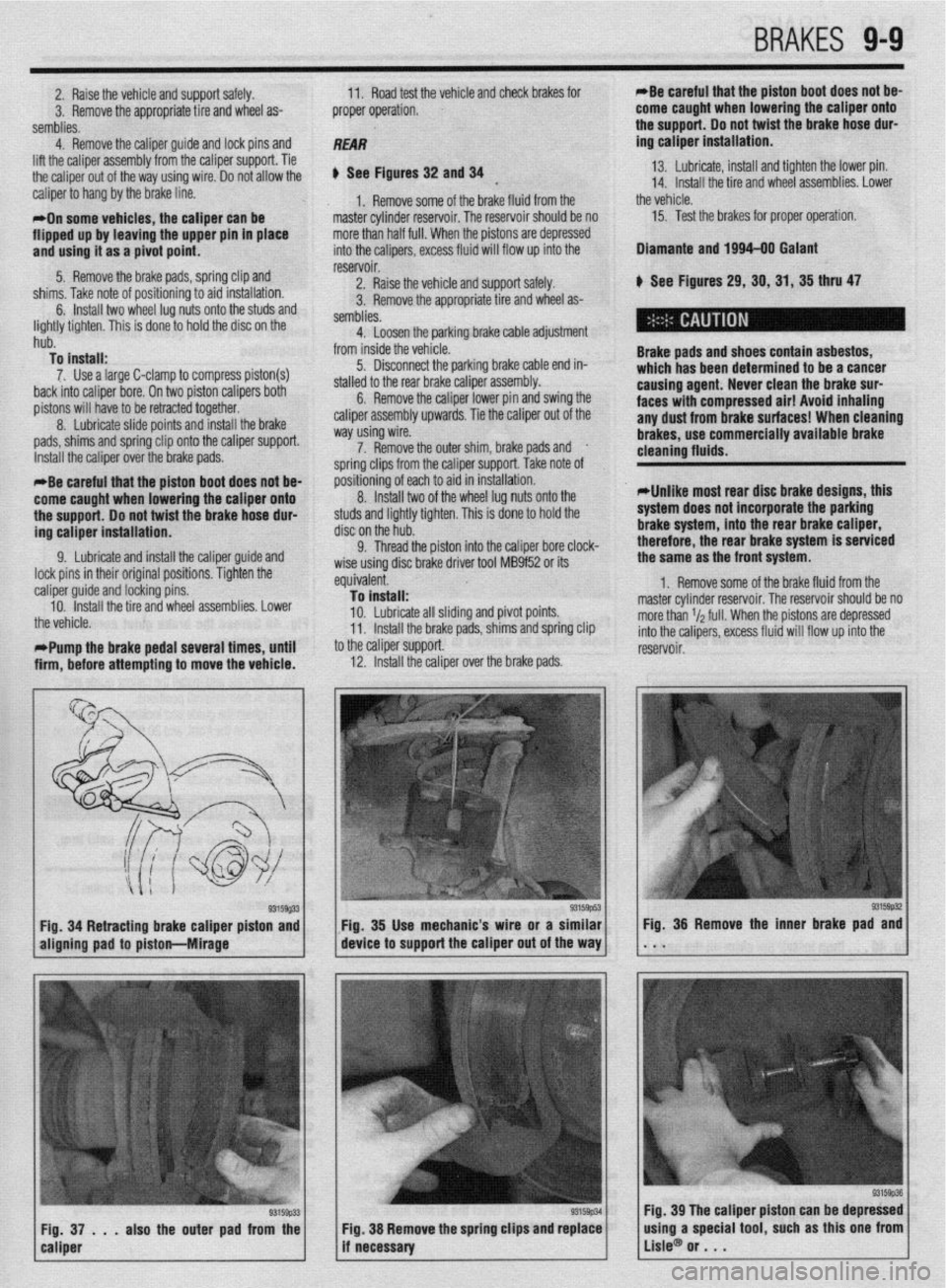
u See Figures 32 and 34 13. Lubricate, install and tighten the lower pin.
*
14. Install the tire and wheel assemblies. Lower
1, Remove some of the brake fluid from the the vehicle.
master cylinder reservoir. The reservoir should be no 15. Test the brakes for proper operation:
more than half full. When the p istons are depressed
into the calioers. excess fluid
3 111,113. ,(lhC ,,“LC “I p”3”‘““H’y I” a,u IIIaLcuIaLt”II. 6. Install two wheel lug nuts onto the studs and
:
lightly tighten. This is done to hold the disc on the
hub.
To install:
7. Use a large C-clamp to compress piston(s)
back into caliper bore. On two piston calipers both
pistons will have to be retracted together.
8. Lubricate slide points and install the brake
pads, shims and spring clip ont- +‘- --“n-* n**nnnA reservoir. /ill flow up into the
2. Raise the vehicle and support safely.
s tire and wheel as- 3. Remove the appropriate
semblies.
4. Loosen the parking bra
from inside the vehicle.
5. Disconnect the parking brake cable end in-
stalled to the rear brake caliper assembly.
6. Remove the caliper lower pin and swing the
caliper assembly upwards. Tie the caliper out of the
way using wire. Dlamante and 1994-00 Galant
k See Figures 29,30,31,35 thru 47
Brake pads and shoes contain asbestos,
which has been determined to be a cancer
causing agent. Never clean the brake sur-
faces with compressed air! Avoid inhaling
any dust from brake surfaces! When cleaning
brakes. use commerciallv avallable brake Ike cable adjustment
Install the caliper over the brake ,..uuG. 7. Remove the outer shim, brake pads and
.
ie caliper support. Take note of soring clips from tl
nositibning of eact
8
IndalI twn cleaning flutds. -
*Be careful that the piston boot does not be-
come caught when lowering the caliper onto
the support. Do not twist the brake hose dur-
ing caliper installation. I to aid in installation.
“. llluLull L..V of the wheel lug nuts onto the
studs and lightly tighten. This is done to hold the
disc on the hub.
Cl Thrm-l the nictnn into thP r!alinar hnre rlnrk-
*Unlike most rear disc brake designs, this
system does not incorporate the parking
brake system, into the rear brake caliper,
therefore, the rear brake system is serviced
9. Lubricate and install the caliper guide and
lock pins in their original positions. Tighten the
: caliper guide and locking pins.
10. Install the tire and wheel assemblies. Lower
the vehicle.
t *Pump the brake pedal several times, until
i
firm, before attempting to move the vehicle. V. ,,,lV”” ,,,V ~,“L”,’ III1” .IIV “..*.prv, ““I., “.“-a.
wise using disc brake driver tool MB9f52 or its
equivalent.
To install:
10. Lubricate all sliding and pivot points.
11. Install the brake pads, shims and spring clip
to the caliper support.
12. Install the caliper over ”
’ -’ ---I~ me oraxe paas. the same as the front system.
1. Remove some of the brake fluid from the
master cylinder reservoir. The reservoir should be no
more than r/a full. When the pistons are depressed
into the calipers, excess fluid will flow up into the
reservoir.
93159#2 Fig. 34 Retracting brake caliper piston and Fig. 35 Use mechanic’s wire or a similar
aligning pad to piston-hlirage device to support the caliper out of the way Fig. 36 Remove the inner brake pad and
. . .
93159p33 Fig, 37 . . . also the outer pad from the
caliper Fig. 39 The caliper piston can be depressed
Fig. 38 Remove the spring clips and replace
if necessary using a special tool, such as this one from
Lisle@ or . . .
Page 346 of 408
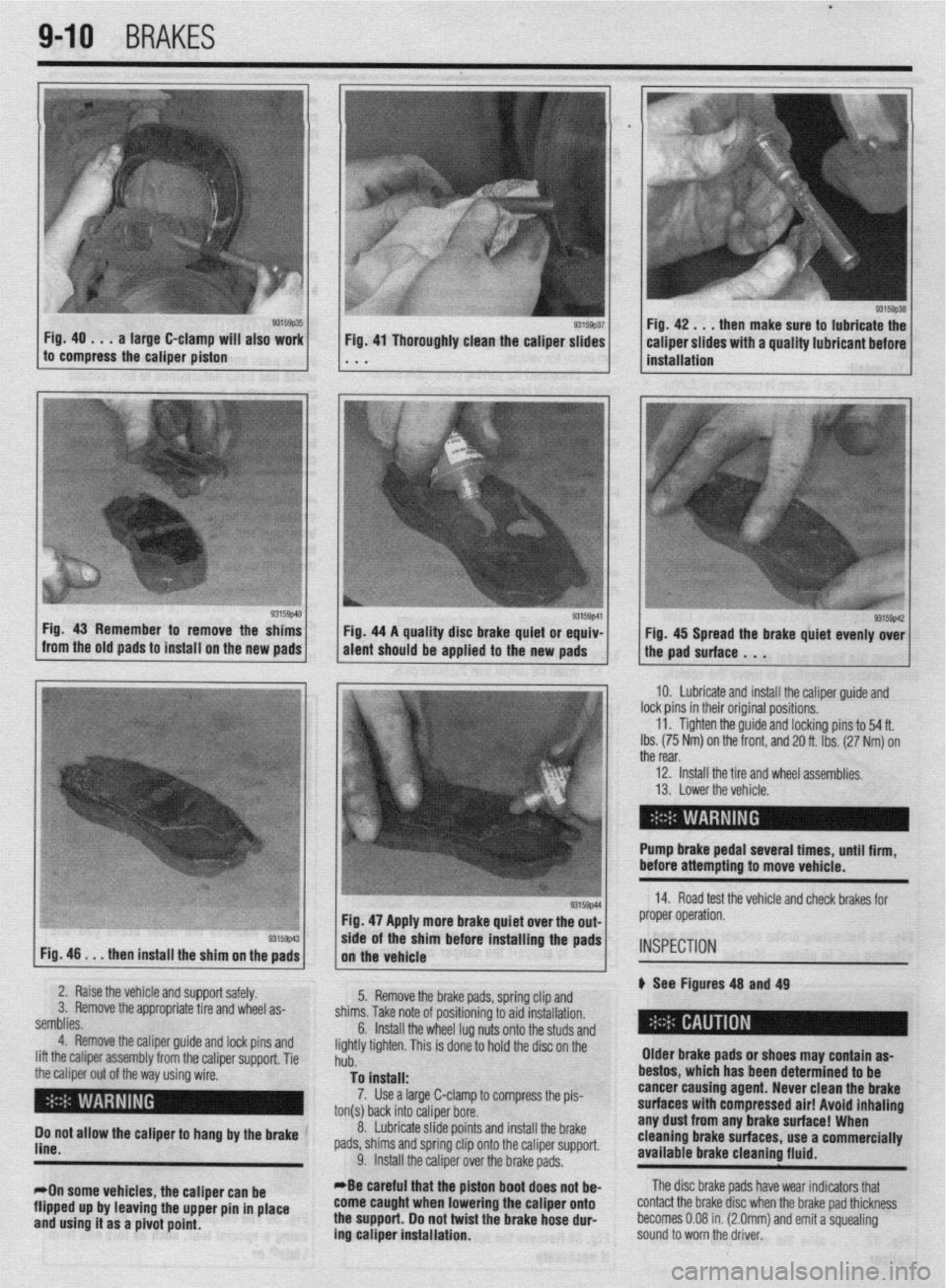
l
9-10 BRAKES
Fig. 40 . . . a large C-clamp will also work
to compress the caliper piston then make sure to lubricate the
Fig. 46
. . . then install the shim on the pads Fig. 47 Apply more brake quiet over the out-
/, the vehicle .Is/l*
wde of the sham before installing the pads
2. Raise the vehicle and support safely.
3. Remove the appropriate tire and wheel as-
semblies.
4. Remove the caliper guide and lock pins and
lift the caliper assembly from the caliper support. Tie
the caliper out of the way using wire.
( I ’ 5. Remove the brake pads, spring clip and
shims. Take note of positioning to aid installation.
6.
Do not allow the caliper to hang by the brake ’
line.
*On some vehicles, the caliper can be
flipped up by leaving the upper pin in place
and using it as a pivot point. Install the wheel lug nuts onto the studs and
lightly tighten. This is done to hold the disc on the
hub.
To install:
7. Use a large C-clamp to compress the pis-
ton(s) back into caliper bore.
_
8. Lubricate slide points and install the brake
pads, shims and spring clip onto the caliper support.
9. Install the caliper over the brake pads.
*Be careful that the piston boot
does not be- come caught when lowering the caliper onto
the support. Do not twist the brake hose dur-
ing caliper installation. Older brake pads or shoes may contain as-
bestos, which has been determined to be
cancer causing agent. Never clean the
brake
surfaces with compressed air! Avoid inhaling any dust from any brake surface! When
cleaning brake surfaces, use a commercially
available brake cleaning fluid. IO. Lubricate and install the caliper guide and
lock pins in their original positions.
11. Tighten the guide and locking pins to 54 ft.
Ibs. (75 Nm) on the front, and 20 ft. Ibs. (27 Nm) on
the rear,
12. install the tire and wheel assemblies.
13. Lower the vehicle.
Pump brake pedal several tlmes, until firm,
before attempting to move vehicle.
14. Road test the vehicle and check brakes for
proper operation.
INSPECTION
p See Figures 48 and 49
The disc brake pads have wear indicators that
contact the brake disc when the brake pad thickness
becomes 0.08 in. (2.0mm) and emit a squealing
sound to worn the driver.
Page 348 of 408
l
942 BRAKES
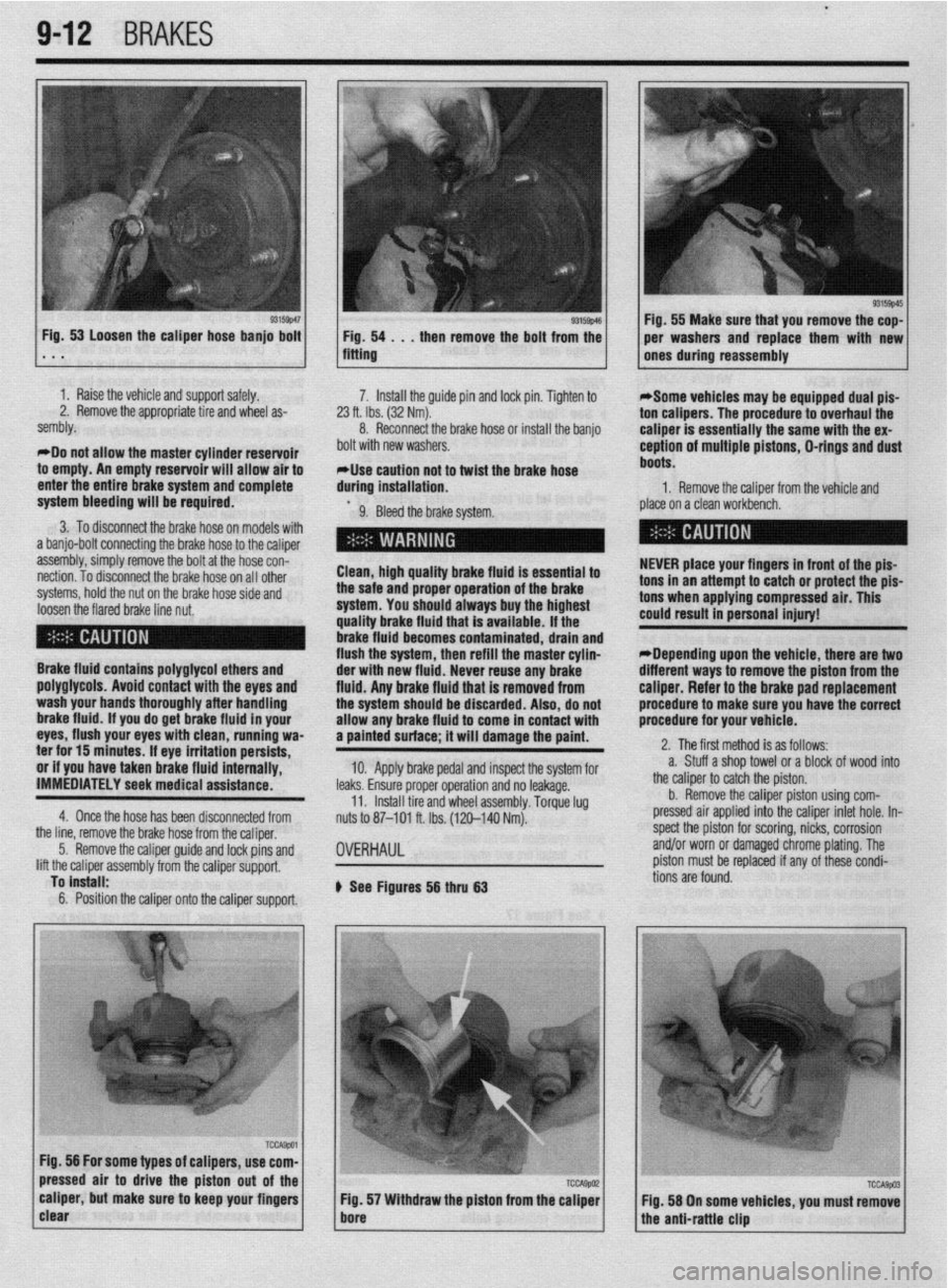
I 93155~46 Fig, 53 Loosen the caliper hose banjo bolt
1 Fig. 54 . . , then remove the bolt from the . * . fitting
1 I Raise the vehicle and support safely.
2. Remove the appropriate tire and wheel as-
sembly.
*Do not allow the master cylinder reservoir
to empty. An empty reservoir will allow air to
enter the entire brake system and complete 7. Install the guide pin and lock pin. Tighten to
23 ft. Ibs. (32 Nm).
8. Reconnect the brake hose of install the banjo
bolt with new washers.
*Use caution not to twist the brake hose
during installation.
system bleeding will be required.
9. Bleed the brake system.
3. To disconnect the brake hose on models with
a banjo-bolt connecting the brake hose to the caliper
assembly, simply remove the bolt at the hose con-
nection. To disconnect the brake hose on all other
systems, hold the nut on the brake hose side and
loosen the flared brake line nut. Clean, high quality brake fluid is essential to
the safe and proper operation of the brake
system. You should always buy the highest
quality brake fluid that is available. If the
brake fluid becomes contaminated, drain and
flush the system, then refill the master cylin-
Brake fluid contains polyglycol ethers and
poly~lycols. Avoid contact with the eves and
wash your hands thoroughly after handling
brake fluid. if you do get brake fluid In your
eyes, flush your eyes with clean, running wa-
ter for 15 minutes. If eye irritation persists,
or if you have taken brake fluid internally,
IMMEDIATELY seek medical assistance.
4. Once the hose has been disconnected from der with new fluid. Never reuse any brake
fluid. Anv brake fluid that is removed from
the systum should be discarded. Also, do not
allow any brake fluid to come in contact with
a painted surface; it will damage the paint.
10. Apply brake pedal and inspect the system for
leaks. Ensure proper operation and no leakage.
11. Install tire and wheel assembly. Torque lug
nuts to 87-101 ft. Ibs. (120-140 Nm).
the line, remove the brake hose from the caliper,
5. Remove the caliper guide and lock pins and
lift the caliper assembly from the caliper support,
To install:
6. Position the caliper onto the caliper support.
OVERHAUL
b See Figures 56 thru 63 1 Fig. 55 Make sure that you remove the cop-
per washers and replace them with new
ones during reassembly
*Some vehicles may be equipped dual pis-
ton calipers. The procedure to overhaul the
caliper is essentially the same with the ex-
ception of multiple pistons, D-rings and dust
boots.
1. Remove the caliper from the vehicle and
place on a clean workbench.
NEVER place your fingers in front of the pis-
tons in an attempt to catch or protect the pis-
tons when applying compressed air. This
could result in personal injury!
*Depending upon the vehicle, there are two
different ways to remove the piston from the
caliper. Refer to the brake pad replacement
procedure to make sure you have the correct
procedure for your vehicle.
2. The first method is as follows:
a. Stuff a shop towel or a block of wood into
the caliper to catch the piston.
b. Remove the caliper piston using com-
pressed air applied into the caliper inlet hole. In-
spect the piston for scoring, nicks, corrosion
and/or worn or damaged chrome plating. The
piston must be replaced if any of these condi-
tions are found.