fuse MITSUBISHI DIAMANTE 1900 User Guide
[x] Cancel search | Manufacturer: MITSUBISHI, Model Year: 1900, Model line: DIAMANTE, Model: MITSUBISHI DIAMANTE 1900Pages: 408, PDF Size: 71.03 MB
Page 208 of 408
CHASSIS ELECTRiCAL 6-5
them. It is used for voltage and ground tests. To use voltmeter has a positive and a negative lead. To avoid
a 12 volt test light, connect the ground clip to a good damage to the meter, always connect the negative
ground and probe wherever necessary with the pick. lead to the negative (-) side of the circuit (to ground
The test light will illuminate when voltage is detected. or nearest the ground side of the circuit) and connect
This
does not necessarily mean that 12 volts (or any the positive lead to the positive(t) side of the circuit When diagnosing a specific problem, organized
troubleshooting is a must. The complexity of a mod-
particular amount of voltage) is present; it only (to the power source or the nearest power source).
means that some voltage is present. It is advisable Note that the negative voltmeter lead will always be ern automotive vehicle demands that you approach
before using the test light to touch its ground clip black and that the positive voltmeter will always be any problem in a logical, organized manner. There
and probe across the battery posts or terminals to some color other than black (usually red). are certain troubleshooting techniques, however,
which are standard:
make sure the light is operating properly.
l Ohmmeter-the ohmmeter is designed to read l Establish when the problem occurs. Does the
resistance (measured in ohms) in a circuit or compo-
nent. Most ohmmeters will have a selector switch problem appear only under certain conditions? Were
there any noises, odors or other unusual symptoms?
Do not use a test light to probe electronic ig- which permits the measurement of different ranges of
Isolate the problem area. To do this, make some sim-
nition, spark plug or coil wires. Never use a resistance (usually the selector switch allows the
multiplication of the meter reading by 10,100,1,000 ple tests and observations, then eliminate the sys-
pick-type test light to probe wiring on com- terns that are working properly. Check for obvious
puter controlled systems unless specifically and 10,000). Some ohmmeters are “auto-ranging”
which means the meter itself will determine which problems, such as broken wires and loose or dirty
instructed to do so. Any wire insulation that
scale to use. Since the meters are powered by an in- connections. Always check the obvious before as-
is pierced by the test light probe should be
ternal battery, the ohmmeter can be used like a self- suming something complicated is the cause.
taped and sealed with silicone after testing.
l Test for problems systematically to determine
powered test light. When the ohmmeter is connected,
the cause once the problem area is isolated. Are all
Like the jumper wire, the 12 volt test light is used current from the ohmmeter flows through the circuit
the components functioning properly? Is there power
to isolate opens in circuits. But, whereas the jumper or component being tested. Since the ohmmeter’s in-
ternal resistance and voltage are known values, the going to electrical switches and motors. Performing
wire is used to bypass the open to operate the load,
amount of current flow through the meter depends on careful, systematic checks will often turn up most
the 12 volt test light is used to locate the presence of
the resistance of the circuit or component being causes on the first inspection, without wasting time
voltage in a circuit. If the test light illuminates, there
tested. The ohmmeter can also be used to perform a checking components that have little or no relation-
is power up to that point in the circuit; if the test light ship to the problem.
does not illuminate, there is an open circuit (no continuity test for suspected open circuits. In using
the meter for making continuity checks, do not be
l Test all repairs after the work is done to make
power). Move the test light in successive steps back
concerned with the
actual resistance readings. Zero sure that the problem is fixed. Some causes can be
toward the power source until the light in the handle traced to more than one component, so a careful veri-
illuminates. The open is between the probe and a resistance, or any ohm reading, indicates continuity
fication of repair work is important in order to pick up
point which was previously probed. in the circuit, Infinite resistance indicates an opening
in the circuit. A high resistance reading where there additional malfunctions that may cause a problem to
The self-powered test light is similar in design to
should be none indicates a problem in the circuit. reappear or a different problem to arise. A blown
the 12 volt test light, but contains a 1.5 volt penlight
Checks for short circuits are made in the same man- fuse, for example, is a simple problem that may re-
battery in the handle. It is most often used in place of
ner as checks for open circuits, except that the circuit quire more than another fuse to repair. If you don’t
a multimeter to check for open or short circuits when look for a problem that caused a fuse to blow, a
power is isolated from the circuit (continuity test). must be isolated from both power and normal
ground. Infinite resistance indicates no continuity, shorted wire (for example) may go undetected.
The battery in a self-powered test light does not Experience has shown that most problems tend
provide much current. A weak battery may not pro- while zero resistance indicates a dead short.
to be the result of a fairly simple and obvious
vide enough power to illuminate the test light even I ’ cause, such as loose or corroded connectors, bad
when a complete circuit is made (especially if there is grounds or damaged wire insulation which causes a
high resistance in the circuit). Always make sure that Never use an ohmmeter to check the resis- short. This makes careful visual inspection of com-
the test battery is strong. To check the battery, briefly tance of a component or wire while there is ponents during testing essential to quick and accu-
touch the ground clip to the probe; if the light glows voltage applied to the circuit. rate troubleshooting.
brightly, the battery is strong enough for testing.
*A self-powered test light should not be
l Ammeter-an ammeter measures the amount
- I
used on any computer controlled system or of current flowing through a circuit in units called
component. The small amount of electricity amperes or amps. At normal operating voltage, most
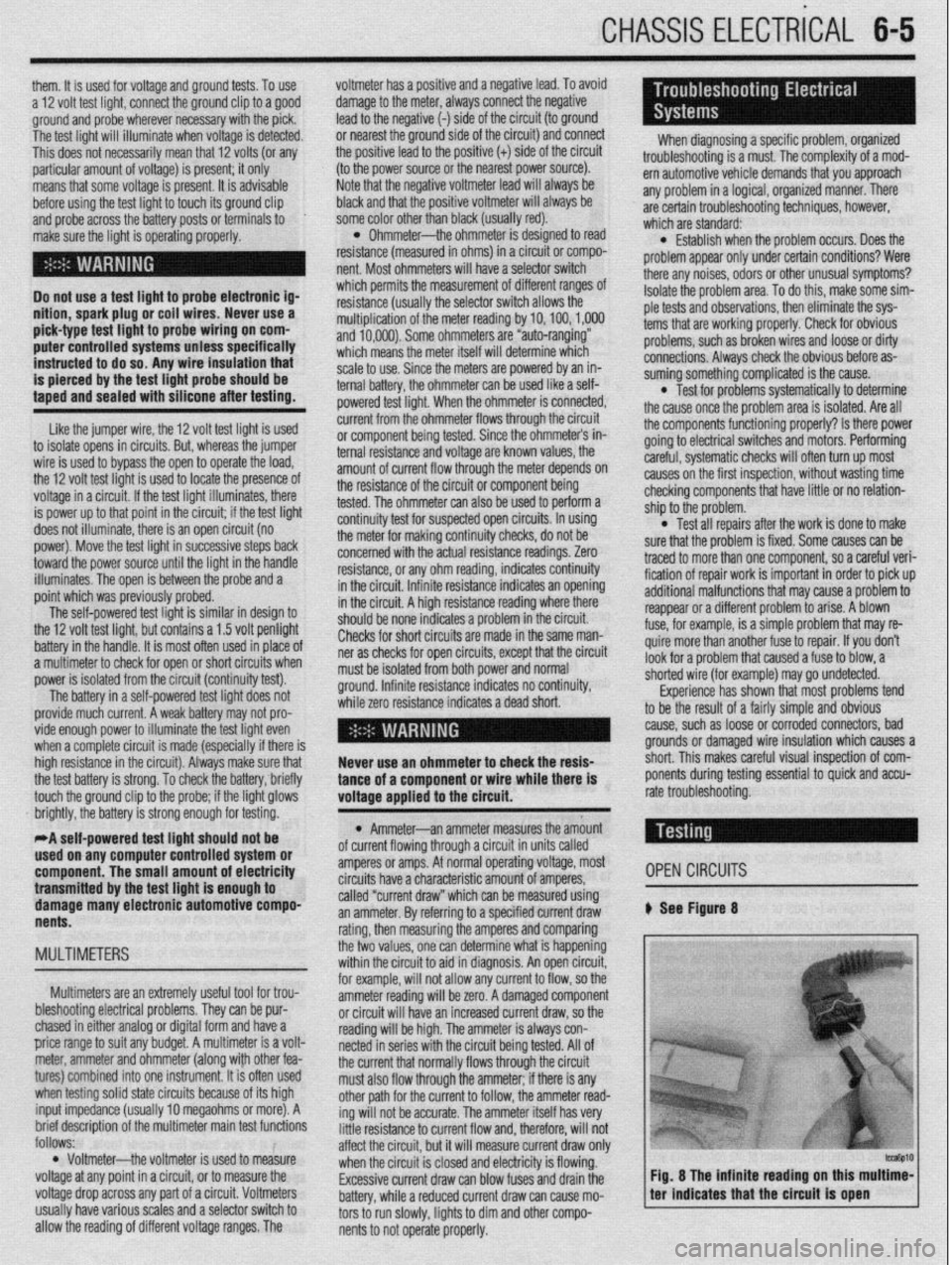
circuits have a characteristic amount of amperes, OPEN CIRCUITS
transmitted by the test light is enough to
damage many electronic automotive compo- called “current draw” which can be measured using
an ammeter. By referring to a specified current draw # See Figure 8
nents.
rating, then measuring the amperes and comparing
MULTIMETERS the two values, one can determine what is happening
within the circuit to aid in diagnosis. An open circuit,
for example, will not allow any current to flow, so the
Multimeters are an extremely useful tool for trou-
bleshooting electrical problems. They can be pur- ammeter reading will be zero. A damaged component
or circuit will have an increased current draw, so the
chased in either analog or digital form and have a
reading will be high. The ammeter is always con-
price range to suit any budget. A multimeter is a volt-
netted in series with the circuit being tested. All of
meter, ammeter and ohmmeter (along with other fea-
the current that normally flows through the circuit
tures) combined into one instrument. It is often used
must also flow through the ammeter; if there is any
when testing solid state circuits because of its high
other path for the current to follow, the ammeter read-
input impedance (usually 10 megaohms or more). A
ing will not be accurate. The ammeter itself has very
brief description of the multiieter main test functions
follows: little resistance to current flow and, therefore, will not
affect the circuit, but it will measure current draw only
l Voltmeter--the voltmeter is used to measure
when the circuit is closed and electricity is flowing.
voltage at any point in a circuit, or to measure the
Excessive current draw can blow fuses and drain the
voltage drop across any part of a circuit. Voltmeters
battery, while a reduced current draw can cause mo-
usually have various scales and a selector switch to
tors to run slowly, lights to dim and other compo-
allow the reading of different voltage ranges. The
nents to not operate properly.
Page 213 of 408
640 CHASSIS ELECTRICAL
careful not to allow anything to come in contact with
the air bag unit.
16. Remove the glove box lamp assembly.
17. Remove the remaining instrument panel
mounting screws and remove the instrument panel
from the vehicle.
18. Remove the left side foot shower ductwork,
lap cooler duct and center duct.
19. Remove the front and center reinforcements
and center stay assembly.
20. Remove the air distribution duct assembly.
21. Detach all connectors from heater-box-
mounted items.
22. Remove the heater box mounting screws and
nut, then remove the unit from the vehicle.
23. Disassemble on a workbench. Remove the
heater core from the heater case.
To install:
24. Thoroughly clean and dry the inside of the
case and install the heater core and all related parts.
25. Install the heater unit to the vehicle and install
the mounting screws and nut. Be sure the evaporator
case and heater case are fitted together properly. At-
tach all connectors to heater-box-mounted items.
26. Install the air distribution duct assembly. In-
stall the front and center reinforcements and center
stay assembly.
27. Install the center duct, lap cooler duct and left
side foot shower duct.
28. Install the instrument panel and mounting
screws.
29. Install the glove box lamp assembly.
30. Secure the steering column and attach all
steering column connectors.
31. Install the speedometer cable adapter to the
instrument panel.
32. Install the instrument cluster and the instru-
ment cluster bezel.
33. Install the speakers to the top of the instru-
ment panel.
34. Install the cup holder.
35. Install the climate control system control
head.
36. Install the stereo entertainment system and
bezel.
37. Install the screw below the glove box assem-
bly, and the entire glove box unit.
38. Install the steering column covers.
39. Install the knee protector support bracket, the
protector and the decorative plugs.
40. Install the console and the ashtray. 41. Install the right side foot shower duct.
42. Install the passenger side undercover.
43. Connect the heater hoses to the core tubes.
44. Fill the cooling system.
45. Connect the negative battery cable and check
the entire climate control system for proper operation
and leaks.
Galant
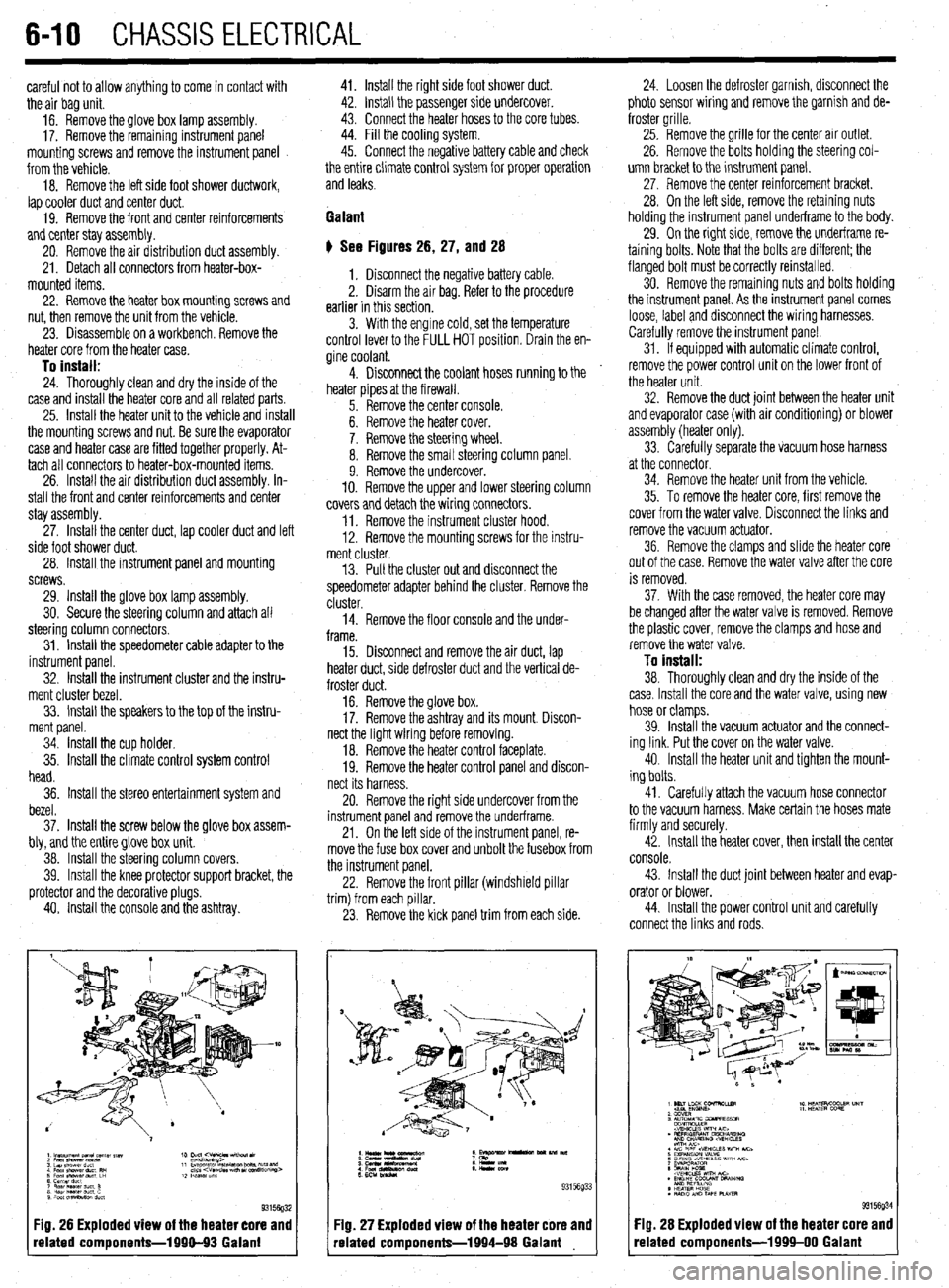
# See Figures 26, 27, and 28
1. Disconnect the negative battery cable.
2. Disarm the air bag. Refer to the procedure
earlier in this section.
3. With the engine cold, set the temperature
control lever to the FULL HOT position. Drain the en-
gine coolant.
4. Disconnect the coolant hoses running to the
heater pipes at the firewall.
5. Remove the center console.
6. Remove the heater cover.
7. Remove the steering wheel.
8. Remove the small steering column panel.
9. Remove the undercover.
10. Remove the upper and lower steering column
covers and detach the wiring connectors.
11. Remove the instrument cluster hood.
12. Remove the mounting screws for the instru-
ment cluster.
13. Pull the cluster out and disconnect the
speedometer adapter behind the cluster. Remove the
cluster.
14. Remove the floor console and the under-
frame.
15. Disconnect and remove the air duct, lap
heater duct, side defroster duct and the vertical de-
froster duct.
16. Remove the glove box.
17. Remove the ashtray and its mount. Discon-
nect the light wiring before removing.
18. Remove the heater control faceplate.
19. Remove the heater control panel and discon-
nect its harness.
20. Remove the right side undercover from the
instrument panel and remove the underframe.
21. On the left side of the instrument panel, re-
move the fuse box cover and unbolt the fusebox from
the instrument panel.
22. Remove the front pillar (windshield pillar
trim) from each pillar.
23. Remove the kick panel trim from each side.
Fig. 26 Exploded view of the heater core and
related components-1990-93 Galant
:IQ. 27 Exploded view of the heater core and
-elated components-1994-98 Galant 24. Loosen the defroster garnish, disconnect the
photo sensor wiring and remove the garnish and de-
froster grille.
25. Remove the grille for the center air outlet.
26. Remove the bolts holding the steering col-
umn bracket to the instrument panel.
27, Remove the center reinforcement bracket.
28. On the left side, remove the retaining nuts
holding the instrument panel underframe to the body.
29. On the right side, remove the underframe re-
taining bolts. Note that the bolts are different; the
flanged bolt must be correctly reinstalled.
30. Remove the remaining nuts and bolts holding
the instrument panel. As the instrument panel comes
loose, label and disconnect the wiring harnesses.
Carefully remove the instrument panel.
31. If equipped with automatic climate control,
remove the power control unit on the lower front of
the heater unit.
32. Remove the duct joint between the heater unit
and evaporator case (with air conditioning) or blower
assembly (heater only).
33. Carefully separate the vacuum hose harness
at the connector.
34. Remove the heater unit from the vehicle.
35. To remove the heater core, first remove the
cover from the water valve. Disconnect the links and
remove the vacuum actuator.
36. Remove the clamps and slide the heater core
out of the case. Remove the water valve after the core
is removed.
37. With the case removed, the heater core may
be changed after the water valve is removed. Remove
the plastic cover, remove the clamps and hose and
remove the water valve.
To install:
38. Thoroughly clean and dry the inside of the
case. Install the core and the water valve, using new
hose or clamps.
39. Install the vacuum actuator and the connect-
ing link. Put the cover on the water valve.
40. Install the heater unit and tighten the mount-
ing bolts.
41. Carefully attach the vacuum hose connector
to the vacuum harness. Make certain the hoses mate
firmly and securely.
42. Install the heater cover, then install the center
console.
43. Install the duct joint between heater and evap-
orator or blower.
44. Install the power control unit and carefully
connect the links and rods.
Fig. 28 Exploded view of the heater core and
related components-1999-00 Galant
Page 230 of 408
CHASSIS ELECTRICAL 6-27
1. Remove the fuse box cover.
2. lnsoect the fuses to determine which is faulty.
REPLACEMENT 3. Grasp the fuse and remove it from the fuse
box. Never exceed the amperage rating of a blown
4. Inspect the box terminals and clean if cor- fuse. If the replacement fuse also blows,
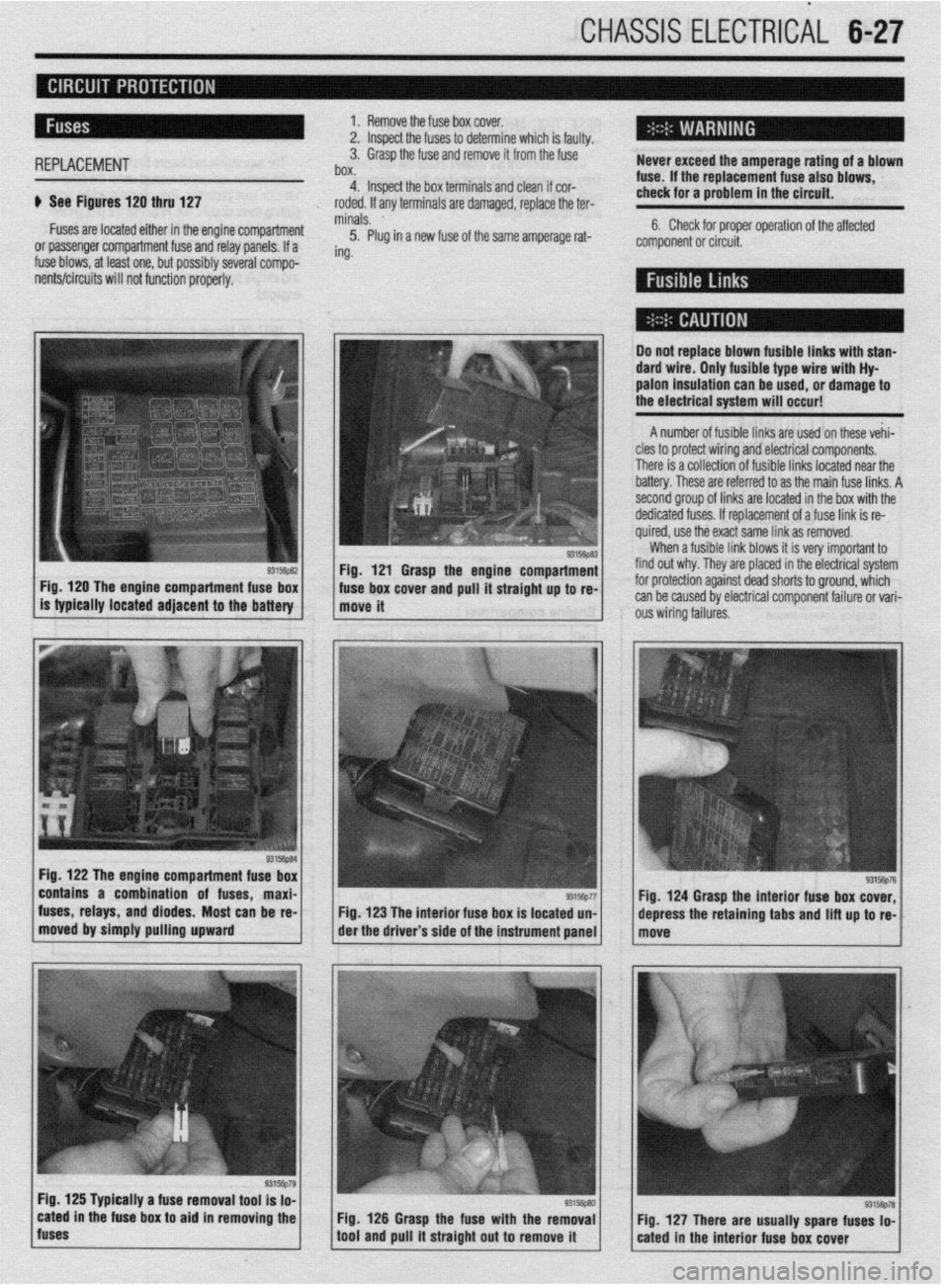
It See Figures 120 thru 127 check for a problem in the circuit.
roded. If any terminals are damaged, replace the ter-
Fuses are located either in the engine Compartment minals. ’
5. Plug in a new fuse of the same amperage rat- 6. Check for proper operation of the affected
or passenger compartment fuse and relay panels. If a component or circuit.
fuse blows, at least one, but possibly several compo- ing.
ients/circuits will not function properly.
Fig, 120 The engine compartment fuse box
is typically located adjacent to the
battery
Fig. 122 The engine compartment fuse box
contains a combination of fuses, maxi-
fuses, relays, and diodes. Most can be re-
moved by simply pulling upward
I Do not replace blown fusible links with stan-
dard wire. Only fusible type wire with Hy
palon insulation can be
used, or damage to
the electrical system will occur!
A number of fusible links are used on these vehi-
cles to protect wiring and electrical components.
There is a collection of fusible links located near the
battery. These are referred to as the main fuse links. A
second group of links are located in the box with the
dedicated fuses. If replacement of a fuse link is re-
quired, use the exact same link as removed.
When a fusible link blows it is very important to
Fig. 121 Grasp the engine compartment find out why. They are placed in the electrical system
. ’ ‘“‘,+“” 1 ous wiring failures. fuse box cover and pull It straight up to re- for protection against dead shorts to ground, which
move it can be caused by electrical component failure or vari-
Fig. 123 The interior fuse box is located un-
der the driver’s side of the instrument panel
Fig. 125 Typically a fuse removal tool is lo-
cated in the fuse box to aid in removing the
fuses Fig. 126 Grasp the fuse with the removal
tool and pull it straight out to remove it Fig. 124 Grasp the interior fuse box cover,
depress the retaining
tabs and lift up to re-
Page 231 of 408
.
6-28 CHASSIS ELECTRICAL
Do not just replace the fosible link to correct
a problem! RESETTlNGAND/OR REPLACEMENT REPLACEMENT
When replacing all fusible links, they are to be re-
placed with the same type of prefabricated link avail-
able from your vehicle manufacturer. Circuit breakers are located inside the fuse panel.
They are automatically reset when the problem cor-
rects itself, is repaired, or the circuit cools down to
allow operation again. The turn signal and hazard flasher unit is located
in the interior fuse panel located under the driver’s
left side knee protector. They are replaced by simply
pulling them straight out. Note that the prongs are
arranged in such a way that the flasher must be prop-
erly oriented before attempting to install it. Turn the
flasher until the orientation of the prongs is correct
and simply push it firmly in until the prongs are fully
engaged.
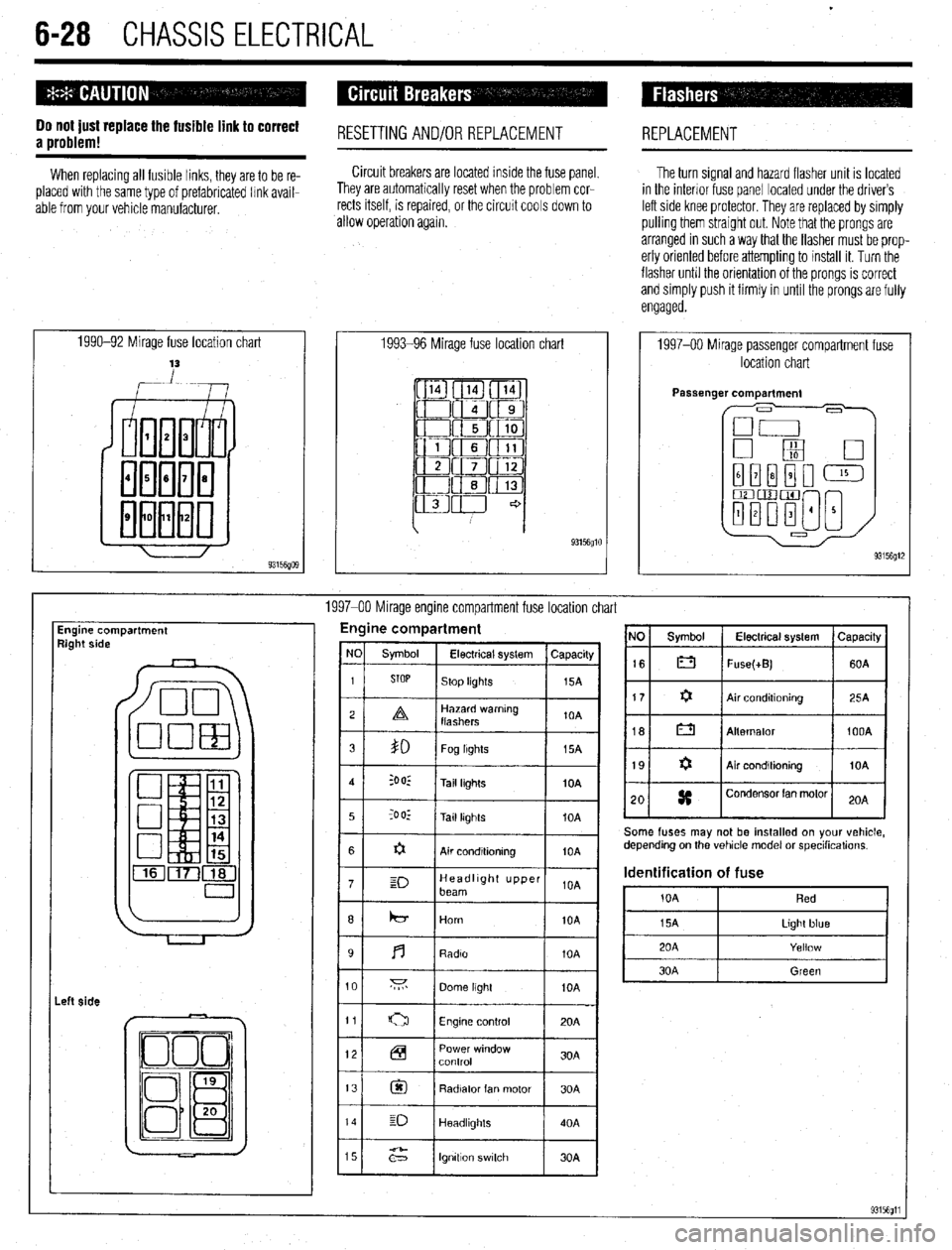
1990-92 Mirage fuse location chart
,-Lw 1993-96 Mirage fuse location chart
93156glO
1997-00 Mirage passenger compartment fuse
location chart
1997-00 Mirage engine compartment fuse location chart
Engine compartment
9ight side Engine compartment
I
I I 12 Power window
Control 30A
13
@I Radiator fan motor 30A
14 E-J
Headllghls 40A
15
;2” lgnttlon switch 30A NO Symbol Electrical system Capacrty
16 0 Fuse(+B) 60A
Some fuses may not be installed on your vehicle,
depending on the vehicle model or specihcations.
Identification of fuse
i0A Red
Page 232 of 408
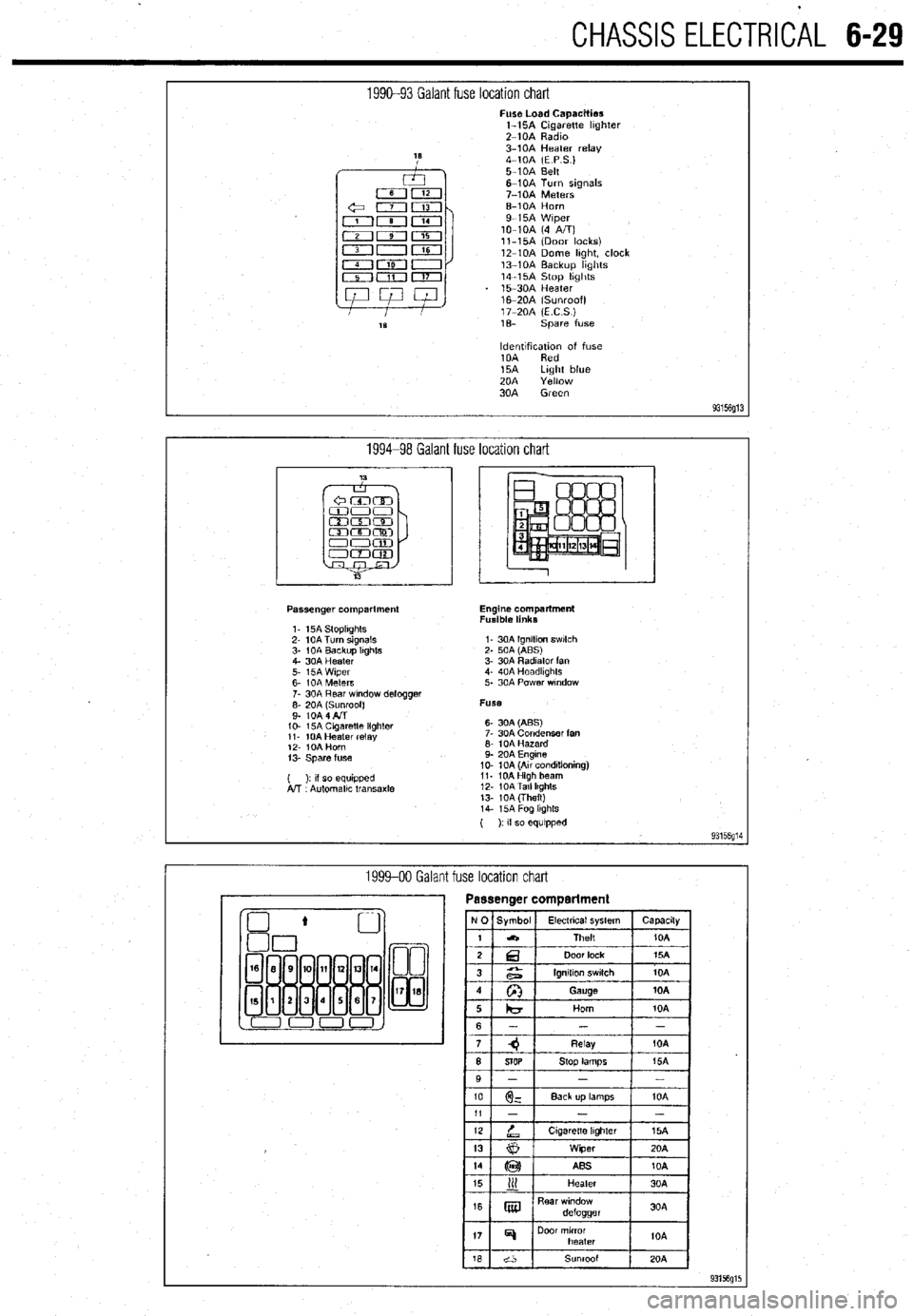
CHASSIS ELECTRlCiL 6-29
1990-93 Galant fuse location chart Fuse Load Capacities
l-15A Cigarette hghter
Z-10A Radm
3-10A Heater relay
4-10A (E P S.)
5-10A Belt
6-10A Turn signals
7-10A Meters
6-10A Horn
9-15A Wiper
lo-10A (4 A/T)
ll-15A (Door locks)
12-10A Dome hght, clock
13-10A Backup hghts
14-15A Stop hghts
15-30A Heater
16m20A (Sunroof)
17-20A (ECS)
1% spare fuse
ldentlfxation of fuse
10A Red
15A Light blue
20A Yellow
30A Green
93156g13
1994-98 Galant fuse location chart
Passenger compartment
1. 15A StoplIghts
2- 10A Turn signals
3- 1 OA Backup Itghts
4. 30A Heater
5. i5A Wiper
6- IOA Meters
7. 30A Rear wndow defogger
;: fo& fl$oof)
IO- 15A Cagaretle lighler
11. 10A Heater relay
12. IOA Horn
13. Spare fuse
( ): II so equipped
A!T Automallc transaxle Engine compartment
Fusible links
I- 30A Ignition swlch
2. 50A (ABS)
3. 30A Radiator fan
4. 40A Headkghts
5. 30A Power wndow
Fuse
6- 30A (ABS)
7. 30A Condenser fan
6. 10A Hazard
9. 20A Engine
10. 10A (Au conditioning)
11. 10AHigh beam
12. 10ATall lkghts
13. 10A (Theft)
14. i5A Fog lkghls
( ): If so equipped
93156g14
1999-00 Galant fuse location chart
Page 233 of 408
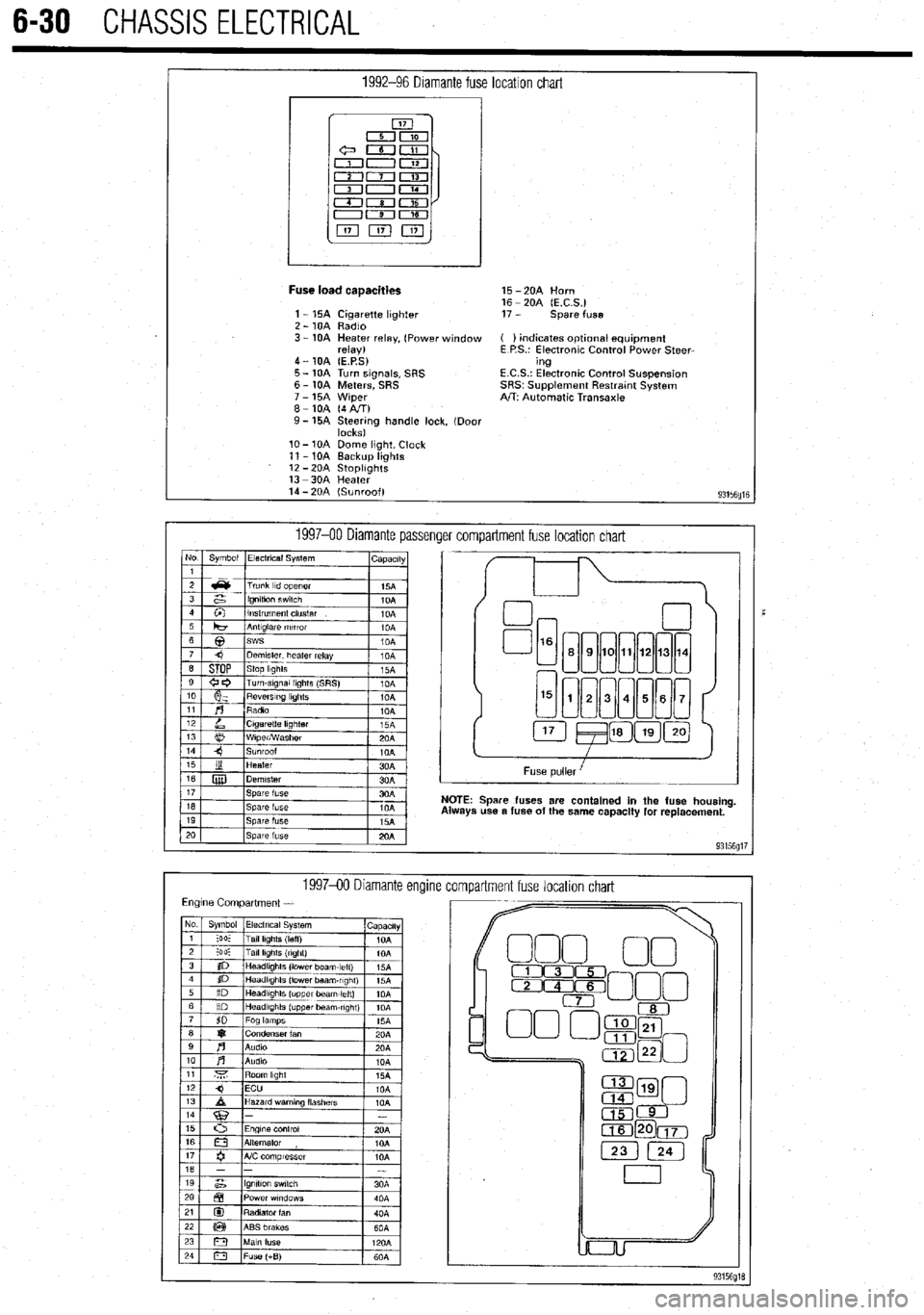
6-30 CHASSIS ELECTRICAL
1992-96 Diamante fuse location chart
I
Fuse load caaacities 15 -2OA Horn
16 - 20A (E.C.S.)
1 - 15A Cigarette lighter 17 - spare fuse
2 - 10A Radio
3 - 10A Heater relay, (Power window ( ) indicates optlonal equipment
relay) E P.S.: Electronic Control Power Steer-
4 - 10A (E.P.S) ing
5 - 10A Turn signals, SRS E.C.S.: Electronic Control Suspension
6 - 10A Meters, SRS SRS~ Supplement Restratnt System
7 - 15A Wiper A/T: Automatic Transaxle
8-10A (4AIT)
9- 15A Steering handle lock, (Door
locks)
lo- 10A Dome light, Clock
11 - 10A Backup lights
12 -2OA StoplIghts
13 -3OA Heater
14 - 20A (Sunroof)
93156fllE
1997-00 Diamante passenger compartment fuse location chart No Symbol Electrical System
I capactty
I
Spare fuses are contained in the fuse housing
use a fuse of the same capacity for replacement.
199740 Diamante encline
compartment fuse location chart
Page 238 of 408
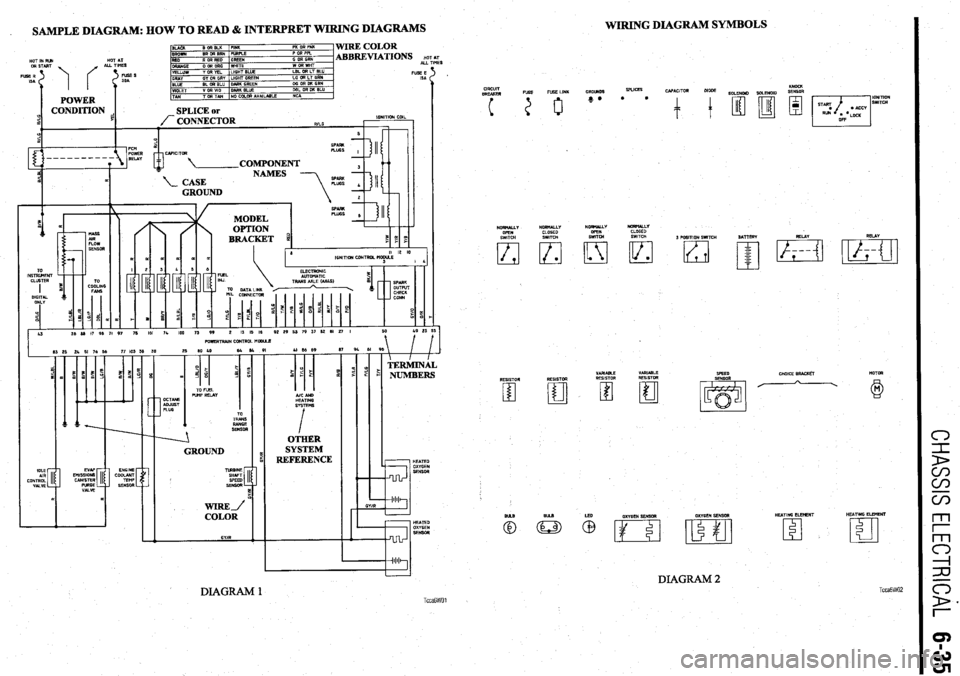
WIRING DIAGRAM SYMBOLS
. SAMPLE DIAGRAM: HOW TO READ & INTERPRET WIRING DIAGRAMS
c-l
1
D
m
m
WIRE COLOR
ABBREVIATIONS HO ALL TI’
TIM
FUSEE
ISA HOT IN RIM HOT AT r
ES
CIRCUIT
BREAKER
1 i ‘=iT KNOCK
SOLENOID SOLENOID SENSOR
3 POSITION SWITCH NORNALLY NORMALLY
NORHbUY
OPEN
SWITCH
El
RESISTOR
m NORMALLY
CLOSED
SWITCH
lzl l
RESISTOR
El SATTERY REIAY RELAY
WIWIZRTIWN CONTROL HODUsE
AICAND
HEATING
SYSTEMS
I
OTHER
SYSTEM
REFERENCE
CHOKE RRACKh MOTOR
VARIABLE VARIABLE
RESISTOR RESISTOR WEED
SENSOR
A
/
GROUND HEATED
IdI1
GYlR
m OXYGEN SENSOR HEATING ELEHENT HEATING ELEMENT
‘m
c3
DIAGRAM 2 TccaGW02 DIAGRAM 1 TccaGWOl
Page 239 of 408
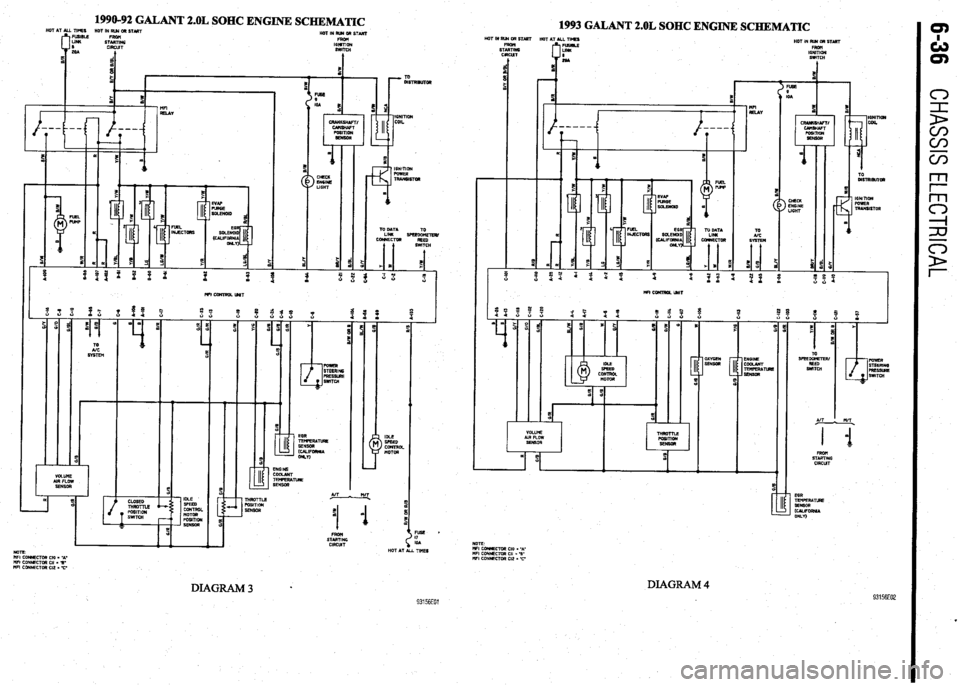
1990-92 GALANT 2.OL SOHC ENGINE SCHEMATIC
1993 GALANT 2.OL SOHC ENGINE SCHEMATIC HOT IN RIB aR START
STEki
CIRCUT HOTINRWORSTART
FROH
16NlTlON
SWITCH
t HOT IN RUR OR STlRT
HOT AT ALL TIMES
HOT IN RU4 DR START
FRDtl
IGNITION
SWITCH
I EEE LIGHT
! a
s ;
--
T m
> CHECK
EN6lNE
LIGHT
%
i E IGNITION
PDWER
4 ’
TRANSISTOR
D
4
&Rl,DR
s
ICNlTlOK
FUWER
TRARSlSTOR
m
TO OATA
LINK SPEED&TEfl/
CONRECTM
REED
( !iWlTCH TO
UC
WI CWJTROL UNIT
IDLE
> SFEED
CONTROL
MOTOR AIT
! n/T.
I 1 0
1
STEK
ClRCUT EGR
TEnFERA~
SENSOR
mLIFoRRlA
WLn
VOLUME
AIR FLOW
SENSOR
I
5
E
! %
FUSE *
I7
IOA
HOT AT ALL TIMES EGR
TEMFERATLRE
SERSDR
, (~~IFORR~A
ONLV) An L MT
.
B m
11
STARTING
CIRCUT NOTE
I’IFI CORRECTOR Cl0 = -A-
WI coRNEcmR CII - 3’
“FI CONNECTOR Cl2 I 77
DIAGRAM 4 93156E02
NOlE
MFI CCMECTOR Cl0 = ‘A-
WI CONNECTOR Cl, = %’
WI CDNNECTOR Cl2 = C
DIAGRAM3 l 93156EOl
Page 241 of 408
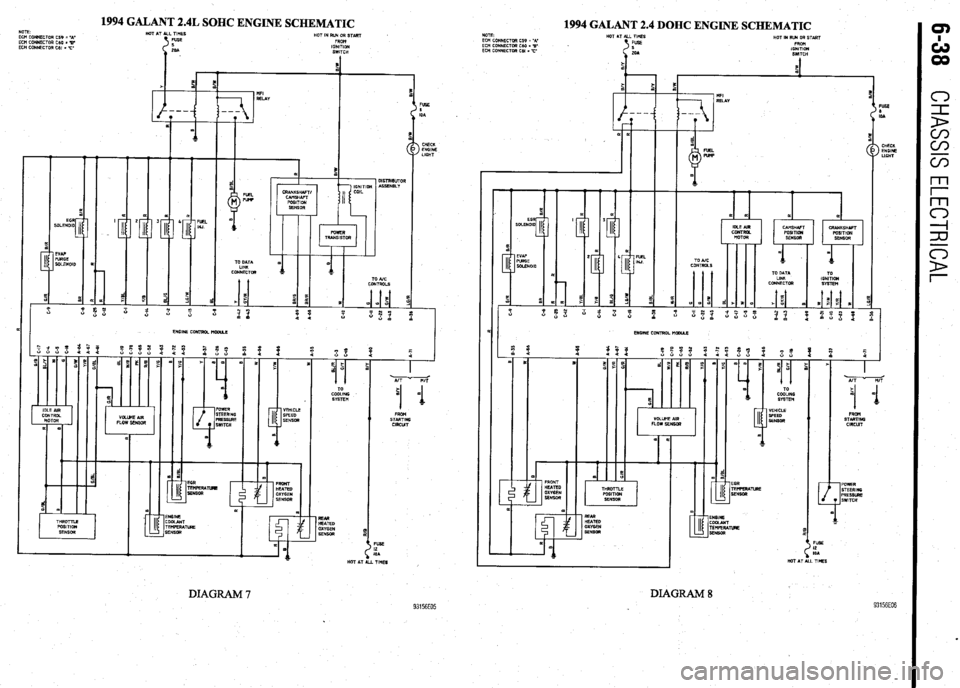
1994 GALANT 2.4L SOHC ENGINE SCHEMATIC
1994 GALANT 2.4 DOHC ENGINE SCHEMATIC NOTE
ECM CONNECTOR CS9 = ‘A’
ECH CONNECTOR C60 = B
ECH CONNECTOR Cti, = -I’ NOTE
ECH CONNECTOR C59 = ‘A-
ECH CONNECTOR C60 = ‘B
ECH CONNECTOR CM = -17 HOT AT ALL Tl?lES
FUSE
s
20A
s HQt IN RUN OR START
FRQ+l
IGNITION
SWITCH *
ON
:li IGI
SI
FVSE
0
IOA
> CHECK
ENGINE
LIGHT CHECU
/ ENOM
LIGHT
-T-T FUEL Pup
TO DATA
LINU
CONNECTOR I
CRANKSHAFT/
CAMSHAFT
POSITION
SENSOR
PQW2R
TRANSISTOR
m
(D
A
a
=
TO AK
CONTROLS
ENGINE CONTROL WCCU.2
m FRONT
H2AT2D
OXYGEN
SENSOR TO
CDDLING
SYSTEM
VEHICLE
SPEED
SENSOR
f FROM
START1116
CIRCWT
EGR
TEllPERATuRE
SENSOR
93156E05
HOT AT !NSlNE
3OLANT
rEMPERATu3E
ENSOR REAR
HEATED
OXYGEN
SENSOR REAR
HUTED
OXYGEN
SENSOA
TIM!3 vJ* HOT AT ALL TlblES
DIAGRAM 7
. DIAGRAM 8
Page 244 of 408
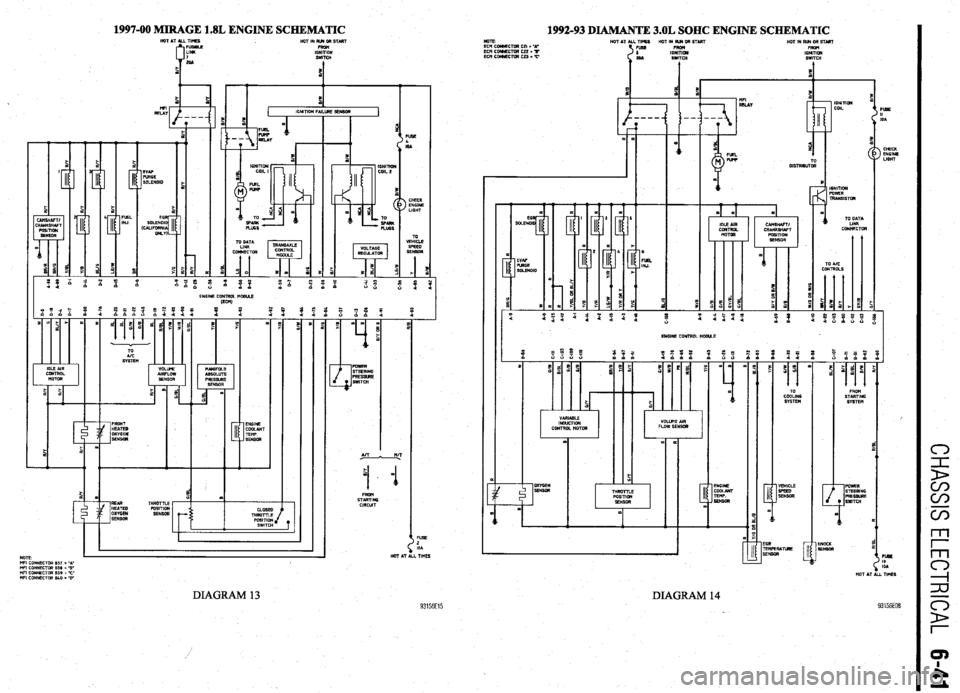
1997-00 MIRAGE 1.8L ENGINE SCHEMATIC
1992-93 DIAMANTE 3.OL SOHC ENGINE SCHEMATIC NOTE
HOT AT ML TIHGS
HOT IN R&S4 OR STbRT
HOT IM RUN OR START
ECM CGNNECTOR CZI = ‘4.
FUSS FROn
ECM COmECTOR CL2 = w
I IGNITIW
Et24 COtWECTOR CZ3 = ‘IT
zG4 SWITCH FROM
IGNlnON
SWITCH
4 HOT AT UL TIMES
HOT IN RiN GR START
FUSIRLE
FRW
LINK
IGNITION
:04 SWITCH
5
1
IGHlnON FAiLUlE SENSOR
FUSE
b
IO4
CHECK
ENGINE
LIGHT
TO
VEHICLG
ENGINE CONTROL MO4M.E
IECH)
II
ENGINE CONTROL MWUE
, 1 TO
COOLING
SYSTlw4
EGR
TEHFRR4TLtGE
SENSOR 1 POWER
STEERIMG
cI>
72
D
cn
c&n
.-
CD NT A NIT
.
5 (I)
I 4 FROM
STARTING
CIRCUT
HOT AT F!u3swE SWITCH
KNOCK
SENM
FLsC
I9
104 POSITION 6
SWITCH
FL&G
2
IOA
TIMES
hl
c3
-i
zu MFI CONNECTOR 8.37 = ‘4.
MFI CONNECTOR 811 - 3’
Hfl CONNECTOR 6.59 = ‘C’
WI CONNECTOR Sk0 g ‘D-
93156E15 DIAGRAM 13
DIAGRAM 14