fuse MITSUBISHI DIAMANTE 1900 Owner's Guide
[x] Cancel search | Manufacturer: MITSUBISHI, Model Year: 1900, Model line: DIAMANTE, Model: MITSUBISHI DIAMANTE 1900Pages: 408, PDF Size: 71.03 MB
Page 266 of 408
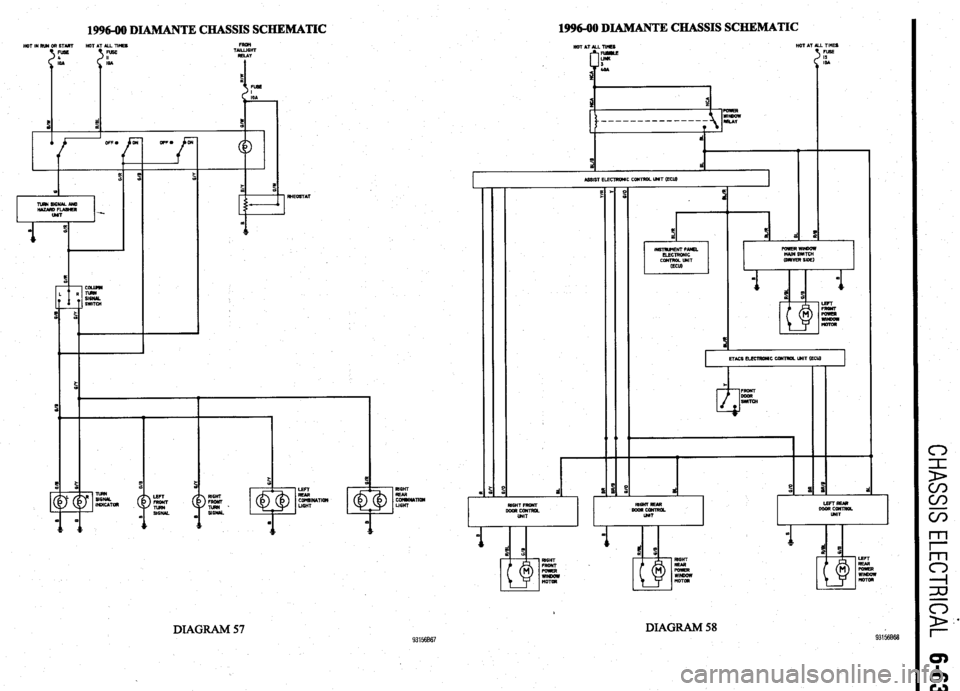
199640 DIAMANTE CHASSIS SCHEMATIC 199640 DIiUW.ANTE CHASSIS SCHEMATIC H6TINRlN6RSTM MT AT ML TIMES
FIB6 FUSE T AK&T
A II RELAY
WA WA
TlmNslcNuAm
-- -..- UNIT
ii
f ii:
r 1 L 1 RllmsTAl
I FHERWlW6W
MAIN SWITCH
CMIVER SIDE)
I
;
I RIGHT fMNT
I I Rl6H-r RUR
wcwc6NTna WORCDWTROL
WT WlT
P
DIAGRAM 58 93156868 DIAGRAM 57 93156B67
Page 268 of 408
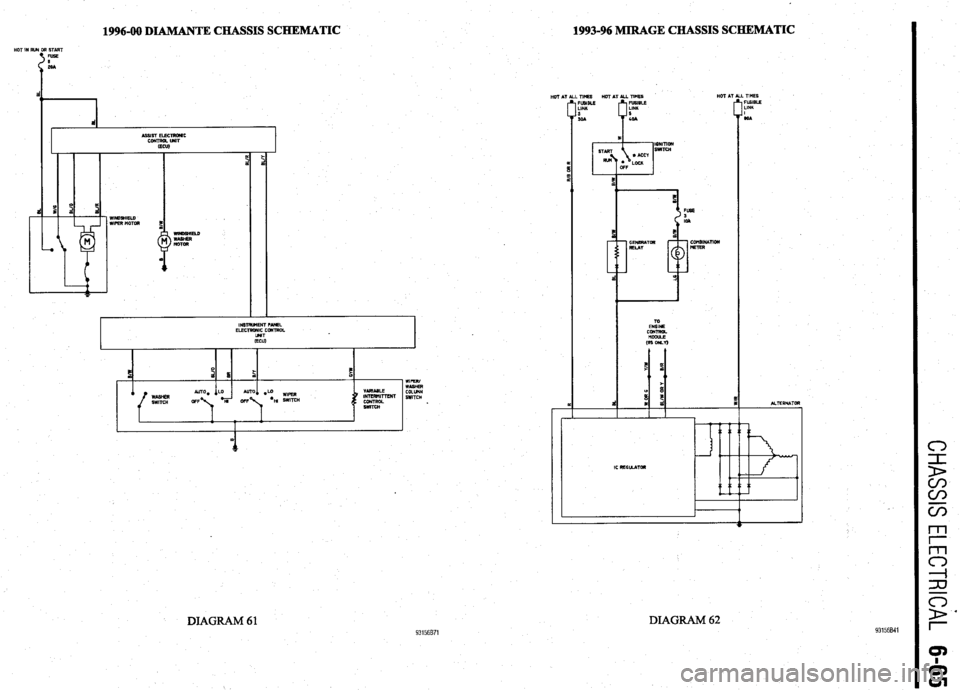
1996-00 DIAMANT E CHASSIS SCHEMATIC 1993-96 MIRAGE CHASSIS SCHEMATIC
ASSIST ELECTRONIC
CONTROL WIT
omJl
WINDEHIELO
WIRER MOTolr
:
INsTRunENT FANEL
ELECTRONIC CONlROL
UNIT
(ECU)
I I
h t
- WIPER/
WASHER
MO, &LO AmOb *LO mPER VARIASLE
COLUMN
INTERtllTTENT
CFF -H1 OfF %I SWITCH 3WlTCH
DIAGRAM 61 93156B71
HOT AT
[ TlnEs HOT AT ALL TIMES HOT Al
FUSlBLE
P FUSISLE
LINK LINU
:oA 5
MA
IGNITION
SWlTCH
,
FUSE
3
ID1
l
s
-- GENERATOR -- CWSlNATtffl
RELAY METER
I
TO
ENOINE
CONTROL TIMES
FUSISLE
LINK
I,
DIAGRAM 62 93156841
Page 271 of 408
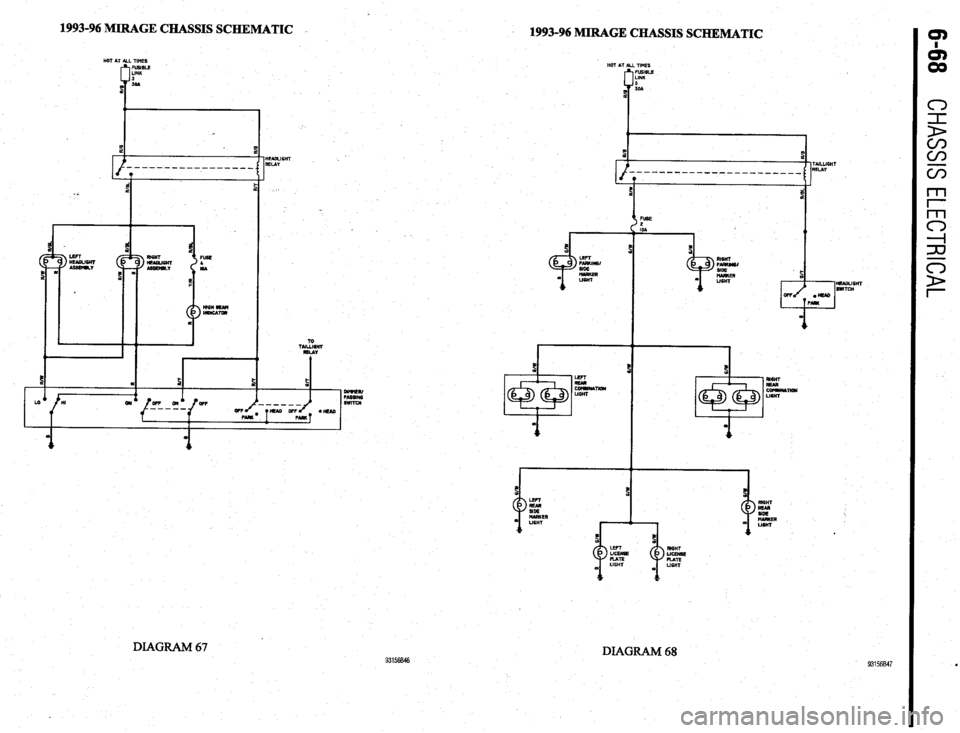
1993-96 MIRAGE CHASSIS SCHEMATIC
1993-96 MIRAGE CHASSIS SCHEMATIC
HOT AT ALL nm3
i-7 FUSIBLE
LINK HOT &T IIMES
lmsLE
INK
OA ALL’
:
3
E 3
F i
, -.
c
5
I
I
L
C 4 TAILUGHT
RELAY
---------~------------
FUSE
2
loA
5
7 m RIGNT
PMKWCI
SiIER
LIGHT
93156847
RIGHT
Eiz
NARKER
uGHT
1 MARKER
P
UGHT
DIAGlU’dM 67
DIAGRAM 68
Page 272 of 408
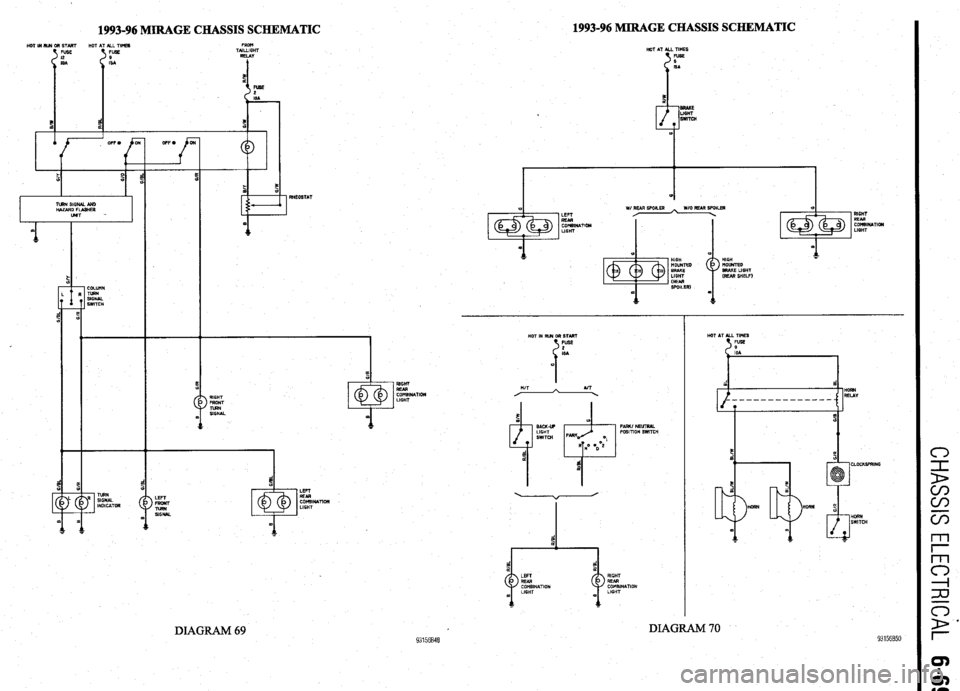
1993-96 MIRAGE CHASSIS SCHEMATIC 1993-96 MIRAGE CHASSIS SCHEMATIC
TURN SIGNAL AND
HAZARD FIASHER
WIT -
COLIJNN
TWN
SIGNAL
SWITCH OFF. 0
c
LEFT
REAR
CDMSINA
LIGHT
HIGH
NOWTED
BRAKE LIGHT
RBAR SHELF)
HOT IN Ruw OR START
FUSE
e
IQ*
> MGWT
FRONT
2LL
SIGNAL LEFT
REAR
COtlBINATlDN
LIGHT
DIAGRAM 69
RIGHT
Zh~T10t4
LIGHT
PARK/ NEUTRAL
POSITION SWITCH RIGHT
REAR
COtlBIKATlQN
UGHT
HOT AT Ml. TIMES
RIGHT
REAR
COHSINATION
LIGHT
DIAGRAM 70 93156850
CI)
72
D
cn
m
cn
Page 274 of 408
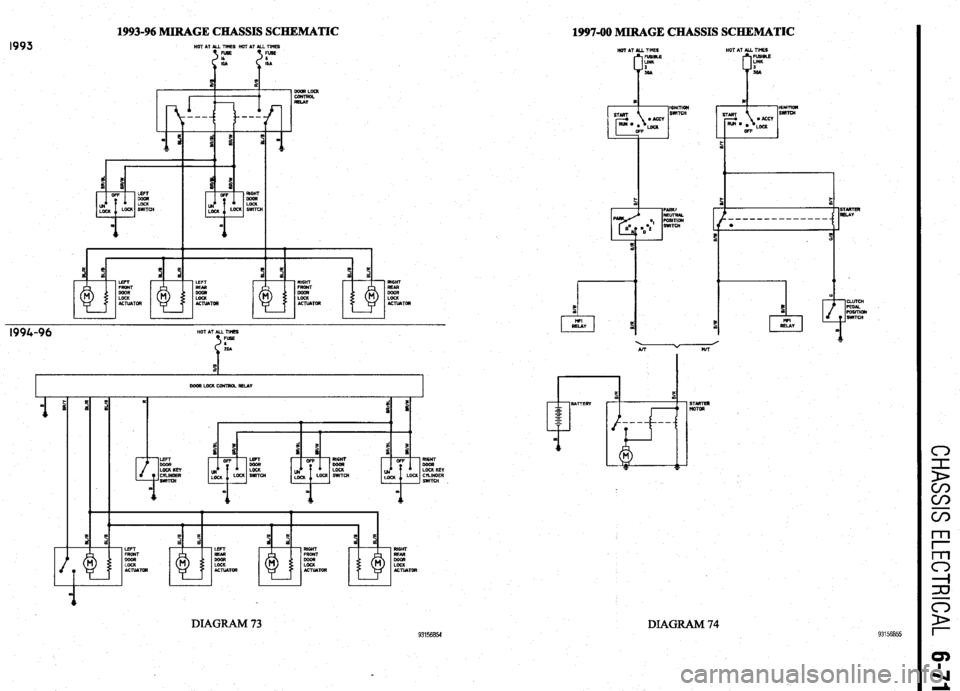
1993-96 MIRAGE CHASSIS SCHEMATIC
1997-00 MIRAGE CHASSIS SCHEMATIC HOT AT ALL TIHEE HOT AT ALL TIMES
LEFT - , RIGHT
FRONT
DOOR
LOCK
ACTUATOR
1994-96 HOT AT ALL TIMES
FUSE
1)
ZOA
1 1 I
r! c
d ii
-- LEFT LEFT ’ RIGHT I
FRW
OOUR Ez zr
kt%ATlm LOCK LOCK
ACTUATOR KTWTOR
DIAGRAM 73
HOT AT N.L TIMES HOT AT ALL TlIlES
FusmlE FUSIBLE
LIRK LINK
s
SOA LA
z 1
‘ISNITIQII ICNITIOW
SWITCH SWITCH
RIWT
iii%
LOCK
ACTUATOR
93156954 DIAGRAM 74 93156855
Page 277 of 408
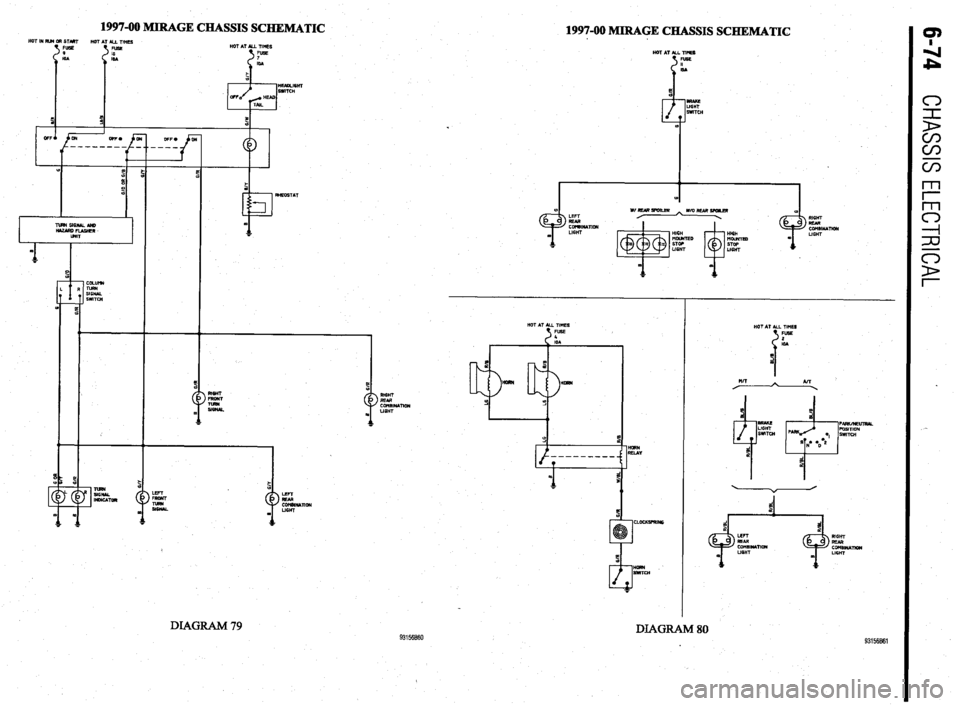
1997-00 MIRAGE CHASSIS SCHEMATIC
1997-00 MIRAGE CHASSIS SCIfEWTIC
$
RIGHT
FRONT RIGHT
EL IE&4ATllm
UGHT
)ET
TmN
SIGNAL
RIGHT
ZiilNAT,ON
LIGHT
HOT AT AU TMES
34 FUSE
RIGHT
REAR
CONEINATIQII
LIGHT
DIAGRAM 79
DIAGRAM 80
Page 278 of 408
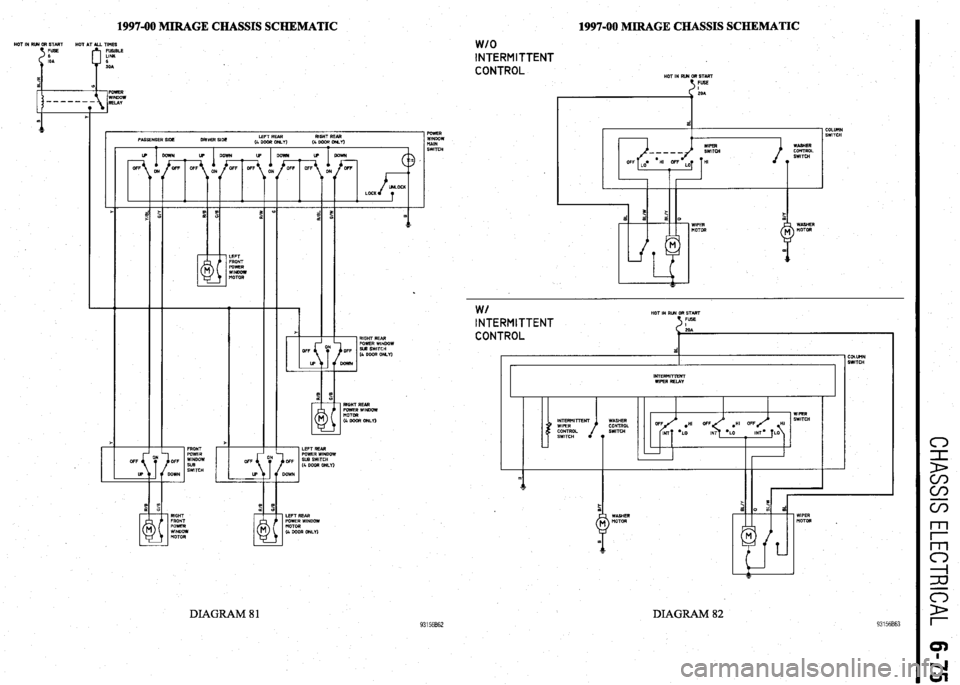
1997-00 MIRAGE CHASSIS SCHEMATIC HOT IN RR4 OR STMT
HOT AT ALL TIMES
FUSIBLE
LINK
6
SOA 1997-00 MIRAGE CHASSIS SCHEMATIC
1 POWER
WINDOW
tiAlN
SWITCH
w/o INTERMITTENT
CONTROL
HOT IN RUN OR START
t FUSE
COLUllN
SWITCH
LEFT REAR RIGHT REAR
4 DOOR or&Y)
(4WWOM.I)
I .
F ?E
d d a 0
WIPER WASHER
MOTOR MOTOR
.
93156862
W/ HOT IN RUN GR START INTERMITTENT FUSE 5
CONTROL
d COLUtlN
SWITCH
I r INTERMITTENT
WIPER RELAY
I I
WIPER
WASHER SWITCH
CONTROL .HI OFF HI
SWITCH
*LO MT= LO
T
1
LEFT REAR
POWER WINDOW
MOTOR
(4 GOOR ONLY) RIGHT
FRONT
POWER
WINDOW
MOTOR WIPER
MOTOR .
DIAGRAM 82 DIAGRAM 81
Page 279 of 408
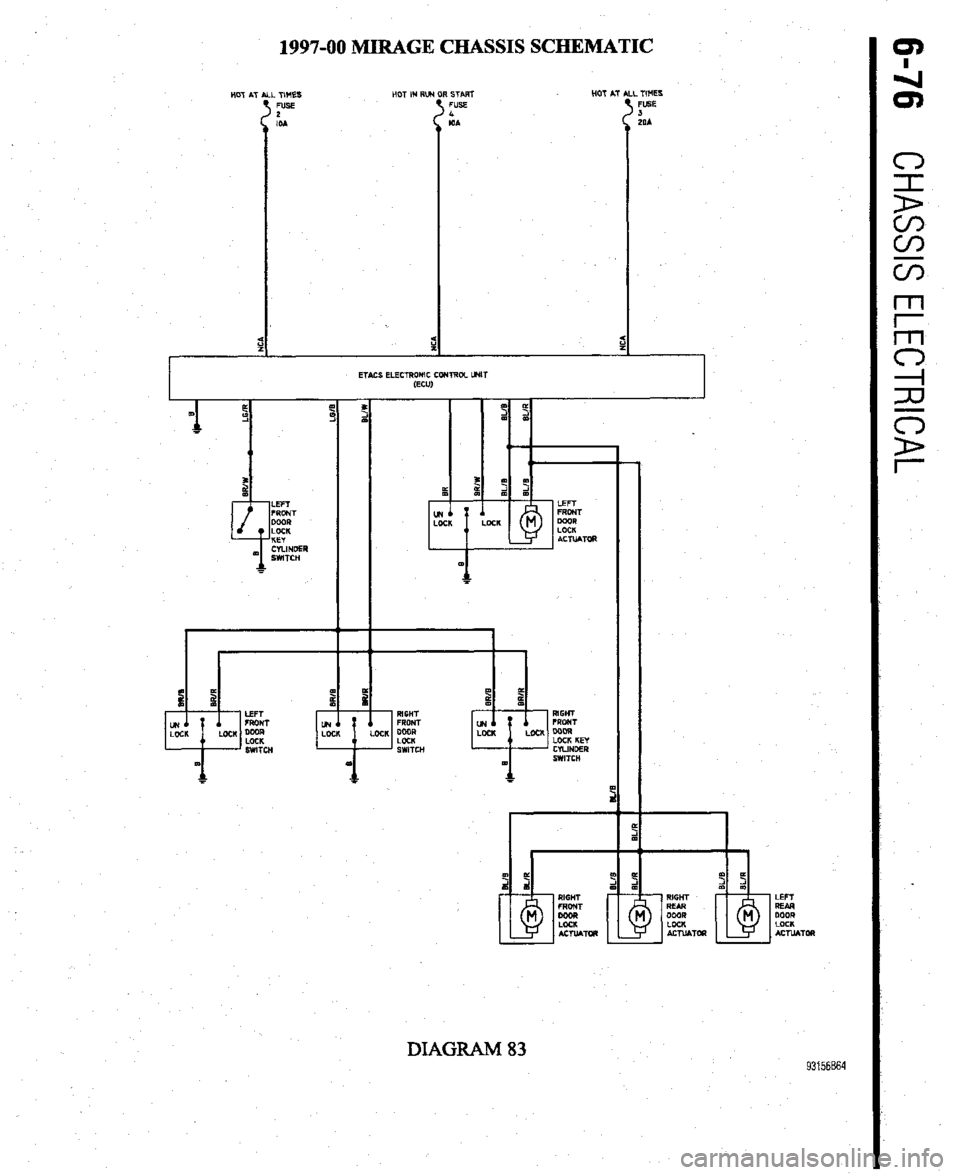
1997-00 MIRAGE CHASSIS SCHEMATIC
START HOT AT
FUSE
I
IOA
ETACS ELECTRONIC CCMROL
(ECU1 _ TIMES
FUSE
J
LOA
DIAGRAM 83 93156B64
Page 338 of 408
9-2 BRAKES
Hydraulic systems are used to actuate the brakes
of all modern automobiles. The system transports the
power required to force the frictional surfaces of the
braking system together from the pedal to the indi-
vidual brake units at each wheel. A hydraulic system
is used for two reasons.
First, fluid under pressure can be carried to all
parts of an automobile by small pipes and flexible
hoses without taking up a significant amount of room
or posing routing problems.
Second, a great mechanical advantage can be
given to the brake pedal end of the system, and the
foot pressure required to actuate the brakes can be
reduced by making the surface area of the master
cylinder pistons smaller than that of any of the pis-
tons in the wheel cylinders or calipers.
The master cylinder consists of a fluid reservoir
along with a double cylinder and piston assembly.
Double type master cylinders are designed to sepa-
rate the front and rear braking systems hydraulically
in case of a leak. The master cylinder converts me-
chanical motion from the pedal into hydraulic pres-
sure within the lines. This pressure is translated back
into mechanical motion at the wheels by either the
wheel cylinder (drum brakes) or the caliper (disc
brakes).
Steel lines carry the brake fluid to a point on the
vehicle’s frame near each of the vehicle’s wheels. The
fluid is then carried to the calipers and wheel cylin-
ders by flexible tubes in order to allow for suspen-
sion and steering movements.
In drum brake systems, each wheel cylinder con-
tains two pistons, one at either end, which push out-
ward in opposite directions and force the brake shoe
into contact with the drum.
In disc brake systems, the cylinders are part of the
calipers. At least one cylinder in each caliper is used
to force the brake pads against the disc.
All pistons employ some type of seal, usually
made of rubber, to minimize fluid leakage. A rubber
dust boot seals the outer end of the cylinder against
dust and dirt. The boot fits around the outer end of
the piston on disc brake calipers, and around the
brake actuating rod on wheel cylinders.
The hydraulic system operates as follows: When at
rest, the entire system, from the piston(s) in the mas-
ter cylinder to those in the wheel cylinders or
calipers, is full of brake fluid. Upon application of the
brake pedal, fluid trapped in front of the master cylin-
der piston(s) is forced through the lines to the wheel
cylinders. Here, it forces the pistons outward, in the
case of drum brakes, and inward toward the disc, in
the case of disc brakes. The motion of the pistons is
opposed by return springs mounted outside the
cylinders in drum brakes, and by spring seals, in disc
brakes.
Upon release of the brake pedal, a spring located
inside the master cylinder immediately returns the
master cylinder pistons to the normal position. The
pistons contain check valves and the master cylinder
I
has compensating ports drilled in it. These are un-
covered as the pistons reach their normal position.
The piston check valves allow fluid to flow toward the
wheel cylinders or calipers as the pistons withdraw.
Then, as the return springs force the brake pads or
shoes into the released position, the excess fluid
reservoir through the compensating ports. It is during the time the pedal is in the released position that any
fluid that has leaked out of the system will be re-
placed through the compensating ports.
Dual circuit master cylinders employ two pistons,
located one behind the other, in the same cylinder.
The primary piston is actuated directly by mechanical
linkage from the brake pedal through the power
booster. The secondary piston is actuated by fluid
trapped between the two pistons. If a leak develops in
front of the secondary piston, it moves forward until it
bottoms against the front of the master cylinder, and
the fluid trapped between the pistons will operate the
rear brakes. If the rear brakes develop a leak, the pri-
mary piston will move forward until direct contact
with the secondary piston takes place, and it will
force the secondary piston to actuate the front brakes.
In either case, the brake pedal moves farther when the
brakes are applied, and less braking power is avail-
able.
All dual circuit systems use a switch to warn the
driver when only half of the brake system is opera-
tional. This switch is usually located in a valve body
which is mounted on the firewall or the frame below
the master cylinder. A hydraulic piston receives pres-
sure from both circuits, each circuits pressure being
applied to one end of the piston. When the pressures
are in balance, the piston remains stationary. When
one circuit has a leak, however, the greater pressure
in that circuit during application of the brakes will
push the piston to one side, closing the switch and
activating the brake warning light.
In disc brake systems, this valve body also con-
tains a metering valve and, in some cases, a propor-
tioning valve. The metering valve keeps pressure
from traveling to the disc brakes on the front wheels
until the brake shoes on the rear wheels have con-
tacted the drums, ensuring that the front brakes will
never be used alone. The proportioning valve con-
trols the pressure to the rear brakes to lessen the
chance of rear wheel lock-up during very hard brak-
ing.
Warning lights may be tested by depressing the
brake pedal and holding it while opening one of the
wheel cylinder bleeder screws. If this does not cause
the light to go on, substitute a new lamp, make conti-
nuity checks, and, finally, replace the switch as nec-
essary.
The hydraulic system may
be checked for leaks by applying pressure to the pedal gradually and steadily.
If the pedal sinks very slowly to the floor, the system
has a leak. This is not to be confused with a springy
or spongy feel due to the compression of air within
the lines. If the system leaks, there will be a gradual
change in the position of the pedal with a constant
pressure.
Check for leaks along all lines and at wheel cylin-
ders. If no external leaks are apparent, the problem is
inside the master cylinder,
DISC BRAKES
Instead of the traditional expanding brakes that
press outward against a circular drum, disc brake
systems utilize a disc (rotor) with brake pads posi-
tioned on either side of it. An easily-seen analogy is
the hand brake arrangement on a bicycle. The pads
squeeze onto the rim of the bike wheel, slowing its
motion. Automobile disc brakes use the identical principle but apply the braking effort to a separate
disc instead of the wheel.
The disc (rotor) is a casting, usually equipped with
cooling fins between the two braking surfaces. This
enables air to circulate between the braking surfaces
making them less sensitive to heat buildup and more
resistant to fade. Dirt and water do not drastically af-
fect braking action since contaminants are thrown off
by the centrifugal action of the rotor or scraped off
the by the pads. Also, the equal clamping action of
the two brake pads tends to ensure uniform, straight
line stops. Disc brakes are inherently self-adjusting.
There are three general types of disc brake:
1. A fixed caliper.
2. A floating caliper.
3. A sliding caliper.
The fixed caliper design uses two pistons
mounted on either side of the rotor (in each side of
the caliper). The caliper is mounted rigidly and does
not move.
The sliding and floating designs are quite similar.
In fact, these two types are often lumped together. In
both designs, the pad on the inside of the rotor is
moved into contact with the rotor by hydraulic force.
The caliper, which is not held in a fixed position,
moves slightly, bringing the outside pad into contact
with the rotor. There are various methods of attaching
floating calipers. Some pivot at the bottom or top,
and some slide on mounting bolts. In any event, the
end result is the same.
DRUM BRAKES
Drum brakes employ two brake shoes mounted on
a stationary backing plate. These shoes are posi-
tioned inside a circular drum which rotates with the
wheel assembly. The shoes are held in place by
springs. This allows them to slide toward the drums
(when they are applied) while keeping the linings and
drums in alignment. The shoes are actuated by a
wheel cylinder which is mounted at the top of the
backing plate. When the brakes are applied, hydraulic
pressure forces the wheel cylinder’s actuating links
outward. Since these links bear directly against the
top of the brake shoes, the tops of the shoes are then
forced against the inner side of the drum. This action
forces the bottoms of the two shoes to contact the
brake drum by rotating the entire assembly slightly
(known as servo action). When pressure within the
wheel cylinder is relaxed, return springs pull the
shoes back away from the drum.
Most modern drum brakes are designed to self-
adjust themselves during application when the vehi-
cle is moving in reverse. This motion causes both
shoes to rotate very slightly with the drum, rocking
an adjusting lever, thereby causing rotation of the ad-
justing screw. Some drum brake systems are de-
signed to self-adjust during application whenever the
brakes are applied. This on-board adjustment system
reduces the need for maintenance adjustments and
keeps both the brake function and pedal feel satisfac-
tory.
POWER BOOSTERS
Virtually all modern vehicles use a vacuum as-
sisted power brake system to multiply the braking
force and reduce pedal effort. Since vacuum is always
available when the engine is operating, the system is
Page 387 of 408
.
TROUBLESHOOTING II-5
Condition Section/Item Number
One brake light inoperative
Both brake lights inoperative
One or both brake lights very dim 5-D, 1
5-D, 2
5-D, 3
Ignition, Battery and Alternator Warning Lights, Check Engine
Light, Anti-Lock Braking System (ABS) Light, Brake Warning
Light, Oil Pressure Warning Light, and Parking Brake Warning
Light
Warning light(s) remains on after the engine is started
Warning light(s) flickers on and off when driving
Warning light(s) inoperative with ignition on, and engine not started 5-E, 1
5-E, 2
5-E, 3
Turn signals or hazard lights come on, but do not flash
Turn signals or hazard lights do not function on either side
Turn signals or hazard lights only work on one side
One signal light does not work
Turn signals flash too slowly
Turn signals flash too fast
Four-way hazard flasher indicator light inoperative
Turn signal indicator light(s) do not work in either direction
One turn signal indicator light does not work 5-F, 1
5-F, 2
5-F, 3
5-F, 4
5-F, 5
5-F, 6
5-F, 7
5-F, 8
5-F, 9
Horn does not operate
Horn has an unusual tone 5-G, 1
5-G, 2
Windshield wipers do not operate
Windshield wiper motor makes a humming noise, gets hot or blows fuses
Windshield wiper motor operates but one or both wipers fail to move
Windshield wipers will not park 5-H, 1
5-H, 2
5-H, 3
5-H, 4
Speedometer does not work
Speedometer needle fluctuates when driving at steady speeds
Speedometer works intermittently 6-A, 1
6-A, 2
6-A, 3
Speedometer does not work
Speedometer works intermittently 6-B, 1
6-B, 2
Gauge does not register 6-C 1
Gauge operates erratically 6-C 2
’
Gauge operates fully pegged 6-C 3
No air coming from air conditioner vents 7-A, 1
Air conditioner blows warm air ’ 7-A, 2
Water collects on the interior floor when the air conditioner is used
Air conditioner has a moldy odor when used 7-A, 3
7-A, 4
Blower motor does not operate
Heater blows cool air
Heater steams the windshield when used 7-B, 1
7-B, 2
7-B, 3